


Abstract
Numerous approaches have attempted to develop systems that more appropriately manage street crossings in cities in recent years. Solutions range from intelligent traffic lights to complex, centralized protocols that evaluate the policies that vehicles must comply with at intersections. Such works attempt to provide traffic-control strategies at intersections where the complexity of a dynamic environment, with vehicles crossing in different directions and multiple conflict points, pose a significant challenge for city traffic optimization. Traditionally, a traffic-control system at an intersection gives the green light to one lane while keeping the other lanes on red. But there may be situations in which there are different levels of vehicle priority; for example, emergency vehicles may have priority at intersections. Thus, this work proposes a distributed junction-management protocol that pays special attention to emergency vehicles. The proposed algorithm implements rules based on the distributed intersection management (DIM) protocol; such rules are used by vehicles while negotiating their crossing through the intersection. The proposal also seeks to affect the traffic flow of non-priority vehicles minimally. An evaluation and comparison of the proposed algorithm are presented in the paper.
1. Introduction
Currently, research on autonomous transportation systems has been significantly influenced by the complexity associated with the communication and interaction between vehicles and infrastructure or between the vehicles themselves [1]. Autonomous transportation systems must integrate communication capabilities to improve safety on the road while fulfilling all the necessary safety conditions. If a vehicle does not meet these safety conditions, the control of the implemented system must act to avoid a potential collision. This problem is particularly relevant in the case of intersections, which are very frequent in urban areas. Numerous issues remain open, for which solutions based on intelligent algorithms are proposed to improve the decision-making process of vehicles at intersections.
In addition to safety, research in transportation systems has also focused on other objectives such as optimizing vehicle flow and travel time [2], as well as improving sustainability and reducing pollution in cities. All these aspects are taken into account for the validation of the type of road infrastructures available in each city as well as to be able to propose alternatives.
Vehicle-to-vehicle communication [3,4] facilitates coordination in order to optimize the above-mentioned aspects. In recent years, numerous studies have explored ways to provide autonomous vehicles with a certain degree of coordination. This is especially relevant when crossing an intersection because this is one of the most critical situations that require the necessary collaboration of vehicles circulating on different intersecting roads. Along these lines, there are different works such as [5,6,7,8,9,10].
When analyzing the different existing proposals, we see that most of them focus on offering centralized solutions for the decision-making process. However, some decentralized solutions can be found that provide an ad-hoc network among vehicles arriving at an intersection. These solutions provide a collaborative decision-making process to improve the flow at the intersection, avoiding the introduction of centralized infrastructures that can be a bottleneck in the execution of the system. In [11], we presented a proposal in which a set of crossing rules are proposed for the coordination of autonomous vehicles at intersections. In this way, collaborative behavior emerges as soon as vehicles follow the established rules.
An essential aspect of this type of system is the possibility of prioritizing certain vehicles at intersections. This may be the case for emergency vehicles in cities, such as ambulances, fire trucks, or police cars. Along these lines, there are previous works that try to optimize the routes of these vehicles in the city [12,13]. In addition, some approaches have attempted to facilitate the flow of emergency vehicles at intersections in front of other types of vehicles. The analysis of these works can be seen in the following section. However, most of these works provide proposals based on centralized solutions. In contrast to these centralized proposals, this paper proposes a distributed solution to the management of intersections with emergency vehicles based on a previous work presented in [14]. The main focus of this proposal is to develop a distributed coordination management system for autonomous vehicles at intersections, prioritizing the crossing of emergency vehicles. This coordination is designed with the main goal of minimizing the impact on the flow of non-priority vehicles. For the evaluation of the proposal, experimentation on the simulation of urban mobility (SUMO) simulator has been carried out to demonstrate the feasibility of the proposal.
The rest of this paper is structured as follows. Section 2 analyzes previous related works. Section 3 describes the proposed distributed intersection management model taking into account emergency vehicles. Section 4 presents several experiments to validate the proposed model. Finally, Section 5 includes some concluding remarks and proposes future research works.
2. Related Work
Over the last few years, several works have tried to optimize the flow of emergency vehicles at intersections. The management of emergency vehicles in the daily traffic of a city is a complex scenario, especially when the density of vehicles on the streets increases considerably. If this process is not adequately controlled, the travel time may be delayed when the emergency vehicle needs to cross an intersection with one or more conflicting roads. Even worse, this vehicle may be involved in a collision at the moment of crossing. Related to this issue, several papers have appeared to analyze how to integrate emergency vehicle management into autonomous vehicle traffic control. The basic idea of these proposals is to prioritize emergency vehicles over other vehicles.
In the literature, we can find different studies, such as [15,16,17,18], focused on reviewing approaches that deal with the intersection traffic signal control problem. We also find specific reviews of the problem of vehicle prioritization at intersections [19]. In most cases, the proposals consider the use of centralized solutions.
We can also find proposals focused on the prioritization of public transport to optimize their flow in the cities. In [20] the authors propose the integration of a bus signal priority strategy and pre-signal methods at the intersection to improve bus performance. Another example can be found in [21], which provides bus priority by using a dedicated bus lane together with an adaptive pre-signal control algorithm adapted to the demands of private and public transportation in real time. In the case of ambulances, ref. [22] proposes the use of an app that connects both the ambulance and the traffic signal station through a cloud network. In this way, when an ambulance arrives at an intersection, the green traffic signal is maintained to facilitate the crossing of the ambulance.
Apart from specific proposals for public transport, other approaches present algorithms that can be generalized to any vehicle that can acquire a priority status at an intersection. In the work presented in [23], it is shown how to integrate emergency vehicles in a vehicle flow simulator, taking into account the specific characteristics of this type of vehicle. The proposed emergency vehicle model is just a starting point for the simulation of emergency vehicles. This model has some limitations that cause the simulated travel times to be, in general, faster than in real scenarios. In [24], a strategy of prioritization of emergency vehicles is implemented in which higher priority is given to those streets where emergency vehicles circulate. The process behind this proposal consists of implementing a first-come, first-serve policy (FCFS) at an intersection by sending a request with a time-space reservation for crossing the intersection. Then, an intersection manager accepts or rejects the request, depending on previous requests from other vehicles. As stated above, the strategy is to prioritize the lanes where there are emergency vehicles. As a result, delays for emergency vehicles are lower than in standard vehicles, for which delays are excessive.
Another centralized approach can be seen in [25], which tries to prioritize emergency vehicles without causing long delays in other lanes. For this purpose, a fuzzy logic system is proposed to calculate the estimated time of the emergency vehicle arrival according to the traffic on the corresponding road. According to these parameters, the system can keep the traffic green light while the emergency vehicle arrives at the intersection for a long time. In the evaluations performed, the authors show fewer vehicle delays than in other traditional systems.
Similarly, in [26], the authors present a centralized strategy that takes into account the distance of the emergency vehicle to the intersection, as well as the arrival probability at the intersection. According to this information, this strategy changes the traffic lights by prioritizing the road in which an emergency vehicle is about to arrive at an intersection. This protocol does not consider emergency vehicles that are far from an intersection. This causes the system not to slow down the flow in roads with no emergency vehicles and makes a smooth transition to prioritize roads with emergency vehicles.
Another interesting work is presented in [27] where an approach based on the use of IoT devices is proposed for self-organized traffic control at intersections by taking into account emergency vehicles. In this proposal, an intersection control system obtains the positions of emergency vehicles as well as the vehicle density data in each lane. With this information, the control system adjusts the traffic lights at intersections. More specifically, the proposal consists of a centralized control system based on sensors located on the roads and a GPS installed in emergency vehicles. This centralized control coordinates the traffic lights at intersections, giving more crossing priority (green light) for those roads with a higher density of vehicles. This information is obtained by the sensors located in the streets. When an emergency vehicle arrives at an intersection, it sends a request directly to the centralized control. Then, this system estimates the distance and the arrival time at the intersection. The centralized control sends a message to the emergency vehicle to prioritize it and finally changes the corresponding traffic light to green. When the emergency vehicle crosses the intersection, it sends a message to the centralized control to reestablish the normal crossing process. The tests carried out show a better performance of this proposed algorithm compared to the traditional traffic light control system.
We can also find some approaches with a semi-centralized organization control system. In [28], the use of a low-cost physical infrastructure in lanes is proposed, which attempts to improve the traditional traffic light system. Different control systems of the proposed infrastructure can be interconnected by adjusting the traffic lights when an emergency vehicle is arriving at the intersection. Two devices are implemented to serve emergency vehicles. The first device is close to the traffic light, and the second one is between two intersections. The first device is responsible for processing whether there is an ambulance arriving at an intersection, knowing the current status of the other traffic light at the intersection (green or red), and giving priority with a green light on the route of the emergency vehicles. In addition, when there is a delay in the arrival of an emergency vehicle, this device is responsible for reprogramming the traffic lights with the regular sequence. The second device is a signal amplifier used when the signal cannot reach a long distance between intersections. This is a semi-centralized approach, as there are communications between several control systems. Although they propose priorities for managing emergency vehicles, this proposal also considers other lanes with regular vehicles. The simulations showed a time saving compared to the same simulation without using the algorithm.
In the literature, some self-organizing approaches can be found, such as the one presented in [29]. This proposal uses a protocol called VTL-PIC, by which a virtual traffic light manager changes traffic lights at intersections. The protocol considers several vehicles arriving at an intersection, and if there is a possible conflict, a leader vehicle is selected to manage the traffic at that intersection. Each vehicle sends a broadcast message indicating its position and speed in this approach. Therefore, each vehicle can build the local map and determine a possible conflicting path over the intersections. To manage priorities for the attention of emergency vehicles, two new rules are added to the VTL-PIC protocol. Emergency vehicles broadcast a message requesting the lead vehicle to prioritize the specific intersection. Once the emergency vehicle crosses the intersection, it sends a message to the leader, normalizing the traffic activity. In the proposal evaluation, the authors detect a waiting time reduction for the emergency vehicles because the VTL-PIC protocol generates green waves in all the intersections in which emergency vehicles are approaching.
An extension of this proposal can be found in [30], where authors add an RFID communication protocol. The difference between the previous proposal is that in the first proposal, the leader does not store the queues of the roads, but in the second proposal, the leader stores the queues generated at the traffic lights in order to evaluate if there are more emergency vehicles within those queues, which is what improves the response of the system.
In [31], the authors propose a centralized intersection control system based on multi-agent systems. The proposal consists of two types of agents, one that is installed in each vehicle and is called the driver agent. This agent is in charge of sending a request message for asking for a space at the intersection. The other agent, called the intersection manager agent, is the one who receives the message from each vehicle and accepts or rejects the crossing requests. The proposed algorithm is based on slot reservations at intersections, and whenever there are several requests, the attention mode is managed as a queue, where the first one to ask for the request is the first one to be attended. It is important to note that after crossing an intersection, all driver agents send a message to the intersection manager in order to inform that the intersection is released. Regarding emergency vehicles, requests from these vehicles are considered as special requests that are prioritized. This approach does not consider situations in which several emergency vehicles arrive at the intersection simultaneously.
As can be seen, we have analyzed several proposals for the prioritization of emergency vehicles at intersections. However, most of these proposals are based on centralized strategies where a failure of the intersection manager can lead to the complete collapse of the intersection and, therefore, the paralysis of vehicles that want to cross. In addition, the scalability of these systems is limited. Moreover, most of the proposals prioritize the roads where there are emergency vehicles, which in a certain way slows down the rest of the vehicles. This aspect can be controlled in a more egalitarian manner if the intersections are managed in a distributed way.
In this sense, the following section presents a proposal for a distributed model of intersection coordination that considers the priority for emergency vehicles by influencing the rest of the vehicles as little as possible. This proposal is similar to other analyzed works because it proposes an algorithm that prioritizes the road where an emergency vehicle circulates. However, it differs from most proposals by adopting a distributed solution, which facilitates the system’s scalability. Furthermore, in line with other proposals, it eliminates the need for traffic lights, although the coordination is done by adjusting the priorities to avoid blocking situations for non-priority roads.
3. Emergency Vehicles Model
In this section, we present the coordination model for emergency vehicles. This model is based on the distributed intersection management (DIM) model [32], which provides autonomous vehicles with the capacity to negotiate and manage crossings at intersections. A dynamic model is required to represent the behavior of vehicles, including their trajectories and their relationship to the rest of the vehicles.
The DIM model is composed of three parts: the traffic flow model, the autonomous vehicle model, and behavioral roles. The traffic flow model is based on the Lárraga-Álvarez-Icaza [33] (LAI) model for large traffic networks simulation. LAI is a model for traffic flow that is able to represent the vehicles’ reactions in real scenarios. This model allows the definition of the individual characteristics of vehicles as well as the specific constraints that regulate the acceleration of vehicles to maintain safe distances among vehicles. This is defined by a decision-making process that simulates a two-lane traffic flow. We should note that we assume only two lines conflict at each intersection. In summary, this model defines the following rules for guaranteeing safe driving and avoiding collisions between vehicles:
- A vehicle can accelerate as long as exists a distance between this vehicle and the vehicle that comes before .
- A vehicle keeps its velocity as long as exists a distance between this vehicle and the vehicle that comes before .
- A vehicle has to decrease its velocity if exists a distance between this vehicle and the vehicle that comes before .
The DIM model incorporates the above rules in order to describe the dynamics of the vehicles moving in the same lane.
Autonomous vehicles are represented as a group of agents moving through the streets of a city. Each vehicle includes sensors to detect other vehicles inside an area. Each vehicle is also provided with a wireless communication system to send messages and request information from other vehicles. To represent this, each vehicle defines two different radii. On the one hand, the perception radius defines an area for detecting other vehicles. On the other hand, the communication radius defines an area for sending messages to other vehicles located inside this area. Taking into account this model, autonomous vehicles are able to negotiate their crossing without the help of devices like traffic lights, sensors, or traffic infrastructure.
Finally, an autonomous vehicle can play two different roles: follower (F) and negotiator (N). These roles define the specific behavior of each vehicle. On the one hand, the follower role is played by autonomous vehicles moving just behind another vehicle. At the beginning of the execution, this role is associated with each autonomous vehicle. On the other hand, the negotiator role is played by autonomous vehicles that do not detect other vehicles inside their communication areas and arrive at an intersection.
In Algorithm 1 we can observe the coordination algorithm for intersection crossings. This algorithm determines which autonomous vehicle should cross an intersection when a conflict with other vehicles occurs.
| Algorithm 1 Coordination intersection crossing |
|
In this model, vehicles manage the crossing process by considering the proximity to the intersection and the vehicle priority. If the density increases, vehicles start an initial negotiation, and the stopped vehicle generates a queue. When this queue exceeds a predefined threshold, the negotiator vehicle interacts with the other conflicting lane in order to report that a convoy of vehicles is waiting to cross. At that point, this convoy will eventually cross. According to this, the decongestion of the road is adapted to the queues of the vehicles waiting to cross an intersection. Because this is related to the density of vehicles in that specific lane, the decongestion process is adaptable to the specific density.
Emergency Vehicles
An emergency vehicle is defined as an autonomous vehicle that plays an emergency role (E). This roles gives the emergency vehicle the priority for crossing an intersection over the rest of vehicles unless other vehicles are already crossing the intersection in a conflicting way.
The negotiation protocol starts by sending a broadcast message which is received by the vehicles located inside its communication radius . According to this, different situations can occur:
- Vehicle does not receive any response to its broadcast message. Then, the intersection is not blocked and is able to cross the intersection.
- Other vehicles are already crossing the intersection in a conflicting way and the vehicle that is playing the negotiator role is able to stop before arriving at the intersection. In this case, reduces the velocity until stopping at the intersection, remaining stopped until crosses the intersection.
- Other vehicles are already waiting to cross the intersection in the same line than . In this case, the vehicle that is playing the negotiator role broadcasts a message in order to stop the traffic in the conflicting way.
- Two emergency vehicles arrive at the same time at the intersection, each one in a different conflicting way; therefore:
- 1.
- If there are not any other vehicles already waiting at the intersection, then both emergency vehicles take the same behavior of a negotiator role.
- 2.
- If there are other vehicles waiting in the intersection, they follow the default behavior of a negotiator role until one of the emergency vehicles crosses the intersection.
It must be noted that emergency vehicles are only considered when they are inside the specified radius. Therefore, the flow of the global traffic system is not influenced by emergency vehicles.
4. Results
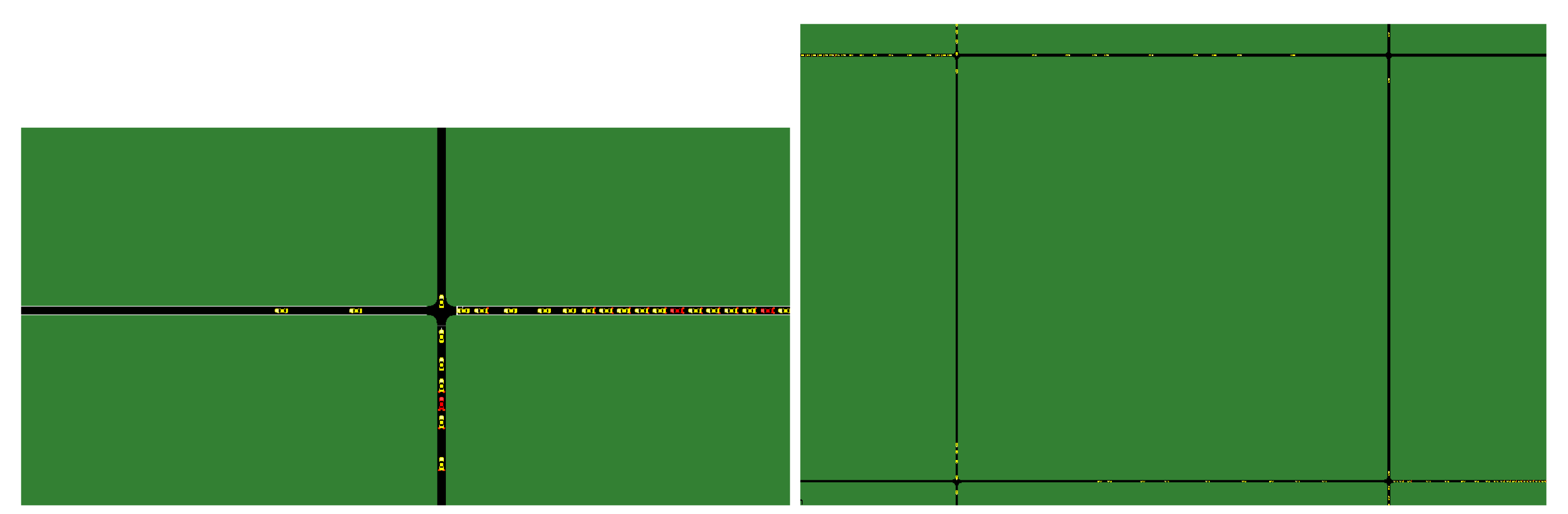
In this section, we show several experiments focused on testing the performance of the emergency vehicles model. We used the SUMO (https://www.eclipse.org/sumo/, accessed on 27 December 2021) (Simulation of Urban MObility) simulator for the modeling of intermodal traffic systems. SUMO is an open-source, highly portable, microscopic, and continuous road traffic simulation package designed to handle large road networks. It allows for intermodal simulation, including pedestrians, and comes with a large set of tools for scenario creation. In this paper, we used the 1.6.0 version of the simulator. SUMO provides functionalities to simulate traffic in cities composed of streets and intersections (Figure 1). For these experiments, we considered different types of cities. First, we carried out experiments with cities with four and twenty-five intersections and different traffic densities, ranging from 0 to 1. Regarding emergency vehicles, we used two different percentages (1% and 9%) of emergency vehicles, which correspond to a prior probability of 36 per every 3600 vehicles, and 332 per every 3600 vehicles, respectively.
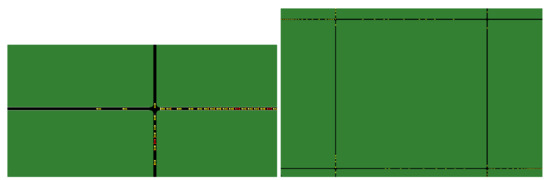
Figure 1.
Left: SUMO simulator showing an intersection with regular vehicles (yellow) and emergency vehicles (red). Right: SUMO simulator showing the representation of a city with 2 × 2 intersections.
In order to test the performance of the model proposed, we compare our DIM model for emergency vehicles with a Green Wave model, which is the traditional approach that provides a traffic intersection management based on traffic lights.
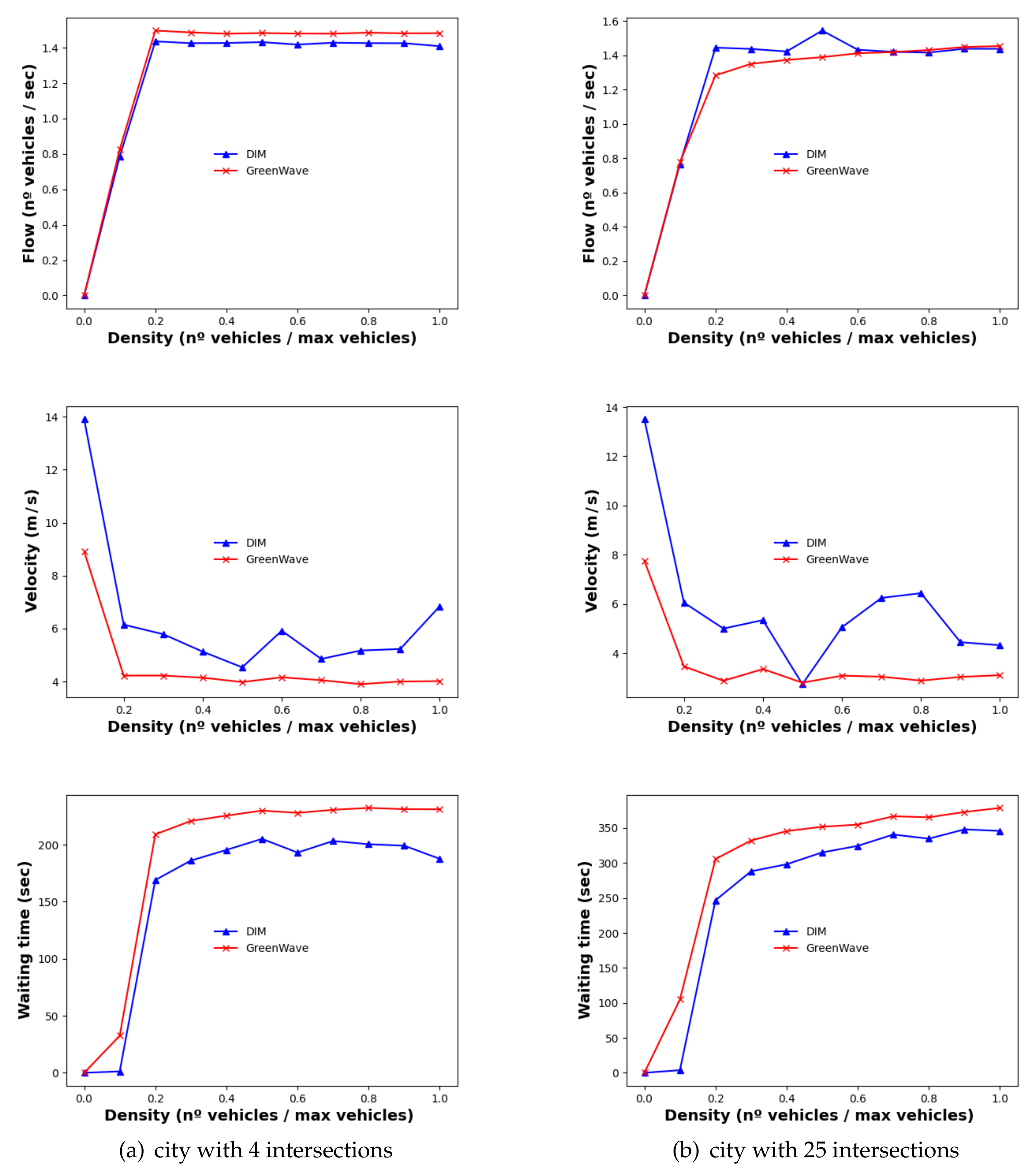
In Figure 2, we show the performance of both models in cities without emergency vehicles. Figure 2a represents the city with 4 intersections. The red line, represents the behavior of the Green Wave model while the blue line represents the behavior of the DIM model. In both models, three different parameters were evaluated for different ranges of traffic densities: the traffic flow, the velocity (in m/s), and the waiting time (in seconds).
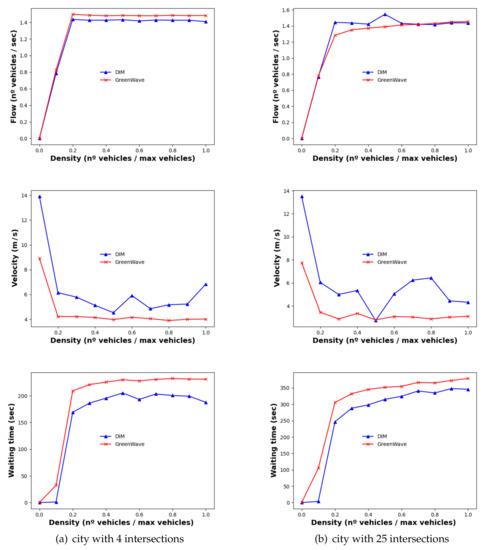
Figure 2.
Models comparison without emergency vehicles on two different cities.
It can be observed that the flow (see Figure 2a top) increases in both models up until a density of 0.2. From this density on, the traffic flow stabilizes. This can be explained because there are intersections that may be blocked for large values of traffic flow and this limits the traffic flow.
As it can be appreciated, the performance of the Green Wave model is slightly worse than DIM for both the velocity and the waiting time. This behavior is shown in Figure 2a, middle and bottom, which shows the average velocity of vehicles and the average waiting time, respectively. This can be explained because the DIM model provides a coordination mechanism based on the traffic, which is adapted depending on the traffic scenario. In contrast, the Green Wave considers a fixed amount of time to give crossing priorities. This strategy may penalize blocked lines.
Figure 2b represents the city with 25 intersections. Regarding the traffic flow, the DIM model reaches a slightly higher flow from densities between 0.2 and 0.5. This can be explained due to the fact that the city is bigger than in the previous case and therefore, some vehicles do not find blocked intersections in a way conflict, causing these vehicles to not stop. After a density of 0.5, both models are stabilzed by the same condition mentioned for the previous city. Comparing both models, it can be observed that the DIM model is more scalable than the Green Wave because the performance of the latter decreases when the size of the city increases.
In a way similar to the city of 4 intersections, the performance of the Green Wave model is slightly worse than DIM model for both velocity and waiting time for the city of 25 intersections. However, the trend of the waiting time is to increase as the density increases. This increase in a larger city can be explained because as the density increases, vehicles are required to wait longer periods of time in order to cross each intersection, which causes higher traffic congestion. Nevertheless, differences between DIM and Green Wave are even considerable.
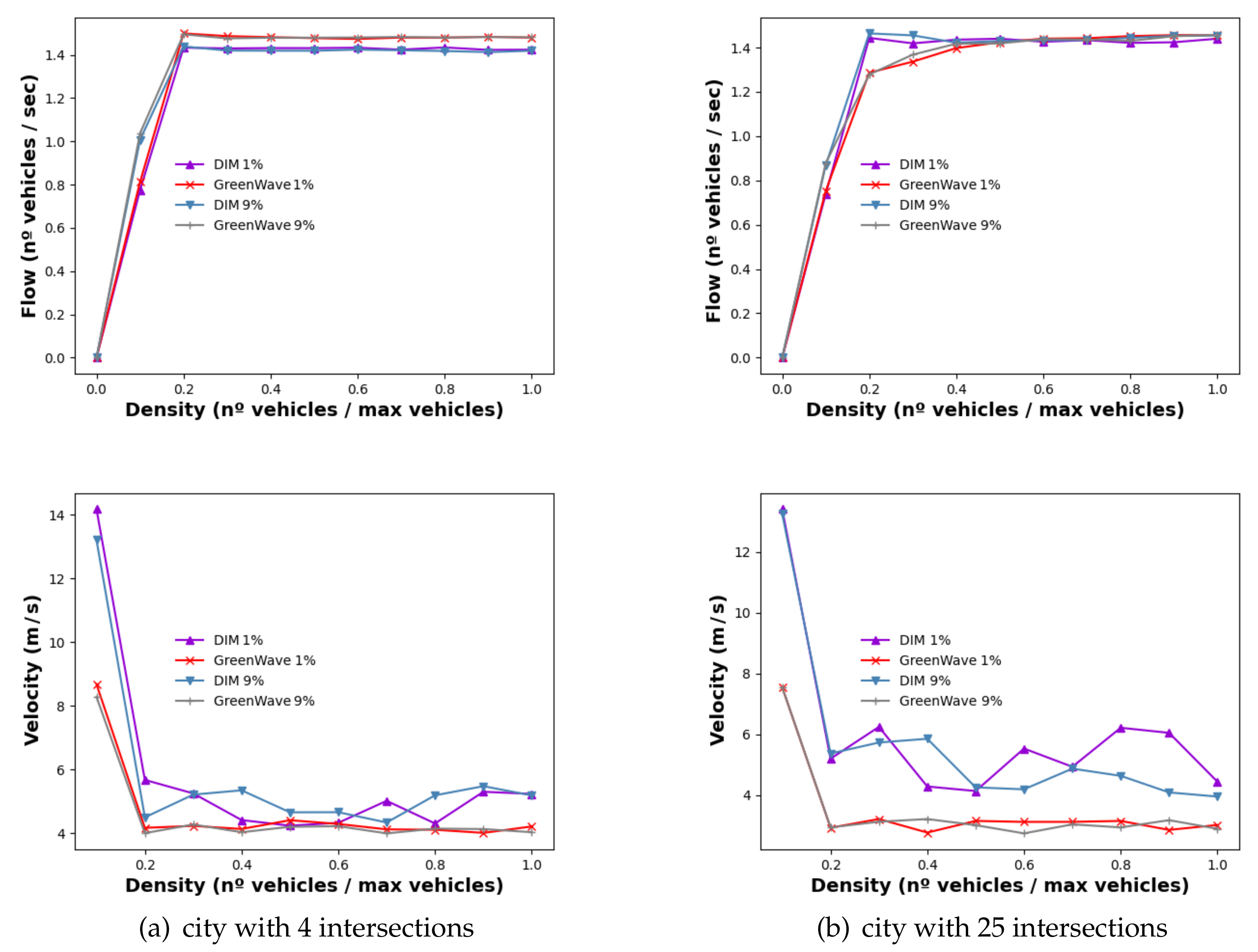
Figure 3 shows the performance of both models in cities with emergency vehicles at 1% and 9%. In the top Figures we can observe the traffic flow for cities with 4 intersections (left) and 25 intersections (right). Similar to the previous experiments, in the city with 4 intersections the traffic flow stabilizes from density values higher than 0.2. In addition, the scalability of DIM is better than Green Wave when the city size increases.
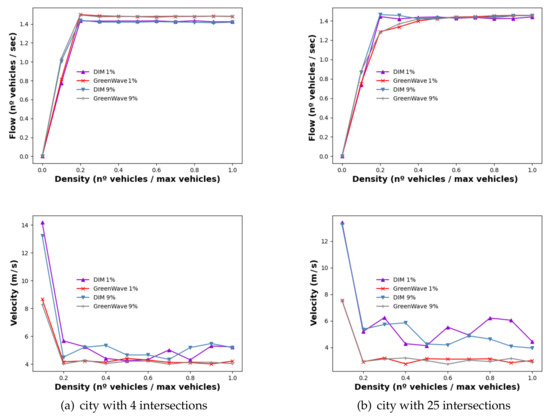
Figure 3.
Model comparison with emergency vehicles at 1% in two different cities.
Regarding the velocity, the difference between the performance of both models is higher for the city with 25 intersections. As can be seen, the velocity of DIM increases as the city size increases, while the city size does not affect the performance of the velocity for the Green Wave model. As it can be observed, when the rate of emergency vehicles is higher (9%), the velocity tends to progressively decrease in the largest city.
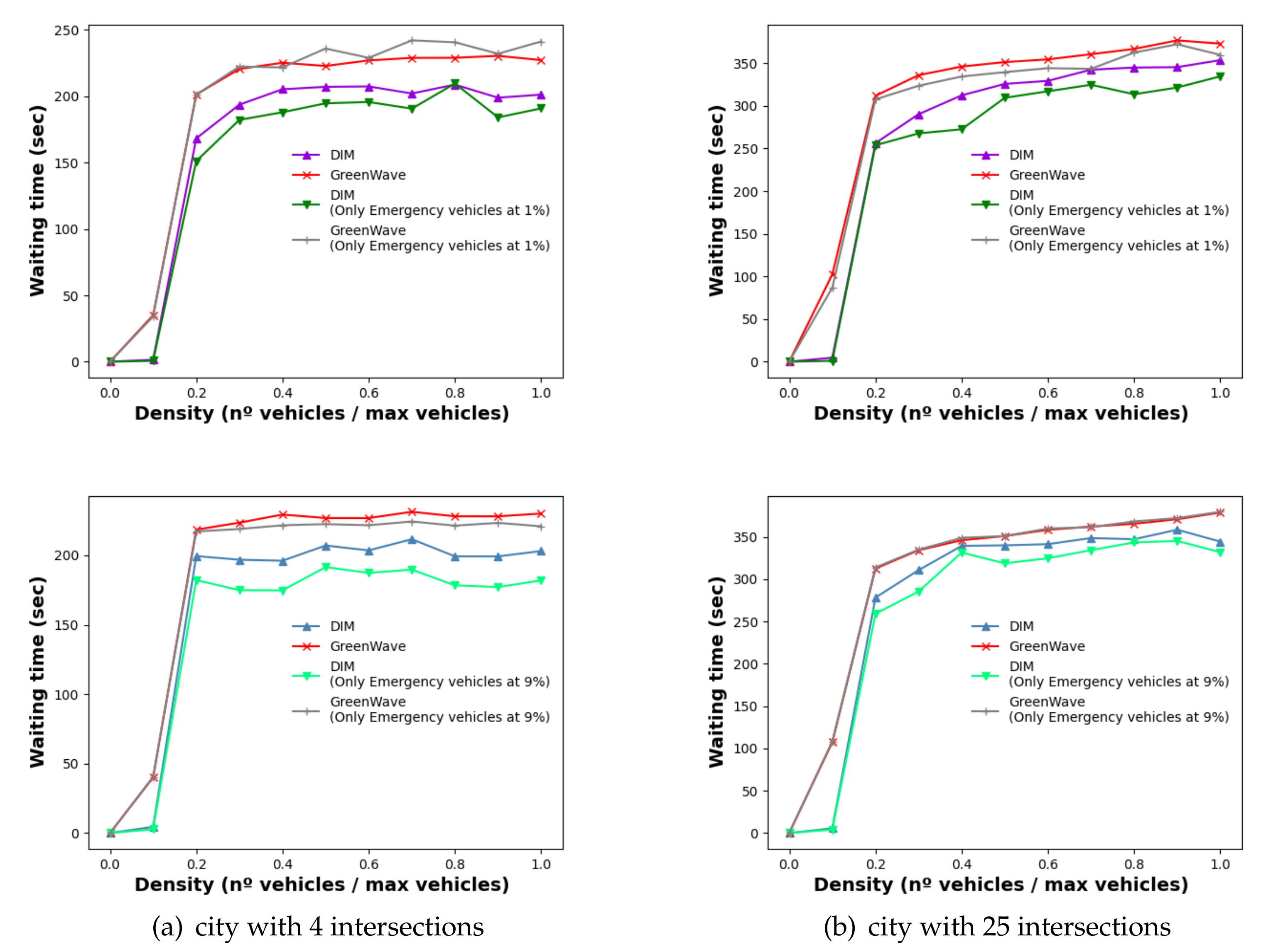
In Figure 4a,b, we show the average waiting time of emergency vehicles and regular vehicles (i.e., non-emergency vehicles) for the two sizes of cities and for 1% of emergency vehicles (top) and 9% of emergency vehicles (bottom). In the city with 4 intersections, the Green Wave model does not give significant priority to emergency vehicles. In contrast, the DIM model provides a mechanism that allows the emergency vehicles to considerably reduce the average waiting time compared with the rest of vehicles. Moreover, these differences become significant when the traffic density is higher than 0.2. In the largest city, the waiting time of both models increase as the density increases. In a similar way to the previous experiments, the increase in traffic causes vehicles to wait larger amounts of time, even emergency vehicles. This may be a limitation when only one-way lines are considered. In addition, it can be also appreciated that for the DIM model, differences between emergency and regular vehicles are shorter when the city size increases. The percentage of emergency vehicles does not considerably influence the differences between both models.
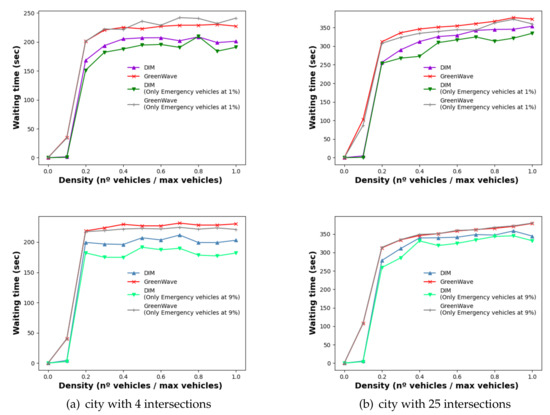
Figure 4.
Models comparison with emergency vehicles at 1% (top) and 9% (bottom) in two different cities.
Following this, we carried out different experiments in order to test the queues and halted vehicles. To do this, we used cities of four and sixteen intersections with high density values (0.7 and 0.9). In addition, we also changed the distance between intersections for 200, 500, and 700 m between each intersection. In these experiments, we fixed the value of emergency vehicles to 1%.
In these experiments, we measured the following parameters.
- Queue length: this parameter shows the average length of queues when a negotiator vehicle (the first of the queue) starts the movement to cross the intersection.
- Halted vehicles: this parameter shows the percentage of vehicles halted (velocity = 0) from the whole number of vehicles of the city. This value is obtained as an average from each step of the execution.
Table 1, Table 2 and Table 3 show the queue lengths and halted vehicles in cities with 200, 500, and 700 m between intersections, respectively. According to these results, the distance between intersections does not influence the performance of the DIM model as it influences the performance of the Green Wave. This can be explained because the coordination in the DIM model emerges from the interaction between those vehicles required to cross the intersection, which consists of a balanced fashion depending on the traffic and density of vehicles.

Table 1.
Queue lengths and halted vehicles in cities with 200 m between intersections.
Table 2.
Queue lengths and halted vehicles in cities with 500 m between intersections.
Table 3.
Queue lengths and halted vehicles in cities with 700 m between intersections.
5. Conclusions
Intersections, mainly in cities, represent a point of conflict in traffic-management systems. With the emergence of autonomous vehicles, different solutions have addressed this type of conflict in recent years. Most proposed solutions are centralized, and they usually propose a central manager coordinating vehicles by establishing crossing priorities. On the other hand, another critical aspect to consider in this type of system is the management of priorities for emergency vehicles at intersections. In recent years, proposals have emerged along these lines, trying to prioritize such vehicles. However, centralized solutions usually have the problem of a bottleneck if the central manager becomes saturated or fails. Along these lines, this work proposes a distributed solution that can also adapt to changes in the context, such as traffic density.
In this work, a distributed coordination management system that considers the prioritization of emergency vehicles has been proposed. The proposed system is able to provide a crossing strategy of vehicles at intersections in a distributed manner through the establishment of behavioral rules. According to the experiments, the proposed system provides better performance than other centralized approaches modeled in traffic lights. In particular, the tests have been carried out taking into account aspects such as the traffic flow, the average speed of vehicles, and their waiting time at intersections. The performance obtained is eventually better for emergency vehicles, which have a higher priority than other vehicles, without generating excessive delays for the rest of the vehicles. The tests were carried out on various configurations with respect to the number of existing intersections. As future work, it would be interesting to include other factors that make the simulation closer to real scenarios, such as unbalanced densities in lines depending on the hour and day, several lines per each direction, or failures and reparation of damages that requires making a line useless.
One assumption of our work is the consideration of one-way lines. Even the performance of the distributed model is better than centralized approaches; this may be a limitation when the city size increases. According to the experiments, differences between the waiting time of regular and emergency vehicles are shorter for large cities and densities. Therefore, we plan to extend this approach to consider several lines for each direction in future works. This would be especially interesting when emergency vehicles are considered because the traffic could be released in one line when needed to prioritize emergency vehicles.
Author Contributions
Conceptualization, C.L.G.; methodology, V.J.; formal analysis, S.L.D. and J.M.A.; investigation, C.L.G.; resources, L.F.N.; writing—original draft preparation, C.L.G.; writing—review and editing, S.L.D. and J.M.A.; visualization, C.L.G.; supervision, V.J.; project administration, V.J. All authors have read and agreed to the published version of the manuscript.
Funding
This work is partially supported by grant RTI2018-095390-B-C31 funded by MCIN/AEI/ 10.13039/501100011033 and by “ERDF A way of making Europe”.
Conflicts of Interest
The authors declare no conflict of interest. The funders had no role in the design of the study; in the collection, analyses, or interpretation of data; in the writing of the manuscript, or in the decision to publish the results.
References
- Abboud, K.; Omar, H.A.; Zhuang, W. Interworking of DSRC and cellular network technologies for V2X communications: A survey. IEEE Trans. Veh. Technol. 2016, 65, 9457–9470. [Google Scholar] [CrossRef]
- Yu, C.; Feng, Y.; Liu, H.X.; Ma, W.; Yang, X. Integrated optimization of traffic signals and vehicle trajectories at isolated urban intersections. Transp. Res. Part B Methodol. 2018, 112, 89–112. [Google Scholar] [CrossRef] [Green Version]
- Abbasi, I.A.; Shahid Khan, A. A review of vehicle to vehicle communication protocols for VANETs in the urban environment. Future Internet 2018, 10, 14. [Google Scholar] [CrossRef] [Green Version]
- Hamdi, M.M.; Audah, L.; Rashid, S.A.; Mohammed, A.H.; Alani, S.; Mustafa, A.S. A review of applications, characteristics and challenges in vehicular ad hoc networks (VANETs). In Proceedings of the IEEE 2020 International Congress on Human-Computer Interaction, Optimization and Robotic Applications (HORA), Ankara, Turkey, 26–28 June 2020; pp. 1–7. [Google Scholar]
- Gregor, D.; Toral, S.; Ariza, T.; Barrero, F.; Gregor, R.; Rodas, J.; Arzamendia, M. A methodology for structured ontology construction applied to intelligent transportation systems. Comput. Stand. Interfaces 2016, 47, 108–119. [Google Scholar] [CrossRef] [Green Version]
- Kaplan, J. Digital Trends-Cars. 2018. Available online: https://www.digitaltrends.com/cars/every-company-developing-self-driving-car-tech-ces-2018/ (accessed on 27 December 2021).
- Morgan, P.L.; Williams, C.; Flower, J.; Alford, C.; Parkin, J. Trust in an autonomously driven simulator and vehicle performing maneuvers at a T-junction with and without other vehicles. In International Conference on Applied Human Factors and Ergonomics; Springer: Cham, Switzerland, 2018; pp. 363–375. [Google Scholar]
- Fagnant, D.J.; Kockelman, K. Preparing a nation for autonomous vehicles: Opportunities, barriers and policy recommendations. Transp. Res. Part A Policy Pract. 2015, 77, 167–181. [Google Scholar] [CrossRef]
- Bertozzi, M.; Broggi, A.; Cellario, M.; Fascioli, A.; Lombardi, P.; Porta, M. Artificial vision in road vehicles. Proc. IEEE 2002, 90, 1258–1271. [Google Scholar] [CrossRef]
- Schwarting, W.; Alonso-Mora, J.; Rus, D. Planning and decision-making for autonomous vehicles. Annu. Rev. Control. Robot. Auton. Syst. 2018, 1, 187–210. [Google Scholar] [CrossRef]
- González, C.L.; Zapotecatl, J.L.; Gershenson, C.; Alberola, J.M.; Julian, V. A robustness approach to the distributed management of traffic intersections. J. Ambient Intell. Humaniz. Comput. 2020, 11, 4501–4512. [Google Scholar] [CrossRef]
- Humagain, S.; Sinha, R.; Lai, E.; Ranjitkar, P. A systematic review of route optimisation and pre-emption methods for emergency vehicles. Transp. Rev. 2020, 40, 35–53. [Google Scholar] [CrossRef]
- Rout, R.R.; Vemireddy, S.; Raul, S.K.; Somayajulu, D.V. Fuzzy logic-based emergency vehicle routing: An IoT system development for smart city applications. Comput. Electr. Eng. 2020, 88, 106839. [Google Scholar] [CrossRef]
- González, C.L.; Pulido, J.J.; Alberola, J.M.; Julian, V.; Niño, L.F. Autonomous Distributed Intersection Management for Emergency Vehicles at Intersections. In Practical Applications of Agents and Multi-Agent Systems; Springer: Cham, Switzerland, 2021; pp. 261–269. [Google Scholar]
- Eom, M.; Kim, B.I. The traffic signal control problem for intersections: A review. Eur. Transp. Res. Rev. 2020, 12, 1–20. [Google Scholar] [CrossRef]
- Guo, Q.; Li, L.; Ban, X.J. Urban traffic signal control with connected and automated vehicles: A survey. Transp. Res. Part C Emerg. Technol. 2019, 101, 313–334. [Google Scholar] [CrossRef]
- Zambrano-Martinez, J.L.; Calafate, C.T.; Soler, D.; Cano, J.C.; Manzoni, P. Modeling and characterization of traffic flows in urban environments. Sensors 2018, 18, 2020. [Google Scholar] [CrossRef] [PubMed] [Green Version]
- Gartner, N.H.; Pooran, F.J.; Andrews, C.M. Implementation of the OPAC adaptive control strategy in a traffic signal network. In Proceedings of the ITSC 2001 IEEE Intelligent Transportation Systems, Proceedings (Cat. No. 01TH8585), Oakland, CA, USA,, 25–29 August 2001; pp. 195–200. [Google Scholar]
- Lin, Y.; Yang, X.; Zou, N.; Franz, M. Transit signal priority control at signalized intersections: A comprehensive review. Transp. Lett. 2015, 7, 168–180. [Google Scholar] [CrossRef]
- Bie, Y.; Liu, Z.; Wang, H. Integrating Bus Priority and Presignal Method at Signalized Intersection: Algorithm Development and Evaluation. J. Transp. Eng. Part A Syst. 2020, 146, 04020044. [Google Scholar] [CrossRef]
- He, H.; Guler, S.I.; Menendez, M. Adaptive control algorithm to provide bus priority with a pre-signal. Transp. Res. Part C Emerg. Technol. 2016, 64, 28–44. [Google Scholar] [CrossRef] [Green Version]
- Saradha, B.J.; Vijayshri, G.; Subha, T. Intelligent traffic signal control system for ambulance using RFID and cloud. In Proceedings of the 2017 2nd International Conference on Computing and Communications Technologies (ICCCT), Chennai, India, 23–24 February 2017; pp. 90–96. [Google Scholar]
- Bieker-Walz, L.; Behrisch, M.; Junghans, M. Analysis of the traffic behavior of emergency vehicles in a microscopic traffic simulation. EPiC Ser. Eng. 2018, 2, 1–13. [Google Scholar]
- Dresner, K.; Stone, P. Human-usable and emergency vehicle-aware control policies for autonomous intersection management. In Proceedings of the Fourth International Workshop on Agents in Traffic and Transportation (ATT), Hakodate, Japan, 9 May 2006. [Google Scholar]
- Hajiebrahimi, S.; Iranmanesh, S. An adaptive control method of traffic signal-timing under emergency situations for smart cities. In Proceedings of the 2018 3rd IEEE International Conference on Intelligent Transportation Engineering (ICITE), Singapore, 3–5 September 2018; pp. 225–230. [Google Scholar]
- Kapileswar, N.; Santhi, P.V.; Chenchela, V.K.; Prasad, C.V.S. A fast information dissemination system for emergency services over vehicular ad hoc networks. In Proceedings of the 2017 International Conference on Energy, Communication, Data Analytics and Soft Computing (ICECDS), Chennai, India, 1–2 August 2017; pp. 236–241. [Google Scholar]
- Khan, A.; Ullah, F.; Kaleem, Z.; Rahman, S.U.; Anwar, H.; Cho, Y.Z. EVP-STC: Emergency vehicle priority and self-organising traffic control at intersections using Internet-of-things platform. IEEE Access 2018, 6, 68242–68254. [Google Scholar] [CrossRef]
- Krishna, A.A.; Kartha, B.A.; Nair, V.S. Dynamic traffic light system for unhindered passing of high priority vehicles: Wireless implementation of dynamic traffic light systems using modular hardware. In Proceedings of the 2017 IEEE Global Humanitarian Technology Conference (GHTC), San Jose, CA, USA, 19–22 October 2017; pp. 1–5. [Google Scholar]
- Viriyasitavat, W.; Tonguz, O.K. Priority management of emergency vehicles at intersections using self-organized traffic control. In Proceedings of the 2012 IEEE Vehicular Technology Conference (VTC Fall), Quebec City, QC, Canada, 3–6 September 2012; pp. 1–4. [Google Scholar]
- Sharma, S.; Pithora, A.; Gupta, G.; Goel, M.; Sinha, M. Traffic light priority control for emergency vehicle using RFID. Int. J. Innov. Eng. Technol 2013, 2, 363–366. [Google Scholar]
- Dresner, K.; Stone, P. Traffic intersections of the future. In Proceedings of the National Conference on Artificial Intelligence, Menlo Park, CA, USA, 18–22 July 1999; AAAI Press: London, UK; MIT Press: Cambridge, MA, USA, 2006; Volume 21, p. 1593. [Google Scholar]
- Gonzalez, C.L.; Zapotecatl, J.L.; Alberola, J.; Julian, V.; Gershenson, C. Distributed Management of Traffic Intersections. In International Symposium on Ambient Intelligence; Springer: Cham, Switzerland, 2018; pp. 56–64. [Google Scholar]
- Lárraga, M.; Alvarez-Icaza, L. Cellular automaton model for traffic flow based on safe driving policies and human reactions. Phys. A Stat. Mech. Its Appl. 2010, 389, 5425–5438. [Google Scholar] [CrossRef]
Publisher’s Note: MDPI stays neutral with regard to jurisdictional claims in published maps and institutional affiliations. |
© 2022 by the authors. Licensee MDPI, Basel, Switzerland. This article is an open access article distributed under the terms and conditions of the Creative Commons Attribution (CC BY) license (https://creativecommons.org/licenses/by/4.0/).