


Survey of Transformer-Based Malicious Software Detection Systems


 , ,
, ,
Abstract
1. Introduction
- Investigation of cutting-edge approaches, such as the creation of strong defenses and adversarial training methods, to lessen the susceptibility of transformer-based systems to malicious assaults.
- Focusing on possible ways to increase malware detection performance and resistance to evasion tactics by combining transformer-based approaches with other machine learning paradigms, including ensemble methods and meta-learning [27].
- Transformer-based models’ key shortcomings, as well as vulnerabilities, are identified, with an emphasis on interpretability and adversarial malicious attacks.
- Analysis of transformer-based models’ applicability on various datasets and platforms, which offers insights into their scalability and generalizability in actual cybersecurity scenarios.
2. Cybersecurity and Threat Landscape
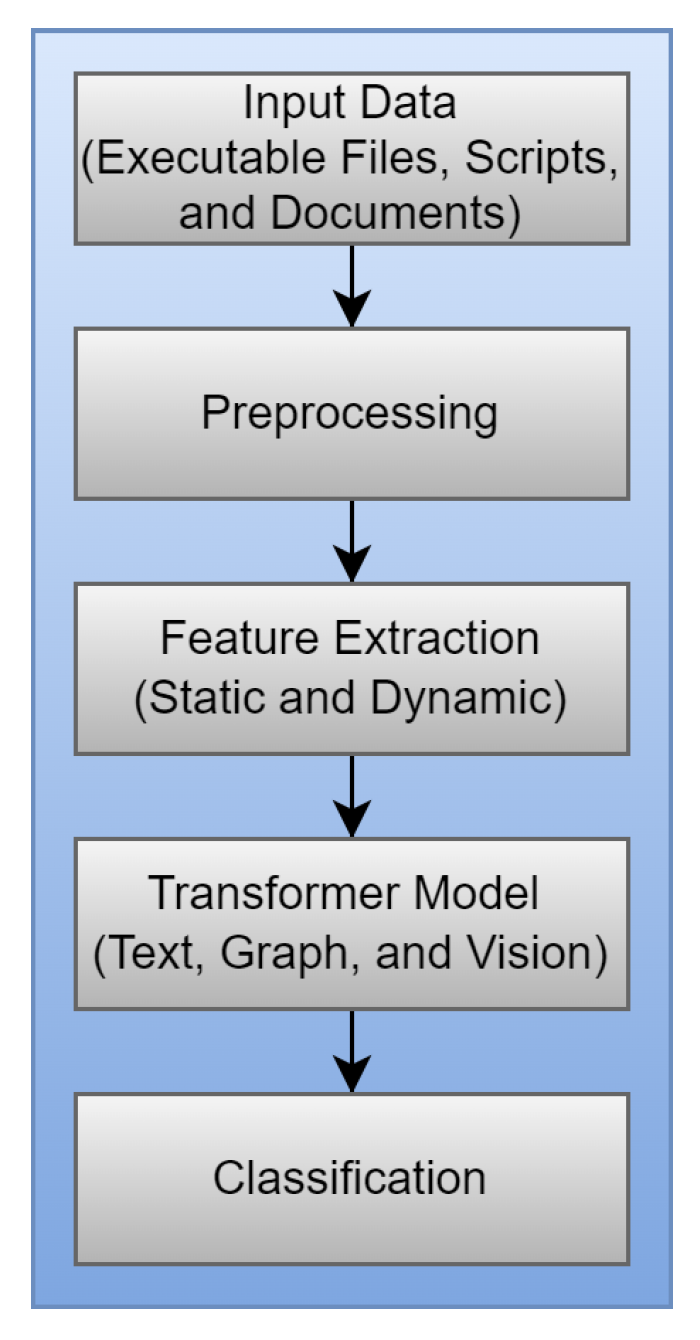
3. Malicious Software Detection Systems
3.1. Background of Intrusion Detection System (IDS)
3.2. Traditional Methods of Malicious Software Detection Systems and Their Challenges
4. AI in Cybersecurity
4.1. Machine Learning Techniques
4.1.1. Reinforcement Learning
4.1.2. Unsupervised Learning
4.1.3. Supervised Learning
4.2. Deep Learning Techniques
4.2.1. Neural Networks
4.2.2. Convolutional Neural Networks (CNNs)
4.2.3. Recurrent Neural Networks (RNNs)
4.3. Deep Neural Networks (DNN)
4.4. Autoencoders
4.5. Generative Adversarial Networks (GAN)
5. Transformers in AI
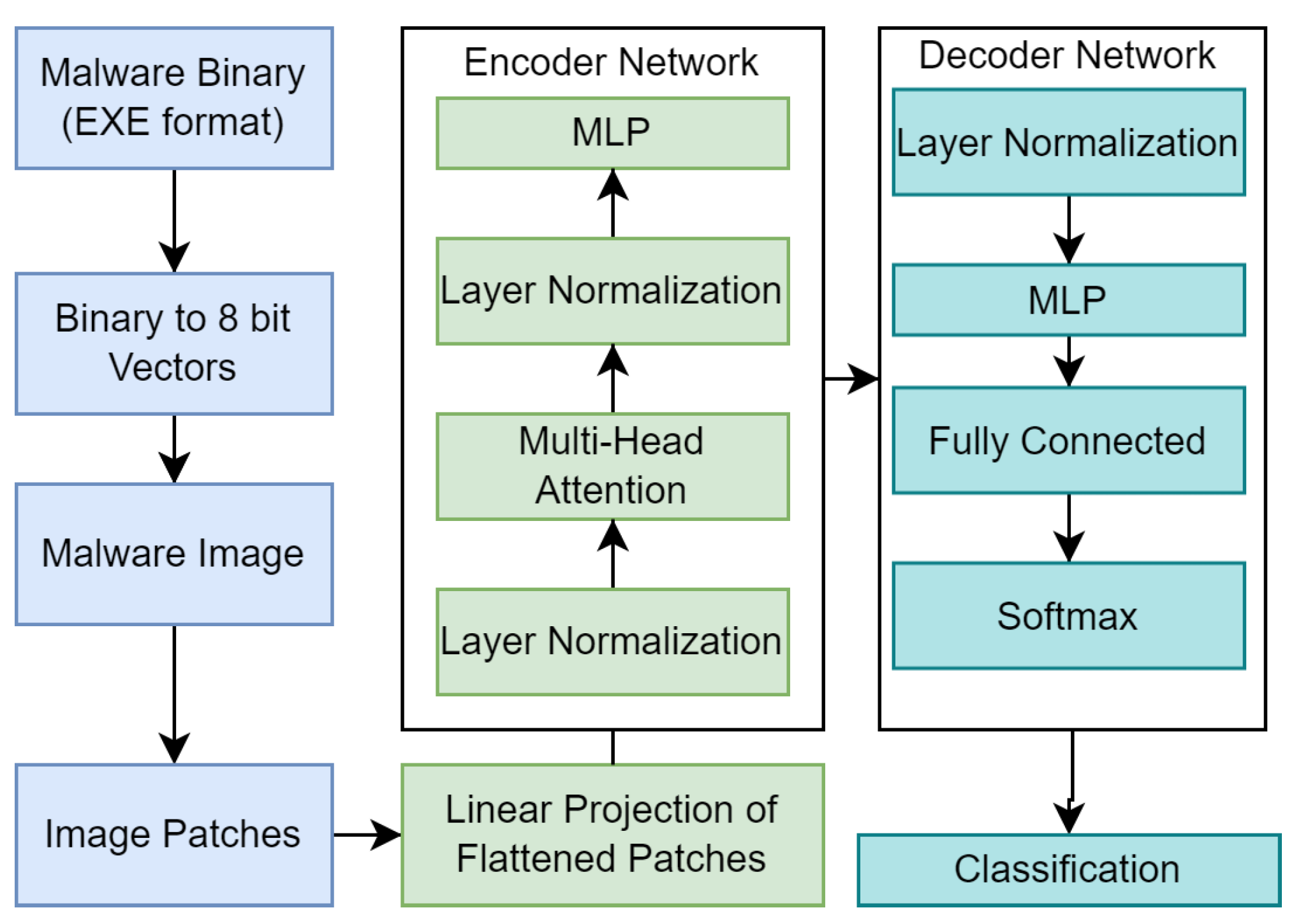
5.1. Vision Transformer (ViT) Architecture
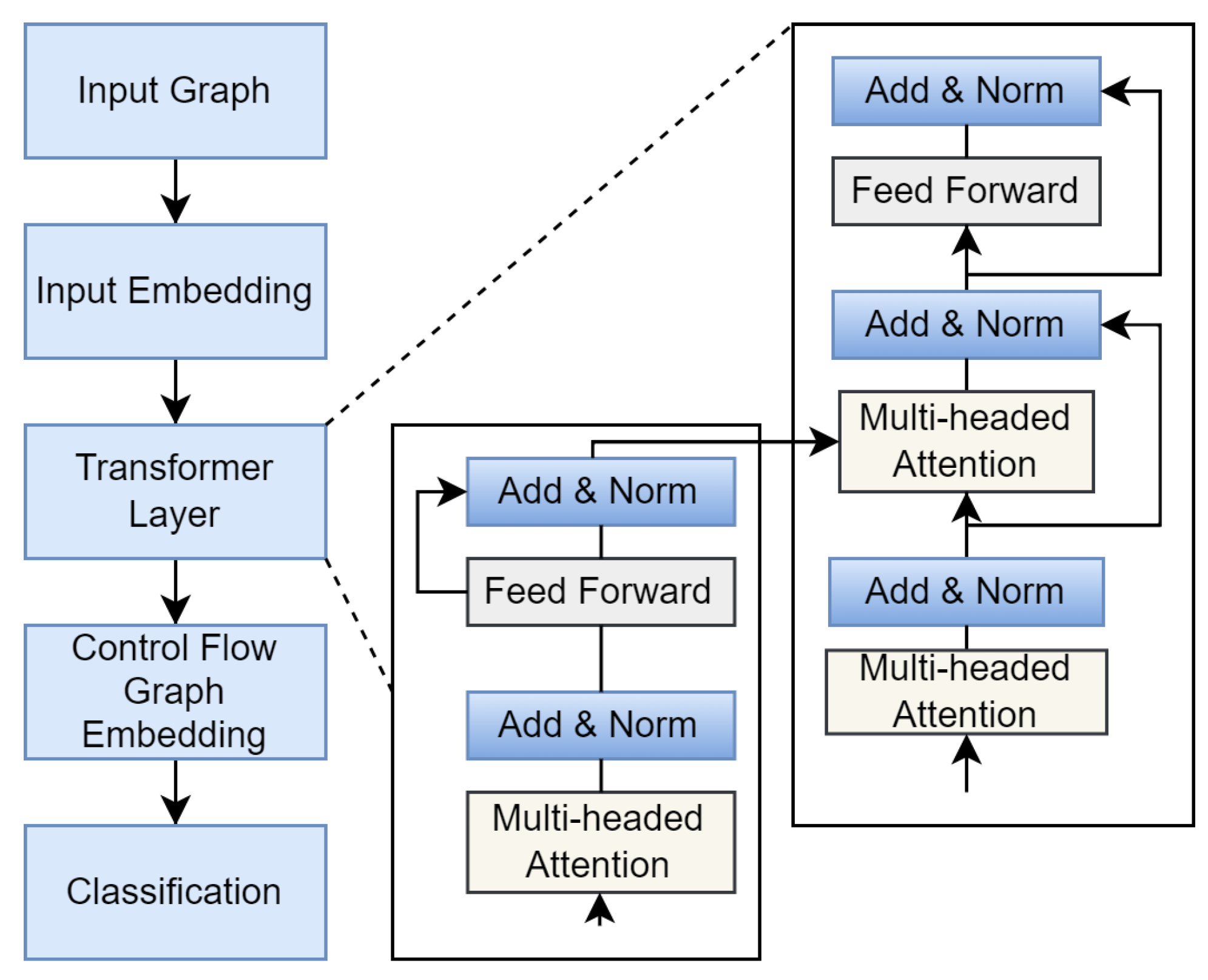
5.2. Graph Transformer Architecture
5.3. Text Transformer Architecture
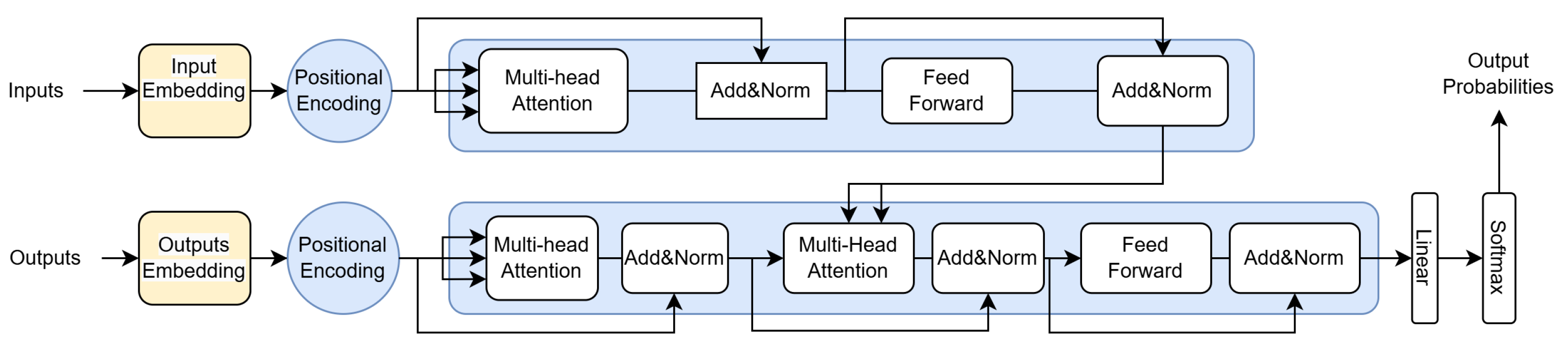
5.4. Attention Mechanism and Encoder–Decoder Structure in Transformers
5.5. Key Variants of Transformers
5.5.1. Encoder Models
Bidirectional Encoder Representations from Transformers (BERT)
DistilBERT
DeBERTaV3
RoBERTa
5.5.2. Decoder Models
GPT-2
GPT-3
GPT-4
BioGPT
5.5.3. Encoder–Decoder Models
T5 (Text-to-Text Transfer Transformer)
FLAN-T5
Code-T5
5.5.4. Vision Models
DiT
DETR
5.5.5. Audio Models
Whisper
VALL-E
5.6. Multimodal Models
LayoutLMv3
Unified-IO
6. Application of Transformers in Malicious Software Detection
6.1. NLP and Cybersecurity: Relevance of NLP Tasks
6.1.1. NLP for Intrusion Detection Systems
6.1.2. Malware Analysis
6.1.3. Anomaly Detection System
6.1.4. Text Classification and Sequence Prediction
6.2. Case Studies: Transformers in Malicious Software Detection
6.3. Phishing Detection in Transformers
6.4. Malware Detection: Use of Transformers to Detect and Classify Malware
6.5. Network Anomaly Detection in Transformers
7. Comparative Analysis

| Ref. | Datasets | Methodology | Features | Result |
|---|---|---|---|---|
| [102] 2021 | The masked assembly model dataset is a collection of 115,000 executables, which are malicious, and 115,000 executables, which are benign and are used to identify malware. | Use of trained transformers to learn assembly code, including Galaxy transformers and Planet-Star transformers. | IFFNN (Interpretable feed-forward neural network), improved form of printable strings, PE imports, PE header numerical features. | Accuracy on training set = 89.2%, on test set = 71.8%. |
| [46] 2021 | ARM, MIPS, and PowerPC | BERT embedding, Hybrid multi-head CNN-BiLSTM-LocAtt model | Opcode sequences, BiLSTM | BERTDeep-Ware outperforms traditional classification models in malware detection. Improved detection accuracy for ARM-based malware. |
| [103] | 12,000 benign and 10,000 malware Android apps from Androzoo dataset | BERT transformer | Textual features using BERT tokenizer | accuracy = 91.02%, F1 score = 78.04% and loss = 0.2214 |
| [67] 2021 | Portable Executable (PE) Format Datasets | DLAM, SLAM, DSLM-GPT2, GLM-GPT2 | API calls and static code attributes | DLAM, accuracy = 98% and SLAM, F1 score = 70.4% |
| [82] 2022 | Dataset 1: Malicious code sample binary files in PE format collected from VirusShare. A total of 9325 from various malicious code families. APT Dataset: Public APT activity. | APT malicious sample organization | Text Feature extraction | 93.24% for six tissue samples headed by APT-28, 90.67% for classifying APT attack organizations, 96.92% for the proposed method. |
| [67] 2022 | three datasets—Benign Portable Executable files (PE), Malicious PE files, Merged assembly instructions | DLAM, SLAM, DSLM-GPT2, GLM-GPT2 | LSTM, word embedding techniques, assembly instructions | For DLAM, F1 score = 98.3%, for SLAM, F1 score = 70.4%, for DSLM-GPT2, F1 Score = 86.0%, for GLM-GPT2,F1 Score = 76.2% |
| [85] 2022 | 2000 samples from public sources, 1244 malicious, 756 benign. | GRU, LSTM, Transformer | Dynamic call sequences | GRU performs best among five classifiers with 76.4% accuracy and F1 score up to 97% |
| [104] 2022 | Catak Dataset, Oliveira Dataset, VirusShare Dataset, VirusSample Dataset | Random Transformer Forest | API call sequence | F1-score: Catak = 0.61, Oliveria = 0.4061, VirusSample = 0.8059, VirusShare = 0.7275 |
| [99] 2022 | Two public datasets, CICMalDroid2020 and CIC-InvesAndMal2019 | Ensemble model(pre-trained BERT model, FAST and BRIEF Descriptor, SMOTE and CNN network for malware classification) | Textual (BERT), Visual(FAST and BRIEF descriptors) and Combined features (SMOTE and deep features mined using CNN) | Dataset 1 detection and classification accuracy 98.44% and 99.16%. Dataset 2 detection and classification accuracy: 97.76% and 98.91%. |
| [15] 2023 | 85,000 apps selected from datasets like MixG-Androzoo, MixG-VirusShare | MalBERTv2, scratch, bidirectional encoder | Sequential Input Processing | Model achieved 82% to 99% weighted f1 score. |
| [29] 2023 | ISCX-URL2016 dataset from The Canadian Institute for Cybersecurity (includes benign URLs and phishing URLs from PhishTank) | BERT transformer model for URL classification | Lexical and host-based features extracted from URLs, Word-cloud visualization for important textual data points | Accuracy = 96%, Precision = 0.97, Recall = 0.94, F1 score = 0.96 for phishing Urls. |
| [81] 2023 | Comprises API call sequences extracted from ransomware and benign software, collected via Cuckoo Sandbox analysis and additional online resources. | Utilizes LSTM and BERT models to analyze and classify API call sequences from malware, distinguishing between benign software and ransomware. | API call sequences | Accuracy = 99% |
| [33] 2023 | ToNIoT | MTNN model based on the attention mechanism of transformer neural networks to identify and accurately classify cybersecurity threats in IoT networks. | Extracted features from network traffic | Accuracy = 57%, Precision = 33%, Recall = 70%, F1 score = 63% |
| [35] 2023 | SST2, OffensEval, AG’s News | Vulnerable Parameters Ranking (VPR), Hardware-aware Attack Optimization (HAO), Vulnerable Bits Pruning (VBP) | Gradient-guided Fisher Information, Hardware Constraints, Bit Flip Optimization | Attack Success Rate on BERT with 64 modified parameters and 141 bit flips is 94.63%. |
| [38] 2023 | CICMalDroid2020 | Semi-supervised Continual Learning transformer (SSCL-TransMD) | Position embeddings, token embeddings and temporal embeddings and API Feature Vector | Binary F1 score = 0.8406, for multi F1 score = 0.7309 |
| [45] 2023 | three combined datasets—Smartbugs Curated, SolidiFI-Benchmark, Smartbugs Wild | BERT, Bi-LSTM, and multimodal deep learning approach | Source code, Bytecode, Input embedding, Bytecode extraction, Tokenizer | Accuracy of 98.95%. |
| [47] 2023 | HDFS, OpenStack, PageRank, BGL | Transformer for log sequence detection, Bi-directional LSTM for prediction | Log lexical and semantic vectors, non-linear dependencies | Accuracy = 99% |
| [49] 2023 | six different web attack datasets | DistilBERT, RNN, and LSTM | Body, URL, and user data analysis | For DistilBERT: Accuracy 80.89%, Precision 83.45%, Recall 76.04%; For RNN: Accuracy 93.99%, Precision 94.48%, Recall 94.89%; For LSTM: Accuracy 91.99%, Precision 91.78%, Recall 89.35%. |
| [105] 2023 | Malware classification with word2vec. | Random Forest (RF), (k-NN), Resnet18 (CNN),(SVM) | Contextualized Vector Embeddings, Context free embeddings and Opcode sequences. | Combination of DistilBERT-generated embeddings and a CNN (Resnet-18) achieving accuracy = 97.85 %. |
| [106] 2023 | 1 million DGA domains from Netlab, 1 million benign domains from Alexa Top 1 million. | Pre-trained CANINE-C model for binary classification of domain names. | Character-level features, leveraging self-attention techniques | Accuracy: 0.99, Precision: 0.99, Recall: 0.99, F1-Score: 0.99 |
| [107] 2023 | CICMalDroid2020, UpDroid, Androzoo | Transfer Learning, Machine Learning Classifiers (Linear Regression, Random Forest, Decision Tree) | BERT for static feature extraction | Accuracy = 99.47%. |
| [108] 2023 | Datasets contained 96,456 defacement URLs, 11,565 malware URLs, 11,999 spam URLs, 9964 phishing URLs, and 35,377 legitimate URLs | CharacterBERT, LSTM, and CNN-based detection model | Character level input and BERT model embeddings | Accuracy = 99.65%. |
| [109] 2023 | Test Corpus for Javascript and corporate document files | Deep Learning Approximate Matching (DLAM) | Fragment Detection and Pattern Learning | Accuracy = 93% |
| [110] 2023 | Five different scenarios for code similarity detection | Unsupervised language model (GenTAL, Denoising Autoencoder method, skip-gram style reconstruction) | Combining Denoising and Skip-gram, semantic embeddings | outperformed than TFIDF-based and BERT-based methods. |
| [58] 2023 | Training dataset with 1,174,060 functions and Downstream Task Dataset with 100K pairs prepared for the DS-BinSim | Well-balanced Instruction Normalization(WIN) and DeepSemantic model | Binary code semantics and positional encoding | Average accuracy of WIN = 49.8% over DeepBinDiff and 15.8% over SAFE. |
| [111] 2023 | Original dataset from Kaggle: 276,851 URL addresses | RoBERTa transformer Tokenized and encoded URLs | URLs tokenized into numerical representations, Categories: XSS, Benign, Phishing, Spam, Malware. | Accuracy = 99%, Precision = 0.96 (phishing) and 0.93 (Spam) and Recall = 0.93 (Phishing), 0.90 (spam) |
| [112] 2023 | JO Medium-3 | Machine Translation Model, TransAST | Input embedding, Pre-processing, Structure De-Obfuscation, Javascript parser | Accuracy = 91.35% |
| [113] 2023 | Powershell Script from hackers repositories | FastText, Random Forest | Textual features, Function-level features, AST, Information entropy, Script Preprocessing | Accuracy = 97.42%. |
| [94] 2024 | First dataset was based on malware hash and API call sequences for training and testing. Another malware dataset was collected from online resources that ran the cuckoo sandbox. | TTDAT (two-step training dual attention transformer method) | API call sequence | Accuracy = 0.9606 |
| [114] 2024 | Four datasets DR (Dataset Reference), VR (Virtual Reality), MD (Malware Detection) and AZ (Amazon) | Hierarchical IoT Malware Detection (TransMalDE) | API call features and Word embeddings | DR = 99.06%, VR = 97.92%, MD = 98.97%, AZ = 96.98% |
| [115] 2024 | Mal-API-2019 Dataset | CAFTrans Model | API call sequences(call vector and low frequencies) and Channel attention | F1 Score = 0.65252, AUC = 0.8913 and Accuracy = 0.6461 |
| [116] 2024 | EMBER dataset, which consists of 800,000 benign and dangerous samples and 300,000 unidentified samples. | BERT, CNN, LSTM | API function sequences and word embeddings | The SeMalBERT model achieves an accuracy rate of 0.8863, 0.9641, 0.9736, 0.9782, and 0.9798 for different variations and transformations of malicious software. |
| [117] 2024 | Used a dataset of 600,000 URL samples provided by the Zhejiang Mobile Innovation Research Institute | M-BERT model based on the transformer encoder architecture, transformer models to reduce false positives and false negatives, | traditional URL components (URL length, numerical content, domain details), IP address length, top-level domain name | Precision rate = 94.42%. |
| Ref. | Datasets | Methodology | Features | Result |
|---|---|---|---|---|
| [95] 2022 | Dataset consisting of 138,047 malicious and benign files, with 55 features extracted from their static analysis. | ANN, RNN, CNN, and LSTM | Portable executable (PE) header features extracted from static analysis | Validation Accuracy of using CNN = 98% |
| [37] 2022 | Balanced dataset including API calls contains 51892 images (49,376 Malware and 2516 Goodware) | Generative Adversarial Networks (GANs), transformers, and seven pre-trained CNN models: MobileNetV2, ResNet50, ResNet50V2, ResNet152V2, DenseNet121, DenseNet201, and EfficientNetV2L | API call sequences and Generated Malware Data | Accuracy = 97% for all models |
| [53] 2022 | VirusShare, It contains a total of 10,868 samples of 9 malicious code families | Malicious code family classification method based on the vision transformer model using images of malicious code as input features to learn the information inside the malicious code image. | Classification of malicious code families based on a vision transformer model. | Transformer model achieves an accuracy of 99.30% on the Microsoft malicious code dataset. |
| [60] 2022 | Three malware datasets: BIG 532 2015, BODMAS-11 and BODMAS-49 | SeqConvAttn and ImgConvAttn | Salient features | SeqConvAttn (BIG 532 2015 = 96.59%, BODMAS-11 = 96.89, BODMAS-49 = 93.33%) and ImgConvAttn (BIG 532 2015 = 98.17%, BODMAS 11 = 95.92%, BODMAS-49 = 92.73%) |
| [87] 2022 | Malnet | Self-supervised learning | Semantic Features | binary = 97%, multi-class = 97% |
| [12] 2023 | Malimg database | Vision transformer (ViT) compared with traditional Convolutional Neural Networks (CNNs) | Image patches (16x16) with RGB channels, vectorized into sequences | ViT accuracy = 98.38% and loss = 5.17%, CNN accuracy = 97.9% and loss = 12.29%, KNN+GIST accuracy = 97.37% with higher loss. |
| [11] 2023 | Three datasets (VirusShare malware repository, IoT-Android mobile dataset, e diverse IoT malware dataset captured by IoTPOT) | ViT4Mal(BRAM utilization with setup on a PYNQ Z1board) | ELF (Executable and Linkable Format) Headers, Opcodes and Images of byte-code | Their ViT4Mal framework achieved an accuracy of 4% and a 41x speedup compared to the original ViT model. |
| [86] 2023 | MalImg, Microsoft BIG datasets, and top-1000 PE imports | butterfly construction-based | Texture-based | Accuracy for IEViT = 99.49% and Accuracy for ViT = 99.99% |
| [34] 2023 | AndroCT dataset containing more than 35,974 Android applications, including both malicious and benign; ADFA-LD dataset. | RNN, MLP model, LSTM-based classifiers, LSTM-transformer architectures, token-level longest common sequence (LCS) | Internal and Sequential features of behavior units | Outperforming existing methods in terms of robustness against adversarial attacks. |
| [41] 2023 | BinaryCorp-3M containing over 3 million function pairs, BinKit, and HowSolve | DiEmph to detect and mitigate instruction distribution biases. | Identifying undesirable instruction distribution biases. | Accuracy = 14.4%. |
| [96] 2023 | Real-world datasets for validating performance | ViT based model for malware detection | Image conversion and attention techniques | Accuracy = 80.27% and Interpretability Score = 0.70 |
| [97] 2023 | 3 image classification datasets | CNNs (ResNet50 and ResNet152), and hybrid models (DeiT, ConViT, Swin) | Transferability of adversarial examples. | Transferability rate = 25.7% |
| [48] 2024 | Malimg Dataset, 9435 malicious code samples, 25 code families | CNNs and transformers, over parametrization, kernel convolution and MDC-RepNet model | Image Normalization and augmentation, large convolutional kernels, structured parameterization | Accuracy = 99.57% |
| [98] 2024 | MaleX: An open-source dataset containing more than 1,044,394 samples, including malware and benign software. | ResNeXt tagging model for malware detection and classification. | Plug-and-play attention mechanisms, Flexible information extraction | Accuracy = 90.64% |
| Ref. | Datasets | Methodology | Features | Result |
|---|---|---|---|---|
| [6] 2021 | Tencent Security Lab—private Android dataset | Heterogeneous temporal graph transformer + MLP | API call sequence | In D.Droid System, ACC = 0.9880, F1 = 0.9908, Recall = 0.9913, Precision = 0.9902 |
| [55] 2023 | Microsoft malware classification challenge | few-shot learning | Portable executable, image, and control flow graph | Accuracy = 99.45%, Recall = 97.89% |
8. Challenges and Limitations
8.1. Data Requirements
8.2. Unbalanced Data
8.3. Computational Resources
8.4. Real-Time Detection
8.5. Adversarial Attacks
9. Future Directions
10. Conclusions
Author Contributions
Funding
Data Availability Statement
Conflicts of Interest
References
- Mimecast. The State of Email Security. 2021. Available online: https://www.infotrust.com.au/resource-library/state-email-security-report-2021-findings (accessed on 19 November 2024).
- Sophos. The State of Ransomware 2021. 2021. Available online: https://news.sophos.com/en-us/2021/04/27/the-state-of-ransomware-2021 (accessed on 19 November 2024).
- SonicWall. Cyber Threat Report. 2021. Available online: https://www.ingrammicro24.com/ikey/d/w4PjTouwxvyUa6PHz1uc/original.pdf (accessed on 19 November 2024).
- Parachute. Cyber Attack Statistics to Know. 2024. Available online: https://parachute.cloud/cyber-attack-statistics-data-and-trends/ (accessed on 19 November 2024).
- James, N. 160 Cybersecurity Statistics: Updated Report 2023. 2022. Available online: https://www.getastra.com/blog/security-audit/cyber-security-statistics/#:~:text=Cybersecurity%20statistics%20indicate%20that%20there (accessed on 19 November 2024).
- Fan, Y.; Ju, M.; Hou, S.; Ye, Y.; Wan, W.; Wang, K.; Mei, Y.; Xiong, Q. Heterogeneous temporal graph transformer: An intelligent system for evolving android malware detection. In Proceedings of the 27th ACM SIGKDD Conference on Knowledge Discovery & Data Mining, Singapore, 14–18 August 2021; pp. 2831–2839. [Google Scholar]
- Alqurashi, F.; Ahmad, I. Scientometric Analysis and Knowledge Mapping of Cybersecurity. Int. J. Adv. Comput. Sci. Appl. 2024, 15. [Google Scholar] [CrossRef] [Scilit]
- Ghourabi, A. A Security Model Based on LightGBM and Transformer to Protect Healthcare Systems From Cyberattacks. IEEE Access 2022, 10, 48890–48903. [Google Scholar] [CrossRef] [Scilit]
- Ahmad, I.; AlQurashi, F.; Abozinadah, E.; Mehmood, R. A novel deep learning-based online proctoring system using face recognition, eye blinking, and object detection techniques. Int. J. Adv. Comput. Sci. Appl. 2021, 12. [Google Scholar] [CrossRef] [Scilit]
- Venugopal, D.; Hu, G. Efficient signature based malware detection on mobile devices. Mob. Inf. Syst. 2008, 4, 33–49. [Google Scholar] [CrossRef] [Scilit]
- Ravi, A.; Chaturvedi, V.; Shafique, M. ViT4Mal: Lightweight Vision Transformer for Malware Detection on Edge Devices. ACM Trans. Embed. Comput. Syst. 2023, 22, 1–26. [Google Scholar] [CrossRef] [Scilit]
- Elaachak, B.L.; Bouhorma, M. Enhancing Malware Classification with Vision Transformers: A Comparative Study with Traditional CNN Models. In Proceedings of the 6th International Conference on Networking, Intelligent Systems & Security, Larache, Morocco, 24–26 May 2023. [Google Scholar] [CrossRef] [Scilit]
- Steverson, K.; Carlin, C.; Mullin, J.; Ahiskali, M. Cyber Intrusion Detection using Natural Language Processing on Windows Event Logs. In Proceedings of the 2021 International Conference on Military Communication and Information Systems (ICMCIS), The Hague, The Netherlands, 4–5 May 2021. [Google Scholar] [CrossRef] [Scilit]
- Ahmad, I.; AlQurashi, F.; Mehmood, R. Machine and Deep Learning Methods with Manual and Automatic Labelling for News Classification in Bangla Language. arXiv 2022, arXiv:2210.10903. [Google Scholar]
- Rahali, A.; Akhloufi, M.A. MalBERTv2: Code Aware BERT-Based Model for Malware Identification. Big Data Cogn. Comput. 2023, 7, 60. [Google Scholar] [CrossRef] [Scilit]
- Ahmad, I.; AlQurashi, F.; Mehmood, R. Potrika: Raw and balanced newspaper datasets in the bangla language with eight topics and five attributes. arXiv 2022, arXiv:2210.09389. [Google Scholar]
- Dobreva, J.; Mitrovikj, A.P.; Dimitrova, V. MalDeWe: New Malware Website Detector Model based on Natural Language Processing using Balanced Dataset. In Proceedings of the 2021 International Conference on Computational Science and Computational Intelligence (CSCI), Las Vegas, NV, USA, 15–17 December 2021. [Google Scholar] [CrossRef] [Scilit]
- Ye, Y.; Li, T.; Adjeroh, D.; Iyengar, S.S. A survey on malware detection using data mining techniques. ACM Comput. Surv. (CSUR) 2017, 50, 1–40. [Google Scholar] [CrossRef] [Scilit]
- Aslan, Ö.A.; Samet, R. A comprehensive review on malware detection approaches. IEEE Access 2020, 8, 6249–6271. [Google Scholar] [CrossRef] [Scilit]
- Bensaoud, A.; Kalita, J.; Bensaoud, M. A survey of malware detection using deep learning. Mach. Learn. Appl. 2024, 16, 100546. [Google Scholar] [CrossRef] [Scilit]
- Yunmar, R.A.; Kusumawardani, S.S.; Widyawan; Mohsen, F. Hybrid Android Malware Detection: A Review of Heuristic-Based Approach. IEEE Access 2024, 12, 41255–41286. [Google Scholar] [CrossRef] [Scilit]
- Gaber, M.G.; Ahmed, M.; Janicke, H. Malware Detection with Artificial Intelligence: A Systematic Literature Review. ACM Comput. Surv. 2024, 56, 1–33. [Google Scholar] [CrossRef] [Scilit]
- Souri, A.; Hosseini, R. A state-of-the-art survey of malware detection approaches using data mining techniques. Hum.-Centric Comput. Inf. Sci. 2018, 8, 1–22. [Google Scholar] [CrossRef] [Scilit]
- Bilot, T.; El Madhoun, N.; Al Agha, K.; Zouaoui, A. A survey on malware detection with graph representation learning. ACM Comput. Surv. 2024, 56, 1–36. [Google Scholar] [CrossRef] [Scilit]
- Chenet, C.P.; Savino, A.; Di Carlo, S. A survey on hardware-based malware detection approaches. IEEE Access 2024, 12, 54115–54128. [Google Scholar] [CrossRef] [Scilit]
- Smmarwar, S.K.; Gupta, G.P.; Kumar, S. Android Malware Detection and Identification Frameworks by Leveraging the Machine and Deep Learning Techniques: A Comprehensive Review. Telemat. Inform. Rep. 2024, 14, 100130. [Google Scholar] [CrossRef] [Scilit]
- Wang, S.; Ko, R.K.L.; Bai, G.; Dong, N.; Choi, T.; Zhang, Y. Evasion Attack and Defense on Machine Learning Models in Cyber-Physical Systems: A Survey. IEEE 2023, 26, 930–966. [Google Scholar] [CrossRef] [Scilit]
- Gezer, A.; Warner, G.; Wilson, C.; Shrestha, P. A flow-based approach for Trickbot banking trojan detection. Comput. Secur. 2019, 84, 179–192. [Google Scholar] [CrossRef] [Scilit]
- Otieno, D.O.; Abri, F.; Namin, A.S.; Jones, K.S. Detecting Phishing URLs using the BERT Transformer Model. In Proceedings of the 2023 IEEE International Conference on Big Data, Sorrento, Italy, 15–18 December 2023. [Google Scholar] [CrossRef] [Scilit]
- Ahmad, I.; Alqurashi, F.; Abozinadah, E.; Mehmood, R. Deep journalism and DeepJournal V1. 0: A data-driven deep learning approach to discover parameters for transportation. Sustainability 2022, 14, 5711. [Google Scholar] [CrossRef] [Scilit]
- Maneriker, P.; Stokes, J.W.; Lazo, E.G.; Carutasu, D.; Tajaddodianfar, F.; Gururajan, A. URLTran: Improving Phishing URL Detection Using Transformers. In Proceedings of the MILCOM 2021-2021 IEEE Military Communications Conference (MILCOM), San Diego, CA, USA, 29 November–2 December 2021. [Google Scholar] [CrossRef] [Scilit]
- Gogoi, B.; Ahmed, T. Phishing and Fraudulent Email Detection through Transfer Learning using pretrained transformer models. In Proceedings of the 2022 IEEE 19th India Council International Conference (INDICON), Kochi, India, 24–26 November 2022. [Google Scholar] [CrossRef] [Scilit]
- Ahmed, S.W.; Kientz, F.; Kashef, R. A Modified Transformer Neural Network (MTNN) for Robust Intrusion Detection in IoT Networks. In Proceedings of the 2023 International Telecommunications Conference (ITC-Egypt), Alexandria, Egypt, 18–20 July 2023. [Google Scholar] [CrossRef] [Scilit]
- Zhan, D.; Tan, K.; Ye, L.; Yu, X.; Zhang, H.; He, Z. An Adversarial Robust Behavior Sequence Anomaly Detection Approach Based on Critical Behavior Unit Learning. IEEE Trans. Comput. Trans. Comput. 2023, 72, 3286–3299. [Google Scholar] [CrossRef] [Scilit]
- Al Ghanim, M.; Santriaji, M.; Lou, Q.; Solihin, Y. TrojBits: A Hardware Aware Inference-Time Attack on Transformer-Based Language Models. Front. Artif. Intell. Appl. 2023, 372, 60–68. [Google Scholar] [CrossRef] [Scilit]
- Ho, C.; Yow, K.; Zhu, Z.; Aravamuthan, S. Network intrusion detection via flow-to-image conversion and vision transformer classification. IEEE Access 2022, 10, 97780–97793. [Google Scholar] [CrossRef] [Scilit]
- Alzahem, A.; Boulila, W.; Driss, M.; Koubâa, A.; Almomani, I. Towards Optimizing Malware Detection: An Approach Based on Generative Adversarial Networks and Transformers. In Proceedings of the 14th International Conference, ICCCI 2022, Hammamet, Tunisia, 28–30 September 2022; pp. 598–610. [Google Scholar] [CrossRef] [Scilit]
- Kou, L.; Zhao, D.; Han, H.; Xu, X.; Gong, S.; Wang, L. SSCL-TransMD: Semi-Supervised Continual Learning Transformer for Malicious Software Detection. Appl. Sci. 2023, 13, 12255. [Google Scholar] [CrossRef] [Scilit]
- Devalla, V.; Raghavan, S.S.; Maste, S.; Kotian, J.D.; Annapurna, D.D. mURLi: A Tool for Detection of Malicious URLs and Injection Attacks. Procedia Comput. Sci. 2022, 215, 662–676. [Google Scholar] [CrossRef] [Scilit]
- Zhang, Y.; Xiao, D.; Guo, X.; Cui, C. Research and implementation of obfuscation binary code similarity detection. In Proceedings of the 2022 4th International Academic Exchange Conference on Science and Technology Innovation (IAECST), Guangzhou, China, 9–11 December 2022. [Google Scholar] [CrossRef] [Scilit]
- Xu, X.; Feng, S.; Ye, Y.; Shen, G.; Su, Z.; Cheng, S.; Tao, G.; Shi, Q.; Zhang, Z.; Zhang, X. Improving Binary Code Similarity Transformer Models by Semantics-Driven Instruction Deemphasis. In Proceedings of the 32nd ACM SIGSOFT International Symposium on Software Testing and Analysis, Seattle WA USA, 17–21 July 2023. [Google Scholar] [CrossRef] [Scilit]
- Prayogo, N.; Amjadian, E.; McDonnell, S.; Abid, M.R. Context-Aware Attended-over Distributed Specificity for Information Extraction in Cybersecurity. In Proceedings of the 2022 IEEE 13th Annual Information Technology, Electronics and Mobile Communication Conference (IEMCON), Vancouver, BC, Canada, 12–15 October 2022. [Google Scholar] [CrossRef] [Scilit]
- Praise, J.J.; Raj, R.J.S.; Benifa, J.B. Development of reinforcement learning and pattern matching (RLPM) based firewall for secured cloud infrastructure. Wirel. Pers. Commun. 2020, 115, 993–1018. [Google Scholar] [CrossRef] [Scilit]
- Huang, Y.; Li, X.; Qiao, M.; Tang, K.; Zhang, C.; Gui, H.; Wang, P.; Liu, F. Android-SEM: Generative Adversarial Network for Android Malware Semantic Enhancement Model Based on Transfer Learning. Electronics 2022, 11, 672. [Google Scholar] [CrossRef] [Scilit]
- Le, C.T.; Vu, T.K.; Trinh, M.H.; Nguyen, H.Q.; Nghi, H.K.; Phan, T.D. A Multimodal Deep Learning Approach for Efficient Vulnerability Detection in Smart Contracts. In Proceedings of the GLOBECOM 2023-2023 IEEE Global Communications Conference, Kuala Lumpur, Malaysia, 4–8 December 2023. [Google Scholar] [CrossRef] [Scilit]
- Hamad, S.A.; Tran, D.H.; Sheng, Q.Z.; Zhang, W.E. BERTDeep-Ware: A Cross-architecture Malware Detection Solution for IoT Systems. In Proceedings of the 2021 IEEE 20th International Conference on Trust, Security and Privacy in Computing and Communications (TrustCom), Shenyang, China, 20–22 October 2021. [Google Scholar] [CrossRef] [Scilit]
- Li, T.; Jiang, Y.; Lin, C.; Obaidat, M.S.; Shen, Y.; Ma, J. DeepAG: Attack Graph Construction and Threats Prediction With Bi-Directional Deep Learning. IEEE Trans. Dependable Secur. Comput. 2023, 20, 740–757. [Google Scholar] [CrossRef] [Scilit]
- Li, S.; Wang, J.; Song, Y.; Wang, S.; Wang, Y. A Lightweight Model for Malicious Code Classification Based on Structural Reparameterisation and Large Convolutional Kernels. Int. J. Comput. Intell. Syst. J. Comput. Intell. Syst. 2024, 17, 30. [Google Scholar] [CrossRef] [Scilit]
- Bokolo, B.G.; Chen, L.; Liu, Q. Detection of Web-Attack using DistilBERT, RNN, and LSTM. In Proceedings of the 2023 11th International Symposium on Digital Forensics and Security (ISDFS), Chattanooga, TN, USA, 11–12 May 2023. [Google Scholar] [CrossRef] [Scilit]
- Tobiyama, S.; Yamaguchi, Y.; Shimada, H.; Ikuse, T.; Yagi, T. Malware detection with deep neural network using process behavior. In Proceedings of the 2016 IEEE 40th annual computer software and applications conference (COMPSAC), Atlanta, GA, USA, 10–14 June 2016; IEEE: Piscataway, NJ, USA, 2016; Volume 2, pp. 577–582. [Google Scholar]
- Zhai, J.; Zhang, S.; Chen, J.; He, Q. Autoencoder and its various variants. In Proceedings of the 2018 IEEE International Conference on Systems, Man, and Cybernetics (SMC), Miyazaki, Japan, 7–10 October 2018; IEEE: Piscataway, NJ, USA, 2018; pp. 415–419. [Google Scholar]
- Goodfellow, I.; Pouget-Abadie, J.; Mirza, M.; Xu, B.; Warde-Farley, D.; Ozair, S.; Courville, A.; Bengio, Y. Generative adversarial nets. Adv. Neural Inf. Process. Syst. 2014, 27. [Google Scholar]
- Chen, S.; Liu, Y.; Hu, W.; Liu, J.; Gao, Y.; Lin, B. Malicious Code Family Classification Method Based on Vision Transformer. In Proceedings of the 2022 IEEE 10th International Conference on Information, Communication and Networks (ICICN), Zhangye, China, 23–24 August 2022. [Google Scholar] [CrossRef] [Scilit]
- Moon, H.J.; Bu, S.J.; Cho, S.B. Directional Graph Transformer-Based Control Flow Embedding for Malware Classification. In Proceedings of the Intelligent Data Engineering and Automated Learning—IDEAL 2021, Manchester, UK, 25–27 November 2021; Lecture Notes in Computer Science. pp. 426–436. [Google Scholar] [CrossRef] [Scilit]
- Bu, S.J.; Cho, S.B. Triplet-trained graph transformer with control flow graph for few-shot malware classification. Inf. Sci. 2023, 649, 119598. [Google Scholar] [CrossRef] [Scilit]
- Vaswani, A.; Shazeer, N.; Parmar, N.; Uszkoreit, J.; Jones, L.; Gomez, A.N.; Kaiser, Ł.; Polosukhin, I. Attention is all you need. In Proceedings of the 31st International Conference on Neural Information Processing Systems, Long Beach, CA, USA, 4–9 December 2017; pp. 6000–6010. [Google Scholar]
- Vubangsi, M.; Abidemi, S.U.; Akanni, O.; Mubarak, A.S.; Al-Turjman, F. Applications of Transformer Attention Mechanisms in Information Security: Current Trends and Prospects. In Proceedings of the 2022 International Conference on Artificial Intelligence of Things and Crowdsensing (AIoTCs), Nicosia, Cyprus, 26–28 October 2022. [Google Scholar] [CrossRef] [Scilit]
- Koo, H.; Park, S.; Choi, D.; Kim, T. Binary Code Representation With Well-Balanced Instruction Normalization. IEEE Access 2023, 11, 29183–29198. [Google Scholar] [CrossRef] [Scilit]
- Or-Meir, O.; Cohen, A.; Elovici, Y.; Rokach, L.; Nissim, N. Pay Attention: Improving Classification of PE Malware Using Attention Mechanisms Based on System Call Analysis. In Proceedings of the 2021 International Joint Conference on Neural Networks (IJCNN), Shenzhen, China, 18–22 July 2021. [Google Scholar] [CrossRef] [Scilit]
- Lu, Q.; Zhang, H.; Kinawi, H.; Niu, D. Self-Attentive Models for Real-Time Malware Classification. IEEE Access 2022, 10, 95970–95985. [Google Scholar] [CrossRef] [Scilit]
- Wang, L.; Cheng, J.; Zhang, R.; Chen, G.; Wang, C.; Pang, J. Spatio-Temporal Feature Encryption Malicious Traffic Detection via Attention Mechanism. In Proceedings of the 2022 IEEE 10th International Conference on Information, Communication and Networks (ICICN), Zhangye, China, 23–24 August 2022. [Google Scholar] [CrossRef] [Scilit]
- Li, C.; Chen, Z.; Zheng, J. An Efficient Transformer Encoder-Based Classification of Malware Using API Calls. In Proceedings of the 2022 IEEE 24th Int Conf on High Performance Computing & Communications; 8th Int Conf on Data Science & Systems; 20th Int Conf on Smart City; 8th Int Conf on Dependability in Sensor, Cloud & Big Data Systems & Application (HPCC/DSS/SmartCity/DependSys), Hainan, China, 18–20 December 2022. [Google Scholar] [CrossRef] [Scilit]
- Alqurashi, F.; Ahmad, I. A data-driven multi-perspective approach to cybersecurity knowledge discovery through topic modelling. Alex. Eng. J. 2024, 107, 374–389. [Google Scholar] [CrossRef] [Scilit]
- Sanh, V.; Debut, L.; Chaumond, J.; Wolf, T. DistilBERT, a distilled version of BERT: Smaller, faster, cheaper and lighter. In Proceedings of the 5th Workshop on Energy Efficient Machine Learning and Cognitive Computing, Vancouver, BC, Canada, 13 December 2019. [Google Scholar]
- He, P.; Liu, X.; Gao, J.; Chen, W. DeBERTaV3: Improving DeBERTa using ELECTRA-Style Pre-Training with Gradient-Disentangled Embedding Sharing. arXiv 2021, arXiv:2111.09543. [Google Scholar]
- Liu, Y.; Ott, M.; Goyal, N.; Du, J.; Joshi, M.; Chen, D.; Levy, O.; Lewis, M.; Zettlemoyer, L.; Stoyanov, V. RoBERTa: A Robustly Optimized BERT Pretraining Approach. arXiv 2019, arXiv:1907.11692. [Google Scholar]
- Demirci, D.; Sahin, N.; Sirlanci, M.; Acarturk, C. Static Malware Detection Using Stacked BiLSTM and GPT-2. IEEE Access 2022, 10, 58488–58502. [Google Scholar] [CrossRef] [Scilit]
- Floridi, L.; Chiriatti, M. GPT-3: Its nature, scope, limits, and consequences. Minds Mach. 2020, 30, 681–694. [Google Scholar] [CrossRef] [Scilit]
- Achiam, S.; Adler, S.; Agarwal, L.; Ahmad, I.; Akkaya, F.L.; Aleman, D.; Almeida, J.; Altenschmidt, S.; Altman, S.; Anadkat; et al. GPT-4 Technical Report. arXiv 2023, arXiv:2303.08774. [Google Scholar] [CrossRef] [Scilit]
- Luo, R.; Sun, L.; Xia, Q.; Xiang, H.; Liu, B.; Wang, L.; Wang, Z.; Xu, F.; Wu, Y. BioGPT: Generative pre-trained transformer for biomedical text generation and mining. Briefings Bioinform. 2022, 23, bbac409. [Google Scholar] [CrossRef] [Scilit]
- Wei, J.; Bosma, M.; Zhao, V.Y.; Guu, K.; Yu, A.W.; Lester, B.; Du, N.; Dai, A.M.; Le, Q.V. Scaling Instruction-Finetuned Language Models. arXiv 2022, arXiv:2210.11416. [Google Scholar]
- Wang, Y.; Li, W.; Joty, S.; Latif, S.; Joty, S.; Ma, Q.; Xiang, L.; Zhou, M.; Li, L. CodeT5: Identifier-aware Unified Pre-trained Encoder-Decoder Models for Code Understanding and Generation. arXiv 2021, arXiv:2109.00859. [Google Scholar]
- Li, Y.; Kim, M.; Gupta, A.; Yao, Z.; Guo, Y.; Belongie, S.; Hariharan, B.; Kalan, S.; Bromley, B.; Ding, M. DiT: Self-supervised Pre-training for Document Image Transformer. arXiv 2023, arXiv:2303.06001. [Google Scholar]
- Carion, N.; Massa, F.; Synnaeve, G.; Usunier, N.; Kirillov, A.; Zagoruyko, S. End-to-End Object Detection with Transformers. In Proceedings of the European Conference on Computer Vision, Glasgow, UK, 23–28 August 2020; Springer: Berlin/Heidelberg, Germany, 2020; pp. 213–229. [Google Scholar]
- Ghadiyaram, D.; Tran, N.V.; Jain, P.; Cai, J.; Mahajan, D.; Girshick, R.; Misra, I. Robust Speech Recognition via Large-Scale Weak Supervision. In Proceedings of the International Conference on Learning Representations, Kigali, Rwanda, 1–5 May 2023. [Google Scholar]
- Wang, C.; Chen, S.; Wu, Y.; Zhang, Z.; Zhou, L.; Liu, S.; Chen, Z.; Liu, Y.; Wang, H.; Li, J.; et al. Neural Codec Language Models are Zero-Shot Text to Speech Synthesizers. arXiv 2023, arXiv:2301.02111. [Google Scholar]
- Huang, L.H.; Xu, Y.; Ma, T.; Zhang, L.; Hwang, J.P.; Shi, J.; Qi, X.; Zhang, L.; Gao, J. LayoutLMv3: Pre-training for Document AI with Unified Text and Image Masking. arXiv 2022, arXiv:2204.08387. [Google Scholar]
- Lu, J.; Goswami, V.; Rohrbach, M.; Parikh, D.; Lee, S. Unified-IO: A unified model for vision, language, and multi-modal tasks. arXiv 2022, arXiv:2206.08916. [Google Scholar]
- Evangelatos, P.; Iliou, C.; Mavropoulos, T.; Apostolou, K.; Tsikrika, T.; Vrochidis, S. Named Entity Recognition in Cyber Threat Intelligence Using Transformer-based Models. In Proceedings of the 2021 IEEE International Conference on Cyber Security and Resilience (CSR), Rhodes, Greece, 26–28 July 2021. [Google Scholar] [CrossRef] [Scilit]
- Chanajitt, R.; Pfahringer, B.; Gomes, H.M.; Yogarajan, V. Multiclass Malware Classification Using Either Static Opcodes or Dynamic API Calls. In Proceedings of the AI 2022: Advances in Artificial Intelligence, Perth, WA, Australia, 5–8 December 2022; pp. 427–441. [Google Scholar] [CrossRef] [Scilit]
- Lin, T.-L.; Chang, H.-Y.; Chiang, Y.-Y.; Lin, S.-C.; Yang, T.-Y.; Zhuang, C.-J.; Tseng, W.-L.; Zhang, B.-H. Ransomware Detection by Distinguishing API Call Sequences through LSTM and BERT Models. Comput. J. 2023, 67, 632–641. [Google Scholar] [CrossRef] [Scilit]
- Li, J.; Gao, Y.; Chen, S.; Liu, J.; Su, B.; Zhang, J. APT Malicious Sample Organization Traceability Based on Text Transformer Model. In Proceedings of the 2022 3rd International Conference on Pattern Recognition and Machine Learning (PRML), Chengdu, China, 22–24 July 2022. [Google Scholar] [CrossRef] [Scilit]
- Sern, L.J.; Keng, T.K.; Fu, C.Z. BinImg2Vec: Augmenting Malware Binary Image Classification with Data2Vec. arXiv 2022, arXiv:2209.00782. [Google Scholar] [CrossRef] [Scilit]
- Prasse, P.; Brabec, J.; Kohout, J.; Kopp, M.; Bajer, L.; Scheffer, T. Learning Explainable Representations of Malware Behavior. In Proceedings of the Machine Learning and Knowledge Discovery in Databases. Applied Data Science Track, ECML PKDD 2021, Bilbao, Spain, 13–17 September 2021; Lecture Notes in Computer Science. p. 53. [Google Scholar] [CrossRef] [Scilit]
- Chanajitt, R.; Pfahringer, B.; Gomes, H.M. A Comparison of Neural Network Architectures for Malware Classification Based on Noriben Operation Sequences. In Proceedings of the Artificial Neural Networks and Machine Learning—ICANN 2022. ICANN 2022, Bristol, UK, 6–9 September 2022; Lecture Notes in Computer Science. pp. 428–440. [Google Scholar] [CrossRef] [Scilit]
- Belal, M.M.; Meena, S.D. Global-Local Attention-Based Butterfly Vision Transformer for Visualization-Based Malware Classification. IEEE Access 2023, 11, 69337–69355. [Google Scholar] [CrossRef] [Scilit]
- Seneviratne, S.; Shariffdeen, R.; Rasnayaka, S.; Kasthuriarachchi, N. Self-Supervised Vision Transformers for Malware Detection. IEEE Access 2022, 10, 103121–103135. [Google Scholar] [CrossRef] [Scilit]
- Taheri, L.; Kadir, A.F.A.; Lashkari, A.H. Extensible android malware detection and family classification using network-flows and API-calls. In Proceedings of the 2019 International Carnahan Conference on Security Technology (ICCST), Chennai, India, 1–3 October 2019; IEEE: Piscataway, NJ, USA, 2019; pp. 1–8. [Google Scholar]
- Lashkari, A.H.; Kadir, A.F.A.; Taheri, L.; Ghorbani, A.A. Toward developing a systematic approach to generate benchmark android malware datasets and classification. In Proceedings of the 2018 International Carnahan Conference on Security Technology (ICCST), Montreal, QC, Canada, 22–25 October 2018; IEEE: Piscataway, NJ, USA, 2018; pp. 1–7. [Google Scholar]
- Nataraj, L.; Karthikeyan, S.; Jacob, G.; Manjunath, B.S. Malware images: Visualization and automatic classification. In Proceedings of the 8th International Symposium on Visualization for Cyber Security, Pittsburgh, PA, USA, 20 July 2011; pp. 1–7. [Google Scholar]
- Ronen, R.; Radu, M.; Feuerstein, C.; Yom-Tov, E.; Ahmadi, M. Microsoft malware classification challenge. arXiv 2018, arXiv:1802.10135. [Google Scholar]
- Oliveira, A. Malware Analysis Datasets: Top-1000 PE Imports. IEEE Dataport. 2019. Available online: https://ieee-dataport.org/open-access/malware-analysis-datasets-top-1000-pe-imports (accessed on 19 November 2024).
- Freitas, S.; Duggal, R.; Chau, D.H. MalNet: A large-scale image database of malicious software. In Proceedings of the 31st ACM International Conference on Information & Knowledge Management, Atlanta, GA, USA, 17–21 October 2022; pp. 3948–3952. [Google Scholar]
- Wang, P.; Lin, T.; Wu, D.; Zhu, J.; Wang, J. TTDAT: Two-Step Training Dual Attention Transformer for Malware Classification Based on API Call Sequences. Appl. Sci. 2024, 14, 92. [Google Scholar] [CrossRef] [Scilit]
- Malani, H.; Bhat, A.; Palriwala, S.; Aditya, J.; Chaturvedi, A. A Unique Approach to Malware Detection Using Deep Convolutional Neural Networks. In Proceedings of the 2022 4th International Conference on Electrical, Control and Instrumentation Engineering (ICECIE), KualaLumpur, Malaysia, 26 November 2022. [Google Scholar] [CrossRef] [Scilit]
- Jo, J.; Cho, J.; Moon, J. A Malware Detection and Extraction Method for the Related Information Using the ViT Attention Mechanism on Android Operating System. Appl. Sci. 2023, 13, 6839. [Google Scholar] [CrossRef] [Scilit]
- Li, K.; Domico, K.; Ferrand, J.C.N.; McDaniel, P. The Efficacy of Transformer-based Adversarial Attacks in Security Domains. arXiv 2023, arXiv:2310.11597. [Google Scholar] [CrossRef] [Scilit]
- He, Y.; Kang, X.; Yan, Q.; Li, E. ResNeXt+: Attention Mechanisms Based on ResNeXt for Malware Detection and Classification. IEEE Trans. Inf. Forensics Secur. 2024, 19, 1142–1155. [Google Scholar] [CrossRef] [Scilit]
- Ullah, F.; Alsirhani, A.; Alshahrani, M.M.; Alomari, A.; Naeem, H.; Shah, S.A. Explainable malware detection system using transformers-based transfer learning and multi-model visual representation. Sensors 2022, 22, 6766. [Google Scholar] [CrossRef] [Scilit]
- Obidiagha, C.C.; Rahouti, M.; Hayajneh, T. DeepImageDroid: A Hybrid Framework Leveraging Visual Transformers and Convolutional Neural Networks for Robust Android Malware Detection. IEEE Access 2024, 12, 156285–156306. [Google Scholar] [CrossRef] [Scilit]
- Singh, S.; Krishnan, D.; Vazirani, V.; Ravi, V.; Alsuhibany, S.A. Deep hybrid approach with sequential feature extraction and classification for robust malware detection. Egypt. Inform. J. 2024, 27, 100539. [Google Scholar] [CrossRef] [Scilit]
- Li, M.Q.; Fung, B.C.M.; Charland, P.; Ding, S.H.H. I-MAD: Interpretable malware detector using Galaxy Transformer. Comput. Secur. 2021, 108, 102371. [Google Scholar] [CrossRef] [Scilit]
- Rahali, A.; Akhloufi, M.A. MalBERT: Malware Detection using Bidirectional Encoder Representations from Transformers. In Proceedings of the 2021 IEEE International Conference on Systems, Man, and Cybernetics (SMC), Melbourne, Australia, 17–20 October 2021. [Google Scholar] [CrossRef] [Scilit]
- Demirkıran, F.; Çayır, A.; Ünal, U.; Dağ, H. An ensemble of pre-trained transformer models for imbalanced multiclass malware classification. Comput. Secur. 2022, 121, 102846. [Google Scholar] [CrossRef] [Scilit]
- Pandya, V.; Di Troia, F. Malware Detection through Contextualized Vector Embeddings. In Proceedings of the 2023 Silicon Valley Cybersecurity Conference (SVCC), San Jose, CA, USA, 17–19 May 2023. [Google Scholar] [CrossRef] [Scilit]
- Gogoi, B.; Ahmed, T. DGA domain detection using pretrained character based transformer models. In Proceedings of the 2023 IEEE Guwahati Subsection Conference (GCON), Guwahati, India, 23–25 June 2023. [Google Scholar] [CrossRef] [Scilit]
- Jain, S.; Gera, T.; Gill, R. A Novel Malware Detection and Classification for Healthcare Apps. In Proceedings of the 2023 2nd International Conference on Ambient Intelligence in Health Care (ICAIHC), Bhubaneswar, India, 17–18 November 2023. [Google Scholar] [CrossRef] [Scilit]
- Almousa, M.; Anwar, M. A URL-Based Social Semantic Attacks Detection With Character-Aware Language Model. IEEE Access 2023, 11, 10654–10663. [Google Scholar] [CrossRef] [Scilit]
- Uhlig, F.; Struppek, L.; Hintersdorf, D.; Göbel, T.; Baier, H.; Kersting, K. Combining AI and AM–Improving approximate matching through transformer networks. Forensic Sci. Int. Digit. Investig. 2023, 45, 301570. [Google Scholar] [CrossRef] [Scilit]
- Li, T.L.; Ding, S.H.; Charland, P. GenTAL: Generative Denoising Skip-gram Transformer for Unsupervised Binary Code Similarity Detection. In Proceedings of the 2023 International Joint Conference on Neural Networks (IJCNN), Gold Coast, Australia,, 18–23 June 2023. [Google Scholar] [CrossRef] [Scilit]
- Ilievska, J.; Trpcheska, H.M.; Dobreva, J.; Dimitrova, V.; Popovska-Mitrovikj, A. RoBERTa for URL Classification: Enhancing Web Security and Content Filtering. In Proceedings of the 2023 31st Telecommunications Forum (TELFOR), Belgrade, Serbia, 21–22 November 2023. [Google Scholar] [CrossRef] [Scilit]
- Qin, Y.; Wang, W.; Chen, Z.; Song, H.; Zhang, S. TransAST: A Machine Translation-Based Approach for Obfuscated Malicious JavaScript Detection. In Proceedings of the 2023 53rd Annual IEEE/IFIP International Conference on Dependable Systems and Networks (DSN), Porto, Portugal, 27–30 June 2023. [Google Scholar] [CrossRef] [Scilit]
- Merzouk Benselloua, A.Y.; Messadi, S.A.; Belfedhal, A.E. Effective Malicious PowerShell Scripts Detection Using DistilBERT. In Proceedings of the 2023 IEEE Afro-Mediterranean Conference on Artificial Intelligence (AMCAI), Hammamet, Tunisia, 13–15 December 2023. [Google Scholar] [CrossRef] [Scilit]
- Deng, X.; Wang, Z.; Pei, X.; Xue, K. TransMalDE: An Effective Transformer Based Hierarchical Framework for IoT Malware Detection. IEEE Trans. Netw. Sci. Eng. 2024, 11, 140–151. [Google Scholar] [CrossRef] [Scilit]
- Qian, L.; Cong, L. Channel Features and API Frequency-Based Transformer Model for Malware Identification. Sensors 2024, 24, 580. [Google Scholar] [CrossRef] [Scilit]
- Liu, J.; Zhao, Y.; Feng, Y.; Hu, Y.; Ma, X. SeMalBERT: Semantic-based malware detection with bidirectional encoder representations from transformers. J. Inf. Secur. Appl. 2024, 80, 103690. [Google Scholar] [CrossRef] [Scilit]
- Yu, B.; Tang, F.; Ergu, D.; Zeng, R.; Ma, B.; Liu, F. Efficient Classification of Malicious URLs: M-BERT - A Modified BERT Variant for Enhanced Semantic Understanding. IEEE Access 2024, 12, 13453–13468. [Google Scholar] [CrossRef] [Scilit]
- Kaur, H.; Pannu, H.S.; Malhi, A.K. A systematic review on imbalanced data challenges in machine learning: Applications and solutions. ACM Comput. Surv. (CSUR) 2019, 52, 1–36. [Google Scholar] [CrossRef] [Scilit]
- Hu, J.L.; Ebrahimi, M.; Chen, H. Single-Shot Black-Box Adversarial Attacks Against Malware Detectors: A Causal Language Model Approach. arXiv 2021, arXiv:2112.01724. [Google Scholar] [CrossRef] [Scilit]
- Asiri, S.; Xiao, Y.; Li, T. PhishTransformer: A Novel Approach to Detect Phishing Attacks Using URL Collection and Transformer. Electronics 2023, 13, 30. [Google Scholar] [CrossRef] [Scilit]
- Kim, J.Y.; Bu, S.J.; Cho, S.B. Malware detection using deep transferred generative adversarial networks. In Proceedings of the Neural Information Processing: 24th International Conference, ICONIP 2017, Guangzhou, China, 14–18 November 2017; Proceedings, Part I 24. Springer: Berlin/Heidelberg, Germany, 2017; pp. 556–564. [Google Scholar]
- Saqib, M.; Mahdavifar, S.; Fung, B.C.; Charland, P. A Comprehensive Analysis of Explainable AI for Malware Hunting. ACM Comput. Surv. 2024, 56, 1–40. [Google Scholar] [CrossRef] [Scilit]
| Surveys | Objectives and Topics |
|---|---|
| Ye et al., 2017 [18] | Focus on data mining technique-based research on malware detection, feature extraction, and feature selection approaches. |
| Souri et al., 2018 [23] | Developments of data mining techniques for malware detection and discuss signature-based and behavior-based detection. |
| Aslan et al., 2020 [19] | Discuss mobile-device-based, behavior-based, and IoT-based research on malware detection. |
| Bensaoud et al., 2024 [20] | Present different deep learning-based algorithms for Android malware detection. |
| Yunmar et al., 2024 [21] | Analyze the heuristic-based techniques and hybrid solutions between 2012 and 2023 for malware detection. |
| Gaber et al., 2024 [22] | Focus on AI, machine learning, and deep learning-based malware detection approaches. |
| Bilot et al., 2024 [24] | Analyze Graph Representation Learning techniques for malware detection. |
| Chenet et al., 2024 [25] | Focus on hardware-based malware detection. |
| Smmarwar et al., 2024 [26] | Developments of machine learning and deep learning techniques for Android malware detection. |
| Ref. | Dataset Name | Malware Types and Classes | Number of Samples | Features | Platform |
|---|---|---|---|---|---|
| [6] | Tencent Security Lab—private Android dataset | three malware families—malicious, benign, unknown | 15,041 malicious samples, 59,561 benign samples, 8229 unknown samples | Content-based | Android |
| [88] | CICInvesAndMal2019 | four classes (adware, ransomware, scareware, and SMS malware) | 5000 of the collected samples (426 malware and 5065 benign) | static features based on permissions and intents and dynamic features based on all generated log files and API calls | Android |
| [89] | CICAndMal2017 | four classes (adware, ransomware, scareware, and SMS malware) | 5000 samples (426 malware and 5065 benign) | static features based on permissions and intents and dynamic features based on all generated log files and API calls | Android |
| [90] | Malware Image Dataset | 25 malware families | Over 9000 malware grayscale images | Grayscale images of Malware Samples | Android |
| [91] | Microsoft BIG datasets | nine malware families malware types are worm, adware, backdoor, trojan, trojan downloader | 10,000 malware bytes files | Associated with malware families | Windows |
| [92] | Top-1000 PE imports | 2 classes benign, malware | 47,581 samples used | Portable Executable Imports from malware samples | Windows |
| [93] | MalNet | 47 malware types and 696 malware families, including benign applications. Adware, trojan, benign, Riskware, Spyware, Exploit, Downloader, Backdoor, HackTool | 1,262,024 malware images extracted from real-world Android applications in AndroZoo. | Image-based Classification | Android |
Disclaimer/Publisher’s Note: The statements, opinions and data contained in all publications are solely those of the individual author(s) and contributor(s) and not of MDPI and/or the editor(s). MDPI and/or the editor(s) disclaim responsibility for any injury to people or property resulting from any ideas, methods, instructions or products referred to in the content. |
© 2024 by the authors. Licensee MDPI, Basel, Switzerland. This article is an open access article distributed under the terms and conditions of the Creative Commons Attribution (CC BY) license (https://creativecommons.org/licenses/by/4.0/).
Share and Cite
Alshomrani, M.; Albeshri, A.; Alturki, B.; Alallah, F.S.; Alsulami, A.A. Survey of Transformer-Based Malicious Software Detection Systems. Electronics 2024, 13, 4677. https://doi.org/10.3390/electronics13234677
Alshomrani M, Albeshri A, Alturki B, Alallah FS, Alsulami AA. Survey of Transformer-Based Malicious Software Detection Systems. Electronics. 2024; 13(23):4677. https://doi.org/10.3390/electronics13234677
Chicago/Turabian StyleAlshomrani, Mohammed, Aiiad Albeshri, Badraddin Alturki, Fouad Shoie Alallah, and Abdulaziz A. Alsulami. 2024. "Survey of Transformer-Based Malicious Software Detection Systems" Electronics 13, no. 23: 4677. https://doi.org/10.3390/electronics13234677
APA StyleAlshomrani, M., Albeshri, A., Alturki, B., Alallah, F. S., & Alsulami, A. A. (2024). Survey of Transformer-Based Malicious Software Detection Systems. Electronics, 13(23), 4677. https://doi.org/10.3390/electronics13234677

