


Abstract
Calculations of high-lying energy resonances of 12 Rydberg series due to the 4p → nd and 4p → ns transitions from the 4s24p3 3S°3/2 ground-state and the 4s24p3 2P°3/2,1/2 and 4s24p3 2D°5/2,3/2 metastable states of the Se+ ion are reported. The calculations believed to be the first theoretical ones are performed using the Screening Constant per Unit Nuclear Charge (SCUNC) method up to n = 40. Analysis of the present results is achieved in the framework of the standard quantum-defect theory and of the SCUNC-procedure by calculating the effective nuclear charge. For many resonances, the SCUNC-method reproduces the ALS measurements excellently [Esteves et al., Phys. Rev. A, 84 013406 (2011)] up to n = 25. However, for some resonances belonging to the 4s24p2 (1D2)nd (2D) and 4s24p2 (1D2)ns (2D) and to the 4s24p2 (1D2)nd (2S) and 4s24p2 (1D2)nd (2P1/2) Rydberg series, the ALS data overlap at high n values. In addition, negative quantum-defect values were determined where positive values are allowable. In the present work, positive quantum defect values almost constants are obtained along all the series investigated up to n = 40, and the narrow resonances are clearly separated. Overall, the present theoretical study provides confidence in the ALS data on Se+ ions for astrophysical interest as far as the understanding of the chemical evolution of Se in the universe is concerned.
1. Introduction
It is well-known that visible matter in the universe is almost in the plasma state, and most observational data about the distant universe are conveyed through interstellar space by photons. Some of these photons are sufficiently energetic to induce the photoionization of atoms and ions according to the process:
γ + Aq+ → A(q+m)+ + me−
Photoionization of atoms and ions is then a fundamental process of importance in many astrophysical systems such as stars and nebulae. Of the greatly important ions, interesting to investigate are those of the elements in connection with their abundances in photoionized astrophysical nebulae. For Z > 30, neutron (n)-capture elements (e.g., Se, Kr, Br, Xe, Rb, Ba and Pb) produced by slow or rapid n-capture nucleosynthesis have been detected in a large number of ionized nebulae [1,2,3,4]. As stated by Covington et al. [5], quantitative measurements of photoionization of ions provide precision data on ionic structure and guidance to the development of theoretical models of multielectron interactions. In the particular case of the Se element, absolute single photoionization cross-section measurements for Se+ ions were performed at the Advanced Light Source (ALS) at Lawrence Berkeley National Laboratory using the photo-ion merged-beams technique [6]. The measurements were made at a photon energy resolution of 5.5 meV from 17.75 to 21.85 eV spanning the 4s24p3 3S°3/2 ground-state ionization threshold and the 4s24p3 2P°3/2,1/2 and 4s24p3 2D°5/2,3/2 metastable states. Analysis of the autoionizing resonance features produced detailed identifications of numerous Rydberg series of resonances where as many as 19 members of a series due to the 4p → nd and 4p → ns transitions in the Se+ ions were identified. The Rydberg resonance series identifications included comparative analysis of the quantum defect parameter. Using the Breit-Pauli and Dirac-Coulomb R-matrix approximations, McLaughlin and Ballance [7] reported the first theoretical calculations of the resonance positions and quantum defects of the 4s24p2 (1D2)nd and 4s24p2 (1S0)nd Rydberg series of Se+. It should be underlined that, in the earlier experiments on Se+ [6,8], the measurements were motivated by the detection of Se emission lines in a large number of ionized astrophysical nebulae [6]. In these works, the photon energy studied in the experiments ranged from 18.0 to 31.0 eV and was scanned with a nominal spectral resolution of 28 meV. After the publication of the results in Ref. [8], the possibility of errors in absolute measurements due to higher-order radiation in the photon beam at these very low beamline energies was a concern [6]. To augment the resonance analysis in Ref. [8], higher photon energy resolution of 5.5 meV from 17.75 to 21.85 eV have been used to correct all the experimental energy positions and quantum defects measured previously [8]. Subsequently, the accurate results and the reach structures in the photoionization process of Se+ ions are those reported in Esteves et al. [6]. In connection with the importance of neutron (n)-capture elements produced by slow or rapid n-capture nucleosynthesis, various methods have been applied recently to study photoionization of Br3+ [9,10] and Rb2+ [11,12]. In these studies, the Screening Constant per Unit Nuclear Charge (SCUNC) method has been used to report accurate results [10,12]. In addition, in the recent past [13], the SCUNC-method has been used to excellently reproduce the ALS data [6] up to n = 25 as far as the 4s24p2 (1D2)nd and 4s24p2 (1S0)nd Rydberg series of Se+ are concerned. In general, the SCUNC formalism is known to be a powerful semi-empirical method very suitable to the study of photoionization of atomic species, as demonstrated in various recent papers [14,15,16,17,18,19]. The motivation of the present work is to complete our previous study [13]. We report high-lying energy resonances of 12 Rydberg series due to the 4p → nd and 4p → ns transitions from 4s24p3 3S°3/2 ground-state ionization threshold and the 4s24p3 2P°3/2,1/2 and 4s24p3 2D°5/2,3/2 metastable states of the Se+ ion. Comparison is performed with the ALS measurements [6]. Analysis of the present results is achieved in the framework of the standard quantum-defect theory and of the SCUNC-procedure by calculating the effective charge. The present paper is organized as follows. Section 2 presents a brief outline of the theoretical part of the work. In Section 3, we present and discuss our results compared with the available ALS experimental data [6]. We summarize our study and draw conclusions in Section 4.
2. Theory
2.1. Brief Description of the SCUNC Formalism
In the framework of the Screening Constant per Unit Nuclear Charge formalism, the total energy of the (Nl, nl′; 2S+1Lπ) excited states is expressed in the form (in Rydberg) [8,9]:
In this equation, the principal quantum numbers N and n are, respectively, for the inner and the outer electron of the helium-isoelectronic series. The β-parameters are screening constants per unit nuclear charge expanded in inverse powers of the nuclear charge Z and given by:
where are screening constants to be evaluated empirically.
For a given Rydberg series originating from a-2S+1LJ state, we obtain:
In Equation (1), ν and μ (μ > ν) denote the principal quantum numbers of the (2S+1LJ) nl Rydberg series used in the empirical determination of the fi screening constants, s represents the spin of the nl-electron (s = ½), E∞ is the energy value of the series limit, En denotes the resonance energy and Z0 stands for the atomic number. The β-parameters are screening constants per unit nuclear charge expanded in inverse powers of Z0 and given by:
where are screening constants to be evaluated empirically.
In Equation (5), is a corrective term introduced to stabilize the resonance energies by increasing the principal quantum number n.
Equation (3) can be rewritten in terms of the effective nuclear charge Z* as follows [19].
In the framework of the SCUNC formalism, the relationship between the nuclear effective charge Z* and the quantum defect δ is in the form [18,19]:
According to this equation, each Rydberg series must satisfy the following conditions:
Additionally, the f2-parameter in Equation (3) is theoretically given by the equation [18,19]:
f2 = Z − Zcore
2.2. Energy Resonances of the Rydberg Series Due to the 4p → nd and 4p → ns Transitions
As stated by Esteves et al. [6], the NIST source data from Moore [20] reports the energies of the 3P1 and 3P2 levels of Se2+ to be, respectively, 0.216 and 0.488 eV above the ground-state, while the online version of the Cowan atomic code available from Los Alamos National Laboratory [21] quoted these energies to be 0.194 and 0.448 eV, respectively. However, the ALS studies [6] determined the 3P2 fine-structure energy level at 0.493 ± 0.010 eV above the ground-state, and no series were found to converge to the 3P1 state. As a result, the 3P1 level is not considered in this work. Hence, the present calculations are focused on the Rydberg series of resonances due to the 4p→ nd and 4p → ns transitions in Se+ converging to the 1D2 and 3P2 series limits in the Se2+ residual ion.
For a photoionization process from an atomic Xp+, we get:
Xp+ + hν → X(p+1)+ + e−.
For the Se+ ions considered in this work, Equation (7) gives:
Se+ + hν → Se2+ + e−.
Thus, for the Se+ ions, Zcore = 2 and f2 = (34 − 2) = 32.0.
Using Equation (5), we find the semi-empirical formulas used in the present work.
- For the Rydberg series starting from the lowest resonance n = ν = 6:
- For the Rydberg series starting from the lowest resonance n = ν = 7:
- For the Rydberg series starting from the lowest resonance n = ν = 11:
The remaining f1 parameters in Equations (12)–(14) are to be evaluated empirically using the ALS data [6] for ν = 6, 7 or 11 according to the Rydberg series considered. The values obtained are presented in the last line of each table.
3. Results and Discussion
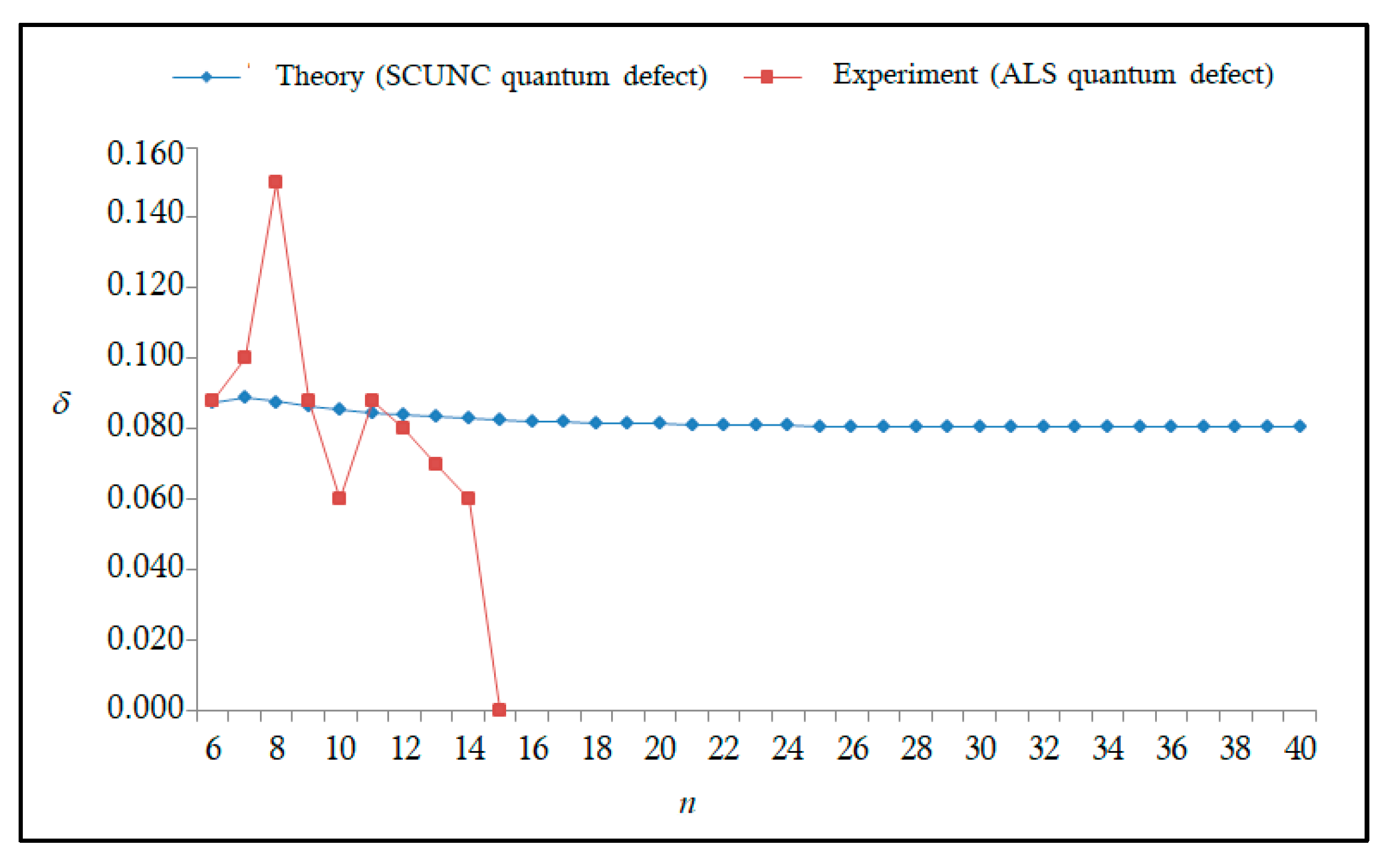
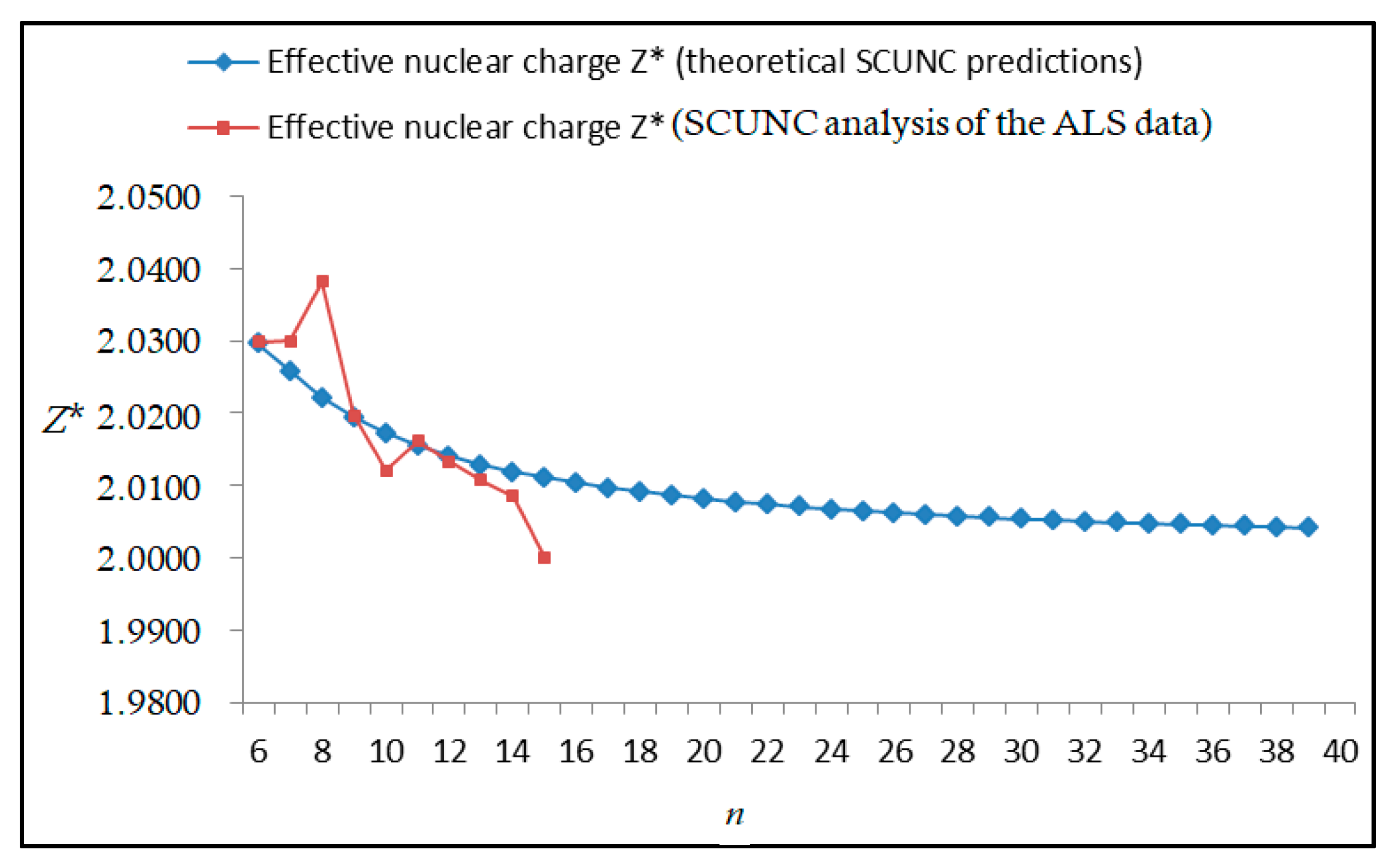
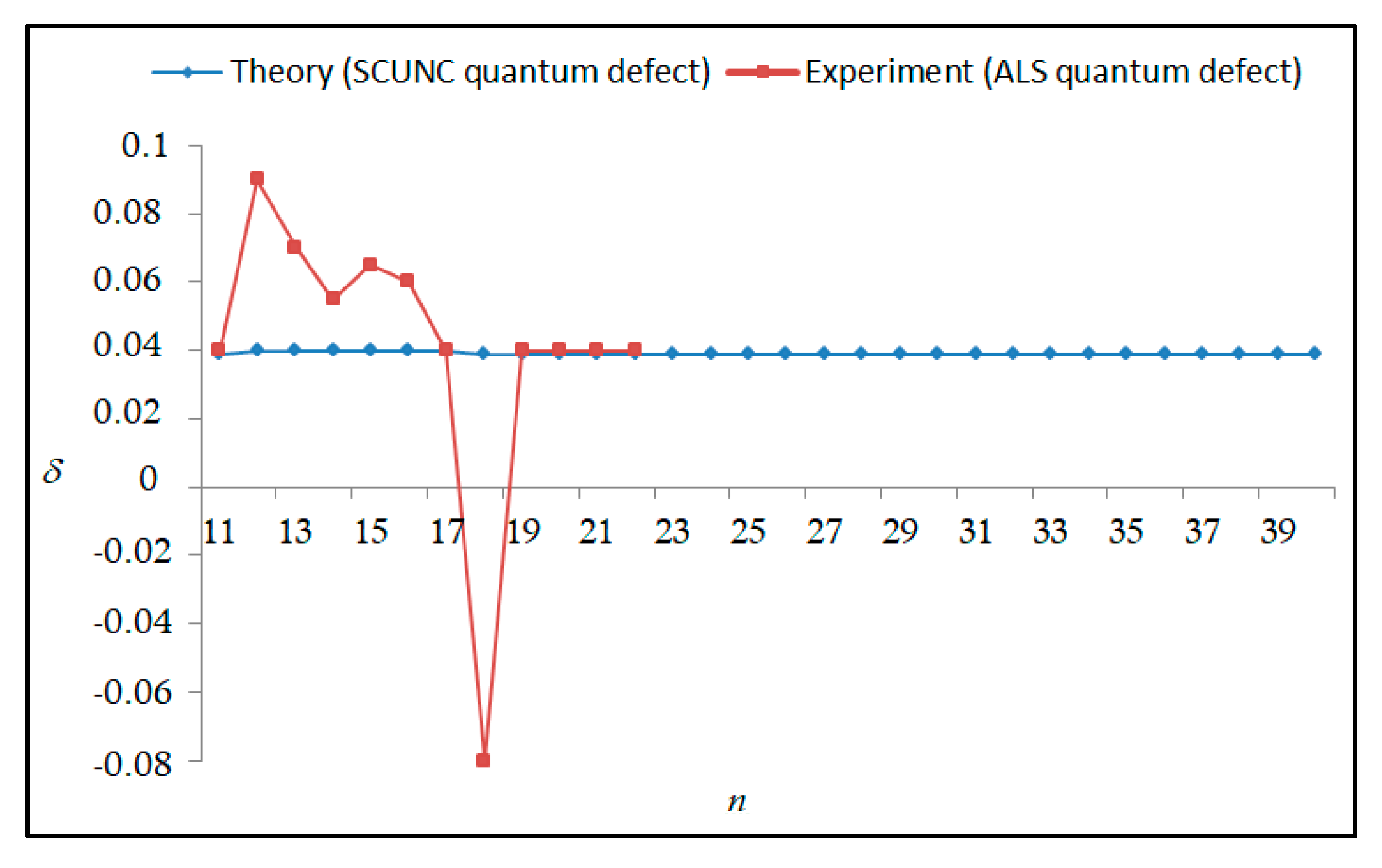
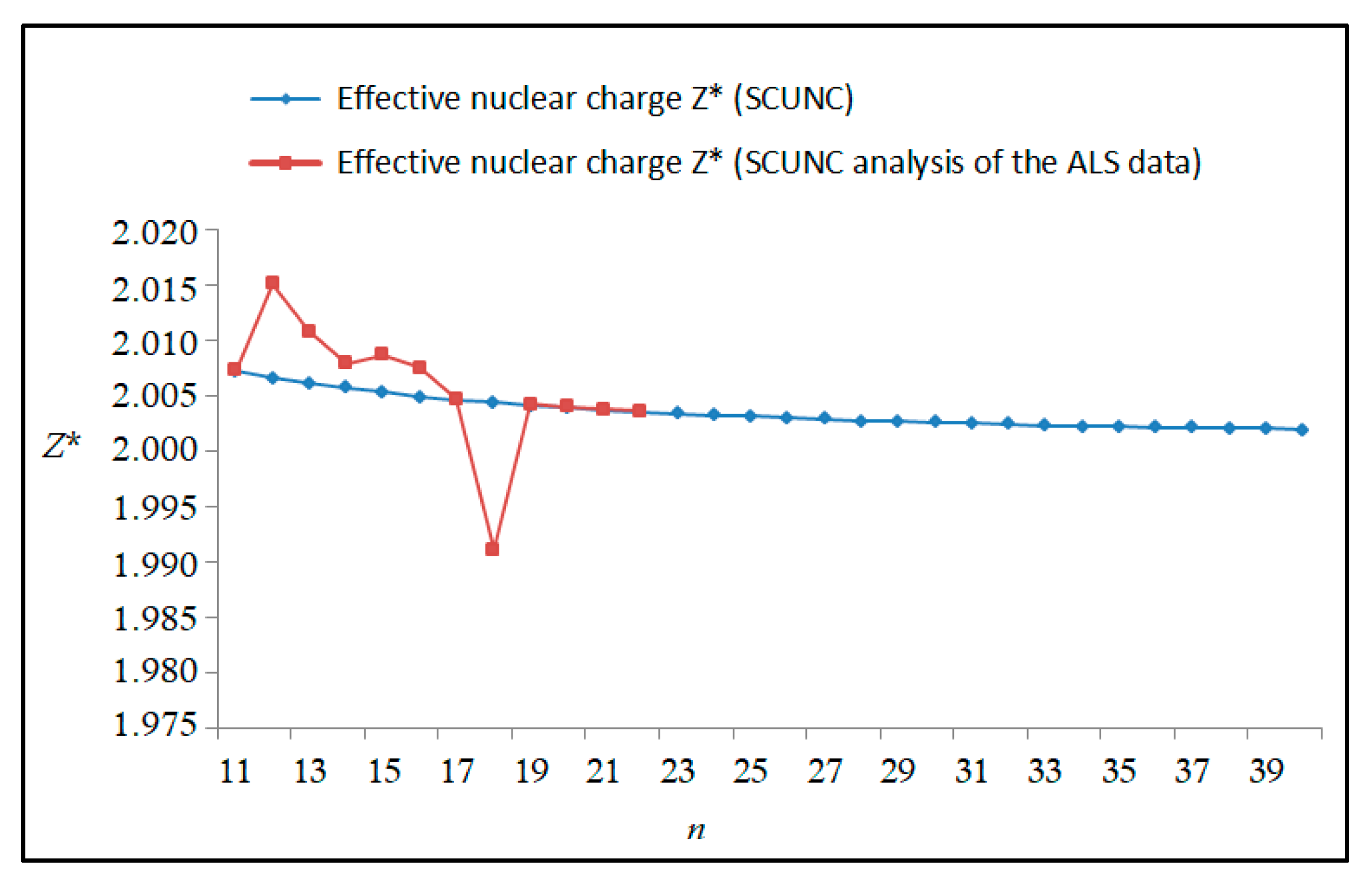
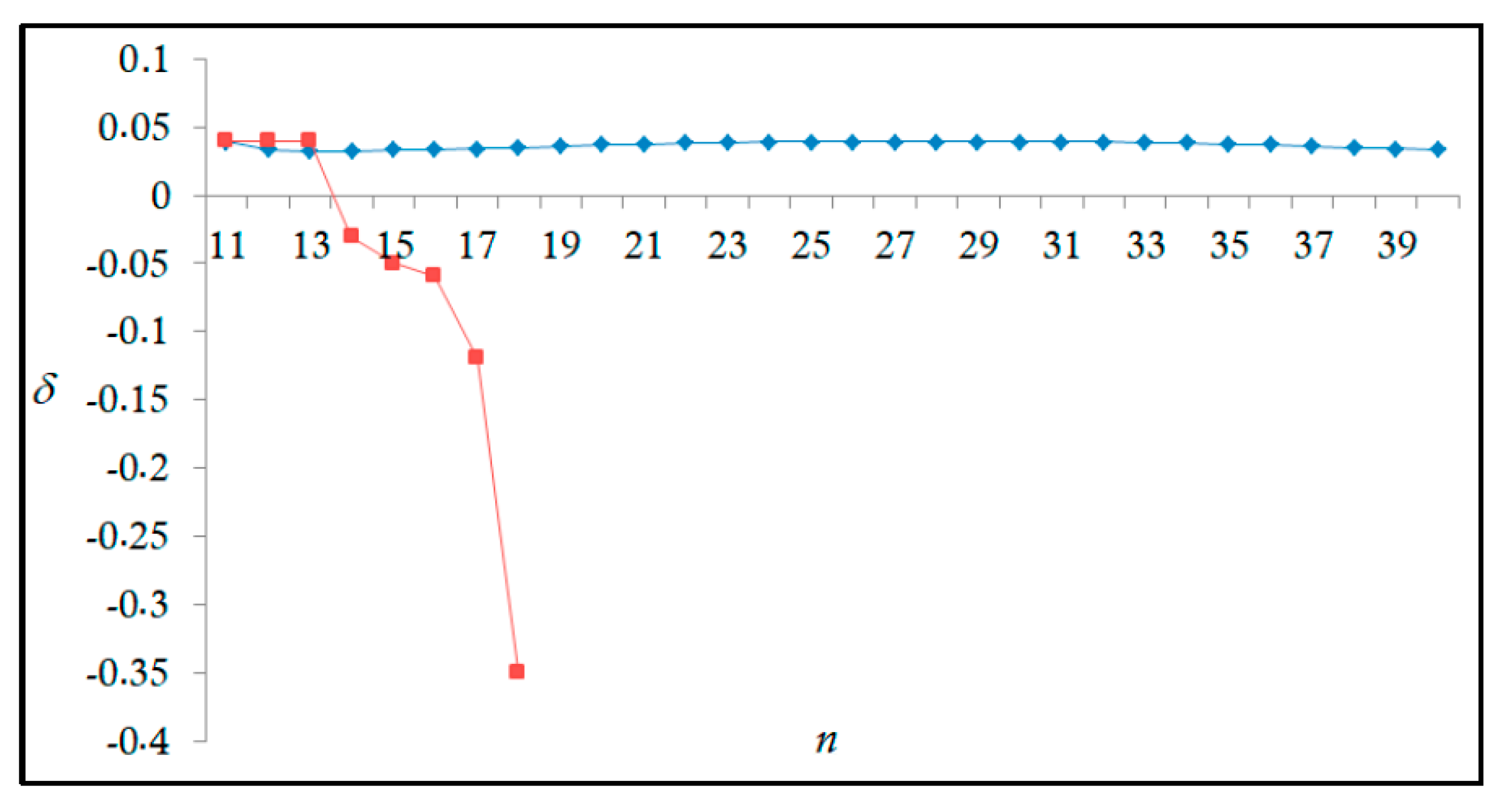
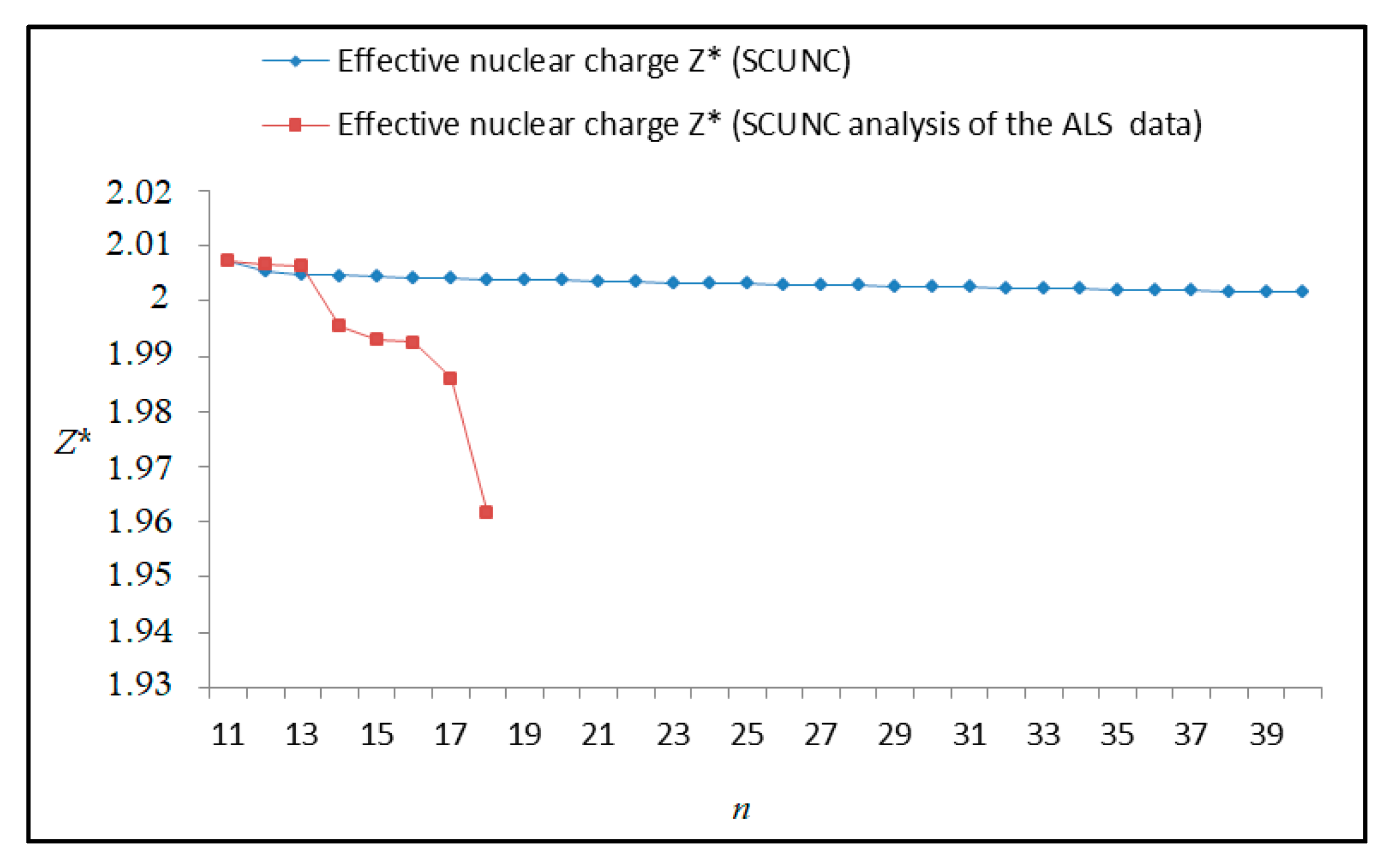
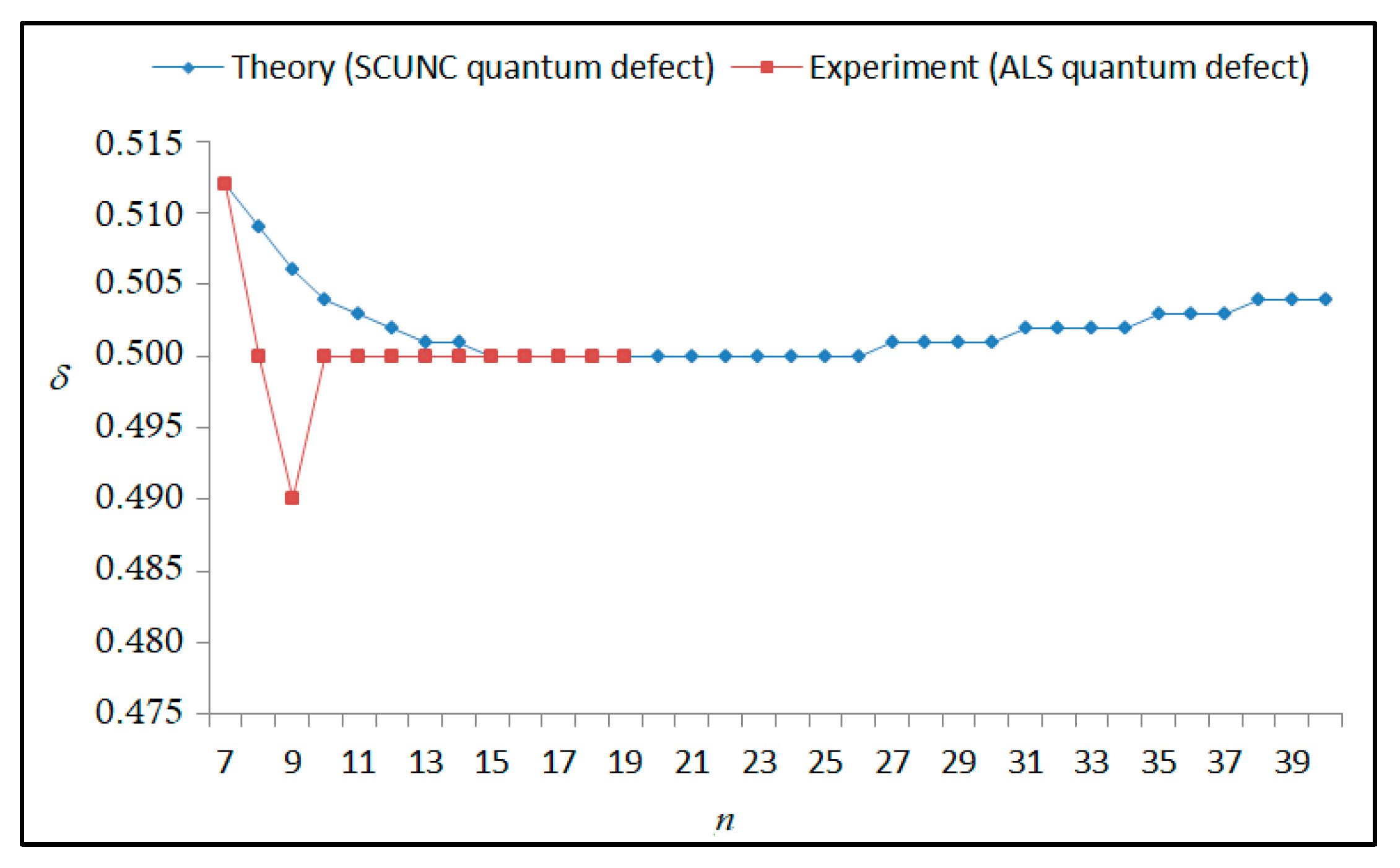
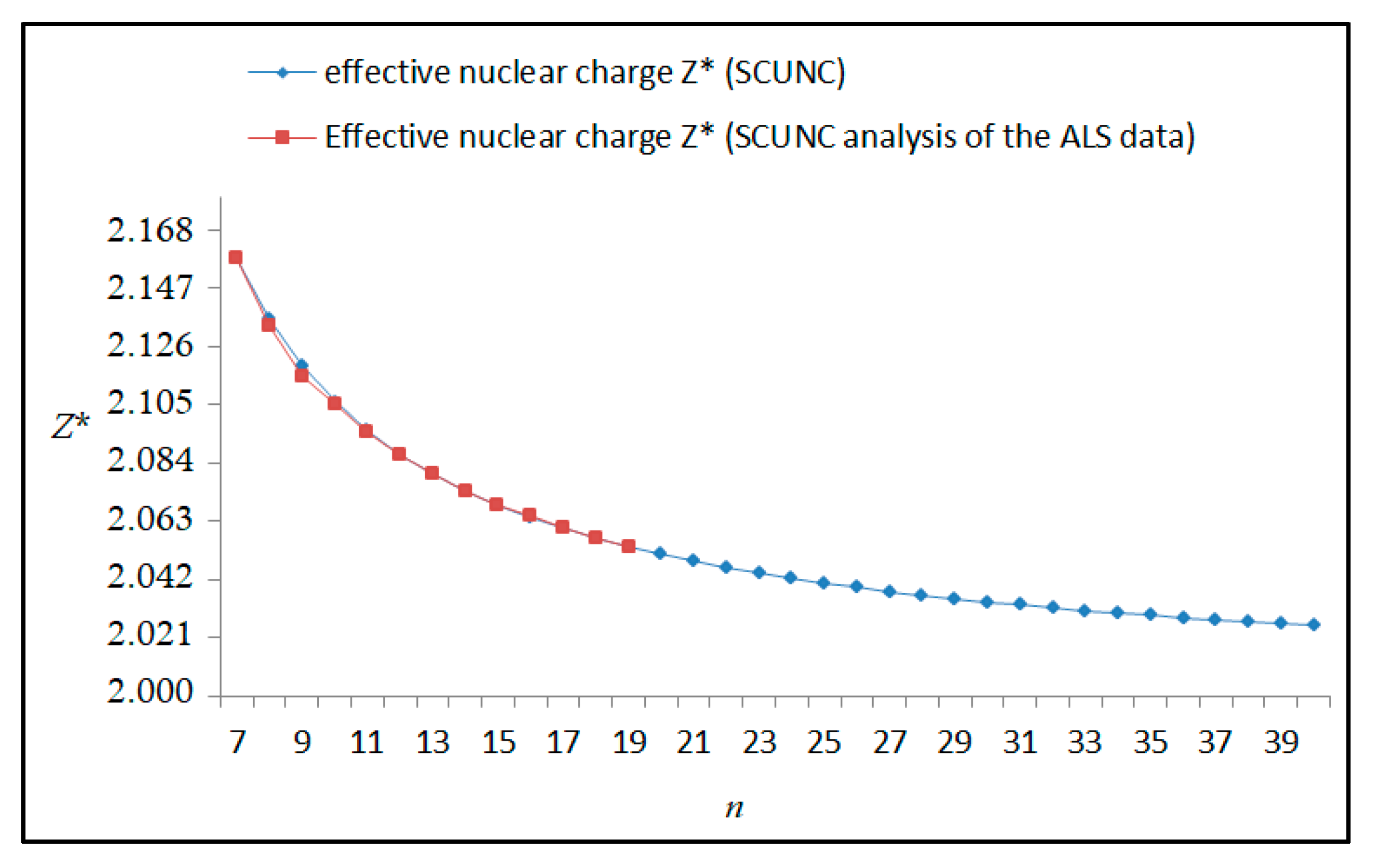
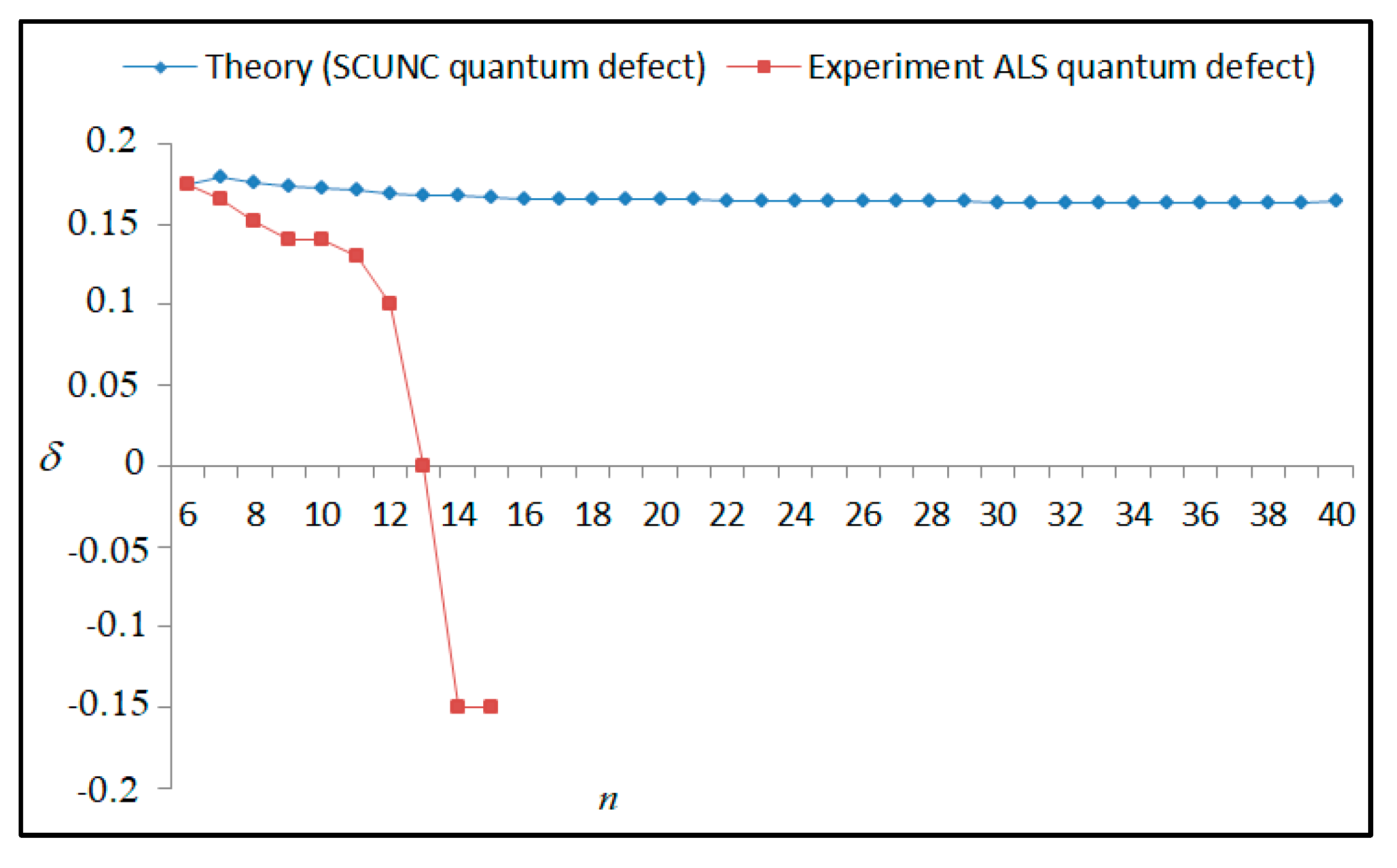
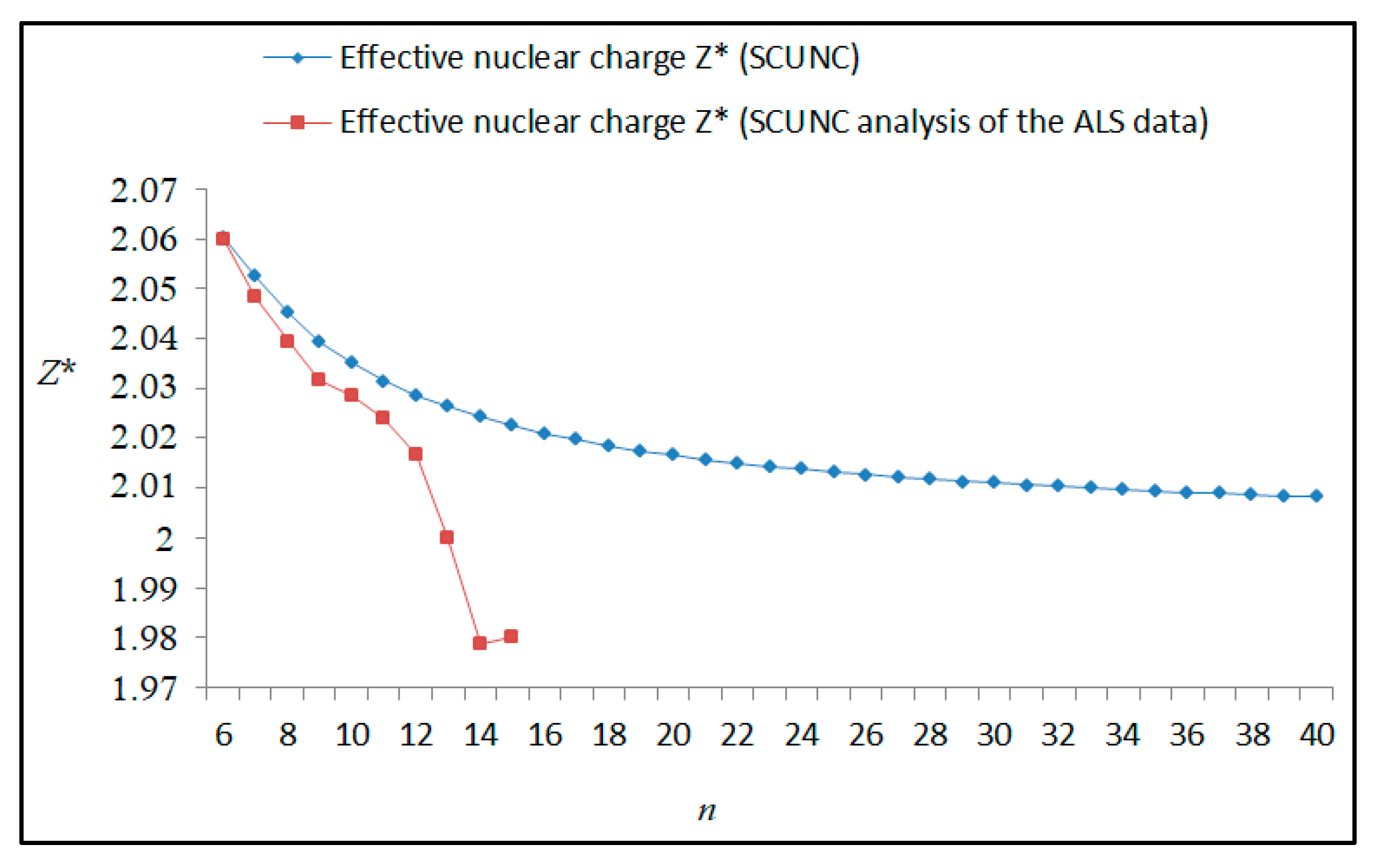
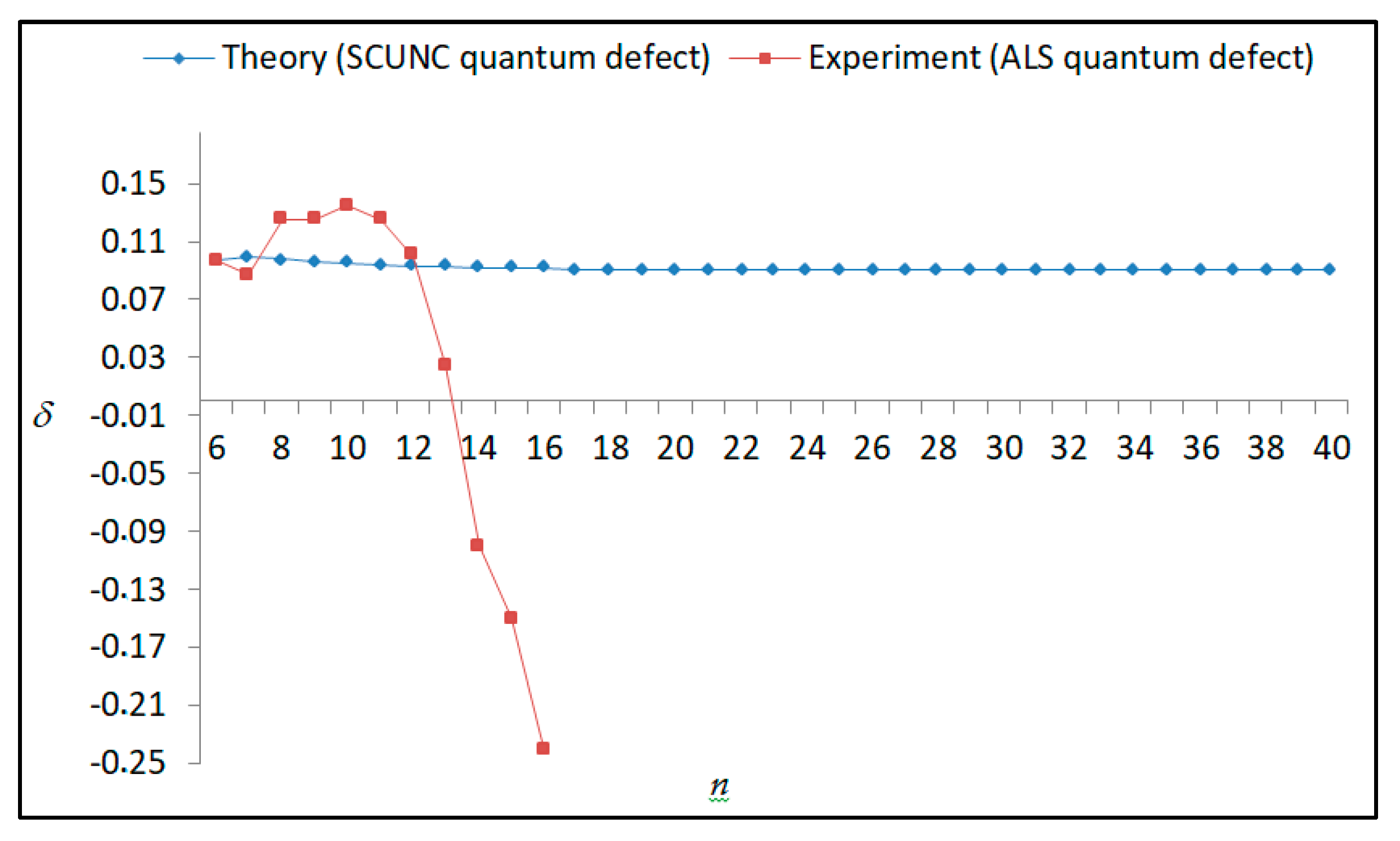
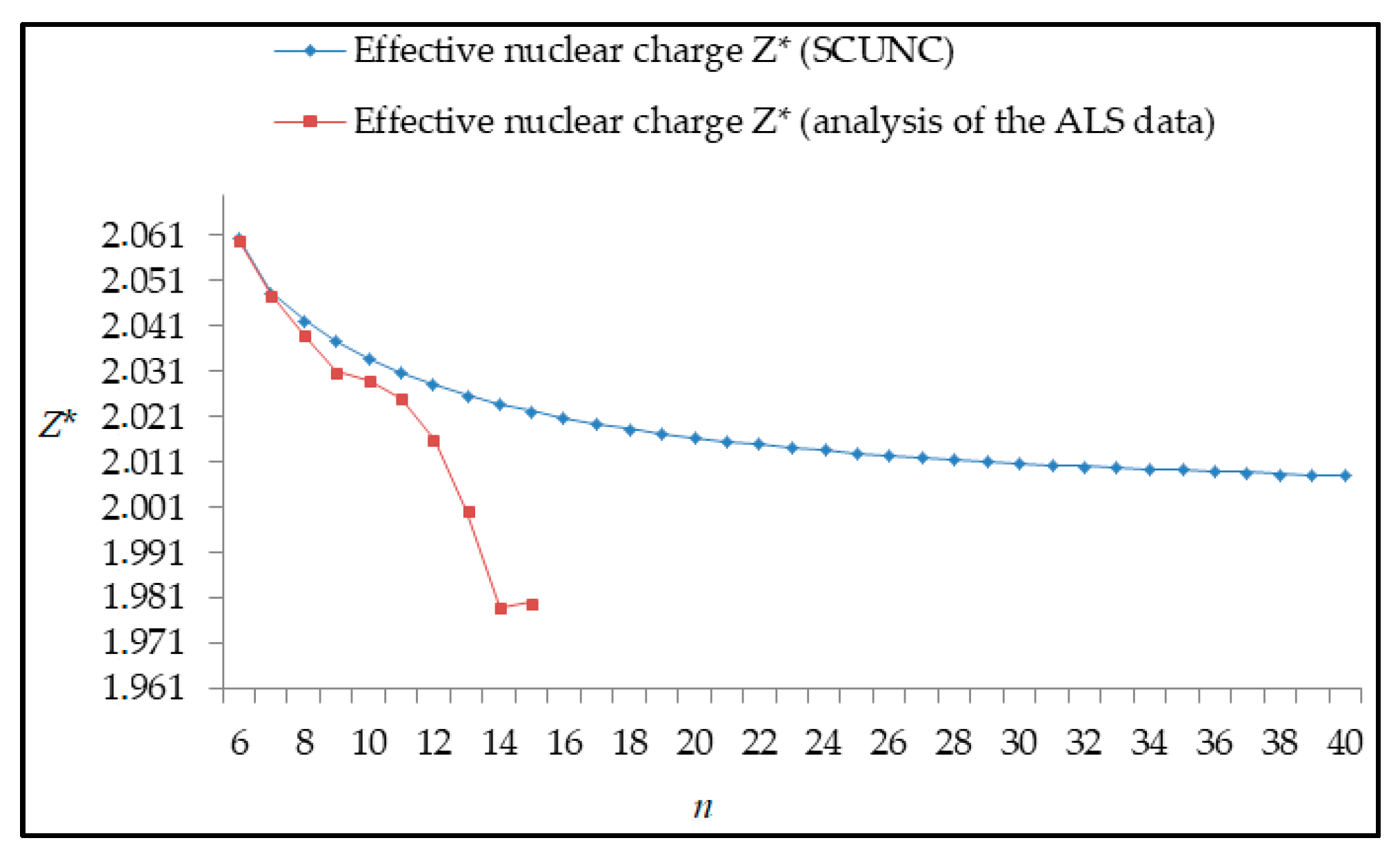
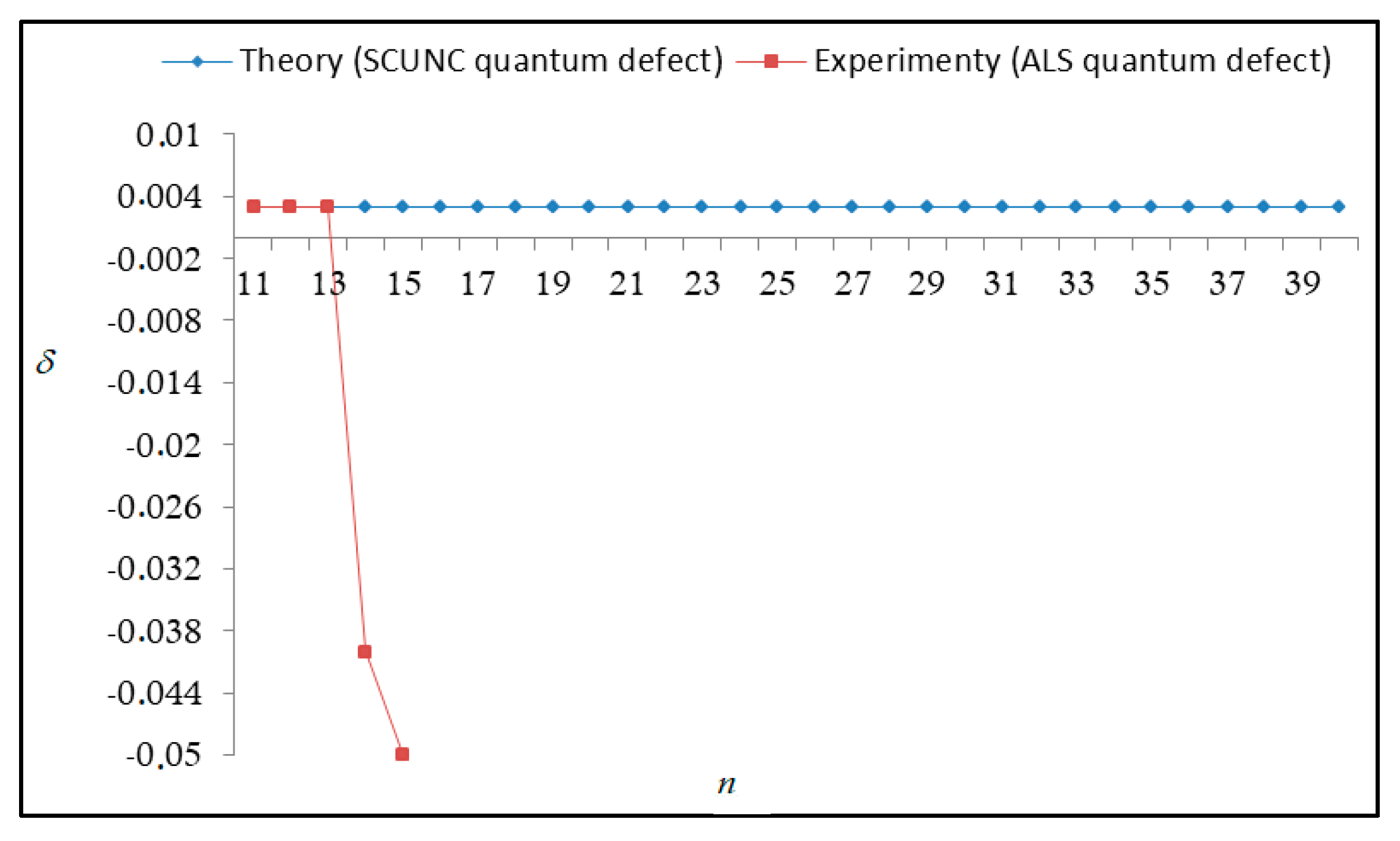
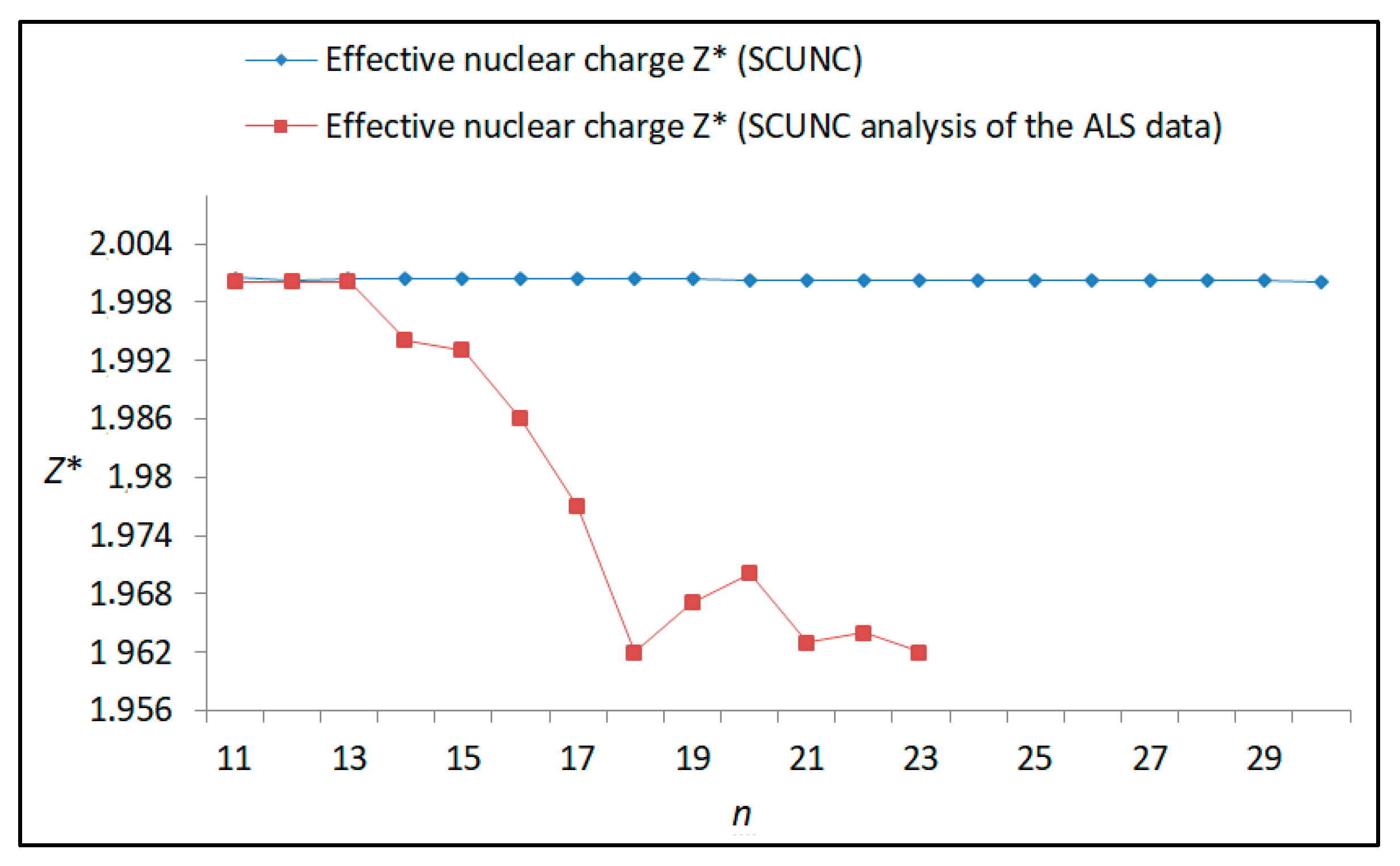
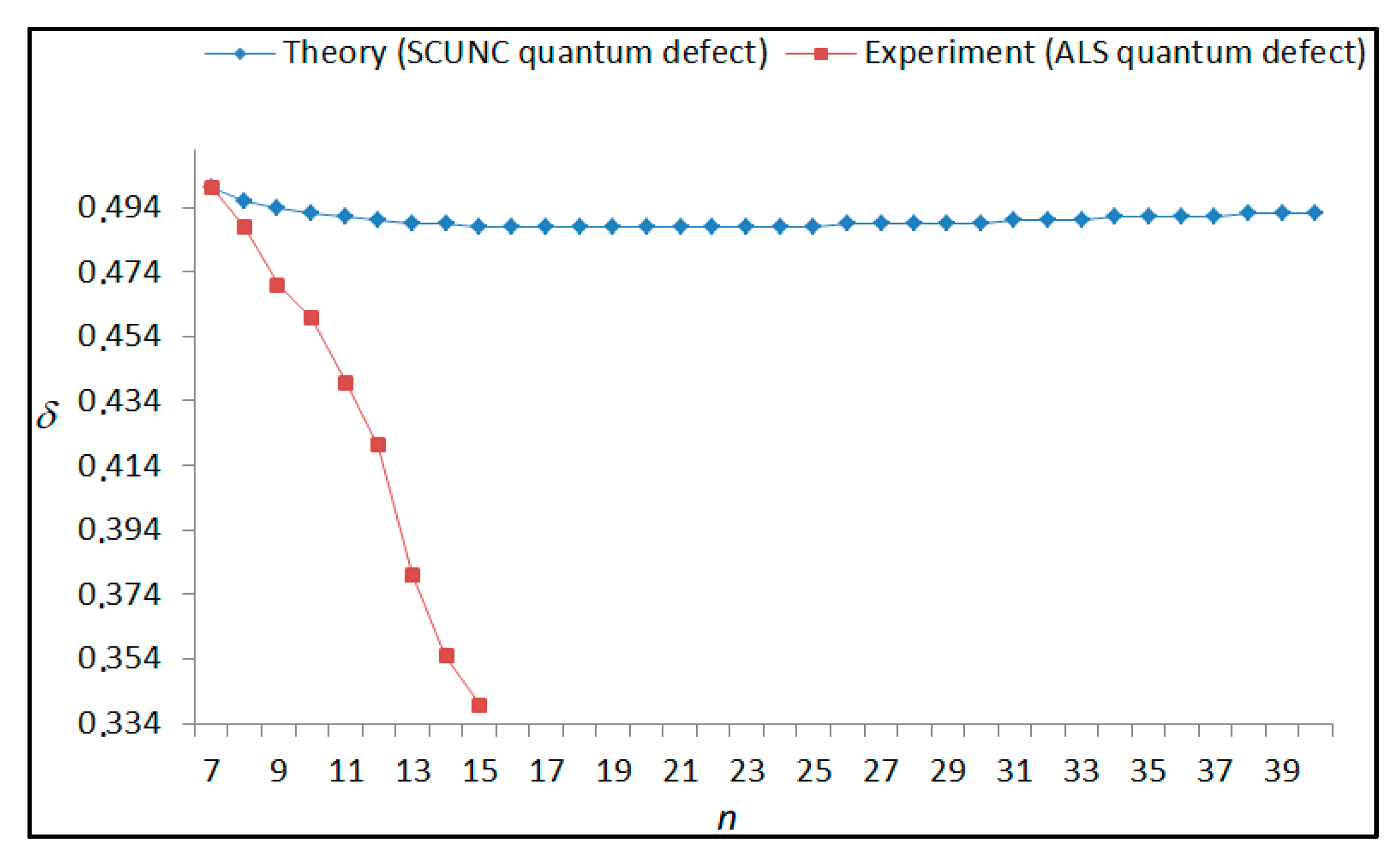
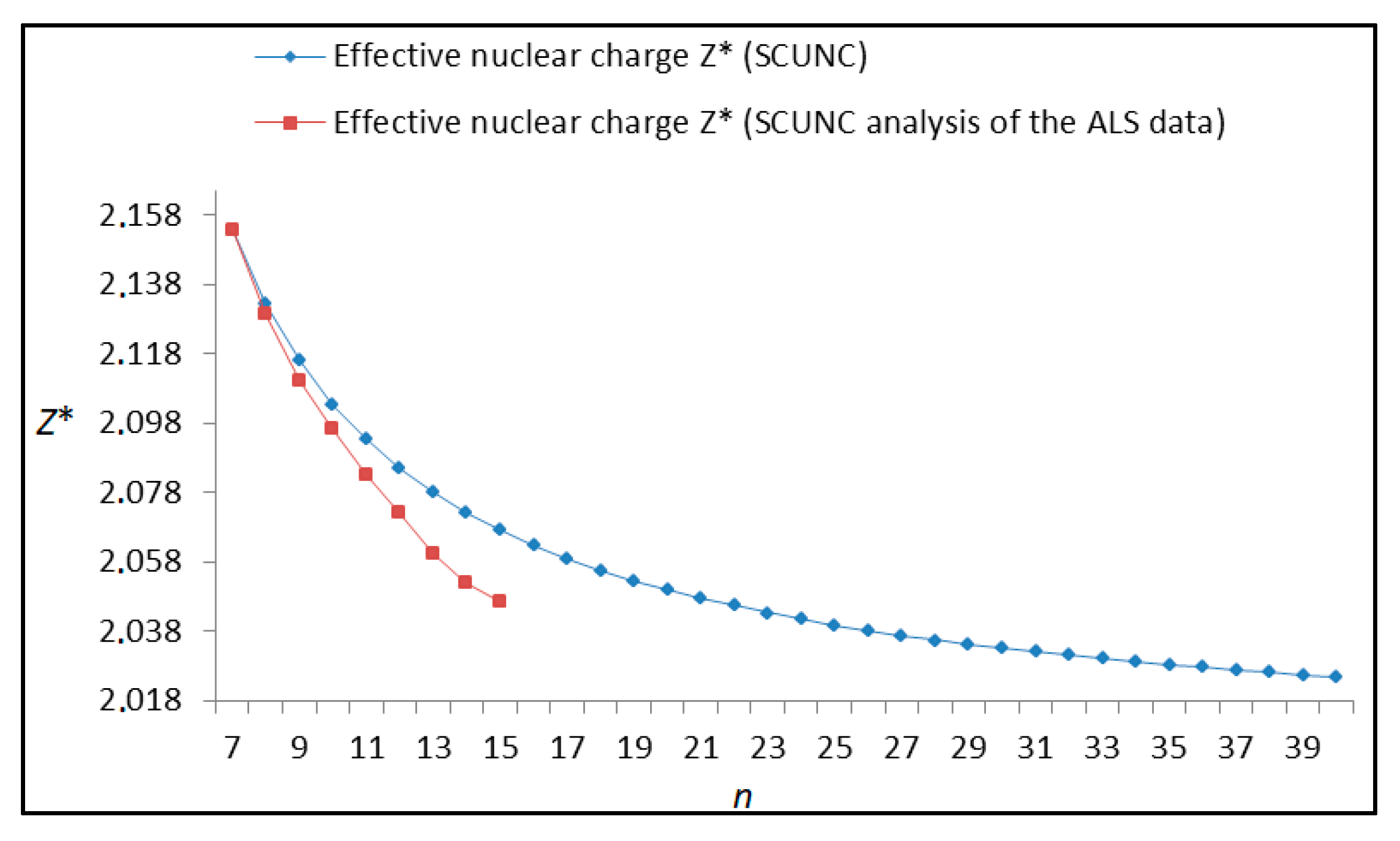
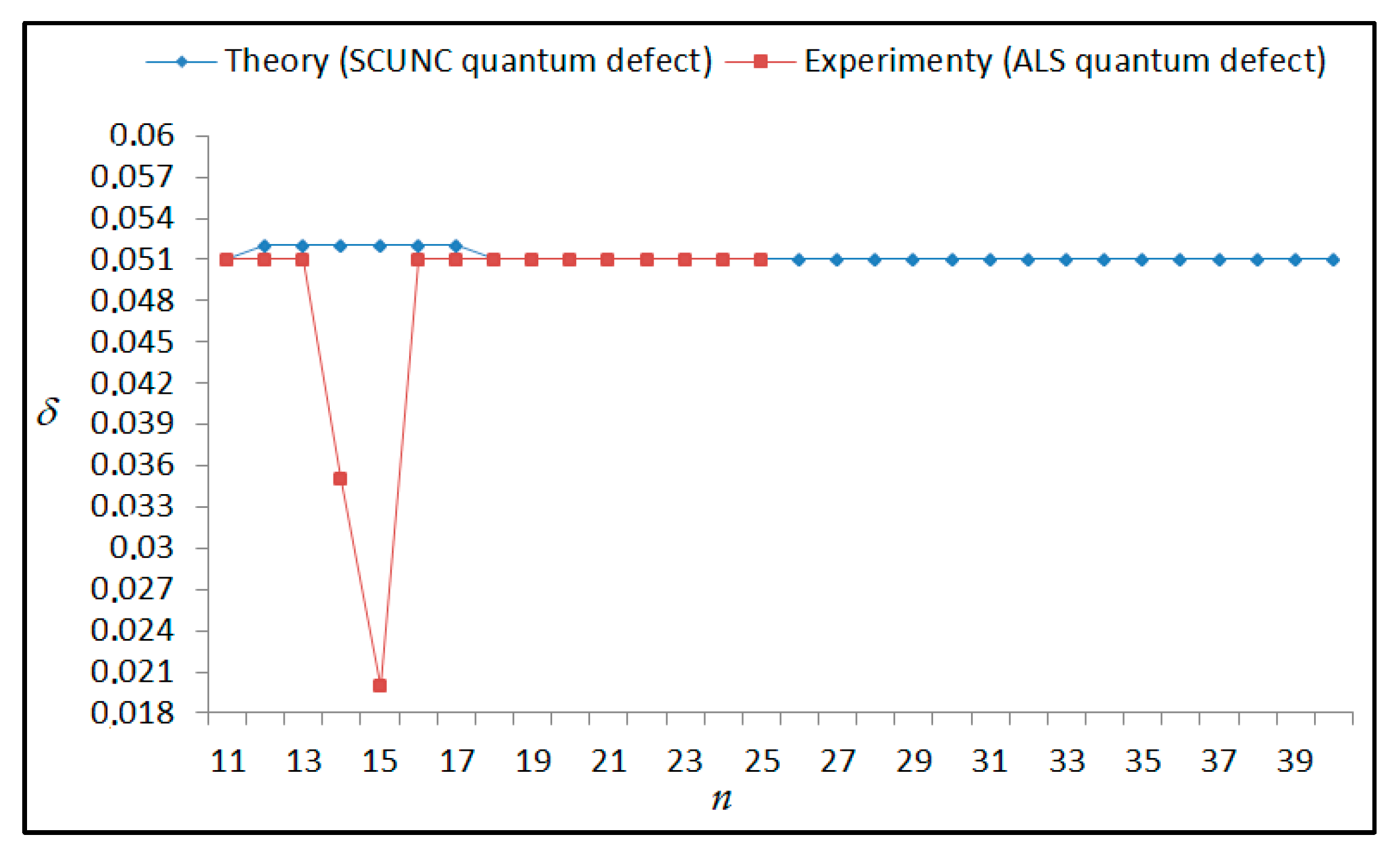
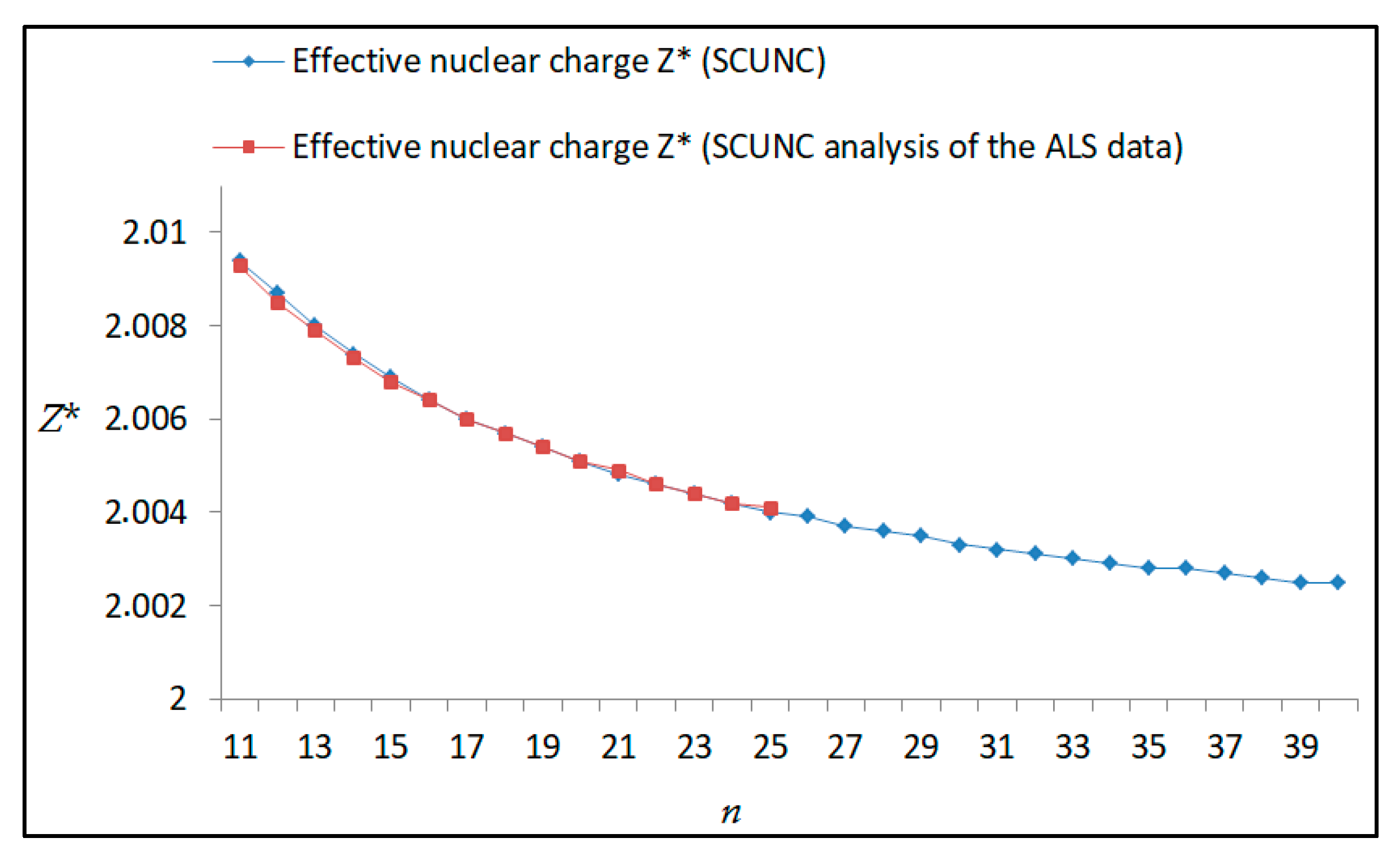
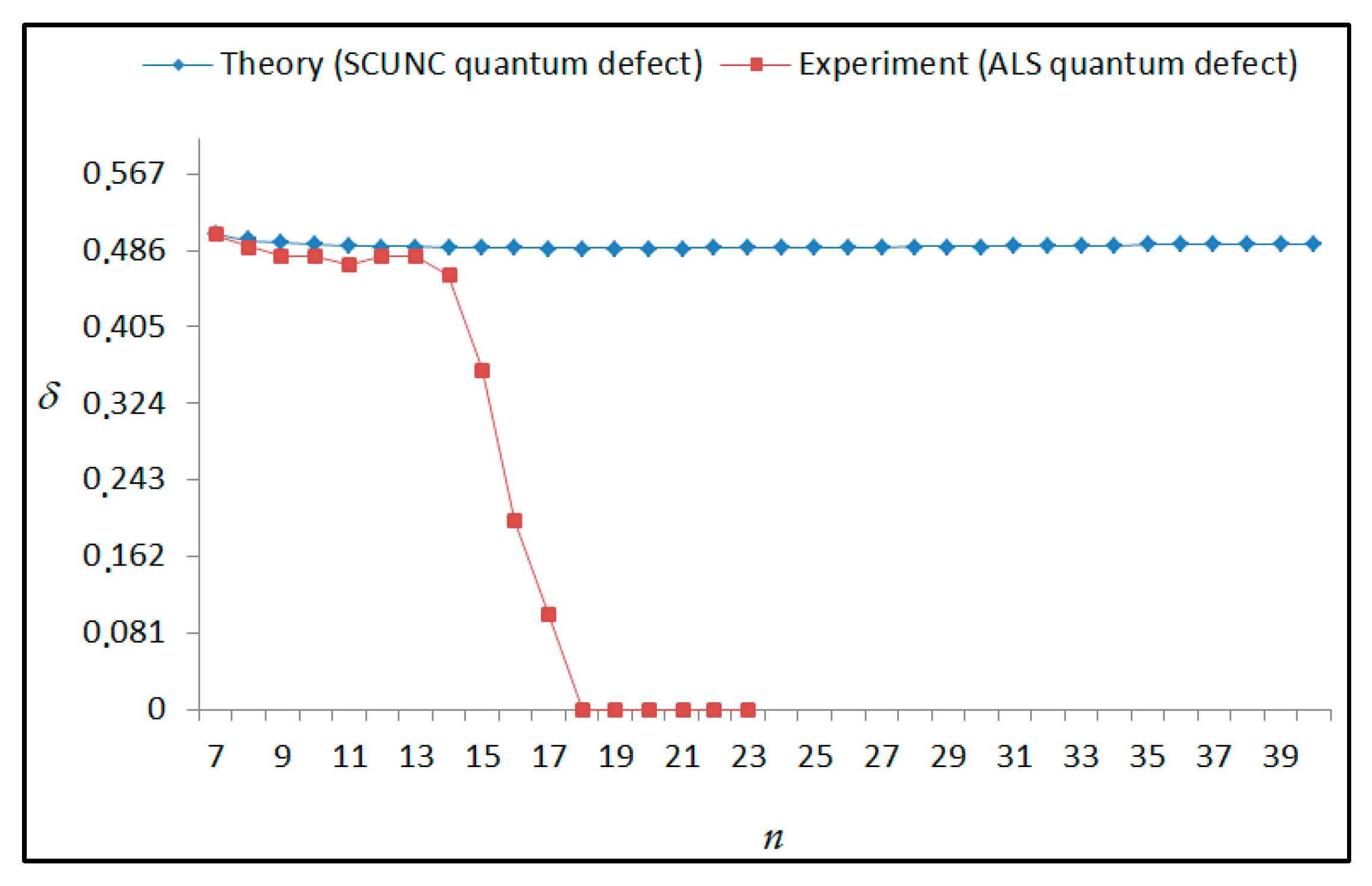
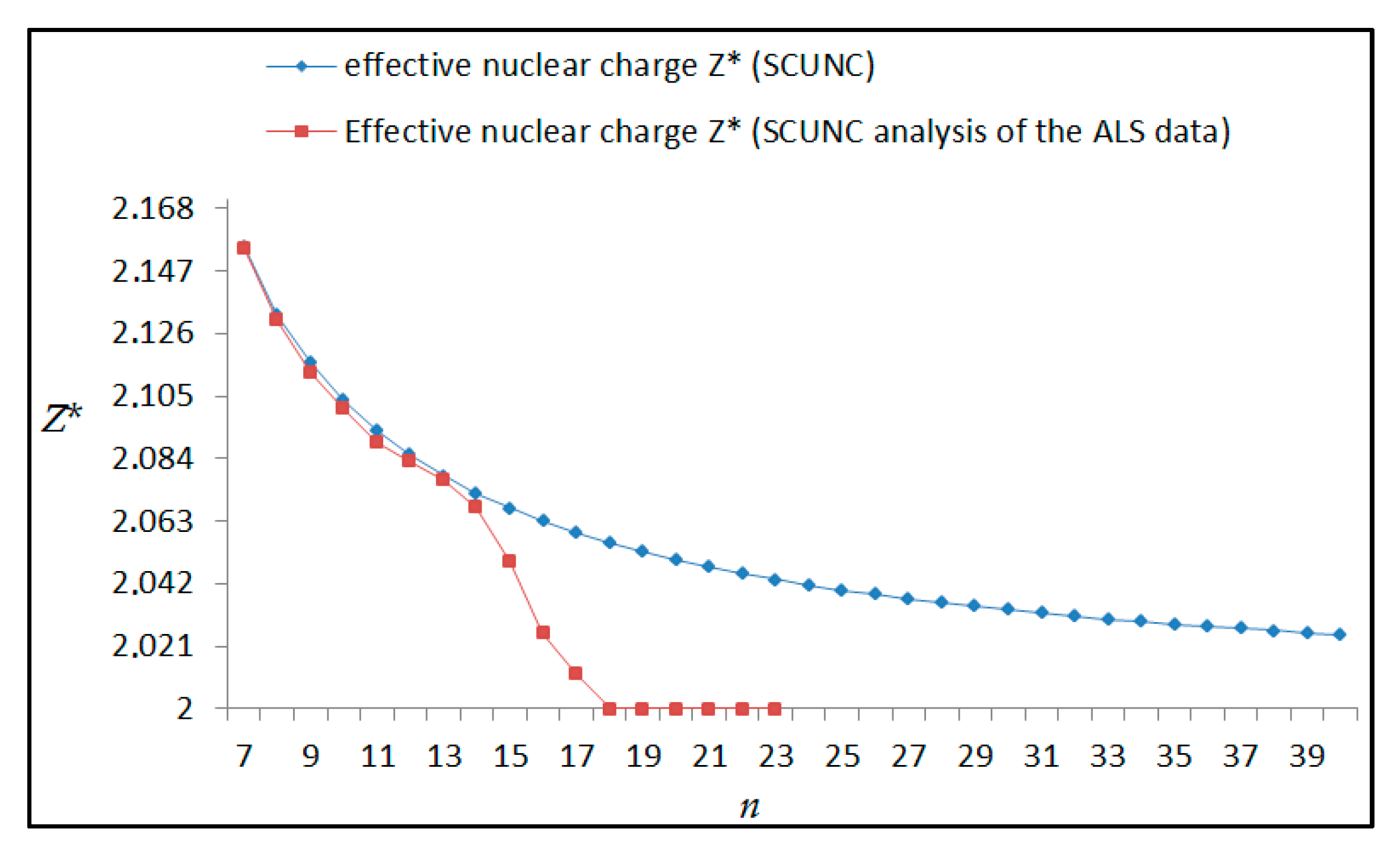
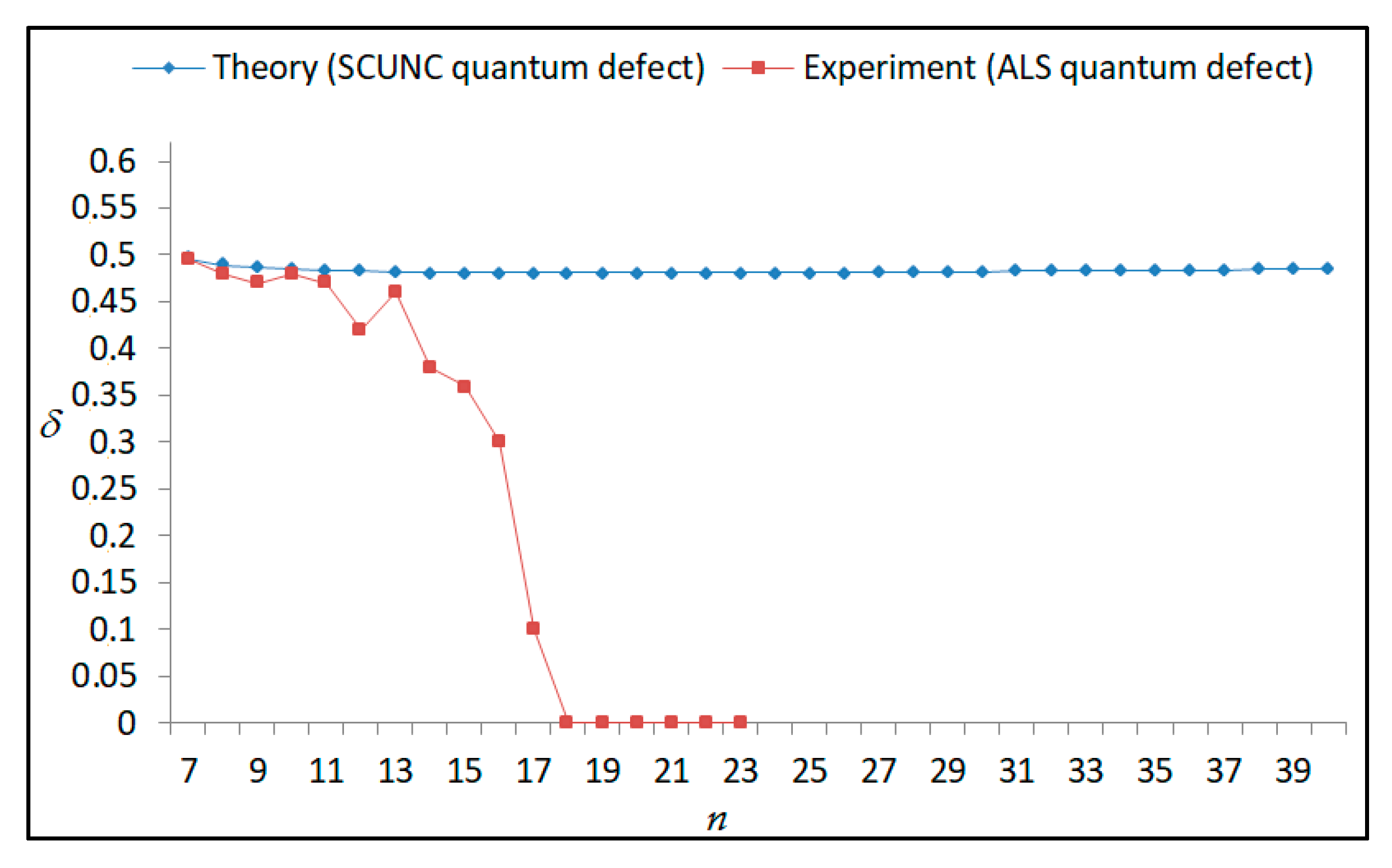
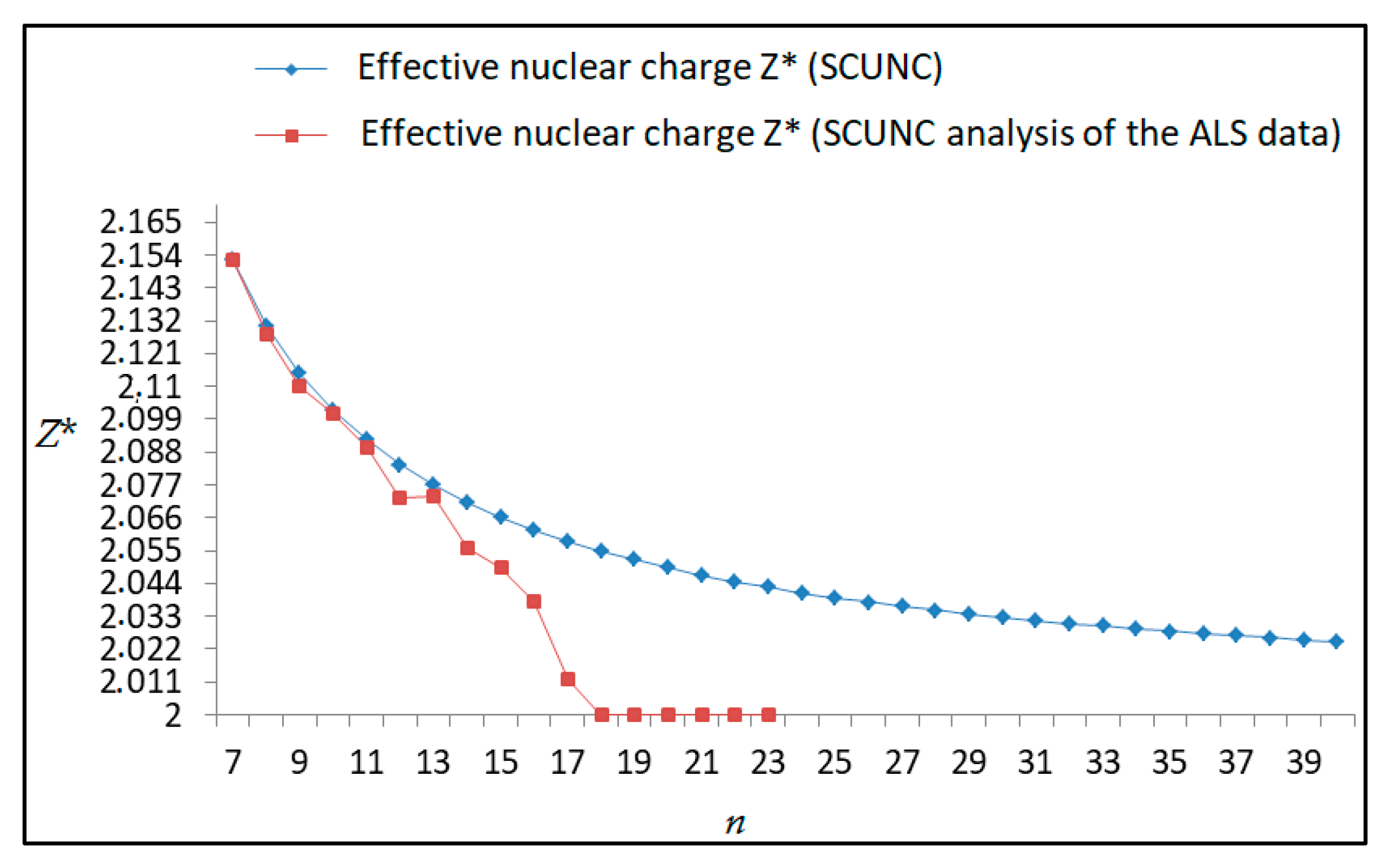
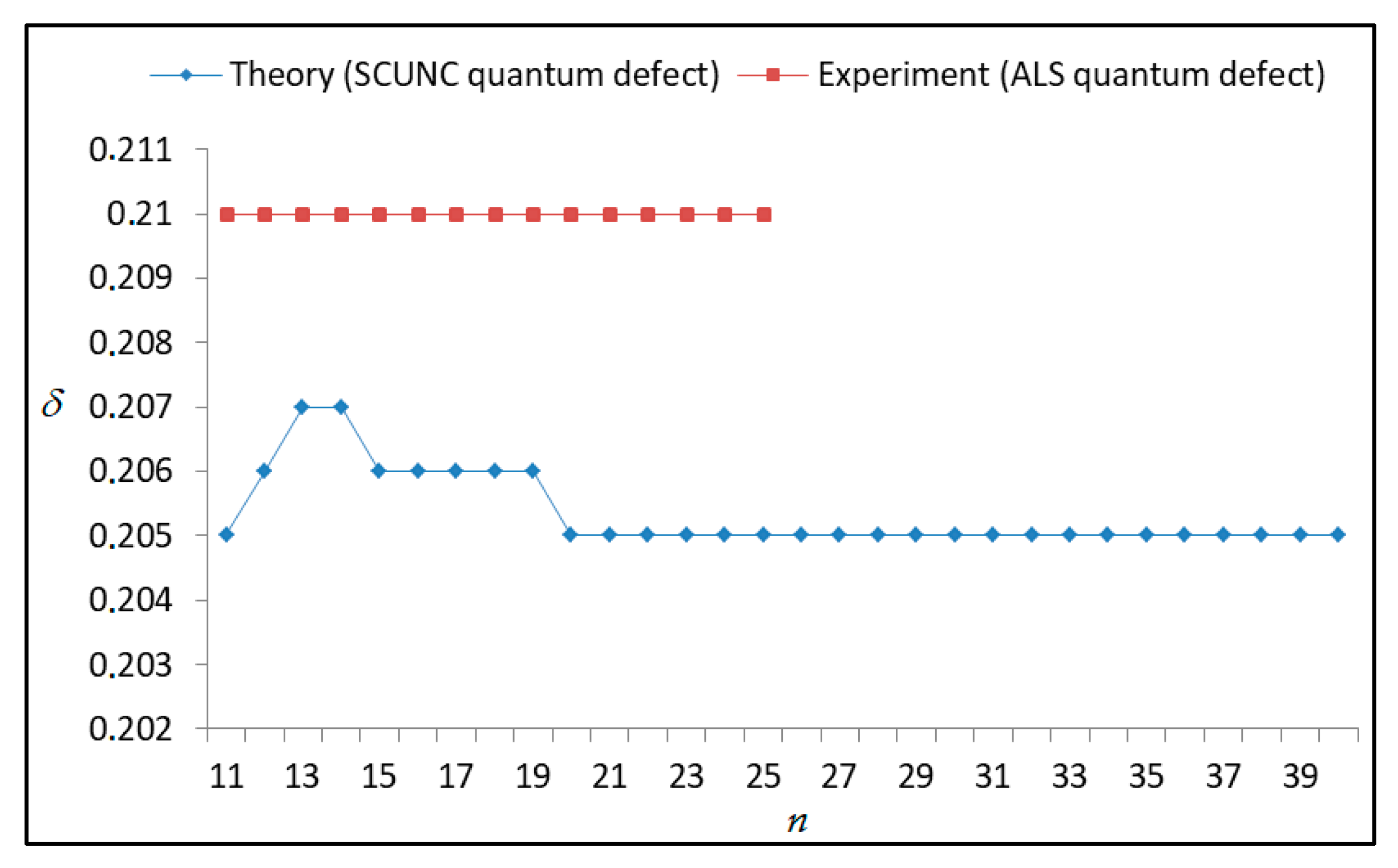
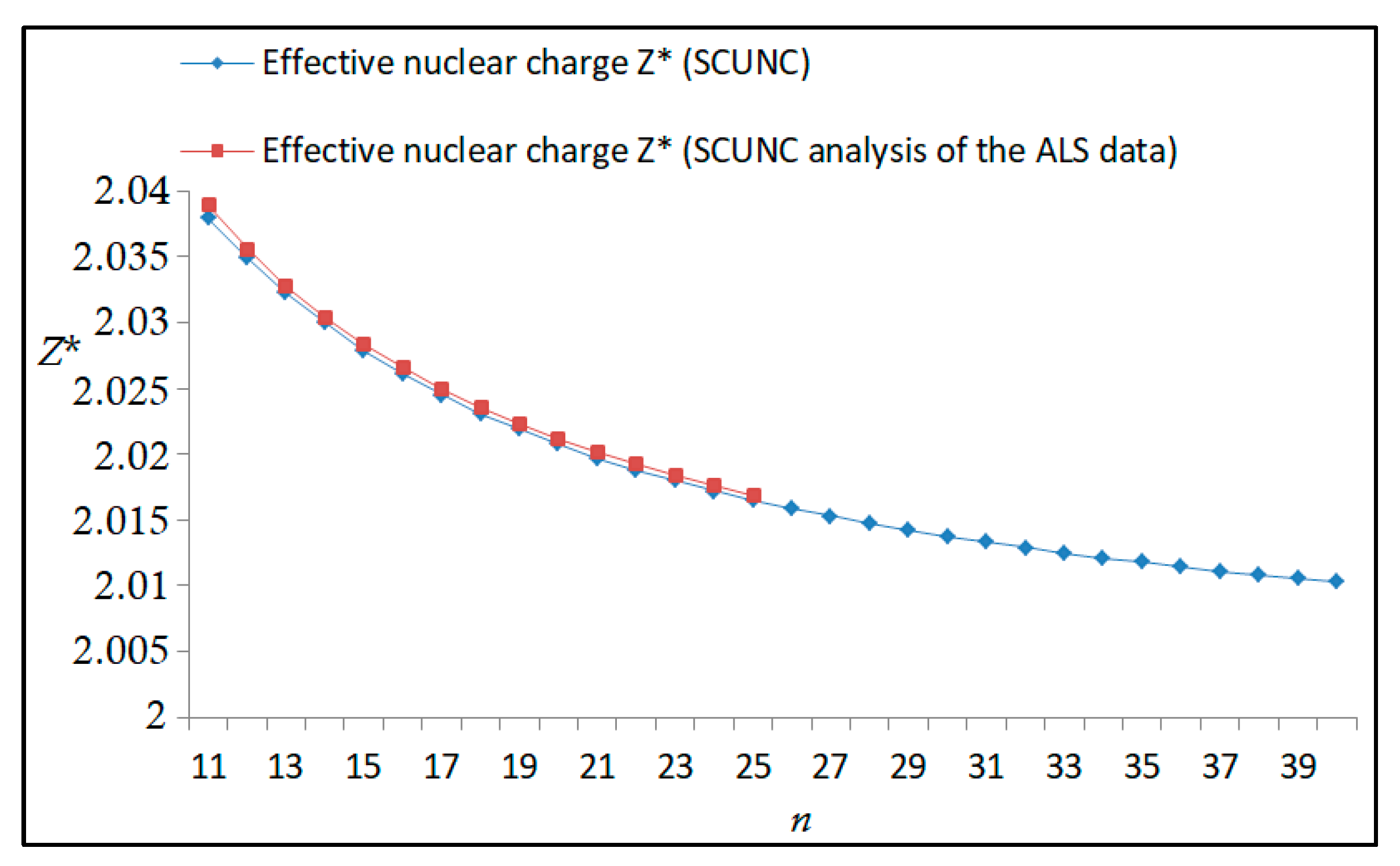
The results obtained in this work are listed in Table 1, Table 2, Table 3, Table 4, Table 5, Table 6, Table 7, Table 8, Table 9, Table 10, Table 11 and Table 12 and compared to the ALS measurements [6]. For all the Rydberg series investigated, the effective nuclear charge Z* related to the ALS data are evaluated from Equation (7) using the experimental ALS quantum defect. Table 1 lists the energy resonances, quantum defect and effective charge of the 4s24p2 (1D2)nd (2S) Rydberg series originating from the 4s24p3 2P°3/2 metastable state of Se+ converging to the 1D2 series limit in Se2+. Comparison indicates excellent agreements between the SCUNC energy resonances and the ALS measurements [6] up to n = 15. For these lines, the shift in energy is less than 0.007 eV. However, the same is not true for quantum defect. The SCUNC data are almost constant up to n = 40, in contrast with the ALS measurements where the quantum defect is equal to zero for n = 15. This is not allowed, as zero quantum defect is obtained in the case of a pure hydrogenic atomic system. As is well-known, the quantum defect is a quantification of the deviation of the true energy of an excited electron in a Rydberg atom from the hydrogenic model [6]. In Figure 1 and Figure 2, the SCUNC and ALS quantum defects and effective nuclear charges are, respectively, plotted versus the principal quantum number n. Correct behaviors of the SCUNC quantum defect and nuclear effective charge are obtained. Table 2 presents the resonances’ parameters evaluated for the 4s24p2 (3P2)nd Rydberg series originating from the 4s24p3 2P°3/2 metastable state of Se+ converging to the 3P2 series limits in Se2+. Here again, the SCUNC and ALS data for energy resonances agree very well. It should be mentioned that the SCUNC formula excellently reproduces the ALS data for n = 16–22, except for n = 18, where negative ALS quantum defect equal to –0.080 is obtained. Subsequently, the SCUNC energy at 18.557 eV corresponding to quantum defect equal to 0.039 is preferable to the ALS data equal to 18.560 eV. The details on the behaviors of the SCUNC and ALS quantum defects and effective nuclear charges with increasing the principal quantum number n are presented in Figure 3 and Figure 4, respectively. Table 3 shows a comparison of the results obtained for the 4s24p2 (3P2)nd Rydberg series originating from the 4s24p3 2P°1/2 metastable state of Se+ converging to the 3P2 series limits in Se2+. Here, the SCUNC formula again excellently reproduces the ALS data for n = 11–13. For n = 14–18, negative ALS quantum defects are obtained where positive values are allowed, which was also mentioned by Esteves et al. [6]. Figure 5 and Figure 6 show the good behaviors of both the quantum defect and effective nuclear charge up to n = 40. For n = 14–18, the SCUNC data may be considered as very accurate. Table 4 shows an excellent agreement between theory and experiment for energy resonances, quantum defect and effective charge of the 4s24p2 (1D2)ns Rydberg series originating from the 4s24p3 2P°3/2 metastable state of Se+ converging to the 1D2 series limit in Se2+. The details of these agreements are presented in Figure 7 and Figure 8. It should be indicated that analysis of the data with respect to the effective nuclear charge give a best way of evaluating the agreement between theory and experiment, as shown in Figure 8. Table 5 indicates a comparison for the SCUNC and ALS energy resonances, quantum defect and effective charge of the 4s24p2 (1D2)nd(2P1/2) Rydberg series originating from the 4s24p3 2P°1/2 metastable state of Se+ converging to the 1D2 series limit in Se2+. For n = 6-12, the SCUNC energy deviations with respect to the ALS data are less than 0.007 eV. For n = 13–15, the ALS quantum defect is equal to zero and becomes negative from n = 14, as shown in Figure 9. However, for all the series, the SCUNC quantum defect is almost constant up to n = 40 (see Figure 9). The SCUNC effective nuclear charge also decreases correctly toward Zcore = 2.0000 when n tends toward infinity, as indicated in Figure 10. It should be underlined that this value is achieved by the ALS measurement for n = 13. Comparison of the results obtained for the 4s24p2 (1D2)nd (2S) Rydberg series originating from the 4s24p3 2P°1/2 metastable state of Se+ converging to the 3P2 series limit in Se2+ is performed in Table 6. Here again, the SCUNC quantum defect is practically constant up to n = 40, while the ALS quantum defects decrease and become negative for n = 14–16. Overall, the shift in energy is less than 0.007 eV for the positive ALS quantum defect. For the resonances n = 14, 15 and 16, the SCUNC energy are, respectively, at 19.674 eV, 19.710 eV and 19.740 eV, and the associated quantum defect is constant and equal to 0.92, which is in contrast with the ALS quantum defects at −0.100, −0.150 and −0.240, respectively. The details regarding the evolution of the quantum defect and the effective nuclear charge are presented in Figure 11 and Figure 12, respectively. Table 7 also indicates negative ALS quantum defects for n = 14–23 as far as the 4s24p2 (3P2)nd Rydberg series are concerned. For these series, the SCUNC quantum defect is constant and equal to 0.003 up to n = 40, as revealed in Figure 13 and Figure 14. The SCUNC energy resonances for n = 14–23 may be very good data references. Table 8 and Table 9 list the results obtained, respectively, for the 4s24p2 (1D2)ns Rydberg series originating from the 4s24p3 2P°1/2 metastable state of Se+ converging to the 1D2 series limit in Se2+ and for the 4s24p2 (3P2)nd Rydberg series originating from the 4s24p3 2D°3/2 metastable state of Se+ converging to the 3P2 series limit in Se2+. For Table 8, the energy deviation with respect to the ALS data is less than 0.007 eV, attesting to the very good agreement between theory and experiment. Table 9 shows an excellent agreement between the SCUNC data and the ALS measurements, where the SCUNC reproduces the ALS data, except for n = 14 and 15, with a shift in energy at 0.001 and 0.002 eV, respectively. The details regarding the behaviors of both quantum defects and effective nuclear charges for the 4s24p2 (1D2)ns and 4s24p2 (3P2)nd Rydberg series are presented in Figure 15 and Figure 16 for the 4s24p2 (1D2)ns states and in Figure 17 and Figure 18 for the 4s24p2 (3P2)nd states. Table 10 and Table 11 present the results obtained, respectively, for the 4s24p2 (1D2)ns (2D) Rydberg series originating from the 4s24p3 2D°5/2 metastable state of Se+ converging to the 1D2 series limit in Se2+ and the 4s24p2 (1D2)ns (2D) Rydberg series originating from the 4s24p3 2D°3/2 metastable state of Se+ converging to the 1D2 series limit in Se2+. For these data, it is seen that the SCUNC quantum defects are almost constant up to n = 40, which is in contrast with the ALS quantum defects becoming equal to zero for n = 18–23, corresponding to an effective nuclear charge at 2.0000 as shown, respectively, in Figure 19 and Figure 20. For these resonances, constant SCUNC quantum defects are obtained and equal to 0.490 (Table 10) and to 0.481 (Table 11). For the accurate ALS quantum defect more than 0.450, the energy deviations are less than 0.005 eV for the data quoted in both Table 10 and Table 11. The details in the accuracy of both quantum defect and effective nuclear charge for the data quoted in Table 11 are presented in Figure 21 and Figure 22. Finally, Table 12 lists the energy resonances, quantum defect and effective charge of the 4s24p2 (3P2)nd Rydberg series originating from the 4s24p3 4S°3/2 ground state of Se+ converging to the 3P2 series limit in Se2+. Here, the SCUNC formula excellently reproduces the ALS energy resonances except for n = 12, where the ALS data is at 21.219 eV compared to the accurate SCUNC prediction at 21.291 eV. Using the ALS effective nuclear charge Z* = 2.0356 from the SCUNC analysis and E∞ = 21.682 eV, Equation (4) gives the corrected ALS data E12 = 21,290 eV for the (3P2)12d. Subsequently, the ALS data at 21.219 may probably be an error occurring during the typewriting step (it seems that the positions of 1 and 9 have been inverted). As far as quantum defect and effective nuclear charge are concerned, the good agreement between theory and experiment is shown in Figure 23 and Figure 24. On the other hand, it should be mentioned that for the 4s24p2 (1D2)nd (2D) and 4s24p2 (1D2)ns (2D) and of the 4s24p2 (1D2)nd (2S) and 4s24p2 (1D2)nd (2P1/2) Rydberg series, the ALS data overlap. As shown in Table 5 and Table 6, the ALS data for the two levels 4s24p2 (1D2)12d(2P1/2) and 4s24p2 (1D2)12d (2S) are equal to 19.571 eV, with a quantum defect at 0.100. In the same way, the levels 4s24p2 (1D2)18d(2P1/2) and 4s24p2 (1D2)18d (2S) are equal to 19.718 eV, with a negative quantum defect at −0.150. For these overlap lines, the SCUNC predicts separate levels associated with the energies 19.556 eV and 19.571 eV, respectively, for the 4s24p2 (1D2)12d(2P1/2) and 4s24p2 (1D2)12d (2S) levels. The corresponding quantum defects are at 0.169 and 0.093, respectively. As a result, the 19.571 eV ALS data may be for the 4s24p2 (1D2)12d (2S) level and not for 4s24p2 (1D2)12d(2P1/2). In addition, the SCUNC predictions for the 4s24p2 (1D2)18d(2P1/2) and 4s24p2 (1D2)18d (2S) levels are at 19.708 eV and 19.710 eV, respectively. The ALS data at 19.718 eV associated with a negative quantum defect at –0.150 may be uncertain. As explained by Esteves et al. [6], some resonances in the ALS analysis have not been resolved, either due to interference from other series or to limitations in photon energy resolution at high n values. In addition, McLaughlin and Balance [7] have shown in their works how the presence of interloping resonances disrupt the regular Rydberg pattern of the resonances. Probable strong coupling series occur in the photoionization processes of the Se+ ions. Anyway, the overlapping ALS lines and the negative quantum defects measured may be explained by the interference from other series, causing strong interseries coupling and/or limitations in photon energy resolution at high n values. In the SCUNC predictions, these narrow lines are clearly identified. The constant behavior of δ along all the series may indicate that the probable strong interseries perturbations due to interference between series has no effect on the fitting parameters f1 and f2. This may demonstrate the stability of Equations (12)–(14) and, subsequently, the utility of the SCUNC formalism to separately identify high-lying narrow interfering series. On the other hand, before closing the discussion section, it is interesting to remind one what the main advantages of using the SCUNC method are. For the various techniques of calculations applied in atomic physics, the R-matrix approach is seen to be the most sophisticated and widely used method [22]. As pointed out by McLaughlin and Ballance [7], in R-matrix theory, all photoionization (PI) cross-section calculations require the generation of atomic orbitals based primarily on the atomic structure of the residual ion. In their works, the PI of the Se+ ions employs relativistic atomic orbitals generated for the residual Se2+ ions which were calculated using the extended-optimal-level (EOL) procedure within the GRASP structure code. In addition, to calculate the direct photoionization cross-sections in these experiments, Bizau et al. [23] performed the multiconfiguration Dirac-Fock (MCDF) calculations using the code developed by Bruneau [24]. These particular examples indicate that calculations or experiments based on PI cross-section studies require at least:

Table 1.
Energy resonances (E), quantum defect (δ) and effective charge (Z*) of the 4s24p2 (1D2)nd (2S) Rydberg series originating from the 4s24p3 2P°3/2 metastable state of Se+ converging to the 1D2 series limit in Se2+. The present results (SCUNC) are compared with the experimental data from ALS measurements [6]. The uncertainties in the experimental energies are stated to be ±0.010 eV. The value of Zcore = 2.0000 is indicated in the last line of the table, f1 (1D2; 2P°3/2) = −0.148 ± 0.033 with ν = 6.
Table 2.
Energy resonances (E), quantum defect (δ) and effective charge (Z*) of the 4s24p2 (3P2)nd Rydberg series originating from the 4s24p3 2P°3/2 metastable state of Se+ converging to the 3P2 series limits in Se2+. The present results (SCUNC) are compared with the experimental data from ALS measurements [6]. The uncertainties in the experimental energies are stated to be ±0.010 eV, f1 (3P2; 2P°3/2) = −0.072 ± 0.042 with ν = 11.
Table 3.
Energy resonances (E), quantum defect (δ) and effective charge (Z*) of the 4s24p2 (3P2)nd Rydberg series originating from the 4s24p3 2P°1/2 metastable state of Se+ converging to the 3P2 series limits in Se2+. The present results (SCUNC) are compared with the experimental data from ALS measurements [6]. The uncertainties in the experimental energies are stated to be ±0.010 eV, f1 (3P2; 2P°1/2) = −0.072 ± 0.042 with ν = 11.
Table 4.
Energy resonances (E), quantum defect (δ) and effective charge (Z*) of the 4s24p2 (1D2)ns Rydberg series originating from the 4s24p3 2P°3/2 metastable state of Se+ converging to the 1D2 series limit in Se2+. The present results (SCUNC) are compared with the experimental data from ALS measurements [6]. The uncertainties in the experimental energies are stated to be ±0.010 eV, f1 (1D2; 2P°3/2) = −0.947 ± 0.050 with ν = 7.
Table 5.
Energy resonances (E), quantum defect (δ) and effective charge (Z*) of the 4s24p2 (1D2)nd(2P1/2) Rydberg series originating from the 4s24p3 2P°1/2 metastable state of Se+ converging to the 1D2 series limit in Se2+. The present results (SCUNC) are compared with the experimental data from ALS measurements [6]. The uncertainties in the experimental energies are stated to be ±0.010 eV, f1 (1D2; 2P1/2; 2P°1/2) = −0.301 ± 0.032 with ν = 6.
Table 6.
Energy resonances (E), quantum defect (δ) and effective charge (Z*) of the 4s24p2 (1D2)nd (2S) Rydberg series originating from the 4s24p3 2P°1/2 metastable state of Se+ converging to the 3P2 series limit in Se2+. The present results (SCUNC) are compared with the experimental data from ALS measurements [6]. The uncertainties in the experimental energies are stated to be ±0.010 eV, f1 (1D2; 2S; 2P°1/2) = −0.165 ± 0.033 with ν = 6.
Table 7.
Energy resonances (E), quantum defect (δ) and effective charge (Z*) of the 4s24p2 (3P2)nd Rydberg series originating from the 4s24p3 2D°5/2 metastable state of Se+ converging to the 3P2 series limit in Se2+. The present results (SCUNC) are compared with the experimental data from ALS measurements [6]. The uncertainties in the experimental energies are stated to be ±0.010 eV, f1 (3P2; 2D°5/2) = −0.005 ± 0.001 with ν = 11.
Table 8.
Energy resonances (E), quantum defect (δ) and effective charge (Z*) of the 4s24p2 (1D2)ns Rydberg series originating from the 4s24p3 2P°1/2 metastable state of Se+ converging to the 1D2 series limit in Se2+. The present results (SCUNC) are compared with the experimental data from ALS measurements [6]. The uncertainties in the experimental energies are stated to be ±0.010 eV, f1 (1D2; 2P°1/2) = −0.923 ± 0.050 with ν = 7.
Table 9.
Energy resonances (E), quantum defect (δ) and effective charge (Z*) of the 4s24p2 (3P2)nd Rydberg series originating from the 4s24p3 2D°3/2 metastable state of Se+ converging to the 3P2 series limit in Se2+. The present results (SCUNC) are compared with the experimental data from ALS measurements [6]. The uncertainties in the experimental energies are stated to be ±0.010 eV, f1 (3P2; 2D°3/2) = −0.094 ± 0.042 with ν = 11.
Table 10.
Energy resonances (E), quantum defect (δ) and effective charge (Z*) of the 4s24p2 (1D2)ns (2D) Rydberg series originating from the 4s24p3 2D°5/2 metastable state of Se+ converging to the 1D2 series limit in Se2+. The present results (SCUNC) are compared with the experimental data from ALS measurements [6]. The uncertainties in the experimental energies are stated to be ±0.010 eV, f1 (1D2; 2D°5/2) = −0.927 ± 0.050 with ν = 7.
Table 11.
Energy resonances (E), quantum defect (δ) and effective charge (Z*) of the 4s24p2 (1D2)ns (2D) Rydberg series originating from the 4s24p3 2D°3/2 metastable state of Se+ converging to the 1D2 series limit in Se2+. The present results (SCUNC) are compared with the experimental data from ALS measurements [6]. f1 (1D2; 2D°3/2) = −0.912 ± 0.050 with ν = 7.
Table 12.
Energy resonances (E), quantum defect (δ) and effective charge (Z*) of the 4s24p2 (3P2)nd Rydberg series originating from the 4s24p3 4S°3/2 ground state of Se+ converging to the 3P2 series limit in Se2+. The present results (SCUNC) are compared with the experimental data from ALS measurements [6]. f1 (3P2; 4S°3/2) = −0.379 ± 0.042 with ν = 11.
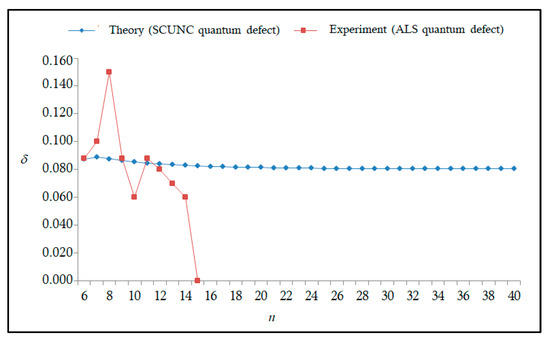
Figure 1.
Variations of the quantum defect (δ) with the principal quantum number n for the 4s24p2 (1D2)nd (2S) Rydberg series originating from the 2P°3/2 metastable state of Se+ converging to the 1D2 series limit in Se2+.
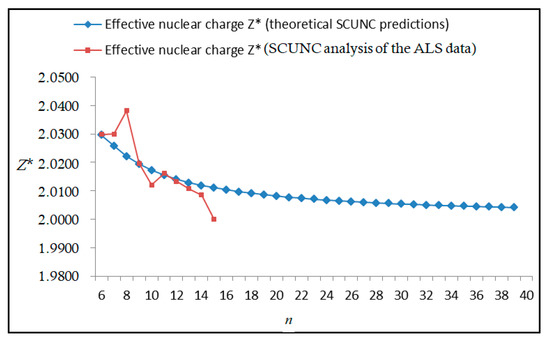
Figure 2.
Variations of the effective nuclear charge Z* with the principal quantum number n for the 4s24p2 (1D2)nd (2S) Rydberg series originating from the 2P°3/2 metastable state of Se+ converging to the 1D2 series limit in Se2+.
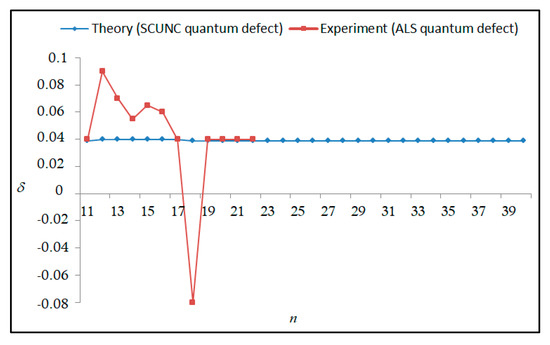
Figure 3.
Variations of the quantum defect (δ) with the principal quantum number n for the 4s24p2 (3P2)nd Rydberg series originating from the 2P°3/2 metastable state of Se+ converging to the 3P2 series limits in Se2+.
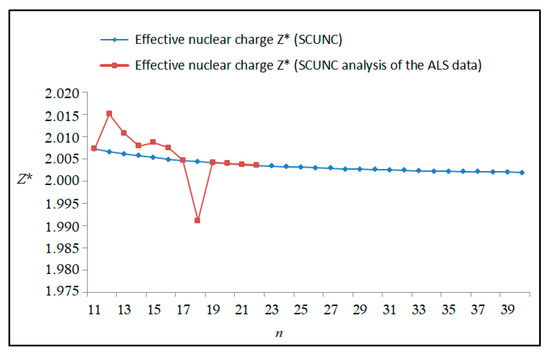
Figure 4.
Variations of the effective nuclear charge Z* with the principal quantum number n for the 4s24p2 (3P2)nd Rydberg series originating from the 2P°3/2 metastable state of Se+ converging to the 3P2 series limits in Se2+.
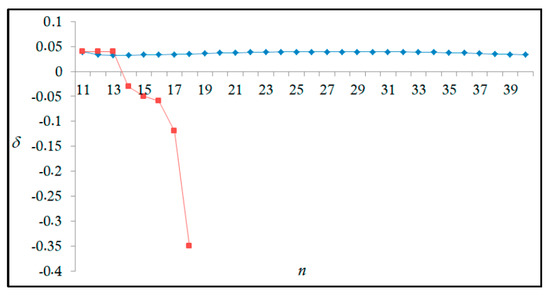
Figure 5.
Variations of the quantum defect (δ) with the principal quantum number n for the 4s24p2 (3P2)nd Rydberg series originating from the 2P°1/2 metastable state of Se+ converging to the 3P2 series limits in Se2++.
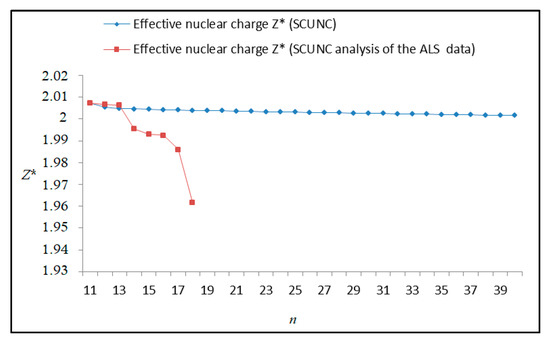
Figure 6.
Variations of the effective nuclear charge Z* with the principal quantum number n for the 4s24p2 (3P2)nd Rydberg series originating from the 2P°1/2 metastable state of Se+ converging to the 3P2 series limits in Se2+.
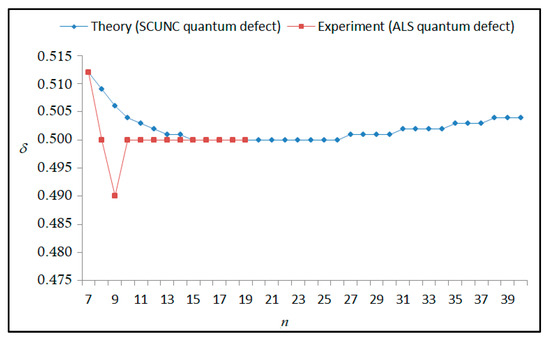
Figure 7.
Variations of the quantum defect (δ) with the principal quantum number n for the 4s24p2 (1D2)ns Rydberg series originating from the 2P°3/2 metastable state of Se+ converging to the 1D2 series limits in Se2+.
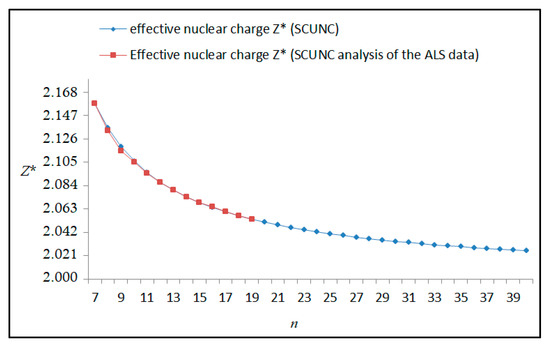
Figure 8.
Variations of the effective nuclear charge Z* with the principal quantum number n for the 4s24p2 (3P2)nd Rydberg series originating from the 2P°3/2 metastable state of Se+ converging to the 1D2 series limits in Se2+.
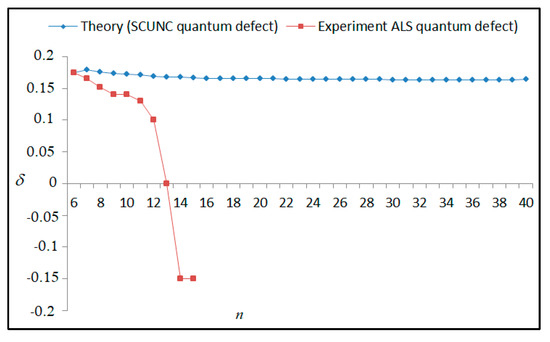
Figure 9.
Variations of the quantum defect (δ) with the principal quantum number n for the 4s24p2 (1D2)nd(2P1/2) Rydberg series originating from the 2P°1/2 metastable state of Se+ converging to the 2D1 series limits in Se2+.
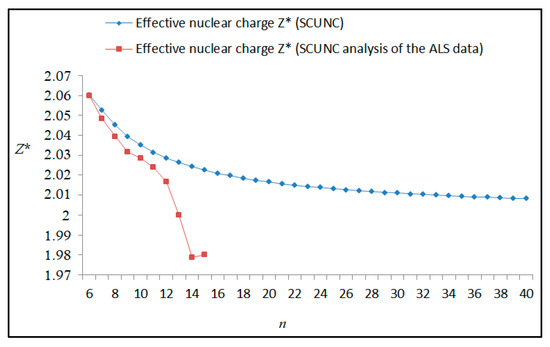
Figure 10.
Variations of the effective nuclear charge Z* with the principal quantum number n for the 4s24p2 (1D2)nd(2P1/2) Rydberg series originating from the 2P°1/2 metastable state of Se+ converging to the 2D1 series limits in Se2+.
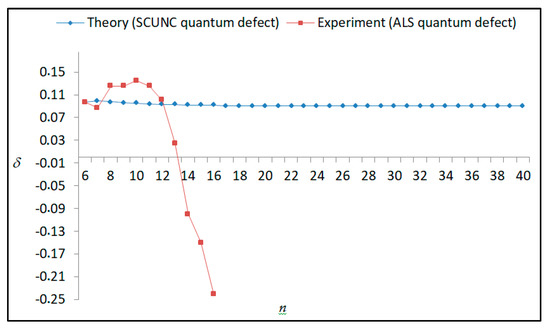
Figure 11.
Variations of the quantum defect (δ) with the principal quantum number n for the 4s24p2 (1D2)nd (2S) Rydberg series originating from the 2P°1/2 metastable state of Se+ converging to the 3P2 series limits in Se2+.
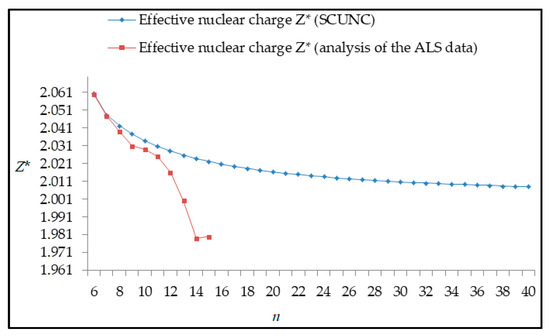
Figure 12.
Variations of the effective nuclear charge Z* with the principal quantum number n for the 4s24p2 (1D2)nd (2S) Rydberg series originating from the 2P°1/2 metastable state of Se+ converging to the 3P2 series limits in Se2+.
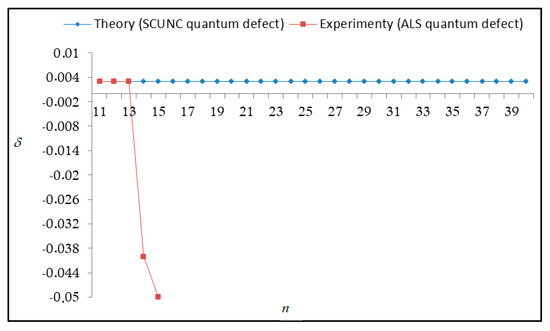
Figure 13.
Variations of the quantum defect (δ) with the principal quantum number n for the 4s24p2 (3P2)nd Rydberg series originating from the 2D°5/2 metastable state of Se+ converging to the 3P2 series limits in Se2+.
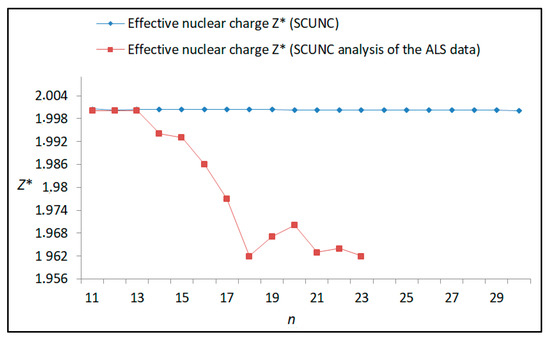
Figure 14.
Variations of the effective nuclear charge Z* with the principal quantum number n for the 4s24p2 (3P2)nd Rydberg series originating from the 2D°5/2 metastable state of Se+ converging to the 3P2 series limits in Se2+.
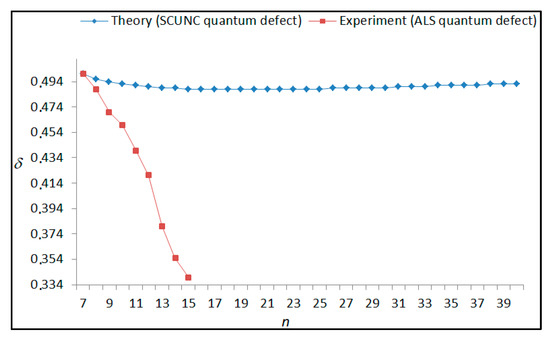
Figure 15.
Variations of the quantum defect (δ) with the principal quantum number n for the 4s24p2 (1D2)ns Rydberg series originating from the 2P°1/2 metastable state of Se+ converging to the 1D2 series limits in Se2+.
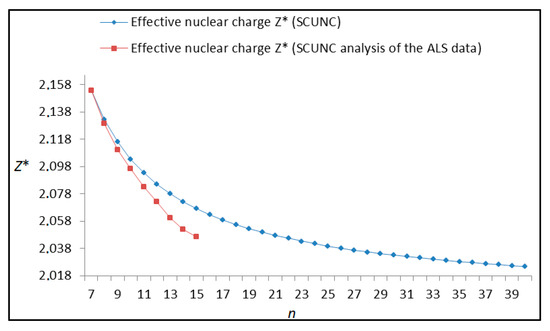
Figure 16.
Variations of the effective nuclear charge Z* with the principal quantum number n for the 4s24p2 (1D2)ns Rydberg series originating from 2P°1/2 metastable state of Se+ converging to the 1D2 series limits in Se2+.
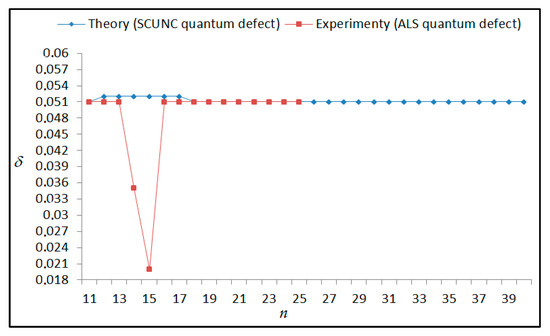
Figure 17.
Variations of the quantum defect (δ) with the principal quantum number n for the 4s24p2 (1D2)ns Rydberg series originating from the 2D°3/2 metastable state of Se+ converging to the 3P2 series limits in Se2+.
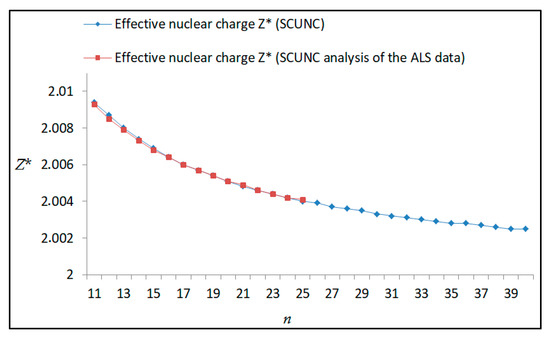
Figure 18.
Variations of the effective nuclear charge Z* with the principal quantum number n for the 4s24p2 (1D2)ns Rydberg series originating from 2D°3/2 metastable state of Se+ converging to the 3P2 series limits in Se2+.
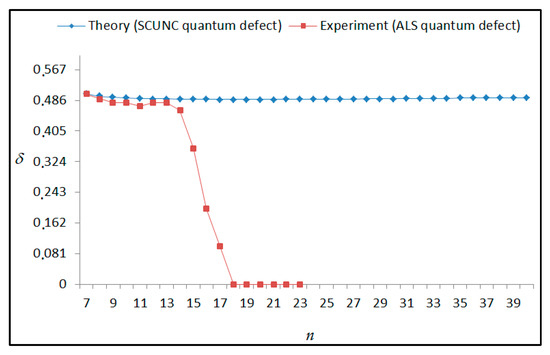
Figure 19.
Variations of the quantum defect (δ) with the principal quantum number n for the 4s24p2 (1D2)ns (2D) Rydberg series originating from the 2D°5/2 metastable state of Se+ converging to the 1D2 series limits in Se2+.
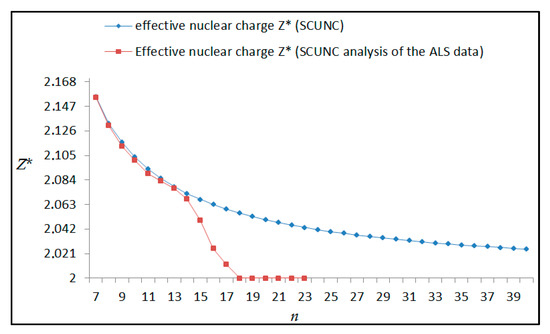
Figure 20.
Variations of the effective nuclear charge Z* with the principal quantum number n for the 4s24p2 (1D2)ns (2D) Rydberg series originating from 2D°5/2 metastable state of Se+ converging to the 1D2 series limits in Se2+.
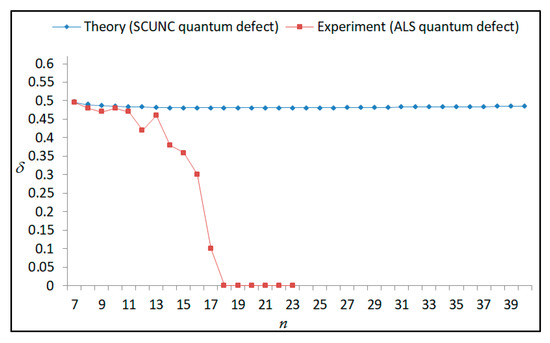
Figure 21.
Variations of the quantum defect (δ) with the principal quantum number n for the 4s24p2 (1D2)ns (2D) Rydberg series originating from the 2D°3/2 metastable state of Se+ converging to the 1D2 series limits in Se2+.
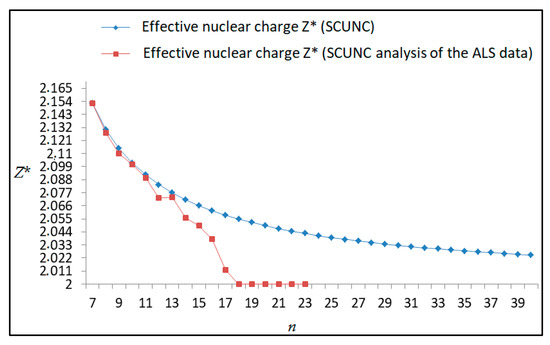
Figure 22.
Variations of the effective nuclear charge Z* with the principal quantum number n for the 4s24p2 (1D2)ns (2D) Rydberg series originating from 2D°3/2 metastable state of Se+ converging to the 1D2 series limits in Se2+.
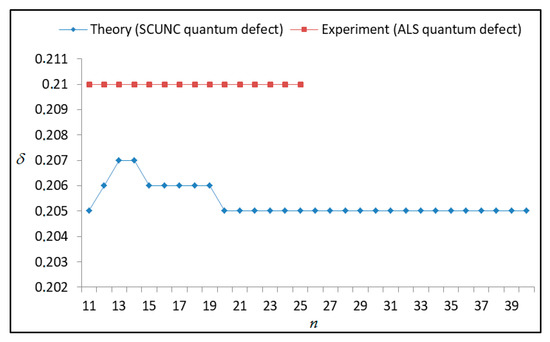
Figure 23.
Variations of the quantum defect (δ) with the principal quantum number n for the 4s24p2 (3P2)nd Rydberg series originating from the 4S°3/2 metastable state of Se+ converging to the 3P2 series limits in Se2+.
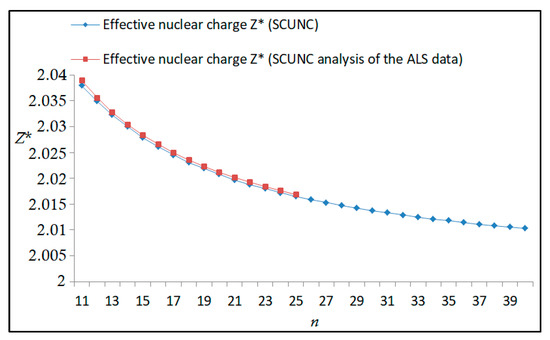
Figure 24.
Variations of the effective nuclear charge Z* with the principal quantum number n for the 4s24p2 (1D2)ns (2D) Rydberg series originating from 2S°3/2 metastable state of Se+ converging to the 3P2 series limits in Se2+.
- The generation of atomic orbitals based primarily on the atomic structure of the residual ion;
- The use of specific codes in the investigations (and then inevitably a fastidious computer program);
- Mathematical complexity in the formalism.
The merit of the SCUNC formalism is due to the fact that accurate energy positions can be obtained within a simple analytical formula for whole members of the Rydberg series by only varying the n-principal quantum number without needing to generate atomic orbitals, to use specific codes or to invoke mathematical complexity in the formalism. Another important point that deserves to be underlined is linked to the limitation of the PI cross-section for high-lying states even when investigations are performed with high photon resolution. In fact, when the n-principal quantum number increases, the peaks of the cross-section become more and more narrow and overlap for high n-values or for high photon energy. As a result, unresolved lines appear necessary, and the corresponding energy positions cannot be determined theoretically or experimentally. The SCUNC method does not face such problems, as accurate energy positions can be obtained up to very high-n, as demonstrated in our recent papers [14,15,16,17,18,19].
4. Summary and Conclusions
The SCUNC method is used to investigate as many as 12 Rydberg series due to the 4p → nd and 4p → ns transitions from the 4S°3/2 ground-state and the 2P°3/2,1/2 and 2D°5/2,3/2 metastable states of the Se+ ions in the energy region (17.75–21.85 eV). Over the entire Rydberg series, positive δ values are obtained, and it is shown that the SCUNC method excellently reproduces the experimental energy resonances from ALS measurements [6] for various resonances. The strength of the present work is that the SCUNC formalism has permitted us to provide confidence in the experimental data on Se+ ions for numerous Rydberg series. In addition, the ALS work is part of a broader investigation of absolute photoionization cross-section measurements of Se+ through Se5+ [6]. The excellent agreements between the ALS measurements [6] and the present calculations and that performed previously [13] on Se+ ions point out the prominent role that the SCUNC formalism can play in the investigations of high-lying energy resonances of Rydberg series of the Se2+, Se3+, Se4+ and Se5+ ions in connections with the understanding of the chemical evolution of Se in the universe.
Funding
This research received no funding.
Data Availability Statement
The present study did not report any data.
Conflicts of Interest
The author declares no conflict of interest.
References
- Sharpee, B.; Zhang, Y.; Williams, R.; Pellegrini, E.; Cavagnolo, K.; Baldwin, J.A.; Phillips, M.; Liu, X.W. s-Process Abundances in Planetary Nebulae. Astrophys. J. 2007, 659, 1265. [Google Scholar] [CrossRef]
- Langanke, K.; Wiescher, M. Nuclear reactions and stellar processes. Rep. Prog. Phys. 2001, 64, 1657. [Google Scholar] [CrossRef]
- Sterling, N.C.; Dinerstein, H.L.; Kallman, T.R. The abundances of light neutron-capture elements in planetary nebulae. I. Photoionization modeling and ionization corrections. Astrophys. J. Suppl. Ser. 2007, 169, 37. [Google Scholar] [CrossRef]
- Sterling, N.C.; Dinerstein, H.L. The abundances of light neutron-capture elements in planetary nebulae. II. s-process enrichments and interpretation. Astrophys. J. Suppl. Ser. 2008, 174, 157. [Google Scholar] [CrossRef]
- Covington, A.M.; Aguilar, A.; Covington, I.R.; Hinojosa, G.; Shirley, C.A.; Phaneuf, R.A.; Alvarez, I.I.; Cisneros, C.; Dominguez-Lopez, I.; Sant’Anna, M.M.; et al. Valence-shell photoionization of chlorinelike Ar+ ions. Phys. Rev. A 2011, 84, 013413. [Google Scholar] [CrossRef]
- Esteves, D.A.; Bilodeau, R.C.; Sterling, N.C.; Phaneuf, R.A.; Kilcoyne, A.L.D.; Red, E.C.; Aguilar, A. Absolute high-resolution Se+ photoionization cross-section measurements with Rydberg-series analysis. Phys. Rev. A 2011, 84, 013406. [Google Scholar] [CrossRef]
- McLaughlin, B.M.; Balance, C.P. Photoionization cross sections for the trans-iron element Se+ from 18 to 31 eV. J. Phys. B At. Mol. Opt. Phys. 2012, 45, 095202. [Google Scholar] [CrossRef]
- Sterling, N.C.; Esteves, D.A.; Bilodeau, R.C.; Kilcoyne, A.L.D.; Red, E.C.; Phaneuf, R.A.; Aguilar, A. Experimental photoionization cross-section measurements in the ground and metastable state threshold region of Se+. J. Phys. B At. Mol. Opt. Phys. 2011, 44, 025701. [Google Scholar] [CrossRef]
- Macaluso, D.A.; Bogolub, K.; Johnson, A.; Aguilar, A.; Kilcoyne, A.L.D.; Bilodeau, R.C.; Bautista, M.; Kerlin, A.B.; Sterling, N.C. Absolute single photoionization cross-section measurements of Rb2+ ions: Experiment and theory. J. Phys. B At. Mol. Opt. Phys. 2017, 50, 119501. [Google Scholar] [CrossRef]
- Gning, M.T.; Sakho, I. Single Photoionization Study of Br3+ via the Screening Constant by Unit Nuclear Charge Method. J. At. Mol. Condens. Nano Phys. 2019, 6, 131–141. [Google Scholar]
- Macaluso, D.A.; Aguilar, A.; Kilcoyne, A.L.D.; Bilodeau, R.C.; Juárez, A.M.; Dumitriu, I.; Hardy, D.; Sterling, N.C.; Bautista, M. Absolute single photoionization cross-sections of Br3+: Experiment and theory. J. Phys. B At. Mol. Opt. Phys. 2019, 52, 145002. [Google Scholar] [CrossRef]
- Sakho, I. Screening Constant by Unit Nuclear Charge Photoionization of Rb2+ Ions. J. At. Mol. Condens. Nano Phys. 2019, 6, 69–79. [Google Scholar]
- Sakho, I. Calculations of high-lying energy resonances of the 4s24p2(1d2)nd and 4s24p2(1s0)nd Rydberg series of Se+. Phys. Rev A 2012, 86, 052511. [Google Scholar] [CrossRef]
- Sakho, I. Energies of doubly excited 1,3P resonances in He-like (Z = 2–40) systems below the N = 3 hydrogenic threshold. Atom. Data. Nucl. Data Tables 2017, 117, 425–438. [Google Scholar]
- Sakho, I. Energy resonances of the 2s2p6np 1P Rydberg series of the Ne-like ions (Z = 27–56) ions. J. Electron. Spectrosc. Relat. Phenom. 2018, 222, 40. [Google Scholar] [CrossRef]
- Ba, M.D.; Diallo, A.; Badiane, J.K.; Gning, M.T. Photoionization of the 3s23p3nd Rydberg series of Cl+ ion using the Screening constant by unit nuclear charge method. Radiat. Phys. Chem. 2018, 153, 111–119. [Google Scholar] [CrossRef]
- Badiane, J.K.; Diallo, A.; Ba, M.D.; Gning, M.T.; Sow, M.; Sakho, I. Photoionization study of the (3d94s 3D3,2,1)np and the (3d94s 1D2)np Rydberg series of Cu-like Zn+ ion via the Screening constant by unit nuclear charge method. Radiat. Phys. Chem. 2019, 158, 17–21. [Google Scholar] [CrossRef]
- Sakho, I. Photoionization Study on the 1s22snp 1P°, 1s22snd 1,3D, and 1s22pnd 3D, Rydberg Series of the Be-like (Z = 8–18) ions. J. At. Mol. Condens. Nano Phys 2021, 8, 15. [Google Scholar]
- Sakho, I. Study of single-photon photoionization of oxygen-like Ne III via the screening constant by unit nuclear charge. Int. J. Mass Spectrom. 2022, 474, 116800. [Google Scholar] [CrossRef]
- Moore, C.E. Atomic Energy Levels. Available online: https://nvlpubs.nist.gov/nistpubs/Legacy/circ/nbscircular467v2.pdf (accessed on 1 August 2022).
- Cowan, R.D. The Theory of Atomic Structure and Spectra. Available online: https://www.ucpress.edu/book/9780520038219/the-theory-of-atomic-structure-and-spectra (accessed on 1 August 2022).
- Liang, L.; Gao, W.; Zhou, C. Photoionization of Ne-like Ca XI. Phys. Scr. 2013, 87, 015301. [Google Scholar] [CrossRef]
- Bizau, J.M.; Blancard, C.; Coreno, M.; Cubaynes, D.; Dehon, C.; El Hassan, N.; Folkmann, F.; Gharaibeh, M.F.; Giuliani, A.; Lemaire, J. Photoionization study of Kr+ and Xe+ ions with the combined use of a merged-beam set-up and an ion trap. J. Phys. B: At. Mol. Opt. Phys. 2011, 44, 055205. [Google Scholar] [CrossRef]
- Bruneau, J. Correlation and relaxation effects in ns2-nsnp transitions. J. Phys. B At. Mol. Phys. 1984, 17, 3009. [Google Scholar] [CrossRef]
Publisher’s Note: MDPI stays neutral with regard to jurisdictional claims in published maps and institutional affiliations. |
© 2022 by the author. Licensee MDPI, Basel, Switzerland. This article is an open access article distributed under the terms and conditions of the Creative Commons Attribution (CC BY) license (https://creativecommons.org/licenses/by/4.0/).