


Abstract
In order to explore their orchid flora, we performed surveys of 96 Azerbaijani burial places in 2018 and 2019. Altogether, 28 orchid taxa were found in 37 visited cemeteries. In the orchid diversity a remarkable pattern was observed: geographic latitude was significantly and positively related to the number of taxa and number of individuals. The most widespread and abundant orchids in Azerbaijani graveyards were Anacamptis pyramidalis and A. papilionacea (found in 23 and 8 cemeteries, respectively). Azerbaijani cemeteries can be important refuges for rare and threatened orchids, e.g., Himantoglossum formosum (three cemeteries), Ophrys sphegodes subsp. mammosa (eight), Orchis adenocheila (two), O. punctulata (three), O. stevenii (one) and Steveniella satyrioides (one). Epipactis turcica, detected in a single locality, was previously unknown to the flora of Azerbaijan. Additionally, we documented orchid tuber (salep) collection in two cemeteries.
1. Introduction
The Earth’s surface has changed dramatically in recent centuries, with human activities serve as a leading cause of the drastic reduction in the area of natural habitats [1,2]. In parallel with the degradation and fragmentation of natural environments throughout the world, isolated natural habitat patches as remnants of the original wildlife have been revalued [3]. Anthropogenically influenced habitats now occupy a significant part of the Earth’s surface and expand rapidly [4]. In order to conserve the remaining biodiversity, it is of the utmost importance to identify and protect the remaining habitats with a high conservation value, to develop a sustainable habitat management practice, and to plan future developments in the light of nature conservation priorities [5].
Recently, conservation professionals have recognized that some of the anthropogenically influenced or even human-made habitats, such as abandoned mines and industrial sites [6,7,8], road verges [9,10,11], tree plantations [12,13,14], river dikes [15], burial mounds [16], and urban habitats [17,18], play significant roles in conserving biodiversity. During the last decades, it has become increasingly evident that cemeteries also play an important role in maintaining biodiversity [19]. Although the orchid flora of cemeteries is globally rather poorly known, occurrences of orchids were published from Australian, Asian, and European burial places [20]. Based on previous knowledge on the occurrence and diversity of orchids in Turkish [21,22,23,24], Albanian [25] and central European [26] burial grounds, we predicted potential conservational importance of traditional Caucasian cemeteries. One of the main goals of our study was to search for Himantoglossum formosum, the rarest and perhaps the least known orchid of the Caucasian region [27]. During the 180 years after its description [28], almost nothing was known about the species [29], and it was re-discovered in 1994 [30]. According to recent studies, this is an ancient, phylogenetically isolated [31] and morphologically well separated [32] bona fide species. It is listed as Vulnerable (Rare) in the IUCN Red List of Threatened Plants [33].
The aims of this paper were to survey Azerbaijani cemeteries as orchid habitats, and to test which geographic factors influence the prevalence of orchids in the surveyed cemeteries.
2. Materials and Methods
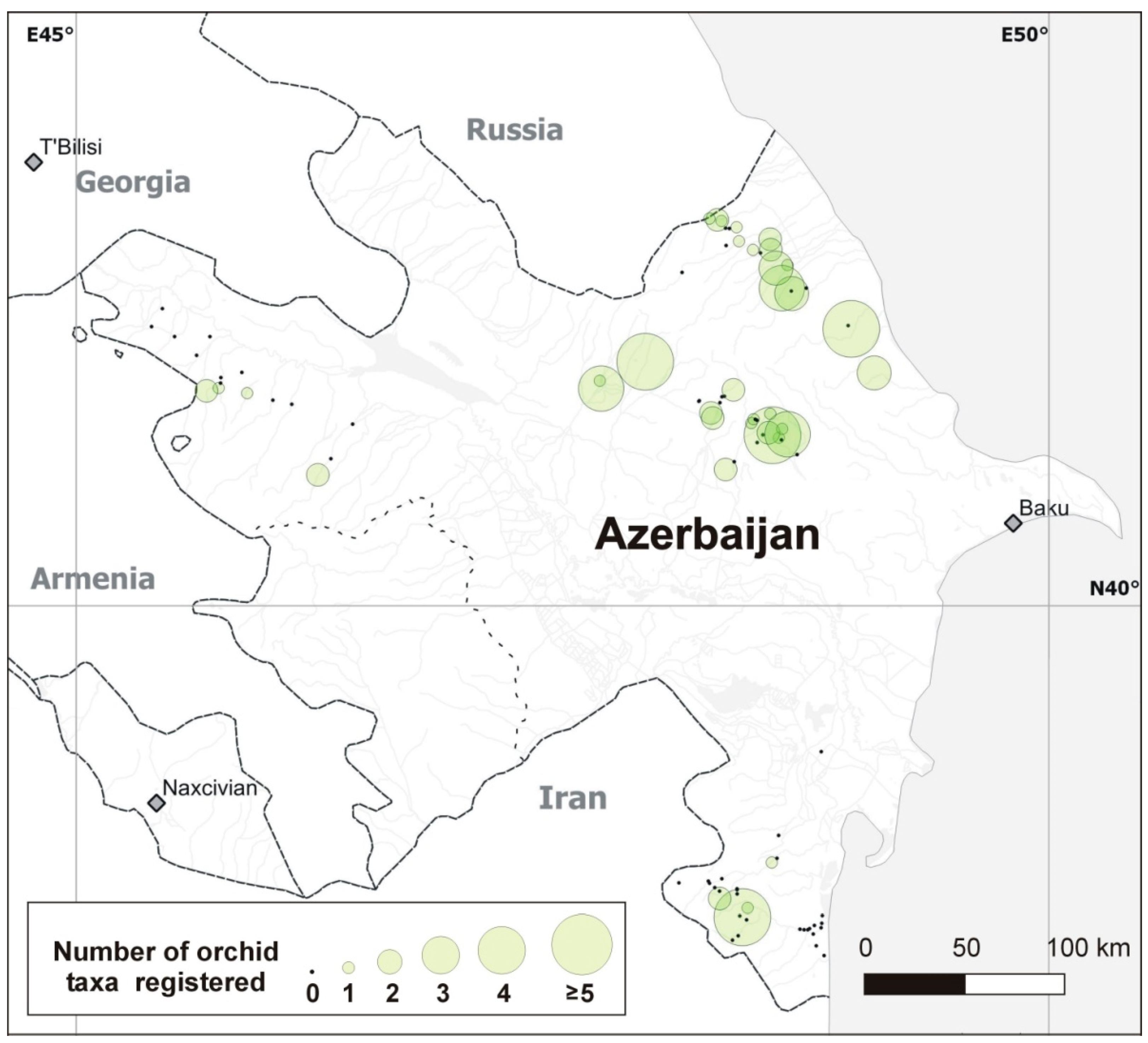
We studied burial grounds (Azerbaijani: məzarlıq, hereafter cemeteries) regardless of their spatial dimension, position within settlements, or presence of built facilities. We surveyed 96 Azerbaijani cemeteries (Figure 1, Table A1) during 2018 (17–30 May by Molnár V., Löki, Mizsei and Süveges, and 28 June–4 July by Molnár V. and Szabó) and 2019 (29 April–6 May by Verbeeck, Duijnhouwer, Segers and Bobocea) and (31 May–6 June by Verbeeck, Duijnhouwer and Bradeanu). Most cemeteries were visited only once (90 and 3 cemeteries in May 2018 and in April 2019, respectively), but three cemeteries were visited in both years. All orchid taxa and the number of individuals were counted or estimated in the whole area of each visited cemetery. Species were identified based on the comprehensive book of Kuehn et al. [34]. Authors of plant names were listed in Table 1. The geocoordinates and the elevation of the visited cemeteries were determined using a Garmin eTrex Legend handheld GPS device and recorded in WGS84 format. During field trips, particular attention was devoted to documenting salep collection activity in cemeteries.
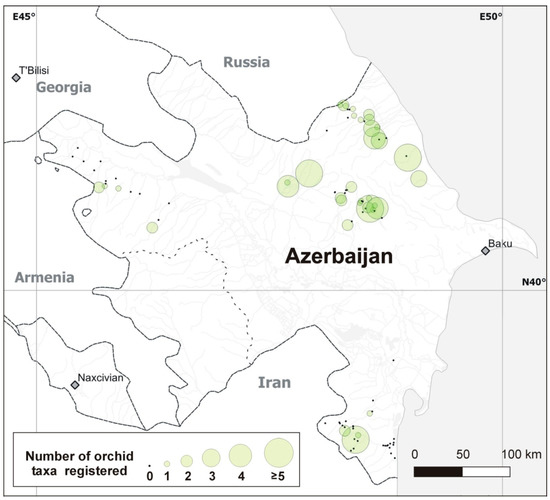
Figure 1.
Number of orchid taxa in the cemeteries surveyed.

Table 1.
Orchid taxa recorded in Azerbaijani cemeteries.
To understand the role of geographic factors in determining variation in taxon richness and abundance of orchids across Azerbaijan, we built statistical models with either of these variables as dependent variables, and latitude, longitude and altitude as explanatory variables. Both the number of individuals and the number of taxa had Poisson distributions, but due to the overdispersion in these variables, we used generalized linear model (GLMs) with quasi-Poisson distribution. All models were built in the R statistical environment [35].
3. Results
Numbering (ID), geographic location, and altitude above see level of the cemeteries visited, together with lists of the orchid taxa found in each one, are given in Table A1. In total, 28 orchid taxa were found, and considerable differences can be observed in the number of individuals and frequency of each taxon (Table 1), as well as in orchid species richness and abundance of each cemetery (Table 2).
Table 2.
Descriptive statistics orchid flora of Azerbaijani cemeteries.
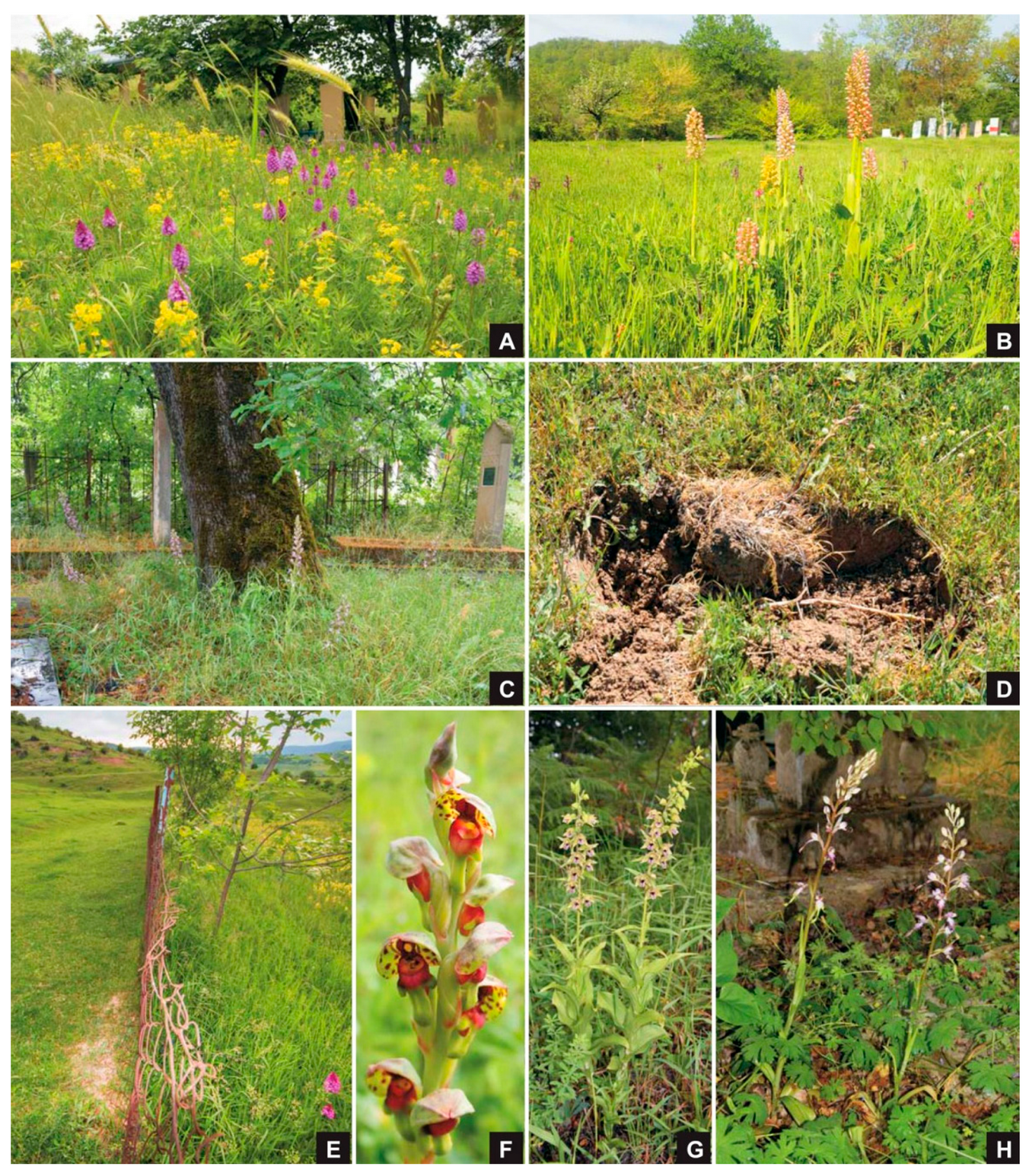
Each taxon was found total in 1–24 cemeteries (mean ± SD = 3.2 ± 4.5), with the number of individuals varying from 1 to 1902 (mean ± SD = 150 ± 374). The most widespread and abundant species was Anacamptis pyramidalis (Figure 2A). The number of taxa detected in only one graveyard was 15, whereas four species were found in more than five cemeteries. The highest number of taxa in a given cemetery was 9. In most cases only one taxon (18 cemeteries (15%)) or two taxa (11 cemeteries (9.4%)) occurred. Cemeteries that serve as habitats for five or more taxa were extremely rare (4 (3.4%)). The most orchid-rich cemeteries were found near Lerik (AZ-16, 9 species) Ağabəyli (AZ-52, 8 species), Nohurqishlaq (AZ-93, Figure 2B, 8 species), and DashliJalgan (AZ-90, 5 species).
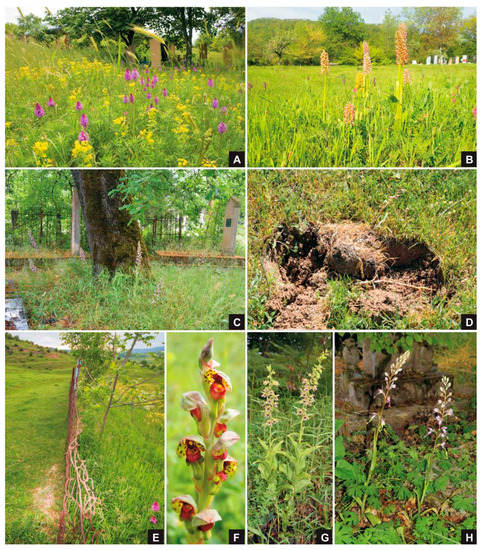
Figure 2.
Orchids in Azerbaijani cemeteries. (A) Anacamptis pyramidalis population in the cemetery of Əngixaran (AZ–61). (B) Cemetery of Nohurqishlaq (AZ-93), habitat of Orchis punctulata, O. stevenii and their hybrids (Orchis ×chabalensis). (C) Viable population of Himantoglossum formosum was found on a few tens of square meter of refuge under some old oak trees in cemetery of Zizik (AZ-74). (D) Spurs of salep harvesting in the cemetery of Ağabəyli (AZ-52). (E) Effect of fencing around cemetery against grazing: plant cover is considerable lower outside (left) than inside (right, with flowering individuals of Anacamptis pyramidalis) of cemetery of Zurnabad (AZ-32). (F) Inflorescence of Steveniella satyrioides. (G) Occurrence of Epipactis turcica was formerly unknown from Azerbaijan (Tengealti, AZ-85). (H) A very localized and rare endemic species, Himantoglossum formosum in cemetery of Zizik (AZ-74). Photo credit: A, C, D, G and H by A. Molnár V.; B and F by M. Verbeeck; E by V. Löki.
The harvest of orchid tubers (“salep”) was observed in two cemeteries during 2018. In Ağabəyli cemetery (AZ-52, Figure 2D) three species (Anacamptis papilionacea, Orchis adenocheila, O. simia), and in Dashli Jalgan cemetery (AZ-90) five species (Anacamptis collina, A. papilionacea, Ophrys sphegodes subsp. mammosa, Orchis simia, Neotinea tridentata), were collected. Both of these localities host notable orchid populations with eight and five species, respectively.
The number of orchid taxa and individuals found in Azerbaijani cemeteries was significantly positively related to latitude (Table 3 and Table 4, respectively), but not to longitude and altitude. When non-significant predictors were removed from the model in a stepwise manner (based on the largest p-values), only latitude remained in the final model as a significant predictor of orchid species richness and abundance.
Table 3.
Effect of geographic location on number of orchid taxa per cemetery. Parameter estimates, their standard errors (SE), associated t-values (t) and significance levels (p) are presented.
Table 4.
Effect of geographic location on number of orchid individuals in Azerbaijani cemeteries.
4. Discussion
During our work, it has been proved that Muslim Azerbaijani cemeteries host significant orchid populations. The key conservation importance of Azerbaijani cemeteries can be explained by two facts: (1) Religious privileges protected these sacred sites and their natural values, because they have largely been exempt from forest and agricultural utilization ever since; and (2) the mostly fenced area of cemeteries provide protection against excessive grazing (Figure 2E).
Azerbaijani cemeteries provide shelters for several valuable populations of rare and threatened orchids. From a conservation point of view, one of the most valuable species is the Eastern Caucasian endemic Himantoglossum formosum (Figure 2H), which was found in three of the visited cemeteries (Zizik, AZ-74, Figure 2C; Yasab, AZ-78; Piral, AZ-79). Viable populations of the rare Orchis adenocheila were found in two cemeteries (Lerik, AZ-16; Ağabəyli, AZ-52). The occurrence of Steveniella satyrioides was detected in cemetery of Lerik (Lerik, AZ-16, Figure 2F). The occurrence of Epipactis turcica (Figure 2G) was also found near Tengealti (AZ-85); this taxon was formerly unreported in Azerbaijan.
The long-term survival of these orchid populations in cemeteries strongly depends on long-established, sustainable management practices and traditional burial habits [22,36]. Establishment of graves (especially modern graves covered by marble or concrete tombstones) on the most valuable parts of these cemeteries is expressly undesirable from a conservation perspective, as well as the use of herbicides or electric trimmers. However, mowing or moderate grazing of grassy areas around the burial ground is preferred and encouraged for a more efficient conservation of the local biodiversity and valuable flora elements. Based on their diverse and abundant orchid community in some of the visited cemeteries, we strongly recommend the local councils and the nature protection authorities to protect certain burial places, especially near Lerik (AZ-16), Ağabəyli (AZ-52), DashliJalgan (AZ-90), Nohurqishlaq (AZ-93), and Nugadi (AZ-92).
A special threatening factor of tuberous orchids, namely the harvest of their tubers (making salep for culinary purposes [37]) was observed in Azerbaijani cemeteries. On the one hand, the right of local human communities to continue using traditional natural resources is unquestionable and seems also sustainable [38,39]. On the other hand, the effects of tuber collection on populations of frequent and widespread orchids is little known, while the sustainability of salep harvesting is at least controversial [40,41,42,43,44,45,46,47]. However, destroying the rarest taxa (Himantoglossum formosum, Orchis adenocheila) should definitely be avoided.
Author Contributions
Conceptualization: A.M.V.; formal analysis: K.S.; investigation: A.M.V., V.L., M.V. and K.S.; writing—original draft preparation: A.M.V.; writing—review and editing: V.L., M.V. and K.S.; visualization: A.M.V., V.L. and M.V. All authors have read and agreed to the published version of the manuscript.
Funding
This research was funded by the National Research, Development and Innovation Office of Hungary (grant number NKFI-OTKA K132573).
Institutional Review Board Statement
Not applicable.
Informed Consent Statement
Not applicable.
Data Availability Statement
All data analyzed in this study are available in Appendix A.
Acknowledgments
The authors are grateful to Edvárd Mizsei, Éva Szabó, Luc Segers, Roel Duijnhouwer, Alin Bradeanu and Mihai Bobocea for their assistance during the field work, to Attila Takács for editing the map of surveyed cemeteries and to the anonymous reviewers for their valuable suggestions and useful recommendations. We would like to express our gratitude to C. A. J. Kreutz (The Netherlands) for identification of Epipactis turcica, and to Orsolya Vincze for her linguistic corrections of the earlier version of our manuscript.
Conflicts of Interest
The authors declare no conflict of interest.
Appendix A
Table A1.
Numbering (ID), geographic location, altitude, year of observation and orchid taxa of the 96 cemeteries studied in Azerbaijan. A dash “–” indicates that no orchid taxa were recorded. Generic name abbreviations: A.—Anacamptis, C.—Cephalanthera, D.—Dactylorhiza, E.—Epipactis, H.—Himantoglossum, L.—Limodorum, O.—Orchis, Op.—Ophrys, S.—Steveniella.
Table A1.
Numbering (ID), geographic location, altitude, year of observation and orchid taxa of the 96 cemeteries studied in Azerbaijan. A dash “–” indicates that no orchid taxa were recorded. Generic name abbreviations: A.—Anacamptis, C.—Cephalanthera, D.—Dactylorhiza, E.—Epipactis, H.—Himantoglossum, L.—Limodorum, O.—Orchis, Op.—Ophrys, S.—Steveniella.
| ID | Settlement | Latitude, Longitude | Alt. (m) | Year | Taxa (Number of Individuals) |
|---|---|---|---|---|---|
| 01 | Şorsulu | 39.42429° N, 48.82938° E | 26 | 2018 | – |
| 02 | TəzəAlvadı | 39.09155° N, 48.61027° E | 2 | 2018 | – |
| 03 | Lənkəran | 38.77246° N, 48.83487° E | 29 | 2018 | – |
| 04 | Lənkəran | 38.74200° N, 48.83201° E | 19 | 2018 | – |
| 05 | Velədi | 38.72414°N, 48.82849°E | 15 | 2018 | – |
| 06 | Şürük | 38.69889° N, 48.78815° E | 21 | 2018 | – |
| 07 | Telman | 38.65184° N, 48.80355° E | 1 | 2018 | – |
| 08 | Kəkülus | 38.61265° N, 48.84406° E | 17 | 2018 | – |
| 09 | Kərgəlan | 38.73326° N, 48.79404° E | 0 | 2018 | – |
| 10 | Shaglakuche | 38.72074° N, 48.76931° E | 58 | 2018 | – |
| 11 | Shaglakuche | 38.71618° N, 48.76020° E | 60 | 2018 | – |
| 12 | Shaglakuche | 38.71618° N, 48.74096° E | 80 | 2018 | – |
| 13 | Shaglakuche | 38.71839° N, 48.72004° E | 97 | 2018 | – |
| 14 | Lerik | 38.80257° N, 48.45105° E | 803 | 2018 | O. mascula (4) |
| 15 | Lerik | 38.77126° N, 48.41079° E | 1108 | 2018 | – |
| 16 | Lerik | 38.76576° N, 48.42419° E | 1062 | 2018, 2019 | A. papilionacea (2019: 3), A. pyramidalis (2018: 500, 2019: 300), D. romana (2019: 20), Op. caucasica (2019: 5), Op. sphegodes subsp. mammosa (2018: 50, 2019: 100), O. adenocheila (2018: 5, 2019: 200), O. mascula (2019: 5), O. simia (2018: 50, 2019: 200), S. satyrioides (2019: 1) |
| 17 | Ambu | 38.75581° N, 48.44571° E | 1238 | 2018 | – |
| 18 | Gosmalijion | 38.69194° N, 48.40264° E | 1308 | 2018 | – |
| 19 | Laman | 38.85799° N, 48.39724° E | 800 | 2018 | – |
| 20 | Aran | 38.87474° N, 48.39668° E | 780 | 2018 | – |
| 21 | Aran | 38.87868° N, 48.39648° E | 780 | 2018 | – |
| 22 | Bülüdül | 38.83971° N, 48.30756° E | 805 | 2018 | A. pyramidalis (7), L. abortivum (4) |
| 23 | Züvüç | 38.86909° N, 48.30655° E | 885 | 2018 | – |
| 24 | Yardımlı | 38.88330° N, 48.28216° E | 1020 | 2018 | – |
| 25 | Yardımlı | 38.90051° N, 48.25522° E | 827 | 2018 | – |
| 26 | Yardımlı | 38.90921° N, 48.24933° E | 720 | 2018 | – |
| 27 | Perimbel | 38.90218° N, 48.09793° E | 1366 | 2018 | – |
| 28 | Yardımlı | 38.91879° N, 48.31857° E | 580 | 2018 | – |
| 29 | Yeyənkənd | 38.98335° N, 48.57487° E | 102 | 2018 | L. abortivum (8) |
| 30 | Allahyarlı | 39.00025° N, 48.60194° E | 66 | 2018 | – |
| 31 | Göygöl | 40.57610° N, 46.30989° E | 720 | 2018 | – |
| 32 | Zurnabad | 40.51304° N, 46.24282° E | 958 | 2018 | A. pyramidalis (100), Op. sphegodes subsp. mammosa (8) |
| 33 | Dağ Kəsəmən | 41.08915° N, 45.38852° E | 401 | 2018 | – |
| 34 | Poylu | 41.15871° N, 45.44410° E | 328 | 2018 | – |
| 35 | Köçəsgər | 41.05043° N, 45.50680° E | 456 | 2018 | – |
| 36 | Qaraxanlı | 41.05042° N, 45.68841° E | 346 | 2018 | – |
| 37 | Tovuz | 40.97800° N, 45.62000° E | 440 | 2018 | – |
| 38 | İbrahimhacılı | 40.89159° N, 45.74460° E | 548 | 2018 | – |
| 39 | Ağaməmmədli | 40.85088° N, 45.73310° E | 581 | 2018 | A. morio (1) |
| 40 | Yanıqlı | 40.84016° N, 45.67080° E | 669 | 2018 | A. pyramidalis (100), O. simia (20) |
| 41 | Məşədilər | 40.87028° N, 45.74312° E | 548 | 2018 | – |
| 42 | Düyərli | 40.91173° N, 45.85246° E | 369 | 2018 | – |
| 43 | Gəncə | 40.71074° N, 46.42177° E | 370 | 2018 | – |
| 44 | Şiştəpə | 40.83121° N, 45.87962° E | 592 | 2018 | A. morio (8) |
| 45 | Şəmkir | 40.80390° N, 46.01184° E | 559 | 2018 | – |
| 46 | Çinarlı | 40.78807° N, 46.10889° E | 431 | 2018 | – |
| 47 | Ağsu | 40.53386° N, 48.33778° E | 152 | 2018 | A. pyramidalis (25), O. simia (20) |
| 48 | Ağsu | 40.56429° N, 48.38220° E | 152 | 2018 | – |
| 49 | Muğanlı | 40.63904° N, 48.50003° E | 732 | 2018 | – |
| 50 | Muğanlı | 40.66912° N, 48.52951° E | 878 | 2018 | – |
| 51 | Böyük Xınıslı | 40.65781° N, 48.61163° E | 870 | 2018 | A. papilionacea (1) |
| 52 | Ağabəyli | 40.66747° N, 48.57887° E | 927 | 2018 | A. collina (1), A. papilionacea (465), A. pyramidalis (150), Op. apifera (1), Op. sphegodes subsp. mammosa (3), O. adenocheila (39), O. punctulata (1), O. simia (26) |
| 53 | Şamaxı | 40.64936° N, 48.62496° E | 783 | 2018 | – |
| 54 | Muğanlı | 40.67730° N, 48.55807° E | 971 | 2018 | A. pyramidalis (9), Op. apifera (2) |
| 55 | Suraxanı | 40.71495° N, 48.47015° E | 900 | 2018 | A. pyramidalis (1) |
| 56 | Kalva | 40.72985° N, 48.48152° E | 907 | 2018 | A. pyramidalis (1) |
| 57 | Xatman | 40.72947° N, 48.49023° E | 862 | 2018 | – |
| 58 | Dilman | 40.72596° N, 48.49876° E | 831 | 2018 | – |
| 59 | Məlhəm | 40.69225° N, 48.62865° E | 1115 | 2018 | A. papilionacea (1) |
| 60 | Qəleybuğurd | 40.75093° N, 48.56726° E | 912 | 2018 | L. abortivum (10) |
| 61 | Əngixaran | 40.67143° N, 48.65670° E | 978 | 2018 | A. papilionacea (2), A. pyramidalis (140), Op. sphegodes subsp. mammosa (8), Op. oestrifera (1) |
| 62 | Gandov | 40.81714° N, 48.31921° E | 952 | 2018 | – |
| 63 | Müşkəmir | 40.81919° N, 48.33202° E | 1100 | 2018 | – |
| 64 | Lahıc | 40.84393° N, 48.37823° E | 1214 | 2018 | A. coriophora (1), A. pyramidalis (7) |
| 65 | Qaraqaya | 40.79417° N, 48.30885° E | 1111 | 2018 | – |
| 66 | Talıstan | 40.79954° N, 48.20033° E | 827 | 2018 | – |
| 67 | Talıstan | 40.80186° N, 48.20287° E | 850 | 2018 | – |
| 68 | İkinci Yeniyol | 40.75425° N, 48.26252° E | 850 | 2018 | A. pyramidalis (12), Op. oestrifera (1) |
| 69 | Təzəkənd | 40.73435° N, 48.27164° E | 671 | 2018 | A. papilionacea (10), A. pyramidalis (2) |
| 70 | Sabir | 40.59207° N, 48.70527° E | 567 | 2018 | – |
| 71 | Digah | 41.38517° N, 48.47876° E | 662 | 2018 | A. pyramidalis (3) |
| 72 | Qirmizi Qəsəbə | 41.37358° N, 48.51741° E | 607 | 2018 | – |
| 73 | Ağbil | 41.42650° N, 48.56662° E | 410 | 2018 | C. damasonium (1), E. sp. (2) |
| 74 | Zizik | 41.38543° N, 48.57021° E | 482 | 2018, 2019 | H. formosum (2018: 21, 2019: 7), Op. sphegodes subsp. mammosa (2018: 1) |
| 75 | Avadjuk | 41.47244° N, 48.39413° E | 670 | 2018 | A. pyramidalis (1) |
| 76 | Hil | 41.46756° N, 48.35726° E | 770 | 2018 | – |
| 77 | Hil | 41.46891° N, 48.33767° E | 768 | 2018 | - |
| 78 | Yasab | 41.49661° N, 48.31670° E | 787 | 2018, 2019 | H. formosum (2018: 4, 2019: 0) |
| 79 | Piral | 41.50062° N, 48.29514° E | 838 | 2018 | A. pyramidalis (13), H. formosum (2) |
| 80 | Hazra | 41.50588° N, 48.25472° E | 725 | 2018 | A. pyramidalis (2) |
| 81 | Laza | 41.29840° N, 48.11429° E | 1703 | 2018 | – |
| 82 | Urva | 41.40196° N, 48.34058° E | 1046 | 2018 | – |
| 83 | Qusar | 41.41850° N, 48.40676° E | 768 | 2018 | C. rubra (2) |
| 84 | Pirvahid | 41.32669° N, 48.65619° E | 370 | 2018 | A. pyramidalis (6) |
| 85 | Tengealti | 41.23764° N, 48.62676° E | 701 | 2018 | A. pyramidalis (10), C. rubra (5), E. turcica (7), L. abortivum (1) |
| 86 | Sirt-Chichi | 41.22650° N, 48.67541° E | 672 | 2018 | – |
| 87 | Chichi | 41.21673° N, 48.67737° E | 538 | 2018 | A. pyramidalis (2), C. rubra (2), E. microphylla (3) |
| 88 | Gilanov | 41.23790° N, 48.75276° E | 325 | 2018 | – |
| 89 | Mashrif | 41.09305° N, 48.96764° E | 420 | 2018 | – |
| 90 | Dashli Jalgan | 41.08023° N, 48.98348° E | 180 | 2018 | A. collina (77), A. papilonacea (35), Neotinea tridentata (3), Op. sphegodes subsp. mammosa (96), O. simia (11) |
| 91 | Tıxlı | 40.90958° N, 49.10128° E | 593 | 2018 | A. collina (8), A. sp. (6), Op. sp. (24) |
| 92 | Nugadi | 41.31504° N, 48.59641° E | 506 | 2018 | A. pyramidalis (800), O. cf. caucasica (50), O. simia (200) |
| 93 | Nohurqishlaq | 40.95280° N, 47.92485° E | 749 | 2019 | A. coriophora (5), A. pyramidalis (5), A. morio (505), Op. sphegodes subsp. mammosa (10), Op. oestrifera (1), O. ×chabalensis (O. punctulata × O. stevenii) (30), O. punctulata (10), O. stevenii (20) |
| 94 | Chukhur Gabala | 40.87934° N, 47.69153° E | 404 | 2019 | A. pyramidalis (5) |
| 95 | Şəfili | 40.84899° N, 47.69877° E | 354 | 2019 | A. papilionacea (50), Op. sphegodes subsp. mammosa (1), O. punctulata (3), O. simia (15) |
| 96 | Gosmalijion | 38.67424° N, 48.37322° E | 1450 | 2018 | – |
References
- Le Roux, J.J.; Hui, C.; Castillo, M.L.; Iriondo, J.M.; Keet, J.H.; Khapugin, A.A.; Médail, F.; Rejmánek, M.; Theron, G.; Yanelli, F.A.; et al. Recent anthropogenic plant extinctions differ in biodiversity hotspots and cold spots. Curr. Biol. 2019, 29, 2912–2918. [Google Scholar] [CrossRef]
- Fahrig, L. Effects of habitat fragmentation on biodiversity. Annu. Rev. Ecol. Evol. Syst. 2003, 34, 487–515. [Google Scholar] [CrossRef] [Green Version]
- Saunders, D.A.; Hobbs, R.J.; Margules, C.R. Biological consequences of ecosystem fragmentation: A review. Conserv. Biol. 1991, 5, 18–32. [Google Scholar] [CrossRef]
- Ellis, E.C. Evolution: Biodiversity in the Anthropocene. Curr. Biol. 2019, 29, R831–R833. [Google Scholar] [CrossRef]
- Areendran, G.; Sahana, M.; Raj, K.; Kumar, R.; Sivadas, A.; Kumar, A.; Deb, S.; Gupta, V.D. A systematic review on high conservation value assessment (HCVs): Challenges and framework for future research on conservation strategy. Sci. Total Environ. 2020, 709, 135425. [Google Scholar] [CrossRef] [PubMed]
- Ratcliffe, D.A. Ecological effects of mineral exploitation in the United Kingdom and their significance to nature conservation. Proc. R. Soc. Lond. A 1974, 339, 355–372. [Google Scholar]
- Esfeld, K.; Hensen, I.; Wesche, K.; Jakob, S.S.; Tischew, S.; Blattner, F.R. Molecular data indicate multiple independent colonizations of former lignite mining areas in Eastern Germany by Epipactis palustris (Orchidaceae). Biodivers. Conserv. 2008, 17, 2441. [Google Scholar] [CrossRef]
- Shefferson, R.P.; Kull, T.; Tali, K. Mycorrhizal interactions of orchids colonizing Estonian mine tailings hills. Am. J. Bot. 2008, 95, 156–164. [Google Scholar] [CrossRef]
- Way, J.M. Roadside verges and conservation in Britain: A review. Biol. Conserv. 1977, 12, 65–74. [Google Scholar] [CrossRef]
- Fekete, R.; Nagy, T.; Bódis, J.; Biró, É.; Löki, V.; Süveges, K.; Takács, A.; Tökölyi, J.; Molnár, V.A. Roadside verges as habitats of rare lizard-orchids (Himantoglossum spp.): Ecological traps or refuges? Sci. Tot. Environ. 2017, 607–608, 1001–1008. [Google Scholar] [CrossRef] [PubMed] [Green Version]
- Fekete, R.; Bódis, J.; Fülöp, B.; Süveges, K.; Urgyán, R.; Malkócs, T.; Vincze, O.; Silva, L.; Molnár, V.A. Roadsides provide refuge for orchids characteristic of the surrounding landscape. Ecol. Evol. 2020, 10, 13236–13247. [Google Scholar] [CrossRef] [PubMed]
- Adamowski, W.; Conti, F. Mass occurrence of orchids in poplar plantations near Czeremcha village as an example of apophytism. Phytocoenosis 1991, 3, 259–267. [Google Scholar]
- Adamowski, W. Population expansion of native orchids in anthropogenous habitats. Neobiota 2004, 3, 86. [Google Scholar]
- Süveges, K.; Löki, V.; Lovas-Kiss, Á.; Ljubka, T.; Fekete, R.; Takács, A.; Vincze, O.; Lukács, B.A.; Molnár, V.A. From European priority species to characteristic apophyte: Epipactis tallosii (Orchidaceae). Willdenowia 2019, 49, 401–409. [Google Scholar] [CrossRef] [Green Version]
- Bátori, Z.; Körmöczi, L.; Zalatnai, M.; Erdős, L.; Ódor, P.; Tölgyesi, C.; Margóczi, K.; Torma, A.; Gallé, R.; Cseh, V.; et al. River dikes in agricultural landscapes: The importance of secondary habitats in maintaining landscape-scale diversity. Wetlands 2016, 36, 251–264. [Google Scholar] [CrossRef]
- Deák, B.; Tóthmérész, B.; Valkó, O.; Sudnik-Wojcikowska, B.; Moysiyenko, I.I.; Bragina, T.M.; Apostolova, I.; Dembicz, I.; Bykov, N.I.; Török, P. Cultural monuments and nature conservation: A review of the role of kurgans in the conservation and restoration of steppe vegetation. Biodivers. Conserv. 2016, 25, 2473–2490. [Google Scholar] [CrossRef]
- Kantsa, A.; Tscheulin, T.; Junker, R.R.; Petanidou, T.; Kokkini, S. Urban biodiversity hotspots wait to get discovered: The example of the city of Ioannina, NW Greece. Landsc. Urban Plan. 2013, 120, 129–137. [Google Scholar] [CrossRef]
- Molnár, V.A.; Siffer, S.; Molnár, H.A.; Fekete, R. Occurrence of the rare plant Sternbergia colchiciflora in urban environment. Biol. Futur. 2020, 71, 93–98. [Google Scholar] [CrossRef] [PubMed]
- Barrett, G.W.; Barrett, T.L. Cemeteries as repositories of natural and cultural diversity. Conserv. Biol. 2001, 15, 1820–1824. [Google Scholar] [CrossRef]
- Löki, V.; Deák, B.; Lukács, B.A.; Molnár, V.A. Biodiversity potential of burial places—A review on the flora and fauna of cemeteries and churchyards. Glob. Ecol. Conserv. 2019, 18, e00614. [Google Scholar] [CrossRef]
- Löki, V.; Tökölyi, J.; Süveges, K.; Lovas-Kiss, Á.; Hürkan, K.; Sramkó, G.; Molnár, V.A. The orchid flora of Turkish graveyards: A comprehensive field survey. Willdenowia 2015, 45, 231–243. [Google Scholar] [CrossRef] [Green Version]
- Löki, V.; Molnár, V.A.; Süveges, K.; Heimeier, H.; Takács, A.; Nagy, T.; Fekete, R.; Lovas-Kiss, Á.; Kreutz, C.A.J.; Sramkó, G.; et al. Predictors of conservation value of Turkish cemeteries: A case study using orchids. Landsc. Urban Plan. 2019, 186, 36–44. [Google Scholar] [CrossRef]
- Molnár, V.A.; Nagy, T.; Löki, V.; Süveges, K.; Takács, A.; Bódis, J.; Tökölyi, J. Turkish graveyards as refuges for orchids against tuber harvest. Ecol. Evol. 2017, 7, 11257–11264. [Google Scholar] [CrossRef] [PubMed] [Green Version]
- Molnár, V.A.; Süveges, K.; Molnár, Z.S.; Löki, V. Using localpeople’s traditional ecological knowledge in discovery of rare plants: A case study from Turkey. Acta Soc. Bot. Pol. 2017, 86, 3541. [Google Scholar] [CrossRef] [Green Version]
- Molnár, V.A.; Takács, A.; Mizsei, E.; Löki, V.; Barina, Z.; Sramkó, G.; Tökölyi, J. Religious differences affect orchid diversity of Albanian graveyards. Pak. J. Bot. 2017, 49, 289–303. [Google Scholar]
- Löki, V.; Schmotzer, A.; Takács, A.; Süveges, K.; Lovas-Kiss, Á.; Lukács, B.A.; Tökölyi, J.; Molnár, V.A. The protected flora of long-established cemeteries in Hungary: Using historical maps in biodiversity conservation. Ecol. Evol. 2020, 10, 7497–7508. [Google Scholar] [CrossRef] [PubMed]
- Vakhrameeva, M.G.; Tatarenko, I.V.; Varlygina, T.I.; Torosyan, G.K.; Zagulskii, M.N. Orchids of Russia and Adjacent Countries; ARG GantnerVerlag KG: Ruggel, Lichtenstein, 2008; 690p. [Google Scholar]
- Steven, C. Stirpes rariores in itinere Caucasico A 1810 lectae a C. Steven. Mémoires Société Impériale Nat. Moscou 1813, 4, 89–112. [Google Scholar]
- Baumann, H.; Kunkele, S. Die Wildwachsenden Orchideen Europas; Kosmos: Stuttgart, Germany, 1982; 432p. [Google Scholar]
- Rückbrodt, D.; Rückbrodt, H.; Gügel, E.; Zaiss, W.-W. Bemerkungen zu Orchideen des Kaukasusgebietes. Ber. Arbeitskr. Heim. Orch. 1994, 11, 46–56. [Google Scholar]
- Sramkó, G.; Molnár, V.A.; Hawkins, J.A.; Bateman, R.M. Molecular phylogeny and evolutionary history of the Eurasiatic orchid genus Himantoglossum s. l. (Orchidaceae). Ann. Bot. 2014, 114, 1609–1626. [Google Scholar] [CrossRef] [PubMed]
- Bateman, R.M.; Molnár, V.A.; Sramkó, G. In situ morphometric survey elucidates the evolutionary systematic of the Eurasian Himantoglossum clade (Orchidaceae: Orchidinae). PeerJ 2017, 5, e2893. [Google Scholar] [CrossRef] [PubMed] [Green Version]
- Walter, K.S.; Gillett, H.J. 1997 IUCN Red List of ThreatenedPlants; IUCN—The World Conservation Union: Gland, Switzerland, 1998; 932p. [Google Scholar]
- Kuehn, R.; Pedersen, H.A.; Cribb, P. Field Guide to the Orchids of European and the Mediterranean; Kew Publishing: Kew, UK, 2019; 430p. [Google Scholar]
- R: A Language and Environment for Statistical Computing. Available online: http://www.rproject.org/ (accessed on 30 November 2021).
- Tamer, E.C.; Karaman, B.; Copur, U.O. A traditional Turkish beverage: Salep. Food Rev. Int. 2006, 22, 43–50. [Google Scholar] [CrossRef]
- Molnár, V.A.; Löki, V. Disappearing botanical and cultural heritage of wooden headboard-graveyards in Eastern-Hungary and Transylvania (Romania). Kitaibelia 2018, 23, 51–64. [Google Scholar]
- Berkes, F.; Folke, C.; Gadgil, M. Traditional ecological knowledge, biodiversity, resilience and sustainability. In Biodiversity Conservation; Perrings, C., Ed.; Kluwer Academic Publishers: Dordrecht, The Netherlands, 2005; pp. 269–287. [Google Scholar]
- Turner, N.J.; Turner, K.L. Traditional food systems, erosion and renewal in Northwestern North America. Indian J. Tradit. Knowl. 2007, 6, 57–68. [Google Scholar]
- Kasparek, M.; Grimm, U. European trade in Turkish salep with special reference to Germany. Econ. Bot. 1999, 53, 396–406. [Google Scholar] [CrossRef]
- Pieroni, A. Reader ponders trade in salep (ground orchid bulbs). Econ. Bot. 2000, 54, 138–139. [Google Scholar] [CrossRef]
- Sezik, E. Destruction and conservation of Turkish orchids. In Biodiversity—Biomolecular Aspects of Biodiversity and Innovative Utilization; Springer: Boston, MA, USA, 2002; pp. 391–400. [Google Scholar]
- Sezik, E. Turkish orchids and salep. Acta Pharm. Turc. 2002, 44, 151–157. [Google Scholar]
- Ghorbani, A.; Gravendeel, B.; Naghibi, F.; de Boer, H. Wild orchid tuber collection inIran: A wake-up call for conservation. Biodivers. Conserv. 2014, 23, 2749–2760. [Google Scholar] [CrossRef]
- Kreziou, A.; de Boer, H.; Gravendeel, B. Harvesting of salep orchids in north-western Greece continues to threaten natural populations. Oryx 2016, 50, 393–396. [Google Scholar] [CrossRef] [Green Version]
- Mincheva, I.; Petrova, A.; Yordanova, M.; Kozuharova, E. Is the traditional use of “salep” in the Bulgarian Rhodopes hazardous for the wild populations of terrestrial orchids? Flora Mediterr. 2018, 28, 399–418. [Google Scholar]
- Charitonidou, M.; Stara, K.; Kougioumoutzis, K.; Halley, J.M. Implications of salep collection for the conservation of the Elder-flowered orchid (Dactylorhiza sambucina) in Epirus, Greece. J. Biol. Res. Thessalon. 2019, 26, 18. [Google Scholar] [CrossRef] [PubMed] [Green Version]
Publisher’s Note: MDPI stays neutral with regard to jurisdictional claims in published maps and institutional affiliations. |
© 2021 by the authors. Licensee MDPI, Basel, Switzerland. This article is an open access article distributed under the terms and conditions of the Creative Commons Attribution (CC BY) license (https://creativecommons.org/licenses/by/4.0/).