
Abstract
This paper presents an integrated framework for aircraft engines, which consists of three phases: modeling, control, and experimental testing. The engine is formulated as an uncertain T–S fuzzy model. By a hierarchical dynamical parameter clustering, the number and premise variables of fuzzy rules are optimized, which keeps the engine’s prime and representative dynamics. For each fuzzy rule, a global stability-guaranteed method is developed for the identification of the consequent uncertain dynamic model. The resulting stable T–S fuzzy model accurately approximates the actual engine dynamics in the operation space. Based on this fuzzy model, a new robust control is constructed with hierarchical compensators. The control parameters take advantage of the fuzzy blend of engine prime dynamics and uncertainty thresholds. Extensive hardware-in-loop (HIL) experimental tests in the flight envelope and a flight task cycle demonstrate the effectiveness and real-time performance of the proposed control. The settling times and overshoots of engine response are suppressed to be under 2.5 s and 10%, respectively.
1. Introduction
Aircraft engines are a typical class of a complex time-varying and uncertain nonlinear system [1]. The engine dynamic varies nonlinearly with the change in states and flight operating conditions. It brings great challenges to the control design. A conventional method is to construct a series of linear models at selected states and operating conditions and design the corresponding controllers [2]. Control parameter scheduling deals with the engine’s dynamic variation to achieve the designed performances. This design methodology is applied to the PI/PID control, the Linear Parameter Variation (LPV) control, the gain scheduling control, etc. [3,4,5]. For these approaches, there are problems in the performance, stability, and solution of LPV control with high-dimension scheduling parameters.
Compared with early research, the T–S fuzzy model is a more effective way to formulate the nonlinear dynamic of aircraft engines with a linear-likewise model pattern [6,7,8,9,10]. Therefore, the fuzzy-model-based robust control design comes after. The crucial problems of the fuzzy-model-based control are the accuracy and complexity of the fuzzy model. In this paper, we devoted time to solving these problems and provide a systematic methodology for accuracy and less complex T–S fuzzy modeling, a novel fuzzy robust control design for aircraft engines. First, we briefly review previous studies on T–S fuzzy modeling and the fuzzy-model-based control design and then focus on the approach provided in this paper.
Designing a fuzzy system is the first step of a fuzzy control study. Compared with the “model-free” fuzzy control, the T–S fuzzy model possesses advantages in stability analysis and control design [11,12]. Reference [13] summarized the six key design parameters for a fuzzy system, in which the numbers of fuzzy sets and fuzzy rules directly affect the accuracy and complexity of a fuzzy model. Hence, in this paper, we focus on research into the identification of these two aspects.
In previous works on early fuzzy modeling, the fuzzy sets defined in the input and output universe on discourse are determined by expert experiences, which makes the fuzzy rules easier to form for practical applications. For example, a human operator’s control for a water cleaning process, fault diagnosis, and water brake control for gas turbines were modeled this way [14,15,16]. Recently, the T–S fuzzy model is widely used to describe complex dynamic systems, such as aircraft engines [7,8]. The dynamics of these complex systems are associated with many factors. Too many factors will increase the dimension of premises and result in the exponential expansion of the complexity of the fuzzy model [17]. To overcome this problem, the multi-objective genetic algorithm is applied to optimize the number of premise variables, since the best premise variables can be selected automatically such that, by obtaining a compact size of the fuzzy model with high accuracy, the method is very simple for identifying the dynamic behavior of nonlinear systems [18].
Another effective trade-off between complexity and accuracy is optimizing the number of fuzzy rules by clustering methods, which has been attempted [19]. The ergodic algorithm and possibilistic -regression algorithm were proposed to address this issue [20,21]. Nearest Neighborhood Clustering (NNC), -means, and Fuzzy -Means (FCMs) are popular algorithms for determining the fuzzy rules [19,22]. In these methods, the number of clustering centers (i.e., the number of fuzzy rules) is set in advance, which cannot achieve a satisfying balance between accuracy and complexity. Therefore, different indexes and algorithms are introduced to optimize the cluster number [23,24,25,26,27,28], in which the mixed- statics are applied to the maximum- and minimum-distance-based fuzzy -means algorithm (MMD-FCM) to obtain the optimal number of fuzzy rules [8].
Based on T–S fuzzy models, control designs were widely developed, and consequently, a large number of outstanding research results were published [29,30,31,32,33]. The parallel distributed compensator (PDC) and non-PDC are two mainstream methods in the cited studies. The PDC control is proposed by Tanaka and was further developed by others [29,34,35]. To reduce the performance conservatism coming from the uniform Lyapunov matrix P in a PDC method, the non-PDC is proposed with for each individual subsystem and a non-quadratic Lyapunov function. Other alternative control schemes for T–S fuzzy models are summarized in [36].
Considering uncertainties in physical systems, there are usually two ways to handle them in T–S fuzzy systems. One is to model uncertainties in each individual local system of T–S fuzzy models, so-called uncertain T–S fuzzy model. The other is to formulate type II fuzzy logical systems (FLSs). The former renders the possibility of various robust approaches to uncertain T–S fuzzy systems [37,38]. The type II FLSs cover the uncertainties in the primary and secondary membership functions [39,40]. The control design based on the type II FLSs is an open issue on T–S fuzzy systems, such as the topic of stability and control design with acceptable manipulations and computation [36].
Different from previous works on fuzzy modeling, in this work, we present hierarchical clustering to identify a T–S fuzzy model for aircraft engines, for strong nonlinear dynamic systems, to improve the accuracy and reduce the complexity of a novel fuzzy-model-based robust control design with uncertainty.
First, the flight conditions and engine state that are directly related to engine dynamics are chosen as the premise variable. A two-level hierarchical clustering strategy is proposed to identify the fuzzy rule number and the engine local linear model in the consequences. A stability-guaranteed method is proposed to construct the nominal state variable models (SVMs) of the engine local systems. The dynamics differences (modeling errors) between nominal and non-nominal conditions are formulated as uncertain matrices in SVMs. Hence, the uncertain T–S fuzzy model of engines is constructed. A fuzzy-model-based robust control is presented with two parts. Then a nominal fuzzy part is designed with a non-PDC scheme and guarantees the baseline performance. A fuzzy robust compensator is designed to deal with the uncertainty. The collaboration of two parts achieves the desired performances of aircraft engines.
The main contributions of this paper are fourfold. First, hierarchical clustering reduces the complexity of the aircraft’s uncertain T–S fuzzy system by optimizing the number of fuzz rules. Second, the dominant eigenvalues selected as engine dynamic features in hierarchical clustering keep the primary dynamics of engines remaining in the uncertain T–S fuzzy models, which increases the model accuracy and benefits the robust control design. Third, the new identification method for local models renders the engine T–S fuzzy system consisting of these local ones globally stable. Fourth, the two-level hierarchical fuzzy robust control guarantees the prescribed performances of the nonlinear uncertain aircraft engines. The fuzzy control parameter, which makes good use of the engine prime dynamics and the fuzzy inference, ensures a superior steady state and dynamic performances regardless of the nonlinearity and uncertainty. In HIL experimental testing, the settling times and overshoots of engine response are suppressed to be under 2.5s and 10%, respectively.
The rest of this paper is organized as follows: In Section 2, we introduce the outline of the hierarchical T–S fuzzy modeling and the hierarchical robust fuzzy control design for aircraft engines. Details about the engine T–S fuzzy modeling and the control design are described in Section 3. Section 4 comes after to demonstrate the desired performance of the resulting controlled systems through HIL testing. Section 5 concludes the paper.
2. T–S Fuzzy Modeling and Fuzzy Control Method for Aircraft Engines
In order to make readers comfortable to follow the research work in this paper, an overview of the work is presented in this section. First, the methodology of T–S fuzzy modeling for aircraft engines is introduced, and then the control framework based on this model is illustrated.
2.1. Methodology
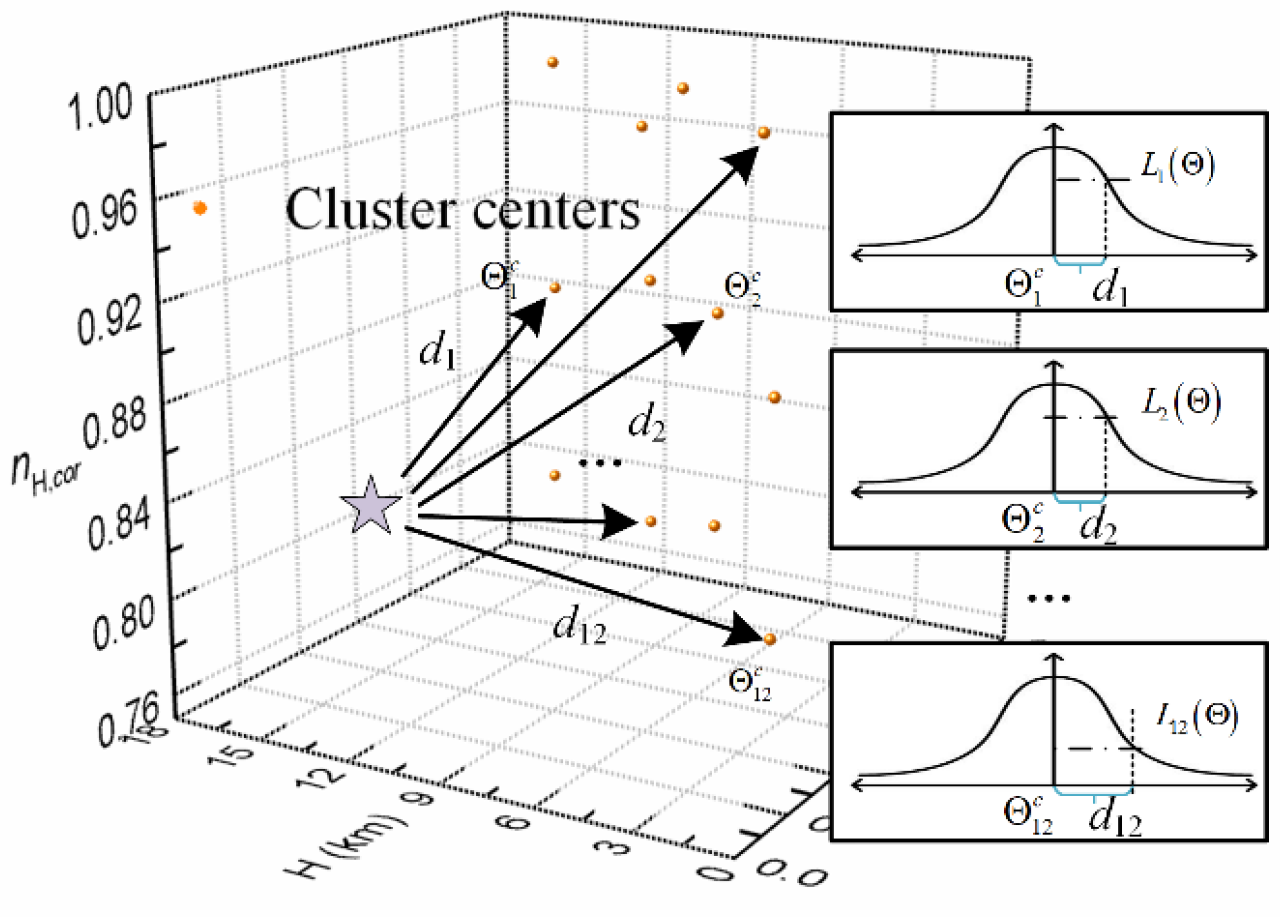
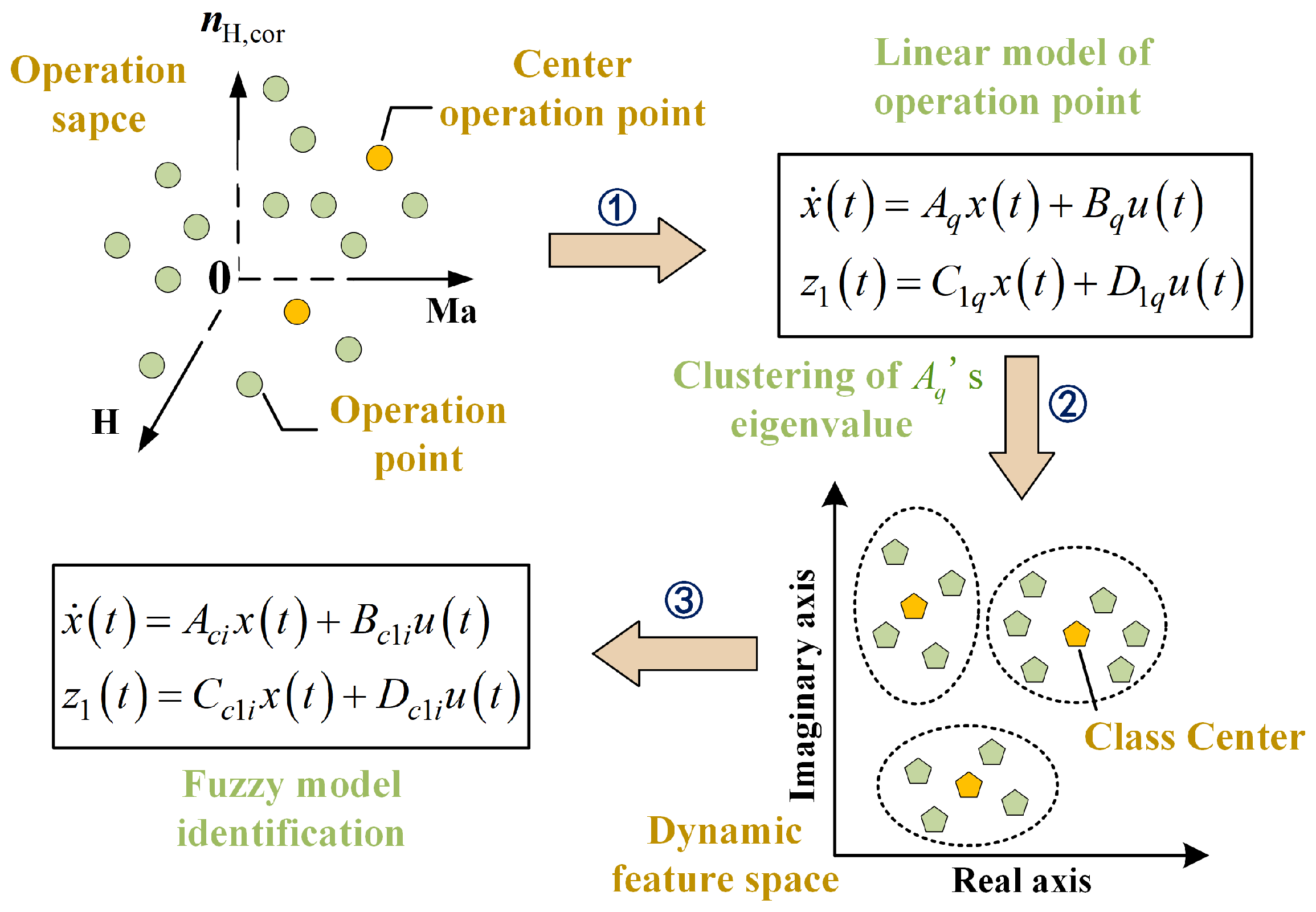
Figure 1 depicts the methodology of clustering-based fuzzy modeling for aircraft engines.
Figure 1.
Intelligent fuzzy modeling methodology.
First, consider that engines operate in a space consisting of the flight height H, the Mach number , and the rotational speed of the spool n. The dynamics of engines vary in this operation space (OS) ∑.
Second, at an arbitrary operation point, a state variable model (SVM) is formulated by linearization, and the dominant eigenvalues of the SVM, whose definition will be given later (7), are regarded as an engine dynamic feature at this operation point.
Third, all dominant eigenvalues form the engine dynamic feature space (DFS). In the DFS, we cluster the dominant eigenvalues with two levels, and the prime dynamics are sought and kept as cluster centers.
Last, the cluster centers in the DFS are mapped back to center operation points in the OS, and the parameters of the fuzzy model are determined by the clustering results. At the center operation points, the global stability-guaranteed SVMs are identified. The number of clusters is the number of fuzzy rules, and the coordinates of the OS form the premises. The identified SVMs are the corresponding consequences. The distances between operation points and center operation points are used in the design of membership functions. Modeling errors, disturbances, and input disturbances are formulated as uncertainties. Hence, by the - rules, SVMs, and fuzzy inferences, the engine uncertain T–S fuzzy model is obtained.
By this methodology, the corresponding SVMs can be formulated for the different types of engines, and the T–S fuzzy model is established by the hierarchical clustering and the SVMs. Based on the resulting fuzzy model, robust control can be designed and obtained. Hence, the above-mentioned methodology is scalable and adaptable to the different types of aircraft engines, such as turbofans, turboshafts, and variable cycle engines (VCEs). Next, we will apply the methodology to turbofans.
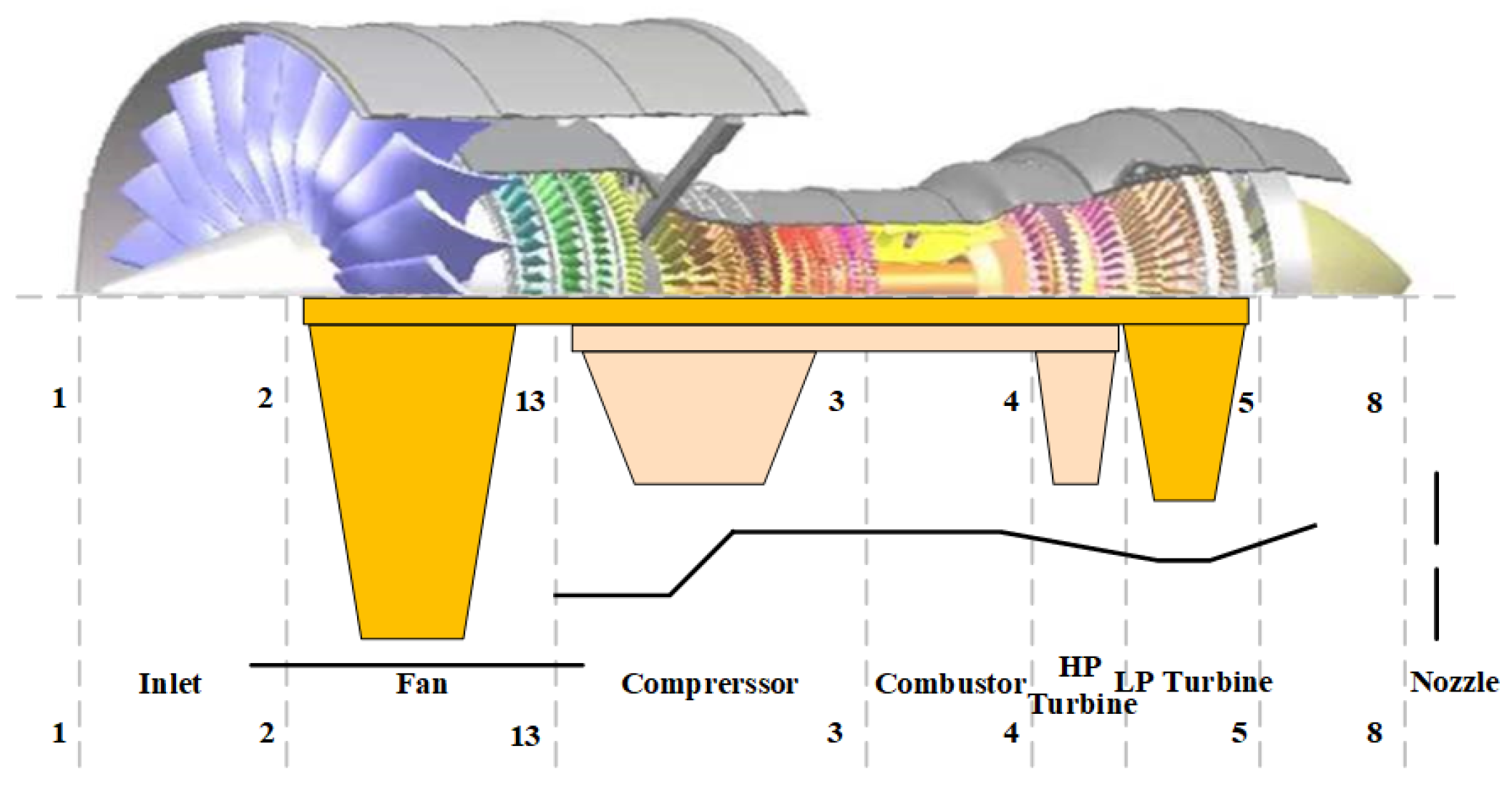
Consider that a turbofan engine shown in Figure 2 is described as
with . Here, the vector is the premise variable, is the premise fuzzy set, is time, is the engine state, and is the initial state. is the uncertain parameter; is the control input; is the disturbance relying on uncertainty; is the input disturbance; and are the evaluation outputs; , , and are known “local” constant matrices; and , , , and are known real matrices with appropriate dimensions. and are matrices depending on x, t, and uncertain parameter . The functions , , and are measurable in t and continuous in x and .
Figure 2.
Diagram of a turbofan engine.
Remark 1.
Remark 2.
The nonlinearity in engine dynamics could be featured via the variation of the eigenvalues of matrices s in (1). Similar eigenvalues of s imply similar engine dynamics. Hence, we take these eigenvalues as the feature parameters and cluster them to find the prime dynamics. The resulting dynamics and their number could help to determine the numbers of the fuzzy rules, membership functions, and consequences in the system (1).
The nominal system of the system (2) is defined as
Remark 3.
The nominal system is the system without the uncertain parts , , and d.
The modeling procedure is as below.
Step 1. Under a flight height H, a Mach number , and a rotational speed of the spool n, linearize the engine component-level model to an SVM. Calculate the dominant eigenvalue of the system matrix (see (7)).
Step 2. According to the distribution of dominant eigenvalues in the DFS, divide the eigenvalues into D primary clusters.
Step 3. In each primary cluster, cluster the dominant eigenvalues by the MMD-FCM. Determine the optimal cluster number by the mixed- statistics. Let the number of fuzzy rules . Map cluster centers in the DFS back to the center operation points in the OS.
Step 4. Choose the membership function. By taking advantage of the distance between the operation points and the center operation points, determine the parameters of the membership functions.
Step 5. At center operation points, identify the local SVMs with global stability constraints. Form the uncertainty in the local system with , .
Step 6. Choose the fuzzy inference and the defuzzifier, and calculate the engine T–S fuzzy system (1).
2.2. T–S Fuzzy Model-Based Control
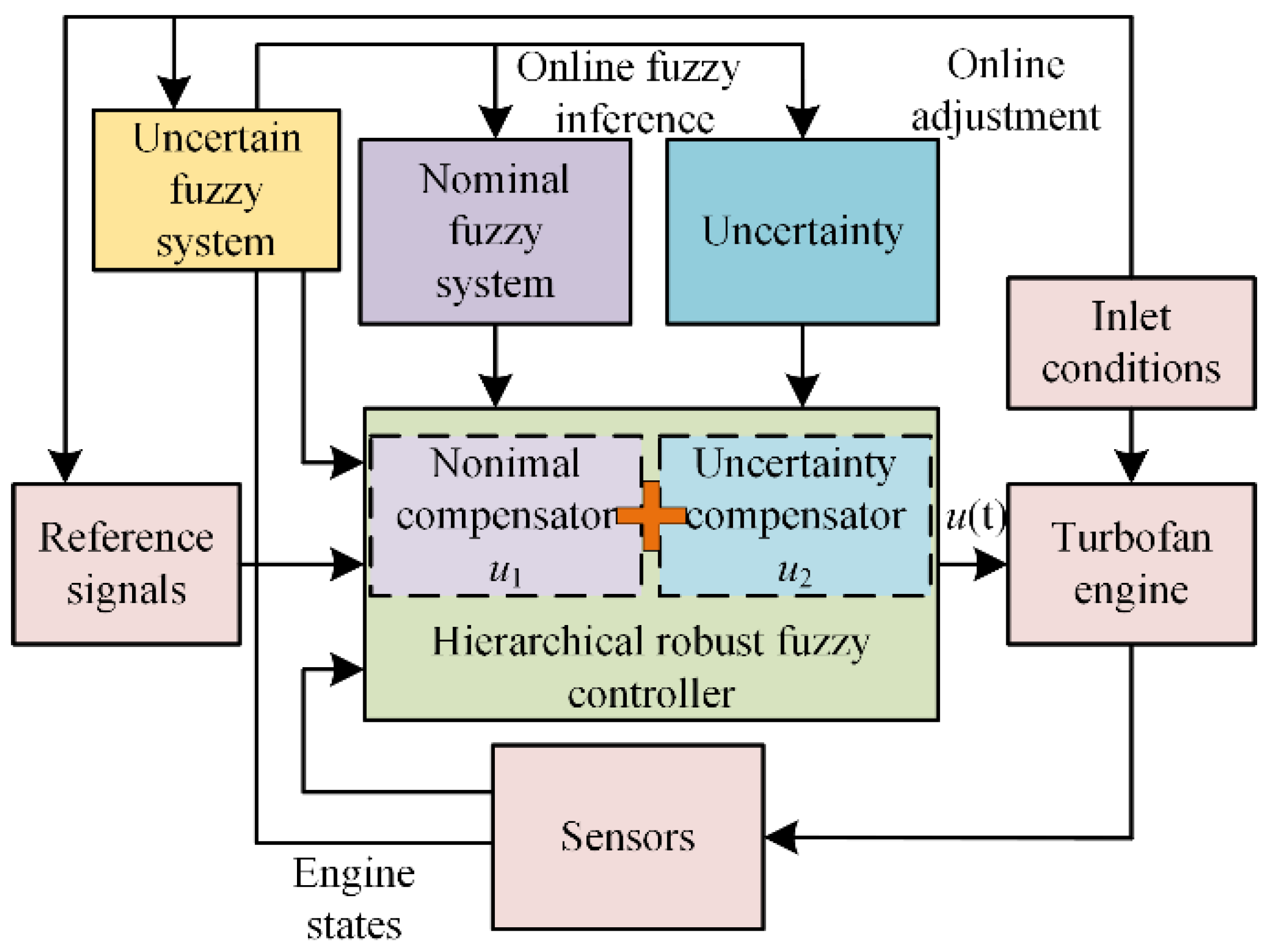
For the engine uncertain fuzzy system (2), a hierarchical fuzzy robust control is proposed as
where and are the nominal compensator and the uncertain compensator. The mechanism of engine fuzzy model-based control is shown in Figure 3. The nominal compensator guarantees the basic performances of the uncertain fuzzy system (2). The uncertainty compensator works with the nominal one, which renders the system (2) uniformly bounded and then uniformly ultimately bounded.
Figure 3.
Mechanism of engine fuzzy model-based control.
3. Turbofan T–S Fuzzy Model
3.1. Hierarchical Clustering of Turbofan Dynamics
Hierarchical clustering is a two-level clustering. Because turbofan dynamics vary nonlinearly and complexly, the two steps of clustering are adopted to extract engine dynamic features sequentially. First, the initial clustering is performed preliminarily by using a K-means-manifold clustering algorithm, and then the secondary clustering is conducted by using an MMD-FCM clustering algorithm for better extraction of engine dynamic characteristics.
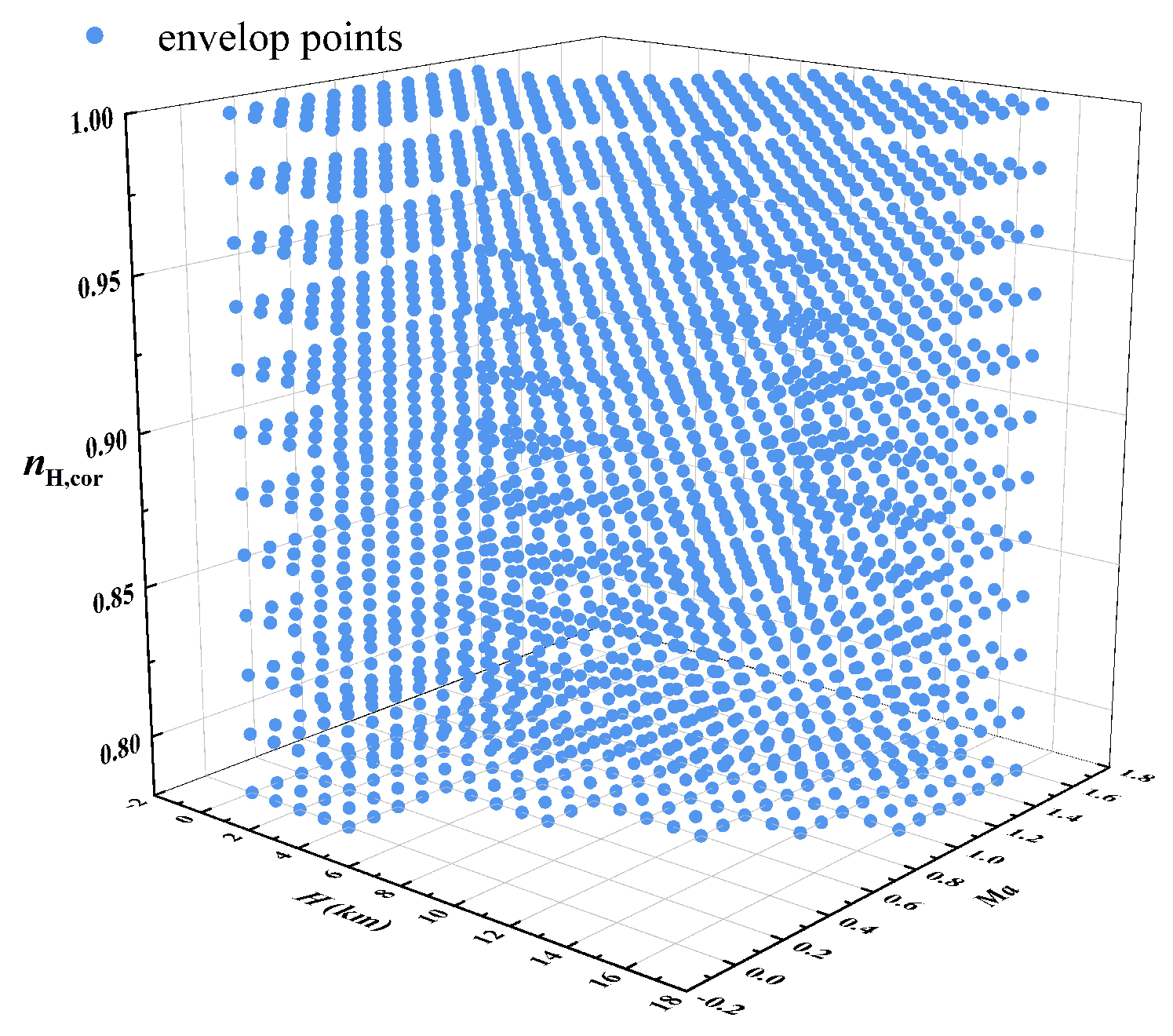
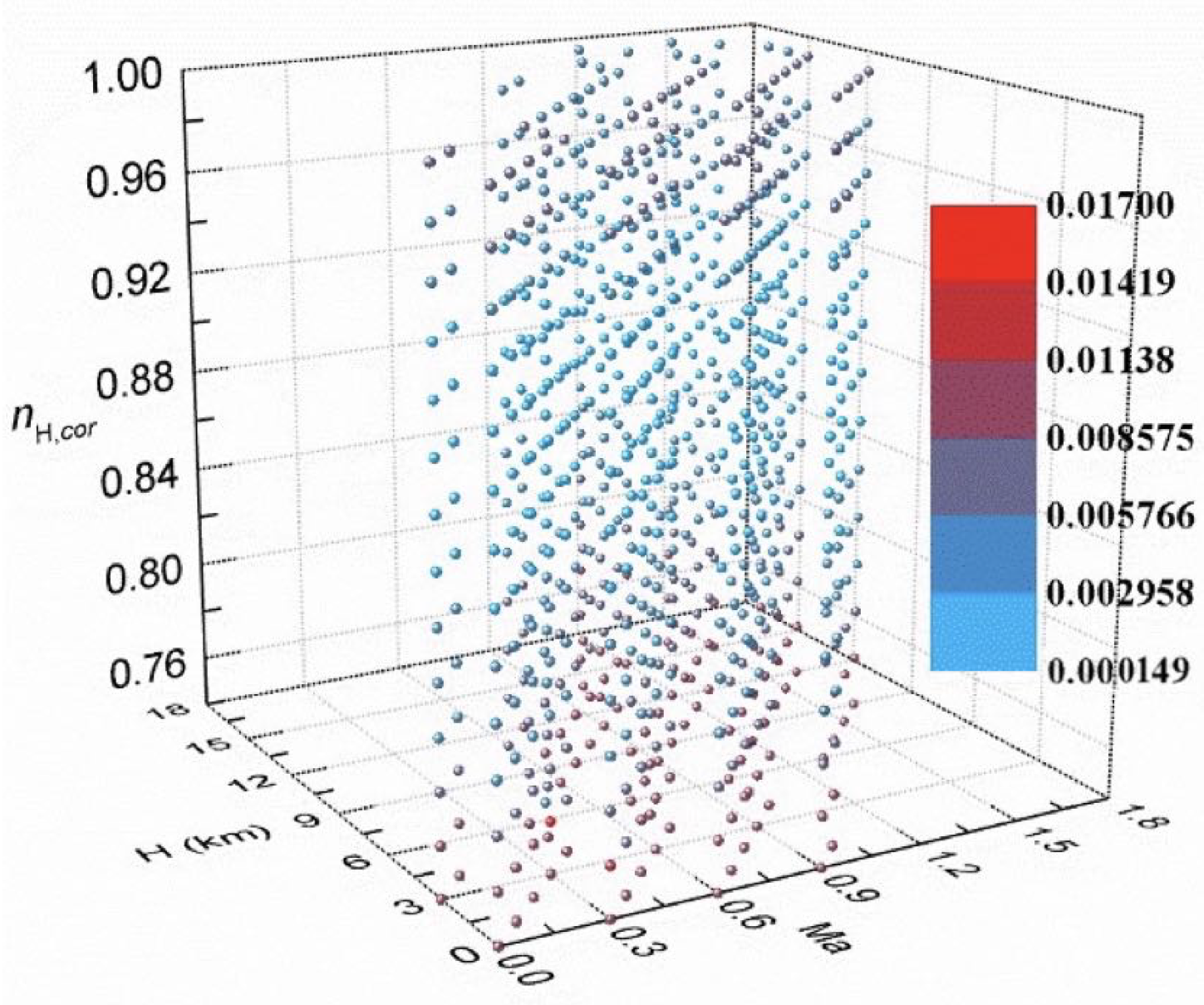
Consider the turbofan operation space ∑ forming by H, , and . Here, is the corrected rotational speed of the high-pressure spool. Let , , and ; a subspace of ∑ is formed. We pick N operation points , , every 1 km, every 0.1 Mach number, and every 0.2 in with the constraint of the flight envelope (Figure 4). Therefore, .
Figure 4.
Operation points in H-- space.
The SVMs at these points are
where , , , will be determined in the robust control design. The matrices in (6) have appropriate dimensions.
The eigenvalue of is , . Define the dominant eigenvalues [41],
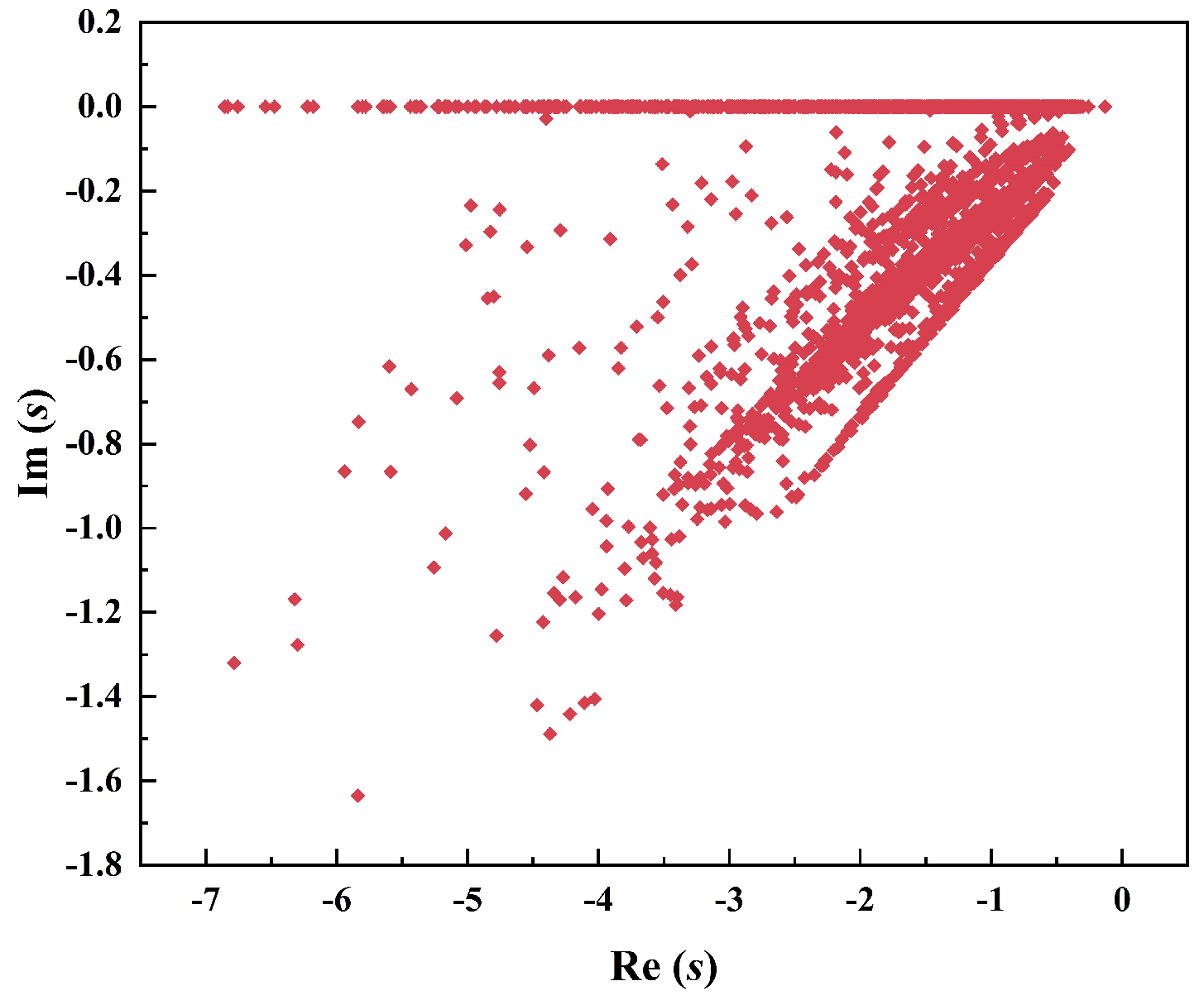
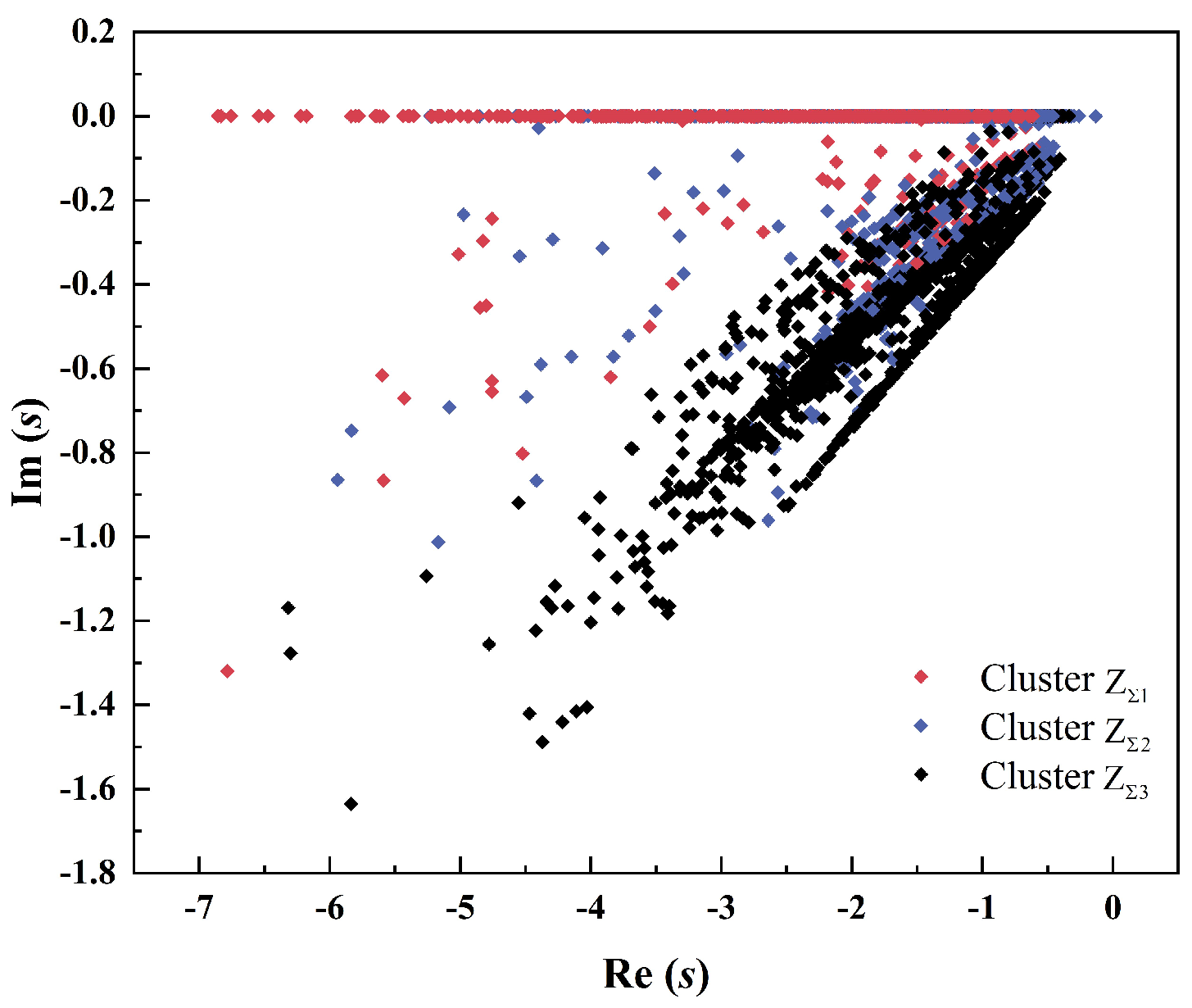
where is the real part of a complex number. By the small perturbation method, the matrices s at N operation points can be obtained from a turbofan component-level model [42]. The distribution of s is shown in Figure 5. Hence, the dominant eigenvalues are preliminarily divided into three clusters, namely, , as shown in Figure 6. The eigenvalues in are notated as with . This is the level 1 clustering of the engine dynamics.
Figure 5.
Distribution of dominant eigenvalues.
Figure 6.
Preliminary clusters of dominant eigenvalues.
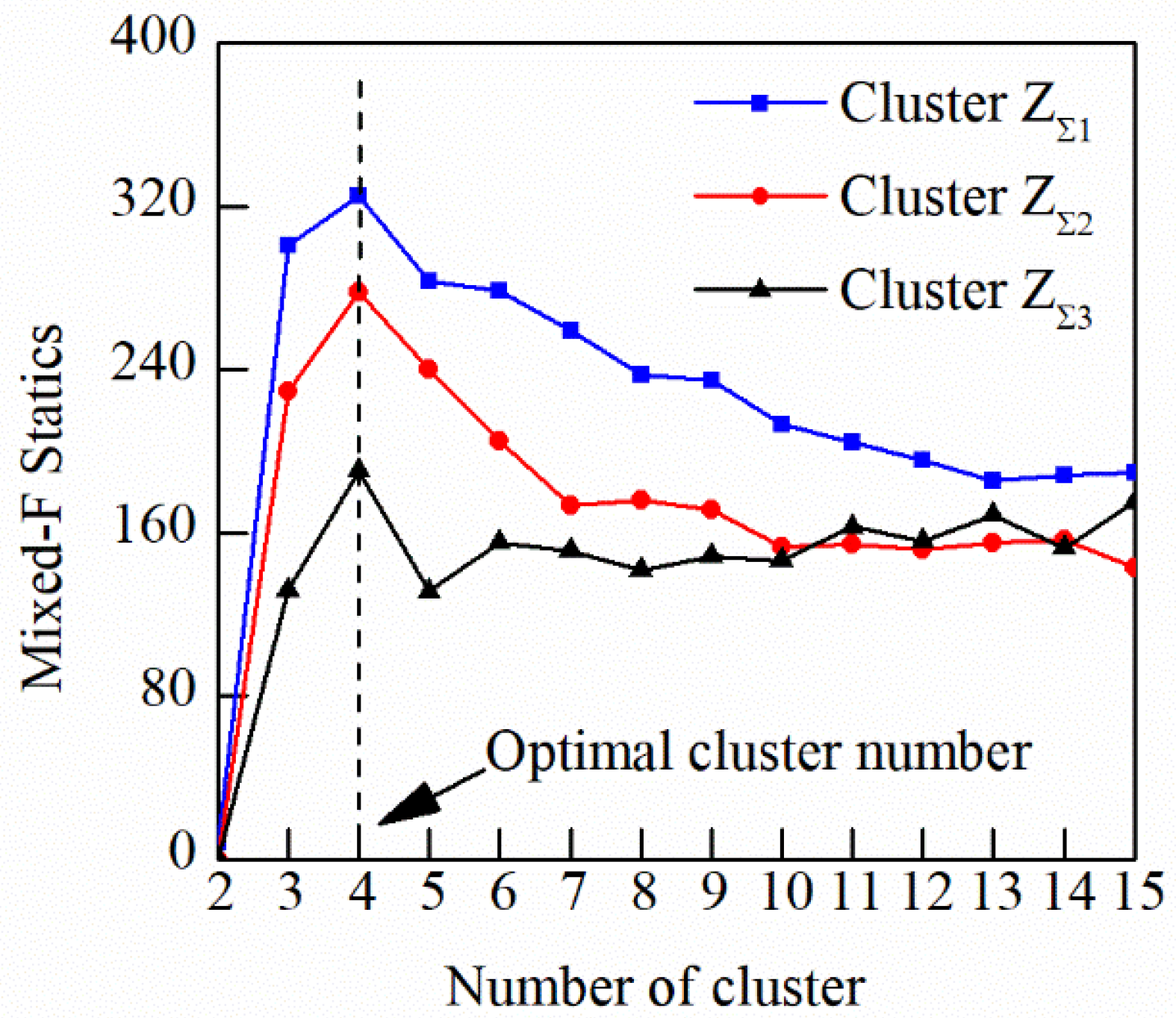
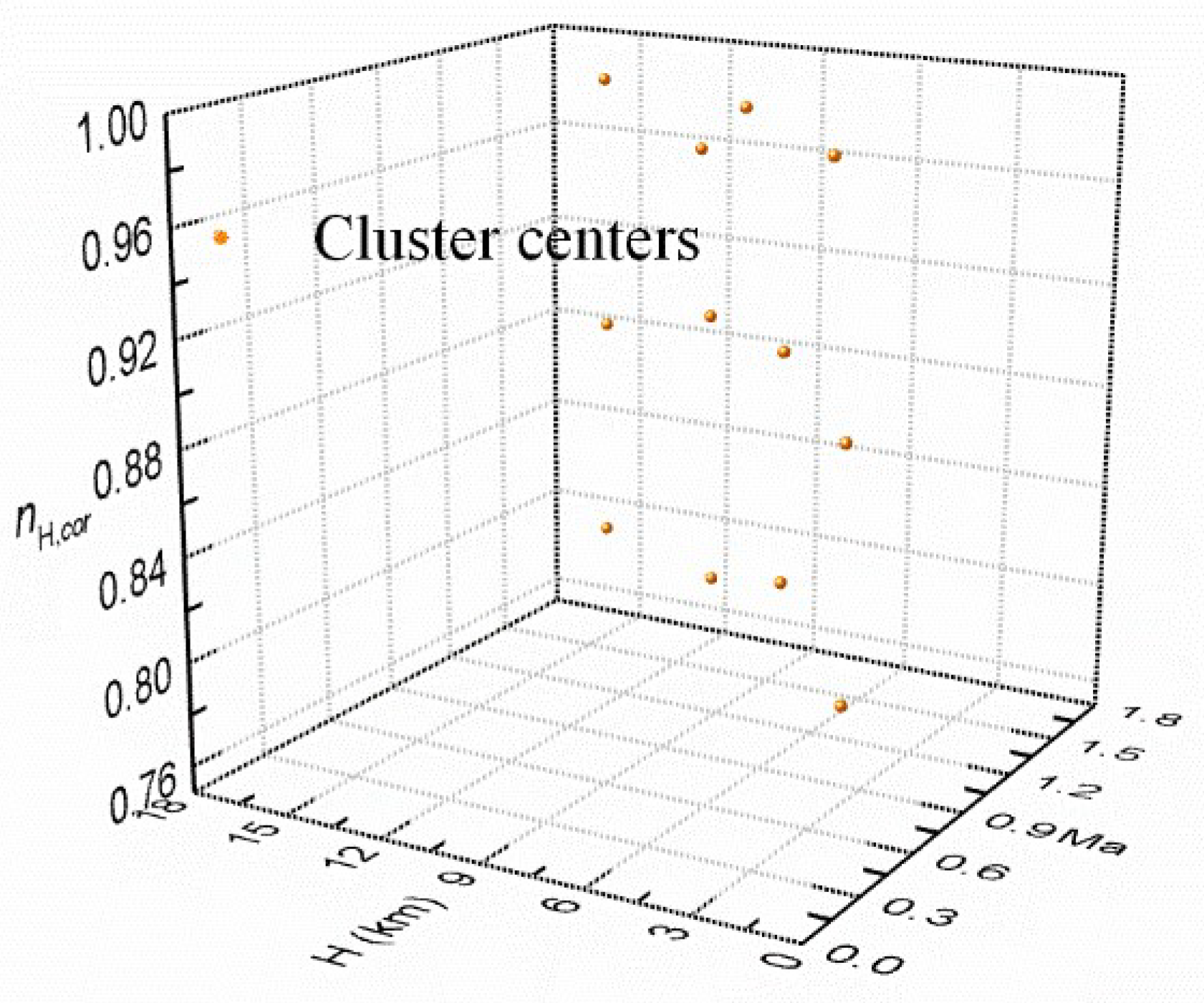
Next, we cluster in , which is the level 2 clustering. In the primary cluster , by the MMD-FCM algorithm with mixed-F statics in [8], the number of clusters and the cluster centers , are obtained. Figure 7 shows the variety of mixed- statistics with the increase in cluster number. When the mixed- statics are maximum, the corresponding cluster number is optimal [8]. Therefore, , and there are twelve cluster centers for all three primary clusters. Let , , and the corresponding center operation points in are shown in Figure 8 and listed in Table 1.
Figure 7.
Mixed- statistics under different cluster numbers.
Figure 8.
Center operation points s corresponding to cluster centers s.
Table 1.
Part of cluster centers in the operation space.
3.2. Identification of Local Systems
If the SVM (6) at the center operation point is adopted as the consequences of a turbofan T–S fuzzy model, it will result in , . Generally, turbofan engines are internally stable, which suggests that the local matrix is Hurwitz-stable. However, by the fuzzy inference, the global in (4) may be unstable [7]. In order to ensure the internal stability of the T–S fuzzy system (4), we present the stability-guaranteed modeling method as follows.
Sample the state x, the input u, and the output of a turbofan at at the instants with the sampling period . Let
Theorem 1.
For the fuzzy system (4), suppose is Hurwitz-stable. If there exist the matrix and the vector to solve
the matrix is Hurwitz-stable.
Proof.
See Appendix A. □
Remark 4.
By solving the optimization problem (11) via the toolbox Yalmip in , the matrices are obtained. Yalmip is a toolbox of used to call other solvers with QP or SQP algorithms for optimal problems.
Remark 5.
The matrices and will be determined in the fuzzy controller design.
3.3. Turbofan T–S Fuzzy Model
In , let and . Choose the Gaussian membership function for each fuzzy rule, which is shown in Figure 9. At the twelve center operation points in Table 1, the inputs and step of their initial values and stimulate the turbofan component-level model separately, and the responses and are collected. Take the initial time of the input steps as , , and ms. Then, we sample the inputs and responses and form (8), (9). Solve the problem (11) and obtain the matrices . Part of the results is listed in Table 2.
Figure 9.
Membership functions for fuzzy rules.
Table 2.
Part of identification results.
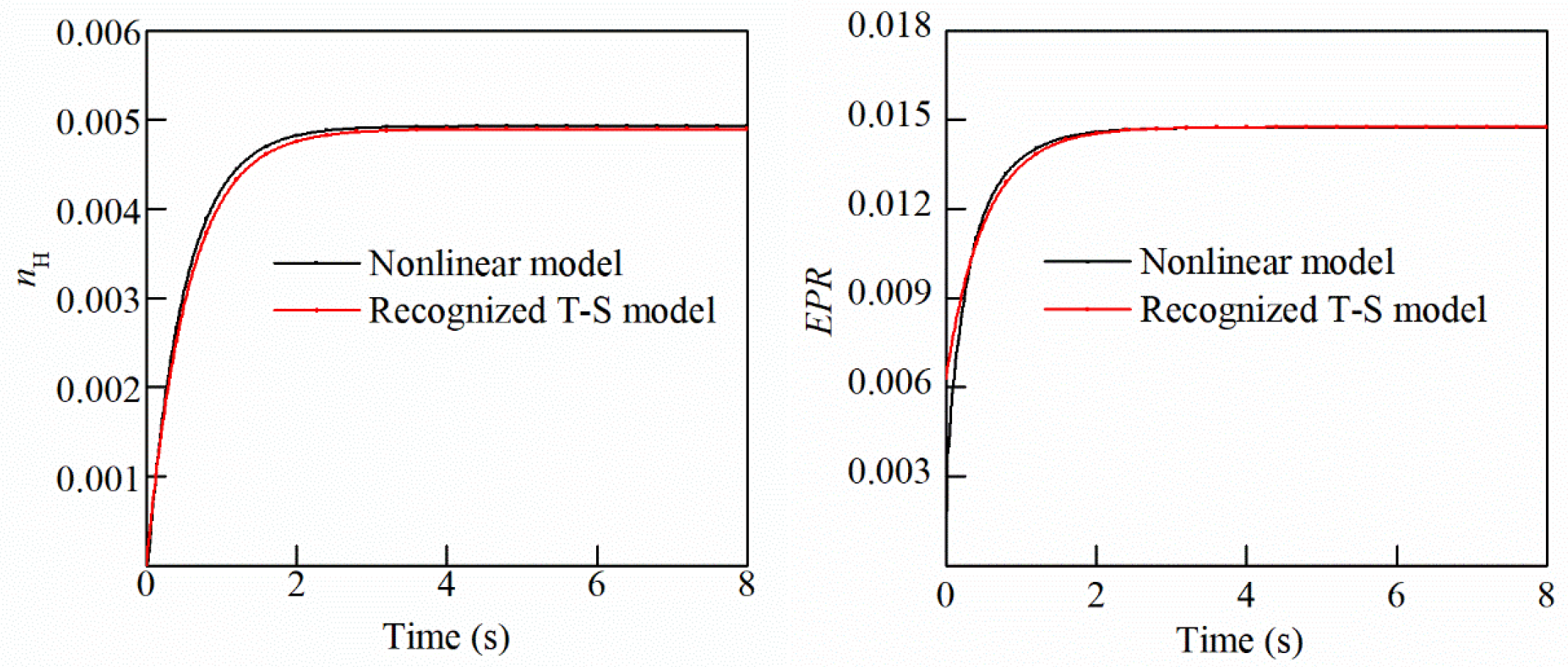
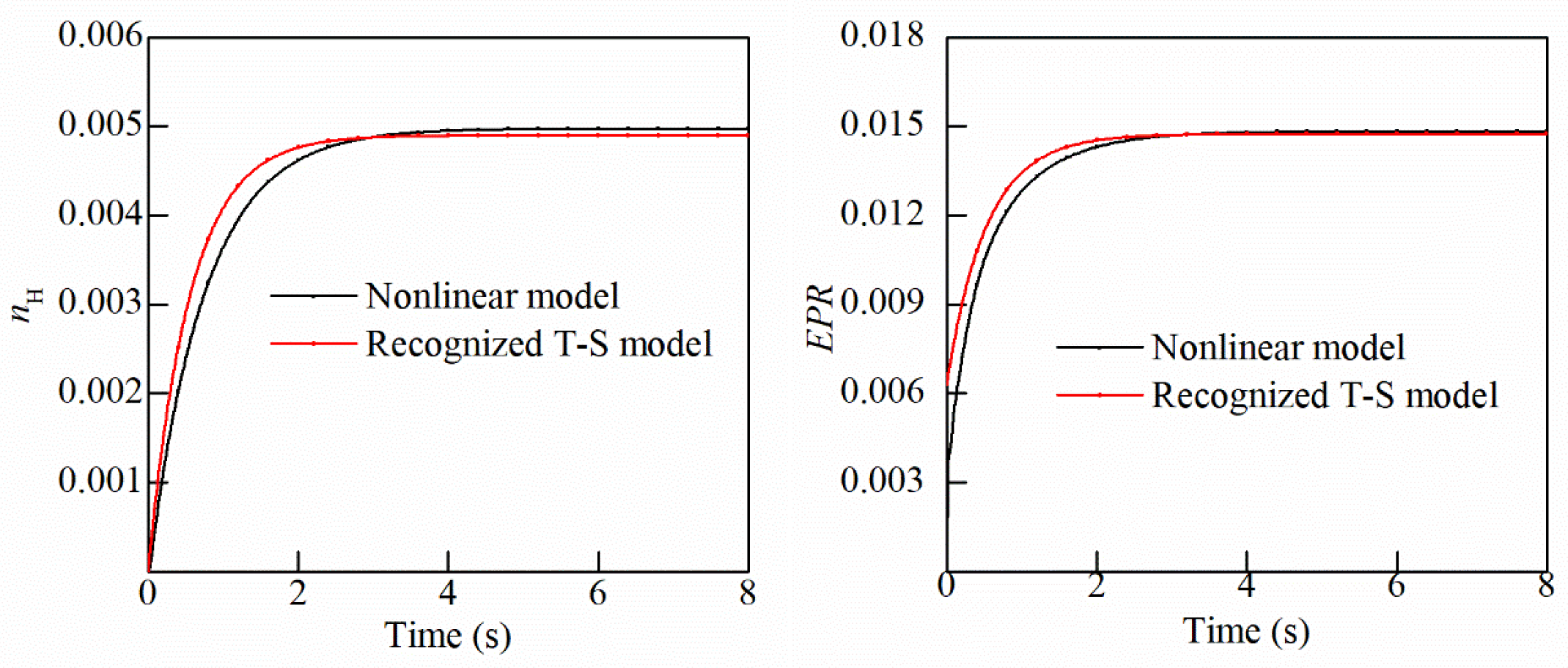
We verify the resulting turbofan T–S fuzzy model at all N operation points. In the verification, the input steps 3%, and the responses of the T–S fuzzy model and those of the component-level model are recorded. Here, the results at and are given in Figure 10 and Figure 11. Figures show that the steady errors between responses and of the T–S fuzzy model and those of the component-level model are less than .
Figure 10.
Outputs of the fuzzy model and nonlinear model at .
Figure 11.
Outputs of the fuzzy model and nonlinear model at .
Define
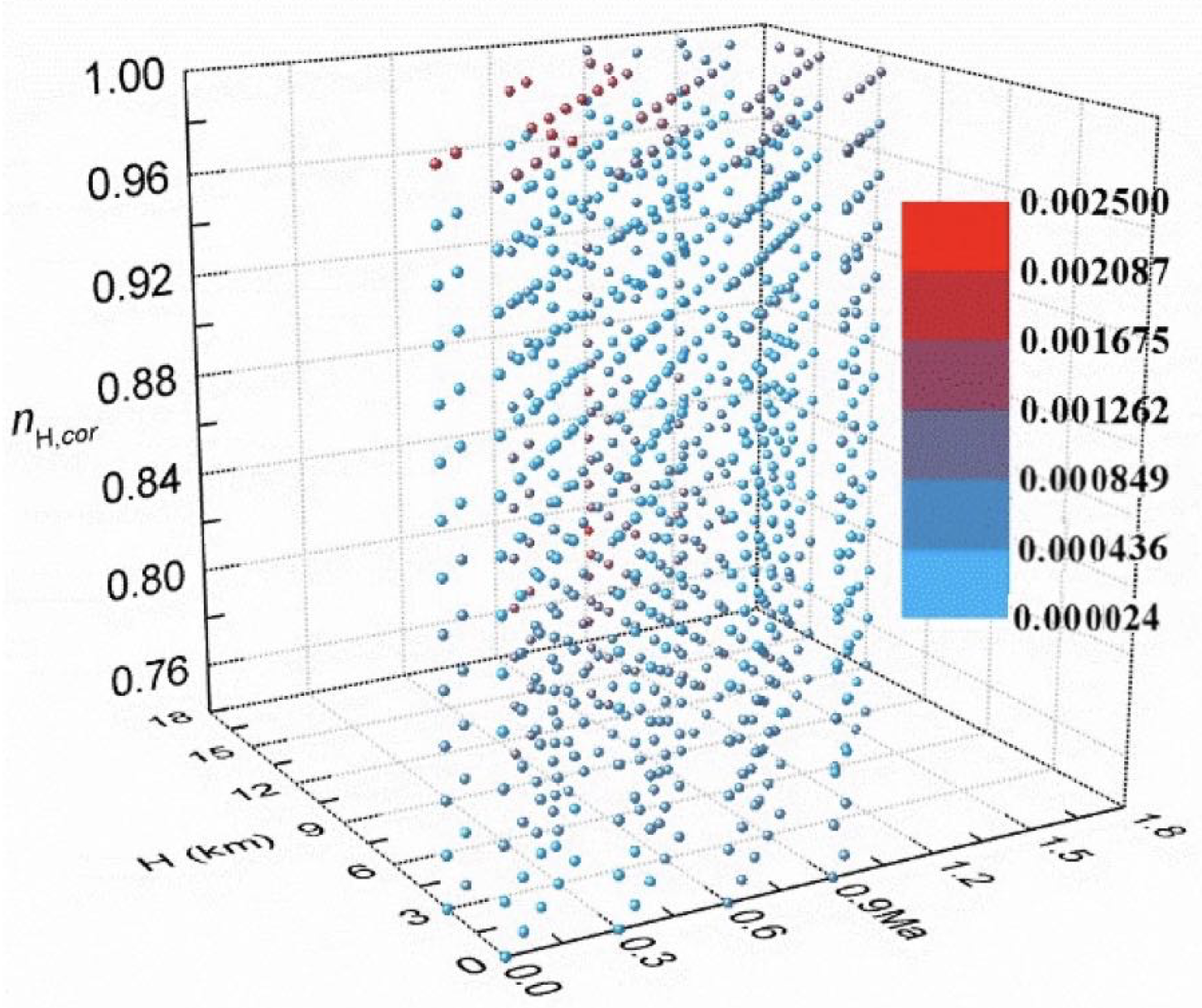
where are the responses of the turbofan component-level model. Figure 12 and Figure 13 show the RMSEs in . The RMSEs at all N operation points are less than . The steady errors and RSMEs indicate that the resulting turbofan T–S fuzzy model has a fairly good steady state and dynamic accuracy.
Figure 12.
RMSE of between fuzzy model and nonlinear model.
Figure 13.
RMSE of between fuzzy model and nonlinear model.
It can also be noted that the RSMEs of tracking trajectories are averagely larger than those of . The supposed reason is that is formed as a linear function of the states and , as shown in (4). The relationship between them is nonlinear. This additional modeling error results in the larger RSMEs.
4. T–S Fuzzy Model-Based Robust Control for Aircraft Engines
4.1. Nominal Compensator
Consider the nominal compensator in (5). For the preparation of its design, the following lemma and assumption are presented.
Lemma 1 ([42]).
If there exist the matrices , , and with such that
then
where and .
Assumption 1.
There exist positive numbers such that
Now the theorem for the nominal compensator is presented below.
Theorem 2.
Consider the nominal system (4) subjected to Assumption 1. For the given number and matrices and , if there exist the matrices , , , , and to solve
Proof.
See Appendix B. □
The nominal system (4) has an performance under the following compensator scheme:
with , .
4.2. Robust Control Design
For the uncertainty part in system (2), some assumptions are presented first.
Assumption 2.
There exist the matrices and with appropriate dimensions such that
Assumption 3.
There exist the positive scalars , , , , and such that
Remark 6.
Remark 7.
Now we propose
where ; the parameter is positive constants. By (19) and (27), the hierarchical fuzzy robust control in (5) is obtained. Now we present the main result of this paper.
Theorem 3.
Consider that the uncertain fuzzy system (2) is subject to Assumptions 1–3. The control (5) with the compensators (19) and (27) renders the controlled system (2) the following performance:
(i) Uniform boundedness: For any , there is such that if , then for all .
(ii) Uniform ultimate boundedness: For any with , there is such that for any as , where .
Proof.
See Appendix C. □
Remark 8.
For a given , the gain parameter should meet inequality (A28). The inequalities (A29) and (A30) and Equation (58) show that the parameter s can adjust the size of a uniform bound. The larger s result in a smaller bound. Meanwhile, the large s mean a large control gain , which may lead to the overshoot and oscillation of the system responses. Hence, there is a trade-off between the bounded performance and the dynamic performance.
Remark 9.
Consider the robust compensator (27). Compared with a uniform control gain, the new control gain synthesized via the fuzzy inference provides the flexibility of the control design.
4.3. Aircraft Engine Tracking Control Design
The main result in Section 4.2 can be applied to the steady-state control to keep the engine’s performance around a desired operation power level for a relatively long period of time. For the engine transient operation, such as the acceleration and the deceleration, the engine outputs should track the references that are given by the control schedules. In order to extend this main result to the engine transient control, the tracking errors are augmented into the state x, and the engine-augmented uncertain fuzzy model is described as
where
where is the reference and is the tracking error.
According to Theorem 3, for the uncertain fuzzy system (2), the new robust control is
4.4. Hardware-in-Loop Experimental Testing
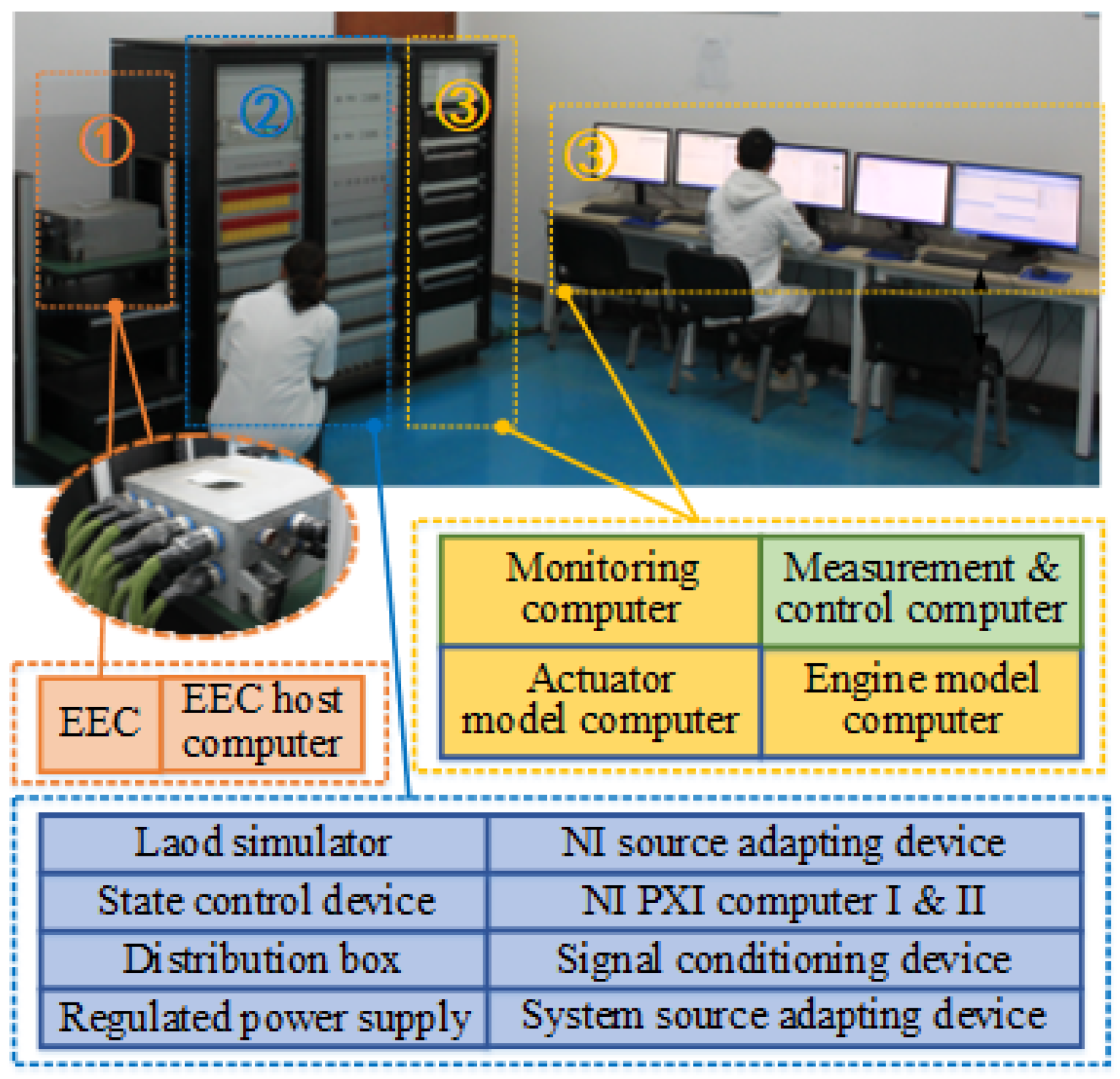
We demonstrate the controlled turbofan performance by a Hardware-in-Loop (HIL) testing. The HIL testing is a kind of experiment in which the controller is a real hardware one, sensors and actuators are simulated by electronic elements, and the controlled object is a mathematical model. The aero-engine HIL experimental platform integrates the real engine electronic controller into the simulation environment to verify the control quality and real-time performance of the control method. The aircraft engine HIL simulator shown in Figure 14 consists of three parts.
Figure 14.
Aircraft engine HIL simulator.
Part 1 is the engine electronic controller (EEC), which is applied to a turbofan engine and is the core of the HIL test platform. Part 2 is the simulator module, which consists of the NI PXI computers, source adapters, conditioning devices, etc. They configure system resources and simulate the sensor signals and actuator driving signals with the electric level. Part 3 is the monitoring module with the model computers, monitoring computer, and other computers, which simulate the engine and actuators, monitor sensor, and actuator signals.
We take the component-level model of a turbofan engine as the control plant, which is embedded in the engine model computer.
Let , . By Theorem 2, obtain and .
Let
Here, is the Moore–Penrose inverse of . We check that all s are positive. Hence, for the engine-augmented uncertain fuzzy system (28), Assumptions 1–3 are met. By and , the fuzzy gain parameter can be calculated. Here, it is worth noting that the appropriate parameters should be chosen and checked to meet the proposed assumptions, such as the uncertainty boundaries , , and .
Two kinds of HIL tests, that is, tests at typical operations and in a flight cycle were conducted. In the former, the robustness, dynamical, and steady-state performances of the control strategy are verified, and the results show that when the references step at the typical operation points, the controller can guarantee high-speed responses with no steady-state errors regardless of the nonlinear dynamics. In the latter tests, the robustness against the large-scale nonlinearity and turbulence is verified. The test outcomes demonstrate that when the dynamics vary significantly during the whole flight cycle with inlet condition turbulence, the controller can also guarantee good dynamical and steady-state performance by utilizing the fuzzy-model-based scheduling strategy.
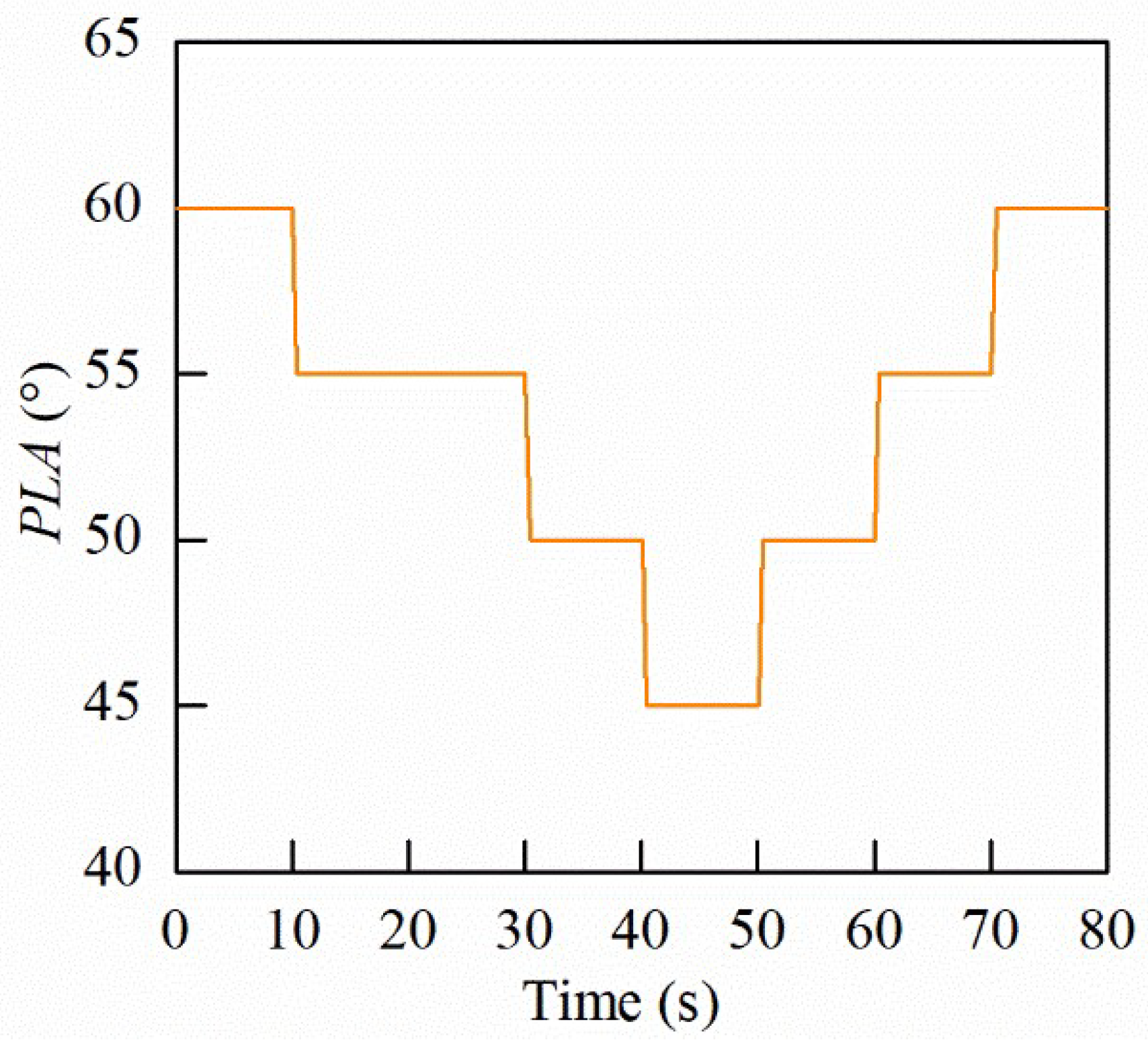
To demonstrate the robustness, dynamical and steady-state performances of the proposed fuzzy control (30), two types of HIL tests, that is, tests at typical operations and in a flight cycle, are performed. In the former tests, the nonlinear dynamics variation is simulated via the reference steps, and in the latter, the large-scale nonlinearity and turbulence are simulated by the continuous variation of flight height, Mach number, and PLA. During the first type of HIL testing, the power lever angle (PLA) steps, as Figure 15 shows. The references and are given according to the PLA and the control schedule. The engine responses, and , are expected to track the references.
Figure 15.
PLA steps.
Next, an LQR robust control is designed and applied to the turbofan to compare with the robust fuzzy control. The main reason for choosing the LQR control as a comparison is threefold. First of all, LQR is the common robust control used in aircraft engines ([1,2]). Thus, it can demonstrate how the new fuzzy control prevails over its rivals in the same area. Other aircraft engine engineers can comprehend our contributions through the comparison. Second, LQR is a standard test board for comparison when it comes to new control developments, such as T–S fuzzy systems, neural network, , , , , and sliding mode control [43,44,45]. No other control has been tested and compared so widely. This implies that our comparison can be easily extended to comparisons with other advanced control approaches. Third, LQR is a well-investigated robust control [46]. All its attribution is well revealed.
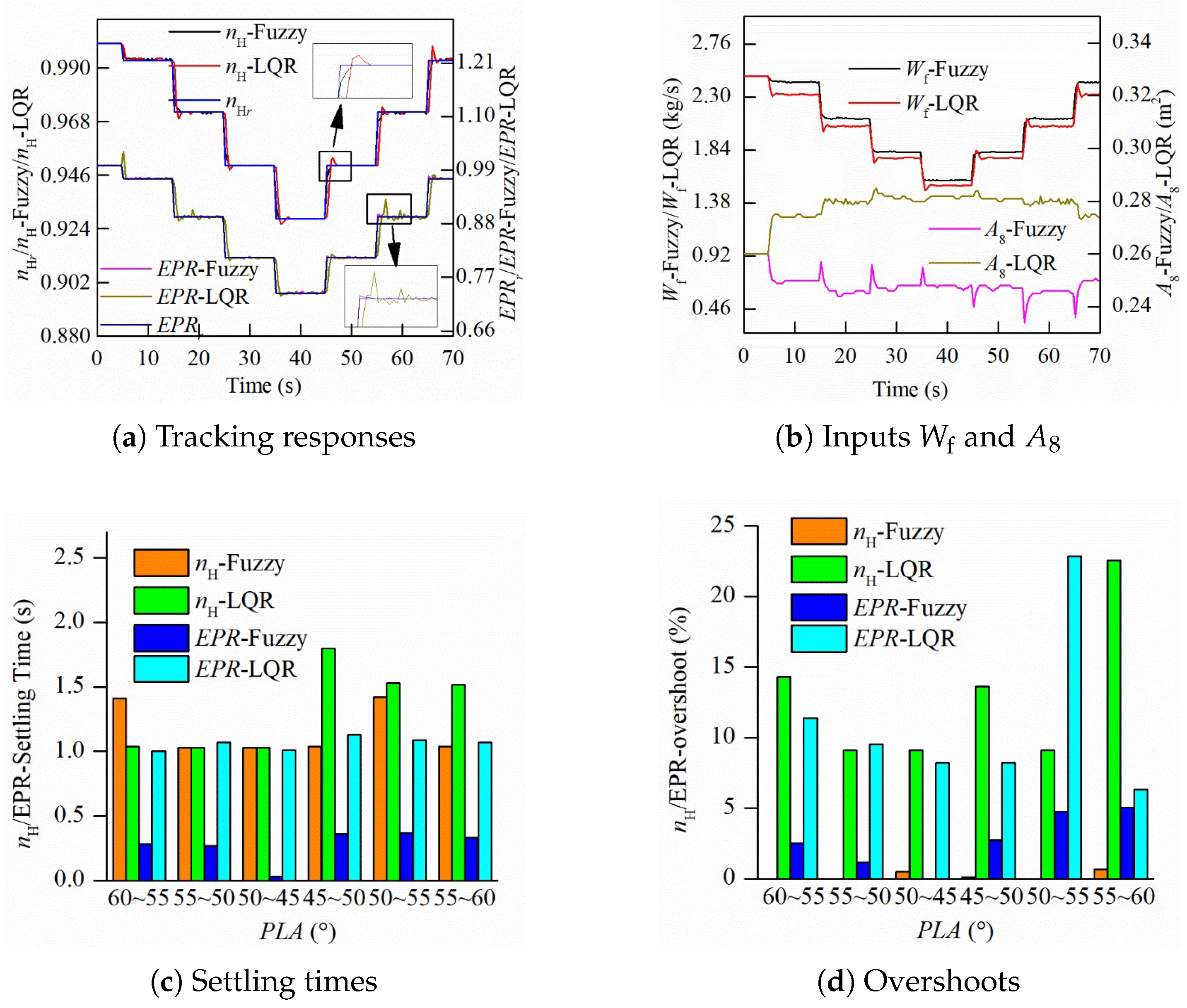
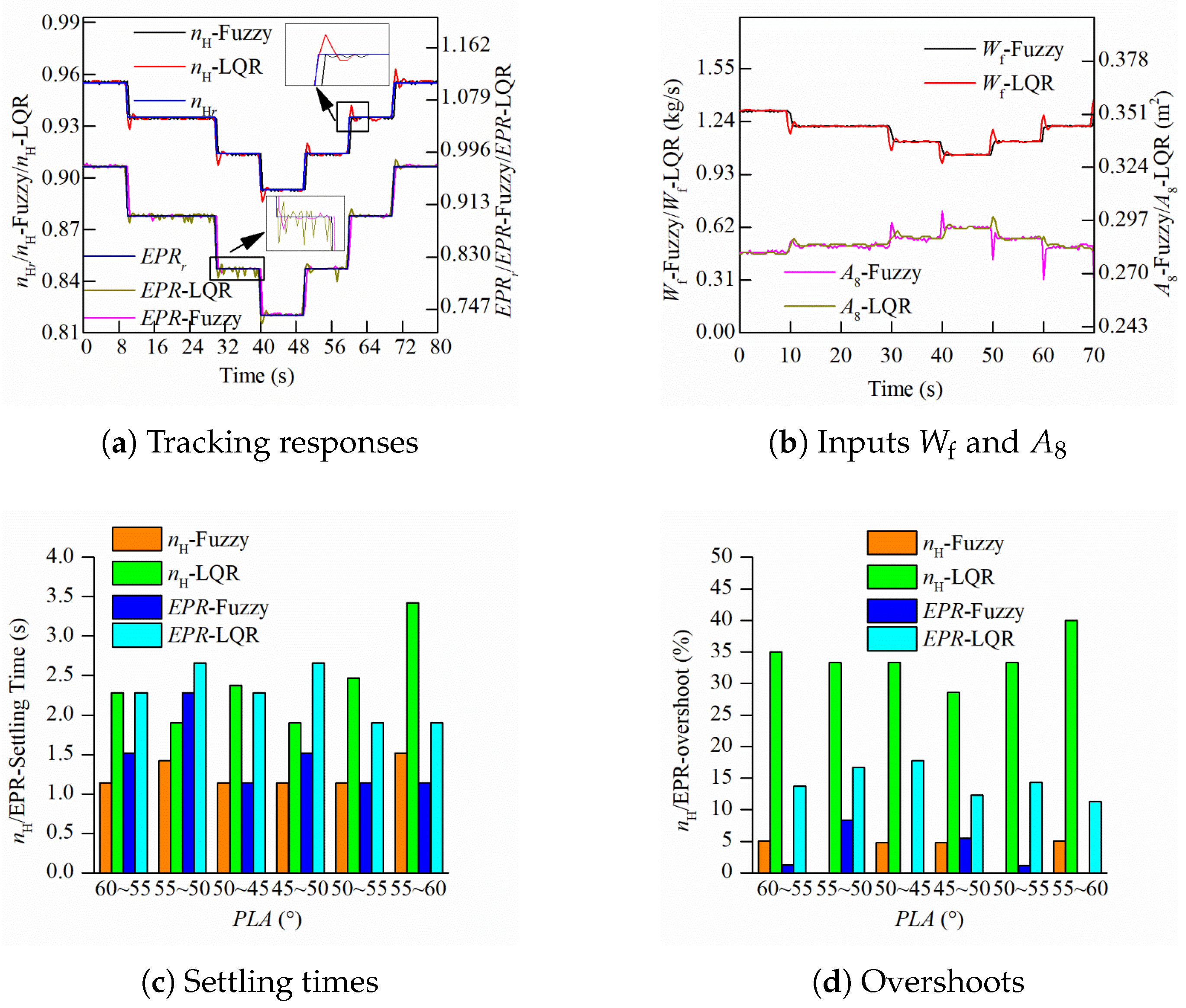
Three groups of the simulation results are shown in Figure 16, Figure 17 and Figure 18. Figure 16a,b show that when and and PLA steps, the robust fuzzy controller guarantees and responses tracking their references respectively without steady errors. Figure 16c shows that the settling times of and responses are around 1.0–1.5 s and 0–0.4 s. Figure 16d shows that there is little overshoot of the response and the overshoot of response is less than 1.5 s. Compared with the fuzzy controller, the LQR controller renders similar steady and dynamical performances of response, but a worse dynamical performance of response. It is also noticed that because of the coupling between the states and inputs, a slight difference between - and - results in a significant difference in - and -.
Figure 16.
HIL testing results when km and and PLA steps.
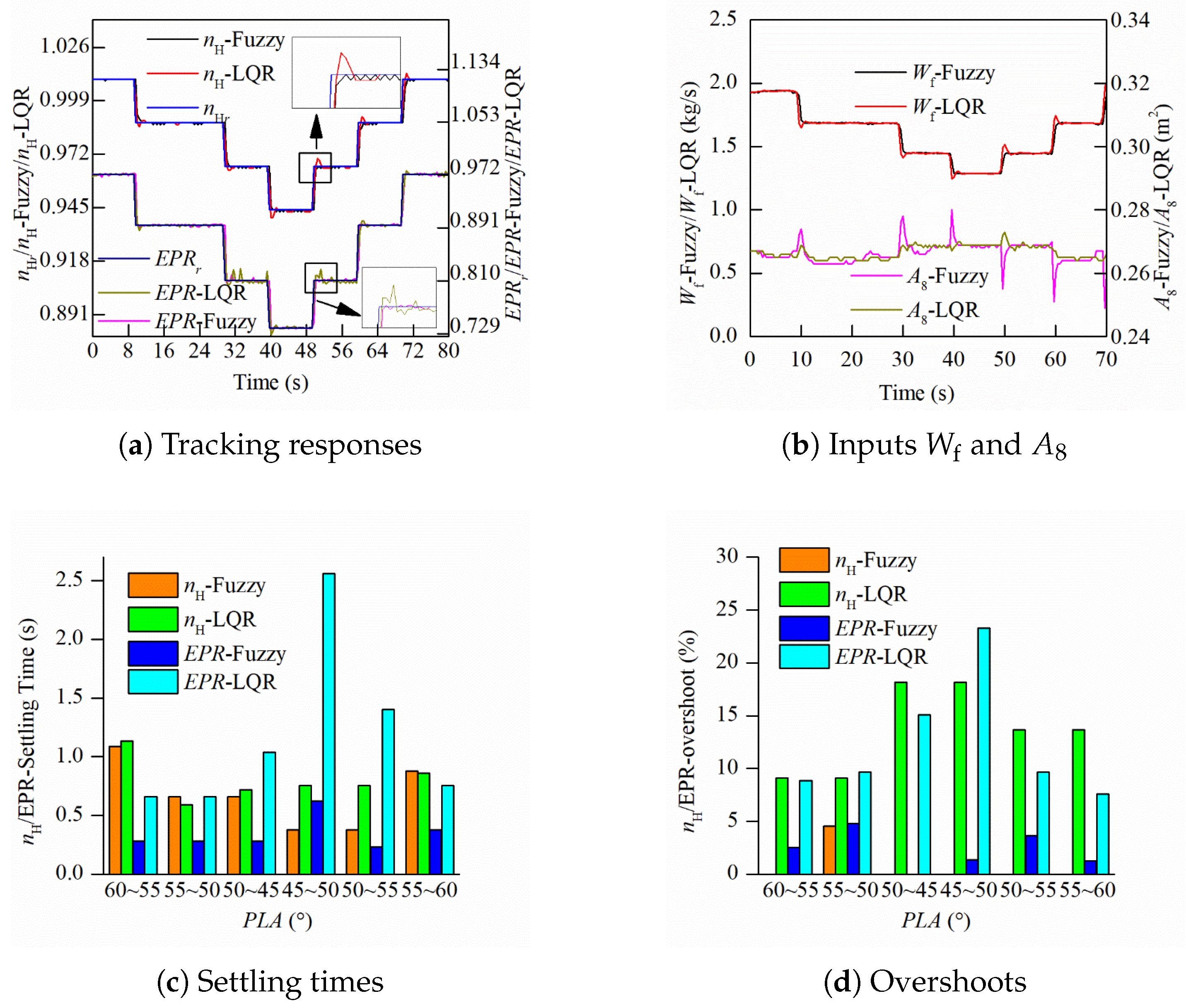
Figure 17.
HIL testing results when km and and PLA steps.
Figure 18.
HIL testing results when km and and PLA steps.
When the turbofan operating conditions change to km and , the engine dynamics are different from that of and . Figure 17 shows that, under the new operating conditions, the settling times of and under the robust fuzzy controller are less than 1.5 s and 2.5 s, and the overshoots of the two responses are less than 5% and 10%. The maximum settling times of the two responses under the LQR controller reach 3.5 s and 2.7 s, and the maximum overshoots are over 24%. The performances of the two responses are both deterioration. Moreover, the engine dynamics change with the operating conditions changing to km and , and the results in Figure 18 also support this conclusion. It can be concluded that the new fuzzy control results in high-speed responses with no steady-state errors regardless of the engine nonlinear dynamics.
Remark 10.
The simulation results show a coupling between the control inputs. In Figure 16, the value of - is slightly smaller than that of -, which results in the distinct difference between - and -. In Figure 18, we can find that the inputs - and - are almost the same, so the other inputs - and - are also close.
Furthermore, we compare the proposed control with the other advanced control methods, such as neural network, , and sliding mode control, which are great accomplishments and have their distinctive traits. The neural network control is a nonlinear control based on data. It provides high control performances by learning numerous effective data and by using complex on-line calculations. Its theoretical base is the universal approximation theorem, which is a local (not global) property. With proper trial-and-error procedure, appropriate neurons (including both the number and the design) can be selected, which, in turn, enables proper learning and performance. This is most suitable when the uncertainty is repetitive and the computational power is not a concern. The control is a robust control method that is most suitable for linear time-invariant systems. For nonlinear systems with a possibly fast time-varying uncertainty, the control method is thoroughly studied, and the performance may be deteriorated. The sliding mode control (SMC) is robust to the uncertainty. However, it is sensitive to noise. Although the system performance may be improved with a reduced boundary layer, the resulting actuator chattering might be a concern.
For aircraft engines, due to the calculation capability limit of the controller hardware and the non-repetitive nature of the uncertainty, the neural network control application is limited. The strong and time-varying nonlinearity and noise may compromise the control and SMC performances. Comparing with these advanced control methods, which are superb in their own right, the proposed control method possesses high robustness to nonlinearity and time-varying uncertainty, while only limited computational power is required.
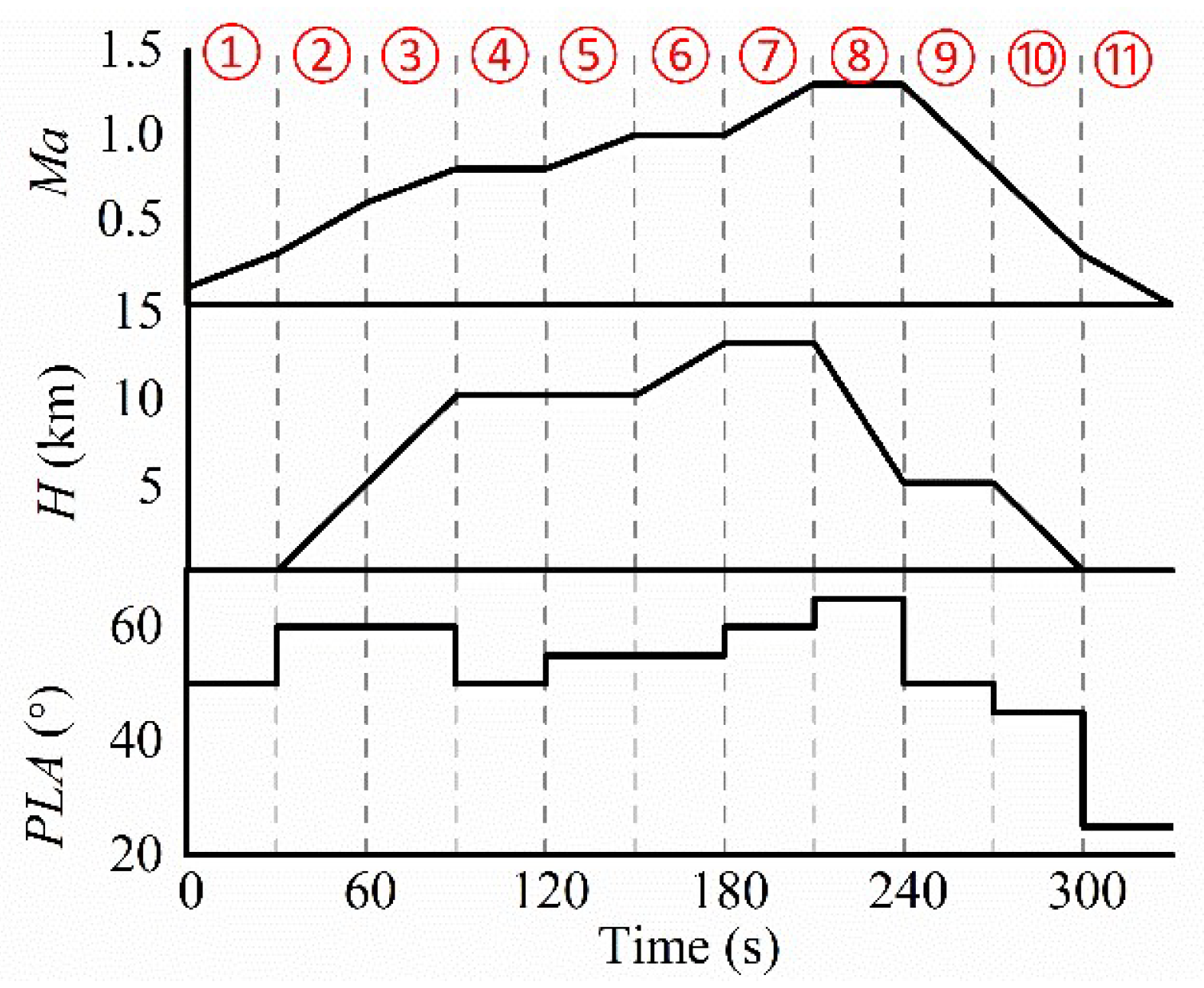
Last, we schedule a flight task cycle as shown in Figure 19 and conduct HIL testing to verify the performance of the resulting closed system under more practical operating conditions. The flight height and Mach number vary from 0 km to 12 km and 0 to 1.2, respectively. During the cycle, the temperature and pressure of the turbofan inlet are changing. Particularly, in phases 2 (taking off), 3 (climbing and acceleration), and 10 (landing), the PLA remains constant and the flight height and Mach number vary, which causes turbulence to the turbofan.
Figure 19.
Operation schedule in the flight envelope with ➀ taxiing, ➁ taking off, ➂ climbing and acceleration, ➃ cruising, ➄ accelerating, ➅ climbing, ➆ accelerating, ➇ diving, ➈ decelerating, ➉ landing, and
taxiing.
taxiing.
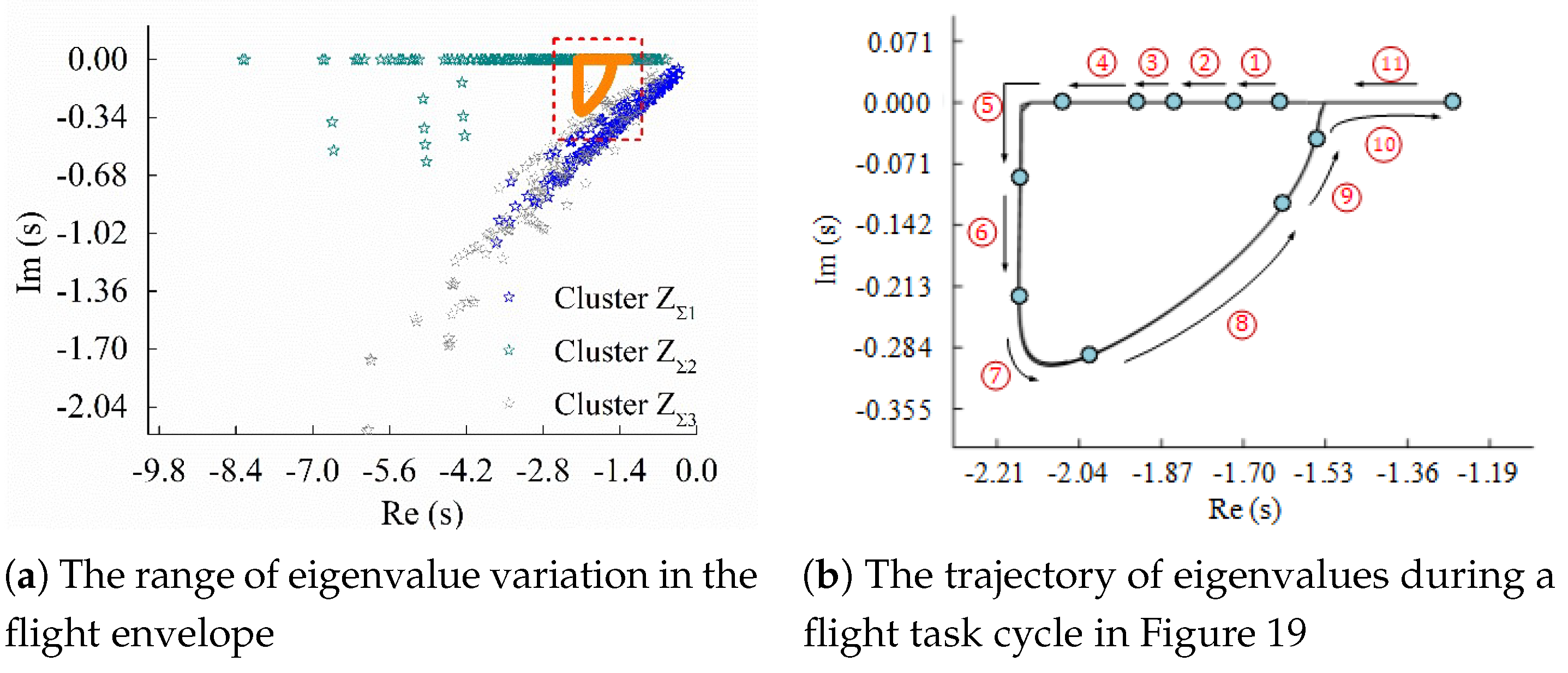
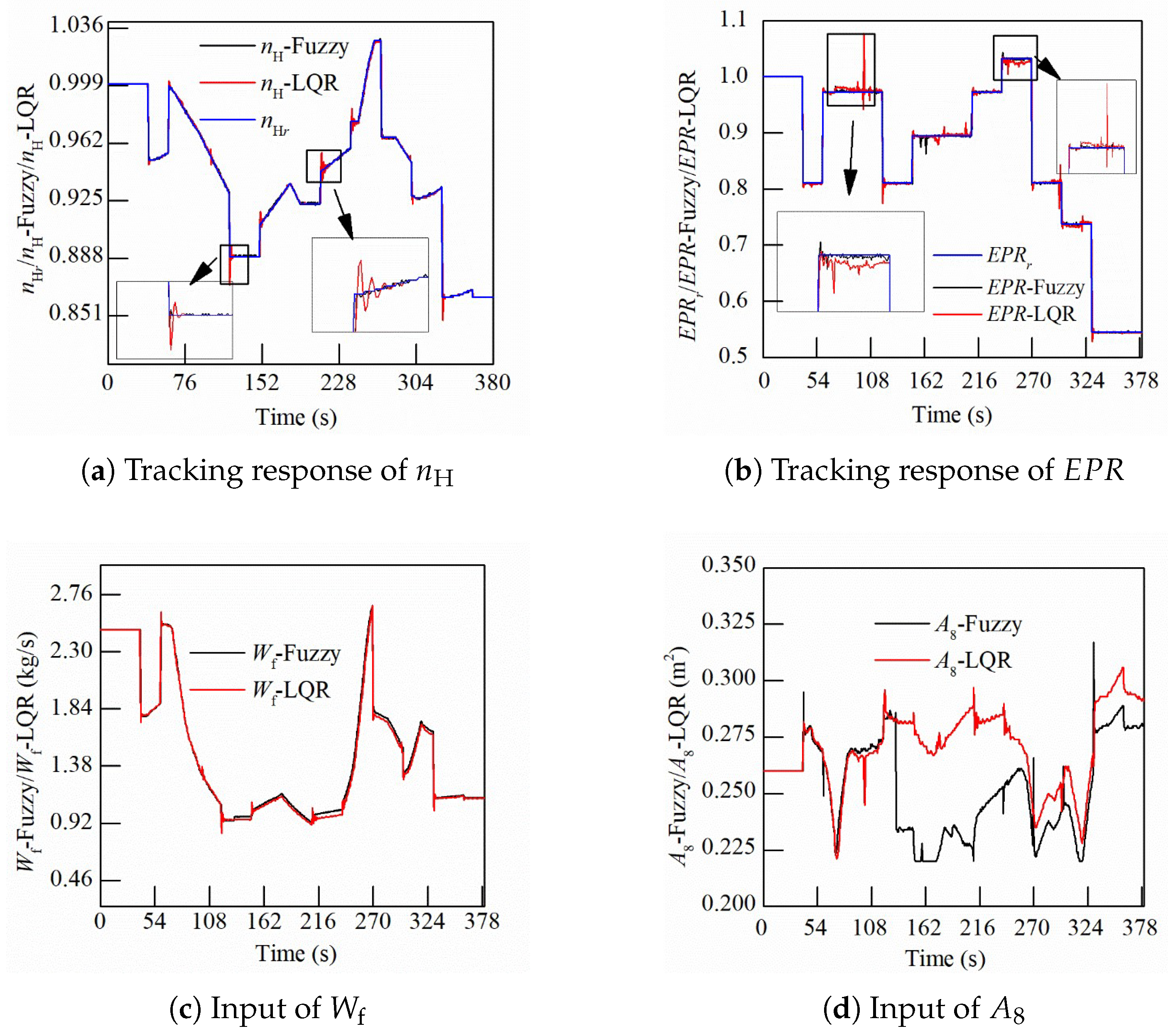
The trajectory of dominant eigenvalues is the orange curve in Figure 20a, and its details are shown in Figure 20b. Figure 21 shows the tracking histories of outputs and inputs during the designed flight task cycle. Figure 20 demonstrates that, during the flight task cycle, there are both real eigenvalues and complex eigenvalues along the trajectory. Some of the eigenvalues on the trajectory are far from the selected dominant eigenvalues. It indicates that the dynamics of the turbofan change significantly and nonlinearly in a flight task cycle. Figure 21a,b show that the proposed control can guarantee the and responses tracking their references quickly and accurately even though there exist temperature and pressure variation or turbulence. Moreover, the responses of the LQR controller have significant jitters due to noise. The comparison shows that the proposed control has better noise suppression than LQR.
Figure 20.
Trajectory of the fuzzy system’s eigenvalues.
Figure 21.
HIL testing results in the flight task cycle.
When PLA steps, the and responses are obviously oscillatory. We notice that, in Figure 21c, the inputs of the two controllers are similar, while their inputs , shown in Figure 21d, are significantly different. This significant difference implies that the appropriate adjustment of can damp the overshoot effectively. Finally, it can be concluded that the new control algorithm can run in the engine electronic controller hardware in real time, and it renders the closed system a good tracking performance and robustness against significant turbulence and large-scale nonlinearity by utilizing the fuzzy-model-based scheduling strategy. It is worth noting that the more complex the system is, the more rules will result, which will be time-consuming. Therefore, the fuzzy model’s simplification method will be a challenge in the next research work.
5. Conclusions
We propose an integrated three-phase framework for turbofan engines, consisting of modeling, control, and experimental testing. This paper develops a highly effective robust control, in which a hierarchical dynamics clustering is applied to the construction of an engine T–S fuzzy model and a hierarchical robust controller is designed. The engine’s dominant eigenvalues under different operating conditions are extracted as the engine’s dynamic feature. The MMD-FCM with mixed- statistics is adopted to determine the prime dynamics, fuzzy rules, and membership functions. The global stability-guaranteed identification is proposed to obtain the local consequence models. The constructed T–S fuzzy model is verified with high accuracy that the steady errors and RSMEs are less than 0.5% and 0.02. It shows that this fuzzy modeling approach can simulate the engine’s complex nonlinear and uncertain dynamics accurately and in real time. As a result, the fuzzy model benefits the robust control design. The hierarchical control with two-level compensators is proposed. The control gain matrices and gain parameter take good advantage of the fuzzy model. The cooperation of the compensators renders the closed uncertain fuzzy system uniform boundedness and uniform ultimate boundedness within the flight envelope and under different power conditions. The Hardware-in-Loop experimental tests under fixed operating conditions and continuously varying operating conditions show that, regardless of the remarkable nonlinearity and uncertainty, the resulting controlled system has a fairly good tracking performance and robustness. The settling times and overshoots of engine response are under 2.5 s and 10%, respectively. As a result, the new control running in real time suggests a realistic potential for further tests, including semi-physical tests, bench tests, and flight tests, which will push the new control forward to the engineering applications. Furthermore, the new control design can be applied to different dynamic systems, such as types of aircraft engines, by forming the T–S fuzzy models.
Author Contributions
Conceptualization, M.P. and H.W.; methodology, M.P. and H.W.; software, H.W.; validation, M.P., H.W., C.Z. and Y.X.; formal analysis, M.P. and H.W.; investigation, M.P. and H.W.; resources, M.P.; data curation, C.Z. and Y.X.; writing—original draft preparation, M.P., H.W. and C.Z.; writing—review and editing, M.P.; visualization, C.Z. and Y.X.; supervision, M.P.; project administration, M.P.; funding acquisition, M.P. All authors have read and agreed to the published version of the manuscript.
Funding
This research was funded by the National Science and Technology Major Project (2019-V-0003-0094).
Data Availability Statement
Data are contained within the article.
Acknowledgments
The authors would like to thank Weiwei Yuan for her constructive discussions on the clustering method. They would also like to thank Jiajie Chen for his help in the HIL tests.
Conflicts of Interest
The authors declare no conflicts of interest.
Appendix A
Proof of Theorem 1.
As is Hurwitz-stable, by [47], it can be written as
where , and the matrix is the solution to the Lyapunov equation
It follows that
By [48], the matrix is Hurwitz-stable.
Hence, Theorem 1 is proved. □
Appendix B
Proof of Theorem 2.
Consider the non-quadratic Lyapunov function candidate (arguments are omitted when no confusions are likely to arise)
Define
Introduce the closed system (4) and the controller (19) into (A1), and it yields
where . By Assumption 1, there is
Apply the Schur complement and (A7) to , and it yields
By (16) and Lemma 1, we obtain , and . Consequently, and . The performance of the system (4) is proved with
Let and . The performance of the system (2) is
Define
Using the Schur complement on , we have
By (19) and Lemma 1, , , and . Therefore,
If the controlled system (4) is stable, there is . Suppose that the control input is a unit impulse , and then the initial state . By (19) and the Schur complement, we have
The performance holds.
Hence, Theorem 2 is proved. □
Appendix C
Proof of Theorem 3.
Consider the non-quadratic Lyapunov function candidate (A4). By the Rayleigh principle, there is
where , , is the eigenvalue of a matrix.
The Lyapunov derivative along the trajectory of the uncertain fuzzy system (2) is
Recall the conclusion in (A6), and it can be inferred that
Therefore, there always exists a positive definite matrix satisfying
Define . It follows that
where .
By Assumption 3, for any strictly positive scalar , there is
where , .
Next, define . Introducing into (A20), we have
By Assumptions 2 and 3,
Let . Similar to (A24), there exists such that
One can always find such that
The inequalities (A27) and (A28) lead to
where , .
Finally, by (A23), (A24), and (A29),
is obtained. Here, . Select the appropriate , , and , and can be positive. By [47], the trajectory of the uncertain fuzzy system (2) is uniformly bounded and uniformly ultimately bounded. Furthermore,
Hence, Theorem 3 is proved. □
References
- Jaw, L.C.; Mattingly, J.D. Aircraft Engine Controls: Design, System Analysis, and Health Monitoring; American Institute of Aeronautics and Astronautics: New York, NY, USA, 2009. [Google Scholar]
- Richter, H. Advanced Control of Turbofan Engines; Springer: Cleveland, OH, USA, 2012. [Google Scholar]
- Chipperfield, A.J.; Bica, B.; Fleming, P.J. Fuzzy Scheduling Control of a Gas Turbine Aero-Engine: A Multiobjective Approach. IEEE Trans. Ind. Electron. 2002, 49, 536–548. [Google Scholar] [CrossRef]
- Gilbert, W.; Henrion, D.; Bernussou, J.; Boyer, D. Polynomial LPV Synthesis Applied to Turbofan Engines. Control. Eng. Pract. 2008, 18, 1077–1083. [Google Scholar] [CrossRef]
- Pakmehr, M.; Fitzgerald, N.; Feron, E.M.; Shamma, J.S.; Behbahani, A. Gain Scheduled Control of Gas Turbine Engines: Stability and Verification. J. Eng. Gas. Turbine Power 2013, 136, 031201. [Google Scholar] [CrossRef]
- Wang, Y.; Huang, J.; Pan, M.; Zhou, W. Game-Theory-Based Mode Switch Control Schedule Design for Variable Cycle Engine. Aerospace 2023, 10, 112. [Google Scholar] [CrossRef]
- Li, R.; Guo, Y.; Nguang, S.K.; Chen, Y. Takagi-Sugeno Fuzzy Model Identification for Turbofan Aero-Engines with Guaranteed Stability. Chinese J. Aeronaut. 2018, 31, 1206–1214. [Google Scholar] [CrossRef]
- Pan, M.X.; Wang, H.; Huang, J.Q. T-S Fuzzy Modeling for Aircraft Engines: The Clustering and Identification Approach. Energies 2019, 12, 3284. [Google Scholar] [CrossRef]
- Hwang, C.L.; Chen, Y.H. Fuzzy fixed-time learning control with saturated input, nonlinear switching surface, and switching gain to achieve null tracking error. IEEE Trans. Fuzzy Syst. 2019, 28, 1464–1476. [Google Scholar] [CrossRef]
- Wang, W.; Peng, J.; Zhang, Y. Modeling and Control for an Aero-Engine Based on the Takagi-Sugeno Fuzzy Model. Aerospace 2023, 10, 523. [Google Scholar] [CrossRef]
- Feng, G. Analysis and Synthesis of Fuzzy Control Systems: A Model-Based Approach; CRC Press: Boca Raton, FL, USA, 2010. [Google Scholar]
- Lam, H.K.; Leung, F.H. Stability Analysis of Fuzzy-Model-Based Control Systems: Linear-Matrix-Inequality Approach; Springer: Berlin/Heidelberg, Germany, 2011. [Google Scholar]
- Wang, L.X. Fuzzy Systems Are Universal Approximators. In Proceedings of the IEEE International Conference on Fuzzy Systems, San Diego, CA, USA, 8–12 March 1992; pp. 1163–1170. [Google Scholar]
- Takagi, T.; Sugeno, M. Fuzzy Identification of Systems and Its Applications to Modeling and Control. IEEE Trans. Syst. Man Cybern. Syst. 1985, 15, 116–132. [Google Scholar] [CrossRef]
- Kyriazis, A.; Mathioudakis, K. Gas Turbine Fault Diagnosis Using Fuzzy-Based Decision Fusion. J. Propuls. Power 2012, 25, 335–343. [Google Scholar] [CrossRef]
- Banazadeh, A.; Gol, H.A. Model-Based Fuzzy Control of a Gas Turbine Coupled with a Dynamometer. J. Propuls. Power 2018, 34, 1178–1188. [Google Scholar] [CrossRef]
- Guerra, T.M.; Kruszewski, A.; Lauber, J. Discrete Tagaki–Sugeno Models for Control: Where Are We. Annu. Rev. Control 2009, 33, 37–47. [Google Scholar] [CrossRef]
- Askari, M.; Davaie-Markazi, A.H. Application of A New Compact Optimized T-S Fuzzy Model to Nonlinear System Identification. In Proceedings of the International Symposium on Mechatronics and its Applications, Amman, Jordan, 27–29 May 2008; pp. 1–6. [Google Scholar]
- Wang, L.X. A Course in Fuzzy Systems and Control; Prentice Hall: Upper Saddle River, NJ, USA, 1999. [Google Scholar]
- Ku, H.; Kung, C.; Chen, W. A Novel Cluster Validity Criterion for the Bilinear Models and Its Application to the T-S Fuzzy Bilinear Model Identification. In Proceedings of the 2012 IEEE International Conference on Fuzzy Systems, Brisbane, QLD, Australia, 10–15 June 2012; pp. 1–7. [Google Scholar]
- Kung, C.; Ku, H. T-S Fuzzy Affine Linear Modeling Algorithm by Possibilistic C-Regression Models Clustering Algorithm. In Proceedings of the 2014 IEEE International Conference on Fuzzy Systems, Beijing, China, 6–11 July 2014; pp. 1242–1247. [Google Scholar]
- Klir, G.J.; Yuan, B. Fuzzy Sets and Fuzzy Logic: Theory and Applications; Prentice Hall: Upper Saddle River, NJ, USA, 1995. [Google Scholar]
- Rezaee, M.R.; Lelieveldt, B.P.F.; Reiber, J.H.C. A New Cluster Validity Index for the Fuzzy C-Mean. Pattern Recognit Lett. 1998, 19, 237–246. [Google Scholar] [CrossRef]
- Li, Y.; Yu, F. A New Validity Function For Fuzzy Clustering. In Proceedings of the 2009 International Conference on Computational Intelligence and Natural Computing, Wuhan, China, 6–7 June 2009; pp. 462–465. [Google Scholar]
- Mahmuddin, M.; Yusof, Y. Automatic Estimation Total Number of Cluster Using A Hybrid Test-and-Generate and K-means Algorithm. In Proceedings of the 2010 International Conference on Computer Applications and Industrial Electronics, Kuala Lumpur, Malaysia, 5–7 December 2010; pp. 593–596. [Google Scholar]
- Ubukata, S.; Yanagisawa, K.; Notsu, A.; Honda, K. Automatic Estimation of Cluster Number in Fuzzy Co-clustering Based on Competition and Elimination of Clusters. In Proceedings of the 2018 Joint 10th International Conference on Soft Computing and Intelligent Systems and 19th International Symposium on Advanced Intelligent Systems, Toyama, Japan, 5–8 December 2018; pp. 660–665. [Google Scholar]
- Muneeswaran, P.; Velvizhy, P.; Kannan, A. Clustering Fusion with Automatic Cluster Number. In Proceedings of the 2014 International Conference on Recent Trends in Information Technology (ICRTIT 2014), Chennai, India, 10–12 April 2014; pp. 1–6. [Google Scholar]
- Xu, Y.J. Optimization of the Clusters Number of an Improved Fuzzy C-Means Clustering Algorithm. In Proceedings of the 2015 10th International Conference on Computer Science & Education (ICCSE 2015), Cambridge, UK, 22–24 July 2015; pp. 931–935. [Google Scholar]
- Wang, H.O.; Tanaka, K.; Griffin, M. Parallel Distributed Compensation of Nonlinear Systems by Takagi-Sugeno Fuzzy Model. In Proceedings of the IEEE International Conference on Fuzzy Systems, Yokohama, Japan, 20–24 March 1995; pp. 531–538. [Google Scholar]
- Horng, W.R.; Fang, C.H.; Chou, J.H. Quadratic optimal control with disturbance attenuation for uncertain continuous-time TS fuzzy systems. IETE J. Res. 2017, 63, 98–108. [Google Scholar] [CrossRef]
- Vu, V.P.; Wang, W.J. State/disturbance observer and controller synthesis for the T–S fuzzy system with an enlarged class of disturbances. IEEE Trans. Fuzzy Syst. 2018, 26, 3645–3659. [Google Scholar] [CrossRef]
- Yang, R.; Gao, Y.; Wang, H.; Ni, X. Fuzzy Neural Network PID Control Used in Individual Blade Control. Aerospace 2023, 10, 623. [Google Scholar] [CrossRef]
- Pan, M.X.; Wang, H.; Gu, B.B.; Qiu, X.J.; Chen, Y.H. A Hierarchical Robust Control Design with Non-Parallel Distributed Compensator and Application to Aircraft Engines. IEEE Access 2019, 7, 144813–144825. [Google Scholar] [CrossRef]
- Taniguchi, T.; Tanaka, K.; Yamafuji, K.; Wang, H.O. A New PDC for Fuzzy Reference Models. In Proceedings of the IEEE International Fuzzy Systems, Conference Proceedings, Seoul, Republic of Korea, 22–25 August 1999; pp. 898–903. [Google Scholar]
- Johansson, M.; Rantzer, A.; Arzen, K. Piecewise Quadratic Stability of Fuzzy Systems. IEEE Trans. Fuzzy Syst. 2000, 7, 713–722. [Google Scholar] [CrossRef]
- Nguyen, A.; Taniguchi, T.; Eciolaza, L.; Campos, V.; Palhares, R.; Sugeno, M. Fuzzy Control Systems: Past, Present and Future. IEEE Comput. Intell. Mag. 2019, 14, 56–68. [Google Scholar] [CrossRef]
- Peters, J.; Mistry, M.; Udwadia, F.; Cory, R.; Nakanishi, J.; Schaal, S. A unifying methodology for the control of robotic systems. In Proceedings of the IEEE IRS/RSJ International Conference on Intelligent Robots and Systems, Edmonton, Canada, 2–6 August 2005; pp. 1824–1831. [Google Scholar]
- Ansari, U.Z.; Bajodah, A.H. Spacecraft Attitude Control Using Robust Generalized Dynamic Inversion. In Proceedings of the IEEE Conference on Control Technology and Applications, Copenhagen, Denmark, 21–24 August 2018; pp. 1741–1746. [Google Scholar]
- Karnik, N.N.; Mendel, J.M.; Liang, Q. Type-2 Fuzzy Logic Systems. IEEE Trans. Fuzzy Syst. 2000, 7, 643–658. [Google Scholar] [CrossRef]
- Wang, L. A New Look at Type-2 Fuzzy Sets and Type-2 Fuzzy Logic Systems. IEEE Trans. Fuzzy Syst. 2016, 25, 693–706. [Google Scholar] [CrossRef]
- Franklin, G.F.; Powell, J.D.; Emami-Naeini, A. Feedback Control of Dynamic Systems; Addison-Wesley: Reading, MA, USA, 1986. [Google Scholar]
- Tuan, H.D.; Apkarian, P.; Narikiyo, T.; Yamamoto, Y. Parameterized Linear Matrix Inequality Techniques in Fuzzy Control System Design. IEEE Trans. Fuzzy Syst. 2001, 9, 324–332. [Google Scholar] [CrossRef]
- Barya, K.; Tiwari, S.; Jha, R. Comparison of LQR and robust controllers for stabilizing inverted pendulum system. In Proceedings of the IEEE International Conference on Communication Control and Computing Technologies, Nagercoil, Tamil Nadu, India, 7–9 October 2010; pp. 300–304. [Google Scholar]
- Fakoor, M.; Nikpay, S.; Kalhor, A. On the ability of sliding mode and LQR controllers optimized with PSO in attitude control of a flexible 4-DOF satellite with time-varying payload. Adv. Space Res. 2021, 67, 334–349. [Google Scholar] [CrossRef]
- Shyu, K.K.; Lai, C.K.; Tsai, Y.W.; Yang, D.I. A newly robust controller design for the position control of permanent-magnet synchronous motor. IEEE Trans. Ind. Electron. 2002, 49, 558–565. [Google Scholar] [CrossRef]
- Zhou, K.; Doyle, J.C.; Glover, K. Robust and Optimal Control; Prentice Hall: Englewood Cliffs, NJ, USA, 1995. [Google Scholar]
- Corless, M.; Leitmann, G. Continuous State Feedback Guaranteeing Uniform Ultimate Boundedness for Uncertain Dynamic Systems. IEEE Trans. Automat. Contr. 1981, 26, 1139–1144. [Google Scholar] [CrossRef]
- Barrnett, S. Matrices in Control Theory with Application in Linear Programming; Van Nostrand Reinhold Company: London, UK, 1971. [Google Scholar]
Disclaimer/Publisher’s Note: The statements, opinions and data contained in all publications are solely those of the individual author(s) and contributor(s) and not of MDPI and/or the editor(s). MDPI and/or the editor(s) disclaim responsibility for any injury to people or property resulting from any ideas, methods, instructions or products referred to in the content. |
© 2024 by the authors. Licensee MDPI, Basel, Switzerland. This article is an open access article distributed under the terms and conditions of the Creative Commons Attribution (CC BY) license (https://creativecommons.org/licenses/by/4.0/).