


Abstract
The COVID-19 pandemic led to many colleges of pharmacy having to make major changes relating to their infrastructure and delivery of their curriculum within a very short time frame, including the transition of many components to an online setting. This scoping review sought to summarize what is known about the impact of COVID-19 on pharmacy education and the effectiveness of adaptation strategies which were put in place. PubMed, Web of Science, OVID Medline, and MedEdPortal were searched to identify pharmacy education-related articles published since the beginning of the COVID-19 pandemic. For article inclusion, the following criteria had to be met: described original research, related directly to PharmD or PharmBS education, related to the impact of COVID-19 on pharmacy education, and was available in English. Out of a total of 813 articles, 50 primary research articles were selected for inclusion. Our review of these identified four domains relating to the impact of COVID-19 on pharmacy education and/or effectiveness of adaptation strategies: (1) lab-based courses and activities (including interprofessional education activities), (2) experiential education, (3) didactic education, and (4) student well-being. The key research findings are summarized and discussed. While the COVID-19 pandemic has clearly brought many challenges to pharmacy education, it has also led to key improvements and innovations.
1. Introduction
The World Health Organization (WHO) officially characterized COVID-19 as a pandemic in March 2020 [1]. Soon after, many institutes of education throughout the world, including those housing pharmacy programs, had to stop some, if not all, in-person classes and either temporarily suspend their programs or transition to alternative modes to deliver their curriculum. These COVID-19-driven changes, many of which have been widely reported as reflection articles and opinion pieces, affected all stakeholders including students, faculty, staff, preceptors, and administrators as challenges were identified and addressed. The impact of COVID-19 on pharmacy education and specific stakeholders as well as the effectiveness of adaptation strategies has also been formally assessed through research studies. Often, new developments and innovations within education, including pharmacy education, are difficult to implement for various reasons, including a lack of buy-in from other faculty members and administrators, accreditation and student satisfaction concerns, and logistical reasons. The COVID-19 pandemic allowed these challenges to be overcome, and it is important to now reflect on what we can learn from what has been published.
The majority of pharmacy programs transitioned to offering at least some of their curriculum via online platforms as part of their COVID-19-driven adaptation strategy. Undoubtedly, pharmacy programs that already offered online classes were better positioned to transition more of their curricular components to an online setting during the COVID-19 pandemic based on their existing infrastructure and experience. Several educational research studies published before the COVID-19 pandemic have shown that online courses are generally well accepted by pharmacy students and that academic standards can be maintained when pharmacy courses are offered online [2,3,4]. For example, our group and others have demonstrated that more than 50% of pharmacy students taking elective courses preferred online delivery and that student satisfaction levels with online elective courses are high [2,3,4]. Porter et al. directly compared online versus in-person delivery of the same didactic elective course and demonstrated that there was no difference in PharmD student performance levels based on course delivery method [3]. Research studies have also identified common challenges with online delivery, including decreased student engagement and concerns relating to the maintenance of exam integrity [5,6,7,8]. While these pre-COVID-19 studies support the use of online delivery within pharmacy education, they are limited in number and focus on primarily online delivery of didactic courses. The COVID-19 pandemic has allowed more research in this area; in particular, there is now a much stronger body of evidence describing online delivery of pharmacy lab-based classes and experiential education. More evidence relating to the impact of online delivery on pharmacy student well-being is also now available.
The purpose of this scoping review was to summarize evidence relating to the impact of the COVID-19 pandemic on pharmacy education, as well as to highlight COVID-19-driven improvements and innovations. A review of educational research data and reflection on how the COVID-19 pandemic has impacted pharmacy education can help guide the future development of pharmacy programs and improve pharmacy education outcomes, as well as help inform contingency planning measures.
2. Methods
2.1. Literature Search
A scoping search of the literature to find relevant articles was conducted using the search engines PubMed, Web of Science, OVID Medline, and MedEdPortal. Search terms related to pharmacy education and COVID-19 (details of the full search strategy can be found in the Supplementary Materials section). A citation chaining strategy was not employed.
2.2. Study Selection Criteria
Citations were imported into an Endnote library and duplicates removed. Two authors independently reviewed article titles, then article abstracts, and then the full text to identify articles for inclusion. At each step, a third author resolved any disagreements. For article inclusion, the following criteria had to be met: described original research, related directly to PharmD or PharmBS education, related to the impact of COVID-19 on pharmacy education, and was available in English.
2.3. Article Review
Following full-text review, the authors met to identify common themes (‘domains’) relating to pharmacy education. Articles were then assigned to one or more of these domains. The following characteristics for each study were also captured: year of publication, country where the study was conducted, number and type of participants, and study type.
3. Results
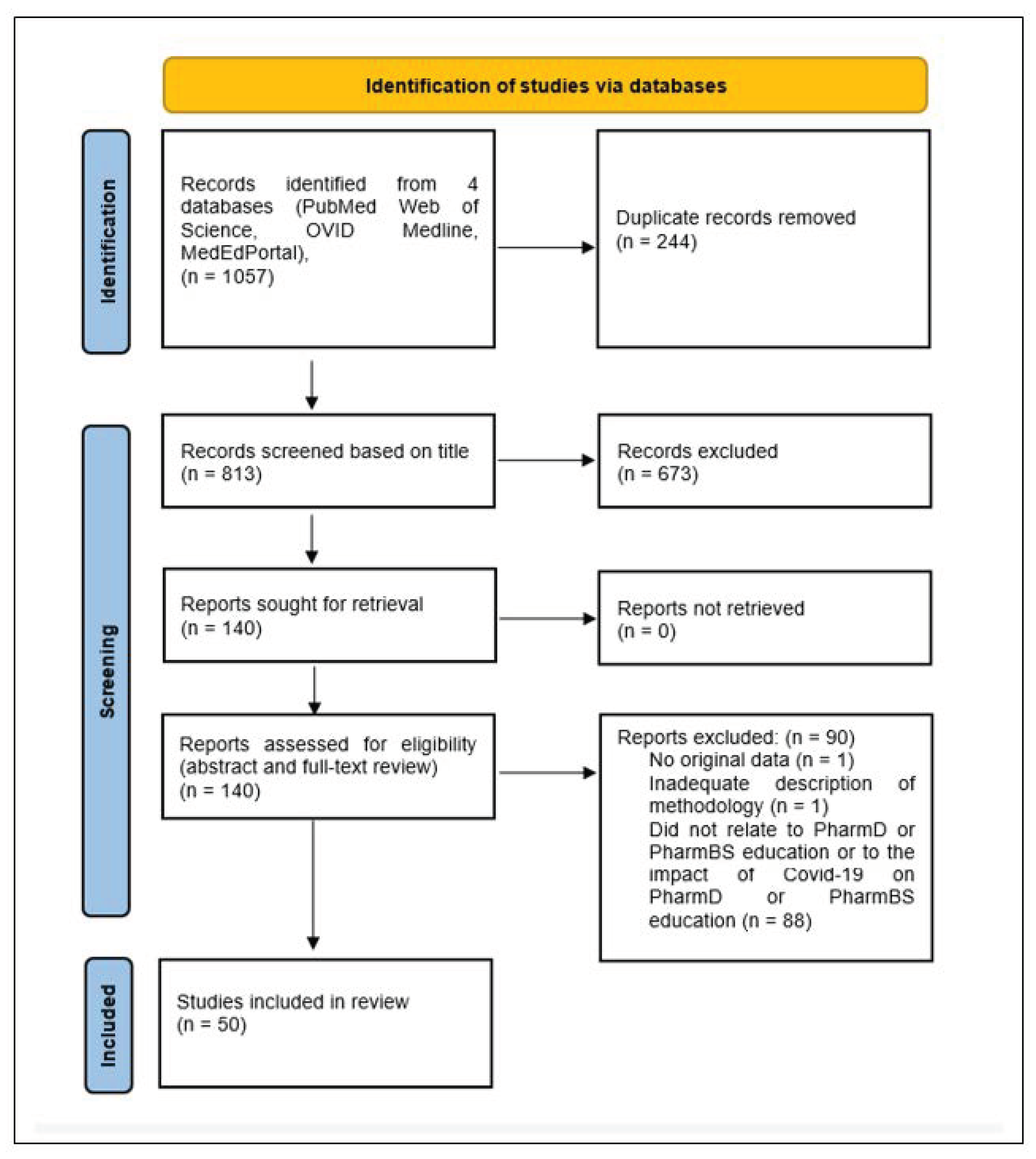
Figure 1 shows the Preferred Reporting Items for Systematic Reviews and Meta-Analyses (PRISMA, http://www.prisma-statement.org/ (accessed on 10 January 2022)) flow chart for article inclusion. A total of 813 articles were identified from the literature search after removal of duplicates. After applying our inclusion strategy (article described original research, related directly to PharmD or PharmBS education, related to the impact of COVID-19 on pharmacy education, and was available in English), this was reduced to 50 articles. It is noteworthy that we did not have to exclude any articles due to their not being available in English.
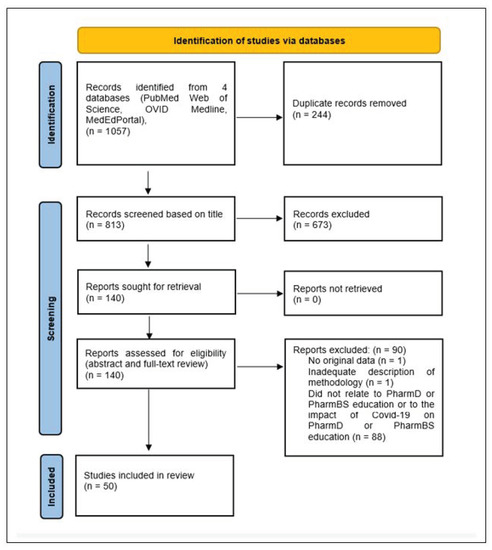
Figure 1.
PRISMA flow chart for article inclusion.
3.1. Characteristics of Selected Studies
We identified four main domains within the 50 articles selected for inclusion: impact of the COVID-19 pandemic on (1) lab-based courses and activities (including interprofessional education activities) (n = 17) (2) experiential education (n = 7) (3) didactic education (n = 17) and (4) student well-being (n = 14). Information for each of these studies, including year of publication, country where the study was conducted, number and type of participants, and study type, can be found in Table 1, Table 2, Table 3 and Table 4, along with an overview of the study results.

Table 1.
Domain 1, lab-based courses activities including interprofessional education (IPE) activities (n = 17).
Table 2.
Domain 2, experiential education (n = 7).
Table 3.
Domain 3, didactic courses (n = 17).
Table 4.
Domain 4, student well-being (n = 14).
3.2. Improvements and Innovations within Lab-Based Courses and Activities Which Allowed for Practice-Based Learning and Assessment of Student Competency to Continue during the COVID-19 Pandemic (n = 17 Studies)
Approximately 34% (17 out of 50 articles) of the included studies focused on the impact of COVID-19 on lab-based courses and activities, including Interprofessional Education (IPE) lab-based courses and activities (Table 1). Nine of the studies were conducted in the USA, three in Australia, two in Saudi Arabia, one in Malaysia, one in Turkey, and one in Germany. All of the studies included a survey analysis component, with 16 of the studies surveying student participants and one surveying administrators. Two of the studies assessed student course performance. Typically, surveys included Likert scale questions as well as free response questions followed by thematic analysis to identify key trends. Two of the survey studies included the implementation of a pre- post-test or conducting an end of course assessment within a given cohort as well as comparing data collected from pre-pandemic and pandemic cohorts. One study had a cross-over design study.
Our review of these studies determined that multiple different strategies were employed to allow for the continuation of lab-based classes during the pandemic, including the use of face-to-face real-time video-conferencing, the generation and use of recorded videos to demonstrate key skill sets, requiring students to submit videos of themselves describing the skill or using role-play with family members/friends who are acting as mock patients to demonstrate competency, and the usage of MyDispense software. Overall, data from these studies indicate that virtual lab-based classes were well received by students, although several challenges were noted, including increased stress levels and technical challenges. The administrators who were surveyed also noted key challenges, including the inability to assess certain skills in an online setting and increased instructor stress levels [12]. Three of the studies focused on IPE-specific classes. The majority of students who participated in virtual IPE activities reported high levels of satisfaction and agreed or strongly agreed that activities helped clarified professional roles, improved communication and teamwork, and improved confidence levels [9,10,21].
Seven of the studies specifically surveyed students’ opinions relating to in-person versus virtual skills-based labs [13,15,16,18,19,20,23]. Three of the studies indicated that students felt less stressed during virtual lab simulations, while one study showed that although students had more time to prepare, most still felt an increase in stress levels during virtual skills-based lab simulations. Some of the advantages of virtual labs that were frequently noted by students included convenience, flexibility, and being easier to perform. In the article by Farahani et al., more than 95% of participants stated that more instructional videos should be included within all lab-based classes [24]. Three of the studies reported telehealth as a theme and noted the benefit and importance of being able to mimic emerging telehealth practices in pharmacy practice using web conferencing platforms [16,18,21]. Only one study focused on students’ opinions relating to virtual versus in-person learning after returning to in-person learning, and students in this study expressed a strong preference for in-person labs after having virtual labs the previous year [22]. This study also assessed the impact of returning to in-person lab courses on COVID-19 infection rates and transmission; no COVID-19 infections or transmissions were reported by students or their tracking system. To help minimize potential exposure and transmission, several infection control protocols and procedures were put into place; students were screened for COVID-19 symptoms, including a temperature check, prior to entering the building. Apps that track an individual’s exposure to COVID-19 were also used. Students were required to wear masks and were divided into smaller groups. Prior to lab classes, students were held in multiple areas, and social distancing was strictly implemented. Rooms were properly ventilated and simulated patients followed proper hand hygiene and social distancing norms, and students were asked to leave the building as soon as they finished the class.
Two of the studies assessed the impact of offering virtual lab classes on course learning outcomes and scores by comparing student cohort performance in pre-pandemic in-person classes versus in virtual classes delivered during the pandemic classes [14,16]. These studies reported conflicting findings. The study by Aranda et al. found the students performed better on the pre-pandemic lab classes, while the study by Scoular found that students performed better on the virtual lab classes which were offered during the pandemic. The study by Scoular et al. noted concerns over exam integrity for the virtual lab classes [14].
Three articles described the use of commercially available simulation platforms [13,14,23]. Two of these used a virtual microbiology simulation (VUMIE), which simulated workflow in a microbiology wet lab [18,19]. Students were randomly split into two groups and either completed the wet lab activities or the VUMIE simulation. Both groups then completed the other activity not completed. This cross-over study design allowed for direct comparison of online versus in-person delivery within the same cohort of students simultaneously taking the same course. Analysis of student self-reporting of knowledge, skills, and confidence showed no difference between the in-person versus virtual experience; however, there was a strong preference for in-person labs. The other article described the use the ‘MyDispense’ platform, which simulates a virtual community pharmacy setting where students simulate pharmacy workflow and clinical decision-making skills [25]. A pre- and post-survey (42 questions) was given to assess student perceptions of confidence, satisfaction, motivation, expertise, and decision-making skills. The study data indicated a collective improvement in performance following participation in the virtual lab classes. It is noteworthy that the majority of students reported enhanced skills in clinical decision making and an improved ability to make drug therapy dispensing decisions.
Two studies clearly showed benefit to using ‘MyDispense’ to help deliver lab-based classes and support its continued usage [25,58]. The ‘MyDispense’ software allows for practice with prescription processing, self-care recommendations, and patient assessment in an online setting.
3.3. Improvements and Innovations within Experiential Education Which Supported Practice-Based Learning and Assessment of Professional Competency to Continue during the COVID-19 Pandemic (n = 7 Studies)
Approximately 14% (7 out of the 50 articles) of studies focused on the impact of COVID-19 on experiential education (Table 2). Five of the studies were conducted in the USA, one in Saudi Arabia, and one in Qatar. All of the studies were survey-based and only included student participants. Typically, surveys included Likert scale questions as well as free response questions followed by thematic analysis to identify key trends. Study designs included the implementation of a pre- post-test or conducting an end of course assessment within a given cohort, as well as comparing data collected from pre-pandemic and pandemic cohorts. One study reported average course grades for their virtual advanced pharmacy practice experience (APPE) rotation (although no comparator was included).
All seven studies described the impact of offering virtual introductory pharmacy practice experience (IPPE) and APPE rotations and training. Overall, student experiences were positive and there was a high level of satisfaction with the materials presented. Most students felt that clear connections made between didactic knowledge and application of this knowledge within the training and that the virtual experiences helped them better understand relevance to pharmacy practice [26,27,28,29,30,31,32]. The collective data indicate that the most valuable aspects of the virtual APPE experiences were patient case presentations, journal clubs, topic discussions, and formal written assignments. Students did not rate written reflections as valuable as the other rotation assignments [26,27,28]. In the study by Montepara et al., students noted that they appreciated working with a variety of preceptors from different specialties and practice settings within the same virtual APPE rotation experience [28]. Common student concerns included anxiety about a lack of adequate patient care experience, and many students noted that virtual APPE activities should not completely replace in-person APPE rotations [26,31]. Suggestions for improvement included standardizing how information is disseminated to multiple students for virtual presentations and the virtual platforms used [28].
Reynolds et al. reported improvements in students’ perceptions of their performance as they relate to knowledge, skills, and abilities and calculations using a pre- post-course survey assessment, but these self-reported improvements were not statistically significant [30]. Overall course grades were high; however, no comparators were included.
It is noteworthy that the study by Moreau et al. showed a telemedicine-based training experience that was well received by students [29]. As part of this study, students provided telephonic patient care service at the NSU College of Pharmacy’s call center. Students received training relating to medication adherence, medication therapy management, and transitions of care prior to starting their rotation. Most students agreed or strongly agreed that they gained a better understanding of the provision of pharmacy services through telehealth modalities as well as the use of value-based care models, including the utility of national quality benchmarks in this setting. Students also noted improvements in patient communication skills in this setting.
3.4. COVID-19 Pandemic-Driven Improvements and Innovations in Online Delivery of Didactic Classes and in Online Testing (n = 17 Studies)
Approximately 34% (17 out of the 50 articles) of the included studies focused on the impact of COVID-19 on didactic classes (Table 3). One study was conducted in the USA, seven in Saudi Arabia, three in Jordan, two in Canada, one in Australia, one in Qatar, one in Malta, and there was one international-based study. The vast majority of studies (16 out of the 17) were survey-based, and most of these captured pharmacy student perspectives. Typically, surveys included Likert scale questions as well as free response questions followed by thematic analysis to identify key trends. One study assessed student performance. Study designs included the implementation of a pre- post-test or conducting an end of course assessment within a given cohort as well as comparing data collected from pre-pandemic and pandemic cohorts.
Overall, based on data from these studies, the majority of pharmacy students appear to have had a positive experience with COVID-19-driven curricular changes relating to didactic classes (the most common change was transition to online delivery); however, there were some exceptions, and data from many studies indicate that students still prefer in-person classes. Frequently observed positive themes included ‘flexibility’ and ‘self-directed learning’. Frequently observed negative themes included ‘technology’, ‘study load’, and ‘well-being’. Only one study (Cor et al.) sought to determine the impact of COVID-19-driven changes on student performance. In this study, Hussain et al. compared midterm and final grades for a communications course offered pre-COVID-19 (offered via in-person delivery) versus offered during COVID-19 (offered via online delivery). No significant change in performance was observed.
An innovation by Almaghaslah et al. was to use social media (Twitter and Instagram) to support the teaching of didactic classes during the pandemic [37]. Primarily, these platforms were used to complement formal teaching beyond core course hours. A survey conducted 4 weeks after the start of class showed that the majority of students ‘agreed’ or ‘strongly agreed’ that social media enhanced communication between peers and with instructors. This is important because well-being was a common theme reported in other studies. Use of the social media platforms was high (n = 73 for Twitter accounts, n = 69 for Instagram accounts); within the 4-week period, a total of 453 and 1740 ‘likes’ were reported on Twitter and Instagram, respectively, and the hashtag for the course was used 80 and 69 times in Twitter and Instagram posts.
Two studies included college of pharmacy administrators or faculty members as administrators [41,44]. The study by Alzubaidi et al. received survey responses from 46 college of pharmacy administrators and found that the majority felt that their institutions were able to offer adequate support to faculty members. Major challenges reported included ensuring exam integrity and the delivery of lab-based courses and experiential education [44]. Fifty-five percent of colleges reported disruption to their experiential program. In addition, administrators reported that many faculty members experienced significant levels of work-related stress, and some felt that their emotional support and training needs were not met. The study by Jaam et al. received survey responses from five faculty and found that faculty workload as well as testing integrity were key issues; however, as with the Alzubaidi et al. study, faculty members generally felt supported by their institutions [41].
3.5. Impact of the COVID-19 Pandemic on Student Well-Being; Lessons Learnt (n = 14 Studies)
Approximately 28% (14 out of the 50 articles) of the included studies focused on the impact of COVID-19 on student well-being (Table 4). Of the 14 studies that analyzed the emotional distress, anxiety, depression, or negative emotional impact of COVID-19, testing, and examination during COVID-19, 35.7% (5 out of 14) were cross-sectional in design, with a majority of the studies, 57.1% (8 of 14), conducted in pharmacy programs outside of the United States. Of these eight international programs, five were located in the Middle East, and one each was located in Canada, Spain, and Australia. Four programs (28.6%) were listed as undergraduate pharmacy programs, and one specifically mentioned analysis of emotional and mental health concerns for pharmacy graduate students and included pharmacy students who were also working towards earning a Ph.D. Almost all studies except two (85.7%) used some form of a perception student questionnaire or survey to collect data. The remaining two studies used an interview format followed by codification and identification of the themes related to COVID-19 emotional distress. Many of the studies compared student stress levels before and during the COVID-19 pandemic.
While 13 of the 14 (92.3%) included studies reported some form of a negative impact of either COVID-19 or the adaptation of online learning such as increases in stress and anxiety levels, one study (0.07%) reported a decrease in student stress levels before exams. Specifically, Hettinger et al. reported on the impact of COVID-19 on pharmacy student stress during high-stakes performance-based assessments before and during COVID-19 [11]. Based on data collected from responses from students at the Purdue University School of Pharmacy, stress levels before the performance-based exam fell from 3.78 to 3.45 when comparing pre-COVID-19 to during COVID-19, while stress levels similarly decreased from 2.84 to 2.52 after performance-based exams when comparing pre-COVID-19 to during COVID-19. It is noteworthy that Purdue College of Pharmacy hired a wellness officer during the pandemic to integrate wellness activities into the curriculum, and doing so most likely helped mitigate COVID-19-driven increases in student stress levels.
Three studies (21.4%) analyzed the effect of COVID-19 on student quality of life, with specific references to stress, anxiety, and depression, while another three studies (21.4%) included coping strategies and resiliency mechanisms as part of the student survey instruments and measured the impact of coping strategies on emotional distress. Only one of the fourteen studies (0.07%), led by Moreno-Fernandez et al., included emotional intelligence as a part of the student response paradigm and found that inclusion of an emotional intelligence workshop alleviated self-reported academic burnout from 63.5% before to 31.1% after the emotional intelligence workshop [57]. They also reported high levels of stress and negativity in pharmacy students in Spain during COVID-19 who responded to the survey (n = 47), with 44.6% of the respondents reporting exhaustion, 41.7% reporting cynicism, and 60.3% reporting ineffective academic performance due to COVID-19.
Interestingly, Atarabeen et al. included an analysis of pharmacy students in a program in the United States that employs flipped classroom pedagogy [48]. This is significant since flipped classrooms place significant emphasis on pre-classroom work, and thus, students may be expected to experience higher stress and anxiety levels. These investigators analyzed the impact of COVID-19 and the consequent adaptation to online and remote delivery on students’ stress, coping behaviors, self-efficacy, and emotional status. Of the 66 students who responded, interestingly, no significant differences were found between any of these four categories before and during COVID-19.
4. Discussion
This scoping review summarizes data from research studies which sought to determine the impact of the COVID-19 pandemic on pharmacy education. Our review of these studies has identified common trends as well as areas which would benefit from further research. We also highlight key COVID-19-driven innovations and improvements which were found to be and/or perceived to be effective.
The vast majority of studies focused on students rather than faculty members or administrators, and many were survey-based. Most focus was placed on assessing student perceptions of COVID-19-driven changes and their effectiveness. Only a few studies included an assessment of the impact of COVID-19-driven changes on student scores and grades. Implementation of more outcomes-based studies are needed to further establish the effectiveness of virtual classes and experiences and thereby help guide decisions regarding their continued usage beyond the pandemic. Typically, surveys comprised a combination of Likert score and open-ended questions; the latter allowed for thematic analysis and for the identification of key benefits as well as issues and concerns. Several study designs were employed for survey studies, including conducting a pre- post-test or survey within a given class or course or simply conducting an end of course survey. Several studies compared data collected prior to the pandemic with pandemic data, and while useful, these data should be interpreted with caution due to potential confounding effects. Only one study used a cross-over design which allowed for the intervention to be assessed within the same cohort.
The most frequently described COVID-19-driven change was the transition of classes and experiences to an online setting, with many studies reporting the use of virtual platforms such as Zoom, BigBlueButtom, and Microsoft Teams. MyDispense software was found to be helpful for the delivery of lab-based classes and for rotations. Data from the majority of the studies indicate that most pharmacy students were satisfied with the online delivery of didactic classes, lab-based classes, and practice experiences, although most students stated they still preferred in-person delivery. This finding aligns with what has been reported by other medical education programs; for example, a survey study by Stoeher et al. (n = 3286 students from 12 medical schools) found that the majority of students were satisfied with the transition to online learning [59].
Many of the 50 studies included in this scoping review conducted thematic analyses, and these identified ‘flexibility’ and ‘self-directed learning’ as benefits to online learning and identified ‘cheating’, ‘mental health’, ‘communication’, ‘patient care experience’, and ‘technical issues’ as key challenges. Increasing and supporting self-directed learning experiences aligns well with directives from pharmacy governing bodies such the Accreditation Council for Pharmacy Education (ACPE) and is a key competency for any healthcare professional including pharmacists. It is therefore encouraging that students identified this as a positive associated with online delivery, and in this regard, the data support the continued usage of online delivery for at least some components of pharmacy education. Cheating on exams is well known to be a challenge associated with online delivery of any higher education course or experience, and this has been reported in both pre- and post-COVID-19 studies [5,6,7,8]. None of the studies included in this scoping review specifically focused on this aspect or how to address it; however, there are many opinion pieces and commentaries available describing potential solutions, and an increasing number of studies relating to this topic have been published in other areas of higher education, including other professional programs [60,61,62,63,64]. Further research on this topic would be beneficial to help support the continued usage of online delivery of didactic and lab-based courses as well as virtual rotation experiences in pharmacy education. The collective data also support the development of strategies to assess and support student well-being and mental health as part of contingency planning and align with what has been reported by other institutions of education including medical education programs. For example, a survey study by Chaklader et al. (n = 300 from 5 medical schools) found that students reported higher levels of depression and anxiety during the pandemic [65]. It is noteworthy that the one study which showed student stress levels were reduced during the pandemic reported hiring a wellness officer to integrate wellness activities into their curriculum [11]. The positive effects on student wellness reported in this study support this as an effective strategy for other colleges of pharmacy as well as other institutes of education to consider.
The successful use of online delivery of didactic classes pre-pandemic and during the pandemic is well described in the literature for many types of higher education, including pharmacy education, with many students indicating high levels of satisfaction with online education [2,3,4,5,6,7,8,66]. As mentioned above, it would be helpful for future studies in pharmacy education to place more focus on the impact of online learning on student learning outcomes (in this scoping review, only one study assessed course scores and grades and showed no difference in performance). A key innovation described by Almaghaslah et al. was the use of social media platforms (Twitter and Instagram) to support extracurricular activities during the pandemic, including use of these to facilitate group discussion of practice questions and class discussions [37]. A systematic review of medical education during the COVID-19 pandemic revealed that multiple medical programs also successfully used social media-based learning strategies to help engage students [67].
The delivery of lab-based classes during the COVID-19 pandemic was extremely challenging for many reasons, including the need to deliver additional content relating to the COVID-19 pandemic-driven expansion in pharmacist scope of practice, as well as the difficulties associated with accommodating the meaningful assessment of lab-based skills in an online setting. A major benefit that was reported by several studies, and which would support continued usage of online learning activities, was their ability to help develop and support the use of skills relating to telemedicine, a field that is rapidly expanding. Similar findings have been reported within medical education [68,69]. Again, increased focus on how online delivery of lab-based classes impacts student course performance is needed to help drive continued usage of many of the strategies described. It is noteworthy that one of the studies reported being able to safely offer lab-based classes in person through the development and implementation of strict infection control protocols [22]. This, along with other data from the other studies which demonstrate that students clearly prefer in-person lab-based classes, support the expanded development of similar infection control policies and procedures within contingency plan measures.
The continuation of IPPE and APPE rotations during the COVID-19 pandemic was also extremely challenging. As with the other curricular areas, a key strategy was the implementation of virtual IPPE and APPE rotations. The successful use of virtual clinical rotations during the COVID-19 pandemic has been reported by several medical schools [70,71,72,73], and the combined data indicate that continued usage of virtual rotations is a viable option. As noted above, telemedicine is a growing field in pharmacy practice, and the data indicate that increased offering of telemedicine experiences would be welcomed by students. A common student concern was the lack of adequate patient care experience, and the data indicate that in-person rotations are important and should not be completely replaced by virtual experiences. This domain had the fewest number of studies available, and many of them had a low number of participants. Only one study reported assessment data and no comparator was included. Clearly, there is a need to conduct more studies in this area to help guide the development of effective virtual rotation experiences, with a focus on telemedicine.
5. Study Limitations
While a PRISMA-based strategy was used to identify the studies reported in this scoping review, it is possible that not all relevant studies were included. Many of the studies reported here have a relatively small sample size and not all studies include specific details regarding recruitment of participants. Based on this limitation, the presence of study bias cannot be ruled out. It is also noteworthy that many studies were more focused on proof of concept rather rigorous assessment, which is a reflection of the relativeness newness of this area of research.
6. Conclusions
Pharmacy educators and administrators have gone above and beyond to help ensure student success throughout the COVID-19 pandemic, and many have leveraged this crisis to further improve pharmacy education. There is clearly a need for more focus on assessment of student performance outcomes in future research studies. In addition, more focus is needed on the impact and effectiveness of virtual experiential rotations on professional development and assessment of the impact of COVID-19 on pharmacy educators (only two of the fifty articles collected data from faculty members and/or administrators). The collective survey data indicate that the majority of students were satisfied with the COVID-19-driven strategies described; however, it is clear that contingency planning should place focus on student wellness and that there is a need to develop improved strategies to minimize cheating in online assessments. The development of infection control policies and procedures should also be considered within contingency planning to help enable more classes, particularly lab-based classes, to continue in person (based on data which support that infection control policies and procedures can be effective, as well as the clear student preference for in-person learning). Key improvements and innovations include increased usage of telemedicine and increased training that supports development of telemedicine-related skills. COVID-19 has served as a key disruptor to pharmacy education, and it is likely that COVID-19-driven improvements and innovations will continue to occur and be put into wider use based on the sharing and discussion of experiences that have been reported within the pharmacy education community and beyond.
Supplementary Materials
The following supporting information can be downloaded at: https://www.mdpi.com/article/10.3390/pharmacy10030060/s1.
Author Contributions
Conceptualization, R.V.; Data curation, J.C., E.T.-L., A.M., R.V.; Investigation, J.C., E.T.-L., A.M., R.V.; Visualization, J.C., E.T.-L., A.M., J.N., R.V.; Validation, A.M., J.N., I.M., W.M., U.L., L.B., X.F.; Writing—original draft preparation, J.C., E.T.-L., A.M., J.N., R.V.; Writing—review and editing, J.C., E.T.-L., A.M., J.N., I.M., W.M., U.L., L.B., X.F., R.V. All authors have read and agreed to the published version of the manuscript.
Funding
This research received no external funding.
Institutional Review Board Statement
Not applicable.
Informed Consent Statement
Not applicable.
Data Availability Statement
The data presented in this study are available in the Supplementary Materials section.
Acknowledgments
The authors would like to thank all administrators, faculty, staff, students, and preceptors at CNU and CNUCOP for helping ensure the continued success of our pharmacy program throughout the COVID-19 pandemic. The authors also thank Callista Rooks for generating the artwork for the issue cover associated with this article.
Conflicts of Interest
The authors declare no conflict of interest.
References
- Director-General of the World Health Organization. Available online: https://www.who.int/director-general/speeches/detail/who-director-general-s-opening-remarks-at-the-media-briefing-on-COVID-19---11-march-2020 (accessed on 31 March 2022).
- Pate, K.A.; Pate, A.N.; Sampognaro, L.A.; Brady, J.H.; Caldwell, D.J. Design, implementation, and evaluation of an online elective course on current topics in pharmacy. Curr. Pharm. Teach. Learn. 2017, 9, 528–536. [Google Scholar] [CrossRef] [PubMed]
- Porter, A.L.; Pitterle, M.E.; Hayney, M.S. Comparison of online versus classroom delivery of an immunization elective course. Am. J. Pharm. Educ. 2014, 78, 96. [Google Scholar] [CrossRef] [PubMed] [Green Version]
- Vinall, R.; Balan, P. Use of Concept Mapping to Identify Expectations of Pharmacy Students Selecting Elective Courses. Pharmacy 2021, 9, 14. [Google Scholar] [CrossRef] [PubMed]
- Dziuban, C.; Moskal, P.; Thompson, J.; Kramer, L.; DeCantis, G.; Hermsdorfer, A. Student Satisfaction with Online Learning: Is it a Psychological Contract? Res. Initiat. Teach. Eff. 2015, 19, 1–15. [Google Scholar] [CrossRef]
- Chen, T.; Peng, L.; Yin, X.; Rong, J.; Yang, J.; Cong, G. Analysis of User Satisfaction with Online Education Platforms in China during the COVID-19 Pandemic. Healthcare 2020, 8, 200. [Google Scholar] [CrossRef] [PubMed]
- Shawaqfeh, M.S.; Al Bekairy, A.M.; Al-Azayzih, A.; Alkatheri, A.A.; Qandil, A.M.; Obaidat, A.A.; Al Harbi, S.; Muflih, S.M. Pharmacy Students Perceptions of Their Distance Online Learning Experience During the COVID-19 Pandemic: A Cross-Sectional Survey Study. J. Med. Educ. Curr. Dev. 2020, 7, 2382120520963039. [Google Scholar] [CrossRef] [PubMed]
- Ives, K.; Moving Classes Online Is Hard. Online Discussion Can Help. April 2020. Available online: https://www.insidehighered.com/advice/2020/04/01/how-cultivate-student-collaboration-and-engagement-online-learning-opinion (accessed on 31 March 2022).
- Bautista, C.A.; Huang, I.; Stebbins, M.; Floren, L.C.; Wamsley, M.; Youmans, S.L.; Hsia, S.L. Development of an interprofessional rotation for pharmacy and medical students to perform telehealth outreach to vulnerable patients in the COVID-19 pandemic. J. Interprof. Care 2020, 34, 694–697. [Google Scholar] [CrossRef]
- Martinez, D.J.; Hamamsy, K.C.; Hines, S.E.; Daddato, A.E.; Pearson, S.M.; Lum, H.D.; Hardland, J.; Church, S.D.; Tietz, S.E. Interprofessional student-led outreach to high-risk older adults during the COVID-19 pandemic. Gerontol. Geriatr. Educ. 2022, 43, 34–42. [Google Scholar] [CrossRef]
- Hettinger, K.N.; Baker, C.M.; Brelage, M.E.; Smith, H.M.; Woodyard, J.L. The Impact Of COVID-19 On Pharmacy Student Stress During High-Stakes, Performance-Based Assessments in Skills-Based Courses. Am. J. Pharm. Educ. 2022, 8874. [Google Scholar] [CrossRef]
- Nolan, M.; Maes, M.; Tran, D.; Driscoll, T.; Knockel, L.; Van Hooser, J.; Dula, C.; Cook, K.; Stoa, M.; Ives, A.; et al. Changes to summative skills-based assessments within the Big Ten Academic Alliance Performance-Based Assessment Collaborative (BTAA-PBAC) due to COVID-19. J. Am. Coll. Clin. Pharm. 2021, 4, 1445. [Google Scholar] [CrossRef]
- Savage, A.; Minshew, L.M.; Anksorus, H.N.; McLaughlin, J.E. Remote OSCE Experience: What First Year Pharmacy Students Liked, Learned, and Suggested for Future Implementations. Pharmacy 2021, 9, 62. [Google Scholar] [CrossRef] [PubMed]
- Scoular, S.; Huntsberry, A.; Patel, T.; Wettergreen, S.; Brunner, J.M. Transitioning Competency-Based Communication Assessments to the Online Platform: Examples and Student Outcomes. Pharmacy 2021, 9, 52. [Google Scholar] [CrossRef] [PubMed]
- Thomas, D.; Soldner, J.A.; Cropp, C.D.; Beall, J. Pharmacy Student Perceptions of a Virtual Pharmacogenomics Activity. Healthcare 2022, 10, 286. [Google Scholar] [CrossRef] [PubMed]
- Aranda, J.P.; Smith, S.R.; Nguyen, H.N.; Jap, C.; Gogineni, H.P. Virtual physical assessment training during the COVID-19 pandemic—Student pharmacists’ performance & perceptions. Pharm. Educ. 2020, 20, 165–173. [Google Scholar] [CrossRef]
- Wilhite, K.; Jones, M.; Kebodeaux, C. PaCE Yourself: Impact of COVID-19 on Patient-Centered Care Experience. Pharmacy 2021, 9, 43. [Google Scholar] [CrossRef]
- Baumann-Birkbeck, L.; Anoopkumar-Dukie, S.; Khan, S.A.; Cheesman, M.J.; O’Donoghue, M.; Grant, G.D. Can a virtual microbiology simulation be as effective as the traditional Wetlab for pharmacy student education? BMC Med. Educ. 2021, 21, 583. [Google Scholar] [CrossRef]
- Baumann-Birkbeck, L.; Anoopkumar-Dukie, S.; Khan, S.A.; O’Donoghue, M.; Grant, G.D. Learner attitudes towards a virtual microbiology simulation for pharmacy student education. Curr. Pharm. Teach. Learn. 2022, 14, 13–22. [Google Scholar] [CrossRef]
- Mak, V.; Krishnan, S.; Chuang, S. Students’ and Examiners’ Experiences of Their First Virtual Pharmacy Objective Structured Clinical Examination (OSCE) in Australia during the COVID-19 Pandemic. Healthcare 2022, 10, 328. [Google Scholar] [CrossRef]
- Alrasheed, A.; Altulahi, N.; Temsah, M.H.; Almasri, Z.; Alghadeer, S.; Mubarak, A.M.; Alzamil, H.; Bashatah, A.S.; Asiri, Y.; AlRuthia, Y. Interprofessional Education Competition During the COVID-19 Pandemic at King Saud University: Benefits and Challenges. J. Multidiscip. Healthc. 2021, 14, 673–679. [Google Scholar] [CrossRef]
- Alshaya, A.; Alowais, S.; Alharbi, S.; Albekairy, A. The Feasibility of Conducting Safe Objective Structured Clinical Exams (OSCEs) During the COVID-19 Era. Adv. Med. Educ. Pract. 2021, 12, 1353–1360. [Google Scholar] [CrossRef]
- Elnaem, M.H.; Akkawi, M.E.; Nazar, N.I.M.; Ab Rahman, N.S.; Mohamed, M.H.N. Malaysian pharmacy students’ perspectives on the virtual objective structured clinical examination during the coronavirus disease 2019 pandemic. J. Educ. Eval. Health Prof. 2021, 18, 6. [Google Scholar] [CrossRef] [PubMed]
- Farahani, S.; Farahani, I.; Burckhardt, B.B.; Monser, K.; Laeer, S. The Development of an Educational Video on Blood Pressure Measurement for Pharmacy Students. Adv. Med. Educ. Pract. 2021, 12, 655–663. [Google Scholar] [CrossRef] [PubMed]
- Aksoy, N.; Ozturk, N. Integration of a virtual pharmacy simulation program "MyDispense" in clinical pharmacy education. Pharm. Educ. 2021, 21, 604–611. [Google Scholar] [CrossRef]
- Johnston, J.P.; Andrews, L.B.; Adams, C.D.; Cardinale, M.; Dixit, D.; Effendi, M.K.; Tompkins, D.M.; Wilczynski, J.A.; Opsha, Y. Implementation and evaluation of a virtual learning advanced pharmacy practice experience. Curr. Pharm. Teach. Learn. 2021, 13, 862–867. [Google Scholar] [CrossRef]
- Kiles, T.M.; Hagemann, T.; Felts, B.; Crill, C. Development of a Remote Public Health Advanced Pharmacy Practice Experience in Response to COVID-19. J. Pharm. Pract. 2021. [Google Scholar] [CrossRef] [PubMed]
- Montepara, C.A.; Schoen, R.R.; Guarascio, A.J.; McConaha, J.L.; Horn, P.J. Health-system implementation of a collaborative core curriculum for advanced pharmacy experiential education during the COVID-19 pandemic. Am. J. Health-Syst. Pharm. AJHP Off. J. Am. Soc. Health-Syst. Pharm. 2021, 78, 890–895. [Google Scholar] [CrossRef] [PubMed]
- Moreau, C.; Joseph, T.; Hale, G.M.; Brice, K.; Tran, Y. Development of a combination didactic-experiential elective course within a college-based pharmacy call center. Curr. Pharm. Teach. Learn. 2022, 14, 83–87. [Google Scholar] [CrossRef]
- Reynolds, P.M.; Rhein, E.; Nuffer, M.; Gleason, S.E. Educational Methods and Technological Innovations for Introductory Experiential Learning Given the Contact-Related Limitations Imposed by the SARS-CoV2/COVID-19 Pandemic. Pharmacy 2021, 9, 47. [Google Scholar] [CrossRef]
- Almohammed, O.A.; Alotaibi, L.H.; Ibn Malik, S.A. Student and educator perspectives on virtual institutional introductory pharmacy practice experience (IPPE). BMC Med. Educ. 2021, 21, 257. [Google Scholar] [CrossRef]
- Al-Naimi, H.; Elkattan, B.; Mohammed, H.; Shafei, L.; Elshazly, M.; El-Awaisi, A. A SWOC analysis on the impact of COVID-19 through pharmacy student leaders’ perspectives. Pharm. Educ. 2020, 20, 226–233. [Google Scholar] [CrossRef]
- Al-Neklawy, A.F.; Ismail, A.S.A. Online anatomy team-based learning using blackboard collaborate platform during COVID-19 pandemic. Clin. Anat. 2022, 35, 87–93. [Google Scholar] [CrossRef] [PubMed]
- Alghamdi, S.; Ali, M. Pharmacy Students’ Perceptions and Attitudes towards Online Education during COVID-19 Lockdown in Saudi Arabia. Pharmacy 2021, 9, 169. [Google Scholar] [CrossRef] [PubMed]
- Ali, M.; Allihyani, M.; Abdulaziz, A.; Alansari, S.; Faqeh, S.; Kurdi, A.; Alhajjaji, A. What just happened? Impact of on-campus activities suspension on pharmacy education during COVID-19 lockdown—A students’ perspective. Saudi Pharm. J. 2021, 29, 59–66. [Google Scholar] [CrossRef]
- Ahmed, N.J.; Alkhawaja, F.Z.; Alrawili, A.S.; Alonazi, W. Pharmacy Students’ Perceptions towards Online Learning. J. Pharm. Res. Int. 2021, 33, 88–93. [Google Scholar] [CrossRef]
- Almaghaslah, D. Teaching in the Era of COVID: A comparison between media platforms. Pharm. Educ. 2021, 21, 449–456. [Google Scholar] [CrossRef]
- Alqurshi, A. Investigating the impact of COVID-19 lockdown on pharmaceutical education in Saudi Arabia—A call for a remote teaching contingency strategy. Saudi Pharm. J 2020, 28, 1075–1083. [Google Scholar] [CrossRef] [PubMed]
- Elsalem, L.; Al-Azzam, N.; Jum’ah, A.A.; Obeidat, N. Remote E-exams during COVID-19 pandemic: A cross-sectional study of students’ preferences and academic dishonesty in faculties of medical sciences. Ann. Med. Surg. 2021, 62, 326–333. [Google Scholar] [CrossRef]
- Al-Alami, Z.M.; Adwan, S.W.; Alsous, M. Remote learning during Covid-19 lockdown: A study on anatomy and histology education for pharmacy students in Jordan. Anat. Sci. Educ. 2022, 15, 249–260. [Google Scholar] [CrossRef]
- Jaam, M.; Nazar, Z.; Rainkie, D.C.; Hassan, D.A.; Hussain, F.N.; Kassab, S.E.; Agouni, A. Using Assessment Design Decision Framework in understanding the impact of rapid transition to remote education on student assessment in health-related colleges: A qualitative study. PLoS ONE 2021, 16, e0254444. [Google Scholar] [CrossRef]
- Cor, M.K.; Brocks, D.R. Does a sudden shift of testing format from closed-book to open-book change the characteristics of test scores on summative final exams? Curr. Pharm. Teach. Learn. 2021, 13, 1174–1179. [Google Scholar] [CrossRef]
- Nagy, D.K.; Hall, J.J.; Charrois, T.L. The impact of the COVID-19 pandemic on pharmacy students’ personal and professional learning. Curr. Pharm. Teach. Learn. 2021, 13, 1312–1318. [Google Scholar] [CrossRef] [PubMed]
- Alzubaidi, H.; Jirjees, F.J.; Franson, K.L.; Saidawi, W.; Othman, A.M.; Rabeeah, Z.H.; Al-Obaidi, H.J.; Hatahet, T.; Caliph, S. A global assessment of distance pharmacy education amid COVID-19: Teaching, assessment and experiential training. Int. J. Pharm. Pract. 2021, 29, 633–641. [Google Scholar] [CrossRef] [PubMed]
- Hussain, A.; Chau, J.; Bang, H.; Meyer, L.; Islam, M. Readiness, Reception, and Performance of Students in a Communications Course Delivered Amid the Pandemic. Am. J. Pharm. Educ. 2021, 85, 8617. [Google Scholar] [CrossRef] [PubMed]
- Liu, L.; Caliph, S.; Simpson, C.; Khoo, R.Z.; Neviles, G.; Muthumuni, S.; Lyons, K.M. Pharmacy Student Challenges and Strategies towards Initial COVID-19 Curriculum Changes. Healthcare 2021, 9, 1322. [Google Scholar] [CrossRef] [PubMed]
- Bartolo, N.S.; Pizzuto, M.A.; Wirth, F.; Szijj, J.V.; Serracino-Inglott, A.; Azzopardi, L.M. The shift from class-based to online learning during COVID-19: A student and academic perception. Pharm. Educ. 2020, 20, 290–296. [Google Scholar] [CrossRef]
- Attarabeen, O.F.; Gresham-Dolby, C.; Broedel-Zaugg, K. Pharmacy student stress with transition to online education during the COVID-19 pandemic. Curr. Pharm. Teach. Learn. 2021, 13, 928–934. [Google Scholar] [CrossRef] [PubMed]
- Cernasev, A.; Desai, M.; Jonkman, L.J.; Connor, S.E.; Ware, N.; Sekar, M.C.; Schommer, J.C. Student Pharmacists during the Pandemic: Development of a COVID-19 Knowledge, Attitudes, and Practices (COVKAP) Survey. Pharmacy 2021, 9, 159. [Google Scholar] [CrossRef]
- Fuentes, A.V.; Jacobs, R.J.; Ip, E.; Owens, R.E.; Caballero, J. Coping, resilience, and emotional well-being in pharmacy students during the COVID-19 pandemic. Ment. Health Clin. 2021, 11, 274–278. [Google Scholar] [CrossRef]
- Hagemeier, N.E.; Dowling-McClay, K. The Impact of Transitions Related to COVID-19 on Pharmacy Student Well-being. Am. J. Pharm. Educ. 2021, 85, 8291. [Google Scholar] [CrossRef]
- Imeri, H.; Jadhav, S.; Barnard, M.; Rosenthal, M. Mapping the impact of the COVID-19 pandemic on pharmacy graduate students’ wellness. Res. Soc. Adm. Pharm. RSAP 2021, 17, 1962–1967. [Google Scholar] [CrossRef]
- Almhdawi, K.A.; Alazrai, A.; Obeidat, D.; Altarifi, A.A.; Oteir, A.O.; Aljammal, A.H.; Arabiat, A.A.; Alrabbaie, H.; Jaber, H.; Almousa, K.M. Healthcare students’ mental and physical well-being during the COVID-19 lockdown and distance learning. Work 2021, 70, 3–10. [Google Scholar] [CrossRef] [PubMed]
- Al-Qerem, W.; Hammad, A.; Amawi, H.A.; Jarab, A.S.; Ling, J. Anxiety and depression among pharmacy students before and during COVID-19 pandemic. Trop. J. Pharm. Res. 2021, 20, 1039–1047. [Google Scholar] [CrossRef]
- Alomar, M.; Palaian, S.; Shanableh, S. Perceived Stress and Quality of Life Among Final-Year Pharmacy Students in the United Arab Emirates During COVID-19 Pandemic Lockdown. Adv. Med. Educ. Pract. 2021, 12, 1361–1369. [Google Scholar] [CrossRef] [PubMed]
- Alrasheedy, A.A.; Abdulsalim, S.; Farooqui, M.; Alsahali, S.; Godman, B. Knowledge, Attitude and Practice About Coronavirus Disease (COVID-19) Pandemic and Its Psychological Impact on Students and Their Studies: A Cross-Sectional Study Among Pharmacy Students in Saudi Arabia. Risk Manag. Healthc. Policy 2021, 14, 729–741. [Google Scholar] [CrossRef] [PubMed]
- Moreno-Fernandez, J.; Ochoa, J.J.; Lopez-Aliaga, I.; Alferez, M.J.M.; Gomez-Guzman, M.; Lopez-Ortega, S.; Diaz-Castro, J. Lockdown, Emotional Intelligence, Academic Engagement and Burnout in Pharmacy Students during the Quarantine. Pharmacy 2020, 8, 194. [Google Scholar] [CrossRef]
- Mak, V.; Fitzgerald, J.; Holle, L.; Vordenberg, S.E.; Kebodeaux, C. Meeting pharmacy educational outcomes through effective use of the virtual simulation MyDispense. Curr. Pharm. Teach. Learn. 2021, 13, 739–742. [Google Scholar] [CrossRef]
- Stoehr, F.; Muller, L.; Brady, A.; Trilla, A.; Mahringer-Kunz, A.; Hahn, F.; Duber, C.; Becker, N.; Worns, M.A.; Chapiro, J.; et al. How COVID-19 kick-started online learning in medical education-The DigiMed study. PLoS ONE 2021, 16, e0257394. [Google Scholar] [CrossRef]
- Nigam, A.; Pasricha, R.; Singh, T.; Churi, P. A Systematic Review on AI-based Proctoring Systems: Past, Present and Future. Educ. Inf. Technol. 2021, 26, 6421–6445. [Google Scholar] [CrossRef]
- Fiano, K.S.; Medina, M.S.; Whalen, K. The Need for New Guidelines and Training for Remote/Online Testing and Proctoring. Am. J. Pharm. Educ. 2021, 85, 8545. [Google Scholar] [CrossRef]
- Meulmeester, F.L.; Dubois, E.A.; Krommenhoek-van Es, C.T.; de Jong, P.G.M.; Langers, A.M.J. Medical Students’ Perspectives on Online Proctoring During Remote Digital Progress Test. Med. Sci. Educ. 2021, 31, 1773–1777. [Google Scholar] [CrossRef]
- Coghlan, S.; Miller, T.; Paterson, J. Good Proctor or "Big Brother"? Ethics of Online Exam Supervision Technologies. Philos. Technol. 2021, 34, 1581–1606. [Google Scholar] [CrossRef] [PubMed]
- Hall, E.A.; Spivey, C.; Kendrex, H.; Havrda, D.E. Effects of Remote Proctoring on Composite Examination Performance Among Doctor of Pharmacy Students. Am. J. Pharm. Educ. 2021, 85, 8410. [Google Scholar] [CrossRef] [PubMed]
- Chakladar, J.; Diomino, A.; Li, W.T.; Tsai, J.C.; Krishnan, A.R.; Zou, A.E.; Kharidia, K.; Baig, F.A.; Householder, S.; Kuo, S.Z.; et al. Medical student’s perception of the COVID-19 pandemic effect on their education and well-being: A cross-sectional survey in the United States. BMC Med. Educ. 2022, 22, 149. [Google Scholar] [CrossRef] [PubMed]
- Hamilton, L.A.; Suda, K.J.; Heidel, R.E.; McDonough, S.L.K.; Hunt, M.E.; Franks, A.S. The role of online learning in pharmacy education: A nationwide survey of student pharmacists. Curr. Pharm. Teach. Learn. 2020, 12, 614–625. [Google Scholar] [CrossRef]
- Khamees, D.; Peterson, W.; Patricio, M.; Pawlikowska, T.; Commissaris, C.; Austin, A.; Davis, M.; Spadafore, M.; Griffith, M.; Hider, A.; et al. Remote learning developments in postgraduate medical education in response to the COVID-19 pandemic—A BEME systematic review: BEME Guide No. 71. Med. Teach. 2022, 1–20. [Google Scholar] [CrossRef] [PubMed]
- Boardman, D.; Wilhite, J.A.; Adams, J.; Sartori, D.; Greene, R.; Hanley, K.; Zabar, S. Telemedicine Training in the COVID Era: Revamping a Routine OSCE to Prepare Medicine Residents for Virtual Care. J. Med. Educ. Curric. Dev. 2021, 8, 23821205211024076. [Google Scholar] [CrossRef] [PubMed]
- Farrell, S.E.; Junkin, A.R.; Hayden, E.M. Assessing Clinical Skills Via Telehealth Objective Standardized Clinical Examination: Feasibility, Acceptability, Comparability, and Educational Value. Telemed J. e-Health 2022, 28, 248–257. [Google Scholar] [CrossRef]
- Huang, L.Y.; McKenty, N.; Alvarez, A.; Gober, J.; Irwin, R.; Molinares, D.; Price, C.; Sherman, A.; Tiu, T.; Gater, D.R., Jr. Virtually Possible: Medical Student Rehabilitation Rotations During a Pandemic. Am. J. Phys. Med. Rehabil. 2021, 100, 831–836. [Google Scholar] [CrossRef]
- Kim, E.; Goodman, E.; Sebbag, G.; Ohana, G.; Jotkowitz, A.; Taragin, B.H. Adapting Surgical Clerkship Curricula in Response to the COVID-19 Pandemic. ISR. Med. Assoc. J. 2021, 23, 690–692. [Google Scholar]
- Asaad, M.; Glassman, G.E.; Allam, O. Virtual Rotations During COVID-19: An Opportunity for Enhancing Diversity. J. Surg. Res. 2021, 260, 516–519. [Google Scholar] [CrossRef]
- Hilliard, B.; Reilkoff, R.A.; Baum, K.D. Rapid implementation of a medical student rotation in health systems operations and remote patient care in response to COVID-19. Med. Educ. Online 2022, 27, 2067024. [Google Scholar] [CrossRef] [PubMed]
Publisher’s Note: MDPI stays neutral with regard to jurisdictional claims in published maps and institutional affiliations. |
© 2022 by the authors. Licensee MDPI, Basel, Switzerland. This article is an open access article distributed under the terms and conditions of the Creative Commons Attribution (CC BY) license (https://creativecommons.org/licenses/by/4.0/).