1. Introduction
Artificial Intelligence (AI) has rapidly diffused across institutions worldwide, positioning itself as a key driver of innovative development (
Velander et al., 2024). In education, AI is no longer viewed as merely a technical add-on but as a technology that has potential to transform teachers’ instructional practices, improve teaching efficiency, and aid pedagogical decision-making in a more complex instructional environment. (
Taheri et al., 2025). From a technology infusion perspective, meaningful AI integration goes beyond initial adoption; it requires a continuous embedding of AI into instructional processes that fundamentally shape daily teaching practices (
Elmaadaway et al., 2025). Since teachers are at the forefront of instructional activities, AI can play a crucial role in supporting their decision-making and systematizing their routine tasks that previously required extensive time. In practice, teachers have used AI for lesson planning, generating instructional materials, instructional delivery, automating assessment, and functioning as a digital teaching assistant (
Azzam & Charles, 2025). Despite these potential benefits, studies suggest that many teachers are hesitant to leverage AI in their instructional routines, highlighting a gap between the availability of AI technologies and their sustained infusion (
Lucas et al., 2024). In that case, understanding factors that enable or hinder this transition from availability to pedagogical routine is crucial for advancing infusion of technology in the teaching and learning contexts.
Professional development has been widely identified as a viable indicator for improving teachers’ technology infusion (
Tan et al., 2025). Consequently, research highlights that when teachers participate in practice-oriented learning environments, they not only develop technical proficiency in how AI tools function, but also make informed judgments and decisions about how and when to incorporate AI tools in instruction (
Aljemely, 2024). Emerging evidence suggests that professional learning alone may not be sufficient to ensure sustained infusion of AI in instruction. Teachers’ internal dispositions, such as their beliefs about usefulness, trustworthiness, instructional value of AI technology, and sense of capability, play a decisive role in shaping instructional decisions (
Mujahidah et al., 2025). When teachers perceive AI tools as worthy of value to support instruction, and they align with pedagogical goals, they are more likely to incorporate them in their practices, such as in lesson planning, instructional delivery, and automating assessment (
Velli & Zafiropoulos, 2024). Conversely, teachers who hold concerns regarding AI, such as its validity in supporting instruction, its reliability, and trustworthiness of new tools, are more likely to avoid it, despite having received professional development opportunities (
Liu et al., 2026). This suggests that teachers’ beliefs operate as an independent drive in shaping teachers’ decisions about whether and how AI technology should be infused into instruction (
Hazzan-Bishara et al., 2025).
Despite growing recognition of the link between teachers’ professional development and AI infusion, limited attention has been given to the role of beliefs in shaping this relationship. Existing empirical evidence offers a fragmented understanding of how teachers’ professional growth and psychological factors jointly influence the use of AI in instructional practice (
Aljemely, 2024;
Tan et al., 2025). Moreover, many previous studies rely on small or localized samples, often focusing on technologically advanced or early-adopting settings, which limits the ability to generalize findings and understand global trends in AI infusion (
Blundell et al., 2025;
Tripathi et al., 2025). To address this gap, this current study investigates direct relationships between AI-related professional development and AI infusion, AI-related professional development and teachers’ beliefs, and teachers’ beliefs and AI infusion. This study further examines the links between AI-related professional development and AI infusion through teachers’ beliefs, thereby elucidating channels through which technology is infused into instructional practices. It advances research on technology integration by focusing specifically on AI as a rapidly evolving educational technology characterized by its adaptive and generative capabilities, and by empirically demonstrating the mediating role of teachers’ AI beliefs. Using partial least squares structural equation modeling and teacher-level dataset from the 2024 cycle of TALIS, with a sample of 34,628 teachers from 55 economies, this study provides cross-national evidence on how AI-related professional development and AI beliefs jointly influence the infusion of AI in instructional settings.
1.1. Theoretical Background
1.1.1. AI-Related Professional Development and AI Infusion in Instruction
Professional development focused on AI has advanced rapidly in recent years, reflecting a fast-changing landscape of educational technology (
Tan et al., 2025). Effective professional development provides teachers with up-to-date knowledge about emerging digital technologies such as AI (
Aldemir et al., 2025;
Liu et al., 2024). Building from a technology infusion lens, professional development centered on AI provides teachers with structured opportunities to learn how emerging technology works, develop practical classroom skills, and form informed judgments about when and how AI can support instructional activities (
Traga Philippakos & Rocconi, 2025). In this case, AI-related professional development is considered a structural enabling condition that fosters the infusion process by equipping teachers with both competence and pedagogical clarity. Existing literature highlights that, in some cases, AI-related instructions introduce a unique set of challenges, ranging from pedagogical alignment and content transparency to ethical uncertainties (
Aljemely, 2024). In this instance, professional development serves as a mechanism for addressing existing misconceptions. Research shows that when teachers engage in AI-designed learning opportunities, such as workshops or demonstrations of AI-enhanced teaching, they gain greater confidence and clarity about how these tools operate in educational contexts. (
Li et al., 2025). For instance,
Roshan et al. (
2024), in their study to examine the influence of teachers’ professional development on AI integration in classrooms, they found that teachers were competent and ready to use new tools after receiving training.
Recognizing AI’s potential to revolutionize education, scholars have expanded its framework to include teachers’ preparedness for AI-mediated instruction. A systematic review by
Li et al. (
2025) found that teachers who regularly engage in AI training are more likely to use AI tools. This idea is supported by
Wang et al. (
2025), who emphasize that targeted professional development and training programs boost teachers’ skills and confidence with AI; factors that collectively increase their readiness to incorporate new tools into instruction.
Ding et al. (
2024) pointed out that case-based professional development enhances teachers’ AI literacy, which subsequently improves their teaching strategies, noting that despite limited self-reports during discussions, teachers improved in developing strategies to integrate AI into their teaching. To this end, despite a growing body of research paying attention to this issue, most studies focus on the direct link between AI-related training and its implementation in the classroom. What remains largely unexplored is how these AI-related professional developments translate into actual instructional infusion.
1.1.2. AI-Related Professional Development and Teachers’ AI Beliefs
Research on technology infusion in education reveals that professional development opportunities leverage teachers’ perceived intentions, self-efficacy, and relevance of digital tools and systems. This, in turn, increases their likelihood of effectively using these tools. (
Bowman et al., 2022;
Lv et al., 2024). Engaging in AI-oriented training helps teachers gain a better understanding of the usefulness, challenges, and limitations of AI in instructional roles (
Lucas et al., 2024). This transformation occurs because AI training programs expose teachers to pedagogical values and practical applications of AI, which shape their informed judgments about how these tools can aid teaching and learning (
Ghiasvand & Seyri, 2025). This, in turn, fosters their perceptions of and trust in AI’s instructional support (
Vorobyeva et al., 2025).
Traga Philippakos and Rocconi (
2025) support this connection by demonstrating that professional development workshops offer teachers interactive learning environments where they can engage with AI technology and tools, thereby enhancing their beliefs about AI’s usefulness in teaching and learning.
Furthermore, professional development boosts teachers’ self-efficacy, a crucial component of their belief system (
Granstrom & Oppi, 2025). Teachers who feel confident using AI technology are more likely to believe that these tools can improve instructional efficiency (
Fteiha et al., 2025). Teachers are given opportunities to practice with these tools and receive feedback through hands-on training, workshops, and peer collaboration (
Chauncey & McKenna, 2023). These experiences foster mastery beliefs rather than mere assumptions, increasing likelihood of AI adoption. For example,
Yang et al. (
2024) looked at how the professional development program helps in-service teachers feel better about using AI technology in English classrooms, thereby helping teachers gain mastery experience with AI tools, which further shapes their beliefs about the tools’ usefulness in guiding teaching and learning. In a cross-national study,
Viberg et al. (
2024) found that teachers who had higher self-efficacy regarding AI Educational Technology (AI-EdTech) reported more positive beliefs about the technology and expressed fewer concerns about its use in instruction. Therefore, as AI-related professional development develops teachers’ mental models of what AI can and cannot do, their beliefs shift toward more constructive and informed perspectives.
1.1.3. Possible Mediation Effect Through Teachers’ AI Beliefs
There is an existing assumption that consistent professional development programs, which shape teachers’ beliefs about AI tools, subsequently translate into AI use for instructional practices (
Hazzan-Bishara et al., 2025). While professional development enhances teachers’ skills and readiness, these improvements do not automatically result in the effective use of AI in the classroom. Teachers’ attitudes, such as their beliefs, perceptions, and confidence, significantly influence whether they embrace or resist this technology. (
Kazmaci et al., 2025). Research recently shows that although teachers demonstrate readiness in AI technology, a substantial gap still exists between awareness and the actual adoption of new technology for instructional practices (
Granstrom & Oppi, 2025;
Mujahidah et al., 2025). For instance,
Bergdahl and Sjöberg (
2025) reported that although 88% of teachers are aware of generative AI, only 31% have used it in instruction. Consequently, this current study conceptualizes these beliefs as the psychological mechanisms through which AI-related professional development facilitates AI infusion in instruction, positioning beliefs as the central pathway through professional learning experiences and sustained AI use.
An extensive body of literature has examined the influence of teachers’ beliefs on AI infusion in teaching and learning (
Busuttil & Calleja, 2025;
Ofem et al., 2025;
Tripathi et al., 2025). One empirical investigation by
Kazmaci et al. (
2025) demonstrated that teacher belief is among the fundamental factors in shaping sustainable AI infusion. Complementary evidence comes from a recent study by
Viberg et al. (
2024), which was conducted across six countries to examine which psychological factors shape teachers’ decisions to adopt AI technology in teaching and learning, and these findings imply that teachers with stronger self-efficacy beliefs in AI systems demonstrated greater instructional benefits compared to those with lower confidence. Importantly, these positive beliefs translate into a greater likelihood of infusing AI in their instructional practices. Understanding from the teachers’ insights,
Segaran and Moltudal (
2025) emphasize that teachers’ interpretations and beliefs about digital technology largely determine their decision to adopt these tools for supporting instructional activities. Therefore, understanding teachers’ beliefs about AI is crucial for describing potential variations in the infusion of emerging technology. Linking professional development to belief formation that influences AI infusion offers a solid theoretical basis for the mediation role examined in this study.
1.2. Framework and Hypotheses
This current study draws from the foundational work of Unified Theory of Acceptance and Use of Technology (UTAUT), a comprehensive model of technology adoption proposed by
Venkatesh et al. (
2003). UTAUT builds on and combines previous technology theories, such as the Technology Acceptance Model and the Theory of Planned Behavior, into a unified framework to explain why individuals choose to use or not use technology (
Ayanwale et al., 2022). The theory highlights four key factors: performance expectancy, effort expectancy, social influence, and facilitating conditions, which affect behavioral intentions and actual technology adoption (
Venkatesh et al., 2003). Performance expectancy refers to the belief that using technology will enhance job performance. In this study, implications are that if teachers believe AI supports teaching quality and improves student learning, they are more likely to incorporate it into their teaching practices. Effort expectancy relates to a perceived ease of using the technology. For example, if teachers see AI tools as user-friendly, their confidence in using them increases, which in turn strengthens their willingness to sustainably integrate AI into their instructional activities (
Abbad, 2021). Social influence is the extent to which colleagues, school leaders, and other education stakeholders encourage the integration of technology. The other determinant, facilitating conditions, is viewed as the availability of resources, training opportunities, and organizational support to help teachers adopt AI technology in their instruction (
Yuan et al., 2023). Within the context of this study, UTAUT is espoused through a technology infusion perspective, where technology is considered not as a one-time act of adoption, but as a sustained and routine embedding of AI into instructional activities.
Educational research increasingly relies on UTAUT to understand teachers’ willingness to use technology in classrooms. Empirical evidence suggests that UTAUT is well-suited for educational settings, as it captures both individual factors, such as beliefs and perceptions, as well as institutional factors like resources, training, and peer encouragement, all of which influence technology adoption (
Taheri et al., 2025). Recently, studies focused on AI have shown that teachers who receive technology-related training tend to be more confident and enthusiastic about using AI tools in their teaching (
Wang et al., 2025). This theoretical basis guides conceptualization of key variables, with AI-related professional development categorized as a facilitating condition, providing teachers with opportunities to learn how to use AI tools to support their instruction. Teachers who regularly participate in AI training are believed to develop knowledge and skills necessary to confidently utilize new tools, which increases their perceived ease of use (effort expectancy) and strengthens their belief in AI’s effectiveness for instruction (performance expectancy) (
Feng et al., 2025). These enhanced beliefs influence their behavior, leading them to sustainably integrate AI tools into instructional routines. Consistent with UTAUT’s view that facilitating conditions influence technology use through behavioral intentions and perceptions, this study considers teachers’ beliefs as a mediator between AI-related professional development and actual tool usage. Practically, UTAUT suggests that teachers who frequently engage in professional development activities involving AI are more likely to develop operational competence and confidence in these tools, reinforcing their belief that AI can support teaching and learning (
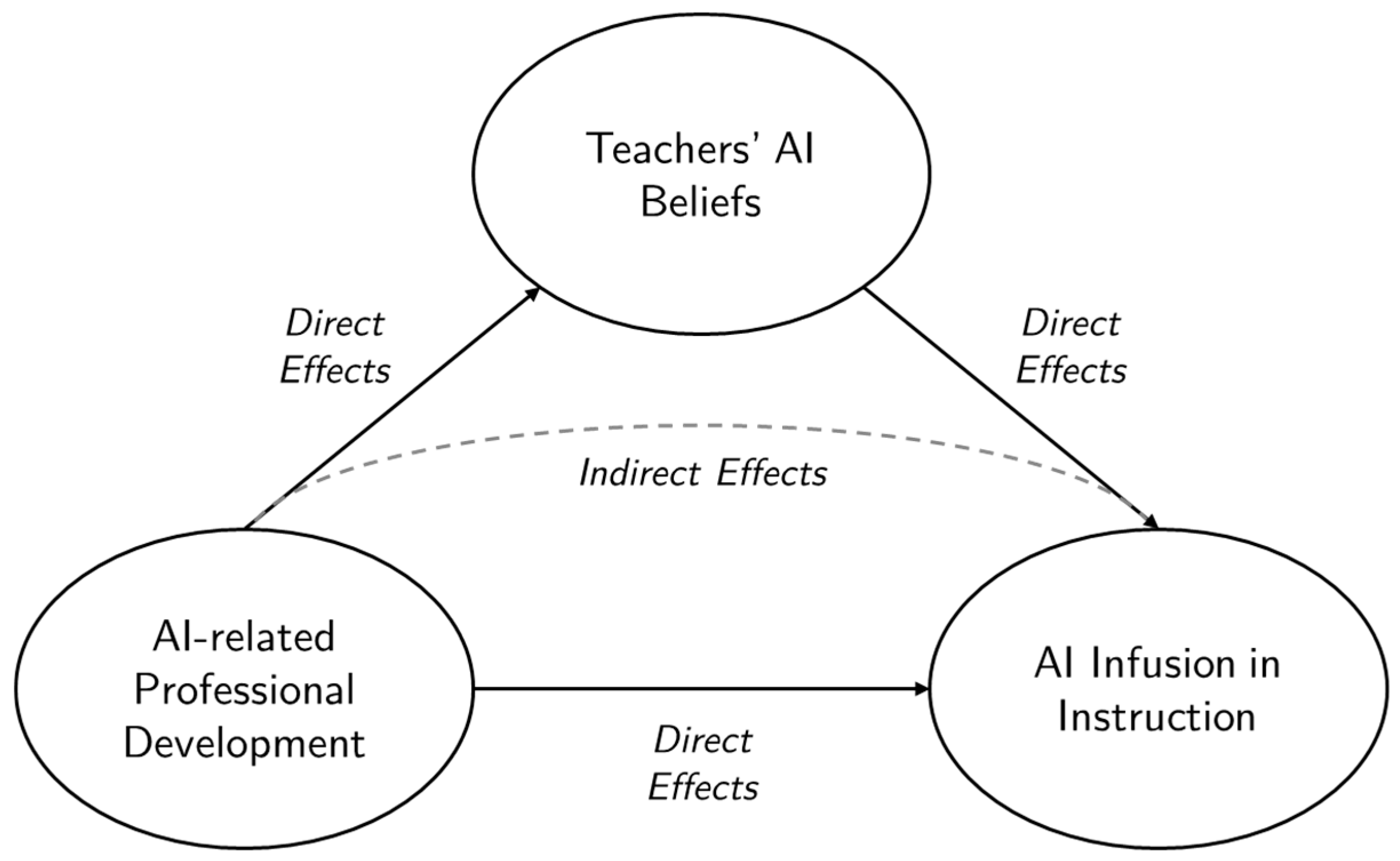
Tan et al., 2025). Therefore, teachers who feel both capable and convinced of AI’s benefits are more likely to adopt it in their classrooms. Guided by the UTAUT and supported by prior literature, this present study sets the following hypotheses, as visualized in
Figure 1.
H1. Participating in artificial intelligence-related professional development will directly and positively develop teachers’ beliefs towards artificial intelligence.
H2. Teachers’ beliefs towards artificial intelligence will be directly and positively related to AI infusion in instruction.
H3. Participating in artificial intelligence-focused professional development will directly increase teachers’ likelihood of infusing AI in instruction.
H4. Teachers’ beliefs about artificial intelligence will mediate the relationship between artificial intelligence-related professional development and the infusion of AI in instruction.
2. Methodology
This current study utilized teacher-level data from the 2024 Teaching and Learning International Survey (TALIS). TALIS, conducted every five years by the Organization for Economic Cooperation and Development (OECD), is a large-scale international survey that targets teachers and school leaders in OECD member and partner countries (
Bas, 2025). Its goal is to gather internationally comparable data on teachers’ working conditions, instructional practices, and professional development to guide educational policy and practice. In the 2024 cycle, TALIS included aspects of digitalization and AI infusion in education, providing a timely opportunity to explore teachers’ professional growth, beliefs, and infusion of AI in instruction (
OECD, 2024). This study emphasizes AI’s role in teaching and learning due to an increasing focus on digital technology infusion to transform educational practices and improve instruction (
Liu et al., 2024). Since TALIS 2024 provides one of the few large-scale international datasets capturing teachers’ professional development experiences, beliefs, and reported AI use, it serves as an ideal source for examining how educators incorporate AI into their instructional practices.
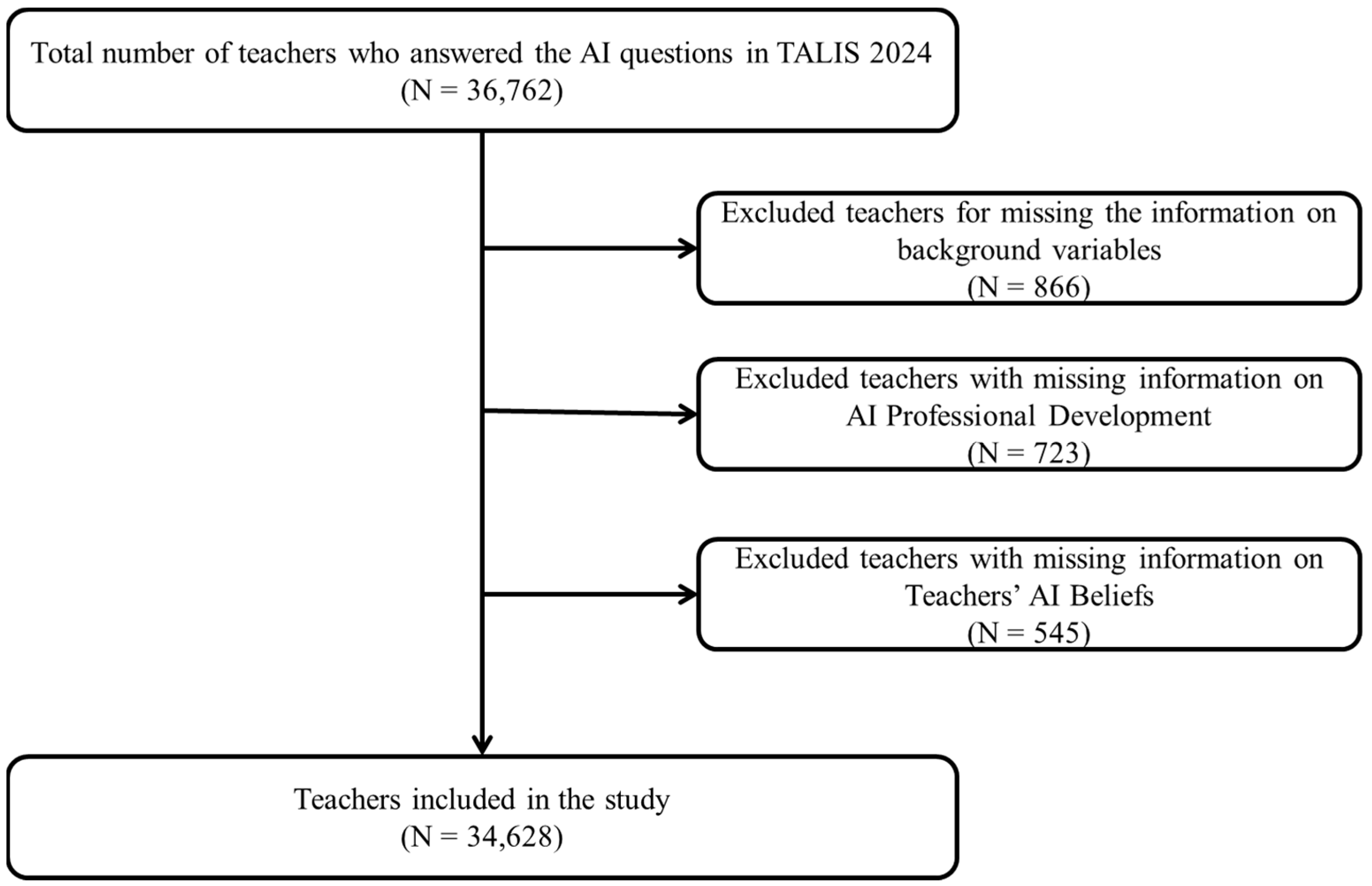
The initial sample consisted of teachers who answered “Yes” to whether they used AI in the past 12 months prior to the TALIS 2024 survey data collection. From the initial 36,762 respondents, 2134 teachers were excluded based on the following criteria (see
Figure 2): (1) missing information on AI-related professional development, beliefs about AI, and AI use in instruction, and (2) missing responses to background variables. After cleaning and removing incomplete responses, 34,628 teachers remained for analysis, as shown in
Figure 2. No missing information regarding AI use in teaching and learning was observed.
Following the sample selection procedure, information on demographic characteristics in
Table 1 provides a clear overview of the study population. A majority of respondents are female (70.74%), while male participants accounted for 29.26% of the sample. With respect to age distribution, 37.96% comprised teachers aged between 40–49, followed by teachers in an age range of 30–39 (29.99%). Younger teachers (with less than 29 years) accounted for 15.82%, whereas those aged 50–59 years and 60 years or above constituted 13.93% and 2.29% respectively. Age distribution indicates that the majority of respondents are mid-career teachers. In terms of teaching experience, an overwhelming population of teachers (92.25%) reported having five years or less of experience, reflecting that the TALIS 2024 sampling frame captures the teaching experience grouping rather than the scrupulous tenancy. Regarding employment status, 89.69% are permanently employed, and 10.31% are on contracts. In terms of working hours, 81.32% of teachers report working full-time, while 18.68% work part-time. These characteristics suggest that the sample primarily consists of young, full-time, permanently employed teachers, offering a potentially representative picture of educators actively involved in contemporary educational practices and integrating AI technology into teaching and learning.
3. Instruments
3.1. AI-Related Professional Development
In this study, AI-related professional development functions as the independent variable. This variable is conceptualized as a latent construct, based on the TALIS 2024 dataset, and is measured using three dichotomous items (TT4G21E, TT4G21F, and TT4G21G) from the teacher questionnaire. These items asked teachers whether topics related to AI or digital technology were included in professional development activities over the past 12 months. Examples include: (1) “Using artificial intelligence for teaching and learning,” (2) “Pedagogical skills for integrating <digital resources and tools> into teaching,” and (3) “Technical skills for using <digital resources and tools>.” Each item has a binary response (1 = Yes and 2 = No), and a composite measure was created from these three indicators. The metrics and factor loadings support the construct validity of AI-related professional development. The standardized factor loadings, as shown in
Table 2, are 0.844, 0.857, and 0.775, respectively, indicating the strong empirical convergence of the underlying constructs. The scale’s internal consistency, measured by Cronbach’s alpha, is 0.695, suggesting acceptable reliability. Construct validity is further supported by the Kaiser–Meyer–Olkin (KMO) measure, which is 0.623, and Bartlett’s test of sphericity, with a value of 24,095.719.
3.2. Teachers’ AI Beliefs
Teachers’ beliefs towards AI serve as the mediating variable in this study. This construct is conceptualized as the latent factor assessed using the multi-item Likert scale from the TALIS 2024 teacher-level questionnaire (TT4G35A-TT4G35E). The items prompt teachers to report their level of agreement regarding the potential benefits of AI infusion in education. Such statements include, but are not limited to: (1) “Artificial intelligence helps teachers write or improve lesson plans”, (2) “Artificial intelligence enables teachers to adapt learning material to different students’ abilities”, (3) “Artificial intelligence assists teachers in supporting students visually”, etc. Teachers’ responses were originally rated on a five-point Likert scale: (1) “Strongly disagree”, (2) “Disagree”, (3) “Agree”, (4) “Strongly agree”, (5) “I don’t know”. Since the “I don’t know” response is theoretically uninterpretable within an attitudinal range, it was recoded following the established measures for handling mid-point ambiguous responses in belief scales. The response (I don’t know) was therefore recoded to the neutral mid-point (5
3) to maintain the ordinal integrity, and the rest of the responses were recoded accordingly (3
4 and 4
5). The construct validity indices and the factor loadings for teachers’ beliefs toward AI are presented in
Table 3. Standardized factor loading for teachers’ beliefs towards AI ranges from 0.665 to 0.829, indicating convergence on the latent constructs. The Cronbach’s alpha coefficient was further used to assess the internal consistency of the scale, and it yielded a value of 0.821. The Kaiser–Meyer–Olkin (KMO) test of sampling adequacy, which is 0.820, as well as Bartlett’s test of sphericity statistic with a value of 63,459.898, further confirms the robustness of the latent structure.
3.3. AI Infusion in Instruction
The dependent variable in this study examines the extent to which teachers have incorporated AI in their instructional practices. Teachers’ AI infusion in instruction was measured using several items (TT4G37A-TT4G37H), which asked teachers to indicate the types of activities in which AI had been integrated. Examples of AI-supported instructional activities listed include: (1) “To assess or mark student work”, (2) To efficiently learn about and summarize a topic”, (3) “To generate lesson plans and activities”, etc. Each item was rated in a dichotomous format, where teachers were required to answer either “Yes” or “No” to indicate whether they had used AI in a specified instructional activity. The construct validity of teachers’ infusion of AI is substantiated by the factor loadings, as shown in
Table 4, which range from 0.616 to 0.897, indicating strong item convergence and internal consistency within the latent construct. The scale’s internal consistency as measured by Cronbach’s alpha is 0.743, and the Kaiser–Meyer–Olkin (KMO) measure of sampling adequacy is 0.828, suggesting acceptable reliability. Furthermore, Bartlett’s test-of-sphericity statistic is 47,233.240, confirming the appropriateness of the scale’s structure.
3.4. Control Variables
In addition to three latent variables, this study includes teachers’ age, gender, teaching experience, employment status, and work hours as covariates to control for potential demographic and contextual influences. Demographic factors such as age, gender, and teaching experience have been reported to influence teachers’ beliefs and participation in professional development (
Taheri et al., 2025;
Thibaut et al., 2018), as well as sustained integration of AI in instructional practices (
Horváth et al., 2025;
C. Zhang et al., 2023). By controlling for these background factors, this study provides an accurate estimation of the relationships between AI-related professional development, teachers’ AI beliefs, and AI infusion in instruction, while mitigating the potential influence of demographic characteristics (
Granstrom & Oppi, 2025).
3.5. Data Analysis
All statistical analyses for the current study were conducted using STATA version 18.0 software (StataCorp LLC, College Station, TX, USA). To ensure the alignment of the structures in the latent constructs representing AI-related professional development, teachers’ AI beliefs, and AI infusion in instruction, the confirmatory factor analysis (CFA) and principal component factor (PCF) analyses were conducted (
Costello & Osborne, 2005). The analytical processes were carried out in several stages to ensure the validity and reliability of the instruments and structural models. The internal consistency of the constructs and sampling adequacy were evaluated using Cronbach’s alpha, Kaiser–Meyer–Olkin (KMO), and Bartlett’s test of sphericity (
Hair et al., 2019). A partial least squares structural equation modeling (PLS-SEM) analysis was conducted to examine the relationships among the latent variables for teachers included in this study. The model allowed for the instantaneous approximation of direct and indirect effects while accounting for dimensional errors (
Memon et al., 2021).
Three test measures, Delta, Sobel, and Monte Carlo, were used to assess the robustness of the indirect effects (
Sobel, 1982). The delta method was used to estimate the sample distribution of the indirect effect, the Sobel test assessed the significance of the mediation effect, and the Monte Carlo method (based on 5000 bootstrap resamples) ensured the accuracy of the confidence intervals for the indirect effect (
Podsakoff et al., 2012). Model fit indices and path coefficients were also examined to assess the adequacy of the structural model and the effect of the hypothesized relationships. Both the dependent and independent variables were standardized to a mean of zero before inclusion in the model to mitigate the multicollinearity and ensure comparability across constructs (
Long & Yi, 2025).
4. Results
4.1. Common Method Bias
Given that this study relies on teachers’ self-reported questionnaires and includes multiple predictors, the variance inflation factors (VIF) were calculated to detect the potential multicollinearity among constructs (
O’brien, 2007). VIFs were computed using the core three constructs. VIF values ranged from 1.02 to 1.17, which is below the conservative threshold for concern (VIF > 3.3), as proposed by
Kock and Lynn (
2012) for identifying common method variance, and the conventional rule-of-thumb (VIF ≥ 5). The results indicate negligible multicollinearity among key variables, suggesting unlikely validity influence.
4.2. Measurement Quality Assessment
Before exploring the structural relationships, the psychometric properties of the three core constructs were examined using reliability analysis and exploratory factor analysis. The internal reliability of the constructs was analyzed using Cronbach’s alpha, and the Kaiser–Meyer–Olkin (KMO) measure, as well as Bartlett’s test of sphericity, was used to assess sampling adequacy and factorability (see
Table 2,
Table 3 and
Table 4).
Across all three scales, the Cronbach’s alpha ranged between 0.695 and 0.821, indicating moderate to strong internal consistency of constructs. The Kaiser–Meyer–Olkin (KMO) statistics also displayed a value range of 0.623 to 0.820, confirming the acceptable reliability. In addition, Bartlett’s test of sphericity was highly significant across all three constructs (24,095.719 63,459.898, p < 0.001), signifying that the associations among the variable items were suitable for extracting latent structure.
4.3. Structural Model Assessment
Apart from validating the structural relationships of the constructs and measurement models, the structural model was evaluated using the PLS-SEM. The model fit accuracy was assessed using the multiple fit indices, including the Root Mean Square Error of Approximation (RMSEA), Comparative Fit Index (CFI), Tucker–Lewis Index (TLI), and the Standardized Root Mean Square Residual (SRMR) (
Hu & Bentler, 1999). The structural model displayed adequate fit to the data. The chi-square statistic for the model relative to the saturated model,
(153) was 12,680.888 (
p < 0.001), while the comparison with the baseline model,
showed a value of 142,473.063, with
p < 0.001. The demonstrated value for RMSEA was 0.049 (
p < 0.05), which was within the threshold fit, and the SRMR was 0.036, which fell well below the recommended upper bound of 0.08 (
Fornell & Larcker, 1981). Moreover, the CFI (0.912) and TLI (0.894) approached the conventional cutoff of 0.9, adding to the justification of a good model fit.
Information criteria further supported the model’s appropriateness, where Akaike’s Information Criterion (AIC = 1,086,000) and the Bayesian Information Criterion (BIC = 1,086,000) corroborated the model’s parsimony. The coefficient of determination (CD), which yielded 0.789, indicates that the structural model highlights approximately 79% of the variance in the endogenous constructs, signifying a strong explanatory power level. The structural model fit results are presented in
Table 5.
4.3.1. Direct Effects
The analysis of direct effects, as displayed in
Table 6, shows that AI-related professional development exerted a statistically positive and significant influence on teachers’ AI beliefs towards AI (
= 0.165,
p < 0.001). These findings suggest that teachers who receive training related to AI are more likely to develop positive attitudes about the impact of such technology on instruction. Results further showed a strong, positive, and significant relationship between teachers’ AI beliefs and AI infusion in instruction (
= 0.416,
p < 0.001), indicating that teachers with favorable perceptions towards AI are considerably more likely to infuse the technology in their instructional activities. Furthermore, the direct effect of AI-related professional development and AI infusion in instruction demonstrated a positive and significant relationship (
= 0.163,
p < 0.001).
4.3.2. Indirect (Mediated) Effects
The mediation effect for the indirect pathway of AI-related professional development on AI infusion through teachers’ beliefs towards AI was statistically positive and significant ( = 0.069, p < 0.001). When analyzed collectively, the results show that approximately 30% of the effect of AI-related professional development on AI infusion is mediated by the teachers’ beliefs towards AI. The total effect of AI-related professional development on teachers’ infusion of AI in instruction is ( = 0.232, p < 0.001). The ratio of the indirect to direct effect was 0.421, indicating that the mediated effect is about 42% as large as the direct effect. The results provide clear evidence that AI-related professional development has an indirect and positive effect on AI infusion through linkages via AI beliefs. This finding implies that, when exposed to AI-related training, it contributes to teachers’ integrating AI for instructional purposes not only through direct skills acquisition but also through shaping teachers’ beliefs and dispositions towards AI technologies. All the findings have confirmed the study’s hypotheses.
5. Discussion
The increasing integration of AI in teaching and learning practices has heightened the need to understand not only how teachers are trained to use these technologies, but also how such training translates into meaningful instructional practice. While prior research has extensively examined professional development and technology integration, much of this work has focused on general digital technologies, limiting attention to the underlying psychological mechanisms that shape how teachers engage with emerging technologies, such as AI.
Drawing on a large-scale international teacher-level dataset from the 2024 cycle of the Teaching and Learning International Survey (TALIS), comprising 34,628 teachers across 55 economies, this study contributes to the growing body of literature by examining both the direct and indirect ways through which AI-related professional development shapes teachers’ beliefs and, in turn, their use of AI in instructional practice.
5.1. Direct Effects
Results from the structural equation analysis indicate that participating in AI-related professional development has a positive and significant impact on teachers’ beliefs about AI infusion. This supports previous research, suggesting that targeted training improves teachers’ attitudes, beliefs, confidence, and readiness to adopt new technologies (
Fteiha et al., 2025;
Granstrom & Oppi, 2025). Since AI-related professional development often introduces teachers to new digital tools, systems, instructional applications, and ethical issues, it helps them develop beliefs about the usefulness and practicality of AI in education. This finding aligns with the evidence from
Sun et al. (
2023), who studied the effect of a professional development program for computer science teachers based on the technological pedagogical content knowledge (TPACK) framework. Their results showed that ongoing interactions with AI tools and collaboration among colleagues significantly improved teachers’ confidence and beliefs about AI adoption, with a large effect size (d = 0.701). From the perspective of the UTAUT theory, this relationship can be seen as AI-related professional development, enhancing performance expectancy and effort expectancy. Teachers gain practical skills through exposure to AI tools, which leads them to develop strong beliefs in the flexibility and effectiveness of these tools to support teaching and learning (
Y. Zhang, 2025). These structured learning experiences also help reduce uncertainties about emerging technologies, enabling teachers to view AI as instructional aides rather than disruptors. As
Ding et al. (
2024) found, teachers who participated in structured AI-focused professional development reduced their fear of the technology, built trust, and gained a clear understanding of how AI can align with curriculum goals.
The study also identified a strong, positive, and significant link between teachers’ AI beliefs and their use of AI tools in instruction. This finding suggests that teachers who perceive AI as pedagogically valuable and useful are more likely to go beyond superficial adoption and infuse it into their instructional practices.
Venkatesh et al. (
2003) note that beliefs influence user intention more strongly than perceived ease of use. When teachers have positive beliefs about AI’s usability and impact, they are more likely to sustainably integrate such technology in the classroom, even if it takes effort to learn the tools (
Enriquez et al., 2025). For example,
Viberg et al. (
2024) surveyed 508 teachers across six countries and found that those who believed more strongly in AI’s effectiveness and pedagogical value were more likely to integrate AI tools into their classrooms. Another study by
Lin et al. (
2025) showed that teachers’ perceived usefulness of AI technology, which is considered an indicator of belief (
Cabellos et al., 2024), was the strongest predictor of the sustainable adoption. This study further emphasizes that teachers’ beliefs are not just internal dispositions but are key factors influencing classroom performance. This significant impact closely relates to the behavioral intention to use model in the UTAUT framework, highlighting that intention and beliefs are essential for understanding technology acceptance and infusion.
Moreover, consistent with the hypothesis, this study shows that AI-related professional development positively affects AI infusion. Perhaps AI-related professional development exposes teachers to practical demonstrations and makes it easier for them to incorporate AI into various instructional practices, such as lesson planning, student engagement, and assessment activities. This finding also aligns with empirical evidence showing that professional development enhances teachers’ digital skills and encourages sustained technology integration, moving beyond superficial use (
Li et al., 2025;
Wang et al., 2025). More specifically, case-based professional development provides teachers with a practical orientation to AI tools, enabling them to develop instruction-specific integration methods rather than surface-level familiarity (
Ding et al., 2024). Such efficiencies are central to technology infusion, since teachers get the opportunity to internalize the instructional value of AI and incorporate it seamlessly into the classroom rather than treating it as an occasional tool (
Naatz & Ruppar, 2025). In this way, guided practice helps teachers move from abstract awareness of AI technology to concrete skills, streamlining routine tasks. Using the UTAUT framework, this finding suggests that AI-related professional development impacts effort expectancy and facilitating conditions, both of which increase the likelihood of infusing AI in education (
Mafa & Govender, 2025). When teachers see AI tools as easy to use within their routines, they are more inclined to use them in practice. Additionally, AI-related professional development includes structured support, such as collaborative learning with colleagues, expert guidance, and resource access; elements that promote the facilitating conditions needed for successful integration (
Tahri et al., 2026).
5.2. Indirect Effects
The significant mediating effect of teachers’ beliefs regarding AI on the association between AI-related professional development and their subsequent use of AI in instructional activities implies the essential role of beliefs in technology infusion (
Mujahidah et al., 2025). Teachers’ beliefs served as the psychological mechanisms that enabled the consistent and meaningful integration of AI in instruction. In other words, AI-related professional development does not directly enhance AI infusion solely by equipping or strengthening teachers’ technical skills; rather, it shapes their internal dispositions, such as confidence, underlying judgments, and perceptions towards the tools as viable instructional resources (
Segaran & Moltudal, 2025). In statistical analyses, the significant impact indicates that a substantial portion of the effect of AI-related professional development on AI operates through belief revision rather than competency alone. This result aligns with prior empirical findings, which show that teachers’ beliefs operate as a critical lens that determines whether newly acquired technical competency progresses into instructional behavioral change (
Fteiha et al., 2025). For instance,
Velli and Zafiropoulos (
2024), in their study to investigate predictors for teachers’ intentions for accepting the educational AI tools (EAIT) in their instruction, they reported that, among others, perceived usefulness (
= 0.465), and perceived ease of use (
= 0.527), of AI tools emerged as the strongest indicators, and they were correlated with the teachers’ behavioral intentions to integrate the tools in teaching and learning.
According to
Cabellos et al. (
2024), teachers’ perceptions about the utility of particular AI tools in aiding their lesson preparation improve their inclination to use such tools. Teachers, in this case, are eager to form judgements not only about how the AI system works, but also about whether to trust the tools, their alignment with the curriculum goals, and whether they facilitate equitable learning. When teachers perceive AI tools as worthy of value to support instruction, and they align with the pedagogical goals, they are more inclined to incorporate them in their practices, such as in lesson planning, instructional delivery, assessment design, and grading. Therefore, teachers’ interpretations of the AI role have become crucial in determining sustained integration. The observed significant indirect effect in this study also aligns with the theoretical stance, where mastery experience, exposure, and practical orientation of the technology system shape the performance and effort expectancies, which further influence behavioral intentions (
Abbad, 2021). Therefore, teachers tend to reduce the perceived complexity and develop a clear mentality about how AI can facilitate instructional activities, perceptions that strengthen their readiness to adopt the tools in teaching and learning.
5.3. Theoretical and Practical Implications of the Study
In line with the UTAUT theory and empirical evidence, this study’s findings indicate that professional development builds practical skills and fosters positive, pedagogically grounded beliefs about AI, which are essential for infusion. The study emphasizes that training programs are the foundation of teachers’ efforts and performance expectations, which in turn influence their readiness to infuse new technology (
Traga Philippakos & Rocconi, 2025). While the theory highlights the collective roles of effort expectancy, performance expectancy, and facilitating conditions in impacting technology infusion (
Venkatesh et al., 2003), this research advances the framework by showing that system-level support mechanisms, such as structured teachers’ professional development, play a crucial role in strengthening these beliefs. Furthermore, the mediating role of teachers’ beliefs regarding AI provides a more comprehensive theoretical contribution by examining the impact of psychological factors on the relationship between AI-oriented professional development and its practical application in the classroom (
Cabellos et al., 2024;
Djekourmane et al., 2025).
The practical implications are particularly relevant for school leaders, professional development coordinators, and education policymakers. The results highlight the importance of implementing well-designed AI training programs as a core strategy to promote sustained AI integration in teaching and learning (
Alwakid et al., 2025). Moreover, the mediating influence of teachers’ beliefs underscores the need to include non-cognitive factors that address mistrust and clarify the instructional value of AI technologies (
Feng et al., 2025). Finally, the school system should foster a supportive environment by ensuring that teachers have access to adequate technological resources, sufficient time for practice, and encouragement to incorporate AI into instruction.
6. Study Limitations and Directions for Future Research
The current study has limitations that should be considered when interpreting its findings. First, the study relies on cross-sectional survey data from TALIS 2024, which limits the ability to draw firm causal conclusions about the included variables. Although the mediation model is theoretically based on the UTAUT framework and supported by empirical sources, the proposed sequence of variables cannot be confirmed. Therefore, future research should use experimental or longitudinal designs, such as AI-related professional development interventions, to determine whether teachers’ beliefs change gradually and how exposure to AI practices influences behavioral change. Second, the analysis depends on teachers’ self-reported responses, which may be affected by common-method bias. Although this study minimized bias through construct validation and model diagnostics, future studies should include objective measures of AI integration, such as classroom observations, to complement teachers’ personal responses. Additionally, the study focuses on teachers’ beliefs as the sole mediating construct. However, emerging research indicates that other psychological factors, like self-efficacy, may also mediate the relationship between professional development and AI integration. Therefore, future research should examine other psychological mediators to better understand the mechanisms behind teachers’ responses to AI-related professional development.
7. Conclusions
The present study examined how AI-related professional development influences teachers’ AI beliefs and ultimately shapes the sustained AI infusion in instruction, using a teacher-level dataset from TALIS 2024, and grounded in the UTAUT framework. The findings indicate that AI-related professional development is positively and significantly correlated with teachers’ AI beliefs and the infusion of AI into teaching and learning. Moreover, teachers’ AI beliefs were found to be a positive and significant mechanism through which AI-related professional development translates into instructional practice. In that case, findings underscore the need to design professional development programs that not only equip teachers with technical skills but also incorporate the related mechanisms, such as beliefs toward AI. By strengthening both teachers’ beliefs and competence, educational systems can foster sustained integration of AI technology into teaching and learning.
Importantly, while the present study conceptualizes teachers’ beliefs as the perceived usefulness and positive orientation towards AI, it is important to recognize that meaningful professional development extends beyond fostering favorable attitudes. Engagement with AI in educational contexts also requires critical analysis of its pedagogical values, practical limitations, and ethical implications. Therefore, positive beliefs should not be interpreted as unconditional acceptance, but as part of a broader spectrum of professional judgement that includes critical awareness and reflective practice.
Beyond the direct relationships identified in this study, findings point on the need to theorize AI infusion within a comprehensive ecosystemic perspective of teaching and learning practices. In this case, the concept of learning design becomes essential. While professional development shapes teachers’ beliefs and equips them with technical skills, the actual integration of AI depends on how these tools are embedded in the design of learning activities, instructional strategies, and student engagement processes. AI integration should therefore be understood not merely as the use of technological tools, but as part of the dynamic instructional systems in which teachers intentionally design learning environments that align AI use with the pedagogical practices. Future research in this case should extend this perspective by examining how teachers translate their beliefs and practices into structured AI-enhanced learning design, thereby offering a comprehensive understanding of AI infusion in education.
Author Contributions
J.L.: conceived and designed the study and conducted the statistical analysis. J.L., A.E.M., D.T. and M.A. conducted the literature search. All authors reviewed the eligible studies and confirmed the final primary studies for inclusion. All authors have read and agreed to the published version of the manuscript.
Funding
This research was supported by a grant from the Shaanxi BNR Research Center for Teacher Education Innovation and Excellence [2025YZ-YZPT-10].
Institutional Review Board Statement
Not applicable.
Informed Consent Statement
Not applicable.
Data Availability Statement
No new data were created or analyzed in this study. The original contributions presented in the study are included in the article; further inquiries can be directed to the corresponding author.
Acknowledgments
The authors would like to thank three anonymous reviewers for detailed professional feedback. All errors are our own.
Conflicts of Interest
The authors declare no conflicts of interest.
References
- Abbad, M. M. M. (2021). Using the UTAUT model to understand students’ usage of e-learning systems in developing countries. Education and Information Technologies, 26, 7205–7224. [Google Scholar] [CrossRef]
- Aldemir, T., Bicer, A., Kilinc, S., Moon, J., & Kwok, M. (2025). Exploring emergent AI-TPACK competencies in a two-week AI literacy module for preservice teachers. Teaching and Teacher Education, 168, 105231. [Google Scholar] [CrossRef]
- Aljemely, Y. (2024). Challenges and best practices in training teachers to utilize artificial intelligence: A systematic review. Frontiers in Education, 9, 1470853. [Google Scholar] [CrossRef]
- Alwakid, W. N., Dahri, N. A., Humayun, M., & Alwakid, G. N. (2025). Exploring the role of AI and teacher competencies on instructional planning and student performance in an outcome-based education system. Systems, 13, 517. [Google Scholar] [CrossRef]
- Ayanwale, M. A., Sanusi, I. T., Adelana, O. P., Aruleba, K. D., & Oyelere, S. S. (2022). Teachers’ readiness and intention to teach artificial intelligence in schools. Computers and Education: Artificial Intelligence, 3, 100099. [Google Scholar] [CrossRef]
- Azzam, A., & Charles, T. (2025). K-12 STEM teachers’ experiences with artificial intelligence. Stem Journal-Technology Education Management Informatics, 14(1), 463–468. [Google Scholar] [CrossRef]
- Bas, G. (2025). Factors related to instructional practices of teachers: Evidence from TALIS 2018. Asia-Pacific Education Researcher, 34, 2003–2012. [Google Scholar] [CrossRef]
- Bergdahl, N., & Sjöberg, J. (2025). Transformation, support needs and AI, in K-12 education. Education and Information Technologies, 31, 191–212. [Google Scholar] [CrossRef]
- Blundell, C. N., Mukherjee, M., & Nykvist, S. (2025). Adopting generative AI in K-12 teaching and learning: Australian teachers’ actions through the lens of innovation theory. Education and Information Technologies, 30, 24009–24028. [Google Scholar] [CrossRef]
- Bowman, M. A., Vongkulluksn, V. W., Zilu, J., & Xie, K. (2022). Teachers’ exposure to professional development and the quality of their instructional technology use: The mediating role of teachers’ value and ability beliefs. Journal of Research on Technology in Education, 54, 188–204. [Google Scholar] [CrossRef]
- Busuttil, L., & Calleja, J. (2025). Teachers’ beliefs and practices about the potential of ChatGPT in teaching mathematics in secondary schools. Digital Experiences in Mathematics Education, 11, 140–166. [Google Scholar] [CrossRef]
- Cabellos, B., de Aldama, C., & Pozo, J.-I. (2024). University teachers’ beliefs about the use of generative artificial intelligence for teaching and learning. Frontiers in Psychology, 15, 1468900. [Google Scholar] [CrossRef]
- Chauncey, S. A., & McKenna, H. P. (2023). A framework and exemplars for ethical and responsible use of AI Chatbot technology to support teaching and learning. Computers and Education: Artificial Intelligence, 5, 100182. [Google Scholar] [CrossRef]
- Costello, A., & Osborne, J. W. (2005). (PDF) Best practices in exploratory factor analysis: Four recommendations for getting the most from your analysis. Available online: https://www.researchgate.net/publication/209835856 (accessed on 20 March 2026).
- Ding, A.-C. E., Shi, L., Yang, H., & Choi, I. (2024). Enhancing teacher AI literacy and integration through different types of cases in teacher professional development. Computers and Education Open, 6, 100178. [Google Scholar] [CrossRef]
- Djekourmane, D., Zhang, Y., Xue, Z., & Zhiyuan, W. (2025). The mediating role of math self-efficacy between school-based parental involvement and math performance among students in Southeast Asia: Evidence from PISA 2022. Frontiers in Psychology, 16, 1594131. [Google Scholar] [CrossRef]
- Elmaadaway, M., El-Naggar, M., & Abouhashesh, M. (2025). Improving primary school students’ oral reading fluency through voice Chatbot-based AI. Journal of Computer Assisted Learning, 41(2), e70019. [Google Scholar] [CrossRef]
- Enriquez, B. G. A., Ballesteros, M. A. A., Guzmán, M., & Angaspilco, J. E. M. (2025). Determinants of AI use in university teachers: The role of leadership, teaching concerns, and constructivist pedagogical beliefs. Available online: https://www.researchgate.net/publication/392091511 (accessed on 20 March 2026).
- Feng, J., Yu, B., Tan, W. H., Dai, Z., & Li, Z. (2025). Key factors influencing educational technology adoption in higher education: A systematic review. PLoS Digital Health, 4(4), e0000764. [Google Scholar] [CrossRef]
- Fornell, C., & Larcker, D. F. (1981). Evaluating structural equation models with unobservable variables and measurement error. Journal of Marketing Research, 18, 39–50. [Google Scholar] [CrossRef]
- Fteiha, M., Al-Rashaida, M., & Ghazal, M. (2025). General and special education teachers’ readiness for artificial intelligence in classrooms: A structural equation modeling study of knowledge, attitudes, and practices in select UAE public and private schools. PLoS ONE, 20(9), e0331941. [Google Scholar] [CrossRef] [PubMed]
- Ghiasvand, F., & Seyri, H. (2025). A collaborative reflection on the synergy of Artificial Intelligence (AI) and language teacher identity reconstruction. Teaching and Teacher Education, 160, 105022. [Google Scholar] [CrossRef]
- Granstrom, M., & Oppi, P. (2025). Assessing teachers’ readiness and perceived usefulness of AI in education: An Estonian perspective. Frontiers in Education, 10, 1622240. [Google Scholar] [CrossRef]
- Hair, J. F., Black, W. C., Babin, B. J., & Anderson, R. E. (2019). Multivariate data analysis (8th ed.). Cengage. [Google Scholar]
- Hazzan-Bishara, A., Kol, O., & Levy, S. (2025). The factors affecting teachers’ adoption of AI technologies: A unified model of external and internal determinants. Education and Information Technologies, 30(11), 15043–15069. [Google Scholar] [CrossRef]
- Horváth, I. D., Rajki, Z., & Nagy, J. T. (2025). University teachers’ digital competence and AI literacy: Moderating role of gender, age, experience, and discipline. Education Sciences, 15, 868. [Google Scholar] [CrossRef]
- Hu, L., & Bentler, P. M. (1999). Cutoff criteria for fit indexes in covariance structure analysis: Conventional criteria versus new alternatives. Structural Equation Modeling, 6(1), 1–55. [Google Scholar] [CrossRef]
- Kazmaci, A., Cek, K., Fahriye, A., Altinay, Z., & Dagli, G. (2025). Influence of theoretical and practical artificial intelligence knowledge on the primary school teachers’ sustainable AI integration ability: Mediating effects of beliefs and attitudes. Frontiers in Psychology, 16, 1628557. [Google Scholar] [CrossRef] [PubMed]
- Kock, N., & Lynn, G. (2012). Lateral collinearity and misleading results in variance-based SEM: An illustration and recommendations. Journal of the Association for Information Systems, 13(7), 58–85. [Google Scholar] [CrossRef]
- Li, K., Wang, P., & Chen, G. (2025). How can AI be integrated into teacher professional development programs? A systematic review based on an adapted technology-based learning model. Teaching and Teacher Education, 168, 105219. [Google Scholar] [CrossRef]
- Lin, T., Zhang, J., & Xiong, B. (2025). Effects of technology perceptions, teacher beliefs, and AI literacy on AI technology adoption in sustainable mathematics education. Sustainability, 17, 3698. [Google Scholar] [CrossRef]
- Liu, J., Aziku, M., Qiang, F., & Zhang, B. (2024). Leveraging professional learning communities in linking digital professional development and instructional integration: Evidence from 16,072 STEM teachers. International Journal of STEM Education, 11, 56. [Google Scholar] [CrossRef]
- Liu, J., Mbowe, A. E., Tahri, D., & Aziku, M. (2026). Meta-analysis on the influence of AI agents on K-12 student cognitive performance. Computers in Human Behavior Reports, 21, 100973. [Google Scholar] [CrossRef]
- Long, Y., & Yi, X. (2025). Leveraging transformational and instructional leadership for teacher professional development: A dual-mediation model of teacher self-efficacy and organisational culture. Science Direct. Available online: https://www.sciencedirect.com/science/article/abs/pii/S0742051X25001647 (accessed on 20 March 2026).
- Lucas, M., Zhang, Y., Bem-haja, P., & Nuno Vicente, P. (2024). The interplay between teachers’ trust in artificial intelligence and digital competence. Education and Information Technologies, 29, 22991–23010. [Google Scholar] [CrossRef]
- Lv, B., Zhou, D., Rong, Z., Tian, X., & Wang, J. (2024). Effects of professional development program on primary science teachers’ ICT use in China: Mediation effects of science teachers’ knowledge, beliefs and instructional practice. Disciplinary and Interdisciplinary Science Education Research, 6(1), 11. [Google Scholar] [CrossRef]
- Mafa, R. K., & Govender, D. W. (2025). Exploring teachers’ technology adoption: Linking TPACK knowledge and UTAUT-3 constructs. Discover Education, 4, 88. [Google Scholar] [CrossRef]
- Memon, M. A., T., R., Cheah, J.-H., Ting, H., Chuah, F., & Cham, T. H. (2021). PLS-SEM statistical programs: A review. Journal of Applied Structural Equation Modeling, 5(1), i–xiv. [Google Scholar] [CrossRef]
- Mujahidah, M., Tarigan, F. N., Dj, M. Z., Mat Husain, M. P., Sanjaya, D., & Yusuf, M. (2025). Teachers’ perceptions & attitudes towards Artificial Intelligence (AI) integration in suburban schools. Journal of Curriculum and Teaching, 14(2), 98. [Google Scholar] [CrossRef]
- Naatz, A. J., & Ruppar, A. (2025). Special education teachers’ use of generative artificial intelligence (AI): An exploratory survey of frequency and factors influencing adoption. Journal of Special Education Technology, 32(6), 42–55. [Google Scholar] [CrossRef]
- O’brien, R. M. (2007). A caution regarding rules of thumb for variance inflation factors. Quality & Quantity, 41(5), 673–690. [Google Scholar] [CrossRef]
- OECD. (2024). TALIS 2024 conceptual framework. Available online: https://www.oecd.org/education/talis/TALIS-2024-Conceptual-Framework (accessed on 20 March 2026).
- Ofem, U. J., Orim, F. S., Edam-Agbor, I. B., Amanso, E. O. I., Eni, E., Ukatu, J. O., Ovat, S. V., Osang, A. W., Dien, C., & Abuo, C. B. (2025). Teachers’ preparedness for the utilization of artificial intelligence in classroom assessment: The contributory effects of attitude toward technology, technological readiness, and pedagogical beliefs with perceived ease of use and perceived usefulness as mediators. Frontiers in Education, 10, 1568306. [Google Scholar] [CrossRef]
- Podsakoff, P. M., MacKenzie, S. B., & Podsakoff, N. P. (2012). Sources of method bias in social science research and recommendations on how to control it. Annual Review of Psychology, 63, 539–569. [Google Scholar] [CrossRef]
- Roshan, S., Zaffar Iqbal, S., & Qing, Z. (2024). Teacher training and professional development for implementing AI-based educational tools. Available online: https://www.researchgate.net/publication/385681771 (accessed on 20 March 2026).
- Segaran, M. K., & Moltudal, S. H. (2025). A qualitative descriptive study of teachers’ beliefs and their design thinking practices in integrating an AI-based automated feedback tool. Education Sciences, 15, 910. [Google Scholar] [CrossRef]
- Sobel, M. E. (1982). Asymptotic confidence intervals for indirect effects in structural equation models. Sociological Methodology, 13, 290–321. [Google Scholar] [CrossRef]
- Sun, J., Ma, H., Zeng, Y., Han, D., & Jin, Y. (2023). Promoting the AI teaching competency of K-12 computer science teachers: A TPACK-based professional development approach. Education and Information Technologies, 28(2), 1509–1533. [Google Scholar] [CrossRef]
- Taheri, R., Nazemi, N., Pennington, S. E., Clark, J. A., & Dadgostari, F. (2025). Factors influencing educators’ AI adoption: A grounded meta-analysis review. Computers and Education: Artificial Intelligence, 9, 100464. [Google Scholar] [CrossRef]
- Tahri, D., Liu, J., & Aziku, M. (2026). Machine-learning applications in predicting students’ non-cognitive skills: Evidence from PISA 2022. Fudan Journal of the Humanities and Social Sciences, 45(9), 1–31. [Google Scholar] [CrossRef]
- Tan, X., Cheng, G., & Ling, M. H. (2025). Artificial intelligence in teaching and teacher professional development: A systematic review. Computers and Education: Artificial Intelligence, 8, 100355. [Google Scholar] [CrossRef]
- Thibaut, L., Knipprath, H., Dehaene, W., & Depaepe, F. (2018). The influence of teachers’ attitudes and school context on instructional practices in integrated STEM education. Teaching and Teacher Education, 71, 190–205. [Google Scholar] [CrossRef]
- Traga Philippakos, Z. A., & Rocconi, L. (2025). AI literacy: Elementary and secondary teachers’ use of AI-tools, reported confidence, and professional development needs. Education Sciences, 15(9), 1186. [Google Scholar] [CrossRef]
- Tripathi, T., Sharma, S. R., Singh, V., Bhargava, P., & Raj, C. (2025). Teaching and learning with AI: A qualitative study on K-12 teachers’ use and engagement with artificial intelligence. Frontiers in Education, 10, 1651217. [Google Scholar] [CrossRef]
- Velander, J., Taiye, M. A., Otero, N., & Milrad, M. (2024). Artificial intelligence in K-12 education: Eliciting and reflecting on Swedish teachers’ understanding of AI and its implications for teaching & learning. Education and Information Technologies, 29(4), 4085–4105. [Google Scholar] [CrossRef]
- Velli, K., & Zafiropoulos, K. (2024). Factors that affect the acceptance of educational AI tools by Greek teachers—A structural equation modelling study. European Journal of Investigation in Health, Psychology and Education, 14, 2560–2579. [Google Scholar] [CrossRef]
- Venkatesh, V., Morris, M. G., Davis, G. B., & Davis, F. D. (2003). User acceptance of information technology: Toward a unified View1. Available online: https://www.researchgate.net/publication/220259897 (accessed on 20 March 2026).
- Viberg, O., Cukurova, M., Feldman-Maggor, Y., Alexandron, G., Shirai, S., Kanemune, S., Wasson, B., Tømte, C., Spikol, D., Milrad, M., Coelho, R., & Kizilcec, R. F. (2024). What explains teachers’ trust in AI in education across six countries? International Journal of Artificial Intelligence in Education, 35(1), 1288–1316. [Google Scholar] [CrossRef]
- Vorobyeva, K. I., Belous, S., Savchenko, N. V., Smirnova, L. M., Nikitina, S. A., & Zhdanov, S. P. (2025). Personalized learning through AI: Pedagogical approaches and critical insights. Contemporary Educational Technology, 17(2), ep574. [Google Scholar] [CrossRef] [PubMed]
- Wang, X., Niu, J., Fang, B., Han, G., & He, J. (2025). Empowering teachers’ professional development with LLMs: An empirical study of developing teachers’ competency for instructional design in blended learning. Teaching and Teacher Education, 165, 105091. [Google Scholar] [CrossRef]
- Yang, Y.-F., Tseng, C. C., & Lai, S.-C. (2024). Enhancing teachers’ self-efficacy beliefs in AI-based technology integration into English speaking teaching through a professional development program—ScienceDirect. Available online: https://www.sciencedirect.com/science/article/abs/pii/S0742051X24001148 (accessed on 20 March 2026).
- Yuan, Z., Liu, J., Deng, X., Ding, T., & Wijaya, T. T. (2023). Facilitating conditions as the biggest factor influencing elementary school teachers’ usage behavior of dynamic mathematics software in China. Mathematics, 11(6), 1536. [Google Scholar] [CrossRef]
- Zhang, C., Schießl, J., Plößl, L., Hofmann, F., & Gläser-Zikuda, M. (2023). Acceptance of artificial intelligence among pre-service teachers: A multigroup analysis. International Journal of Educational Technology in Higher Education, 20(3), 49. [Google Scholar] [CrossRef]
- Zhang, Y. (2025). Predicting teachers’ intentions for AIGC integration in preschool education: A hybrid SEM-ANN approach. Journal of Information Technology Education: Research, 24, 016. [Google Scholar] [CrossRef]
| Disclaimer/Publisher’s Note: The statements, opinions and data contained in all publications are solely those of the individual author(s) and contributor(s) and not of MDPI and/or the editor(s). MDPI and/or the editor(s) disclaim responsibility for any injury to people or property resulting from any ideas, methods, instructions or products referred to in the content. |