


Abstract
Herein, a spectral Galerkin method for solving the fractional Rayleigh–Stokes problem involving a nonlinear source term is analyzed. Two kinds of basis functions that are related to the shifted sixth-kind Chebyshev polynomials are selected and utilized in the numerical treatment of the problem. Some specific integer and fractional derivative formulas are used to introduce our proposed numerical algorithm. Moreover, the stability and convergence accuracy are derived in detail. As a final validation of our theoretical results, we present a few numerical examples.
Keywords:
fractional differential equations; orthogonal polynomials; spectral methods; convergence analysis MSC:
65M70; 11B83; 35L02
1. Introduction
The importance of non-Newtonian fluids in science and industrial applications has piqued the interest of numerous researchers. There are many examples of non-Newtonian fluids such as in natural substances (lava, magma, gums, honey), in biology (semen, mucus, synovia, blood), in industry (molten polymer, lubricant, paint, ink, glue), in food products (ketchup, butter, mustard, chocolate, mayonnaise, cheese), and in cosmetics (cream, silicone, toothpaste, nail polish, soap solution). In this regard, the fractional Rayleigh–Stokes equation (FRSE) plays an important role in describing the dynamic behavior of some non-Newtonian fluids [1,2,3,4].
The nonlinear FRSE [5] is as follows:
with, respectively, the following homogeneous initial and boundary conditions:
and
where a and b are two positive constants and the nonlinear source term satisfies the global Lipschitz condition with respect to . The symbol is the Caputo fractional derivative operator of order that describes the viscoelastic behavior of the flow. Some researchers have investigated and proposed a few methods for the solution of FRSE. In Ref. [6], the authors proposed the finite element method for the numerical solution of FRSE. In Ref. [7], the authors applied the radial basis function-generated finite difference method for the solution of the FRSE, while in [8], the authors solved the FRSE by using the spectral Jacobi–Galerkin method. Furthermore, an improved tau method for the multi-dimensional FRSE for a heated generalized second grade fluid was developed in [9]. Some other studies regarding the Rayleigh–Stokes problem can be found in [10,11].
Chebyshev polynomials (CPs) play significant roles in numerical analysis and approximation theory. There are well-known four kinds of CPs, which are specific types of Jacobi polynomials. These kinds of polynomials have been extensively used in a variety of papers related to numerical analysis; see, for instance, ref. [12,13,14]. The other two kinds of Chebyshev polynomials, namely, the fifth and sixth kinds of Chebyshev polynomials were investigated in [15]. These two classes are symmetric like the first and second kinds of Chebyshev polynomials. In fact, they are particular polynomials of the so-called “generalized ultraspherical polynomials” (see, for example, ref. [16,17]). Regrading these polynomials, their theoretical, as well as practical aspects, have attracted a significant attention from several authors. In this respect, Xu et al. [18] treated the fractional optimal control problems using sixth-kind Chebyshev wavelets. Moreover, Babaei et al. [19] employed Chebyshev polynomials of the sixth kind for solving the variable-order fractional nonlinear quadratic integro-differential equations. In addition, Jafari et al. [20] developed a spectral collocation method for treating the inverse reaction-diffusion–convection based on Chebyshev polynomials of the sixth kind. Some other contributions regarding sixth-kind Chebyshev polynomials can be found in [21,22], while for some contributions regarding Chebyshev polynomials of the fifth kind, one can referred to [23,24].
Since obtaining an exact solution is very computationally expensive for fractional differential equations, it is therefore impossible or extremely difficult to analytically solve such models. As a consequence, it has become an active research pursuit to analyze and implement high-efficient numerical techniques such as spectral methods for the simulation of solutions to these models. Spectral methods are based on the idea that approximate solutions to differential equations can be expressed as a series of truncated special functions. Three main spectral methods are employed, namely, the collocation, tau, and Galerkin methods. Readers interested in this subject can consult [25,26,27] for detailed explanations and applications of these techniques.
The following is a brief summary of the principal aims of this article:
- Construct and develop a new method for solving the nonlinear FRSE through shifted CPs of the sixth-kind by the application of the Galerkin method;
- Discuss the convergence and error analysis of the presented method;
- Present some numerical results to examine the applicability and accuracy of the algorithm.
The structure of the paper is as follows. Section 2 displays a few fundamental concepts related to Caputo fractional calculus. A few definitions and formulas concerning sixth-kind shifted CPs are also displayed. Section 3 discusses the Galerkin approach for the numerical treatment of the FRSE. The proposed double Chebyshev expansion is examined for convergence and error analysis in Section 4. Section 5 contains some numerical examples and comparisons between our numerical results and those produced by other approaches. A few conclusions are summarized in Section 6.
2. Preliminaries and Essential Relations
Essential definitions and formulas are included in this section.
2.1. Some Definitions and Properties of the Fractional Calculus
Definition 1
([28]). On the typical Lebesgue space , the Riemann–Liouville fractional integral operator of order ρ is defined as
Definition 2
([28]). The Caputo definition of the fractional-order derivative is:
where .
The operator fulfills the accompanying properties for
where is the smallest integer greater than or equal to .
2.2. Some Basic Formulas and Properties of Sixth-Kind CPs and Their Shifted Ones
Sixth-kind Chebyshev polynomials [15] are orthogonal polynomials with respect to the weight function . The orthogonality relation of these polynomials is given by [21]
where
These polynomials may be constructed using the following recursive formula:
In [21], the authors also provide trigonometric representations of sixth-kind Chebyshev polynomials as follows:
Now, we define the shifted orthogonal polynomials on as:
The following recurrence relation:
generates the sequence of the shifted sixth-kind CPs on , with
These polynomials are orthogonal on with respect to
More precisely, we have the following orthogonality relation (see, [21]):
where is the well-known Kronecker delta function and
The power form representation of is given by [21]
where
Another important formula of the is its inversion formula [21]
where
For more properties about , see [21,22].
Theorem 1.
The first derivative of is given by [29]
and the coefficients are given by
3. Galerkin Approach for Treating the FRSE
We begin by selecting our basis functions in this section. Then, using the spectral Galerkin approach, we present a numerical solution for solving the FRSE with homogeneous initial and boundary conditions.
3.1. Basis Functions Selection
The following are the basis functions that we choose:
Theorem 2.
The second-order derivative of can be written as [29]:
where
Theorem 3.
The first-order derivative of is given by
where the coefficients are given by
Theorem 4.
The following approximation formula holds for
where
Remark 1.
The proofs of Theorems 3 and 4 are given in the Appendix A at the end of this paper.
3.2. Galerkin Solution for the FRSE
Now, consider the following two spaces:
then, any function may be written as
Thanks to Theorems 2–4 along with the recurrence relation (3), we have the following expressions:
Now, the residual of Equation (1) may be written in the following form:
The following system of equations can be obtained using the Galerkin method as follows:
where
Equation (10) constructs a system of non-linear algebraic equations with unknown expansion coefficients of dimension , which can be solved using the well-known Newton’s iterative approach with zero initial approximations, and thus an approximation of the solution can be obtained.
3.3. Transformation to the Homogeneous Initial and Boundary Conditions
By virtue of the following transformation:
where
the FRSE (1) with non-homogeneous initial and boundary conditions can be transformed into the following form:
with homogeneous initial and boundary conditions
where
4. Convergence Analysis
We present an upper estimate for the truncation error as well as the stability of the proposed approximate solution in this section.
Theorem 5.
Consider the function: , with and having bounded third derivatives that satisfy the expansion:
Then, the above series (11) is uniformly convergent to and the expansion coefficients satisfy the inequality:
where ⪅ means that a generic constant d exists such that
Proof.
The orthogonality relations of and enable one to write
By the hypotheses of the theorem, we obtain
By virtue of the two substitutions:
the last equation turns into the form
Now, we have four cases:
This completes the proof of Theorem 5. □
Theorem 6.
If satisfies the hypothesis of Theorem 5 and if , then the following estimate of truncation error is fulfilled:
Proof.
From the definition of and we obtain
where
Now, following steps similar to those given in Theorem 5, we obtain
and
However, for all we have thus
and hence, the application of the integral test [30] enables us to write Equation (18) as
□
Theorem 7.
Under the assumptions of Theorem 5, we have
5. Illustrative Examples
In this section, the technique presented in Section 3 is applied to solve the nonlinear FRSE. Three illustrative examples are used to demonstrate the effectiveness and applicability of the proposed technique.
Example 1.

Consider the FRSE of the form
where
along with the following initial and boundary conditions:
The exact solution of this problem is
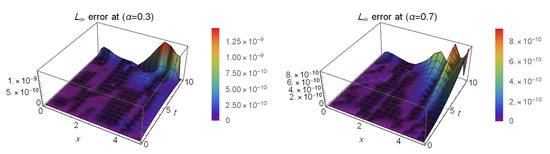
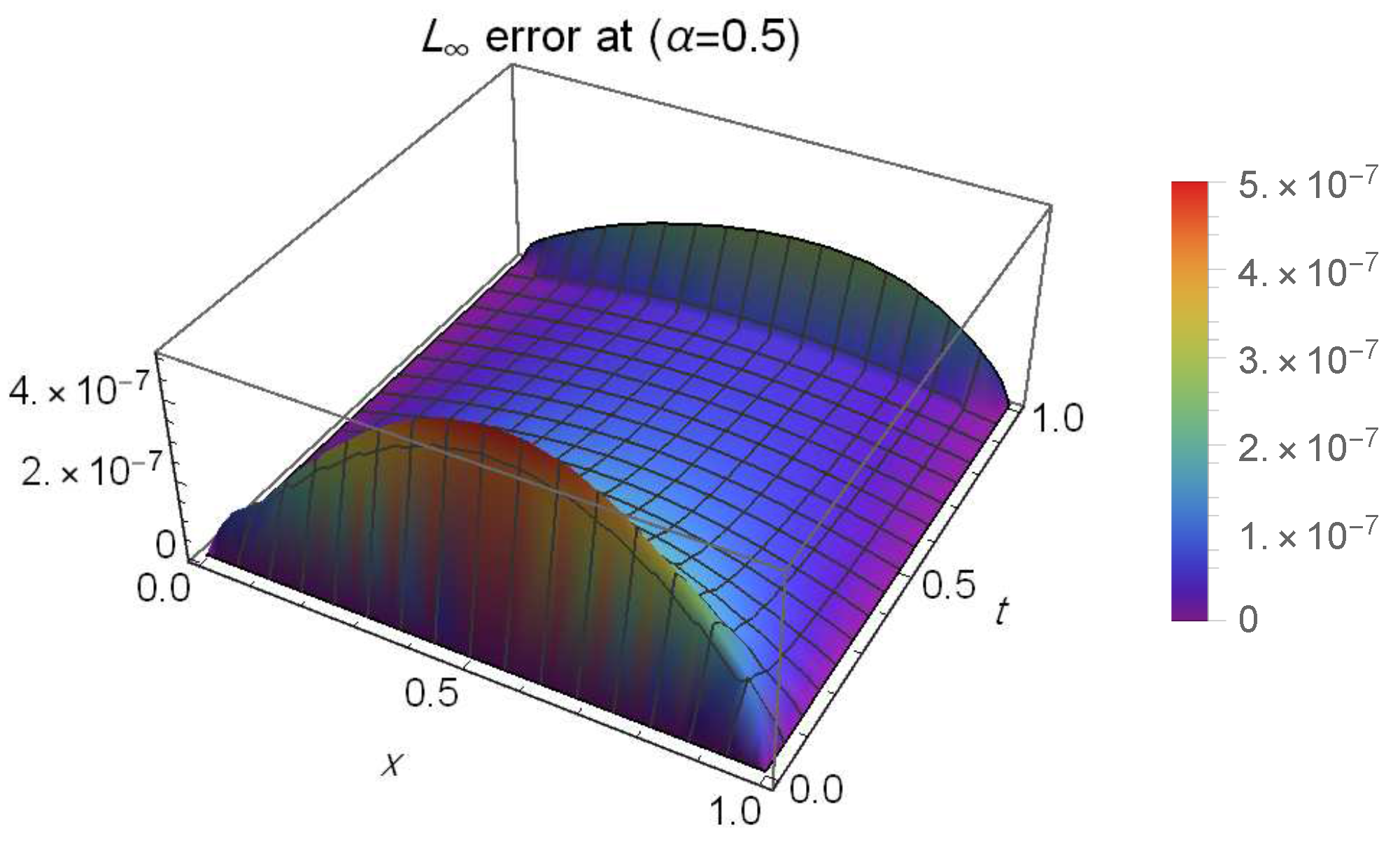
In Table 1, we reported the computational time (CPU time) and compared the errors of the present method with method in [5] at . We see in this table that the results are accurate for small choices of N. Table 2 lists the errors for different values of α at when and and the CPU time. Figure 1 illustrates the error for (left) and (right) at when and . We can see from Table 1 and Table 2 and Figure 1 that the proposed method is appropriate and effective. This demonstrates the advantage of our method compared to some other numerical methods.
Table 1.
The errors for Example 1.
Table 2.
The errors for Example 1.
Figure 1.
The error for Example 1.
Example 2.
Consider the FRSE of the form
where
along with the following initial and boundary conditions:
The exact solution of this problem is
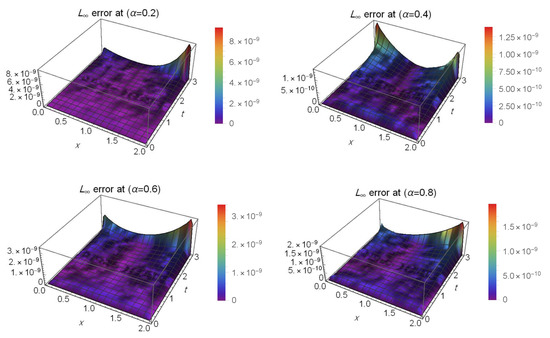
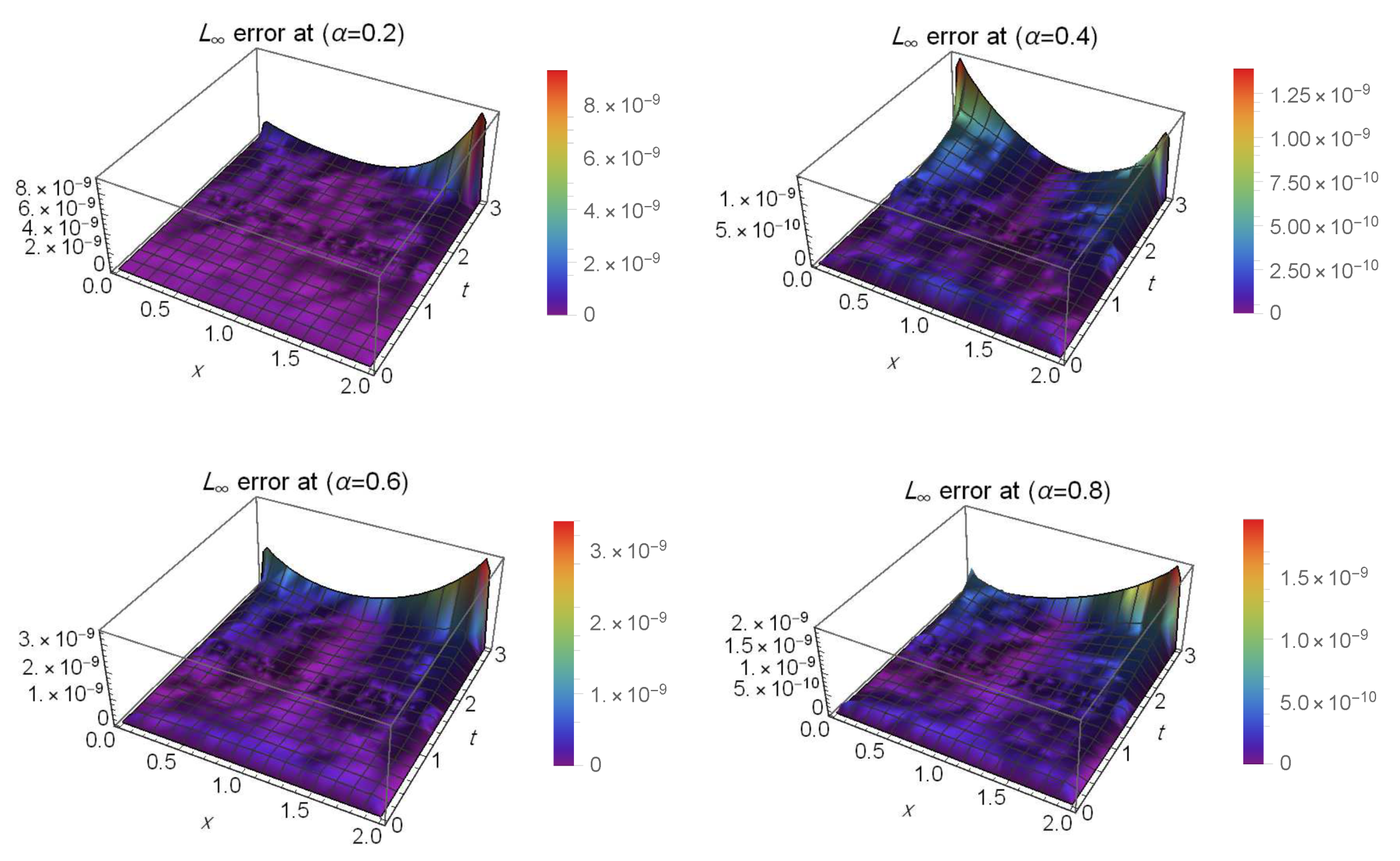
Table 3 presents the CPU time and a comparison of the errors between our proposed method and the method in [5] at . It can be found that the obtained results of the presented method are more accurate than the method in [5]. Moreover, Figure 2 sketches the error for different values of α at when and . This figure show that the numerical and exact solutions are almost identical. In Table 4. we list the absolute error for at when and . As can be seen, the proposed method presents better accuracy.
Table 3.
The errors for Example 2.
Figure 2.
The error for Example 2.
Table 4.
The absolute errors for Example 2.
Example 3.
Consider the FRSE of the form
where
along with the following initial and boundary conditions:
The exact solution of this problem is
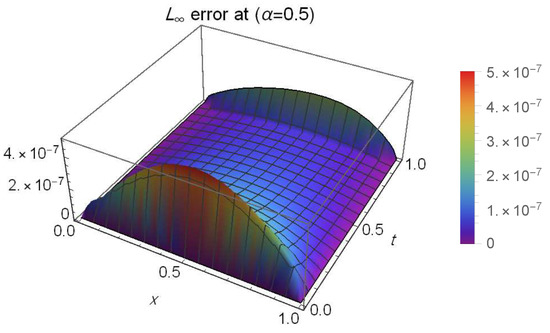
In Table 5, the absolute errors for the case corresponding to , and are displayed. This table confirms that the presented method has high performance and produces accurate results. In addition, Figure 3 illustrates the error for at . The results show good agreement between the approximate solution and the exact one.
Table 5.
The absolute errors for Example 3.
Figure 3.
Th error for Example 3.
6. Concluding Remarks
The nonlinear FRSE was treated numerically by applying the spectral Galerkin method using some polynomials related to shifted sixth-kind Chebyshev polynomials as basis functions. The proposed problem is reduced to a nonlinear system of algebraic equations that can be solved using Newton’s iterative method. The resulting approximate solutions using the suggested method are extremely close to the exact ones, indicating that our proposed algorithm can efficiently solve the problem. To demonstrate the validity and enormous potential of the algorithm, comparisons are performed between our proposed approximate solutions and those developed by other methods in the literature. In this paper, Wolfram Mathematica 11.2 was used for all calculations. In future work, we think that the theoretical results in this paper will be useful for other types of differential equations. In addition, we think that we can derive other derivative formulas for some polynomials related to Chebyshev polynomials of the sixth kind, in order to handle types of fractional differential equations that involve terms of other high-order derivatives.
Author Contributions
Formal analysis, Y.H.Y.; Investigation, A.G.A.; Methodology, W.M.A.-E. and Y.H.Y.; Software, A.G.A. and Y.H.Y.; Supervision, G.M.M. and Y.H.Y.; Validation, W.M.A.-E.; Writing—original draft, A.G.A.; Writing—review & editing, W.M.A.-E. All authors contributed to the preparation of the paper. All authors have read and agreed to the submitted version of the manuscript.
Funding
The authors received no funding for this study.
Institutional Review Board Statement
Not applicable.
Informed Consent Statement
Not applicable.
Data Availability Statement
Not applicable.
Conflicts of Interest
The authors declare no conflict of interest.
Appendix A. Proofs of Theorem 3 and 4
Proof of Theorem 3:
Proof.
From (7), we have
By virtue of Theorem 1, one obtains
Based on the recurrence relation (3), we can write
The last formula after expanding and rearranging terms leads to the following formula:
and the coefficients are given by
This finalizes the theorem’s proof. □
Proof of Theorem 4:
References
- Fetecu, C.; Fetecu, C. The Rayleigh–Stokes problem for heated second grade fluids. Int. J. Non-Linear Mech. 2002, 37, 1011–1015. [Google Scholar] [CrossRef]
- Shen, F.; Tan, W.; Zhao, Y.; Masuoka, T. The Rayleigh–Stokes problem for a heated generalized second grade fluid with fractional derivative model. Nonlinear Anal. Real World Appl. 2006, 7, 1072–1080. [Google Scholar] [CrossRef]
- Abelman, S.; Hayat, T.; Momoniat, E. On the Rayleigh problem for a Sisko fluid in a rotating frame. Appl. Math. Comput. 2009, 215, 2515–2520. [Google Scholar] [CrossRef]
- Gabriele, A.; Spyropoulos, F.; Norton, I.T. Kinetic study of fluid gel formation and viscoelastic response with kappa-carrageenan. Food Hydrocoll. 2009, 23, 2054–2061. [Google Scholar] [CrossRef]
- Guan, Z.; Wang, X.; Ouyang, J. An improved finite difference/finite element method for the fractional Rayleigh–Stokes problem with a nonlinear source term. J. Appl. Math. Comput. 2021, 65, 451–479. [Google Scholar] [CrossRef]
- Dehghan, M.; Abbaszadeh, M. A finite element method for the numerical solution of Rayleigh–Stokes problem for a heated generalized second grade fluid with fractional derivatives. Eng. Comput. 2017, 33, 587–605. [Google Scholar] [CrossRef]
- Nikan, O.; Golbabai, A.; Machado, J.A.T.; Nikazad, T. Numerical solution of the fractional Rayleigh–Stokes model arising in a heated generalized second-grade fluid. Eng. Comput. 2021, 37, 1751–1764. [Google Scholar] [CrossRef]
- Hafez, R.M.; Zaky, M.A.; Abdelkawy, M.A. Jacobi spectral Galerkin method for distributed-order fractional Rayleigh–Stokes problem for a generalized second grade fluid. Front. Phys. 2020, 7, 240. [Google Scholar] [CrossRef]
- Zaky, M.A. An improved tau method for the multi-dimensional fractional Rayleigh–Stokes problem for a heated generalized second grade fluid. Comput. Math. Appl. 2018, 75, 2243–2258. [Google Scholar] [CrossRef]
- Xue, C.; Nie, J. Exact solutions of the Rayleigh–Stokes problem for a heated generalized second grade fluid in a porous half-space. Appl. Math. Model. 2009, 33, 524–531. [Google Scholar] [CrossRef]
- Chen, C.; Liu, F.; Anh, V. Numerical analysis of the Rayleigh–Stokes problem for a heated generalized second grade fluid with fractional derivatives. Appl. Math. Comput. 2008, 204, 340–351. [Google Scholar] [CrossRef] [Green Version]
- Abd-Elhameed, W.M.; Doha, E.H.; Youssri, Y.H.; Bassuony, M.A. New Tchebyshev-Galerkin operational matrix method for solving linear and nonlinear hyperbolic telegraph type equations. Numer. Methods Partial Differ. Equ. 2016, 32, 1553–1571. [Google Scholar] [CrossRef]
- Zhou, F.; Xu, X. The third kind Chebyshev wavelets collocation method for solving the time-fractional convection diffusion equations with variable coefficients. Appl. Math. Comput. 2016, 280, 11–29. [Google Scholar] [CrossRef]
- Doha, E.H.; Abd-Elhameed, W.M.; Bassuony, M.A. On the coefficients of differentiated expansions and derivatives of Chebyshev polynomials of the third and fourth kinds. Acta Math. Sci. 2015, 35, 326–338. [Google Scholar] [CrossRef]
- Masjed-Jamei, M. Some New Classes of Orthogonal Polynomials and Special Functions: A Symmetric Generalization of Sturm-Liouville Problems and Its Consequences. Ph.D. Thesis, University of Kassel, Department of Mathematics, Kassel, Germany, 2006. [Google Scholar]
- Xu, Y. An integral formula for generalized Gegenbauer polynomials and Jacobi polynomials. Adv. Appl. Math. 2002, 29, 328–343. [Google Scholar] [CrossRef] [Green Version]
- Draux, A.; Sadik, M.; Moalla, B. Markov—Bernstein inequalities for generalized Gegenbauer weight. Appl. Numer. Math. 2011, 61, 1301–1321. [Google Scholar] [CrossRef]
- Xu, X.; Xiong, L.; Zhou, F. Solving fractional optimal control problems with inequality constraints by a new kind of Chebyshev wavelets method. J. Comput. Sci. 2021, 54, 101412. [Google Scholar] [CrossRef]
- Babaei, A.; Jafari, H.; Banihashemi, S. Numerical solution of variable order fractional nonlinear quadratic integro-differential equations based on the sixth-kind Chebyshev collocation method. J. Comput. Appl. Math. 2020, 377, 112908. [Google Scholar] [CrossRef]
- Jafari, H.; Babaei, A.; Banihashemi, S. A novel approach for solving an inverse reaction–diffusion–convection problem. J. Optim. Theory Appl. 2019, 183, 688–704. [Google Scholar] [CrossRef]
- Abd-Elhameed, W.M.; Youssri, Y.H. Sixth-kind Chebyshev spectral approach for solving fractional differential equations. Int. J. Nonlinear Sci. Numer. Simul. 2019, 20, 191–203. [Google Scholar] [CrossRef]
- Abd-Elhameed, W.M. Novel expressions for the derivatives of sixth kind Chebyshev polynomials: Spectral solution of the non-linear one-dimensional Burgers’ equation. Fractal Fract. 2021, 5, 53. [Google Scholar] [CrossRef]
- Sadri, K.; Aminikhah, H. A new efficient algorithm based on fifth-kind Chebyshev polynomials for solving multi-term variable-order time-fractional diffusion-wave equation. Int. J. Comput. Math. 2022, 99, 966–992. [Google Scholar] [CrossRef]
- Abd-Elhameed, W.M.; Youssri, Y.H. Fifth-kind orthonormal Chebyshev polynomial solutions for fractional differential equations. Comput. Appl. Math. 2018, 37, 2897–2921. [Google Scholar] [CrossRef]
- Atta, A.G.; Moatimid, G.M.; Youssri, Y.H. Generalized Fibonacci operational tau algorithm for fractional Bagley-Torvik equation. Prog. Fract. Differ. Appl. 2020, 6, 215–224. [Google Scholar]
- Faghih, A.; Mokhtary, P. An efficient formulation of Chebyshev tau method for constant coefficients systems of multi-order FDEs. J. Sci. Comput. 2020, 82, 6. [Google Scholar] [CrossRef]
- Atta, A.G.; Abd-Elhameed, W.M.; Moatimid, G.M.; Youssri, Y.H. Shifted fifth-kind Chebyshev Galerkin treatment for linear hyperbolic first-order partial differential equations. Appl. Numer. Math. 2021, 167, 237–256. [Google Scholar] [CrossRef]
- Podlubny, I. Fractional Differential Equations: An Introduction to Fractional Derivatives, Fractional Differential Equations, to Methods of Their Solution and Some of Their Applications; Academic Press: San Diego, CA, USA, 1999. [Google Scholar]
- Atta, A.G.; Abd-Elhameed, W.M.; Moatimid, G.M.; Youssri, Y.H. Advanced shifted sixth-kind Chebyshev tau approach for solving linear one-dimensional hyperbolic telegraph type problem. Math. Sci. 2022. [Google Scholar] [CrossRef]
- Stewart, J. Single Variable Essential Calculus: Early Transcendentals; Cengage Learning: Boston, MA, USA, 2012. [Google Scholar]
Publisher’s Note: MDPI stays neutral with regard to jurisdictional claims in published maps and institutional affiliations. |
© 2022 by the authors. Licensee MDPI, Basel, Switzerland. This article is an open access article distributed under the terms and conditions of the Creative Commons Attribution (CC BY) license (https://creativecommons.org/licenses/by/4.0/).