


Abstract
An edge labeling of a graph G is a bijection f from to a set of integers. For a vertex u in G, the induced vertex sum of u, denoted by , is defined as . Graph G is said to be antimagic if it has an edge labeling g such that and for any pair with . A linear forest is a union of disjoint paths of orders greater than one. Let denote a linear forest consisting of m disjoint copies of path . It is known that is antimagic if and only if . In this study, we add a disjoint path () to and develop a necessary condition and a sufficient condition whereby the new linear forest may be antimagic.
Keywords:
edge labeling; antimagic labeling; antimagic graph; disconnected antimagic graph; linear forest MSC:
05C78
1. Introduction and Preliminaries
An edge labeling of a graph G is a bijection f from to a set of integers. For a vertex u in G, the induced vertex sum of u, denoted by , is defined as . Graph G is said to be antimagic if it has an edge labeling g such that and for any pair with . Such an edge labeling g is called an antimagic labeling of G. Hartsfield and Ringel introduced antimagic graphs in 1990 [1]. They showed that paths , cycles , wheels, and complete graphs are antimagic. Moreover, they have the following conjecture. Conjecture A: All connected graphs, except for , are antimagic. Although many types of connected graphs have been verified to be antimagic in recent decades [1,2,3,4,5,6,7,8,9,10,11,12,13,14], Conjecture A remains open. As an extension, we study the antimagicness of disconnected graphs. We now list several known results as follows. For , a star is a complete bipartite graph . Let denote the union of disjoint graphs A and B, and the union of m disjoint copies of graph G. Wang et al. [15] proved that , , , and are antimagic for , and is antimagic for and . A star forest is a union of disjoint stars. It is obvious that any star forest containing as its component is not antimagic. Ref. [15] shows that a star forest is antimagic if and only if . An -free star forest is a star forest without any star as its component. Shang et al. [16] proved that an -free star forest containing at most one as its component is antimagic. In addition, they added a star to and proved that the star forest is antimagic if and only if . Chen et al. [17] used a different labeling method to show that is antimagic if and only if . These two results are equivalent as if and only if for . Chen et al. also proposed a necessary condition and a sufficient condition for a star forest to be antimagic. In addition, they showed that a star forest with an extra disjoint path is antimagic. A linear forest is a union of disjoint paths of orders greater than one. A -free linear forest is a linear forest without any path as its component. Shang [18] showed that -free linear forests are antimagic. Furthermore, Shang [19] achieved a progressive result showing that -free linear forests are antimagic. As is isomorphic to , it is seen that is antimagic if and only if . A graph G is said to be k-shifted antimagic () if it has an edge labeling f such that and for any pair with . From the definition we see that an antimagic graph is 0-shifted antimagic. Graph G is called absolutely antimagic if it is k-shifted antimagic for any . Recently, Dhananjaya and Li [20] extended the results in [16,18] showing that -free star forests and -free linear forests are absolutely antimagic. Moreover, they proved that the odd tree forests are absolutely antimagic.
Since any graph containing as component is not antimagic, and [19] shows that -free linear forests are antimagic, the following problem is naturally raising: How many disjoint paths can be added to a -free linear forest such that the extended new linear forest is still antimagic? This problem might not be very easy to answer. Hence, this study begins with the following smaller topic: For a non-antimagic linear forest (), we add a longer path () to it and investigate the antimagicness of . In the following section, we will develop a necessary condition and a sufficient condition whereby the linear forest may be antimagic.
2. Conditions for () to Be Antimagic
It is known that the linear forest is antimagic if and only if [15]. However, with an extra path added to (), the linear forest may be antimagic. In [18], it was conjectured that if is antimagic then . This conjecture is correct, and in the following we prove a necessary condition for the linear forest to be antimagic.
Theorem 1.
For , if the linear forest is antimagic, then .
Proof.
We first let be an antimagic labeling of . It is observed that in there are edges whose both ends are vertices of degree two. Now suppose that these edges receive labels under labeling f, where . Next, we designate the vertices of degree two in as . We now evaluate the summation of the vertex sums . It is evident that
Next, let . It is evident that . Now, let be the i-th least number in the set , for . Since all vertices have distinct vertex sums under the antimagic labeling f, we have for . That is, . Then,
, for , and
, for .
Hence,
As , according to (1) and (2), we have
Then, we have
□
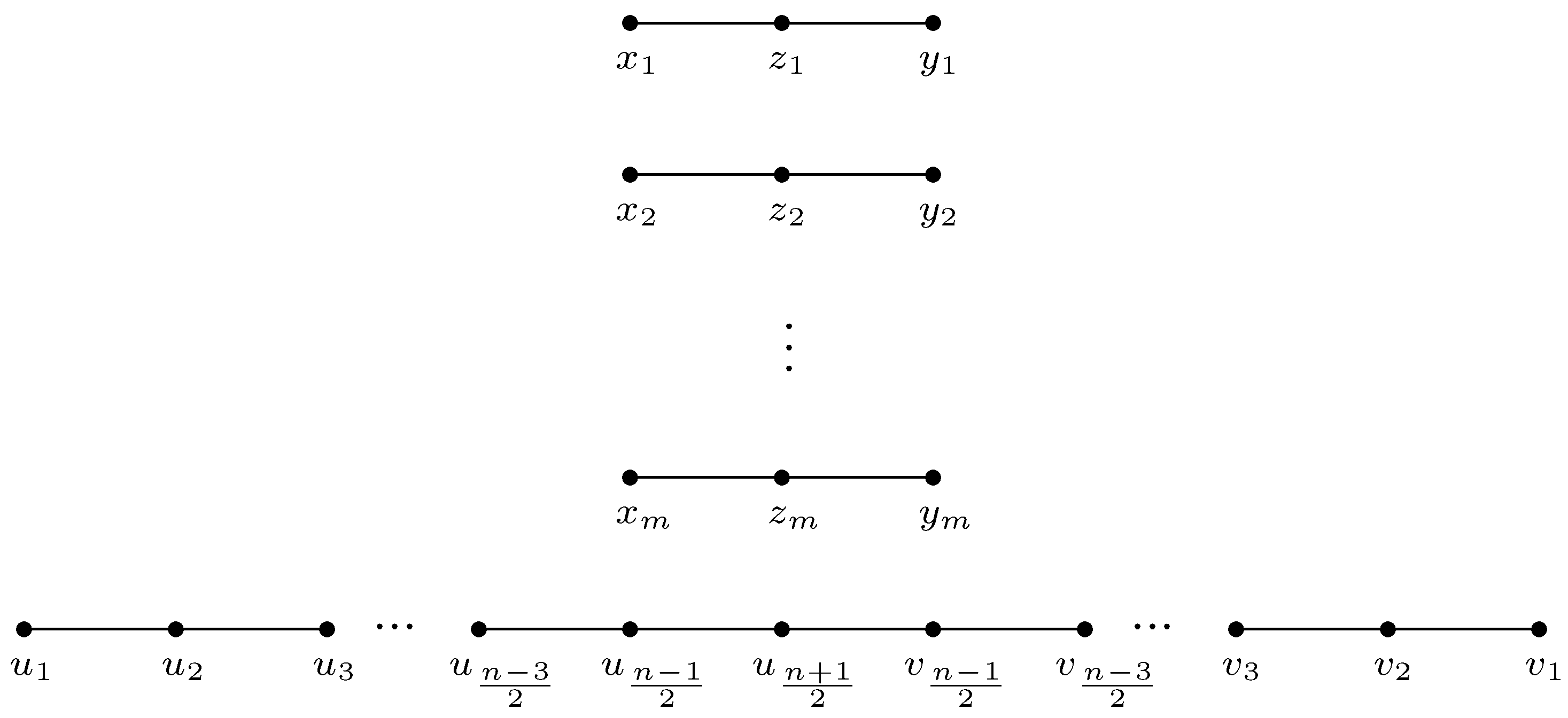
To develop a sufficient condition for to be antimagic, we now designate the vertices in as follows: The i-th copy of the path in is denoted by ; the path is denoted by
The following Figure 1 shows the case where has an odd order n.
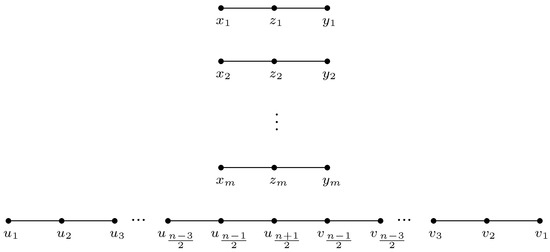
Figure 1.
Notations for vertices in with an odd integer .
For the linear forest , where and , we define a function f on as follows:
We see that
and
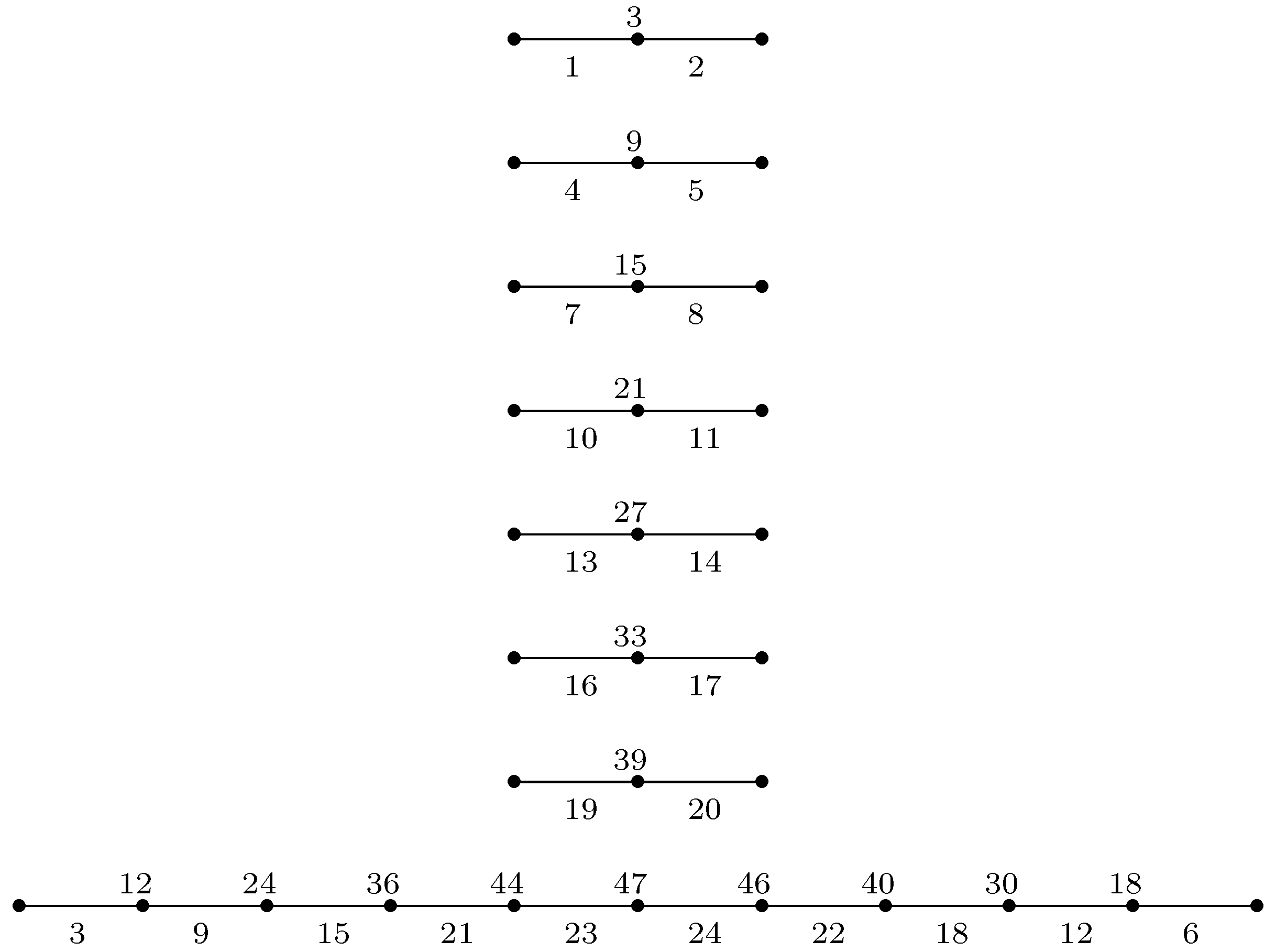
That is, is an edge labeling of . From the labeling f the following is observed: , , , and . And if except for . This labeling strategy helps vertices of obtaining distinct vertex sums with an only exception. As an example, for the linear forest , Figure 2 shows the edge labels and vertex sums under f. We note that the number beside an edge is the label of this edge, and the number above a vertex is the induced vertex sum of this vertex.
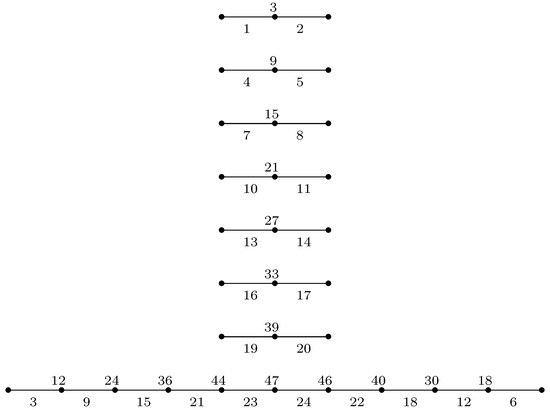
Figure 2.
Edge labels and vertex sums of under edge labeling f.
In Figure 2, we see that the induced vertex sums of all vertices in are almost distinct, except for . Therefore, we have the following lemma.
Lemma 1.
Suppose that f is the aforementioned edge labeling of the linear forest , where and . Then, for any pair of distinct vertices x and y in , we have , except for .
Proof.
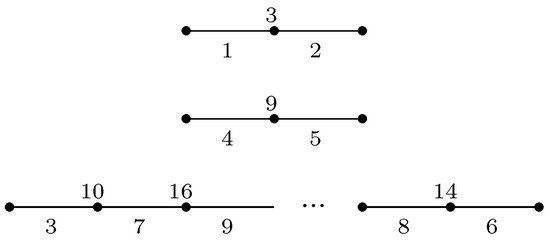
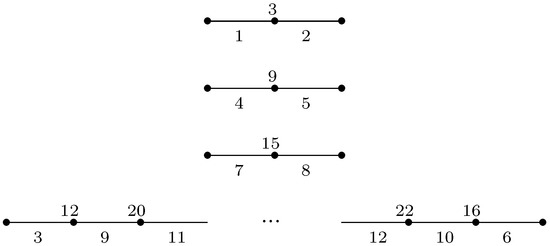
We first consider the case of . According to the definition of f, we have the following.
- (i)
- .
- (ii)
- , , , , and .
- (iii)
- , . That is, , and .
- (iv)
- For , we have and . That is, for , . In addition, for , , we see that . Then, we have . Further, it is evident that . And if n is odd.
Now, let , , and . We see that A, B, and C are subsets of , and . According to (ii)∼(iv) above, it can be seen that are distinct for all , and are distinct for all . To show that this lemma holds, it suffices to show that . We distinguish the following two subcases: m is odd and m is even.
Subcase 1: m is odd. We evaluate , and . . , and , and . It can be seen that are the two greatest numbers in the set , and are the two least numbers in the set . As , we have .
Subcase 2: m is even. We evaluate and . , and . It can be seen that is the greatest number in , and is the least number in . As , we have .
From the two subcases we see that . Thus the lemma holds for the case of .
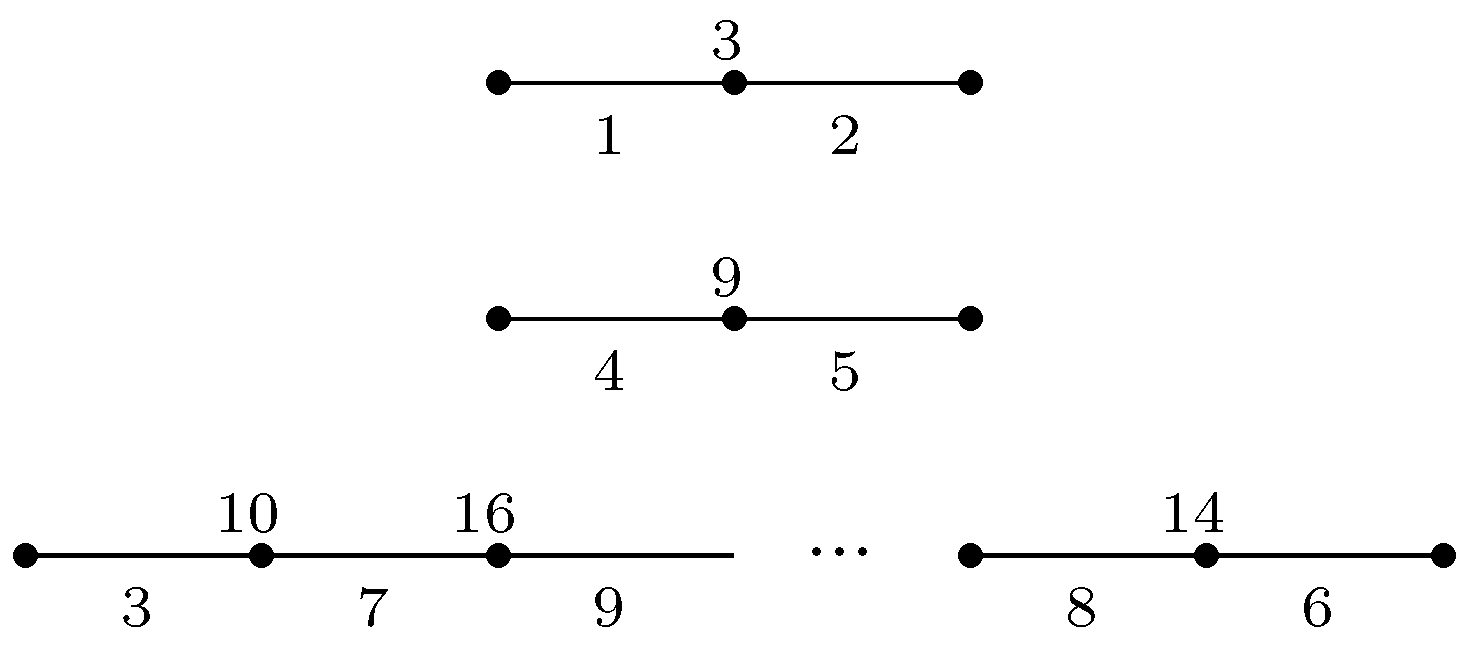
Figure 3.
Vertices in () have distinct vertex sums, except for .
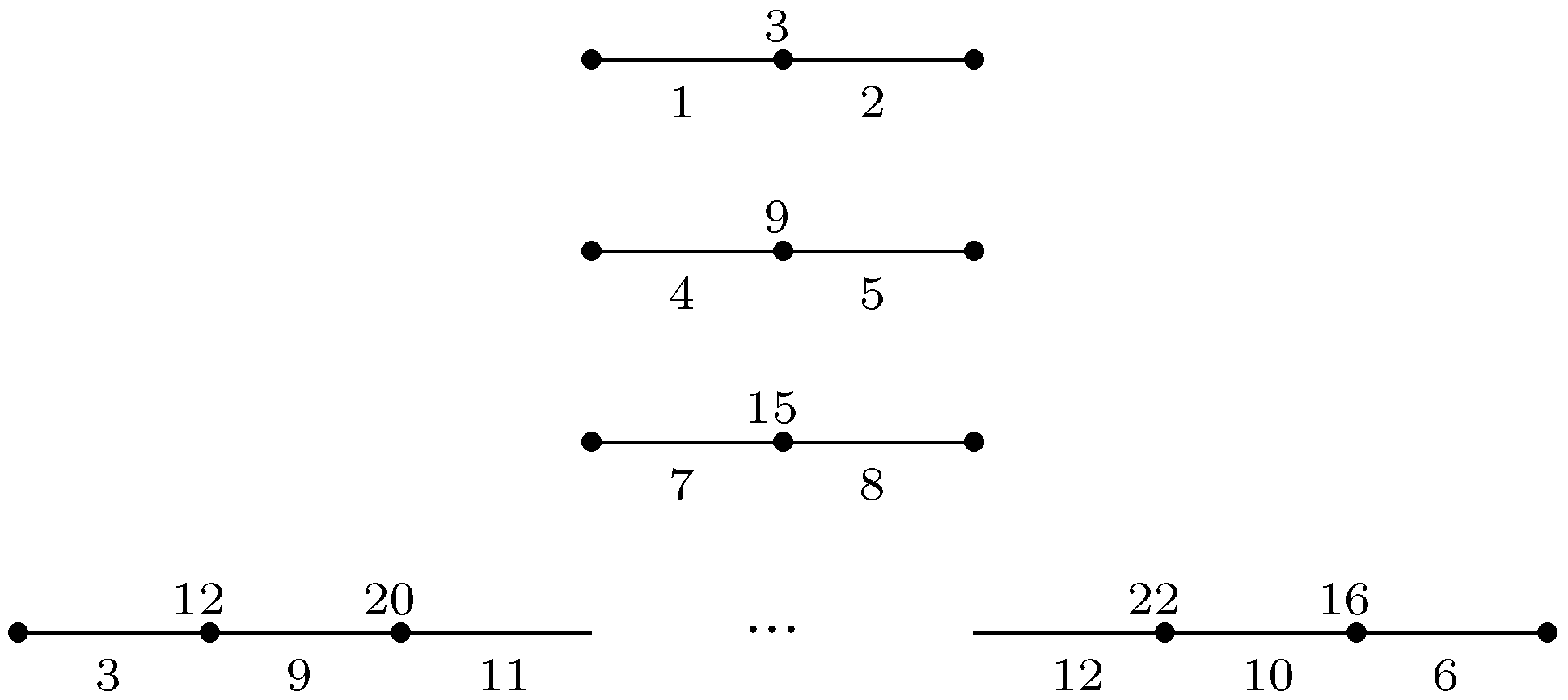
Figure 4.
Vertices in () have distinct vertex sums, except for .
The proof for this part is simple, we leave it to the readers. □
In the following lemma, we modify the labeling f stated in Lemma 1 to obtain an antimagic labeling for the linear forest , where and .
Lemma 2.
For and , linear forest is antimagic.
Proof.
Let f be the edge labeling of which is defined as in Lemma 1. Recall that is the path . We distinguish the two cases and , where .
Case 1. and . In this case, we see that . Now, we define a function on as
Evidently, is an edge labeling of , and for all . Let , and . According to Lemma 1, are distinct for all . Now, we evaluate for all . Note that and , or if . Then, , , , and (or ) . It is observed that are distinct for all . To show that are distinct for all , it suffices to show that . Firstly, we divide Q into two parts, A and B, where and . We now claim that . From the proof of Lemma 1, it can be seen that the values , , , and are the greatest numbers in congruent to 1, 2, 4, and 5 modulo 6, respectively. As and , and , and , and and , we have . Next, we claim that . Evidently, is the least number in , and is the greatest number in . As when , we have . Thus, .
Case 2. and . In this case, we see that and . Now, we define a function on as
Evidently, is an edge labeling of , and for all . Let , and . According to Lemma 1, are distinct for all . Now, we evaluate for all . Note that and , or if . Then, , , , and (or . It is observed that are distinct for all . To show that are distinct for all , it suffices to show that . Firstly, we divide Q into two parts, A and B, where and . We now claim that . From the proof of Lemma 1, it can be seen that the values , , , and are the greatest numbers in congruent to 1, 2, 4, and 5 modulo 6, respectively. As and , and , and , and and , we have . Next, we claim that . Evidently, is the least number in , and is the greatest number in . As when , we have . Thus, .
The above two cases show that the linear forest has an antimagic labeling. Hence, is antimagic. □
The following lemma shows that the linear forest () also has an antimagic labeling.
Lemma 3.
For , linear forest is antimagic.
Proof.
Let f be the edge labeling of which is defined as in Lemma 1. We distinguish the two cases and , where .
Case 1. . In this case, is the path . Now, we define a function on as
Evidently, is an edge labeling of , and for all . Let , and . According to Lemma 1, are distinct for all . Now, we evaluate for all . We see that , , , , , , and . It is observed that are distinct for all . To show that are distinct for all , it suffices to show that . From the proof of Lemma 1, it can be seen that the values , , , , and are the greatest numbers in congruent to 1, 2, 4, 5, and 0 modulo 6, respectively. As and , and , and , and , and and , we have .
Case 2. . In this case, is the path . Now, we define a function on as
Evidently, is an edge labeling of , and for all . It is observed that if , is an antimagic labeling of . In the following, we consider the case of . Let , and . According to Lemma 1, are distinct for all . Now, we evaluate for all . We see that , , , , , and . It is observed that are distinct for all . To show that are distinct for all , it suffices to show that . From the proof of Lemma 1, it can be seen that the values , , , , and are the greatest numbers in congruent to 1, 2, 4, 5, and 0 modulo 6, respectively. As and , and , and , and , and and , we have .
The above two cases show that the linear forest has an antimagic labeling. Thus, is antimagic. □
According to Lemmas 2 and 3, we have the following theorem.
Theorem 2.
For and , linear forest is antimagic.
3. Conclusions
Theorem 2 states that linear forest is antimagic for and . According to Theorem 1 for if is antimagic then . It is seen that there is a gap between and . We would like to know if the upper bound for m in Theorem 2 can be raised. To conclude this study, the following problems are proposed. The first one is previously mentioned in Section 1.
Problem 1.
How many disjoint paths can be added to a -free linear forest such that the extended new linear forest is still antimagic?
Problem 2.
What are the necessary and sufficient conditions for linear forest to be antimagic?
Author Contributions
Conceptualization, J.-L.S. and F.-H.C.; Funding acquisition, J.-L.S.; Methodology, J.-L.S. and F.-H.C.; Writing—original draft, J.-L.S. and F.-H.C.; Writing—review & editing, J.-L.S. All authors have read and agreed to the published version of the manuscript.
Funding
This research was funded by the Ministry of Science and Technology of R.O.C. with grant number MOST 108-2115-M-424-001.
Conflicts of Interest
The authors declare no conflict of interest.
References
- Hartsfield, N.; Ringel, G. Pearls in Graph Theory: A Comprehensive Introduction; Academic Press: Boston, MA, USA, 1990. [Google Scholar]
- Alon, N.; Kaplan, G.; Lev, A.; Roditty, Y.; Yuster, R. Dense graphs are antimagic. J. Graph Theory 2004, 47, 297–309. [Google Scholar] [CrossRef]
- Chang, F.; Liang, Y.-C.; Pan, Z.; Zhu, X. Antimagic labeling of regular graphs. J. Graph Theory 2016, 82, 339–349. [Google Scholar] [CrossRef]
- Cheng, Y. Lattice grids and prisms are antimagic. Theor. Comput. Sci. 2007, 374, 66–73. [Google Scholar] [CrossRef]
- Cheng, Y. A new class of antimagic Cartesian product graphs. Discret. Math. 2008, 308, 6441–6448. [Google Scholar] [CrossRef]
- Cranston, D.W. Regular bipartite graphs are antimagic. J. Graph Theory 2009, 60, 173–182. [Google Scholar] [CrossRef]
- Cranston, D.W.; Liang, Y.-C.; Zhu, X. Regular graphs of odd degree are antimagic. J. Graph Theory 2015, 80, 28–33. [Google Scholar] [CrossRef]
- Kaplan, G.; Lev, A.; Roditty, Y. On zero-sum partitions and anti-magic trees. Discret. Math. 2009, 309, 2010–2014. [Google Scholar] [CrossRef]
- Lee, M.-J.; Lin, C.; Tsai, W.-H. On antimagic labeling for power of cycles. Ars Comb. 2011, 98, 161–165. [Google Scholar]
- Liang, Y.-C.; Wong, T.-L.; Zhu, X. Anti-magic labeling of trees. Discret. Math. 2014, 331, 9–14. [Google Scholar] [CrossRef]
- Liang, Y.-C.; Zhu, X. Anti-magic labelling of Cartesian product of graphs. Theor. Comput. Sci. 2013, 477, 1–5. [Google Scholar] [CrossRef]
- Liang, Y.-C.; Zhu, X. Antimagic labeling of cubic graphs. J. Graph Theory 2014, 75, 31–36. [Google Scholar] [CrossRef]
- Wang, T.-M.; Hsiao, C.-C. On anti-magic labeling for graph products. Discret. Math. 2008, 308, 3624–3633. [Google Scholar] [CrossRef]
- Zhang, Y.; Sun, X. The antimagicness of the Cartesian product of graphs. Theor. Comput. Sci. 2009, 410, 727–735. [Google Scholar] [CrossRef]
- Wang, T.-M.; Liu, M.-J.; Li, D.-M. Some classes of disconnected antimagic graphs and their joins. Wuhan Univ. J. Nat. Sci. 2012, 17, 195–199. [Google Scholar] [CrossRef]
- Shang, J.-L.; Lin, C.; Liaw, S.-C. On the antimagic labeling of star forests. Util. Math. 2015, 97, 373–385. [Google Scholar]
- Chen, Z.-C.; Huang, K.-C.; Lin, C.; Shang, J.-L.; Lee, M.-J. Antimagicness of star forests. Util. Math. 2020, 114, 283–294. [Google Scholar]
- Shang, J.-L. P2, P3, P4-free linear forests are antimagic. Util. Math. 2016, 101, 13–22. [Google Scholar]
- Shang, J.-L. Antimagic labeling of linear forests. Util. Math. 2018, 106, 23–37. [Google Scholar]
- Dhananjaya, E.; Li, W.-T. Antimagic labeling of forests with sets of consecutive integers. Discret. Appl. Math. 2022, 309, 75–84. [Google Scholar] [CrossRef]
Publisher’s Note: MDPI stays neutral with regard to jurisdictional claims in published maps and institutional affiliations. |
© 2022 by the authors. Licensee MDPI, Basel, Switzerland. This article is an open access article distributed under the terms and conditions of the Creative Commons Attribution (CC BY) license (https://creativecommons.org/licenses/by/4.0/).