


Abstract
A connected graph is k-extendable for a positive integer k if every matching M of size k can be extended to a perfect matching. The extendability number of is the maximum k such that is k-extendable. In this paper, we prove that Cayley graphs generated by transposition trees on are -extendable and determine that the extendability number is for an integer .
MSC:
05C25; 05C70
1. Introduction
Cayley graphs on a group and a generating set have been an important class of graphs in the study of interconnection networks for parallel and distributed computing [1,2,3,4,5,6]. Some recent results about topological properties and routing problems on the networks based on Cayley graphs on the symmetric groups with the set of transpositions as the generating sets, including two special classes, the star graphs [5] and bubble-sort graphs [1], can be found in [6,7,8,9].
Throughout this paper, we consider finite, simple connected graph. Let be a graph with vertex set and edge set . A graph H is a subgraph of if and . The induced subgraph is the subgraph of with vertex set C and edge set . Let G be a group, S a subset of G such that the identity element does not belong to S and , where . The Cayley graph , denoted by , is the graph whose vertex set and are adjacent if and only if . It’s known that is connected if and only if S is a generating set of G. Furthermore, obviously, all Cayley graphs are vertex-transitive (see [10]).
We denote as the symmetric group on n letters (set of all permutations on ). Now let us restrict S to be a subset of transpositions on . Clearly all Cayley graphs are -regular bipartite graphs. The transposition generating graph of S, denoted by , is the graph with vertex set and two vertices s and t are adjacent if and only if the transposition is in S. If is a tree, it is called transposition trees.
An edge set is called a of if no two of them share an end-vertex. Moreover, a matching of is said to be if it covers all vertices of . A connected graph having at least vertices is said to be k-extendable, introduced by Plummer [11], if each matching M of k edges is contained in a perfect matching of . Any k-extendable graph is -extendable, but the converse is not true [11]. The extendability number of , denoted by , is the maximum k such that is k-extendable. Plummer [11,12] studied the relationship between n-extendability and other graph properties. For more research results related to matching extendability, one can refer to [13,14,15,16,17]. Yu et al. [18] classified the 2-extendable Cayley graphs of finite abelian groups. Chen et al. [19] classified the 2-extendable Cayley graphs of dihedral groups. Recently, Gao et al. [20] characterize the 2-extendable quasi-abelian Cayley graphs. Their research is focused on 2-extendability of some Cayley graphs; in this paper, we focus on the general extendability, i.e., -extendability of Cayley graphs generated by transposition trees.
2. Preliminaries
In this section, we shall give some definitions and known results which will be used in this paper.
Denote by the group of all permutations on . Obviously, . For convenience, we use to denote the permutation (see [21]); to denote the permutation , which is called a transposition. Obviously, . The identity permutation is denoted by . A permutation of is said to be even (resp. odd) if it can be written as a product of an even (resp. odd) number of transpositions. Let S be a subset of transpositions. Clearly, the Cayley graph is a bipartite graph with one partite set containing the vertices corresponding to odd permutations and the other partite set containing the vertices corresponding to even permutations.
To better describe a transposition set S as the generating set, we use a simple way to depict S via a graph. The transposition generating graph is the graph with vertex set and two vertices s and t are adjacent if and only if . If is a tree, it is called transposition trees, we denote by the set of Cayley graphs generated by transposition trees. For any graph , is adjacent to if and only if for , , and for , that is . In this case, we say that the edge is an -edge and denote , which is the edge e corresponding to transposition. Let . Obviously, for every transposition , is a perfect matching of . We have the following propositions about Cayley graphs generated by transpositions:
Proposition 1
([10], p. 52). Let be a Cayley graph generated by transpositions. Then, Γ is connected if and only if is connected.
Proposition 2
([22]). Let S and be two sets of transpositions on . Then, and are isomorphic if and only if and are isomorphic.
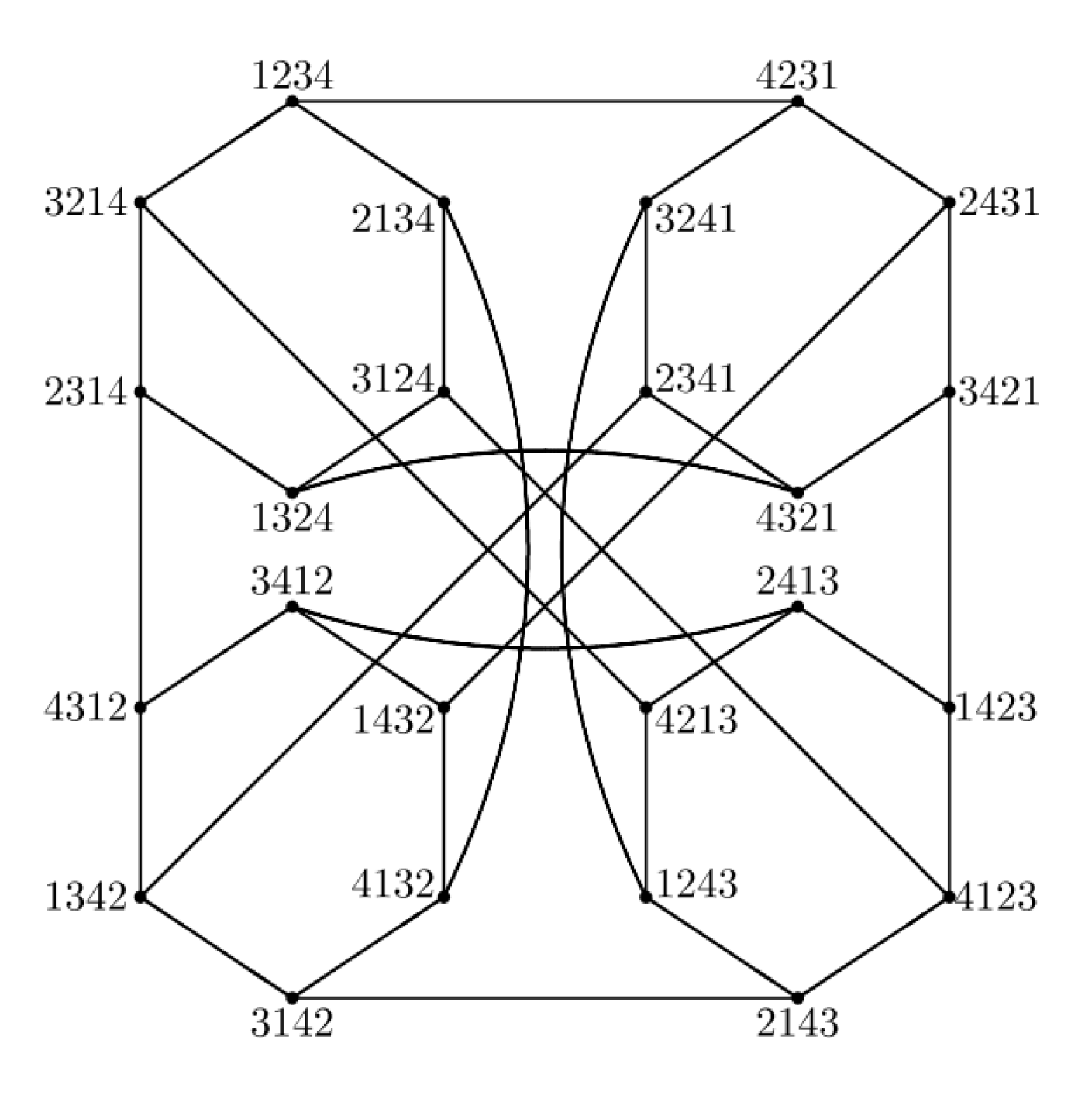
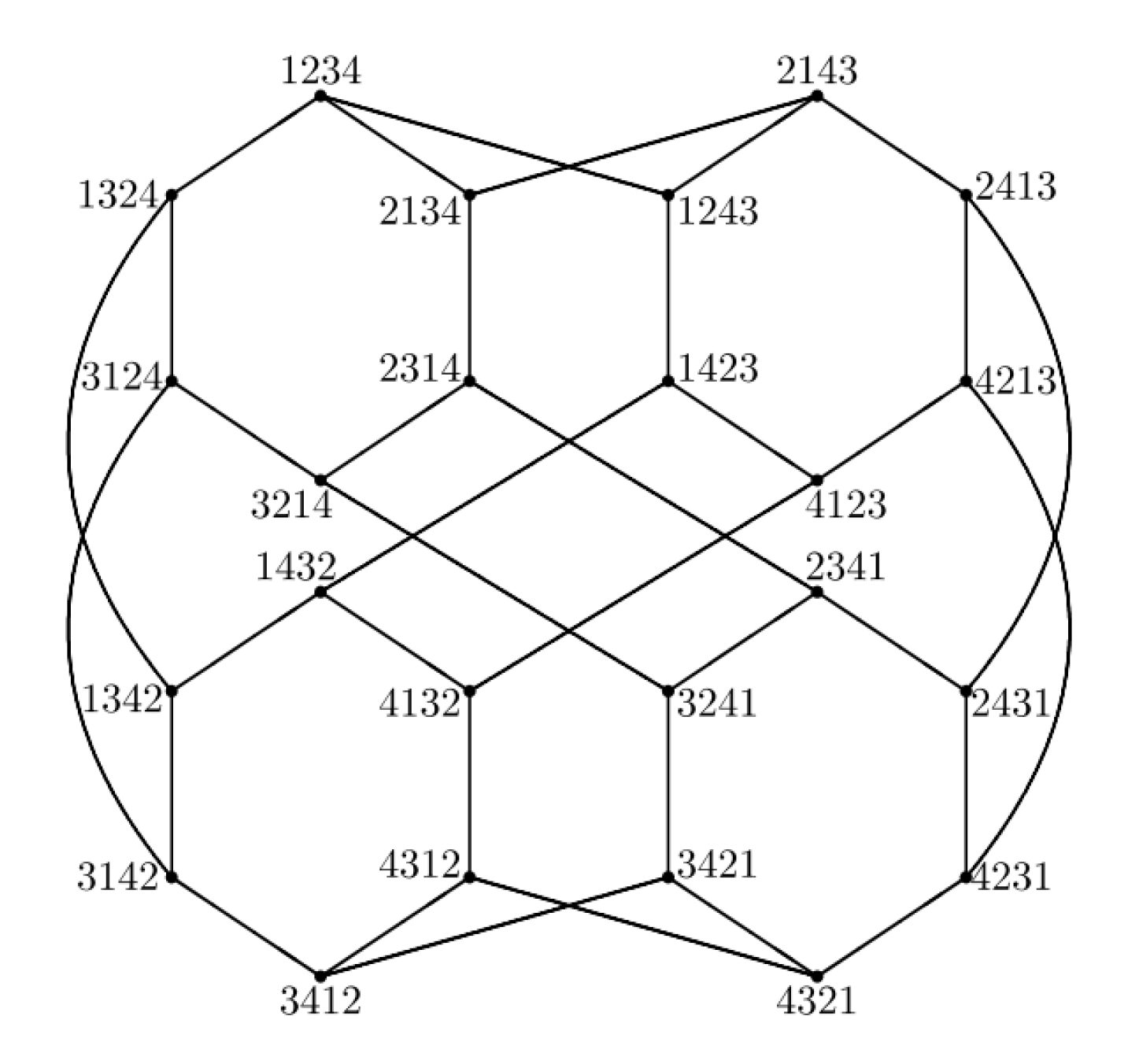
In all Cayley graphs , there are two classes which are most important, when is isomorphic to the star and the path . If , is called n-dimensional star graph and denoted by . If , is called n-dimensional bubble-sort graph and denoted by . The star graph and the bubble-sort graph are illustrated in Figure 1 and Figure 2 for the case n = 4. Both and are connected bipartite -regular graph of order . When , ; , up to isomorphism, there are exactly two different graphs and (see [23]).
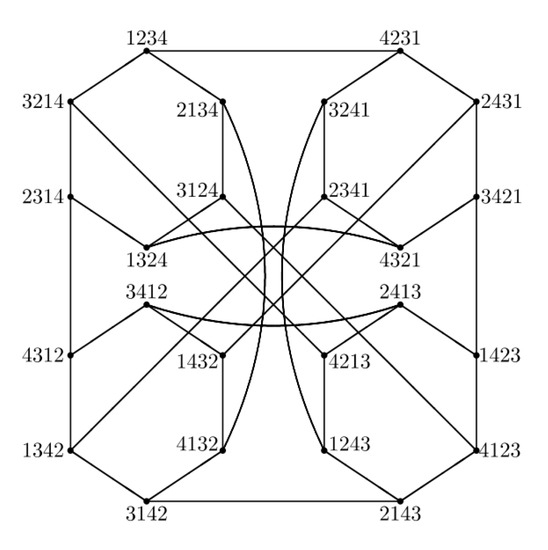
Figure 1.
The star graph .
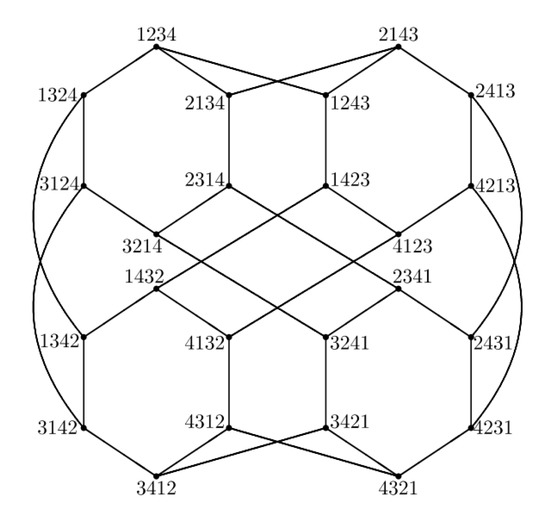
Figure 2.
The Bubble-sort graph .
Let be a vertex of . We say that is the i-th coordinate of , denoted by . It is easy to see that the Cayley graph has the following proposition:
Proposition 3
([23,24]). Let be a transposition tree of order n, j one of its leaf and the subgraph of induced by those vertices with . Then, consists of n vertex-disjoint subgraphs: ; each isomorphic to another Cayley graph with , where τ is the transposition corresponding to the edge incident to the leaf j.
Readers can refer to [10,21] for the terminology and notation not defined in this paper.
3. Main Results
First, we will give some useful lemmas.
The Cartesian product of graphs and is a graph with vertex set . Two vertices and are adjacent in if either and or and . Clearly .
Lemma 1.
Let T be a labeled tree of order n, e any edge of T, and , two components of , where . Furthermore, let S (, , , respectively) be the transposition set on satisfying (, , . Then, has components and each component is isomorphic to .
Proof.
Without loss of generality, we can assume .
When , is an isolated vertex, e is a pendant edge and . Then, . The lemma is true, following from Proposition 3.
When , we relabel T as follows: Relabel the vertices of as and the vertices of as . Let , , , be the corresponding transposition sets. Obviously, . By Proposition 2, we know that , , and so on. Thus, we only need to prove the corresponding result on , , and . Since is disconnected, is also disconnected by Proposition 1. Let be the component of containing the identity element . Since and are connected, generates and generates (let be symmetric group on ). Then, the vertices in can be represented as , where is a permutation on and is a permutation on . Furthermore, let and be two vertices in . Then, and are adjacent if and only if for and , , and for other digits, or, for and , , and for other digits. Thus, and . Since is vertex-transitive, all components of are isomorphic and there exist components in it. □
We need to consider the extendability of the Cartesian product when we investigate the extendability of . The following lemmas are used several times in the proof of our theorem.
Lemma 2
([25,26]). If Γ is a k-extendable graph, then is -extendable.
Lemma 3
([25]). If and are k-extendable and l-extendable graphs, respectively, then their Cartesian product is -extendable.
Lemma 4
([27]). A bipartite Cayley graph is 2-extendable if and only if it is not a cycle.
In order to prove the main result, we need other definitions and notations. The symmetric difference of two sets A and B is defined as the set . Let be a connected graph. If , denote and .
Let be a permutation of . The smallest positive integer k for which is the identity permutation, this number k is called the order of , denoted by . denotes the set of points in fixed by (see [10]). Let . As we know, there is another way of writing the permutation as products of disjoint cycles which are commutative (see [21]). For example, if , , then , and further We say that is a type of permutation. Clearly and .
Theorem 1.
Any Cayley graph is -extendable for any integer .
Proof.
We prove the theorem by induction on n. For , the is 6-cycle, which is 1-extendable. For , the is a 3-regular bipartite Cayley graph, which is not a cycle. is 2-extendable by Lemma 4.
Now we assume the statement is true for all integers smaller than . Let S be a subset of transpositions on . The transposition generating graph is a tree. We will show that any matching M of size can be extended to a perfect matching of .
Let M be a matching with edges. There are classes of edges in because of . We may suppose that . Let . By Lemma 1, has connected components and each component is isomorphic to . We may assume by the symmetry of Cartesian product. For the convenience, we denote the components of by , where .
Claim 1.
is -extendable.
If , the transposition corresponding to the edge is a leaf of , by Proposition 3, where , is -extendable by the inductive hypothesis.
If , , . is -extendable by the inductive hypothesis. is -extendable by Lemma 2.
If , by the inductive hypothesis is -extendable and is -extendable. Hence, is -extendable by Lemma 3. We get the Claim.
Let . If , then . When , each edge set can be extended to a perfect matching of , which is defined by . Clearly, . When , let be an arbitrary perfect matching of . Then, is a perfect matching of , which is also a perfect matching of .
When , without loss of generality, we assume that and contains the identity permutation . If M can be extended to a perfect matching of , we are done. Suppose that M cannot be extended to a perfect matching of . Let be an edge in M. can be extended to a perfect matching of (since ), which is denoted by . Let , , , and . By the transitivity of and without loss of generality, we can assume that . Let , , and , , , where . It is easy to see , , , is an odd permutation and is an even permutation. The cardinality of can only be 2, 4, 5 and 6. We discuss these four cases one by one in order to prove that M can be extended to a perfect matching of .
Case 1. .
In this case, is a transposition and . There are two subcases for the order of .
Subcase 1.1. is a type of permutation.
We have , . Note that , where . Hence, there is an 8-cycle . The vertex . We may take a perfect matching of such that and because of . Now we take . Clearly , is a perfect matching of subgraph . Let be a perfect matching of . Hence, is a perfect matching of .
Subcase 1.2. is a type of permutation.
We have , . Note that , where . Hence, there is a 12-cycle . The vertex . We may take a perfect matching of such that and because of . Now we take . Clearly , is a perfect matching of subgraph . Let be a perfect matching of . Hence, is a perfect matching of .
Case 2. .
In this case, is a type of permutation and . There are two subcases.
Subcase 2.1. is a type of permutation.
We have , . Note that , where . Hence, there is a 16-cycle . The vertex . We may take a perfect matching of such that and because of . Now we take . Clearly , is a perfect matching of subgraph . Let be a perfect matching of . Hence, is a perfect matching of .
Subcase 2.2. is a type of permutation.
We have , . Note that , where . Hence, there is a 20-cycle . The vertex . We may take a perfect matching of such that and because of . Now we take . Clearly , is a perfect matching of subgraph . Let be a perfect matching of . Hence, is a perfect matching of .
Case 3. .
In this case, is a type of permutation and . There are four subcases.
Subcase 3.1. is a type of permutation.
We have , . There is a 12-cycle in subgraph , where for . The rest of the proof is similar to Subcase 1.2.
Subcase 3.2. is a type of permutation.
We have , . There is a 16-cycle in subgraph , where for . The rest of the proof is similar to Subcase 2.1.
Subcase 3.3. is a type of permutation.
We have , . There is a 20-cycle in subgraph , where for . The rest of the proof is similar to Subcase 2.2.
Subcase 3.4. is a type of permutation.
We have , and , . , where . Hence, there is a 24-cycle . The vertex . We may take a perfect matching of such that and because of . Now we take . Clearly, , is a perfect matching of subgraph . Let be a perfect matching of . Hence, is a perfect matching of .
Case 4. .
In this case, is a type of permutation and . There are three subcases.
Subcase 4.1. is a type of permutation.
We have . There is an 8-cycle in subgraph , where for . The rest of the proof is similar to Subcase 1.1.
Subcase 4.2. is a type of permutation.
We have . There is a 16-cycle in subgraph , where for . The rest of the proof is similar to Subcase 2.1.
Subcase 4.3. is a type of permutation.
We have . There is a 24-cycle in subgraph , where for . The rest of the proof is similar to Subcase 3.4.
In conclusion, any matching M of size can be extended to a perfect matching of . The proof is complete. □
The extendability number of , denoted by , is the maximum k such that is k-extendable. As we know that is an -regular bipartite Cayley graph and not -extendable. We can obtain the extendability number of by Theorem 1.
Corollary 1.
for .
4. Concluding Remarks
In this paper, we prove that Cayley graph generated by transposition trees on is -extendable and determine that the extendability number is , which enriches the results on the extendability of Cayley graphs. Here, the transposition generating graph of S is a tree. A natural problem is whether we can generalize transposition trees to general connected graphs which is worth of further investigation. We present a conjecture.
Conjecture 1.
Let S be a transposition generating set of the symmetric group . Then, the Cayley graph is -extendable.
Author Contributions
Methodology: Y.F. and S.X.; writing—original draft preparation:Y.F. and Y.X.; writing—review and editing: Y.F., Y.X., F.L. and S.X. All authors have read and agreed to the published version of the manuscript.
Funding
This work was supported by the National Natural Science Foundation of China (No. 11571155, No. 11961067, No. 12071194).
Informed Consent Statement
Not applicable.
Acknowledgments
Many thanks to the anonymous referees for their helpful comments and suggestions.
Conflicts of Interest
The authors declare no conflict of interest.
References
- Akers, S.B.; Krishnamurthy, B. A group-theoretic model for symmetric interconnection networks. IEEE Trans. Comput. 1989, 38, 555–566. [Google Scholar] [CrossRef]
- Cooperman, G.; Finkelstein, L. New methods for using Cayley graphs in interconnection networks. Discret. Appl. Math. 1992, 37/38, 95–118. [Google Scholar] [CrossRef]
- Heydemann, M.C. Cayley graphs and interconnection networks. In Graph Symmetry; Hahn, G., Sabidussi, G., Eds.; NATO ASI Series, Series C; Kluwer: Dordrecht, The Netherlands, 1997; Volume 497, pp. 167–224. [Google Scholar]
- Jwo, J.S.; Lakshmivarahan, S.; Dhall, S.K. A new class of interconnection networks based on the alternating group. Networks 1993, 23, 315–326. [Google Scholar] [CrossRef]
- Lakshmivarahan, S.; Jwo, J.S.; Dhall, S.K. Symmetry in interconnection networks based on Cayley graphs of permutation groups: A survey. Parallel Comput. 1993, 19, 361–407. [Google Scholar] [CrossRef]
- Xu, L.; Zhou, S.; Yang, W. Component connectivity of Cayley graphs generated by transposition trees. Int. J. Parallel Emergent Distrib. Syst. 2020, 35, 103–110. [Google Scholar] [CrossRef]
- Chang, N.; Cheng, E.; Hsieh, S. Conditional diagnosability of cayley graphs generated by transposition trees under the PMC model. ACM Tran. Design Autom. Electron. Syst. 2015, 20, 1–16. [Google Scholar] [CrossRef]
- Wang, M.; Guo, Y.; Wang, S. The 1-good-neighbour diagnosability of cayley graphs generated by transposition trees under the PMC model and MM* model. Int. J. Comput. Math. 2016, 94, 620–631. [Google Scholar] [CrossRef]
- Zhao, S.L.; Chang, J.M.; Hao, R.X. Reliability assessment of the Caylay graph generated by trees. Discret. Appl. Math. 2020, 287, 10–14. [Google Scholar] [CrossRef]
- Godsil, C.; Royle, G. Algebraic Graph Theory; Graduate Texts in Mathematics; Springer: New York, NY, USA, 2001; Volume 207. [Google Scholar]
- Plummer, M.D. On n-extendable graphs. Discret. Math. 1980, 31, 201–210. [Google Scholar] [CrossRef] [Green Version]
- Plummer, M.D. Matching extension and the genus of a graph. J. Comb. Theory Ser. B 1988, 44, 329–337. [Google Scholar] [CrossRef] [Green Version]
- Cioabǎ, S.M.; Koolen, J.H.; Li, W. Max-cut and extendability of matchings in distance-regular graphs. Eur. J. Comb. 2017, 62, 232–244. [Google Scholar] [CrossRef] [Green Version]
- Hackfeld, J.; Koster, A.M.C.A. The matching extension problem in general graphs is co-NP-complete. J. Comb. Optim. 2018, 35, 853–859. [Google Scholar] [CrossRef]
- Zhang, W. Matching Extendability and Connectivity of Regular Graphs from Eigenvalues. Graphs Comb. 2020, 36, 93–108. [Google Scholar] [CrossRef]
- Aldred, R.E.L.; Plummer, M.D. Matching extension in prism graphs. Discret. Appl. Math. 2017, 221, 25–32. [Google Scholar] [CrossRef]
- Aldred, R.E.L.; Plummer, M.D. Extendability and Criticality in Matching Theory. Graphs Comb. 2020, 36, 573–589. [Google Scholar] [CrossRef]
- Chan, O.; Chen, C.C.; Yu, Q.L. On 2-extendable abelian Cayley graphs. Discret. Math. 1995, 146, 19–32. [Google Scholar] [CrossRef] [Green Version]
- Chen, C.C.; Liu, J.; Yu, Q.L. On the classification of 2-extendable Cayley graphs on dihedral groups. Australas. J. Comb. 1992, 6, 209–219. [Google Scholar]
- Gao, X.; Li, Q.L.; Wang, J.W.; Wang, W.Z. On 2-Extendable Quasi-abelian Cayley Graphs. Bull. Malays. Math. Sci. Soc. 2016, 39, 43–57. [Google Scholar] [CrossRef]
- Bóna, M. A Walk through Combinatorics: An Introduction to Enumeration and Graph Theory; World Scientific Publishing Co. Inc.: Singapore, 2011. [Google Scholar]
- Delorme, C. Isomorphism of Transposition Graphs; L.R.I., Orsay: Gif-sur-Yvette, France, 1997. [Google Scholar]
- Cheng, E.; Lipták, L. Linearly many faults in Cayley graphs generated by transposition trees. Inf. Sci. 2007, 177, 4877–4882. [Google Scholar] [CrossRef]
- Lin, C.K.; Tan, J.M.; Hsu, L.H.; Cheng, E.; Lipták, L. Conditional diagnosability of Cayley graphs generated by transposition trees under the comparison diagnosis model. J. Interconnect. Netw. 2008, 9, 83–97. [Google Scholar] [CrossRef]
- Györi, E.; Plummer, M.D. The cartesian product of a k-extendable and an l-extendable graph is (k+l+1)-extendable. Discret. Math. 1992, 101, 87–96. [Google Scholar] [CrossRef] [Green Version]
- Liu, J.; Yu, Q.L. Matching extensions and products of graphs: In Quo Vadis, Graph Theory?—A Source Book for Challenges and Directions; John Gimbel, J.W.K., Quintas, L.V., Eds.; Elsevier: Amsterdam, The Netherlands, 1993; Volume 55, pp. 191–200. [Google Scholar]
- Li, Q.L.; Gao, X. Classification of 2-extendable bipartite and cubic non-bipartite vertex-transitive graphs. arXiv. 2016.
Publisher’s Note: MDPI stays neutral with regard to jurisdictional claims in published maps and institutional affiliations. |
© 2022 by the authors. Licensee MDPI, Basel, Switzerland. This article is an open access article distributed under the terms and conditions of the Creative Commons Attribution (CC BY) license (https://creativecommons.org/licenses/by/4.0/).