Abstract
The g-extra connectivity is a very important index to evaluate the fault tolerance, reliability of interconnection networks. Let g be a non-negative integer, G be a connected graph with vertex set V and edge set E, a subset is called a g-extra cut of G if the graph induced by the set is disconnected and each component of has at least vertices. The g-extra connectivity of G, denoted as , is the cardinality of the minimum g-extra cut of G. Mycielski introduced a graph transformation to discover chromatic numbers of triangle-free graphs that can be arbitrarily large. This transformation converts a graph G into a new compound graph called , also known as the Mycielskian graph of G. In this paper, we study the relationship on g-extra connectivity between the Mycielskian graph and the graph G. In addition, we show that for , and prove the bounds of for .
MSC:
05C40; 05C76
1. Introduction
With the rise and swift progress of high-performance parallel computer technology, there is increasing focus on interconnection networks that exhibit strong performance. A well-designed topological structure offers significant benefits in enhancing reliability. When designing the network’s topological structure, fault tolerance is a fundamental consideration. This means that the interconnection network should be able to operate effectively even when certain nodes and edges fail, ensuring that it retains specific network properties. Moreover, the topological structure of an interconnection network can be modeled as an undirected graph , where every vertex of V corresponds to a processor, and each edge of E corresponds to a communication link. Then many computer scientists and engineers use some parameters of graph theory to design and analyzing topological structures of interconnection networks, such as the connectivity. In order to design the topological structure of a network with good performance, the fault-tolerance must be considered. This means that the network should be able to function effectively even if certain nodes and edges fail, while still maintaining specific network properties. Additionally, the structure of an interconnection network can be represented as an undirected graph , where each vertex in V represents a processor, and each edge in E represents a communication link. Therefore, many computer scientists and engineers utilize various parameters from graph theory to design and analyze the topological structures of interconnection networks, including connectivity.
The connectivity is a crucial measure of fault-tolerance in an interconnection network. Generally, a higher connectivity indicates better fault-tolerance. Let , F is called a cut set of G if the graph obtained by removing F is disconnected or trivial. The connectivity of a graph G, denoted by , is the minimum number of elements of all cut set of G. A graph G is said to be k-connected if .
To analyze disconnected graphs resulting from a vertex-cut in more detail, Harary [1] proposed investigating the conditional connectivities while imposing additional constraints on the vertex-cut F and/or the component of . A notion concerning the number of vertices of each component associated with the disconnected graph was first introduced by Fábrega and Fiol [2]. Let g be a non-negative integer, be a connected graph, a subset is a g-extra cut of G if the graph induced by the set is disconnected and each component of has at least vertices. The g-extra connectivity of G, denoted as , is the cardinality of the minimum g-extra cut of G. When , we will write for short instead of . The exploration of the g-extra connectivity has achieved much progress, see [3,4,5,6,7,8,9,10,11,12,13,14,15,16,17,18,19,20].
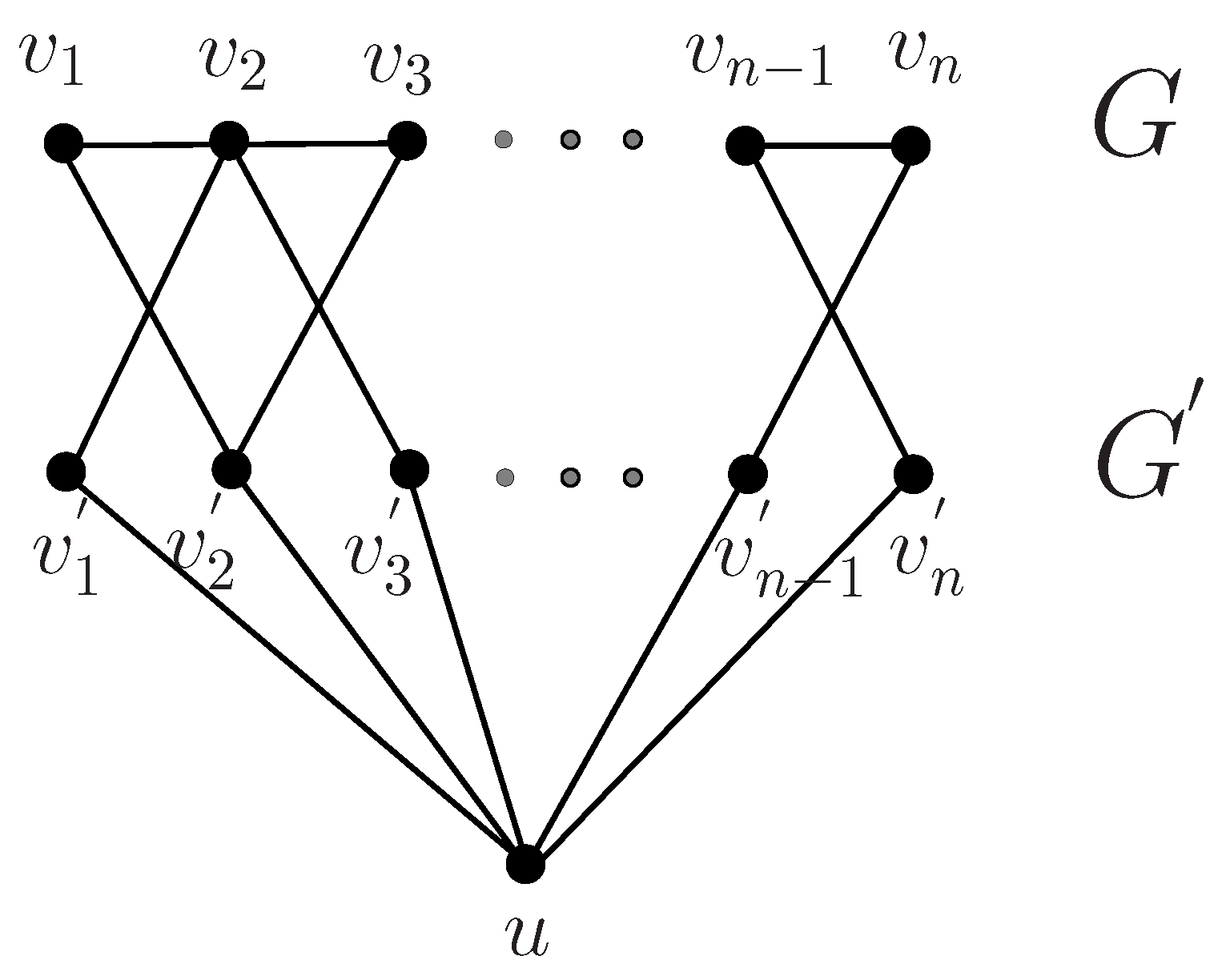
Many researchers are interested with chromatic number without small circles, see [21,22]. To search for arbitrarily large chromatic numbers of triangle-free graphs, Mycielski [23] introduced a graph transformation that converts a graph G into a new compound graph . This transformed graph is known as the Mycielskian graph of G, as depicted below. For a graph , the graph with , , where . We call the vertex is the twin of the vertex x (and x is also the twin of ). Morever, the set () is called the twin of F (and F is also the twin of ) for some . The vertex u is called as the root of . For instance, the Mycielskian graph of a path of order n is showed in Figure 1.
Figure 1.
The Mycielskian of .
Recently, Chang et al. [24] have verified that if a graph G has no isolated vertices. In 2008, Raj and Balakrishnan [25] have studied the edge-connectivity and the vertex-connectivity . In 2016, Guo and Liu [26] have shown that if G is a connected graph, then is super- if and only if , and is super- if and only if . In addition, Guo et al. [27] derived the Mycielskian graph of a digraph in terms of the vertex(arc) connectivity. Recently, the relationship between the 3-connectivity of G has been established and generalized 3-connectivity of the Mycielskian graph has been study by Li et al. [28], i.e., . Moreover, they determined the generalized 3-connectivity of the Mycielskian graph of the tree , the complete graph and the complete bipartite graph . Now, the results on some graph parameters of the Mycielskian graphs have been obtained, see [29,30,31,32,33].
In this paper, we will discuss the relationship between the g-extra connectivity of and G. In addition, we show that for , and propose the bounds of for .
2. Terminology and Notations
All graphs are simple, connected, finite and undirected in following section. For graph theoretical symbols and terminology not expounded here, we use for reference [34]. For a graph G, let V and E represent the set of vertices and the set of edges of G. Let G and H be two graphs, H is called the subgraph of G subject to , . For any vertex subset X of the graph G, the graph is the subgraph of G obtained by deleting all the vertices of X together with the edges incident with them from G. In case , we simply write instead of . For a vertex , the neighborhood of u in G, denoted by , is the set of vertices adjacent to u in G. For a subset , the neighborhood of X in G is defined as . The degree of u in G is denoted by . We also denote the minimum degree .
3. Main Results
In this section, we determine the relationship between and for .
Balakrishnan [25] have the following conclusions.
Lemma 1
([25]). If G is a connected graph, then
For a graph G, in view of the fact and Lemma 1, the relationship between and is immediately obtained for .
Theorem 1.
If G is a connected graph, then
Next, we investigate the relationship between and for .
Lemma 2.
Let F be a vertex cut of G, and be all components of .
- (1)
- If there exists some such that , then ( be the twin of F) is disconnected and the smallest component is the isolated vertex .
- (2)
- If for any , then is connected to in (where and be the twin of and F, respectively).
- (3)
- If there exists one vertex w such that and , then is disconnected and ( is the twin of w) is an isolated vertex.
Proof of Lemma 2.
(1) As there exists some such that , without loss of generality, we set . By the construction of , (see Figure 2a). Then is disconnected and is the smallest component.
- (2)
- In this situation, for any , there exists one edge . By the construction of , and (see Figure 2b). Then is connected to in .
- (3)
- In this situation, there exists one vertex w such that and . By the construction of , is the twin of w, and (see Figure 2c). Then is disconnected and is an isolated vertex.
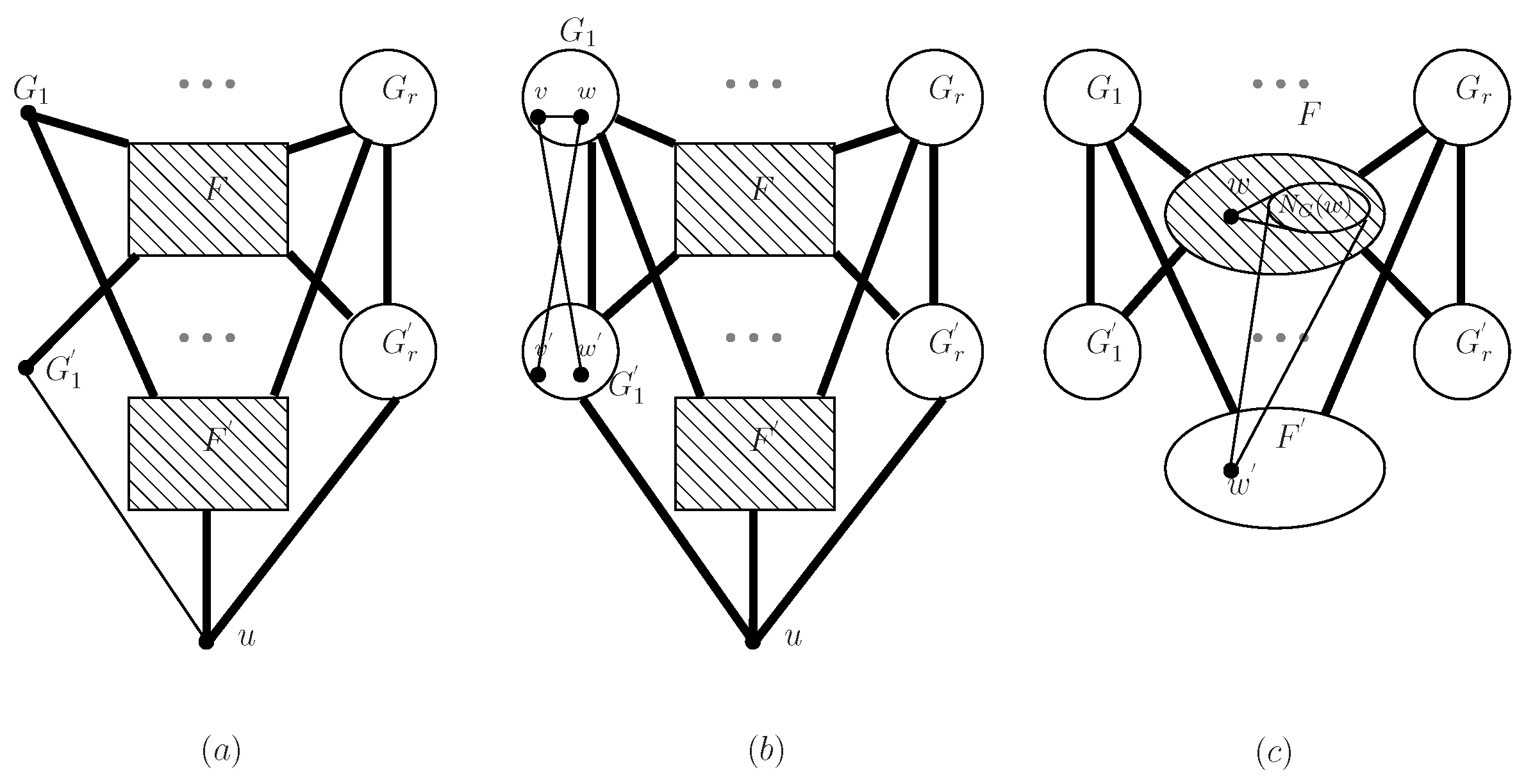
□
Figure 2.
An illustration of the proof of Lemma 2.
Figure 2.
An illustration of the proof of Lemma 2.

Theorem 2.
Let G be a connected graph with n vertices such that . Then
Proof of Theorem 2.
According to the definition of , there exists a set with such that is disconnected and each component of has at least 2 vertices. Let be the twin of F. Then (u is the root vertex of ) is disconnected and each the rest of component has at least 4 vertices. Therefore, .
Next, we show . Conversely, we assume that . Let S be a vertex set of with , we need show it is a contradiction. Without loss of generality, let , and be all components of . The following two cases will be discussed.
Case 1. .
Subcase 1.1 is connected.
Let , where and are the twins of M and A, severally. We consider the situations as follow.
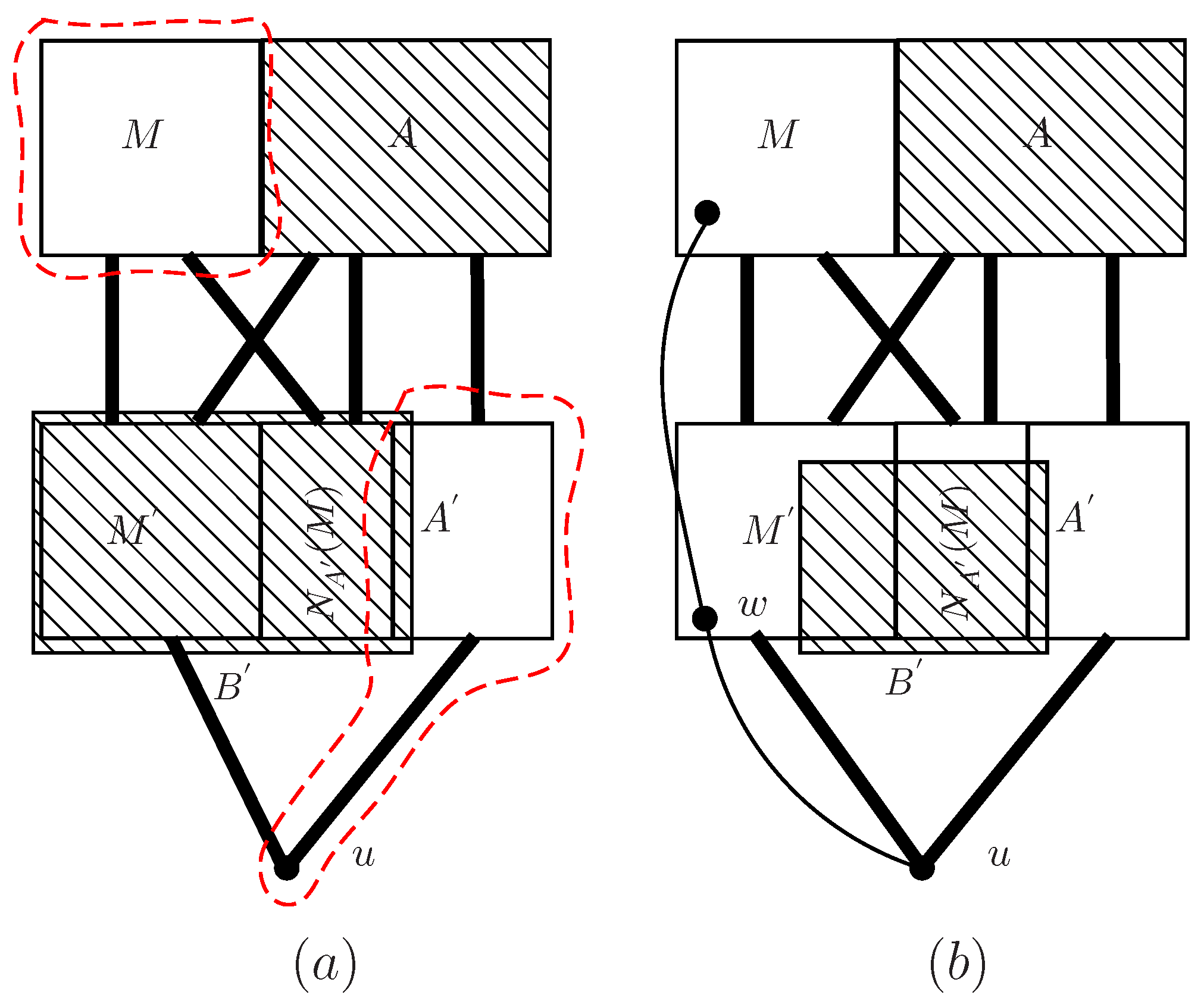
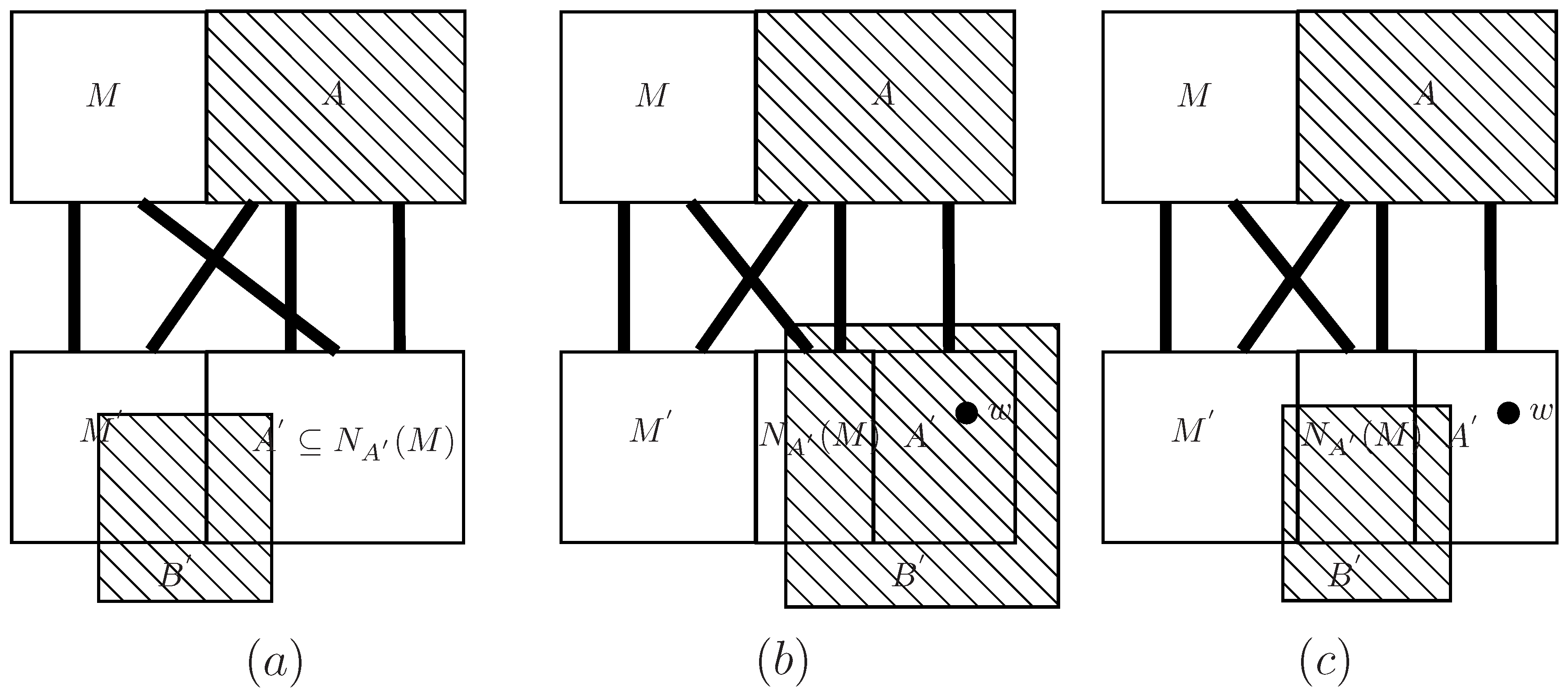
If , then is disconnected (see Figure 3a). Thus, , which contradicts with .
Figure 3.
An illustration of the proof of Subcase .
If , then there exists at least one vertex w such that and . Since the root vertex u is adjacent to all vertices of and w is connected to the connected component M, is connected (see Figure 3b), a contradiction.
Subcase 1.2 is disconnected and each component of has at least two vertices.
Clearly, , and . By Lemma 2, is connected to ( is the twin of ), and is connected to the root vertex u, then is connected, a contradiction.
Subcase 1.3 is disconnected and at least one component is an isolated vertex.
Let and . We distinguish between the following two situations.
If for some . By Lemma 2 , is an isolated vertex in , which contradicts with the definition of .
Next, we suppose that for any , then it implies connected to for any . First, we consider for some , it implies for some () in graph G, then every component of has at least two vertices (see Figure 4). So . If , then it contradicts with . If , then , which contradicts with . Second, , it implies connected to for any (). By the construction of , all components of are connected to , and is connected to the root vertex u, then is connected, a contradiction.
Figure 4.
An illustration of the proof of Subcase 1.3.
Case 2. .
Subcase 2.1 is connected.
Let .
If , then is connected (see Figure 5a), a contradiction.
Figure 5.
An illustration of the proof of Subcase 2.1.
If . By the construction of , all vertices in are connected to A. If , then is connected (see Figure 5b). If , then there exists at least one vertex w such that and . Thus, is disconnected and the smallest component is the vertex w (see Figure 5c), a contradiction.
Subcase 2.2 is disconnected and every component of has at least two vertices.
Clearly, , and .
Subcase 2.2.1 .
By Lemma 2 , we have the following fact.
Fact 1. All vertices of A are adjacent to some components of .
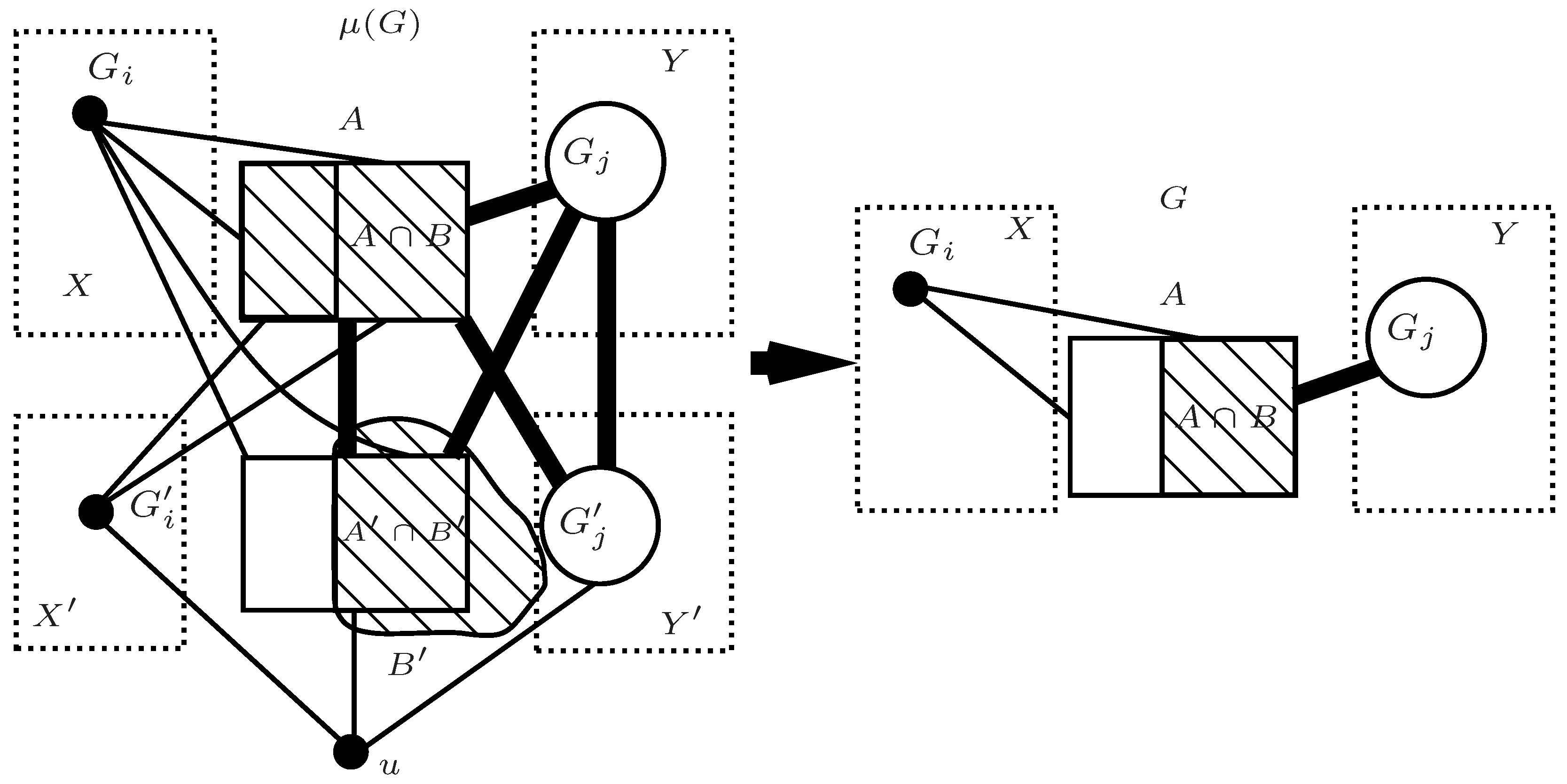
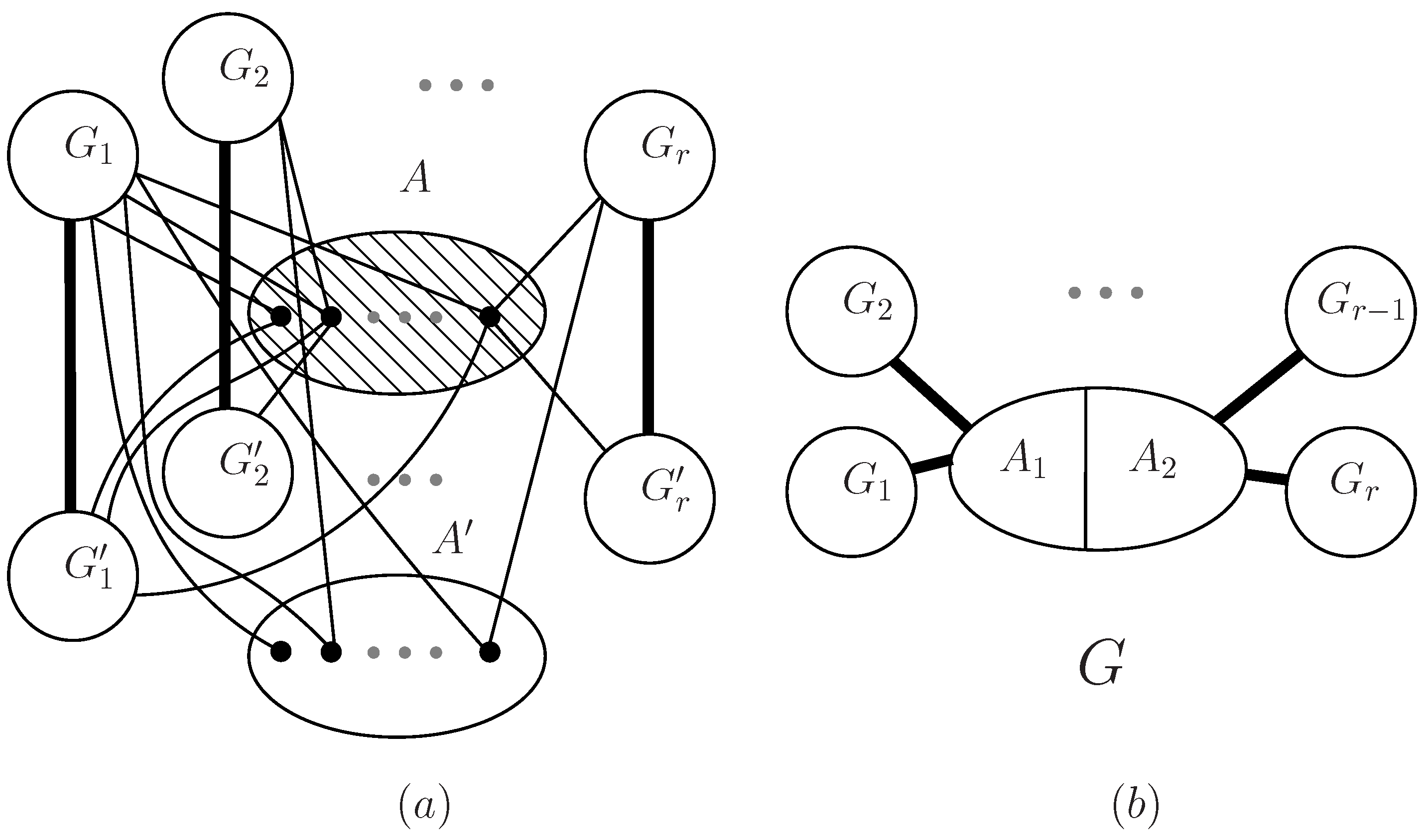
If there exists one component, say , such that , then is connected to all vertices of (see Figure 6a). By Fact 1, all vertices of are adjacent to some components of , then is connected, a contradiction.
Figure 6.
An illustration of the proof of Subcase 2.2.1.
Otherwise, for any of .
Let be some components of such that , and . If there exists the component of such that and , by the construction of , connected to and , then is connected. So, and or and or and . Then we have the following fact.
Fact 2. There exist some components of such that .
By Fact 2, we decompose the set A into and , then some components of are connected to , and the remaining components of are connected to . By the construction of G, is disconnected and each component has at least two vertices, then . By the same reason, (see Figure 6b). So, , which contradicts with .
Subcase 2.2.2 .
If there exists one component, say , such that , then , and each component of has at least two vertices in G. Clearly, , which contradicts with . Otherwise, , it implies is connected to for any . By the same reason with the Subcase (the vertex set in Subcase 2.2.2 is the same as the vertex set in Subcase ).
Subcase 2.3 is disconnected and at least one component is an isolated vertex.
Let and .
Subcase 2.3.1 .
If there exists one vertex such that and , then is disconnected and is an isolated vertex in , which contradicts with the definition of . Then we have the following fact.
Fact 3. .
If there exists one component of such that , then is connected to all vertices of . By Fact 1, all vertices of are adjacent to some components of , then is connected, a contradiction.
Otherwise, for any of .
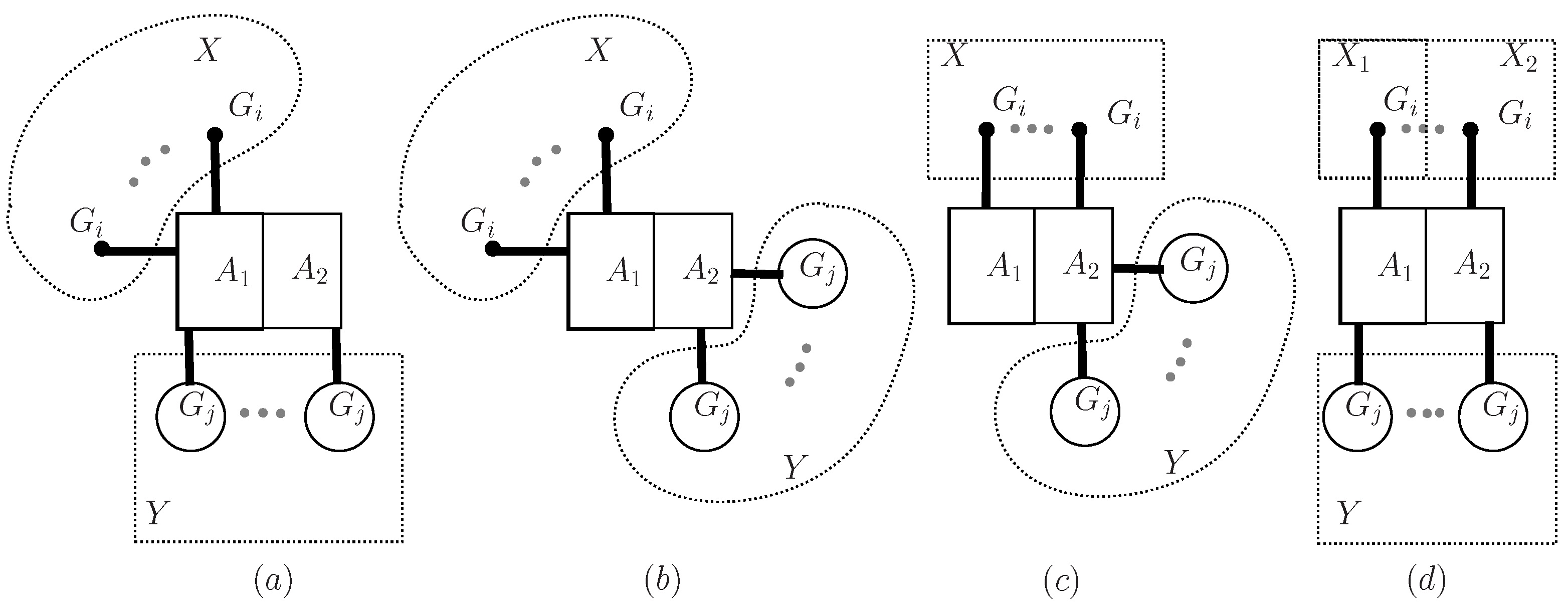
By Fact 2, we decompose the set A into and , then some components of are connected to and the remaining components of are connected to . We consider the following four situations.
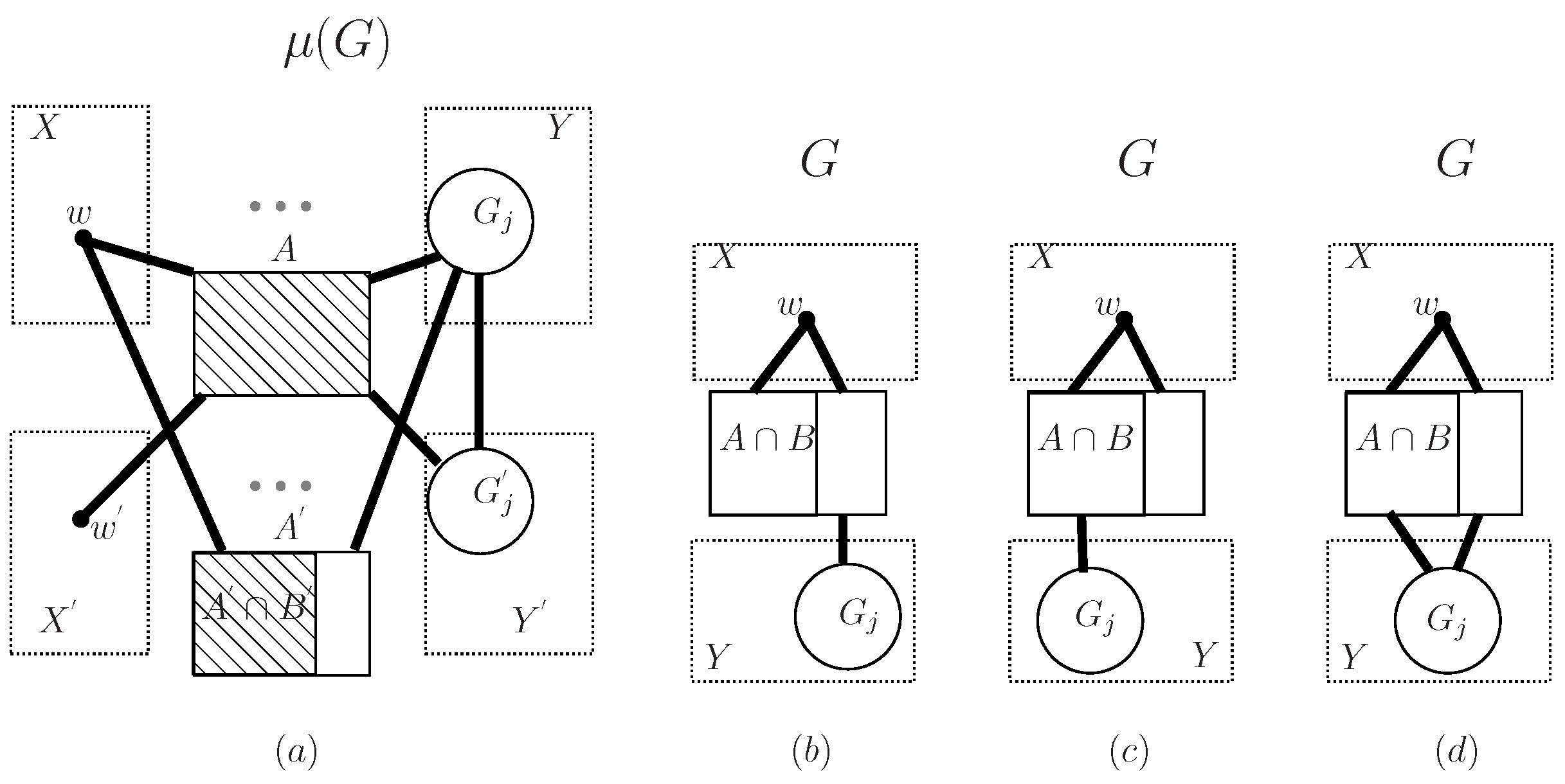
If each component and some components are connected to , and the remaining components of Y are connected to (see Figure 7a). By the construction of G, we know that is disconnected and each component of has at least two vertices, then . By the same reason, . By Facts 1 and 3,
which contradicts with .
Figure 7.
An illustration of the proof of Subcase 2.3.1.
If each component is connected to , and each component is connected to (see Figure 7b). By the same reason with the previous situation, then . If , then is disconnected and is one component of , which contradicts with the definition of . So, we have . And by Facts 1 and 3,
which contradicts with and .
If some component are connected to such that the remaining components of X are connected to , and each component in connected to (see Figure 7c). By the same reason with the previous situation. Thus, , which contradicts with and .
If some components are connected to such that the remaining components of X are connected to , and some components are connected to such that the remaining components of Y are connected to (see Figure 7d). Let and . By the construction of G, is disconnected and each component has at least two vertices, then . By the same reason, . And by Facts 1 and 3,
which contradicts with .
Subcase 2.3.2 .
If there exists one vertex w () such that , then is disconnected and w is an isolated vertex in (see Figure 8a), which contradicts the definition of .
Figure 8.
An illustration of the proof of Subcase 2.3.2.
Otherwise, we suppose that for any (), it implies connected to for any (). Next, we consider the following three situations.
If for some (), it implies for some (), then each component of has at least two vertices in G (see Figure 8b). So, . If , then it contradicts with . If , and , which contradicts with .
If for some (), it implies for some (), and so every component of has at least two vertices in G (see Figure 8c). So, . If , then it contradicts with . If , then , which contradicts with .
If and for any () (see Figure 8d). By the same reason with the Subcase (the vertex set in Subcase is the same as the vertex set in Subcase ). □
Theorem 3.
Let G be a connected graph with n vertices and g be a non-integer with . Then
Proof of Theorem 3.
The upper bound is similar to that the upper bound of the Theorem 2.
Next, we show . Assume, to the contrary, that . Let S be an vertex set of with . The following two cases will be discussed.
Case 1. .
By the construction of , we consider the following three situations.
If and , then is connected to and is connected to the root vertex u, so is connected, a contradiction.
If and , then is connected to V and is connected to the root vertex u, so is connected, a contradiction.
If and . By Lemma 2 (1) and , then is connected or is disconnected and there exists at least one component is an isolated vertex, a contradiction.
Case 2. .
By the construction of , we consider the following two situations.
If and , then is connected to V. So is connected, a contradiction.
If and , then is connected or is disconnected and there exists at least one component, which is an isolated vertex, a contradiction. □
Furthermore, for , we give an example to show that the lower bounds are sharp of Theorem 3.
Example 1.
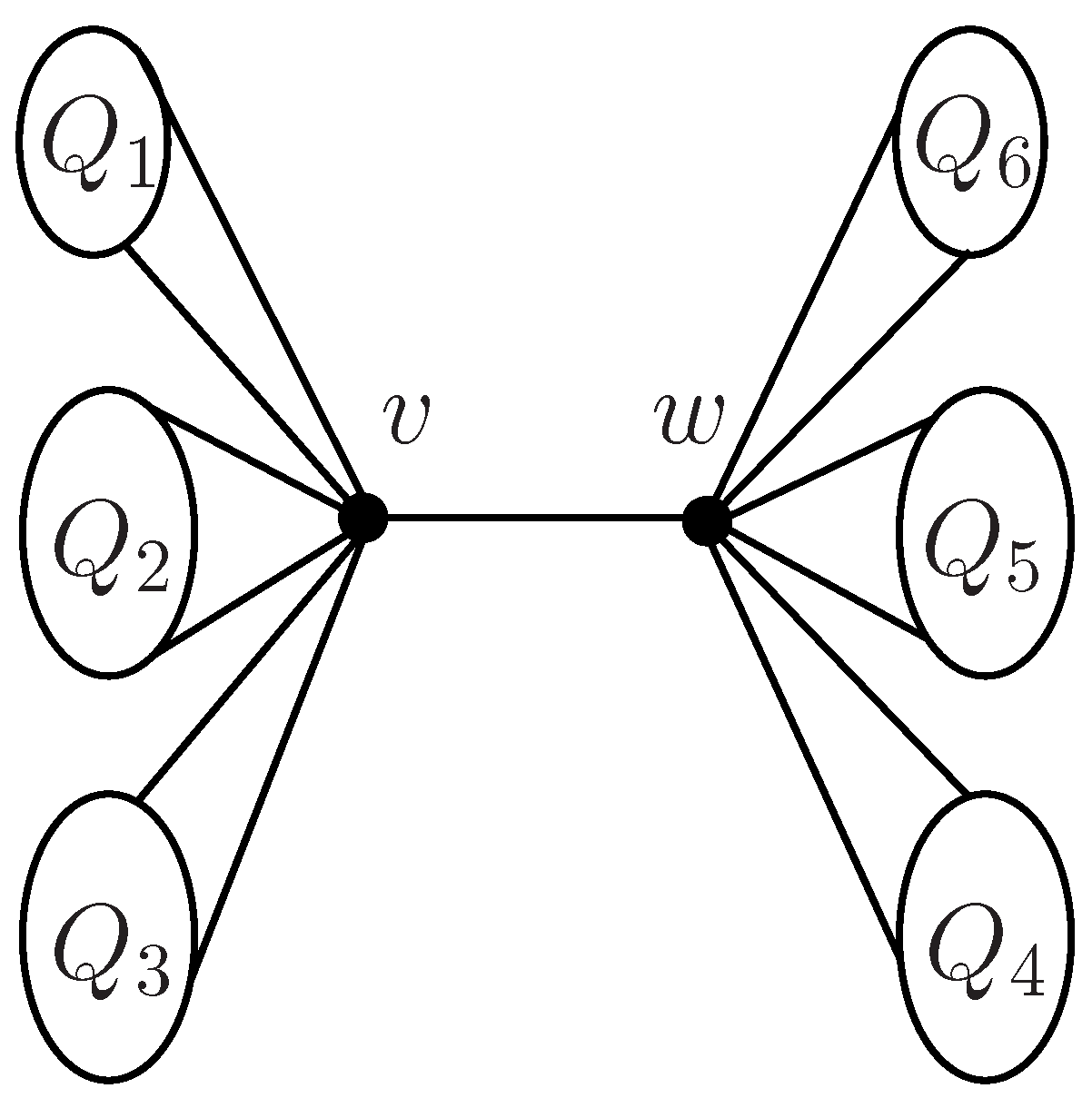
For , let be a clique such that and . Let be the graph with the vertex set and the edge set , (see Figure 9). The removal of v and of , results in a graph with three components , and , and so . The removal of v, w and u (u is the root of ) of , results in a graph is disconnected, and so . Hence, the upper bound of Theorem 3 is sharp.
Figure 9.
The graph .
4. Conclusions
In this paper, we investigate the relationship on the g-extra connectivity between the Mycielskian graph and the original graph G. In addition, we show that for , and propose the bounds of for . The existence g-extra connectivity is still open. Next, we will investigate the g-good-neighbor connectivity and structural connectivity of the Mycielskian graph.
Author Contributions
J.Z. contributes for conceptualization, methodology and writing original draft. H.L. contributes for supervision, validation, formal analysis. S.Z. and C.Y. contribute for review and editing. All authors have read and agreed to the published version of the manuscript.
Funding
This research was funded by the Qinghai University Science Foundation of China (Nos. 2023-QGY-6), the Qinghai Natural Science Foundation of China (Nos. 2020-ZJ-924) and the National Natural Science Foundation of China (Nos. 12261074).
Institutional Review Board Statement
Not applicable.
Informed Consent Statement
Not applicable. Written informed consent has been obtained from the patient(s) to publish this paper.
Data Availability Statement
Not applicable.
Conflicts of Interest
The authors declare no conflict of interest.
References
- Harary, F. Conditional connectivity. Networks 1983, 13, 347–357. [Google Scholar] [CrossRef]
- Fábregta, J.; Fiol, M. On the extraconnectivity of graph. Discrete Math. 1996, 155, 49–57. [Google Scholar] [CrossRef]
- Boesch, F.T. Synthesis of reliable networks-a survey. IEEE Trans. Reliab. 1986, 35, 240–246. [Google Scholar] [CrossRef]
- Chang, N.-W.; Hsieh, S.-Y. {2,3}-extraconnectivities of hypercube-like networks. J. Comput. System Sci. 2013, 79, 669–688. [Google Scholar] [CrossRef]
- Chang, N.-W.; Tsai, C.-Y.; Hsieh, S.-Y. On 3-extra connectivity and 3-extra edge connectivity of folded hypercubes. IEEE Trans. Comput. 2014, 63, 1593–1599. [Google Scholar] [CrossRef]
- Fábregta, J.; Fiol, M. Extraconnectivity of graphs with large girth. Discrete Math. 1994, 127, 163–170. [Google Scholar] [CrossRef]
- Guo, J.; Lu, M. The extra connectivity of bubble-sort star graphs. Theoret. Comput. Sci. 2016, 645, 91–99. [Google Scholar] [CrossRef]
- Hong, W.-S.; Hsieh, S.-Y. Extra edge connectivity of hypercube-like networks. Int. J. Parallel Emergent Distrib. Syst. 2013, 28, 123–133. [Google Scholar] [CrossRef]
- Hsieh, S.-Y.; Chang, Y.-H. Extraconnectivity of k-ary n-cube networks. Theoret. Comput. Sci. 2012, 443, 63–69. [Google Scholar] [CrossRef]
- Latifi, S.; Hegde, M.; Pour, M.N. Conditional connectivity measures for large multiprocessor systems. IEEE Trans. Comput. 2002, 43, 218–222. [Google Scholar] [CrossRef]
- Lv, M.; Zhou, S.; Sun, X.; Lian, G.; Liu, J. Reliability of (n, k)-star network based on g-extra conditional fault. Theoret. Comput. Sci. 2019, 757, 44–55. [Google Scholar] [CrossRef]
- Li, X.-Y.; Fan, J.-X.; Lin, C.-K.; Cheng, B.-L.; Jia, X.-H. The extra connectivity, extra conditional diagnosability and t/k-diagnosability of the data center network DCell. Theoret. Comput. Sci. 2019, 766, 16–29. [Google Scholar] [CrossRef]
- Sun, X.; Dong, Q.; Zhou, S.; Lv, M.; Lian, G.; Liu, J. Fault tolerance analysis of hierarchical folded cube. Theoret. Comput. Sci. 2019, 790, 117–130. [Google Scholar] [CrossRef]
- Sabir, E.; Mamut, A.; Vumar, E. The extra connectivity of the enhanced hypercubes. Theoret. Comput. Sci. 2019, 799, 22–31. [Google Scholar] [CrossRef]
- Zhang, M.-M.; Zhou, J.-X. On g-extra connectivity of folded hypercubes. Theoret. Comput. Sci. 2015, 593, 146–153. [Google Scholar] [CrossRef]
- Yuan, J.; Liu, A.-X.; Wang, X. The Relationship Between the g-Extra Connectivity and the g-Extra Diagnosability of Networks Under the MM* Model. Comput. J. 2021, 64, 921–928. [Google Scholar] [CrossRef]
- Wei, Y.-L.; Li, R.-H.; Yang, W.-H. The g-Extra Edge-Connectivity of Balanced Hypercubes. J. Interconnect. Netw. 2021, 21, 2142008. [Google Scholar] [CrossRef]
- Zhu, Q.; Ma, F.; Guo, G.-D.; Wang, D.-J. A new approach to finding the extra connectivity of graphs. Discrete Appl. Math. 2021, 294, 265–271. [Google Scholar] [CrossRef]
- Shu, C.; Li, X.-J.; Ma, M.-J. Note on reliability of star graphs. Theoret. Comput. Sci. 2022, 923, 366–375. [Google Scholar] [CrossRef]
- Tian, Z.-X.; Zhang, M.-Z.; Feng, X. Reliability measure of the n-th cartesian product of complete graph K4 on h-extra edge-connectivity. Theoret. Comput. Sci. 2022, 922, 46–60. [Google Scholar] [CrossRef]
- Kozhevnikov, V.S.; Raigorodskii, A.M.; Zhukovskii, M.E. Large cycles in random generalized Johnson graphs. Discrete Math. 2022, 345, 3. [Google Scholar] [CrossRef]
- Raigorodskii, A.M.; Karas, V.S. Asymptotics of the Independence Number of a Random Subgraph of the Graph G(n, r, < s). Math. Notes 2022, 111, 124–131. [Google Scholar]
- Mycielski, J. Sur le colouriage des graphes. Colloq. Math. 1955, 3, 161–162. [Google Scholar] [CrossRef]
- Chang, G.; Huang, L.; Zhu, X. Circular chromatic number of Mycielskis graphs. Discrete Math. 1999, 205, 23–37. [Google Scholar] [CrossRef]
- Balakrishnan, R.; Raj, S.F. Connectivity of the Mycielskian of a graph. Discrete Math. 2008, 308, 2607–2610. [Google Scholar] [CrossRef]
- Guo, L.; Liu, R.; Guo, X. Super connectivity and super edge connectivity of the Mycielskian of a graph. Graphs Comb. 2012, 28, 143–147. [Google Scholar] [CrossRef]
- Guo, L.; Guo, X. Connectivity of the Mycielskian of a digraph. Appl. Math. Lett. 2009, 22, 1622–1625. [Google Scholar] [CrossRef]
- Li, S.; Zhao, Y.; Li, F.; Gu, R. The generalized 3-connectivity of the Mycielskian of a graph. Appl. Math. Comput. 2019, 347, 882–890. [Google Scholar] [CrossRef]
- Raj, S.F. Connectivity of the generalised Mycielskian of digraphs. Graphs Comb. 2013, 29, 893–900. [Google Scholar]
- Liu, D. Circular chromatic number for iterated Mycielski graphs. Discrete Math. 2004, 285, 335–340. [Google Scholar] [CrossRef][Green Version]
- Liu, H. Circular chromatic number and Mycielski graphs. Acta Math. Sci. 2006, 26, 314–320. [Google Scholar] [CrossRef]
- Granados, A.; Pestana, D.; Portilla, A.; Rodríguez, J. Gromov Hyperbolicity in Mycielskian Graphs. Symmetry 2017, 9, 131. [Google Scholar] [CrossRef]
- Savitha, K.S.; Vijayakumar, A. Some network topological notions of the Mycielskian of a graph. AKCE Int. J. Graphs Comb. 2016, 13, 31–37. [Google Scholar]
- Bondy, J.A.; Murty, U.S.R.; Theory, G. GTM 244; Springer: Berlin/Heidelberg, Germany, 2008. [Google Scholar]
Disclaimer/Publisher’s Note: The statements, opinions and data contained in all publications are solely those of the individual author(s) and contributor(s) and not of MDPI and/or the editor(s). MDPI and/or the editor(s) disclaim responsibility for any injury to people or property resulting from any ideas, methods, instructions or products referred to in the content. |
© 2023 by the authors. Licensee MDPI, Basel, Switzerland. This article is an open access article distributed under the terms and conditions of the Creative Commons Attribution (CC BY) license (https://creativecommons.org/licenses/by/4.0/).