


Abstract
In this article, we introduce a new subgradient extra-gradient algorithm to find the common element of a set of fixed points of a Bregman relatively nonexpansive mapping and the solution set of an equilibrium problem involving a Pseudomonotone and Bregman–Lipschitz-type bifunction in reflexive Banach spaces. The advantage of the algorithm is that it is run without prior knowledge of the Bregman–Lipschitz coefficients. Finally, two numerical experiments are reported to illustrate the efficiency of the proposed algorithm.
Keywords:
equilibrium problem; pseudomonotone bifunction; Bregman–Lipschitz-type continuity; subgradient extra-gradient method; Legendre function MSC:
47H05; 47H09; 47H10
1. Introduction
Let X be a reflexive real Banach space and C be a closed, convex and nonempty subset of We denote the dual space of X by The minimization problem for a function is defined as
In this case, is called a minimizer of f, and denotes the set of minimizers of f. Minimization problems are very useful in optimization theory as well as convex and nonlinear analysis. An important generalization of Problem (1) for a bifunction is the following equilibrium problem (EP), defined as
We denote by the solutions set of (2). Many interesting and demanding problems in nonlinear analysis, such as complementarity, the fixed point, Nash equilibria, optimization, the saddle point and variational inequality problems, can be reformulated as equilibrium problems (cf. [1,2,3,4]). Some authors have obtained results regarding the existence and stability of solutions of (EP) (cf. [5,6]).
However, equilibrium problems in finite as well as infinite dimensional spaces were studied by [7,8,9,10]. Dadashi et al. [11] studied the subgradient extra-gradient method for Pseudomonotone equilibrium problems.
Recently, several authors have combined equilibrium problems with fixed-point problems. They have presented algorithms to solve them in Hilbert spaces [9,12]. Also, some authors have presented several methods for solving fixed-point problems in metric spaces, see [13,14,15].
One of the most popular methods used to solve equilibrium problems is the extra-gradient method. Authors have considered the extra-gradient method for monotone and Pseudomonotone equilibrium problems [4,16,17,18,19,20,21].
In [8], Reich and Sabach studied equilibrium problems and fixed-point problems in Banach spaces. In their paper, they presented two algorithms to find the common fixed points of many finite, firmly nonexpansive Bregman operators. Very recently, inspired by the extra-gradient method, Yang and Liu [22] presented an algorithm, which is called the subgradient extra-gradient method, to find a common solution to equilibrium problems and the fixed point of a quasinonexpansive mapping without the knowledge of the Lipschitz-type constants of the bifunction in Hilbert spaces. The algorithm is as follows:
where , and is arbitrary. Also,
- (i)
- and
- (ii)
- or
Inspired by the above work, in the present paper, we introduce a new subgradient extra-gradient algorithm to find the common element of a set of fixed points of a Bregman relatively nonexpansive mapping and the solution set of an equilibrium problem involving a Pseudomonotone and Bregman–Lipschitz-type bifunction in reflexive Banach spaces.
This paper is organized as follows: In Section 2, we recall some definitions and preliminary results. Section 3 deals with our algorithm and the relevant convergence analysis. Finally, in Section 4, we illustrate the proposed subgradient extra-gradient method by considering two numerical experiments.
2. Materials and Methods
In this section, we recall some definitions and preliminaries. Suppose that is a convex, proper and lower semicontinuous function. We denote by the set of minimizers of f. If is a singleton, its unique element is denoted by Additionally, we denote by the domain of f; that is, the set Let . Given the proper, convex and lower semicontinuous function , its subdifferential at some is defined as
Concerning this definition, we have
- (i)
- is empty when ,
- (ii)
- is not in general empty when ,
- (iii)
- is nonempty when ; precisely, .
It will be useful to stress these facts in the present exposition. The function defined by
is called the Fenchel conjugate of It can be shown that is equivalent to
We can show that is a proper, convex and lower semicontinuous function. The function f is called cofinite if Let be a convex function. Given and the right-hand derivative of f at x in the direction y is given by
A function f is called Gâteaux differentiable at if the limit as in (4) exists for each The function f is said to be Gâteaux differentiable if it is Gâteaux differentiable at each In this case, the gradient of f at x is the linear function which is defined by for all . We say that f is Fréchet differentiable at x if it is Gâteaux differentiable and the limit as in (4) is attained uniformly for every with . Also, we say that f is uniformly Fréchet differentiable on a bounded subset E of X if the limit is attained uniformly for and .
The function is called Legendre if it satisfies the following two conditions:
- (L1) and subdifferential is single valued on its domain,
- (L2) and is single valued on its domain.
Since X is reflexive, we always have (see [23], p. 83). This fact, combined with Conditions (L1) and (L2), implies the following equalities which will be very useful in the sequel:
Also, Conditions (L1) and (L2), in conjunction with Theorem 5.4 of [24], imply that the functions f and are strictly convex on the interior of their respective domains and f is Legendre if and only if is Legendre. Several interesting examples of Legendre functions are presented in [24]. Among them are the functions with , where the Banach space X is smooth and strictly convex.
Given a Gâteaux differentiable convex function the Bregman distance with respect to f is defined as
Note that is not a distance in the usual sense of the term. In general, is not symmetric and does not satisfy the triangle inequality. Clearly, , but may not imply In our case, when f is Legendre, this indeed holds (see [24], Theorem 7.3(vi)). However, satisfies the three-point identity
and four-point identity
for any and
More information regarding Bregman functions and distances can be found in [4,24,25,26,27,28,29,30,31]. A function is called totally convex at a point if its modulus of total convexity at x, that is, the function defined by
is positive whenever This notion was first introduced by Butnariu and Iusem in [28]. Let E be a nonempty subset of X. The modulus of the total convexity of f on E is defined by
A function f is called totally convex on bounded subsets if is positive for any nonempty and bounded subset E and for any We will need the following lemmas in the proof of our results.
Lemma 1
([32]). If is uniformly Fréchet differentiable and bounded on bounded subsets of X, then is uniformly continuous on bounded subsets of X from the strong topology of X to the strong topology of
The function f is called sequentially consistent (see [33]) if, for any two sequences and , such that is bounded,
and this implies that
Lemma 2
([28]). If contains at least two points, then the function f is totally convex on bounded sets if and only if the function f is sequentially consistent.
Lemma 3
([34]). Let be a Legendre function such that is bounded on bounded subsets of . Let . If is bounded, then the sequence is bounded too.
Let f be a function and C be a closed, convex and nonempty subset of
The Bregman projection (see [35]) concerning f of onto C is defined as the necessarily unique vector , which satisfies
The Bregman projection concerning totally convex and Gâteaux differentiable functions has a variational characterization ([33], Corollary 4.4, p. 23).
Lemma 4.
Let f be Gâteaux differentiable and totally convex on f. Let C be a closed, convex and nonempty subset of and Then, the following statements are equivalent:
- (i)
- The vector is the Bregman projection of x onto C concerning
- (ii)
- The vector is the unique solution of the variational inequality
- (iii)
- The vector is the unique solution of the inequality
With an admissible function we associate the bifunction (see [36,37]) defined by
Recall some properties of the bifunction For all and we have
Also, for all and (see [38]), we have
Let be a proper, lower semicontinuous function. Then, is a proper, convex and weak lower semicontinuous function (see [39]). Therefore, is convex concerning the second variable. Hence, we have
where and with
Let B be the closed unit ball and S be the unit sphere of a Banach space X. Let for all and be a function. We say that f is uniformly convex on bounded subsets (see [40]) if for all , where is the gauge of the uniform convexity of f and is defined by
Lemma 5
([41]). Let be a uniformly convex function on bounded subsets of X and be a constant. Then,
for all , , and with where is the gauge of the uniform convexity of f.
The function f is also said to be uniformly smooth on bounded subsets (see [40]) if
where is defined by
for all A function f is said to be super coercive if
Theorem 1
([40]). Let be a super coercive convex function. Then, the following are equivalent:
- (i)
- f is uniformly smooth on boundedsubsets of X and bounded on bounded subsets.
- (ii)
- f is Fréchet differentiable and is uniformlynorm-to-norm continuous on bounded subsets of X.
- (iii)
- is super coercive and uniformly convex on bounded subsets of .
Theorem 2
([40]). Suppose that is a convex function which is bounded on bounded subsets of X; then, the following are equivalent:
- (i)
- f is super coercive and uniformly convex on bounded subsets of X.
- (ii)
- is bounded on bounded subsets anduniformly smooth on bounded subsets of .
- (iii)
- is Fréchet differentiable and is uniformly norm-to-norm continuous on bounded subsets of .
Theorem 3
([42]). Suppose that is a Legendre function. The function f is totally convex on bounded subsets if and only if f is uniformly convex on bounded subsets.
Lemma 6
([43]). Let C be a nonempty convex subset of X and be a convex and subdifferentiable function on C. Then, f attains its minimum at if and only if , where is the normal cone of C at x; that is,
Lemma 7
([44]). Let f and g be two convex functions on X such that there is a point where f is continuous. Then,
Let C be a closed convex subset of X. A function such that for all , is called a bifunction.
Throughout this paper, we consider bifunctions with the following properties:
- g is monotone on C, that is
- g is Pseudomonotone on C; that is,
- g is Bregman - strongly Pseudomonotone on C if there exists a constant such that
- g is Bregman–Lipschitz-type continuous on C; that is, there exist two positive constants such that
Lemma 8
([19]). Let C be a nonempty closed convex subset of a reflexive Banach space X and be a Legendre and super coercive function. Suppose that is a bifunction satisfying . For the arbitrary sequences and let and be sequences generated by
Then, we have
Let be a mapping; the set of the fixed points of S is
A point is called an asymptotic fixed point of S if X contains a sequence with such that . The set of asymptotic fixed points of S is denoted by . The term “symptotic fixed point” was coined and used by Reich [45].
Definition 1.
Let be a mapping with . Then,
- (i)
- S is called Bregman quasinonexpansive if for all .
- (ii)
- S is called Bregman relatively nonexpansive if S is Bregman quasinonexpansive and .
Bregman quasinonexpansive mappings were studied by Butnariu et al. [46]. Here, we assume that the bifunction g satisfies the following conditions:
- g is Pseudomonotone on C.
- g is Bregman–Lipschitz-type continuous on C.
- is convex, lower semicontinuous and subdifferentiable on X for every fixed .
- g is jointly weakly continuous on in the sense that, if and converge weakly to , respectively, then as .
Remark 1.
If g satisfies , then is closed and convex (see [35]). If S is a Bregman quasinonexpansive mapping, then is a closed convex subset of X ([33], Proposition 1).
Lemma 9
([47]). Let be uniformly Fréchet differentiable and totally convex on bounded subsets of X. Let C be a nonempty closed and convex subset of denote the family of nonempty closed bounded subsets of C and be a Bregman relatively nonexpansive mapping. Then, is closed and convex.
Let be a Gâteaux differentiable function and ; recall that the proximal mapping of a proper convex and lower semicontinuous function concerning f is defined by
Lemma 10
([19]). Let be a super coercive and Legendre function. Let and be a proper convex and lower semicontinuous function. Then, the following inequality holds:
Lemma 11
([48]). Let be a sequence of non-negative real numbers satisfying the inequality
where and satisfy the conditions
- (i)
- and
- (ii)
- or
Then,
Lemma 12
([49]). Let be a sequence of real numbers such that there exists a subsequence such that for all Then, there exists a subsequence such that , and the following properties are satisfied by all (sufficiently large) numbers
In fact,
3. Main Results
In this section, we assume that is a Legendre, super coercive and totally convex function on bounded subsets of X such that is bounded on bounded subsets of and the bifunction satisfies . Now, we present the following Algorithm 1, and we prove a convergence theorem.
| Algorithm 1 Subgradient extra-gradient algorithm |
|
The following lemmas will be useful in the proof of the main theorem.
Lemma 13.
The sequence generated by Algorithm 1 is bounded below with lower bound
Proof of Lemma 13.
Since g satisfies the Bregman–Lipschitz-type condition with constants and , for the case of , we have
From the definition of , we see that this sequence is bounded from below. Indeed, if , then is bounded from below by ; otherwise, is bounded from below by . □
Remark 2.
It is obvious that the sequence is decreasing and the limit of exists and we denote . Clearly, . If , then is a constant sequence.
Lemma 14.
The sequence generated by Algorithm 1 is well defined, and .
Proof of Lemma 14.
It follows from Lemmas 6 and 7 and the condition that
if and only if
There exists and such that
Thus, we have
This implies that for all Hence, . □
Lemma 15.
Suppose that is a Bregman quasinonexpansive mapping. Let and be sequences generated by Algorithm 1 and . Then, the sequences and are bounded.
Proof of Lemma 15.
Since
by Lemma 10, we have
Know that
Assume that . Substituting into the last inequality, we have
From , we obtain . Thus, because of the Pseudomonotonicity of g. Hence, from (11) and , we obtain
Since , we obtain
Substituting into the last inequality, we obtain that
We have
From definition of , we have
we have
We have
We obtain
On the other hand
There exists such that for all we have . So, for all Therefore, we have
Therefore, the sequence is bounded, and by Lemma 3, the sequence is bounded. We have , which implies that is bounded. From (17) and using Lemma 8, we derive that
We get that
Considering the limit supreme in the last inequality as , we obtain that . Therefore, is bounded. Clearly, is bounded. □
Now, we are ready to prove our main theorem.
Theorem 4.
Let S be a Bregman relatively nonexpansive mapping. Assume that are satisfied and . Then, the sequence generated by Algorithm 1 converges strongly to .
Proof of Theorem 4.
By Remark 1 and Lemma 9, is closed and convex. Assume that . By Lemma 4, we have
From Lemma 8, we obtain for all . Therefore,
We have
From (15), we obtain
Know that
From (20) and (21), we have
We divide the proof into two parts:
Case In this case, we suppose that there exists , such that
for all . Then, the limit exists. Let . By (22), we obtain
From (23), the fact that
we obtain that
We have
From Lemma 2, we get that
Since is bounded, there exists a subsequence which converges weakly to some and
From (24) and , we have and . Since
by Lemma 10 we deduce that
Considering the limit in the last inequality as and using the assumptions , , we obtain
Which implies that for all . That is, .
Next, we prove . From and (24), we obtain . Note that,
therefore,
We obtain that
We get that
and thus . Let
The sequences and are bounded and is bounded on bounded subsets of X, we have . In view of Lemma 1 and Theorem 1, is super coercive and uniformly convex on bounded subsets of . Applying (5) and Lemma 5, we obtain
T is a Bregman relatively nonexpansive mapping and
we have
therefore,
Passing the limit in the last inequality as , we obtain
We prove that
If this is not the case, there exists and a subsequence of such that
Since is nondecreasing, we obtain
Letting , we obtain But this is a contradiction to the uniform convexity of on the bounded subsets of . From Theorems 2 and 3, is uniformly continuous on the bounded subset of Therefore, . This, together with (27) and the triangle inequality, gives
The function f is uniformly continuous on the bounded subset of X ([50], Theorem 1.8), and so, from the definition of the Bregman distance, we obtain
and thus is an asymptotic fixed point of Bregman relatively nonexpansive mapping S. Therefore, . Hence, .
We now prove that . We have
We have
From and , we obtain that
From Lemma 11 and (28), we deduce that
From Lemma 2, we have . Since , we have
Case There exists a subsequence of such that
By Lemma 12, there exists an increasing sequence such that , and the following inequalities hold for all :
From (22), we have
Substituting into the last inequality, we obtain
4. Application
In this section, we consider the particular equilibrium problem corresponding to the function g defined for every by , with being L-Lipschitz continuous; that is, there exists such that
So, we obtain the classical variational inequality:
The set of solutions to this problem is denoted by We have ([19], Lemma 4.1)
Therefore, we derive that
Let X be a real Banach space. The modulus of convexity is defined by
The space X is called uniformly convex if for every , and is called p-uniformly convex if and there exists such that for any .
The modulus of smoothness is defined by
The space X is called uniformly smooth if
For a p-uniformly convex space, the metric and Bregman distance have the following relation [51]:
where is a fixed number and the duality mapping is defined by
for every We know that X is smooth if and only if is a single-valued mapping of X into We also know that X is reflexive if and only if is surjective, and X is strictly convex if and only if is one-to-one. Therefore, if X is a smooth, strictly convex and reflexive Banach space, then is a single-valued bijection, and in this case, , where is the duality mapping of
For the duality mapping is called the normalized duality mapping and is denoted by The function is defined by
for all The generalized projection from X onto C is defined by
where C is a nonempty closed and convex subset of
Let X be a uniformly smooth and uniformly convex Banach space and Therefore,
If X is a Hilbert space, then
where is the metric projection.
Hence, we have the following corollary:
Corollary 1.
Let X be a uniformly smooth and two-uniformly convex Banach space and C be a nonempty closed and convex subset of X. Let S be a Bregman relatively nonexpansive mapping and for all . Let be a monotone and Lipschitz-continuous mapping. Suppose that and is sequence defined in Algorithm 1. Then, the sequence generated by
converges strongly to .
5. Numerical Experiment
In the following, two numerical experiments are considered to demonstrate the applicability of our main result.
Example 1.
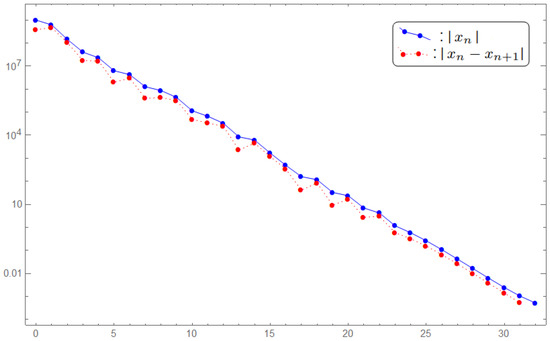
Let , , and , and we consider , , and as well as and . Define the bifunction g on into as follows:
where
The bifunction g satisfies the conditions and . Furthermore,
which proves the condition with A simple computation shows that Algorithm 1 takes the following form:
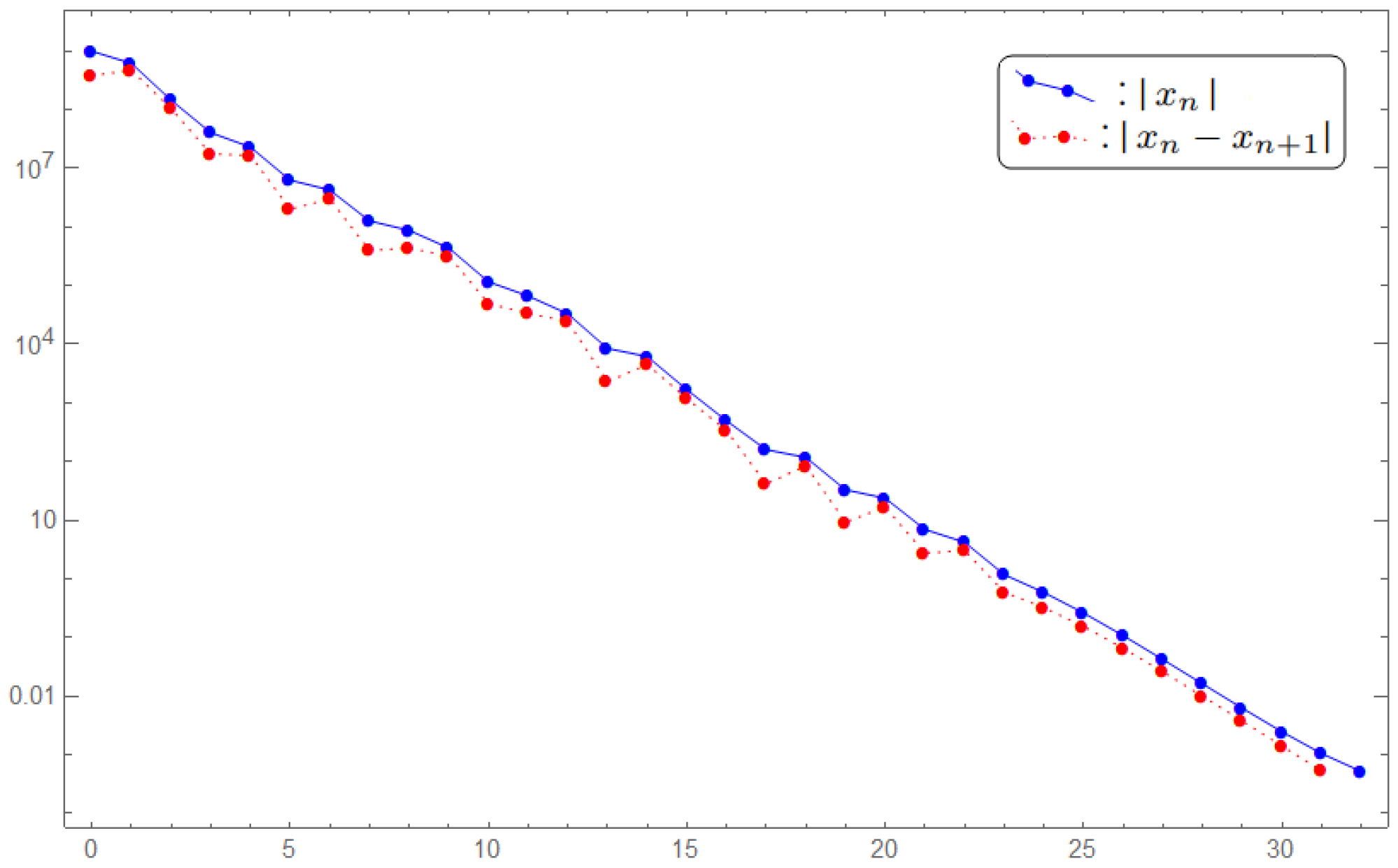
The decreasing values of and also the values of are shown in Figure 1; we see that the sequences and converge to zero.
Figure 1.
The plotting of and .
Now, another numerical example is given in an infinite dimensional space to show that our algorithm is efficient. We will use some notations that were introduced in [52].
Example 2.
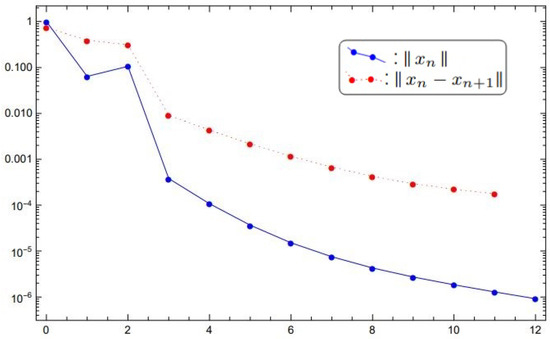
Suppose that with norm and inner product for all in Let be the unit ball. Define an operator by
where
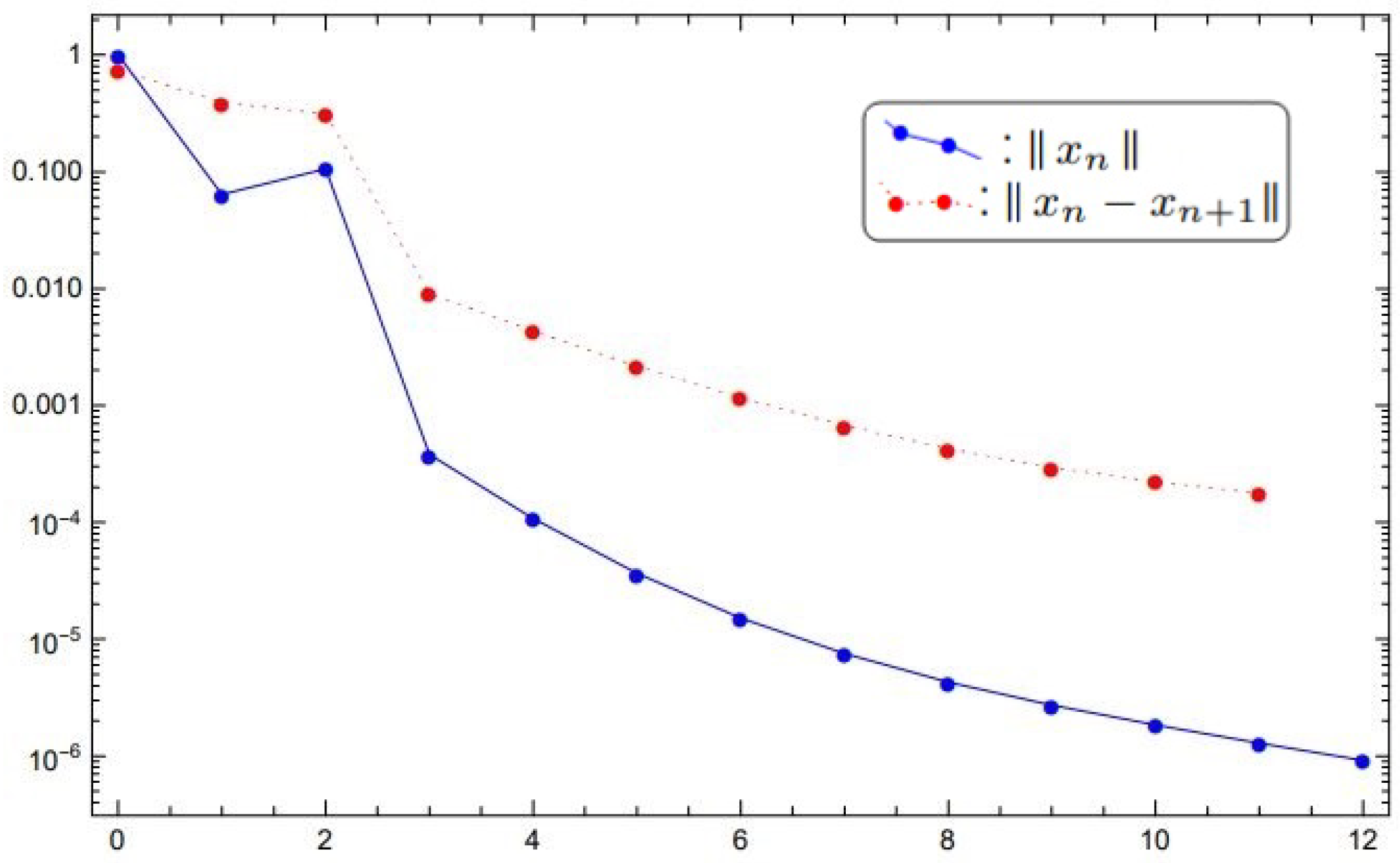
From [53], G is monotone (hence Pseudomonotone) and L-Lipschitz continuous with The bifunction g is defined by , and is defined by and We consider , , and as well as The decreasing values of and also the values of are shown in Figure 2.
Figure 2.
The plotting of and .
6. Conclusions
The equilibrium problem encompasses, among its particular cases, convex optimization problems, variational inequalities, fixed-point problems, Nash equilibrium problems and other problems of interest in many applications. This paper proposes the subgradient extra-gradient algorithm to find a solution to an equilibrium problem involving a Pseudomonotone, which is also a fixed point of a Bregman relatively nonexpansive mapping in reflexive Banach spaces. We proved the strong convergence theorems for the proposed algorithm. Several experiments are reported to illustrate the numerical behavior of our algorithm.
Author Contributions
Writing—original draft, R.L., G.Z.E., J.-K.K. and M.T.R. All authors have read and agreed to the published version of the manuscript.
Funding
This research received no external funding.
Data Availability Statement
The data presented in this study are available on request from the corresponding author.
Conflicts of Interest
The authors declare no conflict of interest.
References
- Blum, E.; Oettli, W. From optimization and variational inequalities to equilibrium problems. Math. Stud. 1994, 63, 123–145. [Google Scholar]
- Kim, J.K.; Majee, P. Modified Krasnoselski Mann iterative method for hierarchical fixed point problem and split mixed equilibrium problem. J. Ineq. Appl. 2020, 2020, 227. [Google Scholar] [CrossRef]
- Kim, J.K.; Salahuddin. Existence of solutions for multi-valued equilibrium problems. Nonlinear Funct. Anal. Appl. 2018, 23, 779–795. [Google Scholar]
- Muangchoo, K. A new explicit extragradient method for solving equilibrium problems with convex constraints. Nonlinear Funct. Anal. Appl. 2022, 27, 1–22. [Google Scholar]
- Iusem, A.N.; Sosa, W. Iterative algorithms for equilibrium problems. Optimization 2003, 52, 301–316. [Google Scholar] [CrossRef]
- Kassay, G.; Reich, S.; Sabach, S. Iterative methods for solving systems of variational inequalities in reflexive Banach spaces. SIAM J. Optim. 2011, 21, 1319–1344. [Google Scholar] [CrossRef]
- Reich, S.; Sabach, S. Two strong convergence theorems for Bregman strongly nonexpansive operators in reflexive Banach spaces. Nonlinear Anal. 2010, 73, 122–135. [Google Scholar] [CrossRef]
- Reich, S.; Sabach, S. A projection method for solving nonlinear problems in reflexive Banach spaces. J. Fixed Point Theory Appl. 2011, 9, 101–116. [Google Scholar] [CrossRef]
- Takahashi, W.; Zembayashi, K. Strong convergence theorem by a new hybrid method for equilibrium problems and relatively nonexpansive mappings. Fixed Point Theory Appl. 2008, 2008, 528476. [Google Scholar] [CrossRef]
- Takahashi, W.; Zembayashi, K. Strong and weak convergence theorems for equilibrium problems and relatively nonexpansive mappings in Banach spaces. Nonlinear Anal. 2009, 70, 45–57. [Google Scholar] [CrossRef]
- Dadashi, V.; Iyiola, O.S.; Shehu, Y. The subgradient extragradient method for pseudomonotone equilibrium problems. Optimization 2020, 69, 901–923. [Google Scholar] [CrossRef]
- Anh, P.N. A hybrid extragradient method extended to fixed point problems and equilibrium problems. Optimization 2013, 62, 271–283. [Google Scholar] [CrossRef]
- Joshi, M.; Tomar, A. On unique and nonunique fixed points in metric spaces and application to chemical sciences. J. Funct. Spaces 2021, 2021, 5525472. [Google Scholar] [CrossRef]
- Ozgur, N.Y.; Tas, N. Some fixed-circle theorems on metric spaces. Bull. Malays. Math. Sci. Soc. 2019, 42, 1433–1449. [Google Scholar] [CrossRef]
- Tomar, A.; Joshi, M.; Padaliya, S.K. Fixed point to fixed circle and activation function in partial metric space. J. Appl. Anal. 2022, 28, 57–66. [Google Scholar] [CrossRef]
- Anh, P.N. Strong convergence theorems for nonexpansive mappings and Ky Fan inequalities. J. Optim. Theory Appl. 2012, 154, 303–320. [Google Scholar] [CrossRef]
- Anh, P.N.; Kim, J.K.; Hien, N.D.; Hong, N.V. Strong convergence of inertial hybrid subgradient methods for solving equilibrium problems in Hilbert spaces. J. Nonlinear Convex Anal. 2023, 24, 499–514. [Google Scholar]
- Anh, P.N.; Thach, H.T.C.; Kim, J.K. Proximal-like subgradient methods for solving multi-valued variational inequalities. Nonlinear Funct. Anal. Appl. 2020, 25, 437–451. [Google Scholar]
- Eskandani, G.Z.; Raeisi, M.; Rassias, T.M. A Hybrid extragradient method for pseudomonotone equilibrium problems by using Bregman distance. Fixed Point Theory Appl. 2018, 27, 120–132. [Google Scholar] [CrossRef]
- Wairojjana, N.; Pakkaranang, N. Halpern Tseng’s Extragradient Methods for Solving Variational Inequalities Involving Semistrictly Quasimonotone Operator. Nonlinear Funct. Anal. Appl. 2022, 27, 121–140. [Google Scholar]
- Wairojjana, N.; Pholasa, N.; Pakkaranang, N. On Strong Convergence Theorems for a Viscosity-type Tseng’s Extragradient Methods Solving Quasimonotone Variational Inequalities. Nonlinear Funct. Anal. Appl. 2022, 27, 381–403. [Google Scholar]
- Yang, J.; Liu, H. The subgradient extragradient method extended to pseudomonotone equilibrium problems and fixed point problems in Hilbert space. Optimi. Lett. 2020, 14, 1803–1816. [Google Scholar] [CrossRef]
- Bonnans, J.F.; Shapiro, A. Perturbation Analysis of Optimization Problems; Springer: New York, NY, USA, 2000. [Google Scholar]
- Bauschke, H.H.; Borwein, J.M.; Combettes, P.L. Essential smoothness, essential strict convexity, and Legendre functions in Banach spaces. Commun. Contemp. Math. 2001, 3, 615–647. [Google Scholar] [CrossRef]
- Abass, H.A.; Narain, O.K.; Onifade, O.M. Inertial extrapolation method for solving systems of monotone variational inclusion and fixed point problems using Bregman distance approach. Nonlinear Funct. Anal. Appl. 2023, 28, 497–520. [Google Scholar]
- Bauschke, H.H.; Borwein, J.M.; Combettes, P.L. Bregman monotone optimization algorithms. SIAM J. Control Optim. 2003, 42, 596–636. [Google Scholar] [CrossRef]
- Butnariu, D.; Censor, Y.; Reich, S. Iterative averaging of entropic projections for solving stochastic convex feasibility problems. Comput. Optim. Appl. 1997, 8, 21–39. [Google Scholar] [CrossRef]
- Butnariu, D.; Iusem, A.N. Totally Convex Functions for Fixed Points Computation and Infinite Dimensional Optimization; Kluwer Academic Publishers: Dordrecht, The Netherlands, 2000. [Google Scholar]
- Kim, J.K.; Tuyen, T.M. A parallel iterative method for a finite family of Bregman strongly nonexpansive mappings in reflexive Banach spaces. J. Korean Math. Soc. 2020, 57, 617–640. [Google Scholar]
- Lotfikar, R.; Zamani Eskandani, G.; Kim, J.K. The subgradient extragradient method for solving monotone bilevel equilibrium problems using Bregman distance. Nonlinear Funct. Anal. Appl. 2023, 28, 337–363. [Google Scholar]
- Reem, D.; Reich, S.; De Pierro, A. Re-examination of Bregman functions and new properties of their divergences. Optimization 2019, 68, 279–348. [Google Scholar] [CrossRef]
- Reich, S.; Sabach, S. A strong convergence theorem for a proximal-type algorithm in reflexive Banach spaces. J. Nonlinear Convex Anal. 2009, 10, 471–485. [Google Scholar]
- Butnariu, D.; Resmerita, E. Bregman distances, totally convex functions and a method for solving operator equations in Banach spaces. Abstr. Appl. Anal. 2006, 2006, 084919. [Google Scholar] [CrossRef]
- Sabach, S. Products of finitely many resolvents of maximal monotone mappings in reflexive banach spaces. SIAM J. Optim. 2011, 21, 1289–1308. [Google Scholar] [CrossRef]
- Bregman, L.M. A relaxation method for finding the common point of convex sets and its application to the solution of problems in convex programming. USSR Comput. Math. Math. Phys. 1967, 7, 200–217. [Google Scholar] [CrossRef]
- Alber, Y.I. Metric and generalized projection operators in Banach spaces: Properties and applications. In Theory and Applications of Nonlinear Operators of Accretive and Monotone Type; Kartsatos, A.G., Ed.; Lecture notes in pure and applied mathematics; Dekker: New York, NY, USA, 1996; Volume 178, pp. 15–50. [Google Scholar]
- Censor, Y.; Lent, A. An iterative row-action method for interval convex programming. J. Optim. Theory Appl. 1981, 34, 321–353. [Google Scholar] [CrossRef]
- Kohsaka, F.; Takahashi, W. Proximal point algorithm with Bregman functions in Banach spaces. J. Nonlinear Convex Anal. 2005, 6, 505–523. [Google Scholar]
- Phelps, R.P. Convex Functions, Monotone Operators and Differentiability, 2nd ed.; Lecture Notes in Mathematics; Springer: Berlin, Germany, 1993; Volume 1364. [Google Scholar]
- Zălinescu, C. Convex Analysis in General Vector Spaces; World Scientific Publishing: Singapore, 2002. [Google Scholar]
- Naraghirad, E.; Yao, J.C. Bregman weak relatively nonexpansive mappings in Banach spaces. Fixed Point Theory Appl. 2013, 2013, 141. [Google Scholar] [CrossRef]
- Butnariu, D.; Iusem, A.N.; Zălinescu, C. On uniform convexity, total convexity and convergence of the proximal point and outer Bregman projection algorithms in Banach spaces. J. Convex Anal. 2003, 10, 35–61. [Google Scholar]
- Tiel, J.V. Convex Analysis: An Introductory Text; Wiley: Chichester, UK; New York, NY, USA, 1984. [Google Scholar]
- Cioranescu, I. Geometry of Banach Spaces, Duality Mappings and Nonlinear Problems; Kluwer Academic: Dordrecht, The Netherlands, 1990. [Google Scholar]
- Reich, S. A weak convergence theorem for the alternating method with Bregman distances. In Theory and Applications of Nonlinear Operators; Marcel Dekker: New York, NY, USA, 1996; pp. 313–318. [Google Scholar]
- Butnariu, D.; Reich, S.; Zaslavski, A.J. Asymptotic behavior of relatively nonexpansive operators in Banach spaces. J. Appl. Anal. 2001, 7, 151–174. [Google Scholar] [CrossRef]
- Shahzad, N.; Zegeye, H. Convergence theorem for common fixed points of a finite family of multi-valued Bregman relatively nonexpansive mappings. Fixed Point Theory Appl. 2014, 2014, 152. [Google Scholar] [CrossRef]
- Xu, H.K. Another control condition in an iterative method for nonexpansive mappings. Bullet. Austral. Math. Soc. 2002, 65, 109–113. [Google Scholar] [CrossRef]
- Maingé, P.E. Strong convergence of projected subgradient methods for nonsmooth and nonstrictly convex minimization. Set-Valued Anal. 2008, 16, 899–912. [Google Scholar] [CrossRef]
- Ambrosetti, A.; Prodi, G. A Primer of Nonlinear Analysis; Cambridge University Press: Cambridge, UK, 1993. [Google Scholar]
- Schöpfer, F.; Schuster, T.; Louis, A.K. An iterative regularization method for the solution of the split feasibility problem in Banach spaces. Inverse Probl. 2008, 24, 055008. [Google Scholar] [CrossRef]
- Shehu, Y.; Dong, Q.; Jiang, D. Single projection method for pseudo-monotone variational inequality in Hilbert spaces. Optimization 2018, 68, 385–409. [Google Scholar] [CrossRef]
- Hieu, D.V.; Muu, L.D.; Anh, P.K. Parallel hybrid extragradient methods for pseudmonotone equilibrium problems and nonexpansive mappings. Numer. Algor. 2016, 73, 197–217. [Google Scholar] [CrossRef]
Disclaimer/Publisher’s Note: The statements, opinions and data contained in all publications are solely those of the individual author(s) and contributor(s) and not of MDPI and/or the editor(s). MDPI and/or the editor(s) disclaim responsibility for any injury to people or property resulting from any ideas, methods, instructions or products referred to in the content. |
© 2023 by the authors. Licensee MDPI, Basel, Switzerland. This article is an open access article distributed under the terms and conditions of the Creative Commons Attribution (CC BY) license (https://creativecommons.org/licenses/by/4.0/).