Article

Research on Spare Parts Configuration Method for Marine Equipment Based on Spare Parts Utilization Rate

1
Department of Basic Courses, Naval University of Engineering, Wuhan 430033, China
2
College of Naval Architecture and Ocean Engineering, Naval University of Engineering, Wuhan 430033, China
*
Author to whom correspondence should be addressed.
Mathematics 2026, 14(1), 35; https://doi.org/10.3390/math14010035
Submission received: 4 November 2025 / Revised: 9 December 2025 / Accepted: 17 December 2025 / Published: 22 December 2025
(This article belongs to the Special Issue Optimization Theory, Algorithms and Applications)

Abstract

An optimization method for the spare parts configuration of marine equipment is investigated based on spare parts support probability and utilization rate indicators. First, a general expression for the spare parts utilization rate is presented, and analytical expressions for the spare parts support probability and utilization rate are derived for Gamma-type spare parts with non-exponential life distributions, which are commonly found in marine spare parts. The relationship between two calculation methods for the utilization rate of exponential-type spare parts, as a special case of Gamma-type spare parts, is discussed. Second, as the analytical expression for the Gamma-type spare parts utilization rate is relatively complex, an approximate calculation method for the spare parts utilization rate is provided. Under the condition of given support probability requirements, the spare parts utilization rate is calculated through three approaches: theoretical calculation, approximate calculation, and simulation experiment. The calculation results demonstrate the validity of the analytical expression for the spare parts utilization rate and the applicability of the approximate algorithm. Furthermore, an approximate algorithm for the Weibull-type spare parts utilization rate is presented and verified through simulation calculations. Subsequently, considering both spare parts support probability requirements and utilization rate requirements, a spare parts configuration optimization model is established with the objective of maximizing the cost ratio, and the calculation procedures are provided. Finally, the feasibility of the spare parts configuration optimization model is illustrated through case analysis.

1. Introduction

Ships are highly integrated complex systems composed of thousands of equipment components. These equipment components operate in harsh marine environments with diverse failure modes and varying life cycles. Consequently, spare parts support research has achieved numerous results in recent years [1,2,3,4], and spare parts configuration optimization [5,6] has become an important subject in spare parts support. Spare parts configuration decision-making for marine equipment is far from a simple matter of “stocking more or less”; rather, it is a complex systems engineering problem involving the interdisciplinary integration of reliability engineering, maintenance strategies, inventory management, space constraints, cost control, and mission demand forecasting. It is necessary to ensure rapid recovery when critical equipment fails, avoiding mission failure or major safety accidents due to parts shortages while preventing excessive stockpiling of non-critical or low-failure-rate spare parts, which would result in resource waste and space burden. Therefore, exploring and applying scientific and intelligent spare parts configuration optimization models and methods is crucial for achieving precise and efficient ship logistics support.
Different spare parts configuration schemes can be formulated based on various theoretical indicators and constraint conditions. For instance, in logistics transportation, the mean time between failures is typically simplified to equate with spare parts demand, thereby serving as the spare parts configuration indicator [7]. In ship spare parts support, to ensure the successful completion of system missions, the maximum support probability of system spare parts has been adopted as the configuration indicator [8]. In certain tunnel engineering projects, scholars have proposed the system satisfaction rate as a constraint condition for spare parts configuration in tunnel boring machine spare parts management, taking into account practical financial situations [9]. It can be observed that in equipment support processes, the current spare parts configuration primarily focuses on indicators such as spare parts support probability, the spare parts satisfaction rate [10,11], and the inventory turnover rate [12], without fully considering spare parts utilization. Consequently, this often leads to issues such as excessive spare parts allocation. Therefore, it is necessary to flexibly select spare parts configuration schemes according to different constraint conditions to simultaneously achieve the objectives of successful support and optimal resource utilization.
The spare parts utilization rate represents the ratio between the quantity of spare parts consumed during equipment mission operations and the initial spare parts allocation quantity. This metric not only reflects the actual usage of spare parts in practice but also indicates maintenance support effectiveness. Although a higher quantity of spare parts allocation leads to an increased spare parts support probability, it simultaneously results in lower spare parts utilization rates [13]. When the spare parts utilization rate remains low while the allocation quantity is excessive, issues such as elevated procurement costs and warehouse inventory accumulation arise. Therefore, the spare parts utilization rate serves as a crucial indicator for establishing spare parts configuration schemes, enabling the optimization of spare parts allocation by maximizing utilization rates while ensuring mission support success. Regarding this utilization rate indicator, scholars have conducted various studies. For instance, Reference [14] estimated spare parts utilization rates from an engineering practice perspective, Reference [15] investigated the integral equation for spare parts utilization rates, Reference [16] examined factors influencing spare parts utilization rates, and Reference [17] established an evaluation system for spare parts configuration schemes considering indicators such as spare parts utilization rates. However, overall, the aforementioned research primarily applies to electronic products, with limited studies addressing products whose spare parts lifespans follow non-exponential distributions.
The fundamental contribution of this work, which distinguishes it from the existing literature, lies in its transformation of the “utilization rate” from a post-event descriptive metric into a pre-event decision-making tool. While conventional research predominantly focuses on measuring, analyzing, or predicting the utilization rate as an indicator, our study pioneers its application as the core driving objective and a direct constraint in the optimization model to generate specific spare parts configuration schemes. This paradigm shift reorients the configuration process from the traditional goal of “meeting service-level thresholds” towards “maximizing resource efficiency,” thereby fundamentally mitigating blind resource allocation and offering a novel, directly implementable solution for lean spare parts management.
Based on the requirements of spare parts support probability and utilization rate indicators, this study investigates the optimization scheme for marine equipment spare parts configuration.
First, starting from the statistical definition of the spare parts utilization rate provided in the national military standard, a general model for the spare parts utilization rate is presented. For the commonly encountered non-exponential Gamma-type spare parts, analytical expressions for spare parts support probability and utilization rates are derived, and the relationships among different expressions of exponential-type spare parts utilization rates are further explored.
Second, to facilitate practical application, an approximate algorithm for the Gamma-type spare parts utilization rate is provided, and the calculation procedures for three methods, namely, analytical expression, approximate calculation, and simulation calculation, are presented. The calculation results demonstrate the rationality of the analytical expression and the applicability of the approximate algorithm. An approximate algorithm for the Weibull-type spare parts utilization rate is also provided, with simulation verification confirming the applicability of the approximate algorithm.
Furthermore, based on the requirements of the spare parts support probability and utilization rate, an optimization model for the spare parts configuration is established, and the calculation procedures for the model are presented. Finally, through case analysis, the rationality of the proposed spare parts configuration optimization model is illustrated.

2. Spare Parts Utilization Rate Model

Extensive and in-depth research has been conducted by scholars on the calculation of exponential-type spare parts utilization rates [15,18]. For the analytical expression of non-exponential spare parts utilization rates, a derivation has been performed for Gamma-type spare parts commonly encountered in engineering practice.

2.1. General Model for Spare Parts Utilization Rate

The utilization rate serves as a crucial indicator in spare parts configuration, measuring the effective degree to which inventory spare parts are actually employed in maintenance activities. According to the national military standard GJB1909A-2009 Demonstration of Equipment Reliability, Maintainability and Supportability Requirements [17], the concept of the utilization rate can be obtained. The spare parts utilization rate refers to the ratio of actually used spare parts to the total spare parts possessed at a specified level within a specified time period [19]. For a single component, the spare parts utilization rate L is calculated by the following equation:
L = n N , 0 n N 1 , n > N
where n represents the number of spare parts actually required during the mission time and N represents the number of spare parts determined based on the spare parts support probability requirement and support mission time. When the actual number of required spare parts n exceeds the configured number of spare parts for the mission, the utilization rate L equals 1.
Equation (1) represents a statistical calculation based on actual usage. As support activities have not yet been implemented, the actual number of spare parts required for a mission cannot be known in advance during practical spare parts configuration work. However, the lifetime distribution of spare parts can be determined according to the equipment production process. Let X ( T ) denote the number of failures that occur during component usage within the support mission time [ 0 , T ] , which is a random variable. Based on the lifetime distribution, the probability of requiring n spare parts can be calculated, i.e., P ( X ( T ) = n ) . As X possesses randomness, n also exhibits randomness, making the utilization rate L expressed in Equation (1) a random variable in the statistical sense. Therefore, the calculation of the utilization rate is essentially the expectation of a discrete random variable and is computed using the standard method for calculating expectation in probability theory. In engineering practice, its expected value is typically regarded as the spare parts utilization rate L , namely:
L = n = 0 N P ( X ( T ) = n ) × n N + n = N + 1 + P ( X ( T ) = n ) = 1 n = 0 N [ P ( X ( T ) = n ) × ( N n ) ] N = 1 n = 0 N 1 [ P ( X ( T ) = n ) × ( N n ) ] N
According to Equation (2), under the condition of determining the spare parts lifetime distribution, the number of spare parts N to be configured can be determined through the spare parts support probability requirement and support mission time, thereby calculating the spare parts utilization rate. Engineering experience indicates that considering the spare parts utilization rate during the determination process of spare parts configuration schemes can optimize the types and quantities of spare parts configurations, improve maintenance efficiency, and reduce spare parts configuration costs.

2.2. Gamma-Type Spare Parts Utilization Rate Model

Spare parts whose lifetime distributions follow the Gamma distribution are referred to as Gamma-type spare parts. In engineering practice, Gamma-type spare parts represent a common category of non-exponential spare parts, with exponential-type spare parts being a special case of Gamma-type spare parts. A non-negative random variable T is said to follow the Gamma distribution if the failure density of T is:
f ( t ) = λ α Γ ( α ) t α 1 e λ t
denoted as T   Γ ( α , λ ) , where α , λ represents the parameter ( α > 0 , λ > 0 , t > 0 , ), and   Γ ( α ) is the Gamma function   Γ ( α ) = 0 x α 1 e x d x .
During the support mission time [ 0 , T ] , assuming that N spare parts are configured, with each spare part having a lifespan of X 1 , X 2 , , X N , and X 0 representing the lifespan of the component installed on the equipment, where the lifespans of both spare parts and components follow the Gamma distribution and are mutually independent, with their probability density functions all being f ( t ) lifespan, then the sum of component and spare part lifespans is T n = X 0 + X 1 + X 2 + + X n   1 n N , where T n is the sum of random variables. The distribution of the sum of independent and identically distributed random variables can be calculated through convolution.
If a component fails once during equipment operation and a spare part is replaced, the relationship between the probability density function f x 0 + x 1 ( t ) and the distribution function of the random variable T 1 = x 0 + x 1 is:
F 2 t = P ( T 1 t ) = 0 T f x 0 + x 1 ( t ) d t
Equation (4) shows that the probability of the spare parts support mission is the integral of the sum of random variables. According to the distribution of functions of random variables:
f x 0 + x 1 ( t ) = f ( t ) f ( t )
The calculation of the lifetime distribution when configuring n spare parts requires n + 1 -fold integration. Direct computation of the n + 1 -fold convolution is excessively complex. By combining the properties of convolution operations and Laplace transforms, it can be determined that the Laplace transform of the n + 1 -fold convolution of a probability density function equals the n + 1 -th power of the Laplace transform of the probability density function. The Laplace transform of the Gamma-type spare parts probability density function, namely, Equation (3), is:
L ( s ) = L [ f ( t ) ] = 0 + f ( t ) e s t d t = 0 + λ α   Γ ( α ) t α 1 e λ t e s t d t = λ α ( s + t ) α
Equation (6) raised to the power of n + 1 is:
L n + 1 ( s ) = λ ( n + 1 ) α ( s + λ ) α ( n + 1 ) = λ ( n + 1 ) α Γ ( n + 1 ) α × Γ ( n + 1 ) α ( s + λ ) α ( n + 1 )
Performing the inverse Laplace transform on Equation (7) yields the result of the n + 1 -fold convolution of Equation (3) as:
f n + 1 ( t ) = λ ( n + 1 ) α Γ ( n + 1 ) α t ( n + 1 ) α 1 e λ t
The n + 1 -th power in Equation (8) considers the lifetimes of components installed on the equipment and n spare parts. According to the definition of lifetime distribution, the distribution function of component lifetime at this moment is obtained as:
F n + 1 ( t ) = P T n t = 0 t λ ( n + 1 ) α Γ ( n + 1 ) α t ( n + 1 ) α 1 e λ t d t
The definition of support probability indicates that the probability of the sum T n of the service life of equipment and its allocated spare parts exceeds the mission support time T , expressed as:
P n ( t ) = P ( T n > T ) = 1 P ( T n T )   = 1 0 T λ ( n + 1 ) α Γ ( n + 1 ) α t ( n + 1 ) α 1 e λ t d t
The distribution P X t = n , 1 n < N of the number of failures X t that occur within mission time [ 0 , T ] is:
P X t = n = P ( T n 1 < t T n ) = P ( t T n ) P ( t T n 1 ) = F n ( t ) F n + 1 ( t ) = 0 T λ n α Γ ( n α ) t n α 1 λ ( n + 1 ) α Γ ( n + 1 ) α t ( n + 1 ) α 1 e λ t d t
If no failure occurs within mission time [ 0 , T ] , then X t = 0 , and its probability is:
P X t = 0 = P ( X 0 > t ) = 1 0 T λ α Γ ( α ) t α 1 e λ t d t
If all spare parts configured within mission time [ 0 , T ] are completely consumed, then X t = N , where N represents the number of spare parts configured for the mission determined according to the spare parts support probability requirement and support mission time, and the probability is:
P X t = N = P ( T N 1 < t ) = 0 T λ n α Γ ( n α ) t n α 1 e λ t d t
From Equations (10)–(12), the distribution of the number of failures X t that occur in the component during mission time [ 0 , T ] can be expressed as:
P X t = n = 1 0 T λ α Γ ( α ) t α 1 e λ t d t , n = 0 0 T λ n α Γ ( n α ) t n α 1 λ ( n + 1 ) α Γ ( n + 1 ) α t ( n + 1 ) α 1 e λ t d t , 1 n < N 0 T λ N α Γ ( N α ) t N α 1 e λ t d t , n = N
Substituting Equation (13) into Equation (2) yields the analytical expression for the Gamma-type spare parts utilization rate:
L = 1 N n = 1 N 0 T λ n α Γ ( n α ) t n α 1 e λ t d t
In engineering practice, when calculating the utilization rate of Gamma-type spare parts, the spare parts configuration quantity N is first determined according to the spare parts support probability requirement and support mission time, combined with Equation (9), and then the spare parts utilization rate is calculated based on Equation (14). The analytical expression for the Gamma-type spare parts utilization rate given by Equation (14) involves integral problems, making the calculation relatively complex.

2.3. Exponential Spare Parts Utilization Rate Model

When parameter α equals 1 for Gamma-type spare parts, they become exponential-type spare parts. Combined with Γ ( n ) = n 1 ! , the analytical expression for the utilization rate of exponential-type spare parts is obtained as:
L = λ N n = 1 N 0 T λ n 1 ( n 1 ) ! t n 1 e λ t d t = λ N n = 0 N 1 0 T λ n n ! t n e λ t d t = λ N 0 T P N 1 , t d t
where P N 1 , t represents the support probability when N 1 spare parts are configured for a component, P N 1 , t = n = 0 N 1 ( λ t ) n n ! e λ t . The exponential spare parts utilization rate expression given in Equation (15) is consistent with the analytical expressions in References [15,20].
From Reference [21], it can be known that:
P N 1 , t = t λ N x N 1 e λ x Γ N d x
Therefore,
0 T P N 1 , t d t = 0 T t λ N x N 1 e λ x Γ N d x d t
By changing the order of integration, the following is obtained:
0 T P N 1 , t d t = 0 T 0 x λ N x N 1 e λ x Γ N d t d x + T 0 T λ N x N 1 e λ x Γ N d t d x = 0 T λ N x N e λ x Γ N d x + T T λ N x N 1 e λ x Γ N d x = Γ N + 1 λ Γ N 1 T λ N + 1 x N e λ x Γ N + 1 d x + T T λ N x N 1 e λ x Γ N d x
Combined with Equation (16), the following is obtained:
0 T P N 1 , t d t = N λ 1 P N , T + T P N 1 , T
Substituting Equation (17) into Equation (15) yields another analytical expression for the exponential spare parts utilization rate:
L = 1 P N , T + λ T N P N 1 , T
Equation (18) is identical to the analytical expression for the exponential spare parts utilization rate in Reference [19], indicating that Equations (15) and (18) are interchangeable and represent two forms of the exponential spare parts utilization rate. Additionally, Equation (18) does not involve integral calculation, making the computation relatively easier. Moreover, during the optimization process of exponential spare parts configuration, it is necessary to determine the spare parts configuration quantity by calculating the spare parts support probability.

3. Approximate Algorithm for Spare Parts Utilization Rate

The analytical expression for the Gamma-type spare parts utilization rate presented in Section 2.2 involves integral calculations, which are relatively complex. To facilitate engineering applications, it is necessary to investigate approximate algorithms for the utilization rate.

3.1. Approximate Algorithm for Gamma-Type Spare Parts Utilization Rate

As the calculation method for the exponential-type spare parts utilization rate in Equation (18) is relatively simple, consideration is given to transforming the calculation problem of the Gamma-type spare parts utilization rate into that of the exponential-type spare parts through the failure rate equivalence method, thereby reducing computational complexity.
Failure rate equivalence, also referred to as λ -equivalence, is based on the core principle that Gamma-type spare parts and exponential-type spare parts with failure rate λ * possess identical failure rates within the support mission time [ 0 , T ] , namely:
0 T λ ( t ) d t = λ * T
The failure rate λ ( t ) of a component with a lifetime distribution density function f ( t ) can be calculated using equation [18] as λ ( t ) = f ( t ) / [ 1 F ( t ) ] . For Gamma-type spare parts, combining with Equation (3) yields:
λ ( t ) = t α 1 e λ t t t α 1 e λ t d t
The failure rate λ * of the exponential-type spare parts equivalent to the Gamma-type spare parts failure rate is calculated as:
λ = 1 T 0 T 1 t t α 1 e λ t d t d t t α 1 e λ t d t = 1 T ln 1 λ α Γ ( α ) 0 T t α 1 e λ t d t
For Gamma-type spare parts with an average lifespan of E = α / λ , according to Reference [22], when the mission support time exceeds the average lifespan, the failure rate λ * of its equivalent exponential spare parts is:
λ * = 1 E ln 1 λ α Γ ( α ) 0 E t α 1 e λ t d t
Based on Equations (20) and (21), the final equivalent failure rate λ * for Gamma-type spare parts can be calculated as:
λ * = 1 T ln 1 λ α Γ ( α ) 0 T t α 1 e λ t d t , T E 1 E ln 1 λ α Γ ( α ) 0 E t α 1 e λ t d t , T > E

3.2. Rationality Analysis of Gamma-Type Spare Parts Utilization Rate Approximation Algorithm

Under the given conditions of the spare parts support probability requirement and support mission time, three methods are employed to calculate and analyze the spare parts utilization rate: analytical expression, approximate calculation, and simulation analysis.
(1)
The calculation steps for the spare parts utilization rate are as follows:
Step 1: Determine the spare parts support probability requirement P 0 , support mission time T , and parameter values of the Gamma-type spare parts lifetime distribution.
Step 2: Calculate the spare parts support probability using Equation (9), and determine the spare parts configuration quantity N 1 based on N 1 = min n P n ( T ) P 0 .
Step 3: Calculate the failure rate λ * of the equivalent exponential-type spare parts using Equation (22), calculate the spare parts support probability using P n , T = i = 0 n ( λ T ) i i ! e λ T , and determine the spare parts configuration quantity N 2 based on N 2 = min n P ( n , T ) P 0 .
Step 4: Set the number of spare parts as n , generate 10,000 groups of n + 1 random numbers following the Gamma distribution using the gamrnd statement in Matlab2021 software. For each group of random numbers, calculate the sum of the array using the sum statement. Specifically, calculate the total lifetime of components and spare parts. Count the number m among the 10,000 summation results that exceed the support mission time T ; then, P n = m / 10 , 000 represents the support probability when the spare parts configuration quantity is specified. Determine the spare parts configuration quantity N 3 based on N 3 = min n P n P 0 .
Step 5: Determine the spare parts configuration scheme N = max N 1 , N 2 , N 3 .
Step 6: Combined with the spare parts configuration scheme, calculate the spare parts utilization rate L 1 using the analytical result expression (14).
Step 7: Combined with the spare parts configuration scheme, calculate the spare parts utilization rate L 2 using the approximate algorithm expression (18).
Step 8: Generate N + 1 random numbers following the Gamma distribution, and calculate the cumulative sum of the array using the cumsum statement for these random numbers. Each element in the output result represents the cumulative value of the current position and all previous elements. Count the maximum value of positions in the output result that are less than mission time T , thereby obtaining the number of spare parts k used within mission time T . If every element in the output result is greater than T , then k = 0 . The spare parts utilization rate in one simulation data is k / N . Repeat 10,000 times and calculate the average value of utilization rates to obtain the simulation result L 3 of the spare parts utilization rate.
(2)
Analysis of calculation results for Gamma-type spare parts utilization rate.
Assuming the life distribution of Gamma-type spare parts is T   Γ ( 1.3 , 0.002 ) , the support mission time is 600 : 100 : 1500 , and the spare parts support probability requirement P 0 is 0.9, when the support mission time takes different values, the spare parts configuration quantity is calculated according to the steps of three types of spare parts utilization rates. The calculation results are shown in Table 1. The definitions of N1, N2, and N3 used in Table 1 are explained in detail within the calculation steps provided in Section 3.2.
As shown in Table 1, for Gamma-type spare parts under the condition of a support probability requirement of 0.9, the spare parts configuration numbers calculated using analytical expressions and simulation methods are completely identical across all considered support durations. As the spare parts configuration number is an integer, the approximation algorithm exhibits certain deviations. In Table 1, the approximation algorithm allocates one additional spare part across four support mission times (800 h, 1100 h, 1200 h, 1500 h), indicating that the approximation algorithm is conservative, but the deviation is not significant.
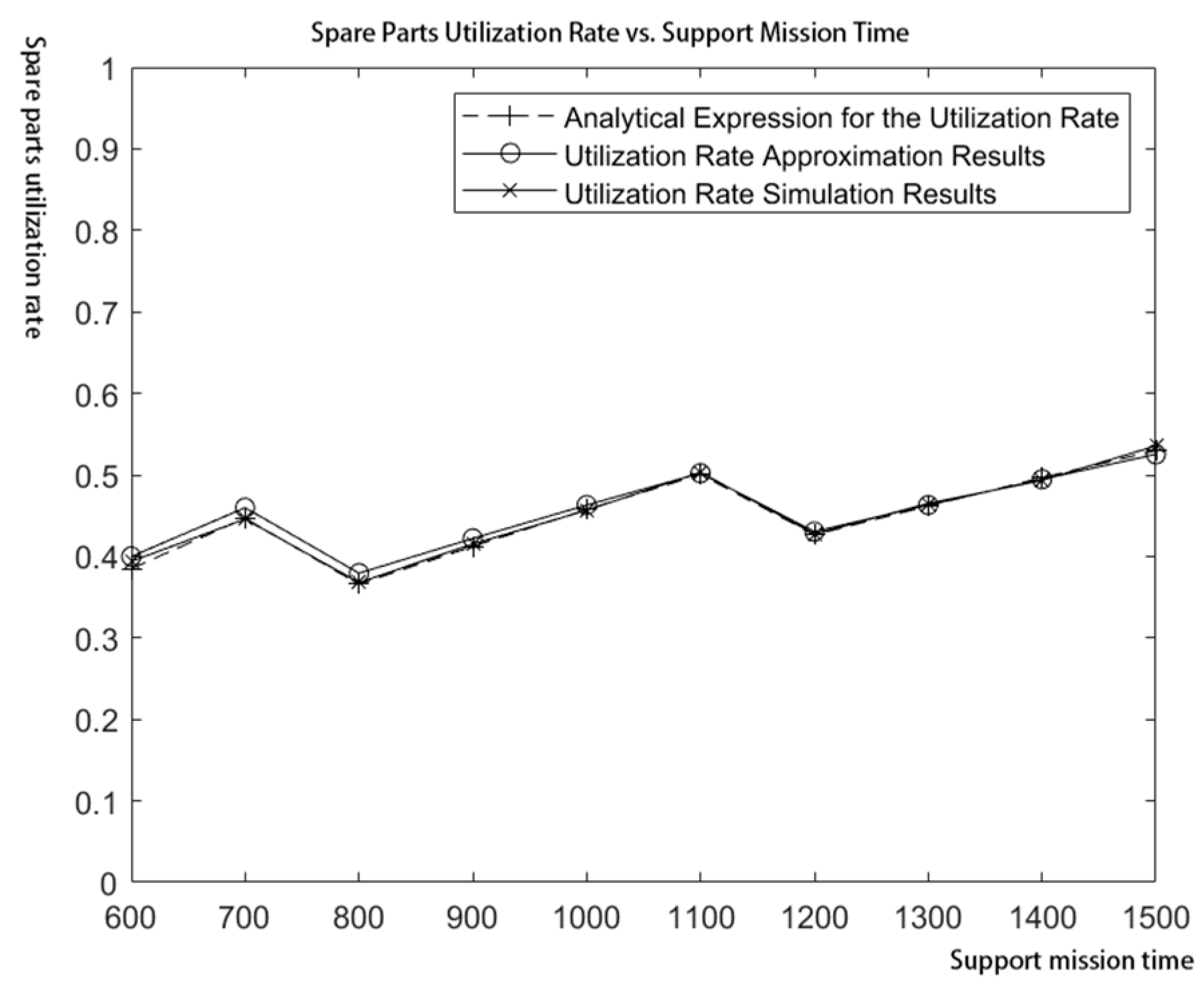
For comparison purposes, the number of spare parts obtained by the approximation algorithm was selected as the spare parts configuration scheme, and three spare parts utilization rate calculation methods were employed for computation. The utilization rate calculation results are presented in Table 2, and the curve showing utilization rate variation with support mission time is illustrated in Figure 1.
According to Table 1, the errors among the three spare parts utilization rates are e r r 12 = max L 1 L 2 = 0.0148 ,   e r r 13 = max L 1 L 3 = 0.0088 , and   e r r 23 = max L 2 L 3 = 0.0140 , respectively.
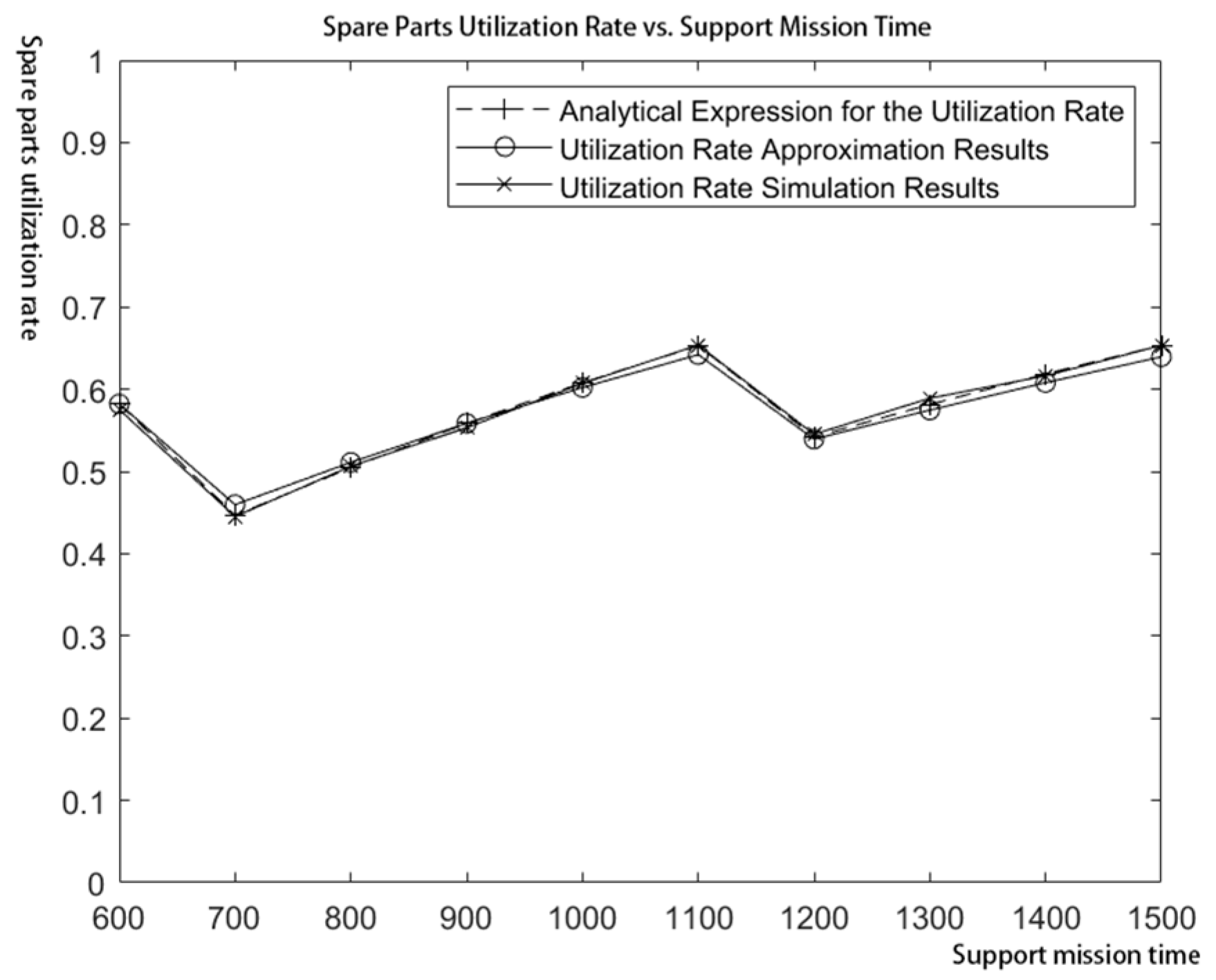
Given a spare parts support probability requirement P 0 of 0.75, the method for determining the spare parts configuration scheme remains the same as when P 0 is 0.9. The calculation results of the spare parts utilization rate are shown in Table 3, and the curve showing the variation in the utilization rate with support mission time is illustrated in Figure 2.
As shown in Table 3, the errors between the spare parts utilization rates are   e r r 12 = 0.0129,   e r r 13 = 0.0076, and   e r r 23 = 0.0145, respectively.
According to Table 2 and Table 3, Figure 1 and Figure 2, under given spare parts support probability requirements, the spare parts utilization rate increases in stages with the extension of support mission time. The primary reason lies in the variation in spare parts configuration quantities. When the spare parts configuration quantity remains constant, the extension of the support mission duration leads to an increase in the consumption of spare parts, thereby resulting in a concomitant rise in the utilization rate. The three calculation results of the spare parts utilization rate demonstrate high consistency, with the maximum error being 0.0148 when the support probability requirement is 0.9, and 0.0145 when the support probability requirement is 0.75, with errors at the percentage level. Therefore, it can be concluded that the analytical expression calculation method for the spare parts utilization rate is correct, and the approximate algorithm is effective in engineering practice.

3.3. Analysis of the Impact of Parameters on the Theoretical Calculation of Gamma-Type Spare Parts

The previous sections analyzed the spare parts utilization rate through analytical, approximate, and simulation calculations, discussing the convergence among these three methods. To examine the robustness of the research model, this section investigates changes in the utilization rate when parameters are varied in the theoretical calculation for Gamma-type spare parts. Using a spare part with a lifetime distribution of T   Γ ( 1.3 , 0.002 ) as an example, and given a support mission duration 600 : 100 : 1500 and a required spare parts support probability P 0 of 0.9, Table 4 presents the variation in the spare parts utilization rate when parameter α is adjusted by specific percentages while parameter λ remains unchanged. Specifically, parameter α is increased or decreased by 2%, 4%, 6%, 8%, and 10% from its baseline value. The utilization rate error is defined as the maximum absolute error resulting from these variations, as shown in Table 4.
As can be seen from Table 4, for the given support mission times, the variation in parameter α has only a minor impact on the theoretical utilization rate, with most calculation errors remaining within 0.1. However, a support duration of 800 h exhibits relatively significant deviations caused by parameter changes. This is because the variation in the parameter leads to a change in the configured quantity, which consequently alters the utilization rate. Similarly, this phenomenon is observed in certain cases of parameter variation at support durations of 900 h, 1200 h, 1300 h, and 1400 h. Although the utilization rate error exceeds 0.1 in some instances, the majority of cases maintain an error below this threshold, demonstrating that the model is acceptable for practical engineering applications.
Similarly, Table 5 presents the variation in the spare parts utilization rate when parameter   λ is adjusted by specific proportions while parameter α remains constant. Specifically, parameter   λ is increased or decreased by 2%, 4%, 6%, 8%, and 10% from its original value. The utilization rate error is calculated as the maximum absolute value of the errors resulting from these parameter variations, as shown in Table 5.
As observed in Table 5, variations in parameter   λ also result in only minor errors in the theoretical utilization rate for the given support mission times, with most errors remaining within 0.1. Similarly, at a support duration of 800 h, parameter variations cause relatively larger deviations, which can be attributed to the change in the configured quantity of spare parts induced by the parameter adjustment. An analogous pattern is observed under certain parameter variation scenarios at support durations of 900 h, 1200 h, 1300 h, and 1400 h. Although the utilization rate error exceeds 0.1 in some instances, the majority of cases still exhibit errors below this threshold, indicating that the model is acceptable for practical engineering applications.

3.4. Approximate Algorithm and Analysis of Weibull-Type Spare Parts Utilization Rate

In addition to Gamma-type spare parts, Weibull-type spare parts are also commonly found in marine equipment. Let the lifetime be T W m , η , and its probability density function [17] is expressed as:
f ( t ) = m η ( t η ) m 1 e ( t η ) m , t 0
where m is referred to as the shape parameter, with m > 0 , and η is referred to as the characteristic life.
The density function expression (23) for Weibull-type spare parts cannot be used to calculate the Laplace transform expression of the density function in the same manner as the density function expression (3) for Gamma-type spare parts. Therefore, an analytical expression for the spare parts utilization rate cannot be derived as it can be for Gamma-type spare parts. For practical convenience, an approximation algorithm is employed to calculate the utilization rate of Weibull-type spare parts.
The failure rate function of Weibull-type spare parts is λ ( t ) = m η ( t η ) m 1 , with an average life of E = η Γ ( 1 m + 1 ) . By combining Equation (19) and Reference [22], the failure rate λ * of the equivalent exponential-type spare parts is obtained as:
λ * = T m 1 η m , T E E m 1 η m , T > E
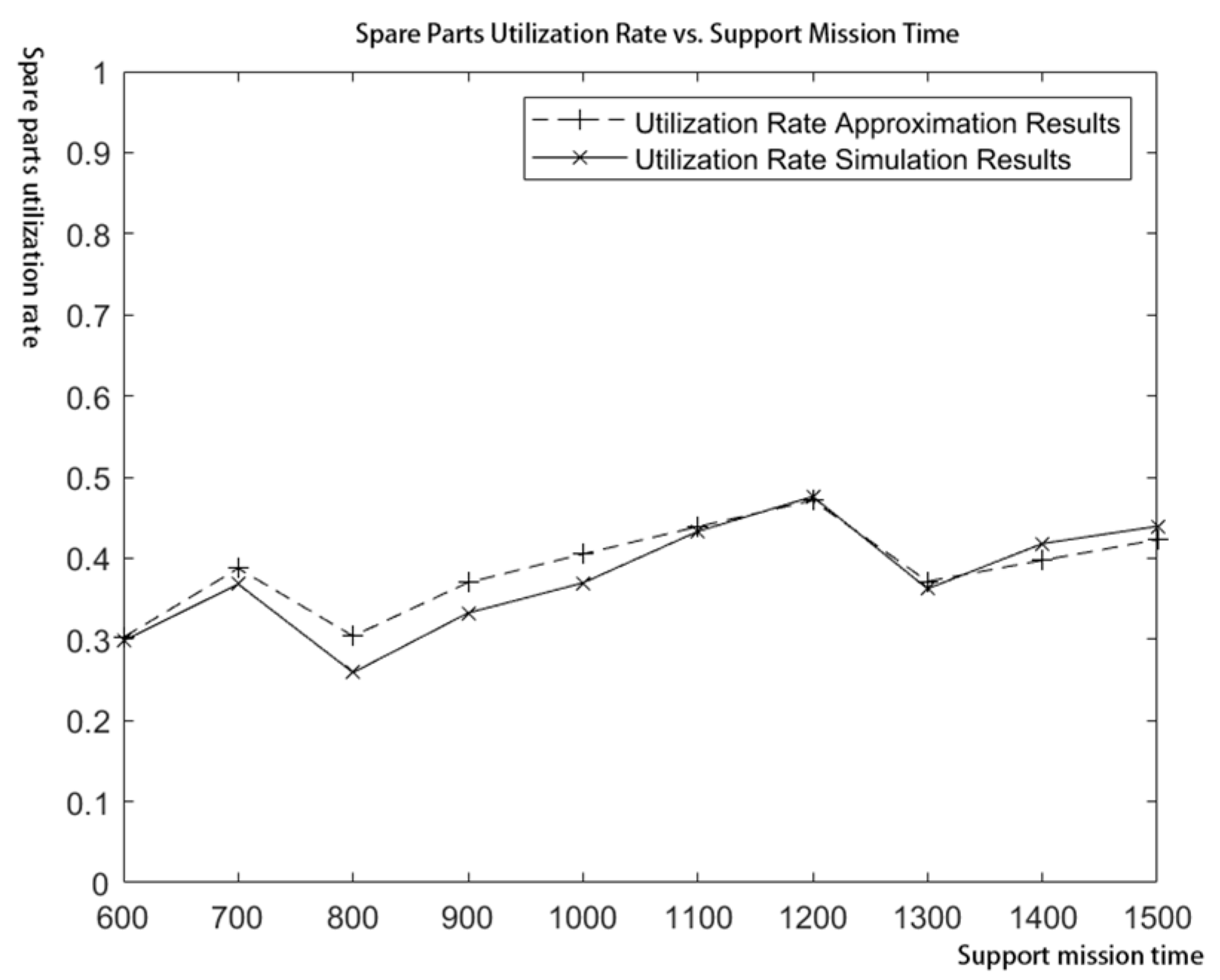
The utilization rate of Weibull-type spare parts is calculated through both simulation analysis and approximate calculation methods to verify the rationality of the approximate algorithm. The component lifetime is set as T W 2 , 1000 , the support mission time is set as 600 : 100 : 1500 , and the spare parts support probability requirement P 0 is set to 0.9. When the support mission time takes different values, the spare parts utilization rates L 2 and L 3 are calculated following steps similar to those used in the approximate algorithm and simulation calculation for Gamma-type spare parts. The spare parts configuration scheme is determined according to the approximate calculation method. The calculation results of the spare parts utilization rate are presented in Table 6, and the curve showing the variation in the spare parts utilization rate with time is shown in Figure 3.
From Table 4, it can be observed that the error between the spare parts utilization rates is   e r r 23 = 0.045.
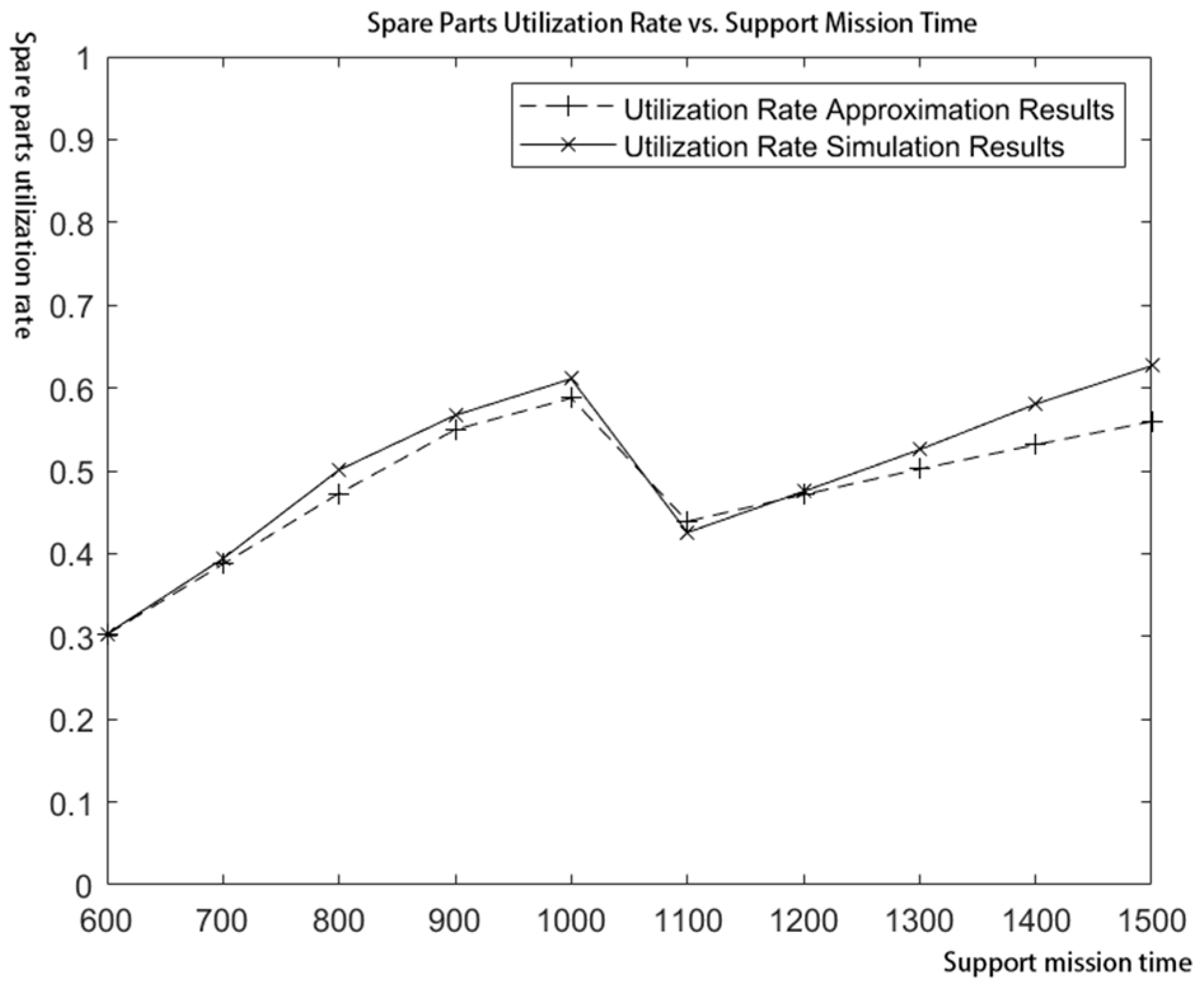
When the spare parts support probability requirement P 0 is 0.75, the calculation results of the spare parts utilization rate are shown in Table 7, and the curve is illustrated in Figure 4.
From Table 5, it can be observed that the error between the spare parts utilization rates is   e r r 23 = 0.0671.
Based on Table 4 and Table 5, as well as Figure 3 and Figure 4, under the condition of a given support probability requirement, as the support mission time increases, the growth trends of the spare parts utilization rate obtained from approximate calculation and simulation results remain essentially consistent. When the spare parts support probability requirements are 0.9 and 0.75, the errors are 0.045 and 0.0671, respectively. The calculation results demonstrate high consistency, indicating that the approximate algorithm is effective.


4. Spare Parts Configuration Optimization Model and Its Solution

4.1. Spare Parts Configuration Optimization Model

In the spare parts configuration process, if only the basic requirement of meeting the spare parts support probability is considered, the spare parts configuration optimization model aims to ensure the availability of spare parts when equipment failures occur as much as possible. To improve support efficiency, the spare parts utilization rate indicator also needs to be considered. Assume that the number of spare parts types for a certain type of equipment is M , the cost corresponding to each type of spare parts is c i , the support probability requirement for each type of spare parts is P 0 i , the support probability for each type of spare parts is P i , the utilization rate requirement for each type of spare parts is L 0 i , the utilization rate for each type of spare parts is L i , the configuration quantity is N i under the given support mission time, spare parts support probability requirements and utilization rate requirements, and the spare parts configuration scheme is N = ( N 1 , N 2 , , N M ) , then the total cost ratio W of the spare parts is:
W = i = 1 M N i × c i × L i i = 1 M N i × c i
Therefore, the spare parts configuration optimization model aims to maximize the total cost ratio while satisfying the requirements of the spare parts support probability and utilization rate, namely:
o b j = max W s . t . P i > P 0 i , L i > L 0 i , i = 1 , 2 , , M

4.2. Model Solution

The spare parts configuration optimization model aims to maximize the cost ratio by identifying the scheme with the highest cost ratio. The specific steps are as follows:
Step 1: Determine the support mission time T , the support probability requirement P 0 i for each type of spare part, and the utilization rate requirement L 0 i according to mission requirements;
Step 2: Identify the types of spare parts and calculate the required quantity of each type under the condition of meeting the support probability requirement, which represents the lower limit of spare parts configuration quantity;
Step 3: Calculate the upper limit of configuration quantity for each type of spare part that satisfies the utilization rate requirement;
Step 4: Select feasible schemes that meet both the spare parts support probability requirement and the utilization rate requirement, and calculate the cost ratio for each scheme;
Step 5: Compare the cost ratios corresponding to different schemes and select the scheme that achieves the maximum cost ratio as the optimal configuration scheme by the spare parts configuration optimization model.

5. Case Study

Suppose it is necessary to determine the spare parts configuration scheme for three types of components in a certain type of marine equipment. The three types of components are exponential-type spare part 1 with a failure rate of 0.002, Gamma-type spare part 2 with a lifetime of   Γ ( 1.3 , 0.002 ) , and Weibull-type spare part 3 with a lifetime of W 2 , 1000 . Among these, spare part 3 is a critical component. The support mission time T is set to 3000 h, and the spare parts support probability requirements are P 01 = 0.7 , P 02 = 0.7 , and P 03 = 0.7 , respectively. The spare parts utilization rate requirements are L 01 = 0.7 , L 02 = 0.65 , and L 03 = 0.6 , respectively. The unit prices of the spare parts are shown in Table 8.
The analytical method is used to calculate Gamma-type spare parts, while the approximate method is applied for Weibull-type spare parts. The spare parts configuration results obtained according to the requirements of the spare parts support probability and utilization rate are shown in Table 9.
Table 9 shows that any combination of the three types of spare parts configurations can satisfy both the spare parts support probability requirement and the utilization rate requirement. Further calculations were conducted to determine different spare parts configuration schemes and their corresponding cost ratios, with the results presented in Table 10. Please refer to Equation (25) for the calculation of the cost ratio.
As shown in Table 8, the cost ratio difference between Scheme 1 and Scheme 5 is minimal. From the perspective of configuration schemes, the difference lies in one exponential spare part, primarily because the unit price of exponential spare parts is relatively lower than the other two types of spare parts. Based on the cost ratio results, Scheme 1 should be selected. From the decision-maker’s perspective, under the premise of meeting the support probability requirements, a configuration scheme with fewer quantities can maximize economic benefits, which further demonstrates the consistency between the cost ratio model and engineering practice.

6. Conclusions

Starting from the statistical definition of the spare parts utilization rate, this study derives its general model and obtains the analytical expression for the Gamma-type spare parts utilization rate. As a special case of Gamma-type spare parts, exponential-type spare parts are investigated, and the relationship between the two calculation formulas is studied. Subsequently, to address the integral calculation problem in the analytical expression of the Gamma-type spare parts utilization rate, an approximate calculation method is proposed. Through failure rate equivalence, the calculation is transformed into that of exponential-type spare parts. Detailed procedures for three methods, namely, analytical expression calculation, approximate calculation, and simulation calculation, are presented for the spare parts utilization rate. Numerical analysis demonstrates the rationality of the analytical expression and the applicability of the approximate method. Furthermore, Weibull-type spare parts, another common non-exponential spare part category, are considered. Due to the special form of their lifetime density function, an approximate algorithm for their spare parts utilization rate is proposed, with numerical calculations illustrating the applicability of the approximate algorithm. Finally, based on the requirements for spare parts support probability and utilization rate indicators, an optimization model for marine equipment spare parts configuration is established. In the practical configuration process of marine spare parts, this method can enhance support efficiency. However, this study only discusses the calculation of the spare parts utilization rate for individual components. Future research can be extended to specific marine systems, investigating system support probability and system utilization rate for marine systems.

Author Contributions

Conceptualization, Z.G. and Y.Z.; methodology, Z.G.; software, Z.G. and Y.Z.; validation, Z.G., Y.Z. and S.S.; formal analysis, Z.G.; investigation, Z.G.; resources, Y.Z. and S.S.; data curation, Z.G.; writing—original draft preparation, Z.G.; writing—review and editing, Y.Z.; visualization, S.S.; supervision, S.S.; project administration, Y.Z.; funding acquisition, Y.Z. All authors have read and agreed to the published version of the manuscript.

Funding

This research received no external funding.

Data Availability Statement

The original contributions presented in this study are included in this article. Further inquiries can be directed to the corresponding author.

Conflicts of Interest

The authors declare no conflicts of interest.

References

  1. Huang, Z.; Zhu, Q.; Lius, S.; Zhu, C. Research on forecast model of spare parts consumption. Procedia Eng. 2017, 174, 700–705. [Google Scholar] [CrossRef]
  2. Yang, C.; Xu, Q.; Qin, H.; Xuan, K.C. Grey forecasting method of equipment spare parts demand based on swarm intelligence optimization. In Proceedings of the 2021 IEEE 5th Advanced Information Technology, Electronic and Automation Control Conference (IAEAC), Chongqing, China, 12–14 March 2021. [Google Scholar]
  3. Van der Auweraer, S.; Boute, R. Forecasting spare part demand using service maintenance information. Int. J. Prod. Econ. 2019, 213, 138–149. [Google Scholar] [CrossRef]
  4. Bounou, O.; Barkany, A.E.; Biyaali, A.E. Stochastic and deterministic Petri networks model for joint management model for spare parts and maintenance: Simulation study. Int. J. Eng. Res. Afr. 2020, 46, 180–188. [Google Scholar] [CrossRef]
  5. Liao, W.; Ye, G.; Yin, Y.; Yan, W.; Ma, Y.; Zuo, D. The inventory of spare parts prediction based on LSTM for large data and a short replacement cycle. In Proceedings of the 2020 IEEE/ACS 17th International Conference on Computer Systems and Applications (AICCSA), Antalya, Turkey, 2–5 November 2020. [Google Scholar]
  6. Rastorguev, G.A.; Elerian, F.A. Spare parts management for the repair of machine tools using fuzzy logic approach. MEJ-Mansoura Eng. J. 2020, 39, 14–21. [Google Scholar]
  7. Monaghan, M.W. When will spares run-out? In Proceedings of the 2015 Annual Reliability and Maintainability Symposium (RAMS), Palm Harbor, FL, USA, 26–29 January 2015. [Google Scholar]
  8. Zhang, R.; Liu, C.L.; Shao, H.W.; Zhou, H.F.; Zhang, J. Multi-constraint optimization of shipboard spare parts configuration based on improved particle swarm algorithm. Ship Electron. Eng. 2023, 43, 102–108. [Google Scholar]
  9. Huang, J.F.; Luo, W.; Wang, B.Y.; Zhou, Y.P.; Ji, G.D. TBM spare parts classification inventory and configuration optimization method. Railw. Constr. Technol. 2024, 2, 5–9. [Google Scholar]
  10. Wang, X.R.; Tang, S.K.; Yang, J.J. A Prediction Method for Spare Parts Support Rate and Utilization Rate Based on BP Neural Network. Mod. Def. Technol. 2025, 53, 175–182. [Google Scholar]
  11. Kang, Z.X.; Zhou, D.; Li, H.X.; Guo, Z.Y.; Chen, C.Z.; Song, Z.C. Aircraft Condition-Based Dynamic Planning Technology for Spare Parts. J. Beijing Univ. Aeronaut. Astronaut. 2024, 50, 276–285. [Google Scholar]
  12. Yang, H.Q.; Qiu, Y.; Li, Y.; Cao, L.; Xia, T.B. Multi-objective Spare Parts Dynamic Inventory Control Strategy Considering Turnover Rate. Manuf. Autom. 2025, 47, 77–86. [Google Scholar]
  13. Wang, J.L.; Lou, J.J.; Ruan, M.Z.; Li, H. Mission-oriented calculation model of utilization rate for ship equipment spare parts. Syst. Eng. Electron. 2023, 45, 1420–1428. [Google Scholar]
  14. Li, H.; Li, Q.M.; Luo, Y. Research on relationship between probability of spare sufficiency and utilization ratio of spare parts. Mine Warf. Ship Self-Def. 2016, 24, 9–12. [Google Scholar]
  15. Ying, X.Y.; Zhang, Z.H.; Jin, Z. System of spare parts utilization rate and configuration optimization scheme of spare parts. Command Control Simul. 2015, 37, 134–138. [Google Scholar]
  16. Wei, S.H.; Chen, Y.Q.; Jin, J.S. Analysis and comparison for influencing factors of the utilization between single item method and system method. Fire Control Command Control. 2017, 42, 49–52. [Google Scholar]
  17. GJB1909A-2009; Demonstration of Reliability Maintainability and Supportability Requirements for Materiel. The General Armament Department of the PLA: Beijing, China, 2009.
  18. Shao, S.S. Shipboard Spare Demand Forecast and Carrying Concept Based on Mission Success. Master’s Thesis, Naval University of Engineering, Wuhan, China, 2020. [Google Scholar]
  19. Zhai, Y.L.; Zhang, Z.H.; Shao, S.S. Probability model and applicability analysis of ship spare parts utilization rate. Ship Electron. Eng. 2022, 42, 124–129. [Google Scholar]
  20. Zhai, Y.L.; Qi, R.; Shao, S.S. Calculation and application of ship spare parts utilization rate under periodic supply conditions. Comput. Simul. 2025, 42, 16–21. [Google Scholar]
  21. Zhang, Z.H. Reliability Theory and Engineering Application; Science Press: Beijing, China, 2012; p. 1. [Google Scholar]
  22. Liu, T.H.; Zhang, Z.H.; Li, D.W.; Li, H. An improved algorithm for demand of Weibull multi-component spare parts. J. Nav. Univ. Eng. 2012, 4, 41–45. [Google Scholar]
Figure 1. Variation curve of the type   Γ ( 1.3 , 0.002 ) spare parts utilization rate over time when the support probability requirement is 0.9.
Mathematics 14 00035 g001
Figure 2. Variation curve of the type   Γ ( 1.3 , 0.002 ) spare parts utilization rate over time when the support probability requirement is 0.75.
Mathematics 14 00035 g002
Figure 3. Variation curve of the type W 2 , 1000 spare parts utilization rate over time when the support probability requirement is 0.9.
Mathematics 14 00035 g003
Figure 4. Variation curve of the type W 2 , 1000 . spare parts utilization rate over time when the support probability requirement is 0.75.
Mathematics 14 00035 g004
Table 1. Calculation results of the type   Γ ( 1.3 , 0.002 ) spare parts configuration quantity when the support probability requirement is 0.9.
T 600 h700 h800 h900 h1000 h1100 h1200 h1300 h1400 h1500 h
N 1 2223333444
N 2 2233344445
N 3 2223333444
Table 2. Calculation results of the type   Γ ( 1.3 , 0.002 ) spare parts utilization rate when the support probability requirement is 0.9.
T 600 h700 h800 h900 h1000 h1100 h1200 h1300 h1400 h1500 h
L 1 0.38500.44680.36580.41240.45740.50070.42650.46190.49640.5300
L 2 0.39980.45970.37940.42200.46290.50210.43040.46300.49460.5253
L 3 0.39380.44570.36800.41520.45650.50310.42750.46490.49330.5356
Table 3. Calculation results of the type   Γ ( 1.3 , 0.002 ) spare parts utilization rate when the support probability requirement is 0.75.
T 600 h700 h800 h900 h1000 h1100 h1200 h1300 h1400 h1500 h
L 1 0.58210.44680.50470.55850.60790.65300.54210.58140.61860.6535
L 2 0.58210.45970.51100.55850.60210.64200.53930.57460.60800.6395
L 3 0.57530.44520.50640.55320.60710.65360.54520.58900.61630.6534
Table 4. Impact analysis of parameter α on the theoretical calculation of Gamma-type spare parts.
T 600 h700 h800 h900 h1000 h1100 h1200 h1300 h1400 h1500 h
2%0.01030.01070.14970.01020.01060.01090.12660.01060.01090.0111
4%0.02080.02150.11790.02080.02150.02190.13770.09810.02210.0224
6%0.07310.04780.16410.15160.13930.03130.12840.12100.11360.0320
8%0.04260.04380.09750.10470.04400.04470.07360.07730.08010.0457
10%0.09570.07100.18770.17530.06260.05110.15260.14540.06990.0521
Table 5. Impact analysis of parameter   λ on the theoretical calculation of Gamma-type spare parts.
T 600 h700 h800 h900 h1000 h1100 h1200 h1300 h1400 h1500 h
2%0.00770.00840.14780.0083000890.00940.12520.10950.00960.0100
4%0.01540.01690.15660.01660.01780.01880.13480.09940.01920.0200
6%0.02310.02550.11170.02500.02680.02840.14410.08900.02890.0302
8%0.03100.03420.10230.10780.03590.03800.07590.07860.03870.0404
10%0.03880.04290.09290.09790.04500.04770.06570.06800.06960.0507
Table 6. Calculation results of the type W 2 , 1000 spare parts utilization rate when the support probability requirement is 0.9.
T 600 h700 h800 h900 h1000 h1100 h1200 h1300 h1400 h1500 h
L 2 0.30230.38740.30400.37000.40510.43890.47120.37140.39740.4229
L 3 0.29800.36800.25900.33250.36950.43300.47600.36230.41800.4393
Table 7. Calculation results of the type W 2 , 1000 spare parts utilization rate when the support probability requirement is 0.75.
T 600 h700 h800 h900 h1000 h1100 h1200 h1300 h1400 h1500 h
Approximate calculation0.30230.38740.47270.54960.58780.43890.47120.50200.53140.5594
Simulation calculation0.30300.39400.50100.56700.61100.42550.47500.52550.58050.6265
Table 8. Spare parts lifetime distribution types and unit prices.
Spare Part TypeSpare Parts Support Probability Requirement Spare Parts Utilization Rate RequirementUnit Price/Yuan
Spare Part 10.70.71500
Spare Part 2 0.70.653540
Spare Part 3 0.70.64500
Table 9. Range of theoretical calculation configuration schemes for each spare part.
Spare Part TypeSpare Part 1Spare Part 2Spare Part 3
Minimum configuration quantity meeting support probability requirements753
Maximum configuration quantity meeting utilization rate requirements864
Table 10. Spare parts configuration schemes and their corresponding cost ratios.
Scheme No.Number of Exponential Spare PartsNumber of Gamma Spare PartsNumber of Weibull Spare PartsCost Ratio
17530.7552
27540.7086
37630.7183
47640.6784
58530.7379
68540.6944
78630.7035
88640.6660
Disclaimer/Publisher’s Note: The statements, opinions and data contained in all publications are solely those of the individual author(s) and contributor(s) and not of MDPI and/or the editor(s). MDPI and/or the editor(s) disclaim responsibility for any injury to people or property resulting from any ideas, methods, instructions or products referred to in the content.