


Abstract
Nowadays, resource utilization and management are very important for businesses. They try to make a profit by providing high levels of efficiency from available sources. Their labor force is one of these sources. Therefore, scheduling based on personnel satisfaction has become an important problem in recent years. In this study, a case study was carried out in a glass factory in Ankara which has 7 department and 80 personnel. The aim of the study is to provide better service by distributing personnel to shifts in a fair and balanced manner. Assignment points are different for the departments where the personnel will work. Every personnel member is assigned to the department as best as possible. A goal programming method was used, and the results were better than those obtained using other methods.
1. Introduction
Today, resource utilization and management is very important for businesses. They try to make a profit by providing high levels of efficiency from available sources. Their labor force is one of these sources. The human factor has different demands and expectations than other sources, and it increases the level of interest in this field. The shift scheduling problem, which is a sub-problem of personnel scheduling, is the most frequently studied problem from past to present. The shift scheduling problem, which is encountered in industries, enterprises, hospitals and many other places, is an important problem. To solve this problem, we aimed to provide better service by distributing personnel to shifts in a fair and balanced manner. In addition, the shift scheduling problem provides more income for institutions and organizations by improving employee wages, overtime and break times [1].
The problem becomes complicated if the solution to the shift scheduling problems is about increasing the satisfaction level of the employee and the enterprise. In terms of business, the seniority levels, knowledge and skills of the personnel are taken into consideration, and from the point of view of the personnel, expectations are met. Being one of the conditions that the parties want to provide for each other, it becomes difficult to solve the problem manually. Goal Programming is a mathematical programming method which aims to simultaneously provide multiple and conflicting goal constraints. As with other mathematical programming methods, the optimal solution is not the result. It works to minimize the deviation variables added to the goal constraints. So, the results are displayed as the closest to the targeted value or values.
In this study, 80 personnel and 7 departments (cutting (1), sanding (2), grinding (3), tempering (4), laminating (5), double glazing (6), shipment (7)) in a glass factory were used. In practice, the shifts of personnel working in the factory are scheduled. In the table consisting of two shifts, besides the provision of the number of personnel needed for the shift, the knowledge, skills and requests of the personnel were taken into consideration. The question was asked which personnel should be assigned to which shift for which department. Improvements were made according to the table prepared in the current situation.
In the second part of the study, shift scheduling is examined; in the third part, goal programming (GP) is discussed. The fourth part comprises a literature review, the fifth part a case study, and the last part presents the results.
2. Shift Scheduling
One situation in which staff scheduling problems are commonly encountered is shift scheduling. During the planning period, personnel perform certain activities such as work, rest, eating and taking tea breaks, week holidays and annual leave. These activities should occur within the framework of certain rules and laws. The equitable and balanced distribution of the personnel to the shifts is called shift scheduling. Businesses and institutions can make a profit by providing a good chart and a high yield.
Shift scheduling problems have been very widely discussed in the literature. The first integer mathematical model for shift scheduling was developed by George Dantzig in 1954, and the second by Elbridge Keith in 1979. In the academic literature, the model developed by Dantzig on shift scheduling and that developed by Keith in commercial studies have attracted the most attention [2].
In shift schedules, it is sometimes desirable to employ personnel mainly in the fields of business or departments where they are experts. Considering both the shift scheduling of these problems and the employment of the personnel in the fields where they are experts, it takes a long time to find an optimal solution. In addition, it is very difficult to deal with this problem manually, even by a skilled person. Developing a mathematical model for such problems is of benefit in every respect [3].
3. Goal Programming Method
Goal programming is a type of multi-purpose programming model. Model constraints are written by adding deviation variables to the targeted constraints, except for the indispensable constraints when creating the model. The aim is to minimize deviation variables in goal constraints. It is expected that multiple objectives will be provided at the same time in the models created using goal programming. At the same time, deviations of constraints can be minimized by converting these objectives into constraints and ranking them according to their importance [1].
It is not always possible to achieve every goal determined by the target programming method. Optimal results are selected from the among the most satisfactory. Targets are created for the selected solution. The priorities for the created target are determined. By performing these steps, the model is provided in general. Finally, the solution is determined.
The mathematical representation of the goal programming is as follows [4].
Variables
- decision variable,
- coefficients of ith goal in variable j,
- desired goal value of the ith goal,
- the deviation values in the positive directions from the ith goal,
- the deviation values in the negative directions from the ith goal,
4. Literature Review
In the literature, there are many comprehensive studies on shift scheduling and staff/personnel scheduling. In [5], Gungor proposes an integer linear model for nursing scheduling in a hospital that is open 24 h a day, 7 days a week, where all nurses were staffed and worked for 40 h per week. The model consists of two stages. First, the minimum number of nurses that need to be fulfilled, and how many of them could be a student nurse is determined; then, a work and holiday schedule for a period of 2 weeks is designed. Bard et al. [6] modeled the tour scheduling problem in the United States Postal Service using integer programming. They added the restrictions set by a trade union agreement to the model. They presented scenarios that aimed to reduce the size of the workforce by producing solutions in 1 h. Wong and Chun [7] examined the nursing scheduling problem using a probability-based technique. As a result of their work, they brought solutions to the problem in a short time and presented appropriate charts. Azaiez and Sharif [8] developed a model for a computerized 0-1 Goal Programming method for nurse scheduling. This model is adapted to a hospital program in Saudi Arabia. The model prevents unnecessary overtime costs when considering hospital goals and nurse preferences. It is also implemented over a six-month period. Seckiner et al. [9] presented the hierarchical workforce scheduling problem with an integer programming model. When they compared the results between the current model and the solved model, they found that worker costs had been reduced. Personnel assigned to a single shift in the previous model can be assigned to alternate shifts by the proposed model. The model provides flexibility to the decision maker. Sungur, et al. [2], using the integer programming method, aimed to reduce labor costs and enabled employers to assign shifts in the most appropriate way. Castillo et al. [10] aimed to minimize labor costs by including service quality in their work at a call center, as well as achieving optimal staff scheduling. They put forward a multi-criteria paradigm. Olive [11] developed a mathematical model for the manufacturing industry to address personnel scheduling problems; to this end, he used mixed integer programming. The aim of this study is to meet the required number of work hours in different time periods. Topaloglu [12] discussed the problem of scheduling medical assistants in a hospital. Assistants are classified according to their seniority levels. The model is solved and scheduled for six months with goal programming. When the results are examined, better performance is shown compared to manual methods. Heimerl and Kolisch [13] discussed the labor planning problem in multiple projects using mixed integer linear programming. The aim of integer linear programming is to minimize labor costs. In terms of solution results, it has received better results than simple heuristic methods. Karaatli [14] studied the health sector and worked on the nursing scheduling problem in which work hours were 24/7. Fuzzy linear programming has benefited from genetic and heuristic algorithms; the results differed according to the methods. Koruca [15] developed a simulation-supported shift planning module in a small-scale enterprise manufacturing central heating boilers. In order to determine the situation, he undertook study and data collection. As a result of the study, four different shift plan scenarios suitable for possible crisis environments were presented. Atmaca et al. [16] determined the number of nurses who needed to be assigned to shifts in a hospital while increasing hospital efficiency, ensuring customer satisfaction and minimizing costs. Then, they compared the results obtained from current methods and the proposed model. Bag et al. [17] addressed the problem of nurse scheduling in a state hospital in Kirikkale using 0-1 goal programming and the Analytical Network Process (ANP) method. They solved the model with 0-1 goal programming and used ANP to determine the weight in goal programming. They used 5 goals in the study. They compared the solution results to the previous situation. Bektur and Hasgul [18] applied this technique to restaurant taking into account the staff, seniority levels and system staff. The objective function of the model is to minimize deviations from loose constraints according to seniority levels. The proposed model gave better results than current methods. Desert [19] examined the problem of labor recruitment using the goal programming method. A schedule for employees in a restaurant, seniority levels, preferences and shifts in accordance with the preferences of the day was made. Unal and Eren [20] addressed the problem of scheduling personnel in a government agency. They used the weighted goal programming method by considering the demands of the personnel, and solved the model with the GAMS 22.5 package program. As a result, the personnel were assigned according to their seniority levels, and most importantly, they were assigned shifts on their preferred days. More effective charts were prepared in a shorter time with the model. Ozcan et al. [4], in a large-scale hydroelectric power plant in Turkey, set a goal programming model by using real data. In the installed model, a 91% improvement was achieved in production stoppages caused by operator errors, taking into account the performance of employees and the requirements of the work. In this study, 3 goal constraints were determined. Ozder et al. [21] provided the best possible cleaning service to a 24-hour university hospital, proposing a monthly chart for 70 staff. They benefited from goal programming as a method. In [3], Varli devised the monthly working schedules of formen working in the bearing sector by considering different scenarios. Goal programming was used as the method. Attempts were made to take the wishes of the formen into account with the least possible level of deviation. The shifts, days and sections used in the scenarios are the same. The different formen numbers are special constraints and goal constraints. In [1], Varli and Eren studied the seniority levels of the workers in a factory using the Analytic Hierarchical Process (AHP) method. They then developed a model with goal programming to meet the number of employees needed for each shift and to make a distribution in a balanced and fair manner. Five goal constraints were used in the study. The same authors [22] aimed to ensure that the supervisory appointments of research assistants in the Faculty of Engineering of Kirikkale University were made in the most appropriate way during the final period. Goal programming was used as the method. Seventy four research assistants were assigned to 741 exams. They also [23] discussed the staff scheduling problem for nurses working in the internal medicine and endocrine departments of a hospital. For the monthly schedule to be created, hospital rules and special permission requests of the nurses were taken into consideration. Once again, the goal programming method was used. As a result of improvements and solutions, service quality is expected to increase. Bedir [24] aimed at reducing production downtime costs from personnel at a hydroelectric power plant by suggesting the use of the 0-1 Priority goal programming model considering personnel competencies. Competencies may be prioritized with the PROMETHEE method. The criteria affecting personnel competences were weighted using the AHP method. As a result of the solution, an 86% improvement was achieved for August 2017, i.e., when the plant was operating most intensively. The studies conducted in the literature have similarities with the present study. In our study, attention was given to the prioritization of personnel competencies. Gur and Eren [25] examined scheduling and planning problems using the goal programming method. As a result of the examination, they categorized the problems with a detailed analysis. Koc [26] aimed at minimizing all direct and indirect costs related to workforce scheduling. The method made use of integer programming. Koctepe [27] created a model for a meeting organization using the 0-1 integer programming method. In a model where personnel competencies are taken into consideration, planning was devised for 2 shifts and 80 personnel for 7 days. As a result of that study, it was determined that personnel satisfaction had increased. Tapkan [28] discussed the task scheduling problem of the Kayseri rail transportation system. Again, the multipurpose 0-1 mixed integer model was used. In the objective function of the mathematical model, the largest difference between the number of staff, the weekly statutory working time of the weekly working hours of the staff, the sum of the overrun periods and the average rest period and the rest period were taken into account. Ozder et al. [29] changed the shifts of personnel using ANP and goal programming methods in a natural gas combined cycle power plant. In order to incorporate the personnel skills into the model, they calculated the seniority levels with the ANP method. They identified 4 levels of seniority among 80 staff members for 3 shifts. The aforementioned studies are presented in Table 1.

Table 1.
Literature review.
5. A Case Study in a Glass Factory in Ankara Province
The present study was carried out in a glass factory operating in the facade sector in Ankara in order to ensure the optimal appointment of personnel to shifts and departments. The factory workday comprises two shifts, i.e., 08:00-18:00 and 22:00-08:00. Personnel change shifts at one week intervals; the factory is closed on Sundays. Seven sections and 80 personnel, in which production goes on continuously, are discussed. When evaluating the existing system, it was assumed that the department and staff were working at full capacity. The relevant sections are cutting (1), sanding (2), grinding (3), tempering (4), laminating (5), double glazing (6) and shipment (7).
Orders from customers are numbered according to the type of product, in other words, according to the last process before the merchandise is made ready for shipment. Materials progress through the work order between the processes. The product range includes flat glass, colored glass, solar and temperature controlled glass, tempered glass, laminated glass and bulletproof glass.
5.1. Product Type
- ❖
- Flat Glass: Flat glass has high light transmittance due to its transparency.
- ❖
- Colored Glass: Colored glass is obtained by adding colorants to the glass paste; available in green, smoked, bronze and blue.
- ❖
- Solar and Heat Controlled Glass: This is a type of glass with different aesthetics and designs that can save energy.
- ❖
- Tempered Glass: A type of glass whose durability and resistance to thermal stresses are 5 times higher than those of flat glass. Areas of application are generally glass railings and doors, walk-in showers, intermediate compartments, glass furniture, refrigerator and oven windows, and side and rear windows of automobiles.
- ❖
- Laminated Glass: Two or more glass plates are produced by combining special binder polyvinyl butyral (PVB) layers under heat and pressure. This process minimizes the risk of glass breakage by keeping the pieces in place in such an event. It contributes to sound insulation.
- ❖
- Bullet Proof Glass: Bulletproof glass is aimed at preventing crime and facilitating the capture of the criminal after the action. Areas of use are banks, police stations, museums, military buildings and other official organizations, psychiatric wards, jewelers and so on. This category comprises polyvinyl butyral (PVB) or polycarbonate interlayer laminated glass.
5.2. Production Rotation
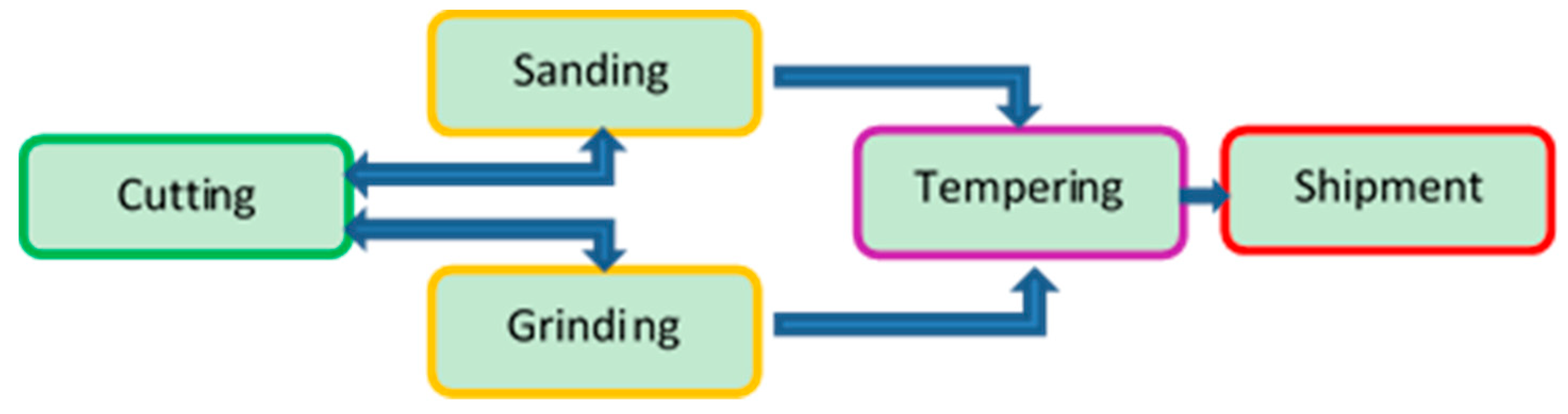
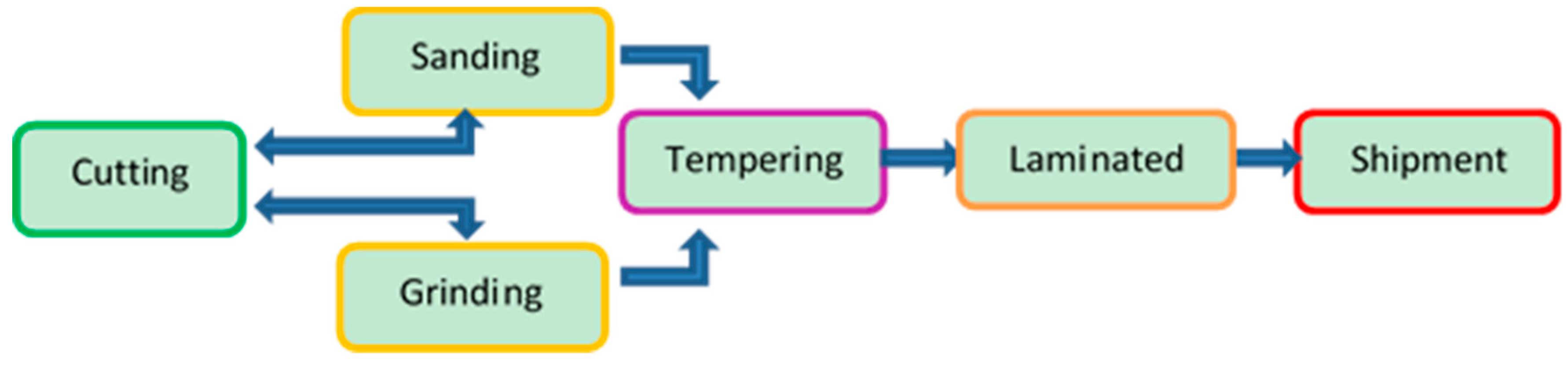
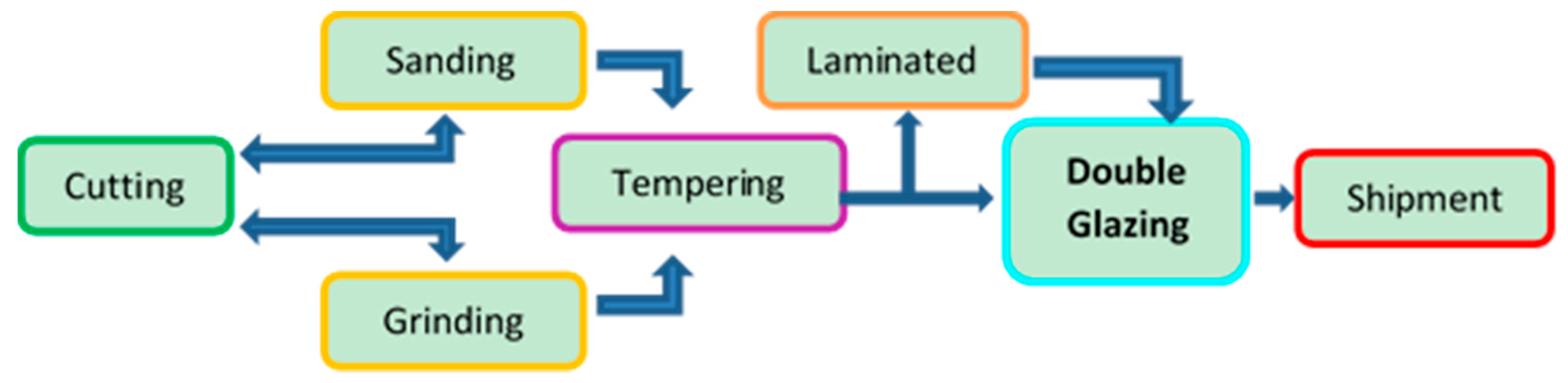
The order number is determined according to the process after which the glass will be ready for dispatch. Routes are created according to the following order numbers. The routes to be determined are cutting, grinding, tempering, laminating and double glazing. Glass is usually prepared by following these routes, except for cases of special orders. The following routes are shown in a flow chart. Routes of the products are shown in the flow charts given in Figure 1 for cutting, Figure 2 for grinding, Figure 3 for temper, Figure 4 for laminate and Figure 5 for double glazing glass.
Cutting Section Route; Cutting-Shipment

Figure 1.
Cutting flow chart.
Figure 1.
Cutting flow chart.

Grinding Section Route; Cutting- Grinding-Shipment

Figure 2.
Grinding flow chart.
Figure 2.
Grinding flow chart.

Temper Section Route; Cutting-Sanding Or Grinding-Tempering-Shipment
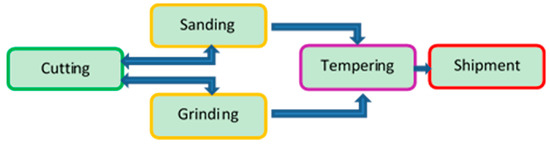
Figure 3.
Tempering flow chart.
Figure 3.
Tempering flow chart.
Laminating Section Route; Cutting-Sanding Or Grinding-Tempering-Laminated-Shipment
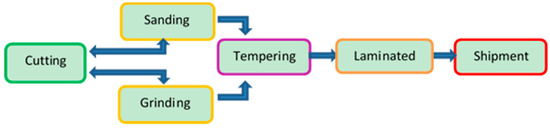
Figure 4.
Laminating flow chart.
Figure 4.
Laminating flow chart.
Double Glazing Section Route; Cutting-Sanding Or Grinding-Tempering-Double Glazing-Shipment
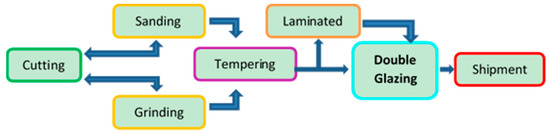
Figure 5.
Double glazing flow chart.
Figure 5.
Double glazing flow chart.
5.3. List of Personnel
The factory has a total of 80 personnel. In practice, each personnel member receives points for each department. These scores are determined according to the opinions of experts. There scale is 1 to 3 points, according to the sections to be assigned. In the determined section, we tried to restricted to system to a maximum of 5 points. The model uses the minimum objective function; 1 point indicates that the competence level is greater than 2, while 3 points indicates that an employee is not competent in that section. The points obtained according to the personnel list and the sections are given in Table A1 in Appendix A section.
5.4. Mathematical Model
5.4.1. Parameters
- n: number of personnel working in the factory, n = 80
- m: number of days, m = 30
- s: Number of sections in the factory, s = 7
- t: Number of shifts, t = 2
- i: Personnel index, i = 1,2,…,n
- j: Day index, j = 1,2,…,m
- k: Section index, k = 1,2,…,s
- l: Shift index, l = 1,2,…,t
5.4.2. Decision variables
5.4.3. Constraints
1-To meet the daily personnel needs of the departments:
Number of personnel needed for each shift in the cutting(1) section.
Number of personnel needed for each shift in the sanding(2) section.
Number of personnel needed for each shift in the grinding(3) section.
Number of personnel needed for each shift in the tempering (4) section
Number of personnel needed for each shift in the laminating (5) section
Number of personnel needed for each shift in the double glazing (6) section
Number of personnel needed for each shift in the shipment (7) section
2- Only one shift per personnel per day:
3- personnel not working on the day of leave:
4- Each personnel member has a minimum of 1 and a maximum of 2 days a week.:
5-Upper limit for each personnel to work on 1 and 2 shifts:
6- Lower limit restrictions for each personnel on 1 and 2 shifts:
7- If an employee were assigned to the night shift on a given day, the next day’s shift in the morning shift would be limited:
5.4.4. Goal Constraints
Goal 1: Goal constraint where personnel are asked to minimize the assignment as day of leave-workday-leave when being assigned shifts:
Goal 2: Goal constraint where personnel are asked to minimize the assignment of working day-tracking-working day when being assigned to shifts:
Goal 3: Goal constraint on which the total number of vacancies for which each personnel is assigned is intended to be as equal as possible:
Goal 4: Personnel assigned to the departments in each shift will provide the required sum of points as a qualification:
5.4.5. Objective Function
5.5. Model Solution
First of all, general constraints and goal constraints are determined for the mathematical model. The current system was examined and the number of personnel needed by the departments was changed. Personnel are also allowed to leave on Sundays. Deviations in goal constraints were minimized and the objective function was created. The solutions used in the solution of the mathematical models were obtained using ILOG version 12.6.2. As a result of the solution, 30-day work schedules for 80 personnel were created. The suggested data is given in Table A2 in Appendix B. The solution produced using the proposed model was compared to that produced using current methods. The total competence score of the personnel working in the departments was divided by the number of people required in that department, and the shift labor force was created. The current system is given in Table 2 and the proposed system is given in Table 3.
Table 2.
Average workforce in the current system.
Table 3.
Average workforce in the proposed model.
In the current system, it is assumed that the factory was operating at full capacity. Staff are only allowed a day off on Sundays. Persons are generally requested to work in the department in which they are employed. A task assignment is made to meet needs rather than special talents; that is why the average labor force is constant for each department, every week and for every shift.
For a sample average workforce calculation from the table, the 8th day shift of the sanding section will be considered; on that day, 2, 18, 34, 75 staff members were assigned. The total score of the assigned personnel for the sanding section was 2 + 2 + 3 + 3 = 10. The score obtained was divided by the number of staff required by the department, and the average workforce was found. This is equal to 10/4 = 2.5.
With the proposed model, specific qualification scores have been defined for each department. Personnel can be assigned to different departments to provide a qualification score. The flexibility of work on different parts by the person provided flexibility for the day of leave. Thanks to our model, the shortage of authorized personnel was addressed. Thus, production can continue without stopages. The average workforce changes daily for each shift.
6. Conclusions
In the factory, we aimed to determine morning and evening shifts for 7 personnel and 80 personnel. Firstly, the number of personnel needed by each departments is emphasized. The number of personnel changed by taking into consideration that the right employee needs to be assigned to the appropriate department. In the current system, 4 staff are required for cutting, sanding, and grinding, 5 are needed for tempering, 7 for laminating, 10 for heaters and 6 for shipments. In the proposed system, these numbers are 3 for cutting, sanding, grinding, 4 for tempering, 6 for laminating, 8 for heaters and 5 for shipments. On Sunday, the personnel permits were distributed. Thus, the factory, which is in need of production, was allowed to operate on Sundays. In terms of the average labor force, only 5 of the 420 shifts did not achieve the desired result within a monthly planning period. In other shifts, the result was quite successful compared to the current situation. Every personnel member was assigned to only one shift during the day and no appointment was made on that employee’s day of leave. Personnel were rated between 1 and 3 according to the departments to be assigned. One point indicates that the employee is more than competent for that part, 2 points indicates that he/she is moderately competent, and 3 points indicates insufficient competence. The assignment was restricted by giving 5 points for cases where personnel appointments were not requested. The upper and lower limit numbers can be determined and the distribution is equal for the morning and evening shifts. The personnel who worked a night shift were prevented from being assigned to the day shift the next day, as this would cause require more than 24 h of work withour a rest. In addition to this, it was desireable that the total number of shifts assigned to the personnel during the one-month planning period be the same, and that these appointments should be sequential around the day of leave. Finally, in order to achieve a certain level of points among the personnel assigned to the departments, a specific score for each department was given. The targets were gathered in one place and the objective function was established. Deviations from the target values determined by the goal programming method were very small. In this way, the most suitable shifts and departments could be assigned on the appropriate days by taking into consideration the talents of the personnel. The aim of the goal programming method is to perform multiple goals simultaneously.
In the existing system used in the factory, personnel are divided into two separate teams; each shift team is divided into 7 sections. The teams change at one week intervals. Each team should comprise only from competent people. Generally, a sufficient number of qualified persons are assigned to each section and the remaining personnel are used to complete the task; however, in this way, full efficiency cannot be achieved. The competence of the departments was improved with the proposed new model. Personnel were used more effectively being better assigned, and the satisfaction levels of the personnel increased. As a result, it was observed that the new system offers better results.
Author Contributions
Ö.K. conceptualized the study, prepared dataset, conducted analyses, contributed to writing the manuscript, and provided modeling processes. H.M.A. supported the solution process of the mathematical model and was a contributor to writing the manuscript. T.E. provided overall guidance and expertise in conducting the analysis and was a contributor to writing the manuscript. All authors read and approved the final manuscript.
Funding
This research received no external funding.
Conflicts of Interest
The authors declare no conflict of interest.
Appendix A
Table A1.
The points of the personnel according to the sections.
Table A1.
The points of the personnel according to the sections.
| Cutting(1) | Sanding(2) | Grinding(3) | Tempering(4) | Laminated(5) | Double Glazing(6) | Shipment(7) | |
|---|---|---|---|---|---|---|---|
| P1 | 1 | 1 | 1 | 5 | 5 | 5 | 2 |
| P2 | 5 | 2 | 2 | 1 | 5 | 5 | 3 |
| P3 | 5 | 1 | 1 | 3 | 5 | 3 | 5 |
| P4 | 5 | 1 | 2 | 2 | 5 | 5 | 3 |
| P5 | 3 | 3 | 5 | 1 | 5 | 5 | 5 |
| P6 | 2 | 5 | 5 | 5 | 1 | 5 | 3 |
| P7 | 5 | 1 | 1 | 2 | 3 | 5 | 5 |
| P8 | 5 | 3 | 3 | 2 | 5 | 1 | 3 |
| P9 | 3 | 2 | 2 | 5 | 1 | 5 | 5 |
| P10 | 5 | 2 | 3 | 5 | 1 | 5 | 1 |
| P11 | 5 | 1 | 2 | 3 | 3 | 5 | 5 |
| P12 | 5 | 1 | 1 | 5 | 5 | 5 | 3 |
| P13 | 1 | 1 | 2 | 2 | 5 | 5 | 3 |
| P14 | 5 | 1 | 2 | 1 | 5 | 5 | 5 |
| P15 | 5 | 1 | 2 | 5 | 1 | 5 | 3 |
| P16 | 5 | 2 | 3 | 1 | 5 | 5 | 1 |
| P17 | 5 | 2 | 3 | 5 | 1 | 5 | 2 |
| P18 | 3 | 2 | 5 | 2 | 5 | 1 | 5 |
| P19 | 5 | 2 | 5 | 2 | 5 | 5 | 1 |
| P20 | 5 | 1 | 2 | 5 | 5 | 2 | 1 |
| P21 | 5 | 2 | 1 | 3 | 5 | 5 | 3 |
| P22 | 1 | 1 | 1 | 5 | 3 | 5 | 2 |
| P23 | 5 | 1 | 3 | 1 | 5 | 5 | 3 |
| P24 | 5 | 2 | 3 | 2 | 5 | 1 | 5 |
| P25 | 5 | 2 | 5 | 1 | 5 | 3 | 1 |
| P26 | 3 | 1 | 2 | 5 | 3 | 5 | 3 |
| P27 | 3 | 2 | 1 | 5 | 3 | 5 | 5 |
| P28 | 5 | 5 | 5 | 3 | 1 | 5 | 1 |
| P29 | 5 | 2 | 5 | 3 | 2 | 1 | 5 |
| P30 | 5 | 2 | 1 | 3 | 5 | 5 | 2 |
| P31 | 3 | 3 | 2 | 5 | 1 | 5 | 5 |
| P32 | 1 | 5 | 5 | 3 | 2 | 3 | 1 |
| P33 | 2 | 1 | 5 | 5 | 5 | 1 | 2 |
| P34 | 5 | 3 | 1 | 5 | 5 | 3 | 5 |
| P35 | 5 | 1 | 2 | 5 | 2 | 5 | 1 |
| P36 | 3 | 5 | 5 | 1 | 3 | 1 | 1 |
| P37 | 5 | 1 | 2 | 1 | 5 | 5 | 2 |
| P38 | 1 | 2 | 3 | 3 | 5 | 5 | 3 |
| P39 | 3 | 1 | 2 | 5 | 3 | 5 | 5 |
| P40 | 5 | 2 | 1 | 5 | 5 | 5 | 1 |
| P41 | 5 | 2 | 3 | 1 | 5 | 1 | 5 |
| P42 | 5 | 1 | 1 | 1 | 3 | 5 | 5 |
| P43 | 3 | 1 | 2 | 5 | 5 | 3 | 2 |
| P44 | 3 | 1 | 1 | 5 | 5 | 3 | 5 |
| P45 | 5 | 2 | 1 | 5 | 5 | 1 | 3 |
| P46 | 5 | 2 | 1 | 3 | 3 | 5 | 5 |
| P47 | 3 | 2 | 3 | 1 | 5 | 1 | 5 |
| P48 | 5 | 2 | 3 | 2 | 1 | 5 | 5 |
| P49 | 5 | 2 | 3 | 1 | 3 | 5 | 5 |
| P50 | 5 | 2 | 1 | 5 | 5 | 1 | 2 |
| P51 | 3 | 2 | 3 | 1 | 5 | 5 | 5 |
| P52 | 5 | 1 | 2 | 3 | 5 | 3 | 5 |
| P53 | 5 | 2 | 2 | 5 | 2 | 1 | 5 |
| P54 | 5 | 1 | 2 | 5 | 1 | 5 | 5 |
| P55 | 5 | 5 | 5 | 2 | 2 | 5 | 1 |
| P56 | 3 | 2 | 2 | 1 | 5 | 5 | 3 |
| P57 | 5 | 1 | 1 | 3 | 3 | 5 | 5 |
| P58 | 3 | 1 | 1 | 5 | 3 | 5 | 2 |
| P59 | 1 | 3 | 2 | 5 | 2 | 5 | 3 |
| P60 | 3 | 5 | 5 | 2 | 5 | 5 | 1 |
| P61 | 1 | 1 | 5 | 3 | 3 | 5 | 3 |
| P62 | 5 | 2 | 5 | 5 | 1 | 3 | 5 |
| P63 | 5 | 2 | 2 | 1 | 3 | 5 | 5 |
| P64 | 5 | 2 | 3 | 5 | 3 | 1 | 1 |
| P65 | 5 | 5 | 5 | 1 | 5 | 3 | 1 |
| P66 | 3 | 1 | 1 | 5 | 5 | 5 | 3 |
| P67 | 5 | 2 | 5 | 1 | 3 | 1 | 5 |
| P68 | 5 | 2 | 3 | 5 | 1 | 5 | 2 |
| P69 | 5 | 2 | 3 | 1 | 5 | 1 | 5 |
| P70 | 5 | 2 | 2 | 5 | 1 | 3 | 5 |
| P71 | 1 | 5 | 3 | 2 | 3 | 3 | 1 |
| P72 | 3 | 3 | 5 | 5 | 1 | 3 | 5 |
| P73 | 5 | 1 | 2 | 2 | 5 | 5 | 3 |
| P74 | 5 | 3 | 5 | 2 | 1 | 1 | 5 |
| P75 | 5 | 3 | 3 | 1 | 1 | 5 | 5 |
| P76 | 5 | 2 | 2 | 5 | 5 | 1 | 1 |
| P77 | 5 | 2 | 5 | 5 | 5 | 3 | 1 |
| P78 | 3 | 2 | 3 | 1 | 5 | 5 | 5 |
| P79 | 5 | 2 | 5 | 2 | 5 | 5 | 1 |
| P80 | 5 | 1 | 2 | 5 | 5 | 1 | 2 |
Appendix B
Table A2.
Monthly chart of factory personnel.
Table A2.
Monthly chart of factory personnel.
| Monday | Tuesday | Wednesday | Thursday | Friday | Saturday | Sunday | Day | Night | |
|---|---|---|---|---|---|---|---|---|---|
| P1 | 1(1) | X | 1(1) | 5(2) | 1(2) | 1(2) | 7(2) | 14 | 11 |
| X | 1(1) | 1(1) | 1(1) | 1(2) | 2(2) | 3(2) | |||
| X | 7(1) | 3(1) | 7(1) | 1(1) | 1(2) | 1(2) | |||
| X | 1(1) | 1(1) | 1(1) | 1(1) | 1(2) | 1(2) | |||
| X | 1(1) | ||||||||
| P2 | X | 4(1) | 4(1) | 2(1) | 4(1) | 4(1) | 4(2) | 12 | 13 |
| X | 4(2) | 4(2) | 4(2) | 7(2) | 1(2) | 4(2) | |||
| X | 7(2) | 4(2) | 4(2) | 2(2) | 4(2) | 4(2) | |||
| X | 4(1) | 4(1) | 1(1) | 4(1) | 4(1) | X | |||
| 2(1) | 4(1) | ||||||||
| P3 | X | 5(2) | 1(2) | 6(2) | 6(2) | 7(2) | 6(2) | 14 | 10 |
| X | 3(1) | 2(1) | 2(1) | 1(1) | 1(1) | 3(1) | |||
| X | 3(1) | 6(1) | 2(1) | 6(2) | 2(2) | X | |||
| 3(1) | 6(1) | 6(1) | 2(1) | 3(2) | 6(2) | X | |||
| X | 3(1) | ||||||||
| P4 | X | 2(2) | 1(2) | 5(2) | 2(2) | 1(2) | 5(2) | 11 | 14 |
| X | 2(1) | 2(1) | 6(1) | 2(1) | 2(2) | 2(2) | |||
| X | 2(1) | 2(1) | 2(1) | 2(1) | 2(1) | 2(1) | |||
| X | 2(2) | 7(2) | 2(2) | 2(2) | 2(2) | 2(2) | |||
| X | 2(1) | ||||||||
| P5 | 4(1) | 4(1) | 4(1) | 4(1) | X | 4(1) | 4(2) | 13 | 13 |
| 4(2) | 7(2) | 5(2) | 1(2) | X | 6(1) | 4(1) | |||
| 6(1) | 4(1) | 4(2) | 4(2) | X | 4(2) | 4(2) | |||
| 4(2) | 4(2) | 1(2) | 4(2) | X | 7(1) | 4(1) | |||
| 4(1) | 4(1) | ||||||||
| P6 | 5(1) | 5(2) | 5(2) | 5(2) | 5(2) | 5(2) | X | 13 | 12 |
| 5(1) | 4(1) | 5(1) | 5(1) | 5(2) | 5(2) | X | |||
| 5(1) | 5(1) | 5(1) | 1(2) | 1(2) | 5(2) | X | |||
| 5(1) | 5(1) | 5(1) | 5(1) | 5(2) | X | 5(1) | |||
| 5(2) | X | ||||||||
| P7 | X | 2(2) | 3(2) | 1(2) | 2(2) | 2(2) | 3(2) | 13 | 12 |
| X | 2(1) | 2(1) | 3(1) | 3(1) | 7(1) | 2(1) | |||
| X | 5(2) | 3(2) | 2(2) | 4(2) | 1(2) | 2(2) | |||
| X | 3(1) | 3(1) | 3(1) | 2(1) | 3(1) | 3(1) | |||
| X | 3(1) | ||||||||
| P8 | X | 5(1) | 6(1) | 6(1) | 6(1) | 5(2) | 6(2) | 13 | 12 |
| X | 6(1) | 5(1) | 6(1) | 6(1) | 6(2) | 6(2) | |||
| X | 6(2) | 6(2) | 6(2) | 6(2) | 6(2) | 6(2) | |||
| X | 3(1) | 6(1) | 6(1) | 6(2) | 6(2) | X | |||
| 6(1) | 6(1) | ||||||||
| P9 | 2(2) | 5(2) | X | 5(2) | 5(2) | 5(2) | 5(2) | 12 | 14 |
| 5(2) | 2(2) | X | 2(1) | 5(1) | 5(1) | 2(1) | |||
| 3(1) | 2(2) | X | 5(1) | 5(1) | 5(1) | 3(1) | |||
| 3(1) | 4(2) | X | 5(1) | 5(1) | 5(2) | 5(2) | |||
| 5(2) | 5(2) | ||||||||
| P10 | 7(1) | 2(1) | 3(2) | 5(2) | X | 5(1) | 5(1) | 13 | 13 |
| 5(1) | 5(1) | 5(2) | X | 5(1) | 5(2) | 5(2) | |||
| 5(2) | 4(2) | 5(2) | X | 5(1) | 5(1) | 5(1) | |||
| 5(2) | 5(2) | 1(2) | X | 5(1) | 5(1) | 7(1) | |||
| 5(2) | 7(2) | ||||||||
| P11 | 2(1) | 2(1) | 2(1) | 6(1) | 2(1) | X | 2(1) | 14 | 12 |
| 2(2) | 2(2) | 2(2) | 2(2) | 2(2) | X | 2(2) | |||
| 2(2) | 2(2) | 2(2) | 2(2) | X | 3(1) | 1(1) | |||
| 2(1) | 2(1) | 2(1) | 2(2) | X | 5(1) | 2(1) | |||
| 2(1) | 5(2) | ||||||||
| P12 | 3(2) | X | 2(1) | 2(1) | 2(1) | 7(1) | 2(2) | 13 | 12 |
| 2(2) | X | 3(1) | 3(2) | 2(2) | 3(2) | 2(2) | |||
| 2(2) | X | 3(1) | 2(1) | 2(1) | 3(1) | 2(1) | |||
| 4(2) | X | 7(1) | 2(1) | 3(1) | 2(2) | 3(2) | |||
| 2(2) | X | ||||||||
| P13 | X | 5(1) | 3(1) | 1(1) | 1(1) | 1(1) | 1(2) | 12 | 13 |
| X | 1(2) | 6(2) | 2(2) | 4(2) | 6(2) | 1(2) | |||
| X | 1(1) | 1(1) | 1(1) | 1(1) | 2(2) | 1(2) | |||
| X | 3(1) | 2(1) | 1(2) | 1(2) | 1(2) | 1(2) | |||
| X | 1(1) | ||||||||
| P14 | 4(2) | 3(2) | X | 2(1) | 3(1) | 4(1) | 3(1) | 12 | 14 |
| 4(2) | 2(2) | X | 2(1) | 4(1) | 4(1) | 4(2) | |||
| 4(2) | 6(2) | X | 4(1) | 2(1) | 4(1) | 4(1) | |||
| 2(2) | 3(2) | X | 2(1) | 4(2) | 1(2) | 2(2) | |||
| 4(2) | 4(2) | ||||||||
| P15 | 5(2) | 5(2) | 5(2) | 3(2) | 3(2) | 3(2) | X | 12 | 14 |
| 6(1) | 5(1) | 5(2) | 5(2) | 5(2) | 5(2) | X | |||
| 5(1) | 1(1) | 5(1) | 5(1) | 5(1) | X | 5(1) | |||
| 5(1) | 5(2) | 5(2) | 5(2) | 5(2) | X | 5(1) | |||
| 5(1) | 5(1) | ||||||||
| P16 | 7(2) | 3(2) | 7(2) | X | 2(1) | 3(1) | 7(1) | 14 | 12 |
| 7(1) | 7(1) | 7(2) | X | 2(1) | 4(1) | 1(1) | |||
| 7(1) | 7(1) | 7(1) | X | 7(1) | 7(1) | 7(2) | |||
| 7(2) | 1(2) | X | 7(1) | 7(2) | 7(2) | 7(2) | |||
| 7(2) | 2(2) | ||||||||
| P17 | 5(1) | 3(1) | 5(1) | 5(1) | X | 5(1) | 5(1) | 12 | 14 |
| 4(1) | 5(2) | 5(2) | 5(2) | X | 5(1) | 5(1) | |||
| 5(1) | 5(1) | 5(2) | 5(2) | X | 1(1) | 5(2) | |||
| 2(2) | 5(2) | 3(2) | 5(2) | X | 5(2) | 5(2) | |||
| 1(2) | 5(2) | ||||||||
| P18 | 6(2) | 6(2) | 6(2) | X | 6(1) | 6(2) | 3(2) | 14 | 11 |
| 6(2) | 6(2) | X | 6(1) | 6(1) | 6(1) | 6(1) | |||
| 6(1) | X | 6(1) | 6(1) | 6(1) | 4(1) | 6(2) | |||
| 6(2) | X | 6(1) | 6(1) | 6(1) | 6(1) | 7(2) | |||
| 7(2) | X | ||||||||
| P19 | 3(1) | 7(1) | 7(1) | 7(1) | 7(2) | 7(2) | X | 14 | 12 |
| 7(1) | 7(1) | 7(1) | 7(1) | 7(1) | 7(2) | X | |||
| 7(2) | 3(2) | 7(2) | 3(2) | 3(2) | 7(2) | X | |||
| 7(1) | 7(1) | 7(1) | 7(1) | 7(1) | 7(2) | X | |||
| 7(2) | 7(2) | ||||||||
| P20 | 6(1) | 7(1) | 7(1) | 7(1) | 7(2) | 6(2) | X | 14 | 12 |
| 3(2) | 6(2) | 7(2) | 6(2) | 6(2) | X | 7(1) | |||
| 6(2) | 6(2) | 6(2) | X | 6(1) | 7(1) | 7(1) | |||
| 2(1) | 3(1) | 3(1) | X | 6(1) | 7(1) | 7(1) | |||
| 7(2) | 7(2) | ||||||||
| P21 | 3(1) | 4(1) | 3(1) | 4(2) | X | 3(1) | 2(1) | 14 | 12 |
| 3(1) | 3(2) | 3(2) | 3(2) | X | 3(1) | 3(1) | |||
| 3(1) | 3(1) | 3(2) | 3(2) | X | 3(2) | 3(2) | |||
| 3(2) | 3(2) | 3(2) | 3(2) | X | 3(1) | 3(1) | |||
| 3(1) | 3(1) | ||||||||
| P22 | X | 5(1) | 4(1) | 1(1) | 1(1) | 7(2) | 1(2) | 14 | 11 |
| X | 1(2) | 3(2) | 5(2) | 1(2) | 3(2) | 1(2) | |||
| X | 6(1) | 2(1) | 1(1) | 2(2) | 4(2) | 3(2) | |||
| X | 1(1) | 7(1) | 7(1) | 3(1) | 1(1) | X | |||
| 3(1) | 3(1) | ||||||||
| P23 | 4(2) | 4(2) | X | 4(1) | 4(1) | 2(1) | 4(1) | 12 | 13 |
| 2(1) | 4(2) | X | 2(2) | 4(2) | 2(2) | 4(2) | |||
| X | 4(1) | 3(1) | 3(1) | 4(1) | 2(1) | 2(2) | |||
| X | 2(1) | 4(1) | 4(2) | 3(2) | 4(2) | 3(2) | |||
| X | 2(2) | ||||||||
| P24 | 6(1) | 6(1) | X | 2(1) | 6(1) | 6(1) | 6(1) | 14 | 11 |
| 6(2) | X | 6(1) | 6(1) | 6(1) | 6(2) | 6(2) | |||
| 6(2) | X | 4(1) | 6(1) | 6(1) | 6(1) | 6(2) | |||
| 6(2) | X | 6(1) | 6(2) | 6(2) | 6(2) | 6(2) | |||
| 6(2) | X | ||||||||
| P25 | 7(2) | 7(2) | 7(2) | 7(2) | X | 7(1) | 7(1) | 13 | 13 |
| 7(1) | 7(1) | 4(1) | 7(1) | X | 7(2) | 7(2) | |||
| 7(2) | 7(2) | 7(2) | 7(2) | X | 3(1) | 7(1) | |||
| 3(2) | 7(2) | 3(2) | X | 7(1) | 7(1) | 2(1) | |||
| 7(1) | 7(1) | ||||||||
| P26 | 2(2) | X | 2(1) | 2(2) | 2(2) | 2(2) | 2(2) | 12 | 13 |
| 2(2) | X | 4(1) | 7(1) | 2(1) | 2(1) | 5(1) | |||
| 4(1) | X | 1(1) | 5(1) | 1(1) | 3(2) | 7(2) | |||
| 7(2) | X | 5(1) | 2(1) | 2(2) | 2(2) | 2(2) | |||
| 2(2) | X | ||||||||
| P27 | 3(2) | X | X | 3(1) | 3(1) | 6(1) | 3(1) | 11 | 14 |
| 3(2) | 3(2) | X | 4(1) | 6(2) | 3(2) | 3(2) | |||
| 3(2) | 3(2) | X | 1(1) | 3(1) | 2(1) | 1(1) | |||
| 3(1) | 5(1) | X | 3(2) | 3(2) | 3(2) | 3(2) | |||
| 3(2) | 3(2) | ||||||||
| P28 | 5(1) | 5(1) | 5(1) | 5(1) | 5(1) | X | 4(2) | 14 | 12 |
| 4(2) | 5(2) | 5(2) | 7(2) | 5(2) | X | 4(1) | |||
| 4(1) | 7(1) | 5(2) | 5(2) | 5(2) | X | 5(1) | |||
| 1(1) | 5(1) | 5(2) | 7(2) | 5(2) | X | 5(1) | |||
| 1(1) | 7(1) | ||||||||
| P29 | 6(1) | 2(1) | 6(1) | 6(1) | 3(1) | 5(1) | X | 13 | 13 |
| 6(2) | 6(2) | 6(2) | 6(2) | 4(2) | 6(2) | X | |||
| 6(2) | 6(2) | 6(2) | 6(2) | 6(2) | 6(2) | X | |||
| 6(1) | 6(1) | 6(1) | 6(1) | 6(2) | X | 4(1) | |||
| 4(1) | 6(1) | ||||||||
| P30 | 3(1) | 3(1) | X | 4(1) | 7(1) | 3(2) | 3(2) | 11 | 14 |
| 7(2) | 3(2) | X | 1(1) | 4(1) | 3(1) | 3(2) | |||
| 3(2) | 3(2) | X | 7(1) | 3(1) | 7(2) | 7(2) | |||
| 3(2) | 4(2) | X | 3(1) | 3(1) | 6(2) | 3(2) | |||
| 3(2) | X | ||||||||
| P31 | 5(2) | 5(2) | 5(2) | 5(2) | 5(2) | X | 5(1) | 12 | 14 |
| 3(1) | 5(1) | 4(2) | 5(2) | 5(2) | X | 5(1) | |||
| 5(1) | 5(1) | 5(1) | 5(1) | 5(1) | X | 5(1) | |||
| 5(1) | 5(1) | 6(2) | 5(2) | X | 3(2) | 5(2) | |||
| 3(2) | 1(2) | ||||||||
| P32 | 1(2) | 1(2) | 1(2) | 7(2) | 1(2) | X | 1(1) | 12 | 14 |
| 1(1) | 1(1) | 1(1) | X | 4(1) | 5(1) | 7(1) | |||
| 1(1) | 7(1) | 1(1) | X | 7(1) | 1(1) | 6(2) | |||
| 1(2) | 1(2) | 7(2) | X | 7(2) | 7(2) | 7(2) | |||
| 4(2) | 7(2) | ||||||||
| P33 | 5(2) | 6(2) | 6(2) | X | 6(2) | 6(2) | 2(2) | 14 | 12 |
| 6(2) | 6(2) | 6(2) | X | 6(1) | 6(1) | 6(1) | |||
| 6(1) | 3(2) | 6(2) | X | 6(1) | 6(1) | 6(1) | |||
| 6(1) | 6(1) | 6(2) | X | 6(1) | 4(1) | 6(1) | |||
| 6(1) | 6(1) | ||||||||
| P34 | 6(2) | 7(2) | X | 3(1) | 3(2) | 3(2) | 6(2) | 12 | 13 |
| 1(2) | 3(2) | X | 6(1) | 5(1) | 6(1) | 3(1) | |||
| 3(1) | 2(1) | X | 6(1) | 6(1) | 6(1) | 3(1) | |||
| 3(1) | X | 3(2) | 6(2) | 3(2) | 3(2) | 4(2) | |||
| 4(2) | X | ||||||||
| P35 | 7(2) | 5(2) | 7(2) | 2(2) | 7(2) | 7(2) | X | 14 | 12 |
| 7(1) | 7(1) | 7(1) | 7(1) | 7(1) | 7(2) | X | |||
| 7(1) | 5(1) | 7(1) | 5(1) | 7(2) | 7(2) | X | |||
| 7(1) | 7(1) | 7(1) | 7(2) | 7(2) | 5(2) | X | |||
| 7(1) | 7(1) | ||||||||
| P36 | 6(1) | 6(1) | 6(2) | 6(2) | 6(2) | X | 6(1) | 13 | 13 |
| 6(1) | 6(1) | 6(1) | 6(1) | 7(1) | X | 6(1) | |||
| 6(1) | 6(1) | 2(2) | 6(2) | 1(2) | X | 6(1) | |||
| 2(2) | 6(2) | 1(2) | 6(2) | 1(2) | X | 6(1) | |||
| 6(2) | 6(2) | ||||||||
| P37 | X | 7(1) | 5(1) | 4(2) | 4(2) | 4(2) | 2(2) | 11 | 14 |
| X | 4(1) | 7(1) | 5(2) | 7(2) | 4(2) | X | |||
| 2(1) | 4(2) | 7(2) | 2(2) | 2(2) | 7(2) | X | |||
| 7(1) | 2(1) | 2(1) | 4(1) | 4(1) | 6(1) | X | |||
| 2(2) | 4(2) | ||||||||
| P38 | 5(1) | 1(1) | 1(1) | 1(2) | X | 1(1) | 6(1) | 13 | 13 |
| 1(1) | 1(1) | 1(2) | 1(2) | X | 1(1) | 1(1) | |||
| 1(1) | 1(2) | 4(2) | 2(2) | X | 4(1) | 1(1) | |||
| 1(1) | 1(2) | 7(2) | 1(2) | X | 4(2) | 1(2) | |||
| 6(2) | 1(2) | ||||||||
| P39 | 6(2) | 7(2) | X | 5(1) | 6(1) | 3(1) | 2(1) | 12 | 13 |
| 2(1) | X | 2(1) | 2(2) | 2(2) | 5(2) | 5(2) | |||
| 2(2) | X | 2(1) | 2(1) | 5(1) | 5(1) | 3(1) | |||
| X | 2(2) | 2(2) | 2(2) | 5(2) | 5(2) | 2(2) | |||
| X | 5(1) | ||||||||
| P40 | 7(1) | 2(2) | 2(2) | 7(2) | 7(2) | X | 4(1) | 13 | 13 |
| 5(1) | 5(1) | 7(1) | 7(2) | 7(2) | X | 7(1) | |||
| 7(1) | 7(2) | 3(2) | 7(2) | 7(2) | X | 7(1) | |||
| 4(1) | 7(2) | 7(2) | 7(2) | X | 3(1) | 7(1) | |||
| 7(1) | 7(1) | ||||||||
| P41 | 6(1) | 6(1) | 6(1) | 6(1) | 6(1) | X | 6(1) | 14 | 12 |
| 6(1) | 6(1) | 6(1) | 6(2) | 3(2) | X | 6(1) | |||
| 6(1) | 6(2) | 6(2) | 6(2) | 6(2) | X | 6(2) | |||
| 6(2) | 6(2) | 2(2) | 6(2) | 6(2) | X | 6(1) | |||
| 6(1) | 6(1) | ||||||||
| P42 | 4(2) | 3(2) | 3(2) | X | 4(1) | 2(1) | 4(2) | 12 | 13 |
| 4(2) | 3(2) | X | 5(1) | 3(1) | 4(1) | 4(1) | |||
| 4(2) | 4(2) | X | 3(2) | 4(2) | 5(2) | 3(2) | |||
| 4(2) | X | 5(1) | 4(1) | 2(1) | 4(1) | 4(1) | |||
| 3(1) | X | ||||||||
| P43 | 2(2) | 6(2) | 2(2) | X | 7(1) | 2(1) | 7(1) | 12 | 14 |
| 2(1) | 2(1) | 6(2) | X | 6(1) | 2(1) | 7(2) | |||
| 2(2) | 2(2) | 2(2) | X | 7(1) | 7(1) | 5(2) | |||
| 7(2) | 2(2) | 2(2) | X | 6(1) | 2(1) | 6(1) | |||
| 6(2) | 2(2) | ||||||||
| P44 | 6(1) | 2(1) | 3(1) | 6(2) | X | 6(1) | 3(1) | 14 | 12 |
| 3(1) | 3(1) | 3(1) | 5(2) | X | 2(1) | 2(2) | |||
| 3(2) | 2(2) | 6(2) | 3(2) | X | 6(1) | 6(1) | |||
| 6(1) | 2(1) | 3(1) | 2(2) | X | 2(2) | 6(2) | |||
| 3(2) | 3(2) | ||||||||
| P45 | 6(2) | 6(2) | X | 3(1) | 6(1) | 6(1) | 6(1) | 13 | 13 |
| 6(1) | 6(2) | X | 6(1) | 3(2) | 6(2) | 6(2) | |||
| 6(2) | 6(2) | X | 6(1) | 2(1) | 6(1) | 6(1) | |||
| 6(2) | 6(2) | X | 6(1) | 6(1) | 6(1) | 6(2) | |||
| 6(2) | 6(2) | ||||||||
| P46 | 3(1) | 3(1) | 3(1) | 3(1) | 3(2) | X | 6(1) | 13 | 13 |
| 3(2) | 5(2) | 3(2) | 3(2) | 3(2) | X | 3(1) | |||
| 2(1) | 1(1) | 3(1) | 3(1) | 3(2) | X | 3(1) | |||
| 5(2) | 3(2) | 5(2) | 3(2) | 2(2) | X | 3(1) | |||
| 5(1) | 3(2) | ||||||||
| P47 | 6(2) | 6(2) | 6(2) | 6(2) | X | 6(1) | 6(1) | 14 | 12 |
| 6(1) | 3(1) | 6(1) | 2(1) | X | 6(1) | 6(2) | |||
| 6(2) | 6(2) | 6(2) | 6(2) | X | 6(1) | 5(1) | |||
| 6(1) | 6(1) | 6(1) | 6(1) | X | 6(1) | 6(2) | |||
| 6(2) | 6(2) | ||||||||
| P48 | 5(2) | 6(2) | 5(2) | 3(2) | 5(2) | X | 5(1) | 12 | 14 |
| 5(2) | 5(2) | 4(2) | 4(2) | X | 5(1) | 5(1) | |||
| 5(1) | 5(1) | 5(1) | 5(2) | X | 5(1) | 4(1) | |||
| 5(1) | 5(1) | 5(2) | 5(2) | X | 2(1) | 5(1) | |||
| 5(2) | 5(2) | ||||||||
| P49 | 4(2) | 4(2) | 4(2) | 2(2) | 4(2) | 4(2) | X | 13 | 13 |
| 6(1) | 4(1) | 4(1) | 4(1) | 5(1) | 2(1) | X | |||
| 4(1) | 4(1) | 4(2) | 4(2) | 5(2) | 2(2) | X | |||
| 4(1) | 4(1) | 4(2) | 5(2) | 4(2) | X | 2(1) | |||
| 3(1) | 5(1) | ||||||||
| P50 | X | 6(1) | 6(2) | 6(2) | 6(2) | 6(2) | 6(2) | 11 | 14 |
| X | 6(1) | 2(2) | 6(2) | 6(2) | 6(2) | 6(2) | |||
| X | 3(1) | 6(1) | 6(1) | 6(2) | 6(2) | X | |||
| 6(1) | 6(1) | 6(1) | 6(1) | 6(2) | 4(2) | X | |||
| 1(1) | 6(1) | ||||||||
| P51 | X | 4(2) | 5(2) | 6(2) | 4(2) | 4(2) | 1(2) | 14 | 10 |
| X | 6(1) | 4(1) | 4(1) | 4(1) | 4(2) | 4(2) | |||
| X | 2(1) | 4(1) | 4(2) | 4(2) | X | 2(1) | |||
| 2(1) | 4(1) | 4(1) | 4(1) | 4(1) | X | X | |||
| 4(1) | 4(1) | ||||||||
| P52 | 2(1) | 4(1) | 6(1) | X | 6(2) | 2(2) | 6(2) | 14 | 12 |
| 2(2) | 2(2) | 6(2) | X | 6(1) | 6(1) | 2(1) | |||
| 2(1) | 2(1) | 6(1) | X | 6(1) | 6(2) | 2(2) | |||
| 6(2) | 2(2) | 2(2) | X | 2(1) | 2(1) | 2(1) | |||
| 6(1) | 2(2) | ||||||||
| P53 | 6(2) | X | 6(1) | 6(1) | 1(1) | 6(1) | 3(1) | 13 | 12 |
| 6(2) | X | 6(2) | 6(2) | 6(2) | 6(2) | 6(2) | |||
| X | 5(1) | 6(1) | 6(1) | 4(2) | 6(2) | 6(2) | |||
| X | 6(1) | 5(1) | 6(1) | 6(1) | 6(1) | 6(2) | |||
| X | 6(2) | ||||||||
| P54 | 2(1) | 5(1) | 5(1) | 5(1) | 5(2) | 5(2) | X | 14 | 12 |
| 5(1) | 5(1) | 5(1) | 5(1) | 5(2) | 5(2) | X | |||
| 1(1) | 5(2) | 5(2) | 5(2) | 5(2) | 5(2) | X | |||
| 5(1) | 5(1) | X | 5(1) | 5(1) | 5(1) | 5(2) | |||
| 5(2) | 5(2) | ||||||||
| P55 | 5(1) | 7(1) | 7(1) | 7(2) | X | 4(1) | 7(1) | 13 | 13 |
| 7(1) | 7(1) | 5(1) | 7(2) | X | 7(1) | 7(1) | |||
| 7(2) | 5(2) | 7(2) | 7(2) | X | 7(1) | 1(2) | |||
| 1(2) | 3(2) | 4(2) | X | 6(1) | 5(1) | 7(2) | |||
| 7(2) | 7(2) | ||||||||
| P56 | 4(1) | 6(1) | 4(2) | 4(2) | X | 7(1) | 4(1) | 12 | 14 |
| 4(1) | 4(2) | 4(2) | 4(2) | X | 6(1) | 4(1) | |||
| 4(2) | 4(2) | 2(2) | X | 4(1) | 2(1) | 4(1) | |||
| 4(1) | 4(1) | X | 4(2) | 4(2) | 7(2) | 4(2) | |||
| 4(2) | 5(2) | ||||||||
| P57 | 3(2) | 3(2) | 4(2) | 2(2) | X | 3(2) | 3(2) | 11 | 14 |
| 5(2) | X | 3(1) | 3(1) | 2(1) | 3(1) | 5(1) | |||
| 6(2) | X | 5(1) | 3(1) | 3(2) | 3(2) | 3(2) | |||
| X | 6(1) | 3(1) | 3(1) | 2(2) | 3(2) | 5(2) | |||
| X | 2(1) | ||||||||
| P58 | 3(2) | 1(2) | 2(2) | X | 3(2) | 2(2) | 5(2) | 14 | 12 |
| 3(2) | 5(2) | 2(2) | X | 3(1) | 7(1) | 2(1) | |||
| 2(1) | 3(1) | 3(2) | X | 3(1) | 3(1) | 7(1) | |||
| 2(1) | 7(1) | 5(2) | X | 3(1) | 3(1) | 1(1) | |||
| 1(1) | 3(2) | ||||||||
| P59 | 1(1) | 1(1) | 2(1) | 1(1) | 5(1) | X | 5(2) | 11 | 13 |
| 1(2) | X | 1(2) | 1(2) | 1(2) | 1(2) | 1(2) | |||
| 1(2) | X | 1(2) | 1(2) | 1(2) | 1(2) | 5(2) | |||
| 1(2) | X | 1(1) | 1(1) | 1(1) | 1(1) | 1(1) | |||
| X | 2(1) | ||||||||
| P60 | 7(1) | 7(1) | 7(1) | 7(1) | 7(1) | 7(1) | X | 12 | 13 |
| 7(2) | 7(2) | 7(2) | 7(2) | X | 1(1) | X | |||
| 7(1) | 7(1) | 7(2) | 7(2) | 7(2) | X | 7(2) | |||
| 7(2) | 7(2) | 7(2) | 7(2) | 7(2) | X | 7(1) | |||
| 7(1) | 1(1) | ||||||||
| P61 | 1(2) | X | 1(1) | 1(2) | 1(2) | 1(2) | 6(2) | 12 | 13 |
| 1(2) | X | 1(1) | 1(1) | 1(1) | X | 1(1) | |||
| 1(2) | 1(2) | 1(2) | 1(2) | X | 1(1) | 5(1) | |||
| 5(1) | 1(1) | 1(1) | X | 1(1) | 1(1) | 6(2) | |||
| 1(2) | 1(2) | ||||||||
| P62 | 4(1) | 5(1) | 5(1) | X | 5(1) | 5(1) | 5(1) | 12 | 14 |
| 5(1) | 5(1) | 5(1) | X | 5(1) | 6(1) | 5(1) | |||
| 5(2) | 5(2) | 5(2) | X | 5(2) | 5(2) | 5(2) | |||
| 5(2) | 5(2) | 5(2) | X | 5(2) | 5(2) | 5(2) | |||
| 5(2) | 6(2) | ||||||||
| P63 | 4(1) | X | 4(1) | 4(1) | 4(1) | 1(1) | 4(1) | 13 | 12 |
| 4(1) | X | 5(2) | 4(2) | 4(2) | 4(2) | 5(2) | |||
| 4(2) | X | 2(1) | 6(1) | 4(1) | 4(2) | 4(2) | |||
| 4(2) | X | 4(1) | 4(1) | 4(1) | 4(2) | 4(2) | |||
| X | 4(2) | ||||||||
| P64 | 6(2) | X | 6(1) | 7(1) | 6(1) | 6(2) | 7(2) | 13 | 12 |
| 6(2) | X | 6(1) | 6(1) | 1(1) | 3(1) | 6(2) | |||
| 6(2) | X | 6(2) | 6(2) | 6(2) | 6(2) | 6(2) | |||
| 6(2) | X | 6(1) | 6(1) | 5(1) | 6(1) | 1(1) | |||
| 6(1) | X | ||||||||
| P65 | 7(1) | X | 7(1) | 3(2) | 7(2) | 7(2) | 7(2) | 11 | 14 |
| 7(2) | X | 7(1) | 3(2) | 7(2) | 7(2) | 6(2) | |||
| 5(2) | X | 7(1) | 7(1) | 7(2) | 6(2) | 7(2) | |||
| X | 7(1) | 7(1) | 7(1) | 7(1) | 7(1) | 7(2) | |||
| X | 7(1) | ||||||||
| P66 | 1(1) | 3(1) | 3(2) | X | 3(1) | 3(1) | 2(1) | 14 | 11 |
| 3(1) | 3(1) | 3(2) | X | 3(2) | 2(2) | 3(2) | |||
| 3(2) | 6(2) | X | 3(1) | 3(2) | 3(2) | 4(2) | |||
| 7(2) | X | 2(1) | 3(1) | 6(1) | 6(1) | 3(1) | |||
| 2(1) | X | ||||||||
| P67 | 1(2) | X | 6(1) | 6(1) | 6(1) | 6(1) | 1(1) | 14 | 11 |
| X | 6(1) | 6(1) | 3(1) | 6(2) | 6(2) | X | |||
| 6(1) | 6(1) | 6(1) | 6(2) | 6(2) | 6(2) | X | |||
| 6(1) | 6(2) | 6(2) | 6(2) | 6(2) | 6(2) | X | |||
| 6(1) | 6(1) | ||||||||
| P68 | 2(2) | 7(2) | X | 5(1) | 5(1) | 5(1) | 7(2) | 14 | 12 |
| 5(2) | 5(2) | X | 5(1) | 5(2) | 3(2) | 5(2) | |||
| 5(2) | 5(2) | X | 5(1) | 7(1) | 5(1) | 2(1) | |||
| 5(2) | 5(2) | X | 5(1) | 5(1) | 5(1) | 5(1) | |||
| 5(1) | 5(1) | ||||||||
| P69 | 6(1) | 6(1) | X | 6(1) | 6(2) | 6(2) | 6(2) | 11 | 14 |
| 6(2) | 1(2) | X | 3(1) | 6(1) | 4(1) | 6(1) | |||
| 6(2) | X | 4(1) | 4(1) | 6(1) | 6(1) | 6(2) | |||
| 6(2) | X | 6(2) | 6(2) | 6(2) | 6(2) | 4(2) | |||
| 6(2) | X | ||||||||
| P70 | 5(1) | 6(2) | 5(2) | X | 5(1) | 5(1) | 5(2) | 13 | 13 |
| 5(2) | 6(2) | 1(2) | X | 6(1) | 5(1) | 5(2) | |||
| 5(2) | 5(2) | 5(2) | X | 5(1) | 5(1) | 5(2) | |||
| 5(2) | 5(2) | X | 5(1) | 5(1) | 4(1) | 6(1) | |||
| 5(1) | 5(1) | ||||||||
| P71 | 7(1) | 1(1) | 7(2) | X | 7(1) | 6(1) | 5(1) | 12 | 14 |
| 1(1) | 7(2) | 7(2) | X | 7(1) | 1(2) | 7(2) | |||
| 1(2) | 1(2) | X | 7(1) | 7(1) | 4(1) | 6(1) | |||
| 6(1) | 7(2) | X | 1(2) | 1(2) | 5(2) | 6(2) | |||
| 1(2) | 6(2) | ||||||||
| P72 | 5(2) | 2(2) | 6(2) | 3(2) | 4(2) | 5(2) | X | 13 | 13 |
| 5(1) | 2(1) | 6(1) | 5(1) | 5(1) | 5(2) | X | |||
| 5(1) | 6(1) | 5(1) | 5(2) | 5(2) | 5(2) | X | |||
| 1(1) | 6(1) | 5(1) | 5(2) | 5(2) | 6(2) | X | |||
| 5(1) | 5(1) | ||||||||
| P73 | 2(1) | 1(2) | 2(2) | X | 2(1) | 2(1) | 7(1) | 12 | 14 |
| 2(1) | 6(2) | 2(2) | X | 2(2) | 7(2) | 7(2) | |||
| 7(2) | 7(2) | X | 4(1) | 2(2) | 2(2) | 2(2) | |||
| 2(2) | 6(2) | X | 7(1) | 2(1) | 2(1) | 6(1) | |||
| 2(1) | 6(1) | ||||||||
| P74 | 6(1) | 6(1) | 6(1) | 6(1) | 5(1) | X | 6(2) | 12 | 14 |
| 6(2) | 6(2) | 6(2) | 6(2) | 6(2) | X | 6(1) | |||
| 6(1) | 6(1) | 6(1) | 6(1) | X | 6(1) | 6(1) | |||
| 3(2) | 6(2) | 6(2) | 6(2) | X | 6(2) | 6(2) | |||
| 6(2) | 6(2) | ||||||||
| P75 | 5(2) | X | 5(1) | 5(1) | 5(2) | 5(2) | 5(2) | 11 | 13 |
| 5(2) | X | 5(1) | 5(1) | 3(1) | 5(1) | 5(2) | |||
| 5(2) | X | 1(2) | 5(2) | 5(2) | 5(2) | 5(2) | |||
| 5(2) | X | 5(1) | 5(1) | 7(1) | 5(1) | X | |||
| 5(1) | X | ||||||||
| P76 | X | 6(1) | 6(2) | 6(2) | 6(2) | 6(2) | X | 14 | 11 |
| 6(1) | 6(1) | 6(1) | 6(2) | 7(2) | X | 6(1) | |||
| 6(1) | 6(1) | 7(1) | 7(1) | 6(1) | X | 6(1) | |||
| 6(2) | 6(2) | 6(2) | 6(2) | 6(2) | X | 6(1) | |||
| 6(1) | 6(1) | ||||||||
| P77 | 7(2) | X | 7(2) | 7(2) | X | 6(2) | 7(2) | 12 | 13 |
| 7(2) | 7(2) | 7(2) | 7(2) | X | 7(1) | 7(1) | |||
| 7(1) | 6(1) | 7(1) | X | 3(1) | 7(1) | 7(1) | |||
| 7(1) | 7(2) | 6(2) | X | 7(1) | 7(1) | 7(1) | |||
| 2(2) | 4(2) | ||||||||
| P78 | X | 4(2) | 4(2) | 4(2) | 2(2) | 4(2) | X | 14 | 11 |
| 4(1) | 4(1) | 3(1) | 4(1) | 6(2) | 4(2) | X | |||
| 4(1) | 4(1) | 4(1) | 4(1) | 4(1) | X | 4(1) | |||
| 4(1) | 4(2) | 4(2) | 4(2) | 4(2) | X | 4(1) | |||
| 4(1) | 4(1) | ||||||||
| P79 | 7(2) | 7(2) | X | 7(1) | 7(1) | 7(1) | 1(1) | 11 | 14 |
| 7(2) | 7(2) | X | 7(1) | 7(1) | 7(1) | 7(2) | |||
| 7(2) | 7(2) | X | 7(2) | 7(2) | 7(2) | X | |||
| 7(1) | 7(1) | 4(2) | 7(2) | 7(2) | 7(2) | X | |||
| 7(1) | 2(1) | ||||||||
| P80 | 6(2) | 6(2) | 6(2) | 6(2) | 6(2) | X | 6(1) | 12 | 14 |
| 6(1) | 6(1) | 6(2) | 6(2) | 6(2) | X | 6(1) | |||
| 3(1) | 6(1) | 6(1) | 6(2) | 6(2) | X | 6(1) | |||
| 6(1) | 6(2) | 6(2) | 3(2) | X | 6(1) | 6(1) | |||
| 6(1) | 6(2) | ||||||||
Notes: l(k): l: shift; k: section assigned personnel.
References
- Eren, T.; Varli, E. Shift Scheduling Problems and A Case Study. Int. J. Inform. Technol. 2017, 10, 185–197. [Google Scholar]
- Sungur, B. Integer Programming Model for Fuzzy Shift Scheduling Problems. Erciyes Univ. J. Fac. Econ. Adm. Sci. 2008, 30, 211–227. [Google Scholar]
- Varli, E. Solution of the Shift Scheduling Problem for the Foremans in the Manufacturing Sector with Ahp-Goal Programming. Master’s Thesis, Kirikkale University, Kirikkale, Turkey, 2017. [Google Scholar]
- Özcan, E.C.; Varli, E.; Eren, T. Goal Programming Approach for Shift Scheduling Problems in Hydroelectric Power Plants. J. Inf. Technol. 2017, 10, 363–370. [Google Scholar]
- Güngör, İ. A Model Proposal for Nursing Assignment and Scheduling. Süleyman Demirel Univ. J. Fac. Econ. Adm. Sci. 2002, 7, 77–94. [Google Scholar]
- Bard, J.F.; Binici, C. Staff Scheduling at the United States Postal Service. Comput. Oper. Res. 2003, 30, 745–771. [Google Scholar] [CrossRef]
- Wong, G.Y.C.; Chun, A.H.W. Constraint-Based Rostering Using Meta-Level Reasoning and Probability-Based Ordering. Eng. Appl. Artif. Intell. 2004, 17, 599–610. [Google Scholar] [CrossRef]
- Azaiez, M.N.; Al Sharif, S.S. A 0-1 Goal Programming Model for Nurse Scheduling. Comput. Oper. Res. 2005, 32, 491–507. [Google Scholar] [CrossRef]
- Seçkiner, S.U.; Gökçen, H.; Kurt, M. An Integer Programming Model for Hierarchical Workforce Scheduling Problem. Eur. J. Oper. Res. 2007, 183, 694–699. [Google Scholar] [CrossRef]
- Castillo, I.; Joro, T.; Li, Y.Y. Workforce Scheduling with Multiple Objectives. Eur. J. Oper. Res. 2009, 196, 162–170. [Google Scholar] [CrossRef]
- Olive, J.T. A Proposed Mathematical Model for the Personnel Scheduling Problem in a Manufacturing Company. Master’s Thesis, Istanbul Technical University, İstanbul, Turkey, 2009. [Google Scholar]
- Topaloğlu, S. A Shift Scheduling Model for Employees with Different Seniority Levels and an Application in Healthcare. Eur. J. Oper. Res. 2009, 198, 943–957. [Google Scholar] [CrossRef]
- Heimerl, C.; Kolisch, R. Scheduling and Staffing Multiple Projects with a Multi-Skilled Workforce. OR Spectr. 2010, 32, 343–368. [Google Scholar] [CrossRef]
- Karaatli, M. Multi Purpose Manpower Scheduling in Fuzzy Environment: An Application for Nurses. Ph.D. Thesis, Süleyman Demirel University, Isparta, Turkey, 2010. [Google Scholar]
- Koruca, H.İ. Development of A Simulation-Based Shift Planning Module. J. Fac. Eng. Archit. Gazi Univ. 2010, 25, 469–482. [Google Scholar]
- Atmaca, E.; Pehlivan, C.; Aydoğdu, B.; Yakici, M. Nurse Scheduling Problem and Application. Erciyes Univ. J. Inst. Sci. Technol. 2012, 28, 351–358. [Google Scholar]
- Bağ, N.; Özdemir, N.M.; Eren, T. 0-1 Goal Programming and ANP Method and Nurse Scheduling Problem Solution. Int. J. Eng. Res. Dev. 2012, 4, 2–6. [Google Scholar]
- Bektur, G.; Hasgül, S. Workforce Scheduling Problem According to Seniority Levels: An Application For A Service System. Afyon Kocatepe Univ. J. Fac. Econ. Adm. Sci. 2013, 15, 385–402. [Google Scholar]
- Çöl, G. Goal Programming Approach to Workforce Scheduling Problem with Different Seniority Levels. Master’s Thesis, Eskişehir Osmangazi University, Eskişehir, Turkey, 2013. [Google Scholar]
- Ünal, F.M.; Eren, T. The Solution of Shift Scheduling Problem by Using Goal Programming. Acad. Platf. J. Eng. Sci. 2016, 4, 28–37. [Google Scholar]
- Özder, E.H.; Varli, E.; Eren, T. A Model Suggestion for Cleaning Staff Scheduling Problem with Goal Programming Approach. Karadeniz J. Sci. 2017, 7, 114–127. [Google Scholar]
- Varli, E.; Alağaş, H.M.; Eren, T.; Özder, E.H. Goal Programming Solution of the Examiner Assignment Problem. Bilge Int. J. Sci. Technol. Res. 2017, 1, 105–118. [Google Scholar]
- Varli, E.; Ergişi, B.; Eren, T. Nurse Scheduling Problem with Special Constraints: Goal Programming Approach. Erciyes Univ. J. Fac. Econ. Adm. Sci. 2017, 49, 189–206. [Google Scholar]
- Bedir, N. Shift Scheduling Problems Solution with Combined Ahppromethee and Goal Programming Methods: An Aplication in Hydroelectric Power Plant. Master’s Thesis, Kirikkale University, Kirikkale, Turkey, 2018. [Google Scholar]
- Gür, Ş.; Eren, T. Scheduling and Planning in Service Systems with Goal Programming: Literature Review. Mathematics 2018, 6, 265. [Google Scholar] [CrossRef]
- Koç, E. An Exact Approach for a Dynamic Workforce Scheduling Problem. Master’s Thesis, Özyeğin University, İstanbul, Turkey, 2018. [Google Scholar]
- Koçtepe, S.; Bedir, N.; Eren, T.; Gür, Ş. Solution of Personnel Scheduling Problem for Organization Officers With 0-1 Integer Programming. J. Econ. Bus. Manag. 2018, 2, 25–46. [Google Scholar]
- Tapkan, P.Z.; Özbakir, L.; Kulluk, S.; Telcioğlu, B. Modelling and solving railway crew rostering problem. J. Fac. Eng. Archit. Gazi Univ. 2018, 33, 953–965. [Google Scholar]
- Özder, E.H.; Özcan, E.; Eren, T. Staff Task-Based Shift Scheduling Solution with an ANP and Goal Programming Method in a Natural Gas Combined Cycle Power Plant. Mathematics 2019, 7, 192. [Google Scholar] [CrossRef]
© 2019 by the authors. Licensee MDPI, Basel, Switzerland. This article is an open access article distributed under the terms and conditions of the Creative Commons Attribution (CC BY) license (http://creativecommons.org/licenses/by/4.0/).