


Abstract
This paper focuses on the -groups of two types of extensions of abelian categories, which are the trivial extension and the gluing of abelian categories. We prove that, under some conditions, -groups of a certian subcategory of the trivial extension category is isomorphic to -groups of the similar subcategory of the original category. Moreover, under some conditions, we show that the -groups of a left (right) gluing of two abelian categories are isomorphic to the direct sum of -groups of two abelian categories. As their applications, we obtain some results of the -groups of the trivial extension of a ring by a bimodule ().
1. Introduction
K-theory plays an important role in many fields of mathematics and physics, such as algebraic topology, algebraic geometry, operator algebra, and Type II string theory. It also can be used in classical mathematics [1,2,3]. In 1973, Quillen [4] introduced the notion of -groups of an exact category. Since the category whose objects are all the finite generated projective modules over a ring is an exact category, -groups of a ring is defined by -groups of this exact category, which is one of the useful tools for the study of rings.
In studies of the category of perverse sheaves on a singular space, Beilinson, Bernstein and Deligne [5] introduced the gluing (recollement) of triangulated categories. Given a gluing (recollement) of triangulated categories and t-structures of the triangulated categories in the gluing, they found that the hearts of the t-structures also had the relation similar to the gluing of the triangulated categories under some conditions [5]. It is known that the heart of a t-structure is an abelian category. Since the gluing (recollement) of triangulated categories is widely used, it is interesting to define and study a gluing of abelian categories. Then, Franjou and Pirashvili defined and studied the gluing of abelian categories in detail [6]. A representative construction of a gluing of abelian categories was given by Macphersion and Vilonen [7], called the MV-construction for short in this paper.
Fossum and Griffith [8] defined and studied the right (left) trivial extension of an abelian category by an endofunctor. Applying the research conclusions, they get some conclusions of a trivial extension of a ring by a bimodule.
We realized that the study of categories can be applied in the study of some specific objects. For example, the modules over a ring form an abelian category, of which the research conclusions can be used in the research of the rings and modules. The main difficulty in dealing with certain objects is finding the proper categorical way to view them [9,10,11].
In this paper, we intend to study -groups of two kinds of the extension categories, the trivial extension category and the gluing of categories. Compared with the original category, the structure of extension categories is more complex. If we can find out the relation between -groups of the extension categories and -groups of the original categories, it will be helpful for applying the research of -groups of the original categories to study -groups of the extension categories. Inspired by the above statement, we will study the relation between -groups of the two extension categories and -groups of the original category. It is known that comma category is an example of the trivial extension category (the gluing of categories). Hence, applying the research conclusions, we can get some more complete conclusions about the -groups of comma category.
This paper is organized as follows. Let i be a natural number, be an abelian category, F be a right exact endofunctor of , and be the right trivial extension of by F (see Definition 1). We denote by the full subcategory of whose objects are projective and finitely generated by the set in . In Section 2, we recall the definitons and some properties of the trivial extension category and the gluing of categories. In Section 3, we obtain that is isomorphic to . In Theorem 2, we show that are isomorphic to under some conditions (). Then we apply our results to deduce the conclusions about the -groups of comma category. In Section 4, under some conditions, we obtain that the -groups of a left (right) gluing of two abelian categories are isomorphic to the direct sum of the -groups of the two abelian categories. Finally, in Section 5, we apply our results to deduce the following results about the -groups of a trivial extension of a ring by a bimodule. For a ring R and an R-R-bimodule M, we prove that . If M is a finitely generated left -module, is a noetherian ring, and , then .
2. Preliminaries
In this section, we recall the definitions and some results of a right trivial extension category and a gluing of categories.
Without special introduction, we use Quillen’s definitions of the -groups [4], and the exact categories considered are all assumed to be small, thereby making the -groups defined (In fact, if the exact category can be equivalent to a small subcategory, the -groups are also defined [4] Page 103).
First, we introduce the definition of a right trivial extension category, which is called the trivial extension category for short in this paper.
Definition 1
([8]). Let be an additive category and be an additive functor. The right trivial extension of by F, denoted by , is defined as follows.
An object in is a morphism for an object A in such that
For two objects , in , a morphism is a morphism in such that
Remark 1
([8]). (1) If is an abelian category and F is a right exact endofunctor of , then is an abelian category.
(2) Let R be a ring and M be an R-R-bimodule. Let F be the tensor product functor -. It is known that - and -Mod are isomorphic.
The following lemma is crucial to study the -groups of the trivial extension category.
Lemma 1
([8]). Let be an abelian category and F be a right exact endofunctor of . The tensor functor is defined by and The cokernel functor is defined by and is the induced map for . The underlying functor is defined by and . The zero functor is defined by and . Then , , and , are adjoint pairs. T and C are right exact, U and Z are exact.
Next we recall the definition of a comma category as follows [8].
Definition 2.
Let and be abelian categories and be an additive functor. The comma category is the category whose objects are triples (A,B,f) where is a morphism in and whose morphisms are pairs
where , and
Remark 2
([8]). A comma category is isomorphic to the right trivial extension category , where is the functor given by and .
Finally, we recall the definition and some results of a gluing of categories.
Definition 3
([6]). Let , be abelian categories. We call a of , if there exist six additive functors
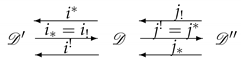 which satisfy the following conditions:
(g1) and are adjoint triples, i.e., is left adjoint to which is also left adjoint to , etc.;
(g2) the functors , and are fully faithful;
(g3) .
These notations will be kept throughout this paper.
Remark 3
([6]). Let be a right exact functor. Take to be the natural transformation to the trivial functor. It was denoted by the gluing of and obtained through MV-construction by F, 0 and ξ. Obviously, is a comma category. Dually, let be a left exact functor. Take to be a natural transformation. It was denoted by the gluing of and obtained through MV-construction by 0, G and . Obviously, is also a comma category.
3. The K-Groups of the Trivial Extension Category
In this section, we discuss the relation between the -groups of and the -groups of , for . Before proving the theorem, we show a lemma.
Lemma 2.
Let A and B be objects in . Then if and only if .
Proof.
Obviously, if then . Conversely, If , then . By Lemma 1, . □
Next, we recall two results of the trivial extension category [8].
Lemma 3.
Let be an abelian category and F be a right exact endofunctor of . For objects , and in , a sequence of objects is exact in if and only if is exact in .
Lemma 4.
If an object P is projective in (resp.), then the object (resp. ) is projective in (resp.).
Consequently, an object P is projective in if and only if the following conclusions both are true: (1) the object is projective in and (2)
Let be a set of some objects in and be the set . We denote by the full subcategory of whose objects are projective and finitely generated by in , and by the full subcategory of whose objects are projective and finitely generated by in . Obviously, and are exact categories.
Now, we study the -group of the category ).
Theorem 1.
Let be an abelian category and be a right exact functor. Then
Proof.
Firstly, for obj we denote by the isomorphism class obj , , where obj . Let L be the free abelian group with the basis obj and be the subgroup of L spanned by the set where obj . For objects , , P in , any short exact sequence in is split. So .
Denote by H the free abelian group with the basis { obj . By Lemmas 2 and 4, since T and C are right exact and , every isomorphism class of objects in can be denoted by , where obj . It yields that
We denote by the subgroup of H spanned by the set
It is obvious that .
Secondly, by Lemma 2, we define a free abelian group isomorphism
It induces an epimorphism
Finally, we claim that . In fact, for each Ker , Hence . It follows that where and . Since is an isomorphism, . Thus . Hence . Obviously, . So . Then . □
Next, we consider the -groups of ) by another method ().
We denote by the full subcategory of whose objects have a finite resolution whose terms are in . Obviously, is an exact category.
Theorem 2.
Let be an abelian category and be a right exact functor. If the following condictions are satisfied:
(t1)
(t2) obj for ,
then is an isomorphism.
Proof.
Firstly, consider . There is an epimorphism where . Since T is a right functor, is an epimorphism. By Lemma 4, . Consider . There is an epimorphism where . According to that C is a right functor and , we obtain that is an epimorphism. By Lemma 4, . So two functors and are exact.
Then we have two group homomorphisms
and
such that on . Thus is a direct summand of .
Secondly, for any object in , since , Ker in . By Lemma 4, is isomorphic to . So Ker = 0 in .
We observe that there is a commutative diagram
where is the coker of in . Then, by Lemma 3, there is an exact sequence in
Note that . Since obj , . Hence we obtain that obj .
For any obj , we show that obj . So, restricted to , the exact functor Z induces an exact functor . Then we get a group homomorphism
Thirdly, there is an inclusion . By Quillen’s resolution theorem ([4], § 4, Corollary 1), the group homomorphism
is an isomorphism. Then we define a group homomorphism
Let be and be . Using the exact sequence (9) and functor J, we obtain an exact sequence of exact functors
from to . By [4], § 3, Corollary 1, the sequence yields that . Denote . Then . So on . Hence and .
Finally, we show that the functor is equivalent to . In fact, for any object in , since , there is a commutative diagram
Note that . Hence . For any objects and in , mor , applying the right exact functor F, we obtain a commutative diagram
where ( ) is the coker of ( ) in . Since , there is a commutative diagram
Then the functor is equivalent to . Hence is equivalent to . So is equivalent to .
Therefore, . So and .
We prove that . □
Next, let and be abelian categories and be a right exact functor. Let and be the sets of some objects in and respectively, be the set }. We denote by the full subcategory of whose objects are projective and finitely generated by in and by the full subcategory of whose objects are projective and finitely generated by in . Obviously, . and are exact categories.
Now, by Remark 2 and Theorems 1 and 2, we get some results about the comma category.
Corollary 1.
.
Corollary 2.
If has a finite resolution whose terms are in for every obj , then is isomorphic to ().
Proof.
It is known that is isomorphic to , where is a functor by and . Obviously, .
We show that is an object in for every object . In fact, , , . Since has a finite resolution whose terms are in , there is a long exact sequence in
where and . We obtain a long exact sequence in
So a long sequence
is exact in .
Hence obj .
By Theorem 2, . □
4. The K-Groups of a Gluing of Abelian Categories
It is known that the comma category is also an example of a gluing of abelian categories. In this section, we will study the relation between the -groups of a gluing of abelian categories and the -groups of the abelian categories. Then we give the applications to the comma category.
For convenience, throughout this section we assume that categories are abelian and small. In order to describe the relation among the -groups of abelian categories in the gluing more precisely, we introduce here two weaker forms of the gluing of abelian categories given as follows:
A left gluing of abelian categories consists of three categories , , and four functors , , , in , (denoted by ), satisfying the conditions (lg1) , and , are adjoint pairs, (lg2) and are fully faithful functors and (lg3) Im Ker;
A right gluing of abelian categories consists of three categories , , and four functors , , , in , (denoted by ), satisfying the conditions (rg1) , and , are adjoint pairs, (rg2) and are fully faithful functors and (rg3) Im Ker.
Now let us discuss the relation between the -groups of a left (right) gluing of abelian categories and the -groups of the abelian categories ().
Theorem 3.
If a left gluing of abelian categories makes and left exact, and right exact, then is a direct summand of .
Moreover, if the sequence of functors is exact, where is the back adjunction and is the front adjunction, then .
Dually, if a right gluing of abelian categories makes and left exact, and right exact, then is a direct summand of .
Moreover, if the sequence of functors is exact, where is the back adjunction and is the front adjunction, then .
Proof
For a left gluing of abelian categories , since , and , are adjoint pairs with the functor and left exact, and right exact, then , , and are all exact. Thus we define two abelian group homomorphisms
and
Recall that and are fully faithful functors. So and . According to , it is easy to prove that . Since , and , we prove that
So is a direct summand of .
Moreover, since there is an exact sequence of functors , by [4], Page 106, Corollary 1 we obtain that . Hence
It follows that . The dual conclusion is similarly proved. □
Let’s give an example to show that the isomorphism doesn’t necessarily hold if there are no conditions.
Example 1.
Let k be an algebraically closed field. Consider the path algebras ([12], Page 43). , and where the quiver is , the quiver is and the quiver is 1. Let , and respectively be the Auslander algebras ([12], Page 419) of A, B and C. Since A can be seen as a upper triangular matrix algebra where P is the projective B-module, A-mod is a gluing of C-mod and B-mod. We note [13] that -mod is a gluing of -mod and -mod. It is known that -mod, -mod and -mod. So -mod-mod) is the proper direct summand of -mod).
For the further research, let us show the properties of the gluing of abelian categories and derived from the MV-construction.
Lemma 5.
Let and be adjoint triples in the gluing of abelian categories and . Then
(1) and are exact functors;
(2) for any object in , where is a morphism of , there exists an exact sequence in
Proof.
(1) is obvious. By the MV-construction it is easy to prove (2). In fact, for each , it is easy to check that the diagram
is commutative with the bottom row exact in . Hence by Lemma 3 we get that
is an exact sequence in . □
Dually, there are similar results about the gluing .
By Theorem 3 and Lemma 5, we obtain the following result.
Corollary 3.
There exists (resp. .
Moreover, by Corollary 3 and Remark 3, we apply the above conclusion to get the following result about the comma category.
Corollary 4.
Let and be abelian categories and be a right exact functor. Then .
If has enough injective objects and satisfies that , by Proposition 8.9 in [6] there is an equivalence of abelian categories . So we can get the following conclusion.
Corollary 5.
Let be a gluing of and . If has enough injective objects and satisfies that , then ; Dually, if has enough projective objects and satisfies that , then .
Proof.
Since there is an equivalence of abelian categories , by Corollary 3, we obtain that . Hence . The dual conclusion is similarly proved. □
5. Examples and Applications
In this section, we give some applications about the -groups and -groups of the trivial extension ring ().
Throughout this section, we assume that a ring R is associative and with an identity. All the modules will be left modules. We denote by R-Mod the category of left modules over a ring R and by R-mod the full subcategory of R-Mod whose objects are finitely generated left R-modules. Let M be an R-R-bimodule and be a trivial extension ring of a ring R by a bimodule M. Obviously, there are ring homomorphisms and where and . Hence M can be seem as a left -module.
It is known that there is an isomorphism of categories -Mod -Mod and ([8], Page 6). Let . Then , (R-Mod) is the full subcategory of R-Mod whose objects are finitely generated projective R-modules and -Mod) is the full subcategory of -Mod whose objects are finitely generated projective -modules. -Mod) is the full subcategory of -Mod whose objects have a finite resolution whose terms are in -Mod). Note that -Mod)) and -mod). Then by the Theorems 1 and 2, we get the following conclusions.
Corollary 6.
There is an abelian group isomorphism .
Corollary 7.
Let M be an R-R-bimodule and . Assume that -mod. If is a noetherian ring, and , then .
Proof.
Let and .
For any -Mod), we show that -Mod). In fact, for each -Mod, since and Ext≅ Hom, Ext, we prove that . Applying the finitely generated left -module M yields that is a finitely generated left -module. Note that is a noetherian ring. Hence, -Mod). Since , by the Theorem 2 we check that . □
The -structure of M is determined by its R-structure, but it cannot specify conditions which are equivalent to the condition of Corollary 7. This question is discussed in [8,14,15]. Next, let’s give an example to show that the isomorphism doesn’t necessarily hold if there are no conditions.
Example 2.
It is seen in [16] that while ≅(. So is a proper direct summand of .
Finally, we give an application about the -groups of the triangular matrix ring.
Corollary 8.
Let be a triangular matrix ring. If R and S are noetherian rings and bimodule is a finitely generated left S-module, then .
Proof.
Let F be the functor . Applying the finitely generated left S-module yields that F preserves the finitely generated modules. Then -mod-mod is defined.
Furthermore, since R and S are noetherian rings and bimodule is a finitely generated left S-module, is also a noetherian ring. Hence R-mod, S-mod and -mod are abelian and -mod -mod)). So, by Corollary 4 we prove that -mod) -mod)-mod))) -mod). . □
6. Conclusions
The study of higher K-groups is a hot issue, but it is difficult to perform. In this paper, we mainly use the category theory to study the relation between -groups of the two extension categories and -groups of the original category. We show the invariance under some conditions. Since a comma category is an example of the trivial extension category (the gluing of categories), we also show the invariance about -groups of the comma category. Finally, we apply to deduce the results about the -groups of a trivial extension ring. Are there any other applications? We know that there are many other extension categories, so how about their -groups? In furure work, we will aim to focus on them.
Author Contributions
Conceptualization, Q.C. and M.Z.; Funding acquisition, Q.C. and M.Z.; Methodology, Q.C. and M.Z.; Writing—original draft, M.Z.; Writing—review and editing, Q.C. Both authors have read and agreed to the published version of the manuscript.
Funding
This research was funded by National Natural Science Foundation of China (grant number 11871404, 11471269 and 11601084).
Institutional Review Board Statement
Not applicable.
Informed Consent Statement
Not applicable.
Data Availability Statement
Not applicable.
Acknowledgments
We would like to thank Dan Grayson for his valuable suggestions and comments on the original draft of this paper, which led to the current, much improved version.
Conflicts of Interest
The authors declare no conflict of interest.
References
- Tsuchimoto, Y. Reflexive modules of rank one over Weyl algebras of non-zero characteristics. Kyushu J. Math. 2011, 65, 279–298. [Google Scholar] [CrossRef]
- Tsuchimoto, Y. Norm based extension of reflexive modules over Weyl algebras. Kyushu J. Math. 2012, 64, 61–77. [Google Scholar] [CrossRef]
- Belov, A.; Bokut, L.; Rowen, L.; Yu, J.T. The Jacobian Conjecture, together with Specht and Burnside-type problems. In Automorphisms in Birational and Affine Geometry; Springer: Cham, Switzerland, 2014; pp. 249–285. [Google Scholar]
- Quillen, D. Higher algebraic K-theory I. Algebraic K-theory I. In Higher K-Theories; Springer: Berlin/Heidelberg, Germany, 1973; Volume 341, pp. 85–147. [Google Scholar]
- Beilinson, A.A.; Bernstein, J.; Deligne, P. Faisceaux pervers, Astérisque 100. Soc. Mathmatique Fr. 1982, 100, 5–172. [Google Scholar]
- Franjou, V.; Pirashvili, T. Comparison of abelian categories recollements. Doc. Math. 2004, 9, 41–56. [Google Scholar]
- Macphersion, R.; Vilonen, K. Elementary construction of perverse sheaves. Invent. Math. 1986, 84, 403–436. [Google Scholar] [CrossRef]
- Fossum, R.M.; Griffith, P.A.; Reiten, I. Trivial Extensions of Abelian Categories. Homological Algebra of Trivial Extensions of Abelian Catergories with Applications to Ring Theory; Springer: Berlin/Heidelberg, Germany, 1975; Volume 456, pp. 1–86. [Google Scholar]
- Cegarra, A.M.; Garzon, A.R.; Grandjean, A.R. Graded extensions of categories. J. Pure Appl. Algebra 2000, 154, 117–141. [Google Scholar] [CrossRef]
- Bergh, P.A.; Thaule, M. The Grothendieck group of an n -angulated category. J. Pure Appl. Algebra 2014, 218, 354–366. [Google Scholar] [CrossRef]
- Jasso, G. n-Abelian and n-exact categories. Math. Z. 2016, 283, 703–759. [Google Scholar] [CrossRef]
- Assem, I.; Simson, D.; Skowroński, A. Elements of the representation theory of associative algebras. Techniques of representation theory. In London Mathematical Society Student Texts 65; Cambridge University Press: Cambridge, UK, 2006; Volume 1, pp. 404–431. [Google Scholar]
- Lin, Z.Q. Recollement of functor categories. J. Math. Study 2010, 43, 193–197. [Google Scholar]
- Keating, M.E. The K-theory of triangular matrix rings and orders. Proc. Am. Math. Soc. 1987, 100, 235–236. [Google Scholar]
- Palmer, I.; Roos, J.E. Explicit formulae for the global homological dimensions of trivial extensions of rings. J. Algebra 1974, 27, 380–413. [Google Scholar] [CrossRef]
- Chen, H.; Chen, M. Whitehead groups of module extensions. Acta Math. Sci. 2004, 24B, 171–174. [Google Scholar] [CrossRef]
Publisher’s Note: MDPI stays neutral with regard to jurisdictional claims in published maps and institutional affiliations. |
© 2021 by the authors. Licensee MDPI, Basel, Switzerland. This article is an open access article distributed under the terms and conditions of the Creative Commons Attribution (CC BY) license (https://creativecommons.org/licenses/by/4.0/).