


Abstract
Ion-imprinted polymers (IIPs) have been widely used in different fields of Analytical Sciences due to their intrinsic selective properties. However, the success of chemical imprinting in terms of selectivity, as well as the stability, specific surface area, and absence of swelling effect depends on fully understanding the preparation process. Therefore, the proposal of this review is to describe the influence of relevant parameters on the production processes of ion-imprinted polymers, including the nature (organic, inorganic, or hybrid materials), structure, properties of the salt (source of the metal ion), ligand, crosslinking agent, porogenic solvent, and initiator. Additionally, different polymerization methods are discussed, the classification of IIPs as well as the applications of these adsorbent materials in the last years (2017–2022).
1. Introduction
Chemical imprinting is a technique employed for obtaining polymeric materials capable of binding selectively target molecules or metal ions, which is bio-inspired on biomolecular interactions such as substrate-enzyme, drug-receptor, and antigen-antibody [1,2]. This technique consists of the synthesis of a material polymeric with tailor-made binding sites complementary or memory to the template metal ions (IIP, Ion-Imprinted Polymers) or molecules (MIP, Molecular Imprinted Polymers) in the shape, size, and functional groups [3].
Over the past few decades, several ion-imprinted polymers have been synthesized to extract metal ions (Hg2+, Cd2+, Fe2+, Fe3+, Pb2+, Ag+, Cu2+, Cr3+, Au3+, Mn2+, Ti4+, Co2+, UO22+, As3+, Ni2+, and others) from biological, environmental, food, and pharmaceutical samples, where the metal ions quantification after pretreatment and extraction has been carried by different analytical techniques, including Flame Atomic Absorption Spectrometry (FAAS) [4,5,6,7,8], Flame Atomic Absorption Spectrometer with Fast Sequential module (FS-FAAS) [9], Graphite Furnace Atomic Absorption Spectrometry (GF AAS) [10,11], Inductively Coupled Plasma Optical Emission Spectrometry (ICP OES) [12,13,14,15], Inductively Coupled Plasma Mass Spectrometry (ICP-MS) [16,17], Hydride Generation Atomic Absorption Spectrometry (HG-AAS) [18], Differential Pulse Voltammetry (DPV) [19,20,21,22], Differential pulse anodic stripping voltammetry (DPASV) [23], Cyclic Voltammetry (CV) [24], and Electrochemical Impedance Spectroscopy (EIS) [25].
Nevertheless, some properties of IIP such as the selectivity, the adsorption capacity, the preconcentration factor, and the chemical stability, as well as its regeneration and reuse after the elution step, strongly depend on the component nature used in the synthesis [26], the polymerization methods adopted in the synthesis and the chemical nature of these materials. The five main components of IIP include the counter-ions of a template (metal ion), ligand, porogenic solvent, crosslinking agent, and initiator. In the same way, the strategies of polymerization that can be used for the IIP synthesis can be classified as bulk polymerization, suspension polymerization, precipitation polymerization, polymerization by surface imprinting, graft polymerization, sol-gel polymerization, and emulsion polymerization. In addition, according to the chemical nature of the reagents used in the synthesis, the IIP can be classified as organic, inorganic, or hybrid (organic-inorganic) in nature.
According to the aforementioned, this review aims to describe in detail the importance of the synthesis components and the effects that each one produces on the properties of the IIP so that this review encourages us to previously evaluate the choice of these parameters in future research using IIP synthesis. Thereby, this article begins with the fundamentals of Ion-Imprinted Polymers, which includes the history, a brief description of each of the synthesis components, and the general features of the IIP. Next, it is complemented by exploring and describing the types of polymers that can be obtained by the polymerization methods commonly used. The characteristics of the imprinted polymers according to their chemical nature and their application over the past few years also are discussed.
2. Fundamentals of Ion-Imprinted Polymers
2.1. History
Despite this review focusing on Ion-Imprinted Polymers (IIP), it is important to know first all of the Molecularly Imprinted Polymers (MIP) history, since with the latter the concept of chemical imprinting is born.
The chemical imprinting technique emerged from the concept of several biomolecular interactions such as substrate-enzyme, drug-receptor, and antigen-antibody, in which the biomacromolecules (enzyme, receptor, and antibody) have receptor sites capable of selectively binding to a molecule (substrate, drug, and antigen) in the presence of other molecules with similar structure. However, among the systems mentioned, the selective antigen-antibody interaction has been the most cited to explain the concept of chemical imprinting, due to the process of how the artificial antibody is formed on the antigen [1,2].
According to Linus Pauling (1940) in his work “The theory of antibody formation,” the antigen (template molecule) is inhibited by an artificial antibody. The process of inhibition or neutralization occurs when the antibody’s polypeptide chain (glycoprotein) is shaped around the antigen, generating a highly selective complementary configuration for the antigen [2,27], in which each antibody can only inhibit the antigen for which it was created.
From the complementary configuration existing between the antigen-antibody, Frank Dickey (1949) synthesized silica gel in the presence of methyl orange and its homologs (ethyl, n-propyl, and n-butyl) to study the selectivity of the adsorbent material [28]. Dickey concluded that by removing the dye from the silica, there is a creation of complementary binding sites to the respective dye, so that, when this material is used in adsorption processes for the dyes mentioned above, the silica showed greater affinity for the compound in which it was synthesized. Thus, Dickey’s work was the first publication associating silica as a molecularly imprinted material. Hence, the adsorbent materials development with the ability to selectively retain the analyte has become of great interest to many researchers. In this context, Wulff and Sarhan (1972) [29] and Takagishi and Klotz (1972) [30] worked independently in the preparation of organic imprinted polymers, adding into the synthesis vinyl monomers that contained functional groups capable of selectively binding to a molecule. These polymers were named Molecularly Imprinted Polymers (MIP).
Wulff and Sarhan presented the organic polymer synthesis with selective sites for the enantiomeric separation of glyceric acid racemates using the 2,3-op-vinylphenyl boronic ester (MF) functional monomer, while Takagishi and Klotz synthesized a polymer with the monomer polyethylenimine (PEI) in the presence of methyl orange dye [29].
Both Wulff and Sarhan and Takagishi and Klotz confirmed that the prepared polymers showed a high selective capacity for template molecules (MM). However, due to the covalent bond between the template molecule (MM) and the functional monomer (MF), it was difficult to remove the MM from the binding site, requiring the use of hydrolysis (cleavage of bonds) in most situations to facilitate the elution process [1].
Arshady and Mosbach (1980) proposed a simple strategy, named “host-guest polymerization”, for the synthesis of an imprinted polymer based on non-covalent interactions, in which the host-guest relationship (Template monomer—Molecule functional) was materialized during polymerization [31]. The functional monomers were chosen for their non-covalent interaction (ionic, hydrogen bonding, hydrophobic, charge transfer) with MM, so that, through a simple wash, varying the pH value, ionic strength, solvent, among other parameters, the removal of the MM became easier, and the binding sites were preserved, obtaining three-dimensional cavities complementary to the MM.
In the 1990s, Whitcombe et al. (1995) [32] synthesized an imprinted polymer for cholesterol using 4-vinylphenol carbonate as a functional monomer. During synthesis, the interaction between cholesterol and the functional monomer is by covalent bonding. However, by removing the template molecule by employing hydrolytic cleavage with the release of CO2, other functional groups are available to re-link cholesterol with non-covalent bonds. Thus, it was possible to synthesize molecularly imprinted polymers employing strategies based on covalent and non-covalent bonds.
Regarding ion-Imprinted polymers, known as IIP, its history begins with the work of Nishide and collaborators published in 1976 [33], who prepared the first organic IIP by crosslinking the poly chelating resin (4-vinylpyridine), previously prepared, with 1,4-dibromobutane in the presence of metal ions (Cu2+, Fe3+, Co2+, Zn2+, Ni2+, and Hg2+). From the results, Nishide and coworkers showed that the resin showed greater selectivity for the Cu2+ ion due to the stability of the polymer complex formed and that the presence of the metal ion in the polymer synthesis gives the polymer material high selectivity.
2.2. Synthesis
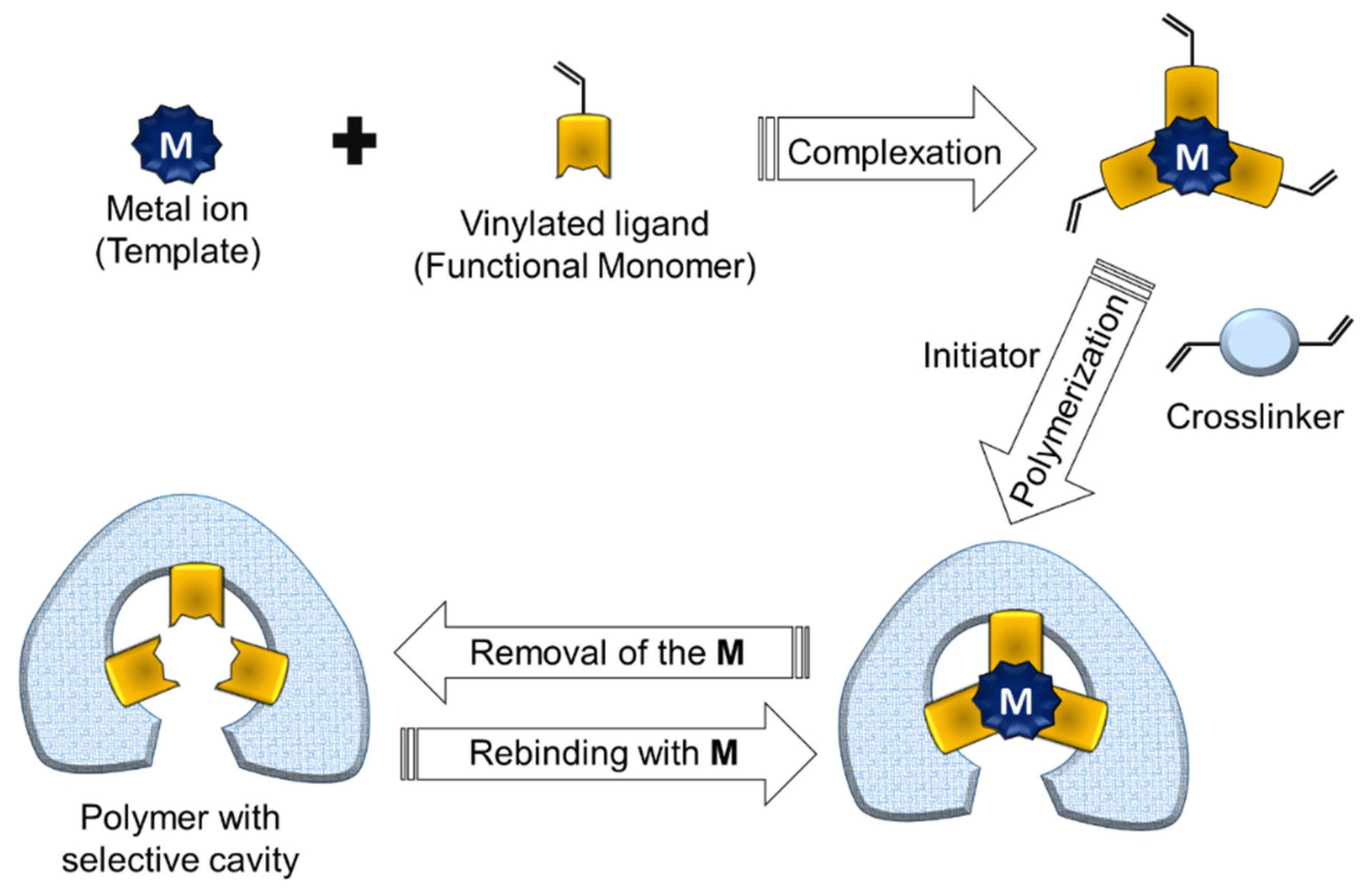
The general process for the synthesis of IIP can be summarized in three steps according to Saatçılar and coworkers [34]. First, the metal ion (template or analyte) is complexed using a vinylated ligand (functional monomer). Then, the vinyl complex is polymerized in the presence of a crosslinking agent and the radical initiator, where the polymeric skeleton is formed on the template and, consequently, remains incorporated into the polymeric network. Finally, after obtaining the polymer, the metal ion is removed by using dilute mineral acids, leaving three-dimensional recognition spaces or cavities within the polymeric network, which have a high affinity for the metal ion [35].
A schematic representation of the general process of synthesis of an IIP is illustrated in Figure 1.
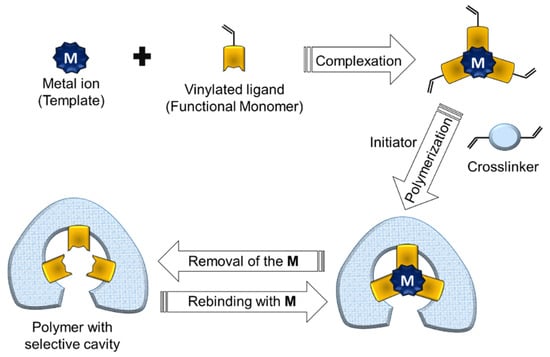
Figure 1.
Schematic representation of the synthesis process of an Ion-imprinted polymer (IIP).
2.3. Components of the IIP
As described in the previous Section 2.2, five chemical substances are used for the synthesis of IIP. These are the metal ion, vinylated ligand (functional monomer), a crosslinking agent (crosslinker), radical initiator, and porogenic solvent, whose combination influences the selectivity of the polymer. Thus, the synthesis and the polymerization method depend on the chemical nature and bonding (electrostatic forces, covalent bonding, hydrogen bonding, dipole-dipole interaction, ionic or hydrophobic interaction) between the reactants, as well as the stoichiometric relationship with each other. Thus, the main characteristics of each component used in the synthesis of IIP and its influence on the adsorption process will be discussed.
2.3.1. Counter-Ions of Template
Organic or inorganic salts generally are used as the source of the metal ion. Among the most counter-ions used are sulfate (SO42−), nitrate (NO3−), chloride (Cl−), iodide (I−), acetate (CH3COO−), and perchlorate (ClO4−). Liu and coworkers [36] assessed the effect of four anions (SO42−, NO3−, Cl−, and CH3COO−) on the polymerization process and the adsorption capacity of ion-imprinted polymers for Cu2+ ions (CuSO4-IIP, Cu(NO3)2 IIP, CuCl2-IIP, Cu(CH3COO)2-IIP). The authors discerned that the template and solution anions have a strong influence on the polymerization process, specifically, in the formation of cavities, as well as the adsorption process, respectively. They observed that due to the smaller ionic radius of Cl−, compared to the other three anions (SO42−, NO3− and CH3COO−), the imprinted cavities formed in the polymer CuCl2-IIP do not fit with the size and shape of the SO42−, NO3− and CH3COO− anions. Thus, lower values of adsorption of Cu2+ ions (mg g−1) were obtained when the solutions of CuSO4, Cu(NO3)2, and Cu(CH3COO)2 and the polymer CuCl2-IIP were employed. However, as soon as the CuCl2 solution was used, higher values of adsorption of Cu2+ ions (mg g−1) were obtained with the four polymers CuSO4-IIP, Cu(NO3)2-IIP, CuCl2-IIP, Cu(CH3COO)2-IIP, which was associated with the smaller size of CuCl2.
The same authors expected to obtain a higher capacity for adsorption of Cu2+ ions by applying the polymer Cu(CH3COO)2–IIP because the ionic radius of CH3COO- is greater than that of SO42− and NO3−. However, as CH3COO− is an organic anion, it interferes in the complexation of Cu with the functional monomer, as well as the formation of the cavity.
Even though lower adsorption values were observed with Cu(CH3COO)2–IIP, this polymer showed greater selectivity than the polymers CuCl2–IIP > CuSO4–IIP > Cu(NO3)2–IIP, in the presence of Ni2+ and Co2+ ions. Regarding the CuSO4–IIP and Cu(NO3)2–IIP polymers, the higher adsorption capacity was observed using the first one, most likely due to the lower ionic strength and chemical stability of the anion NO3− during the synthesis of Cu(NO3)2–IIP.
A briefly survey of literature shows that the most of works on imprinted polymers synthesis for the Cu2+ [37,38,39,40,41,42], Ag+ [43], K+ [44], Li+ [45], Pb2+ [46,47], Zn2+ [48,49], Ni2+ [50,51,52,53], Hg2+ [54] Cd2+ [55,56,57], Co2+ [58], U5+ [59], and In3+ [60] used nitrate salt.
2.3.2. Ligand
The ligand used in the synthesis of IIP is characterized by containing in the structure the vinyl group (-CH=CH2), hence its name of vinylated ligand. This ligand is also named bifunctional monomer because it has the function of forming a complex with the metal ion, to later incorporate this into the polymeric network by participating in the polymerization process through the vinyl group [35].
The functional monomer choice depends on the chemical nature of the metal ion. Pearson (1963) in his work “Hard and Soft Acid and Bases”, known as the HSAB theory [61], argued that hard acids will preferentially react with hard or intermediate bases; and soft acids with soft or intermediate bases, in which the terms “hard” and “soft” are associated with the polarizability of the reactants.
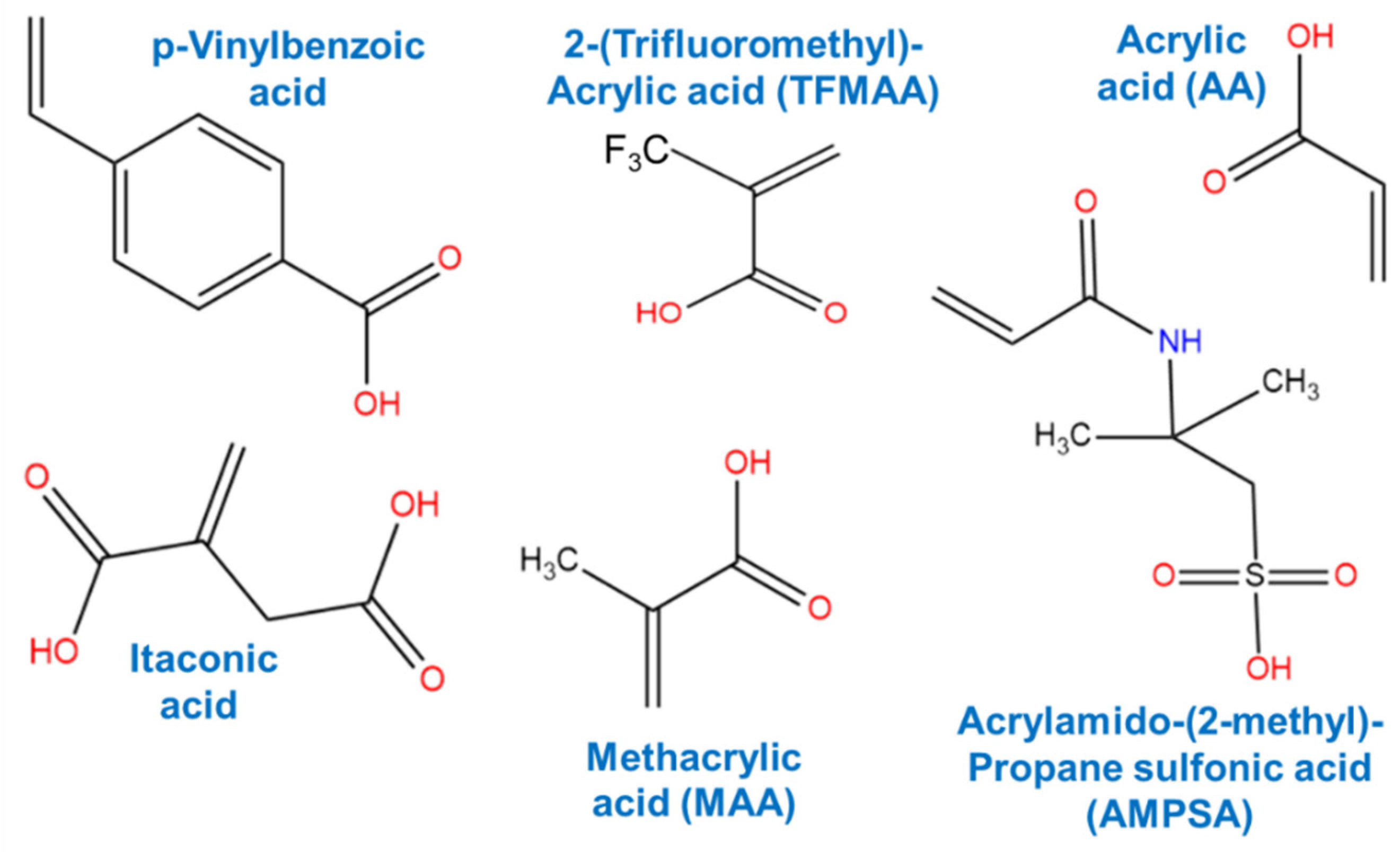
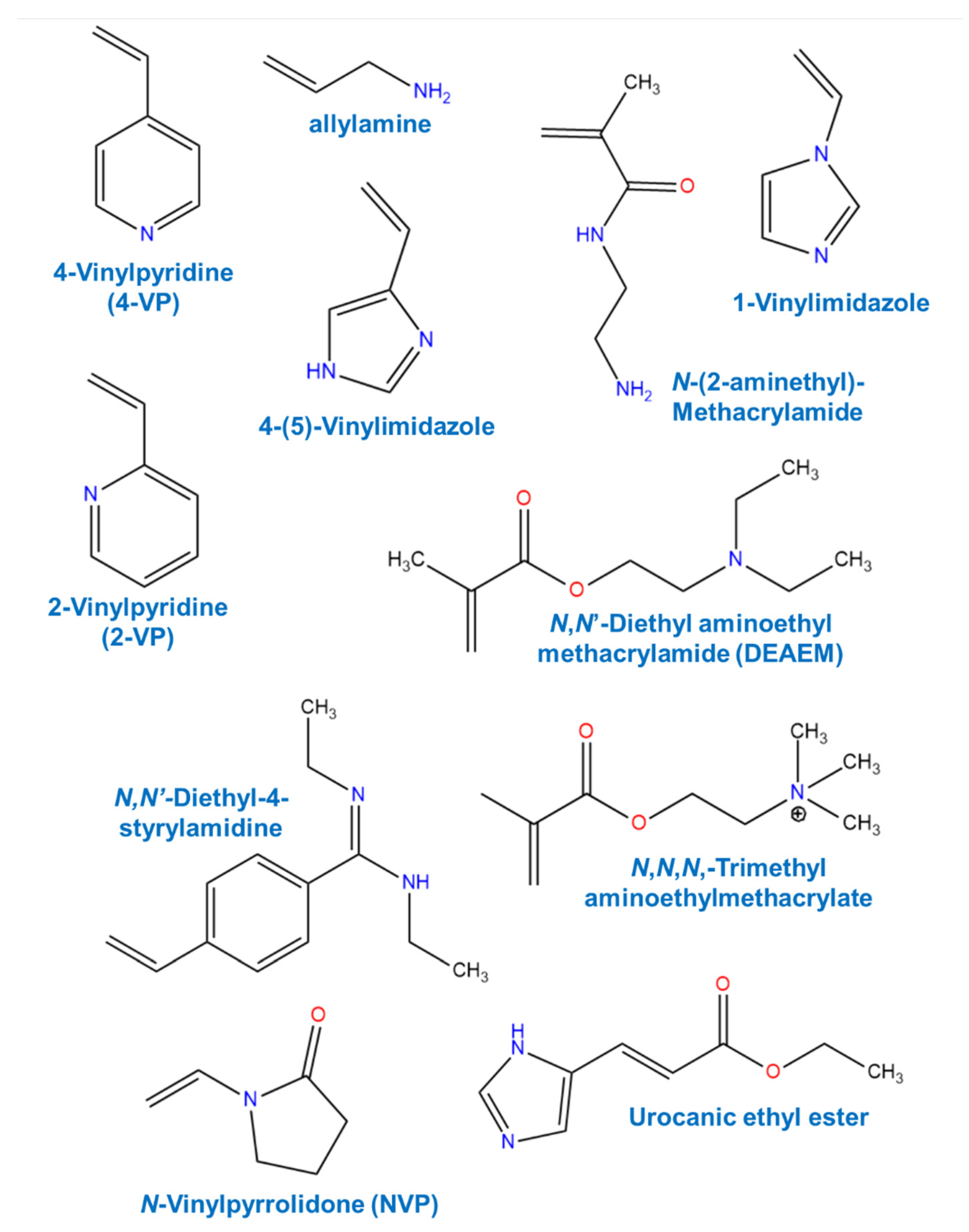
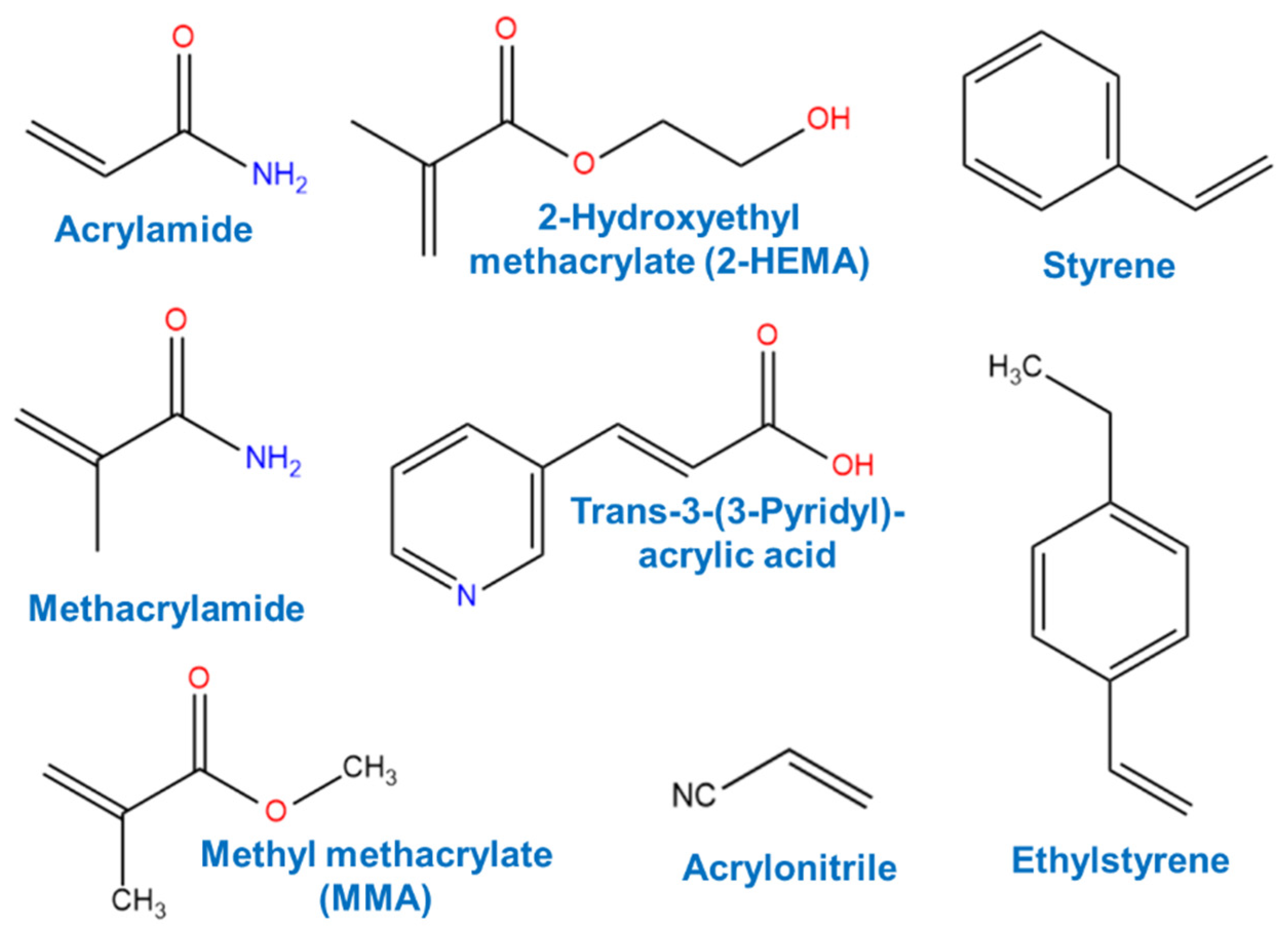
Among the most functional monomers used in the IIP synthesis is the methacrylic acid (MAA) [44,48,49,50,51,59], first proposed by Arshady and Mosbach in 1980 [31], whose electron donor is the atom of oxygen. Basic monomers such as 1-vinylimidazole (1-VID) and 4-vinylpyridine (4-VP) are also frequently used in the synthesis of IIP. However, the complex formed with the metal ion is via a nitrogen atom. Figure 2, Figure 3 and Figure 4 show the structure of the most important functional monomers classified as acids, basic, and neutral, respectively [62].
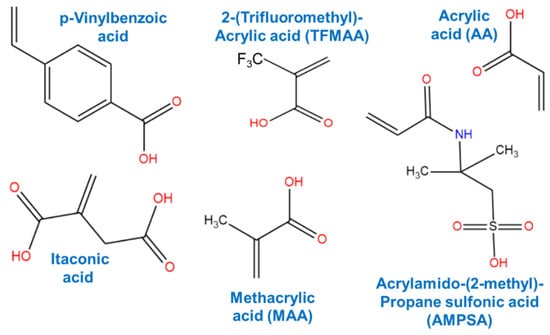
Figure 2.
Main acid functional monomers.
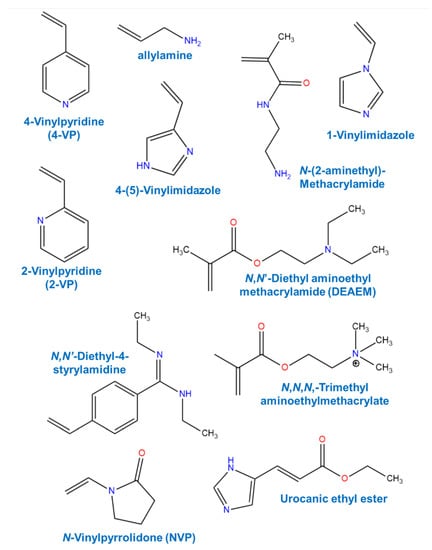
Figure 3.
Main basic functional monomers.
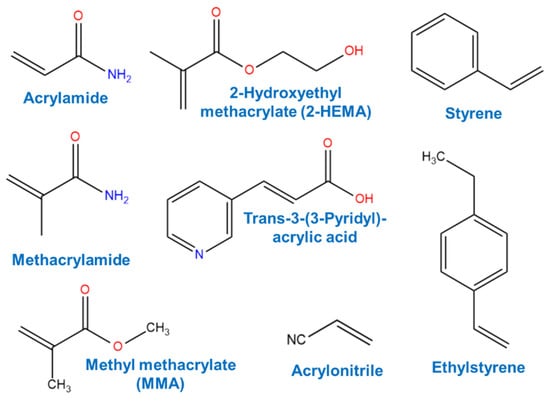
Figure 4.
Main neutral functional monomers.
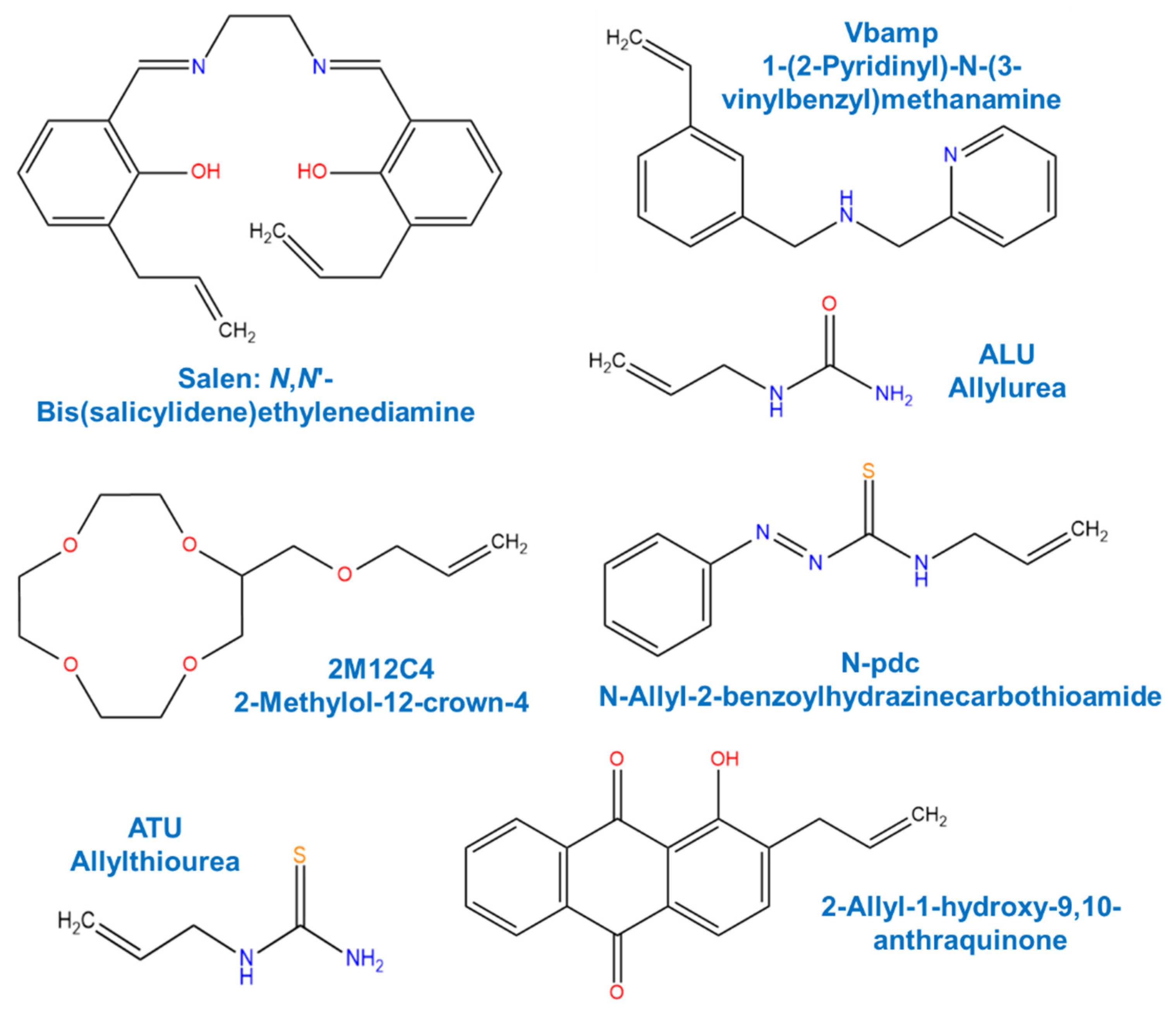
Other functional monomers used in the synthesis of IIP [38,52,55,56,57] were found, which have in their structure the oxygen, nitrogen, or sulfur atom as electron donors (Figure 5).
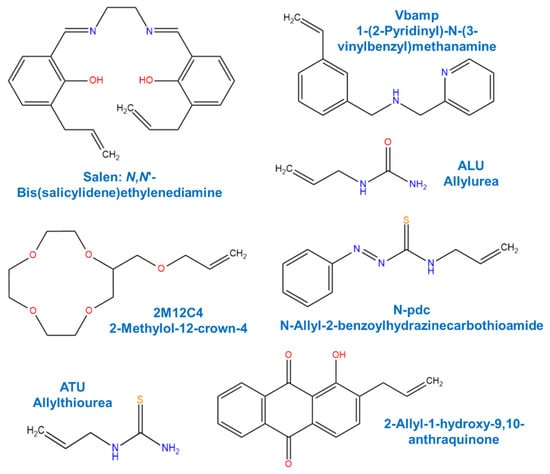
Figure 5.
Other functional monomers were used in the IIP synthesis.
To improve the efficiency of the metal ion complexation, the vinylated ligand can be added together with non-vinylated ligands, which contain functional groups with greater affinity for the metal ion. This process is known in the context of ion-imprinted polymers as “Trapping”. In the IIP synthesis using the Trapping process, the metal ion is initially mixed with the non-vinylated ligand to form the complex. Then, the functional monomer (vinylated ligand) is added to complete the complexation. Due to the absence of polymerizable groups (vinyl group) in the structure of the non-vinylated ligand, it is not chemically bonded to the polymeric network, however, it is incorporated into the polymer matrix when interacting with the functional monomer through intermolecular forces (Hydrogen bonding), as well as by the interaction with the metal ion.
Rabaji and coworkers synthesized an IIP for the K+ ion using the non-vinylated ligand dicyclohexyl 18C6 [44], whereas Behbahani and coworkers added 1,5-diphenylcarbazone to complex the Pb2+ ion [46]. In other papers, the non-vinylated ligand Morin (3,5,7,2′,4′-pentahydroxyflavone), Dz (Ditizone), and PAR (4-(2-pyridylazo)-resorcinol) were used to complex the Pb2+, Ni2+, and Cu2+ ions, respectively [48,50,63]. After the removal of the metal ion, the authors propose that the non-vinylated ligand remains in the polymeric network due to hydrogen bond interactions with the functional monomer [64]. Other non-vinylated ligands containing sulfur as a donor atom and used in the IIP synthesis are diphenylthiocarbazone (Dithizone), thiosemicarbazide, and acetaldehyde thiosemicarbazone [35].
On the other hand, it deserves to point out that in addition to the chemical nature of the functional monomer, the stoichiometric relationship between the metal ion and the functional monomer also interferes in the chemical imprinting process. In this context, Lulinski and coworkers synthesized ten polymers for the Cd2+ ion, nine with chemical imprinting (IP1γ, IP2γ, IP3γ, IP4γ, IP4α, IP4β, IP4δ, IP4ε, IP4ζ) and one (CP4) as a control polymer, using four functional monomers (M1: allylurea; M2: 1-vinylimidazole; M3: acrylamide; M4: allylthiourea) with different stoichiometric ratio metal ion: functional monomer (ζ = 1:1; δ = 1:2; γ = 1:4; β = 1:8; α = 1:16 e ε = 2:3) [56].
Among the synthesized polymers, polymers containing M4 (IP4) showed a higher adsorption capacity for Cd2+ ions when compared with the other three monomers, at two pH values (1.00 and 6.00). This behavior was attributed to the nature of the chemical bond, once the Cd2+ (soft acid) ions have greater interaction with the thiocarbonyl group (C=S) present in M4 (soft base) and less interaction with the oxygen present in M1, M2, and M3, according to the Pearson’s theory [61].
Regarding the stoichiometric ratio of the metal ion and the functional monomer, the authors observed that the surface area and adsorption capacity of the IP4 polymer increased when the stoichiometric ratio was 1:1 and 2:3, corresponding to the polymers IP4ζ and IP4ε, with an adsorption capacity of 3.79 and 2.44 µg g−1 and imprinting factor of 13.68 and 8.80 at pH 1.00, while 1.71 and 1.72 µg g−1 with effect imprinting of 2.55 and 2.56 at pH 6.00, respectively. Hence, if the concentration of Cd2+ ions during synthesis is higher, the chemical imprinting and the adsorptive capacity will be greater too. Those results agree with the study made by Laatikainen and coworkers [52], who synthesized imprinted polymers for Ni2+ ions and a control polymer (Non-Imprinted Polymers, NIP), using two salts (nitrate (NO3−) or perchlorate (ClO4−)) as the metal ion source and the functional monomer Vbamp (1-(2-pyridinyl)-N-(3-vinylbenzyl)methanamine) in the stoichiometric ratio 1:2, 1:4 and 2:1 (metal ion: functional monomer, respectively) for the polymer IIPNO3, and 1:2 for IIPClO4. In this study, the authors obtained higher adsorption capacity with the polymer IIPNO3 at pH 4.00 and 7.00 (7.24 and 11.73 mg g−1, respectively) when the metal ion was in greater proportion than the functional monomer (2:1). In addition, the authors observed that as soon as the concentration of the functional monomer is increasing in the synthesis, the imprinting factor decreases, once the adsorption capacity of the IIPNO3 in the 1:4 ratio is the same as the adsorption capacity of the control polymer (NIP) at pH 4.00 and 7.00.
2.3.3. Porogenic Solvent
The porogenic solvent choice plays a crucial role in the synthesis of IIP. The porogenic solvent must solubilize all the reagents used in the synthesis to form a homogeneous solution without interfering with the interaction between the metal ion and the functional monomer. It also has a higher influence on the morphological characteristics of the polymer, specifically, in the porosity [65]. In addition, the porogenic solvent might influence the selectivity of the polymer.
Gladis and Rao assessed the effect of the porogenic solvents 2-methoxyethanol, methanol (MeOH), tetrahydrofuran (THF), acetic acid (HAc), dichloroethane (DCE), N,N-dimethylformamide (DMF), and toluene on the adsorption capacity from IIP to UO22+ [66]. From the results, the imprinted polymer synthesized in 2-methoxyethanol showed a higher adsorption capacity (34.10 mg g−1) when compared to MeOH (11.28 mg g−1), THF (7.03 mg g−1), HAc (27.28 mg g−1), DCE (6.80 mg g−1), DMF (15.62 mg g−1), toluene (6.62 mg g−1), and in the respective control polymers (NIP). In general, solvents with a higher boiling point, as observed by 2-methoxyethanol are more indicated to provide IIP with micropores and with higher surface area.
Meouche and coworkers synthesized several IIP for the Ni2+ ions in the porogenic DMSO (Dimethylsulfoxide) and using mixtures of acetonitrile (ACN)–(ACN:DMSO, 1:1%, v/v) and 2-methoxyethanol:DMSO (1:1%, v/v), named as IIP-D, IIP-A/D, and IIP-M/D, respectively [67]. The authors compared the structure and adsorption properties of the polymers and observed that although polymers IIP-A/D (134 m2 g−1) and IIP-M/D (177 m2 g−1) had lower porosity than IIP-D (275 m2 g−1) and the respective non-imprinted polymers (NIP-D: 380 m2 g−1, NIP-A/D: 181 m2 g−1 and NIP-M/D: 457 m2 g−1), these have a higher adsorption capacity (23.9 and 22.4 mg g−1, respectively) and imprinting factor (2.77 and 2.52, respectively), even in the presence of Zn2+, Co2+, and Pb2+ ions. These results show clearly that the greater the boiling point of the solvent the higher presence of micropores and the higher the surface area. However, as noticed, the higher surface area of IIP obtained by using DMSO as a solvent, did not guarantee higher adsorption capacity. In this case, most likely DMSO strongly interacted with a metal ion (template) hindering the interaction with functional monomer and, thereby, decreasing the chemical imprinting formation.
Table 1 shows the porogenic solvents most used in the synthesis of IIP, which are organized by increasing polarity. These solvents are classified as apolar, polar aprotic, and polar protic. It is important to point out that in the synthesis of IIP it is also common to use a porogenic mixture of solvents, such as ACN:DMSO [44], MeOH:DMF [45,58], EtOH:ACN [48], MeOH:EtOH [49], and EtOH: 2-methoxyethanol [52]. Rahman and coworkers [68] evaluated the effect of the amount of solvents MeOH or ACN, as well as their mixture, on the adsorption and morphological properties of IIP for Hg2+ ions. Thus, the authors observed that the mixture of MeOH:ACN, as a porogenic solvent, provided the IIP with a greater adsorption capacity for Hg2+ ions compared to polymers synthesized merely in MeOH or ACN, which was attributed to the increase in the material’s porosity. Likewise, the authors observed that higher adsorption capacity for Hg2+ ions was obtained with polymers that were synthesized in larger amounts of the porogenic solvent. However, when comparing the results obtained by Gladis and Rao [66] with the results from Rahman and coworkers [68], it can be inferred once again that the adsorption capacity of an IIP cannot always be attributed to its porosity.

Table 1.
Porogenic solvents most used in the synthesis of IIP.
Polar protic solvents are characterized by containing hydrogen atoms bonded to electronegative elements (F-H, O-H, and N-H) in their structure and, therefore, they can form hydrogen bonds, once this hydrogen has an acidic character. This type of solvent stabilizes the metal ions through the unshared free electron pairs present in the electronegative element, while the anions are stabilized by hydrogen bonds.
On the other hand, aprotic polar solvents do not form hydrogen bonds because the C-H bond is not polarizable. However, these solvents have a dielectric constant (k) and dipole moment (D) relatively higher than the protic polar. Aprotic polar solvents can also stabilize the metal ions or the molecules through the free electron pairs present in the nitrogen or oxygen atom, and the anions through permanent–induced dipoles (Debye force). Thus, protic polar solvents stabilize metal ions better, while polar aprotic solvents stabilize anions better.
Regarding non-polar solvents, they have low dielectric constants (<15) and low dipole moments. The interactions of the metal ion or molecules with the non-polar solvent are through induced dipole-induced dipole interaction (London Dispersion Forces). Non-polar solvents are almost never used in the synthesis of IIP due to the low solubility of salts in this medium. In addition, polar solvents have a higher dielectric constant and dipolar moment than non-polar solvents, which allows them to easily solvate the metal ions or polar molecules. The dielectric constant value of the polar solvent ranges between 15 and 80, where 80 is the value of the dielectric constant of water.
2.3.4. Crosslinking Agent
According to Cormak and Elorza [62], the crosslinking agent performs three functions in the synthesis of polymers, which correspond to controlling the morphology of the polymer; stabilizing the binding sites with ionic recognition capability; and conferring mechanical stability to the polymer matrix.
Crosslinking agent also contains one or more vinyl groups in the structure such as the functional monomer. Mono-vinylated generally forms straight chains, while bi-, tri-, or tetra-(multifunctional) form branched chains with different molecular arrangements.
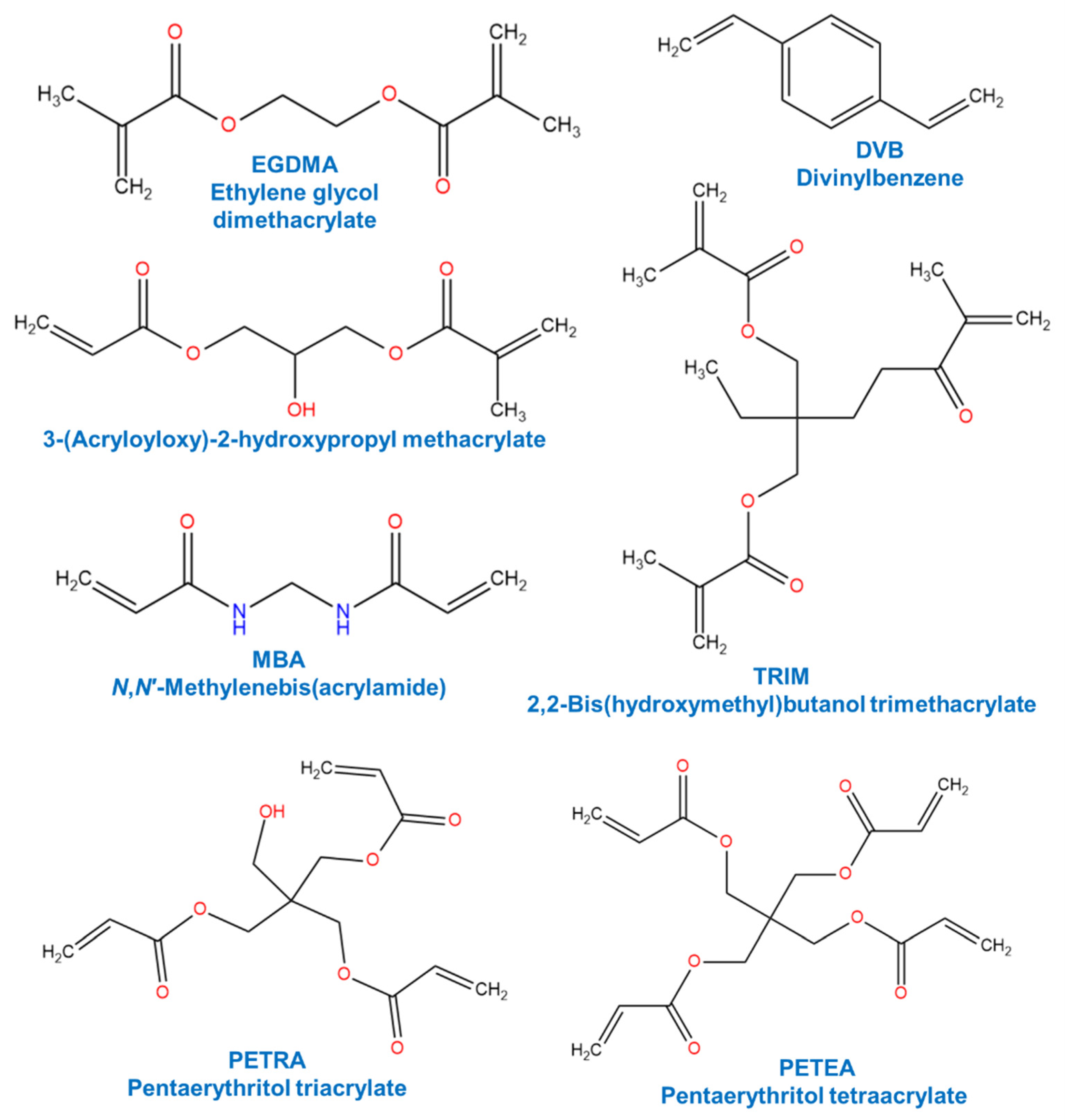
Kala and coworkers synthesized an IIP for Er3+ (Erbium) using different functional monomers (styrene, 2-hydroxyethyl methacrylate (HEMA), and methyl methacrylate (MMA)) and crosslinking agents (divinylbenzene (DVB) and ethylene glycol dimethacrylate (EGDMA)), which were named as Styrene-DVB, HEMA-EGDMA and MMA-EGDMA [69]. Among them, the IIP containing Styrene-DVB showed better results in terms of preconcentration factor, adsorption capacity, and selectivity towards Er3+ in the presence of other ions such as Y (Yttrium), Dy (Dysprosium), Ho (Holmium) and Tm (Ytterbium). This outcome can be attributed to the greater rigidity and denser polymeric chain of the Styrene-DVB polymer as a result of π-π stacking interactions from aromatic rings when compared to aliphatic chains present in HEMA-EGDMA and MMA-EGDMA. Figure 6 illustrates the crosslinking agents often used in the synthesis of IIP.
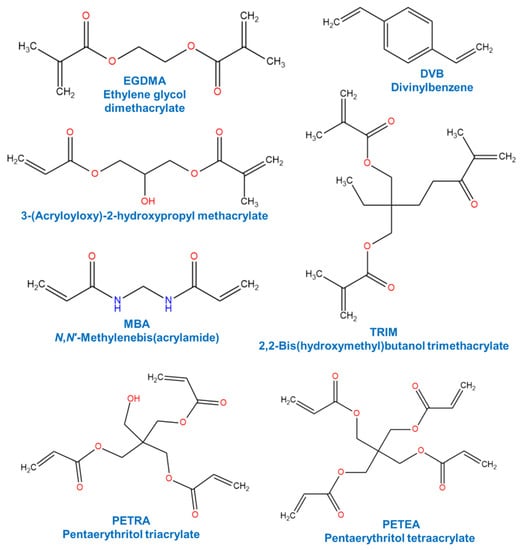
Figure 6.
Chemical structure of the crosslinking agents used in the synthesis of IIP.
As seen in Table 2, an overview of the previously published works showed that EGDMA (bifunctional crosslinker) is the most used crosslinking agent in the synthesis of IIP, due to its ability to form thermally and mechanically stable polymers; in addition, the production of porous materials [1,62]. High proportions of crosslinking reagent must be used about the functional monomer, in general, 1:4 (mol/mol).
Table 2.
Imprinted polymers, found in some previously published works, synthesized for the adsorption of metal ions in samples with a complex matrix.
Recently, Isikver and Baylav synthesized IIP for Ni2+ and Co2+ using EGDMA or TRIM [2,2-bis(hydroxymethyl)butanol trimethacrylate] as crosslinking agents [70]. However, the authors did not show the influence of the chemical structure of crosslinking agents on the adsorptive properties of imprinted polymers. Nonetheless, TRIM is expected to give the polymer higher rigidity, because it is a trifunctional crosslinker, i.e., it has three interaction sites in its structure that allow it to bond strongly to the polymer matrix [71,72], when compared to the bifunctional EGDMA crosslinker. Thus, the more rigid the polymer matrix, the greater the stability of the binding sites, facilitating the interaction with the metal ion and mass transfer (adsorption capacity). It is important to point out that tri- or tetra-functional crosslinking agents such as 2,2-bis(hydroxymethyl)butanol trimethacrylate (TRIM), pentaerythritol triacrylate (PETRA), and pentaerythritol tetraacrylate (PETEA) [73] have been explored in the synthesis of imprinted polymers.
As mentioned, the higher stiffness of the polymeric chain, the greater the stability of binding sites and selectivity of IIP. However, it is important to point out that crosslinking agents should present the minimum interactions with template ions. This fact, explain why EGDMA has been widely used to the detriment of TRIM in the synthesis of IIP.
2.3.5. Initiator
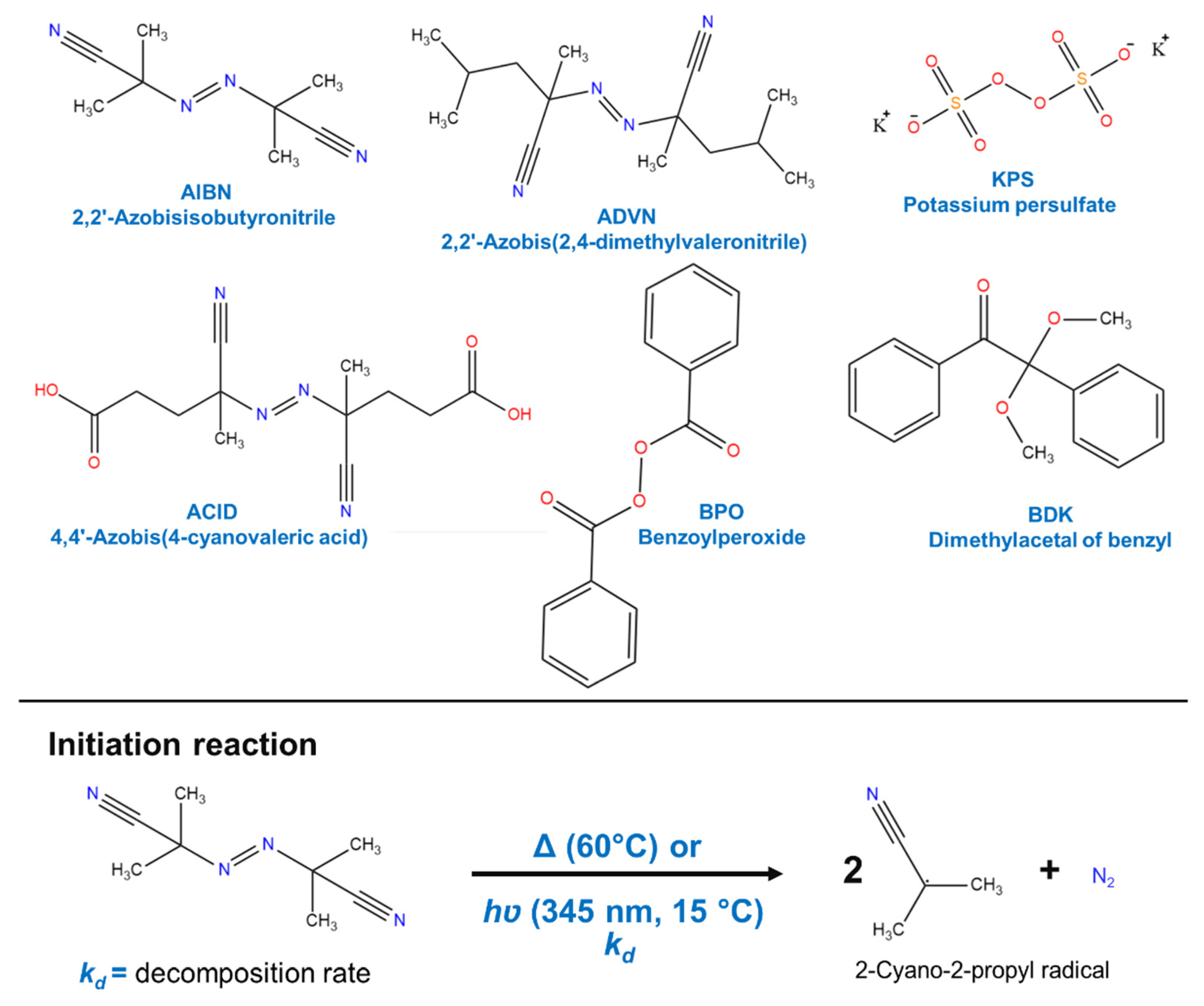
The role of the initiator in imprinted polymer synthesis is the creation of monomeric radicals to propagate the polymerization reaction. These radicals can be generated under mild conditions, such as increasing temperature (thermochemical process, 50–60 °C) or UV radiation incidence (photochemical process, 4–15 °C) because the initiator usually has weak bonds which have a low bond dissociation energy. Therefore, these conditions are decisive for the choice of the initiator, as the other synthesis reagents can be thermo-photo sensitive [62].
It is important to recall that the synthesis of IIP must be carried out in an oxygen-free environment, purging with an inert gas (nitrogen or argon) or using an ultrasound bath, to avoid the formation of oxygen radicals that delay the free-radical polymerization reaction [2].
Figure 7 shows some initiators used in the synthesis of IIP and the representation of the production of 2-Cyano-2-propyl radical from 2,2′-azo-isobutyronitrile (AIBN), where the latter is the initiator commonly employed.
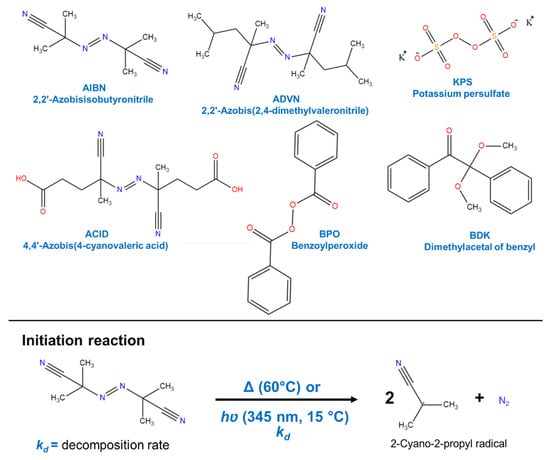
Figure 7.
Chemical structure of the initiators commonly used in the synthesis of IIP, as well as the representation of the production of 2-Cyano-2-propyl radical from 2,2′-azo-isobutyronitrile (AIBN).
2.4. General Features of the IIP
Ion imprinted polymers are adsorbent materials capable of recognizing metal ions. These have several advantages over other adsorbents used in solid phase extraction (SPE) due to their high selectivity, relatively low cost of the synthesis reagents, thermal and mechanical stability, and capacity for easy regeneration after using dilute mineral acids in the pre-concentration step. Furthermore, they enable the preconcentration of metal ions over a wide pH range.
The high selectivity of IIP concerning other adsorbents is explained by the formed cavities (binding sites), which have a specific size, charge, coordination geometry, and coordination number; in addition, to the memory effect, due to the interaction between the template (metal ion) and the functional monomer through electrostatic forces or coordinate covalent bond [34]. However, the limitation of the selective recognition of the metal ion is also directly related to the polymerization methods adopted.
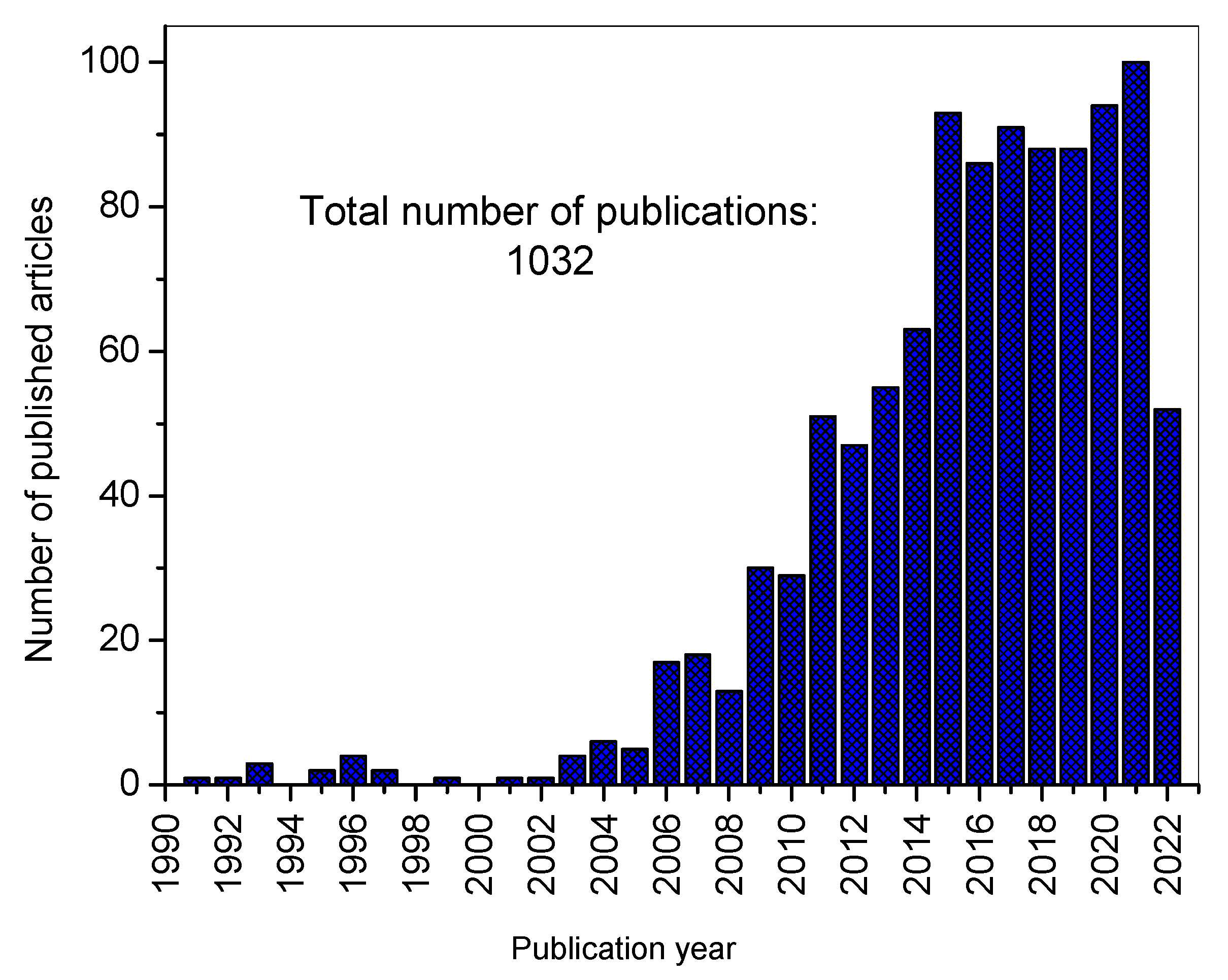
In Figure 8 can be seen that in the last three decades there has been a significant increase in the use of IIP as adsorbents in preconcentration studies by solid phase extraction (SPE).
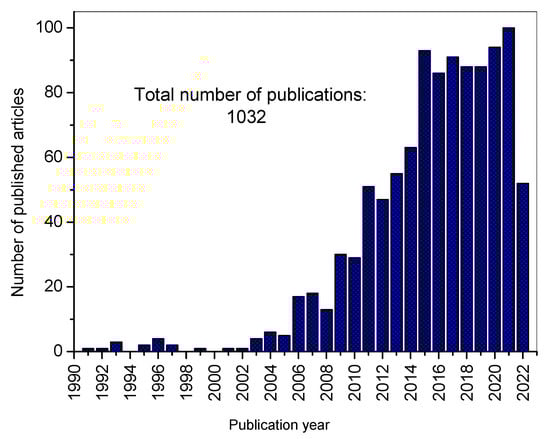
Figure 8.
Number of published papers on IIP from 1991 to 2022. Web of Science: ion-imprinted polymer and ion imprinted polymer (Accessed in August 2022).
3. Polymerization Methods for IIP Synthesis
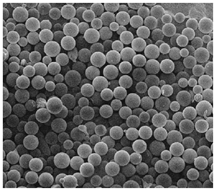
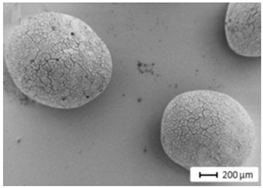
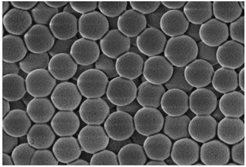
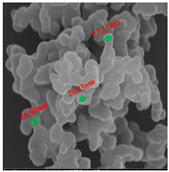
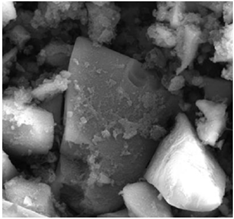
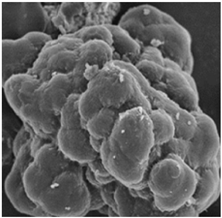
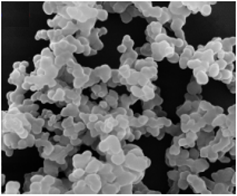
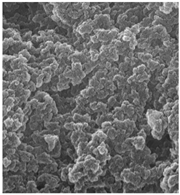
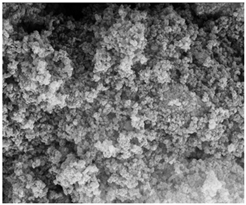
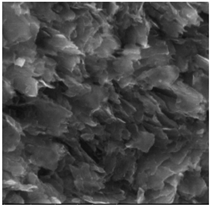
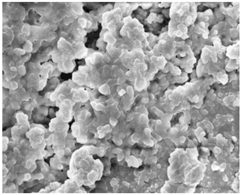
Several polymerization methods have been developed for the synthesis of ion imprinted polymers. Table 3 shows these methods, noting the general features of each one, as well as SEM images to observe the possible morphology of the polymeric particles after synthesis.
Table 3.
Polymerization methods of IIP and SEM images to observe the possible morphology of the polymeric particles after synthesis.
Polymerization Reactions
Polymerization is a reaction in which simpler units, called monomers, chemically combine to form longer structures. There are two types of polymerization reactions: by condensation or by addition; the latter one is the most used in the synthesis of ion imprinted polymers.
For the monomers to bond by addition polymerization (polyaddition) or chain-growth polymerization, it is necessary for the unsaturation presence in the monomer structure, where the homolytic cleavage of the pi bond produces radical species.
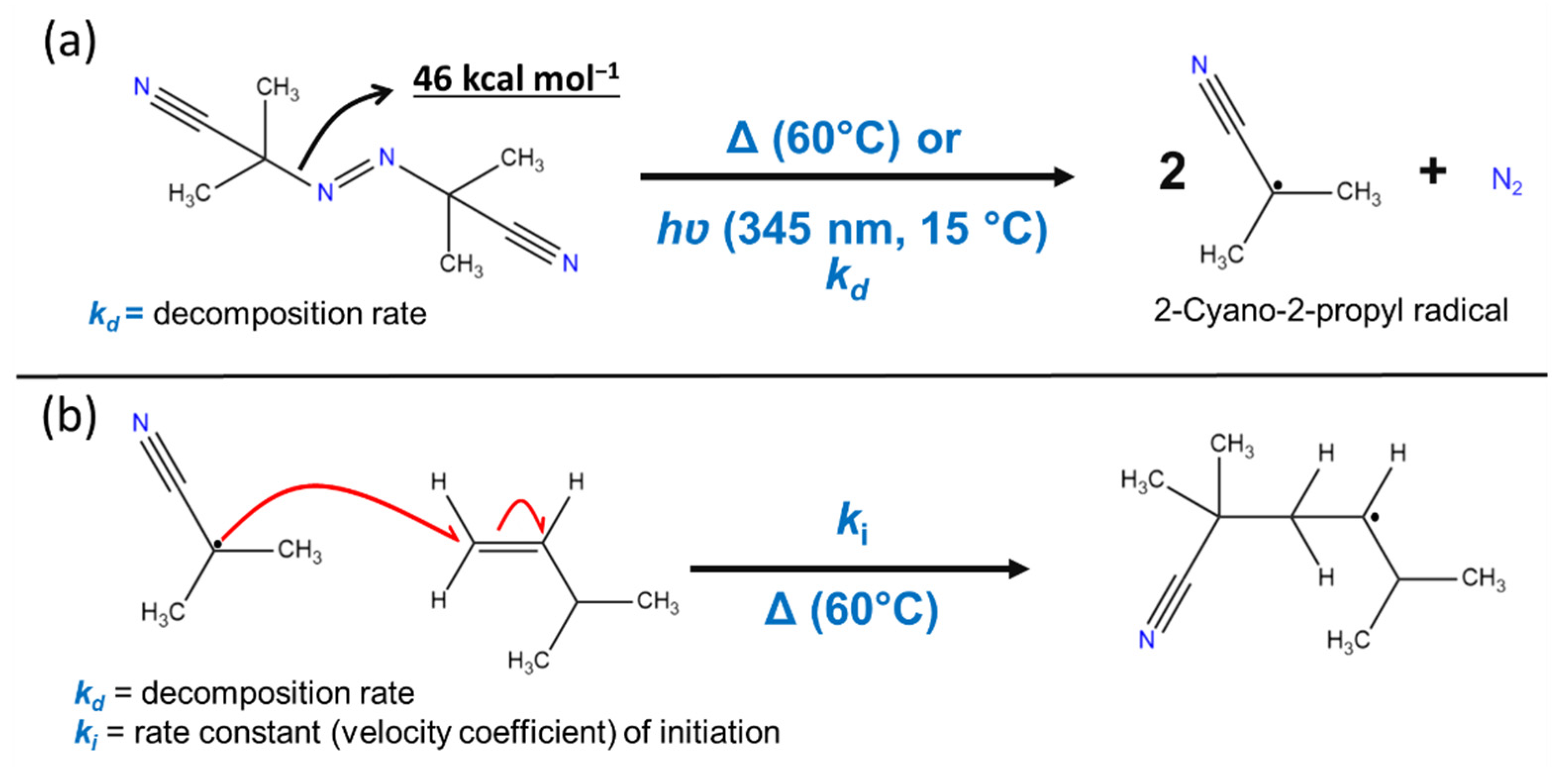
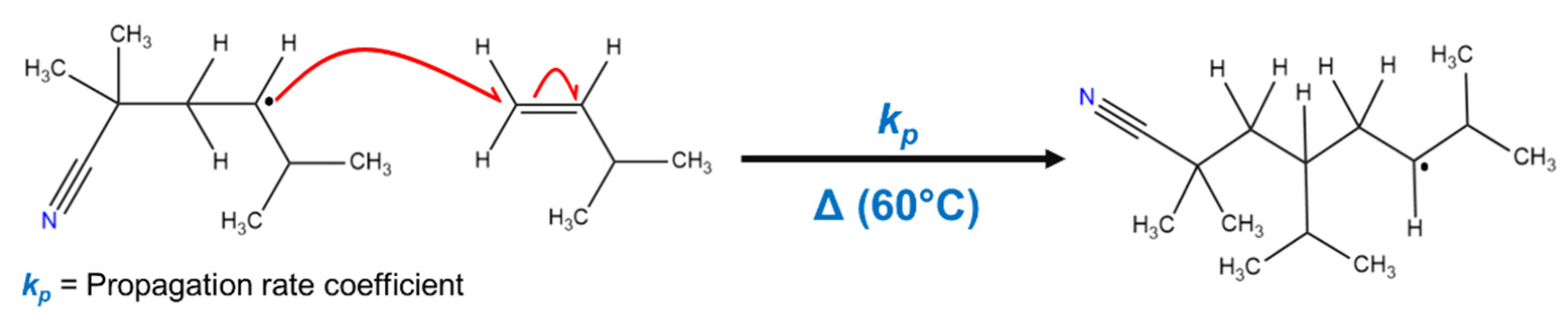
The addition polymerization reaction has three steps with different kinetics: initiation, propagation, and termination. Initiation is the slowest step from a kinetic point of view and is characterized by the formation of free radicals from a radical, which must contain a chemical bond with low dissociation energy for a homolytic decomposition to occur (Figure 9a). This homolytic decomposition can be caused by physical agents such as heat, ultraviolet radiation, or microwaves. Then, the sp2 hybridized radical species react with the least substituted carbon that participates in the π bond in the monomer molecule, generating a free radical that initiates the polymerization reaction (Figure 9b) [85].
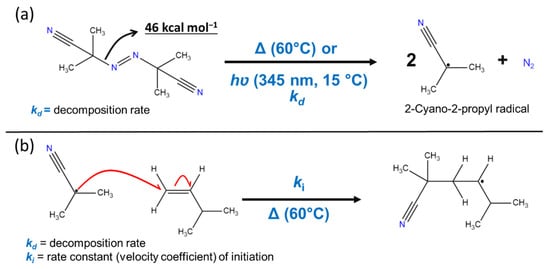
Figure 9.
Mechanism of the initiation step in free-radical polyaddition: (a) homolytic decomposition; (b) free radical production that initiates the polymerization reaction.
The propagation step occurs after the initiation and is considered the most important step in polymerization because in this step the chain grows. This step is very fast, with low activation energy. In the propagation, the active center formed at initiation is added to another monomer, generating a longer chain with the transfer of the active center from monomer to monomer, which is immediately added to another monomer at the end, and so on, until termination occurs [85], as illustrated in Figure 10.
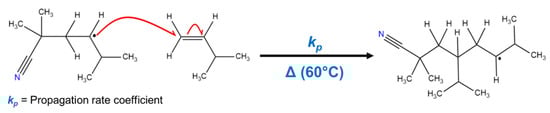
Figure 10.
Mechanism of the propagation step in free-radical polyaddition.
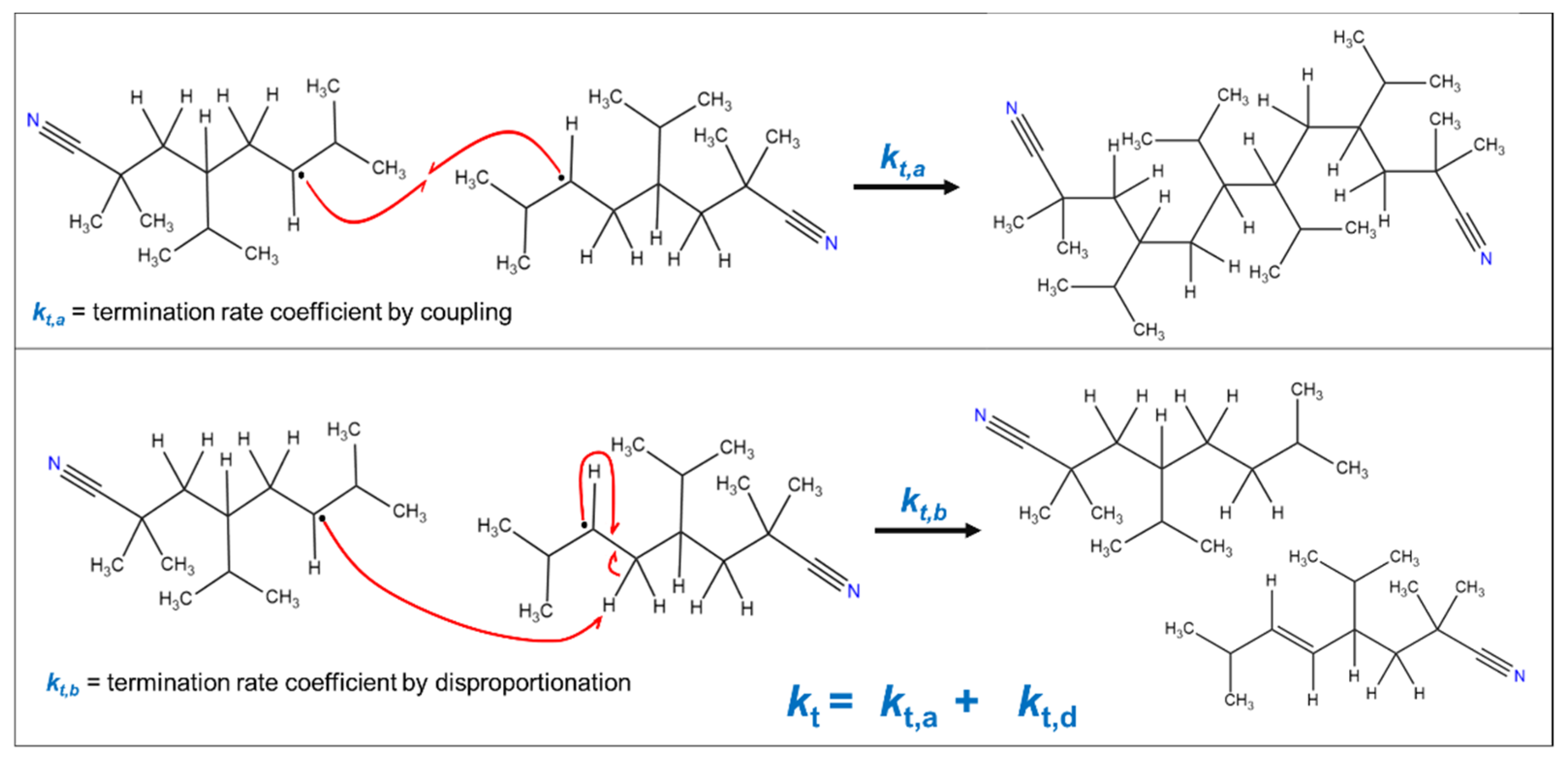
Finally, the termination step occurs when there is interruption of chain growth due to the disappearance of the active center due to: (a) coupling or combination of two active centers, forming a simple bond between the propagating species; (b) disproportionation, which consists of the intermolecular transfer of a hydrogen atom from one chain to another in growth, saturating one end and creating a double bond at the end of the other chain; (c) snatching of a hydrogen atom from any point in the chain, where the active center is transferred to compensate for the loss of this hydrogen, forming branches; (d) interaction of the free radical with other formed radicals or molecules present in the reaction medium, such as a solvent, initiator, impurities or molecular oxygen. The mechanism of the termination step in free radical-initiated polyaddition is shown in Figure 11.
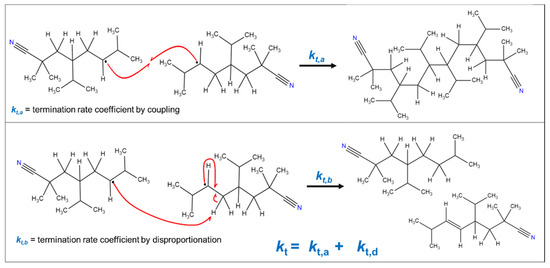
Figure 11.
Mechanisms of the termination step in free-radical initiated polyaddition.
Due to the short lifetime of the growing chains and the several events that benefit the termination of polyaddition, the structure of polymers is difficult to control, with a higher polydispersity index, i.e., greater heterogeneity in particle size [86]. Thus, to control the structure of the polymer chain, reversible-deactivation radical polymerization (RDRP) emerged as an alternative for the control of propagating radical reactivity [86].
There are two types of radicals in RDRP polymerization. The first one can propagate the reaction and overcome the termination event, whereas the second one is bonded to agents that control the termination of polymerization. Thus, the higher the concentration of the two agent control, the lower the probability of interaction between the propagated radicals. Thereby, it is possible to obtain polymers with higher molar mass and high rates of reaction conversion, aside from low polydispersity indices.
Among the RDRP polymerization is the iniferter (Initiator-transfer agent-terminator), where the controlling agent of the propagating center participates in the initiation, transfer of radicals, and termination of the propagating centers [87,88]. The control agent is a substance that forms two types of radicals by the effect of temperature or ultraviolet radiation, such as dithiocarbamate. The first radical function is to add itself to the monomer, through the π bond, to start a propagating chain, while the second has the function of controlling the entry of other molecules of the monomer through rapid activation/deactivation of the C=S bond of the dithiocarbamate. Nonetheless, fragments of the dithiocarbamate radical can initiate new chains and their reversible deactivation balance is not fast or enough to control the entry of monomers into the growing chain, increasing the polydispersion of the formed polymer [89,90].
Huang and coworkers [74] reported the synthesis of an IIP for Cd2+ ions on the surface of a paper using graft polymerization and the RDRP procedure by Iniferter to develop a sensor. In the polymer synthesis, Cd(CH3COO)2 • 2H2O was used as a template, MAA as a functional monomer, DMSO as a porogenic solvent, EGDMA as a cross-linking agent, sodium diethyldithiocarbamate trihydrate as a control agent. The synthesis was carried out by photopolymerization using ultraviolet radiation with λ = 254 nm for 12 h, obtaining a membrane with superficial ion imprinted. From the morphological characterization, the authors observed that the polymer was formed only on the surface of the paper without altering its three-dimensional network structure. In addition, many irregular particles were observed on the IIP membrane. However, for the non-imprinted polymer (NIP) merely a uniform membrane was formed. The authors employed X-Ray Photoelectron Spectroscopy (XPS) to analyze the surface composition of IIP. The presence of two peaks at 163.1 and 165.5 eV were attributed to the sulfur (S) from the C-S and C=S groups due to the modification of the iniferter in the paper.
Regarding the adsorption study, IIP had a higher maximum adsorption capacity (155.2 mg g−1) when compared with the IIP reported for Cd2+ and/or other ions (Table 2) synthesized by conventional radical polymerization.
4. Classification of IIP
Ion imprinted polymers can be classified according to the chemical nature of the reagents used in the synthesis. They can be organic, inorganic, or hybrid (organic-inorganic). Table 4 shows some features and properties of IIP according to its chemical nature.
Table 4.
IIP classification according to the chemical nature of its components.
5. Recent Applications
Ion imprinted polymers have been employed for the extraction of metal ions in several kinds of samples with different preconcentration modalities and techniques of determination. Some of the recent applications of these materials during the last years are shown in Table 5.
Table 5.
Recent applications of ion-imprinted polymers (2017–2022).
Recently, the chemical imprinting technique with ions has been combined with Restricted Access Materials (RAM) to obtain absorbents with high selectivity and satisfactory ability to exclude macromolecules. Cui and coworkers [99] synthesized an IIP-RAM for the adsorption of Cu2+ ions in human urine and blood serum samples. The adsorbent had a maximum adsorption capacity of 15.9 mg g−1 with a pre-concentration factor of 30.0 and satisfactory exclusion of macromolecules. From the textural parameters, the IIP-RAM exhibited a surface area of 86.3 m2 g−1, with a total pore volume of 0.17 cm3 g−1 and an average pore diameter of e 6.29 nm. The authors report that IIP-RAM showed selective capacity for Cu2+ ions in the presence of different ions (Zn2+, Co2+, Ni2+, Pb2+ and Cd2+) at different concentrations (0.2, 0.5, 1.0, 2.0 and 5.0 mg L−1).
Suquila and Tarley [100] synthesized an IIP with RAM based on poly(allylthiourea) and modified it with 2-hydroxyethyl methacrylate (HEMA) and bovine serum (BSA) to preconcentrate Cu2+ ions and simultaneous exclude of protein from milk samples using FIA-FAAS. The proposed method was effectively applied to the copper determination in different milk samples, needful only pH adjustment followed by the preconcentration step as sample pretreatment. The content of copper in the sample of bovine milk was 0.635 ± 0.042 mg kg−1, whereas soybean milk samples were between 0.048 ± 0.008 and 0.094 ± 0.005 mg kg−1. The authors define the proposed extraction method can be considered as a simple, fast, and low-cost analytical strategy when compared to conventional microwave-assisted acid digestion.
In the same way, Oliveira and coworkers [101] developed an IIP with RAM for online preconcentration of Cd2+ and simultaneous clean-up of humic acid from natural water samples. An addition/recovery test was employed to attest to the proposed method’s accuracy at two-level of Cd2+ with the presence of humic acid in a real water sample. The recovery percentages obtained were between 93.8 and 108.7%. Likewise, the cadmium content was analyzed employing TORT-2 (lobster hepatopancreas) as certified reference material. The proposed method was applied to samples of water, food (linseed, 301.8 ± 15.3 μg kg−1), herbal medicine (Ginkgo biloba L., 221.2 ± 5.8 μg kg−1), and cigarette (77.9 ± 6.3 μg kg−1) after a spiking procedure with a known concentration of Cd2+. The authors consider that the proposed method was satisfactory when compared with other works reported in the literature for cadmium determination.
6. Conclusions
From the review of the literature on the ion imprinted polymer, it is possible to state that the synthesis of these absorbent materials has been increasing in recent years, whose analytical purpose is centered on the extraction of various metal ions in samples with complex matrices for later analysis through analytical techniques. This review also shows the IIP has higher potential when compared with other adsorbent materials due to their high selectivity and other parameters considered important in the adsorption processes. However, in the synthesis of these materials, it is necessary to analyze previously each of the components that will be used, since the studies report the strong influence that the synthesis reagents and the polymerization methods have on the properties of these materials, mainly in the selectivity and adsorption capacity.
Author Contributions
Conceptualization, methodology, and validation were done by C.R.T.T. Review, editing, and visualization were done by F.A.C. All authors have read and agreed to the published version of the manuscript.
Funding
This research was funded by Coordenação de Aperfeiçoamento de Nível Superior (CAPES) (Project Pró-Forenses 3353/2014 Grant No 23038.007082/2014–03), Conselho Nacional de Desenvolvimento Científico e Tecnológico (CNPq) (Grant No 481669/2013-2, 305552/2013-9, 307432/2017-3), Fundação Araucária do Paraná (163/2014), SETI do Paraná, and Instituto Nacional de Ciência e Tecnologia de Bioanalítica (INCT) (FAPESP Grant No 2014/50867-3 and CNPq Grant No 465389/2014-7).
Institutional Review Board Statement
Not applicable.
Informed Consent Statement
Not applicable.
Data Availability Statement
Data are available upon request from the corresponding author.
Acknowledgments
The authors acknowledge the financial support and fellowships of Coordenação de Aperfeiçoamento de Nível Superior (CAPES) financial code 001, Conselho Nacional de Desenvolvimento Científico e Tecnológico (CNPq) (Grant No 307505/2021-9, 420097/2021-0, Fundação Araucária do Paraná (PBA2022011000002), SETI do Paraná, and Instituto Nacional de Ciência e Tecnologia de Bioanalítica (INCT) (FAPESP Grant No 2014/50867-3 and CNPq Grant No 465389/2014-7).
Conflicts of Interest
The authors declare no conflict of interest.
References
- Figueiredo, E.C.; Dias, A.C.B.; Arruda, M.A.Z. Impressão molecular: Uma estratégia promissora na elaboração de matrizes para a liberação controlada de fármacos. Rev. Bras. Cienc. Farm. 2008, 44, 361–375. [Google Scholar] [CrossRef]
- Tarley, C.R.T.; Sotomayor, M.P.T.; Kubota, L.T. Polímeros biomiméticos em química analítica. Parte 1: Preparo e aplicações de MIP (“Molecularly Imprinted Polymers”) em técnicas de extração e separação. Quím. Nova 2005, 28, 1076–1086. [Google Scholar] [CrossRef]
- Chen, L.; Wang, X.; Lu, W.; Wu, X.; Li, J. Molecular imprinting: Perspectives and applications. Chem. Soc. Rev. 2016, 45, 2137–2211. [Google Scholar] [CrossRef]
- Mitreva, M.; Dakova, I.; Karadjova, I. Iron(II) ion imprinted polymer for Fe(II)/Fe(III) speciation in wine. Microchem. J. 2017, 132, 238–244. [Google Scholar] [CrossRef]
- Dahaghin, Z.; Mousavi, H.Z.; Sajjadi, S.M. A novel magnetic ion imprinted polymer as a selective magnetic solid phase for separation of trace lead(II) ions from agricultural products, and optimization using a Box–Behnken design. Food Chem. 2017, 237, 275–281. [Google Scholar] [CrossRef] [PubMed]
- Ara, B.; Muhammad, M.; Salman, M.; Ahmad, R.; Islam, N. Preparation of microspheric Fe(III)-ion imprinted polymer for selective solid phase extraction. Appl. Water Sci. 2018, 8, 41. [Google Scholar] [CrossRef]
- Jasmin, S.; Jan, M.R. Selective Solid Phase Extraction of Copper from Different Samples using Copper Ion-Imprinted Polymer. J. Anal. Chem. 2018, 73, 1146–1153. [Google Scholar] [CrossRef]
- Roushani, M.; Saedi, Z.; Baghelani, Y.M.; Hamdi, F. Ti(IV) ion-imprinted polymer as a new selective sorbent for extraction and pre-concentration of trace amounts of titanium ions in different samples. J. Environ. Anal. Chem. 2019, 99, 1586–1603. [Google Scholar] [CrossRef]
- Fattahi, M.; Ezzatzadeh, E.; Jalilian, R.; Taheri, A. Micro solid phase extraction of cadmium and lead on a new ion-imprinted hierarchical mesoporous polymer via dual-template method in river water and fish muscles: Optimization by experimental design. J. Hazard. Mater. 2021, 403, 123716. [Google Scholar] [CrossRef]
- Zhao, B.; He, M.; Chen, B.; Xu, H.; Hu, B. Poly(1-vinylimidazole) functionalized magnetic ion imprinted polymer for fast and selective extraction of trace gold in geological, environmental and biological samples followed by graphite furnace atomic absorption spectrometry detection. Spectrochim. Acta B At. Spectrosc. 2018, 143, 32–41. [Google Scholar] [CrossRef]
- Xie, C.; Huang, X.; Wei, S.; Xiao, C.; Cao, J.; Wang, Z. Novel dual-template magnetic ion imprinted polymer for separation and analysis of Cd2+ and Pb2+ in soil and food. J. Clean. Prod. 2020, 262, 121387. [Google Scholar] [CrossRef]
- Lee, H.-K.; Choi, J.-W.; Choi, S.-J. Magnetic ion-imprinted polymer based on mesoporous silica for selective removal of Co(II) from radioactive wastewater. Sep. Sci. Technol. 2021, 56, 1842–1852. [Google Scholar] [CrossRef]
- AL-Maibd, R.; Al-Ashaq, W.; Zainuddin, N.; Ibrahim, N.A.; Samsudin, I.N.; Yahaya, N.; Kamaruzaman, S. Synthesis and optimization selective ion-imprinted polymer for the elimination of Ca II ions using Taguchi design. J. Polym. Res. 2021, 28, 3–16. [Google Scholar] [CrossRef]
- Froidevaux, P.; Pittet, P.A.; Bühlmann, D.; Bochud, F.; Straub, M. Ion-imprinted resin for use in an automated solid phase extraction system for determining 90Sr in environmental and human samples. J. Radioanal. Nucl. Chem. 2021, 330, 797–804. [Google Scholar] [CrossRef]
- Kumar, S.; Balouch, A.; Alveroğlu, E.; Jagirani, M.S.; Mughal, M.A.; Mal, D. Fabrication of nickel-tagged magnetic imprinted polymeric network for the selective extraction of Ni(II) from the real aqueous samples. Environ. Sci. Pollut. Res. 2021, 28, 40022–40034. [Google Scholar] [CrossRef]
- Hua, Y.; Li, J.; Min, H.; Wu, X.-H.; Cui, X.-B.; Chen, Y.-J.; Zhen-Lian, H.; Sheng, D. Hybrid monolith assisted magnetic ion-imprinted polymer extraction coupled with ICP-MS for determination of trace Au(III) in environmental and mineral samples. Microchem. J. 2020, 158, 105210. [Google Scholar] [CrossRef]
- Yang, S.; Xu, M.; Yin, J.; Zhao, T.; Li, C.; Hua, D. Thermal-responsive Ion-imprinted magnetic microspheres for selective separation and controllable release of uranium from highly saline radioactive effluents. Sep. Purif. Technol. 2020, 246, 116917. [Google Scholar] [CrossRef]
- Jalilian, R.; Shahmari, M.; Taheri, A.; Gholami, K. Ultrasonic-Assisted Micro Solid Phase Extraction of Arsenic on a New Ion-Imprinted Polymer Synthesized from Chitosan-Stabilized Pickering Emulsion in Water, Rice and Vegetable Samples. Ultrason. Sonochem. 2019, 61, 104802. [Google Scholar] [CrossRef]
- Ghanei-Motlagh, M.; Taher, M.A. Magnetic silver(I) ion-imprinted polymeric nanoparticles on a carbon paste electrode for voltammetric determination of silver(I). Microchim. Acta 2017, 184, 1691–1699. [Google Scholar] [CrossRef]
- Aravind, A.; Mathew, B. Electrochemical sensor based on nanostructured ion imprinted polymer for the determination of Cr (III) ions from industrial waste water. Polym. Int. 2018, 67, 1595–1604. [Google Scholar] [CrossRef]
- Aravind, A.; Mathew, B. Nano layered ion imprinted polymer based electrochemical sensor and sorbent for Mn(II) ions from real samples. J. Macromol. Sci. A 2020, 57, 256–265. [Google Scholar] [CrossRef]
- Di Masi, S.; Garcia Cruz, A.; Canfarotta, F.; Cowen, T.; Marote, P.; Malitesta, C.; Piletsky, S.A. Synthesis and application of ion-imprinted nanoparticles in electrochemical sensors for copper(II) determination. Chem. Nano. Mat. 2019, 5, 754–760. [Google Scholar] [CrossRef]
- Shamsipur, M.; Samandari, L.; Besharati-Seidani, A.; Pashabadi, A. Synthesis, characterization and using a new terpyridine moiety-based ion-imprinted polymer nanoparticle: Sub-nanomolar detection of Pb(II) in biological and water samples. Chem. Pap. 2018, 72, 2707–2717. [Google Scholar] [CrossRef]
- Huang, W.; Liu, Y.; Wang, N.; Song, G.; Yin, X.; Zhang, L.; Ni, X.; Xu, W. A Sensitive Electrochemical Sensor Based on Ion Imprinted Polymers with Gold Nanoparticles for High Selective Detecting Cd (II) Ions in Real Samples. J. Inorg. Organomet. Polym. Mater. 2021, 31, 2043–2053. [Google Scholar] [CrossRef]
- Rezvani, S.A.I.; Darroudi, A.; Zavar, M.H.A.; Zohuri, G.; Ashraf, N. Ion imprinted polymer based potentiometric sensor for the trace determination of Cadmium(II) ions. Arab. J. Chem. 2017, 10, S864–S869. [Google Scholar] [CrossRef]
- Molaei, K.; Bagheri, H.; Asgharinezhad, A.A.; Ebrahimzadeh, H.; Shamsipur, M. SiO2-coated magnetic graphene oxide modified with polypyrrole–polythiophene: A novel and efficient nanocomposite for solid phase extraction of trace amounts of heavy metals. Talanta 2017, 167, 607–616. [Google Scholar] [CrossRef]
- Pauling, L. A theory of the structure and process of formation of antibodies. J. Am. Chem. Soc. 1940, 62, 2643–2657. [Google Scholar] [CrossRef]
- Dickey, F.H. The preparation of specific adsorbents. Proc. Natl. Acad. Sci. USA 1949, 35, 227–229. [Google Scholar] [CrossRef]
- Wulff, G.; Sarhan, A. The use of polymers with enzyme-analogous structures for the resolution of racemates. Angew. Chem. Int. Ed. 1972, 11, 341. [Google Scholar]
- Takagishi, T.; Klotz, I.M. Macromolecule-small molecule interactions; Introduction of additional binding sites in polyethyleneimine by disulfide cross-linkages. Biopolymers 1972, 11, 483–491. [Google Scholar] [CrossRef]
- Arshady, R.; Mosbach, K. Synthesis of substrate-selective polymers by host-guest polymerization. Macromol. Chem. Phys. 1981, 182, 687–692. [Google Scholar] [CrossRef]
- Whitcombe, M.J.; Rodriguez, M.E.; Villar, P.; Vulfson, E.N.A. New method for the introduction of recognition site functionality into polymers prepared by molecular imprinting: Synthesis and characterization of polymeric receptors for cholesterol. J. Am. Chem. Soc. 1995, 117, 7105–7111. [Google Scholar] [CrossRef]
- Nishide, H.; Deguchi, J.; Tsuchida, E. Selective adsorption of metal ions on crosslinked poly(vinylpyridine) resin prepared with a metal ion as a template. Chem. Lett. 1976, 5, 169–174. [Google Scholar] [CrossRef]
- Saatçılar, Ö.; Şatıroğlu, N.; Say, R.; Bektas, S.; Denizli, A. Binding behavior of Fe3+ ions on ion-imprinted polymeric beads for analytical applications. J. Appl. Polym. Sci. 2006, 101, 3520–3528. [Google Scholar] [CrossRef]
- Branger, C.; Meouche, W.; Margaillan, A. Recent advances on ion-imprinted polymers. React. Funct. Polym. 2013, 73, 859–875. [Google Scholar] [CrossRef]
- Liu, H.; Kong, D.; Sun, W.; Li, Q.; Zhou, Z.; Ren, Z. Effect of anions on the polymerization and adsorption processes of Cu(II) ion-imprinted polymers. Chem. Eng. J. 2016, 303, 348–358. [Google Scholar] [CrossRef]
- Liu, Y.; Qiu, J.; Liu, Z.; Ni, L.; Jiang, Y.; Gong, C.; Meng, X.; Liu, F.; Zhong, G. Tailor-made ion-imprinted polymer based on functionalized graphene oxide for the preconcentration and determination of trace copper in food sample. J. Sep. Sci. 2016, 39, 1371–1378. [Google Scholar] [CrossRef]
- Walas, S.; Tobiasz, A.; Gawin, M.; Trzewik, B.; Strojny, M.; Mrowiec, H. Application of a metal ion-imprinted polymer based on salen–Cu complex to flow injection preconcentration and F AAS determination of copper. Talanta 2008, 76, 96–101. [Google Scholar] [CrossRef]
- Baghel, A.; Boopathi, M.; Singh, B.; Pandey, P.; Mahato, T.H.; Gutch, P.K.; Sekhar, K. Synthesis and characterization of metal ion imprinted nano-porous polymer for the selective recognition of copper. Biosens. Bioelectron. 2007, 22, 3326–3334. [Google Scholar] [CrossRef]
- Germiniano, T.O.; Corazza, M.Z.; Segatelli, M.G.; Ribeiro, E.S.; Yabe, M.J.S.; Galunin, E.; Tarley, C.R.T. Synthesis of novel copper ion-selective material based on hierarchically imprinted cross-linked poly(acrylamide-co-ethylene glycol dimethacrylate). React. Funct. Polym. 2014, 82, 72–80. [Google Scholar] [CrossRef]
- Kuras, M.J.; Wieckowska, E. Synthesis and characterization of a new copper(II) ion-imprinted polymer. Polym. Bull. 2015, 72, 3227–3240. [Google Scholar] [CrossRef]
- Zhang, T.; Yue, X.; Zhang, K.; Li, J.; Zhu, C.; Zhang, L.; Chen, W. Selective adsorption of CuSO4 from mixed sulfate solutions by Cu(II) ion-imprinted polymers containing salicylaldoximes, ammonium cations, and tertiary amino groups. Mater. Des. 2016, 107, 372–377. [Google Scholar] [CrossRef]
- Ahamed, M.E.H.; Mbianda, X.Y.; Mulaba-Bafubiandi, A.F.; Marjanovic, L. Ion imprinted polymers for the selective extraction of silver(I) ions in aqueous media: Kinetic modeling and isotherm studies. React. Funct. Polym. 2013, 73, 474–483. [Google Scholar] [CrossRef]
- Rajabi, H.R.; Shamsipur, M.; Pourmortazavi, S.M. Preparation of a novel potassium ion imprinted polymeric nanoparticles based on dicyclohexyl 18C6 for selective determination of K+ ion in different water samples. Mater. Sci. Eng. C. 2013, 33, 3374–3381. [Google Scholar] [CrossRef]
- Luo, X.; Guo, B.; Luo, J.; Deng, F.; Zhang, S.; Luo, S.; Crittenden, J. Recovery of lithium from wastewater using development of li ion-imprinted polymers. ACS Sustain. Chem. Eng. 2015, 3, 460–467. [Google Scholar] [CrossRef]
- Behbahani, M.; Bagheri, A.; Taghizadeh, M.; Salarian, M.; Sadeghi, O.; Adlnasab, L.; Jalali, K. Synthesis and characterisation of nano structure lead(II) ion-imprinted polymer as a new sorbent for selective extraction and preconcentration of ultra trace amounts of lead ions from vegetables, rice, and fish samples. Food Chem. 2013, 138, 2050–2056. [Google Scholar] [CrossRef]
- Ebrahimzadeh, H.; Asgharinezhad, A.A.; Moazzen, E.; Amini, M.M.; Sadeghi, O. A magnetic ion-imprinted polymer for lead(II) determination: A study on the adsorption of lead(II) by beverages. J. Food Compos. Anal. 2015, 41, 74–80. [Google Scholar] [CrossRef]
- Shamsipur, M.; Rajabi, H.R.; Pourmortazavi, S.M.; Roushani, M. Ion imprinted polymeric nanoparticles for selective separation and sensitive determination of zinc ions in different matrices. Spectrochim. Acta A Mol. Biomol. Spectrosc. 2014, 117, 24–33. [Google Scholar] [CrossRef]
- Roushani, M.; Abbasi, S.; Khani, H.; Sahraei, R. Synthesis and application of ion-imprinted polymer nanoparticles for the extraction and preconcentration of zinc ions. Food Chem. 2015, 173, 266–273. [Google Scholar] [CrossRef]
- Vatanpour, V.; Madaeni, S.S.; Zinadini, S.; Rajabi, H.R. Development of ion imprinted technique for designing nickel ion selective membrane. J. Membr. Sci. 2011, 373, 36–42. [Google Scholar] [CrossRef]
- Abbasi, S.; Roushani, M.; Khani, H.; Sahraei, R.; Mansouri, G. Synthesis and application of ion-imprinted polymer nanoparticles for the determination of nickel ions. Spectrochim. Acta A Mol. Biomol. Spectrosc. 2015, 140, 534–543. [Google Scholar] [CrossRef] [PubMed]
- Laatikainen, K.; Udomsap, D.; Siren, H.; Brisset, H.; Sainio, T.; Branger, C. Effect of template ion–ligand complex stoichiometry on selectivity of ion-imprinted polymers. Talanta 2015, 134, 538–545. [Google Scholar] [CrossRef]
- He, H.; Gan, Q.; Feng, C. Preparation and application of Ni(II) ion-imprinted silica gel polymer for selective separation of Ni(II) from aqueous solution. R. Soc. Chem. Adv. 2017, 7, 15102–15111. [Google Scholar] [CrossRef]
- Roushani, M.; Abbasi, S.; Khani, H. Synthesis and application of ion-imprinted polymer nanoparticles for the extraction and preconcentration of mercury in water and food samples employing cold vapor atomic absorption spectrometry. Environ. Monit. Assess. 2015, 187, 1–13. [Google Scholar] [CrossRef] [PubMed]
- Aboufazeli, F.; Zhad, H.R.L.Z.; Sadeghi, O.; Karimi, M.; Najafi, E. Novel Cd(II) ion imprinted polymer coated on multiwall carbon nanotubes as a highly selective sorbent for cadmium determination in food samples. J. AOAC Int. 2014, 97, 173–178. [Google Scholar] [CrossRef] [PubMed]
- Lulinski, P.; Kalny, P.; Giebułtowicz, J.; Maciejewska, D.; Wroczynski, P. Synthesis and characterization of cadmium(II)-imprinted poly(1-allyl-2-thiourea-co-ethylene glycol dimethacrylate) particles for selective separation. Polym. Bull. 2014, 7, 1727–1741. [Google Scholar] [CrossRef]
- Li, M.; Feng, C.; Li, M.; Zeng, Q.; Yang, H. Synthesis and characterization of a surface-grafted Cd(II) ion-imprinted polymer for selective separation of Cd(II) ion from aqueous solution. Appl. Surf. Sci. 2015, 332, 463–472. [Google Scholar] [CrossRef]
- Kang, R.; Qiu, L.; Fang, L.; Yu, R.; Chen, Y.; Lu, X.; Luo, X. A novel magnetic and hydrophilic ion-imprinted polymer as a selective sorbent for the removal of cobalt ions from industrial wastewater. J. Environ. Chem. Eng. 2016, 4, 2268–2277. [Google Scholar] [CrossRef]
- Tavengwa, N.T.; Cukrowska, E.; Chimuka, L. Sequestration of U(VI) from aqueous solutions using precipitate ion imprinted polymers endowed with oleic acid functionalized magnetite. J. Radioanal. Nucl. Chem. 2015, 304, 933–943. [Google Scholar] [CrossRef]
- Li, M.; Feng, C.; Li, M.; Zeng, Q.; Gan, Q. Synthesis and application of a surface-grafted in (III) ion-imprinted polymer for selective separation and pre-concentration of indium (III) ion from aqueous solution. Hydrometallurgy 2015, 154, 63–71. [Google Scholar] [CrossRef]
- Pearson, R.G. Chemical hardness and bond dissociation energies. J. Am. Chem. Soc. 1998, 110, 7684–7690. [Google Scholar] [CrossRef]
- Cormack, P.A.G.; Elorza, A.Z. Molecularly imprinted polymers: Synthesis and characterization. J. Chromatogr. B 2004, 804, 173–182. [Google Scholar] [CrossRef] [PubMed]
- Singh, D.K.; Mishra, S. Synthesis of a new Cu(II)-ion imprinted polymer for solid phase extraction and preconcentration of Cu (II). Chromatographia 2009, 70, 1539–1545. [Google Scholar] [CrossRef]
- Bojdi, M.K.; Mashhadizadeh, M.H.; Behbahani, M.; Farahani, A.; Davarani, S.S.H.; Bagheri, A. Synthesis, characterization and application of novel lead imprintedpolymer nanoparticles as a high selective electrochemical sensor forultra-trace determination of lead ions in complex matrixes. Electrochim. Acta 2014, 136, 59–65. [Google Scholar] [CrossRef]
- Martín-Esteban, A. Molecularly imprinted polymers: New molecular recognation materials for selective solidphase extraction of organic compounds. Fresen. J. Anal. Chem. 2001, 370, 795–802. [Google Scholar] [CrossRef]
- Gladis, J.M.; Rao, T.P. Effect of porogen type on the synthesis of uranium ion imprinted polymer materials for the preconcentration-separation of traces of uranium. Microchim. Acta 2004, 146, 251–258. [Google Scholar] [CrossRef]
- Meouche, W.; Laatikainen, K.; Margaillan, A.; Silvonen, T.; Siren, H.; Sainio, T.; Beurroies, I.; Denoyel, R.; Branger, C. Effect of porogen solvent on the properties of nickel ion imprinted polymer materials prepared by inverse suspension polymerization. Eur. Polym. J. 2017, 87, 124–135. [Google Scholar] [CrossRef]
- Rahman, S.K.A.; Yusof, N.A.; Abdullah, A.H.; Mohammad, F.; Idris, A.; Al-lohedan, H.A. Evaluation of porogen factors for the preparation of ion imprinted polymer monoliths used in mercury removal. PLoS ONE 2018, 13, e0195546. [Google Scholar] [CrossRef]
- Kala, R.; Biju, V.M.; Rao, T.P. Synthesis, characterization, and analytical applications of erbium (III) ion imprinted polymer particles prepared via γ-irradiation with different functional and crosslinking monomers. Anal. Chim. Acta 2005, 549, 51–58. [Google Scholar] [CrossRef]
- Isikver, Y.; Baylav, S. Synthesis and characterization of metal ion-imprinted polymers. Bull. Mater. Sci. 2018, 41, 49. [Google Scholar] [CrossRef]
- Marestoni, L.D.; Segatelli, M.G.; Sotomayor, M.P.T.; Sartori, L.R.; Tarley, C.R.T. Polímeros impressos com íons: Fundamentos, estratégias de preparo e aplicações em química analítica. Quím. Nova 2013, 36, 1194–1207. [Google Scholar] [CrossRef][Green Version]
- Kempe, M. Antibody-mimicking polymers as chiral stationary phases in HPLC. Anal. Chem. 1996, 68, 1948–1953. [Google Scholar] [CrossRef] [PubMed]
- Sousa, M.D.; Barbosa, C.M. Polímeros com capacidade de reconhecimento molecular no controlo da libertação de fármacos. Parte 1: Síntese e caracterização. Quím. Nova 2009, 32, 1609–1619. [Google Scholar] [CrossRef]
- Huang, K.; Chen, Y.; Zhou, F.; Zhao, X.; Liu, J.; Mei, S.; Jing, T. Integrated ion imprinted polymers-paper composites for selective and sensitive detection of Cd (II) ions. J. Hazard. Mater. 2017, 333, 137–143. [Google Scholar] [CrossRef]
- Machado, F.; Lima, E.L.; Pinto, J.C. Uma revisão sobre os processos de polimerização em suspensão. Polímeros Ciência Tecnol. 2007, 17, 166–179. [Google Scholar] [CrossRef]
- Mayes, A.G.; Mosbach, K. Molecularly imprinted polymer beads: Suspension polymerization using a liquid perfluorocarbon as the dispersing phase. Anal. Chem. 1996, 68, 3769–3774. [Google Scholar] [CrossRef]
- Lenoble, V.; Meouche, W.; Laatikainen, K.; Garnier, C.; Brisset, H.; Margaillan, A.; Branger, C. Assessment and modelling of Ni(II) retention by an ion-imprinted polymer: Application in natural samples. J. Colloid Interface Sci. 2015, 448, 473–481. [Google Scholar] [CrossRef]
- Long, J.; Luo, X.; Yin, X.; Wu, X. An ion-imprinted polymer based on the novel functional monomer for selective removal of Ni(II) from aqueous solution. J. Environ. Chem. Eng. 2016, 4, 4776–4785. [Google Scholar] [CrossRef]
- Yu, H.; Shao, P.; Fang, L.; Pei, J.; Ding, L.; Pavlostathis, S.G.; Luo, X. Palladium ion-imprinted polymers with PHEMA polymer brushes: Role of grafting polymerization degree in anti-interference. Chem. Eng. Res. Des. 2019, 359, 176–185. [Google Scholar] [CrossRef]
- Hassanzadeh, M.; Ghaemy, M.; Amininasab, S.M.; Shami, Z. An effective approach for fast selective separation of Cr(VI) from water by ion-imprinted polymer grafted on the electro-spun nanofibrous mat of functionalized polyacrylonitrile. React. Funct. Polym. 2018, 130, 70–80. [Google Scholar] [CrossRef]
- Díaz-García, M.E.; Laíño, R.B. Molecular imprinting in sol-gel materials: Recent developments and applications. Microchim. Acta 2005, 149, 19–36. [Google Scholar] [CrossRef]
- Ghanei-Motlagh, M.; Taher, M.A. Novel imprinted polymeric nanoparticles prepared by sol–gel technique for electrochemical detection of toxic cadmium(II) ions. J. Chem. Eng. 2017, 327, 135–141. [Google Scholar] [CrossRef]
- Bali Prasad, B.; Jauhari, D.; Verma, A. A dual-ion imprinted polymer embedded in sol–gel matrix for the ultra trace simultaneous analysis of cadmium and copper. Talanta 2014, 120, 398–407. [Google Scholar] [CrossRef] [PubMed]
- Zhu, F.; Li, L.; Xing, J. Selective adsorption behavior of Cd(II) ion imprinted polymers synthesized by microwave-assisted inverse emulsion polymerization: Adsorption performance and mechanism. J. Hazard. Mater. 2017, 321, 103–110. [Google Scholar] [CrossRef]
- Mano, E.B.; Mendez, L.C. Introdução a Polímeros, 2nd ed.; Edgard Blücher Ltda.: São Paulo, Brazil, 2004; pp. 26–46. [Google Scholar]
- Jenkins, A.D.; Jones, R.G.; Moad, G. Terminology for reversible-deactivation radical polymerization previously called “controlled” radical or “living” radical polymerization (IUPAC Recommendations 2010). Pure Appl. Chem. 2010, 82, 483–491. [Google Scholar] [CrossRef]
- Otsu, T.; Yoshida, M. Role of initiator-transfer agent-terminator (iniferter) in radical polymerizations: Polymer design by organic disulfides as iniferters. Macromol. Rapid Commun. 1982, 3, 127–132. [Google Scholar] [CrossRef]
- Chen, M.; Zhong, M.; Johnson, J.A. Light-Controlled Radical Polymerization: Mechanisms, Methods, and Applications. Chem. Rev. 2016, 116, 10167–10211. [Google Scholar] [CrossRef]
- Ran, J.; Wu, L.; Zhang, Z.; Xu, T. Atom transfer radical polymerization (ATRP): A versatile and forceful tool for functional membranes. Prog. Polym. Sci. 2014, 39, 124–144. [Google Scholar] [CrossRef]
- Zhang, H. Controlled “living” radical precipitation polymerization: A versatile polymerization technique for advanced functional polymers. Eur. Polym. J. 2013, 49, 579–600. [Google Scholar] [CrossRef]
- Hande, P.E.; Samui, A.B.; Kulkarni, P.S. Selective nanomolar detection of mercury using coumarin based fluorescent Hg(II)-Ion imprinted polymer. Sens. Actuators B Chem. 2017, 246, 597–605. [Google Scholar] [CrossRef]
- Francisco, J.E.; Feiteira, F.N.; da Silva, W.A.; Pacheco, W.F. Synthesis and application of ion-imprinted polymer for the determination of mercury(II) in water samples. Environ. Sci. Pollut. Res. 2019, 26, 19588–19597. [Google Scholar] [CrossRef] [PubMed]
- Abdollahi, F.; Taheri, A.; Shahmari, M. Application of selective solid-phase extraction using a new core-shell-shell magnetic ion-imprinted polymer for the analysis of ultra-trace mercury in serum of gallstone patients. Sep. Sci. Technol. 2019, 55, 2758–2771. [Google Scholar] [CrossRef]
- Gao, Y.; Zhou, R.-Y.; Yao, L.; Yin, W.; Yu, J.-X.; Yue, Q.; Xue, Z.; He, H.; Gao, B. Synthesis of rice husk-based ion-imprinted polymer for selective capturing Cu(II) from aqueous solution and re-use of its waste material in Glaser coupling reaction. J. Hazard. Mater. 2022, 424, 127203. [Google Scholar] [CrossRef] [PubMed]
- Sabbaghi, N.; Monajjemi, M. Synthesis of ion-imprinted polymer for solid-phase extraction (IIP-SPE) of lead from tap water samples before ICP/OES analysis: Compared to Monte Carlo simulation. Biointerface Res. Appl. Chem. 2022, 12, 668–681. [Google Scholar]
- Elsayed, N.H.; Monier, M.; Alatawi, R.A.S.; Albalawi, M.A.; Alhawiti, A.S. Preparation of chromium(III) ion-imprinted polymer based on azo dye functionalized chitosan. Carbohydr. Polym. 2022, 284, 119139. [Google Scholar] [CrossRef]
- Lee, Y.; Ahn, S.; Cho, H.; Ogunro, V.; Bae, S. Solventless solid-phase extraction using Zn ion-imprinted polymer detected by colorimetric method. Bull. Korean Chem. Soc. 2022, 43, 429–437. [Google Scholar] [CrossRef]
- Li, W.; Guo, J.; Du, H.; Wang, D.; Cao, J.; Wang, Z. Selective removal of aluminum ions from rare earth solutions by using ion-imprinted polymers. Sep. Purif. Technol. 2022, 286, 120486. [Google Scholar] [CrossRef]
- Cui, C.; He, M.; Chen, B.; Hu, B. Restricted accessed material-copper(II) ion imprinted polymer solid phase extraction combined with inductively coupled plasma-optical emission spectrometry for the determination of free Cu(II) in urine and serum samples. Talanta 2013, 116, 1040–1046. [Google Scholar] [CrossRef]
- Suquila, F.A.C.; Tarley, C.R.T. Performance of restricted access copper-imprinted poly(allylthiourea) in an on-line preconcentration and sample clean-up FIA-FAAS system for copper determination in milk samples. Talanta 2019, 202, 460–468. [Google Scholar] [CrossRef]
- Oliveira, L.L.G.; Suquila, F.A.C.; Figueiredo, E.C.; Segatelli, M.G.; Tarley, C.R.T. Restricted access material-ion imprinted polymer-based method for on-line flow preconcentration of Cd2+ prior to flame atomic absorption spectrometry determination. Microchem. J. 2020, 157, 105022. [Google Scholar] [CrossRef]
Publisher’s Note: MDPI stays neutral with regard to jurisdictional claims in published maps and institutional affiliations. |
© 2022 by the authors. Licensee MDPI, Basel, Switzerland. This article is an open access article distributed under the terms and conditions of the Creative Commons Attribution (CC BY) license (https://creativecommons.org/licenses/by/4.0/).