


Abstract
In this paper, we study the long-time behavior of a weakly dissipative viscoelastic equation with variable exponent nonlinearity of the form where is a continuous function satisfying some assumptions and g is a general relaxation function such that where and are functions satisfying some specific properties that will be mentioned in the paper. Depending on the nature of the decay rate of g and the variable exponent , we establish explicit and general decay results of the energy functional. We give some numerical illustrations to support our theoretical results. Our results improve some earlier works in the literature.
Keywords:
viscoelasticity; relaxation function; general decay; convex functions; variable exponent; numerical computations MSC:
35B37; 35L55; 74D05; 93D15; 93D20
1. Introduction
In this paper, we consider the following weakly dissipative viscoelastic equation with variable exponent nonlinearity
subject to the following conditions
where is a bounded domain of with a smooth boundary , a is a positive constant, is a continuous function satisfying some assumptions, g is a general relaxation function satisfying some conditions and are the given initial data.
For the stabilization of weakly dissipative second-order systems, Rivera et al. [1] considered the following abstract integro-differential equation
where is a strictly positive self-adjoint linear operator and established a polynomial decay result with the interpolating cases and g decays exponentially to zero. In [2], Hassan and Messaoudi generalized the result of [1] by considering a very general assumption on the relaxation function g and obtained a new general decay rate. In [3], Anaya and Messaoudi discussed the following problem
with a general weak damping term, and they derived general decay rate estimates under certain restrictions for the relaxation function g, and the function h is a nondecreasing function satisfying and for ,
In recent years, there has been increasing interest in treating equations with variable exponents of nonlinearity. Some models from physical phenomena such as flows of electro-rheological fluids or fluids with temperature-dependent viscosity, filtration processes in porous media, nonlinear viscoelasticity, and image processing give rise to such problems. This great interest is motivated by the applications to the mathematical modeling of non-Newtonian fluids. One of these fluids is the electro-rheological fluids which have the ability to drastically change when applying some external electromagnetic field. The variable exponent of nonlinearity is a given function of density, temperature, saturation, electric field, etc. For more information about the mathematical model of electro-rheological fluids, we refer to [4,5]. However, there are few available works in the literature including nonlinearities of variable-exponent type. For example, Antontsev [6,7] considered the following problem
where is a positive constant and the author established local, global existence and blow-up results under some conditions on the functions . In [8], Problem (6) was also considered, and the authors proved various blow-up results for the solutions with positive initial energy. Furthermore, in [9], the authors studied the following equation
and proved the existence of a unique weak solution. The authors of [9] also established a finite-time blow up of the solutions. In [10], Messaoudi et al. considered Problem , where , and established decay estimates for the solutions under suitable assumptions on the initial data and the variable exponents.
Recently, in [11], Messaoudi investigated the following problem
and established exponential and polynomial decay results under some conditions on the variable exponents n and r. The existence, stability and blow up of solutions of other problems with variable exponents such as Petrovsky, Kirchhoff and other viscoelastic equations can be found in the references [12,13,14,15,16].
In the present work, we are interested in establishing explicit and general decay results for the system (1)–(2) by using the energy method and some properties related to the variable exponents. Then, we give some numerical examples to illustrate our results. Our decay results depend on the nature of the decay rate of the relaxation function g and the variable exponent . The results improve the recent works in [1,2,3], where the authors considered the usual constant exponents.
The remainder of this paper is organized as follows: In Section 2, we outline some preliminaries. In Section 3, we state and prove some essential lemmas which are needed in the proofs of the decay results. In Section 4, we establish the general decay results of our problem (1)–(2) and present some examples. Finally, in Section 5, we provide some numerical examples to illustrate our theoretical results.
2. Preliminaries
In this work, denotes the standard Lesbesgue space, and we define following
is a Sobolev space with the usual scalar products and norms. Throughout this paper, k is a generic positive constant. Details on Lebesgue and Sobolev spaces with variable exponents can be found in [17,18,19]). Here, we provide some basic definitions. Let be a measurable function, where is a domain of . The Lebesgue space with a variable exponent is given by
where
The space is Banach (see [18]) when equipped with the norm
Furthermore, is both reflexive and separable for , provided is bounded with
The variable-exponent Sobolev space defined by
is also Banach when equipped with the norm . What is more is that is separable and reflexive for , provided is bounded.
Lemma 1
([18]). Let Ω be a bounded domain in with a smooth boundary Assume that such that for all ,
and with
then is continuously and compactly embedded in . Consequently, there exists a constant such that
In this work, we assume the following:
- The function is a non-increasing function satisfyingwhereand there exists a function which is strictly increasing and a strictly convex function on with such thatwhere is a positive non-increasing differentiable function.
- is a continuous function such thatand whereFurthermore, the exponent satisfies the log-Hölder continuity condition; that isfor any .
Lemma 2.
For any , the energy functional satisfies
Proof.
Remark 1
([20]). Using , one can show that for any and for some ,
and hence,
Moreover, if is a strictly increasing and strictly convex function on , with , then there is a strictly convex and strictly increasing function which is an extension of . For instance, we can define , for any , by
3. Technical Lemmas
We establish some important lemmas in this section.
Lemma 3
([21]). Under Assumption , we have for any
,
where
for any .
Lemma 4.
Under the assumptions and , and for , the functional
satisfies the estimates:
and if ,
where is given in Lemma 3 and will be given in the proof below.
Proof.
Using Young’s inequality, we have
Hence,
To establish (17), we set
By fixing and is still bounded; hence, we obtain the required estimate (17). To prove (18), we re-write the fourth term in (19) as follows
where
We notice that on , we have
Fixing , (26) becomes
Similarly, we set
Therefore,
Lemma 5.
Suppose that the assumptions and are satisfied; then, the functional
satisfies the following estimate:
where .
Proof.
Applying Young’s inequality, and the fact that , we obtain, for any ,
□
Lemma 6.
Assume that . Then, the functional defined by
satisfies the following equivalence relation
and for some positive constants , the functional satisfies the following estimate
Proof.
The proof of (32) is completed in [22]. For the proof of (33), combining (14) and (17), and using the fact that yields
First, we select ; then, we choose
Finally, we set . Thus, (33) is established. □
Lemma 7.
Assume that ; then, the functional defined by
satisfies
for a suitable choice of the positive constants , the functional satisfies the following estimate
Proof.
The proof is similar to the above arguments. □
Lemma 8.
Assume that and hold; then, we have, for ,
Proof.
Using Lemmas 5 and 7 we see that the functional defined by
satisfies, for any and for some positive constant ,
We then conclude that
□
Lemma 9.
Assume that and hold; then, for , we obtain
Moreover,
Proof.
Using Lemmas (5) and (7), we obtain that the functional defined by
is non-negative and satisfies, for some and for some positive constants ,
Multiplying (40) by , and using Young’s inequality, we obtain:
Taking to be small enough and the fact that is non-increasing, (41) becomes:
where . From this estimate, we conclude that
Since , we end up with
Furthermore, from (44) and Hölder’s inequality, we can deduce that
□
4. Decay Results
We begin with the statement of our main theorem.
Theorem 1
Proof.
Now, define a functional as
Using the inequality,
we deduce that
These estimates and (37) yield
So, with , we obtain
Let be another functional defined by
In view of estimate (14), we can observe that . Therefore,
Next, the facts that is strictly convex and give that
In view of the assumptions , , (50) and Jensen’s inequality, we obtain
This yields, for any ,
Therefore, (48) becomes
where .
Let , and define a functional by
Then, using the facts that , and together with estimate (52) lead to
is the convex conjugate of (see ([23], pp. 61–64)), that is
and satisfies the generalized Young inequality
Let ; then, we obtain from the non-increasing property of that
Finally, we set . Then, we obtain for some positive constants and the following estimate
□
We consider the following examples:
Example 1.
(1) Take , , as constants. The constant λ is carefully chosen to satisfy the assumption . Consequently,
Hence, in view of Theorem 1, we conclude that for some constant ,
- (2)
- Let , for , and λ selected such that is satisfied. Then,In view of Theorem 1, we deduce that for some constant ,
- (3)
- For letand λ carefully chosen so that is valid. Then,with , and β is a positive constant. It follows from Theorem 1 that for some constants
Theorem 2
Proof.
We then define another functional as
Combining this with the hypotheses , , Jensen’s inequality and (61), we obtain
where is a extension of which is strictly increasing and strictly convex on . This yields, for any ,
and (59) becomes
where . Let ; then, define a functional by
Since , and , we obtain
Let be defined as in (54) and satisfy (55). Set
then, it follows from a combination of (55) and (64) that
By definition of and since , we have:
and it can be written as
Using Young’s inequality with and , we obtain
Let ; then, we obtain, from the non-increasing property of and the fact that and for small enough that
for some . Then, we have for and for small ,
Integrating (69) over yields
It follows from the fact that and non-increasing property of that the map
is non-increasing. Consequently, we have
To finish the proof of Theorem 2, we multiply (71) by to obtain
Next, we set which is strictly increasing; then, we obtain for two positive constants and
□
5. Numerical Results
We produce some numerical experiments in this section to demonstrate the theoretical findings of Theorems 1 and 2. For this reason, we discretize our Problem (1) in the time–space domain using the second-order finite difference method (FDM) in time and fourth-order in space. The time interval is split into 10,000 subintervals with a time step , and the spatial interval is divided into 50 subintervals.
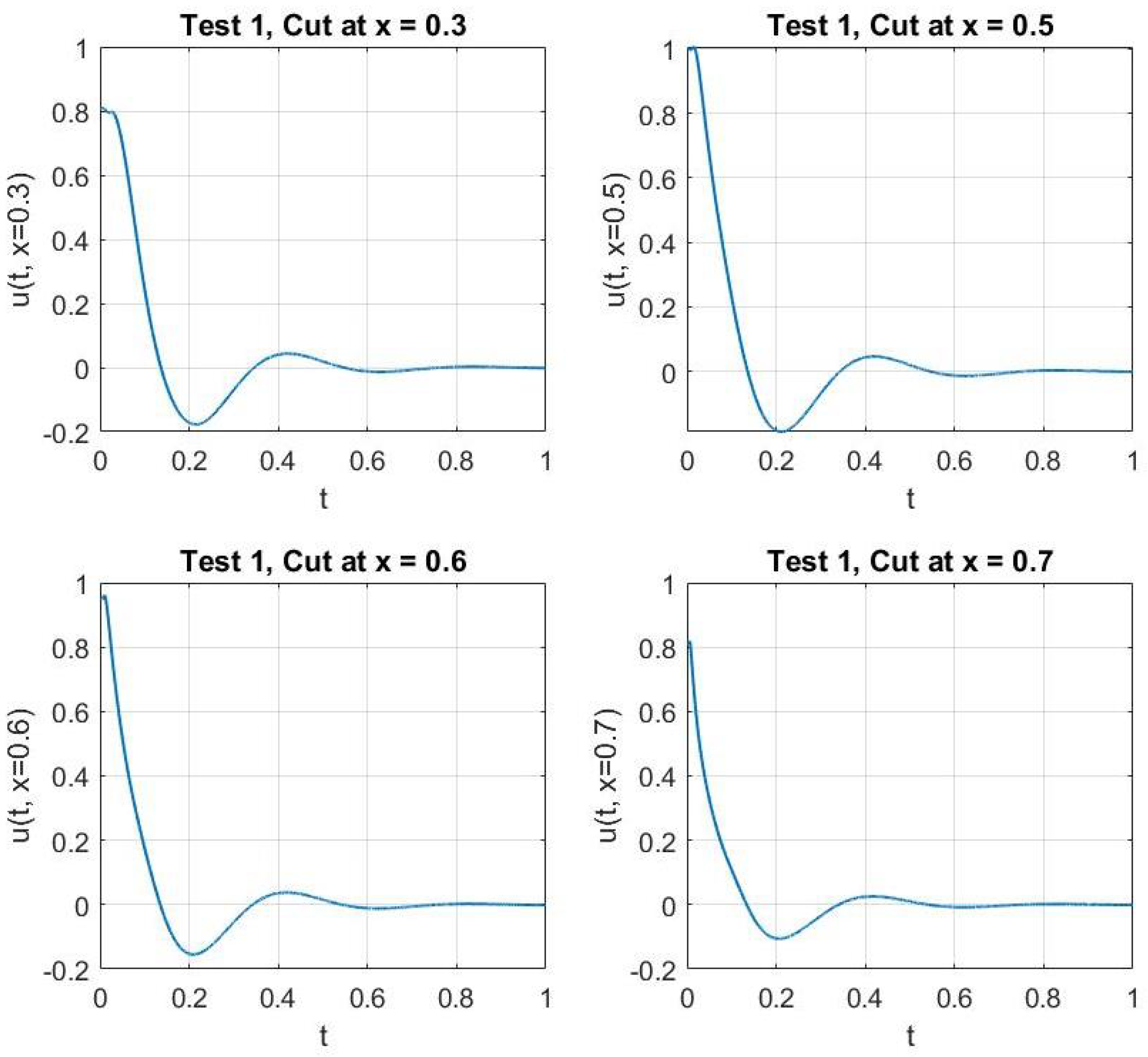
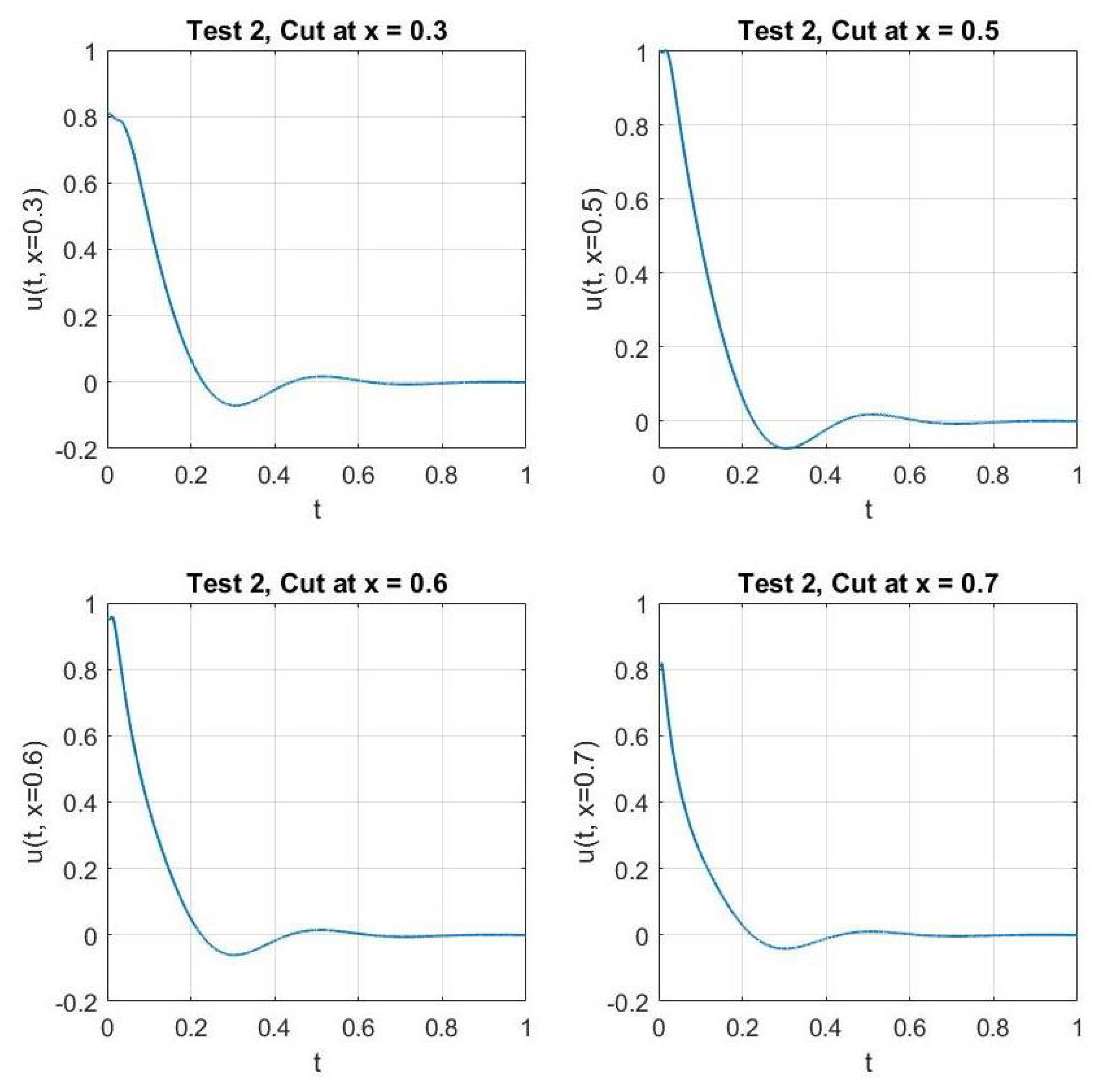
The homogeneous Dirichlet boundary condition for Problem (1) is stated, and = 0 at boundary. Based on the relaxation function and the initial conditions and , we contrast the following numerical two tests.
- Test 2: In the second test, we let and .
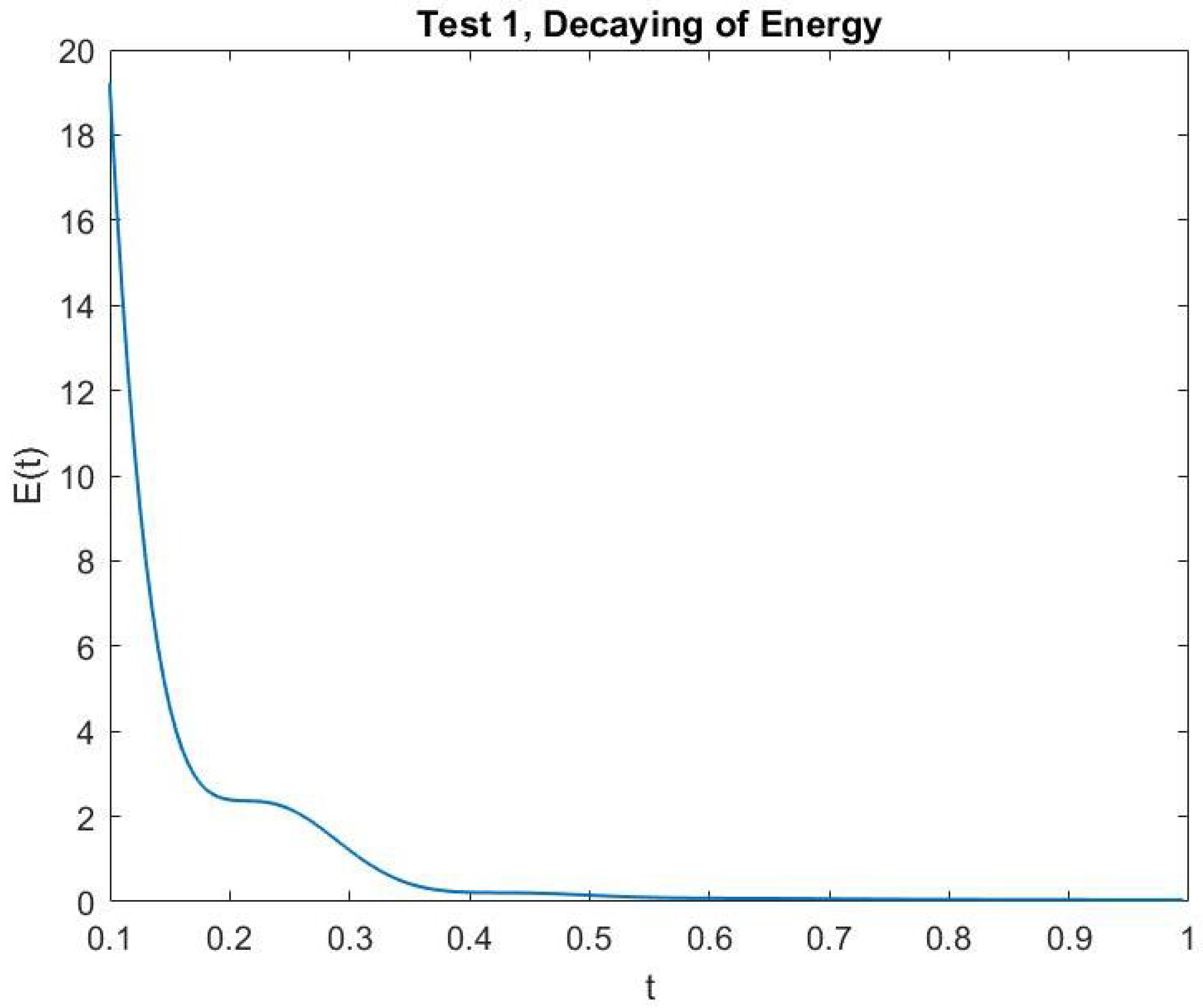
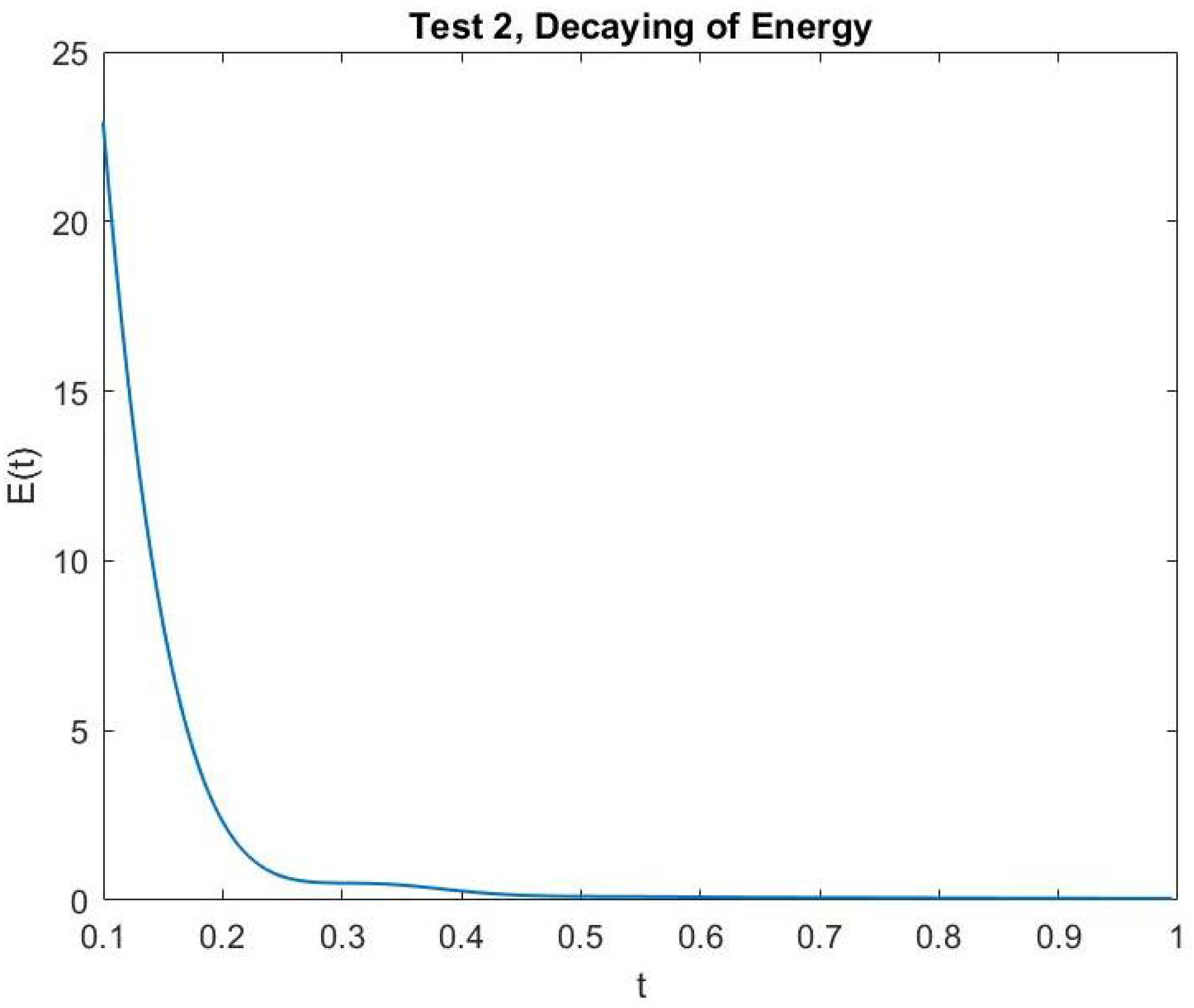
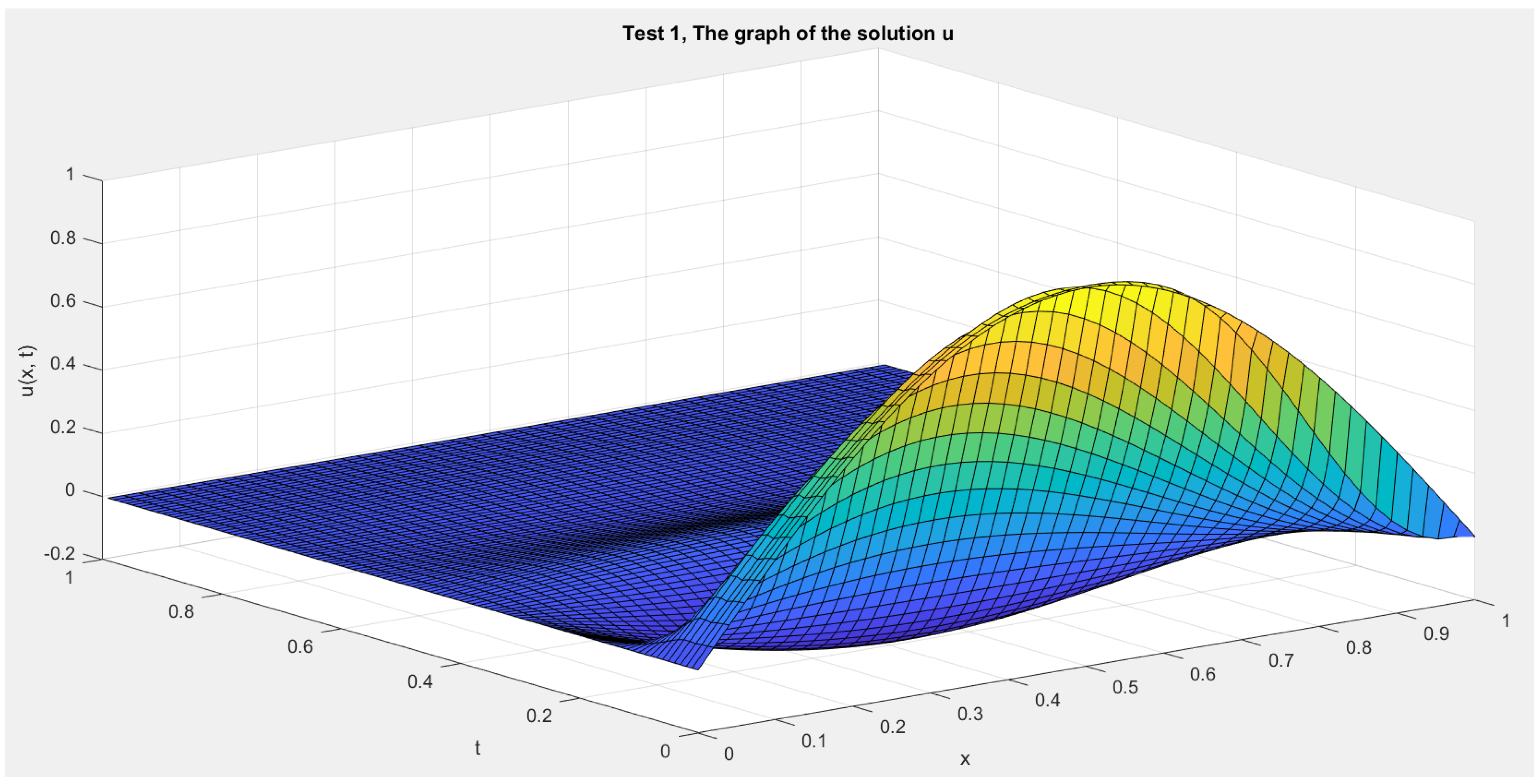
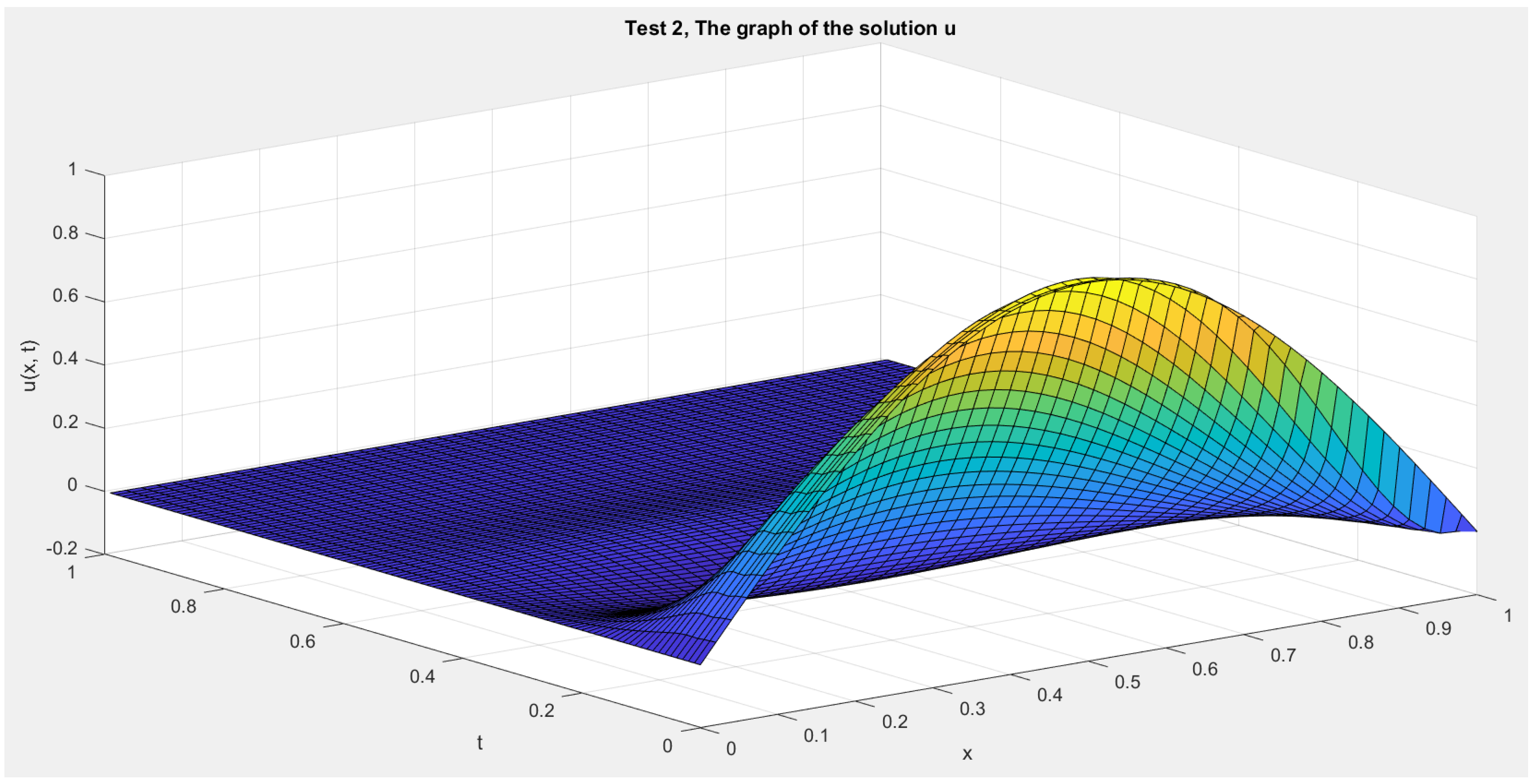
In Figure 1 and Figure 2, we show the cross-sections of the approximate solution u at , , , and for Test 1 and Test 2, respectively. In Figure 3 and Figure 4, we graph the corresponding energy functional (13). In addition, we show the decay behavior of the whole wave over the time interval in Figure 5 and Figure 6 for Test 1 and Test 2, respectively.
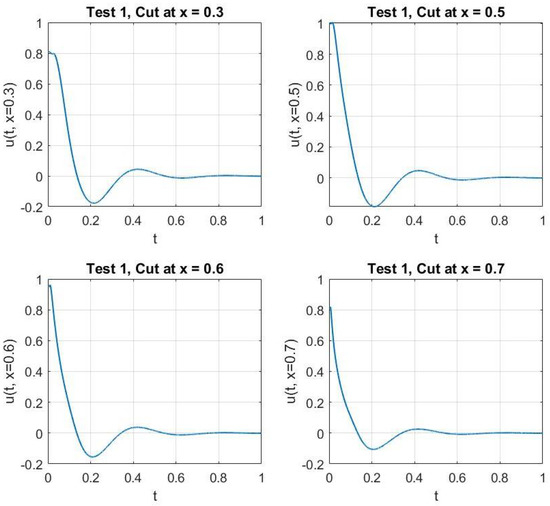
Figure 1.
Test 1: The solution of the problem at fixed values of x.
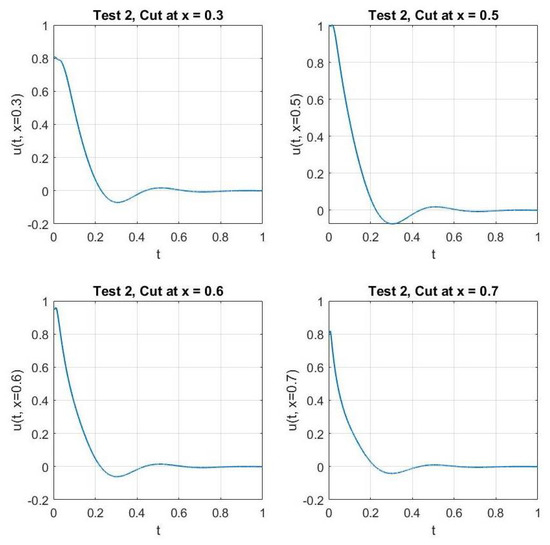
Figure 2.
Test 2: The solution of the problem at fixed values of x.
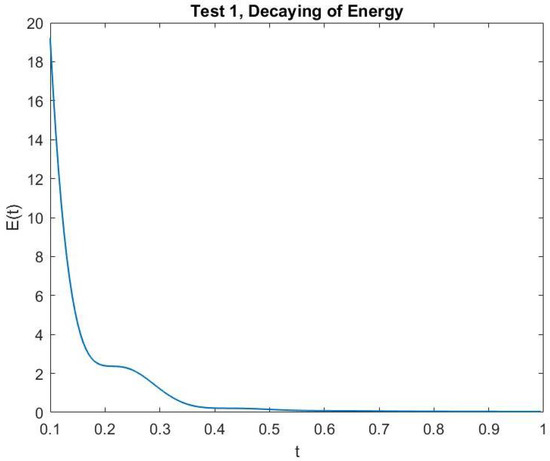
Figure 3.
Test 1: The energy decay.
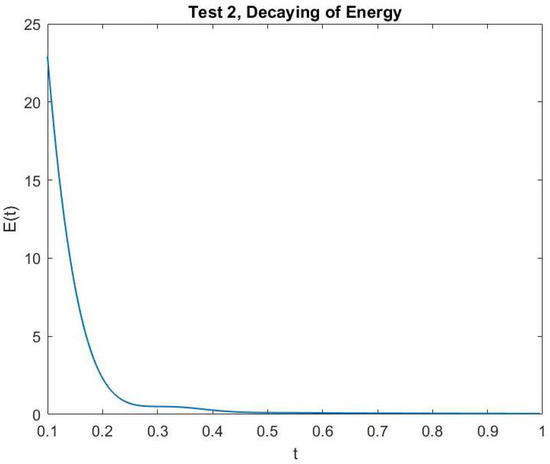
Figure 4.
Test 2: The energy decay.
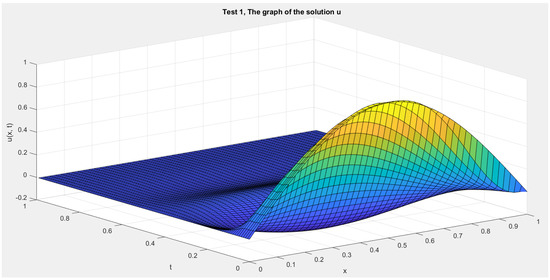
Figure 5.
Test 1: The solution function .
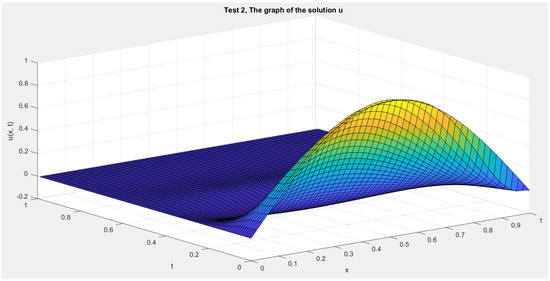
Figure 6.
Test 2: The solution function .
6. Conclusions
In this work, we considered a weakly dissipative viscoelastic equation with variable-exponent nonlinearity. We showed that the decay rate of the energy is weaker than that of the relaxation function. An open question is: can we obtain a similar or even weaker decay rate in the absences of the damping term
Author Contributions
Conceptualization, M.M.A.-G. and A.M.A.-M.; methodology, M.M.A.-G. and A.M.A.-M.; software, M.N.; validation, M.M.A.-G., A.M.A.-M. and J.D.A.; formal analysis, M.M.A.-G. and A.M.A.-M.; investigation, M.M.A.-G. and A.M.A.-M.; data curation, M.N.; writing—original draft preparation, J.D.A.; writing—review and editing, M.M.A.-G. and A.M.A.-M.; visualization, A.M.A.-M.; supervision, M.M.A.-G.; project administration, A.M.A.-M.; funding acquisition, A.M.A.-M. All authors have read and agreed to the published version of the manuscript.
Funding
This research was funded by KFUPM grant number SB20101.
Acknowledgments
The authors would like to express their profound gratitude to King Fahd University of Petroleum and Minerals (KFUPM) for its continuous support. The authors also thank the referee for his/her very careful reading and valuable comments. This work was funded by KFUPM under Project #SB201012.
Conflicts of Interest
The authors declare that there is no conflict of interest.
References
- Rivera, J.E.M.; Naso, M.G.; Vegni, F.M. Asymptotic behavior of the energy for a class of weakly dissipative second-order systems with memory. J. Math. Anal. Appl. 2003, 286, 692–704. [Google Scholar] [CrossRef]
- Hassan, J.H.; Messaoudi, S.A. General decay rate for a class of weakly dissipative second-order systems with memory. Math. Methods Appl. Sci. 2019, 42, 2842–2853. [Google Scholar] [CrossRef]
- Anaya, K.; Messaoudi, S.A. General decay rate of a weakly dissipative viscoelastic equation with a general damping. Opuscula Mathematica 2020, 40, 647–666. [Google Scholar] [CrossRef]
- Acerbi, E.; Mingione, G. Regularity results for stationary electro-rheological fluids. Arch. Ration. Mech. Anal. 2002, 164, 213–259. [Google Scholar] [CrossRef]
- Ruzicka, M. Electrorheological Fluids: Modeling and Mathematical Theory; Springer Science & Business Media: New York, NY, USA, 2000. [Google Scholar]
- Antontsev, S. Wave equation with p(x,t)-Laplacian and damping term: Existence and blow-up. Differ. Equ. Appl. 2011, 3, 503–525. [Google Scholar] [CrossRef]
- Antontsev, S. Wave equation with p(x,t)-Laplacian and damping term: Blow-up of solutions. Comptes Rendus Mécanique 2011, 339, 751–755. [Google Scholar] [CrossRef]
- Guo, B.; Gao, W. Blow-up of solutions to quasilinear hyperbolic equations with p(x,t)-Laplacian and positive initial energy. Comptes Rendus Mécanique 2014, 342, 513–519. [Google Scholar] [CrossRef]
- Messaoudi, S.A.; Talahmeh, A.A. A blow-up result for a nonlinear wave equation with variable-exponent nonlinearities. Appl. Anal. 2017, 96, 1509–1515. [Google Scholar] [CrossRef]
- Messaoudi, S.A.; Al-Smail, J.H.; Talahmeh, A.A. Decay for solutions of a nonlinear damped wave equation with variable-exponent nonlinearities. Comput. Math. Appl. 2018, 76, 1863–1875. [Google Scholar] [CrossRef]
- Messaoudi, S.A. On the decay of solutions of a damped quasilinear wave equation with variable-exponent nonlinearities. Math. Methods Appl. Sci. 2020, 43, 5114–5126. [Google Scholar] [CrossRef]
- Antontsev, S.; Shmarev, S. Blow-up of solutions to parabolic equations with nonstandard growth conditions. J. Comput. Appl. Math. 2010, 234, 2633–2645. [Google Scholar] [CrossRef]
- Antontsev, S.; Ferreira, J.; Piskin, E. Existence and blow up of solutions for a strongly damped Petrovsky equation with variable-exponent nonlinearities. Electron. J. Differ. Equ. 2021, 2021, 1–18. [Google Scholar]
- Abita, R. Existence and asymptotic behavior of solutions for degenerate nonlinear Kirchhoff strings with variable-exponent nonlinearities. Acta Math. Vietnam. 2021, 46, 613–643. [Google Scholar] [CrossRef]
- Rahmoune, A.; Benabderrahmane, B. On the viscoelastic equation with Balakrishnan–Taylor damping and nonlinear boundary/interior sources with variable-exponent nonlinearities. Stud. Univ. Babes-Bolyai Math. 2020, 65, 599–639. [Google Scholar] [CrossRef]
- Al-Gharabli, M.M.; Al-Mahdi, A.M.; Kafini, M. Global existence and new decay results of a viscoelastic wave equation with variable exponent and logarithmic nonlinearities. AIMS Math. 2021, 6, 10105–10129. [Google Scholar] [CrossRef]
- Antontsev, S.; Shmarev, S. Evolution PDEs with Nonstandard Growth Conditions; Atlantis Press: Paris, France, 2015. [Google Scholar]
- Diening, L.; Harjulehto, P.; Hästö, P.; Ruzicka, M. Lebesgue and Sobolev Spaces with Variable Exponents; Springer: New York, NY, USA, 2011. [Google Scholar]
- Radulescu, V.D.; Repovs, D.D. Partial Differential Equations with Variable Exponents: Variational Methods and Qualitative Analysis; CRC Press: Boca Raton, FL, USA, 2015; Volume 9. [Google Scholar]
- Mustafa, M.I. Optimal decay rates for the viscoelastic wave equation. Math. Methods Appl. Sci. 2018, 41, 192–204. [Google Scholar] [CrossRef]
- Jin, K.-P.; Liang, J.; Xiao, T.-J. Coupled second order evolution equations with fading memory: Optimal energy decay rate. J. Differ. Equ. 2014, 257, 1501–1528. [Google Scholar] [CrossRef]
- Messaoudi, S.A. General decay of solutions of a viscoelastic equation. J. Math. Anal. Appl. 2008, 341, 1457–1467. [Google Scholar] [CrossRef]
- Arnol’d, V.I. Mathematical Methods of Classical Mechanics; Springer Science & Business Media: New York, NY, USA, 2013; Volume 60. [Google Scholar]
Disclaimer/Publisher’s Note: The statements, opinions and data contained in all publications are solely those of the individual author(s) and contributor(s) and not of MDPI and/or the editor(s). MDPI and/or the editor(s) disclaim responsibility for any injury to people or property resulting from any ideas, methods, instructions or products referred to in the content. |
© 2023 by the authors. Licensee MDPI, Basel, Switzerland. This article is an open access article distributed under the terms and conditions of the Creative Commons Attribution (CC BY) license (https://creativecommons.org/licenses/by/4.0/).