


Error in Figure
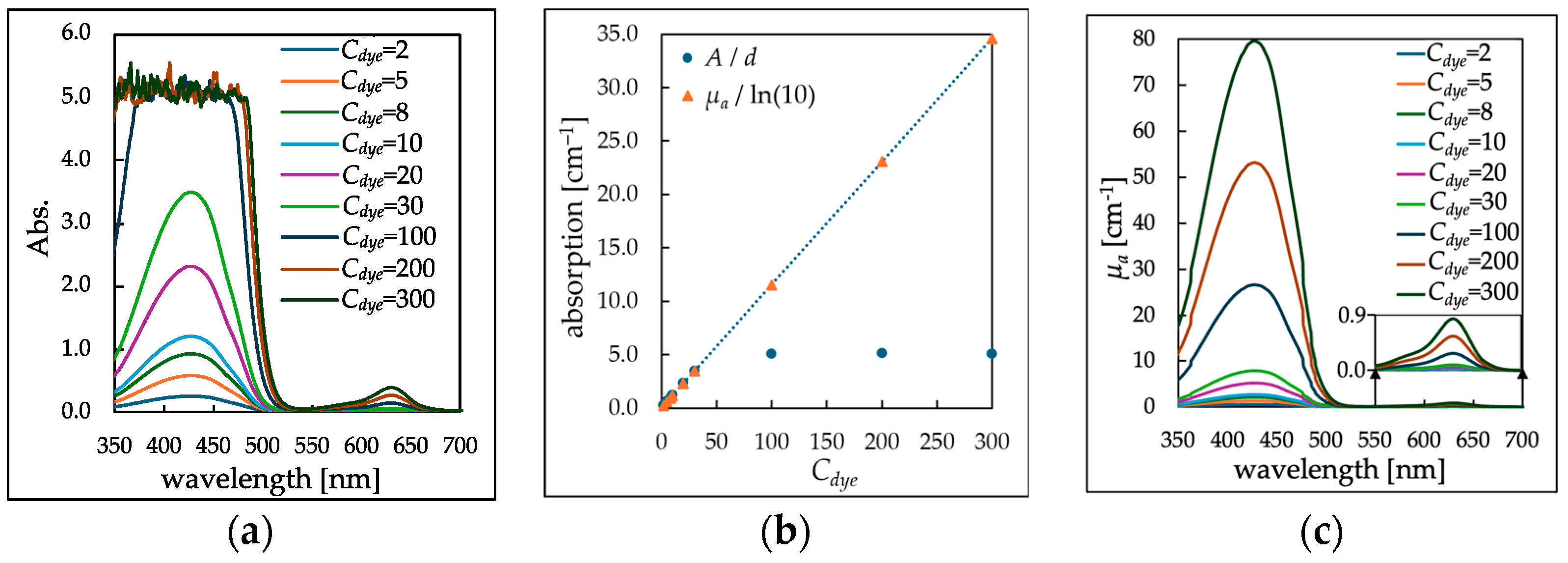
In the original publication [1], there were two mistakes in Figure 3. The notation µa ln(10) in the legend and caption of Figure 3b was incorrect. The text in the legend of Figure 3c was missing. The corrected Figure 3 with the correct legend and caption appears below.
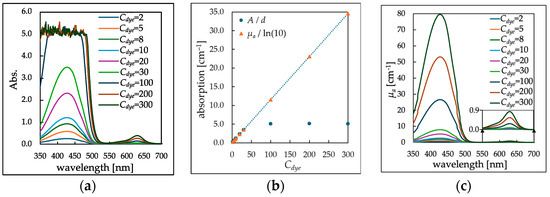
Figure 3.
(a) The absorbance spectra of dye solutions at various concentrations measured using the setup shown in Figure 1a. (b) The concentration dependence of A/d and µa/ln(10) at 423 nm. The blue circles show the measured results, and the dashed line shows the linear approximation of these results. The true µa (orange triangles) was defined from the slope of this approximation line. (c) The absorption spectra of dye solutions derived from the linear approximation of the absorbance and concentration. The inset graph in the lower-right corner shows an expanded view of the absorption spectrum between 550 and 700 nm.
Error in Table
In the original publication, there was a mistake in Table 1 as published. The absorption coefficient µa is calculated using the natural logarithm; however, this table listed a value, µa10, which was calculated using the common logarithm. In the simulations, µa10 was used as the input, and the program internally converted it to µa by multiplying by ln(10). Therefore, the simulations used the correct values. The corrected Table 1 appears below.

Table 1.
Input parameters for Monte Carlo simulations. MC simulations were conducted under a total of 4680 conditions, involving combinations of 130 values of µa and 36 values of λ. β is ln(10). The simulations utilized three input parameters, µa, µs, and g, with µs and g being dependent on λ.
Text Correction
A correction has been made to Appendix A, second paragraph:
In this study, since the imaginary part of the dye solution’s refractive index, κ, is sufficiently small (for the high absorption peak at λ = 426 nm, where µa < 28 cm−1, resulting in κ = µa λ/4π < 9.492 × 10⁻⁵), the scattering coefficient µs and the anisotropy factor g were calculated using conventional Mie theory. However, in cases where κ is large, calculations should be conducted using a modified Mie theory that accounts for the absorption properties of the medium [47,48].
The authors state that the scientific conclusions are unaffected. This correction was approved by the Academic Editor. The original publication has also been updated.
Reference
- Mori, A.; Yamashita, K.; Tokunaga, E. High-Dynamic-Range Absorption Spectroscopy by Generating a Wide Path-Length Distribution with Scatterers. Photonics 2024, 11, 556. [Google Scholar] [CrossRef]
Disclaimer/Publisher’s Note: The statements, opinions and data contained in all publications are solely those of the individual author(s) and contributor(s) and not of MDPI and/or the editor(s). MDPI and/or the editor(s) disclaim responsibility for any injury to people or property resulting from any ideas, methods, instructions or products referred to in the content. |
© 2024 by the authors. Licensee MDPI, Basel, Switzerland. This article is an open access article distributed under the terms and conditions of the Creative Commons Attribution (CC BY) license (https://creativecommons.org/licenses/by/4.0/).