


Abstract
Discrete time crystals (DTC) have been demonstrated experimentally in several different quantum systems in the past few years. Spin couplings and cavity losses have been shown to play crucial roles for realizing DTC order in open many-body systems out of equilibrium. Recently, it has been proposed that eternal and transient DTC can be present with an open Floquet setup in the thermodynamic limit and in the deep quantum regime with few qubits, respectively. In this work, we consider the effects of spin damping and spin dephasing on the DTC order in spin-optomechanical and open cavity systems in which the spins can be all-to-all coupled. In the thermodynamic limit, it is shown that the existence of dephasing can destroy the coherence of the system and finally lead the system to its trivial steady state. Without dephasing, eternal DTC is displayed in the weak damping regime, which may be destroyed by increasing the all-to-all spin coupling or the spin damping. By contrast, the all-to-all coupling is constructive to the DTC in the moderate damping regime. We also focus on a model which can be experimentally realized by a suspended hexagonal boron nitride (hBN) membrane with a few spin color centers under microwave drive and Floquet magnetic field. Signatures of transient DTC behavior are demonstrated in both weak and moderate dissipation regimes without spin dephasing. Relevant experimental parameters are also discussed for realizing transient DTC order in such an hBN optomechanical system.
1. Introduction
In recent years, periodically driven (Floquet) quantum many-body systems have attracted considerable attention since they are crucial for understanding new non-equilibrium Floquet many-body localization (MBL) [1] phase and may have potential applications in quantum metrology [2]. One example of a non-equilibrium Floquet-MBL phase is the discrete time-crystalline (DTC) order [3,4,5], which is different from a continuous time crystal [6,7,8,9] and is characterized by the breaking of discrete time-translation symmetry (TTS) [10]. The DTC order has been realized experimentally in several quantum systems in the past few years [11,12,13,14]. Under driving with a period T, the system can exhibit stroboscopic response with a period and it is expected to be robust against imperfection of the driving [15,16]. Recently, the DTCs in open Floquet systems have been reported [17,18,19,20,21,22,23]. Since any realistic systems will be unavoidably coupled to its surroundings and the influences of baths can be either negative or positive, the mechanisms of stabilizing DTC in dissipative systems will be important to explore.
Meanwhile, recent development of optomechanical systems [24,25,26,27,28] has facilitated breakthroughs of quantum technologies such as ground state cooling [29,30], optical sensing [31,32,33,34,35], and quantum information processing [36,37]. With nanoscale cavity optomechanical devices, the coupling between light and motion of mechanical resonators can be flexibly modulated with controllable loss [38], which may even reach ultrastrong coupling regime [39]. A natural choice of mechanical modes is to use membranes of two-dimensional materials due to their excellent mechanical properties [40]. Recently, hexagonal boron nitride (hBN) has drawn great interest and served as a promising platform for exploring both quantum and nanophotonic effects [41,42,43,44,45]. hBN has a very wide bandgap and outstanding chemical and thermal stability beyond that of graphene. As a type of van der Waals materials, hBN can be integrated with plasmonic, nanophotonic, and potentially more complex structures [46,47,48,49,50]. The hBN membranes have low mass, small out-of-plane stiffness, high elasticity modulus and strong tensile strength, which make them a promising candidate for high-Q mechanical resonators and high-sensitivity sensors [51,52]. A spin-mechanical system based on color centers in a suspended hBN mechanical resonator has been proposed [53,54], which can even simulate the Rabi model in the ultrastrong coupling regime. Very recently, optically addressable spin defects were observed in hBN [55,56,57]. As the DTC order has been found in N atoms in a lossy cavity [19,20,21], it is interesting to explore the DTC in such spin-optomechanical systems with incoherent noise (spin damping or dephasing).
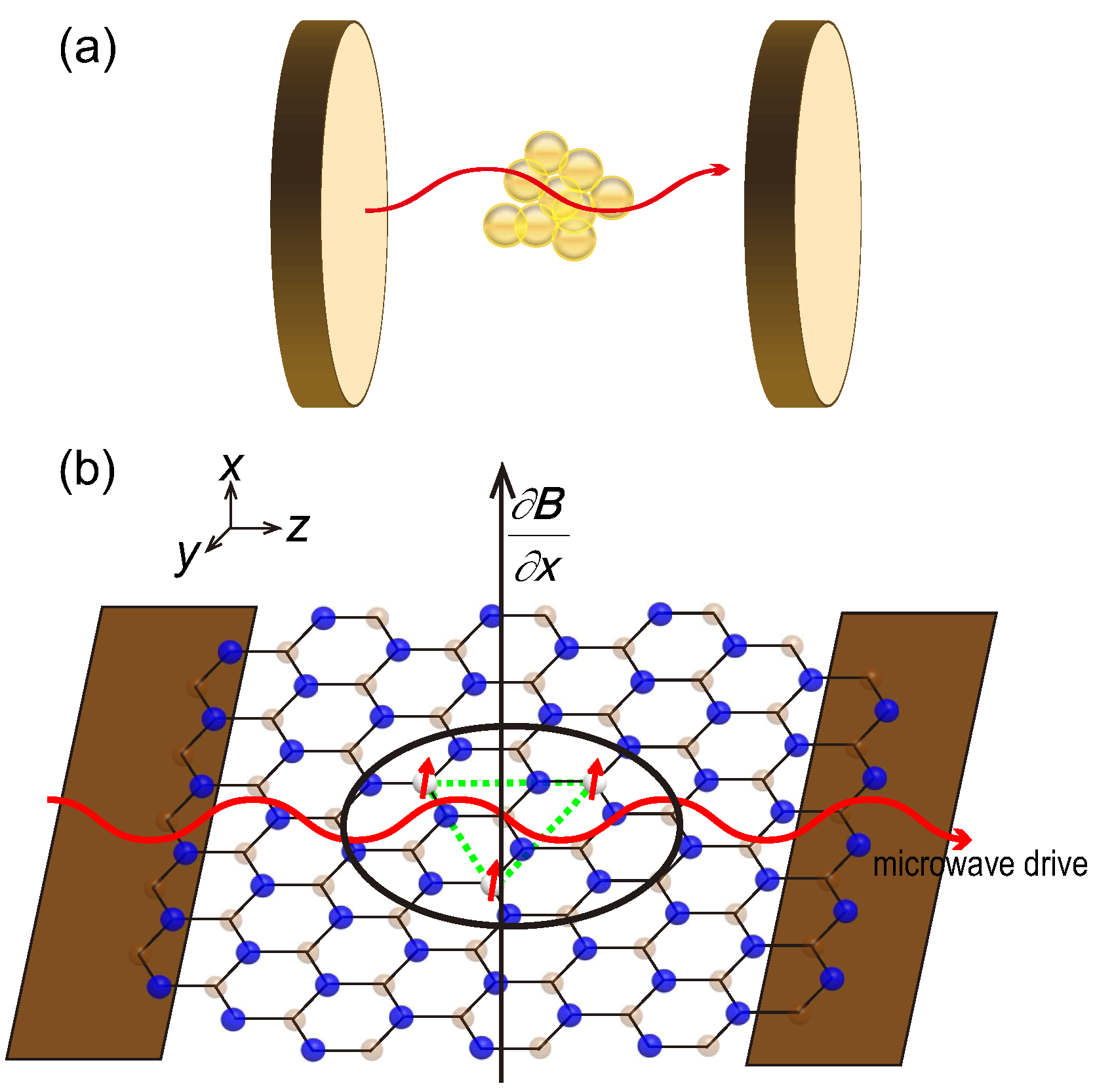
In this work, we consider the DTC behaviors in an open Floquet system as N qubits in a (mechanical) cavity via switching on and off of the spin-cavity coupling. In the thermodynamic limit, it describes a cavity QED model with a large ensemble of trapped spins while, in the deep quantum regime (with few qubits), it characterizes an optomechanical model as a suspended hBN monolayer membrane with a few spin defects under a microwave drive and a Floquet magnetic field (Figure 1). We discuss stroboscopic dynamics in both regimes and explore whether stroboscopic oscillations are stable to spin damping and spin dephasing as well as the effect of all-to-all spin coupling.
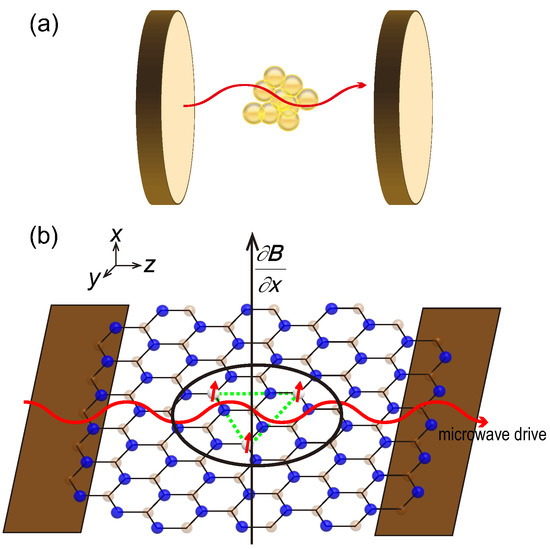
Figure 1.
Sketches of the setups for realizing the DTC order: (a) a large ensemble of spins trapped in a cavity and (b) a suspended hBN monolayer membrane with a few spin color centers under a microwave drive and a circular-localized magnetic field. The Hamiltonian is modeled by Equation (1) and the Floquet driving protocol is that the spin-cavity coupling is switched on (off) in the first (second) half of a Floquet period T. In this work, both spin and cavity losses are considered.
2. Perfect DTC in the Thermodynamic Limit
We consider an open system as N qubits with all-to-all interactions in a (mechanical) cavity (Figure 1). The all-to-all coupling can be mediated by a photon in an optical cavity [19] or a phonon in a mechanical oscillator [53,54,58]. The Hamiltonian is given by [19,20,53,54,59,60]
where () is the annihilation (creation) operator of the photon field with optical frequency , () is the spin- angular momentum operator along the axis for the i-th qubit of transition frequency , and h () is related to the spin-spin (spin-cavity) coupling strength. For convenience, a more compact version can be derived as
by introducing the collective angular moment operator and neglecting a constant term. We consider a general decoherent model by including both the spin and cavity losses. Then, the dynamics of the system can be described by the master equation (setting )
where is the collective lowering operator and . Here, is the cavity damping rate with Q the quality factor. In addition, and are the spin relaxation and dephasing rate, respectively. Previous works mainly focused on the DTC in cavity QED systems with merely the cavity loss or the nearest-neighbor (short-range) spin coupling [19,20,21]. They have neither discussed stabilizing DTC in dissipative systems with all-to-all coupling nor considered the effects of spin damping and spin dephasing.
First, we would like to consider the robustness of DTC behavior in the thermodynamic limit . By performing the mean-field approximation and factorizing the means of operator product, we obtain a closed set of semiclassical equations as
where with and , , and . The set of Equation (4) is a generalization of that in Reference [19] which is a special case as here. The introduction of spin-spin coupling h breaks the original stable attractors and , with and the critical spin-cavity coupling strength . We would also like to focus on the steady-state solutions as Reference [19], which is instead numerically found out due to the more complexity considered. It is clear that there exist trivial steady-state solutions as and . Besides, as long as the dephasing exists (), the steady-state solutions will fall into be trivial. This can be understood as that the existence of dephasing will finally destroy the coherence (non-diagonal terms of density matrix) and leads to the final state as either or when the symmetry is broken at . Here, are the eigenstates of with . Therefore, we set in the following discuss, unless specifically mentioned. Besides, we assume the spins are initially in the eigenstate with , , and and the cavity mode is initially in a coherent state with . If we consider the symmetry-broken regime , it is clear that the final state will fall into either one of the two nontrivial stable states. To observe a DTC order, we perform the Floquet driving protocol similar to Reference [19]: the spin-cavity coupling is artificially switched off in the second-half period, i.e., for with . From an alternative viewpoint, the Floquet driving is that we let the spins periodically driven by a leaky cavity in every first-half period . We introduce the imperfection parameter via a detuning between and as and with . In the perfect case (), it is not difficult to check that the unitary dynamics during the second-half period contributes a parity operator which flips the stable state to the other one. If certain observables of the spins (say ) or the cavity mode (say ) exhibit period doubling oscillations which are robust against imperfection driving , then a DTC order may be identified. We also consider nonunitary imperfections due to decoherence of the system. To observe the long-time behavior, we numerically solve a Floquet–Lindblad master equation (setting in Equation (4) be periodically time-dependent as characterized above) up to 500 periods T by means of the Runge-Kutta method. We shall remark that we have also tried more periods such as 5000 periods as in Reference [19] but there is no qualitative difference. For convenience, we set and to illustrate the perfect DTC in the regime.
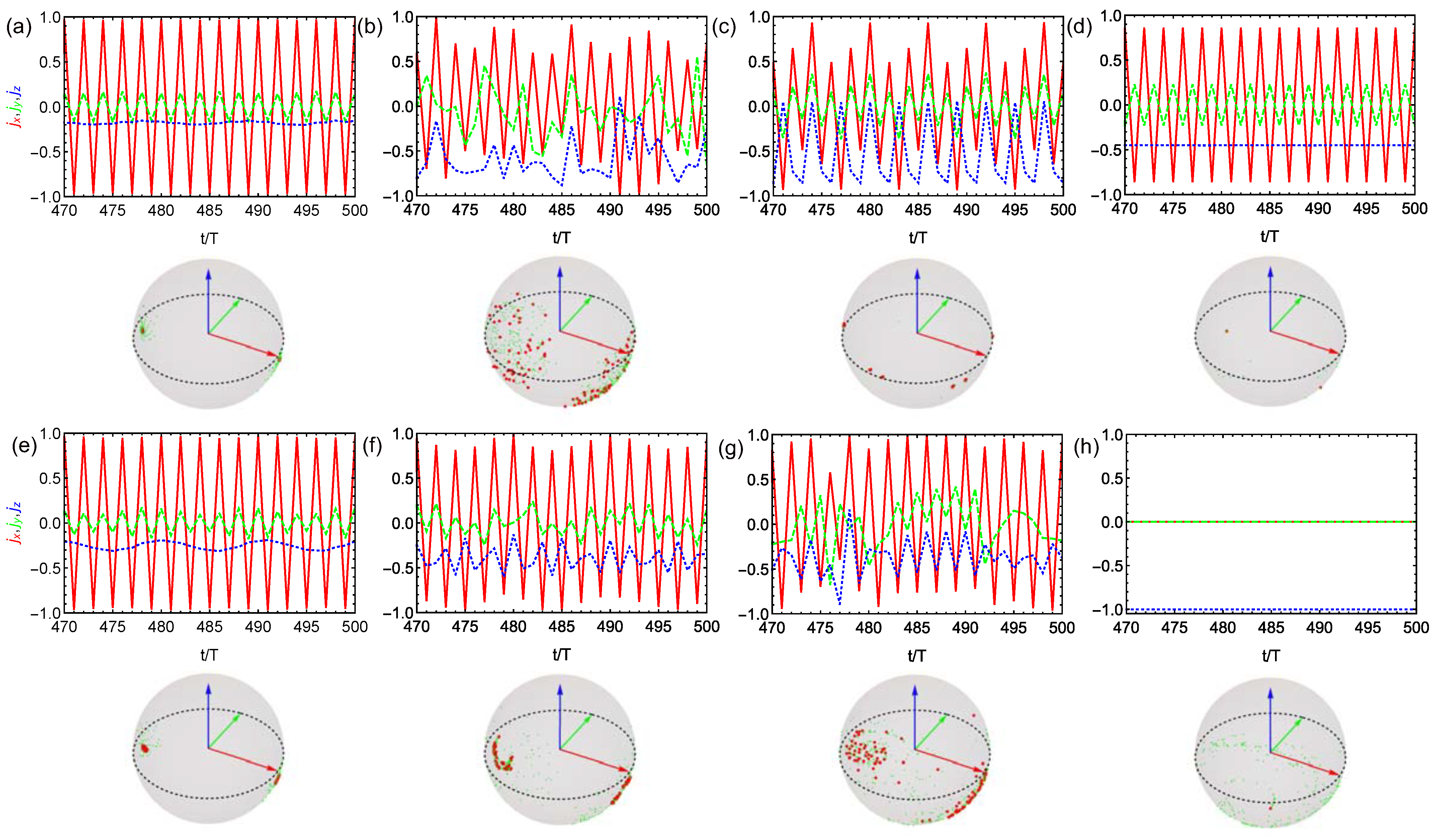
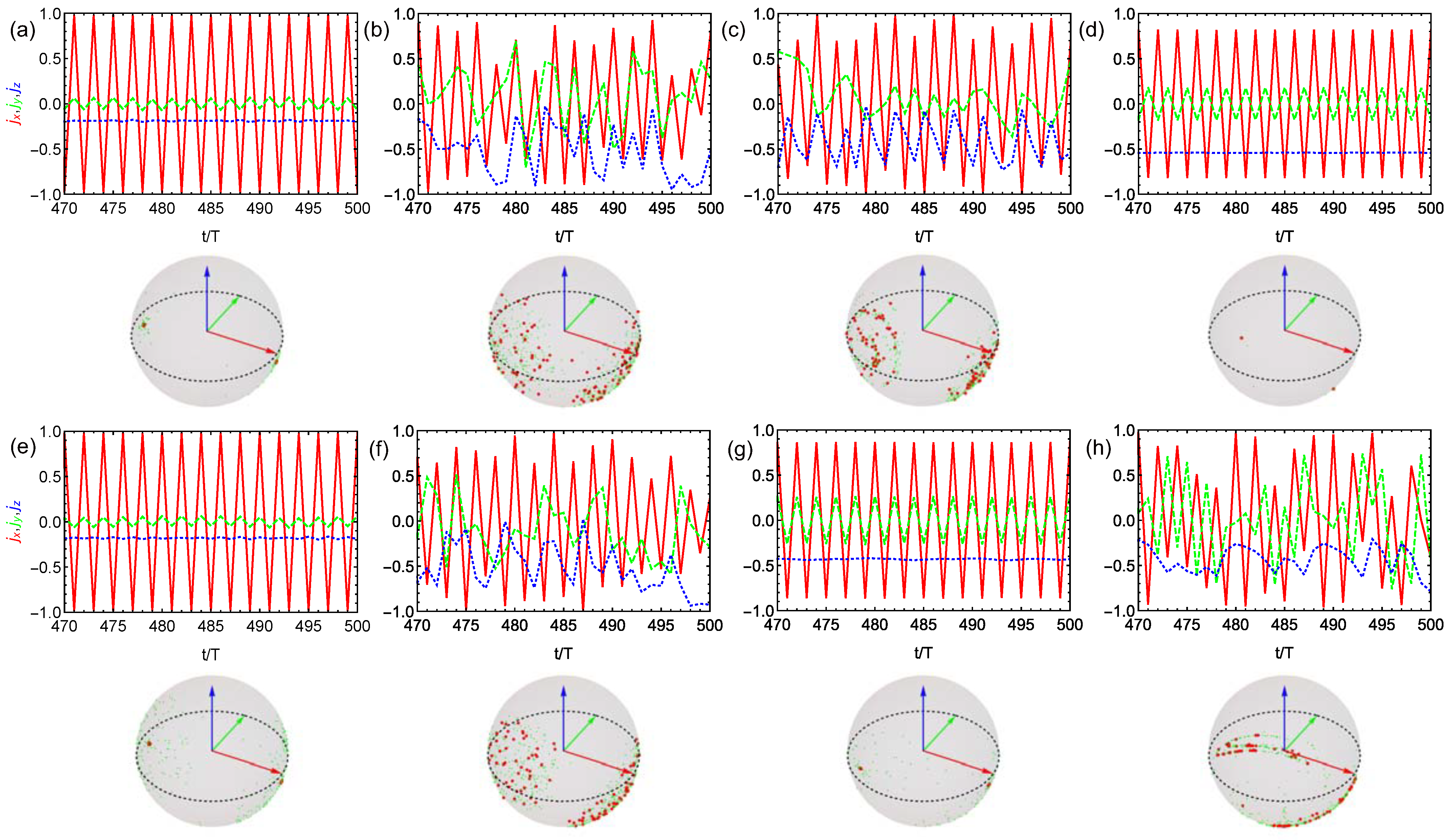
In Figure 2 and Figure 3, we plot the stroboscopic dynamics of the scaled angular momentum vector as well as their stroboscopic trajectories on the Bloch sphere for the perfect driving () and imperfect driving () cases, respectively. By comparing the first row a–d where there is no spin-spin coupling with , we clearly observe different stroboscopic dynamics in different dissipation regimes. First, the DTC order is well preserved by the existence of weak spin damping as shown in Figure 2a and robust again imperfection as shown in Figure 3a. As the spin damping rate increases, the DTC dynamics becomes irregular with the trajectory of scattered on the Bloch sphere (Figure 2b and Figure 3b). However, the dynamics will become more regularly with the area of stroboscopic trajectories reduced if the cavity loss rate increases (Figure 2c and Figure 3c). The eternal stroboscopic oscillations will occur again with the trajectories almost collapse into the two stable points for (Figure 2d), which is robust against imperfection (Figure 3d) so as to identify the DTC order. Besides, by comparing the second row (e–h) where there is spin-spin coupling , different stroboscopic dynamics from that of is also demonstrated in different dissipation regimes. From Figure 2e–h (perfect case) with growing all-to-all coupling h, we observe that DTC oscillations is gradually destroyed and the system finally falls into one of the trivial stable states with and (Figure 2h). By contrast, in the imperfect case () as shown in Figure 3e–h, we surprisingly find that the DTC order may be rebuilt by appropriate h in the moderate damping regime, by comparing Figure 3g with Figure 2g.
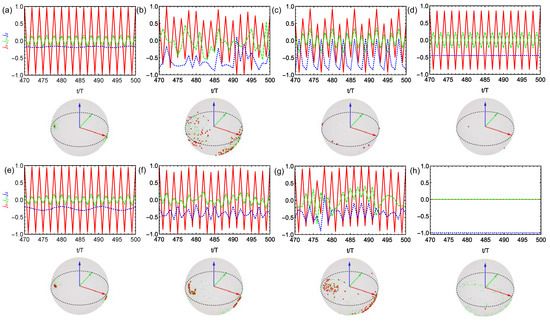
Figure 2.
Stroboscopic dynamics (top) and stroboscopic trajectories (bottom) of the scaled angular momentum vector (red, green, blue) in the thermodynamic limit for the perfect driving case . The top shows typical stroboscopic dynamics of (solid red curve), (dashed green curve) and (dotted blue curve) for the last 30 periods of the entire 500-period evolution. The bottom displays the stroboscopic trajectories on the Bloch sphere for the entire 500 periods (green) and for the last 100 periods (red) sphere. We consider no spin-cavity coupling in (a–d) and increasing spin-cavity coupling strength in (e–h) with , , , 1, respectively. The parameters are set as: (a,e) , (b,f) , , (c,g) and (d,h) , .
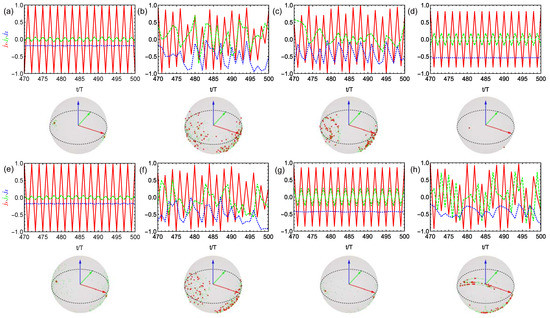
Figure 3.
Stroboscopic dynamics (top) and stroboscopic trajectories (bottom) of the scaled angular momentum vector components (solid red curve), (dashed green curve), (dotted blue curve) in the thermodynamic limit for the imperfect driving case . There is no spin-cavity coupling with in (a–d) and increasing spin-cavity coupling strength with , , , 1 (e–h), respectively. The parameters are set as: (a,e) , (b,f) , , (c,g) and (d,h) , . The robustness of DTC against imperfection is clearly shown in (a,d,e). Besides, it is interesting to find that the DTC can even benefit from the imperfection as comparing Figure 3g with Figure 2g.
3. Transient DTC Behavior in the Deep Quantum Regime
We proceed to focus on the few-atom cases [], which corresponds to the hBN optomechanical system as displayed in Figure 1b. It is expected that a DTC behavior may still survive in few atom cases, the so-called deep quantum regime [19]. In this regime, we do not perform semiclassical approximation so that all the quantumness of the system is well maintained. The interplay among spin-spin coupling, spin-cavity coupling and dissipations may give rise to more subtle behaviors for transiently long DTC in this deep quantum regime. By transiently long we mean that the DTC lasts much longer than the decay time . The initial state is chosen to be ⊗, where is the eigenstate of with the eigenvalue and is a coherent state with . The Floquet–Lindblad dynamics extended from Equations (1) and (3) is directly solved under a truncation of 16 photons for .
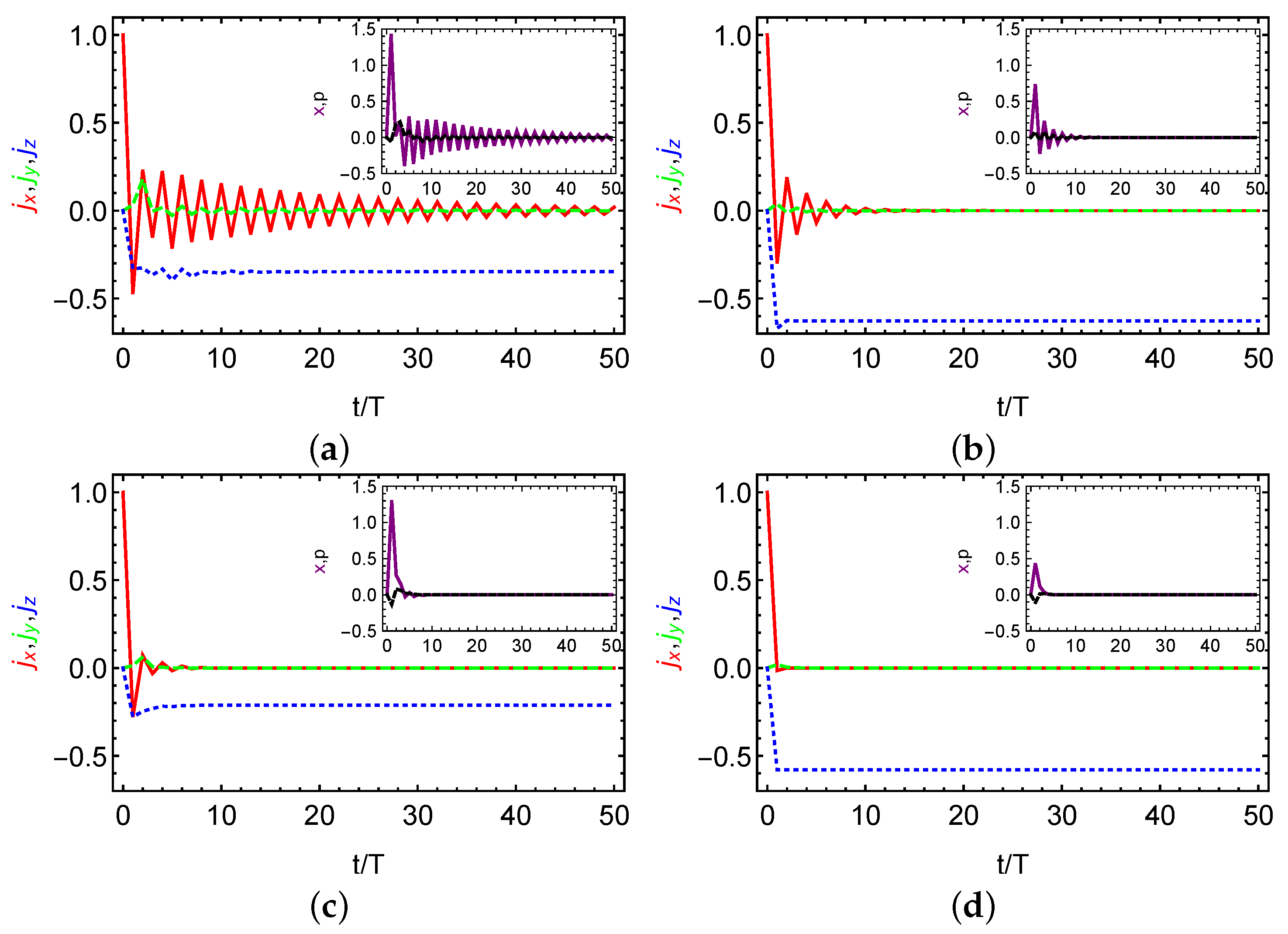
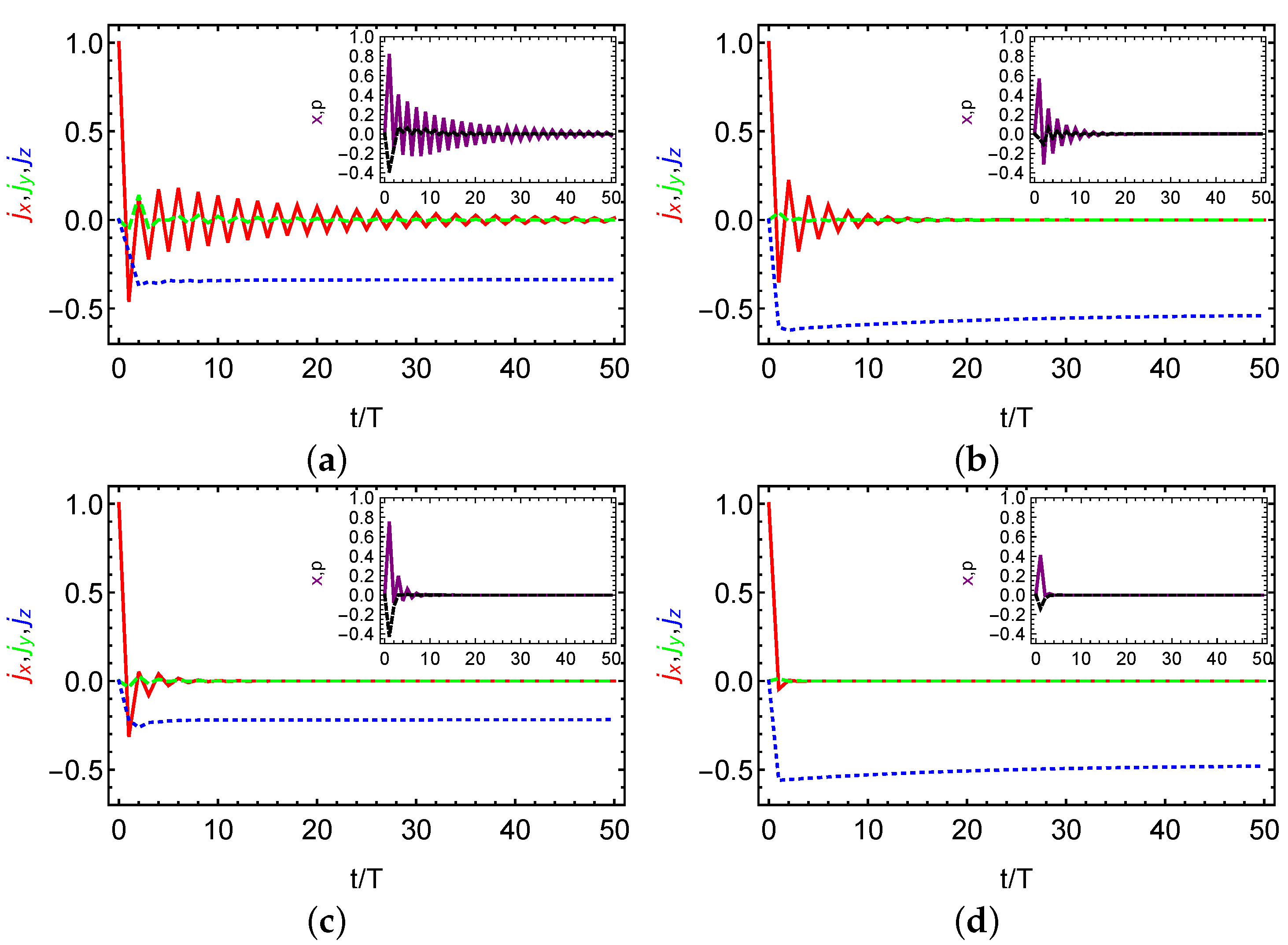
Figure 4a shows the stroboscopic dynamics of the scaled angular momenta and quadratures x, p (inset) in the strong coupling regime () and weak dissipation regime () for the two-qubit case (). We clearly observe that and x exhibit stroboscopic oscillations with doubling period after , which persists even at and thus is much longer than the decay time (here ). In this sense, a transient DTC order is established in the deep quantum regime before reaching the stationary state. In Figure 4b, we plot the stroboscopic dynamics in the moderate dissipation regime (). In this case, the decay time can be estimated as so that the stroboscopic dynamics occur immediately and lasts over , which still maintains a transient DTC order. Moreover, if the spin dephasing as predicted in Reference [53] is additionally considered, as shown in Figure 4c,d, we find that the oscillation time is merely comparable to the decay time and thus no transient DTC order exists. Besides, we observe similar phenomena if more spins are involved such as the case of shown in Figure 5. One effect of increasing the spin number N is that the transient oscillations evolve into an eternal one as predicted at the thermodynamic limit in Figure 2. Another effect of increasing N may be that the stroboscopic oscillations is more robust against the spin dephasing as comparing the oscillation dynamics of quadrature x (purple solid) in Figure 4c and Figure 5c.
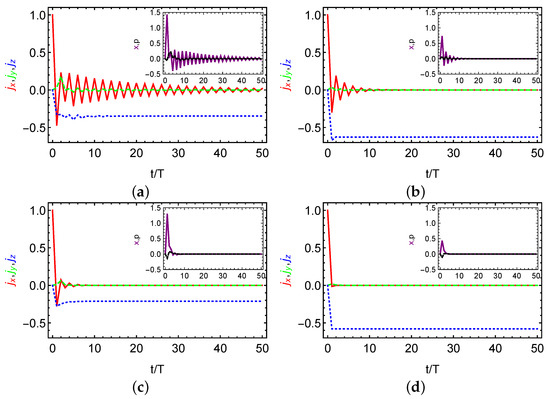
Figure 4.
Stroboscopic dissipative dynamics of the scaled angular momenta of (red solid curve), (green dashed curve), and (blue dotted curve) in the two-qubit case. The insets show stroboscopic dissipative dynamics for quadratures x (purple solid) and p (black dashed). We consider weak dissipation in (a) and moderate dissipation in (b) but without spin dephasing as the thermodynamic limit case. Contrast to (a) and (b), (c) and (d) includes spin dephasing as suggested in Reference [53].
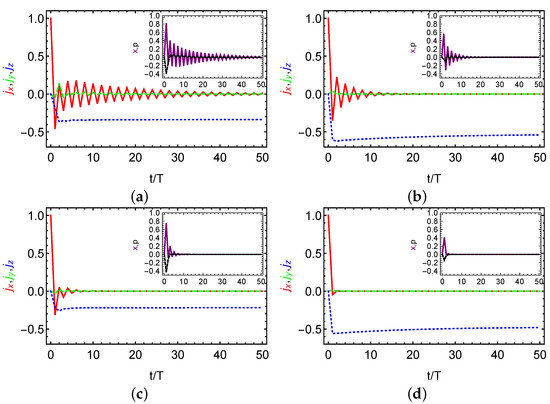
Figure 5.
Stroboscopic dissipative dynamics of the scaled angular momenta of (red solid curve), (green dashed curve), and (blue dotted curve) for the three-qubit case. The insets show stroboscopic dissipative dynamics for quadratures x (purple solid) and p (black dashed). We consider weak dissipation with in (a) and moderate dissipation with in (b) but without spin dephasing as the thermodynamic limit case. Contrast to (a) and (b), (c) and (d) includes spin dephasing .
Before ending, we would like to discuss the setup of experimental parameters for realizing TDC order in the optomechanical system of hBN monolayer membrane. According to Referecne [53], a maximum magnetic field gradient 270 may be reached such that the spin-cavity coupling may become comparable or even larger than the oscillator frequency . In this work, we consider , and with , and the cavity loss rate , which indicates . To insure the occurrence of transient DTC dynamics, we need operate in the regime of . Then, the minimal spin-cavity coupling is to achieve , which is realizable in a suspended circular hBN membrane with radius . Another important aspect is to control the dephasing rate which is detrimental to the DTC order. According to Reference [53], the spin dephasing mainly stems from optical polarization and membrane vibrations , which is proportional to the vibration frequency . Therefore, to suppress the dephasing rate, it is suggested to reduce the cavity frequency , which also corresponds to enhance the membrane radius R. Last, but not least, the cavity loss promotes spin cooling and localization, which is crucial to the emergence of DTC. However, as can be indicated by comparing Figure 4b with Figure 4a (or Figure 5b with Figure 5a), a too strong cavity loss (corresponding to extremely low Q) may overdamp the system dynamics and destroy the DTC order. Besides, a stronger leads to a higher critical spin-cavity coupling such that stronger spin-cavity coupling is needed, which imposes a challenge to its experimental realization. For cavity loss rate as considered in Figure 4c and Figure 5c, the quality factor Q is about 20, which provides a balance between spin cooling and loss to make experimental realization more feasible [52]. Overall, negligible spin dephasing, weak spin damping and appropriate cavity loss are suggested in realizing transient DTC order in such an optomechanical system.
4. Conclusions
In summary, we have investigated DTC order in a Floquet open system composed of N qubits trapped in a (mechanical) cavity. The influences of all-to-all spin interactions, spin damping, spin dephasing as well as cavity loss are explored both in the thermodynamic limit and in the deep quantum regime. It is shown that the existence of dephasing will destroy the coherence of the system and finally leads the system to its trivial steady state. Without dephasing and all-to-all spin coupling, different stroboscopic dynamics in different dissipation regimes is demonstrated. First, with weak spin damping and weak all-to-all coupling, eternal DTC oscillations are observed and robust against imperfection. As the spin damping rate increases, the stroboscopic dynamics evolves irregularly accompanied by the trajectory of the scaled angular momentum vector scattered on the Bloch sphere. However, with enhancement of cavity loss, the dynamics will become more regularly and the eternal eternal DTC order will reemerge at strong cavity loss. Besides, by growing the all-to-all coupling, we demonstrate that stroboscopic oscillations are gradually destroyed in the weak damping regime. It is interesting to show that the DTC order may be rebuilt by appropriate all-to-all coupling in the moderate damping regime.
We also focus on the few-atom cases, the so-called deep quantum regime, the model of which describes a suspended hBN monolayer membrane with a few spin defects under a microwave drive and a Floquet magnetic field. A transient DTC lasting much longer than the decay time can be found in both weak and moderate dissipation regimes when there is no spin dephasing. Nonetheless, the existence of dephasing will destroy transient oscillations and leads the system fast to a trivial steady state, which is consistent with the results obtained by semiclassical approximation in the thermodynamic limit. We also find that stroboscopic oscillations may be more robust against the spin dephasing by increasing the spin number. Finally, the parameters in the experimental aspect are briefly discussed and how to realizing transient DTC order in such an hBN optomechanical system is suggested.
Author Contributions
Conceptualization, T.L.; formal analysis, Z.H.; project administration, T.L.; writing–original draft, Z.H.; writing–review and editing, Z.H., X.G. and T.L. All authors have read and agreed to the published version of the manuscript.
Funding
T.L. acknowledges the support from NSF (Grant No. PHY-2110591). Z.H. acknowledges the support from the Fundamental Research Funds for the Central Universities (Grant No. JUSRP21935).
Institutional Review Board Statement
Not applicable.
Informed Consent Statement
Not applicable.
Data Availability Statement
Not applicable.
Acknowledgments
Z.H. would like to acknowledge the support by the China Scholarship Council (CSC).
Conflicts of Interest
The authors declare no conflict of interest.
References
- Abanin, D.A.; Altman, E.; Bloch, I.; Serbyn, M. Colloquium: Many-body localization, thermalization, and entanglement. Rev. Mod. Phys. 2019, 91, 021001. [Google Scholar] [CrossRef] [Green Version]
- Lyu, C.; Choudhury, S.; Lv, C.; Yan, Y.; Zhou, Q. Eternal discrete time crystal beating the Heisenberg limit. Phys. Rev. Res. 2020, 2, 033070. [Google Scholar] [CrossRef]
- Sacha, K. Modeling spontaneous breaking of time-translation symmetry. Phys. Rev. A 2015, 91, 033617. [Google Scholar] [CrossRef] [Green Version]
- Else, D.V.; Bauer, B.; Nayak, C. Floquet time crystals. Phys. Rev. Lett. 2016, 117, 090402. [Google Scholar] [CrossRef] [Green Version]
- Khemani, V.; Lazarides, A.; Moessner, R.; Sondhi, S.L. Phase structure of driven quantum systems. Phys. Rev. Lett. 2016, 116, 250401. [Google Scholar] [CrossRef]
- Wilczek, F. Quantum time crystals. Phys. Rev. Lett. 2012, 109, 160401. [Google Scholar] [CrossRef] [Green Version]
- Li, T.; Gong, Z.-X.; Yin, Z.-Q.; Quan, H.T.; Yin, X.; Zhang, P.; Duan, L.-M.; Zhang, X. Space-time crystals of trapped ions. Phys. Rev. Lett. 2012, 109, 163001. [Google Scholar] [CrossRef] [Green Version]
- Huang, Y.; Li, T.; Yin, Z.-Q. Symmetry-breaking dynamics of the finite-size Lipkin-Meshkov-Glick model near ground state. Phys. Rev. A 2018, 97, 012115. [Google Scholar] [CrossRef] [Green Version]
- Huang, Y.; Guo, Q.; Xiong, A.; Li, T.; Yin, Z.-Q. Classical and quantum time crystals in a levitated nanoparticle without drive. Phys. Rev. A 2020, 102, 023113. [Google Scholar] [CrossRef]
- Sacha, K. Time Crystals; Springer International Publishing: Cham, Switzerland, 2020. [Google Scholar]
- Choi, S.; Choi, J.; Landig, R.; Kucsko, G.; Zhou, H.; Isoya, J.; Jelezko, F.; Onoda, S.; Sumiya, H.; Khemani, V.; et al. Observation of discrete time-crystalline order in a disordered dipolar many-body system. Nature 2017, 543, 221. [Google Scholar] [CrossRef] [Green Version]
- Zhang, J.; Hess, P.W.; Kyprianidis, A.; Becker, P.; Lee, A.; Smith, J.; Pagano, G.; Potirniche, I.-D.; Potter, A.C.; Vishwanath, A.; et al. Observation of a discrete time crystal. Nature 2017, 543, 217. [Google Scholar] [CrossRef] [PubMed]
- Randall, J.; Bradley, C.E.; van der Gronden, F.V.; Galicia, A.; Abobeih, M.H.; Markham, M.; Twitchen, D.J.; Machado, F.; Yao, N.Y.; Taminiau, T.H. Many-body–localized discrete time crystal with a programmable spin-based quantum simulator. Science 2021, 374, 1474. [Google Scholar] [CrossRef] [PubMed]
- Kyprianidis, A.; Machado, F.; Morong, W.; Becker, P.; Collins, K.S.; Elsel, D.V.; Feng, L.; Hess, P.W.; Nayak, C.; Pagano, G.; et al. Observation of a prethermal discrete time crystal. Science 2021, 372, 1192. [Google Scholar] [CrossRef] [PubMed]
- von Keyserlingk, C.W.; Khemani, V.; Sondhi, S.L. Absolute stability and spatiotemporal long-range order in Floquet systems. Phys. Rev. B 2016, 94, 085112. [Google Scholar] [CrossRef] [Green Version]
- Yao, N.Y.; Potter, A.C.; Potirniche, I.-D.; Vishwanath, A. Discrete time crystals: Rigidity, criticality, and realizations. Phys. Rev. Lett. 2017, 118, 030401. [Google Scholar] [CrossRef]
- Lazarides, A.; Moessner, R. Fate of a discrete time crystal in an open system. Phys. Rev. B 2017, 95, 195135. [Google Scholar] [CrossRef] [Green Version]
- Else, D.V.; Bauer, B.; Nayak, C. Prethermal phases of matter protected by time-translation symmetry. Phys. Rev. X 2017, 7, 011026. [Google Scholar] [CrossRef] [Green Version]
- Gong, Z.; Hamazaki, R.; Ueda, M. Discrete time-crystalline order in cavity and circuit QED systems. Phys. Rev. Lett. 2018, 120, 040404. [Google Scholar] [CrossRef] [Green Version]
- Zhu, B.; Marino, J.; Yao, N.Y.; Lukin, M.D.; Demler, E.A. Dicke time crystals in driven-dissipative quantum many-body systems. New J. Phys. 2019, 21, 073028. [Google Scholar] [CrossRef]
- Keßler, H.; Kongkhambut, P.; Georges, C.; Mathey, M.; Cosme, J.G.; Hemmerich, A. Observation of a dissipative time crystal. Phys. Rev. Lett. 2021, 127, 043602. [Google Scholar] [CrossRef]
- Lazarides, A.; Roy, S.; Piazza, F.; Moessner, R. Time crystallinity in dissipative Floquet systems. Phys. Rev. Res. 2020, 2, 022002. [Google Scholar] [CrossRef] [Green Version]
- Riera-Campeny, A.; Moreno-Cardoner, M.; Sanpera, A. Time crystallinity in open quantum systems. Quantum 2020, 4, 270. [Google Scholar] [CrossRef]
- Fabre, C.; Pinard, M.; Bourzeix, S.; Heidmann, A.; Giacobino, E.; Reynaud, S. Quantum-noise reduction using a cavity with a movable mirror. Phys. Rev. A 1994, 49, 1337. [Google Scholar] [CrossRef] [PubMed]
- Mancini, S.; Tombesi, P. Quantum noise reduction by radiation pressure. Phys. Rev. A 1994, 49, 4055. [Google Scholar] [CrossRef] [PubMed]
- Aspelmeyer, M.; Kippenberg, T.J.; Marquardt, F. Cavity optomechanics. Rev. Mod. Phys. 2014, 86, 1391. [Google Scholar] [CrossRef]
- Yin, Z.; Zhao, N.; Li, T. Hybrid opto-mechanical systems with nitrogen-vacancy centers. Sci. China Phys. Mech. Astron. 2015, 58, 1. [Google Scholar] [CrossRef] [Green Version]
- Xu, Z.; Gao, X.; Bang, J.; Jacob, Z.; Li, T. Non-reciprocal energy transfer through the Casimir effect. Nat. Nanotechnol. 2021. [Google Scholar] [CrossRef]
- Chan, J.; Alegre, T.P.M.; Safavi-Naeini, A.H.; Hill, J.T.; Krause, A.; Gröblacher, S.; Aspelmeyer, M.; Painter, O. Laser cooling of a nanomechanical oscillator into its quantum ground state. Nature 2011, 478, 89. [Google Scholar] [CrossRef] [Green Version]
- Liu, Y.-c.; Hu, Y.-W.; Wong, C.W.; Xiao, Y.F. Review of cavity optomechanical cooling. Chin. Phys. B 2013, 22, 114213. [Google Scholar] [CrossRef] [Green Version]
- Xiong, H.; Liu, Z.X.; Wu, Y. Highly sensitive optical sensor for precision measurement of electrical charges based on optomechanically induced difference-sideband generation. Opt. Lett. 2017, 42, 3630. [Google Scholar] [CrossRef] [Green Version]
- Liu, Z.-X.; Wang, B.; Kong, C.; Si, L.-G.; Xiong, H.; Wu, Y. A proposed method to measure weak magnetic field based on a hybrid optomechanical system. Sci. Rep. 2017, 7, 12521. [Google Scholar] [CrossRef] [PubMed] [Green Version]
- Krause, A.G.; Winger, M.; Blasius, T.D.; Lin, Q.; Painter, O. A high-resolution microchip optomechanical accelerometer. Nat. Photonics 2012, 6, 768. [Google Scholar] [CrossRef] [Green Version]
- Ahn, J.; Xu, Z.; Bang, J.; Ju, P.; Gao, X.; Li, T. Ultrasensitive torque detection with an optically levitated nanorotor. Nat. Nanotechnol. 2020, 15, 89. [Google Scholar] [CrossRef] [PubMed] [Green Version]
- Li, B.-B.; Ou, L.; Lei, Y.; Liu, Y.-C. Cavity optomechanical sensing. Nanophotonics 2021, 10, 2799. [Google Scholar]
- Stannigel, K.; Rabl, P.; Sørensen, A.S.; Zoller, P.; Lukin, M.D. Optomechanical transducers for long-distance quantum communication. Phys. Rev. Lett. 2010, 105, 220501. [Google Scholar] [CrossRef] [Green Version]
- Stannigel, K.; Komar, P.; Habraken, S.J.M.; Bennett, S.D.; Lukin, M.D.; Zoller, P.; Rabl, P. Optomechanical quantum information processing with photons and phonons. Phys. Rev. Lett. 2012, 109, 013603. [Google Scholar] [CrossRef] [Green Version]
- Karg, T.M.; Gouraud, B.; Ngai, C.T.; Schmid, G.-L.; Hammerer, K.; Treutlein, P. Light-mediated strong coupling between a mechanical oscillator and atomic spins 1 meter apart. Science 2020, 369, 174. [Google Scholar] [CrossRef]
- Frisk Kockum, A.; Miranowicz, A.; De Liberato, S.; Savasta, S.; Nori, F. Ultrastrong coupling between light and matter. Nat. Rev. Phys. 2019, 1, 19. [Google Scholar]
- Akinwande, D.; Brennan, C.J.; Bunch, J.S.; Egberts, P.; Felts, J.R.; Gao, H.; Huang, R.; Kim, J.-S.; Li, T.; Li, Y.; et al. A Review on mechanics and mechanical properties of 2D materials–graphene and beyond. Extreme Mech. Lett. 2017, 13, 42. [Google Scholar]
- Tran, T.T.; Bray, K.; Ford, M.J.; Toth, M.; Aharonovich, I. Quantum emission from hexagonal Boron Nitride monolayers. Nat. Nanotechnol. 2016, 11, 37. [Google Scholar] [CrossRef]
- Liu, X.; Hersam, M.C. 2D materials for quantum information science. Nat. Rev. Mater. 2019, 4, 669. [Google Scholar]
- Xia, F.; Wang, H.; Xiao, D.; Dubey, M.; Ramasubramaniam, A. Two-dimensional material nanophotonics. Nat. Photonics 2014, 8, 899. [Google Scholar]
- Sławińska, J.; Zasada, I.; Kosiński, P.; Klusek, Z. Reversible modifications of linear dispersion: Graphene between boron nitride monolayers. Phys. Rev. B 2010, 82, 085431. [Google Scholar] [CrossRef] [Green Version]
- Cadiz, F.; Robert, C.; Courtade, E.; Manca, M.; Martinelli, L.; Taniguchi, T.; Watanabe, K.; Amand, T.; Rowe, A.C.H.; Paget, D.; et al. Exciton diffusion in WSe2 monolayers embedded in a van der Waals heterostructure. Appl. Phys. Lett. 2018, 112, 152106. [Google Scholar] [CrossRef] [Green Version]
- Tran, T.T.; Wang, D.; Xu, Z.-Q.; Yang, A.; Toth, M.; Odom, T.W.; Aharonovich, I. Deterministic coupling of quantum emitters in 2D materials to plasmonic nanocavity arrays. Nano Lett. 2017, 17, 2634. [Google Scholar] [CrossRef]
- Caldwell, J.D.; Aharonovich, I.; Cassabois, G.; Edgar, J.H.; Gil, B.; Basov, D. Photonics with hexagonal boron nitride. Nat. Rev. Mater. 2019, 4, 552. [Google Scholar]
- Gao, X.; Yin, Z.; Li, T. High-speed quantum transducer with a single-photon emitter in a 2D resonator. Annalen Physik 2020, 532, 2000233. [Google Scholar] [CrossRef]
- Wu, K.; Zhang, H.; Chen, Y.; Luo, K.; Xu, K. All-silicon microdisplay using efficient hot-carrier electroluminescence in standard 0.18 μm CMOS technology. IEEE Electron Device Lett. 2021, 42, 541. [Google Scholar] [CrossRef]
- Xu, K. Silicon electro-optic micro-modulator fabricated in standard CMOS technology as components for all silicon monolithic integrated optoelectronic systems. J. Micromech. Microeng. 2021, 31, 054001. [Google Scholar] [CrossRef]
- Kim, S.; Fröch, J.E.; Christian, J.; Straw, M.; Bishop, J.; Totonjian, D.; Watanabe, K.; Taniguchi, T.; Toth, M.; Aharonovich, I. Photonic crystal cavities from hexagonal Boron Nitride. Nat. Commun. 2018, 9, 2623. [Google Scholar] [CrossRef]
- Shandilya, P.K.; Fröch, J.E.; Mitchell, M.; Lake, D.P.; Kim, S.; Toth, M.; Behera, B.; Healey, C.; Aharonovich, I.; Barclay, P.E. Hexagonal Boron Nitride cavity optomechanics. Nano Lett. 2019, 19, 1343. [Google Scholar] [CrossRef] [PubMed]
- Abdi, M.; Hwang, M.-J.; Aghtar, M.; Plenio, M.B. Spin-mechanical scheme with color centers in hexagonal Boron Nitride membranes. Phys. Rev. Lett. 2017, 119, 233602. [Google Scholar] [CrossRef] [PubMed] [Green Version]
- Abdi, M.; Plenio, M.B. Quantum effects in a mechanically modulated single-photon emitter. Phys. Rev. Lett. 2019, 122, 023602. [Google Scholar] [CrossRef] [PubMed] [Green Version]
- Gottscholl, A.; Kianinia, M.; Soltamov, V.; Orlinskii, S.; Mamin, G.; Bradac, C.; Kasper, C.; Krambrock, K.; Sperlich, A.; Toth, M.; et al. Initialization and read-out of intrinsic spin defects in a van der waals crystal at room temperature. Nat. Mater. 2020, 19, 540. [Google Scholar] [CrossRef]
- Chejanovsky, N.; Mukherjee, A.; Geng, J.; Chen, Y.-C.; Kim, Y.; Denisenko, A.; Finkler, A.; Taniguchi, T.; Watanabe, K.; Dasari, D.B.R.; et al. Single-spin resonance in a van der Waals embedded paramagnetic defect. Nat. Mater. 2021, 20, 1079. [Google Scholar] [CrossRef]
- Gao, X.; Jiang, B.; Allcca, A.E.L.; Shen, K.; Sadi, M.A.; Solanki, A.B.; Ju, P.; Xu, Z.; Upadhyaya, P.; Chen, Y.P.; et al. High-contrast plasmonic-enhanced shallow spin defects in hexagonal Boron Nitride for quantum sensing. Nano Lett. 2021, 21, 7708. [Google Scholar] [CrossRef]
- Li, B.; Li, X.; Li, P.; Li, T. Preparing squeezed spin states in a spin–mechanical hybrid system with silicon-vacancy centers. Adv. Quantum Technol. 2020, 3, 2000034. [Google Scholar] [CrossRef]
- Morrison, S.; Parkins, A.S. Dynamical quantum phase transitions in the dissipative Lipkin-Meshkov-Glick model with proposed realization in optical cavity QED. Phys. Rev. Lett. 2008, 100, 040403. [Google Scholar] [CrossRef] [Green Version]
- Russomanno, A.; Iemini, F.; Dalmonte, M.; Fazio, R. Floquet time crystal in the Lipkin-Meshkov-Glick model. Phys. Rev. B 2017, 95, 214307. [Google Scholar] [CrossRef] [Green Version]
Publisher’s Note: MDPI stays neutral with regard to jurisdictional claims in published maps and institutional affiliations. |
© 2022 by the authors. Licensee MDPI, Basel, Switzerland. This article is an open access article distributed under the terms and conditions of the Creative Commons Attribution (CC BY) license (https://creativecommons.org/licenses/by/4.0/).