


Abstract
Background: Beef, because of its high protein content, occupies a privileged place in household consumption in Cameroon. However, the quality of the meat available on the market and the prices charged are far from satisfactory for consumers. There is therefore clearly a problem of physical and financial accessibility to quality beef for the Cameroonian consumer (in a country where 37.5% of the population lives below the poverty line). Methods: To analyze this problem, a qualitative exploratory study based on interviews and on-site observations was conducted. Results: In the article, we are interested in the Supply Chain (SC) of beef in Cameroon, with the aim of understanding its dynamics and highlighting the main obstacles that prevent the actors involved from ensuring consumers, the availability of quality meat at a reasonable price. Through the qualitative exploratory study conducted with the main actors involved (breeders, livestock traders, modern and traditional slaughterhouses, butchers, etc.), we show that the SC of beef in Cameroon is plagued by technical, financial, managerial and cultural constraints that prevent them from satisfying their customers and to take full advantage of their activities. Conclusions: Despite the methodological limits related to sampling and an essentially qualitative approach, the quality and richness of the information collected through in-depth interviews edify the main difficulties and challenges encountered by the actors and lead to managerial implications and prospects of research.
1. Motivation and Background of the Study
1.1. Motivation of the Study
In Cameroon, livestock is an integral part of the primary sector, whose contribution to GDP in 2017 amounted to 290 billion, i.e., a growth rate of 6.3% [1]. Mainly made up of cattle, small ruminants, pigs, poultry, goats and other non-conventional animals, livestock would constitute the main source of income for 30% of the active population. Among the above-mentioned species, cattle breeding occupies a privileged place.
Practiced in extensive or pastoral (30% of the herd), semi-extensive or agro-pastoral (65% of the herd) and ranching (5% of the herd) systems, national cattle breeding, estimated at around 10 million head, would contribute to national consumption of red meat by 54% [2,3]. 83% of the Cameroonian cattle herd are in the northern regions (North, Far North and Adamawa) and the remaining 17% are distributed in the West, North-West, South-West and East regions [4]. Table 1 presents some statistics on the beef sector in Cameroon.

Table 1.
Some statistics of the beef sector.
These statistics show that although the national cattle herd is clearly increasing (22.72%), the national demand for beef is changing more rapidly with, in particular, a growing slaughter volume of 60.82% and an increase in production national level of beef at the order of 28.26%. Overall, national meat production remains low and covers around 65% to 75% of national demand [4,5]. In the second quarter of 2022, Sodepa (Animal Production Company) would have found itself in the need to use its beef safety stock to meet the sharply increasing national demand [6].
Obviously, therefore, the actors of the Supply Chain are experiencing real difficulties in increasing the national supply in terms of quantity and quality of beef. The quality of the meat available on the market and the prices charged are far from satisfactory for consumers [7,8,9,10,11]. This observation leads us to take an interest in the organization and functioning of the Supply Chain (SC) of beef. Concretely, we seek to understand the main difficulties encountered by the actors of this SC and which would constitute an obstacle to the performance of their activities. Achieving such an objective requires a prior state of art on the concepts of SC and Supply Chain Management (SCM).
1.2. Literature Review
Overall, our work is based on the one hand on works relating to the supply chain, and on the other hand, on those having dealt with the management of the supply chain.
1.2.1. The Supply Chain
There is no unanimous or universal definition of this concept. The literature presents a multitude of definitions that can however be grouped into three approaches: the activity-based approach, the product or service-based approach and the company-centered approach.
Regarding the activity-based approach, some authors [12,13,14] consider the supply chain as a network of facilities that performs the functions of supplying raw materials, transforming these raw materials into components and then into finished products and distributing the finished products to the customer.
For supporters of the approach based on the product or service, the supply chain refers to a system of producers, subcontractors, distributors, retailers and customers between which pass physical flows from suppliers to customers and two-way information flows [15].
The authors of the company-centric approach [16,17] define the supply chain as a network of organizations or functions geographically dispersed on several sites which cooperate, to reduce costs and increase the speed of processes and activities between suppliers and customers.
Although all these definitions are relevant, we adopt the third position by considering that the beef supply chain brings together all the actors involved in the processes of breeding, livestock trade, slaughter, distribution of carcasses and sale of meat and its derivatives to consumers. Furthermore, we agree with [16,17] that if the objective of any supply chain is to satisfy the end customer, the degree of complexity varies from one supply chain to another.
1.2.2. Supply Chain Management
Several studies and research work have focused on Supply Chain Management (SCM). Some authors have synthesized this work [18,19]. However, we can find in Table 2 some definitions given by the authors of the concept of SCM.
Table 2.
Summary of some SCM definitions.
All these definitions, although from various sources, seem complementary on several points. Indeed, all of the aforementioned players agree on the necessary integration of the Supply Chain. It, therefore, seems that only integrated management and perfect synchronization of physical, information and financial flows between the various links in the Supply Chain can enable all stakeholders to take advantage of their collaboration and satisfy the end customer. This leads us to question ourselves on the management of the supply chain of beef in Cameroon. What is the organization of beef SC in Cameroon? What are the difficulties encountered by the main actors involved? What explains the inability of the actors of this SC to take full advantage of their activities while providing complete satisfaction to their customers in terms of quantity, quality and price of the beef produced?
To answer these questions, it is important to carefully examine the organization and operation of this Supply Chain.
2. Characteristics and Functioning of the Meat Supply Chain
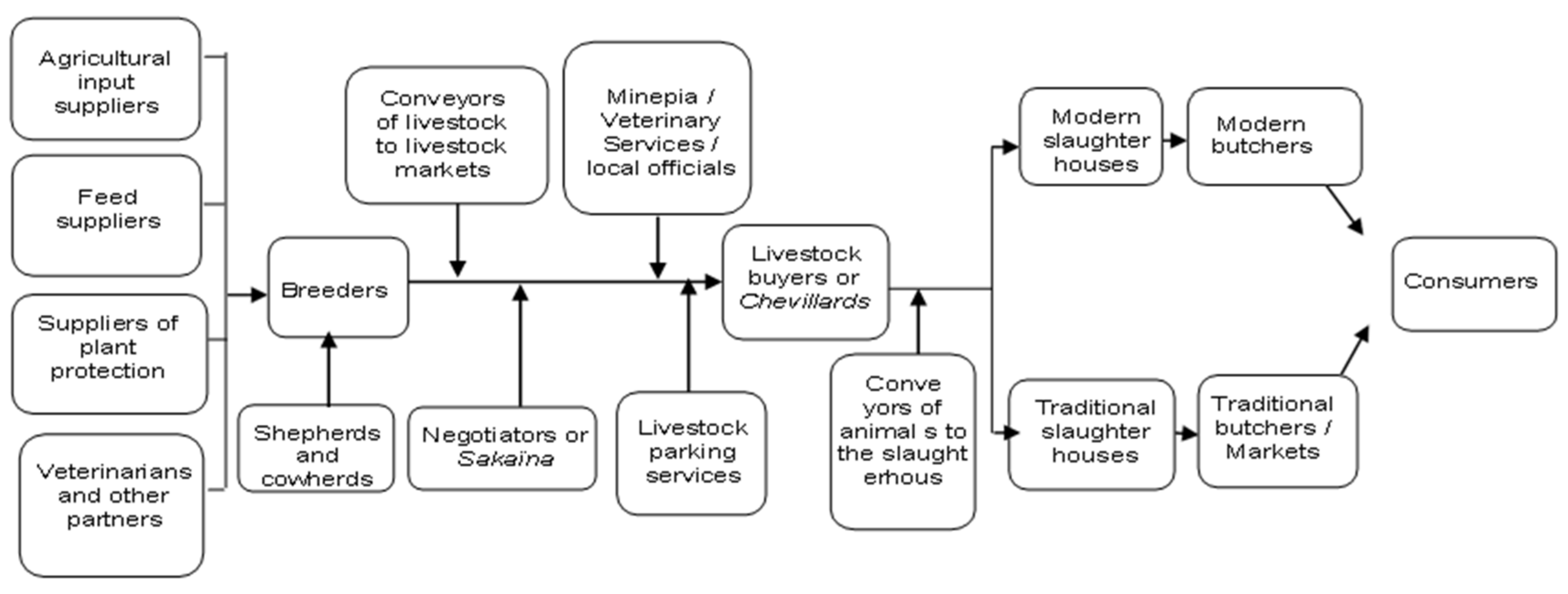
The meat supply chain integrates multiple stakeholders, as illustrated in Figure 1. This supply chain comprises a diversity of actors involved in breeding, livestock trade, slaughter and the distribution of meat to consumers.
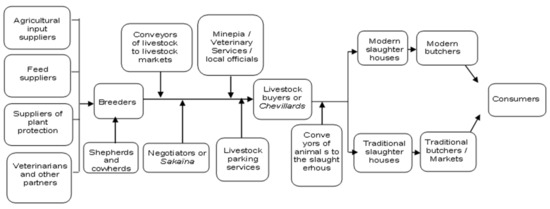
Figure 1.
The actors of the meat supply chain in Cameroon.
2.1. Cattle Breeding
To carry out their activities, the breeder works closely with their suppliers, the herdsmen or cowherds and the agents of Minepia. A distinction is made between small-scale subsistence breeders (with herds of fewer than 50 animals) and large-scale breeders (with herds ranging from 100 to more than 1000 animals). On the farms visited for this research several breeds are kept (Montbéliar, Holstein, Swiss Brown, Simmental, Dir, Brahman, Goudali, Mbororo, Bokolo and hybrid or mixed breeds). Animals are branded with hot stamps, the insignia of which are supplied by Minepia to each breeder for their entire herd. In addition to this administrative marking, some farmers use personalized markings, while others rely more on their experience and familiarity with the animals. Animal feed is diversified (fodder, salt, cotton cake, maize bran and other agricultural by-products) and is undoubtedly the most important item of expenditure, as Mr. Abdel Kader (manager of one of the farms visited) points out: “An animal in a pen consumes an average of 8 kg of concentrated feed per day, at a cost of XAF 120 per kg, which represents a huge cost when the size of the herd is large […]. In addition, the animals consume a great deal of water. A Montbéliar cow, for example, consumes an average of 150 L of water per day, while other species consume an average of 40 to 60 L of water per day.” Some modern farms invest heavily in fodder farming to improve their livestock’s diet, but most opt for transhumance.
To monitor the health of their animals, farmers generally call on the services of veterinarians, but vaccination fraud seems to be common, which explains the persistence of certain bovine diseases, such as bovine pleuropneumonia (Boumsoudé), foot-and-mouth disease (Djoobou) and skin diseases. Cattle are transported to livestock markets on foot, by truck or by train (under the control of the herders), and the cost of this transport can vary from a few thousand to several hundred thousand XAF francs. Overall, relations between the herders and administrative services (especially MINEPIA agents) are marked by mutual distrust and the withholding of information. For example, about declaring the exact size of the herd, Mr. Aliou (a breeder for 25 years) peremptorily points out: “No breeder will tell you the exact size of their herd: it is a question of discretion and security!” Similarly, fraud in the payment of the livestock tax (which amounts to XAF 200 per animal) seems to be widespread. Clearly, therefore, efforts still need to be made by farmers and their partners to improve their relationships and make their collaboration more transparent.
2.2. The Livestock Trade
Livestock is traded in livestock markets. These are open spaces, surrounded or not by enclosures of fences. The porous nature of these markets makes it difficult to filter what comes in and out, and monitor the payment of duties and taxes by livestock traders. Animals admitted to the livestock market are in principle subject to veterinary inspection, but the mixing of animals exposes them to all sorts of contamination. Livestock buyers are economic operators who buy animals for slaughter and resell half of the carcasses to retail butchers. Others may buy livestock for fattening or for export “on the hoof”. The negotiation of the prices of the animals is carried out by intermediaries known as Sakaïna, professional negotiators, as Mr. Sani (a livestock buyer) explains: “Thanks to their experience, the Sakaïna are better placed to set and negotiate livestock prices. It is better to go through them.” After purchases, commercial transactions are recorded in a manual register kept by the agents of the Minepia center chief, in return for the payment of a registration tax of XAF 2000 animal (XAF 1000 for the seller and XAF 1000 for the buyer). This tax is, in principle, divided between the various rightful owners, and the information recorded provides information on all daily commercial transactions and makes it possible for them to be traced or the responsibility established in the event of a dispute. Purchased livestock may be temporarily secured in waiting areas or yards under the responsibility of stockmen (Sarki-tiké), pending their removal. These animals are then driven by the conveyors to the destination indicated by each buyer. Some of the animals purchased are taken to farms, others are destined for export, but most are destined for slaughter.
2.3. Slaughter and Transport of Carcasses: Two Antagonistic Logistics Coexist
2.3.1. Slaughter in Traditional Slaughterhouses
Slaughtering takes place either in traditional slaughterhouses or modern slaughterhouses. Slaughter in traditional slaughterhouses is the most frequent and widespread method of slaughter. In the Adamaoua region, there are many slaughterhouses, known as traditional slaughterhouses, which compete fiercely with the modern slaughterhouse recently created by the authorities and operate at a low level. When asked what he thinks of the modern slaughterhouse in Ngaoundéré, the spokesperson for a traditional slaughterhouse explains: “The modern slaughterhouse. It is not for us poor people. Over there, there are too many constraints […] and then, not everyone who works here can work at the modern slaughterhouse […]. The traditional slaughterhouse feeds more than 300 people”.
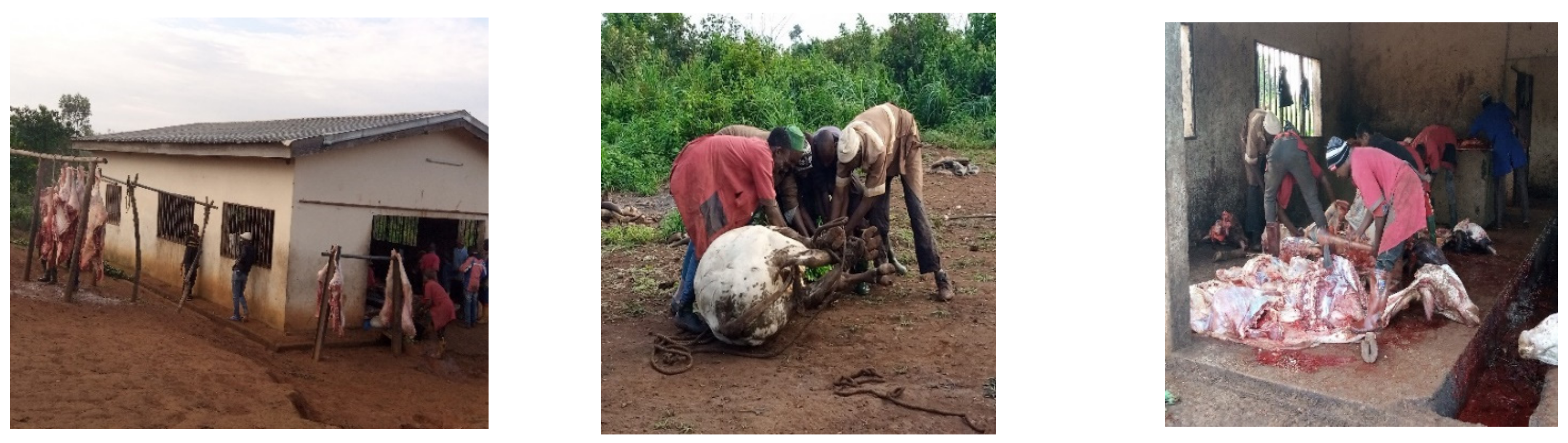
Traditional slaughterhouses are spaces with or without a covered room, located near unhealthy waterways where the slaughter by-products (viscera or marara) are emptied and cleaned. In these makeshift slaughterhouses, the animals are slaughtered, and the carcasses are cut up in the open air, on the ground, because the capacity of the slaughter room is typically insufficient (Figure 2).
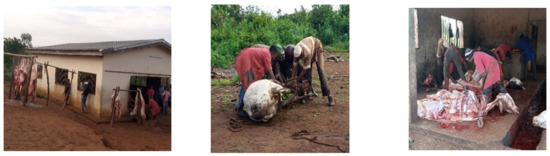
Figure 2.
Slaughterhouse, slaughter and traditional treatment of carcasses in Ngaoundéré.
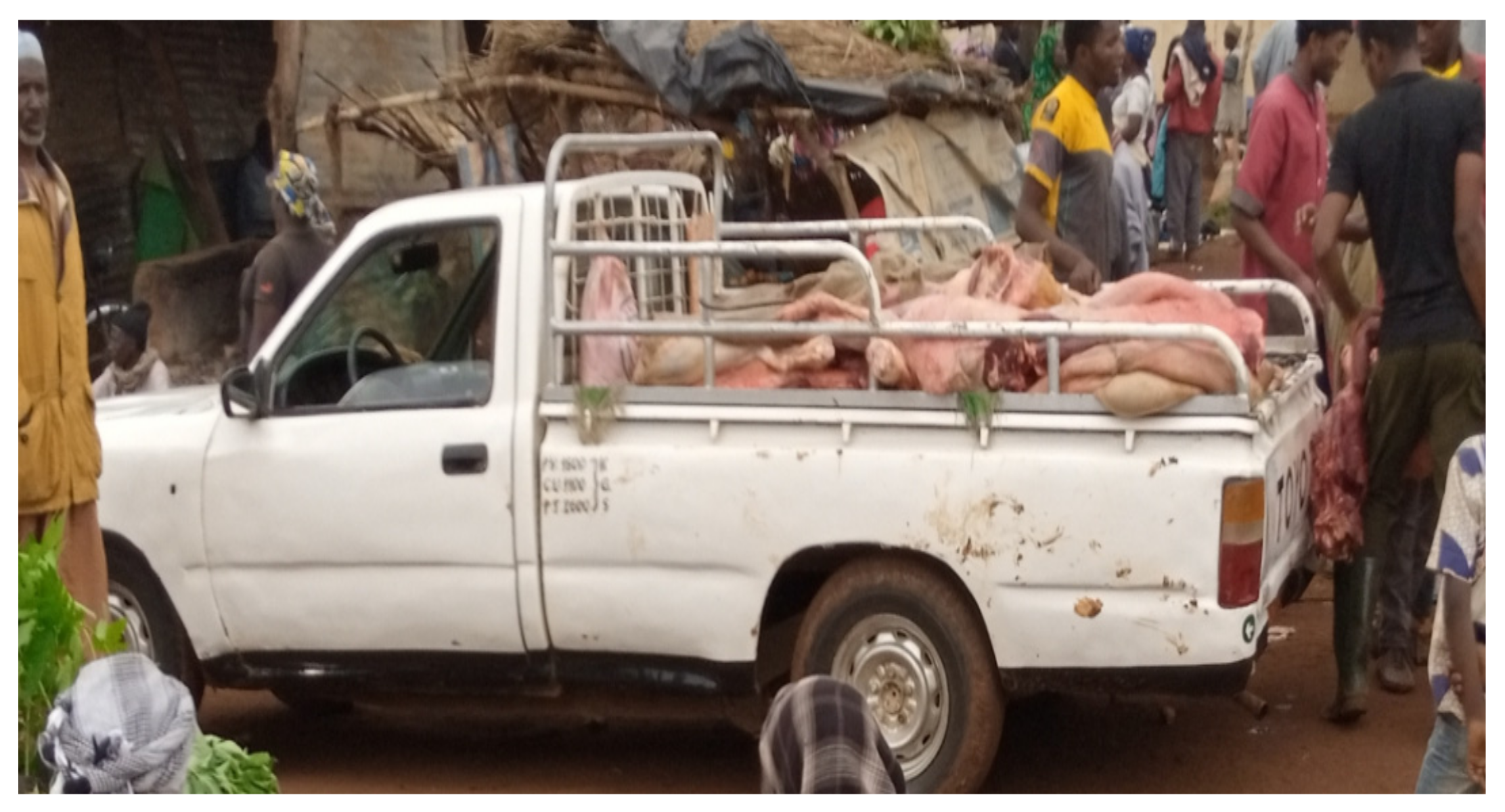
The slaughtering operations are supervised by the Chief Butcher, assisted by the Butcher’s Advisor and the Chief Butcher’s Helper. The butcher’s helpers or cowherds are specialized by activity and, as remuneration for each slaughtered animal, they take certain parts of the meat (Sargal), which they divide up and can then resell. The owners of the slaughtered animals (chevillards) pay a slaughter tax of XAF 1700 per animal. This tax is collected by the Minepia center chief, who is then responsible for distributing it to the various rightful owners. He is also responsible (along with veterinary agents) for antemortem checks of the animals and post-mortem checks of the carcasses. After stamping, the healthy carcasses are immediately transported to the markets and butcheries using makeshift means of transport (open private vehicles, pick-ups, tricycles or motorbikes) (Figure 3). Carcasses that are not fit for consumption are seized and, in principle, sent for incineration.
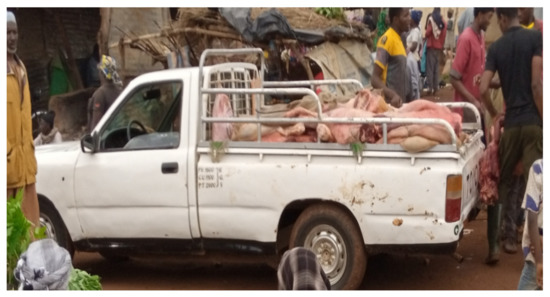
Figure 3.
Traditional transport of carcasses from slaughterhouses to meat distribution points.
2.3.2. Slaughter at the Ngaoundéré Industrial Slaughterhouse
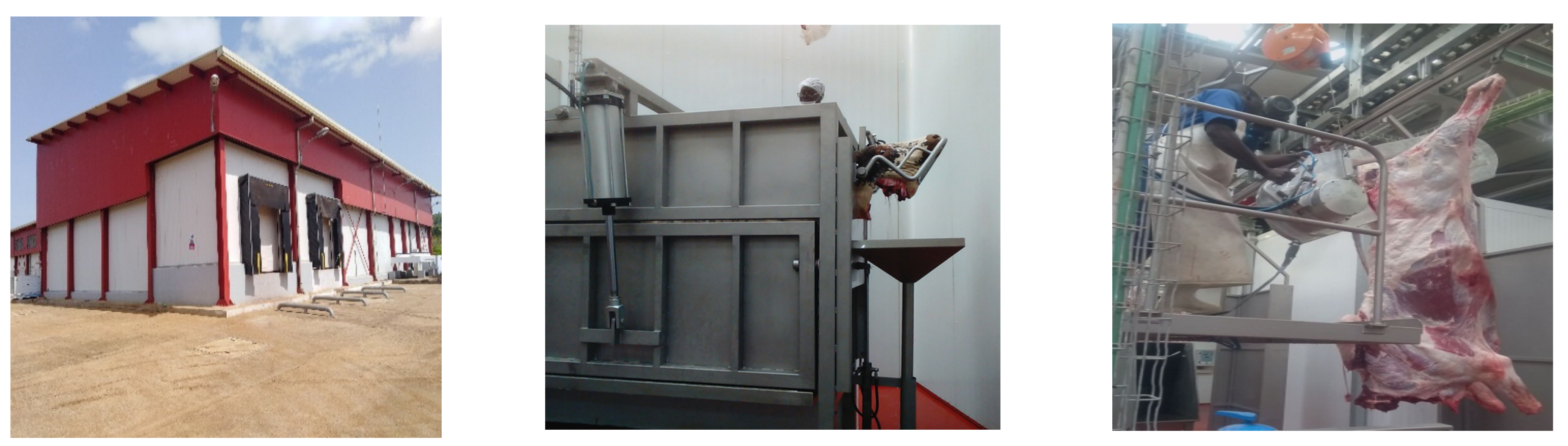
Adamaoua has an industrial slaughterhouse in the town of Ngaoundéré with an estimated slaughter capacity of 500 cattle per day, which is currently underutilized. Group or planned slaughtering is carried out, and slaughtering operations are carried out in accordance with slaughtering standards [24,25]. Emphasis is placed on strict compliance with hygiene rules. For example, animals undergo a water diet before slaughter. The Halal rite is observed when the animal is bled. The processing and cleaning of the carcasses and by-products are carried out in different circuits, respecting the principle of forward movement to avoid any contamination of the carcasses (Figure 4).
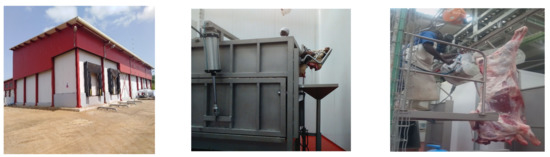
Figure 4.
Modern slaughterhouse, slaughter and carcass processing in Ngaoundéré.
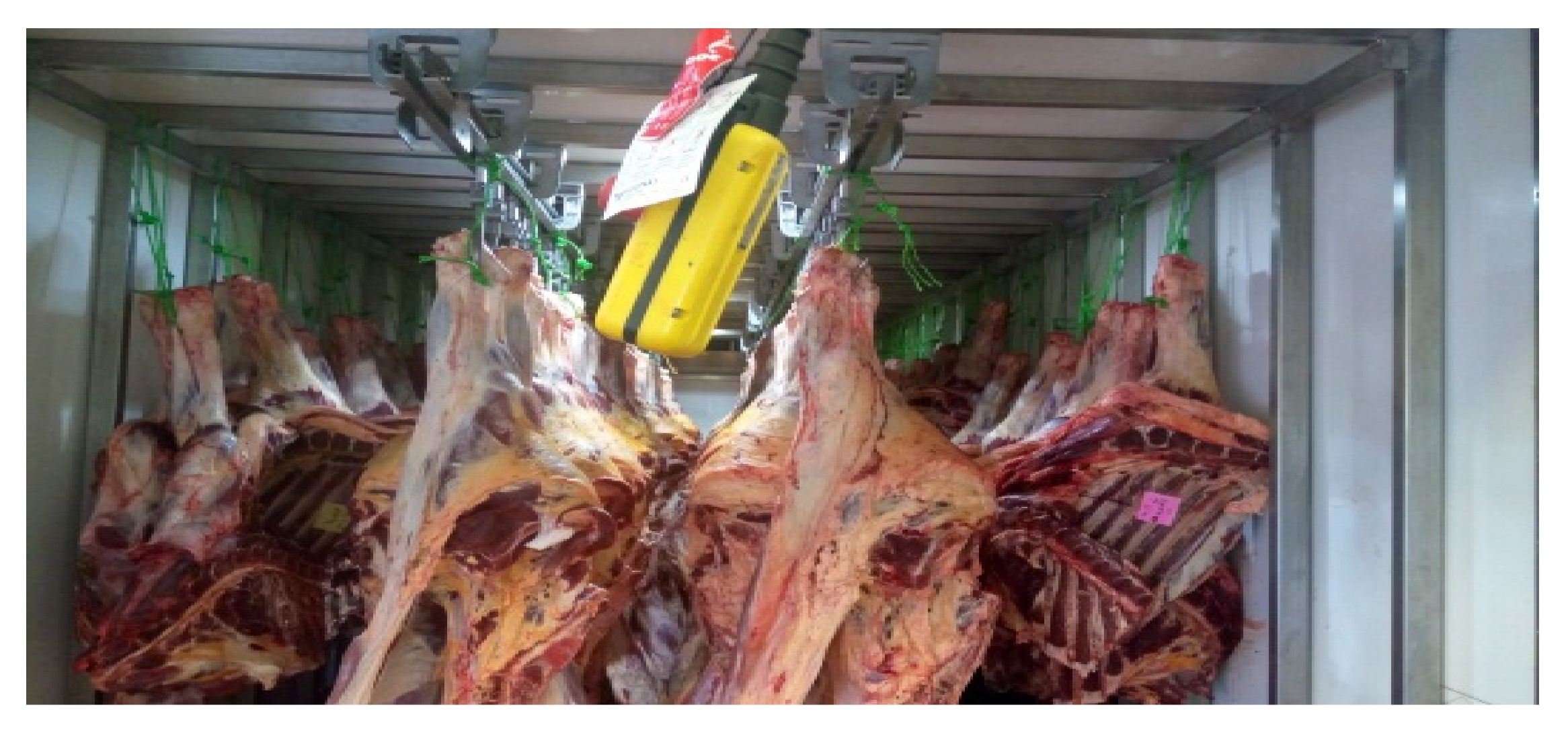
In addition, after post-mortem inspection, the healthy carcasses are marked with a green stamp and re-dried in cold rooms. After this maturation stage, which lasts about 48 h, the carcasses and other slaughter products are delivered to customers by refrigerated means of transport (lorries, vans or trucks) (Figure 5).
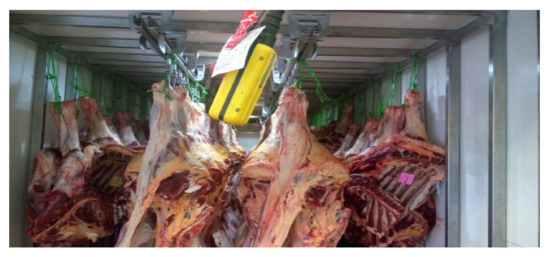
Figure 5.
Modern transport of carcasses from the slaughterhouse to meat distribution points.
The customers of this slaughterhouse are mainly large private buyers of animals, located in the cities of Douala and Yaoundé. These customers are considered real partners by the Director of the Ngaoundéré industrial slaughterhouse, who explains: “Our customers demand healthy animals of large caliber, preferably bulls. The Goudali breed is preferred because of its carcass yield”.
2.4. The Sale of Meat in Markets and Butcheries
Healthy carcasses and by-products from slaughterhouses are taken to markets and butchers’ shops to be sold to consumers after they are cut up, which is the responsibility of butchers and retailers. These actors buy half of the carcasses from butcher–wholesalers and resell the meat by the kilogram to consumers, adding their own margin. After the sale of the meat, the butcher–retailers are obliged to pay the amount due to the butcher–wholesalers. However, they sometimes behave opportunistically, as explained by Mr. Abbo (butcher–wholesaler): “Sometimes butcher–retailers are dishonest: they sell the meat but do not pay the money back to the butcher–wholesaler in time and sometimes they disappear. This can put the butcher–wholesaler in difficulties and lead them to bankruptcy.” This opinion is shared by Mr. Ibrahima (a butcher–wholesaler for nearly 15 years): “Working with meat is complex and risky […] sometimes we win, sometimes we lose […] if it comes out, we win, if it doesn’t, we lose, and the debts follow us.” Overall, the analysis of the dynamics of the interactions between the actors in the meat supply chain suggests dysfunctions that may compromise their capacity to ensure the perfect coverage of the national market with meat that conforms to the standards of quality and sanitary safety required for human consumption. It, therefore, seemed necessary to investigate these possible dysfunctions.
3. Results from Difficulties Encountered by Actors of Meat Supply Chain
3.1. Methodological Approach
Most of the studies conducted so far in the areas of Supply Chain and Supply Chain Management are either descriptive or explanatory, as shown in Table 3.
Table 3.
Illustration of some methodological approaches adopted by previous studies on SC and SCM.
The purpose of our study is to understand the dynamics of interactions in the meat SC and to identify the main difficulties or obstacles that prevent the actors of this SC from providing consumers with quality meat at a reasonable price. It is therefore in reality an exploratory study, purely qualitative. Also, we adopt an interpretative posture as described by [33,34,35]. This interpretative posture obliges us to triangulate sources of information and methods (documentary research, in situ observations, semi-directive interviews with the actors of the SC of meat), the aim of which is to better understand the phenomenon studied. Although such a methodological approach has been adopted by some previous studies [26,30], our approach presents the originality of having associated with the above-mentioned conventional methods of collecting information a method of concerted validation and prioritization of the main difficulties encountered by the actors of the SC of meat: the brainstorming.
First, we conducted a documentary exploration, which allowed us to access available information on the organization of the livestock sector, livestock trade and meat in Cameroon. The exploitation of this information on the basis of a Supply Chain approach then enabled us to develop an interview guide to be administered to the main actors involved in the SC of beef. Armed with this interview guide, the purpose of which was to identify the organization, the activities and the difficulties encountered by the actors of the SC of meat, we carried out field visits in 03 cattle farms, 03 livestock markets, 03 traditional slaughterhouses, 01 modern slaughterhouse and 03 butchers), all located in the Adamawa region. The choice of this region is justified by the size of its cattle herd, estimated at around 28% of the national cattle herd [1,2,4]. In addition, the Adamawa contributes around 38% to national beef production [34]. Finally, the livestock sector would employ about 60% of the active population in rural areas, thus constituting the main engine of the economy in this region [36,37,38].
These visits allowed us to immerse ourselves in the working environment of the various actors and to observe them in action. Moreover, they gave us the opportunity, thanks to the pre-developed interview guides, to collect the opinions and perceptions of the actors in relation to the various themes that interest us.
Table 4 presents the characteristics of the people we interviewed during our visits to the field:
- With the breeders, we discussed the choice of breeds, the feeding of the animals, the safety and health monitoring of the animals, the handling of the animals at the livestock markets, the economic viability of the breeding activity and the difficulties encountered.
- Interviews with livestock market actors provided information on the origin of the livestock traded, the main market participants, the organization and functioning of the market, the transport of livestock after purchase and the main difficulties encountered.
- With the stakeholders of the traditional slaughterhouses, the discussions focused on the management and operation of the slaughterhouse, the origin of the animals slaughtered, the distribution of tasks between stakeholders, the economic viability of the slaughterhouse and the difficulties encountered.
- The director of the modern slaughterhouse of Ngaoundéré, after a guided tour of his structure, talked to us about the creation and mission of the slaughterhouse, the infrastructure and the main services offered, the economic viability of the slaughterhouse and the difficulties encountered.
- The interviews with the butchers gave us an insight into the butchering profession, the relationship between the butcher–retailers and the butcher–wholesalers, and the management of the interactions with the inspection services, trade agents and consumers.
Table 4.
Summary of the profile of interviewees.
Table 4.
Summary of the profile of interviewees.
| Person Interviewed | Profession | Seniority in the Profession |
|---|---|---|
| R1 | Breeder | More than 25 years |
| R2 | Breeder | about 15 years |
| R3 | Breeder | About 10 years |
| R4 | Livestock market actor | More than 10 years |
| R5 | Livestock market actor | About 5 years |
| R6 | Minepia Regional Delegate | 5 years at the duty station |
| R7 | Stakeholders of the traditional slaughterhouse | More than 10 years |
| R8 | Stakeholders of the traditional slaughterhouse | More than 20 years |
| R9 | Butcher–wholesaler | About 15 years |
| R10 | Modern slaughterhouse manager | 5 years at the duty station |
| R11 | Retail butcher | More than 15 years |
| R12 | Retail butcher | About 10 years |
| R13 | Retail butcher | About 10 years |
After the transcription of the interviews, the verbatim quotes of the interviewees were the subject of a semantic analysis [39]. A cross-sectional analysis was carried out with regard to the various themes that interest us and the statements made by the interviewees were grouped together, which enabled us to deduce general opinions. At the end of this first phase of analysis, we drew up a first study report highlighting for each level of the SC of meat, the actors involved, the activities they carry out, the relationships they maintain with their partners, and the difficulties they encounter in carrying out their activities.
Following this first study report, a second meeting was organized with the same interviewees for a collective and concerted validation of the first study report, and a prioritization of the main difficulties they encounter in the context of the exercise of their activities. This second meeting, which took place in the form of brainstorming, was quite rich in information since it opened up a discussion with the operators on the possible solutions and their feasibility. The ideas arising from the joint exploration of possible solutions were then refined through a literature review.
3.2. Characterization of the Difficulties Encountered by Each Link in the Meat Supply Chain
The results of our study reveal that beef SC actors in Cameroon encounter technical, financial, managerial and cultural difficulties that prevent them from satisfying their customers and taking full advantage of their activities. Table 5 gives a non-exhaustive list of difficulties mentioned by each group of actors.
Table 5.
Summary of the difficulties identified by the actors of the SC of meat (Single problem (*), important problem (**), critical problem (***).
A transversal reading of the difficulties mentioned by the actors of the SC of meat during the various interviews makes it possible to make a categorization into four (04) groups of difficulties.
3.2.1. Technical Difficulties
Technical difficulties refer both to the precariousness of working conditions and to the use of rudimentary or obsolete working tools and methods, as evidenced by the comments of interviewees R1, R4, R7 and R11, see Table 6.
Table 6.
Illustrative verbatim of the technical difficulties encountered by meat SC actors.
These technical failures severely limit the capacities of the actors in the exercise of their activities and significantly impact their productivity, their costs and their quality of service.
3.2.2. Financial Difficulties
They are decried at all levels of the meat SC and severely limit the capacities and margins of maneuver of the actors. Breeders must combine with the high cost of animal feed as interviewee R2 points out: “Animal feed is extremely expensive. An animal in a pen consumes an average of 08 kg of concentrated feed per day at a rate of 120F per kg. When the herd is large, it becomes really difficult!” This high cost of animal feed has a significant impact on the price of animals in livestock markets, as respondent R5 explains: “The price of animals has increased a lot. In addition, there is the high cost of transporting animals from production basins to major cities (Yaoundé and Douala). All this impacts the price of meat on the market “. This inflation in the price of animals on the market severely limits the activity of wholesale and retail butchers. The interviewee R9 tells us about his experience in this regard: “Among the butchers, there are the bosses who have money, they buy the animals, have them slaughtered and resell after stamping to small butchers who do not have enough money to buy their own animals. These butcher-retailers sell and will pay the money back to their bosses...but sometimes they don’t pay the money back to the boss on time, and sometimes they disappear! which can put the boss in difficulty and lead him to bankruptcy... It’s a very risky job, sometimes you lose”. Even in well-structured organizations such as the modern slaughterhouse in Ngaoundéré, financial difficulties arise acutely, as the interviewee R10 explains: “We have a slaughter capacity of 500 animals in 24 h, but this capacity is very underused! Currently we do a weekly slaughter which does not even reach the quota that we should do per day. So for the moment, we can’t talk about performance! To support the operating costs, we rely on the support of the State because we have a shortfall of about XAF 10,000,000 on average and then just for the consumption of energy, we pay on average XAF 2,000,000 to 3,000,000 often per month given the low activity there…we have quality maintenance which requires a lot of energy”.
3.2.3. Cultural and Managerial Difficulties
Cattle breeding is considered by breeders to be an ancestral practice that is passed down from generation to generation. Interviewee R1 speaks on this subject: “To breed, you really have to have a love of the profession. It requires a lot of sacrifices… I was born and raised in breeding!” This perception of the profession has a significant impact on the ways of doing things and the behavior of the actors. For example, regarding the identification of animals, interviewee R3 explains: “I know my animals perfectly and I can’t be wrong about each one of them. As soon as I see my animal, I recognize it!” The knowledge transmitted by the parents and the experience acquired over time seems to have strongly determined the actors’ ways of doing things, as follows from the words of the interviewee R4: “I know how to recognize sick animals by simple observation and I know what it takes to treat them...I only call on the veterinarian if things get complicated. For the weight of the beast, I estimate by eye and by experience”. This prevalence of cultural practices does not seem to encourage openness to innovative practices advocating a radical change in ways of doing things. The weak unionization of the actors of the SC of meat is a perfect illustration of this as illustrated by the words of the interviewee R4: “We don’t have a union as such, but all the livestock market players know each other. It is difficult for a stranger to infiltrate, he will be quickly spotted”. The words of interviewee R6 go in the same direction: “Apart from a few who are grouped into cooperatives, most of them evolve in scattered ranks, which does not facilitate their access to the multifaceted support offered by the State”.
3.3. Discussion of Results
Overall, the results of our study reveal that the operation of the SC of meat in Cameroon is based on compartmentalized management of activities [23]. This is characterized by the multiplicity of stakeholders and by the opacity deliberately maintained by the actors in the management of their activities which they consider as reserved for certain ethnic groups (Mbororo, Fulani, Haoussa, Foulani), and transmitted from generation to generation [40]. This lack of transparency in the management of activities is mentioned by interviewee R1: “No breeder will give you exact information on the size of his herd… just know that I started with few animals and today I have a lot. A few are here on the ranch, but I have herds way out in the bush, over 20 km from here”. This voluntary concealment of information on the exact size of the herd, although responding to the individual motivations of the breeders (fraud on livestock tax, risk of aggression and kidnapping for large breeders, etc.) does not, however, allow for an exact idea of the national cattle herd and the potential of the national beef supply. It also encourages fraud in the vaccination and health inspection of animals (even before slaughter in traditional slaughterhouses). Interviewee R6 explains this: “There are cultural obstacles…they don’t understand that it is in their interest to vaccinate their animals to protect them against diseases…our resources are limited, we cannot go to all the farms and ranches. So when we organize vaccination campaigns, we ask them to bring their animals to the site set up for vaccination, but they only take part of their herds, other animals stay in the bush”. However, vaccination fraud explains the persistence of certain bovine diseases and this total lack of transparency and traceability of information relating to vaccination and animal health monitoring does not guarantee the marketing of beef meeting the quality and safety standards required for human consumption [24,25,40]. The first challenge of the total transformation of the SC of beef in Cameroon, therefore, seems to be that of rallying the main actors involved in the Supply Chain cause! Indeed, as many authors point out [13,17,27], only the integration, coordination and perfect synchronization of flows along the Supply Chain can enable all SC players to improve the overall performance of their activities, to take full advantage of their collaboration and to satisfy their end customers (beef consumers). Efforts to raise awareness of all the actors involved in the Supply Chain cause, therefore, remain to be deployed by the administrative supervisory body, the Ministry of Livestock, Fisheries and Animal Industries (Minepia, which seems to be the most allowed.
On the technical and financial levels, practically all the actors of the SC of meat face the precariousness of the working conditions, the absence of the appropriate working tools and the use of the working methods considered obsolete (see Table 5). However, as the authors of [20] point out, the main objective of SCM is to efficiently allocate production, distribution, transport and information resources, in the presence of conflicting objectives, with the aim of achieving the level of service demanded by customers at a reasonable price. However, the fact that beef SC players have no overall vision of their activities and work in a compartmentalized manner necessarily exposes them to technical and financial constraints which severely limit their flexibility, prevent them to make their activities more profitable and to bring total satisfaction to their customers. In this regard, the [24] insists for example on the need for the actors of the meat industry to have installations, tools and equipment, which are in conformity with the exercise of any activity relating to the marketing of meat and meat products intended for human consumption. Substantial investments in the acquisition of modern tools and equipment would enable meat SC actors to abandon their rudimentary working practices and methods in favor of better practices in raising, slaughtering and selling beef and derivatives [24,25]. Similarly, the improvement of the level of know-how or skills of actors in breeding techniques (diversification of animal feed, fattening techniques) and slaughtering (mastery of cutting techniques, the protocol of halal slaughter, compliance with hygiene standards, etc.) seems imperative. However, given the low financial power of independent actors, there is a problem with access to sources of funding. Faced with this financial problem, the grouping of the actors of the SC of meat in corporations or unions would constitute the first step toward the improvement of their power of negotiation with the administration and the financial partners who offer agricultural and livestock financing assistance programs in Cameroon [4,36,41,42]. To achieve this, it would be necessary to go beyond the individualistic logic of compartmentalized management of activities to converge toward the adhesion of all the actors to the Supply Chain cause for a mutually beneficial collaboration [43,44].
4. Conclusions
The global beef and derivatives market has good growth prospects [45]. However, Cameroon, although a fertile ground for livestock and agriculture, is struggling to seize this opportunity because of the weaknesses of its cattle industry. In this article, we are interested in the organization and functioning of the SC of beef in Cameroon, with the aim of understanding the difficulties faced by the actors, and which prevent them from ensuring consumers, the availability of quality meat at a reasonable price.
Through a qualitative exploratory study based on the triangulation of sources of information and methods (documentary exploration, observations (in situ), semi- structured interviews with the actors of the SC of meat), we were able to understand the functioning and the dynamics of the interactions between the different players in the SC of beef (breeders, livestock traders, modern and traditional slaughterhouses, butchers and administrative services). In addition, we were able to highlight four (04) groups of difficulties that prevent actors from taking full advantage of their activities while providing complete satisfaction to meat consumers. These difficulties are mainly technical (precarious working conditions, absence of working tools and appropriate equipment, use of working methods deemed obsolete), financial (low financial power of actors, high cost of feeding animals, high operating costs, etc.), managerial (compartmentalized management of activities, opacity in the management of activities, lack of traceability, etc.) and cultural (attachment to ancestral farming and slaughtering practices which are transmitted from generation to generation, weak unionization of actors, etc.).
At the end of our analyses, we come to the conclusion that substantial efforts are yet to be combined by all the stakeholders (meat SC actors, Minepia and partners in the financing of agriculture and livestock) to create conditions conducive to the development of the beef industry in Cameroon. Improving the working conditions of meat SC actors, investing in the acquisition of equipment and appropriate work tools, improving the level of know-how or skills of actors at all levels of SC, facilitating access to funding sources, etc. are all aspects that must be the subject of concerted reflection. In this sense, the unionization of meat SC actors into corporations and the creation of interfaces favoring easy dialogue would constitute the first step toward the real integration of beef SC in Cameroon.
The results of our study, therefore, inspire both theoretically and managerially.
On the theoretical level, the results of our study show the difficulties related to the necessary integration of the SC of beef in the context of developing countries where the actors involved face multiple constraints. Our work, therefore, agrees with the idea of the necessary integration of SC defended by many authors [15,16,17,20,43,44]. However, the specific context in which the actors of the SC of beef in Cameroon operate sheds new light on the particular difficulties in setting up an SCM approach. If, as stated by the aforementioned authors, the harmonious functioning of any Supply Chain absolutely requires the creation of mechanisms for dialogue and coordination between the various links involved, the actors of the SC of beef in Cameroon, in addition to this absolute requirement first need to be made aware of the SCM cause. In addition, these actors need not only an update of know-how and skills but also a strengthening of resources that would allow them to improve and modernize their technical platforms and their working methods.
On the managerial level, the results of our study show a strong attachment of the actors of the SC of the bovine meat to the ancestral practices of breeding, slaughter and market (trade of the animals and the meat), which are passed down from generation to generation. These obsolete practices constitute real cultural obstacles to the adoption of farming techniques or modern working methods that would nevertheless allow actors to increase their productivity or make their activities more profitable. These cultural obstacles take the form, for example, of the opacity deliberately maintained by the actors in the management of their activities, the lack of transparency or the voluntary concealment of exact information relating to their activities. In such a context, the first challenge, as a previous study argues [42], is to rally or engage all the actors involved in the SCM approach. The first step toward such an approach would be the reorganization of beef SC actors into corporations or unions, as encouraged by [4]. This would suppose that the actors fundamentally renounce the individualistic logic of compartmentalized management of their activities to converge toward joint initiatives, advocating the defense of mutual interests.
Despite the wealth of information provided by our study, intellectual honesty obliges us to recognize its weaknesses or limitations. The first limitation is methodological. Indeed, our study is essentially based on a qualitative approach, which scientifically precludes any generalization of the results obtained. In addition, the absence of reliable and updated statistics on the physical, financial and information flows of the actors interviewed forced us to collect purely qualitative data (verbatim of the interviewees). The second limitation is related to the sampling method. Indeed, the cost constraints related to the conduct of empirical investigations, the lack of literacy and the mistrust of the actors of the SC of beef with respect to investigators outside their circle of work forced us to a reasoned choice of people to interview (our sample is therefore non-probability). Finally, the third limitation is related to the field of study. We cannot claim to have analyzed in this article all the subtleties of the complexity of the meat supply chain in Cameroon.
The aforementioned limitations open up reflections for future research projects.
As a first step, one could consider conducting further research with a more representative sample of beef SC actors in order to confirm the results of this qualitative study. Another perspective would be to conduct a reflection on innovative logistical solutions that could enable the various players in the SC of beef to align themselves with good practices for rearing, slaughtering, transport or distribution of carcasses, and with the sale of meat to consumers. Just as it would also be interesting to conduct a study on the practices of integrating beef SC in the context of developing countries with a low level of literacy of the actors involved. Another avenue would be to conduct a study to assess the real potential of the national market in terms of supply, demand, purchasing behavior and consumption of beef. Such a study would be interesting for all actors involved in the beef industry in Cameroon, including potential entrants and financial partners.
Author Contributions
Project management and conceptualization, V.T.; investigation and writing, M.-N.A.; supervision, H.-D.H. All authors have read and agreed to the published version of the manuscript.
Funding
The project on which this article is based is funded by the German Federal Ministry of Education and Research under the funding code 01DG20011. The authors are responsible for the content of this publication.
Institutional Review Board Statement
The study did not require ethical approval.
Informed Consent Statement
All individuals included in this article have consented to the publication.
Data Availability Statement
The data analyzed were gathered and generated during the study.
Conflicts of Interest
The authors declare no conflict of interest.
References
- INS (Institut National de la Statistique du Cameroun). Annuaire Statistique du Cameroun; INS: Yaoundé, Cameroun, 2019; pp. 210–219. [Google Scholar]
- Ministère de l’Élevage, des Pêches et des Industries Animales (MINEPIA). Document de Stratégie du Sous-Secteur de L’élevage, des Pêches et des Industries Animales; Ministère de l’Élevage, des Pêches et des Industries Animales (MINEPIA): Yaoundé, Cameroun, 2011.
- Mravili, A.; Abdelfetah, E.; Abdourahamane, H. Étude sur les Abattoirs d’Animaux de Boucherie en Afrique Centrale (Cameroun—Congo—Gabon—Tchad); Food and Agriculture Organization of the United Nations (FAO): Rome, Italy, 2013. [Google Scholar]
- Ministère de l’Élevage, des Pêches et des Industries Animales (MINEPIA). Cadre de Gestion Environnementale et Sociale (CGES) du Projet de Développement de L’élevage (PRODEL); Ministère de l’Élevage, des Pêches et des Industries Animales (MINEPIA): Yaoundé, Cameroun, 2016; p. 161.
- Labonne, M.; Magrong, P.; Oustalet, Y. Le Secteur de l’Élevage au Cameroun et dans les Provinces du Grand Nord: Situation Actuelle, Contraintes, Enjeux et Défis. 2007. Available online: https://hal.archives-ouvertes.fr/hal-001139191 (accessed on 31 August 2021).
- Investir au Cameroun. Viande de Bœuf: Le Cameroun devrait entamer ses Stocks de Securité pour satisfaire la Demande au Deuxième Trimestre. 2022. Available online: https://www.investiraucameroun.com/economie/2604-17826 (accessed on 17 August 2022).
- Mouafo, H.T.; Baomog, M.B.; Adjele, J.J.B.; Sokamte, A.T.; Mbawala, A.; Ndjouenkeu, R. Microbial Profile of Fresh Beef Sold in the Markets of Ngaoundéré, Cameroon, and Antiadhesive Activity of a Biosurfactant against Selected Bacterial Pathogens. J. Food Qual. 2020, 2020, 5989428. [Google Scholar] [CrossRef]
- Investir au Cameroun. Les Produits Alimentaires ont dopé l’Inflation au Cameroun, au Cours des Neuf Premiers Mois de l’Année 2020 (INS). 2020. Available online: https://www.investiraucameroun.com/gestion-publique/1712-15742 (accessed on 26 August 2021).
- Institut National de la Statistique du Cameroun (INS). Note sur l’Évolution des Prix à la Consommation Finale des Ménages à Douala en Septembre 2020; INS-Cameroun: Yaoundé, Cameroun, 2020; Available online: https://ww.ins-cameroun.cm (accessed on 26 August 2021).
- WFP (United Nations World Food Program); Minader (Ministère de l’Agriculture et du Développement Rural). Evaluation de L’impact de la Hausse des Prix des Denrées Alimentaires sur la Sécurité Alimentaire des Ménages dans Les Villes de Bamenda, Douala, Maroua et Yaoundé au Cameroun; WFP (United Nations World Food Program): Rome, Italy; Minader (Ministère de l’Agriculture et du Développement Rural): Rome, Italy, 2009; Available online: https//reliefwebintt/sites/reliefwebint/files/resources/679D6038819B5D2E052575D100781540-Rapport-complet.pdf (accessed on 26 August 2021).
- INS—ECAM IV. Quatrième Enquête Camerounaise auprès des Ménages; INS-Cameroun, Archive Nationale des Données du Cameroun (ANADOC): Yaoundé, Cameroun, 2017. [Google Scholar]
- Lee, H.L.; Billington, C. Material management in decentralized supply chains. Oper. Res. 1993, 41, 5. [Google Scholar] [CrossRef]
- Rota-Frantz, K.; Bel, G.; Thierry, C. Gestion des Flux Dans les Chaînes Logistiques. In Performance Industrielle et Gestion des Flux; Hermes Science: Paris, France, 2001; pp. 153–187. [Google Scholar]
- La Londe, B.J.; Masters, J.M. Emerging Logistics Strategies: Blueprints for the next century. Int. J. Phys. Distrib. Logist. Manag. 1994, 24, 35–47. [Google Scholar] [CrossRef]
- Tayur, S.; Ganeshan, R.; Magazine, M. Quantitative Models for Supply Chain Management; Kluwer Academic Publishers: Norwell, MA, USA, 1999. [Google Scholar]
- Mentzer, J.T.; Dewitt, W.; Keebler, J.S.; Min, S.; Nix, N.W.; Smith, C.D.; Zacharia, Z.G. Defining supply chain management. J. Bus. Logist. 2001, 22, 1–25. [Google Scholar] [CrossRef]
- Stadtler, H.; Kilger, C. Supply Chain Management and Advanced Planning; Springer: Berlin/Heidelberg, Germany, 2005. [Google Scholar]
- Belin-Munier, C. Logistique, chaîne logistique et SCM dans les revues francophones de gestion: Quelle dimension stratégique? In Proceedings of the XXIIIème Conférence de L’association Internationale de Management Stratégique (AIMS), Rennes, France, 26–27 May 2014. [Google Scholar]
- Belin-Munier, C. Etat de la recherche sur le supply chain management et sa performance: Une revue de la littérature récente. Logistique Manag. 2008, 162, 17–29. [Google Scholar] [CrossRef]
- Dominguez, H.; Lashkari, R.S. Model for integrating the supply chain of an appliance company: A value of information approach. Int. J. Prod. Res. 2004, 42, 2113–2140. [Google Scholar] [CrossRef]
- Simchi-Levi, D.; Kamnisky, P.; Simchi-Levi, E. Designing and Managing the Supply Chain: Concepts, Strategies, and Case Studies; McGraw-Hill/Irwin: New York, NY, USA, 2003. [Google Scholar]
- Geunes, J.; Chang, B. Operations research models for supply chain management and design. In Encyclopaedia of Optimization; Floudas, C.A., Ed.; Springer: Berlin/Heidelberg, Germany, 2008; pp. 2704–2715. [Google Scholar]
- Fabbe-Costes, N.; Meschi, P.-X. Situations-types et évolution de la logistique dans l’organisation. Logistique Manag. 2000, 8, 101–112. [Google Scholar] [CrossRef]
- FAO (Food and Agricultural Organization). Bonnes Pratiques pour l’industrie de la Viande; FAO: Rome, Italy, 2006. [Google Scholar]
- FAO/OMS Codex Alimentarius. Code d’Usages en Matière d’Hygiène pour la Viande (CXC 58-2005); FAO/OMS Codex Alimentarius: Rome, Italy, 2005. [Google Scholar]
- Mounir, Y.; Gouiferda, F. Pratiques de collaboration dans la chaîne logistique industrielle. Rev. Int. Des. Sci. Gest. 2020, 3, 410–424. [Google Scholar]
- Halley, A.; Beaulieu, M.; Roy, J. Quel niveau de connectivité pour votre chaîne logistique? Du temps réel aux besoins factuels. Rev. Gest. 2006, 31, 46–55. [Google Scholar]
- Talkhokhet, D.; Ouriachi, N.; Moutmih, M. Pratiques collaboratives entre acteurs de la chaîne logistique. Rev. Française d’Economie et de Gestion. 2021, 2, 116–130. [Google Scholar]
- Roy, J.; Landry, S.; Beaulieu, M. Collaborer dans la chaîne logistique: Où en sommes-nous? Gestion 2006, 31, 70–76. [Google Scholar] [CrossRef]
- El Bakkouri, A. Les déterminants de la collaboration verticale dans la chaîne logistique: Cas du secteur pharmaceutique de la région Souss Massa. Rev. Française D’economie Gest. 2021, 2, 205–223. [Google Scholar]
- Tsapi, V.; Assene, M.-N.; Hapsatou, H. Les mécanismes de gestion des flux d’information: Quelle incidence sur la performance logistique des entreprises au Cameroun? Rech. En Sci. Gest. 2021, 2, 205–229. [Google Scholar] [CrossRef]
- Assene, M.-N.; Djouhuo, E.L. Organisation du transport des marchandises et efficacité logistique en contexte camerounais. Manag. Avenir 2018, 105, 35–57. [Google Scholar] [CrossRef]
- Grawitz, M. Méthodes des Sciences Sociales; Dalloz: Paris, France, 1996. [Google Scholar]
- Girod-Séville, M.; Perret, V. Fondements épistémologiques de la recherche. In Méthodes de Recherche en Management; Dunod: Paris, France, 1999; pp. 13–33. [Google Scholar]
- Valet, A.M. Choix Méthodologiques: Pourquoi tant de Chiffres? Hall, Open Science. 2010. Available online: https://hal.archives-ouvertes.fr/hal-00479481 (accessed on 8 August 2022).
- Ministère de l’Economie, de la Planification et de l’Aménagement du Territoire (MINPAT); PNUD (Programme des Nations Unies pour le Développement). Projet PNUD-OPS CMR/98/005/01/99. Études Socio-Economiques Régionales au Cameroun: Eradication de la Pauvreté, Amélioration des Données Sociales; PNUD-OPS: Ngaoundéré, Yaoundé, 2000. [Google Scholar]
- Tsapi, V. La Vache, La Viande et le Lait Dans L’Adamaoua: Pour la Redynamisation d’une Industrie «négligée». In De l’Adamawa à l’Adamaoua: Histoire, Enjeux et Perspectives pour le Nord-Cameroun; Harmattan: Paris, France, 2014. [Google Scholar]
- Deffo, V.; Ottou, J.-F.; Messiné, O.; Achundoh, L.E.; Djoumessi, M. Facteurs socio-économiques affectant l’utilisation des sous-produits agro-industriels pour l’embouche bovine à contre-saison dans l’Adamaoua, Cameroun. Biotechnol. Agron. Soc. Environ. 2009, 13, 357–365. [Google Scholar]
- Dieng, T.O. Enjeux et défis du management de la recherché universitaire: Les spécificités de la recherche publique dans un pays en développement. Rech. En Sci. Gest. 2021, 143, 57–83. [Google Scholar] [CrossRef]
- Njonmeta, N.L.A.; Ejoh, R.A.; Djouldé, R.; Mbofung, C.M.; Etoa, X.F. Microbiological and safety evaluation of street vended meat and meat product in Ngaoundere metropolis (Cameroon). Micro. Hyg. Alim. 2004, 16, 43–48. [Google Scholar]
- IRZ/GTZ. Livestock Farming Systems in Adamawa; Research Report n1; IRZ: Wakwa, Cameroon, 1989. [Google Scholar]
- NEPAD-PDDAA; FAO. Profil de Projet d’Investissement Bancable: Appui au Développement de la Filière Viande Bovine, TCP/CMR/2906 (I) (NEPAD Ref. 04/05 F); Volume III et IV; NEPAD-PDDAA: Midrand, South Africa; FAO: Rome, Italy, 2004; Available online: https://www.fao.org/3/ae411f/ae411f00.htm (accessed on 26 August 2021).
- Samii, A.K. Stratégie Logistique; Dunod: Paris, France, 2004. [Google Scholar]
- Colin, J. De la maîtrise des opérations logistiques au supply chain management. Gestion 2000, 2002, 59–74. [Google Scholar]
- OCDE; FAO. Perspectives Agricoles de l’OCDE et de la FAO 2020–2029; OECD Publishing: Paris, France, 2020. [Google Scholar] [CrossRef]
Publisher’s Note: MDPI stays neutral with regard to jurisdictional claims in published maps and institutional affiliations. |
© 2022 by the authors. Licensee MDPI, Basel, Switzerland. This article is an open access article distributed under the terms and conditions of the Creative Commons Attribution (CC BY) license (https://creativecommons.org/licenses/by/4.0/).