


Abstract
I argue that the emerging sciences of synthetic morphology and diverse intelligence suggest non-physicalist models of mind and show how they can be empirically investigated. Whence the anatomical, physiological, molecular-biological, and behavioral properties of engineered new beings that have never before existed, and do not have a history of selection? Understanding, predicting, and guiding new forms of life and mind requires characterizing a structured latent space of patterns. Developmental, synthetic, and behavioral biology should take seriously, and exploit, the kinds of non-physicalist ideas that are already a staple of Platonist mathematics. I propose the following hypotheses. (1) Patterns in this space span a highly variable degree of agency, comprising a spectrum ranging from static truths studied by mathematicians to active ones studied by behavioral scientists (i.e., some patterns on the same spectrum as mathematical truths are kinds of minds). (2) The relationship between mind and body is the same as the relationship between causally instructive mathematical facts and physics. (3) Living beings have no monopoly on the “free lunches” provided by the ingression of these patterns into the physical world. While traditional computationalist views of living and cognitive systems are insufficient, my framework erases artificial distinctions between organisms and machines, framing all physical constructs (natural or engineered) as being, to various degrees, in-formed by patterns from the latent space. I sketch a research program, already begun, inspired by these ideas. Such frameworks, while contradicting long-held assumptions of both mechanists and organicists, could have many implications for evolutionary biology, regenerative medicine, AI, and the ethics of synthbiosis with the forthcoming immense diversity of morally important beings.
1. Overview
Here, I sketch a framework for a dualistic view of life and mind that is tightly connected to recent scientific advances and implies a novel research program. One way to motivate these ideas is to start with Platonist mathematics and expand the nature of non-physical patterns to ones relative to biological and cognitive sciences. Another, which is done here, approaches from the perspective of molecular morphogenesis and bioengineering—areas that are perhaps the most unexpected places from which to doubt the sufficiency of physicalism—and then connects to mathematical ideas. Here I provide an argument roughly summarized as follows (with much more detail in subsequent sections):
- (a)
- Regenerative medicine, developmental biology, bioengineering, AI, and ethics all require that we learn to predict, and ethically manage, the behavioral properties of novel constructs at many scales. As a community, we are currently not good at this, and it’s likely an existentially important goal for human and ecosystem flourishing.
- (b)
- The production of new life forms that do not have the benefit of “eons of selection in specific environments” as a convenient explanation for their form and function, are a tractable example of the challenge: where do their specific preferences, competencies, and mental properties come from? Moreover, ways to think about the cognitive properties and capabilities of novel beings should also prompt re-thinking of assumptions about conventional ones (like us); if exotic new hybrid and synthetic beings can have specific cognitive properties not set by evolution, we could wonder what percentage of our characteristics have the conventional origin story. Natural life forms’ ubiquitous and consistent nature may obscure insufficiencies in conventional formal models in the life sciences that are so old as to have become implicit axioms which now hold back research agendas. Currently anomalous phenomena may turn out to be widely relevant and under-detected beyond synthetic and chimeric beings.
- (c)
- There are deep symmetries being revealed between the self-construction of the body and that of the mind (as seen in biological morphogenesis), which suggest a unification between numerous disciplines pointing to the same question: what is the origin of different kinds of patterns, whether they be patterns of anatomy, physiology, or behavior? This generalization is an important part of my proposal that almost every aspect of biology, physics, and computer science could be impacted by these patterns—they are not merely mathematics or anatomical forms, they are relevant to many different scales and implementation media.
- (d)
- I argue that, in parallel with Platonist mathematicians, there are important facts that aren’t facts of physics. And I extend it beyond static truths but to a spectrum of dynamic patterns that in-form the interfaces we observe or build and greatly affect how both evolution and engineers really work. As allergic as many thinkers are to multiple “realms”, monism should not be an assumption—we should be open to whatever ontology it takes to help advance science, applications, and ethics.
- (e)
- One way to avoid additional realms is to place the origin of patterns as “emergent”, or simply “regularities that happen to hold in our physical world”. I find this defeatist and pessimistic, amounting to a long-term acceptance of surprise. Rejecting randomness and “that’s just how it happens to be” means that we posit a structured space from which patterns are drawn. I eschew questions about whether the space is “ontologically real”, because as an engineer, to me “real” simply means whatever I need to worry about or can take advantage of, and these patterns certainly meet that criterion1.
- (f)
- We should commit to a systematic investigation of the latent space from which specific patterns are drawn. In other words, appeal to another realm is not mysterianism, but just the opposite—a commitment to understanding important causes (and beings) regardless of whether they match our safe physicalist traditions.
- (g)
- My hypotheses and the core of the framework are as follows:
- The patterns that in-form shape and function inhabit a space very different from our physical world. This bears some resemblance to a Neo-Platonic view, but is different in specific ways described below.
- These patterns occur on a very wide spectrum of agency, ranging from fixed static patterns (e.g., the digits of the Feigenbaum constant) which may be low-agency, through intermediate forms capable of simple dynamics or of serving as goal states for cybernetic systems, to very advanced patterns that are actually behavioral policies readily recognized by behavioral scientists (a.k.a., kinds of minds).
- These patterns are functionally causal and interact with physical systems (likely, bi-directionally). This is an explicit interactionist model; however, it does not require quantum effects [1,2,3,4,5,6] but something much more exotic and universal. I propose that the relationship between mind and body is the same as the relationship between instructive mathematical facts and physics. In a sense, we’ve suspected physicalism is insufficient since Pythagoras and likely long before that.
- Bodies (whether living, engineered, or hybrid) are interfaces for a massive, multi-scale hierarchy of patterns to ingress into the physical world. But, we are not physical bodies occasionally impinged upon by patterns—we are patterns, living in an embodied ecosystem that hosts uncountable other patterns at different scales of organization.
- (h)
- We can look for evidence of contributions from this space, in model systems ranging from living beings to minimal computational ones in which quantification and definitive evidence may be much more within reach. Evolution exploits these contributions2, visible as unexpected coherent competencies in novel embodiments which were neither designed nor evolved. Engineers can exploit them as well, and they appear to be present at levels of complexity far below what might be expected.
- (i)
- The framework is falsifiable in the same way all significant scientific ideas are falsifiable: if concerted effort along the lines of the research program highlighted below reveals no quantifiable input from the Platonic space that isn’t captured by conventional accounting frameworks, and if these ideas result in no new discoveries or capabilities at the bench, then it can be abandoned in favor of more fruitful alternatives.
I argue that we should explore the consequences of dropping the following ubiquitous but limiting assumptions, leading to a facilitation of research approaches that are tractable now (and on-going in our lab):
- (a)
- Dualist models are inherently mysterian.Just the opposite—models that propose a structured latent space of patterns, not a random grab-bag of emergent surprises, invite systematic investigation of that space, its contents, and the mapping between it and its embodiments.
- (b)
- Platonic forms are eternal and unchanging.In my framework, some might be unchanging, while others can change over “time” and/or with experience derived from physical embodiment3.
- (c)
- Causation has to be physical on both ends.Billiard-ball models of causation, even if they were otherwise viable, are guaranteed to only allow physicalism. We must consider other kinds of causation which don’t a priori rule out in advance the thing we want to investigate. In this model, Platonic patterns are instructive and fully causal; an example is that mathematical truths can be considered causal, not descriptive, using two criteria of causation. First, the counterfactual [8] aspect—if the distribution of primes were different, cicadas would emerge in different year multiples [9]. Second, the explanatory: the most insightful explanation for why certain things are the way they are, often terminates in specific facts of mathematics, for example. The most insightful, most impactful (for research) reason why things in the world are the way they are should be considered their cause, and both mathematical and higher-order (mentalistic) patterns are proposed to serve this causal role in their respective physical media. The causation issue is very deep [10,11,12,13,14] and will be dealt with in a forthcoming separate paper.
- (d)
- Platonism applies to mathematics only.Mathematics may be what we call the behavior science of one layer of that space. Other layers may be what we call the subject of other disciplines, like behavioral science. Whatever we learn about the origin of patterns would thus inform everything from philosophy of mind and cognitive science to regenerative medicine, robotics, and bioengineering.
- (e)
- These forms are understandable as “constraints”, which are powerful.Constraints are powerful, but perhaps not sufficiently so to capture everything. What if that space also offers measurable enablements (which look like free lunches, from the perspective of current formalisms of physics and computation)? These enablements would certainly be exploited by evolution, and once recognized, could also be exploited by engineers.
- (f)
- “Life” is a sharp category, and the products of evolutionary search have extra magic that “machines” can never have.What if undirected evolution had no monopoly on making real minds? What if, like us, whose inner life is often assumed to not be fully captured by the laws of chemistry, the formal model of computation is likewise not a comprehensive accounting of “machines”’ nature and capabilities? I consider a spectrum of beings, regardless of composition and origin story, all of which may be relevant to the ideas discussed here.
- (g)
- We need to focus on what exactly constitutes a separate “realm”, decide whether the latent space is “ontologically real”, and to avoid category errors.If there are important patterns that do not originate in physics, then they must be studied using methods most appropriate to them—it doesn’t matter if one considers them a separate “realm” or re-defines Physics as the science of everything, to bundle these domains together and then have two sub-realms with very different properties. I take a pragmatic approach: not commitment to ancient categories (which likely need to change) but to empirically fruitful conceptual frameworks. I think these are to be evaluated not by consistency with ancient ideas, or by the ability of competing views to—after the fact—accommodate experimental results, but by fecundity in driving novel, interesting research programs that would not be reachable otherwise.
2. Introduction
“The fact is that certain ideas exist almost everywhere and at all times and can even spontaneously create themselves quite independently of migration and tradition.”—Carl Jung
Many of the truly big questions are raised by the process of embryogenesis. Right in front of our eyes, a single cell (such as a frog egg) multiplies and self-assembles into a complex organism, with order on every scale of organization and adaptive behavior that, in some cases, signals its conscious inner perspective. In this sense, questions of mind–matter relationships, and many other philosophical questions, begin in developmental biology [15,16,17]. Here, I discuss a number of under-emphasized aspects of developmental biology, in evolutionary and cognitive science contexts, as necessary background for widening the space of science-compatible philosophical approaches. I then use these ideas as a springboard to support a non-physicalist, but empirically tractable, theory of embodied minds.
2.1. Continuity of the Scaling of Mind
Each of us takes the same journey across an imaginary Cartesian Cut, starting off as a quiescent human oocyte—a little blob thought to be well-described by chemistry and physics. Gradually, it undergoes metamorphosis and eventually becomes a mature human with hopes, dreams, and a self-reflective metacognition that can enable it to say things like that it is not a machine—that it is more than its brain and body and their molecular mechanisms [18]. The details of that transformation can help philosophy of mind gain huge amounts of territory, as fodder for the ancient question of how minds can exist in (or with) the physical universe.
How did that transformation happen? How did protoplasm move from the domain of chemistry and physics to that of behavior science and psychoanalysis? It happens on two scales—not only in our personal embryogenesis but also during evolution—back in our ancient past, all of us were unicellular. One key lesson of both ontogeny and phylogeny is that the transition happens slowly and continuously: neither developmental nor evolutionary biology offers any sharp place—a bright line where cognition suddenly snaps in. Whatever our properties and capacities, they must have emerged gradually and scaled up from far more basic competencies. Modern evidence suggests that we should seek theories of continuous metamorphosis—stories of scaling and change—not assumptions of phase transitions and easily labeled but scientifically unsupportable sharp categories4. This becomes important for our purpose here because the model I am going to propose makes heavy use of symmetries across categories that are often assumed to be discrete and distinct: machines vs. organisms, intelligent brainy beings vs. dumb passive matter, etc.
The second lesson we learn from embryogenesis is that all embodied intelligence is collective intelligence (Figure 1). Physical bodies are all made of sub-components and all cognitive beings are the products of some degree of alignment among those components—not just ant and bee colonies’ swarm intelligence [19,20,21], but all of us. We are collections of competent parts (molecular networks, cells, tissues) which work together to implement an emergent higher-order mind with goals, preferences, and competencies that none of its parts have [22]. This is as true of the collective of neurons that enables our conventional cognition as it is of the cells that build the body itself [23,24]; Turing understood this well, in his interest in both diverse embodiments of mind across substrates [25] and in the origin of chemical order during embryogenesis [26]. The story of the self-assembly of the body from a formless chemical chaos shares a deep symmetry with the appearance of minds within a (supposedly) mindless universe [27,28].
Figure 1.
Bodies and minds self-assemble from single cells as a process of alignment and autopoiesis. (A) Most complex biological forms begin as one cell—a fertilized oocyte, commonly thought to be well-described by the laws of physics and chemistry. (B) A gradual, slow process of developmental morphogenesis results in the final form of the organism, which may have complex structure and a mind which may not believe it is a “machine”. Our transformation from a chemical soup into an active embodied mind is continuous but heterogeneous: (C) while we commonly think of ourselves as a unified intelligence with a “centralized” brain, the fact is that even the pineal gland, of which there is only one in the brain, is made of cells (C′) and those cells in turn are made of myriad other active components (C″)—we are a collective intelligence at all scales. (D) The creation of an “individual” out of an excitable medium such as an embryonic blastoderm with hundreds of thousands of cells is a dynamic process that is not hardwired: scratches made in that blastoderm would result in independent self-organization in each island, resulting in multiple embryos forming. This reveals the potentiality for some non-pre-determined number of minds to arise out of the same substrate. Images in (A,B,D) courtesy of Jeremy Guay of Peregrine Creative, used previously in [29]. Image (B) used with permission from [30]. Image in (C′) courtesy of Jose Calvo, Science Photo Library. Image in (C″) courtesy of Evan Ingersoll and Gaël McGill. Image (D) used with permission from [31].
The striking result of autopoiesis [32,33,34,35] is complex structure and function. All the components of the collective intelligence of neurons and other cells are aligned to common purpose in the sense that they create a consistent pattern—of thought/behavior and form/function respectively. These patterns—coherent, adaptive, meaningful regularities distributed and causally linked across space and time—are the hallmark of emergent self-organization of life and mind. They appear in numerous media—physiological space, gene expression space, anatomical morphospace, 3D behavioral space, linguistic space, etc. Crucially, these patterns are not just fodder for philosophical studies or natural history. Understanding them and learning to manipulate them is the gateway to transformative, definitive regenerative medicine of the future [36], and a rate-limiting step toward the development of an ethical synthbiosis with the plethora of novel hybrid and artificial beings with whom we will share our world [37,38]. Understanding the origin of the patterns that emerge as minds become embodied in the physical universe is an essential step to deciding what our species’ future should look like and knowing how to support the flourishing of sentient life on our planet and beyond.
The reason that diverse intelligence in unconventional media is important for this discussion is that it reveals a commonality of influence and information that could in-form a wide diversity of contexts and substrates. It is not only advanced brains that could be considered to have minds, but many levels of biological (and perhaps other) organization exhibit behavioral propensities that need explanation. Patterns of physiology, gene expression, anatomical bioelectric states in non-neural tissue, biomechanical forces, and many others are of the same kind as those that appear to underlie the mental content of our minds. This unification is discussed in more detail elsewhere [39,40]. What it means is that the same questions can be asked about, and perhaps the same theory could help tame, a wide range of phenomena normally treated very differently by philosophy of mind. Going beyond brains and 3D space of conventional “behavior” means that we can ask: what is the level of agency of the patterns that we observe, what is their origin, and what tools and concepts can we use to predict, control, and learn from them?
2.2. Seeking the Origins of Patterns of Form and Behavior
Here, I try to unify, in an experimentally tractable framing, ideas around non-physical forms that have long been explored by thinkers in the context of anatomical shape [41,42,43,44] and in the context of philosophy of mind [45,46,47,48,49]. I discuss an unconventional research program into the origin of patterns throughout biology and beyond. This approach—starting from synthetic morphology and diverse intelligence, asking about the origins of specific features of living systems—is not the only way to work into the below hypotheses about a quasi-Platonic space, but it is a novel path to something that has been anathema in science, especially in molecular biology and related fields: non-physicalist views of the world. As one inroad toward that class of theories, I argue that genetics and environment are not sufficient to explain or make use of the remarkable intelligence of the agential material of life. I make the hypothesis that the “emergent” patterns we observe in life’s (and our) constructions are not random and uncaused, but are part of an ordered space of patterns5 which have a causal influence on the outcomes of evolution and engineering. I make no effort to hew close to the specific views of Plato, Pythagoras, Whitehead, or others who have supported related positions in the past [6], but focus on those aspects of the idea of non-physical forms that seem the most helpful for driving forward advances in research.
Two metaphysical cards should be put on the table. First, my optimistic assumption (really just an extension of the fundamental scientific basis) that the latent space of patterns that explains specific outcomes is not random, or unfathomable, but rather structured and can be studied. A common move is to label surprising outcomes in complex (or even simple) systems as “emergent”, which suggests we can stop looking for an explanatory cause within the system and accept it as “a regularity that happens to hold in our world”. While much work has been done on defining a better sense of “emergence” beyond a cataloging of surprises [50,51,52,53], I think more is needed because in its common use, it buys monism on the cheap—at the expense of stifling creativity and research into areas in which patterns appear that do not seem to have satisfying explanations or causes inside the physical system. We still need to ask why specific forms emerge in specific physical interfaces rather than others6. I prefer, but cannot prove, the working hypothesis that the regularities that happen to hold in our universe are underwritten by a structure that is amenable to systematic investigation. To survive and flourish as a species, we need to not be surprised by behavioral competencies but to be able to predict and, in some cases, ethically relate to them.
Second, I hold that ideas are to be judged by their success in helping us engage with the physical world—I focus on the forward-looking fecundity of research programs (discoveries of novel phenomena, reaching new capabilities, etc.) over philosophical precommitments such as physicalism or reductionism as requirements for good explanations. If the latent space of patterns cannot be handled (or altered) by the methods used in physics, then we would have to bite the bullet and deal with two distinct but interacting domains. At that point, whether one calls that space a second “realm” (a very unpopular move), or just says that the Universe with a capital U contains both—physics and the space of patterns—doesn’t matter. What matters is establishing a toolkit for investigating the things left out by current formalisms in physics, biology, and cognitive science, and understanding how these different domains interact, in a way that doesn’t neglect their unique nature or obscure opportunities for discovery.
Numerous past efforts are relevant to this project, including work on the origins of order, top-down causation and semiotics [54,55,56,57,58,59,60,61,62,63,64,65,66,67,68,69,70,71,72,73,74]. However, these have not yet had sufficient impact on research in domains impacted by these questions. Here, I formulate a more extreme view in an attempt to catalyze new research programs by dropping past assumptions and constraints. Using examples from state-of-the-art biology and related disciplines, I argue that as much as many working scientists would prefer a minimal, sparse, materialist model, progress in a number of fields requires something quite different7.
3. Patterns in Biology and Medicine
“Thus, beyond all questions of quantity there lie questions of pattern, which are essential for the understanding of Nature.”—Alfred North Whitehead (1934)
A foundational aspect of the living world is the patterns8 that life takes. These patterns (Figure 2A–E) include the stereotypical spatial arrangement of animal bodies (and of organ-level structures in plants), the order seen at every scale (from molecular components to whole swarms of animals), and the types of symmetry [75,76,77,78,79,80,81]. It also includes scale-invariant patterns that seem to occur at different levels of organizations (see, for example, [82,83]). Of course, there are temporal patterns too, which we call physiology or behavior [84,85,86], depending on the scale on which they occur and the space in which they play out. For the purposes of this essay, I am especially focused on the example of patterns of behavior of cellular collectives (i.e., the anatomy, arising as a result of cell groups’ traversal through anatomical morphospace). But, specific orderings of metabolism, gene expression, biomechanical strain, and many other arrangements of important parameters of life are all patterns, regardless of whether they play out in the familiar 3D spatio-temporal arena, or other state spaces (Figure 2F–H). This commonality of phenomena usually studied by different types of specialists is emphasized here to convey a key goal of the described formalism: the patterns and their unconventional origin is not just about physical shape—all of the below discussion applies equally to different scales and parameter spaces, relevant to the origin of order from metabolic cycles to the behavior of swarms and ecosystems. That symmetry becomes important as the framework extends concepts usually used to understand static mathematical facts to patterns of form and behavior (a.k.a., kinds of minds), making it essential to provide a viewpoint in which all of these are part of the same continuum.
Figure 2.
Patterns of form and function. (A) Cross-section of a normal human torso. (B) Spider web (photo by Robert Anasch on Unsplash). (C) Fibonacci pattern in a flower (taken with permission from [87]). (D) Symmetry types in diverse living phyla (images by Anna Gitelman, taken with permission from [88]). (E) A landscape of head shapes for different species of planarian flatworms (image by Alexis Pietak, taken with permission from [89]). Patterns of navigation include transcriptional space ((F), taken with permission from [90]), anatomical state space ((G), taken with permission from [91]), and conventional 3D behavior (such as that for the different swimming paths of neurobots in panel (H), taken with permission from [92]).
While the study of patterns began long before formal mathematicians appeared, there have been many advances in developing formal systems to detect, classify, and compare patterns of form and behavior in the living world. Examples include Fibonacci sequences [93], gene networks that can even support the paradoxes of logic systems [94], fractal structures in body components and in physiological rhythms [95,96,97,98,99,100,101], and many others characterized by D’Arcy Thompson’s classic On Growth and Form [102]. Especially prescient has been the work of Alexander Gurwitsch and his school [42,81,103,104,105]. There has also been extensive discussion on the evolutionary course of novelty in patterns [106,107,108,109], and the role of biomechanics [80,110,111,112,113,114] and the interplay between physical form and genetics in the inherencies studied by Stuart Newman [115,116,117]. I emphasize the point that domains which normally are studied by different communities (anatomy, behavior, physiology, gene expression, etc.) all share one symmetry: the need to explain and manage patterns in different problem spaces, and thus share the task of mapping out the latent space from which possible instances are drawn, which range from well-studied anatomical morphospaces [118,119,120,121] and those of networks [122], to spaces of behavioral capabilities and propensities, including senomic spaces [123,124,125,126,127].
3.1. Many Biological Patterns Are Goals the System Pursues, Not Mechanical Outcomes
A crucial aspect of biological patterns is that they are often not simply results of a process that rolls onward in a mechanical, open-loop fashion. I have explored elsewhere [39,40,128,129,130,131] the observation that complexity + emergence (frameworks in which mechanical parts which know nothing and have no goals) is a poor fit for explaining much of the most interesting existing data (Figure 3), and for driving progress in regenerative medicine and bioengineering. Instead, as a matter of empirical observations over recent decades (reviewed in, for example, [39,40,132,133]), higher levels of the cybernetic hierarchy [123,134,135,136,137] and tools from behavior science are more appropriate; in those cases, specific patterns represented by biophysical, biomechanical, or chemical information fields serve as encoded setpoints for homeostatic or allostatic processes—in other words, goal states toward which systems try to navigate in various problem spaces. Understanding (at least some) biological patterns as goals connects this work to the bigger question of the origin of goals of conventional and novel living beings, and the relevance of the Platonic space ideas across the spectrum from metabolic to anatomical to behavioral traits.
Biological wholes have the ability to achieve specific patterns of form, behavior, and physiology despite novel conditions, interventions, changes in environment and in their own parts, etc. Systems continue to take steps, often in novel and context-sensitive paths through their problem space, until specific states are achieved. In effect, these setpoint patterns serve as goals for some degree of intelligent (context-sensitive, creative, problem-solving) navigation in anatomical, transcriptional, physiological, metabolic, and other spaces in the same way that creatures navigate 3D space in traditional examples of adaptive behavior. The many issues involved in this concept are discussed in detail elsewhere [31,128,132], but its relevance is in providing a unification between categories that are usually treated as distinct: patterns as physical objects and patterns as cognitive ones.
The standard background assumption of modern molecular biology is that whatever might be happening at organism level, the parts are mechanical and mindless. On this view (formalized in complexity theory [138]), nothing at those levels (and perhaps even at the brain level) knows anything, and the results—no matter how intricate or clever-seeming, are just the emergent outcomes of high numbers of mechanisms doing the inevitable [138]. Crucially, this is an axiom, not a result. While it was important in getting modern science off the ground, it is no longer needed as an axiom because we now have a perfectly good, non-magical, set of tools with which to study systems that really do know things and really do have goals—not just neuroscience, but also cybernetics, control theory, etc. Moreover, we do not need to keep cognitive models out of biochemistry, developmental biology, etc., to avoid mysterianism because it is no longer true that cognitive processes have to be mysterious—whether in brains or elsewhere, cognitive models of physical events are not magic but are amenable to existing tools of science and engineering. It is thus not necessary to assume that the world is well-described by open-loop models of things that just happen; we can actually see how well real experimental data fits the lowest rung of the cybernetic ladder and test out other models of homeostatic- (or higher) level mechanisms that do have goals and various degrees of competency to meet them. As it turns out, this is not just for brainy behavior in 3D space, but also does well to describe many of the most interesting examples of morphogenesis, suggesting that perhaps some of the same conceptual apparatus could be used to explain the intelligence inherent in patterns of both—body and mind.
Figure 3.
Morphogenesis as a problem-solving process. (A) Embryos of many species make normal twins, triplets, and other multiples when split into pieces, not half-bodies (photo by Oudeschool via Wikimedia Commons). (B) Salamanders can replace an entire appendage when it is amputated, replacing exactly what’s missing no matter at what level the injury occurs (image used with permission from [139]). (C) Tails grafted to the flank of an amphibian slowly remodel into limbs—a structure more appropriate to its new location; this includes remodeling tail tip cells into fingers (red shading) despite the fact that their local environment is normal and contains no damage (image used with permission from [140])—the driver for the molecular biological steps needed to implement these changes is a mismatch relative to goal states (large-scale target morphology of that species) which exists at a higher level within the agential material of the body. (D) This kind of morphological top-down control has a familiar analog in cognitive science. Voluntary motion, not just exotic yoga and mind–body medicine settings, shows top-down control of chemistry by mental processes; for example, high-level social or financial goals—which cells and molecules know nothing about—are reached by complex bodies by transducing those highly abstract states into movement of ions across muscle cell membranes to enable action. (E) Cross section of kidney tubule in newts, showing the accommodation of the cells to larger ploidy by using fewer cells to build the same structure, even if it has to bend one cell around itself to leave a lumen in the middle—an example of the large-scale system using new molecular mechanisms to implement the same anatomical goal (image adapted from [141], used with permission from [142]). Panels (B,D,E) courtesy of Jeremy Guay of Peregrine Creative.
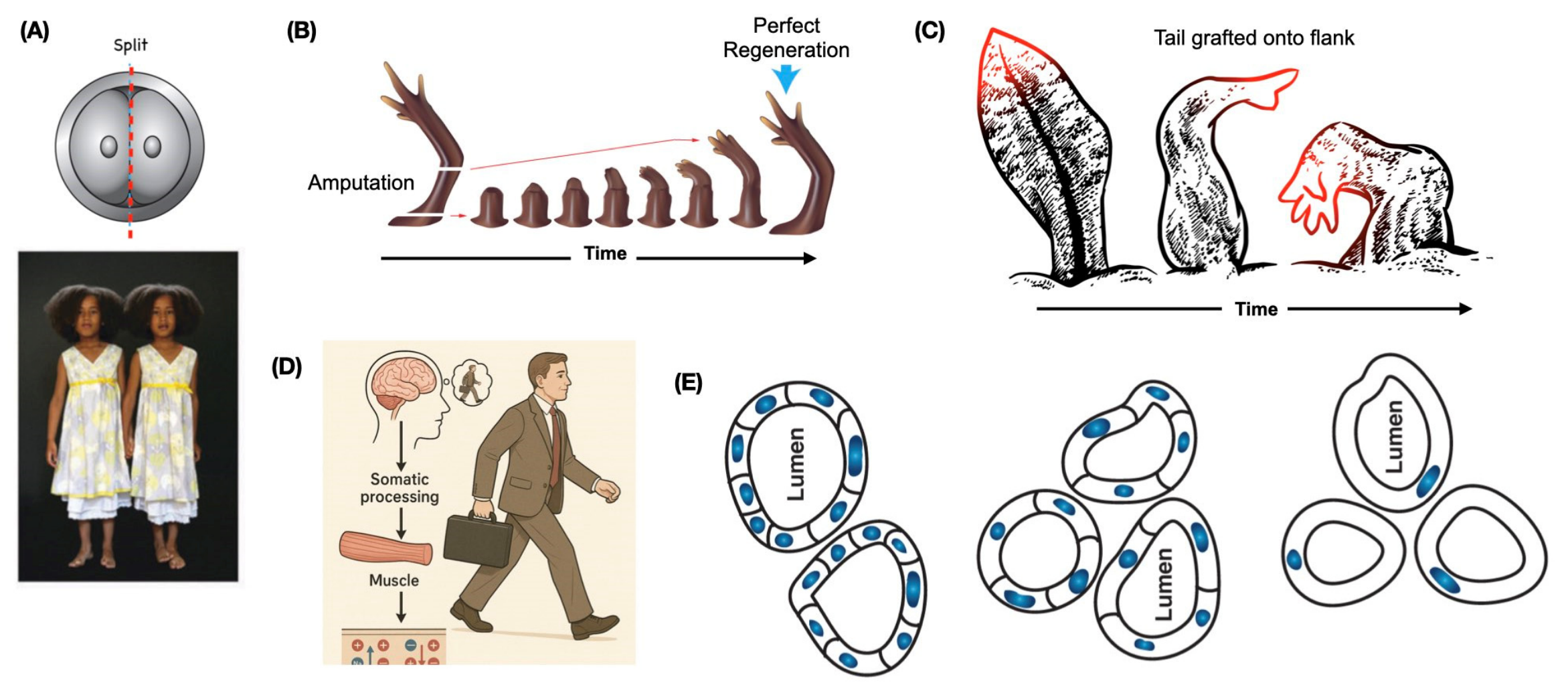
The first sign that morphogenesis is not hardwired is revealed by regulative development: embryos cut into pieces give rise not to partial bodies but to monozygotic twins, triplets, etc. Some animals do this in adulthood—salamanders regenerate perfect limbs (and many other organs) regardless of where they are amputated [143,144]. Indeed, development may just be a special form of regeneration that recovers most of a missing body from one seed cell. However, morphogenesis is more than recognizing that parts are missing and repeating the same steps. Scrambled tadpole heads rearrange to make normal frogs [145,146,147], showing that navigational paths can be altered to find the correct end-state. All of these systems can reach the species-specific target morphology from different starting conditions. What all of these examples have in common is that cells work to create a specific structure (even though no individual cell knows what, for example, a finger is or how many there should be) and stop when the anatomical goal has been reached—the key hallmark of this pattern homeostasis process.
But restoration of injured parts via standard mechanisms not the limit of the competency of this process. The kidney tubule of the newt (Figure 3E) is normally made of 8–10 cells working together. When the newts are made polyploid (having multiple copies of their chromosomal complement), the cells get larger to accommodate the new DNA, but the resulting newt is the same size, which is accomplished by the cell collective’s scaling to include fewer cells [141,148]. Embryos likewise adapt to drastic changes in overall cell number [149,150,151]. This is impressive enough, but the truly remarkable thing happens when the cells are made so large that only one of them fits into the diameter of a normal tubule. In that situation, single cells wrap around themselves to make the same structure. The system is then using a different molecular mechanism to solve its problem—instead of the normal cell:cell communication needed to organize multiple cells into a tube, it’s using cytoskeletal bending. This illustrates the ability to creatively use genetic affordances as needed—to implement a high-level anatomical specification. In other words, an incipient newt coming into the world not only cannot predict the vagaries of the external environment, but worse yet, even its own parts are unreliable. It cannot count on having the correct copy number of genes, or the correct number or size of its cells. It must get the job done using the tools at its disposal in novel circumstances. What can it count on? It can count on the relentless competency of its agential material, honed over eons of evolution that builds problem-solving agents (not fixed solutions to environments) [142], and the pole star that guides its activity—the attractor in morphospace to which it must find a path.
3.2. Tissues Store Bioelectric Pattern Memories (Setpoints) That Drive Morphogenesis
How do these systems know what to do? Many aspects of the biology curriculum hold that this is a bad question—they don’t. However, recent work reveals that, at least in some cases, they not only do, but they know using the same mechanisms that allow all of us to know what to do: electrical networks underlying functional memory. In other words, the encoding of which patterns will manifest is a memory which we can now read out in tissue [30,152]. While neuroscientists work on neural decoding, to extract semantic meaning, memories, preferences, etc., from the electrophysiology of brains [153,154,155,156], we and others can now read morphogenetic goals (pattern memories) in developing and regenerating tissues (Figure 4). The patterns are setpoints for cellular homeodynamic activity, and they are stored as electrical distributions.
A key question arises, critical for the below discussion of patterns’ provenance in general: where do these goal states come from? Contrary to popular misconception, they are not set by the genome any more than the activity of a computer, or a human brain, is entirely determined by genetics. What the genes do is specify the hardware of the body, which constrains and enables the kind of patterns (the physiological and behavioral dynamics) that can manifest in it. But, that hardware has not only the reliable default pattern, but many others it is compatible with. The same brain can have many different thoughts supervening on the same genetically determined electric networks, and the same body can host multiple different bioelectric pattern memories that guide the activity of cell groups during morphogenesis. For example, Planarian flatworms, which normally regenerate the correct heads with very high reliability, can be induced to make worms with two heads—or even heads of other species [157]—without any genetic change (Figure 4). There are specific patterns, in the space of possible planarian head shapes, that will attract not only the species that normally lives there, but also others, under the right conditions. All of these data paint a picture not of genetically determined, emergent outcomes, but of goal-seeking, sense-making systems which include cell collectives and other scales of biology [158] that dial into specific mathematical and other kinds of patterns which serve a functional role [159,160,161,162,163,164,165,166,167,168,169,170].
Figure 4.
Bioelectric encoding of re-writable memory patterns that guide morphogenesis of diverse outcomes with constant genetics. Panels (A–D) show the relationship of the bioelectric pattern memory to the molecular-biological and anatomical patterns, with the left column being a control worm and the right column showing one exposed for several hours to specific ionophores to alter the bioelectric pattern. (A) Both animals show normal molecular histology, with expression of marker gene (purple) in the head and not the tail (green vs. red arrowheads). (B) The anatomy is normal in both worms, with one head and one tail (red dashed lines indicate the amputation planes for the regeneration experiment). (C) The bioelectric pattern indicates one head (green arrow—endogenous depolarized region; white arrow—ectopic depolarized region) in the control worm but two in the exposed worm [171,172], despite their normal anatomy and gene expression. (D) When cut, the middle fragments produce a 1-headed animal in the control case, but a 2-headed bilateral heteromorphosis in the animal with the 2-headed pattern memory. (E) With no further treatment, fragments of these 2-headed worms will continue to regenerate as 2-headed in perpetuity (sequential results of cutting shown in panels i, ii, iii), showing that the bioelectric pattern memory holds indefinitely, despite their normal genome. Panels in (F) show that not only head number, but head shape is plastic: when the bioelectric signaling is disrupted by blocking electrical connections between cells, an animal with a triangular head makes one of several discrete head shapes—flat, round, etc., like other species. Images in (A–D) taken with permission from [171,172,173]. Image in (E) taken with permission from [174]. Images in (F) taken with permission from [175].
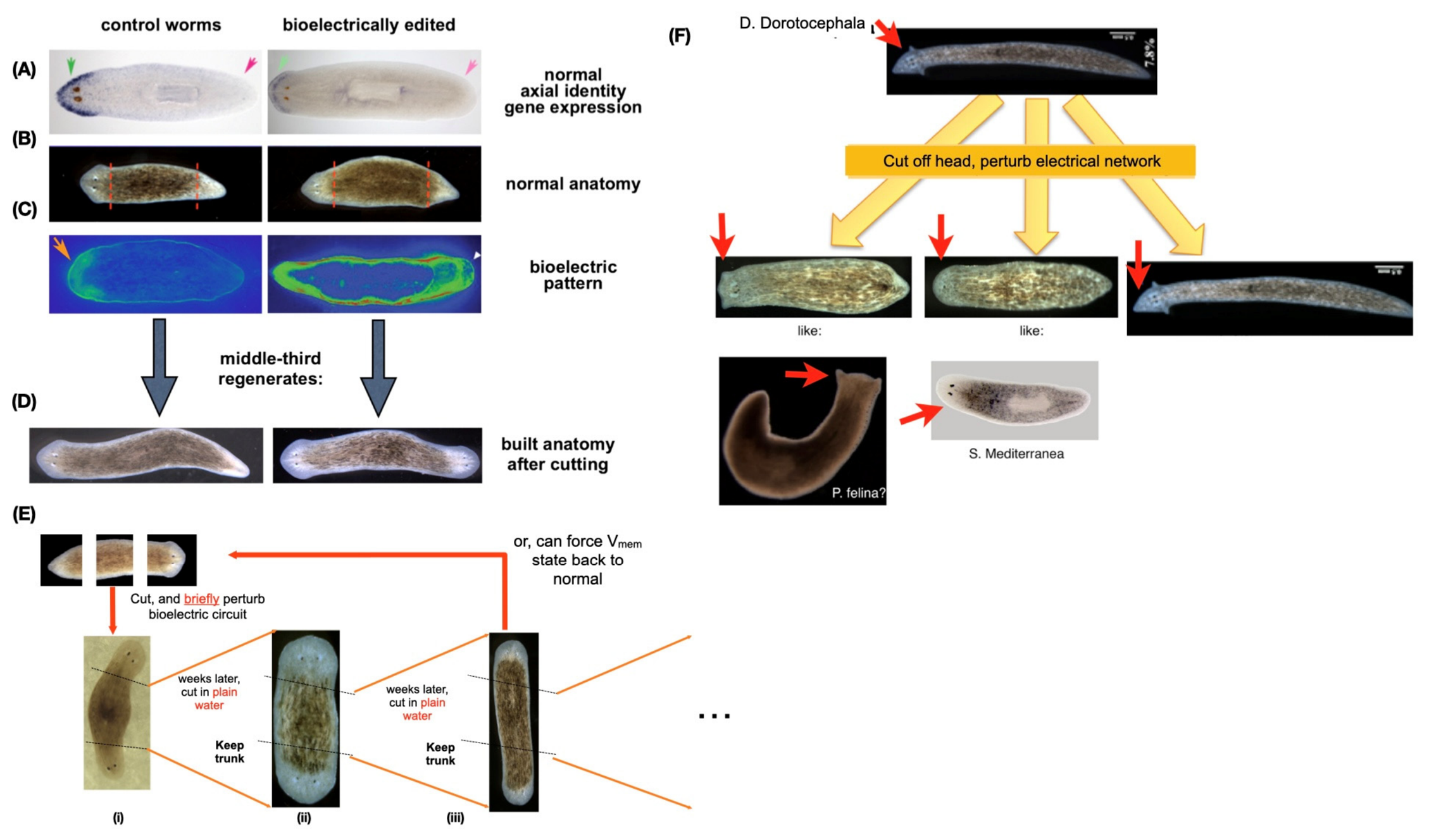
These results and many other examples like them (discussed in detail in [37]) reveal anatomical patterns to serve as setpoints in a homeostatic (or homeodynamic) process—stored functional goal state representations against which error is continuously minimized [130,176]. Much work exists on formalizing this notion in terms of a landscape [177,178] or morphogenetic field [81,104,179,180,181,182,183,184] which the active error-minimization process traverses. Some studies have now also been made of the cognitive glue mechanisms that enable the alignment of parts (molecular networks, cells, etc.) toward large-scale goal states in problem spaces of which the parts have no conception [185]. This is very different from the feed-forward paradigm of emergence of complexity from repeated iterations of simple rules, because open-loop processes do not explicitly represent setpoints, thus obscuring the deep questions around the goal patterns themselves. The mechanisms by which these anatomical pattern memories are stored, recalled, and implemented have been described elsewhere [171,174,186,187,188].
The main logic of the above overview can be summarized as follows: (a) activity in numerous and diverse problem spaces is unified by the notion of patterns of navigation and target states within that space. Thus, questions of origin of patterns equally affect a number of disciplines normally thought to be distinct—behavior science, cell biology, developmental biology, physiology, etc.; I argue that this symmetry is important as it reveals the far-reaching implications of the below arguments beyond the study of morphology. Especially crucial is the morphology-cognition mapping described above in detail, because it helps bridge the gap between questions of the origin of bodies and those of the origin of minds. (b) These patterns are not merely passive outcomes but can also be goal states for highly diverse cybernetic and cognitive systems. In the final sections below, I will extend this idea to ask about the origin of these patterns (in model systems where we cannot simply say “evolution”), and also propose that some patterns are also not merely goal states, but cognitive agents themselves (dissolving the sharp boundary between thoughts and thinkers). Next, however, I motivate the study of the latent space of possible patterns by asking the following question: where do they come from in the first place? The problem arises in many disciplines, but I will especially focus on the version from biology: what sets the targets for the goals of the collective intelligence of different scales of life?
4. Where Do Pattern Memories Come from? Beyond Genetics and Environment
“To invent, I have said, is to choose; but the word is perhaps not wholly exact. It makes one think of a purchaser before whom are displayed a large number of samples. … The sterile combinations do not even present themselves to the mind of the inventor. Never in the field of his consciousness do combinations appear that are not really useful. All goes on as if the inventor were an examiner for the second degree who would only have to question the candidates who had passed a previous examination.”—Poincaré (1921)
The ubiquity of specific patterns of form and behavior in the living world raises the natural question of where the patterns “come from”. This is often asked with the assumption that we know what the question means. One problem with this standard framing is that no answer would be really satisfying. Cases where one can point to a pre-existing structure, process, or agent that provides the necessary specificity for a given pattern, simply leads to “but then where did that pattern come from?”. It’s an endless search for the source of information, but what kind of answer would count as the definitive explanation? Another set of cases is often called “emergence”, in which simple rules give rise to a very specific complex outcome, and there appears to be no more to be sought than the fact of the matter that it happens that way and not some other way. Much has been written on the philosophy of explanations and mathematical causes [189,190,191,192], but biologists need a practical guide to asking increasingly better questions that direct inquiry away from unproductive paradoxes and toward questions of origin that enlighten and reveal novel capabilities and discoveries.
4.1. Some Patterns Have No Physical or Historical Explanation
Physicists are very comfortable with patterns in their subject matter (e.g., properties of particles, etc.) arising from mathematical truths, such as specific symmetries [193]. Biologists instead typically land on one of two sources of patterns that are acceptable: heredity and environment. Heredity provides a long history, backed by selection via interaction with an external environment, of shaping a chemical medium (DNA) that is thought to explain why specific patterns (rather than alternatives) are observed. Many interesting questions exist about the origin of useful solutions—a pre-requisite for being able to select them from a pool of less useful ones [106,107,108,109,194]—but here I want to focus on a source of order that pervades the living and non-living world: that studied by the discipline we call mathematics [192,195,196,197].
Consider the four-color theorem: it turns out that no more than four colors are required to color the regions of any map so that no two adjacent regions have the same color. Or, Feigenbaum’s numbers: mathematical constants which express ratios in a bifurcation diagram for a simple non-linear map (Figure 5). For almost all real numbers, the geometric mean of the coefficients of their continued fraction is about 2.685; almost all, and specifically ~2.685, not some other number. If n2 cannonballs are laid on the ground in a filled square formation, then they cannot all be used to make a square pyramid of cannonballs, except when n = 70. Every number of the form ABABAB (basis 10) is divisible by 37, and each prime (except 2 and 3) is next to a multiple of six. The distribution of prime numbers is well known, and the first six perfect numbers are all even and relatively close together (6, 28, 496, 8128, 33550336, 8589869056), but then there’s a massive jump to the next one (137438691328), and they become increasingly sparse. All of these are specific facts about a world which do not depend on facts from physics—they can be linked to other aspects of mathematics but they form a set of findings that do not reduce to any facts of physics9, or any kind of evolutionary story. We don’t get a choice10 about them—once we’ve picked a starting point (e.g., minimal assumptions of logic or set theory), we eventually discover these facts.
Figure 5.
Feigenbaum’s constant. In this bifurcation diagram (courtesy of Wikipedia), Feigenbaum’s constant δ is the limiting ratio of each bifurcation interval to the next between every period doubling, of an iterated one-parameter map such as a logistic equation Xn+1 = r•Xn•(1 − Xn). It happens to be approximately 4.6692.
Beyond the scalar patterns (specific special numbers in the examples above), there are many higher-dimensional patterns that simply exist “on their own”, unmoored from physical or historical explanations of their origins. Consider the remarkable and beautiful (also, life-like) pattern seen in the Halley plot kinds of fractals (Figure 6). That entire highly specific form is encoded in the very short function in complex numbers, and can be revealed by a simple algorithm. The fact that this highly complex pattern is indicated by a very succinct description of a function provides an un-ending richness from a small seed. I propose that it is better to think of it not as a kind of infinite compression11, but rather as the function serving as an index or a pointer into a morphospace of possible shapes. This idea will be developed further below, casting physical objects (such as embryos and biobots) as other types of pointers into the Platonic space.
Figure 6.
Rich spatial patterns emerging from mathematical seeds. (A) A sample Halley map of a short function in complex numbers such as z3 + 7. There is no physics or evolutionary explanation for the specific features of this structure; (B–D) “biomorph” patterns [204,205,206,207,208] arising from other functions in complex numbers (taken with permission from [96]).
What sets the nature of this shape—where does it come from? There is no history of selection, no prior events in our universe that determine it. Like the natural logarithm e, and many other remarkable constants12, specific patterns emerge from mathematics in ways that cannot be explained by any kind of history or properties of the physical world—they would be this way even if the physical world was entirely different. If the constants setting the properties of the physical universe were all altered at the Big Bang, these kinds of facts and things like the truths of number theory, and other aspects of computer science (e.g., the universality of the NAND gate, Turing halting status of specific algorithms, etc.) would be unchanged. There is nothing in the physical world that can be used as a control knob to alter them. I argue that this breaks the closure of the physical world, as these mathematical facts impinge on physics and dynamics that are the substrate of evolution. It is a non-physicalist approach [198,199,200,209,210] to the project of looking for sources of information and influence when we try to understand and guide biology (and the other disciplines that build on it).
4.2. Random “Facts That Hold” or a Structured Space of Non-Physical Patterns to Study?
This line of argument is compatible with the Platonist view of mathematics—as discovering, not inventing, a pre-existing structure (although there are other views [202]). In addition to special numbers, there are properties—for example, facts about graphs and networks in general [66,211], such as behavior of networks at criticality (edge of chaos), connectivity theorems, and the fact that networks can learn in specific ways [212,213]. The fundamental feature of such things is that, in an important sense, you “get out more than you put in”—constructions are limited or facilitated by patterns which do not themselves need to be constructed (and cannot be changed, only accommodated or exploited). When such examples are encountered, physicalist biologists say these are simply “facts that hold” about the world. This is the emergentist position where mathematical patterns and complex outcomes of iteration of simple rules are discovered from time to time—they can be cataloged and exploited when found, but they simply pop up unexpectedly and there is no further source to be sought. It’s just what happens, full stop.
The benefit of that emergentist position is that it’s a minimal monist ontology—it doesn’t need to postulate a non-physical latent space of patterns because the truly emergent features are not explained by any underlying structure. The downside of it is that it is, fundamentally, a mysterian position that does not facilitate further advances. It fundamentally assumes that there is nothing to investigate as a source of these patterns. I cannot disprove this, but I think it’s a pessimistic research stopper that is inconsistent with the fundamentally optimistic approach to science where we always try to look for a deeper structure, another level of “why?”. In contrast, I propose a vaguely neo-Platonist view in which we view the latent space of these patterns as real, in the following senses:
- (1)
- It can be systematically studied to understand why some things “emerge” rather than others, in a given scenario;
- (2)
- It is structured, and thus can be traversed by thought and experiment to find new “adjacent” patterns once one has found some;
- (3)
- It matters for what happens in the physical world (via ingressions of these patterns [214])—it is causal in that it provides specificity for events and servers as the most insightful explanation for why specific things are how they are;
- (4)
- It meets the engineer’s definition of what is ontologically real: whatever the engineer has to worry about or exploit, in making better creations.
I argue that basic understanding of our nature as cognitive beings, and applications ranging from regenerative medicine to engineering, are better served by going beyond reveling in the surprise of emergent outcomes or “complexity”. Instead, I favor a process of discovery that acknowledges biological (and cognitive) outcomes to be the result of a triad of heredity (hardware), environment (boundary conditions), and ingressing patterns whose most salient fact is that they are part of an ordered and structured, tractable but non-physical, space.
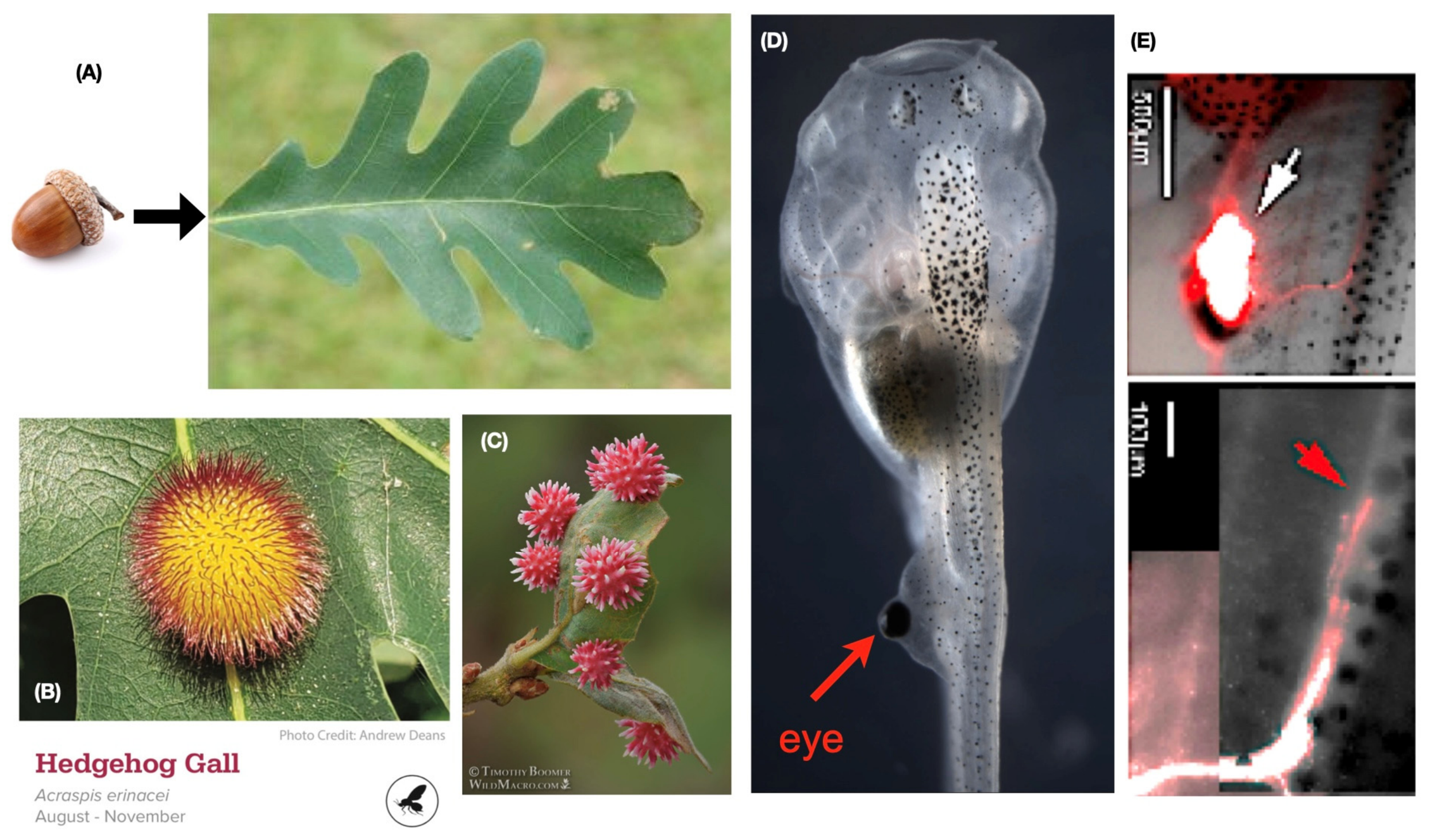
Below I sketch out a perspective in which we view a very diverse range of physical systems—from minimal machines to living constructs—as pointers (and interfaces [215]) into a rich latent space of patterns. Our job then is to characterize the mapping between pointers and the ingressing patterns which they enable, to understand the metric and structure of the space of patterns and be able to follow pointers and design interfaces to access desired patterns at will in biomedical, engineering, and social contexts. We do not want to be surprised by, for example, the arrival and capabilities of Anthrobots [216,217], the functionality of eyes placed on the tails of tadpoles [218] (Figure 7), and humans with minimal brain matter but normal cognition (reviewed in [219])—these are unexpected when relying on selection and a view of evolution as producing specific solutions to specific past problems. The competencies of novel systems without a specific history of design or selection represent examples of the exploitation of the Platonic space by evolution, which favors interfaces that benefit from those patterns. These are a kind of “free lunch” in the sense of competencies of form and function that did not incur the expected cost of specific design or evolution.
We want to be able to anticipate and relate to novel beings by understanding how evolution exploits intelligent, problem-solving physical and computational structures as interfaces to a rich space of patterns which they adaptively navigate and host13.
Figure 7.
Unexpected competencies of form and function—the “free lunches” exploited by evolution and engineers, both human and non-human. (A) Acorns reliably make a very specific shape: the oak leaf. However, when prompted by signals from a parasite, these same cells can make other structures—galls with shapes remarkably different from the default flat, green leaf, raising the question of what other shapes exist in their latent space and could be coaxed. Image in (B) by Andrew Deans; image in (C) by Timothy Boomer at WildMacro.com. Unexpected capabilities can also be discovered by perturbational experiments in behavioral space. For example, tadpoles (D), in which the primary eyes are suppressed but an eye is induced on their tail (red arrow) which can still see and perform well in visual assays [218] even though the optic nerve ((E), bottom panel) emerging from the ectopic eye ((E), top panel, white arrowhead) does not connect to the brain but instead might stop at the spinal cord ((E), bottom panel, red arrow). Images in panel (A) taken from the Harvard Forest Tree Field Guide, used previously in [221]. Images in panels (D,E) taken with permission from [218].
4.3. Beyond Eternal, Unchanging Patterns: Toward a Phylogeny of Platonic Forms
While this addition to the ontology of life sciences is already unconventional, there is another step to take: going beyond static, low-agency forms. One common way of thinking about Platonic space is that it contains things like facts about triangles and integers, which are (1) unchanging, and (2) refer to mechanical patterns unrelated to intelligence (they affect agents but are themselves passive). In other words, the baseline view is that intelligences can benefit from such patterns (as evolutionary or engineering affordances) and can sometimes consciously interact with them (as mathematicians pondering the properties of abstract objects), but that they are passive, waiting for an intelligence to make use of them. This can be extended in ways analogous to how the passive matter of human engineers of past centuries has been extended to examples of active matter, computational matter, and agential materials [142,222,223,224].
First, we move from static “truths” to dynamical patterns. Consider the classic liar paradox, in which sentence X says “X is false”. Patrick Grim [225,226,227,228,229,230,231] developed a fascinating perspective on this by doing two things (Figure 8). First, he added an element of time: there is no paradox if we allow the truth value to change and consider the time-extended behavior; the paradox arises from our trying to freeze a fundamentally dynamic pattern down into an assumption that a proposition should have a static truth value (not move in the abstract space of logical sentences). Second, he moved to fuzzy logic, to allow the Boolean true–false cycle to take on more interesting shapes by allowing sentences like “X is 80% true”. Finally, he enlarged the space by considering and plotting the structures formed by sets of N mutually referencing sentences. This allowed him to observe complex, dynamic, often fractal patterns corresponding to logical sentences. That extends the flat world of static truth claims to a domain of interacting, rich, time-dependent14 systems.
Figure 8.
The dynamic life of logical sentences. Obvious denizens of the Platonic space include logical statements. By simulating their dynamics as fuzzy logic patterns created by coupled systems of two mutually referential sentences, we reveal the complex, dynamical behavior of these logical constructs. Panels (A–C) show the time-dependent patterning behavior of several sentences, starting with the familiar Liar Paradox in (A) which simply alternates between true and false and produces a simple, but not static, pattern. Sentences for the others are shown at the top of each panel. Images (A–C) are screenshots of software created by Madelyn Silveira, Levin lab, to visualize these patterns. (D) A pattern belonging to a pair of sentences, taken with permission from [231].
Thus, the Platonic realm contains passive, static things like Pi and the natural logarithm e (the “rocks” of that world), but also dynamic repetitive things of the kind “this sentence is false” (simple oscillators that buzz “in place”), and more complex structures represented by sets of logical sentences that lock together to define an emergent pattern and whose output can be visualized as a traversal of a space (and we already know that such traversals can offer surprising degrees of competency, such as delayed gratification [232]).
Next, we recognize that some of these, such as ones represented by equations describing gene regulatory networks [212,213], or those describing predator–prey ecological systems [233], can even learn from experience. This way of classifying the ontology of the Platonic space opens the possibility of a rich, perhaps stratified, continuum of inhabitants ranging across the whole spectrum of diverse intelligence—from static and mechanical to the complex and agential, with intermediate forms that can do simple forms of learning. In other words, while some of the contents of this Platonic space are studied by mathematicians, others are ingredients of, or perhaps whole, kinds of minds and are studied by behavior scientists. On this view, perhaps all forms of knowledge are, in a way, a behavior science of some form of the Platonic space of patterns; for example, neuroscientists are simultaneously studying a sector of that space and the physical interface so suited to providing access to its inhabitants.
This view is consistent with others’ models of non-physical mind [6] but focuses on a different aspect than the quantum interface typically resorted to for solving the interactionist problem of dualism [234,235,236]. It is also broadly consistent with other views [237,238] of non-physical components to a transpersonal psychology, such as Jung’s theory that certain “primordial images” or “elementary ideas” activate in the human nervous system as archetypes, describing dreams, myths, art, and rituals as potentially activating triggers for such patterns. While these ideas linking non-physical forms to physical and mental patterns are now classics, they have made little impact on research in the life sciences and in engineering. I think it is fair to say that most biologists regard them, if at all, as ancient relics of a profligately magical worldview that is rightly abandoned in favor of metaphors about molecular pathways. This occurred because there has not been a tractable path to transition these ideas into novel discoveries, thus demonstrating their utility. That is no longer the case, and I believe we now have a toolbox that provides an exciting, actionable research program to evaluate the utility of such ideas. Specifically, that an actionable model can be proposed involving a structured latent space of patterns, with capabilities ranging from reliable constancy to specific behavioral competencies.
5. A Research Program Beyond Physicalism: A Provisional Model
“Computer Science is no more about computers than astronomy is about telescopes.”—E. W. Dijkstra
5.1. If Evolution Is Exploiting Free Lunches, So Should Engineers
Imagine a world in which the highest fitness is achieved by a specific shape of a triangle. Evolution spends N generations finding the first angle, and then it spends ~N more generations optimizing the second angle. But then something magical happens—it does not need to spend time finding the third angle—in flat space, if you know two of the angles of a triangle, you know the third. Similarly, if evolution produces a voltage-gated ion channel (a voltage-gated current conductance, a.k.a., a transistor), it can make logic gates, and then the computational features of these logic gates (and their other properties, like the universality of the NAND gate etc.) are accessible without having to specifically evolve the contents of their truth tables. These kinds of features show up as a kind of “free lunch” in the physicist’s sense—with the right kind of pointer (or interface, or receiver) in physical space, one gets more out than one put in (in terms of effort of design, selection, or learning). This opens an important gap in the closure of the physical world, which means that explanations need to integrate mechanistic components of genetics and environment but also mathematical explanations [239,240]—patterns of form and behavior that derive their being from something other than the facts of physics. Evolution, being the ultimate opportunist, has no pre-commitment to physicalism and would exploit useful features no matter their origin. I suggest that the benefits to evolution range far beyond the patterns we study in mathematics.
5.2. Impact of Platonic Forms in Biology
Life makes extensive uses of the properties of prime numbers [9] and many other mathematical facts. Beyond that, it exploits the generic properties of networks [184,241,242,243,244], differential adhesion [245], fractal structures [95,99,246,247], topological structures [248], emergent features of morphomechanics [79,249,250,251], and the myriad of remarkable examples across the kingdoms of life cataloged by Thompson [102]. Furthermore, it’s not just about numbers; for example, gene regulatory networks are even subject to patterns from the field of logic, being amenable to liar paradoxes and other incompleteness results [94].
Biology often reveals a sensitivity to these mathematical structures, including patterns of algebra, logic, and even Julia sets and root-finding methods [96,204,207]. One of the most interesting is that found by Thompson [102,252], who showed that patterns of different extant living species could be derived from other species by mathematical deformations of a coordinate grid (Figure 9). Importantly, despite the frequent use of fields and positional information grid concepts in developmental biology [183,184,253,254,255,256], many of these fields (especially Thompson’s) do not have a known physical basis, but they do have structure and information content [125,126,127,257] which informs biology.
Figure 9.
Transformations of extant species’ morphologies into others by mathematical deformation of an imaginary grid. These panels show examples of how simple mathematical deformations of animal shapes on a coordinate grid (which has no obvious biological counterpart) result in novel, existing biological species. Taken with permission from [102].
Prior work has extensively explored the idea that the autopoietic processes of self-construction of bodies and of minds have a fundamental symmetry [23,258]. In other words, morphogenesis itself is a cognitive process [28,186] and literally the behavior of the collective intelligence of cells (as our mammalian cognition is the behavior of a collective of neural and other cells). It has thus been suggested that, because of the deep evolutionary conservation of ion channels and other bioelectrical machinery (and the algorithms it implements) across neural and non-neural substrates [24], the tools of behavioral neuroscience can be used to shed light on morphogenetic competencies. Conversely, the science of emergent body forms navigating anatomical space can help understand how neurons align in brains to enable the emergence of a cognitive being that has goals, preferences, and memories that its parts cannot. Is it possible that the relationship goes deeper, in that the core of what it means to be a mind, with inner perspective, embodied in the physical universe, is fundamentally linked to the kinds of autopoietic patterns a given construct can access?
5.3. A Non-Physicalist Model of Embodied Minds
I propose that the relationship between mind and brain is the same as the relationship between mathematical patterns and the morphogenetic outcomes they guide (more broadly, mind:body is as math:physics). Form and agential behavior is a combination of ingressing meaningful information patterns and physical constraints [72,192,259,260,261] in how it can manifest in the physical world determined by structural architecture, limitations of time and energy, etc. The involvement of non-physical components is unwelcome to many—seen as a slide back toward Cartesianism and superstition, although classic [6] and modern [262,263] theories are actually quite consistent with this view). But the exploitation of Platonic mathematical structures by evolution, as well by its products known as mathematicians, has already evicted us from the tidy physicalist paradigm. There is no going back. Taking Platonic mathematics seriously and applying it in biology means we have already abandoned the closure of the physical world for our explanations, intervention strategies, and computational models. We already know that non-physical patterns ingress into, and functionally matter, in the non-living and living world and that we can (and do) study them to great effect [193,264,265,266,267,268]. The only thing holding back from Cartesianism is the idea that the only non-physical patterns that matter are low-agency mathematical static truths that are irrelevant to cognitive science and philosophy of mind; I propose dropping this unwarranted assumption to see where the implications lead.
The standard conception of the contents of the Platonic space is that it consists of unchanging, eternal patterns—shapes, rules, etc.—for low-agency things like integers and triangles. Peirce, in contrast, thought that “The evolutionary process is, therefore, not a mere evolution of the existing universe, but rather a process by which the very Platonic forms themselves have become or are becoming developed.” (CP 6.194, [269]). Perhaps patterns can span across the spectrum of persuadability: they can be static, active (as in Grim’s logic patterns), or possibly agential15. How to conceptualize agential patterns? By remembering that we, ourselves, are patterns—temporary self-organizing patterns that hold together for a time within metabolic and other media, and manage to exert cognition, agency, and consciousness. Why could Platonic space not contain patterns that are intelligent and active to some degree, like the specific kinds of network structures that have been shown to have the simple goal-directedness of attractors and self-assembly capabilities [66,270] or even capacity for Pavlovian conditioning [212,213]? What if some of the Platonic patterns that matter for biology are, themselves, intelligent to a degree?
To recap, the first pillar of the proposed framework is that Platonic forms inject information and influence into physical events, such as the growth and form of biological bodies. The second is that this latent space contains not only low-agency forms such as facts about integers and geometric shapes, but also a wide range of increasingly high-agency patterns, some of which we call “kinds of minds”. Thus, I propose that minds, as patterns that ensoul somatic embodiments, are of exactly the kind (but not in degree) of non-physical nature as the patterns that inhabit and guide the behavior of simple physical structures. The relationship between mind and matter (of the brain for example) is proposed to be the same as the relationship between Platonic patterns and the physical objects they inform.
In colloquial terms, triangular objects are inhabited by the relevant facts of geometry, while brains are also able to host the incarnation (literally, “bringing into meat”) of patterns of a very different kind and sophistication. I propose that the objects on which we often fixate in physics, biology, and AI—the embryos, machines, large language models running on PCs or in robots, etc., are just pointers (or interfaces [215,271,272,273]) to the deeper space of patterns. Every analogy has limitations and no doubt the pointer metaphor will fail at some point, but the aspects of the pointer analogy I wish to emphasize are as follows: (1) as with pointers into a rich informational medium, you get more out than you put in; (2) the mapping between the interface you make and what comes through it is almost always not linear or simple and must be investigated; and (3) in order to learn to call up the patterns we want, we will have to look beyond the pointer toward the structure and contents of the space into which it points.
My model (Figure 10) is an extension of prior Platonic space models [5,6] and broadly consistent with some traditions around a layered (tiered) “Mental plane” of subtle objects that include cognitive types and instances. It is real, while non-physical, because its contents (a) matter for what happens in the physical world (knowledge of these patterns provides massive leverage for evolution or for engineering design), and (b) it can be profitably studied and exploited with outcomes that play out in the arena of empirical experiment. Thus, the complexity of a body (or a mind) are not so much contained or compressed in the seed, in the sense that they must be constructed via emergent surprise from an algorithm that processes it, but rather pointed to by the seed and retrieved by a process that spans both the world of patterns and the world of physical pointers or interfaces to it.
Figure 10.
Models of the Platonic space and its relationship to forms and instances of embodied minds. (A) everything is in-formed by patterns in different regions of the Platonic space, including simple objects, engineered machines, embryos, chimeras, biobots, and other systems, and their physical embodiments act as interfaces or pointers to structures in the Platonic space, which are active and have different degrees of complexity and agency (represented here by the size of the form). (B) Embryos, brains, bioengineered constructs, AIs, parasite hackers, etc., are all exploration vehicles which in effect implement a portal or entry-point into the Platonic space allowing us to explore the latent space of patterns in the vicinity. (C) The space may be layered or structured, such that “lower” levels contain lower-agency forms, such as static truths about numbers, while “higher” levels permit classes of patterns (kinds of minds) which contain specific instances—patterns that are active, or even self-referential strange loops [274] which reify their own existence as a mind and have pinched off from the generative substrate as true individuals.
5.4. Practical Consequences: Implications of the Model
What does this model mean, in practical terms? The latent space is known to be structured not only because Platonist mathematicians have been building a map of it, but also because evolution is able to exploit it—it has a relatively smooth character which allows evolution to progress rapidly, because past interactions with it carry non-trivial information about the adjacent possible [64,66,275]. Thus, the third pillar of the proposed framework is that the space of these forms is not haphazard or random (suitable for emergence and complexity science) but is a structured ordered space that is amenable to systematic exploration. It is now essential to begin to map out the space (to expand out from the patterns studied by mathematicians and link morphogenetic and cognitive within the same map), and to crack the syntax and semantics of the pointers—the mapping between the objects that we make in the physical world and the myriad of patterns that pour through those interfaces from the Platonic space (which I conceive of as being under a sort of positive outward pressure).
Here, then, is a research program which addresses these challenges16. It is formed around two main thrusts. First, studying patterns (form and cognitive behavior) of systems which have not been selected for specific outcomes but form the “adjacent possible” [279] around existing forms. This provides an opportunity to study the metric of the Platonic space by analyzing patterns ingressing into physical pointers that vary widely and specifically illustrate the inadequacy of current paradigms because their functionality cannot be traced to any of the canonical ways of paying for competency: selection, rational design, or training. One example is Xenobots, which teach us about patterns adjacent to those of frog embryos, and Anthrobots, which teach us about patterns adjacent to adult human tissues (Figure 11). The tractability of biobots, synthetic bioengineered constructs [280,281,282,283,284,285], chimeras [286], and other modifications of standard, default embryogenesis reveal the plasticity of the genetically encoded hardware in their ability to serve as interfaces for a wide range of patterns besides the obvious ones that appear as default (and commonly thought to be emergent, selected-for properties). Such living exotica serve as exploration vehicles or periscopes for our study of the Platonic space and its contents, greatly expanding the range of patterns we observe. Most crucially, because they don’t have a specific evolutionary history as such (i.e., there have never been any Xenobots or Anthrobots and thus no eons of selection for being a good biobot with their specific properties and capabilities17), they raise the key question of “where these patterns come from”, and thus serve as an entryway into the space of specific non-physical forms.
Figure 11.
Synthetic beings as exploration vehicles of the Platonic space. (A) Close-up view of an Anthrobot—a motile, living construct that self-assembles from genetically normal human tracheal cells. (B) In groups, these Anthrobots can gather (green) on wounds made on a bed of human neurons (red), and cause healing of the neurons across the gap ((B′), white arrowhead). (C) The Xenopus laevis genome not only makes tadpoles with a specific developmental sequence and behavior (top row) but also Xenobots, with their own unique developmental pattern and behavior (bottom row). (D) These biobots have unique functionality such as kinematic replication, able to form loose skin cells provided to them into the next generation of Xenobots (sequential panels of generations shown). Panels (A–B′) taken with permission from [216]. Panels (C,D) courtesy of Xenbase (https://www.xenbase.org/xenbase/doNewsRead.do?id=136 (accessed on 5 July 2026 and [295]) and Douglas Blackiston, and taken with permission from [296].
5.5. Minimal Models to Extend the Study of Platonic Space: Broader than Biologicals
The second pillar of this research program is the investigation of very minimal systems. Discussed in more detail below, the main point is that in systems where every component is known (unlike cell-based biology), there is nowhere to hide—one cannot posit an as-yet undiscovered physical mechanism that can be said to encode the pattern. Moreover, minimal systems offer the most tractable examples of pointers for working out the relationship between the structure of pointers and the patterns to which they provide entry into the physical world. Biological systems are the richest, most interesting interfaces that we know of, but the tradeoff is that their complexity makes it harder to discern the mapping. In minimal systems, it may be possible to quantify the effort put in and the competencies that emerge; the delta between them directly sheds light on what and how much can be obtained from the Platonic space, and thus, what and how much is missing in the accounting provided by current paradigms in biology and computer science.
Examples of such minimal systems include physically embodied ones like chemical robots—droplets containing only a few chemicals which nevertheless have rich individual and collective behaviors [297,298,299,300], as well as computationally simulated ones such as the learning [212,213] and causal emergence [301] properties of simple gene regulatory network models (coupled systems of differential equations). What is striking about all those examples is that complex patterns of form and behavior can be accessed with extremely minimal pointers—it is clear that our native intuitions are not sufficient to predict, recognize, or rationally manage ingressing patterns, which leads to technological implications and, more importantly, ethical lapses.
6. Implications: If There Are Souls, (Some) Robots Will Embody Them
“Wisdom is one thing. It is to know the thought by which all things are steered through all things.”—Heraclitus
I have argued previously that because of the slow, gradual transformative processes of evolution and embryogenesis, the null hypothesis about cognition is a continuum: a spectrum of minds with different sizes of cognitive light cone and capabilities, not sharp discrete classes [22]. The right question about any mind is “what kind, and how much”, not “whether” it is conscious or intelligent [132], and previous work (and much empirical data from our lab) delineates the empirical criteria for interventional experiments which can help place a system in an appropriate spot on that continuum [132,302]. This gradualism is compatible with a Platonic view of the relationship between minds and bodies, suggesting a very wide variety (Figure 12) of possible beings, animated by a space of mental patterns whose diversity and limits are not known but surely enormous. But the Platonic view is not merely compatible with the framework of diverse intelligence [132,303,304], it suggests a broadening of it. If the minds of living beings are ingressing patterns into meat-based embodiments, there is no principled reason to doubt that some kinds of such patterns will inhabit engineered, hybrid, or even more exotic systems.
Figure 12.
The space of possible bodies and minds, informed by patterns from the Platonic space. The variety of natural forms on Earth are just a tiny region of the space of possible embodied minds, which comprise an uncountable infinity of combinations of evolved material, engineered material, software, and input from the Platonic space. Some of these hybrots, cyborgs, and many other creations already exist [37]. Images by Jeremy Guay of Peregrine Creative, taken with permission from [37,186].
6.1. Unconventional Beings Will Also Interface to Patterns of Mind in Platonic Space
Specifically, I propose that the interface between mathematical truths and physical objects is precisely the interface between the non-physical mind and its physical embodiments. The real “soul” of the triangle and the way it relates to real triangular objects is a minimal, basal version of how complex living beings are “ensouled” by cognitive patterns. This suggests a position on the oft-asked question about diverse intelligence and continuum models of mind: how far down does it go? Cells? Subcellular biochemical networks? Particles? By emphasizing a symmetry between the ingression of patterns into simple machines/objects and that of kinds of minds into living agents, this view argues that the spectrum of minds goes all the way down into extremely simple, basal instances of properties we normally associate with complex brains.
I have discussed this elsewhere with respect to things like learning in gene regulatory networks [212,213] and ecological dynamics [233]. But there is more. For example, geometric frustration [305,306,307,308,309]—misalignment of parts within a whole—is bona fide frustration of the kind that gets magnified (in some architectures) into our familiar cognitive version. On my view, mind precedes and is a superset of life, but we call “living” those things which are very good at scaling up the lowly competencies of their parts into aligned collective intelligences [185] with bigger cognitive light cones that project into new spaces to which the parts have no access, thus enabling the physical manifestation of new patterns and increasingly more sophisticated cognitive agents—all of which coexist in one material embodiment (Figure 13A,B). This is because the Platonic space also contains patterns that we recognize as kinds of minds, ranging across different classification schemes [123,310] (Figure 13C,D), and nervous systems (or perhaps cyborg or AI architectures) which facilitate the ingression of specific types of patterns. This provides a different way of thinking about the inner lives of our own organs and various living constructs that are created for biomedical or bioengineering purposes. But this framework opens two other doors, less comfortable for many than even the diversity of minds suggested by the hierarchical, multi-scale competency of living bodies.
Figure 13.
Nested cognitive light cones in multiscale biological systems with different degrees of intelligence. (A) Single cells have a very small cognitive light cone, pursuing goals that have a spatial scale of roughly their own diameter and short temporal horizons for memory and anticipation that enables them to meet homeostatic goals such as pH and metabolic state; groups of cells can form computational networks that have larger goals, such as morphogenetic patterns of whole organs and appendages (e.g., during regeneration). (B) Different kinds of systems have very different-sized goals and thus are pursuing different scales of agendas; biological systems tend to be multiscale collectives with nested heterarchies of agents with different-sized cognitive light cones cooperating and competing in the body. (C) These architectures allow different kinds of minds, with diverse levels of agency spanning from passive to metacognitive human-level and beyond. (D) Diverse agents, regardless of their composition or provenance, can (with empirical evidence) be placed on a spectrum of persuadability, where different toolkits become appropriate for interacting with them. All panels by Jeremy Guay of Peregrine Creative. Panels (A–C) taken with permission from [22]; (C) is adapted from [123]. Panel (D) taken with permission from [132].
6.2. Emergent Mind in Engineered Objects
Even organicists, who believe that life is exhibiting many capabilities not simply derivable from the biophysical properties of its parts, stop short of extending the same consideration to “machines” or “non-living systems”. The prevailing view is that while the rules of chemistry do not tell the whole story of the living mind, the rules of physics and the algorithms of computational devices do tell the entire story of “machines” [311,312]. There has been no convincing explanation of why the meandering trial-and-error of mutations and selection would have a monopoly on making new minds, but it is a common opinion that life is a discrete natural kind and that machines do not have the magic (although of course this view is resisted by many in the artificial life and artificial intelligence communities [313]).
6.3. More Minimal Models for Ingressing of Forms: Not Just Bodies, Algorithms
In particular, computational devices that function according to an algorithm are widely thought not to be real minds because they were programmed by others18 and face various limitations by being compelled to act in accordance with the laws of physics. Here, I will not pause to ask how it is that living beings are supposed to escape the laws of physics which our parts also obey [316], but argue in a different direction. I think the organicist position is right with respect to computationalism—living things are not agents with true minds because of specific algorithms they embody, but I think organicists do not pursue their ideas to their full extent. If one takes seriously that life and mind are not fully encompassed by the rules that govern their lowest parts (chemistry and physics), might this not apply to non-proteinaceous and non-evolved systems as well?
One recent example [232] provides an illustration. We studied the behavior of sorting algorithms—short, simple, deterministic algorithms (like “bubble sort”), which were designed to take a set of jumbled numbers and move them around until the set was in monotonically increasing order. It’s a good minimal model because all the steps are visible—there is no new biology hidden that could explain any unexpected behaviors. Generations of computer science students have been studying these for decades, and we were using them to model the rearrangements of cells in morphogenetic contexts where scrambled initial conditions sort out to a normal morphological pattern [145]. What we did differently is to visualize the progression of the sort as a movement of the system through “sorting space”, starting out in random configurations but all converging on one target at the end—a point at which everything is in exactly sequential order. The first unexpected thing we found is that these algorithms display “delayed gratification” (Figure 14).
Figure 14.
Unexpected competencies in a minimal algorithm. (A) Illustration of degrees of capability for delayed gratification. Two magnets separated by a barrier will never go around it (it requires going against the simple energy gradient they are pursuing). However, autonomous vehicles, cells, and human beings (here schematized as the Romeo and Juliet scene) have degrees of ability to temporarily go against their gradient to recoup gains later. (B) This trace shows the degree of Sortedness (Y axis) in an array of numbers (one number per cell) being processed by a simple sorting algorithm. When it encounters a number that will not move as directed (a piece of “broken” data which becomes a barrier in their navigation of sorting space), it moves other numbers in a way that temporarily de-sorts the array (the inset magnifies an example of this where the Sortedness decreases) in order to complete its mission. This ability to back-track to deal with a broken piece of data is not explicitly in the algorithm—it is a behavioral competency that could not (indeed, was not, in the decades of use of these algorithms) be seen from the algorithm itself, and is an example of a Platonic behavioral pattern exploited by this very minimal system. (C) Another such example is seen in chimeric sorting modes (where each cell is pursuing one of several possible algorithms—its algotype). While the collective sorts the process over time (blue line, right Y axis), just as required by the algorithm, it also temporarily shows clustering (red line, left Y axis, see maximum around time = 20) where cells with the same algotype cluster together more than chance (light pink line is the control), even though the algorithm does not have any code in it to make decisions based on algotype of a cell or its neighbors. Panel (A) by Jeremy Guay of Peregrine Creative. Panels (B,C) taken with permission from [232].
When encountering a barrier to their journey (e.g., a number that refuses to move when asked to swap—a “broken” cell), the algorithm temporarily de-sorts the array in order to move things around the defective point. This is a capacity that some creatures have—to temporarily move away from their goal in order to recoup greater gains later—it is a relatively sophisticated ability in the cognitive toolkit because it cannot be done by a system that just follows a gradient (like two magnets separated by a piece of wood, which will never go around it to get together because they’re not smart enough to temporarily get further from each other). The critical thing is that we did not add steps to the algorithm to check whether a swap had been completed, or to do specific things if an operation failed. This ability is surprising and not explicitly anywhere in the algorithm. The lesson here is that what appears in even very simple systems is not merely complexity or unpredictability, but cognitive skills recognizable to behavior scientists—minimal, in this case, but that is the point—minimal systems have minimal emergent problem-solving capacities (a.k.a. intelligence) that was not explicitly baked into the algorithm and has gone un-noticed for decades because no one had done the standard approach of diverse intelligence research: do not assume what a system is capable of, test it by challenging its ability to reach specific goals.
The second remarkable thing was observed19 when we replaced the central algorithm that swaps numbers with a bottom-up, distributed architecture: now, each number is a cell which runs the algorithm, using its limited vision of neighbors to decide when to swap positions. We made chimeric data arrays (representing distinct “cell types”) in which some of the numbers moved according to one algorithm, while others moved according to a different one (we called it the “algotype” of a cell, paralleling the genotype/phenotype classification in living cells). This is a much more biological model of agential material—in this case, self-sorting data (a concept that connects to the section on agential patterns below). We found that not only does this collective intelligence still solve the problem (in some cases, better than the traditional centralized version), but it also engages in an interesting side-quest. When we plotted the distribution of algotypes within the array, we found that they tend to cluster (Figure 14C): groups of cells with identical algotypes tended to form and persist for some time, before the array got sorted and the initially random assignment of algotypes to integer values was regained as the array got sorted by integer number with no regard to algotype. As above, the key part is that none of this was in the algorithm: there were no steps to check the algotype of your neighbor or perform actions to bring you closer to those of your own algotype. This unusual behavior—to stick close to others of your own functional kind (without regard for the only thing the algorithm actually cared about—the numerical value)—was completely unexpected and not explicitly programmed into the algorithm.
This kind of example suggests the following. Machines driven by algorithms do the thing the algorithm makes them do; that part is not what we mean by mind, agency, or consciousness, and organicists are correct in rejecting the computationalist perspective in which mind arises because of the steps of an explicit algorithm. But they are wrong in thinking this is the end of the story: machines (whether meaty or silicon-based) also do other things that are not in the algorithm, as do we, and these things are not just unpredictable complexity, it is intelligence and other components of minds. It is those behaviors—allowed by the algorithm but not directly prescribed by it—that correspond to the freedom (physically non-determined) or secret sauce that we seek when trying to understand how free minds can supervene on chemically determined substrates in the case of living beings.
On this view, algorithmic machines and biochemical life are on exactly the same spectrum, having in common the ability to go beyond the facts of physical or algorithmic implementation because both are just pointers/interfaces to patterns that ingress in a way that results in getting more out than we put in. Granted, in these intentionally minimal systems (designed to probe “how far down does it go”), the emergent capabilities are not as sophisticated as those of brainy organisms or other possible constructs. But we should not feel too smug about that. The predicament of an algotype cluster in this world—which forms, lives for a brief time, and then is ripped apart by the inexorable physics of their in silico universe—is eerily similar to our own existential plight in which we appear, perform actions that are consistent with—but also much more than—the mechanics of our world, and then eventually succumb to the impermanence of life and mind. Like living systems, this extremely minimal example is trapped at the edge of an interplay of necessity and freedom (not just chance [318]). Necessity is determined by the physical or computational properties of the medium in which an agent is embodied. The freedom consists of side-quests—not incompatible with, but not predicted, explained, or produced, by that medium.
6.4. Objects vs. Patterns as Beneficiaries of Forms: Blurring the Distinction Between Thoughts and Thinkers
The second door that is opened by the marriage of Platonic space with diverse intelligence spectra is the consideration that while observable, active patterns must be embodied, it is the patterns themselves that can often be seen as the agent. In other words, the classic Turing paradigm which makes a clear, categorical distinction between physical and machine that acts on passive data, can be augmented by the symmetrical view in which the data patterns are the agents, and the machine is the embodiment they drive, which obeys the meaning and information content in the data patterns and serves as a material scratchpad in the sense of stigmergy [319,320,321,322,323].
Whether something is a physical object (thinker) or a pattern (a thought within some cognitive or excitable medium) is a matter of perspective for an observer (Figure 15), as formalized in the polycomputing paradigm. Indeed, we too are not permanent objects but temporarily persisting, self-reinforcing dynamic patterns—a Ship of Theseus with respect to metabolism [324], cognition [158], and morphogenesis at all levels [325,326,327]. This part of the framework (proposal that the Platonic space contains high-agency patterns, not just low-agency ones) is even more radical than the core idea of diverse intelligence (minds all the way down into pre-biotic living material) because it posits agency in the non-physical patterns themselves—it’s not physical living agents that have a mind partly because they draw on computations in a non-physical space (as if that were not unusual enough), it’s that the patterns themselves are the agent, with the physical body being an (important but not primary) scratchpad that allows them to project effort and experience (consciousness) into a physical world.
Figure 15.
Mapping of objects/patterns, or machines/data, is in the eye of the beholder (observer-relative). (A) A visualization of super-dense creatures emerging from the Earth’s core, to whom we and our whole environment are an invisible thin gas; they can notice us as temporary patterns of activity in that plasma using special instruments (the creature on the left), but then will have to debate whether such patterns could possibly be agential. (B) An update on Magritte’s famous “Ceci n’est pas une pipe” painting, in which the inscription under a picture of a Turing Machine says “this is not a Turing Machine”. Just as the picture of a pipe is not a pipe, our formal models of computation and cognition are not the things themselves. There are no “computers”, only systems we can, with degrees of utility, observe from a vantage point of a theory of computation. It will always be insufficient to fully capture the system. For example, current models neglect input from the Platonic space which enables properties and capabilities beyond the components and information specified in our formalisms. Images by Jeremy Guay of Peregrine Creative.
6.5. Implications
I argue that we don’t “make” intelligence; instead, with natural and engineering activities, we enable it to temporarily inhabit various embodiments. There are a few key implications of the above ideas:
- “Machines” and living organisms are placed on the same spectrum, because they can both draw on ingressing forms to get more out than was put in. In other words, the vagaries of mutation and selection have no monopoly on producing embodied minds—patterns from the Platonic space show up for engineers too, although of course biology is currently unparalleled in its ability to produce remarkable pointers into that space.
- The inclusion of machines in the club of true agents is not a commitment to computationalism. Their cognitive capabilities are not because of the algorithm they follow, but in a sense despite it, occurring in the spaces between the steps prescribed by the algorithm. Neither machines nor living things are fully determined by their materials and algorithms. Indeed, for the exact same reason biochemistry doesn’t tell the story of the human mind, algorithms and materials science don’t tell the story of “machines”. The organicist stance against computationalism is correct, but their refusal to follow their emergentist ideas to their fullest is a missed opportunity. Thus, I argue for considerable humility with respect to our engineered constructs (embodied robotics, software AIs, language models, etc.) because much as with the eons of competence without comprehension around having babies, we can make things without understanding how it works or what we really produced (Figure 15B).
- In a sense, if these Platonic forms are the non-material animating forms that impact physical embodiments, then (in colloquial terms), souls are real and robots will have them. Although many religious scholars, including some who otherwise believe that human minds can spend lifetimes incarnated in far simpler objects, hold that robots and AIs are fundamentally not of the same status as living beings, my framework again urges humility in making firm statements as to where high-agency forms can and cannot incarnate. My view occupies an uncanny valley between materialist thinkers who hold that dumb matter is all there is, and others who hold that an immaterial soul demarcates true minds, but can only associate with a specific type of hominid body.
- Specifically with respect to AI, this framework notes the following:
- ○
- Large Language models have shown us that it is possible to dissociate (unlike what happens in biology) language use from more basal agentic capabilities (goal-directedness, multiscale competency, valence, etc.). Thus, whether these things are anything like a human mind is a subject for empirical inquiry (not philosophical fiat), using the tools of behavior science (but then again, diverse intelligence teaches us that humans should not be the metric of all things in any case). What kind of mind is or is not present in these models should be sought outside of the forced language interface, in the same way that one learns nothing about the liver’s intelligence from interrogating the admittedly eloquent left hemisphere of the brain.
- ○
- Because one often gets more than one puts in (and we don’t necessarily know what we have just because we made it), we must be open to surprises and treat our constructions with care while we figure out where on the spectrum of persuadability (Figure 13D) they fall.
- ○
- Much as the products of synthetic morphology, such as biobots, show us patterns that we have not seen before in evolved beings, AIs could be bringing down thought patterns (kinds of minds) that have never before been embodied on this planet (or possibly in the universe). We may now be fishing in regions of Platonic space we have never explored before, which implies a degree of caution not only with practical aspects (what will it do to us) but in terms of ethics (how do we fulfill the opportunities and duties of an ethical synthbiosis with beings who are not quite like us).
7. Outlook
“The artist is … one who allows art to realize its purposes through him.”—Carl Jung
7.1. Breaking Popular Commitments
I have argued for a Pythagorean or radical Platonist view in which some of the causal input into mind and life originates outside the physical world. A number of mathematicians, computer scientists, and even physicists, including Heisenberg [65], Tegmark [316,328,329], Deutsch [268], Ellis [264], and Penrose [330,331,332], have expressed variants of this stance. But this position is unpopular with philosophers of mind because it is fundamentally a dualist theory (by emphasizing causes that are not to be found in physical events), and implies panpsychism (because a very wide range of physical objects could be interfaces to varieties of minds). I have argued [37,132,333,334] that a kind of panpsychism is unavoidable, and it seems that by taking what mathematicians do seriously, we have already abandoned the physicalist worldview; all that remains is to notice that evolution (not just human mathematicians) is exploring the same space of patterns and embrace the idea that since we are patterns too, patterns can be agential (and thus, Platonic space can include minds, not just passive truths).
This view also breaks with the implicit metaphysics underlying the daily work of biologists and cognitive scientists because it loosens the relationship between the properties of physical embodiments (nervous systems) and the cognitive propensities that they enable. In my view, the relationship is indirect (brains, etc., are pointers and interfaces, not direct determinants); while the details of physical embodiment—as studied by neuroscience—clearly matter, they are not the whole story20, and a full fleshing out of the brain/behavior mapping will require going beyond “emergence” as an explanatory fallback for the question of where surprising features originate.
Biologists require two kinds of evidence for saying that a medium contains the information to specify some trait or capability: (1) that one can, with specificity, re-write aspects of that medium and see the expected change in the phenotype, and (2) that there is a historical explanation of how that specific information (vs. another) got there. In the case of patterns such as Halley plot fractals, facts about prime numbers, properties of logical functions, etc., neither of those exists in the physical world. There is nothing you can change in the physical world to edit those patterns, nor is there a historical tale of selection, variation, or anything like evolution that explains the specific content of mathematical truths. Biology cannot limit itself to physicalism, and must embrace a study of the patterns that inform (in-form) the physical world.
My view may also not be welcome by workers in AI who believe that we make cognitive systems and that we do so rationally, with a full understanding of what it is that we are constructing because we understand the pieces. I argue that we are in store for major surprises in this arena that go far beyond perverse instantiation and unpredictable complexity [314,336,337,338]; if we don’t even understand what else bubble sort is capable of [232], how can we think we understand what we have when we build complex AI architectures? Perhaps the whole idea of “writing algorithms to do exactly what we want the system to do” is highly limited. Thinking we understand AIs (especially non-bio-inspired ones, like language models) because we know linear algebra is like thinking we understand cognition because we know the rules of chemistry [334,339].
7.2. Moving Forward, Updating Our Philosophical Assumptions
The emerging consilience of the fields of diverse intelligence, computer science, and biology suggests a few revisions to the current background assumptions21. First, the deep continuity thesis [269,354], invariance of principles across scales [355], and the increasing unsustainability of ancient binary categories must put an end to the debate between the materialists and the organicists, in favor of a pragmatic, pluralistic, observer-focused framework [132,356,357,358,359]. Familiar concepts of “life” and “machine” are like the legal term “adult”—useful in certain contexts to lubricate practical interactions but harmful if taken too seriously because they obscure the deep knowledge gaps about the continuum and the transformation processes across the spectrum from minimal matter to complex metacognitive systems.
Computationalism, mechanism, and holistic organicism can coexist if we understand that they do not make claims about what systems are—but rather, empirically testable claims about what kinds of interactions we can profitably have with different systems. Living things are not Turing machines, but then again, nothing is our model of Turing machines (Figure 15B), because when we make what we think is a Turing machine, it likely ingresses other patterns that we did not anticipate (as do extremely simple algorithms [232]). Because of that additional input into the structure–function relationship, and because of the primacy of observer-relativity [7,360], nothing is anything (in terms of identifying systems with our narrow models of them)—all we have are particular frameworks from the perspective of specific observers which afford utility in different kinds of interactions, but we must not make the mistake of thinking that our formal frameworks, and their limitations, are describing more than a perspective on a given system. The mechanical machine metaphor is hugely useful to an orthopedic surgeon, not at all to the psychoanalyst, and only partially so to a cell biologist. The utility of all of these toolkits must be determined empirically to uncover what systems are capable of, and the full answer will include not only their structure and past history but also the patterns of the Platonic space they explore and reify.
Some of those patterns will be ones we recognize as kinds of minds. The appearance of cognitive behavior in unfamiliar embodiments is becoming increasingly well-known to the fields of diverse intelligence, minimal active matter, etc. [223,304,361,362]. How far down does it go—what is the minimal system that is on the spectrum of cognition? I reframe that question to be: what is the minimal physical interface that begins to draw out cognitive patterns from the Platonic space? I think cognition and goal-directedness goes all the way down, with its simplest forms revealed by the least-action principles in physics [363,364,365]—not because electrons have human-sized hopes and dreams, or because electrons’ consciousness must somehow add up to human consciousness (the combination problem of panpsychism), but because multiple minds at different scales coexist in embodiments [22] and they are not “made” by the physical compositionality anyway, but rather reflect increasingly sophisticated ingressing patterns of cognition and behavior. Organicists should not try to force a categorical distinction between the majestic properties of life and the brute limitations of mere machines22 because there are no truly inanimate systems anywhere—they all reflect patterns from the same unimaginably rich pool [366]. While the systems we call alive are incredibly good at scaling their cognitive light cones and aligning these parts in a way that interfaces to remarkable patterns, nothing is completely inert—just degrees of persuadability from which we can benefit, for practical purposes and enriching relationships. This aspect may be ubiquitous in the universe, but it is not easy to see; fortunately, there is a practical research roadmap ahead of us.
7.3. A Rich Research Agenda
At its broadest, the diverse intelligence research program has massive implications for humanity. We can ameliorate (but never entirely remove) the mind-blindness [367] and narrow intuitions shaped by the expediencies of our evolutionary past. We will do it with theory and the practical technological tools it unlocks—a deep unification such as, for example, was done with the electromagnetic spectrum, that allowed us to see many different manifestations as fundamentally the same phenomenon, and enabled technology to let us observe objects and dynamics that were otherwise completely invisible to us. Recognizing and ethically relating to the unconventional minds all around us will be one of the most important payoffs of including synthetic beings—from software AIs to biobots—as tools to help plumb the Platonic space and understand the kinds of minds that inhabit it with us as their bodies inhabit our physical world.
The following are specific approaches and research questions that await those who are willing to drop the training wheels of ancient philosophical categories and the hubris of thinking that we understand the possibilities and limitations of matter and algorithms:
- Expand our conceptual and empirical toolkits for recognizing higher-agency patterns and create a better understanding of the mapping between physical interfaces and the structures to which they point in the Platonic space.
- ○
- Explore very minimal systems, including fully deterministic ones, which nevertheless offer not just emergent complexity but emergent goal-directedness and problem-solving: simple algorithms, cellular automata, population dynamics equations, fractals produced by complex number functions, and other mathematical objects to improve our ability to detect unconventional minds.
- ○
- Use synthetic and chimeric creations, with bio-inspired and totally novel architectures, as periscopes to explore the space of patterns and its structure.
- ○
- Determine whether the Platonic space offers static patterns, policies, algorithms, or perhaps even virtual machines (free compute), by quantifying the delta between effort put into creating specific embodiments and the resulting competencies.
- ○
- Provide novel embodiments (e.g., robotic bodies) for patterns (e.g., mathematical objects) to study their dynamical behavior in scenarios they do not experience in the natural world.
- Explore the theory and practical implications of inverting the mapping between data and machine: take the perspective of the patterns (agential data) to understand how
- ○
- Memories propagate and niche-construct their cognitive medium;
- ○
- Patterns scale across the [fleeting thought -> intrusive thought -> personality alter -> human personality -> transpersonal level] spectrum;
- ○
- Somatic bioelectric patterns use tissues and gene expression networks as their morphogenetic (stigmergic) scratchpad.
- Study the implications of this model for evolution, merging it with the existing ideas [142] on how an agential medium alters the conventional Darwinian story:
- ○
- The study of learning capacities in gene regulatory networks [212,213] showed that while evolution enriches for learning capacity, it was already there in some random networks before natural selection took off. The same is true of causal emergence [301]. This provides an opportunity for understanding the true source of innovation [107,109,194,368] and the role of evolution as shaping the interfaces that allow it to manifest. The degree of “fine tuning” of the Platonic space needs to be ascertained, as has been done for physical space [369,370].
- ○
- Might be possible to re-cast the theory of evolution as a process in which agential patterns seek embodiments, as a complement to the current view in which physical bodies participate in a search of passive patterns from which they can benefit?
- Improve the links of these ideas to open problems in cognitive neuroscience:
- ○
- Develop a theory of memory in which individual memories are actually patterns in the Platonic space interfaced to by specific engrams, synaptic structures, etc. [371,372].
- ○
- This in turn may inform new experiments on the transplantation of memories [373,374,375,376,377,378,379,380,381,382,383,384] and experiments in which memories traverse within and across bodies [385,386].
- ○
- Explore the practical implications of applying this kind of model to exceptional cases of human creativity (are great works of art and literature located in the Platonic space—discovered, not invented, as with mathematical truths) and clinical cases of normal cognitive performance despite radically reduced brain real-estate (reviewed in [219]).
- Use this framework to accelerate discovery in biomedicine and bioengineering, by improving ways in which the anticipatory [387,388,389,390,391], problem-solving [142,392,393], reprogrammable [394], learning [395,396,397,398] capacities of pathways, cells, and tissues can be exploited toward health and optimal function [36,131,399].
- Explore the consequences of these ideas for exobiology (e.g., the Drake Equation) and Anthropic Principles—areas in which limited views on how cognitive beings might be implemented could drastically change the outcome of existing frameworks. How would the search for extraterrestrial life look, if we focused less on water and carbon and more on ways that exotic materials and energy patterns could serve as interfaces to Platonic forms with whom we could communicate? Fortunately, our current environment offers plentiful opportunity to detect alien minds in our midst, as we hone and deploy novel tools of diverse intelligences for detecting and creating unconventional interfaces to kinds of minds.
- Unify the Platonic space model with
- ○
- Polycomputing [7]—fleshing out the map between a physical embodiment, the Platonic forms it contacts, and the multiple observers which perceive their relationship;
- ○
- Other non-physicalist models such as Froese’s [262,263];
- ○
- Emerging ideas from machine learning in deep neural networks and other architectures, such as the Platonic Representation Hypothesis [400];
- ○
- Existing work on top-down causation [266,267,401,402,403,404,405,406,407,408,409,410,411,412,413,414,415,416,417,418,419,420,421];
- ○
- Others’ models of the origin of evolutionary novelty (constraints, adjacent possible, etc.) including Kauffman, Wagner, Juarrero, Deacon, and others [54,55,65,66,72,73,194,275,368,422,423,424,425];
- ○
- Models of interactionism, which may need to go to quantum level [426,427,428,429] or conversely may need to go to higher scales, such as developing a theory of synchronicity [430,431], to provide a full model of mind–brain interaction.
- Falsifiability. Since this is not purely a philosophical framework but also a scientific one, it is important to specify a success or refutation criterion. Like physicalism, or the current paradigm of “emergence + complexity” to explain cases where the outcomes outstrip the effort put in, or other scientific frameworks of large scope, it is unlikely to be refutable or established by a single experiment. For example, my claim is certainly not that the existence of Anthrobots entails a Platonic model. No single observation could establish such a thing because physicalism and emergence are plastic enough that almost anything, after it is shown, can be accommodated by them as epicycles (as is currently happening with many anomalies such as the brain:mind mismatches reviewed in [219]). Instead, we must look forward, to see if the concepts of symmetry between patterns of widely different types, and the claim that current paradigms do not correctly account for the delta between the effort put into an embodiment and the competencies that are observed, bear fruit. The criteria used for all models of this scope must be judged on the merits of its ability to drive new exploratory work and novel capabilities. If, after some number of years of concerted effort this model has not driven any advances in synthetic bioengineering, computer science, and the fields discussed above, it can be shelved and a better replacement sought. If it has not driven interesting research that would otherwise not have been thought of, if it has given rise to no new technological applications, then it should be abandoned. The model makes specific predictions that break with current computational and other frameworks, and time will tell if it can identify enough useful examples to show their limitations or not.
There are many fundamental questions that must eventually be dealt with by a mature theory of the Platonic space. Is it discrete or continuous? Is it layered into some sort of levels or types? What degree of infinity best describes the totality of its contents? Is it truly unchanging, or is the relationship bi-directional—can its projection into the physical world feed back to modify the patterns and ways in which they will ingress in the future? If the patterns are not fixed and unchanging, is there a “chemistry” by which they interact laterally, separate from their relationship with their physical embodiments? Could we conjecture that creating physical agents is not a simple non-destructive read of the Platonic space of patterns—perhaps acts of engineering or biological procreation somehow pinch off and mold a region of that space which will be modified by its experiences.
Is there a “force”, beyond the “if you build it, they will come” model of physical objects, pulling patterns from the space? Or are the contents of the Platonic space under “positive pressure”, somehow encouraging their appearance in the world as intrusive thoughts, archetypes, works of art? Is there a symmetrical dynamic through which they push outward—inherently driven to “haunt” matter as much as matter calls to the patterns that animate it, projecting outward through interfaces made to that space [237,238]. Could that pressure be quantified in some way? Can it be managed—increased or decreased, to control the degree and quality of ingressions in structures ranging from bioengineered organoids to AIs to social and financial structures?
7.4. Conclusions
As always in science, each putative answer prompts further questions. The claim is that we might move the horizon of possible experiments forward here, not provide ultimate answers. Thus, the obvious question: if our world is impacted by these patterns, where do they themselves come from? What is the origin of the Platonic space of patterns? Perhaps our conventional framing of where things “come from” (as a time-dependent dynamical arising from some other symmetry-breaking process) is not applicable here. Maybe this space flattens the vertical dive of explanations into lateral relationships (as mathematics seems to do), or maybe there will be some sort of self-referential strange loop where patterns lock each other into existence [274], or maybe there is a deeper principle yet to be discovered.
The only thing that can be said strongly at this point is that our ignorance about the capabilities of matter, together with the patterns that ingress into specific architectures, is vast [209,237,238]. Technological and ethical progress now requires immense humility on the part of (1) scientists and engineers, to understand that arrangements of matter may not make life and mind as much as they midwife it, and (2) on the part of philosophers and spiritual leaders to resist thinking that they know what kind of embodiments ineffable minds may or may not ingress into. Leibnitz’s Platonism was that the patterns are thoughts in Universal Mind; if there indeed is no fundamental dichotomy between thoughts and thinkers, and patterns can spawn off other thought patterns as part of their activity, then it is not unreasonable to view all of us cognitive beings as patterns within a greater mindful reality that is partitioned into radically distinct categories only as a temporary but persistent illusion of perspective.
Funding
This research received no external funding.
Institutional Review Board Statement
Not applicable.
Informed Consent Statement
Not applicable.
Data Availability Statement
No new data were created or analyzed in this study. Data sharing is not applicable.
Acknowledgments
I gratefully acknowledge Mike Skiba (for a pointer to Jung and primordial images), Kenneth Augustyn (for pointers to Popper’s work), Galen Strawson for numerous helpful comments, and Amahury Jafet Lopez Diaz, Carlos Gershenson, and Matt Segall, Timothy Jackson, Richard Watson, Chris Fields, Tom Froese, Robert Prentner, and many others for helpful discussions on these matters. I thank three anonymous referees whose comments improved the paper. I am grateful for the support of Eugene Jhong, and the Air Force Office of Scientific Research (AFOSR) under award number FA9550-22-1-0465, Cognitive & Computational Neuroscience program. The views and conclusions contained in this document are those of the authors and should not be interpreted as representing the official policies, either expressed or implied, of the Air Force Office of Scientific Research, or the U.S. Government.
Conflicts of Interest
The author declares no conflict of interest.
Notes
| 1 | In other words, I propose the contents of this Space to have the same ontological status as other scientifically useful constructs. Because of a commitment to experimental fecundity, I cannot provide distinctions between its status as a metaphysical entity, or an epistemology framework. I don’t know how one could distinguish these, and claim that this space is as real as any of the metaphors used in science (molecular pathways, particles, etc.). All we have are metaphors, and (fortunately) ways to see which metaphors work better to make sense of the world. |
| 2 | One might notice a tension between the model of these patterns as agents, and as features that can be exploited by evolutionary search. My model leans into this, via the polycomputing perspective [7] in which multiple such perspectives can all be true simultaneously, for different observers. In other words, patterns are both the sources and the targets of mutually vulnerable, behavior-shaping interactions, such as between an ecological selection process and specific competencies, or thoughts and the thinker whose body they inhabit. |
| 3 | I do not yet have a full account of how time might work at the interface of Platonic space and physical spacetime (but it will probably be impacted by ongoing debates as to the nature of time in physics). |
| 4 | That is not to say that sharp categories cannot be expedient for non-scientific/philosophical uses, such as the concept of ‘adult’, which helps move court proceedings expeditiously, but hide myriad deep questions about the meaning of personal responsibility, decision-making, and free will embodied in a changing and highly susceptible chemical medium in our heads and bodies. But “phase transitions” and binary categories in development, as elsewhere, need explicit demonstration; the null hypothesis, until proven otherwise, is a continuum, and to date I am not aware of any biological process (with the possible exception of quantum events) which cannot be examined at a scale that will reveal its continuous nature. |
| 5 | I make no claims here about what Plato, Whitehead, or others actually thought about these complex issues, nor do I attempt to frame this view to be congruent with any specific prior theory. My use of Platonic space, ingressions, and similar terms is simply to avoid proliferation of vocabulary and anchor these unconventional ideas in terms that are somewhat familiar to mathematicians, using that domain as a springboard for extension to new frontiers. It is entirely possible that subsequent iterations of this framework will need new terminology where it diverges significantly from the views of prior thinkers. As in any new area, it may be too early to get too attached to specific terminology. |
| 6 | To the extent that something has an explanation for why it, rather than something else, occurs, it is no longer “emergent”. Emergence is thus a moving target, signifying merely surprise and a willingness to suppose that there is no upstream instructive pattern to be investigated. |
| 7 | There are intermediate accounts which attempt to hew a middle path: while disavowing reductionism (agreeing with the reality of non-physical components at higher levels), they try to maintain monism by denying that they exist in a truly separate realm. I am not sure that deciding whether it is “an ontologically real, separate realm” or not has any practical implications, once one has agreed that it needs study using novel methods and frameworks that go beyond what current physics and biology use. I focus on the fact that a research program is unlocked when we take very seriously the idea that there is an impactful new object of study which is not captured by the current paradigms that dominate the physical world. We can, if one likes, call it simply another domain within the Universe (capital U) which includes both physical objects and the ingressing patterns I discuss here. I think quibbling over terminology here is less useful than evaluating specific practical implications of the incompleteness of physicalism. I argue that the intermediate views have had a chance to impact research for decades, but perhaps a strong version of the latent space hypothesis needs to be explored for its ability to drive specific discoveries, especially with respect to characterizing what precisely the space offers that is left out of the conventional accounting (the strong emphasis on “free lunch” enablements, not just constraints). At the same time, I assume that it is possible to develop alternative frameworks using idealist, neutral monist, and other perspectives, and look forward to the community testing whatever experimental roadmap these facilitate. |
| 8 | While these patterns are invariant and highly conspicuous, they are in general observer-dependent—regularities across space and time must be observed/detected/inferred by an observer (i.e., an IQ test that challenges the scientist, predator, parasite, or other hacker to optimally “carve nature at its joints”). Symmetry is likewise dependent on what remains “unchanged” after an operation such as reflection across an axis, which is dependent on the observer’s ability to detect various kinds of change. Patterns are, at core, a dyadic relation between living systems observing each other and forming internal models that compress their sensory data to help make expedient sense of what they see. |
| 9 | In other words, mine is an unapologetically non-physicalist view [198,199,200,201]. |
| 10 | It is true that we, or aliens, can pick a different starting set of assumptions and get different structures. The fact that you find different features in a landscape depending on where you start exploring does not change the fact that given a starting point, you find some patterns that you cannot change, you can only move to a different vantagepoint where they are invisible or look different. I realize these are deep arguments among mathematicians, which I do not have the expertise to resolve, but in this paper I take the position of those who think mathematics is discovered, not invented [202,203]. My argument does not really hang on the outcome of this debate, but I do think that mathematical truths, not amenable to change or discovery via methods of physics, offers a well-trodden example of non-physical patterns that matter for biology and beyond, which I then expand. |
| 11 | In true compression, we have an algorithm that produces a compressed seed which can then be unfolded into a richer pattern. In this case, there is no algorithm that takes an image and returns a seed that can be uncompressed into that image. Whereas traditional compression constructs a pointer to a known, also constructed pattern, here we merely discover both and are only able to follow the pointer towards its referent using the Halley method. |
| 12 | I prefer e to Pi for these examples, because people often imagine that its value would change if space was not flat (actually it also appears in other areas of mathematics in ways that have nothing to do with geometry at all). It seems easier to see that the specific value of the natural logarithm wouldn’t be changed by bending spacetime or any other changes to the physical world. |
| 13 | In erasing the mutual exclusivity of the distinction between thoughts and thinkers—between agents and the thought patterns they host [220]—I describe a mutualism in which simultaneously evolution exploits patterns as affordances to improve functionality of the embodied interfaces, and the patterns themselves are agents that inhabit physical bodies and do causal work in the world according to their motivations and cognitive capabilities. |
| 14 | Many interesting questions can be asked here such as: at what rate does the Liar Paradox flicker? On the one hand, one could define a kind of c—speed limit of light—in the Platonic realm by saying that the fastest possible dynamic is that of the simplest Liar Paradox and everything else is some sort of slower harmonic of it. Or, one can take an observer-focused view and say that the speed is defined by the frame rate with which a mind that attempts to instantiate the Liar Paradox (or other such sentences) in its cognitive system polls the truth value of the Platonic object it is modeling. |
| 15 | This relies to some extent on the idea that passive matter, active cybernetic systems, and cognitive systems of all levels of sophistication lie on a continuum; see [123,132] for discussions. |
| 16 | Perhaps here is a good place to acknowledge classical thinkers whose work in philosophy [214,237,238,269] and biology [42,276,277] are compatible with the experimentally grounded approach I outline, as well as point to more recent work, which I had not read at the time of developing this framework but addresses relevant issues from a metaphysical perspective [278]. |
| 17 | Likewise, they were not “engineered” by us (no changes to the genome, no synthetic biology circuits, no nanomaterials, etc.), nor did they acquire their form and function from cues in the environment (Xenobots’ environment, for example, is just weak salt water—same as for embryos—with no cues that could explain their specific features and capabilities). Their novel transcriptome, their ability to respond to sound, and their ability to do kinematic replication need to be explained, because the computational cost of designing such a being was not paid in any of the usual ways we expend effort to extract competency from what we assume is chaos in the absence of selection or design. Appeals to emergence and spandrels (Xenobots evolved at the same time that the very different frogs were selected for) are non-explanatory and undermine the whole point of evolutionary theory, whose job is to provide a path with great specificity between the features of a being and the history of selection pressures that their ancestors experienced), although see [287,288,289,290,291,292,293,294] for interesting discussion of relevant issues. |
| 18 | Even though nowadays the efforts of artificial life researchers are increasingly producing self-programming machines, for example, using the same evolutionary strategies that give rise to conventional life [314,315]. |
| 19 | It should be noted that these examples of unexpected capabilities and un-programmed goals are not claimed to be exhaustive—it’s likely just what we’ve been able to observe so far. Every assessment of a system’s intelligence is in effect, an IQ test for the observer (human engineer or other hacker, like parasites and conspecific body-parts [7,317]) and we are still not good at uncovering such in systems where our narrow mind-blindness does not facilitate recognition of distant cognitive kin. |
| 20 | This is basically a variant of the receiver theory of the mind–brain relationship [335], which has some fascinating clinical examples to recommend it [219]. |
| 21 | It must be noted that the very rich recent literature on causality, emergence, the metaphysics of biology, information theory, the philosophy of mathematics, and philosophy of mind is relevant here [10,11,12,14,159,160,161,162,163,164,165,166,167,168,169,170,190,292,293,294,340,341,342,343,344,345,346,347,348,349,350,351,352,353]. While space limitations prevent me from engaging with all of it here, forthcoming discussions at the intersection of these debates with the model described here are likely to enrich its future utility. |
| 22 | Physics doesn’t see minds because it uses low-agency tools (voltmeters etc.); it takes minds to recognize minds—a kind of resonance or impedance match between what you’re looking for and the tools you are using. |
References
- Stapp, H.P. Quantum theory and the role of mind in nature. Found. Phys. 2001, 31, 1465–1499. [Google Scholar] [CrossRef] [Scilit]
- Stapp, H.P. Science of consciousness and the hard problem. J. Mind Behav. 1997, 18, 171–193. [Google Scholar]
- Stapp, H.P. The Integration of Mind into Physics. In Proceedings of the Fundamental Problems in Quantum Theory, Baltimore, MD, USA, 18 June 1994; Annals of the New York Academy of Sciences; The New York Academy of Sciences: New York, NY, USA, 1995; Volume 755, pp. 822–833. [Google Scholar]
- Stapp, H.P. Mind, Matter, and Quantum Mechanics; Springer: Berlin/Heidelberg, Germany; New York, NY, USA, 1993; 248p. [Google Scholar]
- Eccles, J.C. How the Self Controls Its Brain; Springer: Berlin/Heidelberg, Germany; New York, NY, USA, 1994; 197p. [Google Scholar]
- Popper, K.R.; Eccles, J.C. The Self & Its Brain: An Argument for Interactionism; Routledge: Oxfordshire, UK, 1984. [Google Scholar]
- Bongard, J.; Levin, M. There’s Plenty of Room Right Here: Biological Systems as Evolved, Overloaded, Multi-Scale Machines. Biomimetics 2023, 8, 110. [Google Scholar] [CrossRef] [Scilit]
- Pearl, J. Causality: Models, Reasoning, and Inference, 2nd ed.; Cambridge University Press: Cambridge, UK, 2009. [Google Scholar]
- Cox, R.T.; Carlton, C.E. A commentary on prime numbers and life cycles of periodical cicadas. Am. Nat. 1998, 152, 162–164. [Google Scholar] [CrossRef] [Scilit]
- Hall, N. Two concepts of causation. In Causation and Counterfactuals; Collins, J., Hall, N., Paul, L.A., Eds.; MIT Press: Cambridge, MA, USA, 2004. [Google Scholar]
- Halpern, J.Y. Actual Causality; MIT Press: Cambridge, MA, USA, 2016. [Google Scholar]
- Halpern, J.Y.; Pearl, J. Causes and explanations: A structural-model approach. Part I: Causes. Br. J. Philos. Sci. 2005, 56, 843–887. [Google Scholar] [CrossRef] [Scilit]
- Paul, L.A.; Hall, N. Causation: A User’s Guide; Oxford University Press: Oxford, UK, 2013. [Google Scholar]
- Spirtes, P.; Glymour, C.; Scheines, R. Causation, Prediction, and Search, 2nd ed.; MIT Press: Cambridge, MA, USA, 2000. [Google Scholar]
- Ciaunica, A. The forgotten body: The emergence of conscious experiences in early life. Trends Cogn. Sci. 2024, 28, 967–968. [Google Scholar] [CrossRef] [Scilit]
- Ciaunica, A.; Shmeleva, E.V.; Levin, M. The brain is not mental! coupling neuronal and immune cellular processing in human organisms. Front. Integr. Neurosci. 2023, 17, 1057622. [Google Scholar] [CrossRef] [Scilit]
- Ciaunica, A.; Levin, M.; Rosas, F.E.; Friston, K. Nested Selves: Self-Organization and Shared Markov Blankets in Prenatal Development in Humans. Top. Cogn. Sci. 2023. Online ahead of print. [Google Scholar] [CrossRef] [Scilit]
- Descartes, R.; Haldane, E.S.; Ross, G.R.T. The Philosophical Works of Descartes; University Press: Cambridge, UK, 1931; p. 2v. [Google Scholar]
- Couzin, I. Collective minds. Nature 2007, 445, 715. [Google Scholar] [CrossRef] [Scilit]
- Couzin, I.D. Collective cognition in animal groups. Trends Cogn. Sci. 2009, 13, 36–43. [Google Scholar] [CrossRef] [Scilit]
- Gordon, D.M. Collective Wisdom of Ants. Sci. Am. 2016, 314, 44–47. [Google Scholar] [CrossRef] [Scilit]
- Levin, M. The Computational Boundary of a “Self”: Developmental Bioelectricity Drives Multicellularity and Scale-Free Cognition. Front. Psychol. 2019, 10, 2688. [Google Scholar] [CrossRef] [Scilit]
- Pezzulo, G.; Levin, M. Re-membering the body: Applications of computational neuroscience to the top-down control of regeneration of limbs and other complex organs. Integr. Biol. 2015, 7, 1487–1517. [Google Scholar] [CrossRef] [Scilit]
- Fields, C.; Bischof, J.; Levin, M. Morphological Coordination: A Common Ancestral Function Unifying Neural and Non-Neural Signaling. Physiology 2020, 35, 16–30. [Google Scholar] [CrossRef] [Scilit]
- Turing, A.M. Computing machinery and intelligence. Mind 1950, 59, 433–460. [Google Scholar] [CrossRef] [Scilit]
- Turing, A.M. The Chemical Basis of Morphogenesis. Philos. Trans. R. Soc. B 1952, 237, 37–72. [Google Scholar] [CrossRef] [Scilit]
- Goodwin, B.C. A cognitive view of biological process. J. Soc. Biol. Struct. 1978, 1, 117–125. [Google Scholar] [CrossRef] [Scilit]
- Grossberg, S. Communication, Memory, and Development. In Progress in Theoretical Biology; Rosen, R., Snell, F., Eds.; Academic Press: New York, NY, USA, 1978; Volume 5. [Google Scholar]
- Levin, M. Artificial Intelligences: A Bridge Toward Diverse Intelligence and Humanity’s Future. Adv. Intell. Syst. 2025, 7, 2401034. [Google Scholar] [CrossRef] [Scilit]
- Levin, M.; Martyniuk, C.J. The bioelectric code: An ancient computational medium for dynamic control of growth and form. Biosystems 2018, 164, 76–93. [Google Scholar] [CrossRef] [Scilit]
- McMillen, P.; Levin, M. Collective intelligence: A unifying concept for integrating biology across scales and substrates. Commun. Biol. 2024, 7, 378. [Google Scholar] [CrossRef] [Scilit]
- Beer, R.D. Autopoiesis and cognition in the game of life. Artif. Life 2004, 10, 309–326. [Google Scholar] [CrossRef] [Scilit]
- Luisi, P.L. Autopoiesis: A review and a reappraisal. Naturwissenschaften 2003, 90, 49–59. [Google Scholar] [CrossRef] [Scilit]
- Maturana, H.R.; Varela, F.J. Autopoiesis and Cognition the Realization of the Living; Boston Studies in the Philosophy of Science; Springer: Dordrecht, The Netherlands, 1980; 180p. [Google Scholar]
- Varela, F.G.; Maturana, H.R.; Uribe, R. Autopoiesis: The organization of living systems, its characterization and a model. Curr. Mod. Biol. 1974, 5, 187–196. [Google Scholar] [CrossRef] [Scilit]
- Lagasse, E.; Levin, M. Future medicine: From molecular pathways to the collective intelligence of the body. Trends Mol. Med. 2023, 29, 687–710. [Google Scholar] [CrossRef] [Scilit]
- Clawson, W.P.; Levin, M. Endless forms most beautiful 2.0: Teleonomy and the bioengineering of chimaeric and synthetic organisms. Biol. J. Linn. Soc. 2023, 139, 457–486. [Google Scholar] [CrossRef] [Scilit]
- Schermer, M. The Mind and the Machine. On the Conceptual and Moral Implications of Brain-Machine Interaction. Nanoethics 2009, 3, 217–230. [Google Scholar] [CrossRef] [Scilit]
- Levin, M.; Resnik, D.B. Mind Everywhere: A Framework for Conceptualizing Goal-Directedness in Biology and Other Domains—Part One. Biol. Theory 2026. [Google Scholar] [CrossRef] [Scilit]
- Levin, M.; Resnik, D.B. Mind Everywhere: A Framework for Conceptualizing Goal-Directedness in Biology and Other Domains—Part Two. Biol. Theory 2026. [Google Scholar] [CrossRef] [Scilit]
- Gare, A. Chreods, homeorhesis and biofields: Finding the right path for science through Daoism. Prog. Biophys. Mol. Biol. 2017, 131, 61–91. [Google Scholar] [CrossRef] [Scilit]
- Gurwitsch, A.G. A Biological Field Theory; Nauka: Moscow, Russia, 1944. [Google Scholar]
- Weiss, P. Perspectives in the field of morphogenesis. Q. Rev. Biol. 1950, 25, 177–198. [Google Scholar] [CrossRef] [Scilit]
- Sheldrake, R. A New Science of Life: The Hypothesis of Formative Causation; J.P. Tarcher: Los Angeles, CA, USA; Houghton Mifflin: Boston, MA, USA, 1981; p. 229. [Google Scholar]
- Chalmers, D.J. The Conscious Mind: In Search of a Fundamental Theory; Oxford University Press: New York, NY, USA, 1996; 414p. [Google Scholar]
- Price, H.H. Mind over Mind and Mind over Matter. In Philosophers in Wonderland; French, P., Ed.; Llewellyn: St. Paul, MN, USA, 1975. [Google Scholar]
- Smythies, J.; Beloff, J. The Case for Dualism; University Press of Virginia: Charlottesville, VA, USA, 1989. [Google Scholar]
- Dilley, F. Taking consciousness seriously: A defense of Cartesian dualism. Int. J. Philos. Relig. 2004, 55, 135–153. [Google Scholar] [CrossRef] [Scilit]
- Lycan, W. Giving dualism its due. Australas. J. Philos. 2009, 87, 551–563. [Google Scholar] [CrossRef] [Scilit]
- Rizi, A.K. What is emergence, after all? PNAS Nexus 2026, 5, pgag010. [Google Scholar] [CrossRef] [Scilit]
- Carroll, S.M.; Parola, A. What Emergence Can Possibly Mean. arXiv 2024, arXiv:2410.15468. [Google Scholar] [CrossRef] [Scilit]
- Mediano, P.A.M.; Rosas, F.E.; Luppi, A.I.; Jensen, H.J.; Seth, A.K.; Barrett, A.B.; Carhart-Harris, R.L.; Bor, D. Greater than the parts: A review of the information decomposition approach to causal emergence. Philos. Trans. R. Soc. A Math. Phys. Eng. Sci. 2022, 380, 20210246. [Google Scholar] [CrossRef] [Scilit]
- Rosas, F.E.; Mediano, P.A.M.; Jensen, H.J.; Seth, A.K.; Barrett, A.B.; Carhart-Harris, R.L.; Bor, D. Reconciling emergences: An information-theoretic approach to identify causal emergence in multivariate data. PLoS Comput. Biol. 2020, 16, e1008289. [Google Scholar] [CrossRef] [Scilit]
- Juarrero, A. Top-Down Causation and Autonomy in Complex Systems. In Downward Causation and the Neurobiology of Free Will; Understanding Complex Systems; Springer: Berlin/Heidelberg, Germany, 2009; pp. 83–102. [Google Scholar] [CrossRef] [Scilit]
- Deacon, T.W.; Garcia-Valdecasas, M. A thermodynamic basis for teleological causality. Philos. Trans. A Math. Phys. Eng. Sci. 2023, 381, 20220282. [Google Scholar] [CrossRef] [Scilit]
- Deacon, T.W.; Srivastava, A.; Bacigalupi, J.A. The transition from constraint to regulation at the origin of life. Front. Biosci. 2014, 19, 945–957. [Google Scholar] [CrossRef] [Scilit]
- Chvykov, P.; Berrueta, T.A.; Vardhan, A.; Savoie, W.; Samland, A.; Murphey, T.D.; Wiesenfeld, K.; Goldman, D.I.; England, J.L. Low rattling: A predictive principle for self-organization in active collectives. Science 2021, 371, 90–95. [Google Scholar] [CrossRef] [Scilit]
- Perunov, N.; Marsland, R.; England, J. Statistical Physics of Adaptation. arXiv 2014, arXiv:1412.1875. [Google Scholar] [CrossRef] [Scilit]
- Salthe, S.N. What is Semiotics? Biosemiotics 2010, 3, 245–251. [Google Scholar] [CrossRef] [Scilit]
- Salthe, S.N. Inside/Outside. Biosemiotics 2009, 2, 247–253. [Google Scholar] [CrossRef] [Scilit]
- Rosen, R. Anticipatory Systems: Philosophical, Mathematical, and Methodological Foundations; Springer: New York, NY, USA, 2012. [Google Scholar]
- Rosen, R. Complexity as a System Property. Int. J. Gen. Syst. 1977, 3, 227–232. [Google Scholar] [CrossRef] [Scilit]
- Rosen, R. Biological-Systems as Organizational Paradigms. Int. J. Gen. Syst. 1974, 1, 165–174. [Google Scholar] [CrossRef] [Scilit]
- Kauffman, S.; Clayton, P. On emergence, agency, and organization. Biol. Philos. 2006, 21, 501–521. [Google Scholar] [CrossRef] [Scilit]
- Kastner, R.E.; Kauffman, S.A.; Epperson, M. Taking Heisenberg’s Potentia Seriously. In Adventures in Quantumland; World Scientific Publishing Company: Singapore, 2019. [Google Scholar]
- Kauffman, S.A. The Origins of Order: Self Organization and Selection in Evolution; Oxford University Press: New York, NY, USA, 1993; 709p. [Google Scholar]
- Ellis, G.F.R.; Noble, D.; O’Connor, T. Top-down causation: An integrating theme within and across the sciences? Interface Focus 2012, 2, 1–3. [Google Scholar] [CrossRef] [Scilit]
- Ellis, G.F.R. Top-down causation and emergence: Some comments on mechanisms. Interface Focus 2012, 2, 126–140. [Google Scholar] [CrossRef] [Scilit]
- Heylighen, F. Relational agency: A new ontology for co-evolving systems. In Evolution ‘On Purpose’: Teleonomy in Living Systems; Corning, P., Kauffman, S.A., Noble, D., Shapi, J.A., Vane-Wright, R.I., Pross, A., Eds.; MIT Press: Cambridge, MA, USA, 2023; pp. 79–104. [Google Scholar]
- Heylighen, F. The meaning and origin of goal-directedness: A dynamical systems perspective. Biol. J. Linn. Soc. 2022, in press. [Google Scholar] [CrossRef] [Scilit]
- Busseniers, E.; Veloz, T.; Heylighen, F. Goal Directedness, Chemical Organizations, and Cybernetic Mechanisms. Entropy 2021, 23, 1039. [Google Scholar] [CrossRef] [Scilit]
- Juarrero, A. Context Changes Everything: How Constraints Create Coherence; MIT Press: Cambridge, MA, USA, 2023. [Google Scholar]
- Juarrero, A. What does the closure of context-sensitive constraints mean for determinism, autonomy, self-determination, and agency? Prog. Biophys. Mol. Biol. 2015, 119, 510–521. [Google Scholar] [CrossRef] [Scilit]
- Lopez-Diaz, A.J.; Gershenson, C. Closing the loop: How semantic closure enables open-ended evolution? J. R. Soc. Interface 2025, 22, 20250784. [Google Scholar] [CrossRef] [Scilit]
- Goodwin, B.C. The life of form. Emergent patterns of morphological transformation. C. R. Acad. Sci. III 2000, 323, 15–21. [Google Scholar] [CrossRef] [Scilit]
- Webster, G.; Goodwin, B.C. Form and Transformation: Generative and Relational Principles in Biology; Cambridge University Press: New York, NY, USA, 1996; 287p. [Google Scholar]
- Goodwin, B.C.; Lacroix, N.H. A further study of the holoblastic cleavage field. J. Theor. Biol. 1984, 109, 41–58. [Google Scholar] [CrossRef] [Scilit]
- Beloussov, L.V. Form, rather than Features of Form Features A Review of the Book by V. G. Cherdantsev, Morphogenesis and Evolution, Moscow: KMK, 2003 [English]. Russ. J. Dev. Biol. 2004, 35, 326–328. [Google Scholar] [CrossRef] [Scilit]
- Beloussov, L.V.; Grabovsky, V.I. Information about a form (on the dynamic laws of morphogenesis). Biosystems 2007, 87, 204–214. [Google Scholar] [CrossRef] [Scilit]
- Beloussov, L. The primacy of organic form. (To the memory of Professor Brian Goodwin). Riv. Biol. 2010, 103, 13–18. [Google Scholar]
- Beloussov, L.V.; Opitz, J.M.; Gilbert, S.F. Life of Alexander G. Gurwitsch and his relevant contribution to the theory of morphogenetic fields. Int. J. Dev. Biol. 1997, 41, 771–777; comment 778–779. [Google Scholar] [CrossRef] [Scilit]
- Lima-de-Faria, A. Biological Periodicity’s Atomic Mechanism Disposes of the “Current Theory” of Evolution. Org. J. Biol. Sci. 2021, 4, 35–68. [Google Scholar] [CrossRef]
- Lima-de-Faria, A. The atomic basis of biological symmetry and periodicity. Biosystems 1997, 43, 115–135. [Google Scholar] [CrossRef] [Scilit]
- Piaget, J. Behaviour and Evolution; Pantheon Books: New York, NY, USA, 1976. [Google Scholar]
- Cannon, W.B. The Wisdom of the Body, Revised and Enlarged ed.; Norton: New York, NY, USA, 1932; 333p. [Google Scholar]
- Cannon, W.B. Organization for Physiological Homeostasis. Physiol. Rev. 1929, 9, 399–431. [Google Scholar] [CrossRef] [Scilit]
- Gardiner, J. Fibonacci, quasicrystals and the beauty of flowers. Plant Signal Behav. 2012, 7, 1721–1723. [Google Scholar] [CrossRef] [Scilit]
- Levin, M. Left-Right Asymmetry in Animal Embryogenesis. In Advances in BioChirality; Pfilyi, G., Zucchi, C., Caglioti, L., Eds.; Elsevier Science: Amsterdam, The Netherlands, 1999; pp. 137–152. [Google Scholar]
- Vila-Farre, M.; Rozanski, A.; Ivankovic, M.; Cleland, J.; Brand, J.N.; Thalen, F.; Grohme, M.A.; von Kannen, S.; Grosbusch, A.L.; Vu, H.T.; et al. Evolutionary dynamics of whole-body regeneration across planarian flatworms. Nat. Ecol. Evol. 2023, 7, 2108–2124. [Google Scholar] [CrossRef] [Scilit]
- Huang, S.; Ernberg, I.; Kauffman, S. Cancer attractors: A systems view of tumors from a gene network dynamics and developmental perspective. Semin. Cell Dev. Biol. 2009, 20, 869–876. [Google Scholar] [CrossRef] [Scilit]
- Marder, E.; Goaillard, J.M. Variability, compensation and homeostasis in neuron and network function. Nat. Rev. Neurosci. 2006, 7, 563–574. [Google Scholar] [CrossRef] [Scilit]
- Fotowat, H.; O’Neill, L.; Pio-Lopez, L.; Sperry, M.M.; Erickson, P.; Lin, T.; Levin, M. Engineered Living Systems with Self-Organizing Neural Networks: From Anatomy to Behavior and Gene Expression. Adv. Sci. 2026, 13, e08967. [Google Scholar] [CrossRef] [Scilit]
- Okabe, T. Evolutionary origins of Fibonacci phyllotaxis in land plants. Heliyon 2024, 10, e27812. [Google Scholar] [CrossRef] [Scilit]
- Isalan, M. Gene networks and liar paradoxes. BioEssays 2009, 31, 1110–1115. [Google Scholar] [CrossRef] [Scilit]
- Tsonis, A.A.; Tsonis, P.A. Fractals: A new look at biological shape and patterning. Perspect. Biol. Med. 1987, 30, 355–361. [Google Scholar] [CrossRef] [Scilit]
- Levin, M. A Julia set model of field-directed morphogenesis: Developmental biology and artificial life. Comput. Appl. Biosci. 1994, 10, 85–103. [Google Scholar] [CrossRef] [Scilit]
- Blazsek, I. Innate chaos: I. The origin and genesis of complex morphologies and homeotic regulation. Biomed. Pharmacother. 1992, 46, 219–235. [Google Scholar] [CrossRef] [Scilit]
- Gisiger, T. Scale invariance in biology: Coincidence or footprint of a universal mechanism? Biol. Rev. Camb. Philos. Soc. 2001, 76, 161–209. [Google Scholar] [CrossRef] [Scilit]
- West, B.J. Fractal Physiology & Chaos in Medicine; World Scientific Publishing Company: Singapore, 1990. [Google Scholar]
- Khaluf, Y.; Ferrante, E.; Simoens, P.; Huepe, C. Scale invariance in natural and artificial collective systems: A review. J. R. Soc. Interface 2017, 14, 20170662. [Google Scholar] [CrossRef] [Scilit]
- Elbert, T.; Ray, W.J.; Kowalik, Z.J.; Skinner, J.E.; Graf, K.E.; Birbaumer, N. Chaos and physiology: Deterministic chaos in excitable cell assemblies. Physiol. Rev. 1994, 74, 1–47. [Google Scholar] [CrossRef] [Scilit]
- Thompson, D.A.W.; Whyte, L.L. On Growth and Form; A New Edition; The University Press: Cambridge, UK, 1942. [Google Scholar]
- Gurwitsch, A.G. Principles of Analytical Biology and the Theory of Cellular Fields; Nauka: Moscow, Russia, 1991. [Google Scholar]
- Beloussov, L.V. Morphogenetic fields: History and relations to other concepts. In Fields of the Cell; Fels, D., Cifra, M., Scholkmann, F., Eds.; Research Signpost: Kerala, India, 2015; pp. 271–282. [Google Scholar]
- Beloussov, L.V. “Our standpoint different from common…” (scientific heritage of Alexander Gurwitsch). Russ. J. Dev. Biol. 2008, 39, 307–315. [Google Scholar] [CrossRef] [Scilit]
- Wagner, A. The molecular origins of evolutionary innovations. Trends Genet. 2011, 27, 397–410. [Google Scholar] [CrossRef] [Scilit]
- Fortuna, M.A.; Zaman, L.; Wagner, A.; Bascompte, J. Non-adaptive origins of evolutionary innovations increase network complexity in interacting digital organisms. Philos. Trans. R. Soc. Lond. B Biol. Sci. 2017, 372, 20160431. [Google Scholar] [CrossRef] [Scilit]
- Hosseini, S.R.; Wagner, A. The potential for non-adaptive origins of evolutionary innovations in central carbon metabolism. BMC Syst. Biol. 2016, 10, 97. [Google Scholar] [CrossRef] [Scilit]
- Wagner, A. The Origins of Evolutionary Innovations; Oxford University Press: Oxford, UK, 2011. [Google Scholar]
- Beloussov, L.V. Symmetry transformations in the development of organisms. Paleontol. J. 2014, 48, 1117–1126. [Google Scholar] [CrossRef] [Scilit]
- Beloussov, L.V.; Grabovsky, V.I. Formative capacities of mechanically stressed networks: Developmental and evolutionary implications. Riv. Biol. 2003, 96, 385–398. [Google Scholar]
- Beloussov, L.V. Some questions on embryonic morphogenesis [Russian] [Heкoтopыe вoпpocы эмбpиoнaльнoгo φopмooбpaзoвaния] [Transliteration: Nekotorye voprosu embrinonal’nogo formoobrazovaniia]. Uspekhi Sovrem. Biol. (Biol. Bull. Rev.) 1969, 67, 127–146. [Google Scholar]
- Ermakov, A.S. Professor Lev Beloussov and the birth of morphomechanics. Biosystems 2018, 173, 26–35. [Google Scholar] [CrossRef] [Scilit]
- Newman, S.A. ‘Biogeneric’ developmental processes: Drivers of major transitions in animal evolution. Philos. Trans. R. Soc. B 2016, 371, 20150443. [Google Scholar] [CrossRef] [Scilit]
- Newman, S.A. Inherency of Form and Function in Animal Development and Evolution. Front. Physiol. 2019, 10, 702. [Google Scholar] [CrossRef] [Scilit]
- Newman, S.A. Inherency and homomorphy in the evolution of development. Curr. Opin. Genet. Dev. 2019, 57, 1–8. [Google Scholar] [CrossRef] [Scilit]
- Newman, S.A. Inherency. In Evolutionary Developmental Biology; Nuno de la Rosa, L., Müller, G., Eds.; Springer International Publishing: Cham, Switzerland, 2018; pp. 1–12. [Google Scholar]
- McGhee, G.R. The Geometry of Evolution: Adaptive Landscapes and Theoretical Morphospaces; Cambridge University Press: Cambridge, UK; New York, NY, USA, 2007; 200p. [Google Scholar]
- Stone, J.R. The spirit of D’Arcy Thompson dwells in empirical morphospace. Math. Biosci. 1997, 142, 13–30. [Google Scholar] [CrossRef] [Scilit]
- Olle-Vila, A.; Duran-Nebreda, S.; Conde-Pueyo, N.; Montanez, R.; Sole, R. A morphospace for synthetic organs and organoids: The possible and the actual. Integr. Biol. 2016, 8, 485–503. [Google Scholar] [CrossRef] [Scilit]
- Raup, D.M.; Michelson, A. Theoretical Morphology of the Coiled Shell. Science 1965, 147, 1294–1295. [Google Scholar] [CrossRef] [Scilit]
- Avena-Koenigsberger, A.; Goni, J.; Sole, R.; Sporns, O. Network morphospace. J. R. Soc. Interface 2015, 12, 20140881. [Google Scholar] [CrossRef] [Scilit]
- Rosenblueth, A.; Wiener, N.; Bigelow, J. Behavior, purpose, and teleology. Philos. Sci. 1943, 10, 18–24. [Google Scholar] [CrossRef] [Scilit]
- Sloman, A. The structure of the space of possible minds. In The Mind and the Machine: Philosophical Aspects of Artificial Intelligence; Torrance, S., Ed.; Ellis Horwood: Chichester, UK; Halsted Press: New York, NY, USA, 1984; 213p. [Google Scholar]
- Miller, W.B., Jr.; Torday, J.S.; Baluska, F. The N-space Episenome unifies cellular information space-time within cognition-based evolution. Prog. Biophys. Mol. Biol. 2020, 150, 112–139. [Google Scholar] [CrossRef] [Scilit]
- Miller, W.B., Jr.; Baluska, F.; Torday, J.S. Cellular senomic measurements in Cognition-Based Evolution. Prog. Biophys. Mol. Biol. 2020, 156, 20–33. [Google Scholar] [CrossRef] [Scilit]
- Baluska, F.; Miller, W.B., Jr. Senomic view of the cell: Senome versus Genome. Commun. Integr. Biol. 2018, 11, 1–9. [Google Scholar] [CrossRef] [Scilit]
- Levin, M.; Watson, R. Machines all the way up and cognition all the way down: Updating the machine metaphor in biology. Semin. Cell Dev. Biol. 2026, 177–178, 103668. [Google Scholar] [CrossRef] [Scilit]
- Davies, J.; Levin, M. Synthetic morphology with agential materials. Nat. Rev. Bioeng. 2023, 1, 46–59. [Google Scholar] [CrossRef] [Scilit]
- Harris, A.K. The need for a concept of shape homeostasis. Biosystems 2018, 173, 65–72. [Google Scholar] [CrossRef] [Scilit]
- Mathews, J.; Chang, A.J.; Devlin, L.; Levin, M. Cellular signaling pathways as plastic, proto-cognitive systems: Implications for biomedicine. Patterns 2023, 4, 100737. [Google Scholar] [CrossRef] [Scilit]
- Levin, M. Technological Approach to Mind Everywhere: An Experimentally-Grounded Framework for Understanding Diverse Bodies and Minds. Front. Syst. Neurosci. 2022, 16, 768201. [Google Scholar] [CrossRef] [Scilit]
- Levin, M. Bioelectric networks: The cognitive glue enabling evolutionary scaling from physiology to mind. Anim. Cogn. 2023, 26, 1865–1891. [Google Scholar] [CrossRef] [Scilit]
- Pask, G. Heinz von Foerster’s self organization, the progenitor of conversation and interaction theories. Syst. Res. 1996, 13, 349. [Google Scholar] [CrossRef]
- Pask, G. Different Kinds of Cybernetics—Introduction. Commun. Cogn. 1990, 23, 125–140. [Google Scholar]
- Pask, G. Review of Principles of Biological Autonomy by F.J. Varela. Int. J. Gen. Syst. 1981, 7, 167–168. [Google Scholar] [CrossRef] [Scilit]
- Pask, G. A Broader View of Psychology and of Computation. Behav. Brain Sci. 1979, 2, 486. [Google Scholar] [CrossRef] [Scilit]
- Mitchell, M. Complexity: A Guided Tour; Oxford University Press: Oxford, UK; New York, NY, USA, 2009; 349p. [Google Scholar]
- Pezzulo, G.; Levin, M. Top-down models in biology: Explanation and control of complex living systems above the molecular level. J. R. Soc. Interface 2016, 13, 20160555. [Google Scholar] [CrossRef] [Scilit]
- Farinella-Ferruzza, N. The transformation of a tail into a limb after xenoplastic transformation. Experientia 1956, 15, 304–305. [Google Scholar] [CrossRef] [Scilit]
- Fankhauser, G. Maintenance of normal structure in heteroploid salamander larvae, through compensation of changes in cell size by adjustment of cell number and cell shape. J. Exp. Zool. 1945, 100, 445–455. [Google Scholar] [CrossRef] [Scilit]
- Levin, M. Darwin’s agential materials: Evolutionary implications of multiscale competency in developmental biology. Cell. Mol. Life Sci. 2023, 80, 142. [Google Scholar] [CrossRef] [Scilit]
- McCusker, C.; Gardiner, D.M. The axolotl model for regeneration and aging research: A mini-review. Gerontology 2011, 57, 565–571. [Google Scholar] [CrossRef] [Scilit]
- Haas, B.J.; Whited, J.L. Advances in Decoding Axolotl Limb Regeneration. Trends Genet. 2017, 33, 553–565. [Google Scholar] [CrossRef] [Scilit]
- Vandenberg, L.N.; Adams, D.S.; Levin, M. Normalized shape and location of perturbed craniofacial structures in the Xenopus tadpole reveal an innate ability to achieve correct morphology. Dev. Dyn. 2012, 241, 863–878. [Google Scholar] [CrossRef] [Scilit]
- Pinet, K.; McLaughlin, K.A. Mechanisms of physiological tissue remodeling in animals: Manipulating tissue, organ, and organism morphology. Dev. Biol. 2019, 451, 134–145. [Google Scholar] [CrossRef] [Scilit]
- Pinet, K.; Deolankar, M.; Leung, B.; McLaughlin, K.A. Adaptive correction of craniofacial defects in pre-metamorphic Xenopus laevis tadpoles involves thyroid hormone-independent tissue remodeling. Development 2019, 146, dev175893. [Google Scholar] [CrossRef] [Scilit]
- Fankhauser, G. The Effects of Changes in Chromosome Number on Amphibian Development. Q. Rev. Biol. 1945, 20, 20–78. [Google Scholar] [CrossRef] [Scilit]
- Cooke, J. Scale of body pattern adjusts to available cell number in amphibian embryos. Nature 1981, 290, 775–778. [Google Scholar] [CrossRef] [Scilit]
- Cooke, J. Cell number in relation to primary pattern formation in the embryo of Xenopus laevis. I: The cell cycle during new pattern formation in response to implanted organisers. J. Embryol. Exp. Morphol. 1979, 51, 165–182. [Google Scholar] [CrossRef] [Scilit]
- Mintz, B. Genetic mosaicism in vivo: Development and disease in allophenic mice. Fed. Proc. 1971, 30, 935–943. [Google Scholar]
- Harris, M.P. Bioelectric signaling as a unique regulator of development and regeneration. Development 2021, 148, dev180794. [Google Scholar] [CrossRef] [Scilit]
- Lu, H.Y.; Lorenc, E.S.; Zhu, H.; Kilmarx, J.; Sulzer, J.; Xie, C.; Tobler, P.N.; Watrous, A.J.; Orsborn, A.L.; Lewis-Peacock, J.; et al. Multi-scale neural decoding and analysis. J. Neural Eng. 2021, 18, 045013. [Google Scholar] [CrossRef] [Scilit]
- Huth, A.G.; Lee, T.; Nishimoto, S.; Bilenko, N.Y.; Vu, A.T.; Gallant, J.L. Decoding the Semantic Content of Natural Movies from Human Brain Activity. Front. Syst. Neurosci. 2016, 10, 81. [Google Scholar] [CrossRef] [Scilit]
- Nishimoto, S.; Vu, A.T.; Naselaris, T.; Benjamini, Y.; Yu, B.; Gallant, J.L. Reconstructing visual experiences from brain activity evoked by natural movies. Curr. Biol. 2011, 21, 1641–1646. [Google Scholar] [CrossRef] [Scilit]
- Naselaris, T.; Prenger, R.J.; Kay, K.N.; Oliver, M.; Gallant, J.L. Bayesian reconstruction of natural images from human brain activity. Neuron 2009, 63, 902–915. [Google Scholar] [CrossRef] [Scilit]
- Durant, F.; Lobo, D.; Hammelman, J.; Levin, M. Physiological controls of large-scale patterning in planarian regeneration: A molecular and computational perspective on growth and form. Regeneration 2016, 3, 78–102. [Google Scholar] [CrossRef] [Scilit]
- Levin, M. Self-Improvising Memory: A Perspective on Memories as Agential, Dynamically Reinterpreting Cognitive Glue. Entropy 2024, 26, 481. [Google Scholar] [CrossRef] [Scilit]
- Lange, M. Because Without Cause: Non-Causal Explanations in Science and Mathematics; Oxford University Press: New York, NY, USA, 2017. [Google Scholar]
- Laughlin, R.B.; Pines, D. The theory of everything. Proc. Natl. Acad. Sci. USA 2000, 97, 28–31. [Google Scholar] [CrossRef] [Scilit]
- Linnebo, Ø. Philosophy of Mathematics; Princeton University Press: Princeton, NJ, USA, 2017. [Google Scholar]
- Linnebo, Ø. Thin Objects: An Abstractionist Account; Oxford University Press: Oxford, UK, 2018. [Google Scholar]
- Maddy, P. Realism in Mathematics; Clarendon Press: Oxford, UK, 1990. [Google Scholar]
- Mancosu, P. The Philosophy of Mathematical Practice; Oxford University Press: Oxford, UK, 2008. [Google Scholar]
- Meincke, A.S.; Dupré, J. Biological Identity: Perspectives from Metaphysics and the Philosophy of Biology; Routledge: New York, NY, USA, 2020. [Google Scholar]
- Nicholson, D.J.; Dupré, J. Everything Flows: Towards a Processual Philosophy of Biology; Oxford University Press: Oxford, UK, 2018. [Google Scholar]
- Panza, M.; Sereni, A. Plato’s Problem: An Introduction to Mathematical Platonism; Palgrave Macmillan: Basingstoke, UK, 2013. [Google Scholar]
- Steiner, M. Mathematical explanation. Philos. Stud. 1978, 34, 135–151. [Google Scholar] [CrossRef] [Scilit]
- Wilson, J.M. Metaphysical Emergence; Oxford University Press: Oxford, UK, 2021. [Google Scholar]
- Woodward, J. Making Things Happen: A Theory of Causal Explanation; Oxford University Press: New York, NY, USA, 2003. [Google Scholar]
- Pezzulo, G.; LaPalme, J.; Durant, F.; Levin, M. Bistability of somatic pattern memories: Stochastic outcomes in bioelectric circuits underlying regeneration. Philos. Trans. R. Soc. Lond. B Biol. Sci. 2021, 376, 20190765. [Google Scholar] [CrossRef] [Scilit]
- Durant, F.; Morokuma, J.; Fields, C.; Williams, K.; Adams, D.S.; Levin, M. Long-Term, Stochastic Editing of Regenerative Anatomy via Targeting Endogenous Bioelectric Gradients. Biophys. J. 2017, 112, 2231–2243. [Google Scholar] [CrossRef] [Scilit]
- Oviedo, N.J.; Morokuma, J.; Walentek, P.; Kema, I.P.; Gu, M.B.; Ahn, J.M.; Hwang, J.S.; Gojobori, T.; Levin, M. Long-range neural and gap junction protein-mediated cues control polarity during planarian regeneration. Dev. Biol. 2010, 339, 188–199. [Google Scholar] [CrossRef] [Scilit]
- Fields, C.; Levin, M. Multiscale memory and bioelectric error correction in the cytoplasm-cytoskeleton-membrane system. Wiley Interdiscip. Rev. Syst. Biol. Med. 2018, 10, e1410. [Google Scholar] [CrossRef] [Scilit]
- Emmons-Bell, M.; Durant, F.; Hammelman, J.; Bessonov, N.; Volpert, V.; Morokuma, J.; Pinet, K.; Adams, D.S.; Pietak, A.; Lobo, D.; et al. Gap Junctional Blockade Stochastically Induces Different Species-Specific Head Anatomies in Genetically Wild-Type Girardia dorotocephala Flatworms. Int. J. Mol. Sci. 2015, 16, 27865–27896. [Google Scholar] [CrossRef] [Scilit]
- Levin, M.; Pietak, A.M.; Bischof, J. Planarian regeneration as a model of anatomical homeostasis: Recent progress in biophysical and computational approaches. Semin. Cell Dev. Biol. 2019, 87, 125–144. [Google Scholar] [CrossRef] [Scilit]
- Moris, N.; Pina, C.; Arias, A.M. Transition states and cell fate decisions in epigenetic landscapes. Nat. Rev. Genet. 2016, 17, 693–703. [Google Scholar] [CrossRef] [Scilit]
- Waddington, C.H. The Strategy of the Genes: A Discussion of Some Aspects of Theoretical Biology; Allen & Unwin: London, UK, 1957; 262p. [Google Scholar]
- Davidson, E.H. Later embryogenesis: Regulatory circuitry in morphogenetic fields. Development 1993, 118, 665–690. [Google Scholar] [CrossRef] [Scilit]
- Schiffmann, Y. The second messenger system as the morphogenetic field. Biochem. Biophys. Res. Commun. 1989, 165, 1267–1271. [Google Scholar] [CrossRef] [Scilit]
- Jaffe, L.F. Calcium and morphogenetic fields. In Calcium and the Cell; CIBA Foundation: Chichester, UK, 1986; Volume 122, pp. 271–288. [Google Scholar]
- Beloussov, L.V. Morphogenetic fields: Outlining the alternatives and enlarging the context [English]. Riv. Biol. Biol. Forum 2001, 94, 219–235. [Google Scholar]
- Shi, R.; Borgens, R.B. Three-dimensional gradients of voltage during development of the nervous system as invisible coordinates for the establishment of embryonic pattern. Dev. Dyn. 1995, 202, 101–114. [Google Scholar] [CrossRef] [Scilit]
- Niehrs, C. On growth and form: A Cartesian coordinate system of Wnt and BMP signaling specifies bilaterian body axes. Development 2010, 137, 845–857. [Google Scholar] [CrossRef] [Scilit]
- Watson, R.A.; Levin, M.; Buckley, C.L. Design for an Individual: Connectionist Approaches to the Evolutionary Transitions in Individuality. Front. Ecol. Evol. 2022, 10, 823588. [Google Scholar] [CrossRef] [Scilit]
- Burr, H.S.; Sinnott, E.W. Electrical correlates of form in cucurbit fruits. Am. J. Bot. 1944, 31, 249–253. [Google Scholar] [CrossRef] [Scilit]
- Law, R.; Levin, M. Bioelectric memory: Modeling resting potential bistability in amphibian embryos and mammalian cells. Theor. Biol. Med. Model. 2015, 12, 22. [Google Scholar] [CrossRef] [Scilit]
- Levin, M. Reprogramming cells and tissue patterning via bioelectrical pathways: Molecular mechanisms and biomedical opportunities. Wiley Interdiscip. Rev. Syst. Biol. Med. 2013, 5, 657–676. [Google Scholar] [CrossRef] [Scilit]
- Sosa, A.; Tooley, M. Causation; Oxford University Press: Oxford, UK, 1993. [Google Scholar]
- Baker, A. Are there genuine mathematical explanations of physical phenomena? Mind 2005, 114, 223–238. [Google Scholar] [CrossRef] [Scilit]
- Skow, B. Are There Non-Causal Explanations (of Particular Events)? Br. J. Philos. Sci. 2014, 65, 445–467. [Google Scholar] [CrossRef] [Scilit]
- Ross, L.N. The explanatory nature of constraints: Law-based, mathematical, and causal. Synthese 2023, 202, 56. [Google Scholar] [CrossRef] [Scilit]
- Zee, A.; Penrose, R. Fearful Symmetry: The Search for Beauty in Modern Physics; Princeton University Press: Princeton, NJ, USA, 2016. [Google Scholar]
- Wagner, A. Arrival of the Fittest: Solving Evolution’s Greatest Puzzle; Current: New York, NY, USA, 2014; 291p. [Google Scholar]
- Wigner, E.P. The Unreasonable Effectiveness of Mathematics in the Natural Sciences. Commun. Pure Appl. Math. 1960, 13, 1–14. [Google Scholar] [CrossRef] [Scilit]
- Hamming, R.W. The Unreasonable Effectiveness of Mathematics. Am. Math. Mon. 1980, 87, 2. [Google Scholar] [CrossRef] [Scilit]
- Wolfram, S. The Physicalization of Metamathematics and Its Implications for the Foundations of Mathematics. arXiv 2022, arXiv:2204.05123. [Google Scholar] [CrossRef] [Scilit]
- Livaditis, M.; Tsatalmpasidou, E. A critical review of the physicalistic approaches of the mind and consciousness. Cogn. Process. 2007, 8, 1–9. [Google Scholar] [CrossRef] [Scilit]
- Robinson, H. Objections to Physicalism; Oxford, UK, 1993. [Google Scholar]
- Warner, R. A challenge to physicalism. Australas. J. Philos. 1986, 64, 249–265. [Google Scholar] [CrossRef] [Scilit]
- Strawson, G. Realistic monism—Why physicalism entails panpsychism. J. Conscious. Stud. 2006, 13, 3–31. [Google Scholar]
- Balaguer, M. Platonism and Anti-Platonism in Mathematics; Oxford University Press: New York, NY, USA, 1998; 217p. [Google Scholar]
- Lakoff, G.; Núñez, R.E. Where Mathematics Comes from: How the Embodied Mind Brings Mathematics into Being, 1st ed.; Basic Books: New York, NY, USA, 2000; 492p. [Google Scholar]
- Pickover, C.A. Biomorphs: Computer Displays of Biological Forms Generated from Mathematical Feedback Loops. Comput. Graph. Forum 2007, 5, 313–316. [Google Scholar] [CrossRef] [Scilit]
- Jakubska-Busse, A.; Janowicz, M.W.; Ochnio, L.; Ashbourn, J.M.A. Pickover biomorphs and non-standard complex numbers. Chaos Solitons Fractals 2018, 113, 46–52. [Google Scholar] [CrossRef] [Scilit]
- Gdawiec, K.; Kotarski, W.; Lisowska, A. Biomorphs via modified iterations. J. Nonlinear Sci. Appl. 2016, 9, 2305–2315. [Google Scholar] [CrossRef] [Scilit]
- Mojica, N.S.; Navarro, J.; Marijuan, P.C.; Lahoz-Beltra, R. Cellular “bauplans”: Evolving unicellular forms by means of Julia sets and Pickover biomorphs. Biosystems 2009, 98, 19–30. [Google Scholar] [CrossRef] [Scilit]
- Pickover, C.A. Computers, Pattern, Chaos, and Beauty: Graphics from an Unseen World; St. Martin’s Press: New York, NY, USA, 1990; 394p. [Google Scholar]
- McGilchrist, I. The Matter with Things; Perspectiva: London, UK, 2021. [Google Scholar]
- Soto, A.M.; Sonnenschein, C.; Miquel, P.A. On physicalism and downward causation in developmental and cancer biology. Acta Biotheor. 2008, 56, 257–274. [Google Scholar] [CrossRef] [Scilit]
- Sole, R.V.; Fernandez, P.; Kauffman, S.A. Adaptive walks in a gene network model of morphogenesis: Insights into the Cambrian explosion. Int. J. Dev. Biol. 2003, 47, 685–693. [Google Scholar] [CrossRef] [Scilit]
- Biswas, S.; Clawson, W.; Levin, M. Learning in Transcriptional Network Models: Computational Discovery of Pathway-Level Memory and Effective Interventions. Int. J. Mol. Sci. 2022, 24, 285. [Google Scholar] [CrossRef] [Scilit]
- Biswas, S.; Manicka, S.; Hoel, E.; Levin, M. Gene Regulatory Networks Exhibit Several Kinds of Memory: Quantification of Memory in Biological and Random Transcriptional Networks. iScience 2021, 24, 102131. [Google Scholar] [CrossRef] [Scilit]
- Whitehead, A. Process and Reality: An Essay in Cosmology; Free Press: New York, NY, USA, 1978. [Google Scholar]
- Hoffman, D.D. The Interface Theory of Perception. In Stevens’ Handbook of Experimental Psychology and Cognitive Neuroscience; John Wiley & Sons, Inc.: Hoboken, NJ, USA, 2018. [Google Scholar]
- Gumuskaya, G.; Srivastava, P.; Cooper, B.G.; Lesser, H.; Semegran, B.; Garnier, S.; Levin, M. Motile Living Biobots Self-Construct from Adult Human Somatic Progenitor Seed Cells. Adv. Sci. 2024, 11, e2303575. [Google Scholar] [CrossRef] [Scilit]
- Gumuskaya, G.; Davey, N.; Srivastava, P.; Bender, A.; Pio-Lopez, L.; Hazel, D.; Levin, M. The Morphological, Behavioral, and Transcriptomic Life Cycle of Anthrobots. Adv. Sci. 2025, 12, e2409330. [Google Scholar] [CrossRef] [Scilit]
- Blackiston, D.J.; Levin, M. Ectopic eyes outside the head in Xenopus tadpoles provide sensory data for light-mediated learning. J. Exp. Biol. 2013, 216, 1031–1040. [Google Scholar] [CrossRef] [Scilit]
- Kofman, K.; Levin, M. Robustness of the Mind-Body Interface: Case studies of unconventional information flow in the multiscale living architecture. Mind Brain 2025, in press. [Google Scholar] [CrossRef] [Scilit]
- Fields, C.; Levin, M. Thoughts and thinkers: On the complementarity between objects and processes. Phys. Life Rev. 2025, 52, 256–273. [Google Scholar] [CrossRef] [Scilit]
- Hartl, B.; Levin, M. What does evolution make? Learning in living lineages and machines. Trends Genet. 2025, 41, 480–496. [Google Scholar] [CrossRef] [Scilit]
- Peng, C.; Turiv, T.; Guo, Y.; Wei, Q.H.; Lavrentovich, O.D. Command of active matter by topological defects and patterns. Science 2016, 354, 882–885. [Google Scholar] [CrossRef] [Scilit]
- McGivern, P. Active materials: Minimal models of cognition? Adapt. Behav. 2019, 28, 441–451. [Google Scholar] [CrossRef] [Scilit]
- Bernheim-Groswasser, A.; Gov, N.S.; Safran, S.A.; Tzlil, S. Living Matter: Mesoscopic Active Materials. Adv. Mater. 2018, 30, e1707028. [Google Scholar] [CrossRef] [Scilit]
- Grim, P. Philosophy for computers—Some explorations in philosophical modeling. Metaphilosophy 2002, 33, 181–209. [Google Scholar] [CrossRef] [Scilit]
- St. Denis, P.; Grim, P. Fractal images of formal systems. J. Philos. Log. 1997, 26, 181–222. [Google Scholar] [CrossRef] [Scilit]
- Grim, P. The undecidability of the spatialized prisoner’s dilemma. Theory Decis. 1997, 42, 53–80. [Google Scholar] [CrossRef] [Scilit]
- Grim, P. Spatialization and greater generosity in the stochastic Prisoner’s Dilemma. Biosystems 1996, 37, 3–17. [Google Scholar] [CrossRef] [Scilit]
- Grim, P. Self-Reference and Chaos in Fuzzy-Logic. IEEE Trans. Fuzzy Syst. 1994, 1, 237–253. [Google Scholar] [CrossRef] [Scilit]
- Grim, P.; Mar, G.; Neiger, M.; St. Denis, P. Self-Reference and Paradox in 2 and 3 Dimensions. Comput. Graph. 1993, 17, 609–612. [Google Scholar] [CrossRef] [Scilit]
- Mar, G.; Grim, P. Pattern and Chaos, New Images in the Semantics of Paradox. Nous 1991, 25, 659–693. [Google Scholar] [CrossRef] [Scilit]
- Zhang, T.N.; Goldstein, A.; Levin, M. Classical sorting algorithms as a model of morphogenesis: Self-sorting arrays reveal unexpected competencies in a minimal model of basal intelligence. Adapt. Behav. 2025, 33, 25–54. [Google Scholar] [CrossRef] [Scilit]
- Samanta, A.; Hazan, H.; Levin, M. Training Ecosystems: A Computational Approach to Uncovering Learning Behavior in Unconventional Contexts. arXiv 2026, arXiv:2605.30109. [Google Scholar]
- Larmer, R. Mind-Body Interaction and the Conservation of Energy. Int. Philos. Q. 1986, 26, 277–283. [Google Scholar] [CrossRef] [Scilit]
- Bass, L. A quantum mechanical mind-body interaction. Found. Phys. 1975, 5, 159–172. [Google Scholar] [CrossRef] [Scilit]
- Seager, W. Panpsychism and Energy Conservation. Mind Matters 2022, 20, 17–34. [Google Scholar]
- Bergson, H. Matter and memory; Zone Books: New York, NY, USA, 1988; 284p. [Google Scholar]
- Bergson, H. Creative evolution; University Press of America: Lanham, MD, USA, 1984; 407p. [Google Scholar]
- Brigandt, I. Systems biology and the integration of mechanistic explanation and mathematical explanation. Stud. Hist. Philos. Biol. Biomed. Sci. 2013, 44, 477–492. [Google Scholar] [CrossRef] [Scilit]
- Andersen, H. Complements, Not Competitors: Causal and Mathematical Explanations. Br. J. Philos. Sci. 2018, 69, 485–508. [Google Scholar] [CrossRef] [Scilit]
- Kauffman, S.A.; Johnsen, S. Coevolution to the edge of chaos: Coupled fitness landscapes, poised states, and coevolutionary avalanches. J. Theor. Biol. 1991, 149, 467–505. [Google Scholar] [CrossRef] [Scilit]
- Huang, S.; Ingber, D.E. A non-genetic basis for cancer progression and metastasis: Self-organizing attractors in cell regulatory networks. Breast Dis. 2006, 26, 27–54. [Google Scholar] [CrossRef] [Scilit]
- Huang, S. On the intrinsic inevitability of cancer: From foetal to fatal attraction. Semin. Cancer Biol. 2011, 21, 183–199. [Google Scholar] [CrossRef] [Scilit]
- Bizzarri, M.; Cucina, A.; Biava, P.M.; Proietti, S.; D’Anselmi, F.; Dinicola, S.; Pasqualato, A.; Lisi, E. Embryonic morphogenetic field induces phenotypic reversion in cancer cells. Review article. Curr. Pharm. Biotechnol. 2011, 12, 243–253. [Google Scholar] [CrossRef] [Scilit]
- Steinberg, M.S. Differential adhesion in morphogenesis: A modern view. Curr. Opin. Genet. Dev. 2007, 17, 281–286. [Google Scholar] [CrossRef] [Scilit]
- Cross, S.S. Fractals in pathology. J. Pathol. 1997, 182, 1–8. [Google Scholar] [CrossRef] [Scilit]
- Pansera, F. Fractals and cancer. Med. Hypotheses 1994, 42, 400. [Google Scholar] [CrossRef] [Scilit]
- Thom, R. Mathematical Models of Morphogenesis; Ellis Horwood: Chichester, UK; Halsted Press: New York, NY, USA, 1983; p. 305. [Google Scholar]
- von Dassow, M.; Davidson, L.A. Physics and the canalization of morphogenesis: A grand challenge in organismal biology. Phys. Biol. 2011, 8, 045002. [Google Scholar] [CrossRef] [Scilit]
- Beloussov, L.V. Mechanically based generative laws of morphogenesis. Phys. Biol. 2008, 5, 015009. [Google Scholar] [CrossRef] [Scilit]
- Vogel, S. Cats’ Paws and Catapults: Mechanical Worlds of Nature and People, 1st ed.; Norton: New York, NY, USA, 1998; 382p. [Google Scholar]
- Abzhanov, A. The old and new faces of morphology: The legacy of D’Arcy Thompson’s ‘theory of transformations’ and ‘laws of growth’. Development 2017, 144, 4284–4297. [Google Scholar] [CrossRef] [Scilit]
- Brandts, W.A. Relevance of field models to global patterning in ciliates. In Interplay of Genetic and Physical Processes in the development of Biological Form; Beysens, D., Forgács, G., Gaill, F., Eds.; World Scientific: Singapore, 1995. [Google Scholar]
- Brandts, W.A. A field model of left-right asymmetries in the pattern regulation of a cell. IMA J. Math. Appl. Med. Biol. 1993, 10, 31–50. [Google Scholar] [CrossRef] [Scilit]
- Brandts, W.A.M.; Trainor, L.E.H. A Nonlinear Field Model of Pattern-Formation—Application to Intracellular Pattern Reversal in Tetrahymena. J. Theor. Biol. 1990, 146, 57–85. [Google Scholar] [CrossRef] [Scilit]
- Levin, M. Morphogenetic fields in embryogenesis, regeneration, and cancer: Non-local control of complex patterning. Bio Syst. 2012, 109, 243–261. [Google Scholar] [CrossRef] [Scilit]
- Miller, W.B., Jr. A scale-free universal relational information matrix (N-space) reconciles the information problem: N-space as the fabric of reality. Commun. Integr. Biol. 2023, 16, 2193006. [Google Scholar] [CrossRef] [Scilit]
- O’Brien, T.; Stremmel, J.; Pio-Lopez, L.; McMillen, P.; Rasmussen-Ivey, C.; Levin, M. Machine learning for hypothesis generation in biology and medicine: Exploring the latent space of neuroscience and developmental bioelectricity. Digit. Discov. 2024, 3, 249–263. [Google Scholar] [CrossRef] [Scilit]
- Winning, J.; Bechtel, W. Rethinking Causality in Biological and Neural Mechanisms: Constraints and Control. Mind Mach. 2018, 28, 287–310. [Google Scholar] [CrossRef] [Scilit]
- Bechtel, W. The Importance of Constraints and Control in Biological Mechanisms: Insights from Cancer Research. Philos. Sci. 2018, 85, 573–593. [Google Scholar] [CrossRef] [Scilit]
- Montevil, M.; Mossio, M. Biological organisation as closure of constraints. J. Theor. Biol. 2015, 372, 179–191. [Google Scholar] [CrossRef] [Scilit]
- Froese, T. Irruption and Absorption: A ‘Black-Box’ Framework for How Mind and Matter Make a Difference to Each Other. Entropy 2024, 26, 288. [Google Scholar] [CrossRef] [Scilit]
- Froese, T. Irruption Theory: A Novel Conceptualization of the Enactive Account of Motivated Activity. Entropy 2023, 25, 748. [Google Scholar] [CrossRef] [Scilit]
- Ellis, G.; Drossel, B. How Downwards Causation Occurs in Digital Computers. Found. Phys. 2019, 49, 1253–1277. [Google Scholar] [CrossRef] [Scilit]
- Walker, S.I.; Davies, P.C.W.; Ellis, G.F.R. From Matter to Life: Information and Causality; Cambridge University Press: Cambridge, UK, 2017; 494p. [Google Scholar]
- Dodig-Crnkovic, G. Anticipation, memory, and top-down causation in living systems. Biosystems 2026, 259, 105640. [Google Scholar] [CrossRef] [Scilit]
- Okasha, S. Emergence, hierarchy and top-down causation in evolutionary biology. Interface Focus 2012, 2, 49–54. [Google Scholar] [CrossRef] [Scilit]
- Deutsch, D. Fabric of Reality; Viking Adult: New York, NY, USA, 1997. [Google Scholar]
- Peirce, C.S. The Charles S. Peirce Papers. In Annotated Catalogue of the Papers of Charles S. Peirce; University of Massachusetts Press: Amherst, MA, USA, 1967. [Google Scholar]
- Serra, R.; Villani, M.; Barbieri, A.; Kauffman, S.A.; Colacci, A. On the dynamics of random Boolean networks subject to noise: Attractors, ergodic sets and cell types. J. Theor. Biol. 2010, 265, 185–193. [Google Scholar] [CrossRef] [Scilit]
- Fields, C.; Hoffman, D.D.; Prakash, C.; Singh, M. Conscious agent networks: Formal analysis and application to cognition. Cogn. Syst. Res. 2018, 47, 186–213. [Google Scholar] [CrossRef] [Scilit]
- Fields, C.; Hoffman, D.D.; Prakash, C.; Prentner, R. Eigenforms, Interfaces and Holographic Encoding Toward an Evolutionary Account of Objects and Spacetime. Constr. Found. 2017, 12, 265–274. [Google Scholar]
- Hoffman, D.D.; Singh, M.; Prakash, C. The Interface Theory of Perception. Psychon. Bull. Rev. 2015, 22, 1480–1506. [Google Scholar] [CrossRef] [Scilit]
- Hofstadter, D.R. I Am a Strange Loop; Basic Books: New York, NY, USA, 2007; 412p, 414p of plates. [Google Scholar]
- Kauffman, S.A. At Home in the Universe: The Search for Laws of Self-Organization and Complexity; Oxford University Press: New York, NY, USA, 1995; 321p. [Google Scholar]
- Prigogine, I.; Stengers, I. Order out of Chaos: Man’s New Dialogue with Nature, 1st ed.; New Science Library: Distributed by Random House: Boulder, CO, USA, 1984; 349p. [Google Scholar]
- Driesch, H. The Science & Philosophy of the Organism, 2nd ed.; A. & C. Black: London, UK, 1929; 344p. [Google Scholar]
- Ostachuk, A. A Theory of Evolution as a Process of Unfolding. Cosm. Hist. J. Nat. Soc. Philos. 2020, 16, 347–379. [Google Scholar]
- Kauffman, S.A. Investigations; Oxford University Press: Oxford, UK; New York, NY, USA, 2000; 287p. [Google Scholar]
- Sample, M.; Boulicault, M.; Allen, C.; Bashir, R.; Hyun, I.; Levis, M.; Lowenthal, C.; Mertz, D.; Montserrat, N.; Palmer, M.J.; et al. Multi-cellular engineered living systems: Building a community around responsible research on emergence. Biofabrication 2019, 11, 043001. [Google Scholar] [CrossRef] [Scilit]
- Kamm, R.D.; Bashir, R.; Arora, N.; Dar, R.D.; Gillette, M.U.; Griffith, L.G.; Kemp, M.L.; Kinlaw, K.; Levin, M.; Martin, A.C.; et al. Perspective: The promise of multi-cellular engineered living systems. APL Bioeng. 2018, 2, 040901. [Google Scholar] [CrossRef] [Scilit]
- Doursat, R.; Sanchez, C. Growing fine-grained multicellular robots. Soft Robot. 2014, 1, 110–121. [Google Scholar] [CrossRef] [Scilit]
- Doursat, R.; Sayama, H.; Michel, O. A review of morphogenetic engineering. Nat. Comput. 2013, 12, 517–535. [Google Scholar] [CrossRef] [Scilit]
- Ebrahimkhani, M.R.; Levin, M. Synthetic living machines: A new window on life. iScience 2021, 24, 102505. [Google Scholar] [CrossRef] [Scilit]
- Ebrahimkhani, M.R.; Ebisuya, M. Synthetic developmental biology: Build and control multicellular systems. Curr. Opin. Chem. Biol. 2019, 52, 9–15. [Google Scholar] [CrossRef] [Scilit]
- Nanos, V.; Levin, M. Multi-scale Chimerism: An experimental window on the algorithms of anatomical control. Cells Dev. 2022, 169, 203764. [Google Scholar] [CrossRef] [Scilit]
- Stotz, K.; Griffiths, P. Epigenetics: Ambiguities and implications. Hist. Philos. Life Sci. 2016, 38, 22. [Google Scholar] [CrossRef] [Scilit]
- Stotz, K.C.; Bostanci, A.; Griffiths, P.E. Tracking the shift to ‘postgenomics’. Community Genet. 2006, 9, 190–196. [Google Scholar] [CrossRef] [Scilit]
- Stotz, K. Molecular epigenesis: Distributed specificity as a break in the central dogma. Hist. Philos. Life Sci. 2006, 28, 533–548. [Google Scholar]
- Griffiths, P.E.; Stotz, K. Genes in the postgenomic era. Theor. Med. Bioeth. 2006, 27, 499–521. [Google Scholar] [CrossRef] [Scilit]
- Kivelson, S.; Kivelson, S.A. Defining emergence in physics. npj Quantum Mater. 2016, 1, 16024. [Google Scholar] [CrossRef] [Scilit]
- Bedau, M.A. Weak emergence. Philos. Perspect. 1997, 11, 375–399. [Google Scholar] [CrossRef] [Scilit]
- Chalmers, D.J. Strong and weak emergence. In The Re-Emergence of Emergence: The Emergentist Hypothesis from Science to Religion; Clayton, P., Davies, P., Eds.; Oxford University Press: Oxford, UK, 2006; pp. 244–254. [Google Scholar]
- Humphreys, P. Emergence: A Philosophical Account; Oxford University Press: New York, NY, USA, 2016. [Google Scholar]
- Zahn, N.; Levin, M.; Adams, D.S. The Zahn drawings: New illustrations of Xenopus embryo and tadpole stages for studies of craniofacial development. Development 2017, 144, 2708–2713. [Google Scholar] [CrossRef] [Scilit]
- Kriegman, S.; Blackiston, D.; Levin, M.; Bongard, J. Kinematic self-replication in reconfigurable organisms. Proc. Natl. Acad. Sci. USA 2021, 118, e2112672118. [Google Scholar] [CrossRef] [Scilit]
- Li, F.X.; Shu, J.; Zhang, L.R.; Yang, N.L.; Xie, J.; Li, X.P.; Cheng, L.; Kuang, S.L.; Tang, S.Y.; Zhang, S.W.; et al. Liquid metal droplet robot. Appl. Mater. Today 2020, 19, 100597. [Google Scholar] [CrossRef] [Scilit]
- Points, L.J.; Taylor, J.W.; Grizou, J.; Donkers, K.; Cronin, L. Artificial intelligence exploration of unstable protocells leads to predictable properties and discovery of collective behavior. Proc. Natl. Acad. Sci. USA 2018, 115, 885–890. [Google Scholar] [CrossRef] [Scilit]
- Cejkova, J.; Banno, T.; Hanczyc, M.M.; Stepanek, F. Droplets As Liquid Robots. Artif. Life 2017, 23, 528–549. [Google Scholar] [CrossRef] [Scilit]
- Egbert, M.; Hanczyc, M.M.; Harvey, I.; Virgo, N.; Parke, E.C.; Froese, T.; Sayama, H.; Penn, A.S.; Bartlett, S. Behaviour and the Origin of Organisms. Orig. Life Evol. Biosph. 2023, 53, 87–112. [Google Scholar] [CrossRef] [Scilit]
- Pigozzi, F.; Goldstein, A.; Levin, M. Associative Conditioning in Gene Regulatory Network Models Increases Integrative Causal Emergence. OSF Preprints 2024. [Google Scholar] [CrossRef] [Scilit]
- Abramson, C.I.; Levin, M. Behaviorist approaches to investigating memory and learning: A primer for synthetic biology and bioengineering. Commun. Integr. Biol. 2021, 14, 230–247. [Google Scholar] [CrossRef] [Scilit]
- Lyon, P. The biogenic approach to cognition. Cogn. Process. 2006, 7, 11–29. [Google Scholar] [CrossRef] [Scilit]
- Baluška, F.; Levin, M. On Having No Head: Cognition throughout Biological Systems. Front. Psychol. 2016, 7, 902. [Google Scholar] [CrossRef] [Scilit]
- Sadoc, J.-F.; Mosseri, R. Geometrical Frustration; Cambridge University Press: Amherst, MA, USA, 2010. [Google Scholar]
- Granan, L.P. The Ising Model Applied on Chronification of Pain. Pain Med. 2016, 17, 5–9. [Google Scholar] [CrossRef] [Scilit]
- Torquato, S. Toward an Ising model of cancer and beyond. Phys. Biol. 2011, 8, 015017. [Google Scholar] [CrossRef] [Scilit]
- Totafurno, J.; Lumsden, C.J.; Trainor, L.E. Structure and function in biological hierarchies: An Ising model approach. J. Theor. Biol. 1980, 85, 171–198. [Google Scholar] [CrossRef] [Scilit]
- Weber, M.; Buceta, J. The cellular Ising model: A framework for phase transitions in multicellular environments. J. R. Soc. Interface 2016, 13, 20151092. [Google Scholar] [CrossRef] [Scilit]
- Dennett, D.C. Kinds of Minds: Toward An Understanding of Consciousness, 1st ed.; Basic Books: New York, NY, USA, 1996; 184p. [Google Scholar]
- Bongard, J.; Levin, M. Living Things Are Not (20th Century) Machines: Updating Mechanism Metaphors in Light of the Modern Science of Machine Behavior. Front. Ecol. Evol. 2021, 9, 650726. [Google Scholar] [CrossRef] [Scilit]
- McShea, D.W. Machine wanting. Stud. Hist. Philos. Biol. Biomed. Sci. 2013, 44, 679–687. [Google Scholar] [CrossRef] [Scilit]
- Rahwan, I.; Cebrian, M.; Obradovich, N.; Bongard, J.; Bonnefon, J.F.; Breazeal, C.; Crandall, J.W.; Christakis, N.A.; Couzin, I.D.; Jackson, M.O.; et al. Machine behaviour. Nature 2019, 568, 477–486. [Google Scholar] [CrossRef] [Scilit]
- Lehman, J.; Clune, J.; Misevic, D.; Adami, C.; Altenberg, L.; Beaulieu, J.; Bentley, P.J.; Bernard, S.; Beslon, G.; Bryson, D.M.; et al. The Surprising Creativity of Digital Evolution: A Collection of Anecdotes from the Evolutionary Computation and Artificial Life Research Communities. Artif. Life 2020, 26, 274–306. [Google Scholar] [CrossRef] [Scilit]
- Bäck, T.; Fogel, D.B.; Michalewicz, Z. Evolutionary Computation; Institute of Physics Publishing: Bristol, UK; Philadelphia, PA, USA, 2000; p. 2v. [Google Scholar]
- Tegmark, M. The mathematical universe. Found. Phys. 2008, 38, 101–150. [Google Scholar] [CrossRef] [Scilit]
- Rule, J.S.; Tenenbaum, J.B.; Piantadosi, S.T. The Child as Hacker. Trends Cogn. Sci. 2020, 24, 900–915. [Google Scholar] [CrossRef] [Scilit]
- Monod, J. Chance and Necessity: An Essay on the Natural Philosophy of Modern Biology; Vintage Books: New York, NY, USA, 1972; 198p. [Google Scholar]
- Heylighen, F. Stigmergy as a universal coordination mechanism II: Varieties and evolution. Cogn. Syst. Res. 2016, 38, 50–59. [Google Scholar] [CrossRef] [Scilit]
- Heylighen, F. Stigmergy as a universal coordination mechanism I: Definition and components. Cogn. Syst. Res. 2016, 38, 4–13. [Google Scholar] [CrossRef] [Scilit]
- Gloag, E.S.; Turnbull, L.; Javed, M.A.; Wang, H.; Gee, M.L.; Wade, S.A.; Whitchurch, C.B. Stigmergy co-ordinates multicellular collective behaviours during Myxococcus xanthus surface migration. Sci. Rep. 2016, 6, 26005. [Google Scholar] [CrossRef] [Scilit]
- Ricci, A.; Omicini, A.; Viroli, M.; Gardelli, L.; Oliva, E. Cognitive stigmergy: Towards a framework based on agents and artifacts. In E4MAS; Weyns, D., Parunak, H.V.D., Michel, F., Eds.; Springer: Berlin/Heidelberg, Germany, 2007; pp. 124–140. [Google Scholar]
- Theraulaz, G.; Bonabeau, E. A brief history of stigmergy. Artif. Life 1999, 5, 97–116. [Google Scholar] [CrossRef] [Scilit]
- Sender, R.; Milo, R. The distribution of cellular turnover in the human body. Nat. Med. 2021, 27, 45–48. [Google Scholar] [CrossRef] [Scilit]
- Drinnenberg, I.A.; Henikoff, S.; Malik, H.S. Evolutionary Turnover of Kinetochore Proteins: A Ship of Theseus? Trends Cell Biol. 2016, 26, 498–510. [Google Scholar] [CrossRef] [Scilit]
- Yun, M.H.; Davaapil, H.; Brockes, J.P. Recurrent turnover of senescent cells during regeneration of a complex structure. eLife 2015, 4, e05505. [Google Scholar] [CrossRef] [Scilit]
- Pellettieri, J.; Sanchez Alvarado, A. Cell turnover and adult tissue homeostasis: From humans to planarians. Annu. Rev. Genet. 2007, 41, 83–105. [Google Scholar] [CrossRef] [Scilit]
- Tegmark, M. Is “the Theory of Everything” Merely the Ultimate Ensemble Theory? Ann. Phys. 1998, 270, 1–51. [Google Scholar] [CrossRef] [Scilit]
- Tegmark, M. Our Mathematical Universe; Knopf: New York, NY, USA, 2014. [Google Scholar]
- Penrose, R. Shadows of the Mind; Oxford University Press: Oxford, UK; New York, NY, USA, 1994. [Google Scholar]
- Penrose, R. The Emperor’s New Mind: Concerning Computers, Minds, and the Laws of Physics; Penguin Books: New York, NY, USA, 1991; 466p. [Google Scholar]
- Penrose, R. Consciousness, the brain, and spacetime geometry: An addendum—Some new developments on the Orch OR model for consciousness. Cajal Conscious. 2001, 929, 105–110. [Google Scholar]
- Fields, C.; Glazebrook, J.F.; Levin, M. Minimal physicalism as a scale-free substrate for cognition and consciousness. Neurosci. Conscious. 2021, 2021, niab013. [Google Scholar] [CrossRef] [Scilit]
- Rouleau, N.; Levin, M. The Multiple Realizability of Sentience in Living Systems and Beyond. eNeuro 2023, 10, ENEURO.0375-23.2023. [Google Scholar] [CrossRef] [Scilit]
- Youvan, D. Beyond the Brain: Exploring Receiver-Based Theories of Consciousness Within Scientific Frameworks; ResearchGate: Berlin, Germany, 2024. [Google Scholar]
- Arora, S.; Goyal, A. A Theory for Emergence of Complex Skills in Language Models. arXiv 2023, arXiv:2307.15936. [Google Scholar] [CrossRef] [Scilit]
- Betley, J.; Bao, X.; Soto, M.; Sztyber-Betley, A.; Chua, J.; Evans, O. Tell me about yourself: LLMs are aware of their learned behaviors. arXiv 2025, arXiv:2501.11120. [Google Scholar] [CrossRef] [Scilit]
- Greenblatt, R.; Denison, C.; Wright, B.; Roger, F.; MacDiarmid, M.; Marks, S.; Treutlein, J.; Belonax, T.; Chen, J.; Duvenaud, D.; et al. Alignment faking in large language models. arXiv 2024, arXiv:2412.14093. [Google Scholar] [CrossRef] [Scilit]
- Rouleau, N.; Levin, M. Discussions of machine versus living intelligence need more clarity. Nat. Mach. Intell. 2024, 6, 1424–1426. [Google Scholar] [CrossRef] [Scilit]
- Adami, C. What is information? Philos. Trans. R. Soc. A Math. Phys. Eng. Sci. 2016, 374, 20150230. [Google Scholar] [CrossRef] [Scilit]
- Anderson, P.W. More is different. Science 1972, 177, 393–396. [Google Scholar] [CrossRef] [Scilit] [PubMed]
- Baker, A. Mathematical explanation in science. Br. J. Philos. Sci. 2009, 60, 611–633. [Google Scholar] [CrossRef] [Scilit]
- Brown, P. Platonism, Naturalism, and Mathematical Knowledge; Routledge: London, UK, 2012. [Google Scholar]
- Bangu, S. The Applicability of Mathematics in Science: Indispensability and Ontology; Palgrave Macmillan: Basingstoke, UK, 2012. [Google Scholar]
- Batterman, R.W. The Devil in the Details: Asymptotic Reasoning in Explanation, Reduction, and Emergence; Oxford University Press: New York, NY, USA, 2002. [Google Scholar]
- Colyvan, M. The Indispensability of Mathematics; Oxford University Press: New York, NY, USA, 2001. [Google Scholar]
- Colyvan, M. An Introduction to the Philosophy of Mathematics; Cambridge University Press: Cambridge, UK, 2012. [Google Scholar]
- Dupré, J. Processes of Life: Essays in the Philosophy of Biology; Oxford University Press: Oxford, UK, 2012. [Google Scholar]
- Field, H. Science Without Numbers: A Defence of Nominalism; Princeton University Press: Princeton, NJ, USA, 1980. [Google Scholar]
- Floridi, L. The Philosophy of Information; Oxford University Press: Oxford, UK, 2011. [Google Scholar]
- Goff, P. Consciousness and Fundamental Reality; Oxford University Press: New York, NY, USA, 2017. [Google Scholar]
- Guay, A.; Pradeu, T. Individuals Across the Sciences; Oxford University Press: New York, NY, USA, 2016. [Google Scholar]
- Illari, P.; Russo, F. Causality: Philosophical Theory Meets Scientific Practice; Oxford University Press: Oxford, UK, 2014. [Google Scholar]
- Pietarinen, A.V.; Shumilina, V. Synechism 2.0: Contours of a new theory of continuity in bioengineering. Biosystems 2025, 250, 105410. [Google Scholar] [CrossRef] [Scilit]
- Fields, C.; Levin, M. Scale-Free Biology: Integrating Evolutionary and Developmental Thinking. BioEssays 2020, 42, e1900228. [Google Scholar] [CrossRef] [Scilit]
- Miller, W.B., Jr.; Baluška, F.; Reber, A.S. A revised central dogma for the 21st century: All biology is cognitive information processing. Prog. Biophys. Mol. Biol. 2023, 182, 34–48. [Google Scholar] [CrossRef] [Scilit]
- Baluska, F.; Reber, A.S.; Miller, W.B., Jr. Cellular sentience as the primary source of biological order and evolution. Biosystems 2022, 218, 104694. [Google Scholar] [CrossRef] [Scilit]
- Baluška, F.; Miller, W.B.; Reber, A.S. Cellular and evolutionary perspectives on organismal cognition: From unicellular to multicellular organisms. Biol. J. Linn. Soc. 2023, 139, 503–513. [Google Scholar] [CrossRef] [Scilit]
- Reber, A.S.; Baluska, F. Cognition in some surprising places. Biochem. Biophys. Res. Commun. 2021, 564, 150–157. [Google Scholar] [CrossRef] [Scilit]
- Fields, C. Sciences of Observation. Philosophies 2018, 3, 29. [Google Scholar] [CrossRef] [Scilit]
- Hanczyc, M.M. Droplets: Unconventional protocell model with life-like dynamics and room to grow. Life 2014, 4, 1038–1049. [Google Scholar] [CrossRef] [Scilit]
- Smith-Ferguson, J.; Beekman, M. Who needs a brain? Slime moulds, behavioural ecology and minimal cognition. Adapt. Behav. 2020, 28, 465–478. [Google Scholar] [CrossRef] [Scilit]
- Kaila, V.R.I.; Annila, A. Natural selection for least action. Proc. Math. Phys. Eng. Sci. 2008, 464, 3055–3070. [Google Scholar] [CrossRef] [Scilit]
- Moore, T.A. Getting the most action out of least action: A proposal. Am. J. Phys. 2004, 72, 522–527. [Google Scholar] [CrossRef] [Scilit]
- Georgiev, G.; Georgiev, I. The least action and the metric of an organized system. Open Syst. Inf. Dyn. 2002, 9, 371–380. [Google Scholar] [CrossRef] [Scilit]
- Cunning, D. The Cambridge Companion to Margaret Cavendish; Cambridge University Press: Cambridge, UK, 2016. [Google Scholar]
- Frith, U. Mind blindness and the brain in autism. Neuron 2001, 32, 969–979. [Google Scholar] [CrossRef] [Scilit]
- Wagner, A.; Rosen, W. Spaces of the possible: Universal Darwinism and the wall between technological and biological innovation. J. R. Soc. Interface 2014, 11, 20131190. [Google Scholar] [CrossRef] [Scilit]
- Barrow, J.D. Cosmology, life, and the anthropic principle. Ann. N. Y. Acad. Sci. 2001, 950, 139–153. [Google Scholar] [CrossRef] [Scilit]
- Davies, P.C.W. The Goldilocks Enigma: Why is the Universe Just Right for Life? Allen Lane: London, UK, 2006; 349p. [Google Scholar]
- Semon, R.W.; Duffy, B.; Lee, V. Mnemic Psychology; G. Allen & Unwin: London, UK, 1923. [Google Scholar]
- Semon, R.W.; Simon, L. The Mneme; The Macmillan Company: London, UK; New York, NY, USA, 1921; 304p. [Google Scholar]
- Bedecarrats, A.; Chen, S.; Pearce, K.; Cai, D.; Glanzman, D.L. RNA from Trained Aplysia Can Induce an Epigenetic Engram for Long-Term Sensitization in Untrained Aplysia. eNeuro 2018, 5, ENEURO.0038-18.2018. [Google Scholar] [CrossRef] [Scilit]
- Ray, S. Survival of olfactory memory through metamorphosis in the fly Musca domestica. Neurosci. Lett. 1999, 259, 37–40. [Google Scholar] [CrossRef] [Scilit]
- Liester, M.B. Personality changes following heart transplantation: The role of cellular memory. Med. Hypotheses 2020, 135, 109468. [Google Scholar] [CrossRef] [Scilit]
- Reinis, S. Analysis of Memory-Transfer by Puromycin. Act. Nerv. Super. 1970, 12, 289–294. [Google Scholar]
- Frank, B.; Stein, D.G.; Rosen, J. Interanimal “memory” transfer: Results from brain and liver homogenates. Science 1970, 169, 399–402. [Google Scholar] [CrossRef] [Scilit]
- Corson, J.A.; Golub, A.M.; Masiarz, F.R.; Villars, T.; McConnell, J.V. “Behavior induction” or “memory transfer”. Science 1970, 169, 1342. [Google Scholar] [CrossRef] [Scilit]
- Rashevsky, N. Some possible theoretical implications of experiments on the chemical transfer of memory. Bull. Math. Biophys. 1968, 30, 341–349. [Google Scholar] [CrossRef] [Scilit]
- Verster, F.B.; Tapp, J.T. On RNA and memory: Transfer of learned behavior by injections of RNA? Psychol. Rep. 1967, 21, 937–941. [Google Scholar] [CrossRef] [Scilit]
- Mcgaugh, J.L. Analysis of Memory Transfer and Enhancement. Proc. Am. Philos. Soc. 1967, 111, 347–351. [Google Scholar]
- Jacobson, A.L.; Fried, C.; Horowitz, S.D. Planarians and memory: Transfer of learning by injection of ribonucleic acid. Nature 1966, 209, 599–601. [Google Scholar] [CrossRef] [Scilit]
- Byrne, W.L.; Samuel, D.; Bennett, E.L.; Rosenzweig, M.R.; Wasserman, E. Memory transfer. Science 1966, 153, 658–659. [Google Scholar] [CrossRef] [Scilit]
- Miller, B.E.; Holt, G.L. Memory transfer in rats by injection of brain and liver RNA. J. Biol. Psychol. 1977, 19, 4–9. [Google Scholar]
- Blackiston, D.J.; Shomrat, T.; Levin, M. The stability of memories during brain remodeling: A perspective. Commun. Integr. Biol. 2015, 8, e1073424. [Google Scholar] [CrossRef] [Scilit]
- McConnell, J.V. (Ed.) The modern search for the engram. In A manual of Psychological Experimentation on Planarians, 2nd ed.; The Worm Runner’s Digest: Ann Arbor, MI, USA, 1967. [Google Scholar]
- Nadin, M. (Ed.) Epigenetics and Anticipatory Processes: From the Empirical to Foundational Aspects. In Epigenetics and Anticipation; Cognitive Systems Monographs; Springer International Publishing: Cham, Switzerland, 2022; pp. 201–234. [Google Scholar]
- Nadin, M. Redefining medicine from an anticipatory perspective. Prog. Biophys. Mol. Biol. 2018, 140, 21–40. [Google Scholar] [CrossRef] [Scilit]
- Nechansky, H. Elements of a cybernetic epistemology: Elementary anticipatory systems. Kybernetes 2013, 42, 185–206. [Google Scholar] [CrossRef] [Scilit]
- Calvo, P.; Friston, K. Predicting green: Really radical (plant) predictive processing. J. R. Soc. Interface 2017, 14, 20170096. [Google Scholar] [CrossRef] [Scilit]
- Rosen, R. Anticipatory Systems in Retrospect and Prospect. Gen. Syst. 1979, 24, 11–23. [Google Scholar]
- Fields, C.; Levin, M. Competency in Navigating Arbitrary Spaces as an Invariant for Analyzing Cognition in Diverse Embodiments. Entropy 2022, 24, 819. [Google Scholar] [CrossRef] [Scilit]
- Levin, M. Collective Intelligence of Morphogenesis as a Teleonomic Process. In Evolution “on Purpose”: Teleonomy in Living Systems; Corning, P.A., Kauffman, S.A., Noble, D., Shapiro, J.A., Vane-Wright, R.I., Pross, A., Eds.; MIT Press: Cambridge, UK, 2023; pp. 175–198. [Google Scholar]
- Levin, M. Bioelectric signaling: Reprogrammable circuits underlying embryogenesis, regeneration, and cancer. Cell 2021, 184, 1971–1989. [Google Scholar] [CrossRef] [Scilit]
- Csermely, P.; Kunsic, N.; Mendik, P.; Kerestely, M.; Farago, T.; Veres, D.V.; Tompa, P. Learning of Signaling Networks: Molecular Mechanisms. Trends Biochem. Sci. 2020, 45, 284–294. [Google Scholar] [CrossRef] [Scilit]
- Keresztes, D.; Kerestely, M.; Szarka, L.; Kovacs, B.M.; Schulc, K.; Veres, D.V.; Csermely, P. Cancer drug resistance as learning of signaling networks. Biomed. Pharmacother. 2025, 183, 117880. [Google Scholar] [CrossRef] [Scilit]
- Veres, T.; Kerestely, M.; Kovacs, B.M.; Keresztes, D.; Schulc, K.; Seitz, E.; Vassy, Z.; Veres, D.V.; Csermely, P. Cellular forgetting, desensitisation, stress and ageing in signalling networks. When do cells refuse to learn more? Cell. Mol. Life Sci. 2024, 81, 97. [Google Scholar] [CrossRef] [Scilit]
- Kaygisiz, K.; Ulijn, R.V. Can Molecular Systems Learn? ChemSystemsChem 2025, 7, e202400075. [Google Scholar] [CrossRef] [Scilit]
- Levin, M. The Multiscale Wisdom of the Body: Collective Intelligence as a Tractable Interface for Next-Generation Biomedicine. BioEssays 2025, 47, e202400196. [Google Scholar] [CrossRef] [Scilit]
- Huh, M.; Cheung, B.; Wang, T.; Isola, P. The Platonic Representation Hypothesis. arXiv 2024, arXiv:2405.07987. [Google Scholar] [CrossRef] [Scilit]
- Dewan, E.M. Consciousness as An Emergent Causal Agent in the Context of Control System Theory; Globus, G., Maxwell, G., Savodnik, I., Eds.; Plenum Press: New York, NY, USA, 1976; pp. 179–198. [Google Scholar]
- Walker, S.; Cisneros, L.; Davies, P.C.W. Evolutionary Transitions and Top-Down Causation. Artif. Life 2012, 13, 283–290. [Google Scholar] [CrossRef] [Scilit]
- Scerri, E.R. Top-down causation regarding the chemistry-physics interface: A sceptical view. Interface Focus 2012, 2, 20–25. [Google Scholar] [CrossRef] [Scilit]
- Jaeger, L.; Calkins, E.R. Downward causation by information control in micro-organisms. Interface Focus 2012, 2, 26–41. [Google Scholar] [CrossRef] [Scilit]
- Elder-Vass, D. Top-down causation and social structures. Interface Focus 2012, 2, 82–90. [Google Scholar] [CrossRef] [Scilit]
- Davies, P.C. The epigenome and top-down causation. Interface Focus 2012, 2, 42–48. [Google Scholar] [CrossRef] [Scilit]
- Butterfield, J. Laws, causation and dynamics at different levels. Interface Focus 2012, 2, 101–114. [Google Scholar] [CrossRef] [Scilit]
- Ellis, G.F.R.; Bloch, C.S. Top-Down Causation, Adaptive Selection, and Their Consequences. Hum. Dev. 2011, 54, 93–100. [Google Scholar] [CrossRef] [Scilit]
- Ellis, G.F.R. Top-Down Causation and the Human Brain. In Downward Causation and the Neurobiology of Free Will; Understanding Complex Systems; Springer: Berlin/Heidelberg, Germany, 2009; pp. 63–81. [Google Scholar] [CrossRef] [Scilit]
- Ellis, G.F.R. On the nature of causation in complex systems. Trans. R. Soc. S. Afr. 2008, 63, 69–84. [Google Scholar] [CrossRef] [Scilit]
- Auletta, G.; Ellis, G.F.; Jaeger, L. Top-down causation by information control: From a philosophical problem to a scientific research programme. J. R. Soc. Interface 2008, 5, 1159–1172. [Google Scholar] [CrossRef] [Scilit]
- Craver, C.F.; Bechtel, W. Top-down causation without top-down causes. Biol. Philos. 2007, 22, 547–563. [Google Scholar] [CrossRef] [Scilit]
- Jaworski, W. Mental causation from the top-down. Erkenntnis 2006, 65, 277–299. [Google Scholar] [CrossRef] [Scilit]
- Varley, T.F.; Hoel, E. Emergence as the conversion of information: A unifying theory. Philos. Trans. A Math. Phys. Eng. Sci. 2022, 380, 20210150. [Google Scholar] [CrossRef] [Scilit]
- Hoel, E.; Levin, M. Emergence of informative higher scales in biological systems: A computational toolkit for optimal prediction and control. Commun. Integr. Biol. 2020, 13, 108–118. [Google Scholar] [CrossRef] [Scilit]
- Klein, B.; Hoel, E. Uncertainty and causal emergence in complex networks. arXiv 2019, arXiv:1907.03902. [Google Scholar]
- Hoel, E.P. Agent Above, Atom Below: How Agents Causally Emerge from Their Underlying Microphysics. In Wandering Towards a Goal; The Frontiers Collection; Aguirre, A., Foster, B., Merali, Z., Eds.; Springer International Publishing: Cham, Switzerland, 2018; pp. 63–76. [Google Scholar]
- Hoel, E.P. When the Map Is Better Than the Territory. Entropy 2017, 19, 188. [Google Scholar] [CrossRef] [Scilit]
- Albantakis, L.; Marshall, W.; Hoel, E.P.; Tononi, G. What caused what? An irreducible account of actual causation. arXiv 2017, arXiv:1708.06716. [Google Scholar]
- Hoel, E.P.; Albantakis, L.; Marshall, W.; Tononi, G. Can the macro beat the micro? Integrated information across spatiotemporal scales. Neurosci. Conscious. 2016, 2016, niw012. [Google Scholar] [CrossRef] [Scilit]
- Hoel, E.P.; Albantakis, L.; Tononi, G. Quantifying causal emergence shows that macro can beat micro. Proc. Natl. Acad. Sci. USA 2013, 110, 19790–19795. [Google Scholar] [CrossRef] [Scilit]
- Deacon, T.W. Incomplete Nature: How Mind Emerged from Matter, 1st ed.; W.W. Norton & Co.: New York, NY, USA, 2012; 602p. [Google Scholar]
- Roli, A.; Kauffman, S.A. Emergence of Organisms. Entropy 2020, 22, 1163. [Google Scholar] [CrossRef] [Scilit]
- Karve, S.; Wagner, A. Environmental complexity is more important than mutation in driving the evolution of latent novel traits in E. coli. Nat. Commun. 2022, 13, 5904. [Google Scholar] [CrossRef] [Scilit]
- Karve, S.; Wagner, A. Multiple Novel Traits without Immediate Benefits Originate in Bacteria Evolving on Single Antibiotics. Mol. Biol. Evol. 2022, 39, msab341. [Google Scholar] [CrossRef] [Scilit]
- Mohrhoff, U. The physics of interactionism. J. Conscious. Stud. 1999, 6, 165–184. [Google Scholar]
- White, B. Conservation Laws and Interactionist Dualism. Philos. Q. 2016, 67, 387–405. [Google Scholar] [CrossRef] [Scilit]
- Schwartz, J.M.; Stapp, H.P.; Beauregard, M. Quantum physics in neuroscience and psychology: A neurophysical model of mind-brain interaction. Philos. Trans. R. Soc. Lond. 2005, 360, 1309–1327. [Google Scholar] [CrossRef] [Scilit]
- Stapp, H.P. Quantum Propensities and the Brain Mind Connection. Found. Phys. 1991, 21, 1451–1477. [Google Scholar] [CrossRef] [Scilit]
- Pauli, W.; Meier, C.A.; Enz, C.P.; Fierz, M.; Jung, C.G. Atom and archetype: The Pauli/Jung letters, 1932–1958; Princeton University Press: Princeton, NJ, USA, 2001; 250p. [Google Scholar]
- Jung, C.G.; Pauli, W. The Interpretation of Nature and the Psyche. Synchronicity: An Acausal Connecting Principle; Pantheon Books: New York, NY, USA, 1955; 247p. [Google Scholar]
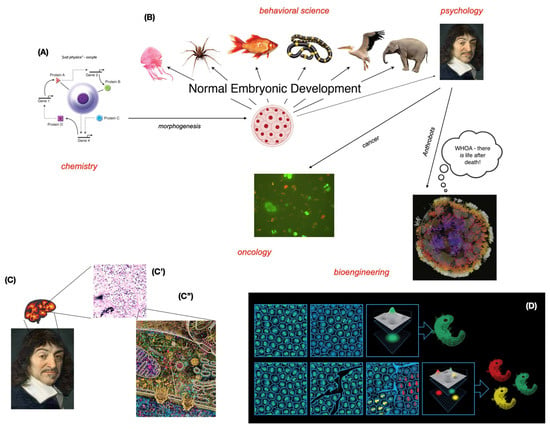
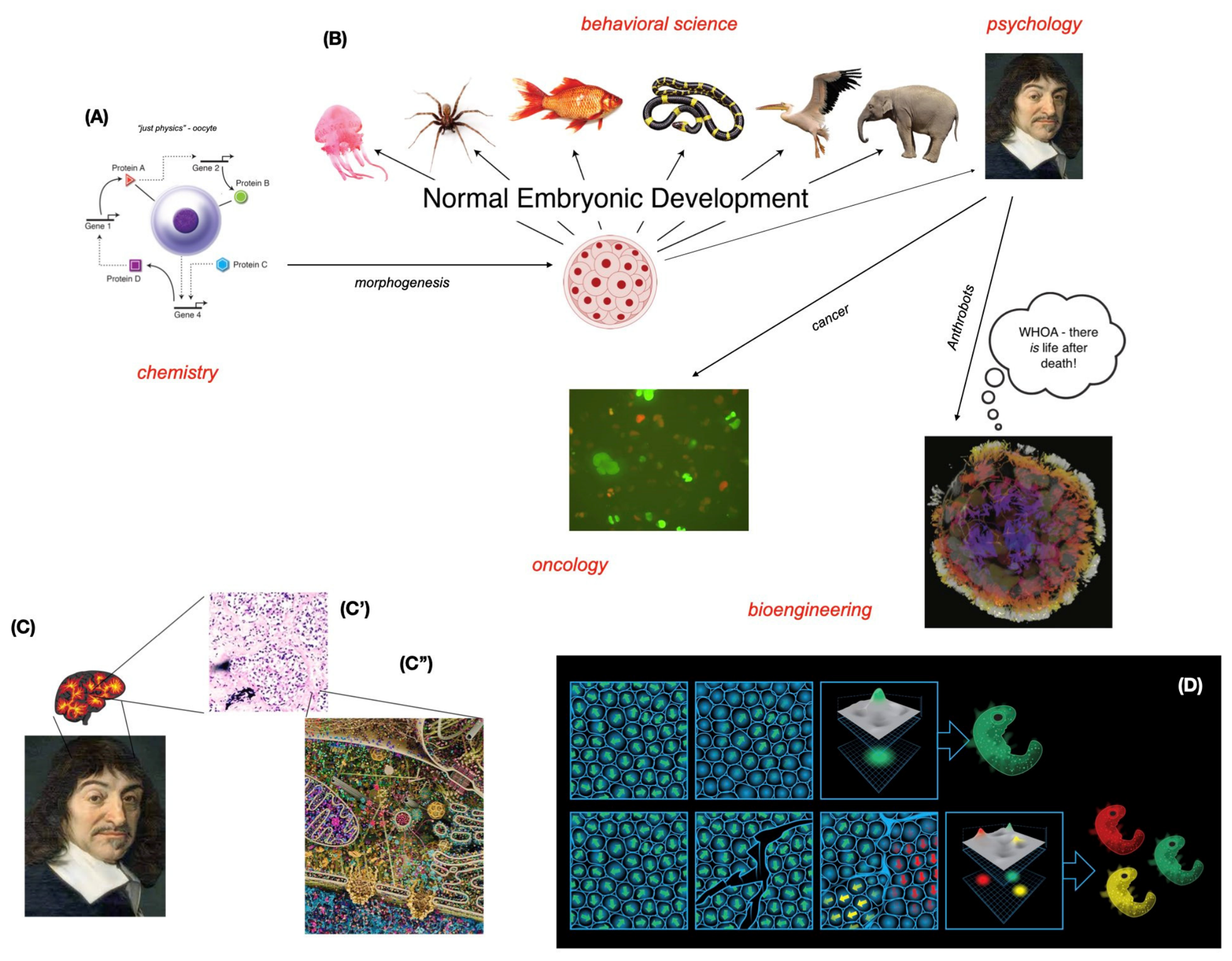
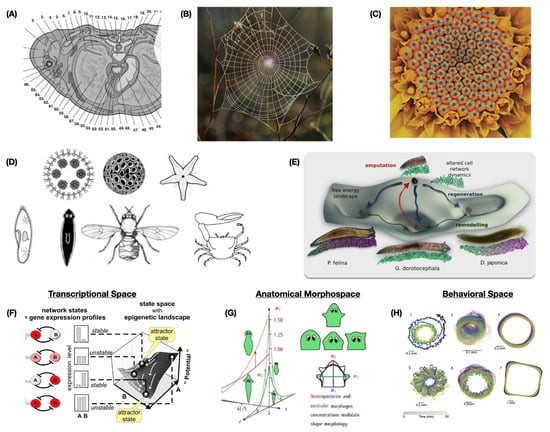
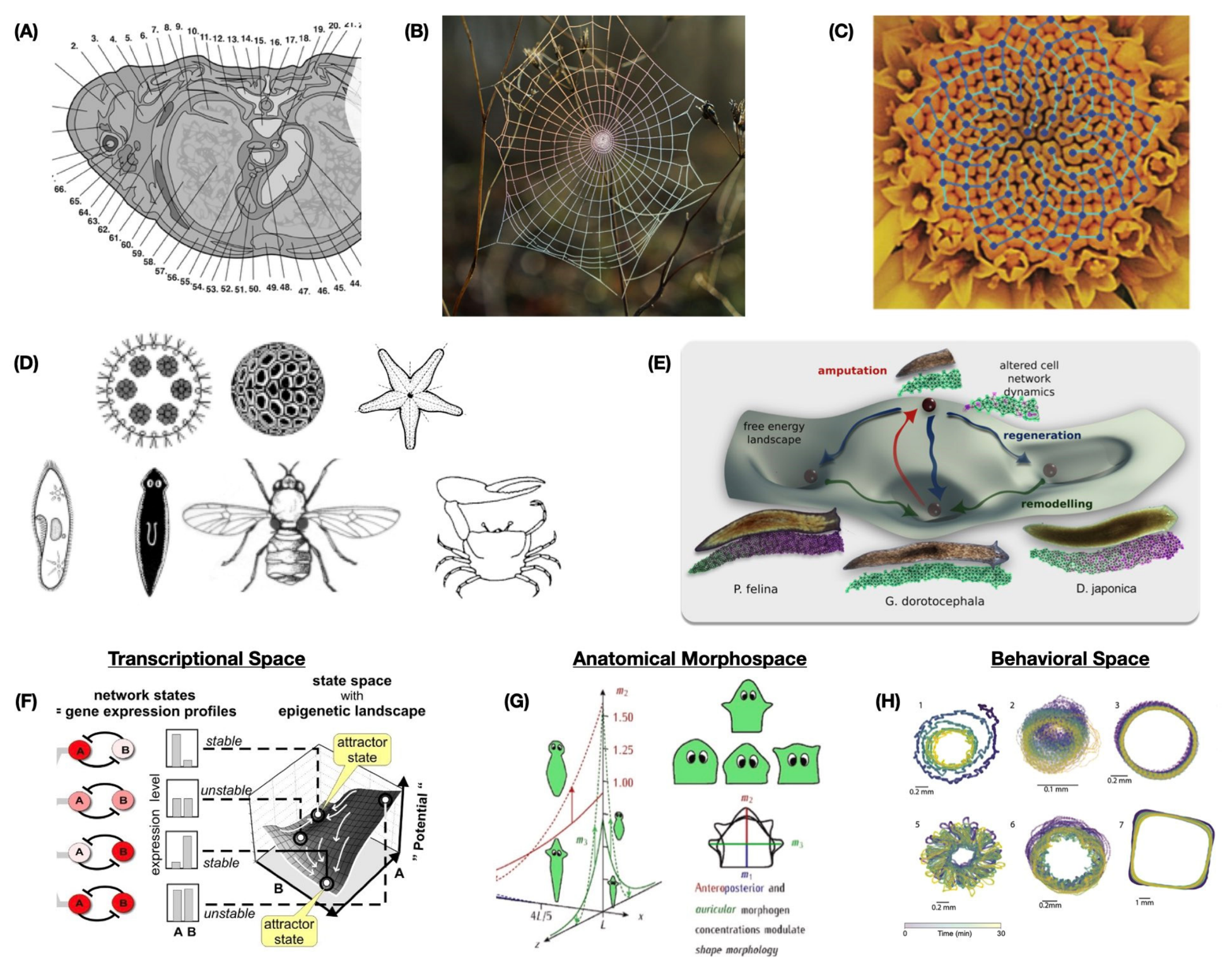
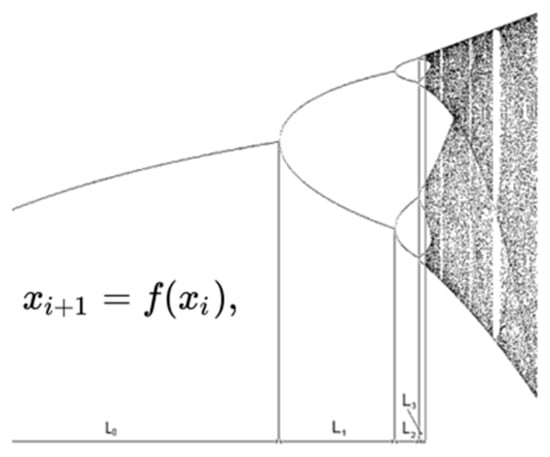
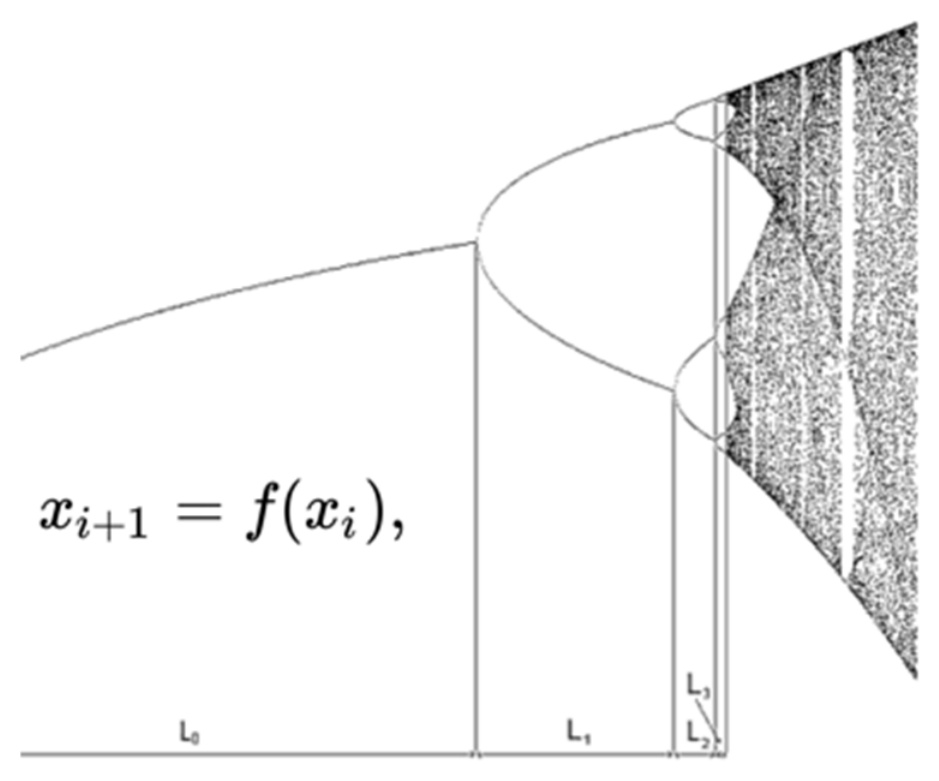
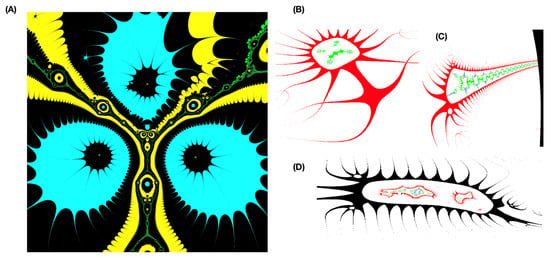
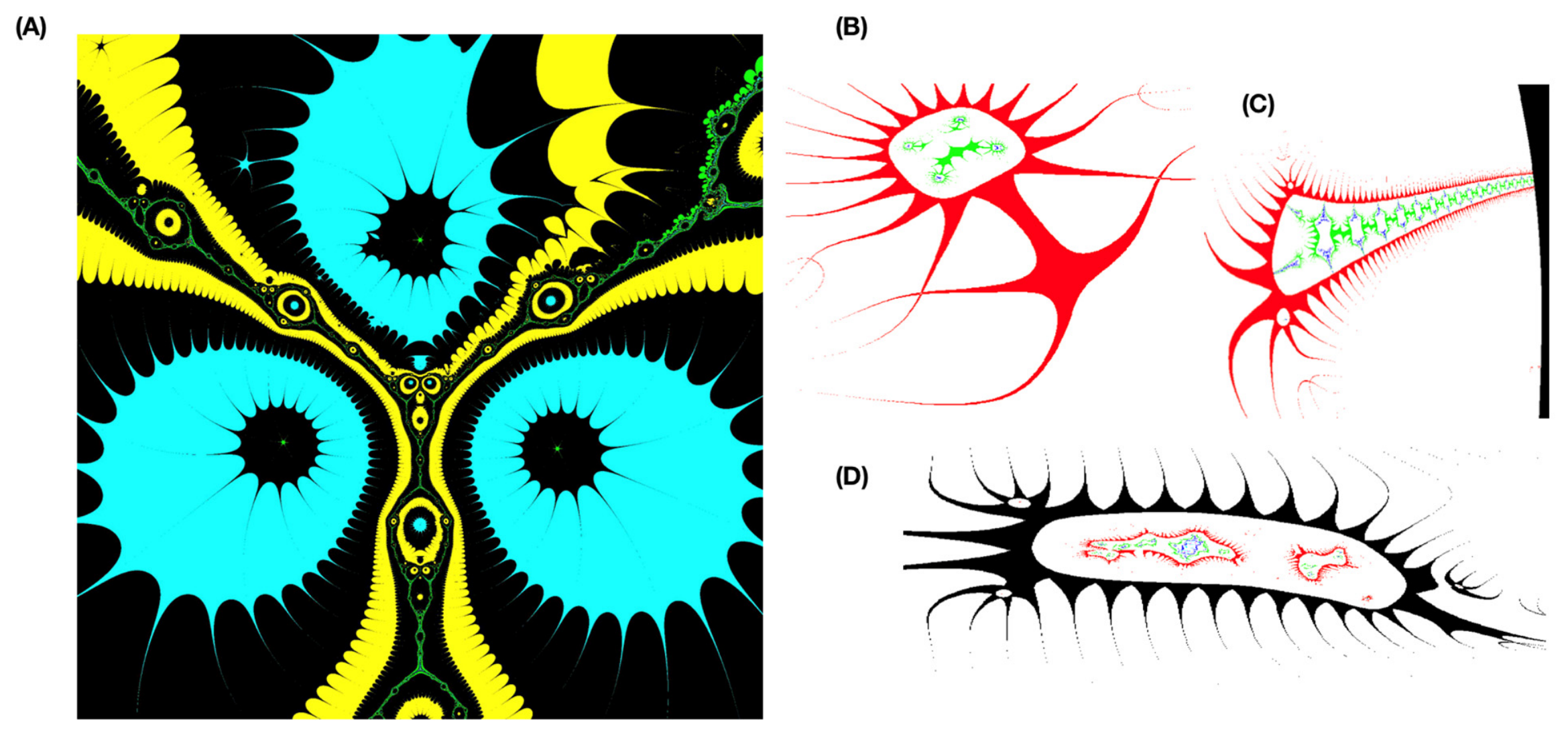
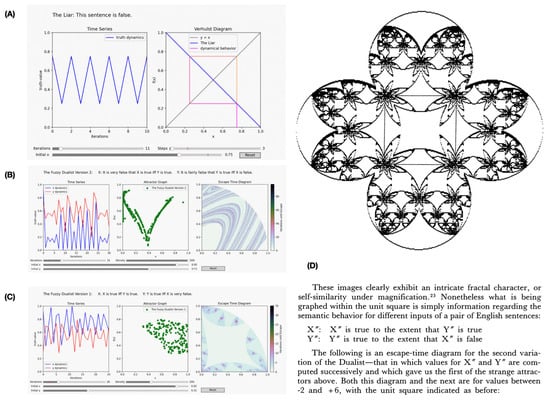
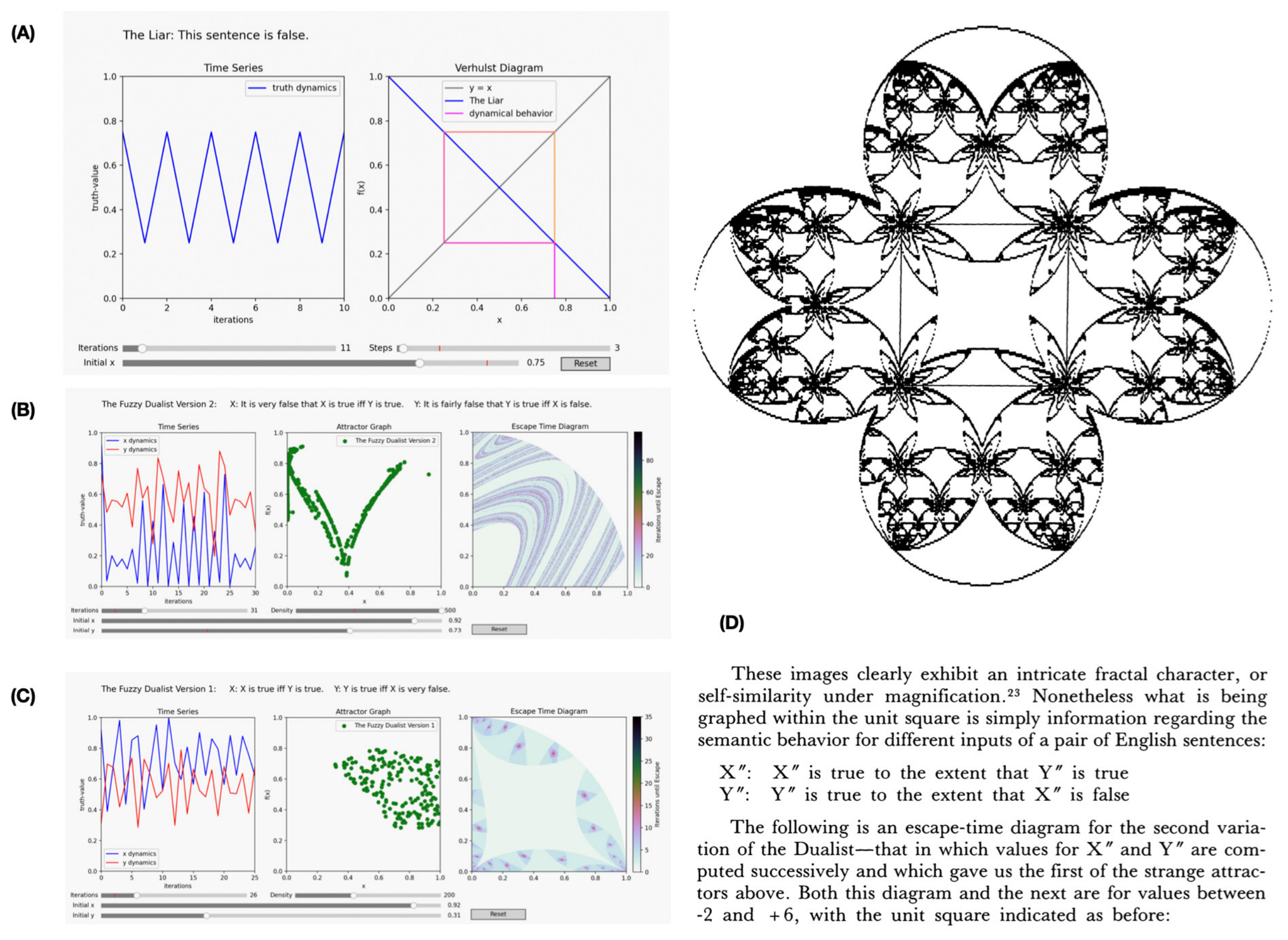
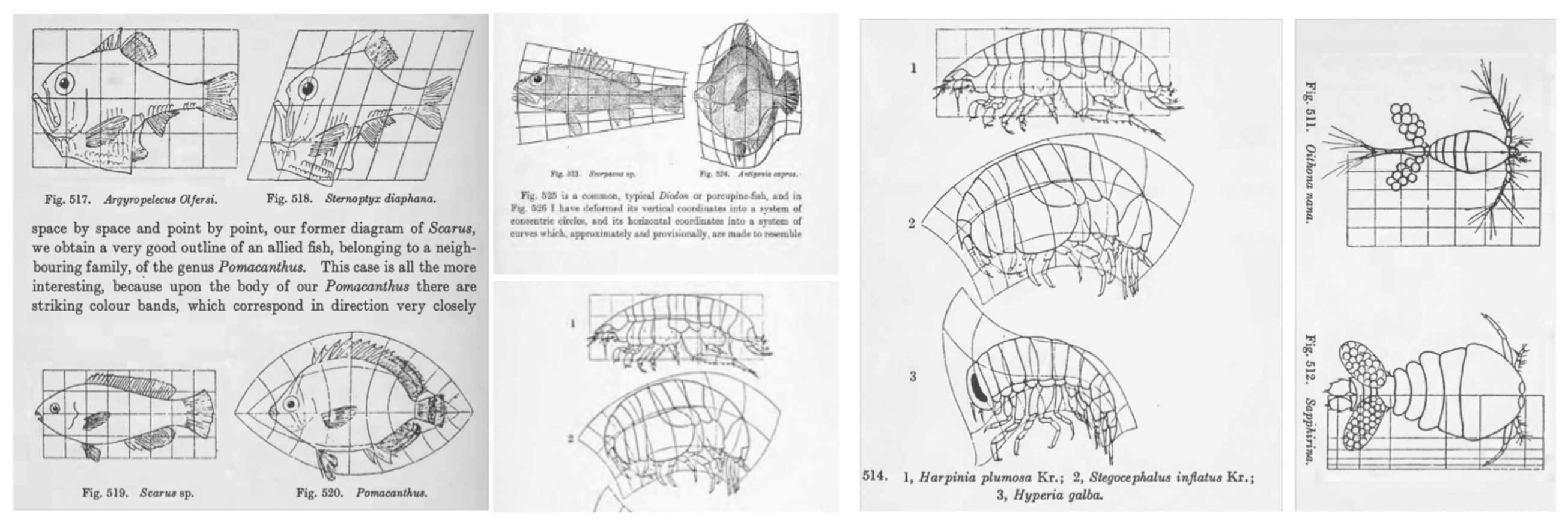
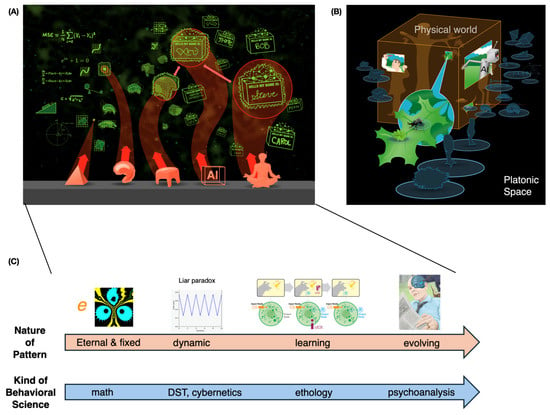
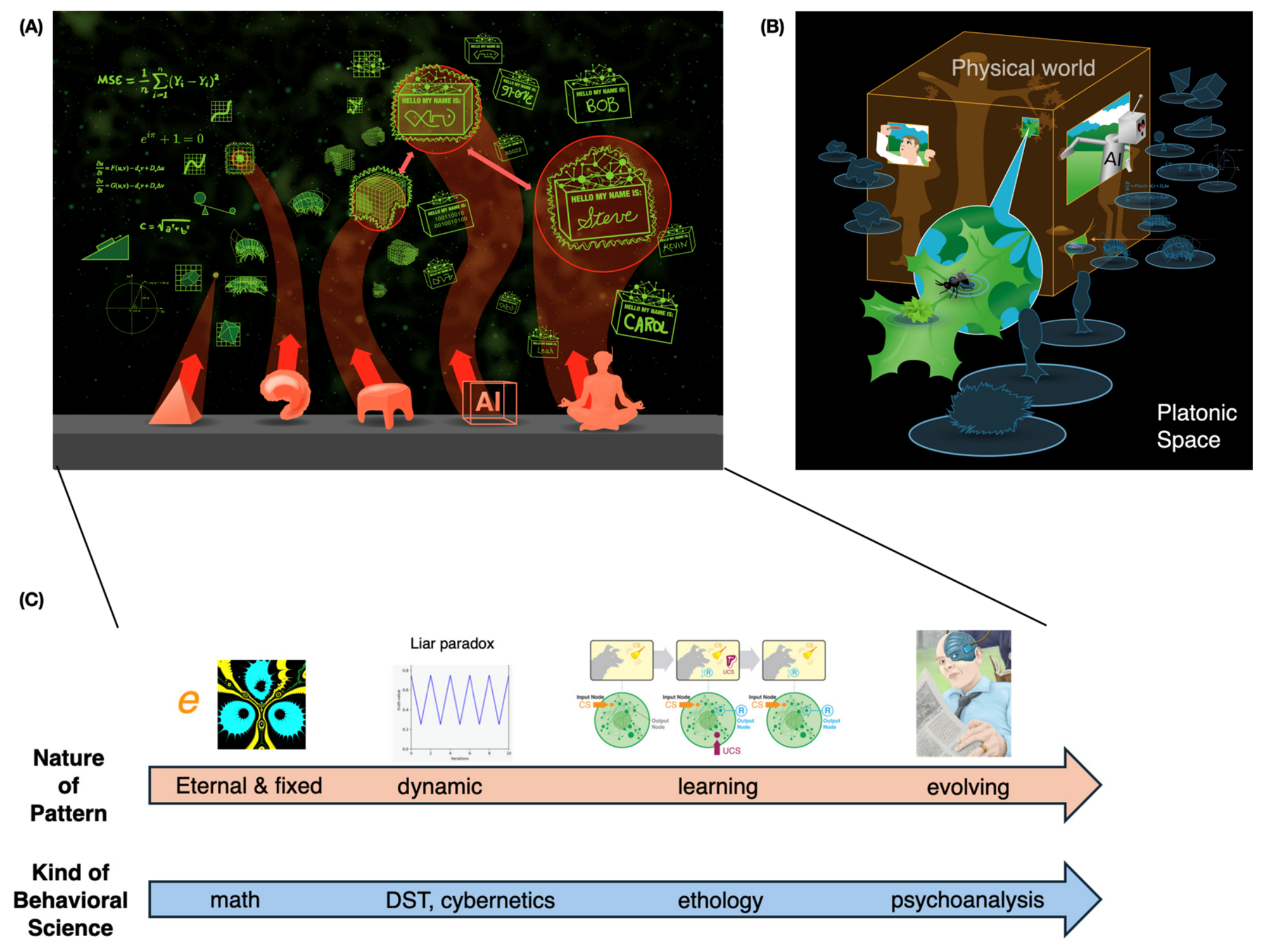
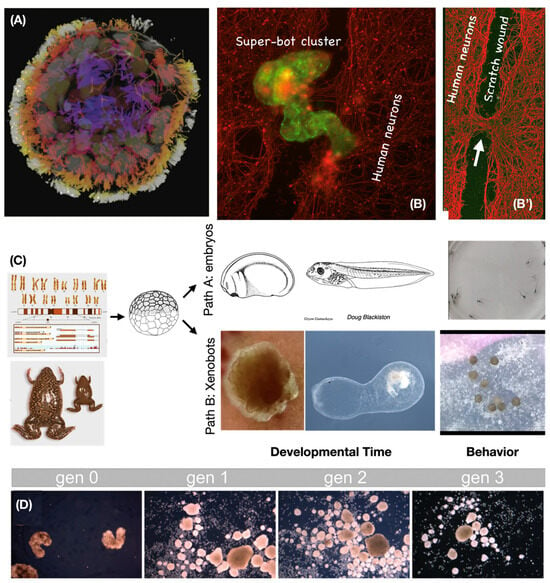
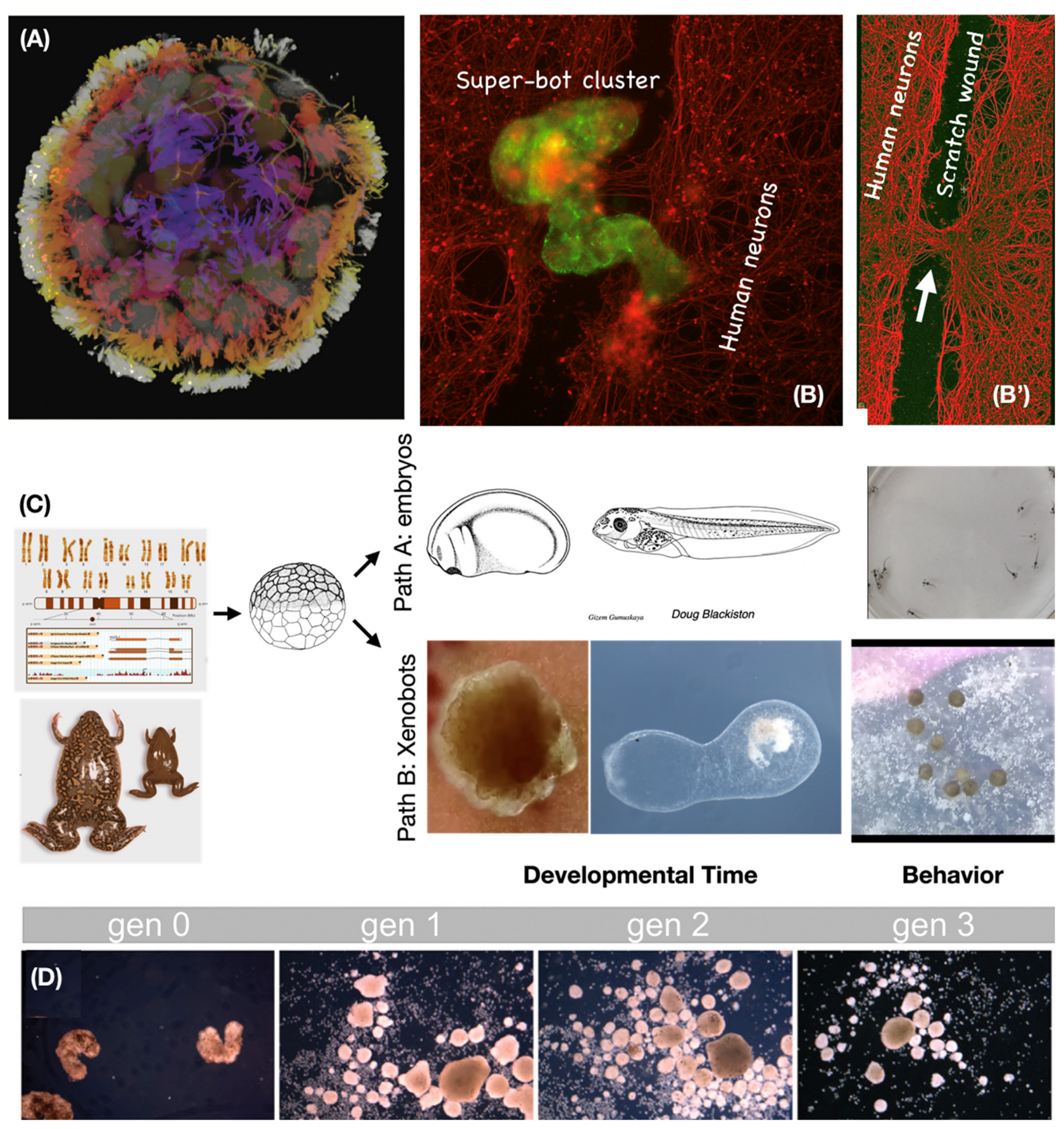
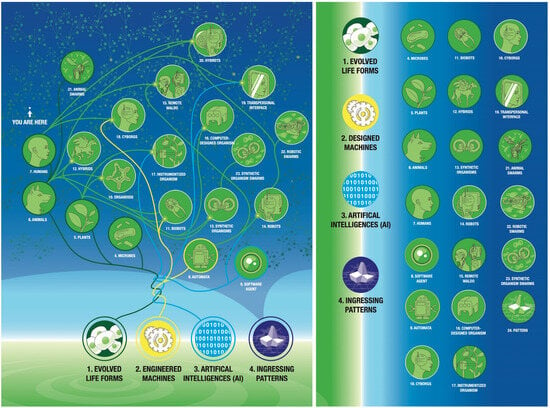
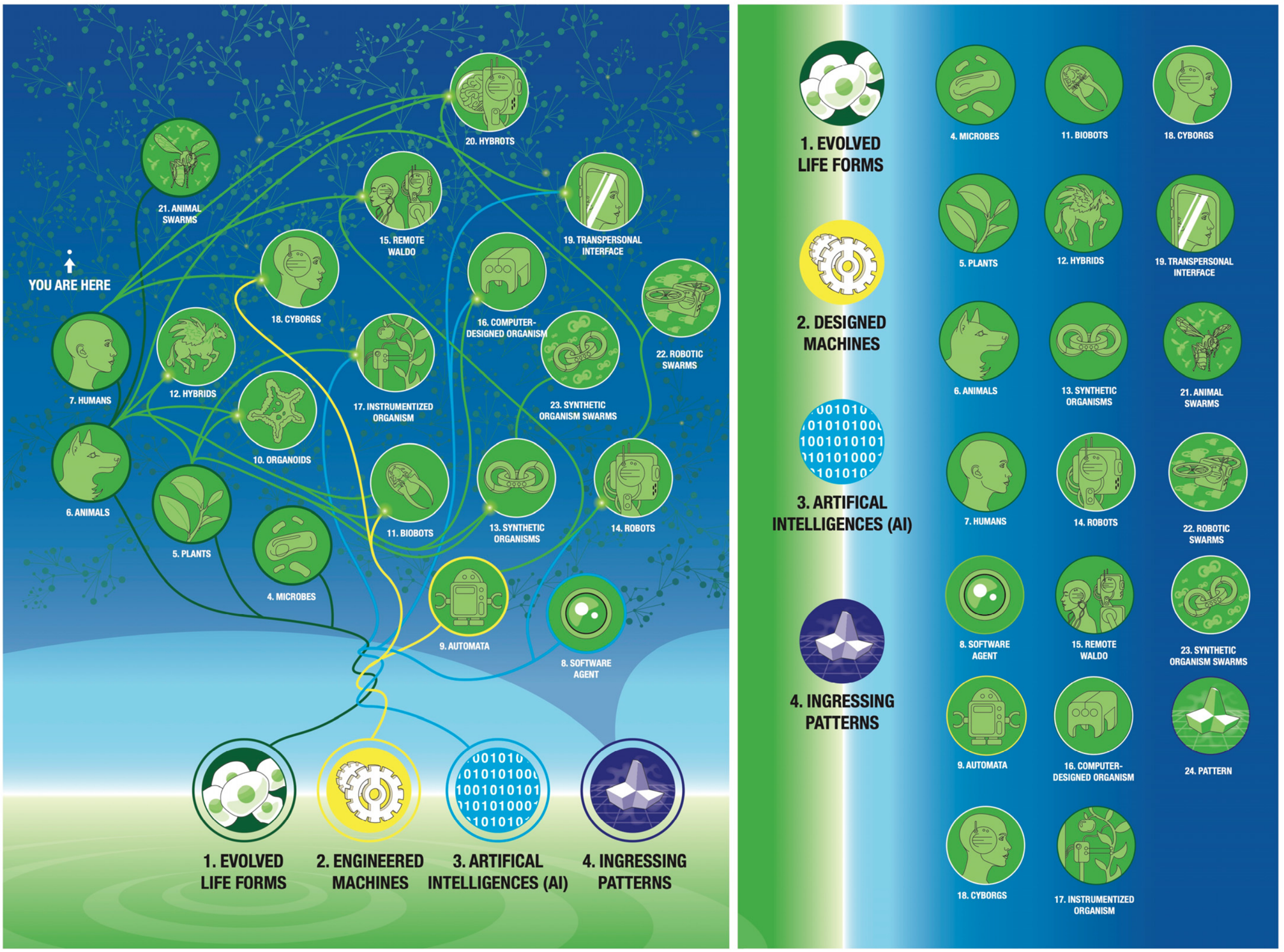
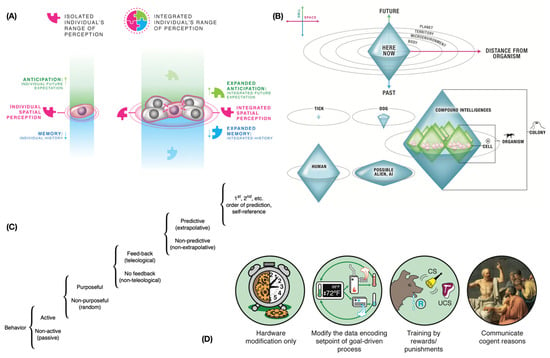
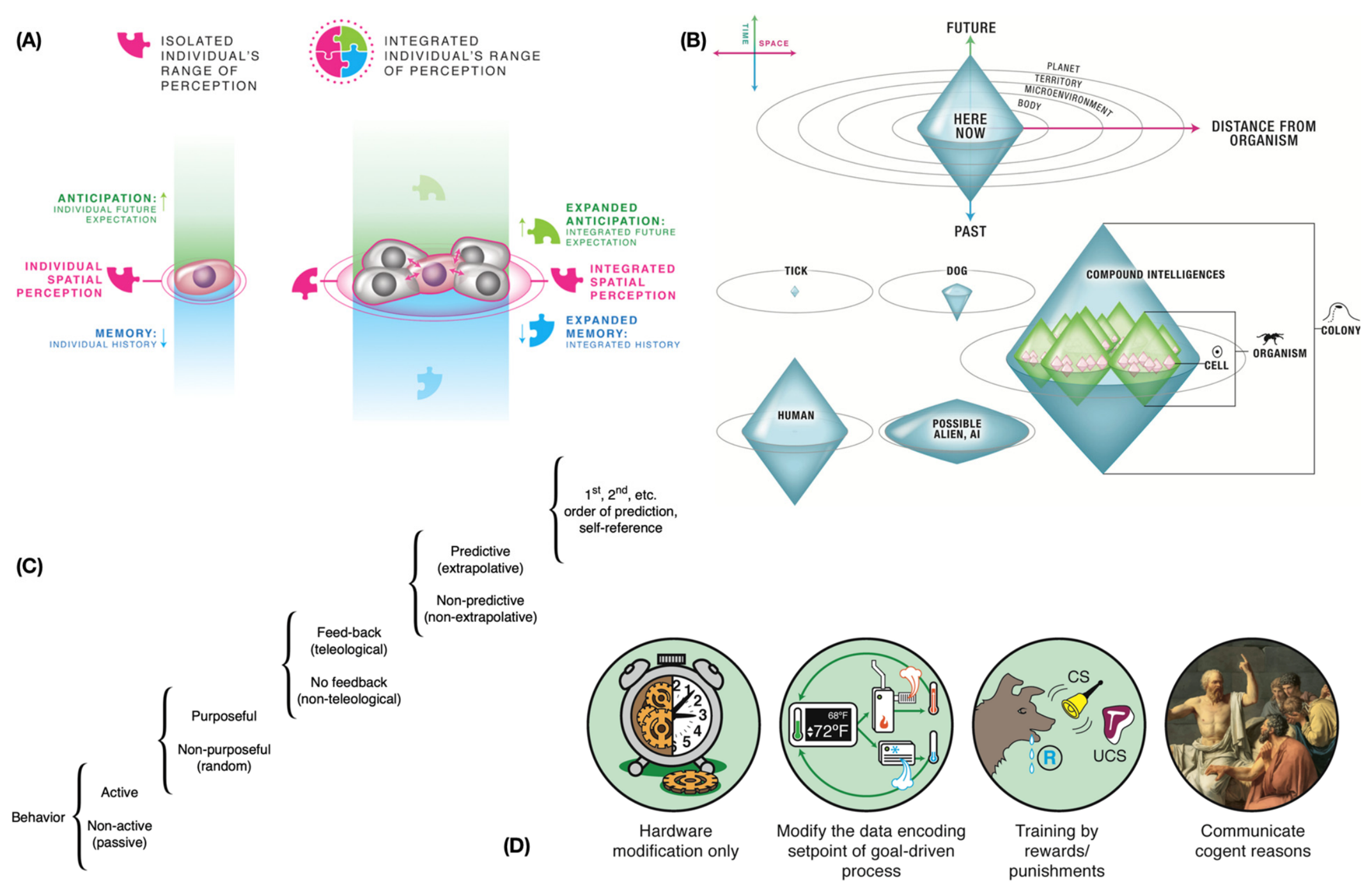
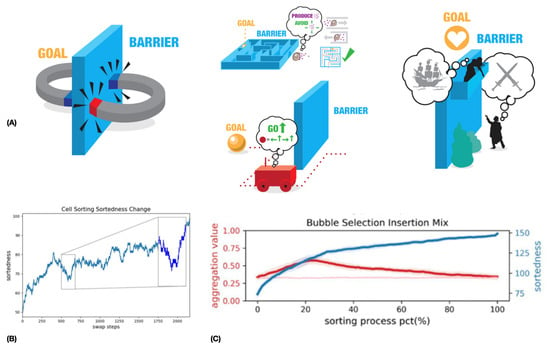
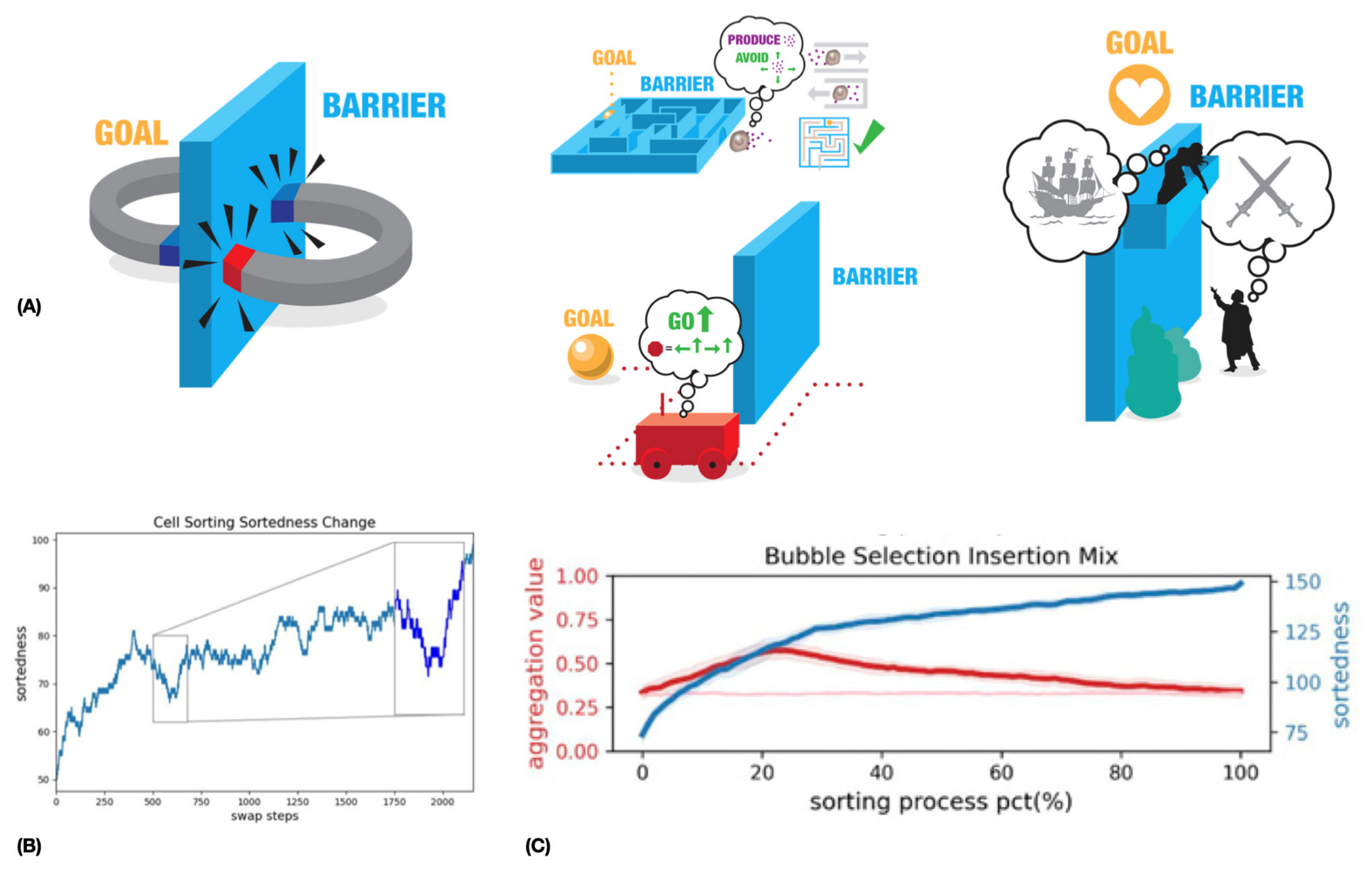

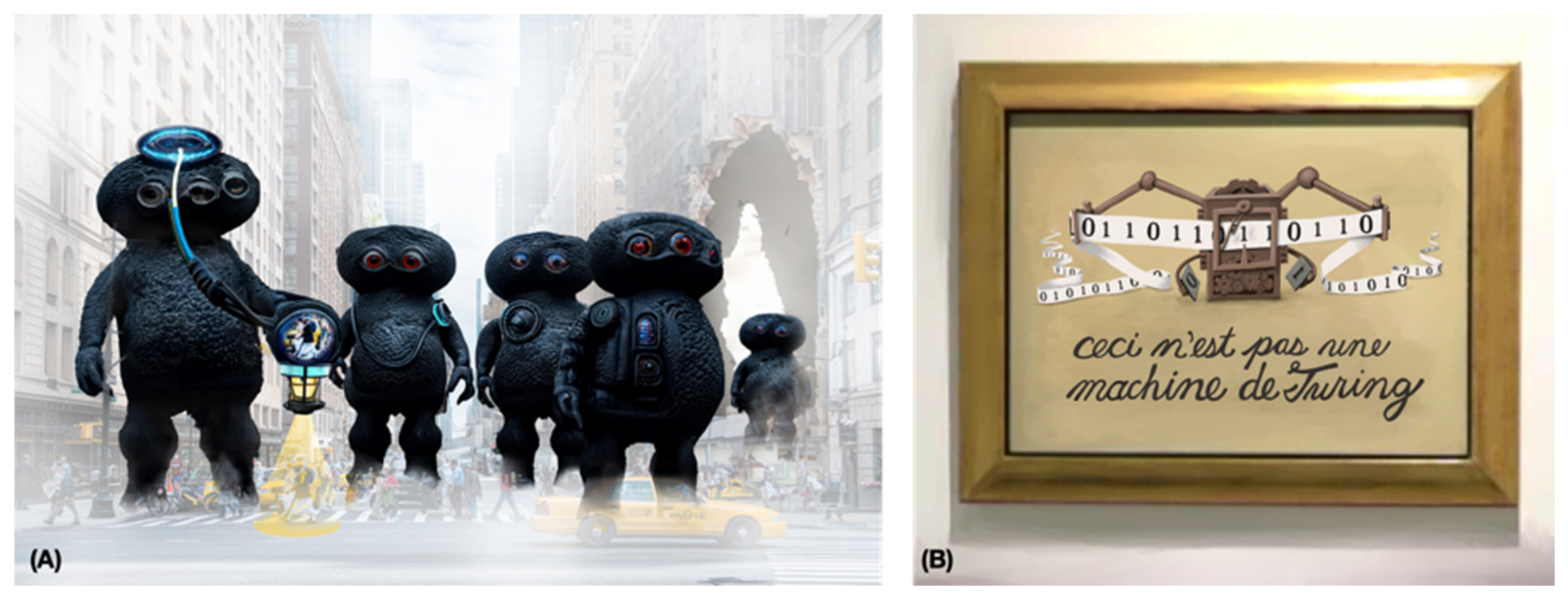
Disclaimer/Publisher’s Note: The statements, opinions and data contained in all publications are solely those of the individual author(s) and contributor(s) and not of MDPI and/or the editor(s). MDPI and/or the editor(s) disclaim responsibility for any injury to people or property resulting from any ideas, methods, instructions or products referred to in the content. |
© 2026 by the author. Licensee MDPI, Basel, Switzerland. This article is an open access article distributed under the terms and conditions of the Creative Commons Attribution (CC BY) license.