Skip Content
You are currently on the new version of our website. Access the old version .

Cryptography, Volume 7, Issue 3

2023 September - 13 articles

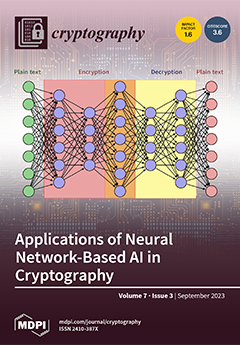
Cover Story: The rise of Artificial Intelligence, particularly Artificial Neural Networks (ANNs), which are enabled by a significant increase in computational power, opens up the exploration of their applications in cryptanalysis. Indeed, as excellent approximators for arbitrary non-linear functions and aggregators of latent information, ANNs have the potential to model and learn salient non-linear layers that are at the heart of symmetric encryption processes. This is equally true for asymmetric post-quantum encryption that is based on lattices, which resemble the architecture of ANNs. In this paper, we review four major algorithms, namely AES, RSA, LWE, and the ASCON family of authenticated encryption algorithms, and pinpoint encryption transformations that can benefit from ANNs to help improve their security parameters. View this paper
  • Issues are regarded as officially published after their release is announced to the table of contents alert mailing list .
  • You may sign up for email alerts to receive table of contents of newly released issues.
  • PDF is the official format for papers published in both, html and pdf forms. To view the papers in pdf format, click on the "PDF Full-text" link, and use the free Adobe Reader to open them.

Articles (13)

  • Article
  • Open Access
17 Citations
4,142 Views
20 Pages

A Novel and Secure Fake-Modulus Based Rabin-Ӡ Cryptosystem

  • Raghunandan Kemmannu Ramesh,
  • Radhakrishna Dodmane,
  • Surendra Shetty,
  • Ganesh Aithal,
  • Monalisa Sahu and
  • Aditya Kumar Sahu

Electronic commerce (E-commerce) transactions require secure communication to protect sensitive information such as credit card numbers, personal identification, and financial data from unauthorized access and fraud. Encryption using public key crypt...

  • Article
  • Open Access
4 Citations
3,744 Views
28 Pages

In this paper, we present new variants of Newton–Raphson-based protocols for the secure computation of the reciprocal and the (reciprocal) square root. The protocols rely on secure fixed-point arithmetic with arbitrary precision parameterized b...

  • Article
  • Open Access
2 Citations
4,784 Views
17 Pages

The internet of things (IoT) enables a hyperconnected society, offering intelligent services and convenience through various connections between people, objects, and services. However, the current state of the IoT still faces limitations in security....

  • Article
  • Open Access
4 Citations
5,932 Views
19 Pages

Matrix Encryption Walks for Lightweight Cryptography

  • Aeryn Dunmore,
  • Juliet Samandari and
  • Julian Jang-Jaccard

In this paper, we propose a new symmetric stream cipher encryption algorithm based on Graph Walks and 2-dimensional matrices, called Matrix Encryption Walks (MEW). We offer example Key Matrices and show the efficiency of the proposed method, which op...

  • Article
  • Open Access
113 Citations
33,260 Views
18 Pages

A Survey of Post-Quantum Cryptography: Start of a New Race

  • Duc-Thuan Dam,
  • Thai-Ha Tran,
  • Van-Phuc Hoang,
  • Cong-Kha Pham and
  • Trong-Thuc Hoang

Information security is a fundamental and urgent issue in the digital transformation era. Cryptographic techniques and digital signatures have been applied to protect and authenticate relevant information. However, with the advent of quantum computer...

  • Article
  • Open Access
28 Citations
19,296 Views
26 Pages

Applications of Neural Network-Based AI in Cryptography

  • Abderrahmane Nitaj and
  • Tajjeeddine Rachidi

Artificial intelligence (AI) is a modern technology that allows plenty of advantages in daily life, such as predicting weather, finding directions, classifying images and videos, even automatically generating code, text, and videos. Other essential t...

  • Article
  • Open Access
17 Citations
4,143 Views
18 Pages

Boosting Quantum Key Distribution via the End-to-End Loss Control

  • Aleksei D. Kodukhov,
  • Valeria A. Pastushenko,
  • Nikita S. Kirsanov,
  • Dmitry A. Kronberg,
  • Markus Pflitsch and
  • Valerii M. Vinokur

With the rise of quantum technologies, data security increasingly relies on quantum cryptography and its most notable application, quantum key distribution (QKD). Yet, current technological limitations, in particular, the unavailability of quantum re...

  • Article
  • Open Access
2 Citations
3,373 Views
16 Pages

A New RSA Variant Based on Elliptic Curves

  • Maher Boudabra and
  • Abderrahmane Nitaj

In this paper, we propose a new scheme based on ephemeral elliptic curves over a finite ring with an RSA modulus. The new scheme is a variant of both the RSA and the KMOV cryptosystems and can be used for both signature and encryption. We study the s...

  • Article
  • Open Access
1 Citations
3,855 Views
21 Pages

Cryptanalysis has been studied and gradually improved with the evolution of cryptosystems over past decades. Recently, deep learning (DL) has started to be used in cryptanalysis to attack digital cryptosystems. As computing power keeps growing, deplo...

  • Article
  • Open Access
6 Citations
3,889 Views
20 Pages

The development of Distributed Ledger Technology (DLT) is pushing toward automating decentralized data exchange processes. One of the key components of this evolutionary step is facilitating smart contracts that, in turn, come with several additional...

  • Article
  • Open Access
4 Citations
5,839 Views
16 Pages

This paper presents a new threshold signature scheme based on Damgaard’s work. The proposed scheme allows for changing the message signature threshold, thereby improving the flexibility of the original Damgaard scheme. This scheme can be applie...

Get Alerted

Add your email address to receive forthcoming issues of this journal.

XFacebookLinkedIn
Cryptography - ISSN 2410-387X