


Abstract
This paper presents the semi-analytical analysis of the fractional-order non-linear coupled system of Whitham-Broer-Kaup equations. An iterative process is designed to analyze analytical findings to the specified non-linear partial fractional derivatives scheme utilizing the Yang transformation coupled with the Adomian technique. The fractional derivative is considered in the sense of Caputo-Fabrizio. Two numerical problems show the suggested method. Moreover, the results of the suggested technique are compared with the solution of other well-known numerical techniques such as the Homotopy perturbation technique, Adomian decomposition technique, and the Variation iteration technique. Numerical simulation has been carried out to verify that the suggested methodologies are accurate and reliable, and the results are revealed using graphs and tables. Comparing the analytical and actual solutions demonstrates that the proposed approaches effectively solve complicated non-linear problems. Furthermore, the proposed methodologies control and manipulate the achieved numerical solutions in a vast acceptable region in an extreme manner. It will provide us with a simple process to control and adjust the convergence region of the series solution.
1. Introduction
Fractional calculus (FC) was invented by Newton, but it has recently piqued the interest of many academics. Fascinating breakthroughs in science and engineering applications have been found within the framework of FC over the last 30 years. Due to the complications involved with a heterogeneity issue, the notion of the fractional derivative has been industrialized. The behaviour of complex media with a diffusion mechanism may be captured using non-integer order differential operators [1,2,3,4]. It has proven a handy tool, and differential equations of any order may demonstrate various situations more efficiently and precisely. Numerous scholars began to work on calculus and its generalization to express their viewpoints while investigating many complicated events due to the rapid development of mathematical approaches using computer software [5,6,7,8].
Differential equations featuring non-linearities are used in science, technology, and engineering to explain a variety of phenomena, ranging from gravity to dynamical systems [9,10,11]. Non-linear partial differential equations (PDEs) are significant techniques for modeling non-linear dynamical events in a variety of domains, including mathematical biology, fluid mechanics, material science, and fluid dynamics, as shown in [12]. A sufficient set of partial differential equations can represent the bulk of dynamical systems. PDEs are also well-known for being utilized to solve mathematical difficulties like the Poincare and the Calabi conjectures.
It has already been demonstrated that the non-linear development of shallow-water waves may be represented using the technique of the Whitham-Broer-Kaup equation in fluid mechanics (WBKEs) [13]. Whitham, Broer, and Kaup [14,15,16] developed the integrated framework of the equations as mentioned earlier. The mentioned equations can be written as the shallow water acoustic waves with various diversity connections, as shown [17]. In the classical order, the governing equations for the phenomenon mentioned above are represented by
where indicates the horizontal velocity and height of the fluids, respectively, which differ greatly from the equilibrium, and are the constants that are composed of various diffusion powers. For the past few decades, investigating the results of non-linear PDEs has been a major focus of research. Several authors have devised numerous mathematical methods to examine approximate results of non-linear PDEs. Mohyud Din et al. [18] investigated the analysis of many integer order PDEs using homotopy perturbation techniques. To solve the coupled set of Burgers and Brusselator equations, Biazar and Aminikhah [19] used the perturbation technique. For the numerical result of many traditional order differential equations by applying other techniques, interested readers can refer to Refs. [20,21,22,23,24,25]. Numerous strategies have been used to study the solution to the given non-linear coupled scheme (1) of PDEs. To address the classical order coupled systems of the WBK problem, Mohyud-Din et al. [26] employed perturbation methods. As a result, researchers like Xie et al. 2002 (who studied the solution using the hyperbolic technique) have used several powerful and efficient methods to investigate the problem of the WBK coupled equation of classical order PDEs. In the same way, El-Sayed and Kaya used the Adomian decomposition approach to investigate the scheme (1). Moreover, Ahmad et al. [12] used the Adomian decomposition method and He’s polynomial to solve the coupled system (1).
Adomian proposed the Adomian decomposition method in 1980, which is a helpful technique for obtaining an explicit and numerical solution to a system of differential equations that represents a physical problem [27,28,29]. The Laplace transform technique is a vital technique in technology and applied mathematics. Combining the Adomian decomposition method and Yang transformation leads to a well-known technique named the Yang decomposition method. In this study, we convert differential equations to algebraic equations using the Laplace transform, and the non-linear terms are decomposed using Adomain polynomials. This numerical approach is effective for both deterministic and stochastic differential equation systems. It can be applied to a classical and fractional-order ordinary and a PDEs system, both linear and non-linear. There is no need for perturbation or liberalization in this procedure. Furthermore, unlike RK4, it does not require a pre-defined step size. In addition, this technique does not depend upon a parameter, as required for homotopy analysis and homotopy perturbation methods. However, the solutions achieved via this technique are the same as gained by the Adomian decomposition method (for detail, see [30,31,32,33]). It must be mentioned that the Yang decomposition method is more effective than the basic Adomian decomposition method.
2. Preliminaries Concepts
In this section, we provide the fundamental definitions that will be used throughout the article. For the purpose of simplification, we write the exponential decay kernel as, .
Definition 1.
If the Caputo-Fabrizio derivative is given as follows [34]:
is the normalization function with .
Definition 2.
The fractional integral Caputo-Fabrizio is given as [34]
Definition 3.
For , the following result shows the Caputo-Fabrizio derivative of Laplace transformation [34]:
Definition 4.
The Yang transformation of is expressed as [35]
Remark 1.
The Yang transformation of a few useful functions is defined as:
Lemma 1.
Let the Laplace transformation of is , then [36].
Proof.
From Equation (6), we can achieve another type of the Yang transformation by putting as
Since , this implies that
Put in (9), we have
Thus, from Equation (8), we achieve
Lemma 2.
Let be a continuous function; then, the Caputo-Fabrizio derivative Yang transformation of is defined by [36]
Proof.
The Caputo-Fabrizio fractional Laplace transformation is given by
In addition, we have that the connection among Laplace and Yang property, i.e., . To achieve the necessary result, we substitute v by in Equation (14), and get
The proof is completed. □
3. The Producer of YDM
In this portion, we discuses the YDM producer for fractional partial differential equations.
with initial condition
where is the Caputo fractional derivative of order ℘, , and , are the linear and non-linear functions, respectively, and , are the source functions.
Using the Yang transformation to Equation (16),
Using the Yang transformation differentiation property, we have
YDM describes the solution of infinite series and ,
Adomian polynomials of non-linear terms of and are represented as
The expression for Adomian polynomials is
The inverse Yang transformation is implemented on Equation (23),
Find the and using the initial conditions and sources functions. The following terms are expressed:
For
the general for , is given by
4. Numerical Results
Example 1.

Consider the fractional-order system of WBKEs [11]
with the initial conditions
The above equation is simplified
Using inverse Yang transform, we have
Assume that the and the infinite series solution functions as follows:
Remember that the Adomian polynomials are given as , and
With the aid of the Adomian polynomial, according to Equation (22), all forms of non-linear may be stated as
Therefore we can easily obtain
For
For
The remaining steps of the YDM outcomes may be conveniently gathered from and using the same methods. Then, we assess the sequence of possibilities as follows:
At integer order , the following series form of solution is achieved:
The exact solution of Equation (26) at ,
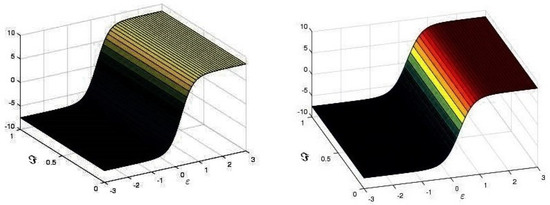
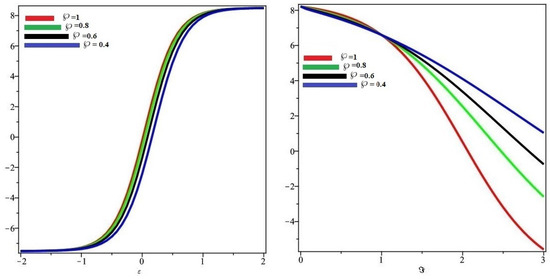
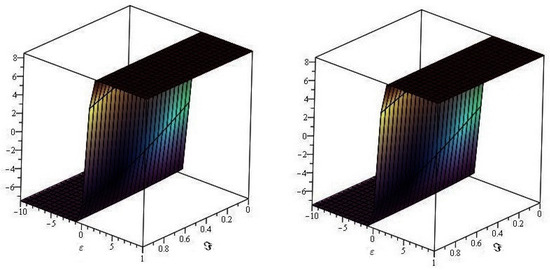
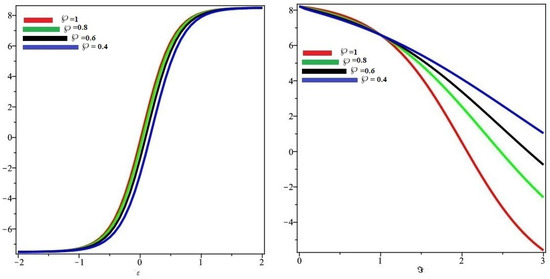
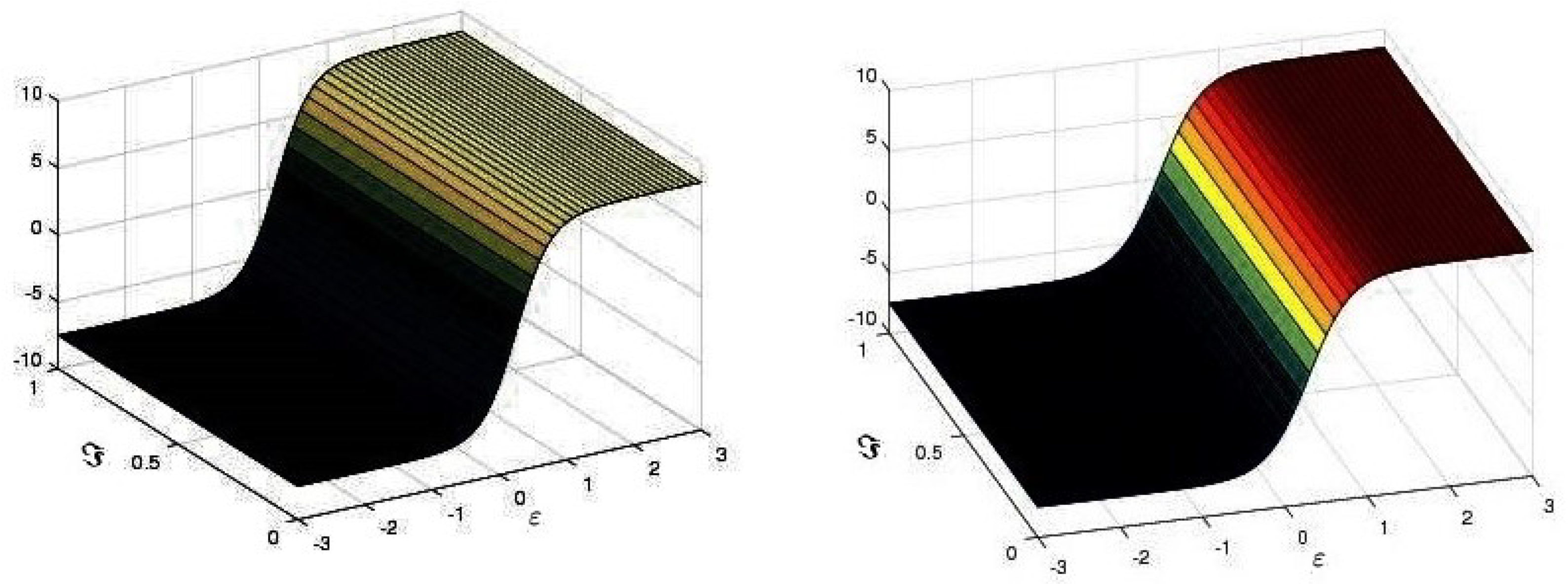
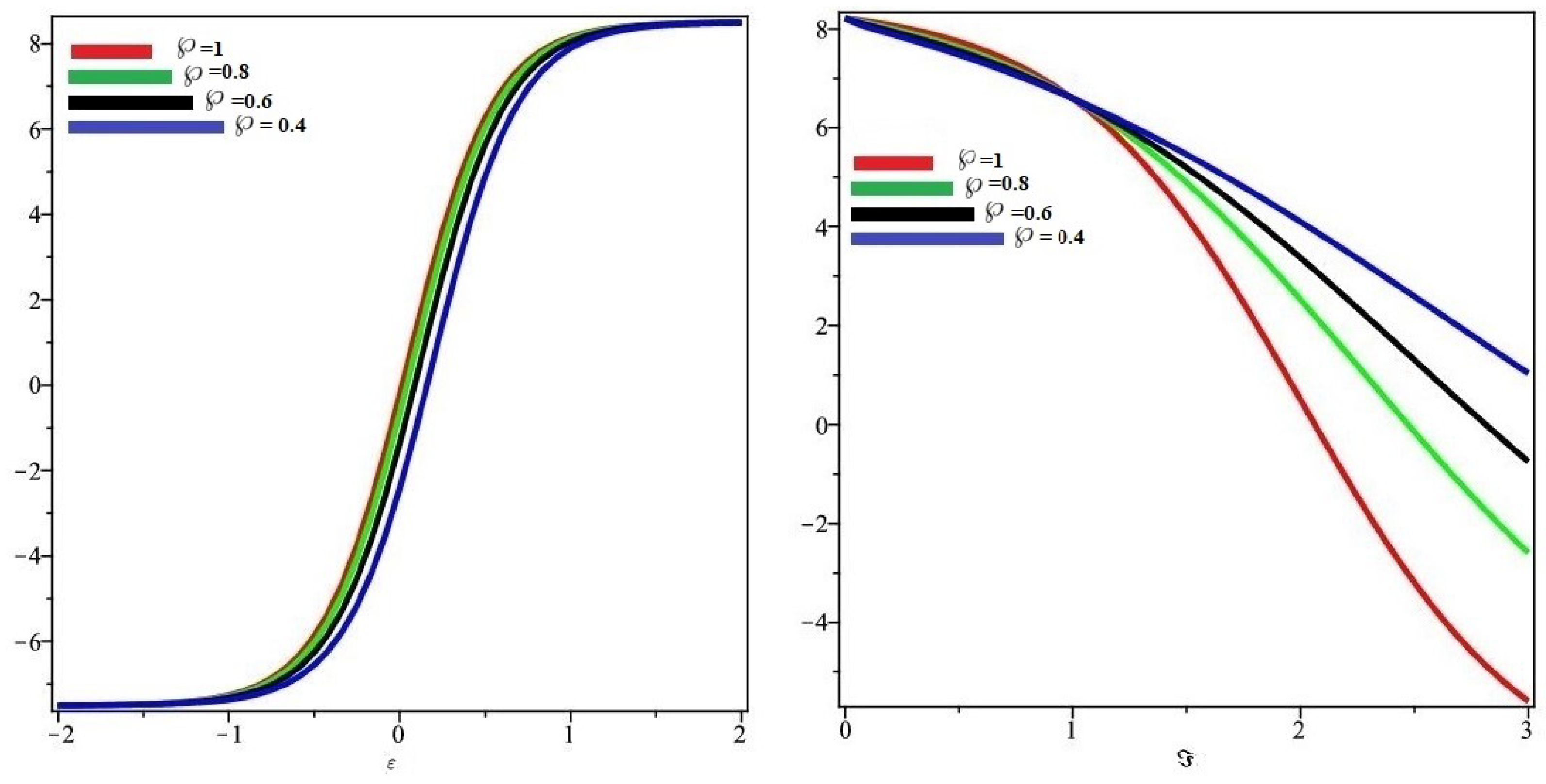
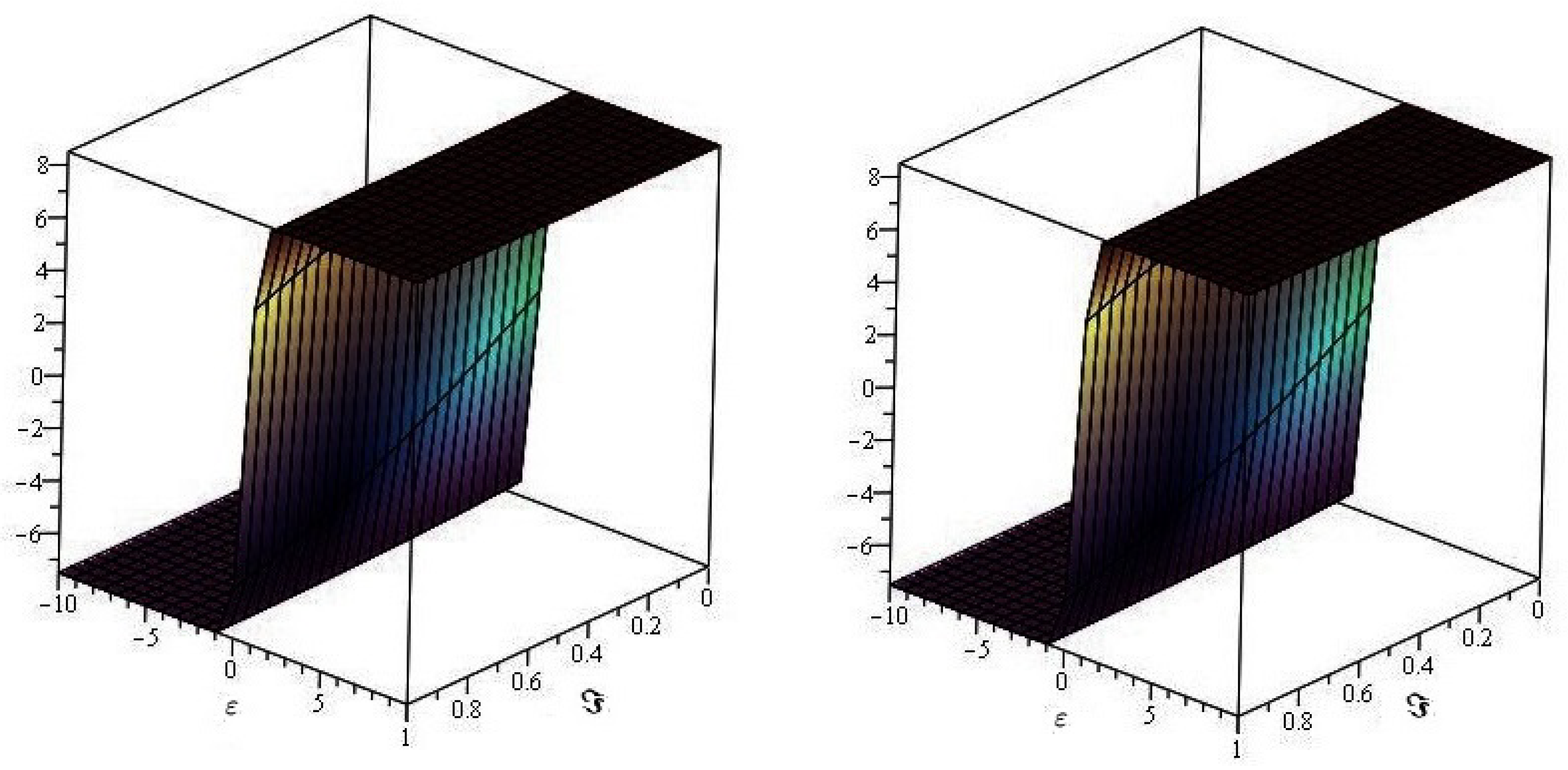
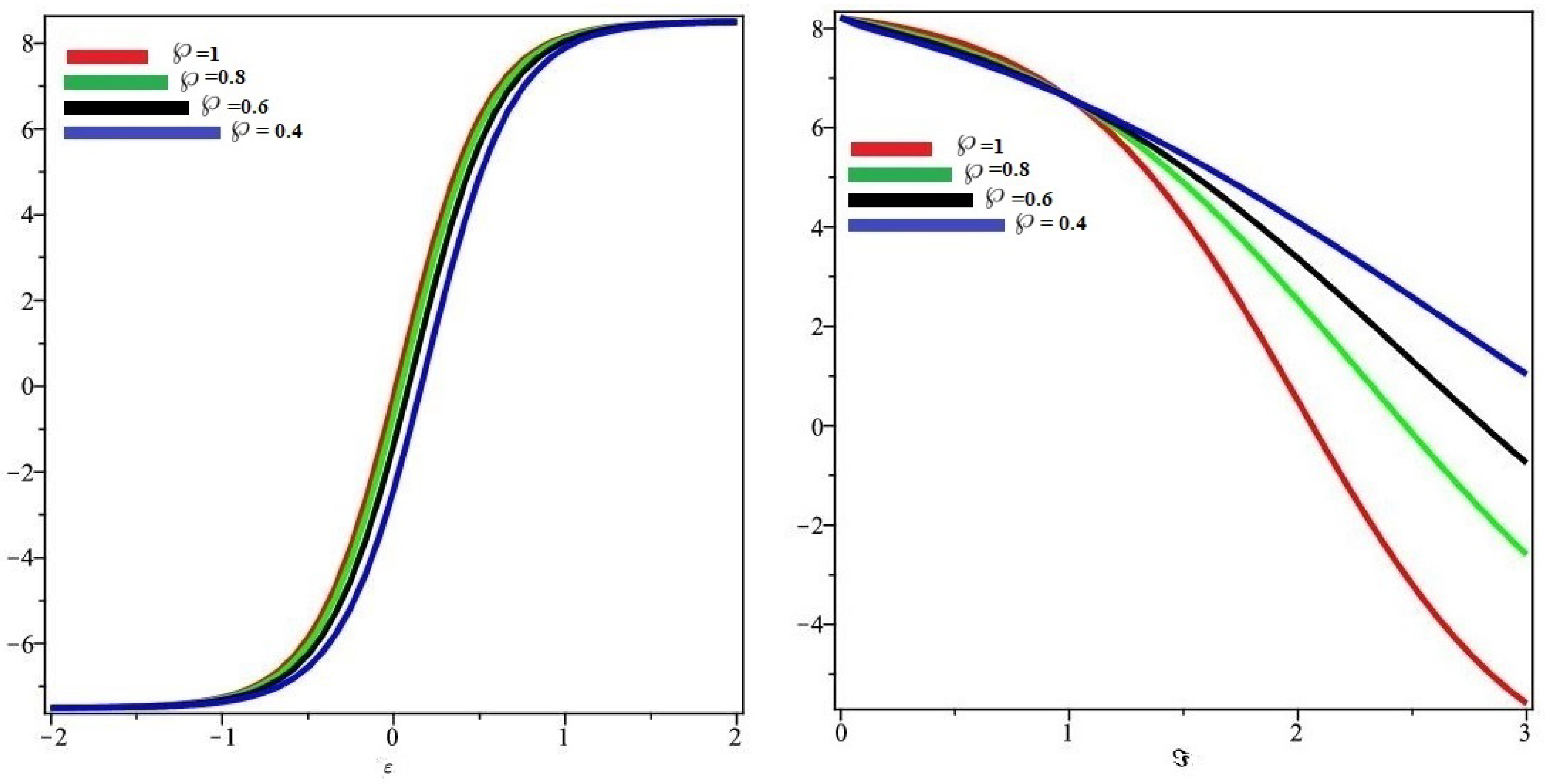
In Figure 1 and Figure 2, the actual and Yang decomposition method solutions at an integer-order are represented for both and of Example 1. It is observed that Yang decomposition method results are in good contact with the actual result of the models. In Figure 3 and Figure 4, various fractional-order solutions of Example 1, at different fractional-orders, are plotted. It is investigated that for Example 1, the fractional-order solutions are convergent to an integer-order solution for both and . In Table 1 and Table 2 show that yang decomposition method of different fractional order ℘ of Example 1. In Table 3 and Table 4 compassion of different analytical and numerical methods of Example 1.
Figure 1.
The actual and YDM solution of at of Example 1.
Figure 2.
The actual and YDM solution of at of Example 1.
Figure 3.
The fractional-order solutions of at ℘ of Example 1.
Figure 4.
The fractional-order solutions of at ℘ of Example 1.
Table 1.
YDM solution of at various fractional-order ℘ of Example 1.
Table 2.
YDM solution of at various fractional-order ℘ of Example 1.
Table 3.
Comparison of absolute error (AE) of at obtained by various methods.
Table 4.
Comparison of absolute error of at obtained by various methods.
Example 2.
Consider the fractional-order system of WBKEs [11]
with the initial conditions
The above equation is simplified
Using inverse Yang transform, we have
Assume that the infinite series solution functions and are as follows:
Remember that , and are the Adomian polynomials
With the aid of the Adomian polynomial according to Equation (22), all forms of non-linear may be stated as
Hence, one can easily obtain
For
For
The remaining steps of the YDM results may be conveniently gathered from and using the same procedure. The alternative series can then be assessed as follows:
We achieve the following series solution at integer order , , , defined by
The exact result of Equation (32) at and taking , and .
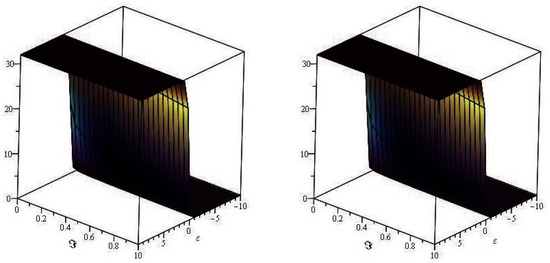
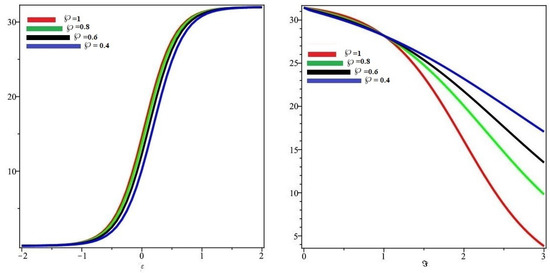
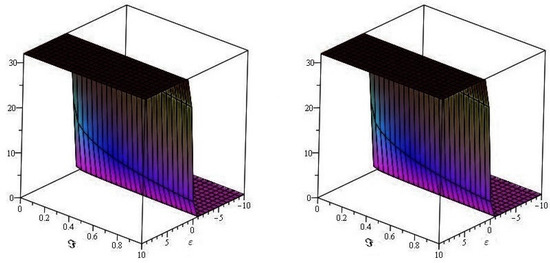
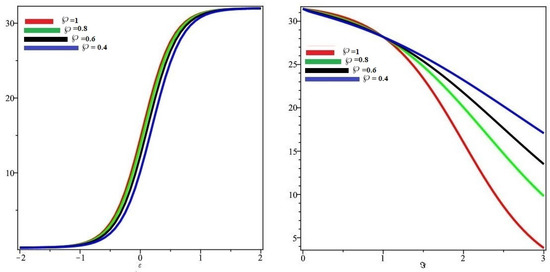
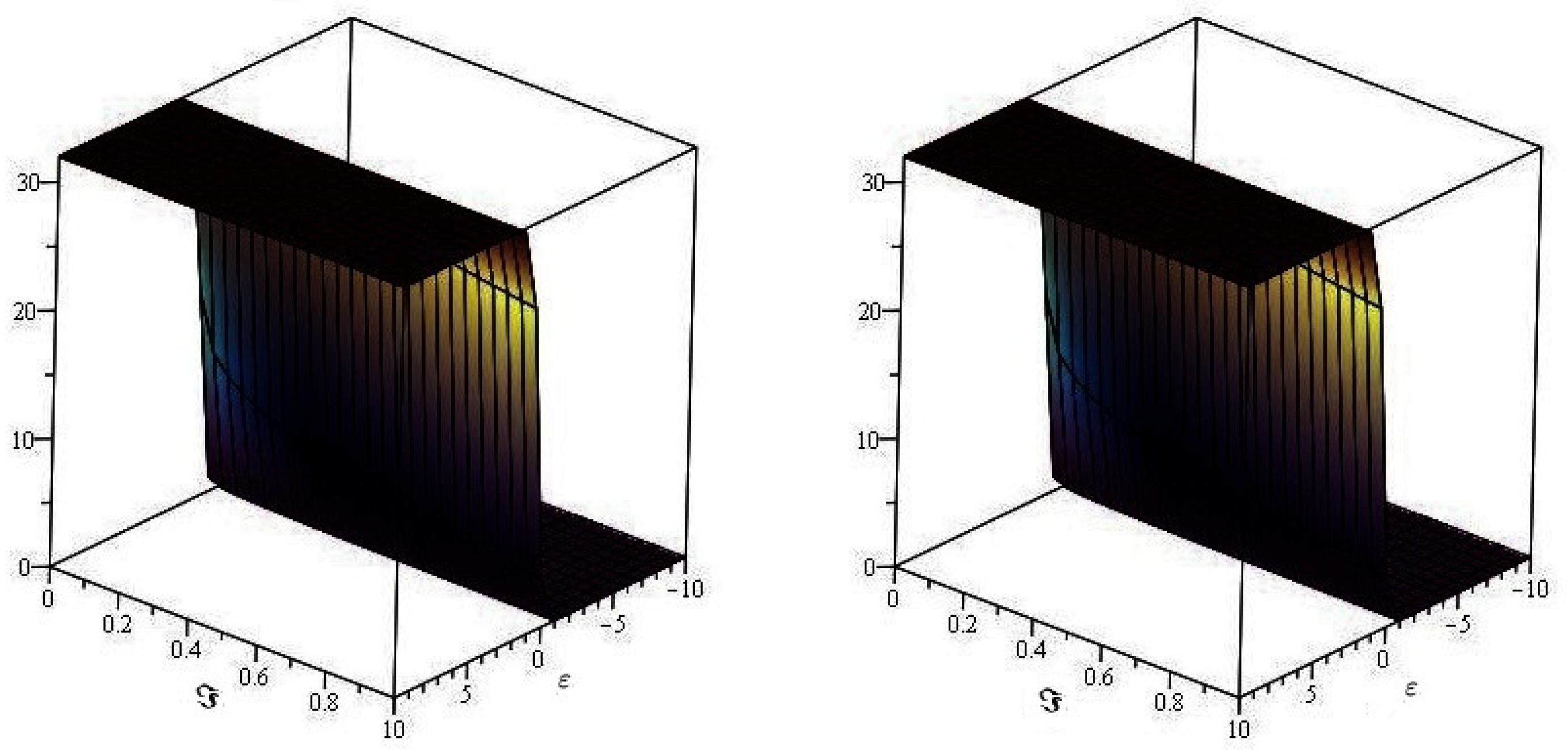
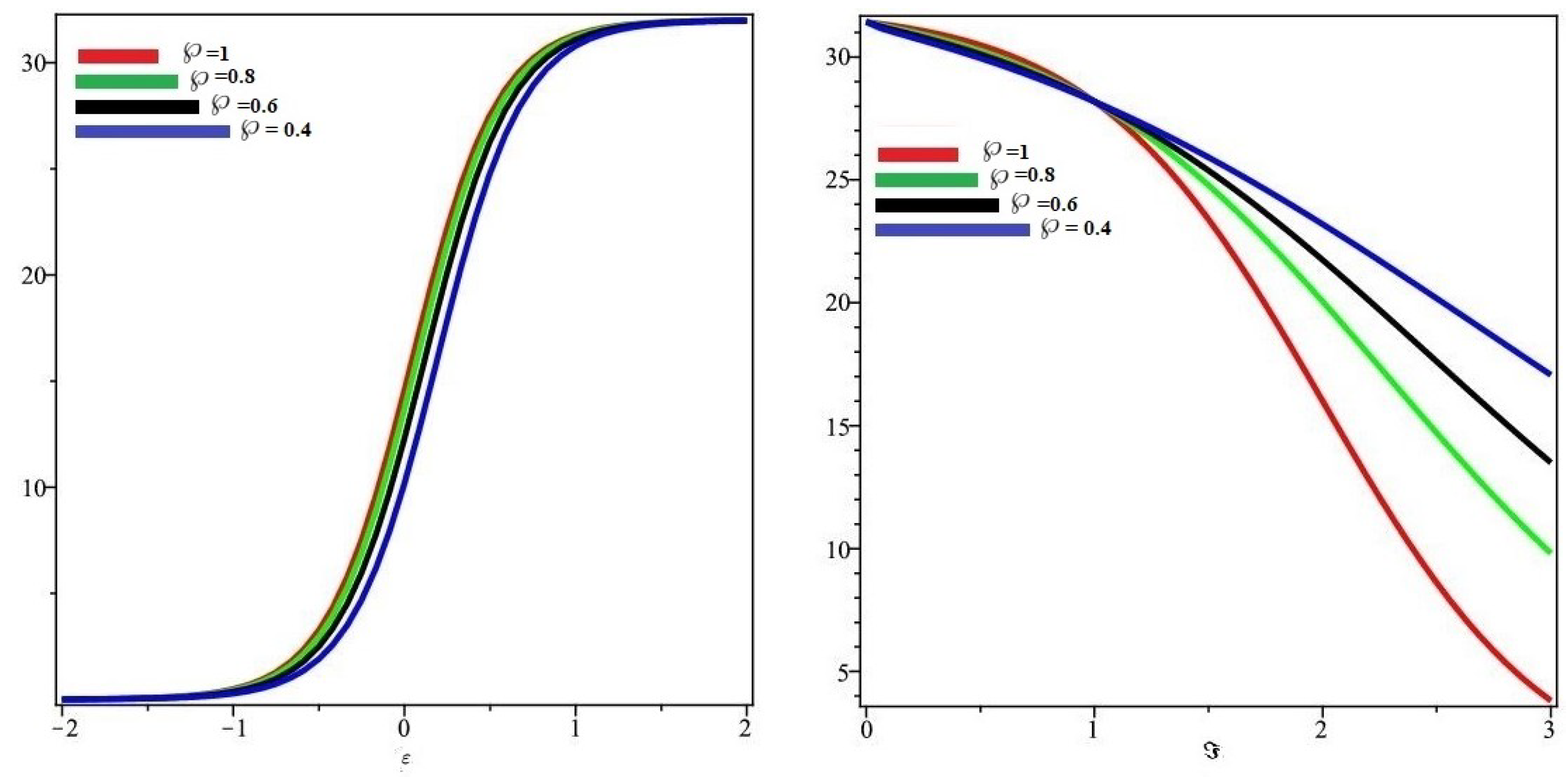
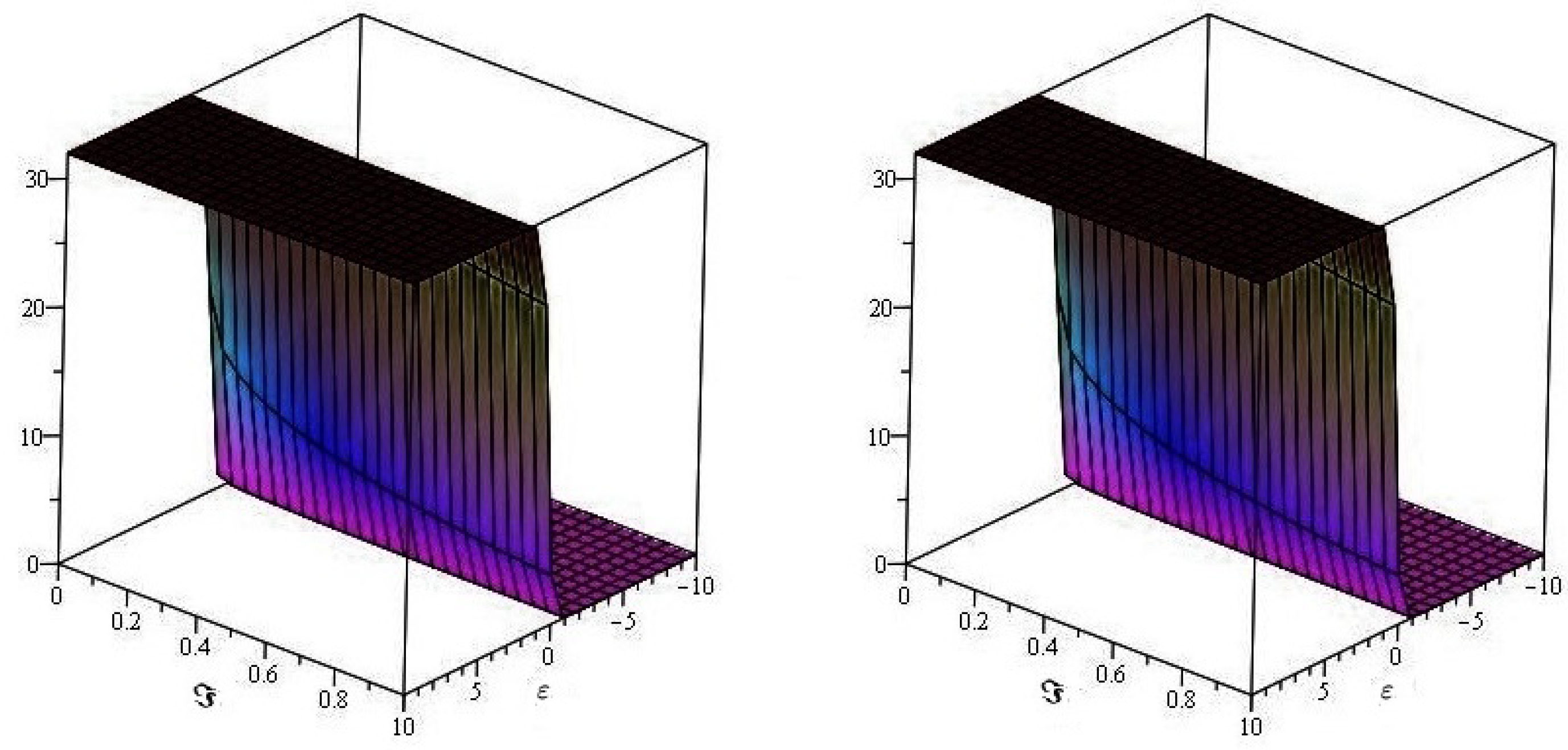
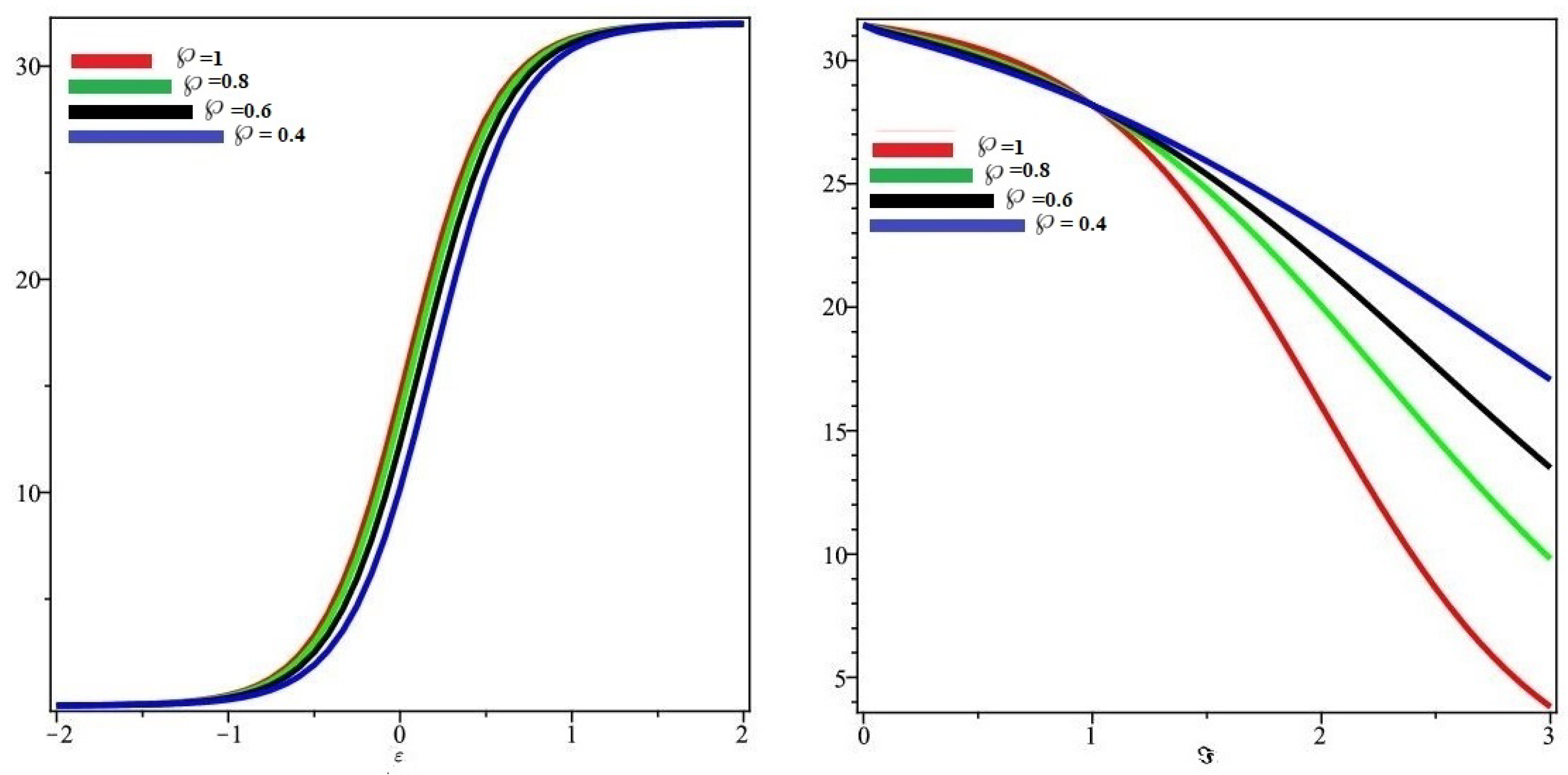
In Figure 5 and Figure 6, the actual and Yang decomposition method solutions at an integer-order are represented for both and of Example 1. It is observed that Yang decomposition method results are in good contact with the actual result of the models. In Figure 7 and Figure 8, various fractional-order solutions of Example 2, at different fractional-orders, are plotted. It is investigated that for Example 2, the fractional-order solutions are convergent to an integer-order solution for both and . In Table 5 and Table 6 show that yang decomposition method of different fractional order ℘ of Example 2.
Figure 5.
The actual and YDM solution of at of Example 2.
Figure 6.
The actual and YDM solution of at of Example 2.
Figure 7.
The fractional-order solutions of at ℘ of Example 2.
Figure 8.
The fractional-order solutions of at ℘ of Example 2.
Table 5.
YDM solution of at different fractional-order ℘ of Example 2.
Table 6.
YDM solution of at different fractional-order ℘ of Example 2.
5. Conclusions
This research applies the Yang decomposition method to a fractional-order non-linear Whitham-Broer-Kaup equations system. The suggested approach has been thoroughly researched for fractional-order systems of linear and non-linear differential equations. The numerical results show that the approach is accurate and effective in achieving numerical solutions for non-linear fractional partial differential equations. The proposed methodology is an effective and convenient tool for evaluating numerical solutions to non-linear coupled systems of fractional PDEs compared to previous analytical techniques. Furthermore, the proposed scheme is easy and intuitive, requiring less computing time to solve additional fractional-order partial differential equations.
Funding
This work is supported by the Deanship of Scientific Research, King Faisal University, Saudi Arabia (Nasher (third edition) Grant Number: NA000190).
Institutional Review Board Statement
Not applicable.
Informed Consent Statement
Not applicable.
Data Availability Statement
No data were used to support this study.
Acknowledgments
This work is supported by the Deanship of Scientific Research, King Faisal University, Saudi Arabia (Nasher (third edition) Grant Number: NA000190).
Conflicts of Interest
The author declare that I have no conflict of interest.
References
- Kavitha, K.; Vijayakumar, V.; Udhayakumar, R.; Sakthivel, N.; Sooppy Nisar, K. A note on approximate controllability of the Hilfer fractional neutral differential inclusions with infinite delay. Math. Methods Appl. Sci. 2021, 44, 4428–4447. [Google Scholar] [CrossRef]
- Shah, R.; Farooq, U.; Khan, H.; Baleanu, D.; Kumam, P.; Arif, M. Fractional View Analysis of Third Order Kortewege-De Vries Equations, Using a New Analytical Technique. Front. Phys. 2020, 7, 244. [Google Scholar] [CrossRef] [Green Version]
- Vijayakumar, V.; Nisar, K.S.; Chalishajar, D.; Shukla, A.; Malik, M.; Alsaadi, A.; Aldosary, S.F. A Note on Approximate Controllability of Fractional Semilinear Integrodifferential Control Systems via Resolvent Operators. Fractal Fract. 2022, 6, 73. [Google Scholar] [CrossRef]
- Shah, R.; Khan, H.; Farooq, U.; Baleanu, D.; Kumam, P.; Arif, M. A New Analytical Technique to Solve System of Fractional-Order Partial Differential Equations. IEEE Access 2019, 7, 150037–150050. [Google Scholar] [CrossRef]
- Hammouch, Z.; Mekkaoui, T.; Agarwal, P. Optical solitons for the Calogero-Bogoyavlenskii-Schiff equation in (2 + 1) dimensions with time-fractional conformable derivative. Eur. Phys. J. Plus 2018, 133, 248. [Google Scholar] [CrossRef]
- Shah, R.; Khan, H.; Baleanu, D.; Kumam, P.; Arif, M. The analytical investigation of time-fractional multi-dimensional Navier–Stokes equation. Alex. Eng. J. 2020, 59, 2941–2956. [Google Scholar] [CrossRef]
- Ruzhansky, M.; Cho, Y.J.; Agarwal, P.; Area, I. (Eds.) Advances in Real and Complex Analysis with Applications; Springer: Singapore, 2017. [Google Scholar]
- Alesemi, M.; Iqbal, N.; Botmart, T. Novel Analysis of the Fractional-Order System of Non-Linear Partial Differential Equations with the Exponential-Decay Kernel. Mathematics 2022, 10, 615. [Google Scholar] [CrossRef]
- Xie, F.; Yan, Z.; Zhang, H. Explicit and exact traveling wave solutions of Whitham-Broer-Kaup shallow water equations. Phys. Lett. A 2001, 285, 76–80. [Google Scholar] [CrossRef]
- Wang, L.; Chen, X. Approximate analytical solutions of time fractional Whitham-Broer-Kaup equations by a residual power series method. Entropy 2015, 17, 6519–6533. [Google Scholar] [CrossRef] [Green Version]
- Ali, A.; Shah, K.; Khan, R.A. Numerical treatment for traveling wave solutions of fractional Whitham-Broer-Kaup equations. Alex. Eng. J. 2018, 57, 1991–1998. [Google Scholar] [CrossRef]
- Ahmad, J.; Mushtaq, M.; Sajjad, N. Exact Solution of Whitham Broer-Kaup Shallow Water Wave Equations. J. Sci. Arts 2015, 15, 5. [Google Scholar]
- Kupershmidt, B. Mathematics of dispersive water waves. Commun. Math. Phys. 1985, 99, 51–73. [Google Scholar] [CrossRef]
- Whitham, G.B. Variational methods and applications to water waves. Proceedings of the Royal Society of London. Ser. A Math. Phys. Sci. 1967, 299, 6–25. [Google Scholar]
- Broer, L.J.F. Approximate equations for long water waves. Appl. Sci. Res. 1975, 31, 377–395. [Google Scholar] [CrossRef]
- Kaup, D. A higher-order water-wave equation and the method for solving it. Prog. Theor. Phys. 1975, 54, 396–408. [Google Scholar] [CrossRef]
- Rashidi, M.M.; Ganji, D.D.; Dinarvand, S. Approximate traveling wave solutions of coupled Whitham-Broer-Kaup shallow water equations by homotopy analysis method. Differ. Equ. Nonlinear Mech. 2008, 2008, 243459. [Google Scholar] [CrossRef] [Green Version]
- Mohyud-Din, S.T.; Noor, M.A. Homotopy perturbation method for solving partial differential equations. Z. Fur Nat. A 2009, 64, 157–170. [Google Scholar] [CrossRef]
- Biazar, J.; Aminikhah, H. Study of convergence of homotopy perturbation method for systems of partial differential equations. Comput. Math. Appl. 2009, 58, 2221–2230. [Google Scholar]
- Yuzbasi, S.; Sahin, N. Numerical solutions of singularly perturbed one-dimensional parabolic convection-diffusion problems by the Bessel collocation method. Appl. Math. Comput. 2013, 220, 305–315. [Google Scholar]
- Shah, R.; Khan, H.; Baleanu, D. Fractional Whitham-Broer-Kaup equations within modified analytical approaches. Axioms 2019, 8, 125. [Google Scholar] [CrossRef] [Green Version]
- Ali, I.; Khan, H.; Shah, R.; Baleanu, D.; Kumam, P.; Arif, M. Fractional view analysis of acoustic wave equations, using fractional-order differential equations. Appl. Sci. 2020, 10, 610. [Google Scholar] [CrossRef] [Green Version]
- Nonlaopon, K.; Alsharif, A.M.; Zidan, A.M.; Khan, A.; Hamed, Y.S.; Shah, R. Numerical investigation of fractional-order Swift-Hohenberg equations via a Novel transform. Symmetry 2021, 13, 1263. [Google Scholar] [CrossRef]
- Xu, J.; Khan, H.; Shah, R.; Alderremy, A.A.; Aly, S.; Baleanu, D. The analytical analysis of nonlinear fractional-order dynamical models. AIMS Math. 2021, 6, 6201–6219. [Google Scholar] [CrossRef]
- Iqbal, N.; Yasmin, H.; Ali, A.; Bariq, A.; Al-Sawalha, M.M.; Mohammed, W.W. Numerical Methods for Fractional-Order Fornberg-Whitham Equations in the Sense of Atangana-Baleanu Derivative. J. Funct. Spaces 2021, 2021, 2197247. [Google Scholar] [CrossRef]
- Mohyud-Din, S.T.; Yildirim, A.; Demirli, G. Traveling wave solutions of Whitham-Broer-Kaup equations by homotopy perturbation method. J. King Saud Univ. Sci. 2010, 22, 173–176. [Google Scholar] [CrossRef] [Green Version]
- Iqbal, N.; Yasmin, H.; Rezaiguia, A.; Kafle, J.; Almatroud, A.O.; Hassan, T.S. Analysis of the Fractional-Order Kaup-Kupershmidt Equation via Novel Transforms. J. Math. 2021, 2021, 2567927. [Google Scholar] [CrossRef]
- Rach, R. On the Adomian (decomposition) method and comparisons with Picard’s method. J. Math. Anal. Appl. 1987, 128, 480–483. [Google Scholar] [CrossRef] [Green Version]
- Wazwaz, A.M. A reliable modification of Adomian decomposition method. Appl. Math. Comput. 1999, 102, 77–86. [Google Scholar] [CrossRef]
- Alesemi, M.; Iqbal, N.; Hamoud, A.A. The Analysis of Fractional-Order Proportional Delay Physical Models via a Novel Transform. Complexity 2022, 2022, 2431533. [Google Scholar] [CrossRef]
- Alesemi, M.; Iqbal, N.; Abdo, M.S. Novel Investigation of Fractional-Order Cauchy-Reaction Diffusion Equation Involving Caputo-Fabrizio Operator. J. Funct. Spaces 2022, 2022, 4284060. [Google Scholar] [CrossRef]
- Kumar, M. Numerical solution of singular boundary value problems using advanced Adomian decomposition method. Eng. Comput. 2021, 37, 2853–2863. [Google Scholar]
- Agarwal, R.; Mofarreh, F.; Shah, R.; Luangboon, W.; Nonlaopon, K. An Analytical Technique, Based on Natural Transform to Solve Fractional-Order Parabolic Equations. Entropy 2021, 23, 1086. [Google Scholar] [CrossRef] [PubMed]
- Caputo, M.; Fabrizio, M. On the singular kernels for fractional derivatives. some applications to partial differential equations. Progr. Fract. Differ. Appl. 2021, 7, 1–4. [Google Scholar]
- Yang, X.J. A new integral transform method for solving steady heat-transfer problem. Therm. Sci. 2016, 20 (Suppl. S3), 639–642. [Google Scholar] [CrossRef] [Green Version]
- Ahmad, S.; Ullah, A.; Akgul, A.; De la Sen, M. A Novel Homotopy Perturbation Method with Applications to Nonlinear Fractional Order KdV and Burger Equation with Exponential-Decay Kernel. J. Funct. Spaces 2021, 2021, 8770488. [Google Scholar] [CrossRef]
- El-Sayed, S.M.; Kaya, D. Exact and numerical traveling wave solutions of Whitham Broer Kaup equations. Appl. Math. Comput. 2005, 167, 1339–1349. [Google Scholar] [CrossRef]
- Rafei, M.; Daniali, H. Application of the variational iteration method to the Whitham-Broer-Kaup equations. Comput. Math. Appl. 2007, 54, 1079–1085. [Google Scholar] [CrossRef] [Green Version]
- Sirajul, H.; Ishaq, M. Solution of coupled Whitham-Broer-Kaup equations using optimal homotopy asymptotic method. Ocean. Eng. 2014, 84, 81–88. [Google Scholar]
Publisher’s Note: MDPI stays neutral with regard to jurisdictional claims in published maps and institutional affiliations. |
© 2022 by the author. Licensee MDPI, Basel, Switzerland. This article is an open access article distributed under the terms and conditions of the Creative Commons Attribution (CC BY) license (https://creativecommons.org/licenses/by/4.0/).