


Abstract
In this work, we present a new type of fractional derivatives (FD) involving exponential cotangent function in their kernels called Riemann–Liouville and Caputo cotangent fractional derivatives , respectively, and their corresponding integral . The advantage of the new fractional derivatives is that they achieve a semi-group property, and we have special cases; if we obtain the Riemann–Liouville FD (RL-FD), Caputo FD (C-FD), and Riemann–Liouville fractional integral (RL-FI). We give some theorems and lemmas, and we give solutions to linear cotangent fractional differential equations using the Laplace transform of the , and . Finally, we give the application of this new type on the SIR model. This new type of fractional calculus can help other researchers who still work on the actual subject.
1. Introduction
Fractional calculus (FC) is used in modeling in chemistry, physics, electricity, and mechanics; see [1,2,3,4]. There are many works on FC, see [5,6,7,8,9,10,11,12,13,14,15,16].
In [17], the authors presented the conformable derivative (CD) of x of order is:
where the drawback is that . The author [18] presented some concepts of CD and raised an open problem about how to use CD to produce a more general FD. The general FD and fractional integrals (FI) proposed and studied [19,20] provided a response to this problem.
In [21,22], Anderson hence improved the CD, i.e., . In [23,24,25,26,27], the authors presented new types of FD that allow the appearance of the kernel (exponential function or the Mittag–Leffler (ML) function). Nevertheless, the new nonsingular kernel does not possess a semi-group property which makes it difficult to solve certain complicated fractional systems. Concurrently, remarkable efforts have been made to define different types of FD and integrals involving ML functions in their representations; see the papers [28,29,30]. Motivated by the above-mentioned background, we introduce a new type of FC.
Cotangent FD has three features that make it different and special:
- 1.
- The kernel operator is the exponential of the cotangent function,
- 2.
- The , and achieve a semi-group property,
- 3.
- If order , we obtain the RL-FD, C-FD, and RL-FI.
Contained in this paper, in Section 2, we provide preliminaries of FC. In Section 3, we present the Riemann–Liouville cotangent fractional derivatives and their corresponding integrals, giving the main results and studying their properties. In Section 4, we present the Laplace transforms for the cotangent Riemann–Liouville fractional derivative and use them to solve linear cotangent fractional differential equations of the Riemann–Liouville type. In Section 5, we present the Caputo cotangent fractional derivatives, the Laplace transforms for the cotangent, and the Caputo fractional derivative and use them to solve linear cotangent fractional differential equations of the Caputo type. Finally, in Section 6, we present the application.
2. Preliminaries of FC
In this section, we give some definitions for FD and FI that will be for the sake of comparison. Let and a function , we state the following definitions:
- 1.
- The left RL-FI of x of order is:
- 2.
- The right RL-FI of x of order is:
- 3.
- The left RL-FD of x of order is:
- 4.
- The right RL-FD of x of order is:
- 5.
- The left C-FD of x of order is:
- 6.
- The right C-FD of x of order is:
For comparison with cotangent integrals and cotangent derivatives, we give the main definitions presented [19,20,21]. In [19], Katugampola gives the left fractional integral (K-FI) by
and right K-FI by
The left and right Katugampola FD (K-FD) [20] are defined, respectively, as:
and
where and .
In [30], Jarad et al. give the left Caputo FDs (GC-FD) by
and right GC-FD by
where . We give some reference for ML functions see [29,31,32]. It is worth mentioning here that once , the K-FI (8) and (9), we obtain RL-FI (2) and (3), the K-FD (10) and (11) become the RL-FD (4) and (5) and the GC-FD (12) and (13) have the forms of the C-FD (6) and (7).
3. The Riemann–Liouville Cotangent Fractional Derivatives
Now, we present the Riemann–Liouville cotangent fractional derivatives and their corresponding integrals, giving the main results and studying their properties. The first time has been presented CD by Khalil et al. [17] as x of order is Equation (1).
Notice that and . From the article [21], Anderson et al. gave the following definition.
Definition 1.
([21,22]). Let and be continuous such that
Then, the proportional derivatives (PD) of x of order γ is:
We will confine ourselves to an important special case when and . Therefore, (14) becomes
Notice that and .
We want to search for the integral associated with PD in (15). Let us use the following equation:
the solution of (16) is:
where cot is the cotangent function, defined by . The proportional integral (cotangent fractional integral) associated with is defined by:
where we accept that .
Remark 1.
Let . The is a nonconstant function. However, .
Proposition 1.
Let x be defined on and differentiable on and . Then, we obtain
Proof.
We have
□
For producing a general type of FI depending on the cotangent fractional integral Equation (17), we have
From (18), we have the following definition.
Definition 2.
Let and such that , the left Riemann–Liouville cotangent fractional integral of x is:
and right Riemann–Liouville cotangent fractional integral of x is:
Let , we use the notation
Definition 3.
Let and . The left Riemann–Liouville cotangent derivative of x is given as:
and right Riemann–Liouville cotangent derivative of x is given as:
where .
Lemma 1.
Let function , we have
Proposition 2.
Let and . We have
- 1.
- .
- 2.
- .
- 3.
- .
- 4.
- .
Proof. 1.
We have
making the change of variable , we obtain
and using the Beta function defined by, and the fact that , so
- 2.
- Similar to 1.
- 3.
- Let , using the Lemma 1 and we have
- 4.
- Similar to 3.
□
Lemma 2.
Let and , where is the Mittag–Lefler function [3]. Then
Proof.
We have
□
In the Theorem 1, we present the semi-group property for the Riemann–Liouville cotangent integral.
Theorem 1.
Let , and x be continuous and defined for . Then,
Proof.
We have
making the change of variable , we obtain
□
Theorem 2.
Let x be integrable in each interval and . Then
Proof.
Using the definition and the Lemma 1.7 in [21] (or ), we have
we continue l-times in this method until we reach (24). □
Corollary 1.
Let , . We obtain
Proof.
From the help of the Theorems 1 and 2, we obtain
□
Theorem 3.
Let and x be integrable on . Then, we obtain
Proof.
From the definition and Theorem 1, we obtain
□
Lemma 3.
Let and , then
In particular, if , then
Proof.
Remark 3.
We have
- .
- Using Lemma 3 we obtain
- Lemma 3 is valid for any real σ.
Theorem 4.
Let and . Then
Proof.
By the Definition 3, we have
from applying (25) in Lemma 3, we obtain
and use of the first point in Remark 3, we have
and the Theorem 1, we have
with the change of variable has been used. □
4. The Laplace Transforms for Cotangent Fractional Integrals
Theorem 5.
Let x to be exponential order, and where . We have
Proof.
We have
□
Theorem 6.
Let σ sash that and be such that are of exponential order on each subinterval . We have,
Theorem 7.
Let where and and , then
with . In particular, if x is continuous at then
Proof.
By applying Theorems 5 and 6 we have
□
Theorem 8.
Let the linear cotangent fractional differential equation:
Then, the solution of Equation (32) is:
5. The Caputo Cotangent Fractional Derivative
Now, we present the Caputo cotangent fractional derivatives with a solution of their linear cotangent fractional equations.
Definition 4.
Let and . The left Caputo cotangent fractional derivative is:
and the right Caputo cotangent fractional derivative is:
where .
Proposition 3.
Let , and . We have
- 1.
- .
- 2.
- .
Let , for , we have
In particular, and .
Proof.
Let , using Proposition 2, we have
For the relation 2 is similar. □
Lemma 4.
Let , then
Proof.
□
Theorem 9.
Let and , then
Proof.
From the Theorem 4 where , we obtain
□
Theorem 10.
Let and , . Let , then
Proof.
By using Theorems 5 and 6, we obtain
□
By using Theorems 7 and 10, we obtain the following proposition.
Proposition 4.
Let and where , then
and
Remark 4.
We have
- Let then .
- implies that .
Theorem 11.
Let the linear Caputo cotangent fractional differential equation:
Then the solution of (40) is:
Proof.
Applying to (40) and use the Theorem 10 where , we obtain
where and . Hence,
We applying the inverse of and using the Theorem (see Theorem 1.9.13 in [3])
and
Using the convolution formula we obtain (41). □
Remark 5.
Let and be continuous such that
Then, the left Riemann–Liouville cotangent fractional integral of x is:
the right Riemann–Liouville cotangent fractional integral of x is:
the left Riemann–Liouville cotangent derivative of x is:
the right Riemann–Liouville cotangent derivative of x is:
the left Caputo cotangent fractional derivative of x is:
and the right Caputo cotangent fractional derivative of x is:
where ,
and .
This new type of fractional calculus can help other researchers who still work on the actual subject, for example [33,34,35,36,37,38,39,40,41].
6. Application
Now, we present the application of the SIR model (see for example [42,43,44,45,46,47,48,49,50]). Let the following model:
where the number of susceptible, the number of infected and the number of removed individuals at time t. The parameters and b represent the recruitment rate, the natural death rate, the infection rate, and the removal rate, respectively. Let be the total population. Then
so
The exact solution of Equation (51) is:
We replace the classical derivative by , so from Equation (51), we obtain
We are interested in solving Equation (53), which plays a significant role in virology as well as in epidemiology.
We apply to Equation (40) and use the Theorem 10 where , we obtain
Which is equivalent to
Thus,
Additionally,
Additionally,
Hence, by using convolution formula in Equation (62), we obtain:
Applying the Laplace inverse of Equation (63), we obtain:
Therefore,
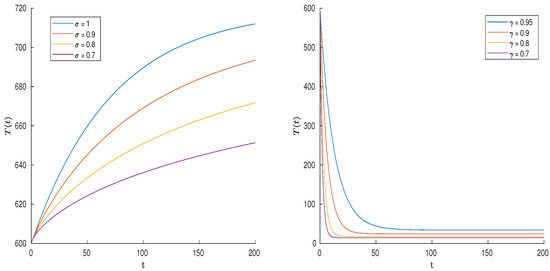
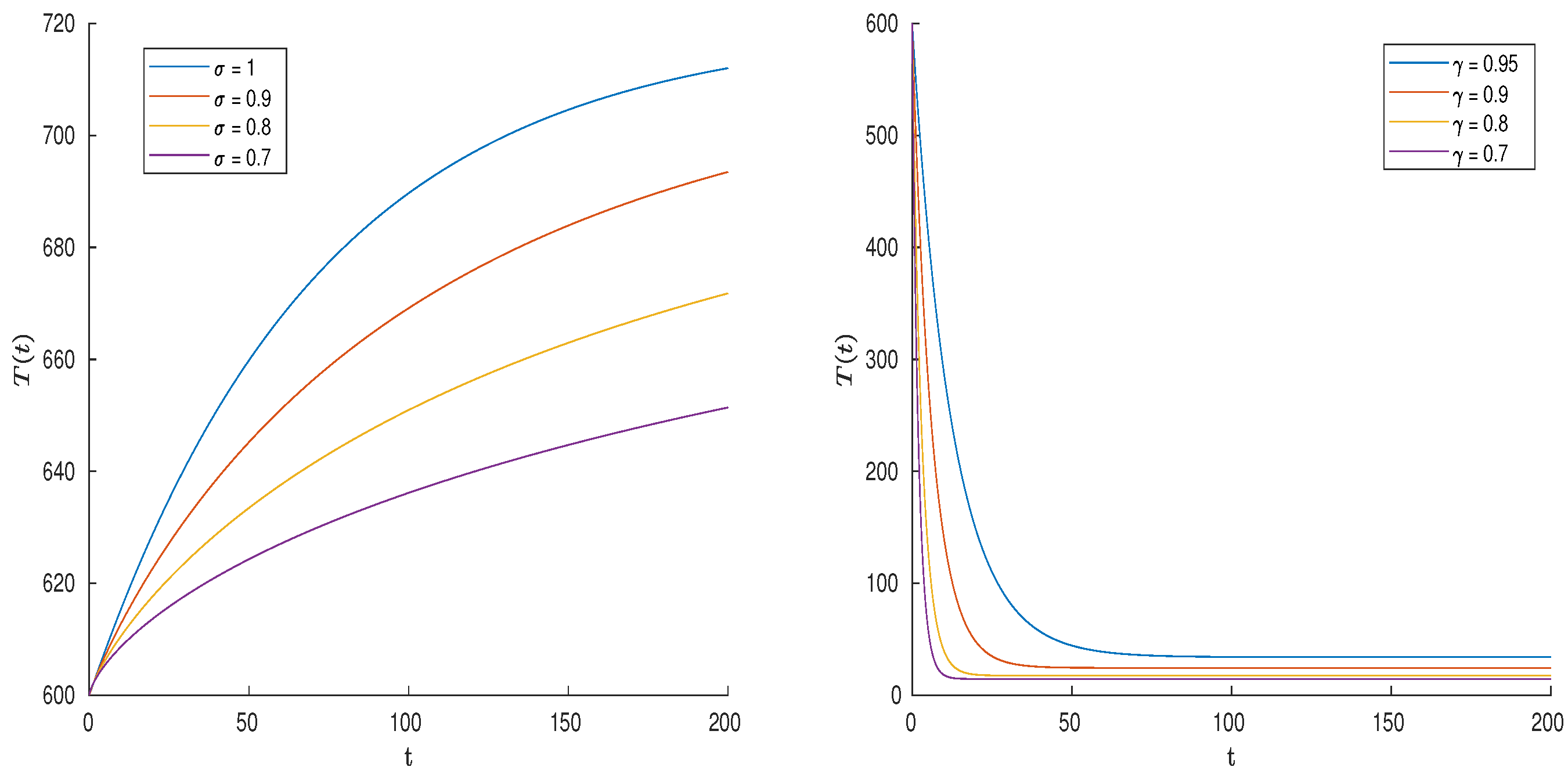
Now, we trace the impact of the order of the new type of FD on the dynamics behavior of the solution given by (64). We choose cells day day , and cells .
7. Conclusions
We have presented the cotangent fractional derivatives (Riemann–Liouville type) and (Caputo type) whose kernel contains exponential cotangent function. The advantage of the new type of FD is that they achieve a semi-group property, and we have special cases; if we obtain the RL-FD, C-FD, and RL-FI. We noticed that the function is a nonconstant function, however, of is zero. Using the Laplace transform of cotangent derivatives and integrals and we give the exact solution for linear cotangent fractional differential equations. Finally, we give the application of this new type on the SIR model. This new type of fractional calculus can help other researchers who still work on the actual subject.
Funding
This research received no external funding.
Data Availability Statement
Data sharing is not applicable to this article, as no data sets were generated or analyzed during the current study.
Acknowledgments
The author would like to thank to the referees for their useful comments and remarks.
Conflicts of Interest
The author declares no conflict of interest.
References
- Hilfer, R. (Ed.) Applications of Fractional Calculus in Physics; World Scientific: Singapore, 2000. [Google Scholar]
- Debnath, L. Recent applications of fractional calculus to science and engineering. Int. J. Math. Math. Sci. 2003, 2003, 3413–3442. [Google Scholar] [CrossRef]
- Kilbas, A.A.; Srivastava, H.M.; Trujillo, J.J. Theory and Applications of Fractional Differential Equations; Elsevier: Amsterdam, The Netherlands, 2006; Volume 204. [Google Scholar]
- Magin, R.L. Fractional Calculus in Bioengineering; Begell House Publishers: Danbury, CT, USA, 2006. [Google Scholar]
- Shah, K.; Jarad, F.; Abdeljawad, T. On a nonlinear fractional order model of dengue fever disease under Caputo-Fabrizio derivative. Alex. Eng. J. 2020, 59, 2305–2313. [Google Scholar] [CrossRef]
- Shah, K.; Alqudah, M.A.; Jarad, F.; Abdeljawad, T. Semi-analytical study of Pine Wilt Disease model with convex rate under Caputo-Febrizio fractional order derivative. Chaos Solitons Fractals 2020, 135, 109754. [Google Scholar] [CrossRef]
- Jarad, F.; Ugurlu, E.; Abdeljawad, T.; Baleanu, D. On a new class of fractional operators. Adv. Differ. Equ. 2017, 2017, 247. [Google Scholar] [CrossRef]
- Jarad, F.; Abdeljawad, T. Generalized fractional derivatives and Laplace transform. Discret. Contin. Dyn. S 2020, 13, 709–722. [Google Scholar] [CrossRef]
- Jarad, F.; Abdeljawad, T.; Alzabut, J. Generalized fractional derivatives generated by a class of local proportional derivatives. Eur. Phys. J. Spec. Top. 2017, 226, 3457–3471. [Google Scholar] [CrossRef]
- Jarad, F.; Alqudah, M.A.; Abdeljawad, T. On more general forms of proportional fractional operators. Open Math. 2020, 18, 167–176. [Google Scholar] [CrossRef]
- Rashid, S.; Jarad, F.; Noor, M.A.; Kalsoom, H.; Chu, Y.M. Inequalities by means of generalized proportional fractional integral operators with respect to another function. Mathematics 2019, 7, 1225. [Google Scholar] [CrossRef]
- Rahman, G.; Abdeljawad, T.; Jarad, F.; Nisar, K.S. Bounds of generalized proportional fractional integrals in general form via convex functions and their applications. Mathematics 2020, 8, 113. [Google Scholar] [CrossRef]
- Rahman, G.; Abdeljawad, T.; Jarad, F.; Khan, A.; Nisar, K.S. Certain inequalities via generalized proportional Hadamard fractional integral operators. Adv. Differ. Equ. 2019, 2019, 454. [Google Scholar] [CrossRef]
- Gambo, Y.Y.; Jarad, F.; Baleanu, D.; Abdeljawad, T. On Caputo modification of the Hadamard fractional derivatives. Adv. Differ. Equations 2014, 2014, 10. [Google Scholar] [CrossRef]
- Jarad, F.; Abdeljawad, T.; Baleanu, D. Caputo-type modification of the Hadamard fractional derivatives. Adv. Differ. Equ. 2012, 2012, 142. [Google Scholar] [CrossRef]
- Adjabi, Y.; Jarad, F.; Baleanu, D.; Abdeljawad, T. On Cauchy problems with Caputo Hadamard fractional derivatives. J. Comput. Anal. Appl. 2016, 21, 661–681. [Google Scholar]
- Khalil, R.; Al Horani, M.; Yousef, A.; Sababheh, M. A new definition of fractional derivative. J. Comput. Appl. Math. 2014, 264, 65–70. [Google Scholar] [CrossRef]
- Abdeljawad, T. On conformable fractional calculus. J. Comput. Appl. Math. 2015, 279, 57–66. [Google Scholar] [CrossRef]
- Katugampola, U.N. New approach to a generalized fractional integral. Appl. Math. Comput. 2011, 218, 860–865. [Google Scholar] [CrossRef]
- Katugampola, U.N. A new approach to generalized fractional derivatives. arXiv 2011, arXiv:1106.0965. [Google Scholar]
- Anderson, D.R.; Ulness, D.J. Newly defined conformable derivatives. Adv. Dyn. Syst. Appl. 2015, 10, 109–137. [Google Scholar]
- Anderson, D.R. Second–order self-adjoint differential equations using a proportional–derivative controller. Comm. Appl. Nonlinear Anal. 2017, 24, 17–48. [Google Scholar]
- Caputo, M.; Fabrizio, M. A new definition of fractional derivative without singular kernel. Progr. Fract. Differ. Appl. 2015, 1, 73–85. [Google Scholar]
- Losada, J.; Nieto, J.J. Properties of a new fractional derivative without singular kernel. Progr. Fract. Differ. Appl. 2015, 1, 87–92. [Google Scholar]
- Abdeljawad, T.; Baleanu, D. Monotonicity results for fractional difference operators with discrete exponential kernels. Adv. Differ. Equ. 2017, 2017, 78. [Google Scholar] [CrossRef]
- Abdeljawad, T.; Baleanu, D. On fractional derivatives with exponential kernel and their discrete versions. Rep. Math. Phys. 2017, 80, 11–27. [Google Scholar] [CrossRef]
- Atangana, A.; Baleanu, D. New fractional derivative with non-local and non–singular kernel. Thermal Sci. 2016, 20, 757. [Google Scholar] [CrossRef]
- Kochubei, A.N. General fractional calculus, evolution equations, and renewal processes. Integral Equ. Oper. Theory 2011, 71, 583–600. [Google Scholar] [CrossRef]
- Kilbas, A.A.; Saigo, M.; Saxena, R.K. Generalized Mittag-Leffler function and generalized fractional calculus operator. Integral Transform. Spec. Funct. 2004, 15, 31–49. [Google Scholar] [CrossRef]
- Jarad, F.; Abdeljawad, T.; Baleanu, D. On the generalized fractional derivatives and their Caputo modification. J. Nonlinear Sci. Appl. 2017, 10, 2607–2619. [Google Scholar] [CrossRef]
- Podlubny, I. Fractional Differential Equations; Academic Press: San Diego, CA, USA, 1999. [Google Scholar]
- Samko, S.G.; Kilbas, A.A.; Marichev, O.I. Fractional Integrals and Derivatives: Theory and Applications; Gordon and Breach: Yverdon, Switzerland, 1993. [Google Scholar]
- Habibi, F.; Birgani, O.; Koppelaar, H.; Radenović, S. Using fuzzy logic to improve the project time and cost estimation based on Project Evaluation and Review Technique (PERT). J. Proj. Manag. 2018, 3, 183–196. [Google Scholar] [CrossRef]
- Chandok, S.; Sharma, R.K.; Radenović, S. Multivalued problems via orthogonal contraction mappings with application to fractional differential equation. J. Fixed Point Theory Appl. 2021, 23, 14. [Google Scholar] [CrossRef]
- Stojiljković, V.; Ramaswamy, R.; Ashour Abdelnaby, O.A.; Radenović, S. Riemann-Liouville Fractional Inclusions for Convex Functions Using Interval Valued Setting. Mathematics 2022, 10, 3491. [Google Scholar] [CrossRef]
- Sadek, L. Controllability and observability for fractal linear dynamical systems. J. Vib. Control 2022, 10775463221123354. [Google Scholar] [CrossRef]
- Sadek, L.; Bataineh, A.S.; Talibi Alaoui, H.; Hashim, I. The Novel Mittag-Leffler–Galerkin Method: Application to a Riccati Differential Equation of Fractional Order. Fractal Fract. 2023, 7, 302. [Google Scholar] [CrossRef]
- Sadek, L. Stability of conformable linear infinite-dimensional systems. Int. J. Dyn. Control 2022, 11, 1276–1284. [Google Scholar] [CrossRef]
- Alipour, M.; Soradi Zeid, S. Optimal control of Volterra integro-differential equations based on interpolation polynomials and collocation method. Comput. Methods Differ. Equ. 2023, 11, 52–64. [Google Scholar]
- Zhao, W.; Gunzburger, M. Stochastic Collocation Method for Stochastic Optimal Boundary Control of the Navier–Stokes Equations. Appl. Math. Optim. 2023, 87, 6. [Google Scholar] [CrossRef]
- Oqielat, M.A.N.; Eriqat, T.; Al-Zhour, Z.; Ogilat, O.; El-Ajou, A.; Hashim, I. Construction of fractional series solutions to nonlinear fractional reaction–diffusion for bacteria growth model via Laplace residual power series method. Int. J. Dyn. Control 2023, 11, 520–527. [Google Scholar] [CrossRef]
- Kermack, W.O.; McKendrick, A.G. A contribution to the mathematical theory of epidemics. Proc. R. Soc. Lond. Ser. A Contain. Pap. Math. Phys. Character 1927, 115, 700–721. [Google Scholar]
- Sene, N. SIR epidemic model with Mittag-Leffler fractional derivative. Chaos Solitons Fractals 2020, 137, 109833. [Google Scholar] [CrossRef]
- Khan, M.A.; Ismail, M.; Ullah, S.; Farhan, M. Fractional order SIR model with generalized incidence rate. AIMS Math. 2020, 5, 1856–1880. [Google Scholar] [CrossRef]
- Naik, P.A. Global dynamics of a fractional-order SIR epidemic model with memory. Int. J. Biomath. 2020, 13, 2050071. [Google Scholar] [CrossRef]
- Taghvaei, A.; Georgiou, T.T.; Norton, L.; Tannenbaum, A. Fractional SIR epidemiological models. Sci. Rep. 2020, 10, 20882. [Google Scholar] [CrossRef] [PubMed]
- Dasbasi, B. Stability analysis of an incommensurate fractional-order SIR model. Math. Model. Numer. Simul. Appl. 2021, 1, 44–55. [Google Scholar]
- Kilicman, A. A fractional order SIR epidemic model for dengue transmission. Chaos Solitons Fractals 2018, 114, 55–62. [Google Scholar]
- Karaji, P.T.; Nyamoradi, N. Analysis of a fractional SIR model with general incidence function. Appl. Math. Lett. 2020, 108, 106499. [Google Scholar] [CrossRef]
- Jena, R.M.; Chakraverty, S.; Baleanu, D. SIR epidemic model of childhood diseases through fractional operators with Mittag-Leffler and exponential kernels. Math. Comput. Simul. 2021, 182, 514–534. [Google Scholar] [CrossRef]
Disclaimer/Publisher’s Note: The statements, opinions and data contained in all publications are solely those of the individual author(s) and contributor(s) and not of MDPI and/or the editor(s). MDPI and/or the editor(s) disclaim responsibility for any injury to people or property resulting from any ideas, methods, instructions or products referred to in the content. |
© 2023 by the author. Licensee MDPI, Basel, Switzerland. This article is an open access article distributed under the terms and conditions of the Creative Commons Attribution (CC BY) license (https://creativecommons.org/licenses/by/4.0/).