


Abstract
This paper introduces new versions of Hermite–Hadamard, midpoint- and trapezoid-type inequalities involving fractional integral operators with exponential kernels. We explore these inequalities for differentiable convex functions and demonstrate their connections with classical integrals. This paper validates the derived inequalities through a numerical example with graphical representations and provides some practical applications, highlighting their relevance to special means. This study presents novel results, offering new insights into classical integrals as the fractional order approaches 1, in addition to the fractional integrals we examined.
1. Introduction and Preliminaries
Convexity is a fundamental concept in both pure and applied mathematics that serves as a basis for optimization, inequality, and problem-solving in several fields of study. A function is considered convex on the interval , if for all , and , the following inequality holds:
One of the most intriguing results associated with the concept of convexity is the Hermite–Hadamard inequality (see [1,2]). This inequality has garnered significant attention and is widely recognized for its utility in related fields. For a convex function on the interval , we have
In [3], Kirmaci obtained the following result connected with the left-hand side of (1) as follows:
Theorem 1
([3]). Let be a differentiable function on I such that (Lebesgue integrable), where , with . If is convex on , then the following inequality holds:
A refinement of the above result was provided by Kadakal in [4] as follows:
Theorem 2
([4]). Let be a differentiable function on I such that , where , with . If is convex on , then the following inequality holds:
Dragomir and Agarwal presented the subsequent result associated with the right-hand side of (1) in [5].
Theorem 3
([5]). Let be a differentiable function on , , with . If is convex on , then the following inequality holds:
In [6], Kavurmacı et al. provided a refinement of the above result as follows:
Theorem 4
([6]). Let be a differentiable function on such that , where , with . If is convex on , then the following inequality holds:
Fractional calculus expands upon conventional calculus by incorporating derivatives and integrals of non-integer order. It is utilized in various scientific disciplines to accurately represent non-local and non-Markovian phenomena. Various fractional integral operators have been developed to enhance the modeling of different phenomena in science and engineering. One of the most frequently seen operators is the Riemann–Liouville operators, which can be defined in the following manner.
Definition 1
([7]). Let . The left and right Riemann–Liouville fractional integrals of order are defined by
respectively, where is the gamma function, and .
In [8], Sarikaya established the analogue of inequality (1) for Riemann–Liouville fractional integrals as follows.
Theorem 5
([8]). Let be a positive function such that with . If is convex on , then for the following inequalities hold:
where and denote the left and right Riemann–Liouville integrals, respectively.
In [9], Sarikaya and Yıldırım provided another version of the Hermite–Hadamard inequality for Riemann–Liouville fractional integrals.
Theorem 6
([9]). Let be a positive function such that with . If is convex on , then for , the following inequalities hold:
In the same paper, the authors derived the Riemann–Liouville fractional midpoint-type inequalities as follows:
Theorem 7
([9]). Let be a differentiable function on I such that , where , with . If is convex on , then for , the following inequality for fractional integrals holds:
In [10], Özdemir et al. provided the following trapezoid-type inequalities via Riemann–Liouville fractional integrals.
Theorem 8
([10]). Let be a differentiable function on I such that , where , with . If is convex on , then for , the following inequality for fractional integrals holds:
Remark 1.
Setting in Theorem 8 yields Theorem 4.
For additional studies on fractional integral inequalities involving Riemann–Liouville operators, readers may refer to [11,12,13,14,15] and the references cited therein.
In [16], Ahmad et al. introduced the following new fractional integrals with exponential kernels.
Definition 2
([16]). Let . The fractional integrals and of order are defined, respectively, by
In the following, for the sake of simplicity, we adopt the following notation: .
Remark 2.
From Definition 2, one can derive the following statements.
- 1.
- and .
- 2.
- .
In the same paper, the authors provided the Hermite–Hadamard inequality as well as trapezoid-type inequalities via the newly introduced fractional integrals.
Theorem 9
([16]). Let be a positive function such that with . If is convex on , then for , the following inequalities hold:
Theorem 10
([16]). Let be a differentiable function on such that with . If is convex, then we have
On the other hand, Wu et al. in their publication [17] introduced midpoint-type inequalities for the same operator in the following manner:
Theorem 11
([17]). Let be a differentiable function on such that with . If is convex, then we have
In [18], the authors explored another variant of the Hermite–Hadamard inequality as well as Hermite–Hadamard-type inequalities for left-sided fractional integrals with exponential kernels. Furthermore, Zhou et al. [19] established a series of results related to three-point quadrature formulas for twice-differentiable convex functions. However, the most intriguing work related to this type of operators was performed by Yuan et al. in [20]. In this study, the authors conducted a parametric analysis on the same operator previously addressed by Ahmad et al. [16] and Wu et al. [17], and they were able to establish the following result, from which they deduced the error bounds of several quadrature rules.
Theorem 12
([19]). Let be a differentiable function on such that with . If is convex, then we have for
In this study, we present new versions of Hermite–Hadamard and Hermite–Hadamard-type inequalities by employing fractional operators with exponential kernels that differ from the ones previously established in Theorems 9–11. The results we obtained are analogous to those established in Theorems 6 and 8; although, it is important to mention that our findings are just generalizations of classical inequalities. The study is supported by graphical representations that confirm the validity of the acquired results.
The organization of this paper is as follows: Section 1 presents some previous results and useful definitions pertinent to our study. Section 2 is divided into three subsections. In the Section 2.1, we provide a new version of the Hermite–Hadamard inequality for fractional integrals with exponential kernels. The Section 2.2 is dedicated to the study of the midpoint inequality for the same type of integrals. The Section 2.3 establishes several trapezoid-type inequalities for the same operators. Section 3 provides a numerical example with graphical representations that justify the accuracy of our outcomes, while Section 4 presents some applications of the obtained results to special means. The study concludes with a summary of the key findings in Section 5.
2. Main Results
In this section, we initiate our study by establishing a novel version of the Hermite–Hadamard inequality for the new fractional integrals introduced in [16]. Subsequently, we introduce two new identities, from which we derive several new midpoint- and trapezoid-type inequalities for differentiable convex functions.
2.1. Hermite–Hadamard Inequality
In this part, we present a new version of the Hermite–Hadamard inequality specifically tailored for fractional integrals with exponential kernels.
Theorem 13.
Let be a positive function such that with . If is convex on , then for , the following inequalities hold:
Proof.
Multiplying both sides of (4) by and then integrating the resulting inequality with respect to over , we obtain
As a result, we obtain
Furthermore, we have for
and
By adding the above inequalities, we obtain
Multiplying both sides of (6) by and then integrating the resulting inequality with respect to over , we obtain
that is
The desired result is obtained by combining inequalities (5) and (7).
The proof is completed. □
2.2. Midpoint-Type Inequalities
Here, we focus on the study of the midpoint inequality, extending it to apply to fractional integrals with exponential kernels.
Lemma 1.
Let be a differentiable function on , with , and . Then, for , the following equality holds:
Proof.
Theorem 14.
Let be a differentiable function on such that with . If is convex, then we have
Proof.
From Lemma 1, properties of modulus, and the convexity of , we have
where we have used
and
The proof is completed. □
Corollary 1.
In Theorem 14, using the convexity of , we obtain
Remark 4.
By making β tend to 1, we find
- 1.
- .
- 2.
- .
- 3.
- .
- 4.
- .
Corollary 2.
In Theorem 14, letting β tend to 1, we obtain
This represents a new result analogous to that established by Kadakal in Corollary 1 from [4].
Remark 5.
By tending β to 1, Corollary 1 will be reduced to Theorem 2.2 from [3].
Theorem 15.
Let be a differentiable function on such that with . If is convex where with , then we have
Proof.
From Lemma 1, properties of modulus, Hölder’s inequality, and the convexity of , we have
The proof is completed. □
Corollary 3.
In Theorem 15, using the convexity of , we obtain
Remark 6.
By making β tend to 1, we get
Thus, we obtain
Corollary 4.
In Theorem 15, letting β tend to 1, then we obtain
Corollary 5.
In Corollary 3, letting β tend to 1, we obtain
Theorem 16.
Let be a differentiable function on such that with . If is convex where , then we have
Proof.
Corollary 6.
In Theorem 16, using the convexity of , we obtain
Remark 7.
By making β tend to 1, we find
- 1.
- .
- 2.
- .
- 3.
- .
- 4.
- 5.
- .
Corollary 7.
In Theorem 16, letting β tend to 1, we obtain
Corollary 8.
In Corollary 6, letting β tend to 1, then we obtain
2.3. Trapezoid-Type Inequalities
Now, we establish several trapezoid-type inequalities for the same fractional integral operators, further enriching our theoretical framework.
Lemma 2.
Let be a differentiable function on , with , and . Then, for the following equality holds
Proof.
Theorem 17.
Let be a differentiable function on such that with . If is convex, then we have
Proof.
From Lemma 2, properties of modulus, and convexity of , we have
where we have used
and
The proof is completed. □
Corollary 9.
In Theorem 17, using the convexity of , we obtain
Remark 8.
For , Corollary 9 reduces to Theorem 3 established by Dragomir and Agarwal in [5].
Remark 9.
By making β tend to 1, we find
- 1.
- .
- 2.
- .
- 3.
- .
- 4.
- .
Corollary 10.
In Theorem 17, letting β tend to 1, we obtain
This represents a new result analogous to that established by Kavurmacı et al. in [6].
Theorem 18.
Let be a differentiable function on such that with . If is convex where with , then we have
Proof.
From Lemma 2, properties of modulus, Hölder’s inequality and the convexity of , we have
The proof is completed. □
Corollary 11.
In Theorem 18, using the convexity of , we obtain
Remark 10.
By making β tend to 1, we get
Thus, we obtain
Corollary 12.
In Theorem 18, letting β tend to 1, then we obtain
Corollary 13.
In Corollary 11, letting β tend to 1, then we obtain
Theorem 19.
Let be a differentiable function on such that with . If is convex where , then we have
Proof.
From Lemma 2, properties of modulus, power mean integral inequality and the convexity of , we have
where we have used (14)–(17). The proof is achieved. □
Corollary 14.
In Theorem 19, using the convexity of , we obtain
Remark 11.
By making β tend to 1, we find
- 1.
- .
- 2.
- .
- 3.
- .
- 4.
- 5.
- .
Corollary 15.
In Theorem 19, letting β tend to 1, we obtain
Corollary 16.
In Corollary 14, letting β tend to 1, then we obtain
3. Illustrative Example
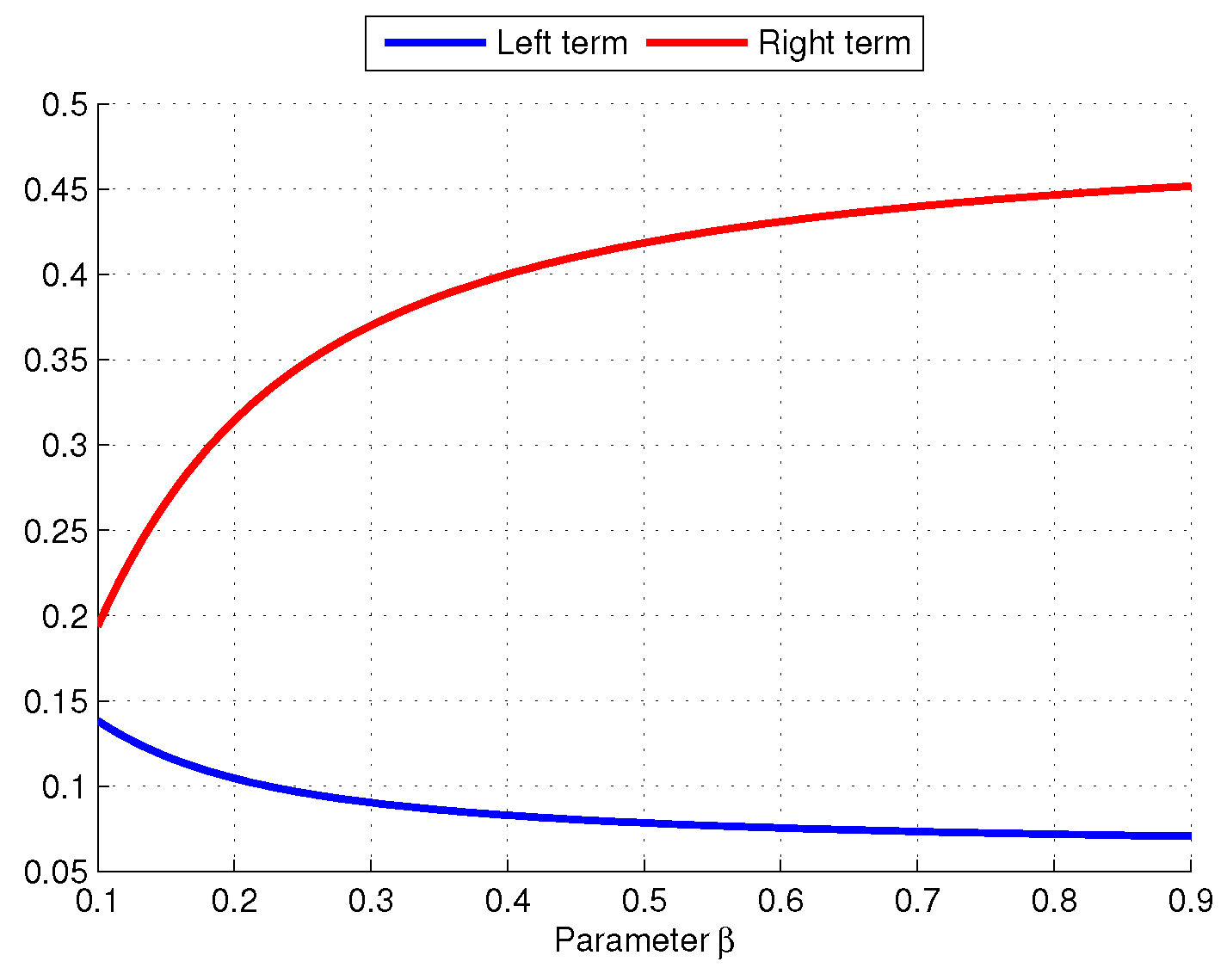
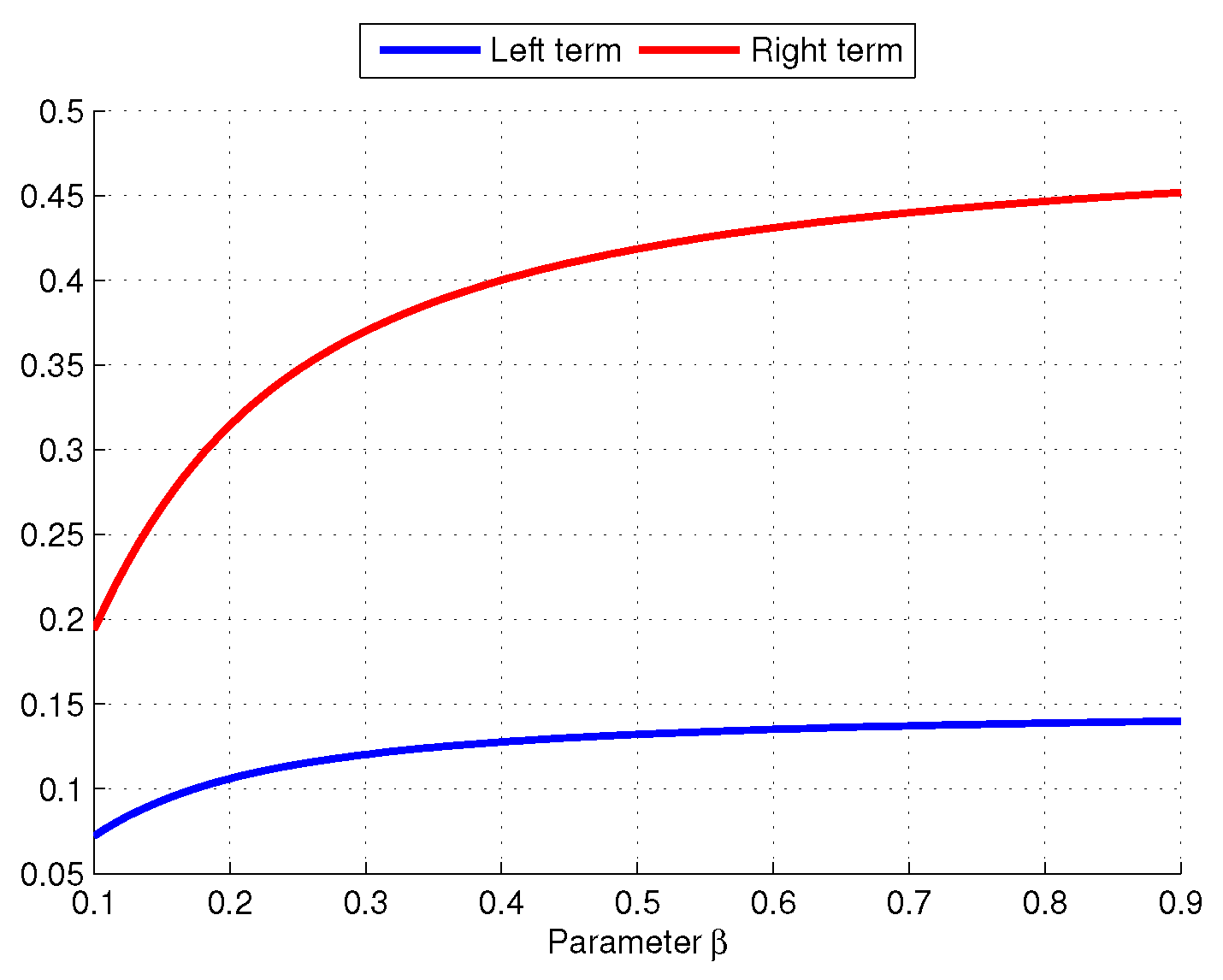
In this section, to confirm the accuracy of the established results, we provide an example with graphical representations of the three types of inequalities discussed in this work. It should be noted that the figures were generated using MATLAB 7.12.0 (R2011a) software.
Example 1.
Consider the function defined by . This function satisfies the conditions of our theorems, as its derivative, given by , is convex on the interval .
Let us note that for the function considered, for , we have:
Now, we will apply the three main theorems from our study to the specified function.
- 1.
- From Theorem 13, the Hermite–Hadamard inequality for the given function is expressed aswhere is defined as in (18). The above result is graphically represented in Figure 1.
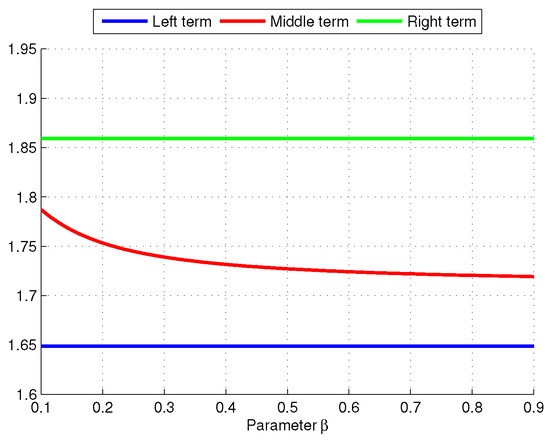 Figure 1. Hermite–Hadamard inequality.
 - 2.
- From Theorem 14, the midpoint-type inequality for the given function is given bywhere is defined as in (18). This result is graphically depicted in Figure 2.
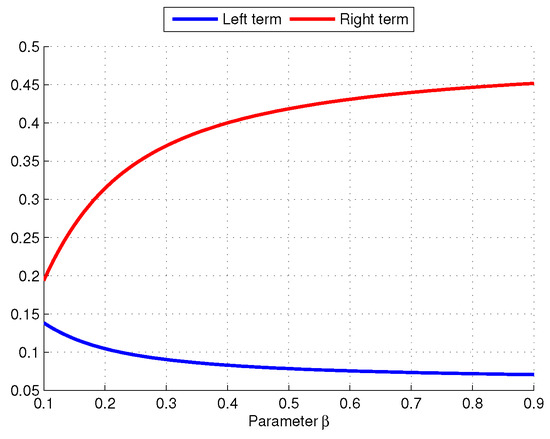 Figure 2. Midpoint-type inequality.
 - 3.
- From Theorem 17, the trapezoid-type inequality for the given function is stated aswhere is defined as in (18). This result is illustrated graphically in Figure 3.
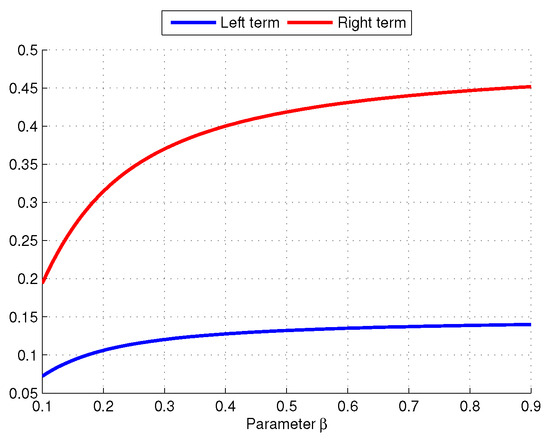 Figure 3. Trapezoid-type inequality.
4. Some Applications
For arbitrary real numbers we have the following:
The arithmetic mean: .
The logarithmic mean: , .
The harmonic mean: .
Proposition 1.
Let , then we have
Proof.
Taking for in Theorem 17. □
Proposition 2.
Let , then we have
Proof.
Taking for in Theorem 17. □
Proposition 3.
Let , then we have
Proof.
Taking for in Corollary 1. □
Proposition 4.
Let , then we have
Proof.
Taking for in Corollary 9. □
5. Conclusions
This research successfully extends the realm of Hermite–Hadamard inequalities through the innovative use of fractional integral operators with exponential kernels, as initially proposed by Ahmad et al. [16]. The newly formulated inequalities enrich the existing literature on fractional calculus by linking them with classical integral inequalities and expanding their potential applications. The detailed numerical examples presented not only verify the theoretical results but also highlight the sensitivity of these inequalities to changes in the parameter . This study offers new insights into both the fractional integrals that we investigated and classical integrals as the fractional order tends to 1. These findings pave the way for further explorations into more complex functions and different types of fractional operators, potentially opening up new avenues for research in applied mathematics and engineering.
Author Contributions
Conceptualization: H.L., H.X., A.K., and A.L.; Formal analysis: H.L., B.M., W.S., and H.X.; Investigation: H.L., W.S., and A.L.; Methodology: B.M., H.X., and A.K.; Project administration: H.X.; Software: A.L.; Supervision: B.M., and A.K; Validation: B.M., and A.L.; Visualization: W.S., and H.X.; Writing—original draft: B.M., H.X., and A.L.; Writing—review and editing: H.L., B.M., W.S., H.X., A.K., and A.L. All authors have read and agreed to the published version of the manuscript.
Funding
The first author is supported by the Science and Technology Research Project of Jiangxi Provincial Department of Education (GJJ2201238), the Project of Jiangxi Province Education Science Planning Project in China (23YB176).
Data Availability Statement
Not applicable.
Acknowledgments
The authors would like to express their gratitude to the reviewers for their valuable comments and suggestions, which have significantly improved the quality of this paper.
Conflicts of Interest
The authors declare no conflicts of interest.
References
- Hadamard, J. Etude sur les propriétés des fonctions entières et en particulier d’une fonction considérée par Riemann. J. Math. Pures Appl. 1893, 58, 171–215. [Google Scholar]
- Hermite, C. Sur deux limites d’une integrale définie. Mathesis 1883, 3, 82. [Google Scholar]
- Kirmaci, U. Inequalities for differentiable mappings and applications to special means of real numbers to midpoint formula. Appl. Math. Comput. 2004, 147, 137–146. [Google Scholar] [CrossRef]
- Kadakal, H. On refinements of some integral inequalities using improved power-mean integral inequalities. Numer. Methods Partial. Differ. Equ. 2020, 36, 1555–1565. [Google Scholar] [CrossRef]
- Dragomir, S.; Agarwal, R. Two inequalities for differentiable mappings and applications to special means of real numbers and to trapezoidal formula. Appl. Math. Lett. 1998, 11, 91–95. [Google Scholar] [CrossRef]
- Kavurmacı, H.; Avcı, M.; Özdemir, M.E. New inequalities of Hermite-Hadamard type for convex functions with applications. J. Inequal. Appl. 2011, 2011, 86. [Google Scholar] [CrossRef]
- Kilbas, A.; Srivastava, H.; Trujillo, J. Theory and Applications of Fractional Differential Equations; North-Holland Mathematics Studies; Elsevier Science B.V.: Amsterdam, The Netherlands, 2006; Volume 204. [Google Scholar]
- Sarikaya, M.; Set, E.; Yaldiz, H.; Başak, N. Hermite-Hadamard’s inequalities for fractional integrals and related fractional inequalities. Math. Comput. Model. 2013, 57, 2403–2407. [Google Scholar] [CrossRef]
- Sarikaya, M.; Yıldı rım, H. On Hermite-Hadamard type inequalities for Riemann–Liouville fractional integrals. Miskolc Math. Notes 2016, 17, 1049–1059. [Google Scholar] [CrossRef]
- Özdemir, M.; Avcı, M.; Kavurmacı, H. Hermite Hadamard type inequalities for s-convex and s-concave functions via fractional integrals. Turkish J. Sci. 2016, 1, 28–40. [Google Scholar]
- Ayed, H.; Meftah, B. Open two-point Newton–Cotes integral inequalities for differentiable convex functions via Riemann–Liouville fractional integrals. J. Prime Res. Math. 2023, 19, 24–36. [Google Scholar]
- Ying, R.; Lakhdari, A.; Xu, H.; Saleh, W.; Meftah, B. On Conformable Fractional Milne-Type Inequalities. Symmetry 2024, 16, 196. [Google Scholar] [CrossRef]
- Du, T.; Peng, Y. Hermite–Hadamard type inequalities for multiplicative Riemann–Liouville fractional integrals. J. Comput. Appl. Math. 2024, 440, 115582. [Google Scholar] [CrossRef]
- Zhu, W.; Meftah, B.; Xu, H.; Jarad, F.; Lakhdari, A. On parameterized inequalities for fractional multiplicative integrals. Demonstr. Math. 2024, 57, 20230155. [Google Scholar] [CrossRef]
- Almatrafi, M.B.; Saleh, W.; Lakhdari, A.; Jarad, F.; Meftah, B. On the multiparameterized fractional multiplicative integral inequalities. J. Inequal. Appl. 2024, 2024, 52. [Google Scholar] [CrossRef]
- Ahmad, B.; Alsaedi, A.; Kirane, M.; Torebek, B.T. Hermite-Hadamard, Hermite-Hadamard-Fejér, Dragomir-Agarwal and Pachpatte type inequalities for convex functions via new fractional integrals. J. Comput. Appl. Math. 2020, 353, 120–129. [Google Scholar] [CrossRef]
- Wu, X.; Wang, J.; Zhang, J. Hermite–Hadamard-type inequalities for convex functions via the fractional integrals with exponential kernel. Mathematics 2019, 7, 845. [Google Scholar] [CrossRef]
- Yu, S.; Du, T. Certain inequalities in frame of the left-sided fractional integral operators having exponential kernels. AIMS Math. 2022, 7, 4094–4114. [Google Scholar] [CrossRef]
- Zhou, T.; Yuan, Z.; Yang, H.; Du, T. Some parameterized inequalities by means of fractional integrals with exponential kernels and their applications. J. Inequal. Appl. 2020, 2020, 163. [Google Scholar] [CrossRef]
- Yuan, Z.; Zhou, T.; Zhang, Q.; Du, T. Certain parameterized inequalities arising from fractional integral operators with exponential kernels. Filomat 2021, 35, 1707–1724. [Google Scholar] [CrossRef]
Disclaimer/Publisher’s Note: The statements, opinions and data contained in all publications are solely those of the individual author(s) and contributor(s) and not of MDPI and/or the editor(s). MDPI and/or the editor(s) disclaim responsibility for any injury to people or property resulting from any ideas, methods, instructions or products referred to in the content. |
© 2024 by the authors. Licensee MDPI, Basel, Switzerland. This article is an open access article distributed under the terms and conditions of the Creative Commons Attribution (CC BY) license (https://creativecommons.org/licenses/by/4.0/).