


Abstract
We introduce an analysis platform for the viscoelastic properties of biological fluids such as the synovia found in articular joints. Small sample volumes are available for diagnostic purpose. Our approach uses a thickness shear mode quartz crystal integrated in an electrodynamically actuated spring structure. This combines the sensitivity of the quartz resonator operating at several overtones in the MHz range with previously introduced low kHz frequency multimode resonators. The latter is not only advantageous for characterizing viscoelastic fluids but is also used as an acoustic streaming actuator. Particulate matter in the sample thus can be resuspended and their settling is observed by tracking the resonance frequencies and Q-factors of both the quartz and electrodynamic resonator sensors.
1. Introduction
The synovial fluid found in joints of vertebrates has the important physiological functions of lubrication, shock absorption, and maintaining the healthy condition of the surrounding tissue. Pathological alterations of the fluid lead to various diseases like arthritis and gout. Due to the low amount of available sample volume and its complex composition, the viscoelastic properties are difficult to measure using state-of-the-art equipment available at laboratory scale.
Measuring the viscoelastic properties with electromechanical in-plane mode resonators is a promising approach that was demonstrated in previous work [1]. Quartz resonators operated in the thickness shear mode are able to measure viscoelastic properties in the megahertz range [2]. Custom designed electrodynamic plate resonators use a similar fluid interaction mechanism to measure these properties in the low kilohertz range [3]. From a rheological perspective the two methods probe the sample in two different regimes. For common fluids, the low frequency resonators measures below the lower relaxation frequency, whereas the quartz frequencies often are above the highest structural relaxation frequency. As the quartz can be operated at several overtones, these complementary methods yield a detailed characterization of the fluid. In the case of synovia, the goal is to optimize the measurement parameters so that both the concentration and the molecular weight of the hyaluronic acid can be analyzed with a single device. In addition, the acoustic streaming mechanism, introduced in [4], allows repeated stirring and settling experiments to determine the amount of particular matter such as gout crystals and cartilage debris that indicate pathological joint alterations.
2. Materials and Methods
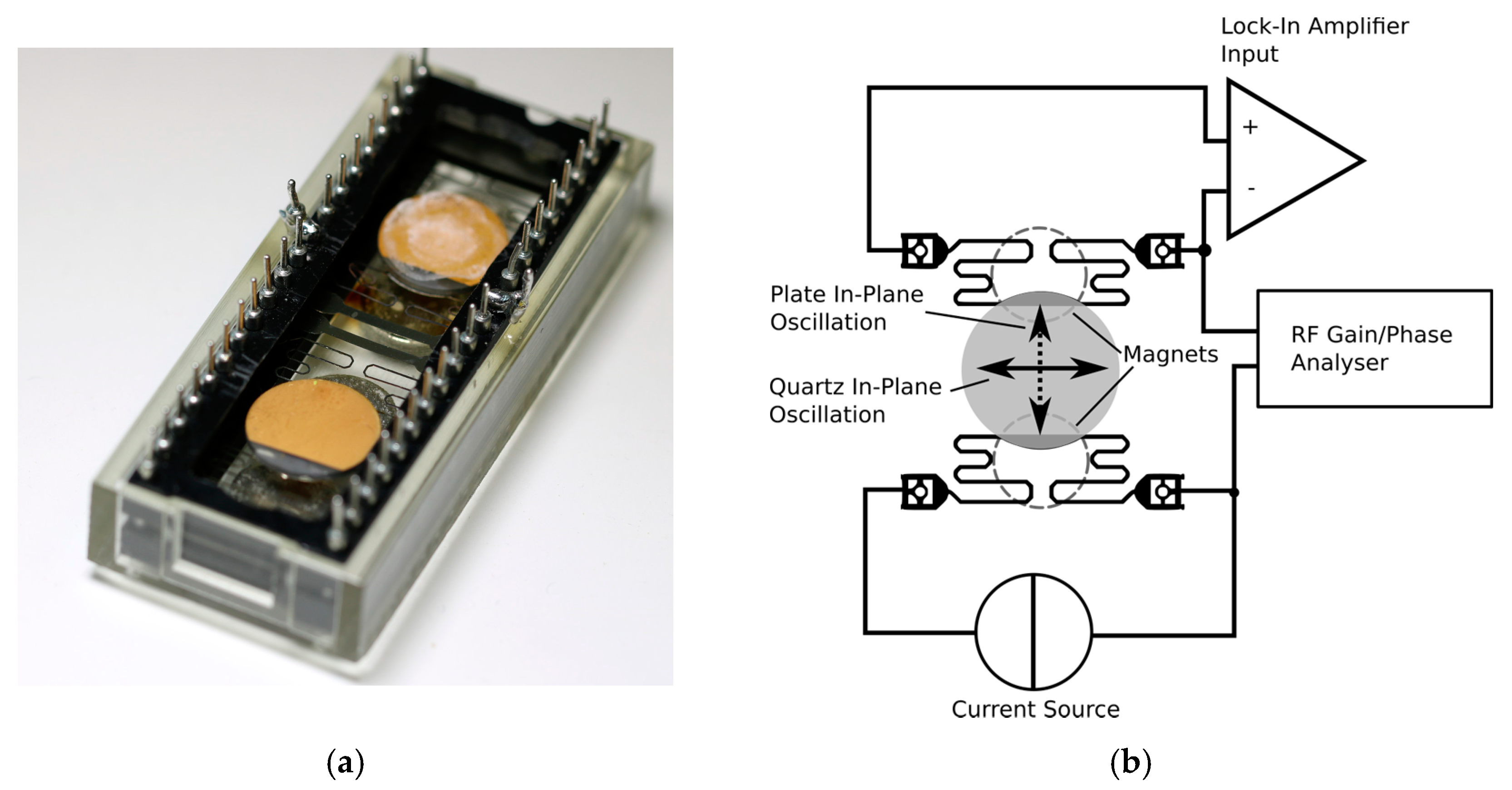
The device, where two similar combined transducer elements are integrated, is shown in Figure 1a. In each element, both the low-frequency electrodynamic resonator and the high-frequency quartz are realized in a single combined transducer element.
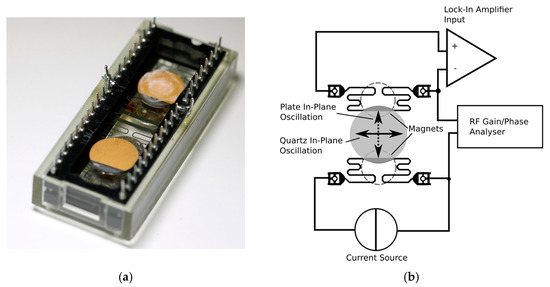
Figure 1.
(a) Photo of the combined resonator device. The 2.5 MHz (fundamental mode) quartz resonators with around-the-edge electrodes are soldered to the etched Ni-brass support structure. Two identical devices are integrated in a DIL40 housing to facilitate drift compensation; (b) Connection scheme for excitation and readout. The low frequency plate resonances are measured using a lock-in amplifier setup with current amplification. The quartz resonances are measured using a RF gain/phase analyser. With the magnetic field aligned perpendicular to the plate, in-plane modes are excited. Using a different orientation of the magnetic field, the plate can alternatively be excited in out-of-plane modes.
The electrodynamic transducer is driven by a TOE 7621 four quadrant power supply (DC-100 kHz) and either a Stanford Research SR830 Lock-In Amplifier, or a NI analog I/O interface. The latter is used to implement a rapid resonance analysis based on transient chirp measurements similar to [5]. A signal transducer is used to avoid grounding issues arising from the combination with the high-frequency signals. The quartz frequency response is measured with an Agilent ENA 5061B network analyzer. The electrical connections for excitation and readout are shown in Figure 1b.
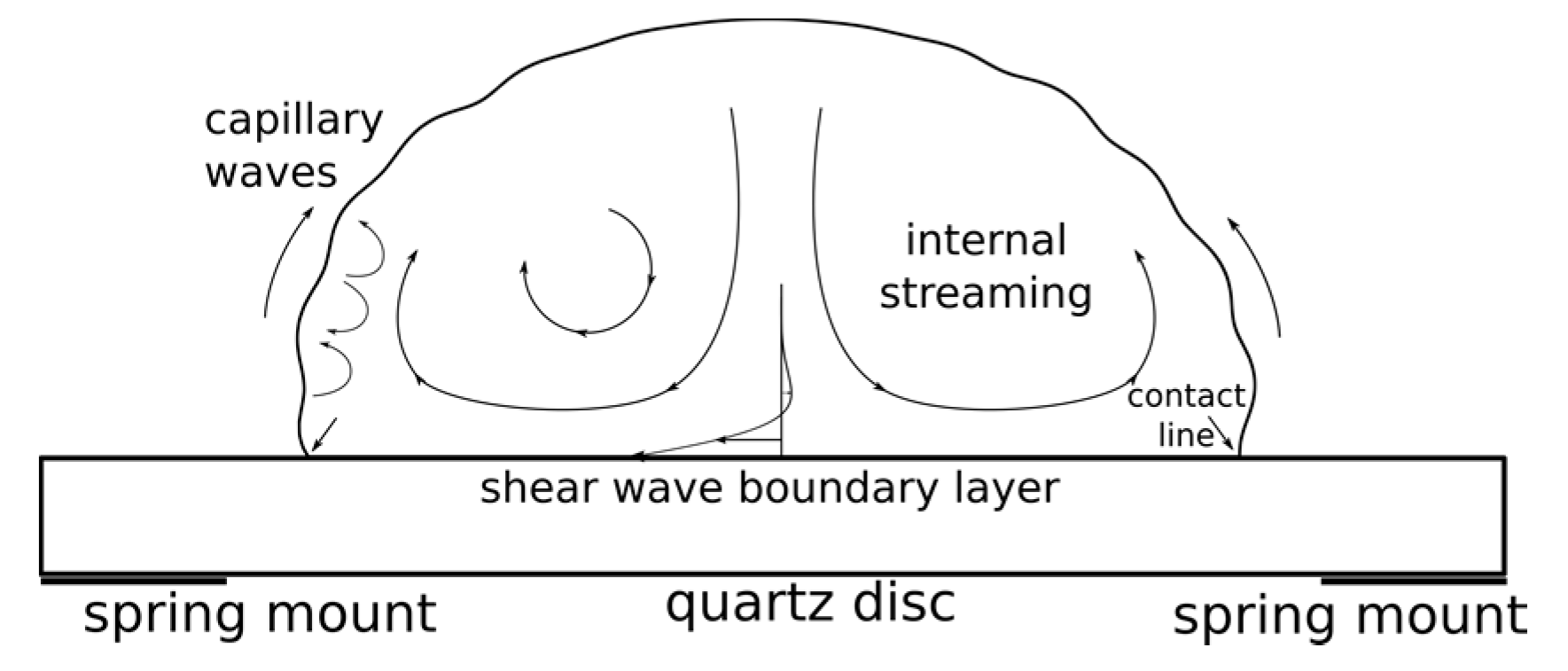
Operating the electrodynamic transducer at significantly high oscillation amplitudes excites capillary waves on the surface of the droplet placed on the resonator surface. The resulting oscillatory velocity field leads to a second order (boundary induced) streaming effect. It should be noted that in contrast to acoustic streaming excited at high frequencies, this type of streaming does not rely on the compressibility of the fluid. The streaming interaction is depicted in Figure 2.
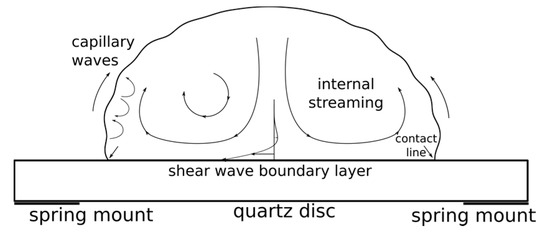
Figure 2.
Acoustic streaming is induced in the sessile droplet of sample liquid at sufficiently high oscillation amplitudes. This way, particulate matter is resuspended and the settling can be observed by tracking the shift in the resonance frequencies of both the quartz plate and the electrodynamic transducer.
3. Results
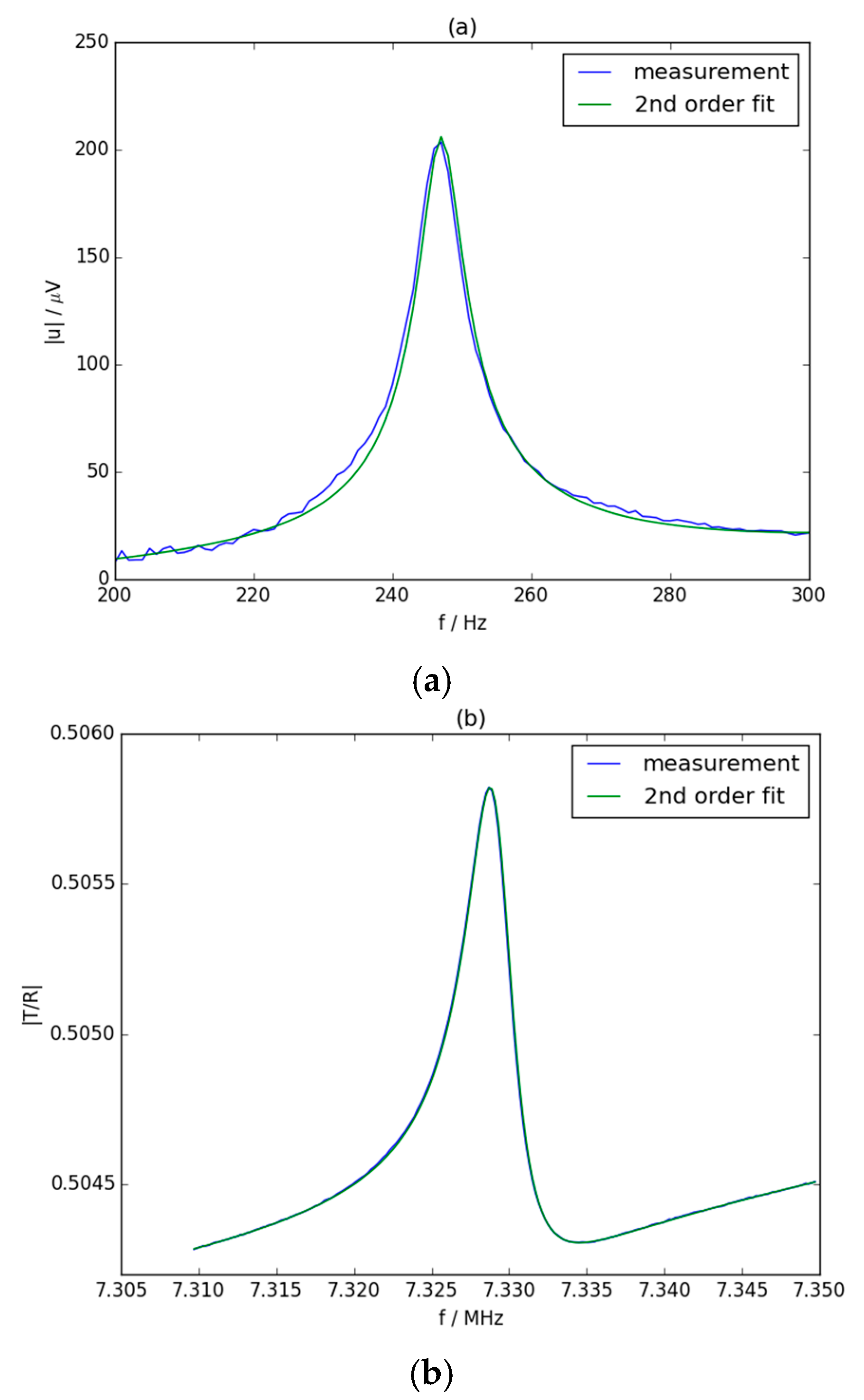
The two resonance measurements in the low and high frequency range are shown in Figure 3.
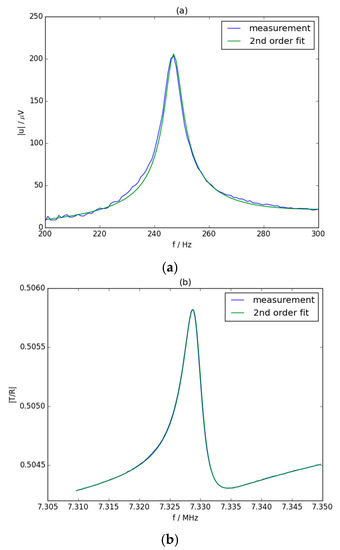
Figure 3.
Measured resonance spectra of the (a) low frequency electrodynamic transducer and (b) the high frequency quartz resonator with fitted second order system response.
4. Conclusions
The target application is the measurement of the viscoelastic properties over a large frequency range to derive the concentration and molecular weight of hyaluronic acid in the synovial fluid. Preliminary experiments using synthetic hyaluronic acid solutions and canine synovia demonstrate the applicability of this approach. In addition, particulate matter such as gout crystals can be detected by monitoring the shift in resonance frequencies after a period of acoustic stirring.
Acknowledgments
This work was supported by the Linz Institute of Technology (project LIT-2016-1-SEE-019).
Author Contributions
E.K.R. was responsable for sensor design, interface electronics, experiments and manuscript writing. T.V.-B. was working on modeling, data analysis, and project management. B.J. contributed to the sensor design, readout circuitry and project management.
Conflicts of Interest
The authors declare no conflict of interest.
References
- Reichel, E.K.; Heinisch, M.; Jakoby, B.; Vermant, J.; Kirschhock, C.E. Modeling and data analysis of a multimode resonator sensor loaded with viscous and viscoelastic fluids. In Proceedings of the 2012 IEEE Sensors, Taipei, Taiwan, 28–31 October 2012; pp. 1–4. [Google Scholar]
- Follens, L.R.A.; Reichel, E.K.; Riesch, C.; Vermant, J.; Martens, J.A.; Kirschhock, C.E.A.; Jakoby, B. Viscosity sensing in heated alkaline zeolite synthesis media. Phys. Chem. Chem. Phys. 2009, 11, 2854–2857. [Google Scholar] [CrossRef] [PubMed]
- Reichel, E.K.; Riesch, C.; Keplinger, F.; Kirschhock, C.E.A.; Jakoby, B. Analysis and experimental verification of a metallic suspended plate resonator for viscosity sensing. Sens. Actuators A Phys. 2010, 162, 418–424. [Google Scholar] [CrossRef]
- Reichel, E.K.; Heinisch, M.; Jakoby, B. Droplet mixing and liquid property tracking using an electrodynamic plate resonator. In Proceedings of the 2012 IEEE Sensors, Baltimore, MD, USA, 3–6 November 2013. [Google Scholar]
- Reichel, E.K.; Heinisch, M.; Jakoby, B.; Vermant, J.; Kirschhock, C.E. Viscoelasticity sensor with resonance tuning and low-cost interface. Procedia Eng. 2011, 25, 623–626. [Google Scholar] [CrossRef][Green Version]
Publisher’s Note: MDPI stays neutral with regard to jurisdictional claims in published maps and institutional affiliations. |
© 2017 by the authors. Licensee MDPI, Basel, Switzerland. This article is an open access article distributed under the terms and conditions of the Creative Commons Attribution (CC BY) license (https://creativecommons.org/licenses/by/4.0/).