


Abstract
The inclusive production of the charmonium state was studied in p-Pb and Pb-Pb collisions at = 8.16 TeV and 5.02 TeV respectively, using the ALICE detector at the CERN LHC. The is less bound than the and it represents an interesting probe for the study of cold nuclear matter effects in p-Pb collisions, while in the Pb-Pb system its formation can be strongly influenced by QGP production. The measurements are performed in different center-of-mass rapidity ranges, 2.03 < < 3.53 and −4.46 < < −2.96 for p-Pb collisions and 2.5 < < 4.0 for Pb-Pb collisions, down to zero transverse momentum, through the decay channel. The results are compared to those obtained for the and with theoretical predictions.
1. Introduction
The study of charmonia, bound states of a charm and anti-charm quarks (), represents a research field of particular interest in the investigation of Quark-Gluon Plasma (QGP). In fact the production of these mesons is expected to be modified in the QGP, by means of a screening mechanism due to the high density of colour charges [1]. This leads to a suppression of the charmonium yields in nucleus-nucleus collisions with respect to proton-proton collisions. At LHC energies, large number of pairs can be produced in each Pb-Pb collision, hence charmonium suppression can be partly counterbalanced by a (re)generation mechanism, which is related to the charmonium formation through the statistical recombination of charm quarks. In nucleus-nucleus collisions there are also effects which are not related to the formation of a deconfined medium, hence it becomes important to quantify these mechanisms and their influence on charmonium production. These effects are studied in proton-nucleus collisions, where no QGP is expected to be formed and they are known as cold nuclear matter effects. One of them is the nuclear shadowing which refers to the modification of the quark and gluon structure functions for a nucleon inside nuclei. Another effect is the coherent energy loss which leads to a modification of the parton kinematics due to gluon radiation [2]. Finally charmonia can be dissociated by interacting with colliding nuclei. This effect, named nuclear absorption, is relevant when the formation time of the resonance is smaller than the time spent by the inside the nucleus and it is not important at LHC energies. In these proceedings ALICE results on production are shown as a function of rapidity, transverse momentum and centrality in p-Pb collisions at 8.16 TeV and as a function of centrality for Pb-Pb collisions at 5.02 TeV.
2. Analysis Technique
The ALICE detector design and performance are described in details in [3,4]. The is measured via its decay into a muon pair and for this reason the Muon Spectrometer plays a crucial role. It is composed of a system of passive absorbers, a dipole magnet, a muon tracker, a passive iron wall and a muon trigger system. Events are selected when there is an opposite sign muon pair, with muons above a certain transverse momentum threshold ( 0.5 GeV/ for p-Pb and 1 GeV/ for Pb-Pb). The modification of the production in pA or AA collisions, with respect to the pp cross section measured at the same center-of-mass energy is studied through the nuclear modification factor:
where x is equal to p for pA collisions and to A for AA collisions. is the number of and it can be evaluated through the fit of the invariant mass distribution using different combinations of background and signal functions. The extracted number of is corrected for the acceptance and efficiency () of the muon spectrometer. This is achieved with a Monte-Carlo simulation, where are generated according to rapidity and transverse momentum distributions tuned to match the data. is the number of equivalent minimum-bias events, is the average of the nuclear overlap function, (∼7.9 ) is the branching ratio for to a muon pair and finally is the cross section in pp collisions. Any deviation from unity of the can be attributed to the presence of hot (or cold) medium effects.
3. Results
In this section the main results for in p-Pb collisions at = 8.16 TeV (∼8.7 , ∼12.9 ) and in Pb-Pb ones at = 5.02 TeV (∼225 ) are presented.
3.1. in p-Pb Collisions at 8.16 TeV
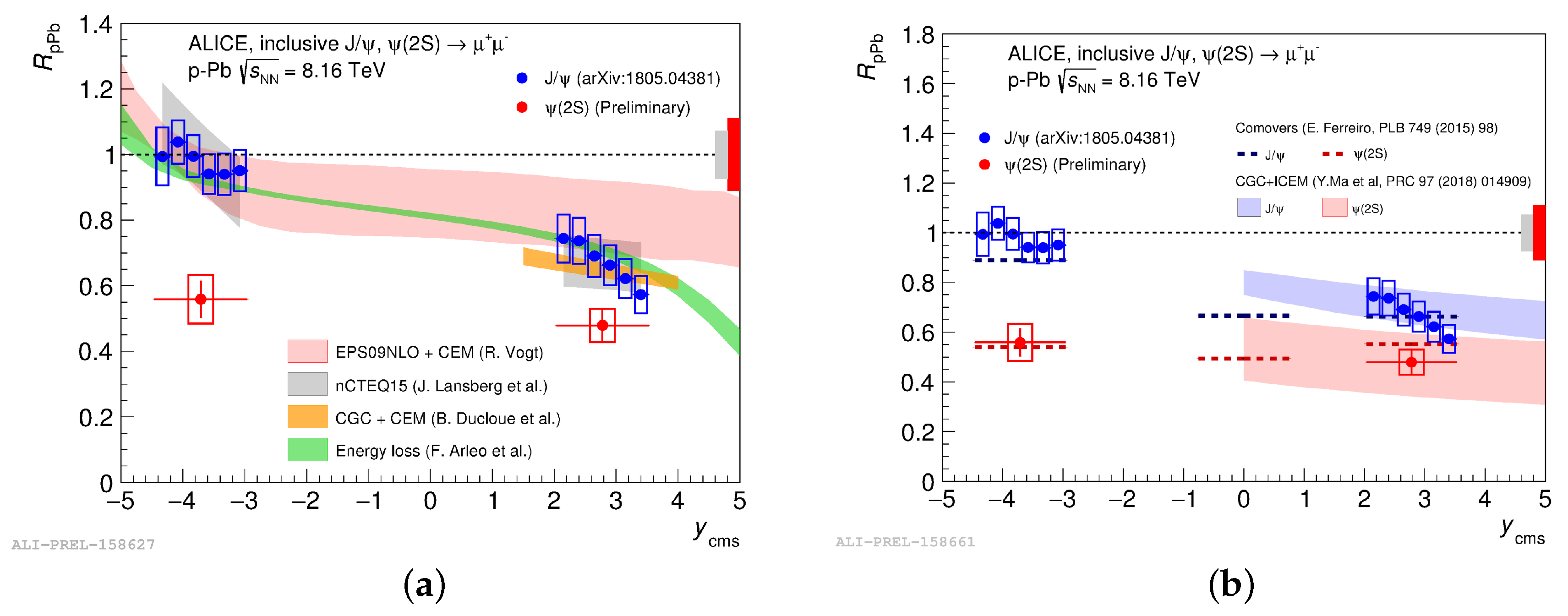
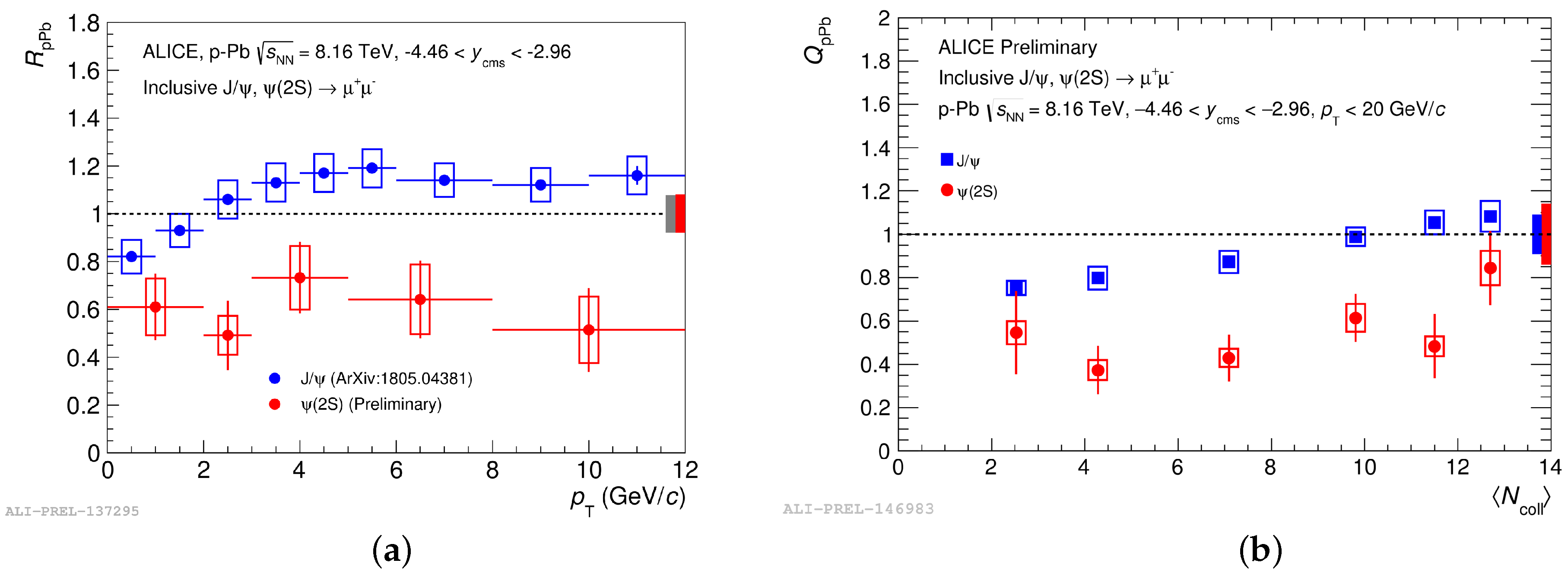
Data used for this analysis have been collected with two different beam configurations, obtained by inverting the direction of the orbits of two colliding beams. The ranges and are accessible, where positive rapidity corresponds to the situation in which the proton beam is going towards the Muon Spectrometer while negative rapidity refers to the situation in which the Pb beam is travelling towards the spectrometer. The two panels of Figure 1 show the as a function of rapidity for and which are compared with theoretical predictions. The difference between the results for the two resonances is significant, with an absolute difference of ∼0.2 in the forward rapidity region, while in the backward one it is ∼0.45. The sizeable statistics collected in proton-nucleus collisions allows for a differential study of the nuclear modification factor as a function of from 0 to 12 GeV/ and as a function of centrality in six centrality intervals. In Figure 2 the is shown as a function of and , the mean number of nucleon-nucleon collisions equivalent to one p-Pb collision, and in both the cases exhibits a rather constant suppression.
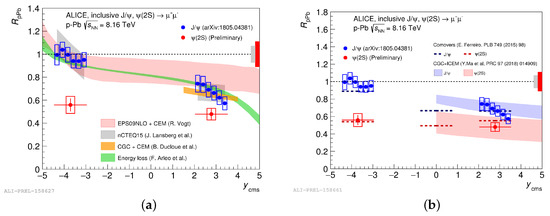
Figure 1.
Nuclear modification factor of and as a function of rapidity at 8.16 TeV in proton-nucleus collisions. Results are compared with theoretical predictions which include shadowing and energy loss (a) and models which implements final state effects (b), in particular the “comovers model” (dashed line) [5] and CGC+iCEM (coloured bands) [6].
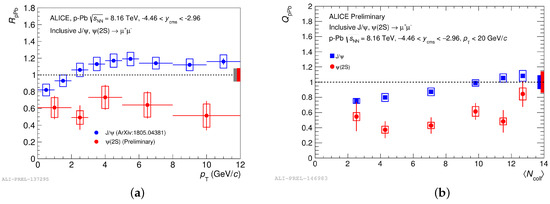
Figure 2.
Nuclear modification factor of and as a function of transverse momentum (a) and centrality (b) in the backward rapidity region at 8.16 TeV in proton-nucleus collisions.
From a theoretical point of view, and are expected to be affected in a similar way by cold nuclear matter effects, in particular shadowing and energy loss, because there is no sensitivity of these processes to the final quantum numbers of the charmonium state produced. In the left panel of Figure 1 the for the two resonances as a function of rapidity are compared with theoretical models which include only cold nuclear matter effects. While the of is in good agreement with predictions, the shows a large deviation from theoretical models in particular in the backward rapidity region. The nuclear absorption of charmonium in the medium cannot explain this effect because it is relevant when the formation time of the resonance is smaller than the crossing time of the colliding particles, which is not the case at 8.16 TeV. The anomalous suppression of the can be explained by models which include final state effects such as the interaction of the states with comovers. In general this term refers to particles produced in the collision which travel together with the pair and can dissociate it. Interaction with comovers would produce a larger suppression for than for , because of its lower binding energy. In the right panel of Figure 1 the of and is compared with two theoretical models which include the interaction with comoving particles and for both the resonances there is a significant improvement in the agreement.
3.2. Pb-Pb Collisions at 5.02 TeV
The energy density necessary for the production of the Quark-Gluon Plasma can be achieved in Pb-Pb collisions, where the main goal is to investigate the properties of the hot and dense medium that is formed in the interaction between the colliding nuclei. On the one hand, suppression effects are expected to be observed, on the other hand it is fundamental to understand what is the role of (re)generation. The hot and dense medium produced in the interaction is responsible for the suppression effect observed for and as a consequence the same color-screening mechanism is expected for , with a larger suppression given its lower binding energy. The limited statistics for does not allow extracting the signal for some centrality bins. In these cases a 95% confidence level has been evaluated using the Confidence Levels (CLs) method.
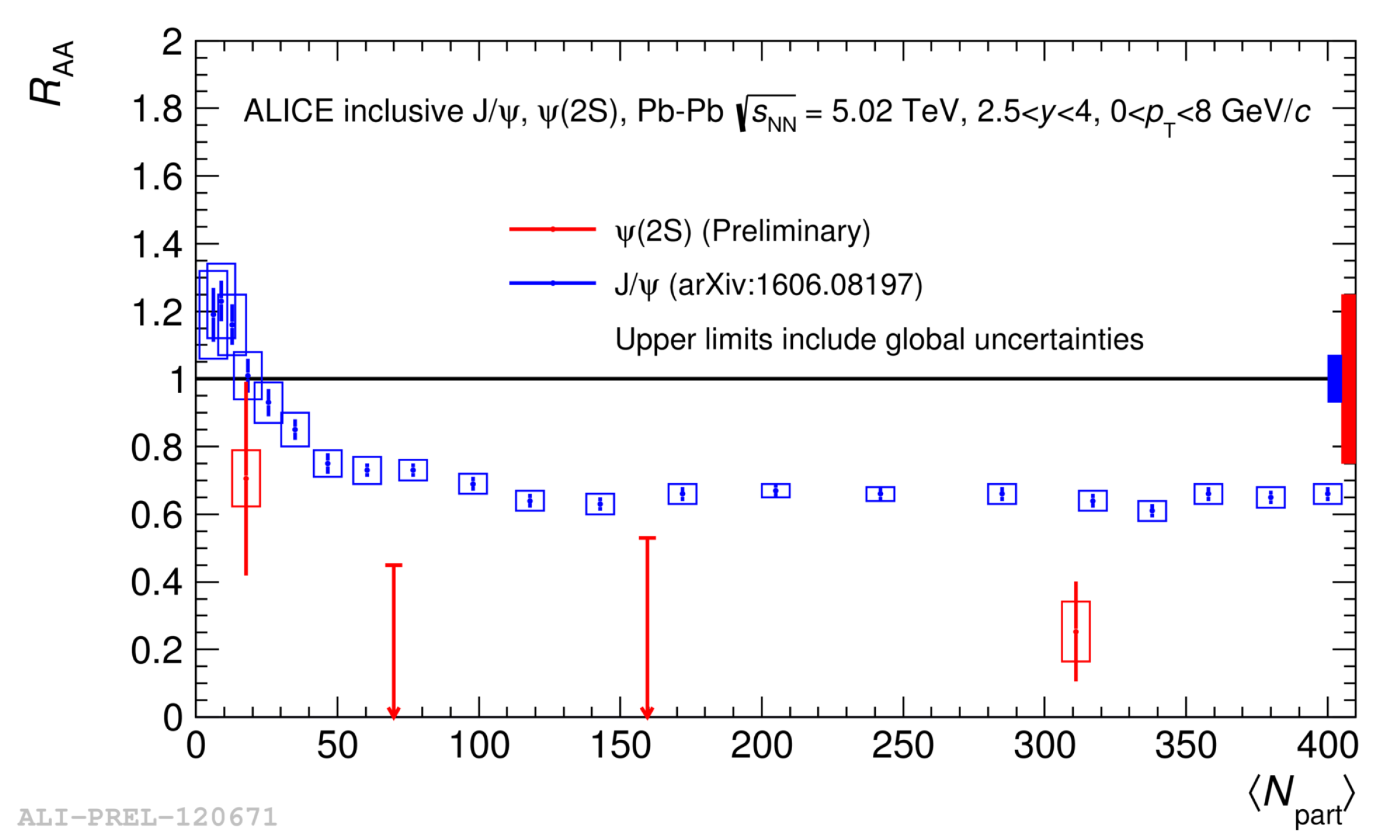
In Figure 3 the nuclear modification factor of is compared to the one as a function of the mean number of participating nucleons in the collisions, . Despite the large error bars, a stronger suppression with respect to is observed. As expected is more suppressed than , but at the same time it could be very interesting to understand if regeneration plays a role for as for . To answer this more data will be needed.
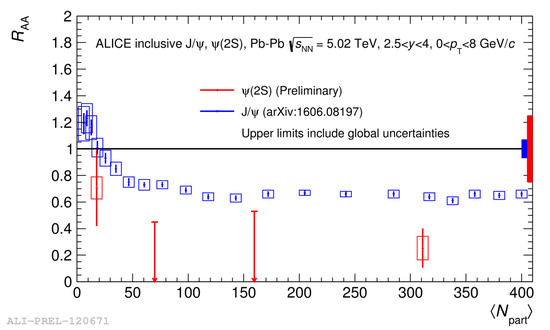
Figure 3.
The of compared to the same quantity for as a function of at 5.02 TeV. The vertical bars represent the statistical uncertainties while the boxes correspond to the systematic uncertainties.
4. Conclusions
In both collision systems under study exhibits a larger suppression than , which can be explained by the interaction with comovers for p-Pb collisions, and by color screening mechanism for Pb-Pb ones. One of the future goals is to collect a larger statistics, in order to improve the comparison with theoretical models, by reducing the uncertainties on the experimental points and extracting a signal instead of confidence intervals in Pb-Pb collisions.
References
- Matsui, T.; Satz, H. J/ψ Suppression by Quark-Gluon Plasma Formation. Phys. Lett. B 1986, 178, 416–422. [Google Scholar] [CrossRef]
- Arleo, F.; Kolevatov, R.; Peigné, S.; Rustamova, M. Centrality and pT dependence of J/ψ suppression in proton-nucleus collisions from parton energy loss. JHEP 2013, 2013, 155. [Google Scholar] [CrossRef]
- Aamodt, K.; Abrahantes Quintana, A.; Achenbach, R.; Acounis, S.; Adamová, D.; Adler, C.; Aggarwal, M.; Agnes, F.; Aglieri Rinella, G.; ALICE Collaboration. The ALICE experiment at the CERN LHC. JINST 2008, 3, S08002. [Google Scholar] [CrossRef]
- ALICE Collaboration. Performance of the ALICE Experiment at the CERN LHC. Int. J. Mod. Phys. A 2014, 29, 1430044. [Google Scholar] [CrossRef]
- Ferreiro, E.G. Excited charmonium suppression in proton-nucleus collisions as a consequence of comovers. Phys. Lett. B 2015, 749, 98–103. [Google Scholar] [CrossRef]
- Ma, Y.Q.; Venugopalan, R.; Watanabe, K.; Zhang, H.F. ψ(2S)/J/ψ suppression in proton-nucleus collisions from factorization violating soft color exchanges. Phys. Rev. 2018, C97, 014909. [Google Scholar] [CrossRef]
Publisher’s Note: MDPI stays neutral with regard to jurisdictional claims in published maps and institutional affiliations. |
© 2019 by the author. Licensee MDPI, Basel, Switzerland. This article is an open access article distributed under the terms and conditions of the Creative Commons Attribution (CC BY) license (https://creativecommons.org/licenses/by/4.0/).