


Spinwave propagation in yttrium iron garnet (YIG) films has a long history [1] but has recently attracted renewed attention due to the observation of an unusual coherent phenomenon [2] in a heavily pumped magnon gas in the backward volume geometry [3] where the spectrum displays a minimum. The effect has been termed Bose condensation or, from a more classical perspective, a Rayleigh-Jeans condensation. The time dependence of the observed behavior has recently been simulated and shown to arise from a dynamic equilibrium state of a classical magnon gas interacting through three and four magnon scattering processes [4].
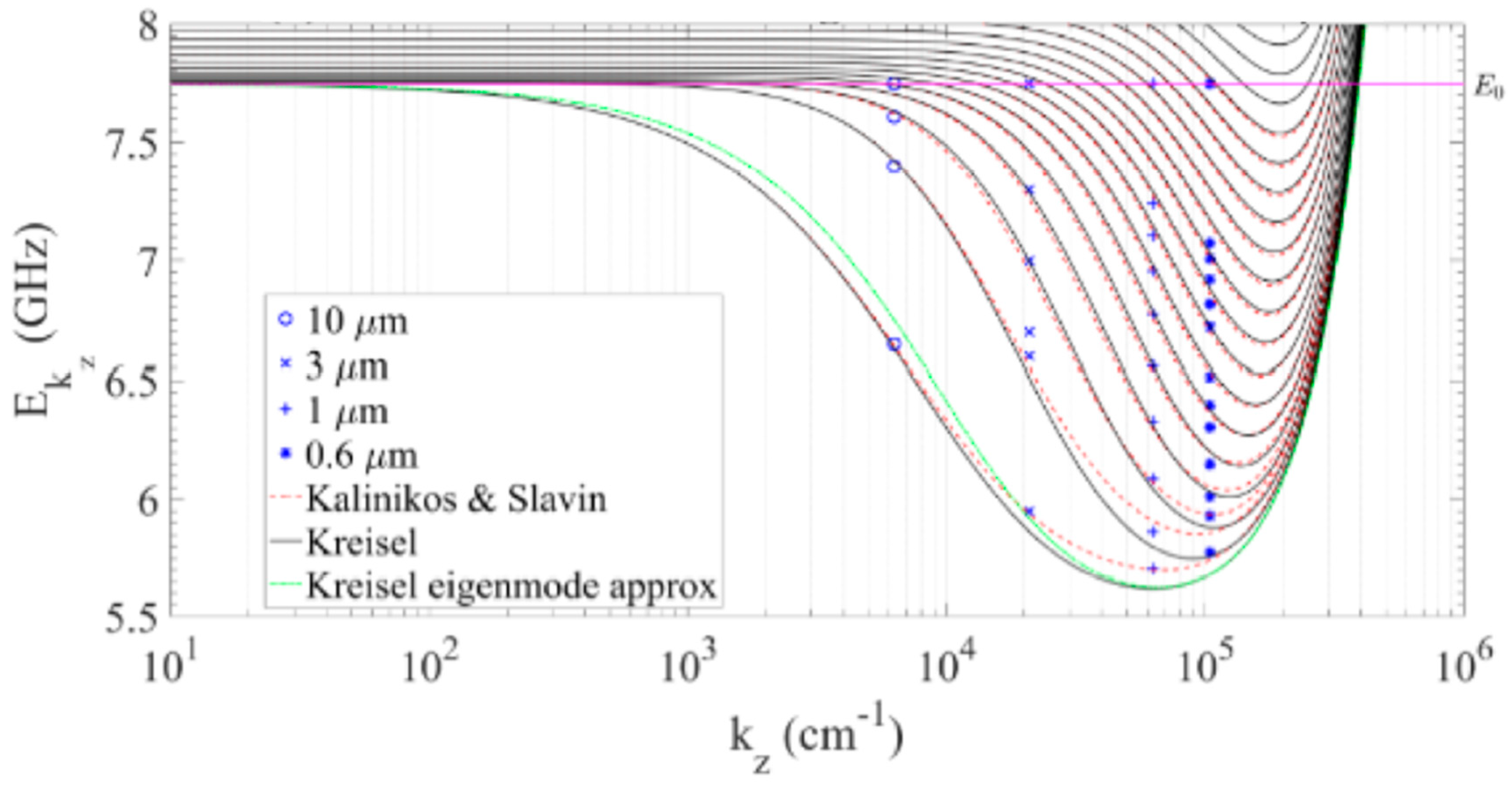
The measurements cited above utilized the Brillouin scattering technique which has the advantage allowing studies over a broad spectral range, but for which the resolution is limited. To better understand the properties of magnons in the vicinity of the minimum in the spectrum (where the condensation occurs) we have patterned a set of wave-vector-specific, multi-element, ”ladder” antennas, with which we can directly couple spin waves with micron and submicron wavelengths to a microwave generator and determine the resulting absorption. Our measurements, which are shown in the Figure 1, were carried out on a 2.84 micron film and have resolved the dispersion relations of multiple (ten or more depending on the wavelength) low lying backward volume modes for wavelengths of 10, 3, 1 and 0.6 microns. Overall the data are in excellent agreement with theoretical predictions based on a Heisenberg model Hamiltonian [5]. Data are also compared with solutions of Landau-Lifshitz equation that include both dipolar and exchange effects [6].
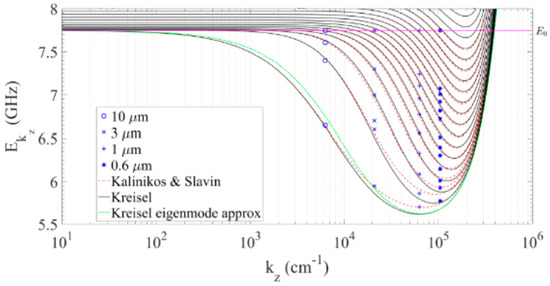
Figure 1.
Dispersion curves of magnons in a 2.4 micron thick film in the backward volume geometry.
We will also report our recent experiments in which we use our one micron antenna to detect coherent spin waves at the minimum which arise via a Suhl two magnon decay processes where we pump at twice the detected frequency; this is the first time such modes have been detected to our knowledge. Other parametric pumping experiments will also be described.
The techniques developed in this work now facilitate the characterization of spin waves at length scales limited only by available lithography and with a spectral resolution that greatly exceeds that of Brillouin scattering.
Dispersion curves of magnons in a 2.4 micron thick film in the backward volume geometry.
Acknowledgments
The magnetic resonance measurements were performed at Northwestern University under support from the U.S. Department of Energy through grant DE-SC0014424. Device fabrication was carried out at Argonne and supported by the U.S. Department of Energy, Office of Science, Materials Science and Engineering Division. Lithography was carried out at the Center for Nanoscale Materials, an Office of Science user facility, which is supported by DOE, Office of Science, Basic Energy Science under Contract No. DE-AC02-06CH11357.
References
- Serga, A.A.; Chumak, A.V. Hillebrands, B. YIG Magnonics. J. Phys. D Appl. Phys. 2010, 43, 264002. [Google Scholar] [CrossRef]
- Demokritov, S.O.; Demidov, V.E.; Dzyapko, O.; Melkov, G.A.; Serga, A.A.; Hillebrands, B.; Slavin, A.N. Bose–Einstein condensation of quasi-equilibrium magnons at room temperature under pumping. Nature 2006, 443, 430. [Google Scholar] [CrossRef] [PubMed]
- Damon, R.W. Eshbach, Magnetostatic modes of a ferromagnet slab. J. Phys. Chem. Solids 1961, 19, 308. [Google Scholar] [CrossRef]
- Rückriegel, A.; Kopietz, P. Rayleigh-Jeans condensation of pumped magnons in thin-film ferromagnets. Phys. Rev. Lett. 2015, 115, 157203. [Google Scholar] [CrossRef] [PubMed]
- Kreisel, A.; Sauli, F.; Bartosch, L. Kopietz, Microscopic spin-wave theory for yttrium-iron garnet films. Eur. Phys. J. B 2009, 1, 59. [Google Scholar] [CrossRef]
- Kalinikos, A.; Slavin, A.N. Theory of dipole-exchange spin wave spectrum for ferromagnetic films with mixed exchange boundary conditions. J. Phys. C Solid State Phys. 1986, 19, 7013. [Google Scholar] [CrossRef]
© 2019 by the authors. Licensee MDPI, Basel, Switzerland. This article is an open access article distributed under the terms and conditions of the Creative Commons Attribution (CC BY) license (https://creativecommons.org/licenses/by/4.0/).