


Abstract
Globally, effective and efficient healthcare is critical to the wellbeing and standard of living of any society. Unfortunately, several distant communities far from the national grid do not have access to reliable power supply, owing to economic, environmental, and technical challenges. Furthermore, unreliable, unavailable, and uneconomical power supply to these communities contributes significantly to the delivery of substandard or absence of qualitative healthcare services, resulting in higher mortality rates and associated difficulty in attracting qualified healthcare workers to the affected communities. Given these circumstances, this paper aims to conduct a comprehensive review of the status of renewable energy available to rural healthcare clinics around the globe, emphasizing its potential, analysis, procedures, modeling techniques, and case studies. In this light, several renewable energy modeling techniques were reviewed to examine the optimum power supply to the referenced healthcare centers in remote communities. To this end, analytical techniques and standard indices for reliable power supply to the isolated healthcare centers are suggested. Specifically, different battery storage systems that are suitable for rural healthcare systems are examined, and the most economical and realistic procedure for the maintenance of microgrid power systems for sustainable healthcare delivery is defined. Finally, this paper will serve as a valuable resource for policymakers, researchers, and experts in rural power supply to remote healthcare centers globally.
1. Introduction
Healthcare centers need readily available, reliable, sustainable, and accessible power supplies for effective operation. Unfortunately, in Africa and some other parts of the world, the majority of the people living in rural areas do not have access to basic amenities, including a reliable power supply. Moreover, the people living in such communities are classified as poor due to the high poverty index, poor infrastructure, and difficulty in accessing the remote terrain. In addition, another constraint for such people and communities is the lack of access to finances for businesses and markets. Furthermore, due to their locations and characteristics, an extension of power transmission lines to those remote places is usually very expensive and technically impossible in some cases. This unavailable power supply makes it difficult to have adequate healthcare centers available in those places. Unfortunately, those communities with available health facilities depend on fossil fuels, and their supply is becoming more difficult as a result of many regulatory and government policies [1]. In addition, power generation using fossil fuel resources is not clean and poses huge health issues [2,3,4].
Similarly, the world population is increasing, and hence the need for more penetration of healthcare facilities has globally increased. This increase in population will translate into a need for more energy. By extension, there are more healthcare clinics in rural areas, where a greater percentage of the world population resides. Unfortunately, recent predictions by the International Energy Agency (IAE) have shown that energy demand will increase threefold by 2050. These predictions by the IAE have catalyzed energy markets in many parts of the world [5,6,7]. Furthermore, one of the approaches to resolving the global energy need is to use renewable energy sources that are inexhaustible, available, and reliable compared to their fossil counterparts. Hence, there is a need to double the global installed energy capacity. This could help developing countries meet their healthcare energy demand, especially for rural health facilities. Due to this need, many countries across the globe have many targets for increasing the share of renewable energy.
It is clear that during and after the COVID-19 pandemic, the concept of healthcare access based on face-to-face contact between healthcare practitioners and patients is becoming absolute [8]. Furthermore, the world is focusing on the development of other alternative healthcare solutions for rural and underserved populations in the form of e-health, telemedicine, and virtual and mobile clinics to deliver healthcare. These systems have many advantages, such as better healthcare delivery, improvements in quality of service, effective and timely diagnosis, remote patient monitoring, remote assessments of medical conditions, two-way communication between patients, decreased patient appointment time, and healthcare providers, to mention just a few [9,10]. These services are possible with the help of the internet and available modern communication networks. These could resolve the problem of the unavailability of health care services for reasonable populations in both developing and underdeveloped nations. One of the solutions to some of the power shortages in healthcare facilities in remote places is the use of microgrids. Microgrid can be DC, AC, or a combination of both (hybrid mode), depending on the application. It can be single- or three-phase and sometimes be connected to low- or medium-voltage distribution networks [11]. In some cases, it can be operated in standalone mode. In each case, the system requirements differ in control, stability, reliability analysis approaches, etc. Microgrids are usually designed on a small scale with either solar, wind, or a combination of two or more sources.
Many research papers have designed microgrids for healthcare delivery in remote places. However, these papers did not establish an extensive overview and review, taxonomy, and technical design considerations for economical, technical, and reliable power supply to healthcare hospitals in developing countries. Furthermore, the existing reviews were not comprehensive and realistic ways of analyzing the renewable energy potential of the site under consideration. In addition, for the economical and realistic reliability of the power supply of healthcare systems, reliability analysis of each design is of critical importance. Unfortunately, the existing papers ignored this critical factor in the success of reliable power supply to healthcare systems in rural communities. Additionally, this paper proposes indices for the reliability study of renewable energy microgrids to ensure a reliable power supply. These factors, when considered in the design of future energy power supply to health facilities, will guide future research and stakeholders in remote health care service delivery globally. Given these, this paper’s key contributions include the following:
- A comprehensive overview and taxonomy of renewable energy microgrids.
- Detailed procedure on the feasibility analyses of renewable energy resources for electrical power generation.
- Extensive review and taxonomy on the design of electrical power for health care systems.
- A proposed system procedure for reliability studies of renewable energy microgrids suitable for health care services.
The rest of the paper consists of the following sections: Renewable energy resources available for health care applications are defined in Section 2. Section 3 is on battery storage for healthcare applications. A microgrid design procedure is presented in Section 4. Optimization approaches for sizing microgrid systems for healthcare clinics are presented in Section 5. The procedure for assessing the reliability of power supply for rural healthcare clinics is provided in Section 6. Section 7 is on the taxonomy of global health care systems. Modeling environment requirements suitable for healthcare microgrid systems are provided in Section 8. Future directions and lessons learned are presented in Section 9, and the conclusion to the paper is presented in Section 10.
2. Renewable Sources and Availability for Rural Healthcare
It is clear that once the system demand is known for the rural health care system, the next step is to determine the availability of renewable energy resources in the area under consideration. Rural healthcare systems located in developing and developed nations are connected to the national grid. On the other hand, standalone microgrids consisting of solar, wind, and small hydro for the supply of electricity to rural health facilities are usually found in the global south [11]. In this part of the world, the rural health care clinics are located where there is no national grid, too far from the grid, and the extension of the national grid could be economically or technically impossible. Therefore, a standalone microgrid is the best option for rural electricity supply. However, in some cases, even those clinics connected to the grid experienced acute shortages of electricity due to unavailable, unreliable electricity. Other reasons for non-availability could be conflicts and natural disasters, to mention just a few. Hence, the standalone/grid-connected microgrid could help rural health facilities function optimally, efficiently, and economically. Eventually, standalone power systems have the potential to run the healthcare systems during the peak period of electricity demand, in some cases when the national grid is not available or unable to satisfy the system’s electricity demand.
In addition, globally, it has been established that countries on the African continent are blessed with renewable energy resources. Therefore, when these potentials are used optimally, there is a high probability that the energy requirements of health clinics in rural areas of these countries can be met. This could assist in solving the energy needed to supply the heat facilities in these countries, thereby increasing accessibility to healthcare and meeting some of the sustainable development goals of 2030. The renewable energy available in abundance in this part of the world includes sunlight [12,13], biomass [14], water [15,16], and wind [17]. Unfortunately, due to some reasons, this part of the world could harness these resources optimally. Given this, the authors in [11] outline some of the issues to be used in comparing these sources of energy for the electricity supply of rural health care clinics, as outlined in Table 1.

Table 1.
Renewable options for rural healthcare in the global south.
2.1. Solar Energy Availability
Due to the availability of solar energy globally, it can be called a promising technology for rural healthcare, especially in countries with an abundance of solar energy. Technology can be divided into two categories. The two categories are those that convert sunlight into thermal energy and electricity directly in the form of direct current (DC). Both options are excellent opportunities for rural healthcare systems because the thermal systems of the healthcare clinics can be satisfied directly. On the other hand, the electricity requirement can be fed directly from the second option. This source of power is an excellent option for satisfying rural healthcare facilities, especially in the global south. In the African and Middle Continents, PV systems have been the best option for rural healthcare systems. Due to its inherent advantages on the continent. Furthermore, due to the high initial cost, rural health centers are still finding it difficult to install on many African continents. In the same way, oil-producing nations still supply rural healthcare facilities with fuel-based power systems. However, some countries have tried to use solar energy for their power supply. It is sad to note that some countries have higher solar energy potential than the solar energy giants of the world. A typical example is a World Bank report that has shown that Zambia has average horizontal solar irradiances between 5.5 Wh/m2/day and 6.3 Wh/m2/day compared to Germany (2.7–3.3 kWh/m2/day). Tanzania’s solar resources are between 4.5 Wh/m2/day and 6.21 Wh/m2/day. Rwanda experienced an average of 4.5 Wh/m2/day; in the same way, Haiti has a GHI of 5 to 8 Wh/m2/day. The availability of these resources is a clear indication that the rural healthcare facilities of global south countries can be satisfied if the solar energy resources of these countries are used optimally [18,19].
In addition, solar irradiance is the power per unit area received from the sun in the form of electromagnetic radiation in the wavelength range of the measuring instrument. Irradiance may be measured in space or at the Earth’s surface after atmospheric absorption and scattering. It is measured perpendicular to the incoming sunlight. This solar irradiance hits the surface of the earth in two forms, i.e., beam (Gb) and diffuse (Gd). The beam component comes directly as irradiance from the sun, while the diffuse component reaches the earth indirectly and is scattered or reflected from the atmosphere or cloud cover. The total irradiance on a surface is as follows:
G = Gb + Gd (beam and diffuse)
- For the Dual Axis:
Practical data on solar irradiance for a dual-axis sun tracker were collected. The data contain the solar irradiance value of a particular place from sunset to sunrise, which hourly averaged, and is denoted by I0. Incidental solar radiation is determined by the method of finding the slope from this hour-by-hour average data.
- For the Single Axis:
The solar irradiance value for a single-axis sun tracker is denoted by the following:
where δ = declination angle.
Solar Irradiance (I1) = cos (δ) ∗ I0
- For the Fixed Panel:
The solar irradiance value for a fixed panel is denoted by I2. The equation for calculating solar irradiance for a fixed panel is as follows:
where θ = hour angle and δ = declination angle.
Solar Irradiance (I2) = I0 ∗ cos (δ) ∗ sin (θ)
A mathematical model of the output power of the photovoltaic system (PV) is presented in this section. Many models are presented in the literature, depending on the available parameters. A model that uses many input variables is used in the analysis, such as temperature, number of series, and parallel connected cells. In the same manner, standard test conditions, light intensity, and the ambient temperature are assumed. The short-circuit current of the PV module is defined as follows:
Maximum-point current, open-circuit voltage, and maximum-point voltage are defined in (5)–(7).
where
- : PV output power;
- : solar radiation at standard test conditions;
- solar radiation from the operating point;
- : output power under standard test conditions;
- : PV cell temperature;
- : ambient temperature;
- : reference temperature of the model;
- : nominal cell operating temperature;
- : Boltzmann’s constant;
- : empirically determined diode factor for each cell;
- : normalized temperature for ;
- : temperature coefficient for ;
- : temperature coefficient for ;
- : empirically determined coefficient relating ;
- : empirically determined coefficient relating .
Equation (8) defines effective isolation as follows:
The thermal voltage per cell ( is given by the following expression:
Also, the temperature inside each cell ( is also defined as follows:
The output power of the solar energy conversion system is obtained in Equation (11).
Cumulative energy over a given period can be determined using the expression defined as follows:
2.2. Wind Resource Availability
The process of converting electricity from wind speed is performed with the help of a wind turbine. Electricity from the wind energy conversion system is dependent on the geography of the study area and resource availability [20]. Furthermore, the wind turbines used for this conversion are categorized according to their power ratings. Normally, for small communities, homes, and loads such as healthcare, wind turbines of rated power between 1 kW and 100 kW are used. On the other hand, higher-capacity wind turbines can be employed for both grid-connected and standalone microgrids. In the case of rural healthcare facilities, usually smaller wind turbines are used. Other issues surrounding applications of higher-rated power wind turbines are environmental concerns. Some countries with lower wind speeds cannot use wind energy conversion systems for electrical power production. Therefore, it is recommended that countries with wind speeds between 5 and 7 m/s at 50 m height are suitable candidates for standalone electricity generation, including health centers, as shown in Figure 1.
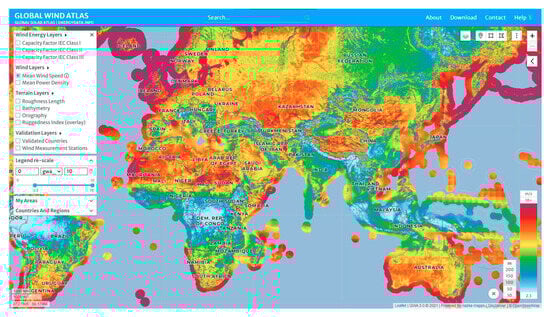
Figure 1.
Wind speed and wind power potentials.
The power output of a wind energy-generating system is a function of the three wind speeds, resulting in different design alternatives. The wind speeds include the cut-in speed (the cut-out speed ) and the rate speed of the wind turbine (). The wind speed and output power are linearly approximated in the range as shown in Figure 2.
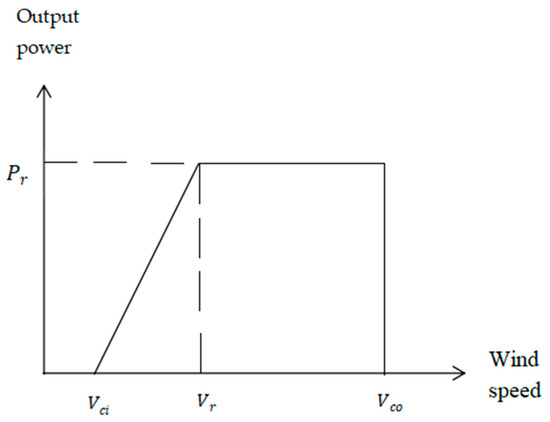
Figure 2.
Linearized curve of a wind turbine.
After the random distribution is obtained, the power output of the wind energy conversion system is expressed as a function of wind speed.
is a constant. The output power can be determined as a piecewise linear relationship of the rated capacity. Therefore, the rated capacity of the wind energy conversion system can be used as a decision variable. Finally, the model decides on the capacity for each design.
3. Battery Storage Systems for Healthcare Power Systems
Battery storage systems perform many functions in power systems. Some of the functions include storing excess energy when the output power from renewable energy sources is greater than the clinical demand. Another application is peak shaving, which also provides energy during outages for grid-connected and standalone microgrids. Therefore, battery storage systems can be used to increase power system reliability, especially for grid-connected microgrids. The battery storage options used for healthcare applications are highlighted briefly in Table 2. The attributes of these battery storage systems are shown in the same table. Some of them are mature for storing electrical energy, while others are still under experimentation and therefore not suitable for commercialization. The major batteries used for healthcare systems in the global south are lithium, lead-acid, nickel, and sodium battery storage systems. However, to achieve the system requirements of higher power and energy densities, it is clear that a compromise has to be reached to meet rural healthcare clinics’ requirements of high reliability and availability [20].
Table 2.
Battery storage options for rural healthcare facilities.
4. Design of a Renewable Energy Microgrid for Health Centers
To design a microgrid for power generation in rural health systems, there are basic steps involved in the design. These include renewable energy potential analyses of the site, sizing of the system components, and analysis of the system demand. In this section, approaches used in the analysis are presented. In order to achieve site potential, analyses of the renewable energy resources and some of the probability distribution functions are normally used, as presented here. Eventually, the next step is the selection of the best among them that accurately represents the renewable energy potential of the site. This is normally achieved with the help of error analysis and some goodness-of-fit tests presented in this section. The second stage is the development of an optimization model for the microgrid under consideration. After the development of the model, various optimization functions are used for the determination of the component sizes, as presented in the section below. However, the majority of the design of the microgrid stops after optimization without due regard to the reliability analyses of the designed microgrid. This procedure is well-detailed in the section below. When all these are combined in the design of the healthcare microgrid, it is clear that the designed system will be optimal.
4.1. Energy Demand of Rural Health Care Clinics
According to the definition of rural health clinics by the United States Agency for International Development (USAID), rural health clinics can be defined as category A. According to the agency, category A is a health clinic for rural areas that is characterized by some limitations in staffing and limited medical services. Therefore, these types of health centers needed electricity for lighting and simpler medical surgical procedures, refrigerators for storing vaccines, and other medical essentials. This means that the basic electricity requirement is for powering the hematology mixer, centrifuge, and microscopes. The power rating of this class is usually between 5 and 10 kWh/day. Furthermore, category B’s power rating is between 10 and 20 kWh/day. Finally, category C usually has some more complicated power-consuming equipment that needs more power. In this regard, the power requirements of these rural health centers are usually between 20 and 30 kWh.
4.2. Probability Distributions
Renewable-energy resource assessment is usually carried out using probability distribution functions. Unfortunately, the commonly used models are Weibull, gamma, and Rayleigh distributions. Other probability distribution functions that can be used more for these analyses include lognormal, gamma, beta, and logistics distributions. More details on each of these distributions are explained in Section 4.2.1, Section 4.2.2, Section 4.2.3, Section 4.2.4, Section 4.2.5 and Section 4.2.6.
4.2.1. Weibull Distribution Function
Several works in the literature have confirmed that this model is the most widely used mathematical model. Presently, the Weibull distribution is one of the most widely used probability distributions in renewable energy analyses. Many papers have defined this distribution function, and the mathematical model can be expressed in Equations (15) and (16) [21].
Also, the cumulative distribution (DF) function is expressed as follows:
where = scale parameter and = shape parameter.
Due to the dependence of this distribution function on c and k parameters, it is well established that accurate modeling using this function is a function of these variables. Given this, there are many methods used to determine these parameters; one such method is the standard deviation method, as presented in Equations (3) and (4).
Once probability density functions are determined, the next stage is the determination of the c and k parameters. It is important to note that the accuracy of fitting Weibull functions to the renewable energy resource data is a function of the c and k parameters. These parameters can be obtained using many available techniques in the literature. One of the methods is called the method of moments [21]. If these parameters are to be determined using this method, Equations (17) and (18) can be used as follows:
where is the standard deviation and is the mean element of the sites.
The next step is the determination of the site power density as a function of the c and k parameters. Hence, the next step is the presentation of Weibull average power as a function of these parameters. In this case, power can be presented in Equation (19).
where is called the gamma function.
The same presentation can be extended for the average site parameters as a function of the c and k parameters. This expression is shown in Equation (20).
4.2.2. Rayleigh Distribution
Another model of interest to renewable energy system designers is called the Rayleigh distribution model, and the corresponding mathematical expression is shown in Equation (21) [22].
where m is called the average of the parameter.
In a similar way, the Rayleigh cumulative density function can be defined by the following expression:
Equation (23) defines the variance of the Rayleigh distribution as follows:
Therefore, the average power can be expressed through Equation (24).
Note that when k = 2, the Weibull distribution becomes the Raleigh distribution. In this regard, the mean of this model is as follows:
Also, it can be shown that the wind power density can be defined as follows:
4.2.3. Gamma Distribution
In this model, shape α and scale β parameters are the elements that define the gamma density function as follows:
The cumulative distribution function can be defined as follows:
where = gamma function.
Using a similar transformation, the power can be shown as a function of the c and k parameters, as presented in Equation (29).
4.2.4. Lognormal Probability Distribution
In the case of the lognormal distribution function, a random number is defined such that the logarithm is normally distributed with a mean and corresponding standard deviation, defined as and , respectively. The lognormal distribution can be applied once the natural log transformation results in a normal distribution. Mathematically, the corresponding density function of is defined in Equation (30) [22].
where and are the mean and variance of the distribution defined in Equations (31) and (32), respectively [23].
4.2.5. Beta Distribution
The beta distribution function is usually used to model the uncertainty of some event with parameters . The corresponding density function is defined in Equation (33) [24,25].
The mean of this distribution is given by the following expression:
The variance is defined in Equation (35).
The mathematical models for the determination of and are given in Equations (36) and (37), respectively.
Also,
where is the mean.
4.2.6. Logistic Distribution
A logistic distribution has a curve that is symmetrical about the mean of the data and is defined mathematically as follows [26]:
where is the mean and is the scale parameter of the distribution calculated using Equation (40).
4.3. Goodness of Fit
When a forecast is carried out, there is a need to compare the theoretical and forecasted results. Given this, there are standard models developed for this purpose. Some of the models are a coefficient of determination and root mean square method, as presented in Equations (41) and (42) [27,28,29].
4.3.1. Root Mean Square Error (RMSE)
Annually, the average error can be defined as follows:
where = power density from the assumed probability density function and = actual site power density.
To compare the actual and predicted power densities, Equations (41) and (42) can be used. The closer the error is to zero, the better its fitness for predicting the power of the site.
4.3.2. Kolmogorov–Smirnov Test
Mathematically, it is assumed that the sample consists of from the same distribution of the cumulative distribution function . This test is to check the weather and decide on the continuity of the distribution. The Empirical Cumulative Distribution Function (ECDF) is defined as follows:
This test uses the largest vertical difference between the density function and the theoretical value. Mathematically, this is defined as follows [27,28,29]:
4.3.3. Anderson–Darling Test
The Anderson–Darling test () can be defined as a procedure that compares the cumulative distribution and the expected cumulative density function of the same distribution, as defined in [27,28,29]. The test tends to give more weight to the tail in comparison with the Kolmogorov–Smirnov test as expressed in Equation (45).
4.3.4. Chi-Square Test
The chi-square test is defined as the test that is carried out to confirm that a particular sample comes from a particular probability function [24]. This test is written as follows:
where is the observed frequency, while is the expected frequency that is defined in Equation (47).
where = distribution function and the upper and lower limits of the bin are defined as and , respectively.
5. Optimization Approaches for Sizing Microgrid Systems for Healthcare Clinics
It has been established that, till today, a significant number of communities are not connected to the national grid. This neglect is making healthcare in such communities a serious setback in achieving healthcare for all. Therefore, to achieve the sustainable development goal of the United Nations, there is a need to take the issue of rural electrification very seriously. In this paper, it’s clear that one of the best approaches to resolving healthcare electricity access is through the use of renewable energy resources onsite. Therefore, this section presents a comprehensive design approach and reliability studies of such systems. The need for understanding is because if such systems are not designed properly, there is a probability that healthcare accessibility in rural areas will not see the light of day in the near future. Furthermore, the need to optimally size the resources is critical for cost, reliability, and environmental concerns [30,31,32,33,34]. Also, the comprehensive advantages and disadvantages of each of the techniques from a sizing point of view are shown in Table 3.
Table 3.
Advantages and disadvantages of the sizing techniques.
5.1. Conventional Approaches
In most cases, the system designers use trial and error. Therefore, the design approach here is usually based on experience. In this case, after the components are assembled, issues arise, such as cost, battery degradation, and the unavailability of the power supply. This could be a serious issue in developing countries where health facilities are located in remote locations [19,35].
5.2. Ampere Hourly Method
In this method, usually an Excel sheet is used to determine the system component sizes. The method is simple, and therefore all component-rated power ratings are multiplied by the hours needed to be in operation per day. Other factors used in the calculations in some cases are losses and battery cycling. System designers also determine storage capacity by considering autonomous days, usually between 3 and 7 days, arbitrarily. An example of sizing renewable energy systems can be seen in [36,37,38]. Unfortunately, this method can lead to oversizing or undersizing of components. This method of design has many drawbacks, such as the inability to consider weather variations and environmental issues in the design [39].
5.3. Trade-Off Technique
This method is proposed to design a renewable energy system by developing a simple database such that all possible combinations are defined. In this case, the system can be simulated under different conditions of operations that could happen in the future. The simulations allow system designers and decision-makers to decide on the final design option. Unfortunately, the current power requirements of rural electrical loads and inclusive health centers are more advanced. Therefore, the system requirements are nonlinear, and optimal solution determination is time-consuming, complex, and cumbersome. Therefore, classical techniques might not be suitable [40,41,42].
5.4. Classical Techniques
Classical techniques depend on calculus and the applications of calculus to determine the optimum sizes of components. These methods are used for the hybridization of renewable energy systems. Examples of the method include linear programming, nonlinear programming, and dynamic programming. In all of them, linear programming is the base; others could be driven from it. Therefore, it has the following format, consisting of objective functions and constraints [43,44].
where, , , , , and are vectors, and and are matrices.
Mixed-integer programming is used when all or some of the decision variables can be integer values. The problem formulation can be presented in the following format, consisting of the objective function and constraints in the following format [45].
where and is an integer .
In addition, when the objective function or one of the constraints is nonlinear, the optimization problem can be formulated as a nonlinear problem with the general structure presented below. This optimization problem is based on Newtonian or Lagrangian techniques [46].
Moreover, it is then subjected to the following:
where some terms in the constraints or are non-linear.
5.5. Biological Techniques of Sizing Microgrid
This classification can be classified into three major techniques, including swarm intelligence, artificial neural networks, and evolutionary techniques.
5.5.1. Particle Swarm Optimization
In 1995, Kennedy and Eberhart developed a technique that is capable of solving complex optimization problems based on the social interaction concept. The technique has been successful in solving complicated mathematical problems; as a result, many problems, such as the size of renewable energy systems, are resolved using this method. The key element of this method is that each particle is represented using velocity and position. In this regard, the velocity and position of each particle can be defined as follows:
where
- and are the jth components of the ith particle’s position and velocity vector, respectively;
- and are the acceleration coefficients;
- and are uniformly distributed random numbers between 0 and 1;
- xbest(i) is the best position of particle i until iteration k;
- gbest is the best position of the group;
- k is the constriction factor.
5.5.2. Genetic Algorithm
A genetic algorithm is a process capable of optimizing a system through the use of natural selection. It was developed by John Holland. The basic steps involved in achieving the solution are inheritance, selection, crossover, and mutation. The process has major building blocks, namely random number generation, fitness, reproduction, crossover, and mutation processes, as shown in Figure 3 [47,48].
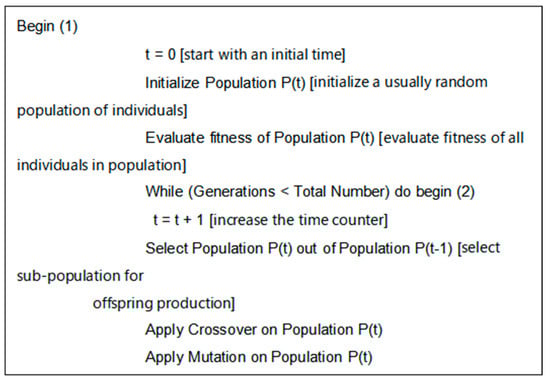
Figure 3.
Genetic algorithm.
5.5.3. Artificial Neural Network
It has been established that one of the characteristics of a smart microgrid is the ability to forecast the future of the system conditions. Therefore, the sizing of renewable energy microgrids needs an optimization model that can make future predictions, and therefore, ANN is a good candidate for such a situation. Future predictability is critical for power system planners and operators to make necessary changes that could prevent unreliable power supply or unavailability. Therefore, ANN can predict the situation in the hours or days ahead [49]. Also, it can handle noisy and incomplete data with suitable training to perform other tasks such as identification, forecasting, modeling, and control of power flow in the system. The general architecture of the ANN is shown in Figure 4. Furthermore, the general classification of the optimization techniques is shown in Figure 5. Some examples of sizing microgrids are presented in Table 4.
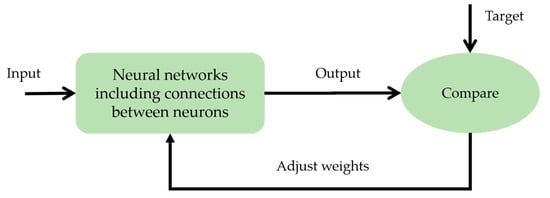
Figure 4.
Artificial neural networks.
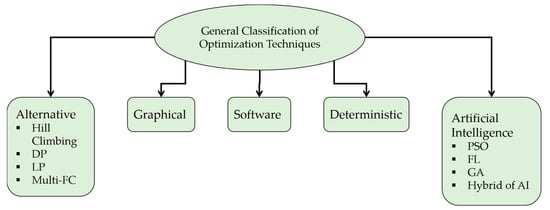
Figure 5.
General classification of optimization techniques.
Table 4.
Microgrid sizing with emphasis on objective function and mathematical models.
6. Reliability of Power Supply for Rural Healthcare Clinics
Rural healthcare electricity grid reliability is expected to be high at all times, which presents a critical part of the system design and is paramount to system designers and practitioners. This can be achieved if the stakeholders consider it at the design stage. However, this can be possible if a better definition is proposed and the correct metrics are used in the design. Therefore, there is a need to define the most sensible element guiding the reliability study of this part of the network. In this paper, the reliability of rural health clinics can be defined as the possibility of supplying electricity to the clinics over a period designed under defined system operating conditions without failure. Therefore, for a health clinic microgrid power system to be reliable, it is expected to be adequate and secure from the power system point of view. The essence of the reliability study is to establish the performance of the system against some standard and to determine the ability of the system to provide the minimum required power to the health center. Given this, certain indices are used. However, it is important to note that most of the papers in the literature do not classify the studies at different stages of the system. Therefore, it is also important for the system designers to separate reliability indices at different levels of the network. This could allow for critical understanding and maintenance strategy development of the microgrid system [60,61]. This would significantly improve the reliability of the system. In this paper, the indices are defined as the loss of power supply probability [62].
where ET (t) is the total energy generated by the source.
where
- L: the expected load;
- CA: available system generation capacity;
- Cj: remaining system generation capacity;
- Pj: probability of a system capacity outage;
- P: probability;
- tj: % time when the system demand exceeds Cj.
6.1. System-Level Reliability Indices of Microgrids
There is also the need to define indices at the system level of the microgrid. Understanding them can be a source of energy problems for healthcare microgrid power systems. The indices can be defined in Equations (59)–(67). Also, the flow chart shown in Figure 6 can be used for the analysis of these indices as defined in DigSilent [63].
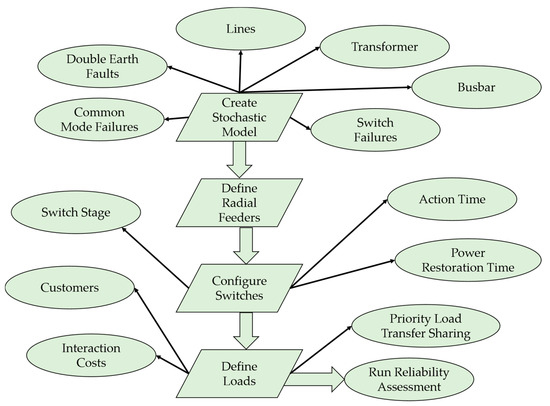
Figure 6.
Procedure used in the reliability assessment of a microgrid.
Systems Average Interruption Frequency Index (SAIFI):
Customer Average Interruption Frequency (CAIFI):
Average System Interruption Frequency Index (ASIFI):
The average duration a customer experienced interruptions for one year is called SAIDI.
Customer Average Interruption Duration Index (CAIDI):
Average System Interruption Duration Index (ASIDI):
Average Service Availability Index (ASUI):
Average Services Availability Index (ASAI):
Average Customer Curtailment Index (ACCI):
6.2. Maintenance and Reliability Indices
At the maintenance level of the system, four indices should be used in the analysis for a realistic design of the microgrids. Unfortunately, none of the research papers have explored the reliability studies of healthcare microgrids at system levels. However, the systems could not be reliable and were sometimes unavailable due to approximations in the reliability studies at system levels. Given these, these papers propose indices to be taken into consideration while designing microgrids. These indices include Barbiums, criticality, network reliability achievement, and network reliability reduction [64,65,66,67,68,69,70]. These indices are defined in Equations (68)–(71).
The Barbiums index is a measure for measuring component importance to system reliability failures as defined in Equation (68).
Criticality index is a measure that can help system designers understand the contributions of particular components or blocks to the reliability improvement of the entire microgrid, given mathematically as follows:
The reliability achievement model is for the establishment of the component responsible for the entire system failure at time t, as presented in Equation (69).
Network reliability reduction is important to determine the increment in system reliability due to a particular component or subsystem of the microgrid structure, as defined in the following equation:
7. Taxonomy of Proposed Energy Sources for Healthcare Facilities
The taxonomy in Table 5 shows that several works have proposed a hybrid version of power supply for healthcare facilities, which is mostly comprised of solar, wind, diesel generators, and battery storage, and only a few works suggest the use of solar-standalone power sources. The majority of the work is conducted in rural areas of many countries, where the energy supply can be inconsistent and healthcare access is a critical concern. Additionally, it can be seen that most of the works utilized Hybrid Optimization of Multiple Energy Resources (HOMER) to conduct simulation and analysis of their proposed system design and implementation.
Table 5.
Related literature on the sizing of healthcare microgrids.
Furthermore, it was stated in [114,115] that over the past three decades, coinciding with the rapid expansion of the global economy, there has been a substantial surge in energy demand. Projections indicate that from 2015 to 2040, there will be an estimated 30% increase in global energy consumption. In response to this escalating demand and to mitigate the adverse environmental effects associated with fossil fuels, there has been a noteworthy emphasis on exploring renewable energy sources (RESs) like solar, wind, and hydropower. In the year 2022, many nations implemented policies aimed at fostering the advancement of renewable energy.
At present, approximately one-fourth of the world’s electricity is derived from renewable sources. Notably, hydropower stands as the most prevalent RES on a global scale, closely trailed by wind and solar power, both of which are experiencing rapid expansion. Careful observation in the table above has shown that many of the proposed renewable energy power supply systems were left at the design stages [116]. One such system is the design of a renewable energy system for Chennai, a smart city in India. It has been established that the proposed system can satisfy the proposed system demand. The study recommends a hybrid microgrid consisting of wind, PV, and DG as the best option using HOMER software.
It is worth noting that realistic planning of renewable energy systems, especially in the health care section, requires a technical understanding of battery storage systems, as explained in the previous section. Furthermore, some of the storage systems need further studies and more in-depth analyses to be suitable for healthcare applications. Other areas of concern to the system designers include environmental concern, storage capacity, and size, to mention a few [117].
Authors in [118] have shown that in sub-Saharan Africa, a huge gap has been observed in health care provision. However, if realistic planning is considered and investments in a power supply are holistically carried out, nearly 281 million people could have access to healthcare and reduce travel time. In the same vein, the cost estimate for the provision of about 50,000 health facilities in the region is approximately 484 million euros. The analysis has shown that renewable energy systems could provide a clean, reliable, and economical way of solving the electricity requirements of the region.
It can be discovered from the reviews above that the hybrid system is the most recommended. However, solar cannot be useful on a rainy day, just as wind cannot be useful on a calm day. Fossil generators, too, can be reliable, but they are also expensive. Hence, adding a battery storage system to the health care facility microgrids is recommended for reliable and economical power supply to the systems.
8. Characteristics of Modeling Tools for Realistic Sizing of Healthcare Center Energy Requirements
It is evident in the literature that there are various techniques and modeling tools for sizing renewable energy microgrids for health applications. However, specifically due to the requirements for reliability, availability, and sensitivity of healthcare load systems, a tool suitable for modeling such a type of load needs to meet certain requirements as presented in Section 8.1, Section 8.2, Section 8.3 and Section 8.4.
8.1. Ability to Represent the Variability
This is important because future energy microgrids are expected to integrate all possible renewable energy resources; therefore, the modeling tool should be able to represent the renewable energy resources in realistic ways, considering a reasonable time scale from seconds to years. Spatial resolutions and statistical representations are also characteristic requirements of such tools.
8.2. Renewable Base Power Generation
Decarbonization of society is one of the sustainable goals, however challenging. One of the simplest is the replacement of the conventional system of power generation with renewable energy. This can be achieved by using a more renewable energy mix to supply other essential loads, such as health systems. Furthermore, this method could allow for more penetration of intelligent power systems, which is a basic requirement of healthcare feeders. This technology could give health facilities and equipment access to clean energy for electricity, heating, and laboratory needs in hospitals for present and future generations.
8.3. General System Benefit
In addition to the electricity supply to the health centers, the proposed utilization of renewable energy systems could assist society in achieving one of the sustainable development goals by 2030. In this regard, renewable energy could be a catalyst for resolving the missing link between many attributes of an ideal society. These attributes include climate, health, quality water supply, and land use, to mention just a few.
8.4. Validation of the Results
It is important to understand the need for the modeling tool/environment to be testable and verifiable. This attribute is critical, such that system designers and stakeholders should be able to test the results and verify all the results obtained as a result of various design options. This is important to ensure the validity and accuracy of the results. Therefore, there is a need for this stage to avoid overestimation or underestimation of the system parameters designed.
9. Future Directions and Lessons Learned
This section presents the lessons learned as a result of the presented overview on the realistic application of the procedure for the achievement of higher penetration of renewable energy resources in the area of health care, especially for rural clinics.
9.1. Inaccurate Load Modeling Techniques
It has been clear from the papers reviewed that many of the research papers estimate load based on power rating and operating hours. However, this technique could lead to oversizing or undersizing of system components. Eventually, the microgrid design might not be optimal due to this shortcoming. To resolve the situation, the system designers need to consider the variation of the system demand because, in health centers, some equipment or parts of the system consume power even while in standby mode. In addition, this approximation led to higher costs for healthcare microgrids.
9.2. Lack of Optimal Sizing
One of the purposes of proposing a renewable energy system in health facilities for power supply is to supply power to critical loads and the entire health center at the lowest cost. Unfortunately, without a realistic sizing approach, this global shortage of electricity supply to these facilities might not see the light of day in the near future. Furthermore, due to the approximations introduced at the design stage, there is a need to design the system most economically; this is possible if all the design variables are considered during the design of the microgrid. One of the factors that need to be considered is weather and load variations in the design of the microgrid. Furthermore, critical loads should be considered in the design of such systems. Hence, it is important to use artificial intelligence techniques in the sizing of renewable energy for healthcare applications to supply electricity at minimum cost.
9.3. The Need for Reliable Power Supply
This paper focused on the health care facilities supplied with reliable power supplies. Unfortunately, developing countries with acute shortages of electricity could not extend the grid to rural areas where health centers are located. This makes it difficult to attract qualified personnel to the local areas. Also, the availability of medical services in those areas is increasing. This research has shown that energy in rural health facilities is one of the critical elements of achieving universal health care globally. Therefore, without reliable electricity in health clinics, it has been established that life-saving health services will be impossible. This universality in universal health accessibility is defined as one of the sustainable development goals. Finally, many of the health centers lack basic power supplies such as lighting, diagnosis, communication, and other complicated medical equipment. Furthermore, laboratory service will be unavailable or inadequate due to the absence of a reliable power supply. Other services that will be unavailable due to the shortage of electricity include surgery, intensive care unit services, and the safekeeping of medics.
9.4. The Need for Realistic Reliability Studies of the Developed Models
It has been established from the literature that the majority of the papers on the design of microgrids designed for health facilities do not consider reliability analyses of the design. Thereby making the design unrealistic and sometimes uneconomical. Therefore, this paper proposes the reliability analysis of healthcare microgrid systems, considering component, system, and load point reliability before a final realistic design is achieved. Also, comprehensive reliability analyses considering the demand and supply of the expected health facilities are important.
9.5. Development of Maintenance Strategies
Strategies need to be developed on how electricity access and availability could be enhanced in rural communities so that access to health care can be improved. This will assist in the delivery of health care and improve access, thereby decreasing the mortality rate, especially in developing countries. Others include health and safety, staff retention and recruitment, logistics, and administration.
9.6. Applications of Artificial Intelligence Techniques for Rural Healthcare Applications
Due to the complexity of the future energy grid, it is becoming unrealistic to perform complex tasks without switching to soft computing techniques. Unfortunately, the design of microgrids for healthcare applications is a complex task. Therefore, it can be established here that for realistic sizing of microgrids suitable for medical microgrids, there is a need to use the new domain of complex optimization techniques. Furthermore, it has been established that most of the complex analysis that requires intelligent work is occurring in the field of soft computing. Also, due to certain automation requirements, a lot of researchers are proposing many solutions to problems related to electricity supply to rural healthcare clinic systems using soft computing techniques. Some of the recent soft computing techniques are neural networks, genetic algorithms, and fuzzy logic techniques. In summary, some soft computing techniques and areas of application in renewable energy conversion systems are presented in Table 5.
Fuzzy logic is applicable in MPPT pitch angle controls and power predictions. ANFIS models have been applied to forecast renewable energy systems’ output power at the regional level. Power factor predictions, power factor optimizations, and pitch angle determinations of wind energy conversion systems can be achieved using genetic algorithms. Another model is ANN, which finds applications in power prediction, online power predictions, short-term renewable energy predictions, and sometimes fault detection in systems. More details about them can be seen in Table 6.
Table 6.
Applications of soft computing models to renewable energy conversion systems.
10. Conclusions
Hospitals in rural areas of developing countries are performing below expectations due to unavailability and unreliable power supply, resulting in poor health care and health-related services. In practice, it is difficult to attract qualified personnel due to difficulty in supplying the needed sophisticated equipment, unrealistic diagnoses, and poor equipment handling, leading to higher mortality rates in those communities. All these problems are attributed to an unreliable power supply that needs to be addressed urgently. This paper reviews the current state of power supply to these remote communities and presents realistic and reliable strategies for available power supply to cater to the power supply needs of health centers in remote communities. Specifically, the methods for renewable energy resources are critically analyzed, and the accompanying optimization models are elaborated. In addition, the maintenance strategies for reliable and economical power supply to those health facilities are assessed comprehensively. Key findings from the study reveal that power supply for health centers is based predominately on sizing. Also, the study showed that existing tools used for renewable energy resources for rural health care microgrids are based on trial-and-error methods, resulting in extensive time consumption and prohibitive costs, posing serious challenges to effective power supplies for rural healthcare systems. Another challenge that system designers often ignore in the design of rural healthcare power supplies is the development of systematic reliability analysis models. This paper exposes the gaps in renewable energy power supply for rural health clinics in Africa and beyond. Last, the paper provides a technical and professional guide to researchers, policymakers, and practitioners in the area of power supply, especially for rural healthcare centers.
Funding
This work is funded by the Federal Republic of Nigeria under the National Research Fund (NRF) of the Tertiary Education Trust Fund (TETFund) Grant No. TETF/ES/DR&D-CE/NRF-2021/SETI/ICT/00112/VOL.1.
Acknowledgments
The authors thank the reviewers for their valuable comments which help to inprove the quality of the manuscript.
Conflicts of Interest
The authors declare no conflict of interest.
Abbreviations
| AC | Alternating current |
| ANN | Artificial neural network |
| DC | Direct current |
| ECDF | Empirical Cumulative Distribution Function |
| GA | Genetic algorithm |
| HOMER | Hybrid Optimization of Multiple Energy Resources |
| IAE | The International Energy Agency |
| PV | Photovoltaics |
| RES | Renewable energy source |
| USAID | The United States Agency for International Development |
References
- Okonkwo, P.C.; Barhoumi, E.M.; Mansir, I.B.; Ogunleye, J.O. Technoeconomic analysis of hybrid energy system for health clinic in Salalah Oman. Energy Rep. 2023, 9 (Suppl. S12), 444–447. [Google Scholar] [CrossRef]
- Okonkwo, P.C.; Barhoumi, E.M.; Emori, W.; Shammas, M.I.; Uzoma, P.C.; Amer Mohamed, A.M.; Abdullah, A.M. Economic evaluation of hybrid electrical systems for rural electrification: A case study of a rural community in Nigeria. Int. J. Green. Energy 2022, 19, 1059–1071. [Google Scholar] [CrossRef]
- Rotas, R.; Fotopoulou, M.; Drosatos, P.; Rakopoulos, D.; Nikolopoulos, N. Adaptive Dynamic Building Envelopes with Solar Power Components: Annual Performance Assessment for Two Pilot Sites. Energies 2023, 16, 2148. [Google Scholar] [CrossRef]
- Freitas, S.; Brito, M.C. Solar façades for future cities. Renew. Energy Focus. 2019, 31, 73–79. [Google Scholar] [CrossRef]
- Guerra, K.; Haro, P.; Gutiérrez, R.; Gómez-Barea, A. Facing the high share of variable renewable energy in the power system: Flexibility and stability requirements. Appl. Energy 2022, 310, 118561. [Google Scholar] [CrossRef]
- Zakeri, B.; Paulavets, K.; Barreto-Gomez, L.; Echeverri, L.G.; Pachauri, S.; Boza-Kiss, B.; Zimm, C.; Rogelj, J.; Creutzig, F.; Ürge-Vorsatz, D.; et al. Pandemic, war, and global energy transitions. Energies 2022, 15, 6114. [Google Scholar] [CrossRef]
- Ram, M.; Osorio-Aravena, J.C.; Aghahosseini, A.; Bogdanov, D.; Breyer, C. Job creation during a climate compliant global energy transition across the power, heat, transport, and desalination sectors by 2050. Energy 2022, 238, 121690. [Google Scholar] [CrossRef]
- Yakub, A.O.; Same, N.N.; Owolabi, A.B.; Nsafon, B.E.K.; Suh, D.; Huh, J.-S. Optimizing the performance of hybrid renewable energy systems to accelerate a sustainable energy transition in Nigeria: A case study of a rural healthcare centre in Kano. Energy Strategy Rev. 2022, 43, 100906. [Google Scholar] [CrossRef]
- Ji, L.; Liang, X.; Xie, Y.; Huang, G.; Wang, B. Optimal design and sensitivity analysis of the stand-alone hybrid energy system with PV and biomass-CHP for remote villages. Energy 2021, 225, 120323. [Google Scholar] [CrossRef]
- Ayodele, T.; Mosetlhe, T.; Yusuff, A.; Ogunjuyigbe, A. Off-grid hybrid renewable energy system with hydrogen storage for South African rural community health clinic. Int. J. Hydrogen Energy 2021, 46, 19871–19885. [Google Scholar] [CrossRef]
- Franco, A.; Shaker, M.; Kalubi, D.; Hostettler, S. A review of sustainable energy access and technologies for healthcare facilities in the Global South. Sustain. Energy Technol. Assess 2017, 22, 92–105. [Google Scholar] [CrossRef]
- World Bank. Solar Resource Mapping in Zambia: Solar Modeling Report. 2015. Available online: http://documents.worldbank.org/curated/en/259231467986245030/Solarresource-mapping-in-Zambia-solar-modeling-report (accessed on 12 February 2024).
- Lucky, M.; Auth, K.; Ochs, A.; Fu-Bertaux, X.; Weber, M.; Konold, M.; Lu, J. Haiti Sustainable Energy Roadmap: Harnessing Domestic Energy Resources to Build an Affordable, Reliable, and Climate-Compatible Electricity System. 2014. Available online: www.worldwatch.org/system/files/Haiti-Roadmap-English_0.pdf (accessed on 12 February 2024).
- Chauhan, A.; Saini, R.P. A review on Integrated Renewable Energy System based power generation for stand-alone applications: Configurations, storage options, sizing methodologies and control. Renew. Sustain. Energy Rev. 2014, 38, 99–120. [Google Scholar] [CrossRef]
- Kaunda, C.S.; Kimambo, C.Z.; Nielsen, T.K. Potential of small-scale hydropower for electricity generation in sub-Saharan Africa, international scholarly research network. Renew. Energy 2012, 2012, 1–15. [Google Scholar] [CrossRef]
- Mas’ud, A.A.; Wirba, A.V.; Muhammad-Sukki, F.; Mas’ud, I.A.; Munir, A.B.; Yunus, N. An assessment of renewable energy readiness in Africa: Case study of Nigeria and Cameroon. Renew. Sustain. Energy Rev. 2015, 51, 775–784. [Google Scholar] [CrossRef]
- Szewczuk, S. Feasibility of Generating Electricity for Clinics Using Wind Turbines. In The Green Building Handbook South Africa; The Essential Guide; CSIR: Pretoria, South Africa, 2015; Volume 8, Available online: http://hdl.handle.net/10204/8306 (accessed on 24 February 2024).
- Mini-Grid Market Opportunity Assessment. A Report Prepared by Nigeria SE for ALL Africa Hub and African Development Bank. 2018. Available online: https://greenminigrid.afdb.org/sites/default/files/minigrid_market_opportunity_assessment_nigeria_june_2018.pdf (accessed on 7 July 2020).
- Prăvălie, R.; Patriche, C.; Bandoc, G. Spatial assessment of solar energy potential at global scale. A geographical approach. J. Clean. Prod. 2019, 209, 692–721. [Google Scholar] [CrossRef]
- Amir, M.; Deshmukh, R.G.; Khalid, H.M.; Said, Z.; Raza, A.; Muyeen, S.; Nizami, A.-S.; Elavarasan, R.M.; Saidur, R.; Sopian, K. Energy storage technologies: An integrated survey of developments, global economical/environmental effects, optimal scheduling model, and sustainable adaption policies. J. Energy Storage 2023, 72 Pt E, 108694. [Google Scholar] [CrossRef]
- Ahmed, S. Comparative study of four methods for Weibull parameters for Halabja, Iraq. Int. J. Phys. Sci. 2013, 8, 186–192. [Google Scholar]
- Change, T.P. Investigation on frequency distribution of global radiation using different probability density functions. Int. J. Appl. Sci. Eng. 2010, 8, 99–107. [Google Scholar]
- Hogg, R.V.; Craig, A. Introduction to Mathematical Statistics; Jwang Yuan Publishing Company: Taipei, Taiwan, 1998. [Google Scholar]
- Abdulkarim, A.; Abdelkader, S.M.; John Morrow, D. Statistical Analyses of Wind and Solar Energy Resources for the Development of Hybrid Microgrid. In 2nd International Congress on Energy Efficiency and Energy Related Materials (ENEFM2014); Springer International Publishing: Cham, Switzerland, 2015; pp. 9–14. [Google Scholar]
- Ettoumi, F.Y.; Mefti, A.; Adane, A.; Bouroubi, M.Y. Statistical analysis of solar measurements in Algeria using beta distributions. Renew. Energy 2002, 26, 47–67. [Google Scholar] [CrossRef]
- Abbas, K.; Alamgir, K.S.; Ali, A.; Khan, D.M.; Khalil, U. Statistical analysis of wind speed data in Pakistan. World Appl. Sci. J. 2012, 18, 1533–1539. [Google Scholar]
- Azad, A.K.; Rasul, M.G.; Yusaf, T. Statistical diagnosis of the best Weibull methods for wind power assessment for Agricultural Applications. Energies 2014, 7, 3056–3085. [Google Scholar] [CrossRef]
- Kaoga, D.K.; Danwe, R.; Doka, S.Y.; Djongyang, N. Statistical analysis of wind speed distribution based on six Weibull Methods for wind power evaluation in Garoua, Cameroon. Rev. Des. Energ. Renouvelables 2015, 18, 105–125. [Google Scholar]
- Liu, J.; Jiang, Y. A statistical analysis of wind power density based on the Weibull models for Fujian province in China. In Proceedings of the World Non-Grid-Connected Wind Power and Energy Conference, Nanjing, China, 24–26 September 2009. [Google Scholar]
- Ashok, S. Optimised model for community-based hybrid energy system. Renew. Energy 2007, 32, 1155–1164. [Google Scholar] [CrossRef]
- Wu, Y.; Chang, S. Review of the Optimal Design on a Hybrid Renewable Energy System 2 Case Studies on Small-Scale Hybrid Generation Systems. EDP Sci. 2016, 1, 4–10. [Google Scholar]
- Khurshid, H.; Mohammed, B.S.; Al-Yacoubya, A.M.; Liew, M.S.; Zawawi, N.A. Analysis of Hybrid Offshore Renewable Energy Sources for Power Generation: A literature Review of Hybrid Solar, Wind, and Waves Energy Systems. Dev. Built Environ. 2024, 4, 100497. [Google Scholar] [CrossRef]
- Tyagi, S.V.; Singhal, M.K. A comprehensive review of sizing and uncertainty modeling methodologies for the optimal design of hybrid energy systems. Int. J. Green Energy 2024, 21, 1567–1612. [Google Scholar] [CrossRef]
- Riess, H.; Roessler, E.; Sobirey, A.; Sprau, P. Performance and reliability of the photovoltaic demonstration plants in the German measurement and documentation programme. In Proceedings of the 12th European PV Conference, Amsterdam, The Netherlands, 11–15 April 1994. [Google Scholar]
- Loois, G.; Van der Weiden, T.C.J.; Hoekstra, K.J. Technical set-up and use of PV-diesel systems for households and barge. Sol. Energy Mater. Sol. Cells 1993, 35, 163–164. [Google Scholar]
- Sawle, Y.; Gupta, S.C.; Kumar Bohre, A. PV-wind hybrid system: A review with case study. Cogent Eng. 2016, 3, 1189305. [Google Scholar] [CrossRef]
- Seeling-Hochmuth, G. Optimisation of Hybrid Energy Systems Sizing and Operation Control; Kassel University Press: Kassel, Germany, 1998; p. 219. [Google Scholar]
- Jin, B.; Liu, M.; Chen, Z. Small scale solar PV generating system-the household electricity supply used in remote area. Renew. Energy 1995, 6, 501–505. [Google Scholar] [CrossRef]
- Bhuiyan, M.M.H.; Asgar, M.A. Sizing of a stand-alone photovoltaic power system at Dhaka. Renew. Energy 2003, 28, 929–938. [Google Scholar] [CrossRef]
- Gavanidous, E.S.; Bakirtzis, A.G. Design of stand-alone system with renewable energy sources using trade-off methods. IEEE Trans. Energy Convers. 1993, 7, 42–48. [Google Scholar] [CrossRef]
- Zheng, Y.-J.; Chen, S.-Y.; Lin, Y.; Wang, W.-L. Bio-Inspired Optimization of Sustainable Energy Systems: A Review. Math. Probl. Eng. 2013, 2013, 354523. [Google Scholar] [CrossRef]
- Baños, R.; Manzano-Agugliaro, F.; Montoya, F.; Gil, C.; Alcayde, A.; Gómez, J. Optimization methods applied to renewable and sustainable energy: A review. Sustain. Energy Rev. 2011, 15, 1753–1766. [Google Scholar] [CrossRef]
- Prakash, P.; Khatod, D.K. Optimal sizing and siting techniques for distributed generation in distribution systems: A review. Renew. Sustain. Energy Rev. 2016, 57, 111–130. [Google Scholar] [CrossRef]
- Kusakana, K.; Vermaak, H.J.; Yuma, G.P. Optimization of Hybrid Standalone Renewable Energy Systems by Linear Optimization of Hybrid Standalone Renewable Energy Systems by linear programming. Adv. Sci. Lett. 2015, 19, 2501–2504. [Google Scholar] [CrossRef]
- To, I.; Tools, C. Computational Tools for Smart Grid Design 5.1; IEEE: Piscataway, NJ, USA, 2012; pp. 100–121. [Google Scholar]
- Harbo, S. Tackling Variability of Renewable Energy with Stochastic Optimization of Energy System Storage Sondre Harbo. Master’s Thesis, Norwegian University of Science and Technology, Trondheim, Norway, 2017. [Google Scholar]
- John, H. Holland. Genetic Algorithms. Sci. Am. J. 1992, 267, 66–72. [Google Scholar]
- Genesis, G.J. Navy Center for Applied Research in Artificial Intelligence; Navy Res. Lab.: Washington, DC, USA, 1990. [Google Scholar]
- Kalogirou, S.A.; Arzu, Ş. Artificial Intelligence Techniques in Solar Energy Applications. Sol. Collect. Panels Theory Appl. 2010, 15, 315–340. [Google Scholar]
- Zhao, B.; Zhang, X.; Chen, J.; Wang, C.; Guo, L. Operation optimization of standalone microgrids considering lifetime characteristics of battery energy storage system. IEEE Trans. Sustain. Energy 2013, 4, 934–943. [Google Scholar] [CrossRef]
- Zhang, L.; Barakat, G.; Yassine, A. Design and optimal sizing of hybrid PV/wind/diesel system with battery storage by using DIRECT search algorithm. In Proceedings of the Power Electronics and Motion Control Conference (EPE/PEMC), Novi Sad, Serbia, 4–6 September 2012. [Google Scholar]
- Wang, L.; Singh, C. PSO-based hybrid generating system design incorporating reliability evaluation and generation/load forecasting. In Proceedings of the 2007 IEEE Lausanne Power Tech, Lausanne, Switzerland, 1–5 July 2007. [Google Scholar]
- Jahanbani, F.; Riahy, G.H. Optimum design of hybrid renewable energy system. Renew. Energy Trend Appl. 2013, 11, 231–250. [Google Scholar]
- Duan, H.; Li, Q.; Li, Y.; Ji, T.; Zhang, J.; Xie, Y. Comparative study of microgrid optimal scheduling under multi-optimization algorithm fusion. In Proceedings of the 2023 10th International Forum on Electrical Engineering and Automation (IFEEA), Nanjing, China, 3–5 November 2023; Available online: https://arxiv.org/abs/2310.01805 (accessed on 24 February 2024).
- Wang, L.; Singh, C. Compromise between cost and reliability in optimum design of an autonomous hybrid power system using mixedinteger PSO algorithm. In Proceedings of the International Conference on Clean Electrical Power, Capri, Italy, 21–23 May 2007. [Google Scholar]
- Tanaka, K.; Maeda, K. Simulation-based design of microgrid system for a resort community. In Proceedings of the International Conference on Clean Electrical Power (ICCEP), Ischia, Italy, 14–16 June 2011; Available online: https://www.semanticscholar.org/paper/GREY-WOLF-OPTIMIZATION-TO-HYBRID-RENEWABLE-ENERGY-G.R.VENKATAKRISHNAN-R.RENGARAJ/44a73fa1aa6aa1984d340498a05edbed573607ad (accessed on 24 February 2024).
- Abdulkarim, A.; Abdelkader, S.M.; Morrow, D.J. Model for optimum design of standalone hybrid renewable energy microgrids. J. Fundam. Appl. Sci. 2017, 9, 1074–1101. [Google Scholar] [CrossRef][Green Version]
- Laidi, M.; Hanini, S.; Abbad, B.; Merzouk, N.K.; Abbas, M. Study of a solar PV-wind-battery hybrid power system for a remotely located region in the southern Algerian sahara: Case of refrigeration. J. Technol. Innov. Renew. Energy 2012, 1, 30–38. [Google Scholar] [CrossRef]
- Meiqin, M.; Meihong, J.; Wei, D.; Chang, L. Multi-objective economic dispatch model for a microgrid considering reliability. In Proceedings of the 2nd IEEE International Symposium on Power Electronics for Distributed Generation Systems (PEDG), Hefei, China, 16–18 June 2010. [Google Scholar]
- Kamjoo, A.; Maheri, A.; Putrus, G. Wind Speed and Solar Irradiance Variation Simulation Using ARMA Models in Design of Hybrid Wind-PV-Battery System. J. Clean Energy Technol. 2013, 1, 14–17. [Google Scholar] [CrossRef]
- Zhang, F.; Chen, X.; Yin, X.; Wang, Z. An improved capacity ratio design method based on complementary characteristics of wind and solar. In Proceedings of the Electrical Machines and Systems (ICEMS) 2013 International Conference, Busan, Republic of Koresa, 26–29 October 2013. [Google Scholar]
- Khatib, T.; Ibrahim, I.A.; Mohamed, A. A review on sizing methodologies of photovoltaic array and storage battery in a standalone photovoltaic system. ENERGY Convers. Manag. 2016, 120, 430–448. [Google Scholar] [CrossRef]
- DIgSILENT. PowerFactory 15.2 User Manual; DIgSILENT GmbH: Gomaringen, Germany, 2015. [Google Scholar]
- Casteren, J.V. Assessment of Interruption Costs in Electric Power Systems Using the Weibull-Markov Model; Department of Electric Power Engineering, Chalmers University of Technology: Goteborg, Sweden, 2003. [Google Scholar]
- Kanabar, M.; Sidhu, T. Reliability and availability analysis of IEC 61850 based substation communication architectures. In Proceedings of the Power & Energy Society General Meeting, Calgary, AB, Canada, 26–30 July 2009. [Google Scholar]
- Peng, H.; Coit, D.W.; Feng, Q. Component reliability criticality or importance measures for systems with degrading components. Reliab. IEEE Trans. 2012, 61, 5–12. [Google Scholar] [CrossRef]
- Ramirez-Marquez, J.; Coit, D. Composite importance measures for multi-state systems with multi-state components. Reliab. IEEE Trans. 2005, 55, 517–529. [Google Scholar] [CrossRef]
- Wang, W.; Loman, J.; Vassitiou, P. Reliability importance of components in a complex system. In Proceedings of the Reliability and Maintainability, Annual Symposium-RAMS, Los Angeles, CA, USA, 26–29 January 2005. [Google Scholar]
- Vancells, G.; Herraiz, S.; Meléndez, J.; Ferreira, A. Analysis of the importance of components in power systems using time-sequential simulation. Renew. Energy Power Qual. J. 2013, 1088–1092. [Google Scholar] [CrossRef]
- Al-Quraan, A.; Al-Mhairat, B. Sizing and energy management of standalone hybrid renewable energy systems based on economic predictive control. Energy Con-Version Manag. 2024, 15, 117948. [Google Scholar] [CrossRef]
- Olatomiwa, L.; Blanchard, R.; Mekhilef, S.; Akinyele, D. Hybrid Renewable Energy Supply for Rural Healthcare Facilities: An Approach to Quality Healthcare Delivery. Sustain. Energy Technol. Assess. 2018, 30, 121–138. [Google Scholar] [CrossRef]
- Ani, V.A. Powering Primary Healthcare Centres with Clean Energy Sources. Renew. Energy Environ. Sustain. 2021, 6, 7. [Google Scholar] [CrossRef]
- Soto, E.A.; Hernandez-Guzman, A.; Vizcarrondo-Ortega, A.; McNealey, A.; Bosman, L.B. Solar Energy Implementation for Health-Care Facilities in Developing and Underdeveloped Countries: Overview, Opportunities, and Challenges. Energies 2022, 15, 8602. [Google Scholar] [CrossRef]
- Olatomiwa, L.; Mekhilef, S. Techno-Economic Feasibility of Hybrid Renewable Energy System for Rural Health Centre (RHC): The Wayward for Quality Health Delivery. In Proceedings of the 2015 IEEE Conference on Energy Conversion (CENCON), Johor Bahru, Malaysia, 20 October 2015; pp. 504–509. [Google Scholar]
- Olatomiwa, L. Optimal Configuration Assessments of Hybrid Renewable Power Supply for Rural Healthcare Facilities. Energy Rep. 2016, 2, 141–146. [Google Scholar] [CrossRef]
- Olatomiwa, L.; Blanchard, R.E.; Uligwe, J. Demand Side Management Strategies for Solar-PV Penetration in Powering Rural Healthcare Centre in Africa; IAPE’19: Oxford, UK, 2019; ISBN 9781912532056. [Google Scholar]
- Oladigbolu, J.O.; Al-Turki, Y.A.; Olatomiwa, L. Comparative Study and Sensitivity Analysis of a Standalone Hybrid Energy System for Electrification of Rural Healthcare Facility in Nigeria. Alex Eng. J. 2021, 60, 5547–5565. [Google Scholar] [CrossRef]
- Nwachukwu, C. Renewable Energy Solutions for Rural Healthcare Facilities: A Look at the Energy-Health Nexus in Southeastern Nigeria; Princeton University: Princeton, NJ, USA, 2019. [Google Scholar]
- Palanichamy, C.; Naveen, P. Micro Grid for All India Institute of Medical Sciences, Madurai. Clean. Energy 2021, 5, 254–272. [Google Scholar] [CrossRef]
- Peirow, S.; Razi Astaraei, F.; Saifoddin Asl, A.A.; Yousefi, H. Sustainable Backup Power Supply of a Hospital by Designing a Hybrid Renewable Energy System. J. Renew. Energy Environ. 2022, 9, 48–63. [Google Scholar] [CrossRef]
- Twizeyimana, E.K.; Ndisanga, T. Feasibility Study of a Sustainable Power System for Health Facilities; Kolandoto Hospital: Kolandoto, Tanzania, 2016. [Google Scholar]
- Olatomiwa, L.; Mekhilef, S.; Ohunakin, O.S. Hybrid renewable power supply for rural health clinics (RHC) in six geo-political zones of Nigeria. Sustain. Energy Technol. Assess. 2016, 13, 1–12. [Google Scholar] [CrossRef]
- Babatunde, O.; Akinyele, D.; Akinbulire, T.; Oluseyi, P. Evaluation of a grid-independent solar photovoltaic system for primary health centers (PHCs) In developing countries. Renew. Energy Focus. 2018, 24, 16–27. [Google Scholar] [CrossRef]
- Kowsar, A.; Haque, N.; Islam, M.S.; Debnath, S.C.; Rahaman, M.; Alam, F. Techno-economic Evaluation of a 29-kW Micro-grid Hybrid Photovoltaic System for a Healthcare Center in Bangladesh, 3rd International Conference on Energy and Power. ICEP2021AIP Conf. Proc. 2021, 2681, 020071-1–020071-8. [Google Scholar] [CrossRef]
- Nourdine, B.; Saad, A. Hybrid System for Powering Moroccan Healthcare Centers in Remote Rural Areas. J. Electr. Eng. Technol. 2021, 16, 809–820. [Google Scholar] [CrossRef]
- Islam, M.M.; Kowsar, A.; Haque, A.K.M.M.; Hossain, M.K.; Ali, H.; Rubel, M.H.K.; Rahman, F. Techno-economic Analysis of Hybrid Renewable Energy System for Healthcare Centre in Northwest Bangladesh. Process Integr. Optim. Sustain. 2023, 7, 315–328. [Google Scholar] [CrossRef]
- Isa, N.M.; Tan, C.W.; Yatim, A. A techno-economic assessment of grid-connected photovoltaic system for hospital building in Malaysia. Mater. Sci. Eng. 2017, 217, 012016. [Google Scholar] [CrossRef]
- Alsagri, A.S.; Alrobaian, A.A.; Nejlaoui, M. Techno-economic evaluation of an off-grid health clinic considering the current and future energy challenges: A rural case study. Renew. Energy 2021, 169, 34–52. [Google Scholar] [CrossRef]
- Razmjoo, A.; Kaigutha, L.G.; Rad, M.V.; Marzband, M.; Davarpanah, A.; Denai, M. A Technical analysis investigating energy sustainability utilizing reliable renewable energy sources to reduce CO2 emissions in a high potential area. Renew. Energy 2021, 164, 46–57. [Google Scholar] [CrossRef]
- Rad, M.A.V.; Shahsavari, A.; Rajaee, F.; Kasaeian, A.; Pourfayaz, F.; Yan, W.-M. Techno-economic assessment of a hybrid system for energy supply in the affected areas by natural disasters: A case study. Energy Convers. Manag. 2020, 221, 113170. [Google Scholar] [CrossRef]
- Kobayakawa, T.; Kandpal, T.C. Optimal resource integration in a decentralized renewable energy system: Assessment of the existing system and simulation for its expansion. Energy Sustain. Dev. 2016, 34, 20–29. [Google Scholar] [CrossRef]
- Singh, A.; Baredar, P. Techno-economic assessment of a solar PV, fuel cell, and biomass gasifier hybrid energy system. Energy Rep. 2016, 2, 254–260. [Google Scholar] [CrossRef]
- Assaf, J.; Shabani, B. A novel hybrid renewable solar energy solution for continuous heat and power supply to standalone-alone applications with ultimate reliability and cost-effectiveness. Renew. Energy 2019, 138, 509–520. [Google Scholar] [CrossRef]
- Hohne, P.A.; Kusakana, K.; Numbi, B.P. Economic Power Dispatch for Energy Cost Reduction of a Hybrid Energy System Considering Maximum Demand Charges and Time-Based Pricing in a Healthcare Institution. In Proceedings of the 2020 6th IEEE International Energy Conference (ENERGYCon), Tunis, Tunisia, 28 September 2020; pp. 395–400. [Google Scholar]
- Renedo, C.; Ortiz, A.; Mañana, M.; Silió, D.; Pérez, S. Study of different cogeneration alternatives for a Spanish hospital center. Energy Build. 2006, 38, 484–490. [Google Scholar] [CrossRef]
- Lozano, M.A.; Ramos, J.C.; Carvalho, M.; Serra, L.M. Structure optimization of energy supply systems in tertiary sector buildings. Energy Build. 2009, 41, 1063–1075. [Google Scholar] [CrossRef]
- Ashtiani, M.N.; Toopshekan, A.; Astaraei, F.R.; Yousefi, H.; Maleki, A. Techno-economic analysis of a grid-connected PV/battery system using the teaching-learning-based optimization algorithm. Sol. Energy 2020, 203, 69–82. [Google Scholar] [CrossRef]
- Ogedengbe, E.; Aderoju, P.; Nkwaze, D.; Aruwajoye, J.; Shitta, M. Optimization of energy performance with renewable energy project sizing using multiple objective functions. Energy Rep. 2019, 5, 898–908. [Google Scholar] [CrossRef]
- Pena-Bello, A.; Barbour, E.; Gonzalez, M.; Patel, M.; Parra, D. Optimized PV coupled battery systems for combining applications: Impact of battery technology and geography. Renew. Sustain. Energy Rev. 2019, 112, 978–990. [Google Scholar] [CrossRef]
- Ayeng’O, S.P.; Axelsen, H.; Haberschusz, D.; Sauer, D.U. A model for direct coupled PV systems with batteries depending on solar radiation, temperature, and number of serials connected PV cells. Sol. Energy 2019, 183, 120–131. [Google Scholar] [CrossRef]
- Guangqian, D.; Bekhrad, K.; Azarikhah, P.; Maleki, A. A hybrid algorithm-based optimization on modeling of grid-independent biodiesel-based hybrid solar/wind systems. Renew. Energy 2018, 122, 551–560. [Google Scholar] [CrossRef]
- Eteiba, M.; Barakat, S.; Samy, M.; Wahba, W.I. Optimization of an off-grid PV/Biomass hybrid system with different battery technologies. Sustain. Cities Soc. 2018, 40, 713–727. [Google Scholar] [CrossRef]
- Nadjemi, O.; Nacer, T.; Hamidat, A.; Salhi, H. Optimal hybrid PV/wind energy system sizing: Application of cuckoo search algorithm for Algerian dairy farms. Renew. Sustain. Energy Rev. 2017, 70, 1352–1365. [Google Scholar] [CrossRef]
- Sanajaoba, S.; Fernandez, E. Maiden application of Cuckoo Search algorithm for optimal sizing of a remote hybrid renewable energy System. Renew. Energy 2016, 96, 1–10. [Google Scholar] [CrossRef]
- Lorenzi, G.; Silva, C.A.S. Comparing demand response and battery storage to optimize self-consumption in PV systems. Appl. Energy 2016, 180, 524–535. [Google Scholar] [CrossRef]
- Vaziri, S.M.; Rezaee, B.; Monirian, M.A. Bi-Objective Integer Programming of Hospitals Under Dynamic Electricity Price Proceedings of the Tenth International Conference on Management Science and Engineering Management. Adv. Intell. Syst. Comput. 2017, 502, 409–417. [Google Scholar] [CrossRef]
- Vaziri, S.M.; Rezaee, B.; Monirian, M.A. Long Term Scheduling for Optimal Sizing of Renewable Energy Sources for Hospitals. In Proceedings of the Eleventh International Conference on Management Science and Engineering Management, Lecture Notes on Multidisciplinary Industrial Engineering, Melbourne, Australia, 1–4 August 2018. [Google Scholar] [CrossRef]
- Alamoudi, R.; Taylan, O.; Aktacir, M.A.; Herrera-Viedma, E. Designing a Solar Photovoltaic System for Generating Renewable Energy of a Hospital: Performance Analysis and Adjustment Based on RSM and ANFIS Approaches. Mathematics 2021, 9, 2929. [Google Scholar] [CrossRef]
- Yoshida, S.; Ito, K.; Yokoyama, R. Sensitivity analysis in structure optimization of energy supply systems for a hospital. Energy Convers. Manag. 2007, 48, 2836–2843. [Google Scholar] [CrossRef]
- Zubi, G.; Dufo-López, R.; Pasaoglu, G.; Pardo, N. Techno-economic assessment of an off-grid PV system for developing regions to provide electricity for basic domestic needs: A 2020–2040 scenario. Appl. Energy 2020, 176, 309–319. [Google Scholar] [CrossRef]
- Bingham, R.D.; Agelin-Chaab, M.; Rosen, M.A. Whole building optimization of a residential home with PV and battery storage in the Bahamas. Renew. Energy 2019, 132, 1088–1103. [Google Scholar] [CrossRef]
- O’Shaughnessy, E.; Cutler, D.; Ardani, K.; Margolis, R. Solar plus: Optimization of distributed solar PV through battery storage and dispatchable load in residential buildings. Appl. Energy 2018, 213, 11–21. [Google Scholar] [CrossRef]
- Rodríguez-Gallegos, C.D.; Yang, D.; Gandhi, O.; Bieri, M.; Reindl, T.; Panda, S. A multi-objective and robust optimization approach for sizing and placement of PV and batteries in off-grid systems fully operated by diesel generators: An Indonesian case study. Energy 2018, 160, 410–429. [Google Scholar] [CrossRef]
- Ghimire, R.; Niroula, S.; Pandey, B.; Subedi, A.; Thapa, B.S. Techno-economic assessment of fuel cell-based power backup system as an alternative to diesel generators in Nepal: A case study for hospital applications. Int. J. Hydrogen Energy 2024, 22, 289–301. [Google Scholar] [CrossRef]
- Liu, J.; Hu, H.; Yu, S.S.; Trinh, H. Virtual Power Plant with Renewable Energy Sources and Energy Storage Systems for Sustainable Power Grid-Formation, Control Techniques and Demand Response. Energies 2023, 16, 3705. [Google Scholar] [CrossRef]
- Karthick, A.; Chinnaiyan, V.K.; Karpagam, J.; Chandrika, V.S.; Kumar, P.R. Optimization of PV-wind hybrid renewable energy system for health care buildings in smart city. Hybrid. Renew. Energy Syst. 2021, 8, 183–198. [Google Scholar]
- Mitali, J.; Dhinakaran, S.; Mohamad, A. Energy storage systems: A review. Energy Storage Sav. 2022, 1, 166–216. [Google Scholar] [CrossRef]
- Moner-Girona, M.; Kakoulaki, G.; Falchetta, G.; Weiss, D.J.; Taylor, N. Achieving universal electrification of rural healthcare facilities in sub-Saharan Africa with decentralized renewable energy technologies. Joule 2021, 5, 2687–2714. [Google Scholar] [CrossRef]
- Ibrahim, O.; Bakare, M.S.; Amosa, T.I.; Otuoze, A.O.; Owonikoko, W.O.; Ali, E.M.; Adesina, L.M.; Ogunbiyi, O. Development of fuzzy logic-based demand-side energy management system for hybrid energy sources. Energy Convers. Manag. X 2023, 18, 100354. [Google Scholar] [CrossRef]
- Afolabi, T.; Farzaneh, H. Optimal Design and Operation of an Off-Grid Hybrid Renewable Energy System in Nigeria’s Rural Residential Area, Using Fuzzy Logic and Optimization Techniques. Sustainability 2023, 15, 3862. [Google Scholar] [CrossRef]
- Erjaee, A.; Hendiani, S.; Moradi, S.; Bagherpour, M. Healthcare Sustainability Evaluation Using a Hybrid Fuzzy Multi-Criteria Decision-Making Model. Int. J. Fuzzy Syst. 2022, 24, 1182–1202. [Google Scholar] [CrossRef]
- Bermejo, J.F.; Fernández, J.F.G.; Polo, F.O.; Márquez, A.C. A Review of the Use of Artificial Neural Network Models for Energy and Reliability Prediction. A Study of the Solar PV, Hydraulic and Wind Energy Sources. Appl. Sci. 2019, 9, 1844. [Google Scholar] [CrossRef]
- Grimaccia, F.; Leva, S.; Mussetta, M.; Ogliari, E. ANN Sizing Procedure for the Day-Ahead Output Power Forecast of a PV Plant. Appl. Sci. 2017, 7, 622. [Google Scholar] [CrossRef]
- Koholé, Y.W.; Fohagui, F.C.V.; Ngouleu, C.A.W.; Tchuen, G. An effective sizing and sensitivity analysis of a hybrid renewable energy system for household, multi-media and rural healthcare centres power supply: A case study of Kaele, Cameroon. Int. J. Hydrogen Energy 2024, 49 Pt C, 1321–1359. [Google Scholar] [CrossRef]
- Ansari, A.B. Multi-objective size optimization and economic analysis of a hydrogen-based standalone hybrid energy system for a health care center. Int. J. Hydrogen Energy 2024, 62, 1154–1170. [Google Scholar] [CrossRef]
- Benti, N.E.; Chaka, M.D.; Semie, A.G. Forecasting Renewable Energy Generation with Machine Learning and Deep Learning: Current Advances and Future Prospects. Sustainability 2023, 15, 7087. [Google Scholar] [CrossRef]
- Krechowicz, A.; Krechowicz, M.; Poczeta, K. Machine Learning Approaches to Predict Electricity Production from Renewable Energy Sources. Energies 2022, 15, 9146. [Google Scholar] [CrossRef]
- Boum, A.T.; Foba Kakeu, V.J.; Mbey, C.F.; Yem Souhe, F.G. Photovoltaic Power Generation Forecasting Using a Novel Hybrid Intelligent Model in Smart Grid. Comput. Intell. Neurosci. 2022, 2022, 7495548. [Google Scholar] [CrossRef] [PubMed] [PubMed Central]
- Ghenai, C.; Al-Mufti, O.A.A.; Al-Isawi, O.A.M.; Amirah, L.H.L.; Merabet, A. Short-term building electrical load forecasting using adaptive neuro-fuzzy inference system (ANFIS). J. Build. Eng. 2022, 52, 104323. [Google Scholar] [CrossRef]
- Mystakidis, A.; Ntozi, E.; Afentoulis, K.; Koukaras, P.; Gkaidatzis, P.; Ioannidis, D.; Tjortjis, C.; Tzovaras, D. Energy generation forecasting: Elevating performance with machine and deep learning. Computing 2023, 105, 1623–1645. [Google Scholar] [CrossRef]
- Bilal, B.; Adjallah, K.H.; Sava, A.; Yetilmezsoy, K.; Ouassaid, M. Wind turbine output power prediction and optimization based on a novel adaptive neuro-fuzzy inference system with the moving window. Energy 2023, 263, 126159. [Google Scholar] [CrossRef]
- Ibrahim, A.M.; Lawan, S.M.; Abdulkadir, R.; Shuaibu, N.S.; Uzair, M.; Indabawa, M.G.; Ibrahim, M.; Aliyu, A.M. Solar Radiation Prediction Using an Improved Adaptive Neuro-Fuzzy Inference System (ANFIS) Optimization Ensemble. In Adaptive Neuro-Fuzzy Inference System as a Universal Estimator; IntechOpen: London, UK, 2024. [Google Scholar]
- Poongavanam, E.; Kasinathan, P.; Kandasamy, K.; Raja, S.P. Energy Forecasting Information System of Optimal Electricity Generation using Fuzzy-based RERNN with GPC. KSII Trans. Internet Inf. Syst. 2023, 17, 2701–2717. [Google Scholar]
- Sahu, K.; Srivastava, R.K.; Kumar, S.; Saxena, M.; Gupta, B.K.; Verma, R.P. Integrated hesitant fuzzy-based decision-making framework for evaluating sustainable and renewable energy. Int. J. Data Sci. Anal. 2023, 16, 371–390. [Google Scholar] [CrossRef]

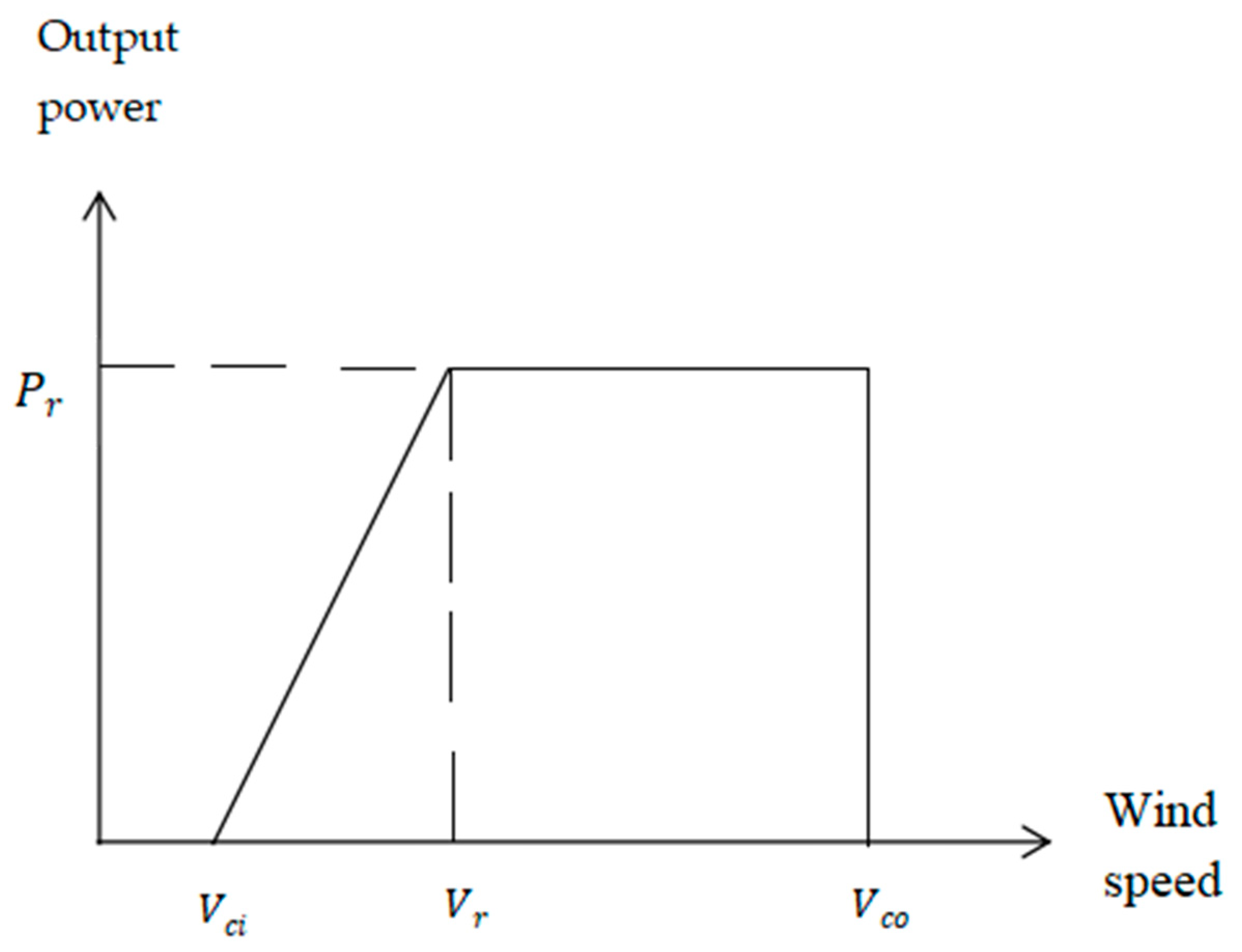
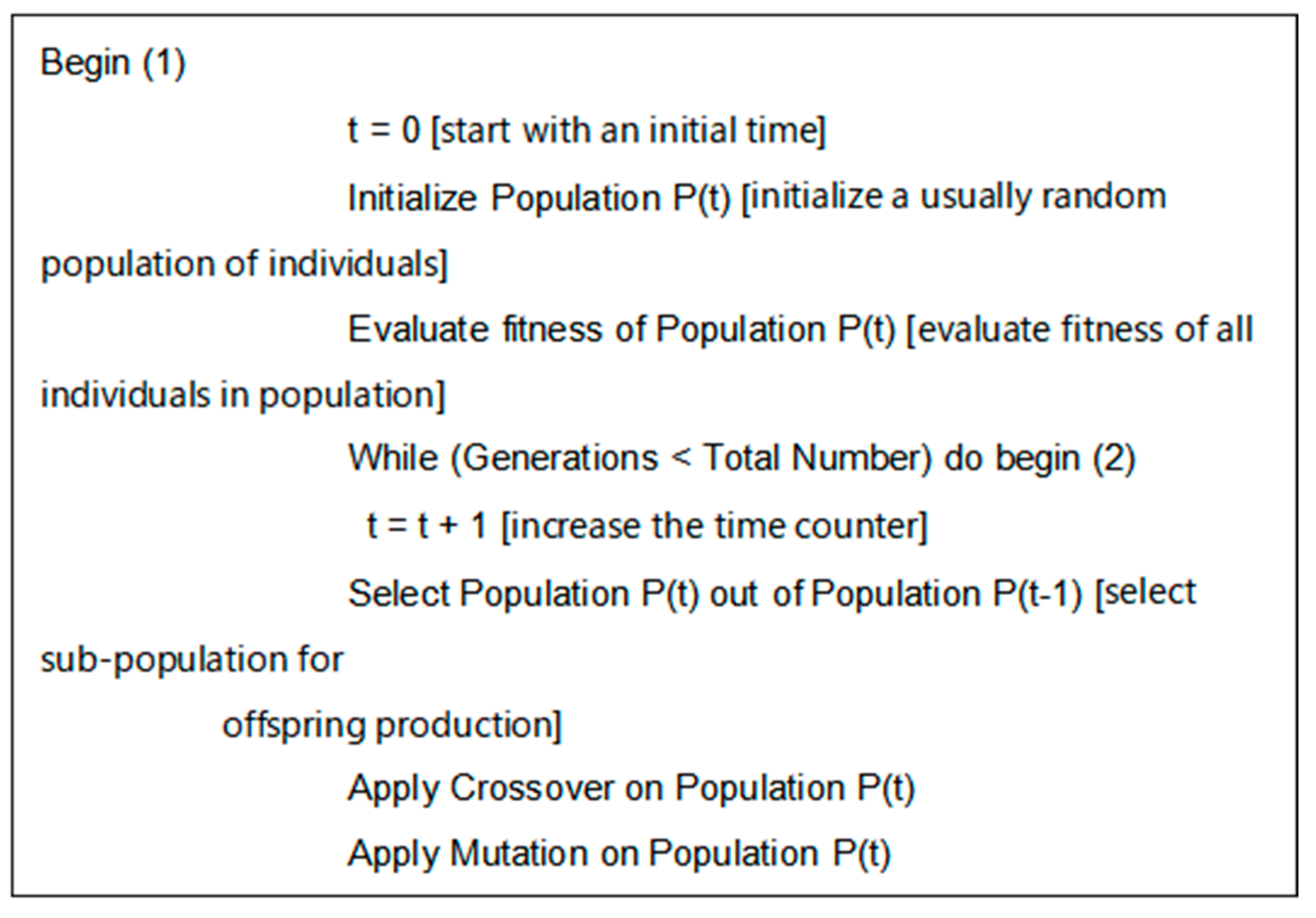
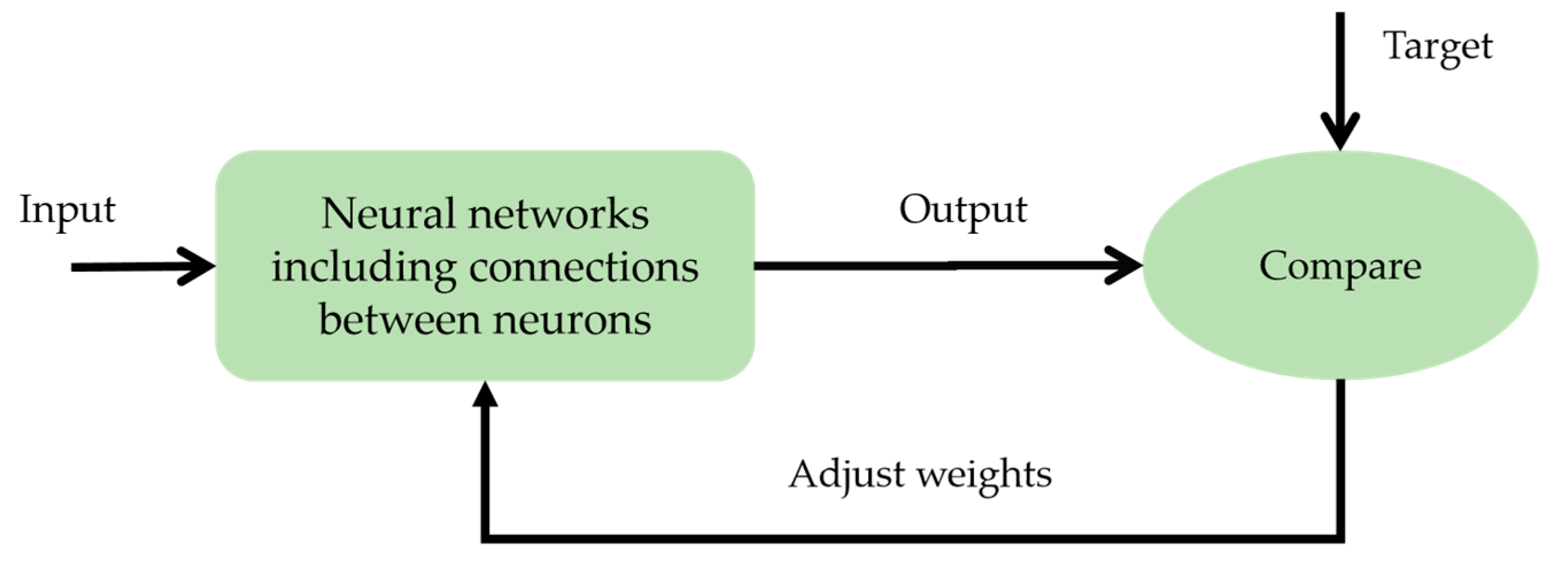
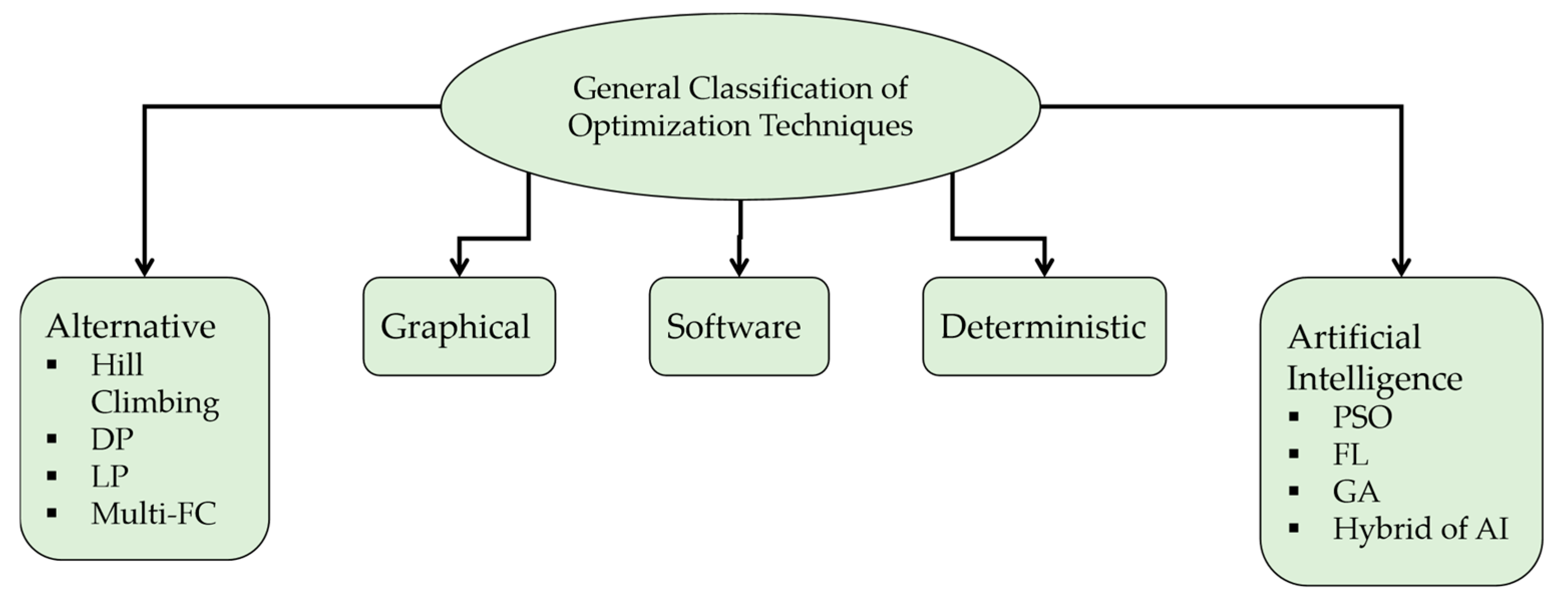
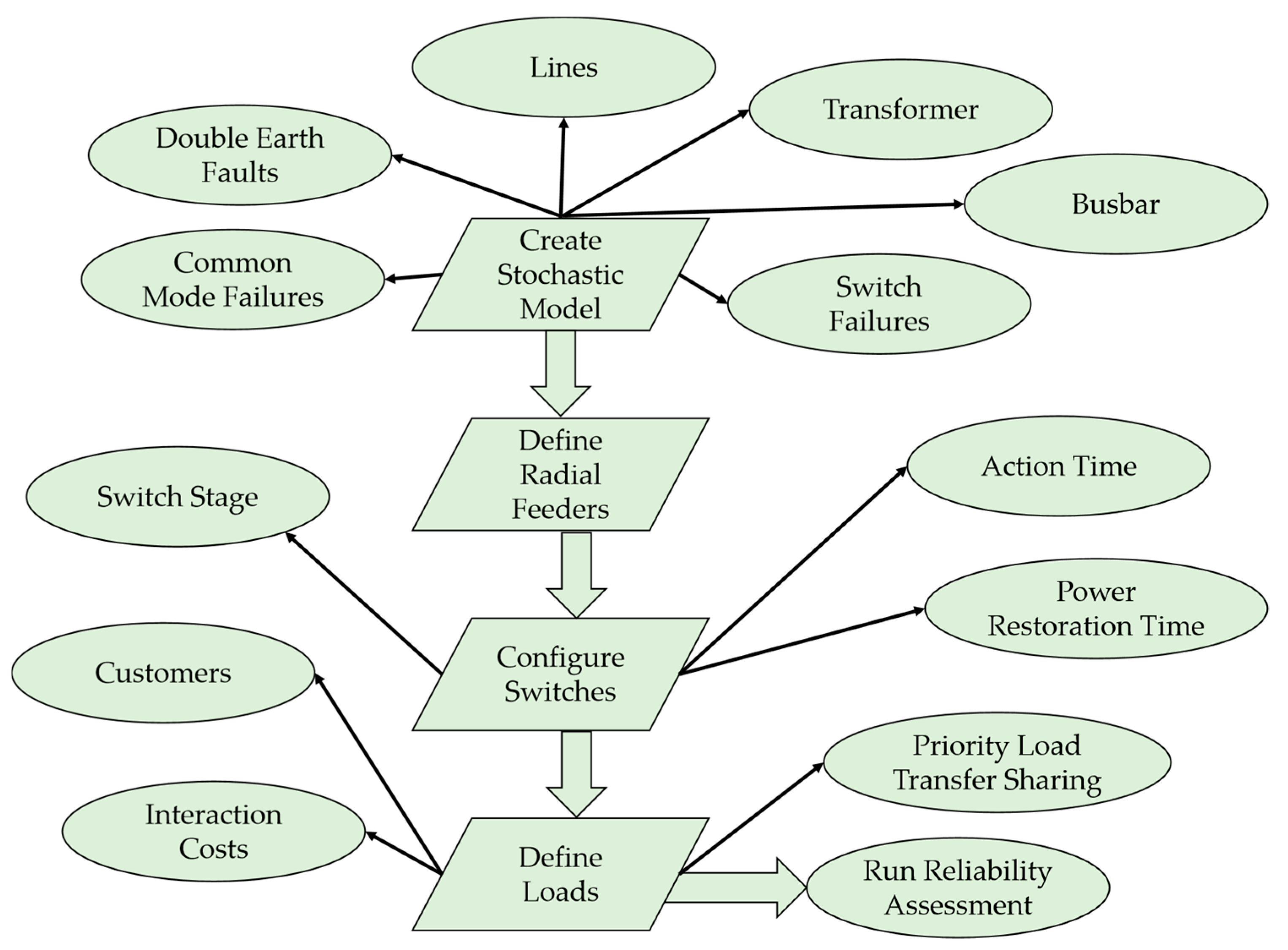
Disclaimer/Publisher’s Note: The statements, opinions and data contained in all publications are solely those of the individual author(s) and contributor(s) and not of MDPI and/or the editor(s). MDPI and/or the editor(s) disclaim responsibility for any injury to people or property resulting from any ideas, methods, instructions or products referred to in the content. |
© 2024 by the authors. Licensee MDPI, Basel, Switzerland. This article is an open access article distributed under the terms and conditions of the Creative Commons Attribution (CC BY) license (https://creativecommons.org/licenses/by/4.0/).