


Abstract
In this paper, a new five-parameter distribution is proposed using the functionalities of the Kumaraswamy generalized family of distributions and the features of the power Lomax distribution. It is named as Kumaraswamy generalized power Lomax distribution. In a first approach, we derive its main probability and reliability functions, with a visualization of its modeling behavior by considering different parameter combinations. As prime quality, the corresponding hazard rate function is very flexible; it possesses decreasing, increasing and inverted (upside-down) bathtub shapes. Also, decreasing-increasing-decreasing shapes are nicely observed. Some important characteristics of the Kumaraswamy generalized power Lomax distribution are derived, including moments, entropy measures and order statistics. The second approach is statistical. The maximum likelihood estimates of the parameters are described and a brief simulation study shows their effectiveness. Two real data sets are taken to show how the proposed distribution can be applied concretely; parameter estimates are obtained and fitting comparisons are performed with other well-established Lomax based distributions. The Kumaraswamy generalized power Lomax distribution turns out to be best by capturing fine details in the structure of the data considered.
1. Introduction
For several decades, researchers have been working to come up with several new distributions to meet certain practical requirements. The motivation is that, in concrete applications related to disciplines such as hydrology, econometrics and many others, the standard distributions have been observed to lack fit. For instance, for daily precipitation and daily vapor flow data, Kumaraswamy [1] showed that the beta distribution does not provide a suitable fit. Continuing this work, in References [2,3], it is also explored that distributions like Johnson, sinepower and extended sinepower distributions were satisfactory in fitting the above mentioned data type. However, in later years, an alternative distribution of finite range was suggested by Kumaraswamy [1] which is named later as Kw distribution. It reveals to fit such data appropriately. The cumulative distribution function (cdf) and probability density function (pdf) are given in (1) and (2), respectively:
and
where and are shape parameters, with the usual modifications for . The main advantage of the Kw distribution is that it has the shape parameter that addresses data that has an extended tail nature. Also, the Kw distribution has been well received by many researchers for fitting skewed types of data sets from hydrology and other engineering disciplines. Other works on Kw distribution has been planned by several researchers, pointing out that it is a special case of the three-parameter beta distribution [4]. Also, the similarities along with basic properties have been extensively studied by Jones [5]. In the recent past, a generalized version of the Kw distribution has been proposed by Cordeiro and de Castro [6] with the cdf and pdf given in (3) and (4), respectively:
and
Here, is the cdf of a chosen base distribution, with pdf given as . Clearly, if , the forms in (3) and (4) reduce to the pdf and cdf from the base distribution. This generalized version of the Kw distribution is called the Kw-G family of distributions. Extensive work on the Kw-G family of distributions has been observed exponentially by proposing new distributions of various asymmetric natures. To cite a few, there are the Kumaraswamy-Weibull distribution [7], Kumaraswamy-Gumbel distribution [8], Kumaraswamy generalized gamma distribution [9] and Kumaraswamy-Burr XII (KBXII) distribution [10]. Applications of the Kw-G family can also be found in References [11,12,13], among others.
In general, the goal of providing new distributions is to create flexible mathematical models capable of handling non-normal data scenarios. This flexibility can be achieved in a simple way by adding additional parameters such as location, scale and shape. In similar lines of thought process, several distributions extending the famous Lomax distribution, such as the exponentiated-Lomax (EL) distribution [14], extended Lomax distribution [15], Kumaraswamy-generalized Lomax distribution [16], exponential-Lomax distribution [17], Weibull-Lomax (WL) distribution [18], Weibull Fréchet (WFr) distribution [19], power Lomax (PL) distribution [20], half-logistic Lomax distribution [21], inverse PL distribution [22], Topp-Leone Lomax (TLGL) distribution [23], type II Topp-Leone power Lomax (TIITLPL) distribution [24], Marshall-Olkin exponential Lomax distribution [25] and Marshall-Olkin length biased Lomax distribution [26] were proposed and developed.
In this present work, an attempt to propose a new distribution by compounding the PL distribution into the general Kw-G family of distributions is made. The proposed distribution is called the Kumaraswamy generalized PL distribution, KPL for short. The rationality of considering the PL distribution is that it equips the most famous extensions of the Lomax distribution [20] and it allows applications dealing with heavy tailed data. Because of its nature, we wish to exhibit mathematical flexibility by adding two additional shape parameters that are presented in the Kw-G family of distributions. To be more precise, a short retrospective on the PL distribution is necessary. First, let us mention that the cdf and pdf of the PL distribution have the forms in (5) and (6), respectively:
and
where is a shape parameter, and and are scale parameters. Rady et al. [20] mentioned that the hazard rate function (hrf) of the PL distribution does not have an increasing curve, which remains a serious limitation for some modeling purposes. This issue is addressed in this work by making the use of the shape parameter and it is performed in the proposed KPL distribution. In particular, the various forms of the pdf of the KPL distribution show that, with increasing values of the new parameters that will be denoted “a” and “b”, it is unimodal and can attain the symmetric nature curve. Also, the corresponding hrf possesses decreasing, increasing and inverted (upside-down) bathtub shapes. In addition, decreasing-increasing-decreasing shapes are observed, which is a clear plus for various statistical purposes. The KPL distribution and its statistical properties such as quantiles, moments, information measures, order statistics and maximum likelihood (ML) estimation are detailed out in subsequent sections of the article. Using two famous data sets, namely turbo charger data set and radiation therapy data set, we demonstrate that the proposed distribution is better suited compared to different types of Lomax distribution, including the PL distribution.
The rest of the article is structured by the following sections. Section 2 completes the presentation of the KPL distribution. Section 3 is devoted to its moments analysis. Section 4 is about information measures of the KPL distribution. Section 5 discusses the related order statistics. The estimation of the parameters of the KPL distribution is afforded in Section 6, including a simulation study. Section 7 focuses on the applications by considering two practical data sets. A summary is given in Section 8.
2. The Kumaraswamy Generalized Power Lomax Distribution
By considering (5) and (6) in (3) and (4), we obtain the following cdf and pdf, respectively,
where , and
The expressions (7) and (8) constitute the cdf and pdf of the KPL distribution, respectively. The KPL distribution contains several existing distribution, including the PL distribution for and the TIITLPL distribution for . It can be also viewed as a re-parametrized version of the KBXII distribution. As already mentioned, the roles of a and b will be major in the interests of the KPL distribution, reaching new levels of flexibility compared to those of the PL distribution, among others.
As preliminary properties, note that is a decreasing function with respect to a and , an increasing function with respect to b and , and a non-monotonic function with respect to . This implies various first-order stochastic dominance properties. For instance, for and with and , since is an increasing function with respect to b and , we have . Similar inequalities can be presented by taking into account the other parameters. Also, it is worth mentioning that the KPL distribution is heavy-tailed; for all , we can prove that .
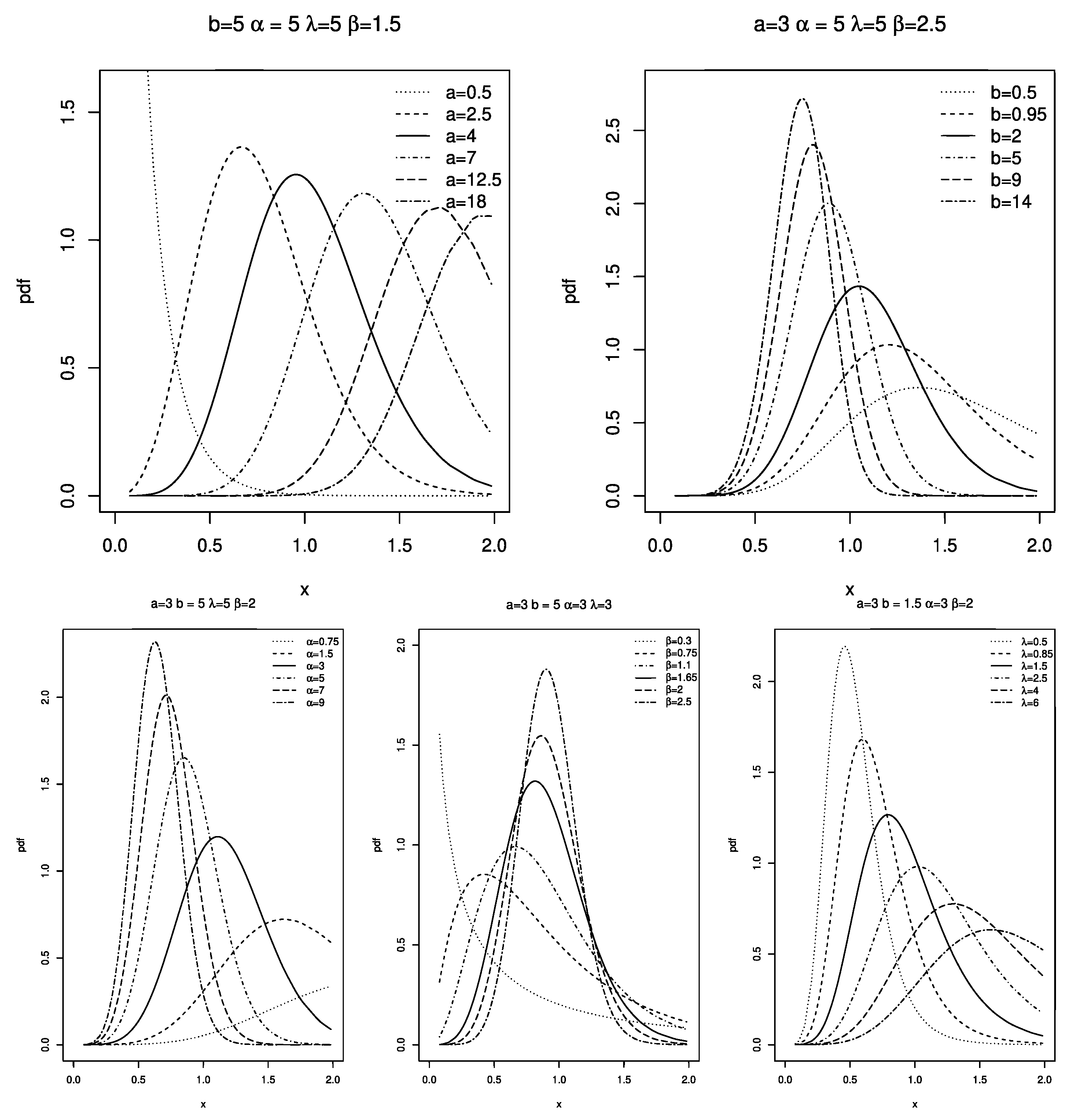
Considering different values of the parameters, variant density forms of the KPL distribution are obtained, and are shown in Figure 1.
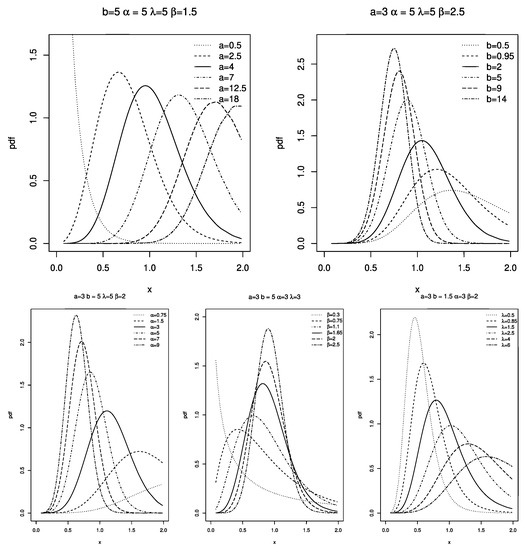
Figure 1.
Curves of the pdf of the KPL distribution at different parameter values.
From Figure 1, we observe that the pdf of the KPL distribution can be decreasing or unimodal, with very flexible skewness, peakness and plateness. One can show that the decreasing case corresponds to . When the pdf is unimodal, we see that it is mainly ‘almost symmetric’ or ‘right-skewed’, which is ideal for the modelling of diverse lifetime phenomena.
Since the KPL distribution belongs to the family of lifetime distributions, its hrf is of interest to deals with some of the statistical properties of the proposed distribution. These properties will help out to exhibit the practical applications and characterizations of real data phenomenon. The hrf of the KPL distribution is given by
that is, by substituting the Equations (7) and (8) in ,
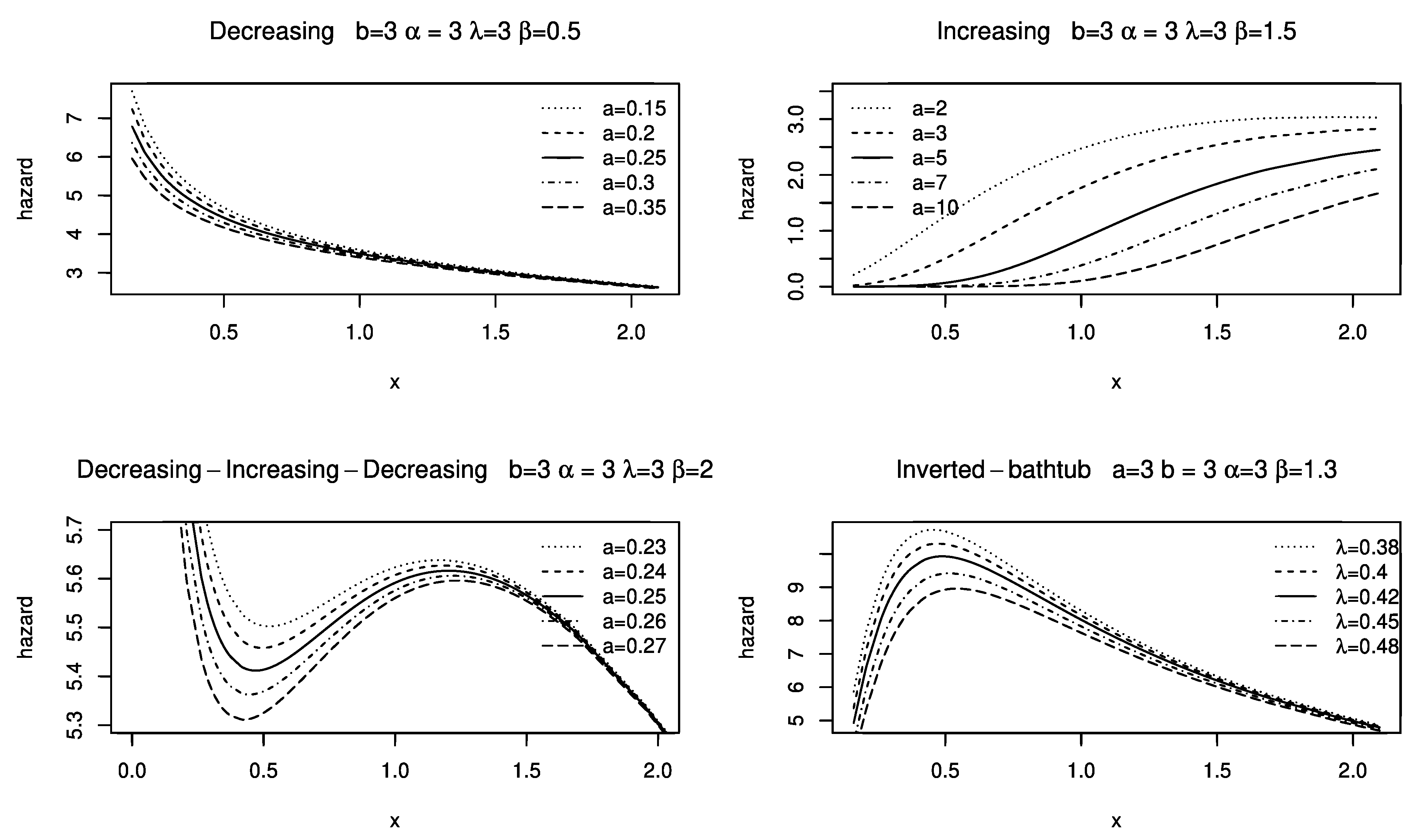
Considering various values of the parameters, the hrf of the KPL distribution contains different kinds of shapes as shown in Figure 2.
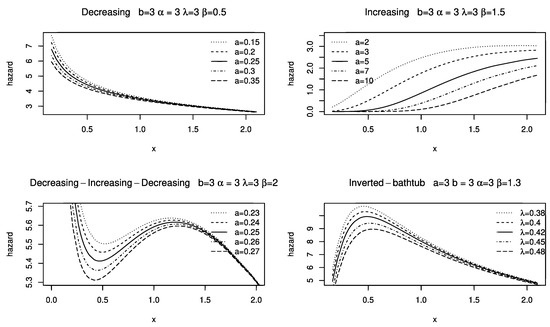
Figure 2.
Shapes of the hrf of the KPL distribution at different parameter values.
From Figure 2, we highlight a crucial difference between the PL and KPL distributions. Indeed, an immediate limitation of the PL distribution is that its hrf cannot be increasing (see Reference [20]). This limitation is overcome in this work by using shape parameters and it is shown that the hrf of the proposed KPL distribution may be increasing. At the same time, we are able to present a decreasing-increasing-decreasing hrf. It is another point to emphasize that the proposed distribution has a better way of expressing different natures of data.
We end this part by presenting the quantile function (qf) of the KPL distribution which also defines it in the mathematical sense. This qf is rigorously defined as the inverse function of . By solving the following nonlinear equation: with and respect to , we obtain
We immediately derive the median of the KPL distribution as
Additional quantile analysis can be performed based on . In this regard, one may refer to Reference [27].
3. Moments of the KPL Distribution
By definition, for any positive integer r, the order moment about the origin of a random variable X following the KPL distribution is given as
where E denotes the expectation. Clearly, in view of the mathematical complexity of , a simple expression of this integral is not possible. Let us first study its existence according to the values of the parameters of the KPL distribution. At the neighborhood of , we have and, by the Riemann integrability criterion, since , the function is integrable over with . Now, at the neighborhood of , we have and, by the Riemann integrability criterion, the function is integrable over with if and only if . In summary, exists if and only if . In this case, one can approximate it via various numerical procedures.
For an analytical approach, one can derive series expansion for and plug-in into (9). With this in mind, the next result presents a series expansion of a power transformation of the pdf of the KPL distribution.
Proposition 1.
For any , we have
where, by introducing generalized binomial coefficients,
and
Proof.
We have
Now, the generalized binomial theorem states that for any real numbers b and Z such that , condition that can be removed if b is a positive integer. Therefore, by the application of this theorem two times in a row, we obtain
The desired expansion is obtained. □
The particular case in Proposition 1 gives
Hence, under the condition that permitting to interchange the integral and sum signs, the order moment about the origin of X is given as
Let us now discuss a tractable expression for the integral term. We have
Let us now set , so and with no change at the boundaries, implying that
where denotes the standard beta function defined by with and . We finally get
This formula is exact, without approximation. It can serve to determine the exact numerical values of and all the associated measures. The most basic of them are the mean of X defined by and the variance given by . A practical approximation of is given by
the bound 50 being an integer chosen arbitrary large.
As an illustration, with the use of the R software, Table 1 provides the moments about the origin and variance of X with different parameter values of the KPL distribution.

Table 1.
Moments about the origin and variance with different parameter values of the KPL distribution.
From Table 1, we see that the fourth moments about the origin and variance have notable numerical variations. This is particularly obvious for the last combination of parameters: , , , with and 36. The high numerical variability of these moment measures also testifies to the flexibility of the KPL distribution.
The incomplete versions of the moments about the origin can have a similar mathematical treatment. They allow us to define various deviation measures and diverse types of residual life function, as those managed in References [10,20,24].
4. Information Measures
In this section, some information measures of the KPL distribution are discussed, namely the Rényi entropy and -entropy measures. Both measuring the variation or uncertainty of the considered distribution.
4.1. Rényi Entropy
Rényi [28] provided an useful extension of the Shannon entropy. The Rényi entropy of the KPL distribution can be defined as
with and . Let us now study the existence of this entropy measure which depends on the existence of its integral term. At the neighborhood of , we have and, by the Riemann integrability criterion, the function is integrable over with if and only if . Now, at the neighborhood of , we have and, by the Riemann integrability criterion, the function is integrable over with if and only if . Hence, exists if and only if and . If these conditions are satisfied, one can approximate through the approximation of its integral term via various numerical procedures.
In a more analytical manner, one can use Proposition 1. Under the conditions above plus and , a direct application of this result gives
A comprehensive expression of the integral term is developed below. By setting , so and with no change at the boundaries, it comes
Therefore, we obtain an expression for as
This formula is exact, without approximation. The following simple approximation can be derived for practical purposes:
Here again, the bound 50 must be viewed as a large integer arbitrarily chosen.
4.2. Tsallis Entropy
The Tsallis entropy or q-entropy was discovered by Havrda and Charvat [29]. Later, it was developed by Tsallis [30] in the context of Physics. The Tsallis entropy of the KPL distribution can be defined as
where and . Then, based on the previous work on the Rényi entropy, exists if and only if and . In all cases, we can approximate it via numerical procedures. With the following additional assumptions: and , proceeding as for , we can expand as
Based on this formula, analytical approximation can be conducted.
5. Order Statistics
The modeling of certain random systems requires the concept of order statistic. Basically, for , the order statistic of a statistical sample is equal to its smallest value. In what follows, some immediate distributional properties of the order statistics of the KPL distribution are presented.
Let be an ordered random sample distributed with the KPL distribution. Then, the pdf of is computed as
that is, by substituting the Equations (7) and (8) in ,
For , we get the pdf of the first order statistics as follows
One can remark that , meaning that the distribution of is also a KPL distribution.
Similarly, for , we get the pdf of the order statistics as follows
The next result exhibits the linear relation existing between the pdf of and some pdfs of the KPL distribution.
Proposition 2.
The pdf of can be expressed as a linear combination of pdfs of the KPL distribution, and, more precisely,
Proof.
It follows from (10) and the (standard) binomial theorem that
This ends the proof of Proposition 2. □
An immediate consequence of Proposition 2 is the determination of some properties for based on those of the KPL distribution. For example, the order moment of about the origin can be written as
where denotes the order moment about the origin of a random variable with the KPL distribution with parameters , , , a and .
6. Maximum Likelihood Estimates of the Parameters
The ML estimation method is used for estimating the unknown parameters of the distribution. Let be a random sample drawn from the KPL distribution. Then the likelihood function and log-likelihood function corresponding to the Equation (8) are, respectively, as follows
and
where it is set . The ML estimates (MLEs) of the parameters and , say and , are given by making or maximal. These MLEs can be obtained by solving the following nonlinear equations:
and
Based on data, the MLEs can be obtained numerically by the iterative procedure of Newton-Raphson method for a system of simultaneous nonlinear equations. As an example of use, Monte Carlo simulations are carried out to assess the finite sample behavior of the MLEs , , , and . For a given sample size, 1000 random samples drawn from the KPL distribution with given parameters are generated by using the qf technique. In this setting, the MLEs of the five model parameters along with the respective bias and mean square error (MSE) for the sample sizes are shown in Table 2.
Table 2.
Bias in parenthesis and MSEs for different sample sizes in the context of the KPL distribution.
As mentioned initially about the advantage of having additional shape parameters, the same is true between bias and MSE. From the results of Table 2, it is clearly evident that the estimates are quite stable and close to the true values of the parameters for these sample sizes. Additionally, as the sample size increases, the biases and MSEs of the MLEs decrease as expected.
7. Applications of the KPL Model
Two real data sets are used as applications of the proposed KPL distribution as heavy tailed distribution.
Data set 1: (Strength data [31]) The data represent 69 strength data for single carbon fibers (and impregnated 1000-carbon fiber tows). The measures in GPA by subtracting 1 are: 0.0312, 0.314, 0.479, 0.552, 0.700, 0.803, 0.861, 0.865, 0.944, 0.958, 0.966, 0.977, 1.006, 1.021, 1.027, 1.055, 1.063, 1.098, 1.140, 1.179, 1.224, 1.240, 1.253, 1.270, 1.272, 1.274, 1.301, 1.301, 1.359, 1.382, 1.382, 1.426, 1.434, 1.435, 1.478, 1.490, 1.511, 1.514, 1.535, 1.554, 1.566, 1.570, 1.586, 1.629, 1.633, 1.642, 1.648, 1.684, 1.697, 1.726, 1.770, 1.773, 1.800, 1.809, 1.818, 1.821, 1.848, 1.880, 1.954, 2.012, 2.067, 2.084, 2.090, 2.096, 2.128, 2.233, 2.433, 2.585, 2.585.
Data set 2: (Theft data [32]) The data represent the amounts of 120 theft claims made in a home insurance portfolio. The 120 theft claims data are: 3, 11, 27, 36, 47, 49, 54, 77, 78, 85, 104, 121, 130, 138, 139, 140, 143, 153, 193, 195, 205, 207, 216, 224, 233, 237, 254, 257, 259, 265, 273, 275, 278, 281, 396, 405, 412, 423, 436, 456, 473, 475, 503, 510, 534, 565, 656, 656, 716, 734, 743, 756, 784, 786, 819, 826, 841, 842, 853, 860, 877, 942, 942, 945, 998, 1029, 1066, 1101, 1128, 1167, 1194, 1209, 1223, 1283, 1288,1296, 1310, 1320, 1367, 1369, 1373, 1382, 1383, 1395, 1436, 1470, 1512, 1607, 1699, 1720, 1772, 1780, 1858, 1922, 2042, 2247, 2348, 2377, 2418, 2795, 2964, 3156, 3858, 3872, 4084, 4620, 4901, 5021, 5331, 5771, 6240, 6385, 7089, 7482, 8059, 8079, 8316, 11,453, 22,274, 32,043. After analyzing the histograms, data set 1 shows an offset deviation from the symmetrical pattern while data set 2 shows a decreasing histogram shape.
In order to show the best fit of the KPL distribution, some other distributions based on the Lomax distribution are considered and used for comparison. These competing distributions have already been mentioned in the introduction, and are the KBXII distribution [10], PL distribution [20], WL distribution [18], WFr distribution [19], TLGL distribution [23], EL distribution [14] and the basic Lomax distribution.
The ML estimation method is applied for all the distribution parameters. The MLEs are obtained by iterative procedures. The MLEs of the distribution parameters are given in Table 3.
Table 3.
MLEs of the considered distribution parameters for the data sets.
Based on the notations of the KPL distribution, we now present the measures of adequacy that we use. Let represent the data and be their ordered values. First, we consider the Cramér-von Mises (W*), Anderson Darling (A*) and Kolmogorov-Smirnov (K-S) statistics () defined by
and
respectively, where n is the sample size, denotes the parameters of the distribution ( for the KPL distribution) and its vectorial MLE. The p-Value of the K-S test related to is also considered. The adequacy measures are widely used to know which distribution suits in a better manner. The distribution having the minimum value for the W* or A*, and maximum value for the p-Value, is chosen as the best one that is in adequacy to the data.
Also, we consider the Akaike information criterion (AIC), correct Akaike information criterion (CAIC), Bayesian information criterion (BIC) and Hannan-Quinn information criterion (HQIC), defined as
respectively, where k is the number of parameters ( for the KPL distribution). As commonly accepted, the distribution having the minimum value for the AIC or CAIC or BIC or HQIC value is chosen as the best one that fits the data. For the considered data sets and distributions, the values of the measures above are computed and reported in Table 4.
Table 4.
The goodness of fit tests and adequacy values for the data sets.
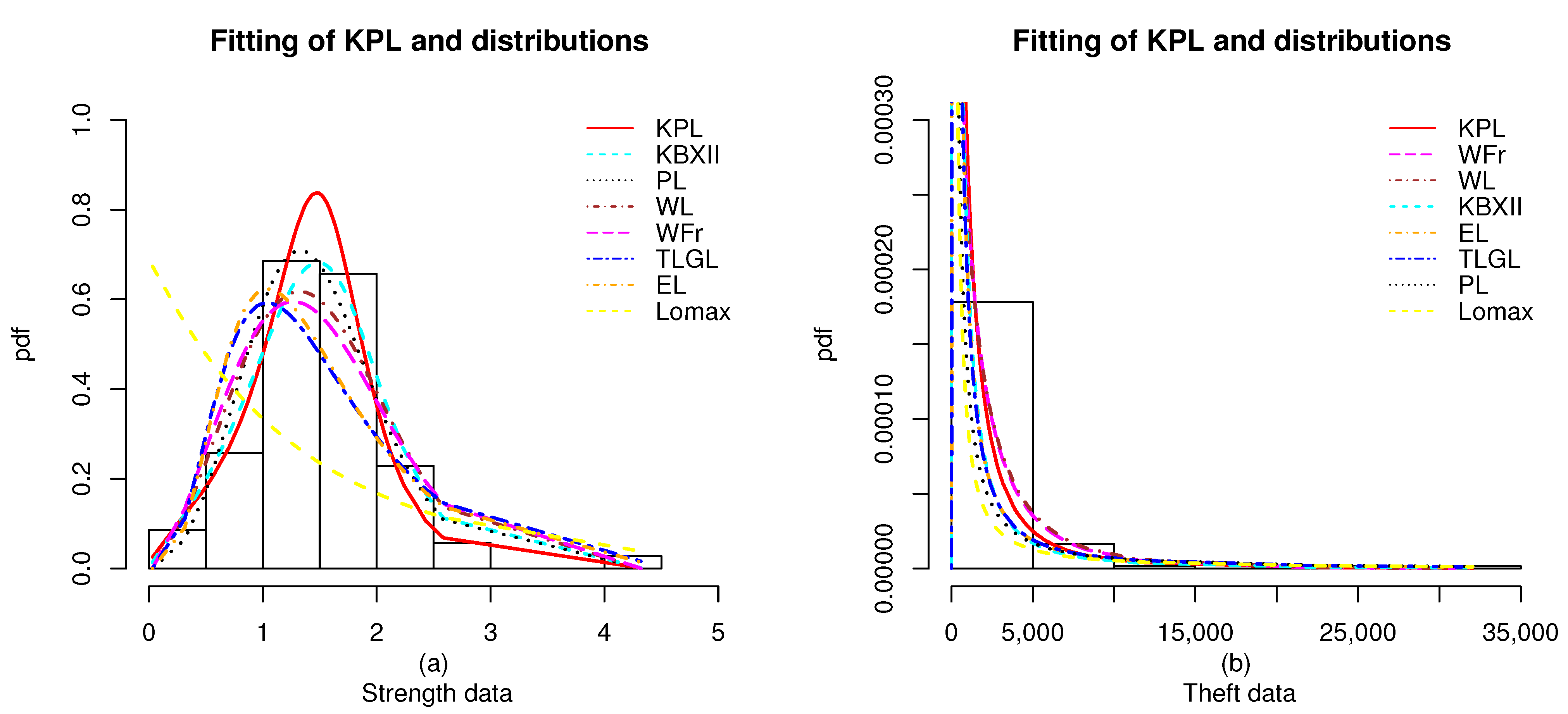
From the results of Table 4, it is evident that best fit is observed with the proposed KPL distribution and other distributions based on the Lomax distribution attained worst information criterion values. This is also witnessed through the fits of the pdfs that are depicted in Figure 3.
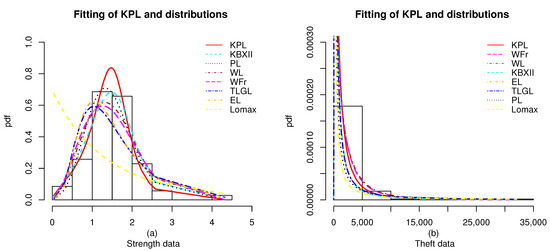
Figure 3.
Fitted pdf curves of the distributions to the histograms for (a) data set 1 and (b) data set 2.
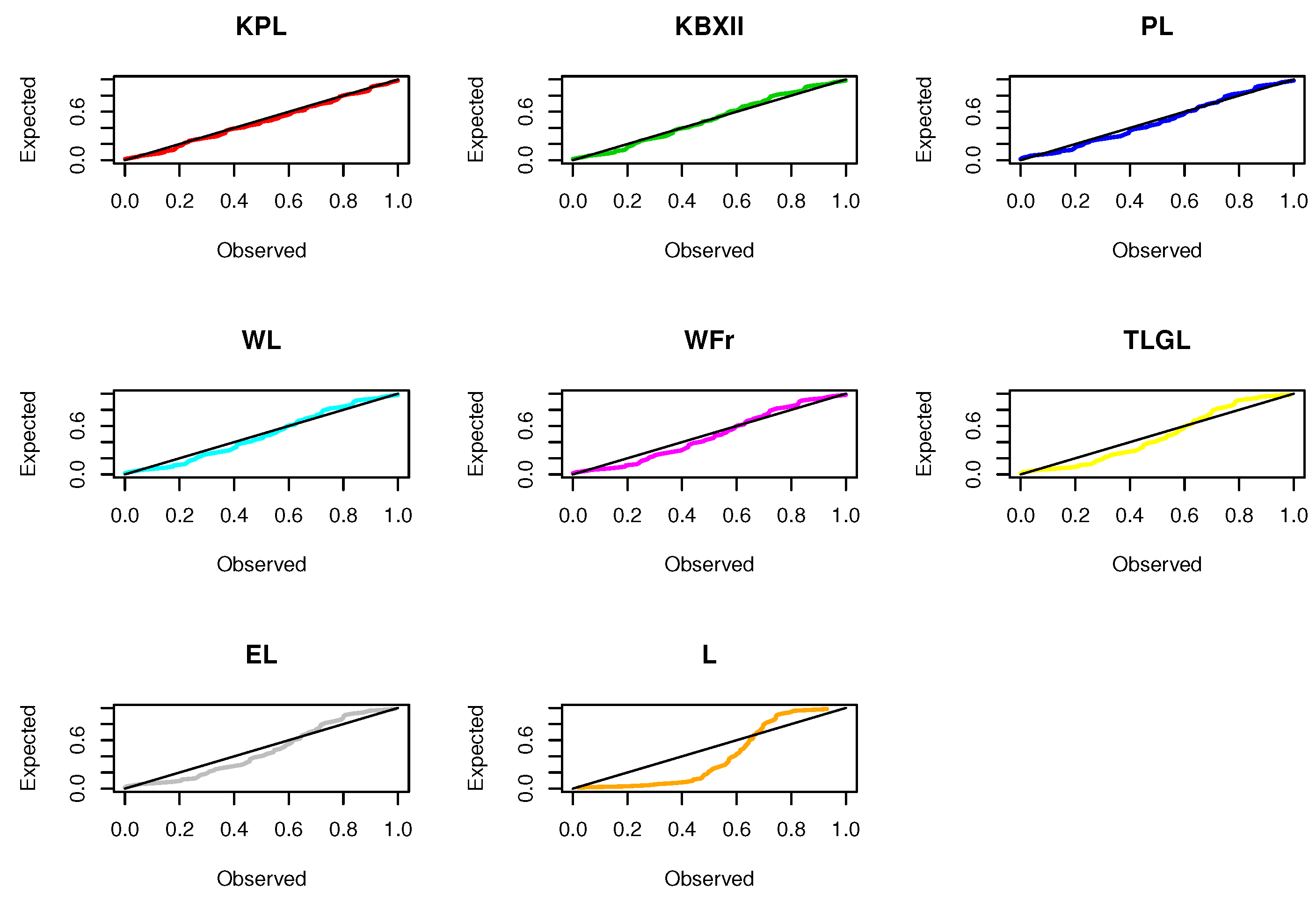
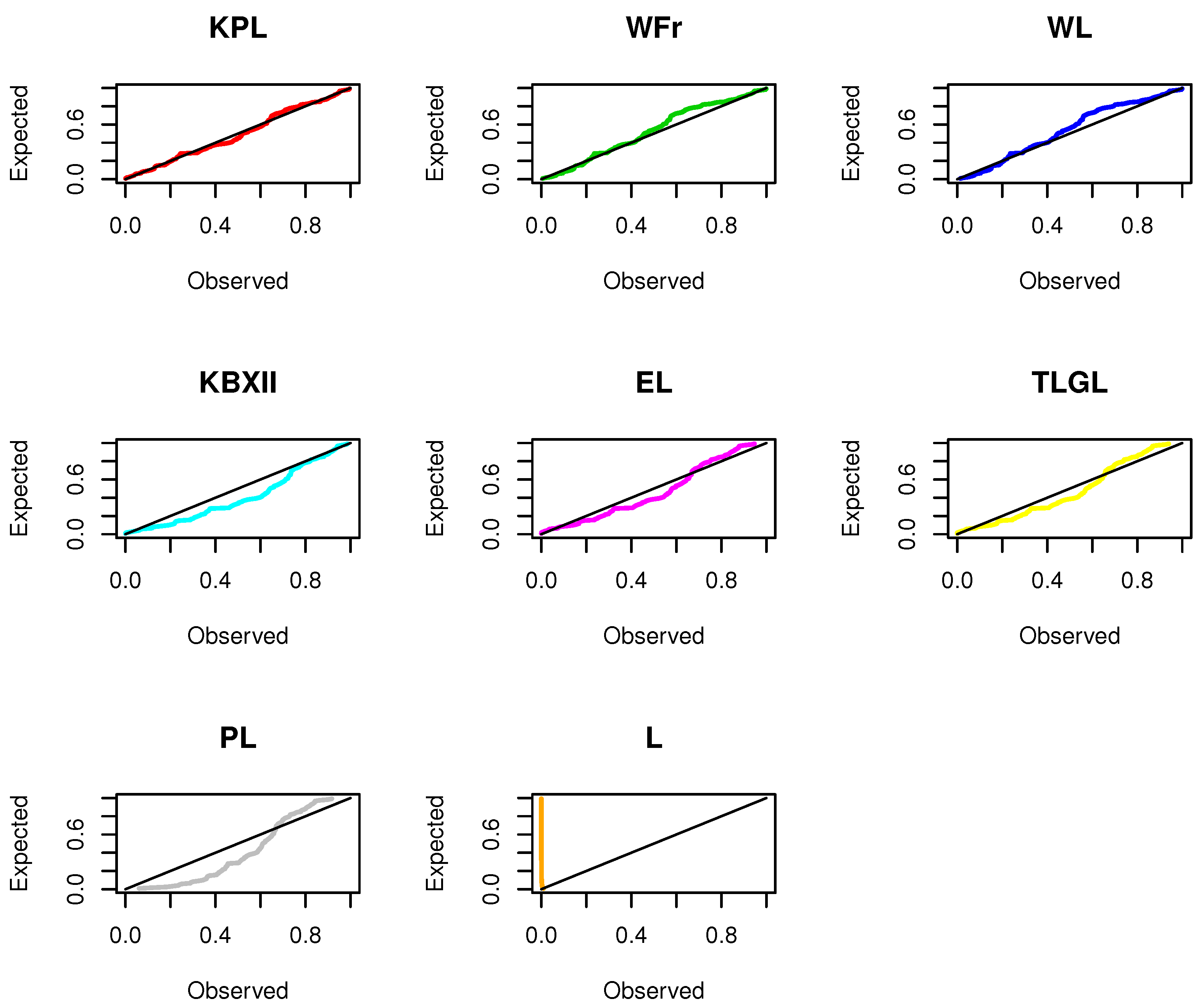
Among all the listed distributions, the KPL distribution has a better fit for the data considered. We confirm this visual result by plotting the Probability-Probability (PP) plots of the estimated distributions in Figure 4 and Figure 5 for data sets 1 and 2, respectively.
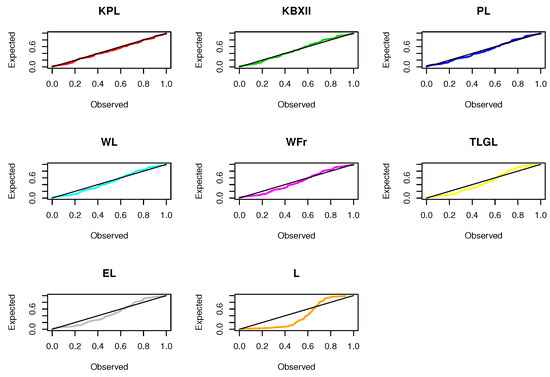
Figure 4.
Fitted PP plots of the distributions for data set 1.
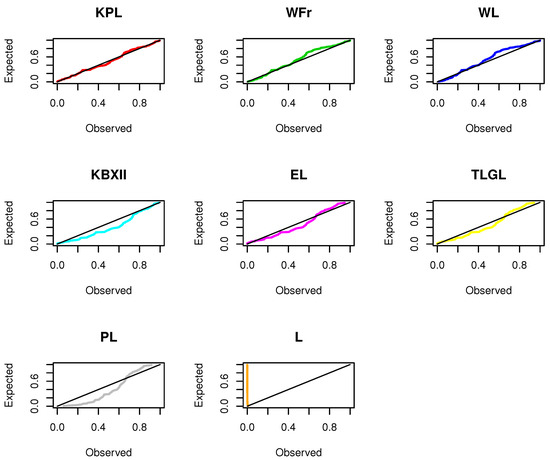
Figure 5.
Fitted PP plots of the distributions for data set 2.
From Figure 4 and Figure 5, for the two data sets, it is clear that the best fit of the black diagonal line is assigned to the red line, corresponding to the one of the KPL distribution.
From these analyses, it can be seen that having additional shape parameters in the distribution is an advantage when talking about the extended tail version of the data. In addition, the dispersion and trend of the data can be characterized using the scale and location parameters of the basic distribution. Overall, a distribution that is compared to measurements of location, scale, and shape parameters always has a better advantage in handling non-normal data structures. Here, this advantage is captured by having two additional shape parameters which helped to see the characterization and fit in the best way.
8. Summary
The work carried out in this paper is to address some limitations of the PL distribution and also to illustrate the usefulness of the shape parameters in handling non-normal data. An attempt is made to introduce a new distribution, namely the KPL distribution, which is obtained by inducing the cdf of the PL distribution into the functional form of the Kw-G family of distributions. It contains five parameters consisting of one location, one scale and three shape parameters. In the work of Rady et al. [20], it is learned that the hrf of the PL distribution fails to attain the increasing pattern and decreasing-increasing-increasing pattern. This is not the case for the hrf of the KPL distribution. Important properties are studied, including moments, entropy measures and order statistics. With the help of two practical data sets, the fit of the KPL distribution is done. Information criterion measures are compared between the KPL distribution and some distributions also based on the Lomax distribution, including the PL distribution. It is shown that the KPL distribution has a better fit. Hence, the KPL distribution can work in a better manner for some kind of non-normal data.
Author Contributions
V.B.V.N., R.V.V. and C.C. have contributed equally to this work. All authors have read and agreed to the published version of the manuscript.
Funding
This research received no external funding.
Acknowledgments
The authors are grateful to the four anonymous referees for a careful checking of the details and for helpful comments that improved this paper.
Conflicts of Interest
The authors declare no conflict of interest.
References
- Kumaraswamy, P. A generalized probability density function for double-bounded random processes. J. Hydrol. 1980, 46, 79–88. [Google Scholar] [CrossRef]
- Kumaraswamy, P. Sinepower probability density function. J. Hydrol. 1976, 31, 181–184. [Google Scholar] [CrossRef]
- Kumaraswamy, P. Extended sinepower probability density function. J. Hydrol. 1978, 37, 81–89. [Google Scholar] [CrossRef]
- Nadarajah, S. On the distribution of Kumaraswamy. J. Hydrol. 2008, 348, 568–569. [Google Scholar] [CrossRef]
- Jones, M.C. Kumaraswamy’s distribution: A beta-type distribution with some tractability advantages. Stat. Methodol. 2009, 6, 70–81. [Google Scholar] [CrossRef]
- Cordeiro, G.M.; de Castro, M. A new family of generalized distributions. J. Stat. Comput. Simul. 2011, 81, 883–898. [Google Scholar] [CrossRef]
- Cordeiro, G.M.; Ortega, E.M.; Nadarajah, S. The Kumaraswamy Weibull distribution with application to failure data. J. Frankl. Inst. 2010, 347, 1399–1429. [Google Scholar] [CrossRef]
- Cordeiro, G.M.; Nadarajah, S.; Ortega, E.M. The Kumaraswamy Gumbel distribution. Stat. Methods Appl. 2012, 21, 139–168. [Google Scholar] [CrossRef]
- De Pascoa, M.A.; Ortega, E.M.; Cordeiro, G.M. The Kumaraswamy generalized gamma distribution with application in survival analysis. Stat. Methodol. 2011, 8, 411–433. [Google Scholar] [CrossRef]
- Paranaíba, P.F.; Ortega, E.M.; Cordeiro, G.M.; Pascoa, M.A.d. The Kumaraswamy Burr XII distribution: Theory and practice. J. Stat. Comput. Simul. 2013, 83, 2117–2143. [Google Scholar] [CrossRef]
- Malinova, A.; Golev, A.; Rahneva, O.; Kyurkchiev, V. Some notes on the Kumaraswamy-Weibull-Exponential cumulative sigmoid. Int. J. Pure Appl. Math. 2018, 120, 521–529. [Google Scholar]
- Malinova, A.; Kyurkchiev, V.; Iliev, A.; Kyurkchiev, N. A note on the transmuted Kumaraswamy quasi Lindley cumulative distribution function. Int. J. Sci. Res. Dev. 2018, 6, 561–564. [Google Scholar]
- Angelova, E.; Arnaudova, V.; Terzieva, T.; Malinova, A. A note on the new Kumaraswamy alpha power inverted exponential family of C.D.F. Neural Parallel Sci. Comput. 2020, 28, 59–67. [Google Scholar]
- Abdul-Moniem, I.B. Recurrence relations for moments of lower generalized order statistics from exponentiated Lomax distribution and its characterization. J. Math. Comput. Sci. 2012, 2, 999–1011. [Google Scholar]
- Lemonte, A.J.; Cordeiro, G.M. An extended Lomax distribution. Statistics 2013, 47, 800–816. [Google Scholar] [CrossRef]
- Shams, T.M. The Kumaraswamy-Generalized Lomax Distribution. Middle-East J. Sci. Res. 2013, 17, 641–646. [Google Scholar] [CrossRef]
- El-Bassiouny, A.H.; Abdo, N.F.; Shahen, H.S. Exponential Lomax Distribution. Int. J. Comput. Appl. 2015, 121, 24–29. [Google Scholar] [CrossRef]
- Tahir, M.H.; Cordeiro, G.M.; Mansoor, M.; Zubair, M. The Weibull-Lomax distribution: Properties and applications. Hacet. J. Math. Stat. 2015, 44, 461–480. [Google Scholar] [CrossRef]
- Afify, A.Z.; Yousof, H.M.; Cordeiro, G.M.; Ortega, E.M.; Nofal, Z.M. The Weibull Fréchet distribution and its applications. J. Appl. Stat. 2016, 43, 2608–2626. [Google Scholar] [CrossRef]
- Rady, E.H.A.; Hassanein, W.A.; Elhaddad, T.A. The power Lomax distribution with an application to bladder cancer data. SpringerPlus 2016, 5, 1–22. [Google Scholar] [CrossRef]
- Anwar, M.; Zahoor, J. The Half-Logistic Lomax Distribution for Lifetime Modeling. J. Probab. Stat. 2018, 3152807. [Google Scholar] [CrossRef]
- Hassan, A.S.; Abd-Allah, M. On the Inverse Power Lomax Distribution. Ann. Data Sci. 2019, 6, 259–278. [Google Scholar] [CrossRef]
- Oguntunde, P.E.; Khaleel, M.A.; Okagbue, H.I.; Odetunmibi, O.A. The Topp–Leone Lomax (TLLo) Distribution with Applications to Airbone Communication Transceiver Dataset. Wirel. Pers. Commun. 2019, 109, 349–360. [Google Scholar] [CrossRef]
- Al-Marzouki, S.; Jamal, F.; Chesneau, C.; Elgarhy, M. Type II Topp Leone Power Lomax Distribution with Applications. Mathematics 2020, 8, 4. [Google Scholar] [CrossRef]
- Nagarjuna, V.B.V.; Vardhan, V. Marshall-Olkin Exponential Lomax Distribution: Properties and its Application. Stoch. Model. Appl. 2020, 24, 161–177. [Google Scholar]
- Mathew, J.; Chesneau, C. Some New Contributions on the Marshall–Olkin Length Biased Lomax Distribution: Theory, Modelling and Data Analysis. Math. Comput. Appl. 2020, 25, 79. [Google Scholar] [CrossRef]
- Nair, N.U.; Sankaran, P.; Balakrishnan, N. Quantile-Based Reliability Analysis; Birkhäuser: Basel, Switzerland, 2013. [Google Scholar]
- Rényi, A. On Measures of Entropy and Information; Technical Report; Hungarian Academy of Sciences: Budapest, Hungary, 1961. [Google Scholar]
- Havrda, J.; Charvát, F. Quantification method of classification processes. Concept of structural a-entropy. Kybernetika 1967, 3, 30–35. [Google Scholar]
- Tsallis, C. Possible generalization of Boltzmann-Gibbs statistics. J. Stat. Phys. 1988, 52, 479–487. [Google Scholar] [CrossRef]
- Bader, M.; Priest, A. Statistical aspects of fibre and bundle strength in hybrid composites. In Progress in Science and Engineering Composites; Hayashi, T., Kawata, K., Umekawa, S., Eds.; ICCM-IV: Tokyo, Japan, 1982; pp. 1129–1136. [Google Scholar]
- Louzada-Neto, F.; Mazucheli, J.; Achcar, J.A. Uma Introdução à análise de Sobrevivência e Confiabilidade; Sociedad Chilena de Estadística: Valparaíso, Chili, 2001. [Google Scholar]
Publisher’s Note: MDPI stays neutral with regard to jurisdictional claims in published maps and institutional affiliations. |
© 2021 by the authors. Licensee MDPI, Basel, Switzerland. This article is an open access article distributed under the terms and conditions of the Creative Commons Attribution (CC BY) license (http://creativecommons.org/licenses/by/4.0/).