Skip Content
You are currently on the new version of our website. Access the old version .

Clocks & Sleep

Clocks & Sleep is a peer-reviewed, open access journal that investigates a wide range of sleep related topics and is published quarterly online by MDPI.
The Australasian Chronobiology Society, Society for Light, Rhythms, and Circadian Health, and Swiss Society of Sleep Research, Sleep Medicine and Chronobiology are affiliated with Clocks & Sleep and their society members receive a discount on the article processing charges.

All Articles (360)

Light exposure profoundly influences human emotions and physiology. Yet, adolescents spend considerable time under artificial indoor lighting. Reduced daytime light exposure delays the circadian clock, negatively affecting sleep, cognition, and mood. This pilot study examined whether 470–490 nm enhanced LED lighting modulates mood, sleep quality, and attention among 65 male Korean high school students (mean age = 15.4 years) who participated in a two-week intervention. Both groups were exposed to natural daylight, but the experimental group additionally used LED lighting enriched in the 470–490 nm wavelength range, whereas the control group used LED lighting without modified spectral characteristics. Students were exposed to the assigned lighting from 08:00 to 17:00 during regular school hours for two consecutive weeks. To evaluate the effects of the two-week intervention, pre- and post-assessments included the Beck Depression Inventory (BDI-II), the Richards–Campbell Sleep Questionnaire (RCSQ), the Epworth Sleepiness Scale (ESS), the Perceived Stress Scale (PSS), and the Frankfurter Attention Inventory (FAIR), administered twice at each assessment point. The linear mixed-effect model showed a significant time × group interaction for line errors in the first FAIR trial (F (1, 52) = 5.21, p = 0.027, η2 partial = 0.09), suggesting a greater relative reduction in attentional errors in the experimental group compared with the control group. No significant effects were observed for sleep- or mood-related outcomes. These results indicate the potential relevance of wavelength-optimized lighting in educational settings where sustained attention is critical. Future studies with larger samples and longer interventions are required to confirm and extend these findings.

30 January 2026
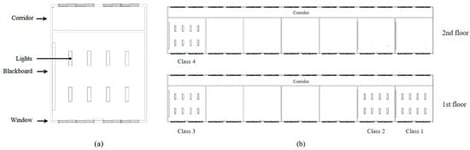
Classroom layout and classroom distribution. (a) Schematic diagram of a standard classroom layout illustrating the spatial arrangement of ceiling-mounted LED luminaires, blackboard, and windows. (b) Floor plan of the school building showing the distribution of the four first-year classrooms (Classes 1–4) across the first and second floors, connected by a central corridor.

Insomnia symptoms are very common among psychiatric inpatients and can increase the risk of suicide in this population. However, little is known about how psychiatrists and nurses manage insomnia symptoms in psychiatric inpatients. This study aimed to investigate the views, opinions, and experiences of psychiatrists and nurses regarding inpatients’ sleep complaints in a Swiss psychiatric hospital. This qualitative study used individual semi-structured interviews with a purposive sample of psychiatrists and nurses working in a Swiss psychiatric hospital. Interviews were audio-recorded, transcribed verbatim, and analysed manually using inductive thematic analysis. Ten participants (six psychiatrists and four nurses) were interviewed. Three overarching themes were identified: identifying and classifying sleep complaints, the decision-making process, and the actions taken to respond to the complaint. Insomnia symptoms were approached by psychiatrists and nurses in a highly heterogeneous, non-evidence-based manner, with a lack of adaptation of CBT-I leading to overmedication. This heterogeneity may be explained by the diversity of underlying problems associated with insomnia symptoms, the lack of hospital-specific guidelines, and the fact that current guidelines focus mainly on chronic insomnia and do not fully account for the complexity of psychiatric inpatients.

20 January 2026

  • Brief Report
  • Open Access

Prevalence of Obstructive Sleep Apnea and Adherence to CPAP for TAXI Drivers

  • Yik Hin Chan,
  • Anastasya Maria Kosasih and
  • Chi-Hang Lee
  • + 4 authors

We investigated the effects of Continuous Positive Airway Pressure (CPAP) on blood pressure (BP) and vigilance in taxi drivers with obstructive sleep apnea (OSA). This pilot study recruited taxi drivers aged ≥60 years to undergo polysomnography. Those diagnosed with OSA underwent 6 months of CPAP therapy. Baseline and follow-up assessments included 24 h ambulatory blood pressure monitoring (ABPM) and the psychomotor vigilance test (PVT). Among the 32 participants, 22 (68.8%) were diagnosed with OSA (median age 63.0 [62.0–65.0] years; 21 males). The average CPAP adherence was 3.1 ± 2.3 h per night, with 23.5% using CPAP for more than 4 h per night. There were no significant changes in 24 h mean systolic ABPM (125.9 [116.8–134.9] mmHg to 126.0 [118.3–133.7] mmHg; p = 0.93) or reaction times measured by PVT (2.0 [0.0–3.0] lapses to 2.0 [1.0–3.0] lapses; p = 0.82) after CPAP therapy. A high prevalence of OSA was observed among taxi drivers. CPAP adherence was suboptimal and did not result in significant improvements in BP or vigilance.

7 January 2026

Background. Exposure to artificial light at night can lead to circadian disruption and health risks. It can cause mood swings, confusion, and depression. The aim of this cross-sectional study was to assess the relationship between the illuminance of urban lighting and the health of residents. Methods: This study was carried out among residents of two similar towns, one with typical street lighting and a Dark Sky Park characterized by reduced lighting. A total of 272 respondents participated in this study. A self-administered questionnaire and the WHOQOL-BREF were used among the respondents. Results. People living in the Dark Sky Park were more likely to be satisfied with their sleep (p < 0.001). In fact, 58.7% of Dark Sky Park residents reported no sleep problems. In the control town, only 49.25% did (p = 0.04). The sleep duration was similar in the two towns, but Dark Sky Park residents were statistically less likely to use sleeping pills and window blinds. People exposed to typical street lighting at night reported suffering from eye diseases, cardiovascular diseases, and mood changes more often than those living in the Dark Sky Park. The environmental and physical quality of life, as measured by the WHOQOL-BREF, were significantly higher in the Dark Sky Park residents than in the control town (p < 0.05). Conclusions. People living in places with limited illuminance declare better health and a higher quality of life in the physical and environmental domains.

5 January 2026

News & Conferences

Issues

Open for Submission

Editor's Choice

Get Alerted

Add your email address to receive forthcoming issues of this journal.

XFacebookLinkedIn
Clocks & Sleep - ISSN 2624-5175