

Skip Content
You are currently on the new version of our website. Access the old version .

Corrosion and Materials Degradation, Volume 2, Issue 3

2021 September - 10 articles

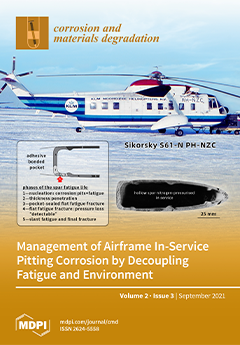
Cover Story: This accident, leading to the loss of 6 people, predated by 25 years the recognition of the issue of whether corrosion and fatigue (specifically fatigue crack growth) may be decoupled. The detectable fatigue crack growth period was only about 1 ½ hours, and the cracking during this period occurred in the last flight. Quantitative fractography showed ductile fatigue striations and some post-accident mild corrosion owing to the time before recovery of the helicopter from the seabed. The rotor blade failure is therefore a demonstrable example of decoupling corrosion and detectable fatigue crack growth. View this paper
  • Issues are regarded as officially published after their release is announced to the table of contents alert mailing list .
  • You may sign up for email alerts to receive table of contents of newly released issues.
  • PDF is the official format for papers published in both, html and pdf forms. To view the papers in pdf format, click on the "PDF Full-text" link, and use the free Adobe Reader to open them.

Articles (10)

  • Feature Paper
  • Review
  • Open Access
10 Citations
5,826 Views
19 Pages

Corrosion-induced maintenance is a significant cost driver and availability degrader for aircraft structures. Although well-established analyses enable assessing the corrosion impact on structural integrity, this is not the case for fatigue nucleatio...

  • Feature Paper
  • Article
  • Open Access
10 Citations
5,604 Views
19 Pages

Preliminary Assessment of Cooling Water Chemistry for Fusion Power Plants

  • Eugenio Lo Piccolo,
  • Raffaele Torella,
  • Nicholas Terranova,
  • Luigi Di Pace,
  • Claudia Gasparrini and
  • Mauro Dalla Palma

The determination of the water chemistry for cooling systems of nuclear fusion plants is under debate. It should be tailored for different types of fusion reactors: either experimental, e.g., ITER, JT-60SA, and DTT, or aimed at power generation, e.g....

  • Article
  • Open Access
8 Citations
10,129 Views
13 Pages

Corrosion of Stainless Steel by Urea at High Temperature

  • Anastasiia Galakhova,
  • Fabian Kadisch,
  • Gregor Mori,
  • Susanne Heyder,
  • Helmut Wieser,
  • Bernhard Sartory and
  • Simon Burger

The corrosion mechanism of stainless steel caused by high temperature decomposition of aqueous urea solution has been investigated. The relationship between aqueous urea solution, its thermal decomposition products and the corrosion mechanism of stai...

  • Article
  • Open Access
9 Citations
3,771 Views
19 Pages

During their service life, existing structures may suffer a combination of ageing and reinforcement corrosion. The corrosion deterioration can significantly affect the durability of reinforced concrete (RC) elements causing premature concrete crushin...

  • Article
  • Open Access
19 Citations
12,163 Views
14 Pages

Comparative Study of Chloride and Fluoride Induced Aluminum Pad Corrosion in Wire-Bonded Device Packaging Assembly

  • Goutham Issac Ashok Kumar,
  • Alexander Lambert,
  • Joshua Caperton,
  • Muthappan Asokan,
  • William Yi and
  • Oliver Chyan

The introduction of copper as wire bonding material brings about a new challenge of aluminum bond pad bimetallic corrosion at the copper/aluminum galvanic interface. Aluminum is well known to undergo pitting corrosion under halide-contaminated enviro...

  • Review
  • Open Access
8 Citations
6,280 Views
35 Pages

Stress Corrosion Cracking in Amorphous Phase Separated Oxide Glasses: A Holistic Review of Their Structures, Physical, Mechanical and Fracture Properties

  • Weiying Feng,
  • Daniel Bonamy,
  • Fabrice Célarié,
  • Paul C. M. Fossati,
  • Stéphane Gossé,
  • Patrick Houizot and
  • Cindy L. Rountree

Stress corrosion cracking is a well-known phenomenon in oxide glasses. However, how amorphous phase separation (APS) alters stress corrosion cracking, and the overall mechanical response of an oxide glass is less known in literature. APS is a dominan...

  • Feature Paper
  • Article
  • Open Access
21 Citations
7,685 Views
15 Pages

Understanding Corrosion Morphology of Duplex Stainless Steel Wire in Chloride Electrolyte

  • Cem Örnek,
  • Kemal Davut,
  • Mustafa Kocabaş,
  • Aleyna Bayatlı and
  • Mustafa Ürgen

The corrosion morphology in grade 2205 duplex stainless steel wire was studied to understand the nature of pitting and the causes of the ferrite phase’s selective corrosion in acidic (pH 3) NaCl solutions at 60 °C. It is shown that the corrosion mech...

  • Article
  • Open Access
4 Citations
6,262 Views
21 Pages

Sulfide Stress Cracking of C-110 Steel in a Sour Environment

  • Sagar Tale,
  • Ramadan Ahmed,
  • Rida Elgaddafi and
  • Catalin Teodoriu

The scope of this study includes modeling and experimental investigation of sulfide stress cracking (SSC) of high-strength carbon steel. A model has been developed to predict hydrogen permeation in steel for a given pressure and temperature condition...

  • Article
  • Open Access
14 Citations
4,070 Views
16 Pages

The influence of loading rate on the environment-assisted cracking (EAC) behavior of AA7075-T651 immersed in 0.6 and 1.0 M NaCl solution was assessed at applied potentials ranging from −800 to −1200 mVSCE via a slow-rising stress intensity (K) testin...

  • Article
  • Open Access
5 Citations
2,946 Views
19 Pages

Electrochemical Impedance Spectroscopy (EIS) measurements were carried out in high temperature water with Ni-based Alloy-182. The aim was to correlate the EIS results with differences in Stress Corrosion Cracking (SCC) susceptibility that is present...

Get Alerted

Add your email address to receive forthcoming issues of this journal.

XFacebookLinkedIn
Corros. Mater. Degrad. - ISSN 2624-5558