
Assessing the Climatological Relationship between Heatstroke Risk and Heat Stress Indices in 47 Prefectures in Japan

Abstract
1. Introduction
2. Materials and Methods
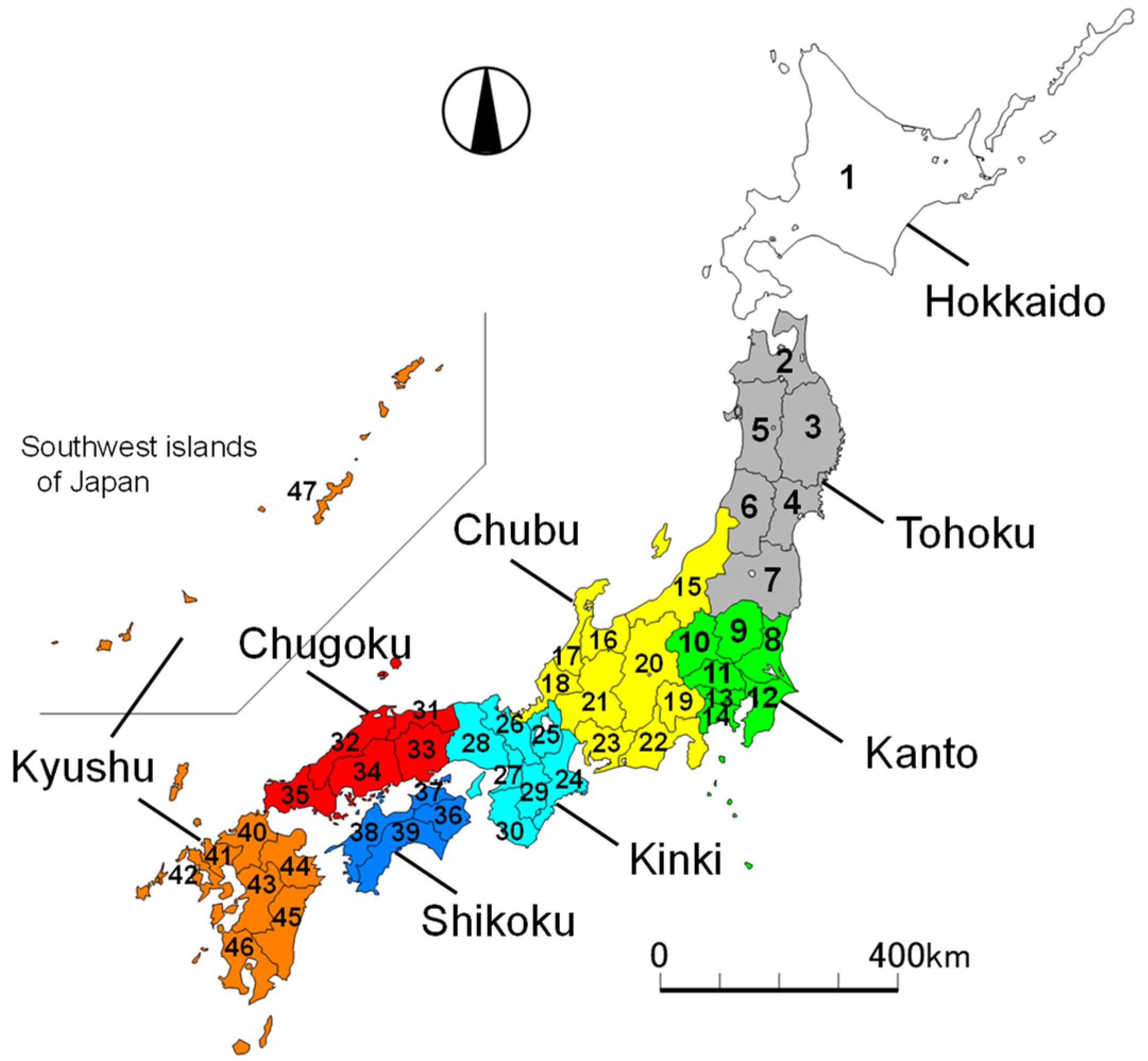
2.1. Heatstroke Transport Data
2.2. Heat Stress Indices
3. Results and Discussion
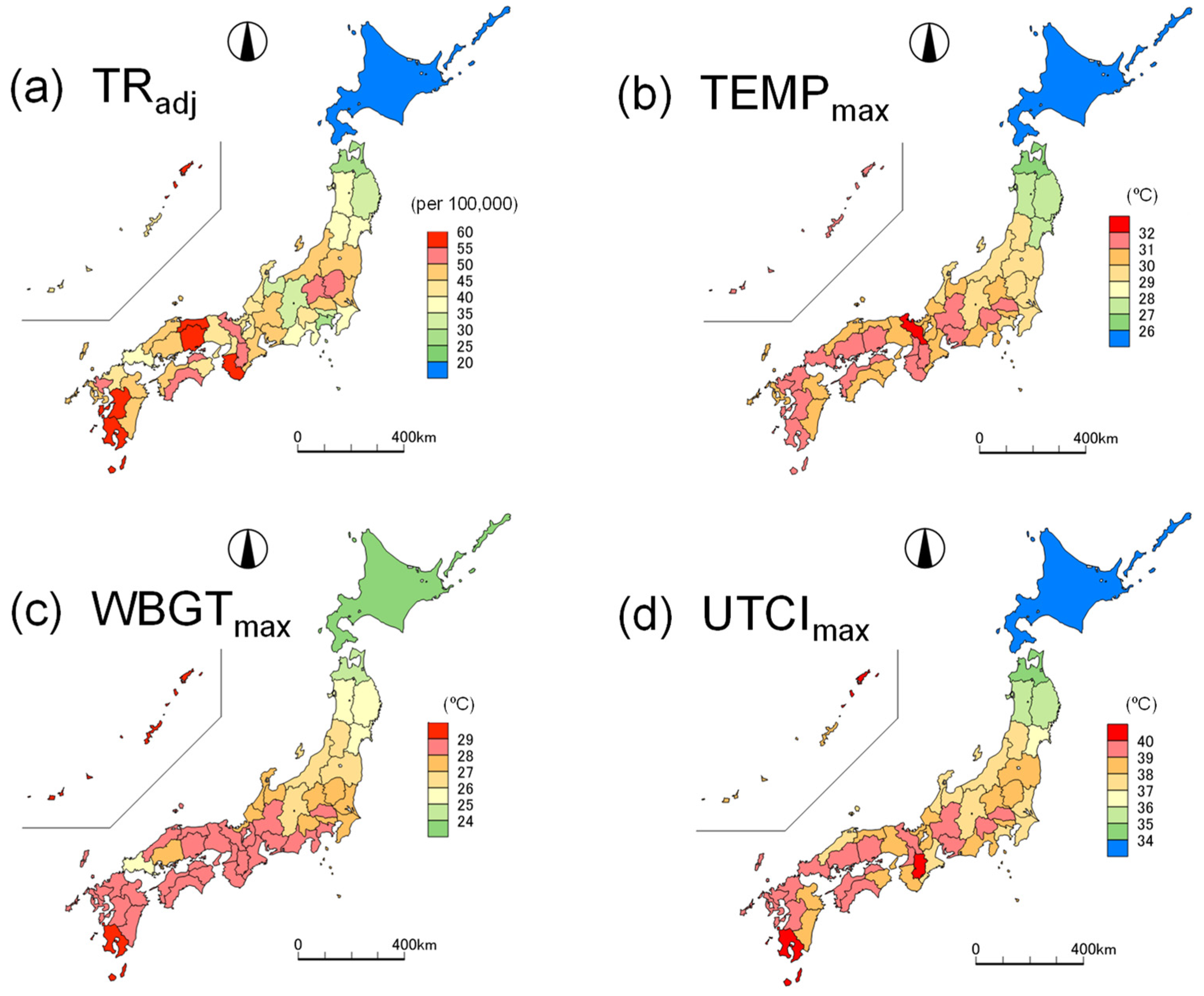
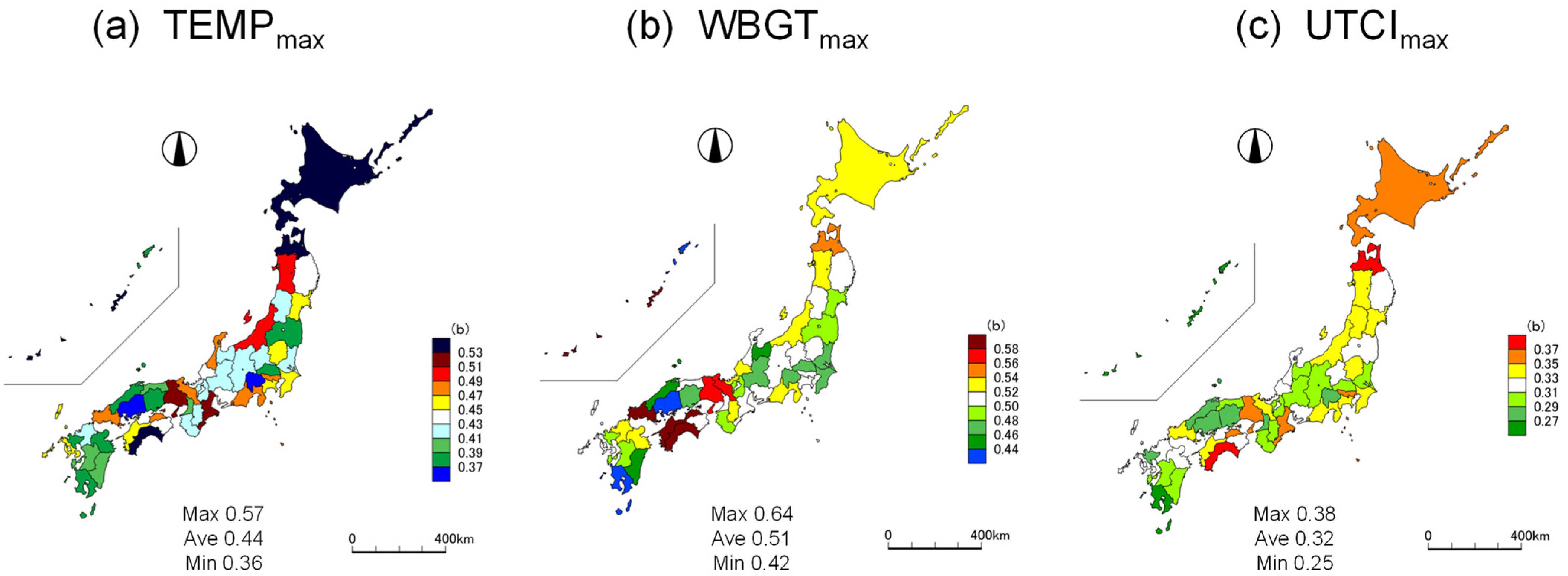
3.1. Decade Distributions in 47-Prefecture Scale
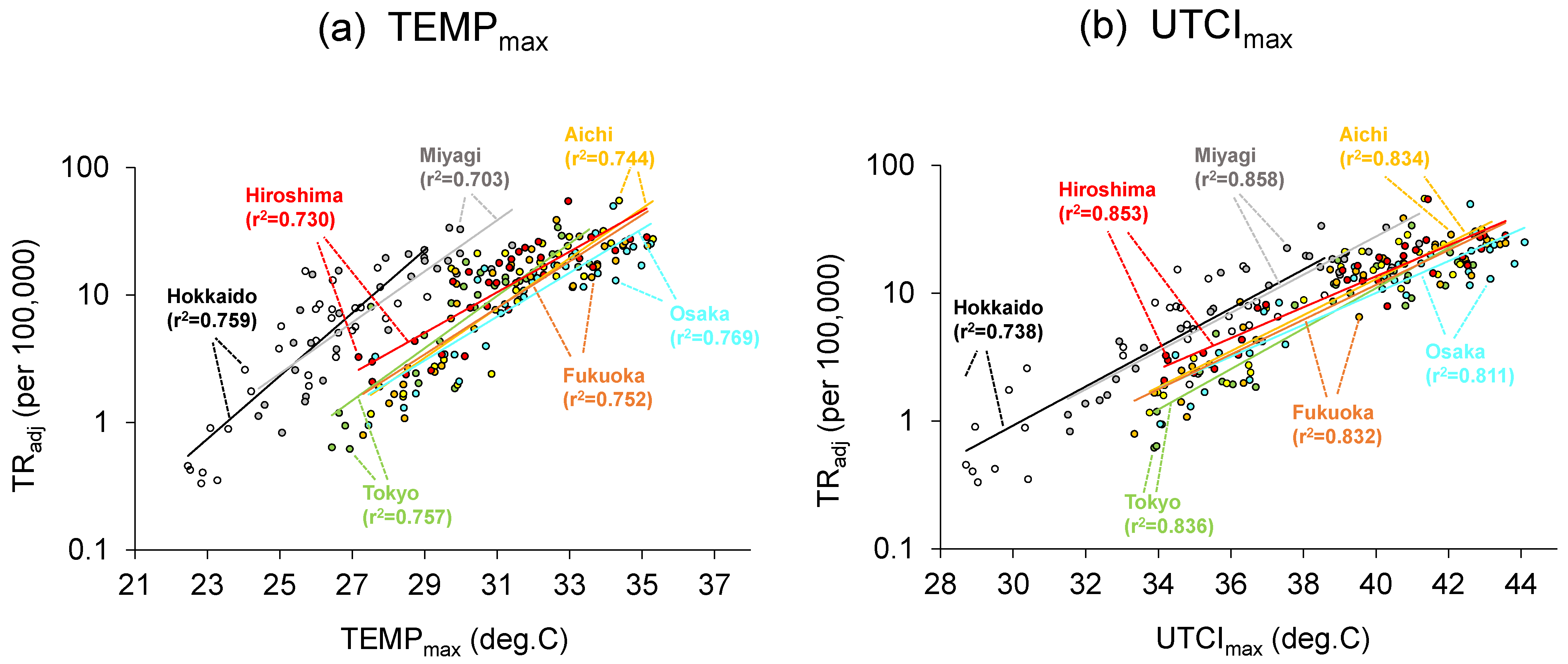
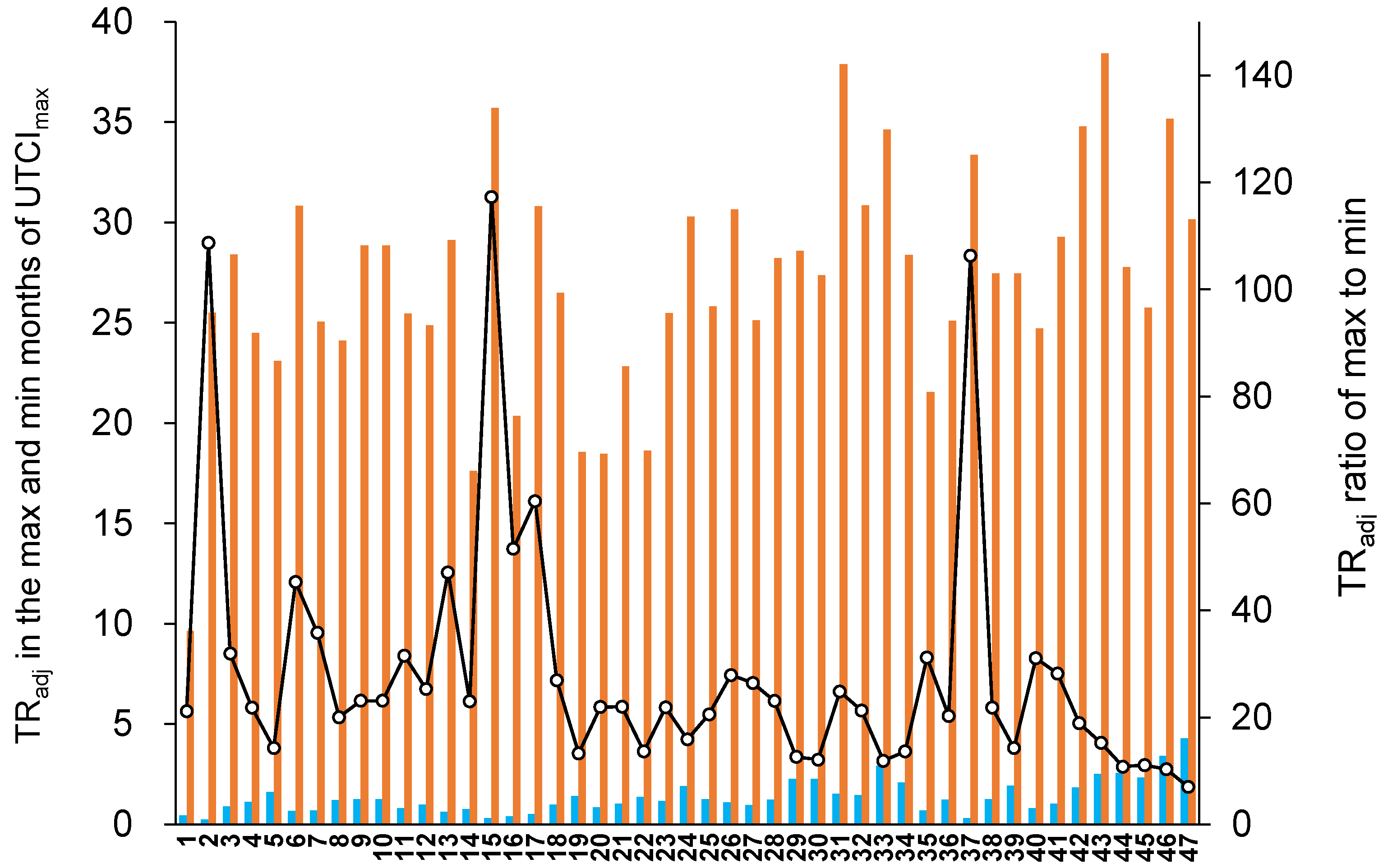
3.2. Vulnerability to Heat Stress Conditions
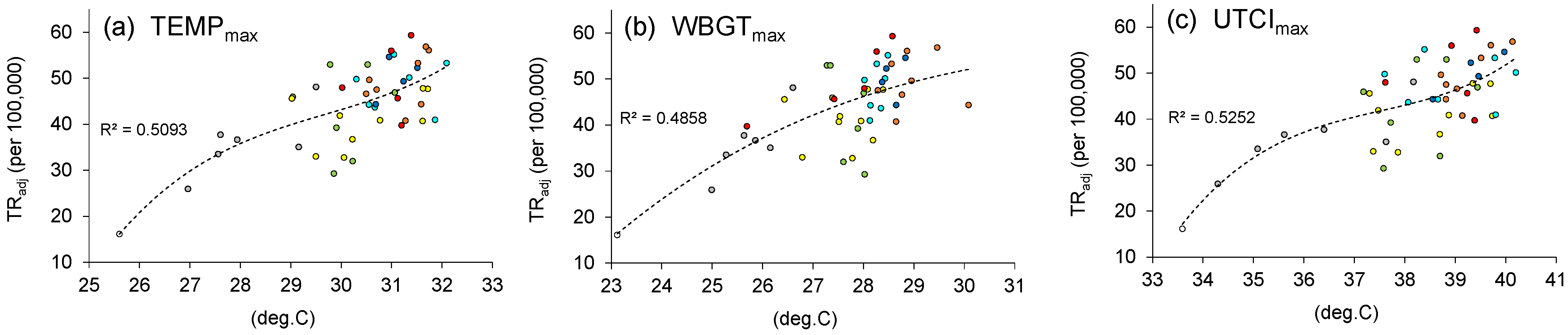
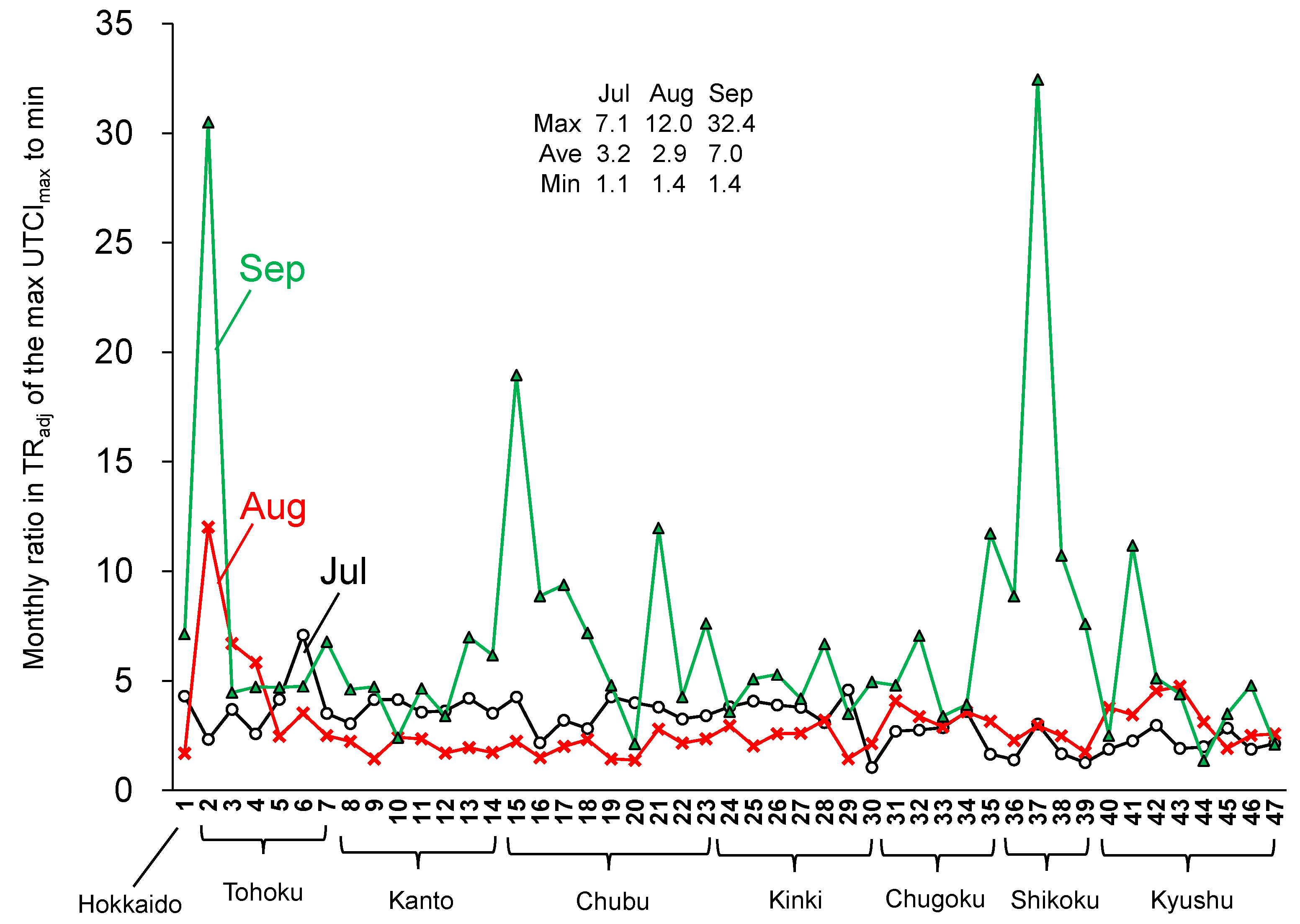
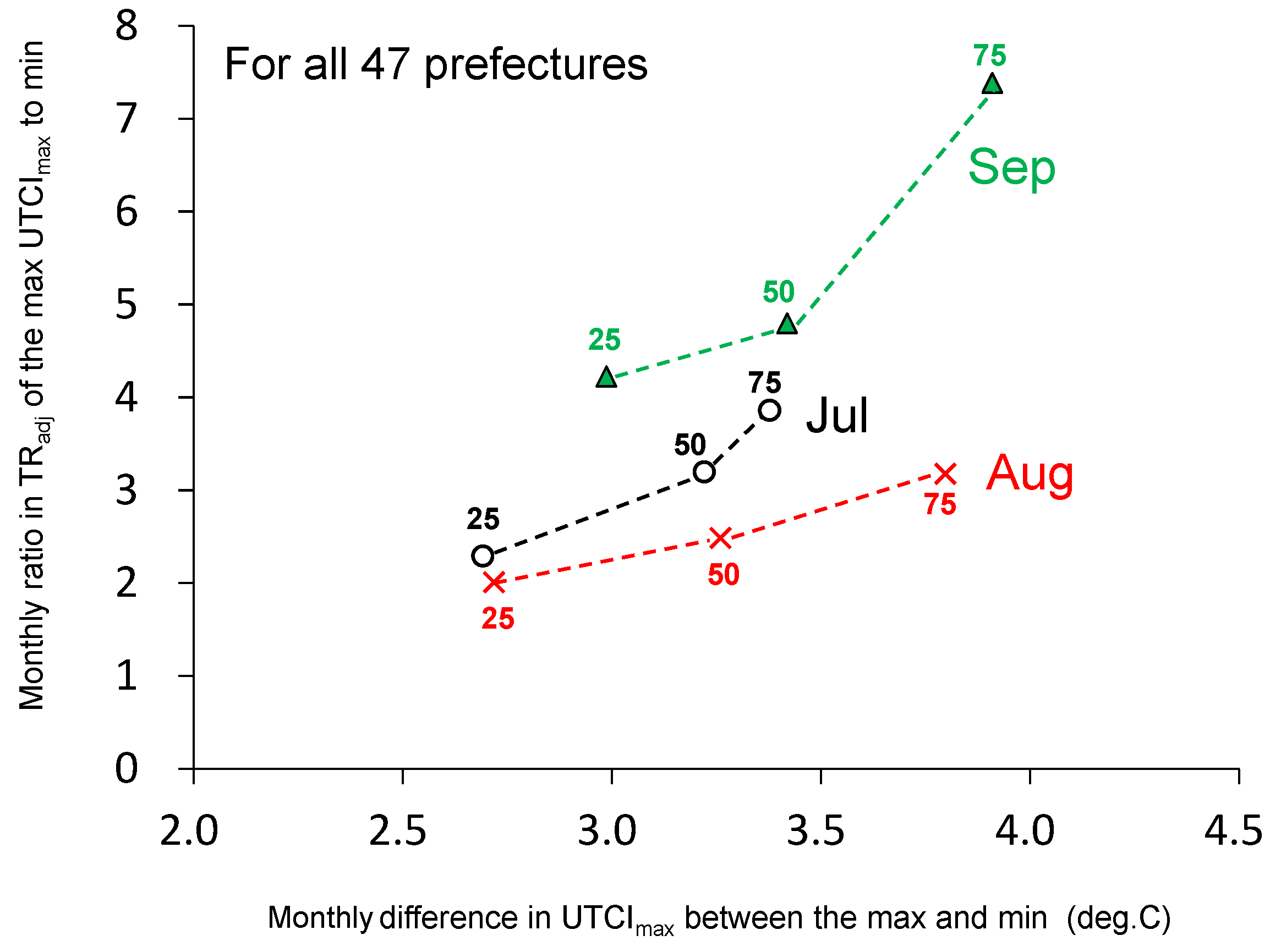
3.3. Heatstroke Risk of Hot to Cool Months
4. Conclusions
- (1)
- Analysed results obtained from the decade averaging preview.
- (2)
- Analysed results obtained from monthly averaging—heat vulnerability.
- (3)
- Analysed results obtained from monthly averaging—heatstroke risk.
Supplementary Materials
Author Contributions
Funding
Institutional Review Board Statement
Informed Consent Statement
Data Availability Statement
Acknowledgments
Conflicts of Interest
References
- World Health Organization. Ten Threats to Global Health in 2019. Available online: https://www.who.int/news-room/spotlight/ten-threats-to-global-health-in-2019 (accessed on 19 September 2021).
- Fire and Disaster Management Agency. Disaster Information. Available online: https://www.fdma.go.jp/disaster/heatstroke/ (accessed on 19 September 2021). (In Japanese)
- Nakai, S.; Itoh, T.; Morimoto, T. Deaths from heat-stroke in Japan: 1968–1994. Int. J. Biometeorol. 1999, 43, 124–127. [Google Scholar] [CrossRef] [Scilit]
- Makie, T.; Harada, M.; Kinukawa, N.; Toyoshiba, H.; Yamanaka, T.; Nakamura, T.; Sakamoto, M.; Nose, Y. Association of meteorological and day-of-the-week factors with emergency hospital admissions in Fukuoka, Kapan. Int. J. Biometeorol. 2002, 46, 38–41. [Google Scholar] [CrossRef] [Scilit] [PubMed]
- Hoshi, A.; Inaba, Y. Meteorological conditions and sports deaths at school in Japan, 1993–1998. Int. J. Biometeorol. 2005, 49, 224–231. [Google Scholar] [CrossRef] [Scilit] [PubMed]
- Ooka, R. Recent development of assessment tools for urban climate and heat-island investigation especially based on experiences in Japan. Int. J. Climatol. 2007, 27, 1919–1930. [Google Scholar] [CrossRef] [Scilit]
- Fujibe, F. Detection of urban warming in recent temperature trends in Japan. Int. J. Climatol. 2009, 29, 1811–1822. [Google Scholar] [CrossRef] [Scilit]
- Ohashi, Y.; Kikegawa, Y.; Ihara, T.; Sugiyama, N. Numerical simulations of outdoor heat stress index and heat disorder risk in the 23 wards of Tokyo. J. Appl. Meteorol. Climatol. 2014, 53, 583–597. [Google Scholar] [CrossRef] [Scilit]
- Takaya, A.; Morioka, Y.; Behera, S.K. Role of climate variability in the heatstroke death rates of Kanto region in Japan. Sci. Rep. 2014, 4, 5655. [Google Scholar]
- Akatsuka, S.; Uno, T.; Horiuchi, M. The relationship between the heat disorder incidence rate and heat stress indices at Yamanashi Prefecture in Japan. Adv. Meteorol. 2016, 2016, 9492815. [Google Scholar] [CrossRef] [Scilit]
- Sato, T.; Kusaka, H.; Hino, H. Quantitative assessment of the contribution of meteorological variables to the prediction of the number of heat stroke patients for Tokyo. SOLA 2020, 16, 104–108. [Google Scholar] [CrossRef] [Scilit]
- Fujibe, F.; Matsumoto, J.; Suzuki, H. Spatial and temporal features of heat stroke mortality in Japan and their relation to temperature variations, 1999–2014. Geogr. Rev. Jpn. Ser. B 2018, 91, 17–27. [Google Scholar]
- Ministry of the Environment. How Much Heatstroke Is Occurring? Available online: https://www.wbgt.env.go.jp/pdf/envman/1-3.pdf (accessed on 19 September 2021). (In Japanese)
- Moran, D.S.; Shapiro, Y.; Epstein, Y.; Matthew, W.; Pandolf, K.B. A modified discomfort index (MDI) as an alternative to the wet bulb globe temperature (WBGT). Environ. Ergon. 1998, 8, 77–80. [Google Scholar]
- Jendritzky, G.; Maarouf, A.; Staiger, H. Looking for a Universal Thermal Climate Index UTCI for outdoor applications. In Proceedings of the Windsor-Conference on Thermal Standards, Windsor, UK, 5–8 April 2001; pp. 353–367. [Google Scholar]
- Nastos, P.T.; Matzarakis, A. Human-biometeorological effects on sleep disturbances in Athens, Greece: A preliminary evaluation. Indoor Built Environ. 2008, 17, 535–542. [Google Scholar] [CrossRef] [Scilit]
- Solymosi, N.; Torma, C.; Kern, A.; Maróti-Agóts, A.; Barcza, Z.; Könyves, L.; Berke, O.; Reiczigel, J. Changing climate in Hungary and trends in the annual number of heat stress days. Int. J. Biometeorol. 2010, 54, 423–431. [Google Scholar] [CrossRef] [Scilit] [PubMed]
- Willett, K.M.; Sherwood, S. Exceedance of heat index thresholds for 15 regions under a warming climate using the wet-bulb globe temperature. Int. J. Climatol. 2012, 32, 161–177. [Google Scholar] [CrossRef] [Scilit]
- Kershaw, S.E.; Millward, A.A. A spatio-temporal index for heat vulnerability assessment. Environ. Monit. Assess. 2012, 184, 7329–7342. [Google Scholar] [CrossRef] [Scilit]
- Giannaros, T.M.; Melas, D.; Matzarakis, A. Evaluation of thermal bioclimate based on observational data and numerical simulations: An application to Greece. Int. J. Biometeorol. 2015, 59, 151–164. [Google Scholar] [CrossRef] [Scilit]
- Basarin, B.; Lukic, T.; Matzarakis, A. Quantification and assessment of heat and cold waves in Novi Sad, Northern Serbia. Int. J. Biometeorol. 2016, 60, 139–150. [Google Scholar] [CrossRef] [Scilit]
- Napoli, C.D.; Pappenberger, F.; Cloke, H.L. Assessing heat-related health risk in Europe via the universal thermal climate index (UTCI). Int. J. Biometeorol. 2018, 62, 1155–1165. [Google Scholar] [CrossRef] [Scilit] [PubMed]
- Tomczyk, A.M.; Bednorz, E.; Matzarakis, A. Human-biometeorological conditions during heat waves in Poland. Int. J. Climatol. 2020, 40, 5043–5055. [Google Scholar] [CrossRef] [Scilit]
- Vinogradova, V. Using the Universal Thermal Climate Index (UTCI) for the assessment of bioclimatic conditions in Russia. Int. J. Biometeorol. 2021, 65, 1473–1483. [Google Scholar] [CrossRef] [Scilit] [PubMed]
- Fujibe, F.; Matsumoto, J.; Suzuki, H. Regional features and temporal variations of heat-stroke ambulance transport rates in Japan –Comparison with mortality. J. Heat Isl. Inst. Int. 2020, 15, 1–13. (In Japanese) [Google Scholar]
- Fire and Disaster Management Agency. Heatstroke Information. Available online: http://www.fdma.go.jp/neuter/topics/fieldList9_2.html (accessed on 19 September 2021). (In Japanese)
- Yaglou, C.P.; Minard, C.D. Control of heat casualties at military training centers. AMA Arch. Indust. Health 1957, 16, 302–316. [Google Scholar]
- Jendritzky, G.; Maarouf, A.; Fiala, D.; Staiger, H. An update on the development of a Universal Thermal Climate Index. In Proceedings of the 15th Conference on Biometeorological Aerobiology and 16th ICB02, American Meteorological Society, Kansas City, MO, USA, 27 October–1 November 2002; pp. 129–133. [Google Scholar]
- Błażejczyk, K.; Jendritzky, G.; Bröde, P.; Fiala, D.; Havenith, G.; Epstein, Y.; Psikuta, A.; Kampmann, B. An introduction to the universal thermal climate index (UTCI). Geog. Pol. 2013, 86, 5–10. [Google Scholar] [CrossRef] [Scilit]
- Jendritzky, G.; Höppe, P. The UTCI and the ISB. Int. J. Biometeorol. 2017, 61, S23–S27. [Google Scholar] [CrossRef] [Scilit]
- Bröde, P.; Fiala, D.; Błażejczyk, K.; Holmér, I.; Jendritzky, G.; Kampmann, B.; Tinz, B.; Havenith, G. Deriving the operational procedure for the Universal Thermal Climate Index (UTCI). Int. J. Biometeorol. 2012, 56, 481–494. [Google Scholar] [CrossRef] [Scilit] [PubMed]
- Budd, G.M. Wet-bulb globe temperature (WBGT)—Its history and its limitations. J. Sci. Med. Sport 2018, 11, 20–32. [Google Scholar] [CrossRef] [Scilit]
- Błażejczyk, K.; Kuchcik, M.; Błażejczyk, A.; Milewksi, P.; Szmyd, J. Assessment of urban thermal stress by UTCI—Experimental and modelling studies: An example from Poland. DIE ERDE 2014, 145, 16–33. [Google Scholar]
- Provençal, S.; Bergeron, O.; Leduc, R.; Barrette, N. Thermal comfort in Quebec City, Canada: Sensitivity analysis of the UTCI and other popular thermal comfort indices in a mid-latitude continental city. Int. J. Biometeorol. 2016, 60, 591–603. [Google Scholar] [CrossRef] [Scilit]
- Hosokawa, Y.; Adams, W.M.; Belval, L.N.; Davis, R.J.; Huggins, R.A.; Jardine, J.F.; Katch, R.K.; Streams, R.L.; Casa, D.J. Exertional heat illness incidence and on-site medical team preparedness in warm weather. Int. J. Biometeorol. 2018, 62, 1147–1153. [Google Scholar] [CrossRef] [Scilit] [PubMed]
- Zare, S.; Hasheminejad, N.; Shirvan, H.E.; Hemmatjo, R.; Sarebanzadeh, K.; Ahmadi, S. Comparing Universal Thermal Climate Index (UTCI) with selected thermal indices/environmental parameters during 12 months of the year. Weather Clim. Extrem. 2018, 19, 49–57. [Google Scholar] [CrossRef] [Scilit]
- The Japan Meteorological Agency. The Past Meteorological Data. Available online: https://www.data.jma.go.jp/obd/stats/etrn/index.php (accessed on 19 September 2021). (In Japanese)
- The Ministry of the Environment. Heat Illness Prevention Information. Available online: https://www.wbgt.env.go.jp/wbgt_data.php (accessed on 19 September 2021).
- Błażejczyk, K.; Epstein, Y.; Jendritzky, G.; Staiger, H.; Tinz, B. Comparison of UTCI to selected thermal indices. Int. J. Biometeorol. 2012, 56, 515–535. [Google Scholar] [CrossRef] [Scilit] [PubMed]
- Zare, S.; Shirvan, H.E.; Hemmatjo, R.; Nadri, F.; Jahani, Y.; Jamshidzadeh, K.; Paydar, P. A comparison of the correlation between heat stress indices (UTCI, WBGT, WBDT, TSI) and physiological parameters of workers in Iran. Weather Clim. Extrem. 2019, 26, 100213. [Google Scholar] [CrossRef] [Scilit]
- Agresti, A.; Finlay, B. Statistical Methods for the Social Sciences, 4th ed.; Pearson-Prentice Hall: Upper Saddle River, NJ, USA, 2009. [Google Scholar]
- Huynh, H.; Meyer, P. Use of robust z in detecting unstable items in item response theory models. Pract. Assess. Res. Eval. 2010, 15, 2. [Google Scholar]
- Puwastien, P. Issues in the development and use of food composition databases. Public Health Nutr. 2002, 5, 991–999. [Google Scholar] [CrossRef] [Scilit] [PubMed]
- Tripathy, S.S.; Saxena, R.K.; Gupta, P.K. Comparison of statistical methods for outlier detection in proficiency testing data on analysis of lead in aqueous solution. Am. J. Theor. Appl. Stat. 2013, 2, 233–242. [Google Scholar] [CrossRef] [Scilit]
- Ono, M. Heat stroke and the thermal environment. Jpn. Med. Assoc. J. 2013, 56, 199–205. [Google Scholar]
- V-RESAS, Agoop Corp. Visualisation of the Influence of COVID-19 on Regional Economy. Available online: https://v-resas.go.jp/#population (accessed on 19 September 2021). (In Japanese)
- Ministry of Internal Affairs and Communications. Summary Report of Heatstroke Transport in 2020. Available online: https://www.soumu.go.jp/main_content/000713462.pdf (accessed on 19 September 2021). (In Japanese)

Publisher’s Note: MDPI stays neutral with regard to jurisdictional claims in published maps and institutional affiliations. |
© 2021 by the authors. Licensee MDPI, Basel, Switzerland. This article is an open access article distributed under the terms and conditions of the Creative Commons Attribution (CC BY) license (https://creativecommons.org/licenses/by/4.0/).
Share and Cite
Iwamoto, Y.; Ohashi, Y. Assessing the Climatological Relationship between Heatstroke Risk and Heat Stress Indices in 47 Prefectures in Japan. GeoHazards 2021, 2, 321-331. https://doi.org/10.3390/geohazards2040017
Iwamoto Y, Ohashi Y. Assessing the Climatological Relationship between Heatstroke Risk and Heat Stress Indices in 47 Prefectures in Japan. GeoHazards. 2021; 2(4):321-331. https://doi.org/10.3390/geohazards2040017
Chicago/Turabian StyleIwamoto, Yuki, and Yukitaka Ohashi. 2021. "Assessing the Climatological Relationship between Heatstroke Risk and Heat Stress Indices in 47 Prefectures in Japan" GeoHazards 2, no. 4: 321-331. https://doi.org/10.3390/geohazards2040017
APA StyleIwamoto, Y., & Ohashi, Y. (2021). Assessing the Climatological Relationship between Heatstroke Risk and Heat Stress Indices in 47 Prefectures in Japan. GeoHazards, 2(4), 321-331. https://doi.org/10.3390/geohazards2040017