
Orbital Footprint: A Critical Review of Satellite Megaconstellation Impacts on Atmospheric Chemistry, Precipitation, Hydrological Processes, and Flood Risk

 , and
, and 
Abstract
1. Introduction
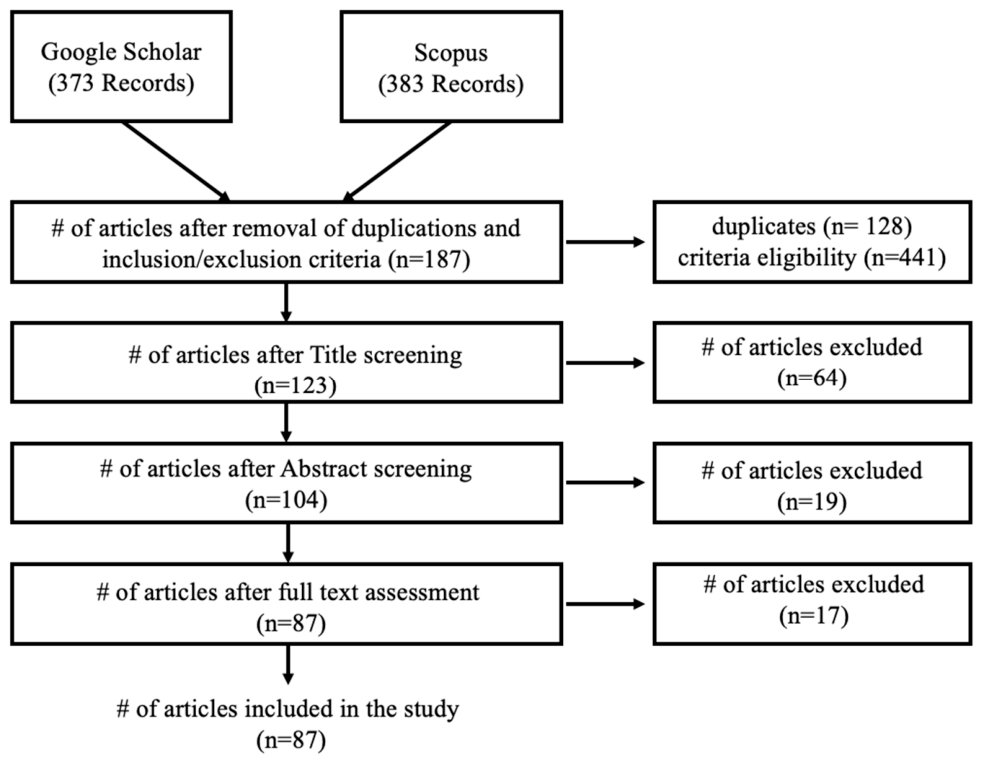
2. Materials and Methods
- (i)
- What atmospheric emissions are generated during satellite launch and re-entry processes;
- (ii)
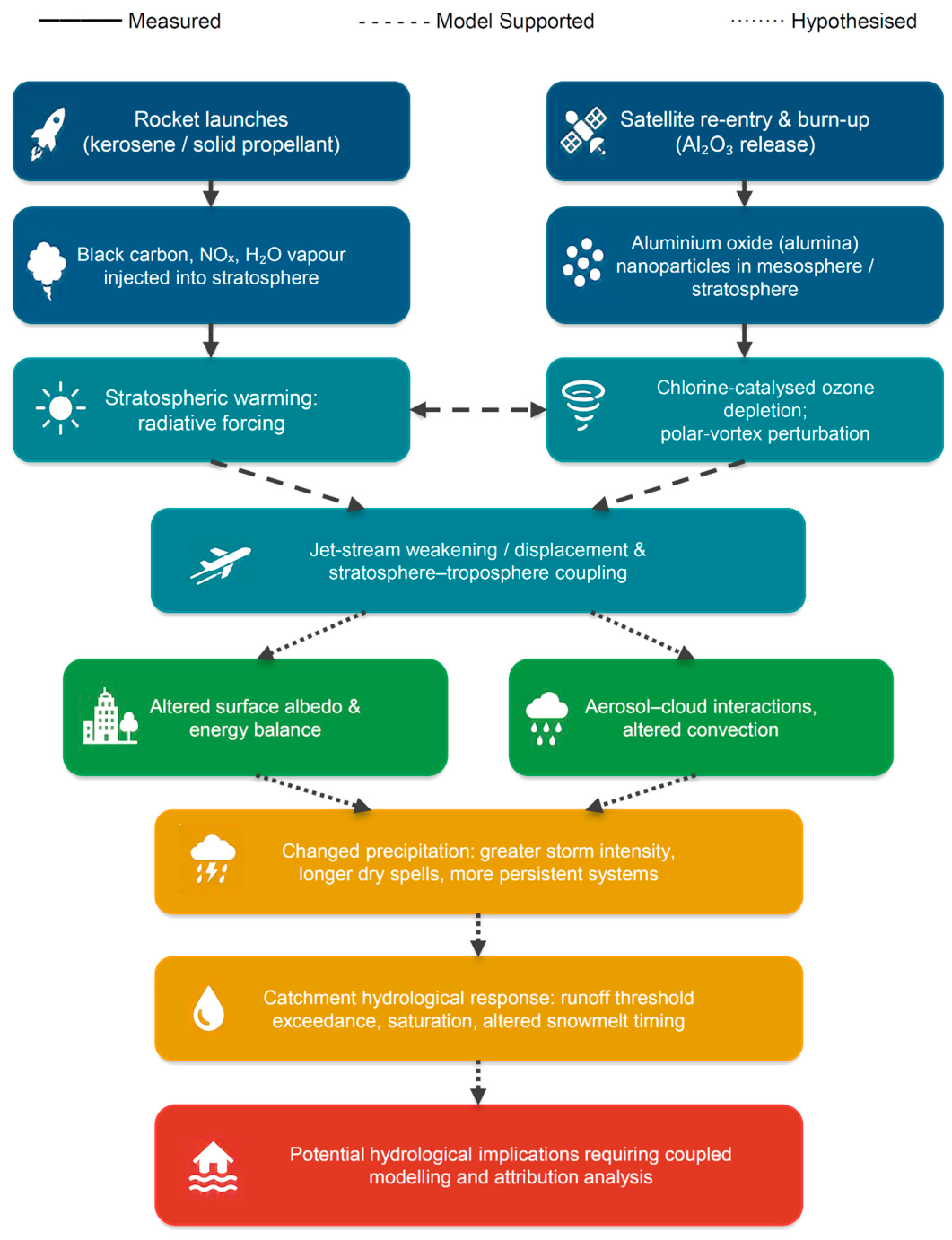
- How do these emissions influence stratospheric chemistry, radiative forcing, and atmospheric circulation;
- (iii)
- Through which physical mechanisms such perturbations may affect precipitation processes; and
- (iv)
- Whether these pathways could plausibly contribute to changes in flood risk.
3. Stratospheric and Mesospheric Chemistry: The Primary Forcing Layer
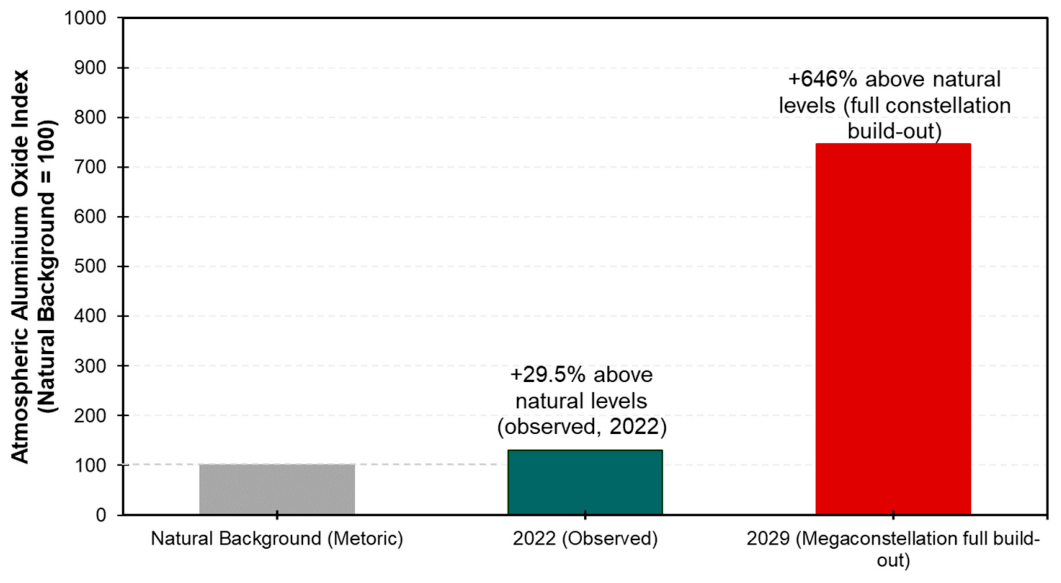
3.1. Aluminium Oxide from Satellite Re-Entry
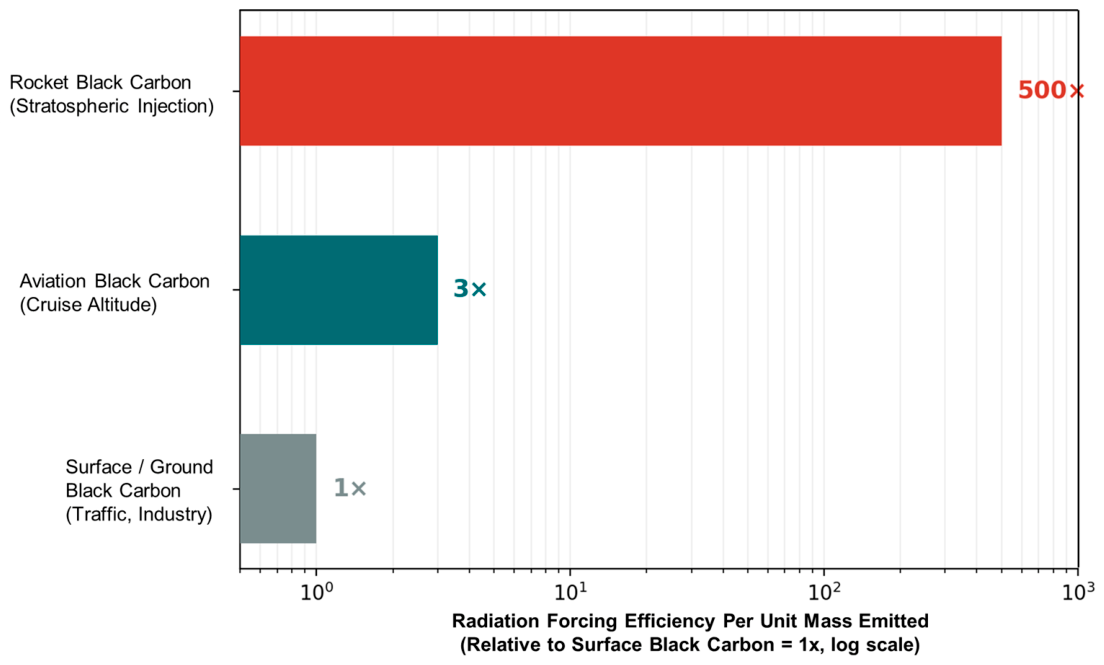
3.2. Black Carbon Soot from Rocket Launches
3.3. Water Vapour, Nitrogen Oxides, and Chlorine Compounds
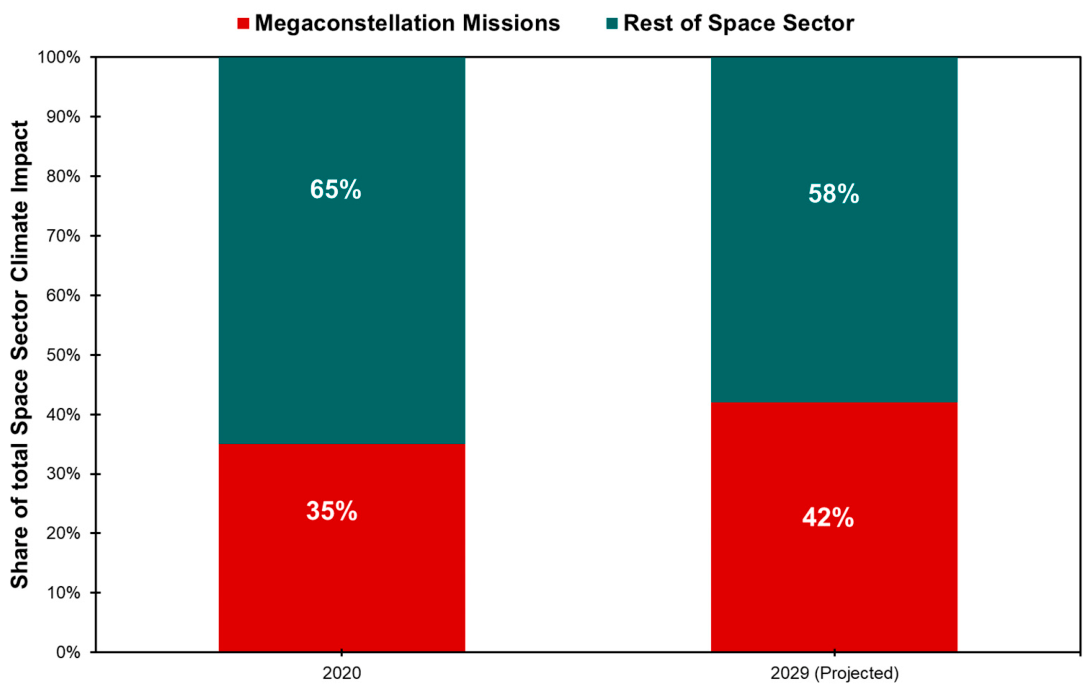
4. Radiative Forcing and the Space Sector’s Climate Footprint
5. Stratospheric Ozone: A Critical and Underappreciated Pathway
6. Albedo Modification and Surface Energy Balance
6.1. Stratospheric Albedo
6.2. Surface Albedo and Urban Heat Islands
7. Precipitation, Hydrological Processes, and Flood Risk
7.1. Aerosol–Cloud–Precipitation Interactions
7.2. Jet Stream Displacement
7.3. Observed Precipitation Trends
7.4. From Rainfall to Rivers: Hydrological Pathways to Flooding
7.5. The Dual Role of Satellites in Flood Science
8. Advances, Challenges, and Future Research Directions
8.1. Recent Scientific Advances
8.2. Key Scientific Challenges
8.3. Attribution and Modelling Gaps
8.4. Governance and Regulatory Challenges
8.5. Priority Future Research Directions
9. Conclusions
Author Contributions
Funding
Data Availability Statement
Acknowledgments
Conflicts of Interest
Abbreviations
| LEO | Low Earth Orbit |
| AI | Artificial Intelligence |
| CCN | Cloud Condensation Nuclei |
| NEPA | National Environmental Policy Act |
References
- Boley, A.C.; Byers, M. Satellite mega-constellations create risks in Low Earth Orbit, the atmosphere and on Earth. Sci. Rep. 2021, 11, 10642. [Google Scholar] [CrossRef] [Scilit] [PubMed]
- Baccelli, F.; Candel, S.; Perrin, G.; Puget, J.-L. Large Satellite Constellations: Challenges and Impact; Académie des Sciences: Paris, France, 2024. [Google Scholar]
- Zhang, J.; Cai, Y.; Xue, C.; Xue, Z.; Cai, H. LEO mega constellations: Review of development, impact, surveillance, and governance. Space Sci. Technol. 2022, 2022, 9865174. [Google Scholar] [CrossRef] [Scilit]
- Miraux, L. Environmental limits to the space sector’s growth. Sci. Total Environ. 2022, 806, 150862. [Google Scholar] [CrossRef] [Scilit] [PubMed]
- Brown, T.F.; Bannister, M.T.; Revell, L.E.; Sukhodolov, T.; Rozanov, E. Worldwide rocket launch emissions 2019: An inventory for use in global models. Earth Space Sci. 2024, 11, e2024EA003668. [Google Scholar] [CrossRef] [Scilit]
- Jain, A.K.; Eastham, S.D.; Hastings, D. Future of Satellite Reentry and Earth’s Atmosphere: The Lifetime and Direct Radiative Forcing of Space Debris Reentry Alumina. ESS Open Archive 2023. [Google Scholar] [CrossRef] [Scilit] [PubMed]
- Rothe, D.L.; Collins, V.E. The ‘Irrational’ ‘Rationalization’of Space Expansionism. J. Theor. Philos. Criminol. 2026, 18, 41. [Google Scholar]
- Maloney, C.; Portmann, R.; Ross, M.; Rosenlof, K. Modeling the atmospheric transport and possible radiative impact of alumina aerosols emitted from the projected increase in annual satellite reentry emissions. In Proceedings of the EGU General Assembly Conference Abstracts; European Geosciences Union (EGU): Munich, Germany, 2025; p. EGU25-3866. [Google Scholar]
- Maloney, C.M.; Portmann, R.W.; Ross, M.N.; Rosenlof, K.H. Investigating the potential atmospheric accumulation and radiative impact of the coming increase in satellite reentry frequency. J. Geophys. Res. Atmos. 2025, 130, e2024JD042442. [Google Scholar] [CrossRef] [Scilit]
- Kim, M.; Williams, I. Thousands of Satellites Are Due to Burn Up in the Atmosphere Every Year–Damaging the Ozone Layer and Changing the Climate. The Conversation, 2025. Available online: https://theconversation.com/thousands-of-satellites-are-due-to-burn-up-in-the-atmosphere-every-year-damaging-the-ozone-layer-and-changing-the-climate-251845 (accessed on 26 August 2026).
- Shindell, D.T.; Faluvegi, G.; Koch, D.M.; Schmidt, G.A.; Unger, N.; Bauer, S.E. Improved attribution of climate forcing to emissions. Science 2009, 326, 716–718. [Google Scholar] [CrossRef] [Scilit] [PubMed]
- Kukreja, R.; Oughton, E.J.; Linares, R. Greenhouse Gas (GHG) Emissions Poised to Rocket: Modeling the Environmental Impact of LEO Satellite Constellations. arXiv 2025, arXiv:2504.15291. [Google Scholar]
- Agrawal, R. The effect of space launches on climate: A legal and policy perspective. Adv. Space Law 2024, 13, 75–87. [Google Scholar] [CrossRef] [Scilit]
- Liu, Y.; Tanguturi, S.; Shrestha, R.R.; RahimiMovaghar, M.; Najafi, M.R. Projection of future climate change and precipitation extremes over the Canadian Lake Erie and Lake Ontario basins under global warming. Front. Water 2026, 8, 1774999. [Google Scholar] [CrossRef] [Scilit]
- Misra, A.; White, K.; Nsutezo, S.F.; Straka, W., III; Lavista, J. Mapping global floods with 10 years of satellite radar data. Nat. Commun. 2025, 16, 5762. [Google Scholar] [CrossRef] [Scilit] [PubMed]
- Ferreira, J.P.; Huang, Z.; Nomura, K.i.; Wang, J. Potential ozone depletion from satellite demise during atmospheric reentry in the era of mega-constellations. Geophys. Res. Lett. 2024, 51, e2024GL109280. [Google Scholar] [CrossRef] [Scilit]
- Murphy, D.M.; Abou-Ghanem, M.; Cziczo, D.J.; Froyd, K.D.; Jacquot, J.; Lawler, M.J.; Maloney, C.; Plane, J.M.; Ross, M.N.; Schill, G.P. Metals from spacecraft reentry in stratospheric aerosol particles. Proc. Natl. Acad. Sci. USA 2023, 120, e2313374120. [Google Scholar] [CrossRef] [Scilit] [PubMed]
- Ryan, R.G.; Marais, E.A.; Balhatchet, C.J.; Eastham, S.D. Impact of rocket launch and space debris air pollutant emissions on stratospheric ozone and global climate. Earth’s Future 2022, 10, e2021EF002612. [Google Scholar] [CrossRef] [Scilit] [PubMed]
- Barker, C.R.; Marais, E.A.; McDowell, J.C. Global 3D rocket launch and re-entry air pollutant and CO2 emissions at the onset of the megaconstellation era. Sci. Data 2024, 11, 1079. [Google Scholar] [CrossRef] [Scilit] [PubMed]
- Marc, O.; Barret, M.; Biancamaria, S.; Dassas, K.; Firmin, A.; Gandois, L.; Gheusi, F.; Kuppel, S.; Maisonobe, M.; Mialon, A. Comprehensive carbon footprint of Earth, environmental and space science laboratories: Implications for sustainable scientific practice. PLoS Sustain. Transform. 2024, 3, e0000135. [Google Scholar] [CrossRef] [Scilit]
- Danilin, M.; Shia, R.L.; Ko, M.; Weisenstein, D.; Sze, N.; Lamb, J.; Smith, T.; Lohn, P.; Prather, M. Global stratospheric effects of the alumina emissions by solid-fueled rocket motors. J. Geophys. Res. Atmos. 2001, 106, 12727–12738. [Google Scholar] [CrossRef] [Scilit]
- Ross, M.N.; Sheaffer, P.M. Radiative forcing caused by rocket engine emissions. Earth’s Future 2014, 2, 177–196. [Google Scholar] [CrossRef] [Scilit]
- Solomon, S.; Garcia, R.R.; Rowland, F.S.; Wuebbles, D.J. On the depletion of Antarctic ozone. Nature 1986, 321, 755–758. [Google Scholar] [CrossRef] [Scilit]
- Solomon, S. Stratospheric ozone depletion: A review of concepts and history. Rev. Geophys. 1999, 37, 275–316. [Google Scholar] [CrossRef] [Scilit]
- Carslaw, K.; Boucher, O.; Spracklen, D.; Mann, G.; Rae, J.; Woodward, S.; Kulmala, M. A review of natural aerosol interactions and feedbacks within the Earth system. Atmos. Chem. Phys. 2010, 10, 1701–1737. [Google Scholar] [CrossRef] [Scilit]
- Plane, J.M. Cosmic dust in the Earth’s atmosphere. Chem. Soc. Rev. 2012, 41, 6507–6518. [Google Scholar] [CrossRef] [Scilit] [PubMed]
- Carrillo-Sánchez, J.; Nesvorný, D.; Pokorný, P.; Janches, D.; Plane, J. Sources of cosmic dust in the Earth’s atmosphere. Geophys. Res. Lett. 2016, 43, 11979–11986. [Google Scholar] [CrossRef] [Scilit] [PubMed]
- Hervig, M.E.; Plane, J.M.C.; Siskind, D.E.; Feng, W.; Bardeen, C.; Bailey, S.M. Meteoric smoke and meteor influx from global SOFIE observations. ESS Open Archive 2021. [Google Scholar] [CrossRef] [Scilit]
- Peter, T. Microphysics and heterogeneous chemistry of polar stratospheric clouds. Annu. Rev. Phys. Chem. 1997, 48, 785–822. [Google Scholar] [CrossRef] [Scilit]
- Barker, C.R.; Marais, E.A.; Tan, E.Y.; Eastham, S.D.; Diskin, G.S.; DiGangi, J.P.; Choi, Y.; Rollins, A.W.; Waxman, E.; Bui, T.P. Radiative forcing and ozone depletion of a decade of satellite megaconstellation missions. Earth’s Future 2026, 14, e2025EF007229. [Google Scholar] [CrossRef] [Scilit]
- Anselmo, L.; Pardini, C. Computational methods for reentry trajectories and risk assessment. Adv. Space Res. 2005, 35, 1343–1352. [Google Scholar] [CrossRef] [Scilit]
- Bond, T.C.; Doherty, S.J.; Fahey, D.W.; Forster, P.M.; Berntsen, T.; DeAngelo, B.J.; Flanner, M.G.; Ghan, S.; Kärcher, B.; Koch, D. Bounding the role of black carbon in the climate system: A scientific assessment. J. Geophys. Res. Atmos. 2013, 118, 5380–5552. [Google Scholar] [CrossRef] [Scilit]
- Ramanathan, V.; Carmichael, G. Global and regional climate changes due to black carbon. Nat. Geosci. 2008, 1, 221–227. [Google Scholar] [CrossRef] [Scilit]
- Koch, D.; Schulz, M.; Kinne, S.; McNaughton, C.; Spackman, J.; Balkanski, Y.; Bauer, S.; Berntsen, T.; Bond, T.C.; Boucher, O. Evaluation of black carbon estimations in global aerosol models. Atmos. Chem. Phys. 2009, 9, 9001–9026. [Google Scholar] [CrossRef] [Scilit]
- Calvin, K.; Dasgupta, D.; Krinner, G.; Mukherji, A.; Thorne, P.W.; Trisos, C.; Romero, J.; Aldunce, P.; Barrett, K.; Blanco, G. IPCC, 2023: Climate Change 2023: Synthesis Report. Contribution of Working Groups I, II and III to the Sixth Assessment Report of the Intergovernmental Panel on Climate Change; European Union: Brussels, Belgium, 2023; pp. 35–115. [Google Scholar]
- Maloney, C.M.; Portmann, R.W.; Ross, M.N.; Rosenlof, K.H. The climate and ozone impacts of black carbon emissions from global rocket launches. J. Geophys. Res. Atmos. 2022, 127, e2021JD036373. [Google Scholar] [CrossRef] [Scilit]
- Revell, L.E.; Bannister, M.T.; Brown, T.F.; Sukhodolov, T.; Vattioni, S.; Dykema, J.; Frame, D.J.; Cater, J.; Chiodo, G.; Rozanov, E. Near-future rocket launches could slow ozone recovery. npj Clim. Atmos. Sci. 2025, 8, 212. [Google Scholar] [CrossRef] [Scilit] [PubMed]
- Polvani, L.M.; Waugh, D.W.; Correa, G.J.; Son, S.-W. Stratospheric ozone depletion: The main driver of twentieth-century atmospheric circulation changes in the Southern Hemisphere. J. Clim. 2011, 24, 795–812. [Google Scholar] [CrossRef] [Scilit]
- Elgendy, D.; Tolba, O.; Kamel, T. The impact of increasing urban surface albedo on outdoor air and surface temperatures during summer in newly developed areas. Sci. Rep. 2025, 15, 25165. [Google Scholar] [CrossRef] [Scilit] [PubMed]
- Kidston, J.; Scaife, A.A.; Hardiman, S.C.; Mitchell, D.M.; Butchart, N.; Baldwin, M.P.; Gray, L.J. Stratospheric influence on tropospheric jet streams, storm tracks and surface weather. Nat. Geosci. 2015, 8, 433–440. [Google Scholar] [CrossRef] [Scilit]
- Voigt, C.; Kleine, J.; Sauer, D.; Moore, R.H.; Bräuer, T.; Le Clercq, P.; Kaufmann, S.; Scheibe, M.; Jurkat-Witschas, T.; Aigner, M. Cleaner burning aviation fuels can reduce contrail cloudiness. Commun. Earth Environ. 2021, 2, 114. [Google Scholar] [CrossRef] [Scilit]
- Webb, D. The Environmental Effects of Space Tourism. In Space Tourism; Routledge: New Delhi, India, 2024; pp. 114–132. [Google Scholar]
- Li, Y.; Feng, W.; Plane, J.M.; Wang, T.; Chipperfield, M.P. The impact of rocket-emitted chlorine on stratospheric ozone. Atmos. Chem. Phys. 2026, 26, 3621–3635. [Google Scholar] [CrossRef] [Scilit]
- Solomon, S.; Rosenlof, K.H.; Portmann, R.W.; Daniel, J.S.; Davis, S.M.; Sanford, T.J.; Plattner, G.-K. Contributions of stratospheric water vapor to decadal changes in the rate of global warming. Science 2010, 327, 1219–1223. [Google Scholar] [CrossRef] [Scilit] [PubMed]
- Forster, P.M.d.F.; Shine, K. Assessing the climate impact of trends in stratospheric water vapor. Geophys. Res. Lett. 2002, 29, 10-11–10-14. [Google Scholar] [CrossRef] [Scilit]
- Held, I.M.; Soden, B.J. Water vapor feedback and global warming. Annu. Rev. Energy Environ. 2000, 25, 441–475. [Google Scholar] [CrossRef] [Scilit]
- Crutzen, P.J. The influence of nitrogen oxides on the atmospheric ozone content. Q. J. R. Meteorol. Soc. 1970, 96, 320–325. [Google Scholar] [CrossRef] [Scilit]
- Lee, J.N.; Wu, D.L.; Thurairajah, B.; Hozumi, Y.; Tsuda, T. The Sensitivity of Polar Mesospheric Clouds to Mesospheric Temperature and Water Vapor. Remote Sens. 2024, 16, 1563. [Google Scholar] [CrossRef] [Scilit]
- Sharma, S.P. Impact of Spaceflight on Earth’s Atmosphere: Climate, Ozone, and the Upper Atmosphere; National Aeronautics and Space Administration: Washington, DC, USA, 2024.
- Clerbaux, C.; Cunnold, D.; Anderson, J.; Engel, A.; Fraser, P.; Mahieu, E.; Manning, A.; Miller, J.; Montzka, S.; Nassar, R. Scientific Assessment of Ozone Depletion: 2006; Global Ozone Research and Monitoring Project-Report No. 50; World Meteorological Organization: Geneva, Switzerland, 2007. [Google Scholar]
- Molina, M.J.; Rowland, F.S. Stratospheric sink for chlorofluoromethanes: Chlorine atom-catalysed destruction of ozone. Nature 1974, 249, 810–812. [Google Scholar] [CrossRef] [Scilit]
- Arias, P.; Bellouin, N.; Coppola, E.; Jones, R.; Krinner, G.; Marotzke, J.; Naik, V.; Palmer, M.; Plattner, G.-K.; Rogelj, J. Climate Change 2021: The Physical Science Basis. Contribution of Working Group I to the Sixth Assessment Report of the Intergovernmental Panel on Climate Change; Technical Summary; Cambridge University Press: Cambridge, UK, 2021. [Google Scholar]
- Myhre, G.; Shindell, D.; Bréon, F.-M.; Collins, W.; Fuglestvedt, J.; Huang, J.; Koch, D.; Lamarque, J.-F.; Lee, D.; Mendoza, B. Anthropogenic and natural radiative forcing. In Climate Change 2013—The Physical Science Basis; Cambridge University Press: Cambridge, UK, 2014; pp. 659–740. [Google Scholar]
- Kravitz, B.; MacMartin, D.G.; Wang, H.; Rasch, P.J. Geoengineering as a design problem. Earth Syst. Dyn. 2016, 7, 469–497. [Google Scholar] [CrossRef] [Scilit]
- Boucher, O.; Randall, D.; Artaxo, P.; Bretherton, C.; Feingold, G.; Forster, P.; Kerminen, V.-M.; Kondo, Y.; Liao, H.; Lohmann, U. Clouds and aerosols. In Climate Change 2013: The Physical Science Basis. Contribution of Working Group I to the Fifth Assessment Report of the Intergovernmental Panel on Climate Change; Cambridge University Press: Cambridge, UK, 2013; pp. 571–657. [Google Scholar]
- Robock, A. Volcanic eruptions and climate. Rev. Geophys. 2000, 38, 191–219. [Google Scholar] [CrossRef] [Scilit]
- National Academies of Sciences, Engineering, and Medicine. Reflecting Sunlight: Recommendations for Solar Geoengineering Research and Research Governance; National Academies Press (NAP): Washington, DC, USA, 2021. [Google Scholar]
- Solomon, S.; Portmann, R.; Garcia, R.; Thomason, L.; Poole, L.; McCormick, M. The role of aerosol variations in anthropogenic ozone depletion at northern midlatitudes. J. Geophys. Res. Atmos. 1996, 101, 6713–6727. [Google Scholar] [CrossRef] [Scilit]
- Hofmann, D.J.; Solomon, S. Ozone destruction through heterogeneous chemistry following the eruption of El Chichon. J. Geophys. Res. Atmos. 1989, 94, 5029–5041. [Google Scholar] [CrossRef] [Scilit]
- Baldwin, M.P.; Dunkerton, T.J. Stratospheric harbingers of anomalous weather regimes. Science 2001, 294, 581–584. [Google Scholar] [CrossRef] [Scilit] [PubMed]
- Thompson, D.W.; Solomon, S.; Kushner, P.J.; England, M.H.; Grise, K.M.; Karoly, D.J. Signatures of the Antarctic ozone hole in Southern Hemisphere surface climate change. Nat. Geosci. 2011, 4, 741–749. [Google Scholar] [CrossRef] [Scilit]
- Trenberth, K.E.; Dai, A. Effects of Mount Pinatubo volcanic eruption on the hydrological cycle as an analog of geoengineering. Geophys. Res. Lett. 2007, 34, L15702. [Google Scholar] [CrossRef] [Scilit]
- Wu, S.; Lin, X.; Bian, Z.; Lipson, M.; Lafortezza, R.; Liu, Q.; Grimmond, S.; Velasco, E.; Christen, A.; Masson, V. Satellite observations reveal a decreasing albedo trend of global cities over the past 35 years. Remote Sens. Environ. 2024, 303, 114003. [Google Scholar] [CrossRef] [Scilit]
- Oke, T.R. The energetic basis of the urban heat island. Q. J. R. Meteorol. Soc. 1982, 108, 1–24. [Google Scholar] [CrossRef] [Scilit]
- Arnfield, A.J. Two decades of urban climate research: A review of turbulence, exchanges of energy and water, and the urban heat island. Int. J. Climatol. J. R. Meteorol. Soc. 2003, 23, 1–26. [Google Scholar] [CrossRef] [Scilit]
- Shepherd, J.M. A review of current investigations of urban-induced rainfall and recommendations for the future. Earth Interact. 2005, 9, 1–27. [Google Scholar] [CrossRef] [Scilit]
- Rosenzweig, C.; Solecki, W.D.; Hammer, S.A.; Mehrotra, S. Climate Change and Cities: First Assessment Report of the Urban Climate Change Research Network; Cambridge University Press: Cambridge, UK, 2011. [Google Scholar]
- Xiong, J.; Yang, Y.; Yang, L.; Yang, D. Asymmetric shifts in precipitation due to urbanization across global cities. Nat. Commun. 2025, 16, 5802. [Google Scholar] [CrossRef] [Scilit] [PubMed]
- Guccione, A.; Bassi, P.; Desbiolles, F.; Borgnino, M.; D’Andrea, F.; Pasquero, C. Extreme precipitation changes in relation to urbanization. npj Nat. Hazards 2026, 3, 10. [Google Scholar] [CrossRef] [Scilit]
- Yang, L.; Yang, Y.; Shen, Y.; Yang, J.; Zheng, G.; Smith, J.; Niyogi, D. Urban development pattern’s influence on extreme rainfall occurrences. Nat. Commun. 2024, 15, 3997. [Google Scholar] [CrossRef] [Scilit] [PubMed]
- Feldman, A.F.; Reed, S.C.; Wessels, K.; Ojima, D.; Moore, D.J.; Smith, W.K.; Hanan, N.; Amaral, C.; Babst, F.; Biederman, J.A. An overview of the NASA Adaptation and Response in Drylands field experiment scoping study. Camb. Prism. Drylands 2026, 3, e22. [Google Scholar] [CrossRef] [Scilit] [PubMed]
- Rosenfeld, D.; Lohmann, U.; Raga, G.B.; O’Dowd, C.D.; Kulmala, M.; Fuzzi, S.; Reissell, A.; Andreae, M.O. Flood or drought: How do aerosols affect precipitation? Science 2008, 321, 1309–1313. [Google Scholar] [CrossRef] [Scilit] [PubMed]
- Andreae, M.; Rosenfeld, D. Aerosol–cloud–precipitation interactions. Part 1. The nature and sources of cloud-active aerosols. Earth-Sci. Rev. 2008, 89, 13–41. [Google Scholar] [CrossRef] [Scilit]
- Rosenfeld, D.; Andreae, M.O.; Asmi, A.; Chin, M.; De Leeuw, G.; Donovan, D.P.; Kahn, R.; Kinne, S.; Kivekäs, N.; Kulmala, M. Global observations of aerosol-cloud-precipitation-climate interactions. Rev. Geophys. 2014, 52, 750–808. [Google Scholar] [CrossRef] [Scilit]
- Francis, J.A.; Vavrus, S.J. Evidence linking Arctic amplification to extreme weather in mid-latitudes. Geophys. Res. Lett. 2012, 39, L06801. [Google Scholar] [CrossRef] [Scilit]
- Coumou, D.; Robinson, A.; Rahmstorf, S. Global increase in record-breaking monthly-mean temperatures. Clim. Change 2013, 118, 771–782. [Google Scholar] [CrossRef] [Scilit]
- Mann, M.E.; Rahmstorf, S.; Kornhuber, K.; Steinman, B.A.; Miller, S.K.; Coumou, D. Influence of anthropogenic climate change on planetary wave resonance and extreme weather events. Sci. Rep. 2017, 7, 45242. [Google Scholar] [CrossRef] [Scilit] [PubMed]
- Allan, R.P.; Soden, B.J. Atmospheric warming and the amplification of precipitation extremes. Science 2008, 321, 1481–1484. [Google Scholar] [CrossRef] [Scilit] [PubMed]
- Blöschl, G.; Hall, J.; Viglione, A.; Perdigão, R.A.; Parajka, J.; Merz, B.; Lun, D.; Arheimer, B.; Aronica, G.T.; Bilibashi, A. Changing climate both increases and decreases European river floods. Nature 2019, 573, 108–111. [Google Scholar] [CrossRef] [Scilit] [PubMed]
- Woollings, T.; Hannachi, A.; Hoskins, B.; Turner, A. A regime view of the North Atlantic Oscillation and its response to anthropogenic forcing. J. Clim. 2010, 23, 1291–1307. [Google Scholar] [CrossRef] [Scilit]
- Pfahl, S.; O’Gorman, P.A.; Fischer, E.M. Understanding the regional pattern of projected future changes in extreme precipitation. Nat. Clim. Change 2017, 7, 423–427. [Google Scholar] [CrossRef] [Scilit]
- Westra, S.; Alexander, L.V.; Zwiers, F.W. Global increasing trends in annual maximum daily precipitation. J. Clim. 2013, 26, 3904–3918. [Google Scholar] [CrossRef] [Scilit]
- Seinfeld, J.H.; Bretherton, C.; Carslaw, K.S.; Coe, H.; DeMott, P.J.; Dunlea, E.J.; Feingold, G.; Ghan, S.; Guenther, A.B.; Kahn, R. Improving our fundamental understanding of the role of aerosol—Cloud interactions in the climate system. Proc. Natl. Acad. Sci. USA 2016, 113, 5781–5790. [Google Scholar] [CrossRef] [Scilit] [PubMed]
- Pruppacher, H.R.; Klett, J.D. Microphysics of Clouds and Precipitation; Kluwer Academic Publishers: Amsterdam, The Netherlands, 1997. [Google Scholar]
- Stevens, B.; Feingold, G. Untangling aerosol effects on clouds and precipitation in a buffered system. Nature 2009, 461, 607–613. [Google Scholar] [CrossRef] [Scilit] [PubMed]
- Fan, J.; Rosenfeld, D.; Yang, Y.; Zhao, C.; Leung, L.R.; Li, Z. Substantial contribution of anthropogenic air pollution to catastrophic floods in Southwest China. Geophys. Res. Lett. 2015, 42, 6066–6075. [Google Scholar] [CrossRef] [Scilit]
- Avery, S.K.; Sperry, P.D. Annual Report NOAA Cooperative Agreement NA67RJ0153; Cooperative Institute for Research in Environmental Sciences, University of Colorado: Boulder, CO, USA, 2001. [Google Scholar]
- Nakamura, J.; Lall, U.; Kushnir, Y.; Robertson, A.W.; Seager, R. Dynamical structure of extreme floods in the US Midwest and the United Kingdom. J. Hydrometeorol. 2013, 14, 485–504. [Google Scholar] [CrossRef] [Scilit]
- Tuel, A.; Steinfeld, D.; Ali, S.M.; Sprenger, M.; Martius, O. Large-scale drivers of persistent extreme weather during early summer 2021 in Europe. Geophys. Res. Lett. 2022, 49, e2022GL099624. [Google Scholar] [CrossRef] [Scilit]
- Nie, Y.; Sun, J. Moisture sources and transport for extreme precipitation over Henan in July 2021. Geophys. Res. Lett. 2022, 49, e2021GL097446. [Google Scholar] [CrossRef] [Scilit]
- Barnes, E.A.; Screen, J.A. The impact of Arctic warming on the midlatitude jet-stream: Can it? Has it? Will it? Wiley Interdiscip. Rev. Clim. Change 2015, 6, 277–286. [Google Scholar] [CrossRef] [Scilit]
- Feldman, A.F.; Feng, X.; Felton, A.J.; Crow, W.T.; Biederman, J.A.; Konings, A.G.; Poulter, B.; Serbin, S.P. Widespread co-location of less frequent and more intense daily precipitation over land. Geophys. Res. Lett. 2026, 53, e2025GL120745. [Google Scholar] [CrossRef] [Scilit]
- Beven, K.J. Rainfall-Runoff Modelling: The Primer; John Wiley & Sons: Hoboken, NJ, USA, 2012. [Google Scholar]
- Merz, R.; Blöschl, G.; Parajka, J. Spatio-temporal variability of event runoff coefficients. J. Hydrol. 2006, 331, 591–604. [Google Scholar] [CrossRef] [Scilit]
- Barnett, T.P.; Adam, J.C.; Lettenmaier, D.P. Potential impacts of a warming climate on water availability in snow-dominated regions. Nature 2005, 438, 303–309. [Google Scholar] [CrossRef] [Scilit] [PubMed]
- Mote, P.W.; Li, S.; Lettenmaier, D.P.; Xiao, M.; Engel, R. Dramatic declines in snowpack in the western US. npj Clim. Atmos. Sci. 2018, 1, 2. [Google Scholar] [CrossRef] [Scilit]
- Solakian, J.; Maggioni, V.; Godrej, A.N. On the performance of satellite-based precipitation products in simulating streamflow and water quality during hydrometeorological extremes. Front. Environ. Sci. 2020, 8, 585451. [Google Scholar] [CrossRef] [Scilit]
- Jackson, G. The Global Precipitation Measurement Mission. In Proceedings of the EGU General Assembly Conference Abstracts; European Geosciences Union (EGU): Munich, Germany, 2014; p. 2303. [Google Scholar]
- Thomas, M.; Tellman, E.; Osgood, D.E.; DeVries, B.; Islam, A.S.; Steckler, M.S.; Goodman, M.; Billah, M. A framework to assess remote sensing algorithms for satellite-based flood index insurance. IEEE J. Sel. Top. Appl. Earth Obs. Remote Sens. 2023, 16, 2589–2604. [Google Scholar] [CrossRef] [Scilit]
- Feldman, A.F.; Konings, A.G.; Gentine, P.; Cattry, M.; Wang, L.; Smith, W.K.; Biederman, J.A.; Chatterjee, A.; Joiner, J.; Poulter, B. Large global-scale vegetation sensitivity to daily rainfall variability. Nature 2024, 636, 380–384. [Google Scholar] [CrossRef] [Scilit] [PubMed]
- McKevett, S.M. Between sky and space: NEPA’s extraterritorial application to the stratosphere and implications for SpaceX’s Starlink satellite constellation. Georget. Environ. Law Rev. 2023, 36, 375. [Google Scholar]



| Pathway | Proposed Mechanism | Satellite-Specific Evidence | Evidence Grade | Main Uncertainty |
|---|---|---|---|---|
| Flash flooding | Aerosol-cloud interactions potentially increasing short-duration rainfall intensity | Indirect only | Plausible | Whether re-entry aerosols reach cloud-forming regions in sufficient concentrations |
| Prolonged flooding | Possible jet-stream weakening and increased weather persistence | Rocket-emissions modelling | Plausible | Magnitude of circulation response and attribution |
| Snowmelt flooding | Changes in radiative forcing and temperature potentially affecting snow accumulation and melt timing | No direct evidence | Speculative | Long causal chain and absence of dedicated modelling |
| Urban flood amplification | Interaction between atmospheric changes and existing urban heat-island effects | Indirect only | Plausible | Relative contribution compared with urbanisation and climate change |
| Coastal flooding | Potential long-term interaction with climate and sea-level processes | No direct evidence | Highly Speculative | Multiple intermediate processes and no attribution studies |
| Study | Methods | Atmospheric Domain | Principal Finding Relevant to Review | Key Limitations | Evidence Grade | ≈Citations |
|---|---|---|---|---|---|---|
| Solomon et al. [23] | Observational and chemical interpretation | Antarctic stratospheric ozone | Establishes catalytic halogen chemistry as central to Antarctic ozone depletion. | Foundational mechanism rather than rocket-specific evidence. | Measured | >2000 |
| Solomon [24] | Historical and mechanistic review | Stratospheric ozone | Synthesises ozone-depletion chemistry, observations, and policy history. | Predates contemporary satellite-re-entry concerns. | Measured | >2600 |
| Crutzen [47] | Atmospheric chemical theory | NOx and ozone | Establishes catalytic NOx-driven ozone destruction. | Foundational and predates modern rocket/re-entry emissions concerns. | Measured | >2300 |
| Molina & Rowland [51] | Laboratory chemistry and atmospheric theory | Chlorine and ozone | Establishes that chlorine atoms from halocarbons catalytically destroy ozone. | Foundational mechanism, not a rocket-emissions estimate. | Measured | >6700 |
| Bond et al. [32] | Comprehensive scientific assessment | Black carbon and climate | Concludes black carbon has high climate-warming potential but large uncertainty across processes. | Not rocket-specific; substantial observational/model spread. | Model-Supported | >7300 |
| Ramanathan & Carmichael [33] | Synthesis of regional/global climate evidence | Black carbon | Shows black carbon can alter radiation, circulation, and regional climate. | Broad pollutant context; rocket black carbon not isolated. | Model-Supported | >4400 |
| Calvin et al. [35] | Authoritative evidence synthesis | Climate, extremes, adaptation | Confirms human-driven warming and intensification of many precipitation extremes. | Does not address space-sector emissions specifically. | Measured | >2100 |
| Baldwin & Dunkerton [60] | Stratospheric observational analysis | Stratosphere–troposphere coupling | Shows that stratospheric anomalies can precede anomalous weather regimes. | Predictive relationship does not establish effects of small anthropogenic perturbations. | Measured | >2400 |
| Solomon et al. [44] | Climate attribution analysis | Stratospheric water vapour | Shows stratospheric water-vapour changes contributed to decadal variations in warming rate. | Does not attribute water-vapour changes to rockets. | Measured | >1500 |
| Forster & Shine [45] | Radiative-forcing assessment | Stratospheric water vapour | Establishes climate sensitivity to trends in stratospheric water vapour. | Not specific to launch emissions. | Model-Supported | >450 |
| Held & Soden [46] | Theoretical climate-feedback review | Global water-vapour feedback | Explains the amplifying role of water vapour in global warming. | General climate mechanism; no satellite relevance. | Model-Supported | >1700 |
| Boucher et al. [55] | IPCC assessment chapter | Aerosols and clouds | Identifies cloud–aerosol interactions as a major source of uncertainty in climate forcing. | Not specific to stratospheric spacecraft emissions. | Model-Supported | >3000 |
| Robock [56] | Volcanic-climate review | Stratospheric aerosol forcing | Documents how volcanic aerosols cool climate and alter atmospheric circulation. | Volcanic sulfate is an imperfect analogue for alumina, metals, and soot. | Model-Supported | >3300 |
| Solomon et al. [58] | Chemical-transport modelling | Aerosols and ozone | Shows aerosol variations can modulate heterogeneous ozone loss at northern midlatitudes. | Applies mainly to sulfate aerosol perturbations. | Model-Supported | >500 |
| Hofmann & Solomon [59] | Observational/chemical analysis | Volcanic aerosols and ozone | Links post-El Chichón aerosol loading to enhanced heterogeneous ozone destruction. | Volcanic analogue rather than direct spacecraft evidence. | Measured | >750 |
| Thompson et al. [61] | Climate attribution | Antarctic ozone hole and surface climate | Identifies surface-climate signatures associated with Antarctic ozone depletion. | Historical, large-scale ozone-hole forcing differs from projected rocket-induced changes. | Measured | >1100 |
| Trenberth & Dai [62] | Hydrological analysis of volcanic perturbation | Global hydrological cycle | Finds that Pinatubo-related cooling altered precipitation and the hydrological cycle. | Volcanic forcing is much larger and chemically different from projected rocket forcing. | Measured | >500 |
| Rosenfeld et al. [72] | Conceptual and observational synthesis | Aerosols, clouds, precipitation | Concludes aerosols can either suppress or enhance precipitation depending on environmental conditions. | Causal responses are strongly regime-dependent and difficult to generalise. | Model-Supported | >2400 |
| Andreae & Rosenfeld [73] | Review of cloud-active aerosol sources/processes | Aerosol cloud microphysics | Details how anthropogenic and natural aerosols influence cloud microphysical properties. | Does not assess re-entry-derived particles specifically. | Model-Supported | >2100 |
| Rosenfeld et al. [74] | Global satellite and in situ evidence synthesis | Aerosol–cloud–precipitation interactions | Documents global observations linking aerosols, clouds, precipitation, and climate. | Attribution and retrieval uncertainties remain substantial. | Measured | >600 |
| Allan & Soden [78] | Observational and model synthesis | Hydrological cycle and extremes | Shows warming amplifies heavy precipitation through increased atmospheric moisture. | Global relationship masks regional circulation and moisture limitations. | Measured | >2000 |
| Blöschl et al. [79] | Continental flood-trend attribution | European river floods | Shows climate change can increase or decrease river-flood behaviour depending on region and flood mechanism. | Regional focus; flood records also reflect land use and management. | Measured | >1500 |
| Westra et al. [82] | Global observational trend analysis | Daily precipitation extremes | Finds increasing trends in annual maximum daily precipitation across many regions. | Data coverage and regional heterogeneity limit universal inference. | Measured | >1500 |
| Seinfeld et al. [83] | Research-priority synthesis | Aerosol cloud interactions | Identifies aerosol–cloud interactions as a core uncertainty in climate prediction. | Does not quantify a specific spacecraft-emissions effect. | Model-Supported | >800 |
| Stevens & Feingold [85] | Conceptual/theoretical analysis | Aerosols, clouds, precipitation | Explains buffering and competing feedbacks that complicate aerosol effects on clouds and rain. | Emphasises uncertainty rather than providing a source-specific estimate. | Model-Supported | >1200 |
| Peter [29] | Microphysics and heterogeneous-chemistry review | Polar stratospheric clouds | Establishes that particle surfaces and microphysics strongly govern heterogeneous ozone chemistry. | Not specific to alumina or spacecraft metals. | Model-Supported | >350 |
| Polvani et al. [38] | Climate-model and observational attribution | Stratosphere–troposphere circulation | Identifies stratospheric ozone depletion as a major driver of late twentieth-century Southern Hemisphere circulation change. | Attribution applies to historical ozone depletion, not small future rocket perturbations. | Measured | >700 |
| Carslaw et al. [25] | Earth-system aerosol review | Aerosols, clouds, climate feedbacks | Explains how aerosol processes interact with clouds, radiation, and climate feedbacks. | Focuses mainly on natural aerosols; no space-emissions quantification. | Model-Supported | >700 |
Disclaimer/Publisher’s Note: The statements, opinions and data contained in all publications are solely those of the individual author(s) and contributor(s) and not of MDPI and/or the editor(s). MDPI and/or the editor(s) disclaim responsibility for any injury to people or property resulting from any ideas, methods, instructions or products referred to in the content. |
© 2026 by the authors. Licensee MDPI, Basel, Switzerland. This article is an open access article distributed under the terms and conditions of the Creative Commons Attribution (CC BY) license.
Share and Cite
Riaz, M.Z.B.; Iqbal, U.; Zain, H.; Anjum, M.N.; Hussain, S. Orbital Footprint: A Critical Review of Satellite Megaconstellation Impacts on Atmospheric Chemistry, Precipitation, Hydrological Processes, and Flood Risk. GeoHazards 2026, 7, 106. https://doi.org/10.3390/geohazards7040106
Riaz MZB, Iqbal U, Zain H, Anjum MN, Hussain S. Orbital Footprint: A Critical Review of Satellite Megaconstellation Impacts on Atmospheric Chemistry, Precipitation, Hydrological Processes, and Flood Risk. GeoHazards. 2026; 7(4):106. https://doi.org/10.3390/geohazards7040106
Chicago/Turabian StyleRiaz, Muhammad Zain Bin, Umair Iqbal, Huda Zain, Muhammad Naveed Anjum, and Saddam Hussain. 2026. "Orbital Footprint: A Critical Review of Satellite Megaconstellation Impacts on Atmospheric Chemistry, Precipitation, Hydrological Processes, and Flood Risk" GeoHazards 7, no. 4: 106. https://doi.org/10.3390/geohazards7040106
APA StyleRiaz, M. Z. B., Iqbal, U., Zain, H., Anjum, M. N., & Hussain, S. (2026). Orbital Footprint: A Critical Review of Satellite Megaconstellation Impacts on Atmospheric Chemistry, Precipitation, Hydrological Processes, and Flood Risk. GeoHazards, 7(4), 106. https://doi.org/10.3390/geohazards7040106