


Abstract
Low-energy Coulomb excitation is capable of providing unique information on static electromagnetic moments of short-lived excited nuclear states, including non-yrast states. The process selectively populates low-lying collective states and is, therefore, ideally suited to study phenomena such as shape coexistence and the development of exotic deformation (triaxial or octupole shapes). Historically, these experiments were restricted to stable isotopes. However, the advent of new facilities providing intense beams of short-lived radioactive species has opened the possibility to apply this powerful technique to a much wider range of nuclei. The paper discusses the observables that can be measured in a Coulomb-excitation experiment and their relation to the nuclear structure parameters with an emphasis on the nuclear shape. Recent examples of Coulomb-excitation studies that provided outcomes relevant for the Shell Model are also presented.
1. Introduction
Among the multitude of experimental techniques used in nuclear-structure physics, low-energy Coulomb excitation is one of the oldest and, still to this day, one of the most widely employed. The reason for its success is twofold. On the one hand, this technique requires ion beams with relatively low energy (a few MeV per nucleon) and the large cross sections of the Coulomb-excitation process can compensate for low beam intensity. For these reasons, it was widely used for experimental nuclear-structure studies in their early days and, at present, leads the way at new-generation radioactive ion beam (RIB) facilities. On the other hand, low-energy Coulomb excitation is particularly sensitive to nuclear collective properties, such as the shape. Specifically, this method can be used to determine reduced transition probabilities between low-lying states and their spectroscopic quadrupole moments. As it relies on the well-known electromagnetic interaction, all these observables can be extracted in a model-independent way. Furthermore, the unique and model-independent information on relative signs of matrix elements, achievable solely with this technique, makes it possible to link transitional and diagonal matrix elements to Hill–Wheeler parameters describing a quadrupole shape, via non-energy weighted quadrupole sum rules [1]. Hence, low-energy Coulomb excitation constitutes a powerful tool to study phenomena such as shape coexistence, shape transitions, superdeformation, and octupole collectivity (see [2,3,4] for recent examples).
This paper aims to outline how the results of low-energy Coulomb-excitation measurements can be used to benchmark the Shell Model and inspire further theoretical developments. In the next Section the method is briefly introduced, and first-order and higher-order effects, giving rise to sensitivity to transitional and diagonal electromagnetic matrix elements, are discussed. The following Section presents examples of low-energy Coulomb-excitation experiments that provided outcomes particularly relevant for the Shell Model. The aim of this paper is not to provide a comprehensive review of low-energy Coulomb-excitation studies, as these can be found elsewhere (see, for instance, [5,6]).
2. Basics of Low-Energy Coulomb Excitation
Coulomb excitation is an inelastic scattering process, in which the two colliding nuclei are excited via a mutually-generated, time-dependent electromagnetic field. If the distance between the collision partners is sufficiently large, the short-range nuclear interaction has a negligible influence on the excitation process, which is governed solely by the well-known electromagnetic interaction. This condition can be quantified using the Cline’s safe distance criterion [7], appropriate for heavy nuclei, which states that if the distance of the closest approach between the surfaces of the collision partners exceeds 5 fm, contributions from the nuclear interaction to the observed excitation cross sections are below 0.5%.
The excitation cross sections depend on electromagnetic matrix elements coupling the low-lying states in the nucleus of interest, including diagonal matrix elements related to spectroscopic quadrupole moments. The decay of Coulomb-excited states is governed by the same set of electromagnetic matrix elements, although the influence of specific matrix elements on the excitation and decay processes may be very different as illustrated by Figure 1. Namely, low-energy Coulomb excitation favours the population of collective states through and transitions, while other multipolarities typically have a small impact on the measured cross sections (see [8] for further details). The and multipolarities, however, remain important in the de-excitation process. The quantities measured in low-energy Coulomb-excitation experiments are, most commonly, -ray yields in coincidence with at least one of the collision partners. It is, however, also possible to measure Coulomb-excitation cross sections by detecting only scattered particles or only rays.
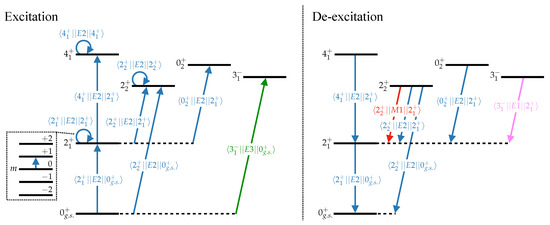
Figure 1.
Low-lying level scheme of a fictitious even–even nucleus outlining dominant excitation (left) and de-excitation (right) patterns in low-energy Coulomb excitation. The transitions are labelled with the corresponding matrix elements. The inset on the left depicts the magnetic substates m of the state and illustrates the reorientation effect. Some allowed transitions are neglected for simplicity.
While Coulomb-excitation cross sections can be calculated using a full quantum-mechanical treatment, a semi-classical approach is typically employed to overcome difficulties arising from the long-range of the Coulomb interaction and complex level schemes of the colliding nuclei. In this approach, introduced by K. Alder and A. Winther [9], the relative motion of collision partners is described using classical equations, and the quantal treatment is limited to the excitation process. The validity of this procedure, which provides a significant simplification of the calculations without a relevant loss of accuracy, stems from the fact that the interaction in the Coulomb-excitation process is dominated by the Rutherford term. For the semi-classical approximation to be valid, the de Broglie wavelength associated with the projectile must be small compared to the distance of closest approach, and the energy transferred in the excitation process must be small compared with the total kinetic energy in the centre-of-mass reference system. These two conditions are well satisfied in low-energy Coulomb-excitation experiments involving heavy ions, but when light nuclei are involved (i.e., protons, deuterons, particles), a full quantum-mechanical analysis is required.
2.1. First-Order Effects
If the interaction between the colliding nuclei is weak, i.e., the excitation probability is ≪1, Coulomb-excitation amplitudes can be calculated within the first-order perturbation theory. In the first order, the cross section for the excitation of a final state from the ground state is proportional to the square of the transitional matrix element , where . Therefore, from the measured Coulomb-excitation cross section, it is possible to extract the reduced transition probability .
The excitation process strongly depends on the kinematics and the mass es A and atomic numbers Z of the target and projectile nuclei. The first-order approximation is usually sufficiently accurate to describe the population of excited states from the ground state in experiments employing a light beam or a light target, or when small centre-of-mass scattering angles are used; examples of such recent studies are presented in Section 3.4. Larger kinetic energy, larger atomic numbers of the collision partners, and lower excitation energies enhance the excitation probability, leading to the appearance of higher-order effects in the excitation process.
2.2. Higher-Order Effects
If the electromagnetic field acting between the collision partners is strong enough and the collision process lasts a sufficiently long time, multi-step excitation becomes a possibility and higher-order contributions have to be taken into account. These contributions give rise to the experimental sensitivity to relative signs of transitional matrix elements and spectroscopic quadrupole moments of excited states, as described in the following.
2.2.1. Multi-Step Excitation and Relative Signs
To understand the importance of multi-step excitation, it is useful to consider the population of two excited states, , , in an even–even nucleus (see Figure 1). As Coulomb excitation via an transition is strictly forbidden, two-step excitation is the only way to populate the state. The state can be Coulomb-excited in two ways: directly from the ground state, via an excitation, or with an two-step excitation through the first excited state. Since the probability of Coulomb-exciting a given state through an transition is much smaller than through the excitation [8], the two-step excitation is typically dominant. Consequently, by measuring the intensities of the , -ray transitions with respect to the decay, and relating them to excitation cross sections, it is possible to extract the and values.
In some cases, single-step and multi-step excitations are comparable in magnitude; an example is the state in an even–even nucleus (see Figure 1). This state can be populated by a direct transition from the ground state and by a two-step excitation through the first excited state. The total excitation probability for the state can be written as:
where , are first-order and second-order excitation amplitudes. Consequently, includes a term related to one-step excitation (), one related to two-step excitation () and the interference term
In this last term, at variance with all the others, the matrix elements are not squared. As the total Coulomb-excitation cross section will be different for a negative (destructive) and a positive (constructive) interference term, its sign becomes an observable.
More complex interference terms can influence the Coulomb-excitation cross sections if states are populated through several excitation patterns involving multiple intermediate states. As such terms include non-squared matrix elements, their appearance leads to the experimental sensitivity to relative signs of transitional matrix elements. A sign convention should be adopted to ensure consistent analysis and facilitate a comparison with model predictions. Usually, signs of all in-band transitional matrix elements are assumed to be positive, and, for each band head, a positive sign is imposed for one of the transitions linking it with a state in the ground-state band. The signs of all remaining matrix elements can be determined relative to those.
The probability of exciting a state via a process involving two or more steps can be comparable to that of one-step excitation, depending, for instance, on the magnitude of the involved matrix elements. Multi-step excitation is enhanced for larger scattering angles and masses of the collision partners. Experiments aiming at extracting reduced transition probabilities between the ground state and an excited state are typically performed in conditions reducing multi-step excitations, by limiting the scattering angle in the forward direction and selecting a light collision partner. In contrast, if the relative signs of transitional matrix elements and reduced transition probabilities between excited states are the objective of the experiment, the detection of scattered particles at backward angles and the use of a heavy collision partner is preferable.
2.2.2. Reorientation Effect and Spectroscopic Quadrupole Moments
The reorientation effect [10] is another second-order effect in Coulomb excitation, which provides experimental sensitivity to spectroscopic quadrupole moments () of excited nuclear states. This effect essentially consists in a double-step excitation, in which the intermediate state is identical to the final state, but the magnetic substate is different (see Figure 1). For a given state , reorientation produces a second-order correction to its Coulomb-excitation cross section, which is proportional to the diagonal matrix element , i.e., to . Since this matrix element, and not its square, appears in the expression for cross section, its sign is also an observable. In favourable conditions, the reorientation effect may have a considerable influence on the measured -ray intensities. For example, in a recent study of Kr Coulomb-excited on Pb [11], a change of sign of the from negative to positive resulted in a 1.8-fold increase of the 4/2 intensity ratio measured in coincidence with Kr nuclei scattered at 130 in the centre-of-mass frame.
The influence of the reorientation effect on Coulomb-excitation cross sections is often comparable to that of multi-step excitations. Consequently, the impact of the spectroscopic quadrupole moment can compete with, for instance, that of the sign of an interference term. This is why in early low-energy Coulomb-excitation measurements two values of the spectroscopic quadrupole moment were often reported: one corresponding to a positive sign of the interference term, and the other one for a negative sign. This ambiguity can be solved by measuring -ray yields as a function of the scattering angle, thus exploiting the different angular dependence of the two effects [5,12]. This approach, typically referred to as a differential Coulomb-excitation measurement, is often employed in modern Coulomb-excitation studies. Alternatively, the use of different beam-target combinations in the same experiment can also help to disentangle competing contributions to the cross sections, and more constraints can be provided by including known spectroscopic data (lifetimes, branching ratios, and branching ratios) in the Coulomb-excitation data analysis.
2.3. Quadrupole Sum Rules
The nuclear shape can be inferred indirectly from transition probabilities or spectroscopic quadrupole moments, but this approach is not always unambiguous and generally depends on comparisons with models. An alternative model-independent approach, proposed by K. Kumar [1] and D. Cline [7], exploits the specific properties of the electromagnetic multipole operators. As these operators are spherical tensors, their zero-coupled products are rotationally invariant. The expectation values of these products are observables, and they are strictly related to the parameters describing the shape of the charge distribution.
The electric quadrupole operator in the principal axis system can be represented using the variables Q and , whose expectation values are equivalent to the Hill–Wheeler parameters describing the quadrupole shape [1,7]. The simplest invariants read:
The expectation values of these invariants for a state can be expressed through matrix elements defined in the laboratory system. For instance:
where and the expression in curly brackets is a coefficient. Higher-order invariants can be defined, such as , which can be linked to the dispersion in via
A similar definition applies to . In principle, this approach can be extended to more complex, non-quadrupole shapes.
The invariants obtained from quadrupole sum rules provide a model-independent description of the nuclear shape in the intrinsic reference system. However, the experimental determination of such invariants requires numerous matrix elements to be known. While for the lowest-order shape invariant, , all matrix elements enter the sum in squares, this is not true for most higher-order invariants. In particular, the invariant is constructed from triple products of matrix elements, , where is the state in question and and are the intermediate states. The diagonal matrix elements (i.e., ) and their signs are necessary to extract this invariant, as well as the relative signs of all relevant transitional matrix elements.
While the sums in Equations (5) and (6) formally run over all intermediate states that can be reached from the state in question via a single transition, usually only a few key states contribute to the invariant. In particular, for the ground state of an even–even nucleus, the contributions to are dominated by the coupling to the state, which typically amounts to well over 90% of the total. Similarly, the largest contributions to for the ground state come from the and products. The situation becomes much more complicated for excited states, and the number of intermediate states that need to be included in the sum rules varies from one case to another. While theoretical approaches can, in principle, provide a complete set of electromagnetic matrix elements, this is not always true for experiments. Systematic studies employing the Shell Model addressed this convergence issue [13,14,15]. The contributions of individual products of matrix elements to the experimentally determined invariants have also been analysed in some cases [14,16,17,18].
3. Examples of Recent Low-Energy Coulomb-Excitation Studies Relevant for the Shell Model
The examples of experimental studies presented in this Section illustrate the variety of nuclear-structure questions, relevant for the Shell Model, that can be addressed using low-energy Coulomb excitation. The discussion is focused on the region of mid-mass nuclei between Ca and Sm and the reader is directed to [6] for other noteworthy examples, particularly concerning lighter nuclei important for astrophysical processes.
3.1. Superdeformation in 42Ca
The potential of Coulomb excitation as a tool to study superdeformation has been demonstrated in the very first experiment using the AGATA -ray tracking array [19]. The superdeformed (SD) structure in Ca was populated following Coulomb excitation of a Ca beam on Pb and Au targets [3,18]. From the measured -ray intensities, magnitudes and relative signs of numerous matrix elements coupling the low-lying states in Ca were determined. In particular, two key pieces of information were obtained for the first time, which confirm that the band built on the state in Ca has a SD character at low spin: the spectroscopic quadrupole moment of the 2 state, which corresponds to , as well as the enhanced W.u. value. As discussed in [12], even though the transition is too weak to be observed and, prior to the study of K. Hadyńska-Klȩk et al. [3,18] only an upper limit for the branching ratio was known, the corresponding matrix element has a strong influence on excitation cross sections of the observed states, and hence it could be determined from the intensities of other transitions measured in the Coulomb-excitation experiment.
The obtained transitional and diagonal matrix elements were further interpreted in terms of quadrupole invariants of the 0 and 2 states, leading to the conclusion that the spherical ground state of Ca exhibits large fluctuations into the – plane, while the excited structure has a large quadrupole deformation of for the 0 state, comparable to those deduced from lifetime measurements for other SD bands in this mass region. The important increase of the quadrupole invariant for the 2 state with respect to that for the ground state was attributed to the mixing of the 2 states. Additionally, the triaxiality parameter obtained for the 0 state, corresponding to , provided the first experimental evidence for the non-axial character of SD structures around . The value obtained for the ground state, , was interpreted as resulting from its softness.
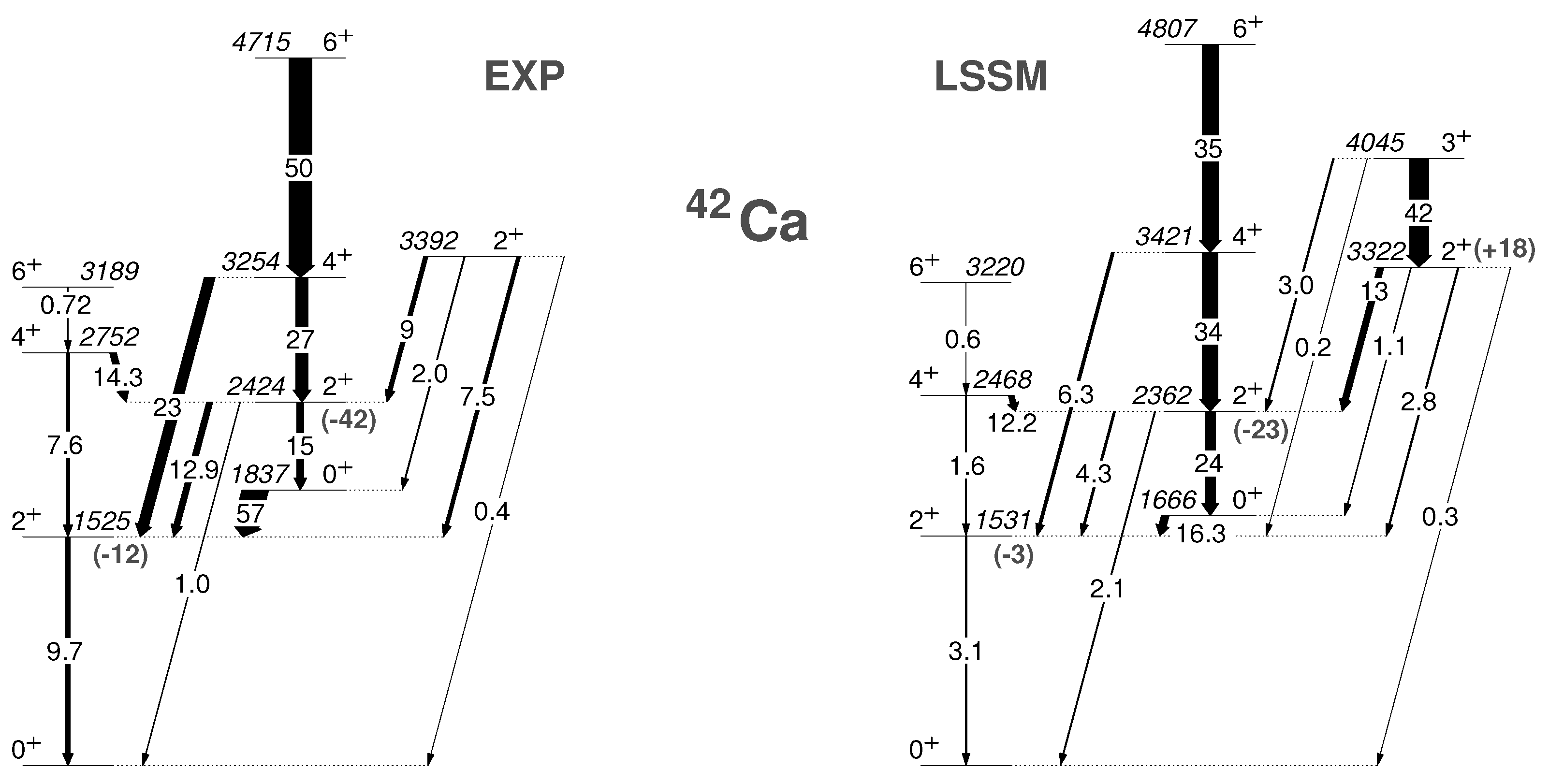
This experimental study triggered new Large-Scale Shell Model (LSSM) calculations for Ca [3,18]. They were performed using the SDPF.MIX interaction in the model space for neutrons and protons, with a virtual Si core, as in the earlier study [20] that successfully described properties of the deformed – and – structures in Ca. Up to six particle –hole excitations from the and orbitals into the orbitals were allowed, and the electric effective charges were for protons and for neutrons. The overall agreement of the calculations with the experimental level energies and decay patterns is remarkable, see Figure 2. The experimental values of the and invariants for the 0 states were also well reproduced. The only notable systematic difference is the overestimation of matrix elements in the SD band and underestimation of those in the yrast band as well as intra-band ones, which suggests that the mixing between the two bands is not fully reproduced by the calculations.
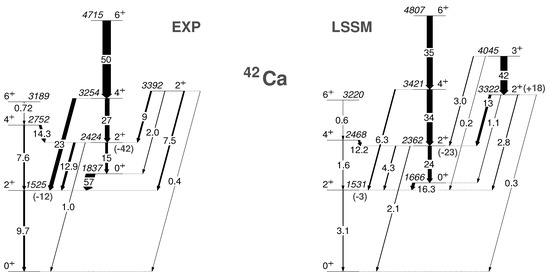
Figure 2.
Comparison of the experimental low-energy part of the Ca level scheme with that calculated using Large-Scale Shell Model (LSSM) [3,18]. States are labelled with their energies in keV, transitions with transition probabilities in Weisskopf units and spectroscopic quadrupole moments for the 2 states, expressed in efm, are reported in brackets.
The LSSM results provide insight into the configurations of normal-deformed and SD states in Ca: the 0 and 2 states are predicted to be dominated by the – excitation s, while the ground-state band has a predominantly two-particle configuration, with considerable – and – admixtures. Furthermore, they suggest that the experimentally known state is the band head of a band related to the SD structure, with the configuration dominated by almost equal contributions of – and – excitations (≈40% each). This gives further support for the slightly triaxial shape of the SD band in Ca, while the identification of higher-spin members of the predicted band represents a challenge for future experimental studies.
3.2. Shape Coexistence, Triaxiality, and the N = 50 Shell Closure in Germanium and Zinc Isotopes
Detailed low-energy Coulomb-excitation studies were performed to investigate quadrupole properties of stable and exotic Ge and Zn isotopes, which are important in the context of the numerous Shell-Model calculations developed for this region. While extensive sets of electromagnetic matrix elements were extracted for the stable nuclei and interpreted within the quadrupole sum rules approach, in neutron-rich isotopes these measurements provided the first access to values and, in some cases, also excitation energies.
In the stable Ge isotopes, the invariants extracted for the ground state and the state via low-energy Coulomb excitation represent one of the strongest signatures of shape coexistence [21,22]. As shown in Figure 3a, the ground-state values in Ge are similar, b, while those of the 0 states evolve as a function of the neutron number. The 0 state in Ge is more deformed than the ground state [23], in Ge both states seem to have comparable overall deformations and considerable triaxiality [24], while those for the 0 states in Ge point to nearly spherical shapes [25,26]. Based on the similarity of the energy systematics in Ge and Zn nuclei (see Figure 3b), one could speculate that shape coexistence is present also in the latter isotopic chain.
The first hints of the intruder character of the states in the Zn isotopes came from measurements in the stable even–even Zn isotopes [27], a feature further supported by the results of multi-step Coulomb-excitation experiments on Zn [14,28]. However, only for Zn has the key matrix element been determined, which, when combined with other matrix elements involving the state, leads to a invariant significantly different from that of the ground state [28]. On the other hand, multiple low-energy Coulomb-excitation studies of stable Ge and Zn isotopes [14,25,28] demonstrated the importance of the triaxial degree of freedom in their structure, which was also evoked for the neighbouring Se nuclei [29,30]. Particularly relevant is the study of Ge [31], which yielded parameters for the 0, 2 and 2 states and their dispersions, which are consistent with rigid triaxial deformation. This is particularly important considering that Ge is a candidate for searches of neutrinoless double- decay, and the nuclear shape is predicted to play a significant role in this process [32,33].
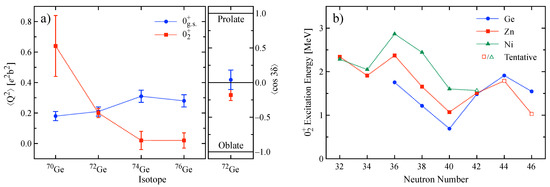
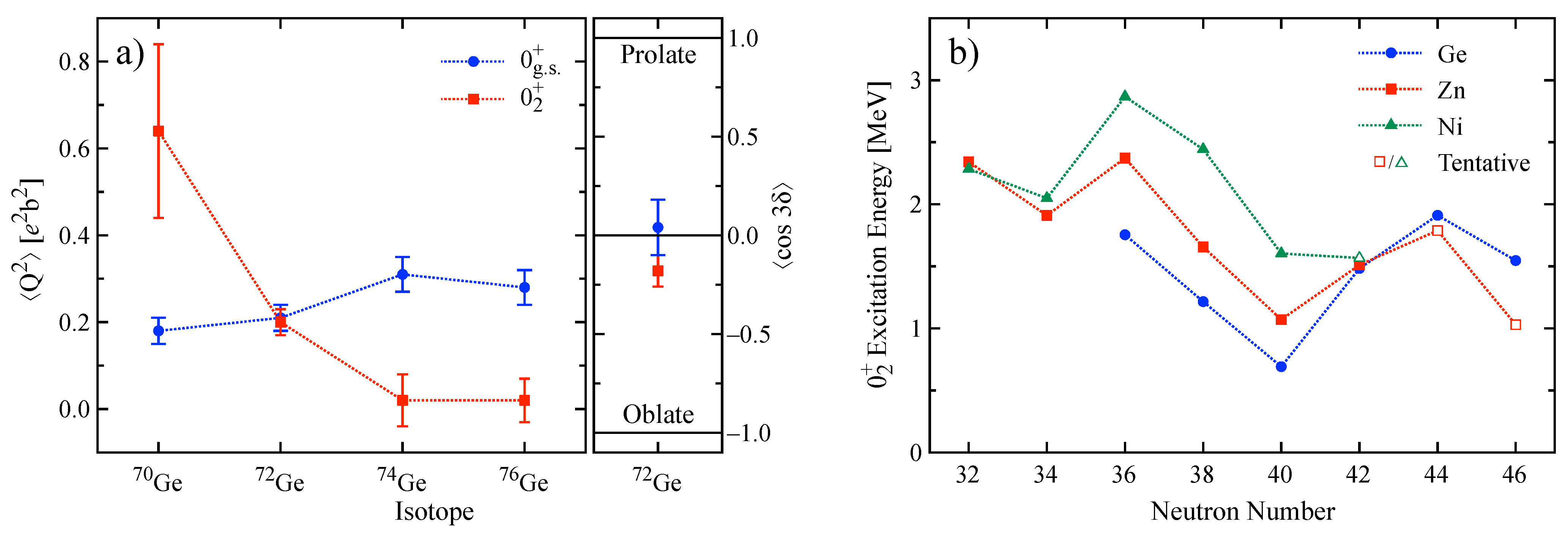
Figure 3.
(a) and quantities for the and states in Ge isotopes. Data are taken from [21,23,24,25,26]. (b) Systematics of excitation energies for the states in Ge, Zn and Ni isotopes from neutron number to . Tentative spin assignments are shown by open symbols. Data are taken from the ENSDF database [34,35,36,37]. See text for details.
Figure 3.
(a) and quantities for the and states in Ge isotopes. Data are taken from [21,23,24,25,26]. (b) Systematics of excitation energies for the states in Ge, Zn and Ni isotopes from neutron number to . Tentative spin assignments are shown by open symbols. Data are taken from the ENSDF database [34,35,36,37]. See text for details.
Shell-model calculations focusing on the Ge, Zn, and Se isotopes well reproduced the features related to their triaxial shapes [14,29,38,39], even though the degree of softness and the presence of static triaxial deformation are still debated [38]. The V-shaped pattern of the excitation energies in the Ge isotopes between the neutron numbers and (see Figure 3b) was related to shape coexistence by Shell-Model calculations [39] using the JUN45 effective interaction in a model space consisting of the Ni inert core and up to the orbital for both neutrons and protons. The collectivity of the deformed ground states was linked to strong correlations (arising from pairing and the quadrupole –quadrupole force), which offset the gap and lead to the enhanced occupation of the neutron orbital that has a maximum predicted for . In contrast, the role of neutron excitations from the shell into the orbital is smaller for the states, with, on average, two additional neutrons promoted through the gap with respect to the normal-order configuration. In particular, the wave function of the state in Ge is dominated by the normal-order configuration, i.e., neutrons completely filling the shell, with a contribution of 37%, which suggests a nearly spherical shape.
As shown in Figure 3b, a decrease of the state energy between and , similar to those observed in the Ge and Zn chains, is evident also in the Ni isotopes. According to Monte-Carlo Shell-Model (MCSM) calculations with the A3DA effective interaction in the model space [40], the states in Ni are oblate deformed and result from neutron – excitation across the gap, similar to their counterparts in the Ge isotones. The V-shaped trend of the excitation energies with the vertex at does not persist for Ni and beyond, as different configurations start to appear at low excitation energy. Specifically, proton – excitations across the energy gap at are suggested [40,41] to dominate the structure of the state in Ni, the state in Ni and the state in Ni. MCSM calculations predict that these predominantly – states have well-deformed prolate shapes, resulting from an interplay of type-I and type-II shell evolution. The experimental verification of this multiple shape-coexistence scenario through the quadrupole sum rules approach represents a challenge for future low-energy Coulomb-excitation studies. Unfortunately, the population of excited states in both stable and radioactive Ni nuclei will be severely limited due to the high excitation energies involved, which is further complicated by the prohibitively low intensities of radioactive Ni beams that are currently available at energies suitable for low-energy Coulomb excitation.
On the neutron-rich side, low-energy Coulomb excitation has provided valuable structure information in the Ge and Zn isotopes. Experiments at ISOLDE identified the first excited state in Zn and yielded the values in Zn and the values in Zn [42,43]. The obtained values hint at the importance of triaxiality also in neutron-rich Zn isotopes, whose ground states were suggested to be rather diffuse in the degree of freedom [42]. Furthermore, the energy of the first excited state in Zn confirms the persistence of the shell closure two protons away from the doubly-magic Ni. The same conclusion was reached for the neutron-rich Ge isotopes from the values of the radioactive Ge measured using low-energy Coulomb excitation at ORNL [44].
The measured values in Zn were found in good agreement with those deduced from the experimental excitation energies via the Grodzins rule [45], provided that a renormalization factor (0.92) was applied to the calculated values [42]. The experimental results for Zn and Ge were compared with Shell-Model calculations comprising the , , , and orbitals for both protons and neutrons outside of an inert Ni core. Effective charges significantly different from the standard , values were adopted to compensate for the enhanced Ni core polarization reported in [46,47]. The persistence of the shell closure in neutron-rich Zn and Ge isotopes, emerging from the experimental and calculated values and excitation energies, anticipated the more recent results for Ni, in which the first excited state was ultimately identified [48].
3.3. Shape Coexistence in 40 Nuclei
The sudden onset of deformation at observed in the Zr and Sr isotopic chains has attracted a lot of attention, both from theoretical and experimental points of view. While the energies of the 2 states in Zr were well reproduced by the LSSM calculations reported in [49], the required truncations of the model space made it impossible to account for the enhanced transition probability in Zr. Recently, the rapidity of the shape transition in the Zr isotopes has been reproduced, for the first time both in terms of level energies and transition probabilities, using the MCSM [50]. The calculations [50] also predict that Zr would present a multitude of low-lying states with various quadrupole shapes. A Coulomb-excitation study of Zr aiming to verify this scenario was performed at INFN-LNL [51], and its analysis is in progress. There exists, however, strong experimental evidence for the coexistence of deformed and spherical structures in Sr, recently reinforced by the results of Coulomb-excitation experiments performed at ISOLDE [2,52]. The rich set of transitional and diagonal matrix elements determined in this study provides a consistent picture of a prolate-deformed ground-state band in Sr that coexists with an almost spherical structure built on the 0 state. Similarity of the W.u. value in Sr with the W.u. value in Sr, as well as of the quadrupole moments of the state in Sr and the state in Sr (both compatible with zero), suggest that the spherical and deformed structures interchange at . Contrary to what is observed in most known cases of shape coexistence, these two structures mix very weakly. This feature is in line with the type-II shell-evolution scenario proposed in [50] that links particular multiparticle–multihole excitations to significant reorganisations of the shell structure, which hinders configuration mixing.
A notable result of [2,52] is the observed reduction of the value in Sr with respect to the rotational estimate. This feature may indicate triaxiality of this state, which gives way to a more prolate deformation for higher-spin members of the ground-state band. Detailed Coulomb-excitation studies of Mo [17,53] yielded and invariants for the ground states and the low-lying 0 states, demonstrating their different shapes and confirming that triaxiality is also a key feature of Mo nuclei with . The obtained invariant quantities indicate that, in Mo, an almost spherical state coexists with a triaxial ground state, while, in Mo, both the and states have approximately the same values of . However, the values suggest that the ground state in Mo is triaxial and the state has a prolate shape. The same pattern of a prolate state coexisting with a triaxial ground state appears in Mo, but the invariants obtained for both the and states in this nucleus are significantly greater than those for Mo, with that for the state being much larger. Given also that the proton vacancies and neutron occupancies for the ground states of Mo were recently extracted from an extensive series of single-proton and single-neutron transfer reactions [54], these nuclei would represent a stringent test for Shell-Model calculations. Such investigation would also be relevant in the context of neutrinoless double- decay studies, as Mo is one of candidate nuclei for this process.
3.4. Evolution of Collectivity in 50 Nuclei
The tin nuclei, forming the longest chain of experimentally accessible isotopes between two doubly-magic nuclei, have traditionally been considered a prime example of the seniority scheme. While this description is supported by the almost constant energies of the 2 states in the even–even Sn nuclei from Sn to Sn, the corresponding values seem to deviate from the expected parabolic behaviour (see Figure 4). Extensive Coulomb-excitation studies of stable [55,56,57] and exotic [58,59,60,61,62] Sn nuclei yielded values for Sn that were discussed in the context of Shell-Model calculations. In the Coulomb-excitation campaigns aiming at high-precision measurements of the values in stable Sn isotopes, the experimental conditions minimised the role of multi-step excitation and the reorientation effect. The experiments at ORNL [55] were performed in strongly inverse kinematics, with a C target bombarded by Sn beams; a Ti target was also used for complementary measurements.
In the IUAC campaign [56,57], a reaction partner with a much higher Z was used: a Ni beam impinged on Sn targets. However, due to the selection of events with the Ni beam particles scattered at forward angles, no excitation of higher-lying states was observed, although their possible weak influence on the excitation process was taken into account in the data analysis. The values were obtained with relative uncertainties of 5% or less in all cases, and the results of the two campaigns agreed within 3 for Sn and within 1 for the other isotopes, demonstrating the level of accuracy and precision that can be achieved (see Figure 4).
Low-energy Coulomb-excitation experiments on neutron-deficient Sn isotopes were performed at ISOLDE [58,59] with 2.8-MeV/ASn beams bombarding Ni targets. On the neutron-rich side, a campaign was performed at ORNL [60,61] to study Sn in very similar experimental conditions as those used for stable isotopes in [55]. In order to increase the excitation cross section for the 2 state in Sn, located at 4.04-MeV excitation energy, targets of Ti and Pb were used in the ORNL [60] and HIE-ISOLDE [62] measurements, respectively.
While certain discrepancies with the values obtained using other methods exist (see e.g., [63] for a compilation of experimental data), the ensemble of experimental results points to an asymmetric shape of the distribution as a function of N, with a plateau extending towards lighter nuclei. The reproduction of this plateau represented a challenge for model calculations. Recently, its appearance has been discussed [64,65] in the context of pseudo-SU(3) symmetry acting in the space of orbitals excluding . The calculations were performed using variants of the realistic N3LO interaction, with the monopole part of the interaction replaced by a Hamiltonian provided by the GEMO code [66], adding the single-particle energies for Sn. They successfully reproduced the evolution of the values in Sn [64,65] (see Figure 4) and demonstrated that modifications of the pairing strength had a negligible effect on the calculated values, in contrast to what was observed for the strengths [65].
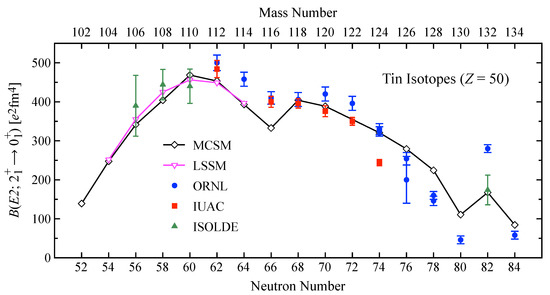
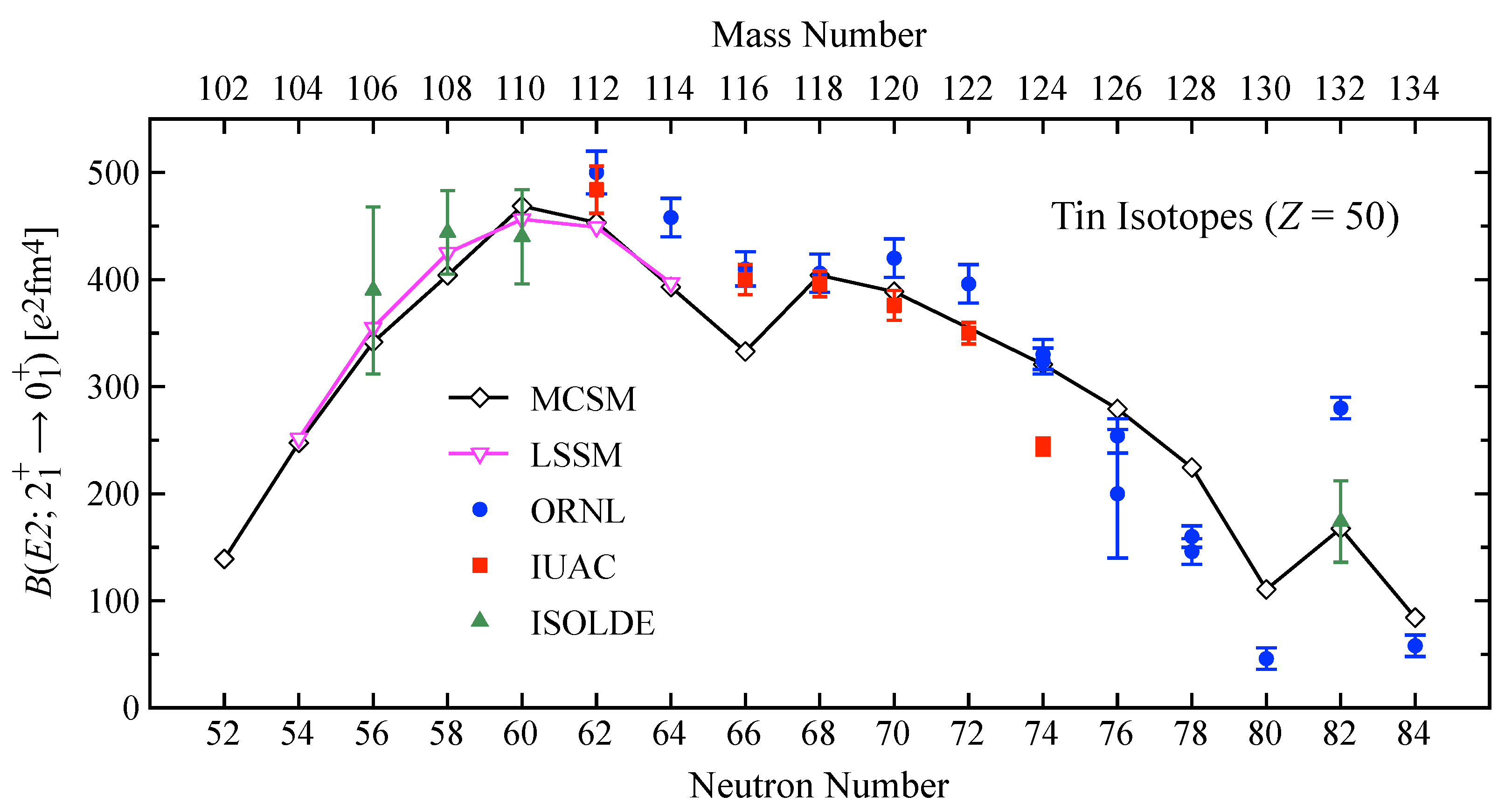
Figure 4.
Reduced transition probabilities in the Sn isotopic chain determined from low-energy Coulomb-excitation measurements. The experimental results obtained at ORNL [55,60,61], IUAC [56,57], and ISOLDE [58,59,62] are compared with predictions from the Monte-Carlo Shell Model (MCSM) [63] and LSSM [64,65].
Figure 4.
Reduced transition probabilities in the Sn isotopic chain determined from low-energy Coulomb-excitation measurements. The experimental results obtained at ORNL [55,60,61], IUAC [56,57], and ISOLDE [58,59,62] are compared with predictions from the Monte-Carlo Shell Model (MCSM) [63] and LSSM [64,65].
An alternative explanation was offered by the MCSM calculations [63] performed in the full model space complemented by the , , and orbitals for protons and neutrons. These calculations provide good reproduction of all measured values in the Sn chain, including the local increase observed for Sn (see Figure 4), and link their enhancement for Sn to the development of quadrupole deformation driven by proton excitations from the orbital. This scenario is consistent with the observed increase of the values at mid shell [55], which was suggested to be due to the mixing with a deformed configuration, resulting in the presence of proton – and – components in the 2 wave function [55]. Low-lying states of predominantly proton – character have been identified in Sn via two-proton transfer reactions [67], and later also in Sn and Sn, although at higher excitation energies. The MCSM calculations [63] predicted indeed that the ground states of Sn nuclei involve a significant promotion of protons across the gap, with the largest occupation predicted at . The occupation of proton orbitals above the gap becomes even larger for the states, and the corresponding T-plots indicate deformed shapes [63], in line with the measured non-zero quadrupole moments. Multi-step Coulomb-excitation studies aiming at the determination of deformation parameters of the deformed structures built on the states, as well as their mixing with the ground-state configurations, would be of much interest. One should note here that the quadrupole invariants for the 0 states in Cd were measured in a recent Coulomb-excitation experiment [68].
The and patterns in Cd nuclei closely resemble that of the values in the corresponding Sn isotones. They were well reproduced by the calculation of [65], and found almost independent of the assumed pairing strength. This was linked [65] to their static quadrupole deformation, consistent with non-zero quadrupole moments measured for the Cd isotopes in a Coulomb-excitation experiment at ISOLDE [69]. Interestingly, the obtained values are positive, in contrast to those measured for stable Cd nuclei. Unfortunately, they are subject to large uncertainties, and the value for Cd significantly changes if a previously measured lifetime of the state is used as an additional constraint in the Coulomb-excitation data analysis.
Quadrupole deformation of light Cd isotopes was explored in an LSSM study [15] using a modified effective interaction [70] in the , model space. The calculated matrix elements provide a good reproduction of the experimental and values, and were analysed in terms of quadrupole invariants and pointing to a predominantly prolate character of Cd with both and increasing with N. Very recently, Coulomb excitation of Cd was performed [71] at the NSCL ReA3 facility. Quadrupole moments of the , 4, 6 and 2 states were obtained, as well as the and invariants for the ground state, which suggest its considerable triaxiality. This feature does not emerge from the LSSM calculations reported in [71], which also used a G-matrix-renormalized CD-Bonn nucleon –nucleon potential and the same model space as those of [15], but allowed at most two neutrons in the orbital. While they well reproduced the experimental invariant for the ground state, the shapes that they predict for light Cd isotopes are decidedly prolate. The difference with respect to a more -soft behaviour suggested by [15] was attributed to the different single-particle energies, as well as the adopted truncation. However, none of these calculations are able to explain the observed pattern of spectroscopic quadrupole moments in the light Cd nuclei, which will hopefully trigger future experimental and theoretical investigations aiming at understanding their quadrupole properties.
3.5. Heavier Collective Nuclei: Triaxiality in 130Xe and 140Sm
The Xe and Sm isotopes are examples of relatively heavy nuclei, probed with low-energy Coulomb excitation, for which extensive Shell-Model calculations have been performed [16,72]. Both isotopes were studied at ISOLDE, with the measurement for the stable Xe being a by-product of a radioactive beam experiment. Beam energies were 4.2 MeV/A and 2.8 MeV/A, respectively, and states up to were observed in Xe, while the , and states were populated in Sm. The results point to the importance of the triaxial degree of freedom in the structure of low-lying levels in both nuclei.
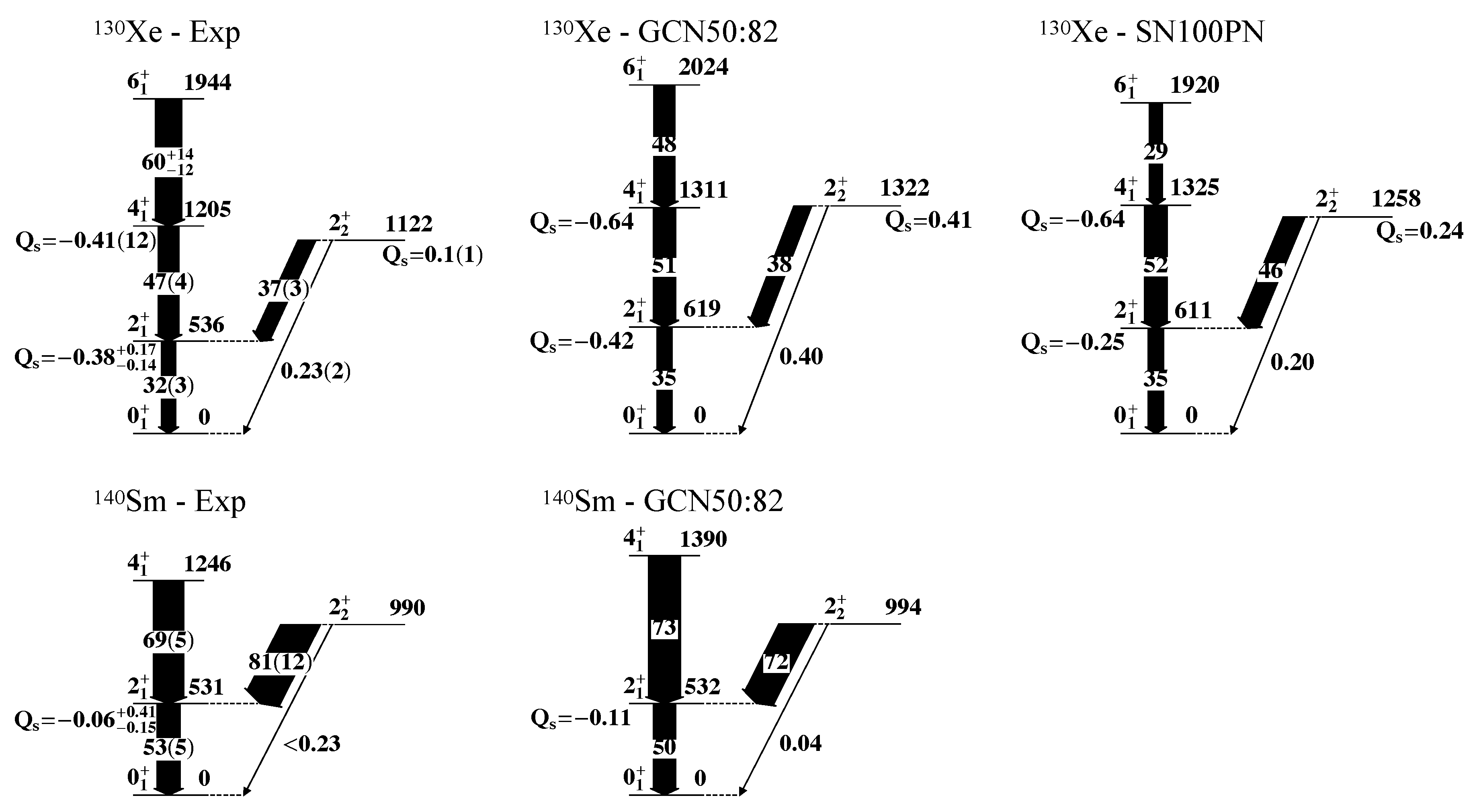
The extracted transitional and diagonal matrix elements indicate that Xe and Sm are collective, and their ground states are characterized by and . For Xe, this conclusion was drawn on the basis of the determined quadrupole invariants, while, for Sm, it results from the measured eb, compatible with zero, and the enhanced W.u. value. Shell-Model calculations for Xe and Sm were performed in a large model space consisting of the Sn inert core and all orbitals up to . The GCN50:82 effective interaction [73] was employed for both cases, complemented by the SN100PN effective interaction [74] for Xe. The experimental and theoretical results showed good agreement (see Figure 5), which is remarkable considering the evident collective nature of the two nuclei and the relatively high number of allowed valence particles in the Shell-Model calculations. However, for both Xe and Sm, effective charges larger than the standard , values were needed to reproduce the measured values. For Xe, , and , were adopted for the GCN50:82 and SN100PN interactions, respectively, while , were used for the GCN50:82 interaction in the case of Sm. The need for increasing the effective charges in this mass region with respect to the standard values is known [75,76], and it suggests that a further expansion of the model space is necessary.
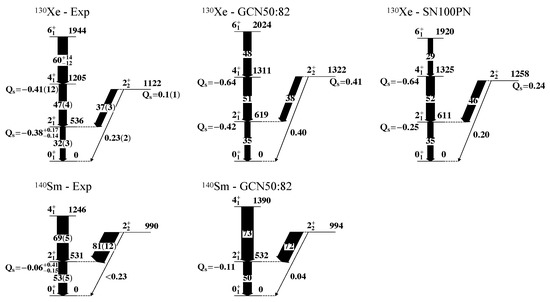
Figure 5.
Comparison of low-energy parts of the experimental Xe and Sm level schemes with Shell-Model calculations using GCN50:82 and SN100PN interactions [16,72]. The states are labelled with their spin and parity and excitation energy in keV. Transitions are labelled with reduced transition probabilities expressed in Weisskopf units. Spectroscopic quadrupole moments are reported in eb. See text for further details about the calculations.
Despite the good reproduction of the experimental results by state-of-the-art Shell-Model calculations, further developments are needed to properly describe the structure of nuclei within this theoretical approach. This is particularly relevant for Xe, which would be the daughter of the Te neutrinoless double- decay. If this process is observed at ongoing experiments, such as CUORE [77] and SNO+ [78], the relevant nuclear matrix elements will need to be calculated in order to extract the Majorana mass. Such calculations are under way, also within the Shell Model [79], with important experimental constraints coming from recent measurements of valence proton and neutron occupations in Te and Xe [80,81]. Further low-energy Coulomb-excitation studies should help to elucidate the nuclear structure at . A Xe beam could be delivered by a stable ion beam facility with a much higher intensity than that available in [16], and the use of a heavier target (e.g., Pb) would increase the excitation cross sections. For Sm, an experiment with a higher beam energy would be beneficial. Under favourable conditions, such experiments should be capable of extracting higher-order quadrupole invariants related to the dispersions in and for the ground state.
4. Summary and Outlook
In parallel to recent advances in accelerator and ion-source technologies, and the construction of new-generation high-resolution -ray tracking arrays as AGATA [19] and GRETINA [82], noteworthy developments have taken place in nuclear-structure theory. The state-of-the-art calculations, some of which were discussed in the preceding sections, are now able to predict the properties of nuclei with an unprecedented level of detail, particularly concerning the nuclear shape. Within the Shell Model, quadrupole shapes of ground and excited states can be inferred using T-plots [40] and the quadrupole sum rules approach [38]. Due to the large model spaces involved, Shell-Model studies of octupole collectivity are more rare, and one may hope that the availability of precise experimental data on strengths will trigger further efforts in this direction.
The ongoing experimental and theoretical developments will bring forward our understanding of nuclear structure, while also being relevant for cross-disciplinary fields, such as astrophysics, neutrino physics, and physics of (and beyond) the Standard Model [4,33,83]. In this context, a precise understanding of the nuclear shape can bring us closer to answering long-standing questions in physics, such as how heavy elements originate in cataclysmic stellar events and the reason for the matter-antimatter asymmetry in the universe.
Thanks to the constant development of powerful computational resources, and refinements of Shell-Model codes and methods, this theoretical approach can now be extended to vast regions of the nuclear chart. It can be anticipated that this progress will be complemented and inspired by the availability of high-precision spectroscopic data and that low-energy Coulomb excitation will continue to play an important role in future studies throughout the nuclear chart. Let us emphasize, however, as in the cases of Mo and Xe, that the combination of data from a variety of techniques that probe both collective and single-particle degrees of freedom will provide perhaps the most demanding tests of Shell-Model calculations, and studies in that direction should be pursued.
Author Contributions
The authors contributed equally to all aspects of this work. All authors have read and agreed to the published version of the manuscript.
Funding
This research was funded in part through the Natural Sciences and Engineering Research Council (NSERC) Canada.
Data Availability Statement
Data sharing not applicable.
Acknowledgments
We thankfully acknowledge P.E. Garrett for fruitful discussions and for the careful reading of the manuscript, and M. Siciliano for his contribution to Section 3.4 and Figure 4.
Conflicts of Interest
The authors declare no conflict of interest.
Abbreviations
The following abbreviations are used in this manuscript:
| AGATA | Advanced GAmma Tracking Array |
| CUORE | Cryogenic Underground Laboratory for Rare Events |
| ENSDF | Evaluated Nuclear Structure Data File |
| GRETINA | Gamma-Ray Energy Tracking In-beam Nuclear Array |
| HIE-ISOLDE | High Intensity and Energy ISOLDE |
| INFN | Istituto Nazionale di Fisica Nucleare (National Institute for Nuclear Physics) |
| ISOLDE | Isotope Separator On-Line DEvice |
| IUAC | Inter-University Accelerator Centre |
| LNL | Legnaro National Laboratories |
| LSSM | Large-Scale Shell Model |
| MCSM | Monte-Carlo Shell Model |
| NSCL | National Superconducting Cyclotron Laboratory |
| ORNL | Oak Ridge National Laboratory |
| ReA3 | Re-accelerator facility |
| RIB | Radioactive Ion Beam |
| SD | Superdeformed |
| SNO+ | Sudbury Neutrino Observatory Plus |
| T-Plot | Tsunoda-Plot |
References
- Kumar, K. Intrinsic quadrupole moments and shapes of nuclear ground states and excited states. Phys. Rev. Lett. 1972, 28, 249. [Google Scholar] [CrossRef]
- Clément, E.; Zielińska, M.; Görgen, A.; Korten, W.; Péru, S.; Libert, J.; Goutte, H.; Hilaire, S.; Bastin, B.; Bauer, C.; et al. Spectroscopic quadrupole moments in 96,98Sr: Evidence for shape coexistence in neutron-rich strontium isotopes at N=60. Phys. Rev. Lett. 2016, 116, 022701. [Google Scholar] [CrossRef]
- Hadyńska-Klȩk, K.; Napiorkowski, P.J.; Zielińska, M.; Srebrny, J.; Maj, A.; Azaiez, F.; Valiente Dobón, J.J.; Kicińska-Habior, M.; Nowacki, F.; Naïdja, H.; et al. Superdeformed and triaxial states in 42Ca. Phys. Rev. Lett. 2016, 117, 062501. [Google Scholar] [CrossRef]
- Gaffney, L.P.; Butler, P.A.; Scheck, M.; Hayes, A.B.; Wenander, F.; Albers, M.; Bastin, B.; Bauer, C.; Blazhev, A.; Bönig, S.; et al. Studies of pear shaped nuclei using accelerated radioactive beams. Nature 2013, 497, 199. [Google Scholar] [CrossRef]
- Zielińska, M.; Gaffney, L.P.; Wrzosek-Lipska, K.; Clément, E.; Grahn, T.; Kesteloot, N.; Napiorkowski, P.J.; Pakarinen, J.; Van Duppen, P.; Warr, N. Analysis methods of safe Coulomb-excitation experiments with radioactive ion beams using the GOSIA code. Eur. Phys. J. A 2016, 52, 99. [Google Scholar] [CrossRef]
- Görgen, A.; Korten, W. Coulomb excitation studies of shape coexistence in atomic nuclei. J. Phys. G Nucl. Part. Phys. 2010, 43, 024002. [Google Scholar] [CrossRef]
- Cline, D. Nuclear shapes studied by Coulomb excitation. Annu. Rev. Nucl. Part. Sci. 1986, 36, 683. [Google Scholar] [CrossRef]
- Srebrny, J.; Czosnyka, T.; Karczmarczyk, W.; Napiorkowski, P.; Droste, C.; Wollersheim, H.-J.; Emling, H.; Grein, H.; Kulessa, R.; Cline, D.; et al. E1, E2, E3 and M1 information from heavy ion Coulomb excitation. Nucl. Phys. A 1993, 557, 663c. [Google Scholar] [CrossRef]
- Alder, K.; Winther, A. Electromagnetic Excitation; North-Holland: Amsterdam, The Netherlands, 1975. [Google Scholar]
- De Boer, J.; Eichler, J. The Reorientation Effect. In Advances in Nuclear Physics; Plenum Press: New York, NY, USA, 1968; Volume 1, Chapter 1; pp. 1–65. [Google Scholar]
- Clément, E.; Görgen, A.; Korten, W.; Bouchez, E.; Chatillon, A.; Delaroche, J.-P.; Girod, M.; Goutte, H.; Hürstel, A.; Le Coz, Y.; et al. Shape coexistence in neutron-deficient krypton isotopes. Phys. Rev. C. 2007, 75, 054313. [Google Scholar] [CrossRef]
- Zielińska, M.; Hadyńska-Klȩk, K. Nuclear shapes studied with low-energy Coulomb excitation. EPJ Web Conf. 2018, 178, 02014. [Google Scholar] [CrossRef][Green Version]
- Henderson, J. Convergence of electric quadrupole rotational invariants from the nuclear shell model. Phys. Rev. C 2020, 102, 054306. [Google Scholar] [CrossRef]
- Rocchini, M.; Hadyńska-Klȩk, K.; Nannini, A.; Goasduff, A.; Zielińska, M.; Testov, D.; Rodriguez, T.R.; Gargano, A.; Nowacki, F.; De Gregorio, G.; et al. Onset of triaxial deformation in 66Zn and properties of its first excited 0+ state studied by means of Coulomb excitation. Phys. Rev. C 2021, 103, 014311. [Google Scholar] [CrossRef]
- Schmidt, T.; Heyde, K.L.G.; Blazhev, A.; Jolie, J. Shell-model-based deformation analysis of light cadmium isotopes. Phys. Rev. C 2017, 94, 014302. [Google Scholar] [CrossRef]
- Morrison, L.; Hadyńska-Klȩk, K.; Podolyák, Z.; Doherty, D.T.; Gaffney, L.P.; Kaya, L.; Próchniak, L.; Samorajczyk-Pyśk, J.; Srebrny, J.; Berry, T.; et al. Quadrupole deformation of 130Xe measured in a Coulomb-excitation experiment. Phys. Rev. C 2020, 102, 054304. [Google Scholar] [CrossRef]
- Wrzosek-Lipska, K.; Próchniak, L.; Zielińska, M.; Srebrny, J.; Hadyńska-Klȩk, K.; Iwanicki, J.; Kisieliński, M.; Kowalczyk, M.; Napiorkowski, P.J.; Piȩtak, D.; et al. Electromagnetic properties of 100Mo: Experimental results and theoretical description of quadrupole degrees of freedom. Phys. Rev. C 2012, 86, 064305. [Google Scholar] [CrossRef]
- Hadyńska-Klȩk, K.; Napiorkowski, P.J.; Zielińska, M.; Srebrny, J.; Maj, A.; Azaiez, F.; Valiente Dobón, J.J.; Kicińska-Habior, M.; Nowacki, F.; Naïdja, H.; et al. Quadrupole collectivity in 42Ca from low-energy Coulomb excitation with AGATA. Phys. Rev. C 2018, 97, 024326. [Google Scholar] [CrossRef]
- Akkoyun, S.; Algora, A.; Alikhani, B.; Ameil, F.; de Angelis, G.; Arnold, L.; Astier, A.; Ataç, A.; Aubert, Y.; Aufranc, C.; et al. AGATA—Advanced GAmma Tracking Array. Nucl. Instrum. Methods Phys. Res. A 2012, 668, 26. [Google Scholar] [CrossRef]
- Caurier, E.; Menéndez, J.; Nowacki, F.; Poves, A. Coexistence of spherical states with deformed and superdeformed bands in doubly magic 40Ca: A shell-model challenge. Phys. Rev. C 2007, 75, 054317. [Google Scholar] [CrossRef]
- Toh, Y.; Czosnyka, T.; Oshima, M.; Hayakawa, T.; Hatsukawa, Y.; Matsuda, M.; Katakura, J.; Shinohara, N.; Sugawara, M.; Kusakari, H. Shape coexistence in even–even Ge isotopes—Complete spectroscopy with Coulomb excitation. J. Nucl. Sci. Technol. 2002, 39, 497. [Google Scholar] [CrossRef]
- Heyde, K.; Wood, J.L. Shape coexistence in atomic nuclei. Rev. Mod. Phys. 2011, 83, 1467. [Google Scholar] [CrossRef]
- Sugawara, M.; Toh, Y.; Czosnyka, T.; Oshima, M.; Hayakawa, T.; Kusakari, H.; Hatsukawa, Y.; Katakura, J.; Shinohara, N.; Matsuda, M.; et al. Multiple Coulomb excitation of a 70Ge beam and the interpretation of the state as a deformed intruder. Eur. Phys. J. A 2003, 16, 409. [Google Scholar] [CrossRef]
- Ayangeakaa, A.D.; Janssens, R.V.F.; Wu, C.Y.; Allmond, J.M.; Wood, J.L.; Zhu, S.; Albers, M.; Almaraz-Calderon, S.; Bucher, B.; Carpenter, M.P.; et al. Shape coexistence and the role of axial asymmetry in 72Ge. Phys. Lett. B 2016, 754, 254. [Google Scholar] [CrossRef]
- Toh, Y.; Czosnyka, T.; Oshima, M.; Hayakawa, T.; Kusakari, H.; Sugawara, M.; Hatsukawa, Y.; Katakura, J.; Shinohara, N.; Matsuda, M. Coulomb excitation of 74Ge beam. Eur. Phys. J. A 2000, 9, 353. [Google Scholar] [CrossRef]
- Toh, Y.; Czosnyka, T.; Oshima, M.; Hayakawa, T.; Kusakari, H.; Sugawara, M.; Osa, A.; Koizumi, M.; Hatsukawa, Y.; Katakura, J.; et al. Multiple Coulomb excitation of a 76Ge beam. J. Phys. G Nucl. Part. Phys. 2001, 27, 1475. [Google Scholar] [CrossRef]
- Passoja, A.; Julin, R.; Kantele, J.; Luontama, M.; Vergnes, M. E0 transitions in 70Ge and shape-coexistence interpretation of even-mass Ge isotopes. Nucl. Phys. A 1985, 438, 413. [Google Scholar] [CrossRef]
- Koizumi, M.; Seki, A.; Toh, Y.; Osa, A.; Utsuno, Y.; Kimura, A.; Oshima, M.; Hayakawa, T.; Hatsukawa, Y.; Katakura, J.; et al. Multiple Coulomb excitation experiment of 68Zn. Nucl. Phys. A 2004, 730, 46. [Google Scholar] [CrossRef]
- Henderson, J.; Wu, C.Y.; Ash, J.; Brown, B.A.; Bender, P.C.; Elder, R.; Elman, B.; Gade, A.; Grinder, M.; Iwasaki, H.; et al. Triaxiality in selenium-76. Phys. Rev. C 2019, 99, 054313. [Google Scholar] [CrossRef]
- Hayakawa, T.; Toh, Y.; Oshima, M.; Osa, A.; Koizumi, M.; Hatsukawa, Y.; Utsuno, Y.; Katakura, J.; Matsuda, M.; Morikawa, T.; et al. Projectile Coulomb excitation of 78Se. Phys. Rev. C 2003, 67, 064310. [Google Scholar] [CrossRef]
- Ayangeakaa, A.D.; Janssens, R.V.F.; Zhu, S.; Little, D.; Henderson, J.; Wu, C.Y.; Hartley, D.J.; Albers, M.; Auranen, K.; Bucher, B.; et al. Evidence for rigid triaxial deformation in 76Ge from a model-independent analysis. Phys. Rev. Lett. 2019, 123, 102501. [Google Scholar] [CrossRef] [PubMed]
- Caurier, E.; Nowacki, F.; Poves, A. Nuclear-structure aspects of the neutrinoless ββ-decays. Eur. Phys. J. A 2008, 36, 195. [Google Scholar] [CrossRef][Green Version]
- Rodríguez, T.R.; Martínez-Pinedo, G. Energy density functional study of nuclear matrix elements for neutrinoless ββ decay. Phys. Rev. Lett. 2010, 105, 252503. [Google Scholar] [CrossRef]
- ENSDF, NNDC, Brookhaven National Laboratory. Available online: https://www.nndc.bnl.gov/ensdf/ (accessed on 1 June 2021).
- Mărginean, N.; Little, D.; Tsunoda, Y.; Leoni, S.; Janssens, R.V.F.; Fornal, B.; Otsuka, T.; Michelagnoli, C.; Stan, L.; Crespi, F.C.L.; et al. Shape coexistence at zero spin in 64Ni driven by the monopole tensor interaction. Phys. Rev. Lett. 2020, 125, 102502. [Google Scholar] [CrossRef] [PubMed]
- Tracy, J.L., Jr.; Winger, J.A.; Rasco, B.C.; Silwal, U.; Siwakoti, P.; Rykaczewski, K.P.; Grzywacz, R.; Batchelder, J.C.; Bingham, C.R.; Brewer, N.T.; et al. Updated β-decay measurement of neutron-rich 74Cu. Phys. Rev. C 2018, 98, 034309. [Google Scholar] [CrossRef]
- Recchia, F.; Chiara, C.J.; Janssens, R.V.F.; Weisshaar, D.; Gade, A.; Walters, W.B.; Albers, M.; Alcorta, M.; Bader, V.M.; Baugher, T.; et al. Configuration mixing and relative transition rates between low-spin states in 68Ni. Phys. Rev. C 2013, 88, 041302. [Google Scholar] [CrossRef]
- Poves, A.; Nowacki, F.; Alhassid, Y. Limits on assigning a shape to a nucleus. Phys. Rev. C 2020, 101, 054307. [Google Scholar] [CrossRef]
- Honma, M.; Otsuka, T.; Mizusaki, T.; Hjorth-Jensen, M. New effective interaction for f5pg9-shell nuclei. Phys. Rev. C 2009, 80, 064323. [Google Scholar] [CrossRef]
- Tsunoda, Y.; Otsuka, T.; Shimizu, N.; Honma, M.; Utsuno, Y. Novel shape evolution in exotic Ni isotopes and configuration-dependent shell structure. Phys. Rev. C 2014, 89, 031301(R). [Google Scholar] [CrossRef]
- Leoni, S.; Fornal, B.; Marginean, N.; Sferrazza, M.; Tsunoda, Y.; Otsuka, T. Shape coexistence and shape isomerism in the Ni isotopic chain. Acta Phys. Pol. B 2019, 50, 605. [Google Scholar] [CrossRef]
- Van de Walle, J.; Aksouh, F.; Behrens, T.; Bildstein, V.; Blazhev, A.; Cederkäll, J.; Clément, E.; Cocolios, T.E.; Davinson, T.; Delahaye, P.; et al. Low-energy Coulomb excitation of neutron-rich zinc isotopes. Phys. Rev. C 2009, 79, 014309. [Google Scholar] [CrossRef]
- Van de Walle, J.; Aksouh, F.; Ames, F.; Behrens, T.; Bildstein, V.; Blazhev, A.; Cederkäll, J.; Clément, E.; Cocolios, T.E.; Davinson, T.; et al. Coulomb excitation of neutron-rich Zn isotopes: First observation of the state in 80Zn. Phys. Rev. Lett. 2007, 99, 142501. [Google Scholar] [CrossRef] [PubMed]
- Padilla-Rodal, E.; Galindo-Uribarri, A.; Baktash, C.; Batchelder, J.C.; Beene, J.R.; Bijker, R.; Brown, B.A.; Castaños, R.; Fuentes, B.; Gomez del Campo, J.; et al. B(E2)↑ measurements for radioactive neutron-rich Ge isotopes: Reaching the N=50 closed shell. Phys. Rev. Lett. 2005, 94, 122501. [Google Scholar] [CrossRef]
- Grodzins, L. The uniform behaviour of electric quadrupole transition probabilities from first 2+ states in even–even nuclei. Phys. Lett. 1962, 2, 88. [Google Scholar] [CrossRef]
- Honma, M.; Otsuka, T.; Brown, B.A.; Mizusaki, T. New effective interaction for pf-shell nuclei and its implications for the stability of the N=Z=28 closed core. Phys. Rev. C 2004, 69, 034335. [Google Scholar] [CrossRef]
- Otsuka, T.; Honma, M.; Mizusaki, T. Structure of the N=Z=28 closed shell studied by Monte Carlo Shell Model calculation. Phys. Rev. Lett. 1998, 81, 1588. [Google Scholar] [CrossRef]
- Taniuchi, R.; Santamaria, C.; Doornenbal, P.; Obertelli, A.; Yoneda, K.; Authelet, G.; Baba, H.; Calvet, D.; Château3, F.; Corsi, A.; et al. 78Ni revealed as a doubly magic stronghold against nuclear deformation. Nature 2019, 569, 52. [Google Scholar] [CrossRef]
- Sieja, K.; Nowacki, F.; Langanke, K.; Martínez-Pinedo, G. Shell model description of zirconium isotopes. Phys. Rev. C 2009, 79, 064310. [Google Scholar] [CrossRef]
- Togashi, T.; Tsunoda, Y.; Otsuka, T.; Shimizu, N. Quantum Phase Transition in the shape of Zr isotopes. Phys. Rev. Lett. 2016, 117, 172502. [Google Scholar] [CrossRef]
- Marchini, N.; Rocchini, M.; Nannini, A.; Doherty, D.T.; Zielińska, M.; Garrett, P.E.; Hadyńska-Klȩk, K.; Testov, D.; Goasduff, A.; Benzoni, G.; et al. Shape coexistence in 94Zr studied via Coulomb excitation. Eur. Phys. J. Web Conf. 2019, 223, 01038. [Google Scholar] [CrossRef]
- Clément, E.; Zielińska, M.; Péru, S.; Goutte, H.; Hilaire, S.; Görgen, A.; Korten, W.; Doherty, D.T.; Bastin, B.; Bauer, C.; et al. Low-energy Coulomb excitation of 96,98Sr beams. Phys. Rev. C 2016, 94, 054326. [Google Scholar] [CrossRef]
- Zielińska, M.; Czosnyka, T.; Choiński, J.; Iwanicki, J.; Napiorkowski, P.; Srebrny, J.; Toh, Y.; Oshima, M.; Osa, A.; Utsuno, Y.; et al. Electromagnetic structure of 98Mo. Nucl. Phys. A 2002, 712, 3. [Google Scholar] [CrossRef]
- Freeman, S.J.; Sharp, D.K.; McAllister, S.A.; Kay, B.P.; Deibel, C.M.; Faestermann, T.; Hertenberger, R.; Mitchell, A.J.; Schiffer, J.P.; Szwec, S.V.; et al. Experimental study of the rearrangements of valence protons and neutrons amongst single-particle orbits during double-β decay in 100Mo. Phys. Rev. C 2017, 96, 054325. [Google Scholar] [CrossRef]
- Allmond, J.M.; Stuchbery, A.E.; Galindo-Uribarri, A.; Padilla-Rodal, E.; Radford, D.C.; Batchelder, J.C.; Bingham, C.R.; Howard, M.E.; Liang, J.F.; Manning, B.; et al. Investigation into the semimagic nature of the tin isotopes through electromagnetic moments. Phys. Rev. C 2015, 92, 041303(R). [Google Scholar] [CrossRef]
- Kumar, R.; Saxena, M.; Doornenbal, P.; Jhingan, A.; Banerjee, A.; Bhowmik, R.K.; Dutt, S.; Garg, R.; Joshi, C.; Mishra, V.; et al. No evidence of reduced collectivity in Coulomb-excited Sn isotopes. Phys. Rev. C 2017, 96, 054318. [Google Scholar] [CrossRef]
- Kumar, R.; Doornenbal, P.; Jhingan, A.; Bhowmik, R.K.; Muralithar, S.; Appannababu, S.; Garg, R.; Gerl, J.; Górska, M.; Kaur, J.; et al. Enhanced → E2 transition strength in 112Sn. Phys. Rev. C 2010, 81, 024306. [Google Scholar] [CrossRef]
- Cederkäll, J.; Ekström, A.; Fahlander, C.; Hurst, A.M.; Hjorth-Jensen, M.; Ames, F.; Banu, A.; Butler, P.A.; Davinson, T.; Datta Pramanik, U.; et al. Sub-barrier Coulomb excitation of 110Sn and its implications for the 100Sn shell closure. Phys. Rev. Lett. 2007, 98, 172501. [Google Scholar] [CrossRef]
- Ekström, A.; Cederkäll, J.; Fahlander, C.; Hjorth-Jensen, M.; Ames, F.; Butler, P.A.; Davinson, T.; Eberth, J.; Fincke, F.; Görgen, A.; et al. → transition strengths in 106Sn and 108Sn. Phys. Rev. Lett. 2008, 101, 012502. [Google Scholar] [CrossRef]
- Radford, D.C.; Baktash, C.; Beene, J.R.; Fuentes, B.; Galindo-Uribarri, A.; Gomez del Campo, J.; Gross, C.J.; Halbert, M.L.; Larochelle, Y.; Lewis, T.A.; et al. Nuclear structure studies with heavy neutron-rich RIBS at the HRIBF. Nucl. Phys. A 2004, 746, 83c. [Google Scholar] [CrossRef]
- Allmond, J.M.; Radford, D.C.; Baktash, C.; Batchelder, J.C.; Galindo-Uribarri, A.; Gross, C.J.; Hausladen, P.A.; Lagergren, K.; Larochelle, Y.; Padilla-Rodal, E.; et al. Coulomb excitation of 124,126,128Sn. Phys. Rev. C 2012, 84, 061303(R). [Google Scholar] [CrossRef]
- Rosiak, D.; Seidlitz, M.; Reiter, P.; Naïdja, H.; Tsunoda, Y.; Togashi, T.; Nowacki, F.; Otsuka, T.; Colò, G.; Arnswald, K.; et al. Enhanced quadrupole and octupole strength in doubly magic 132Sn. Phys. Rev. Lett. 2018, 121, 252501. [Google Scholar] [CrossRef]
- Togashi, T.; Tsunoda, Y.; Otsuka, T.; Shimizu, N.; Honma, M. Novel shape evolution in Sn isotopes from magic numbers 50 to 82. Phys. Rev. Lett. 2018, 121, 062501. [Google Scholar] [CrossRef]
- Siciliano, M.; Valiente-Dobón, J.J.; Goasduff, A.; Nowacki, F.; Zuker, A.P.; Bazzacco, D.; Lopez-Martens, A.; Clément, E.; Benzoni, G.; Braunroth, T.; et al. Pairing-quadrupole interplay in the neutron-deficient tin nuclei: First lifetime measurements of low-lying states in 106,108Sn. Phys. Lett. B 2020, 806, 135474. [Google Scholar] [CrossRef]
- Zuker, A.P. Quadrupole dominance in the light Sn and in the Cd isotopes. Phys. Rev. C 2021, 103, 024322. [Google Scholar] [CrossRef]
- Dufflo, J.; Zuker, A.P. The nuclear monopole Hamiltonian. Phys. Rev. C 1999, 59, R2347. [Google Scholar] [CrossRef]
- Fielding, H.W.; Anderson, R.E.; Zafiratos, C.D.; Lind, D.A.; Cecil, F.E.; Wieman, H.H.; Alford, W.P. 0+ states observed in Cd and Sn nuclei with the (3He, n) reaction. Nucl. Phys. A 1977, 281, 389. [Google Scholar] [CrossRef]
- Wrzosek-Lipska, K.; Próchniak, L.; Garrett, P.E.; Yates, S.W.; Wood, J.L.; Napiorkowski, P.J.; Abraham, T.; Allmond, J.M.; Bello Garrote, F.L.; Bidaman, H.; et al. Quadrupole deformation of 110Cd studied with Coulomb excitation. Acta Phys. Pol. B 2020, 51, 789. [Google Scholar] [CrossRef]
- Ekström, A.; Cederkäll, J.; DiJulio, D.D.; Fahlander, C.; Hjorth-Jensen, M.; Blazhev, A.; Bruyneel, B.; Butler, P.A.; Davinson, T.; Eberth, J.; et al. Electric quadrupole moments of the states in 100,102,104Cd. Phys. Rev. C 2009, 80, 054302. [Google Scholar] [CrossRef]
- Boelaert, N.; Smirnova, N.; Heyde, K.; Jolie, J. Shell model description of the low-lying states of the neutron deficient Cd isotopes. Phys. Rev. C 2007, 75, 014316. [Google Scholar] [CrossRef]
- Rhodes, D.; Brown, B.A.; Henderson, J.; Gade, A.; Ash, J.; Bender, P.C.; Elder, R.; Elman, B.; Grinder, M.; Hjorth-Jensen, M.; et al. Exploring the role of high- j configurations in collective observables through the Coulomb excitation of 106Cd. Phys. Rev. C 2021, 103, L051301. [Google Scholar] [CrossRef]
- Klintefjord, M.; Hadyńska-Klȩk, K.; Görgen, A.; Bauer, C.; Bello Garrote, F.L.; Bönig, S.; Bounthong, B.; Damyanova, A.; Delaroche, J.-P.; Fedosseev, V.; et al. Structure of low-lying states in 140Sm studied by Coulomb excitation. Phys. Rev. C 2016, 93, 054303. [Google Scholar] [CrossRef]
- Caurier, E.; Nowacki, F.; Poves, A.; Sieja, K. Collectivity in the light xenon isotopes: A shell model study. Phys. Rev. C 2010, 82, 064304. [Google Scholar] [CrossRef]
- Brown, B.A.; Stone, N.J.; Stone, J.R.; Towner, I.S.; Hjorth-Jensen, M. Magnetic moments of the states around 132Sn. Phys. Rev. C 2005, 71, 044317. [Google Scholar] [CrossRef]
- Kaia, L.; Vogt, A.; Reiter, P.; Müller-Gatermann, C.; Siciliano, M.; Coraggio, L.; Itaco, N.; Gargano, A.; Arnswald, K.; Bazzacco, D.; et al. Millisecond 23/2+ isomers in the N=79 isotones 133Xe and 135Ba. Phys. Rev. C 2018, 98, 054312. [Google Scholar] [CrossRef]
- Vogt, A.; Birkenbach, B.; Reiter, P.; Blazhev, A.; Siciliano, M.; Hadyńska-Klȩk, K.; Valiente-Dobón, J.J.; Wheldon, C.; Teruya, E.; Yoshinaga, N.; et al. Isomers and high-spin structures in the N=81 isotones 135Xe and 137Ba. Phys. Rev. C 2017, 95, 024316. [Google Scholar] [CrossRef]
- CUORE Collaboration. Arnaboldi, C.; Avignone, F.T., III; Beeman, J.; Barucci, M.; Balata, M.; Brofferio, C.; Bucci, C.; Cebrian, S.; Creswick, R.J.; et al. CUORE: A cryogenic underground observatory for rare events. Nucl. Instrum. Methods Phys. Res. A 2004, 518, 775. [Google Scholar]
- Albanese, V.; Alves, R.; Anderson, M.R.; Andringa, S.; Anselmo, L.; Arushanova, E.; Asahi, S.; Askins, M.; Auty, D.J.; Back, A.R.; et al. The SNO+ experiment. J. Instrum. 2021, 16, P08059. [Google Scholar] [CrossRef]
- Coraggio, L.; De Angelis, L.; Fukui, T.; Gargano, A.; Itaco, N. Calculation of Gamow-Teller and two-neutrino double-β decay properties for 130Te and 136Xe with a realistic nucleon-nucleon potential. Phys. Rev. C 2017, 95, 064324. [Google Scholar] [CrossRef]
- Entwisle, J.P.; Kay, B.P.; Tamii, A.; Adachi, S.; Aoi, N.; Clark, J.A.; Freeman, S.J.; Fujita, H.; Fujita, Y.; Furuno, T.; et al. Change of nuclear configurations in the neutrinoless double-β decay of 130Te →130Xe and 136Xe →136Ba. Phys. Rev. C 2016, 93, 064312. [Google Scholar] [CrossRef]
- Kay, B.P.; Bloxham, T.; McAllister, S.A.; Clark, J.A.; Deibel, C.M.; Freedman, S.J.; Freeman, S.J.; Han, K.; Howard, A.M.; Mitchell, A.J.; et al. Valence neutron properties relevant to the neutrinoless double-β decay of 130Te. Phys. Rev. C 2013, 87, 011302(R). [Google Scholar] [CrossRef]
- Paschalis, S.; Lee, I.Y.; Macchiavelli, A.O.; Campbell, C.M.; Cromaz, M.; Gros, S.; Pavin, J.; Qian, J.; Clark, R.M.; Crawford, H.L.; et al. The performance of the Gamma-Ray Energy Tracking In-beam Nuclear Array GRETINA. Nucl. Instrum. Methods Phys. Res. A 2013, 709, 44. [Google Scholar] [CrossRef]
- Surman, R.; Engel, J.; Bennett, J.R.; Meyer, B.S. Source of the rare-earth element peak in r-process nucleosynthesis. Phys. Rev. Lett. 1997, 79, 1809. [Google Scholar] [CrossRef]
Publisher’s Note: MDPI stays neutral with regard to jurisdictional claims in published maps and institutional affiliations. |
© 2021 by the authors. Licensee MDPI, Basel, Switzerland. This article is an open access article distributed under the terms and conditions of the Creative Commons Attribution (CC BY) license (https://creativecommons.org/licenses/by/4.0/).