Next Article in Journal
Editorial for the Special Issue “Computational Aspects and Software in Psychometrics II”
Next Article in Special Issue
Editorial to the Special Issue “Feature Papers in Psychometrics and Educational Measurement”
Previous Article in Journal
A SAS Macro for Automated Stopping of Markov Chain Monte Carlo Estimation in Bayesian Modeling with PROC MCMC
Previous Article in Special Issue
Scale Type Revisited: Some Misconceptions, Misinterpretations, and Recommendations
 
 
Psych concluded publication with Volume 6, Issue 1. It has been succeeded by Psychology International, which has a revised scope and a new editorial direction and is now published here. To preserve historical data integrity, the information on this webpage is retained but will no longer be updated.
Article

Evaluating the Effect of Planned Missing Designs in Structural Equation Model Fit Measures

by
Paula C. R. Vicente
ECEO, COPELABS, Lusofona University, 1749-024 Lisbon, Portugal
Psych 2023, 5(3), 983-995; https://doi.org/10.3390/psych5030064
Submission received: 7 August 2023 / Revised: 31 August 2023 / Accepted: 1 September 2023 / Published: 6 September 2023
(This article belongs to the Special Issue Feature Papers in Psychometrics and Educational Measurement)

Abstract

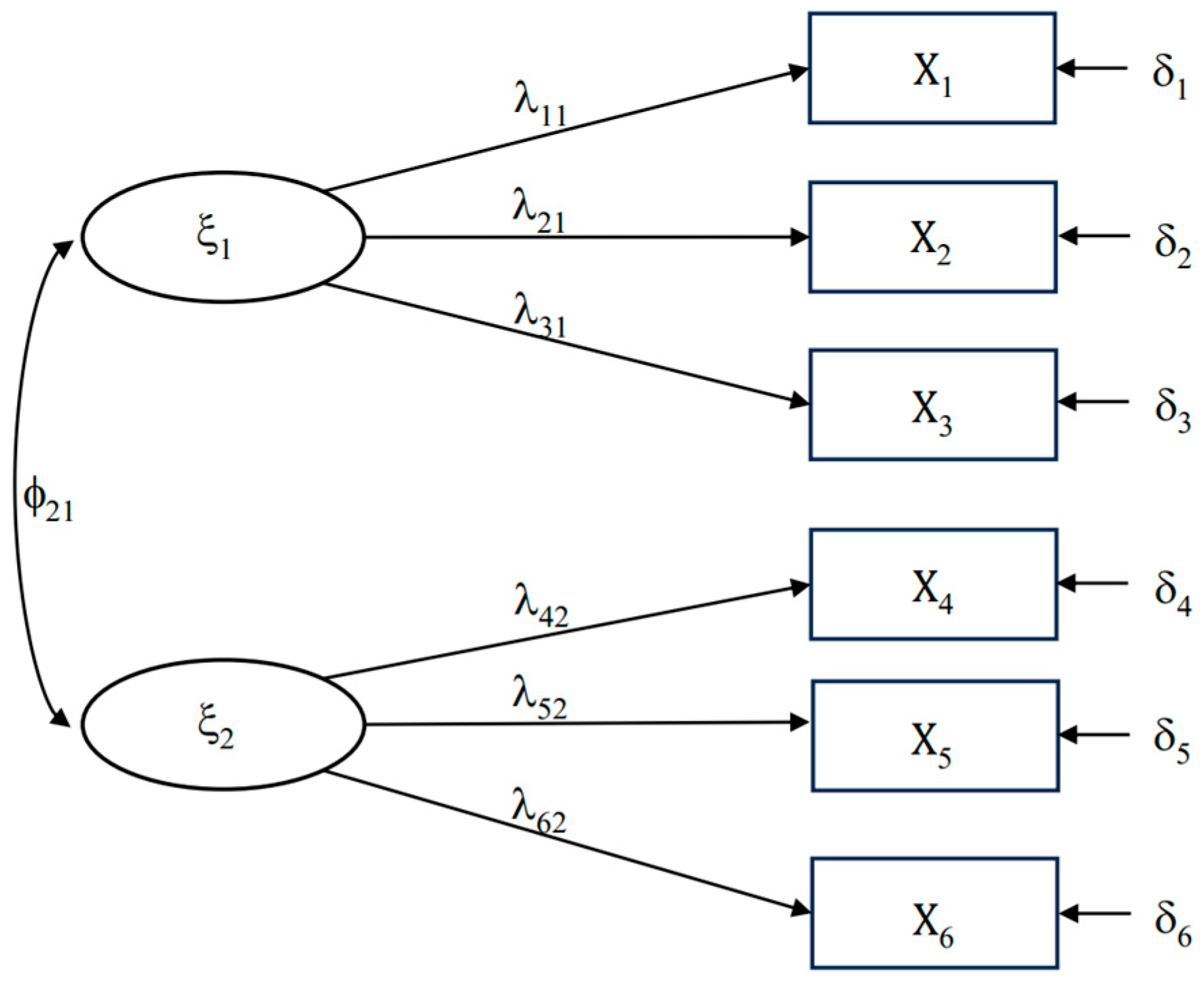
In a planned missing design, the nonresponses occur according to the researcher’s will, with the goal of increasing data quality and avoiding overly extensive questionnaires. When adjusting a structural equation model to the data, there are different criteria to evaluate how the theoretical model fits the observed data, with the root mean square error of approximation (RMSEA), standardized root mean square residual (SRMR), comparative fit index (CFI) and Tucker–Lewis index (TLI) being the most common. Here, I explore the effect of the nonresponses due to a specific planned missing design—the three-form design—on the mentioned fit indices when adjusting a structural equation model. A simulation study was conducted with correctly specified model and one model with misspecified correlation between factors. The CFI, TLI and SRMR indices are affected by the nonresponses, particularly with small samples, low factor loadings and numerous observed variables. The existence of nonresponses when considering misspecified models causes unacceptable values for all the four fit indexes under analysis, namely when a strong correlation between factors is considered. The results shown here were performed with the simsem package in R and the full information maximum-likelihood method was used for handling missing data during model fitting.
Keywords: fit measures; planned missing design; Monte Carlo simulation study fit measures; planned missing design; Monte Carlo simulation study