


Abstract
Artificial ventilation systems play a crucial role in the field of respiratory care, especially in intensive care units and surgical environments, where patients often require assisted breathing due to conditions such as acute respiratory distress syndrome (ARDS) or the effects of anesthesia. This study focuses on the development of an adaptive proportional–integral–derivative (PID) controller enhanced by a backpropagation neural network (BPNN) algorithm to accurately track airway pressure throughout the mechanical ventilation process. To achieve this, a MATLAB/Simulink model of a blower-driven patient hose (BDPH) ventilator system is constructed. Then, the performance efficiency of the artificial ventilation system is evaluated and analyzed based on the proposed control scheme under different operational scenarios. Furthermore, an analysis and comparison study of the performance of the adaptive PID controller based on the BPNN method and the classical PID controller has been conducted in terms of the robustness properties and transient behavior of the system. Simulation outcomes indicate that the adaptive PID controller showed faster convergence to the target airway pressure compared to the classical PID controller. This performance advantage arises from the controller’s ability to continuously adapt its gains to changes in operational conditions.
1. Introduction
Over the past two decades, many viruses, epidemics and even new pandemics have emerged. In 2002, the Severe Acute Respiratory Syndrome Virus (SARS) first appeared in Guangdong Province, China. In 2009, the World Health Organization announced a new pandemic called swine influenza virus (H1N1), while the organization announced another pandemic outbreak in 2019 called coronavirus disease (COVID-19). All of the mentioned viruses attack the human respiratory system, where they work to damage the lung cells and thus the person infected with these diseases will have to be supported with an artificial ventilator to assist or replace their spontaneous breathing [1,2].
A ventilator is a life-preserving emergency medical device that is used in an intensive care unit (ICU) or an anesthesia unit to help patients with acute respiratory issues. It works by creating the necessary pressure to facilitate the passage of air into the lungs during inhalation and releasing pressure to push air out of the lungs during exhalation. The ventilator has multiple modes of operation to help respiratory patients, including regulated mode, in which the ventilator completely or largely determines the pattern of breathing, aided mode, in which the ventilator still provides a certain number of “mandatory” breaths at a set volume or pressure, and spontaneous breathing mode, in which the ventilator only provides pressure assistance to overcome the work of breathing [3].
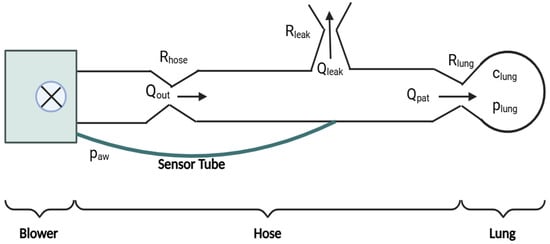
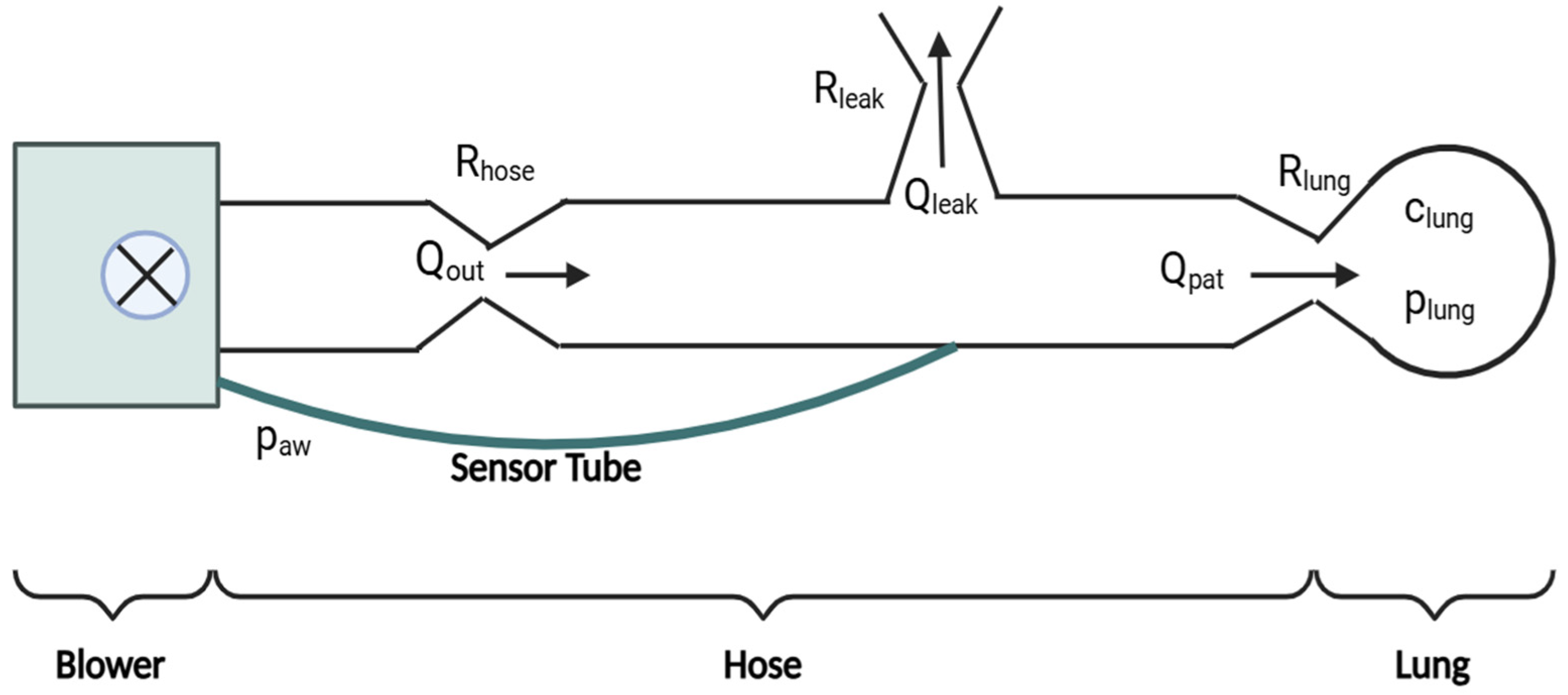
Pumped oxygen pressure and lung volume are two of the most important control variables of the ventilator. Accordingly, ventilators are divided into two types. The first type is the volume-controlled ventilator (VCV), which is recommended for use during surgery and severe cases. The second type is the pressure-controlled ventilator (PCV), which is adopted to avoid the risk of major barotrauma due to pressure changes in VCV, as it supports the patient based on a predefined, constant pressure. A BDPH ventilator system is classified as a PCV that is generally used in the ICU [4]. Figure 1 illustrates a BDPH ventilator system. In PCV, the pressure near the patient’s mouth must be monitored. Air enters and exits the respiratory system through the inspiratory peak pressure (IPP) and positive end-expiratory pressure (PEEP), respectively [5].
Figure 1.
Schematic model of a blower-driven patient hose ventilator.
Numerous studies have introduced different control methods to improve the capability of the ventilation system in monitoring pressure. The following studies discuss control schemes proposed by previous researchers for controlling ventilation systems:
D.S. Acharya and D.K. Das [4] proposed a novel PID controller to control the work of artificial ventilators. The parameters of the PID controller are assigned as the outputs of fuzzy inference system (FIS), where the entries of knowledge rules-base are optimized using a reshaped class-topper optimization (RCTO) algorithm. The proposed controller effectively enhances the pressure tracking response, improving overshoot by 16% and settling time by 60–80% compared to existing methods.
D.R. Acharya and D.K. Das [6] utilized an optimal fuzzy type-2 PID (FT2PID) controller based on a Human Conception Optimizer (HCO) to strengthen the pressure tracking capability of an artificial ventilator system. The output of the fuzzy inference system is used to adjust the values of the PID controller’s parameters, allowing for dynamic adjustments based on real-time data. Meanwhile, the HCO algorithm is employed to optimize the ranges of the triangular-shaped fuzzy type-2 memberships of the fuzzy inference system. The HCO algorithm improves the performance of the controlled system by ensuring that the parameters of the PID are adjusted optimally in response to external disturbances and parametric uncertainties.
A.T. Yimchunger et al. [7] introduced a PID controller whose parameters were optimized using the particle swarm optimization (PSO) algorithm to adjust the total amount of air delivered by the artificial ventilator system. The optimization process increased the controller’s ability to maintain system stability in response to variation in the volume of air delivered. This improvement has provided safety and comfort for patients by ensuring consistent and appropriate airflow, even under dynamic operating conditions.
I.M. Mehedi et al. [8] offered a fuzzy-based adaptive PID (FPID) controller to enhance the airway pressure tracking in the mechanical ventilator system. The respiratory model proposed in this study combined a BDPH system with a single-compartment lung model exhibiting nonlinear compliance. Simulation results showed that the FPID controller provided improved dynamic performance, resulting in faster response times, reduced tracking errors and reduced overshoot when compared to the classical PID controller.
I.M. Mehedi et al. [9] proposed Adaptive Fuzzy Sliding Mode Control (AFSMC), which combines fuzzy logic control and sliding mode control, to administer the pressure in mechanical ventilators effectively. The AFSMC shows more efficient performance compared to classical PID and sliding mode controllers. The introduced controller achieves reliable tracking of specified airway pressure, characterized by more rapid convergence, minimized overshoot, and smaller tracking error.
D. Acharya and D.K. Das [10] utilized a mixed integer tilted fractional order integral and integer order derivation controller optimized using an adaptive chaotic search fractional order class-topper optimization algorithm to track the desired airway pressure and maintain the brain and lungs from harmful damage. To improve the optimization process, a Gaussian-based mutation operator was merged with the chaotic search algorithm. This effective addition leads to better optimization results. The optimized controller shows efficient performance in tracking airway pressure to the specified level.
I. Naskar et al. [11] proposed a setpoint modulated fuzzy PI-based model reference adaptive controller (SFPIMRAC) to adjust the oxygen saturation levels (SpO2) in the mechanical ventilation system. Simulation results showed that the proposed controller achieved accurate control of SpO2 level compared to classical PID controller and model reference adaptive control, particularly under varying patient conditions.
Suwarsono et al. [12] suggested a fuzzy logic-based control strategy to develop an adaptive ventilator system that supports and improves breathing and reduces the risk of lung damage. The proposed control scheme dynamically adjusted its operational parameters in response to real-time feedback from pressure sensors. Simulation results indicated that the adaptive ventilator outperformed the traditional ventilator by providing precise control designed to meet individual patients’ needs.
I.M. Batiha et al. [13] utilized an optimal fractional-order PID (FPID) controller to enhance the performance of an artificial ventilator used for patients suffering from respiratory distress. The optimal values of FPID controlled parameters determined by using Bacteria Foraging Optimization and particle swarm optimization algorithms. The simulation results indicates that both optimization algorithms proposed produced effective controller parameters. The offered optimal FPID controller significantly enhanced the performance of the artificial ventilation system for COVID-19 patients facing difficulties with respiratory distress. The suggested controller is validated through various simulations, illustrating its efficiency in high-risk care settings.
Z. Chen [14] used a fuzzy PID controller integrated with a variable universe concept, which makes the input and output parameters of the fuzzy PID controller capable of adapting consciously based on the operating conditions to improve the performance of the tunnel ventilation system and minimize energy consumption. The variable universe fuzzy PID control system has a better control effect, its overshoot is smaller and the adjustment time is shorter compared to the classical fuzzy PID control system.
The PID controller is known for its enormous and consistent demand in many applications due to its simple structure and easy application. These features also make it difficult to use with complex and coupled nonlinear systems. For reliable performance, the PID controller parameters must be appropriately tuned and adapted based on changes in system behavior or operating conditions [15,16,17,18,19,20]. Several methods exist for implementing adaptive PID control such as the gain scheduling method, the fuzzy logic method, and the neural network method. Neural network-based PID controllers (NNPIDs) have been widely investigated as adaptive schemes for online adjustment of PID parameters using neural learning strategies [21,22,23,24,25,26,27,28,29,30,31,32]. In this context, a summary overview of research pertinent to the NNPID control strategy will be shown:
B. Mohamed et al. [33] developed a PID controller whose parameters were adapted online using a multi-layer perceptron neural network based on a back propagation method (ANNPID) to enhance the performance of the continuous stirred tank reactor (CSTR) system. Simulation results indicated superior performance of the proposed controller in terms of adaptability to system parameter variations and disturbance rejection compared to classical PID, Type-1 fuzzy logic control, and Type-2 fuzzy logic control methods.
A.F. Bawazir et al. [34] introduced an adaptive PID controller based on artificial neural networks (ANNs) and reinforcement learning (RL) to address the regulation of nonlinear dynamic pressure drops. The key role of the RL algorithm in this architecture is to improve decision-making capabilities during control tasks. A comparative study showed that the proposed controller achieved more robust performance than the classical PID controller, particularly in handling complex nonlinear behavior.
M. Benrabah et al. [35] developed an adaptive approach to PID control based on the neural network framework, referred to as the Adaptive Fourier Series Neural Network PID Controller (AFSNNPID), to enhance the dynamic performance of a 3-DOF robot arm manipulator. Experimental findings showed that the proposed controller produced superior performance when compared to the optimal PID controller based on particle swarm optimization and the classical adaptive neural network PID controller.
J. Liu et al. [36] introduced a neural network PID controller which incorporates a dynamic adjustment mechanism to improve the performance of DC–DC switching converters. Simulation results showed that integrating the proposed adaptive structure with a classical PID controller led to noticeable improvements in system efficiency, particularly under variable operating conditions.
I. Ali et al. [37] suggested an adaptive linear neural network approach designed to adjust the gains of a PID controller dynamically during the operation process of a two-area interconnected power system. The findings of this study showed that the proposed method contributed to enhanced frequency stability by effectively reducing frequency fluctuations. The main contributions addressed in this work are summarized as follows:
- Developing an adaptive PID controller that employs a neural network architecture to control a BDPH ventilator system.
- Online tuning of PID controller parameters to improve the performance of a BDPH ventilator system based on the backpropagation method.
- Conducting a comparative study between the adaptive PID controller and the classical PID controller regarding the robustness and transient behavior characteristics of the system.
The organization of the remaining sections is as follows: Section 2 shows the modeling process of a BDPH ventilator system. Section 3 shows the design steps of an adaptive PID controller based on a BPNN algorithm. Section 4 shows a computer simulation to validate the performance of the introduced controller. Finally, the conclusions drawn based on the attained results of the numerical simulation are highlighted in Section 5.
2. Mathematical Representation and Analysis of an Artificial Ventilation System
As illustrated in Figure 1, the artificial ventilation system used in this paper is made up of three parts. The first one is the blower, which pressurizes atmospheric air to the specified pressure (); the second one is the hose, which links the blower to the patient’s lung; and finally, the patient’s lung [5]. During the patient’s inhalation process, the airflow rate () flows through the hose with the resistance of into the lung system () with the resistance of being caused by the blower system. During the exhalation process, the patient expels air into the hose, where some of it exits through the leak () with resistance . Thus, the airflow equation can be written as follows [4,5,6,7,8]:
The expressions for the patient’s flow rate, the blower’s flow rate, and the leak’s flow rate can be derived from the pressure drop across the resistance as follows:
where, denotes the airway pressure, which is measured using a pressure sensor implanted within the device.
where is the lung pressure, which can be written as a differential equation as follows:
The parameter represents lung compliance. Clinical data show that its value is not constant but exhibits an increase or decrease as a function of lung volume. By combining Equations (1) and (5), the expression of lung dynamic can be rewritten as follows:
The airway pressure can be obtained by substituting Equations (2) and (4) into Equations (1) and reformulating it as follows:
By substituting Equation (6) in Equation (7) into Equation (5), the lung dynamic equation can be written as
One can represent Equations (4), (6) and (7) into state space representation by assigning the variables as the output and as input, where denotes the state variable. Accordingly, the system dynamic can be rewritten in the following state space representation
where
where
3. Design Methodology for the Controller
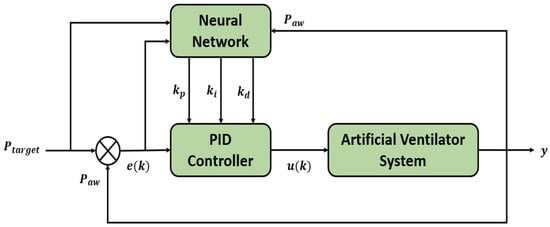
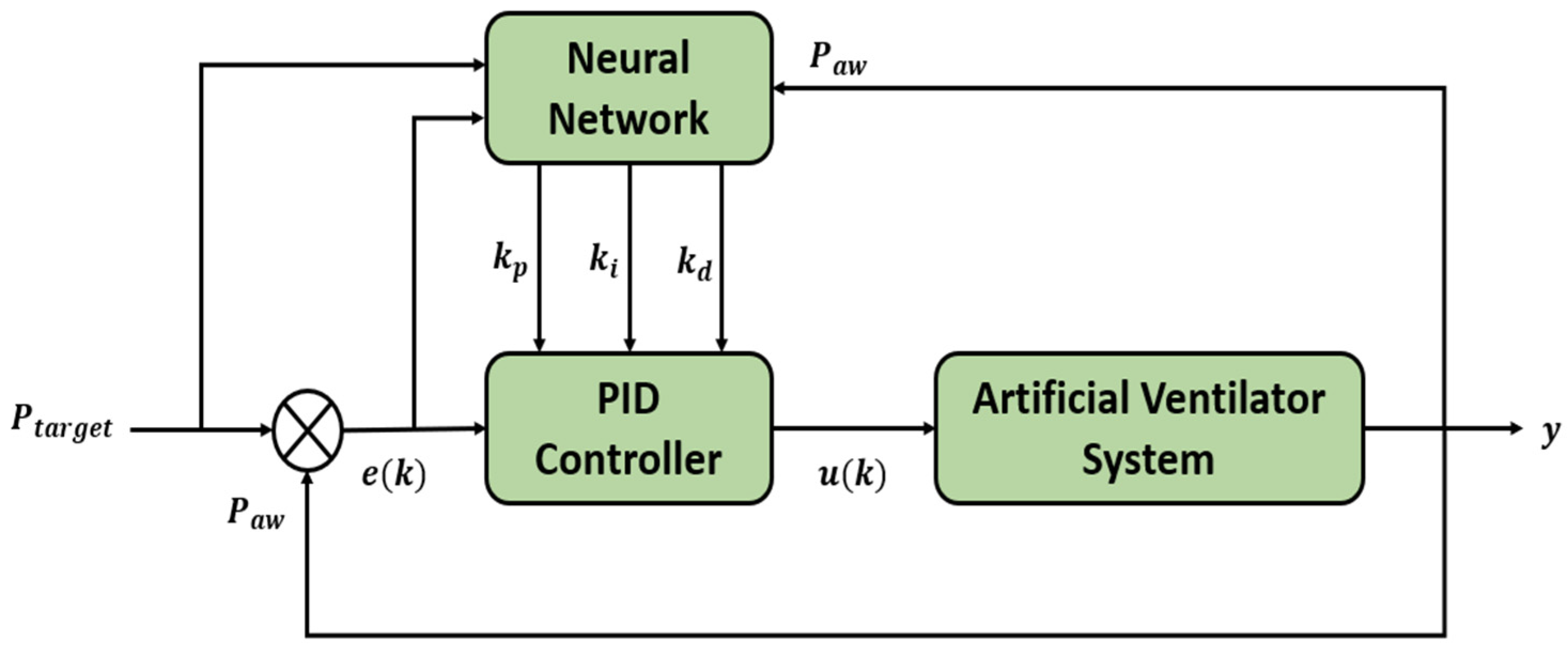
This section will introduce the mechanism of designing an adaptive PID controller based on the backpropagation neural network method to control the operation of the BDPH ventilator system. The controlled system is illustrated in Figure 2. The mathematical formulation of the classical PID controller is described as [20]
Figure 2.
Control scheme of artificial ventilation system based on proposed adaptive PID controller.
The control algorithm’s objective is to improve the tracking performance of the lung system such that the airway pressure, during artificial ventilation, tracks the target set-point . Accordingly, the error equation is defined as follows
The discrete version of the PID controller can be described by using the trapezoidal method as follows
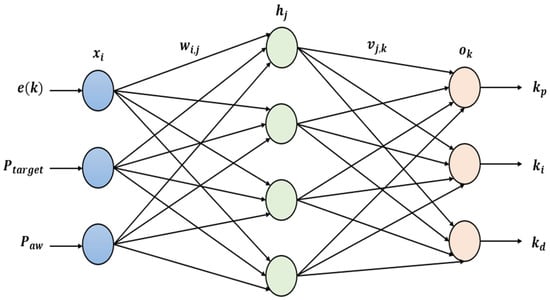
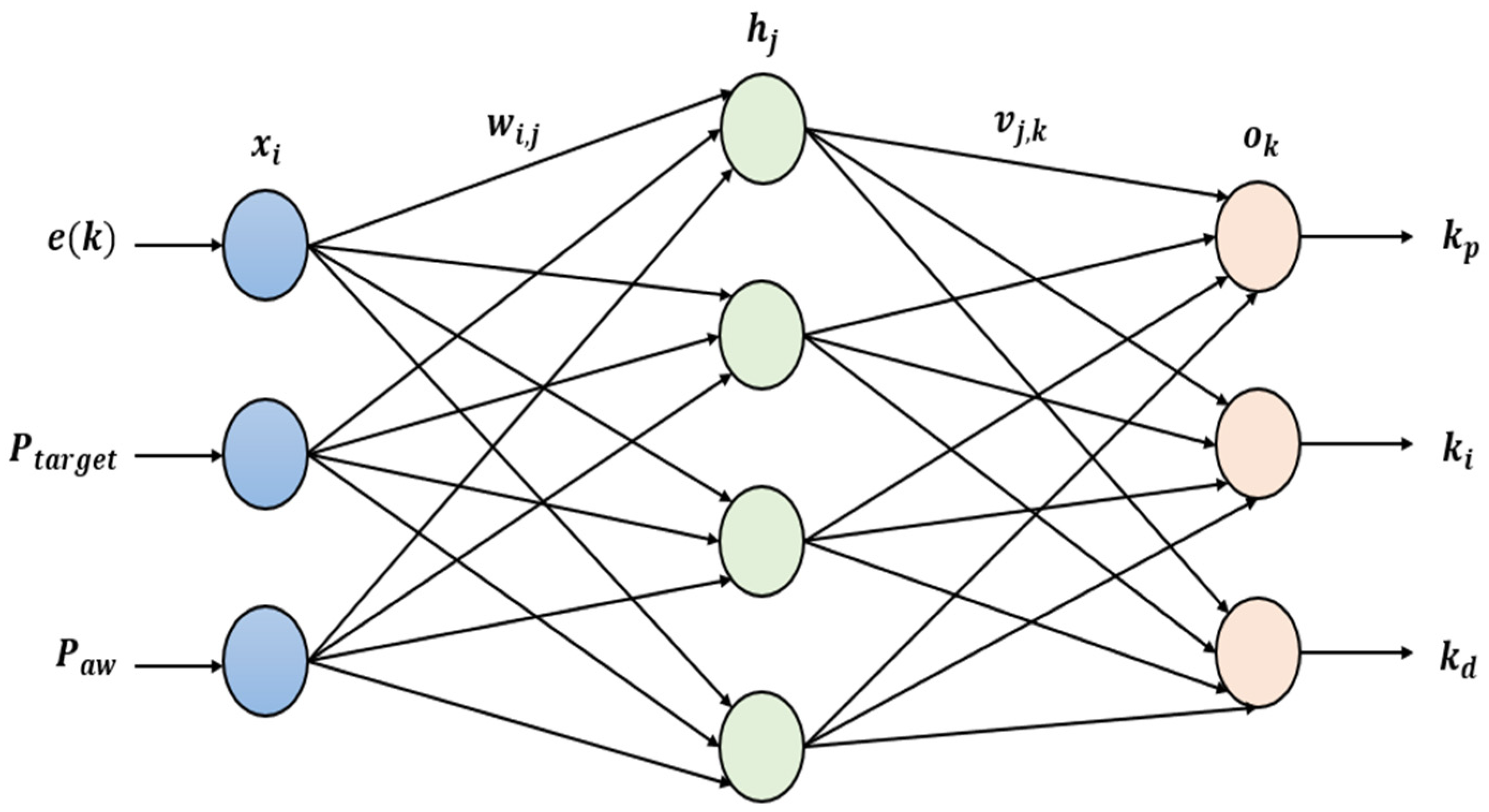
where represents the sampling time. The effective PID controller performance is related to robust tuning of controller parameters, which makes it able to maintain the stability of the system under changing operating conditions. To compensate for the effect of variations in the operating conditions of the system and to achieve more satisfactory performance, a neural network structure is proposed to tune the PID gains. Figure 3 shows the proposed neural architecture for tuning the PID controller’s gains [38].
Figure 3.
The proposed neural architecture.
The proposed neural architecture is a feedforward network with three outputs (), three inputs () and one hidden layer with four nodes. These inputs were chosen to provide the neural network with real-time system state information, reference targets, and performance feedback. The output of each node in the hidden layer is given by
where represents the activation function of the hidden nodes; it is defined as follows:
The proposed activation function is characterized by providing a smooth, continuous, and finite nonlinear mapping between inputs and outputs of the neural network, which is well suited for function approximation in a neural network-based control system. Moreover, its differentiability facilitates stable weight adjustment during training, and its limited output helps prevent undesirable control actions.
The outputs of the neural architecture, which represent the gains of the PID controller (), are expressed as follows [16]:
The connection weights of the neural architecture are updated to minimize the fitness function described by Equation (18).
To achieve this purpose, the connection weights of the output layer are adapted using the backpropagation method according to the gradient descent algorithm [21]
where represents the learning rate. The term can be determined as follows:
where
For the hidden layer, the fitness function gradient is determined as follows:
The different term of Equation (24) can be calculated as follows:
where
4. Simulation Results and Discussion
The artificial ventilation system’s physical parameters are listed in Table 1 [8]. The artificial ventilation system has been developed and modeled based on numerical solver “Ode45” within the MATLAB/Simulink (2013a) programming environment. The values of the classical PID are determined by using a particle swarm optimization algorithm (PSO) [39]; Table 2 shows the PID controller gains based on the PSO algorithm.
Table 1.
Specifications of artificial ventilation system.
Table 2.
Optimal setting of PID controller’s terms using PSO algorithm.
The pseudocode of the BPNN-based PID controller is described step-by-step using Algorithm 1.
| Algorithm 1: Neural Network-based Adaptive PID Parameter Update |
| Initialize PID controller internal states: integral term , previous error , and |
| Initialize neural network parameters (weights, biases, and learning rates) by using PSO algorithm |
| At each sampling instant k = 1, 2, 3, …, do |
| Step 1: form neural network input vector () |
| Step 2: neural network forward propagation |
| Step 3: update PID controller gains |
| Step 4: compute PID control signal |
| Step 5: define adaptation objective Equation (17) |
| Step 6: online neural network weights adaptation |
| Step 7: Updated stored variables |
| repeat |
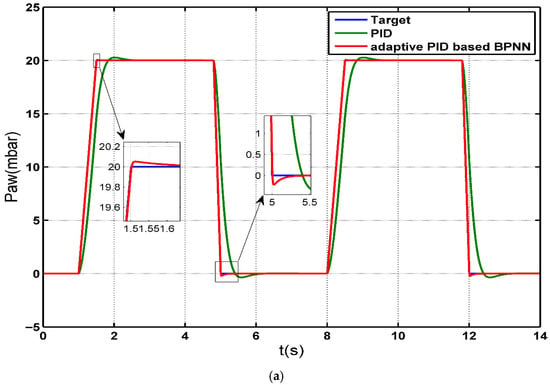
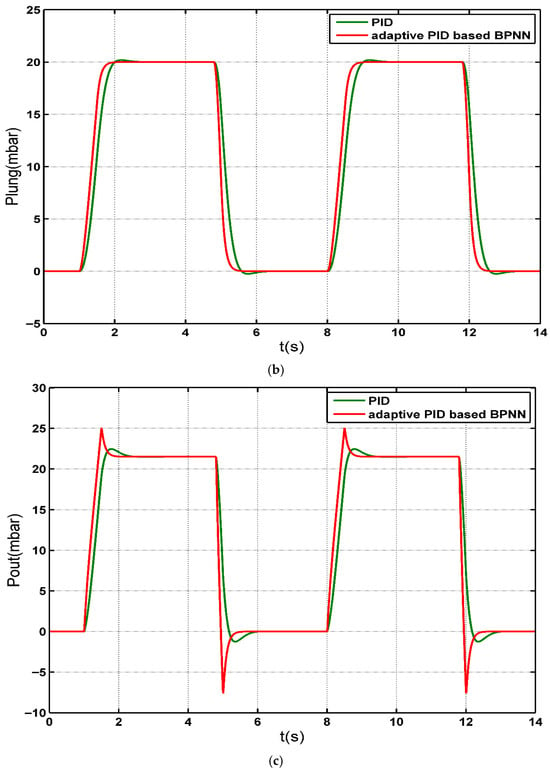
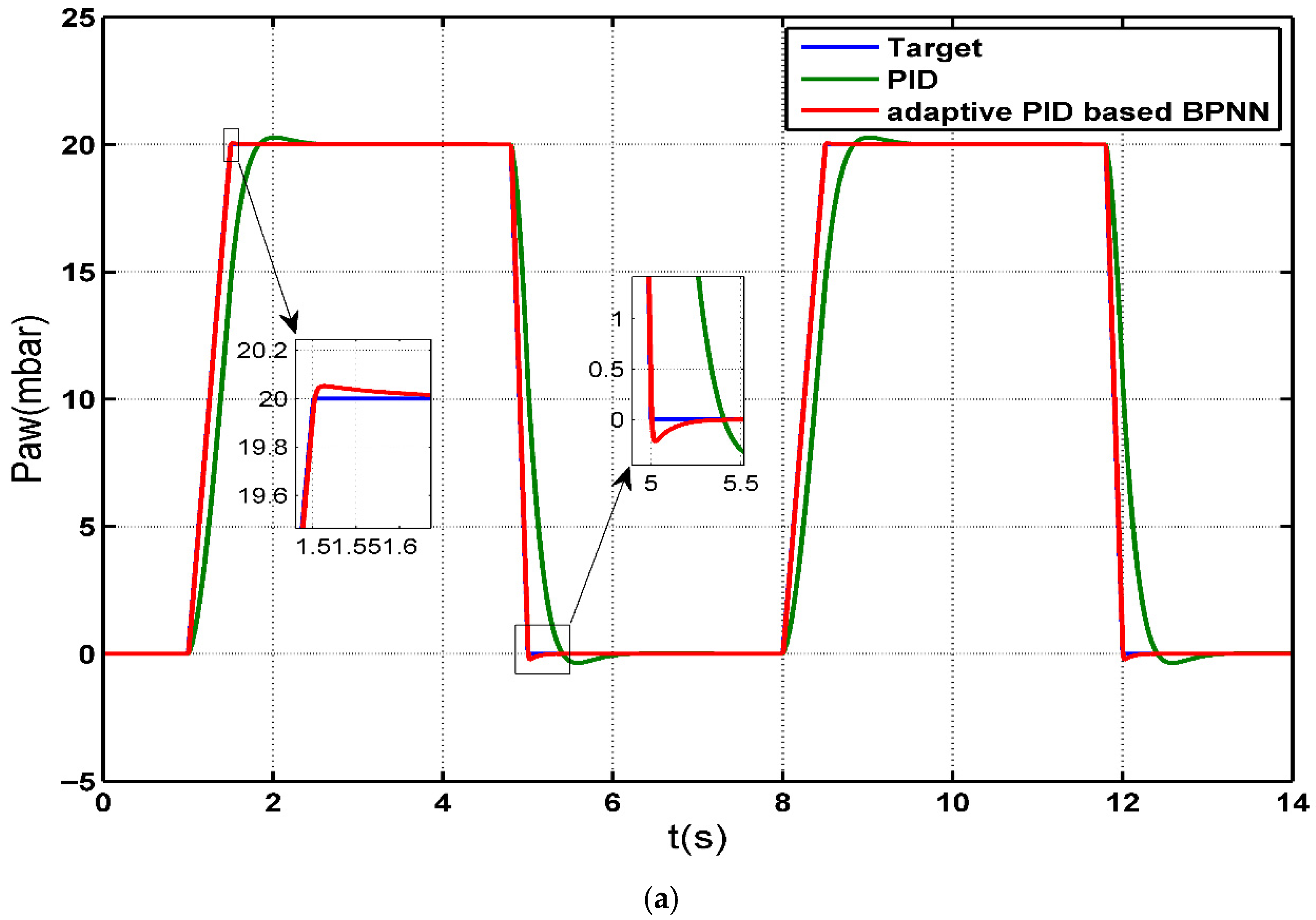
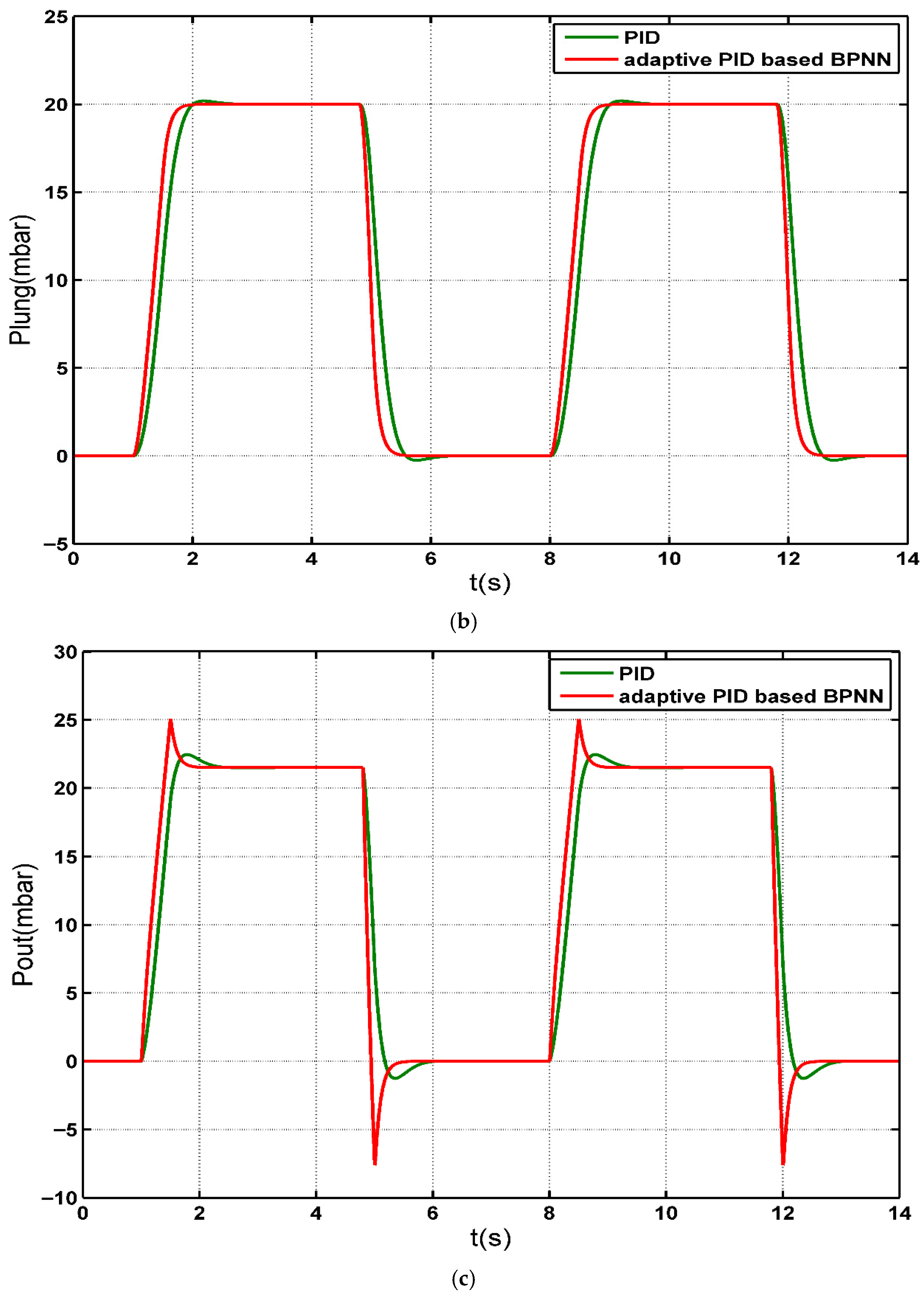
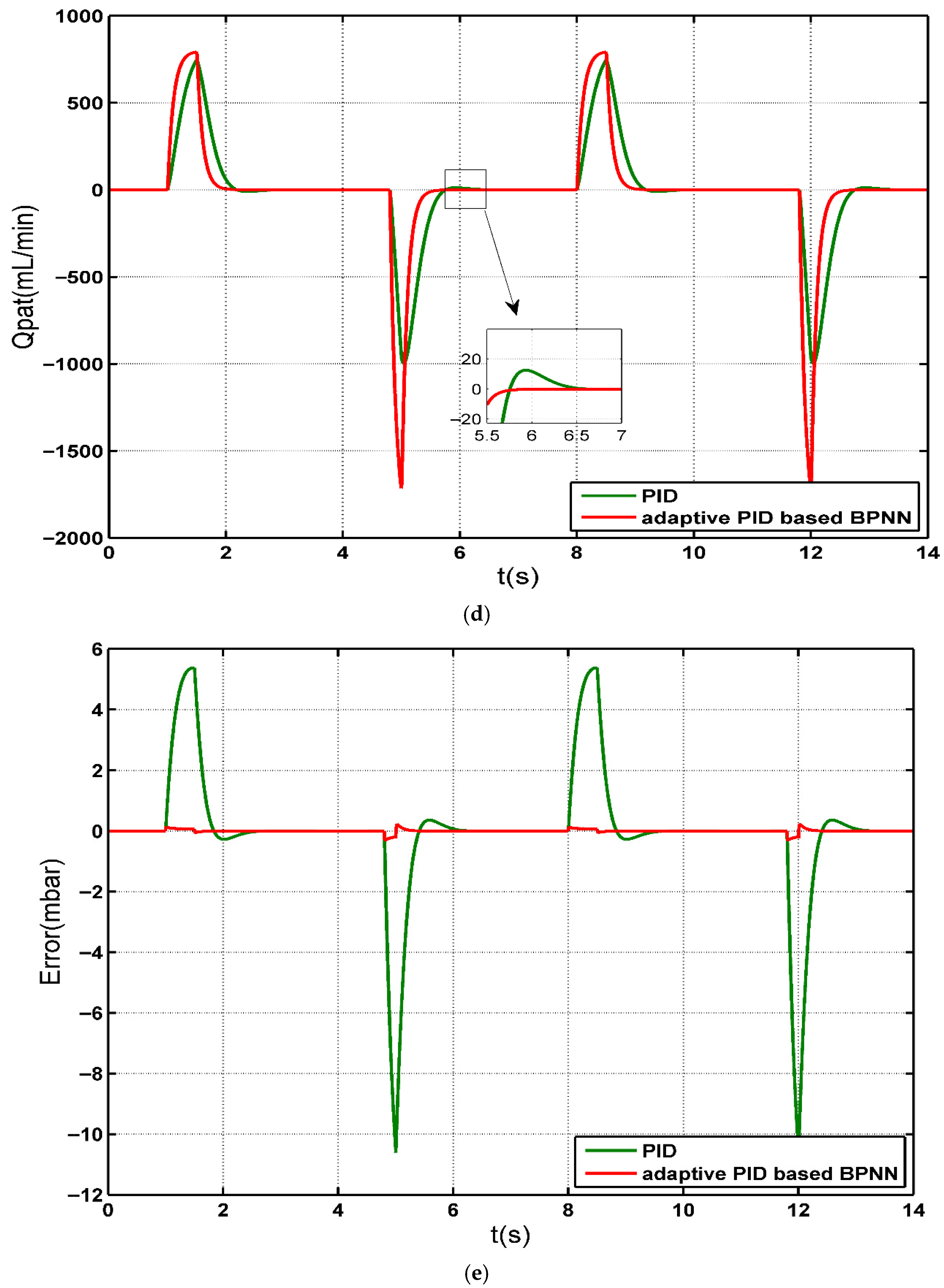
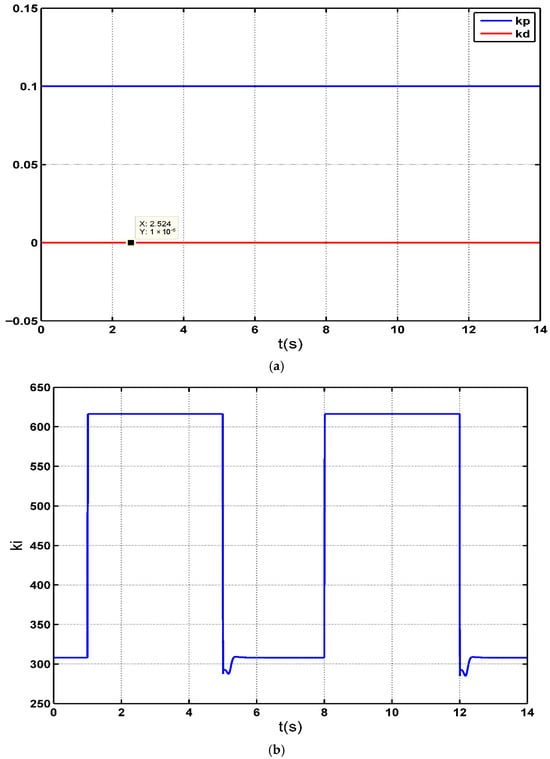
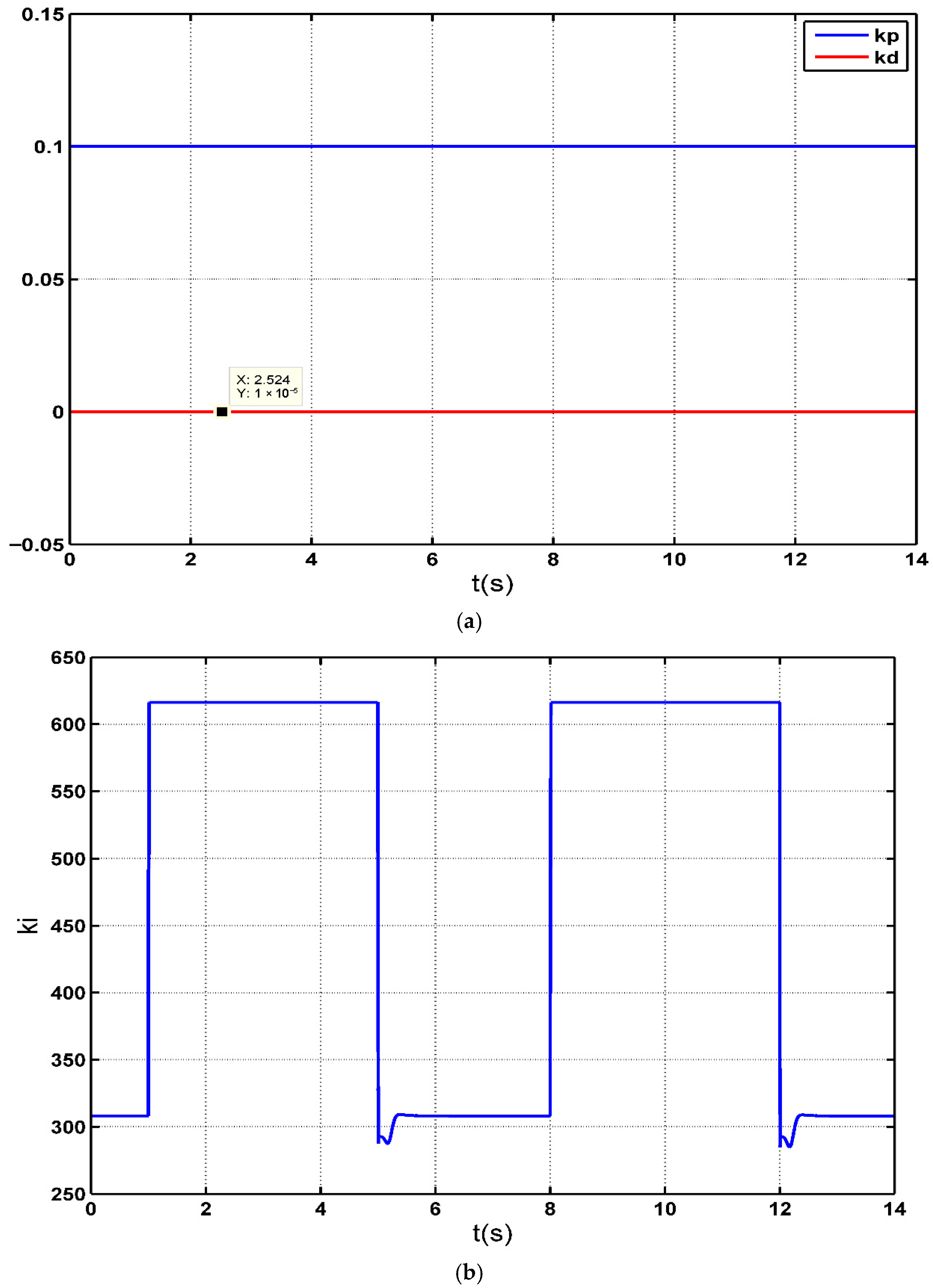
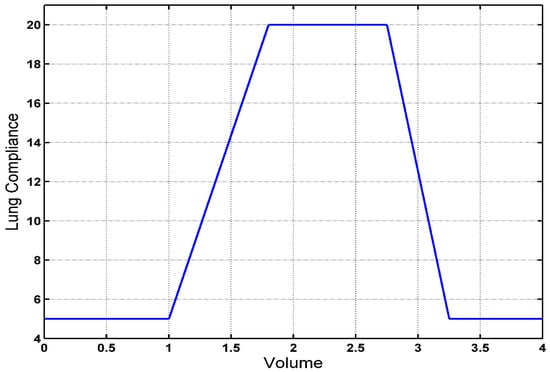
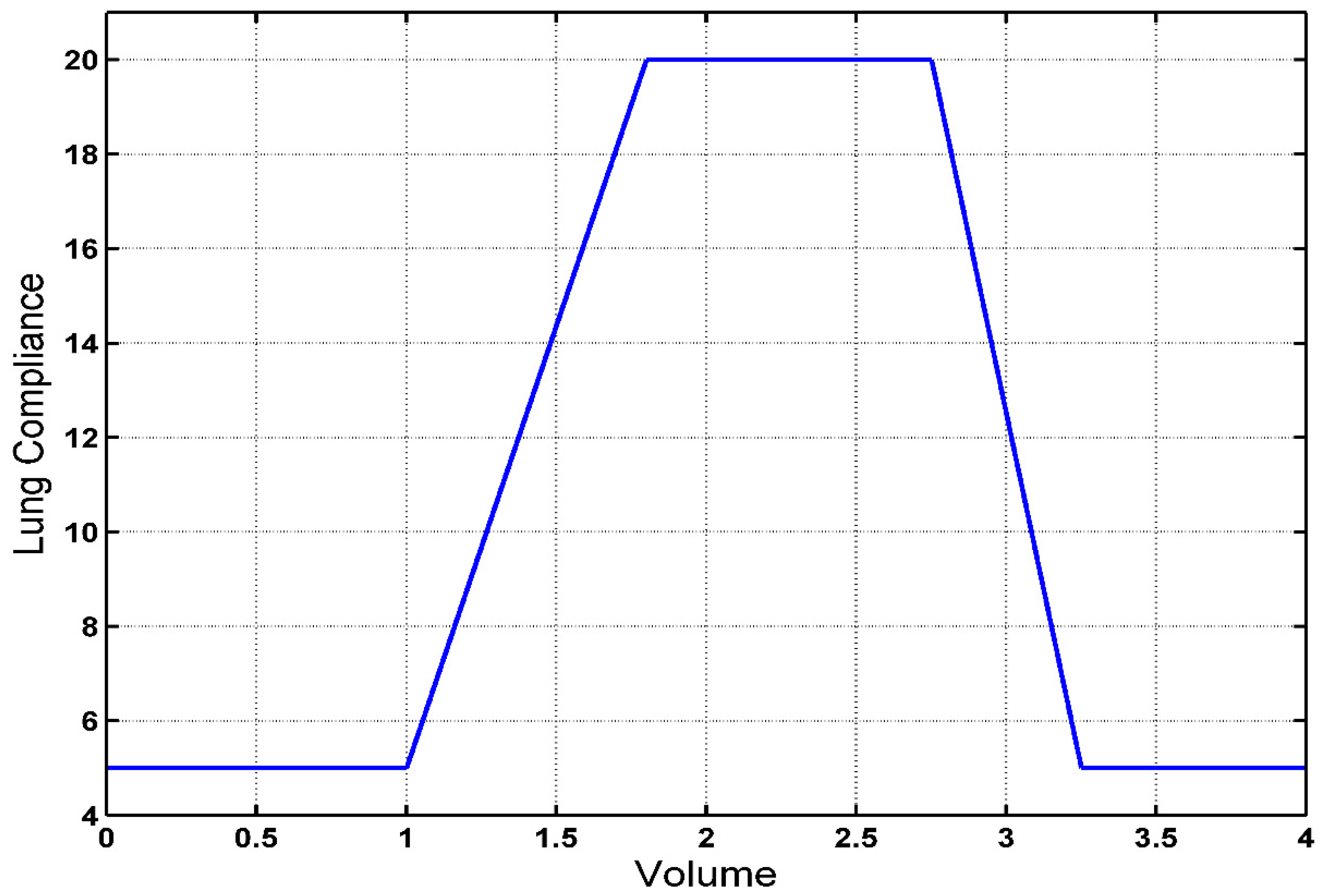
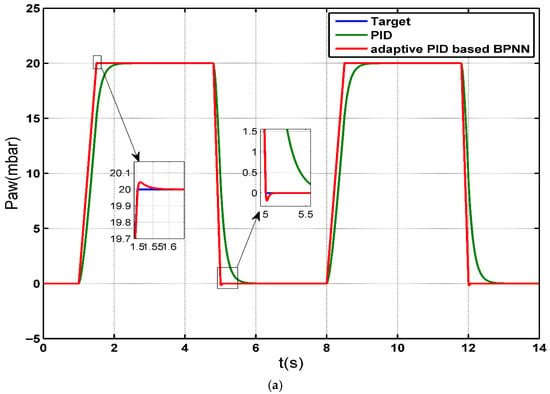
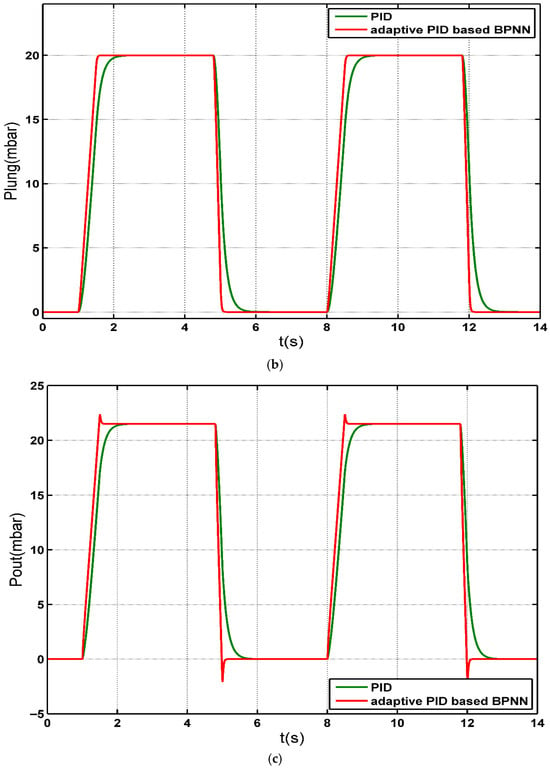
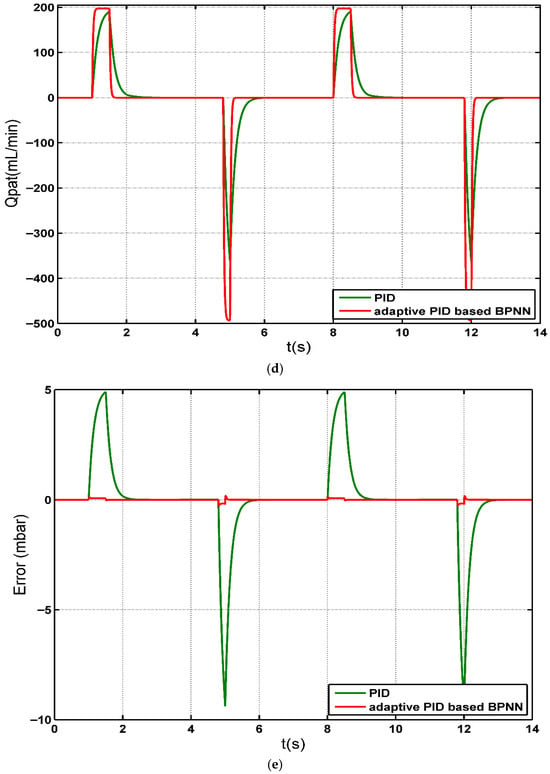
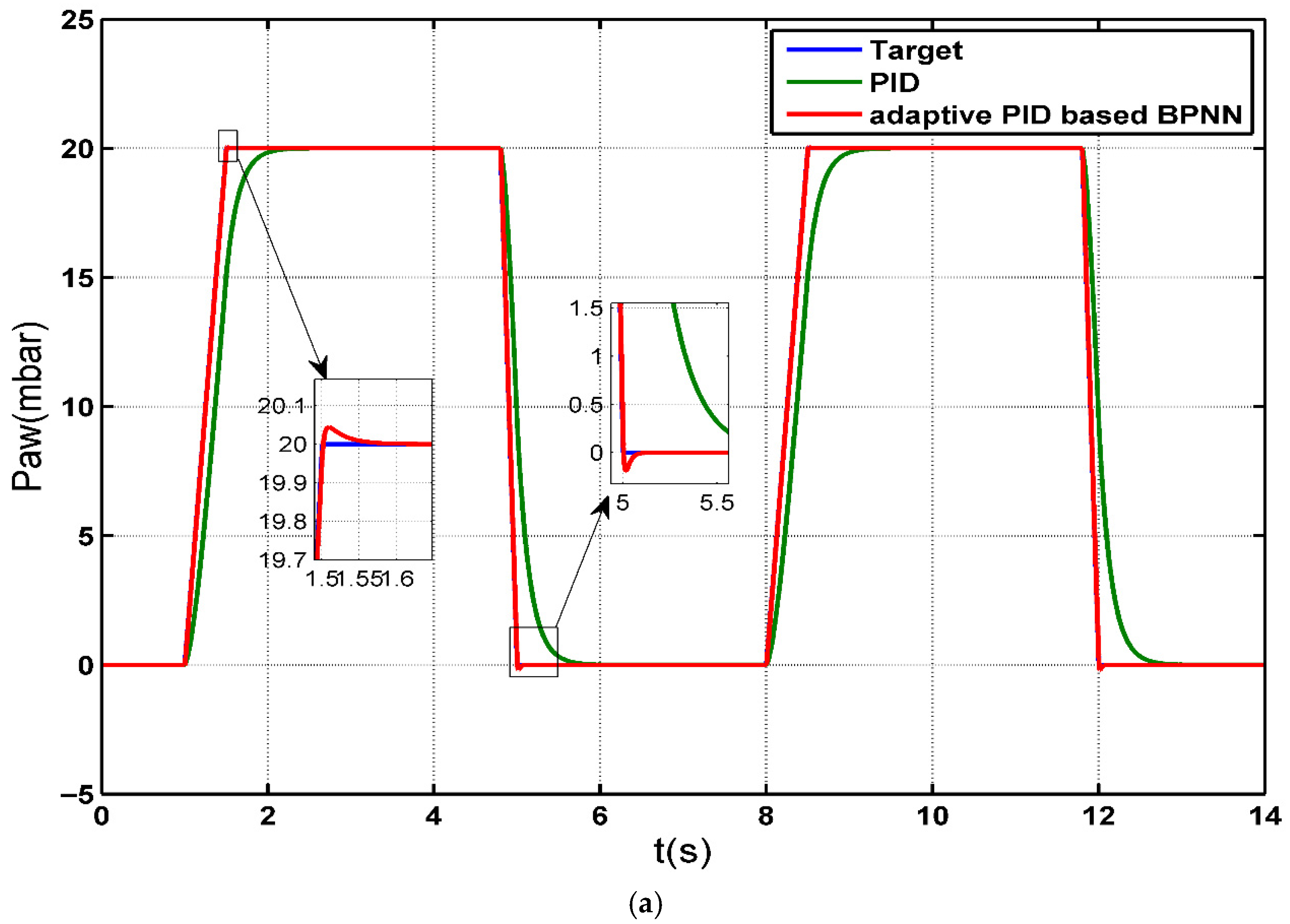
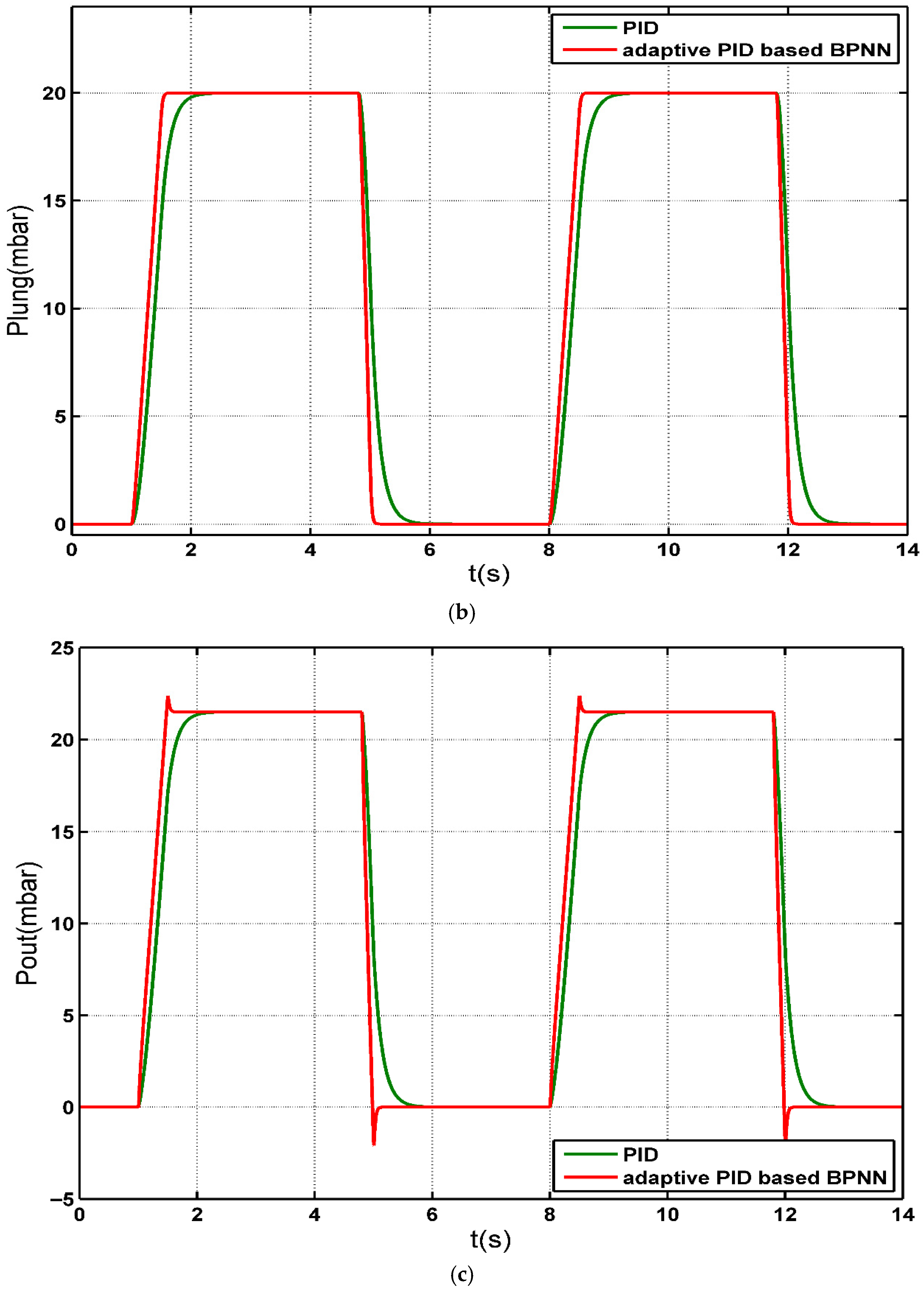
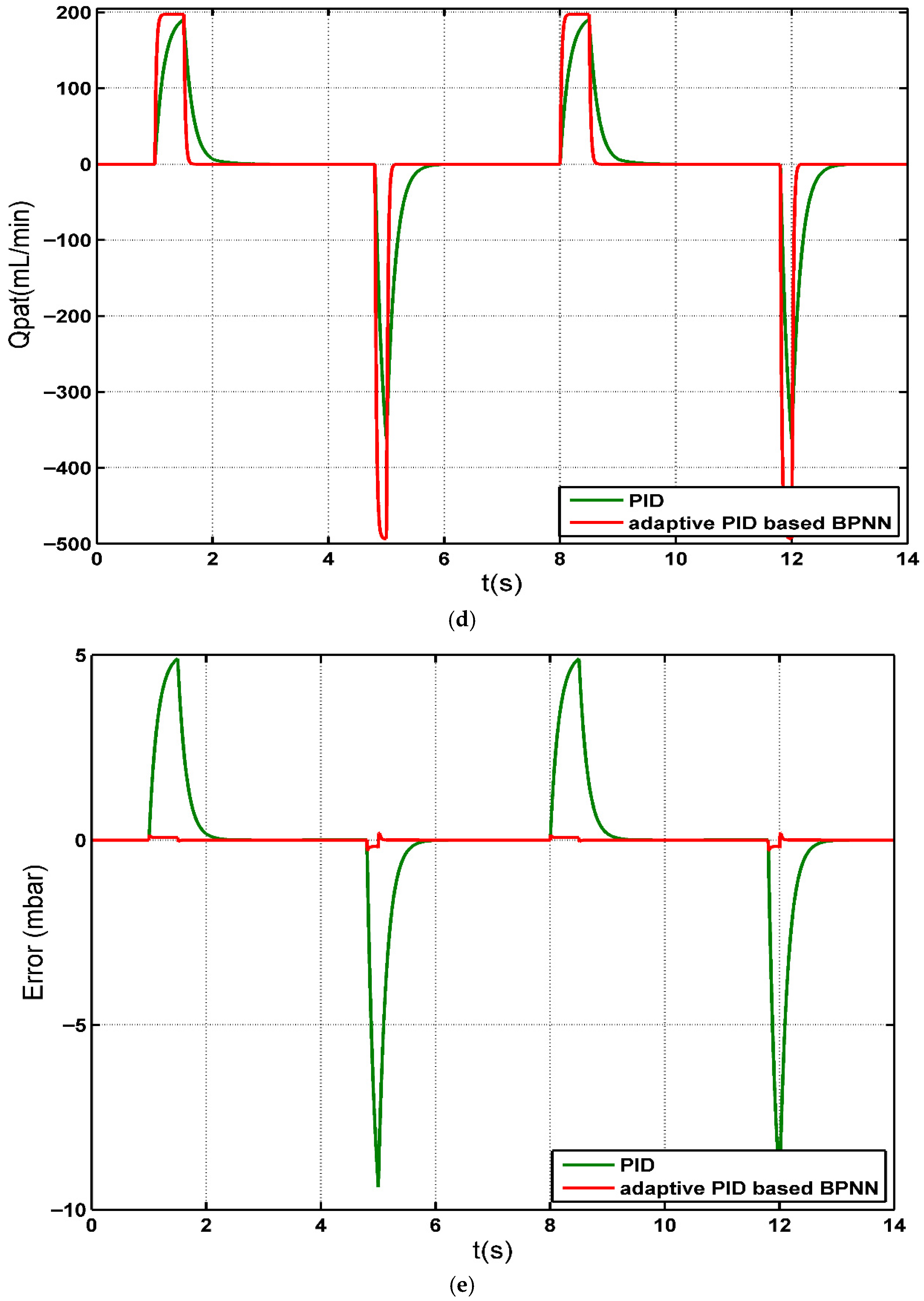
To evaluate how the proposed controller effectively operates, two scenarios has been conducted based on numerical simulation and the value of lung compliance: The first scenario assumes constant lung compliance during the process of exhalation inhalation, while the other scenario incorporates lung compliance as a function of lung volume. The response of the artificial ventilation system to the targeted airway pressure pattern in terms of lung compliance stability is shown in Figure 4. The behavior of adaptive PID controller gains is demonstrated in Figure 5. To assess the system’s robustness against uncertainty, the responses of the proposed controllers were tested under varying lung compliance. The change in lung compliance used in the examination of the proposed controller is depicted in Figure 6.
Figure 4.
Operational performance of artificial ventilation system under constant lung compliance, (a) airway pressure , (b) lung pressure , (c) control action , (d) patient flow rate and (e) error signal.
Figure 5.
The time behavior of PID controller gains based on NNBP method (a) kp and kd, and (b) ki.
Figure 6.
Lung compliance as a function of lung volume.
The tradeoff between faster convergence toward the targeted airway pressure pattern in the response curves of proposed control strategies is shown in Figure 7. The simulation results, especially the error metrics integral time absolute error (ITAE), maximum overshoot, and root mean square error (RMSE), conclusively support the superiority of the adaptive PID controller compared to the classical PID controller. For example, Table 3 shows how adaptive PID maintains lower error rates even under parameter uncertainty, proving its resilience. It is also worth mentioning that the online tuning results show that the derived gain value is close to zero, while the integral gain represents the dominant adaptive component. Since the system exhibits relatively smooth responses without high oscillations, this major performance improvement is achieved by eliminating steady-state error and enhancing disturbance rejection through the integrated term.
Figure 7.
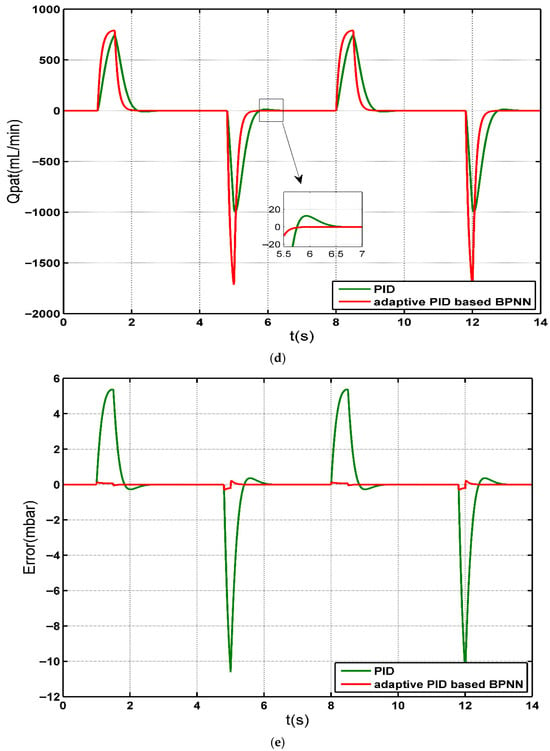
Operational performance of artificial ventilation system under varying lung compliance, (a) airway pressure, (b) control action, (c) lung pressure, (d) patient flow rate and (e) error signal.
Table 3.
Evaluation of controlled artificial ventilation system using adaptive PID based on NNBP and classical PID controllers.
Moreover, the obtained results demonstrate a significant improvement in airway pressure pattern regulation accuracy when compared to the findings of I. M. Mehedi et al. [8]. While their model achieved an ITAE of 7.467 using a fuzzy logic control technique to tune the gains of the PID controller, our approach, which employed a neural network based on a backpropagation method to tune the gains of the PID controller, resulted in an ITAE of 1.129. Although both studies used a similar model, the differing tuning strategies appear to play a critical role in tracking performance.
5. Conclusions
In this study, an adaptive PID controller was proposed to improve the pressure regulation performance of an artificial ventilator system. The controller was based on a neural network, trained using the backpropagation algorithm, to continuously optimize the values of the PID gains in real time. The controller’s performance was evaluated using a blower-driven patient hose (BDPH) ventilator system operating under various conditions. Simulation results showed superior pressure tracking capability, with reductions of up to 97% in RMSE, and up to 98.3% in ITAE compared to a classical PID controller. Future work will focus on implementing the proposed control strategy in a real ventilator setup to validate its effectiveness in a practical scenario. Furthermore, a distributed optimization algorithm for tuning classical PID parameters will be studied to examine whether performance improvement is attributable to the adaptive control architecture or influenced by the specific optimization approach. Finally, the proposed framework will be expanded and compared with advanced control algorithms such as adaptive neural-output feedback control and event-triggered control strategies to evaluate their suitability for the target system [40,41,42,43,44,45,46,47,48,49].
Author Contributions
Author Contributions: methodology, A.F.H. and A.J.H.; formal analysis, A.J.H., A.F.H. and F.A.R.; validation, F.A.R. and A.F.H.; investigation, F.A.R., A.F.H. and A.J.H.; re-sources, F.A.R. and A.F.H.; Conceptualization, F.A.R. and A.F.H.; software, A.F.H.; writing—review and editing, A.J.H., A.F.H. and F.A.R.; re-sources, A.J.H., A.F.H. and F.A.R.; funding acquisition, A.J.H. and F.A.R.; supervision, A.J.H. All authors have read and agreed to the published version of the manuscript.
Funding
This research received no external funding.
Institutional Review Board Statement
Not applicable.
Informed Consent Statement
Not applicable.
Data Availability Statement
The dataset utilized in this work may be accessed through the machine-learning repository at UCI.
Conflicts of Interest
The authors declare no conflicts of interest.
References
- Walter, M.; Leonhardt, S. Control applications in artificial ventilation. In 2007 Mediterranean Conference on Control & Automation; IEEE: New York, NY, USA, 2007; pp. 1–6. [Google Scholar]
- Borrello, M. Modeling and control of systems for critical care ventilation. In Proceedings of the 2005, American Control Conference, 2005; IEEE: New York, NY, USA, 2005; pp. 2166–2180. [Google Scholar]
- Pomprapa, A.; Alfocea, S.R.; Göbel, C.; Misgeld, B.J.; Leonhardt, S. Funnel control for oxygenation during artificial ventilation therapy. IFAC Proc. Vol. 2014, 47, 6575–6580. [Google Scholar] [CrossRef] [Scilit]
- Acharya, D.; Das, D.K. A novel PID controller for pressure control of artificial ventilator using optimal rule based fuzzy inference system with RCTO algorithm. Sci. Rep. 2023, 13, 9281. [Google Scholar] [CrossRef] [Scilit]
- Hunnekens, B.; Kamps, S.; Van De Wouw, N. Variable-Gain Control for Respiratory Systems. IEEE Trans. Control Syst. Technol. 2018, 28, 163–171. [Google Scholar] [CrossRef] [Scilit]
- Acharya, D.; Das, D.K. Human Conception Optimizer-Based Optimal Type-2 Fuzzy PID Controller Design for Artificial Respiratory System. IEEE Trans. Syst. Man Cybern. Syst. 2024, 54, 5388–5399. [Google Scholar] [CrossRef] [Scilit]
- Yimchunger, A.T.; Acharya, D.; Das, D.K. Particle Swarm Optimization based PID-Controller Design for Volume Control of Artificial Ventilation System. In 2020 IEEE Calcutta Conference (CALCON); IEEE: New York, NY, USA, 2020; pp. 278–282. [Google Scholar]
- Mehedi, I.M.; Shah, H.S.M.; Al-Saggaf, U.M.; Mansouri, R.; Bettayeb, M. Fuzzy PID control for respiratory systems. J. Healthc. Eng. 2021, 2021, 7118711. [Google Scholar] [CrossRef] [Scilit]
- Mehedi, I.M.; Shah, H.S.M.; Al-Saggaf, U.M.; Mansouri, R.; Bettayeb, M. Adaptive Fuzzy Sliding Mode Control of a Pressure-Controlled Artificial Ventilator. J. Healthc. Eng. 2021, 2021, 1926711. [Google Scholar] [CrossRef] [Scilit]
- Acharya, D.; Das, D.K. An adaptive fractional order optimizer based optimal tilted controller design for artificial ventilator. Optim. Control Appl. Methods 2024, 45, 2651–2668. [Google Scholar] [CrossRef] [Scilit]
- Naskar, I.; Pal, A.K.; Jana, N.K. Self-regulating adaptive controller for oxygen support to severe respiratory distress patients and human respiratory system modeling. Diagnostics 2023, 13, 967. [Google Scholar] [CrossRef] [Scilit]
- Suwarsono, S.; Budiono, B.; Hidayat, D.F.; Raharjo, G.D.; Humaidi, H.N.A. Design and build implementation of fuzzy logic control on adaptive ventilator. AIP Conf. Proc. 2024, 2927, 040031. [Google Scholar]
- Batiha, I.M.; El-Khazali, R.; Ababneh, O.Y.; Ouannas, A.; Batyha, R.M.; Momani, S. Optimal design of PIρDµ-controller for artificial ventilation systems for COVID-19 patients. AIMS Math. 2023, 8, 657–675. [Google Scholar] [CrossRef] [Scilit]
- Chen, Z. Tunnel Ventilation System Based on Variable Universe Fuzzy PID Control. In 2022 IEEE 2nd International Conference on Data Science and Computer Application (ICDSCA); IEEE: New York, NY, USA, 2022; pp. 98–102. [Google Scholar]
- Fortuna, L.; Frasca, M.; Buscarino, A. Optimal and Robust Control: Advanced Topics with MATLAB®, 2nd ed.; CRC Press: Boca Raton, FL, USA, 2021. [Google Scholar] [CrossRef] [Scilit]
- Al-Jodah, A.; Abbas, S.J.; Hasan, A.F.; Humaidi, A.J.; Al-Obaidi, A.S.M.; AL-Qassar, A.A.; Hassan, R.F. PSO-based optimized neural network PID control approach for a four wheeled omnidirectional mobile robot. Int. Rev. Appl. Sci. Eng. 2023, 14, 58–67. [Google Scholar] [CrossRef] [Scilit]
- Humaidi, A.J.; Oglah, A.A.; Abbas, S.J.; Ibraheem, I.K. Optimal Augmented Linear and Nonlinear PD Control Design for Parallel Robot Based on PSO Tuner. Int. Rev. Model. Simul. (IREMOS) 2019, 12, 281–291. [Google Scholar] [CrossRef] [Scilit]
- Mutuab, G.A.; Hassan, M.Y. Non-Linear PID Control of Fluid Catalytic Cracking Unit. J. Eur. Syst. Autom. 2023, 56, 793–800. [Google Scholar] [CrossRef] [Scilit]
- Ghane, R.G.; Hassan, M.Y. Wind Disturbance Rejection of a Foldable Quadrotor Using Nonlinear PID-based Sliding Mode Control. Tikrit J. Eng. Sci. 2025, 32, 1–16. [Google Scholar] [CrossRef] [Scilit]
- Humaidi, A.J.; Abdulkareem, A.I. Design of augmented nonlinear PD controller of Delta/Par4-like robot. J. Control Sci. Eng. 2019, 2019, 7689673. [Google Scholar] [CrossRef] [Scilit]
- Zouari, F.; Mahmud, M. Neural Network-Based Robust Adaptive Output Feedback Control for MIMO Time-Varying Delay Systems. In Applications of Artificial Intelligence and Data Science; Mahmud, M., Pillay, N., Kaiser, M.S., Eds.; AAIDS 2024; Communications in Computer and Information Science; Springer: Cham, Switzerland, 2026; Volume 2601. [Google Scholar]
- Zouari, F.; Saad, K.B.; Benrejeb, M. Lyapunov-Based Dynamic Neural Network for Adaptive Control of Complex Systems. J. Softw. Eng. Appl. 2012, 5, 225–248. [Google Scholar]
- Zouari, F.; Saad, K.B.; Benrejeb, M. Robust Neural Adaptive Control for a Class of Uncertain Nonlinear Complex Dynamical Multivariable Systems. Int. Rev. Model. Simul. 2012, 5, 2075–2103. [Google Scholar]
- Atiyah, H.A.; Hassan, M.Y. Outdoor Localization of 4-Wheels for Mobile Robot Using CNN with 3D Data. Int. J. Adv. Sci. Eng. Inf. Technol. 2022, 12, 1403–1409. [Google Scholar] [CrossRef] [Scilit]
- Zouari, F.; Ibeas, A.; Boulkroune, A.; Jinde, C.A.; Arefi, M.M. Neural network controller design for fractional-order systems with input nonlinearities and asymmetric time-varying Pseudo-state constraints. Chaos Solitons Fractals 2021, 144, 110742. [Google Scholar] [CrossRef] [Scilit]
- Ghane, R.G.; Hassan, M.Y. Advanced Hybrid Nonlinear Control for Morphing Quadrotors. Math. Model. Eng. Probl. 2023, 10, 1216–1224. [Google Scholar] [CrossRef] [Scilit]
- Hasan, M.Y.; Kadhim, D.J.; Humaidi, A.J. Prediction of electricity-consumption and residential bills based on artificial neural network. Inter. Rev. App. Sci. Eng. 2025, 16, 142–152. [Google Scholar] [CrossRef] [Scilit]
- Waheed, A.R.; Issa, A.H.; Hassan, M.Y. Modified inverse neural controller using adaptive gain factor for DC motor. J. Phys. Conf. Ser. 2020, 881, 012123. [Google Scholar] [CrossRef] [Scilit]
- Ghintab, S.S.; Hassan, M.Y. Localization for Autonomous Vehicles Based on Deep Learning Network. Int. Rev. Electr. Eng. 2023, 18, 128–135. [Google Scholar] [CrossRef] [Scilit]
- Zouari, F.; Boulkroune, A.; Ibeas, A. Neural Adaptive quantized output-feedback control-based synchronization of uncertain time-delay incommensurate fractional-order chaotic systems with input nonlinearities. Neurocomputing 2017, 237, 200–225. [Google Scholar] [CrossRef] [Scilit]
- Atiyah, H.A.; Hassan, M.Y. Outdoor Localization for a Mobile Robot under Different Weather Conditions Using a Deep Learning Algorithm. J. Eur. Syst. Autom. 2023, 56, 1–9. [Google Scholar] [CrossRef] [Scilit]
- Msallam, M.M.; Alkhalid, F.F.; Jirjees, S.W.; Mahmod, R.A.; Hasan, A.M.; Humaidi, A.J.; Al Mhdawi, A.K. Inertial sensor measurement calibration using artificial intelligence techniques: A comparative study. Eng. Res. Express 2025, 7, 045213. [Google Scholar] [CrossRef] [Scilit]
- Mohamed, B.; Kara, K.; Oussama, A.; Hadjili, L. Adaptive neural network PID controller. In 2019 IEEE International Conference on Environment and Electrical Engineering and 2019 IEEE Industrial and Commercial Power Systems Europe (EEEIC/I&CPS Europe); IEEE: New York, NY, USA, 2019; pp. 1–6. [Google Scholar]
- Bawazir, A.F.; AL-Yazidi, N.M.; Al-Dogail, A.S.; Gaufan, K.S.B.; Saif, A.-W.A. Adaptive pid controller using neural network for pressure drop in nonlinear fluid systems. In 2024 21st International Multi-Conference on Systems, Signals & Devices (SSD); IEEE: New York, NY, USA, 2024; pp. 272–277. [Google Scholar]
- Benrabah, M.; Kara, K.; AitSahed, O.; Hadjili, M.L. Adaptive Fourier series neural network PID controller. Int. J. Control Autom. Syst. 2021, 19, 3388–3399. [Google Scholar] [CrossRef] [Scilit]
- Liu, J.; Wei, T.; Chen, N.; Liu, W.; Wu, J.; Xiao, P. A neural network PID controller with dynamic structure adjustment for DC-DC switching converters. In 2022 7th International Conference on Integrated Circuits and Microsystems (ICICM); IEEE: New York, NY, USA, 2022; pp. 356–360. [Google Scholar]
- Ali, I.; Askir, A.N.; Nazlibilek, S. Design of an Adaptive PID Controller Based Linear Neural Network for Two-Area Interconnected Power System. In 2023 IEEE 11th International Conference on Systems and Control (ICSC); IEEE: New York, NY, USA, 2023; pp. 43–49. [Google Scholar]
- Fan, J.; Zhong, J.; Zhao, J.; Zhu, Y. BP neural network tuned PID controller for position tracking of a pneumatic artificial muscle. Technol. Health Care 2015, 23, S231–S238. [Google Scholar] [CrossRef] [Scilit]
- Kennedy, J.; Eberhart, R. Particle swarm optimization. In Proceedings of ICNN’95-International Conference on Neural Networks; IEEE: New York, NY, USA, 1995; Volume 4, pp. 1942–1948. [Google Scholar]
- Jin, Z. Global Asymptotic Stability Analysis for Autonomous Optimization. IEEE Trans. Automat. Control 2025, 70, 6953–6960. [Google Scholar] [CrossRef] [Scilit]
- Humaidi, A.J.; Sadiq, M.E.; Abdulkareem, A.I.; Ibraheem, I.K.; Azar, A.T. Adaptive backstepping sliding mode control design for vibration suppression of earth-quaked building supported by magneto-rheological damper. J. Low Freq. Noise Vib. Act. Control 2022, 41, 768–783. [Google Scholar] [CrossRef] [Scilit]
- Humaidi, A.J.; Kadhim, S.K.; Gataa, A.S. Development of a Novel Optimal Backstepping Control Algorithm of Magnetic Impeller-Bearing System for Artificial Heart Ventricle Pump. Cybern. Syst. 2020, 51, 521–541. [Google Scholar] [CrossRef] [Scilit]
- Zouari, F. Neural Network Based Adaptive Backstepping Dynamic Surface Control of Drug Dosage Regimens in cancer treatment. Neurocomputing 2019, 366, 248–263. [Google Scholar] [CrossRef] [Scilit]
- Zouari, F.; Ibeas, A.; Boulkroune, A.; Cao, J.; Arefi, M.M. Neuro-adaptive tracking control of non-integer order systems with Input Nonlinearities and time-varying Output Constraints. Inf. Sci. 2019, 485, 170–199. [Google Scholar] [CrossRef] [Scilit]
- Zouari, F.; Ibeas, A.; Boulkroune, A.; Cao, J.; Arefi, M.M. Adaptive neural output-feedback control for nonstrict-feedback time-delay fractional-order systems with output constraints and actuator nonlinearities. Neural Netw. 2018, 105, 256–276. [Google Scholar] [CrossRef] [Scilit] [PubMed]
- Abdul-Kareem, A.I.; Hasan, A.F.; Al-Qassar, A.A.; Humaidi, A.J.; Hassan, R.F.; Ibraheem, I.K.; Azar, A.T. Rejection of Wing-Rock Motion in Delta Wing Aircrafts Based on Optimal LADRC Schemes with Butterfly Optimization Algorithm. J. Eng. Sci. Technol. 2022, 17, 2476–2495. [Google Scholar]
- Humaidi, A.J.; Talaat, E.N.; Hameed, M.R.; Hameed, A.H. Design of Adaptive Observer-Based Backstepping Control of Cart-Pole Pendulum System. In 2019 IEEE International Conference on Electrical, Computer and Communication Technologies (ICECCT); IEEE: New York, NY, USA, 2019; p. 8869179. [Google Scholar]
- Raheem, F.A.; Hasan, A.F.; Flaieh, E.H.; Humaidi, A.J. A Nonlinear Disturbance Observer-Based Super-Twisting Sliding Mode Controller for a Knee-Assisted Exoskeleton Robot. Automation 2026, 7, 23. [Google Scholar] [CrossRef] [Scilit]
- Wang, Y.; Li, H.; Jin, Z.; Jiang, Y.; Vardulakis, A.I.G. A Pre-Routed Searching Approach to Adaptive Event-Triggered Control of Uncertain Nonlinearly Parameterized Systems. IEEE Trans. Automat. Control 2025, 71, 1286–1293. [Google Scholar] [CrossRef] [Scilit]

Disclaimer/Publisher’s Note: The statements, opinions and data contained in all publications are solely those of the individual author(s) and contributor(s) and not of MDPI and/or the editor(s). MDPI and/or the editor(s) disclaim responsibility for any injury to people or property resulting from any ideas, methods, instructions or products referred to in the content. |
© 2026 by the authors. Licensee MDPI, Basel, Switzerland. This article is an open access article distributed under the terms and conditions of the Creative Commons Attribution (CC BY) license.