


Abstract
The sustainability of the agroproductive nodes of the Sonoran Desert is a function of environmental and water limitations, the degree of ecotechnological inclusion, and the strategic diversification of its production processes. The objective of this work is to evaluate the inclusion of the ecotechnological approach of an agroproductive node with a sustainable trend (ANST) in Moctezuma, Sonora, Mexico, from the opening, and the adoption of strategic management through the Braden scale to interpret the changes that have occurred in an agroproductive node when it tends towards sustainability. The case study is node-oriented to the production of forage for haymaking. The global evaluation of the activity is tending towards a decrease in sustainability and a value of the environmental compatibility trait of 25 BU. The valuation of the same trait for the new productive approaches included in the node result from collateral categories that contribute to production and sustainability, among which are distinguished: (a) the definition and practice of arid tourism with 47 BU, (b) buffer areas for the protection of wildlife with 100 BU, and (c) the use of rescue grazing with 68 BU. The sustainable-ecotechnological-adoption process in the study node is a process with complex relationships, with an influence and trend towards what is defined by the SDGs as an agroproductive approach.
1. Introduction
Sonora, Mexico, is a world reference in agriculture, and in it there are various categories of agricultural production units that are located throughout the geography of the state. The gross domestic
product for this item alone for the year 2020 was 6.5%, with a total of MXN 57,669,885 million [1]. These dimensions are based on the conversion of various natural resources, which leads to a context of disturbances and pressures on the ecosystem of origin [2].
Conventional farming represents an
antithesis to organic farming. In this productive plane, the use of resources
is unlimited, as well as the activities that they hold against the natural
environment and its components. Therefore, its long-term results represent an
environmental mortgage and, in the case of the desert and its different niches,
under this scenario of intensive nonecological production, environmental
impacts of different intensities and a minimal resilience capacity are the
double common factors in the generality of productive units [3,4,5].
In the new way of managing natural
resources in arid Mexican territories, a complex and integrative approach that
includes water as the first resource, and other factors involved in
agroproductive units, cannot be postponed [4,5,6,7,8,9,10]. These factors are related to environmental and climatic risks or catastrophes;
at the same time, decisive with effective development, one of these cases
consists of revitalizing the agroproductive nodes through improvement programs
and local participation [11,12,13,14,15,16,17,18]. The
combination of nodes, as an interconnected network forming productive networks,
and their combination of pristine spaces and the sustainable management of
resources, constitutes a Sustainable Ecotechnological Agropolis [4,5,15].
The objective of this work was to apply an
ecotechnological-adoption-evaluation methodology to an agroproductive node in
Moctezuma, Sonora, Mexico, the orientation of which is conventional hay
production. As specific research aims, the following were sought: (1) an assessment
of the aptitude of new sustainable activities for the potential development of
the study of the agroproductive node, and (2) a definition of the inclusion of
the activity suggested to the node based on the capacity and the sustainable
and ecotechnological trend from the processes inserted into that activity.
2. Methods
2.1. Location of the Study Area and Observation Site
The observations were made in a production
unit concerning livestock production. The focus of this node originates from a
conventional trend in the production of hay, silage, and grazing forage. The
location of this node is in the vicinity of the southeast of Moctezuma, Sonora,
Mexico (lat 29°42′01″ N, long 109°39′05″ W), at an average altitude of 658 m
above sea level. The climate corresponds to a semiwarm dry climate with summer
rains BS0hw (x’), and with maximum and minimum temperatures in the range of
from −3 to 48 °C. The hottest period of the year is between June and September,
and the coldest month is January.
2.2. Elements of the Agroproductive Node and Its Identification
The elements of the agroproductive node, or
productive unit, are all the activities that exist in it. Therefore, the
primordial activity is evaluated and compared with those activities of possible
insertion into the node. To carry out this evaluation, it is necessary to:
- (a)
- Identify the vulnerable points of the process, vulnerability traits, importance value, and numerical value;
- (b)
- Establish the risks and respective indicators;
- (c)
- For both cases, assign a value from 0 to 1, defined by the operator of the agroproductive node;
- (d)
- Identify the value of the threat (VT) using Equation (1):
VT = PVV × RV,
This value allows the threat to be classified into three ranges:
- Low or tolerable: between 0 and 5. The threat is tolerable. Change 10% of the processes that seem fragile or unsuitable for the development of the activity;
- Medium or latent: between >5 and <10. The threat is latent. Identify and assess possible activities to be carried out that are complementary to the main activity of the node in 50% of these;
- High or imminent: >10. The threat is imminent. The main activity requires a transformation in more than 50% of its processes.
2.3. Selection Criteria of the Elements or Activities of the Agroproductive Node
To choose the activities or elements of the
agroproductive node in transition, the following conditioning criteria were
taken into account, which are applicable to the processes that constituted
them:
- That there are vulnerable processes or potential risks that represent a threat to the existence of the node;
- That the options for the use of natural resources generate sustainable activity;
- That the results are products or services within a sustainable category;
- That they contribute to the development and food security of the community and/or region with minimal environmental impact.
Finally, the biophysical, vision or projection, and technical and financial characteristics are identified to propose a technical alternative.
2.4. Definition of the Scale of Ecotechnological and Sustainable Adoption
To assess each productive activity of the
node in an integrated way, it is essential to recognize the emerging attributes
of the agroproductive process. Table 1
shows a modified Braden scale. This scale is applicable in the agroproductive
production process. The pressure exerted must result in a change in the
processes of the agroproductive node, which thereby induces an ecotechnological
transition of the node. The change moves from a conventional approach to an
ecotechnological state, which reduces the vulnerability and risk of the
agroproductive node.

Table 1.
Fundamentals of the Braden scale adapted for the ecotechnological insertion into the elements of the agroproductive node.
The degree of adoption from a conventional
agricultural production system to an ecotechnological one is established
through an evaluation of each aspect represented in the quartiles, for which an
end sum of no more than 100 points is obtained.
3. Results
3.1. Analysis of the Agroproductive Process of the Original Activity
The original activity is oriented towards
the production of hay from alfalfa and sorghum, and the vulnerable stages of
the process and their respective scores Table 2.
Table 2.
Identification of vulnerable stages of the process.
3.2. Identification of Risk Indicators and Threat Quantification
Those directly linked to the main activity of hay production were identified as the main risks. The faults, shortcomings, or deficiencies of the inputs in some parts of the process stand out. The assigned values ranged, according to the operator, from 0.23 for germination failure to 0.97 for the necessary irrigation water for growth; from 0.95 for hours of irrigation with electricity to 0.62 for a low prevalence of plants in the meadow. Once the equation is applied, it is considered that there is a high or imminent threat to the existence of the node with a value greater than 10.59, and so it is essential that the main activity performs a transformation in more than 50% of its processes.
3.3. Conditioning Criteria for the Adoption of Potential Productive Activities
The main attributes identified according to the criteria defined in the methodology were: (a) Biophysical characteristics: In this category are soils with 73% fertility levels; the existence of native vegetation (pristine in 95% of the area); a 5% slope of the land; the presence of faunal diversity. (b) The projection of the node: being a diverse node in the activities aimed at fulfilling the SDGs. (c) Technical capacity: sufficient enough to moderate, with necessary technical support for the development of low-energy ecotechnologies. (d) Financial capacity: sufficient for the development of ecological projects that require low investment.
3.4. Alternatives for the Transition of Node of Study
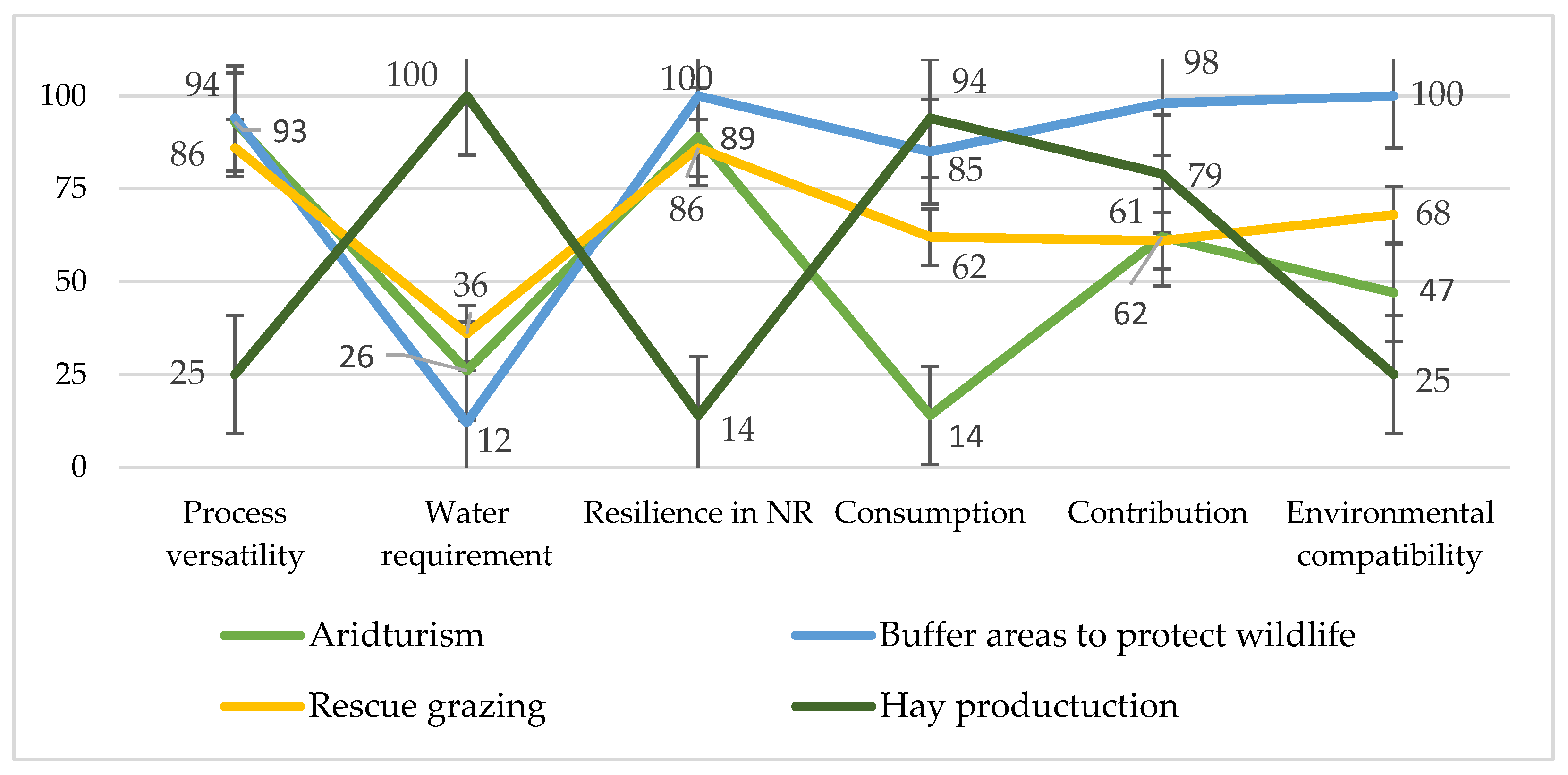
The alternative activities identified, as suggested, use options for the ecotechnological conversion of the node, which, according to the values obtained through the Braden scale, were three: the practice of arid tourism (14–93 BU), the creation of areas for the protection of wildlife (12–100 BU), and rescue grazing use (36–86 BU). Figure 1 shows a comparison between the original activity and the activities suggested for the transition to the ecotechnological and sustainable management of the Moctezuma node, Sonora, Mexico.
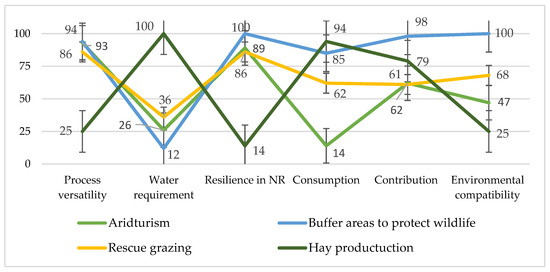
Figure 1.
Comparison of the levels of ecotechnological inclusion in the activities of the agroproductive node under study.
4. Discussions
The importance of agricultural production systems in arid Mexican territories represents an alternative for food security and for local–regional self-consumption, guaranteeing the existence of inputs and food for local users under a production approach of an ecotechnological nature. The level of ecotechnology adoption is partially influenced by the physical-climatic conditions of the productive environment and the climatic emergency. These severe conditions of a climatic nature occur in various ways during the seasons of the year in the arid territories of the Sonoran Desert, Mexico [5,6,8,15,17].
5. Conclusions
In the node for hay production in Moctezuma, Sonora, Mexico, diversity traits were identified in the existence of resources, capacities, and biophysical aptitudes. This diversity gave rise to other sustainable productive activities, which were parallel to but independent from each other, with different ecotechnological processes. The complex integration, as well as the link in the optimal and sustainable use of the natural resources of the node, derive from the implementation of the integrated strategic management.
The activity identified as arid turismo refers to the care and development of buffer areas to protect wildlife, as well as rescue grazing, and they were included as integration elements. Its planning and operational development are within sustainability. These activities generate a contribution to the ecosystem with environmental services and, simultaneously, have positive effects on the local users of other agroproductive nodes by acting as primary suppliers.
Both the sustainable and ecotechnological capacity of the node, as well as its gradual changes in the processes over time, were determined in Braden units. The importance of the pragmatism of sustainability was valued, with the various strategies applied in the activities included in the agroproductive node.
The rational use of and the sustainable and ecotechnological tendencies of endemic natural resources in the activities of the node have the following particularly relevant features:
- (a)
- Arid tourism values spaces that are direct to the environment and that are focused on the appreciation of nature, without population overcrowding. It promotes inner peace, as well as the use of xeric landscapes for therapeutic walking and connecting with the biology of the desert;
- (b)
- The purpose of the buffer areas to protect wildlife is to conserve undisturbed spaces on the site for the maintenance of migratory and local species, or both, such as vertebrates and other native organisms;
- (c)
- The use of rescue grazing provides a healthy soil cover, without pressure from trampling or soil erosion. This generates protein from the rescue of livestock, which suffer the consequences of prolonged droughts in the region and the low availability of forage.
In the case of the agroproductive node under study, in order to move from a conventional mode of production to an ecotechnological–sustainable one, it is necessary to adopt, in the processes of the activities, a strategy that will: (1) attend to local priorities; (2) include in the total of the variables the various visualized changes in the local climate; (3) provide a dimension to the availability of quality water. These three are necessary agents for the development of new sustainable techniques and, at the same time, for the maintenance of a balance between production and the pristine state of the natural system where activities take place.
The above generates a design of a state of complexity, which is the basis for integrated and ecotechnological management for the creation of entities organized in the Sustainable Agropolis.
Funding
This research received no external funding.
Institutional Review Board Statement
Not applicable.
Informed Consent Statement
Not applicable.
Data Availability Statement
The data presented in this research work are available upon request to the author of this study.
Conflicts of Interest
The author declare no conflict of interest.
References
- Instituto Nacional de Estadístia y Geografía. Available online: https://www.inegi.org.mx/contenidos/saladeprensa/boletines/2021/pibe/PIBEntFed2020.pdf (accessed on 6 January 2022).
- Acebes, P.; Iglesias-González, Z.; Muñoz-Galvez, F.J. Do Traditional Livestock Systems Fit into Contemporary Landscapes? Integrating Social Perceptions and Values on Landscape Change. Agriculture 2021, 11, 1107. [Google Scholar] [CrossRef]
- Molina Benavides, R.A.; Campos Gaona, R.; Sánchez Guerrero, H.; Giraldo Patiño, L.; Atzori, A.S. Sustainable Feedbacks of Colombian Paramos Involving Livestock, Agricultural Activities, and Sustainable Development Goals of the Agenda 2030. Systems 2019, 7, 52. [Google Scholar] [CrossRef] [Green Version]
- Banson, K.E.; Nguyen, N.C.; Sun, D.; Asare, D.K.; Sowah Kodia, S.; Afful, I.; Leigh, J. Strategic Management for Systems Archetypes in the Piggery Industry of Ghana—A Systems Thinking Perspective. Systems 2018, 6, 35. [Google Scholar] [CrossRef] [Green Version]
- Cowan, L.; Wright, V. An Approach for Analyzing the Vulnerability of Small Family Businesses. Systems 2016, 4, 3. [Google Scholar] [CrossRef] [Green Version]
- Shongwe, M.I.; Bezuidenhout, C.N.; Sibomana, M.S.; Workneh, T.S.; Bodhanya, S.; Dlamini, V.V. Developing a Systematic Diagnostic Model for Integrated Agricultural Supply and Processing Systems. Systems 2019, 7, 15. [Google Scholar] [CrossRef] [Green Version]
- Balanay, R.; Halog, A. A Review of Reductionist versus Systems Perspectives towards ‘Doing the Right Strategies Right’ for Circular Economy Implementation. Systems 2021, 9, 38. [Google Scholar] [CrossRef]
- Byomkesh Talukder, B.; Blay-Palmer, A.; Gary, W.; van Loon, G.W.; Hipel, K.W. Towards complexity of agricultural sustainability assessment: Main issues and concerns. Environ. Sustain. Indic. 2020, 6, 10038. [Google Scholar] [CrossRef]
- Turner, B.L.; Goodman, M.; Machen, R.; Mathis, C.; Rhoades, R.; Dunn, B. Results of Beer Game Trials Played by Natural Resource Managers Versus Students: Does Age Influence Ordering Decisions? Systems 2020, 8, 37. [Google Scholar] [CrossRef]
- Malec, K.; Gebeltová, Z.; Mansoor, M.; Appiah-Kubi, S.N.K.; Sirohi, J.; Maitah, K.; Phiri, J.; Pańka, D.; Prus, P.; Smutka, L.; et al. Water Management of Czech Crop Production in 1961–2019. Agriculture 2022, 12, 22. [Google Scholar] [CrossRef]
- Maxwell, C.M.; Langarudi, S.P.; Fernald, A.G. Simulating a Watershed-Scale Strategy to Mitigate Drought, Flooding, and Sediment Transport in Drylands. Systems 2019, 7, 53. [Google Scholar] [CrossRef] [Green Version]
- Cheng, L.; Zou, W.; Duan, K. The Influence of New Agricultural Business Entities on the Economic Welfare of Farmer’s Families. Agriculture 2021, 11, 880. [Google Scholar] [CrossRef]
- Jayaraman, S.; Dang, Y.P.; Naorem, A.; Page, K.L.; Dalal, R.C. Conservation Agriculture as a System to Enhance Ecosystem Services. Agriculture 2021, 11, 718. [Google Scholar] [CrossRef]
- Ramírez-Orellana, A.; Ruiz-Palomo, D.; Rojo-Ramírez, A.; Burgos-Burgos, J.E. The Ecuadorian Banana Farms Managers’ Perceptions: Innovation as a Driver of Environmental Sustainability Practices. Agriculture 2021, 11, 213. [Google Scholar] [CrossRef]
- Armenia, S.; Pompei, A.; Castaño Barreto, A.C.; Atzori, A.S.; Fonseca, J.M. The Rural-Urban Food Systems’ Links with the Agenda 2030: From FAO Guidelines on Food Supply and Distribution Systems to a Dairy Sector Application in the Area of Bogota. Systems 2019, 7, 45. [Google Scholar] [CrossRef] [Green Version]
- Mahamud, M.A.; Saad, N.A.; Zainal Abidin, R.; Yusof, M.F.; Zakaria, N.A.; Mohd Amiruddin Arumugam, M.A.R.; Mat Desa, S.; Md. Noh, M.N. Determination of Cover and Land Management Factors for Soil Loss Prediction in Cameron Highlands, Malaysia. Agriculture 2022, 12, 16. [Google Scholar] [CrossRef]
- Kurdyś-Kujawska, A.; Sompolska-Rzechuła, A.; Pawłowska-Tyszko, J.; Soliwoda, M. Crop Insurance, Land Productivity and the Environment: A Way forward to a Better Understanding. Agriculture 2021, 11, 1108. [Google Scholar] [CrossRef]
- Serrano, J.; Shahidian, S.; Machado, E.; Paniagua, L.L.; Carreira, E.; Moral, F.; Pereira, A.; de Carvalho, M. Floristic Composition: Dynamic Biodiversity Indicator of Tree Canopy Effect on Dryland and Improved Mediterranean Pastures. Agriculture 2021, 11, 1128. [Google Scholar] [CrossRef]
Publisher’s Note: MDPI stays neutral with regard to jurisdictional claims in published maps and institutional affiliations. |
© 2022 by the author. Licensee MDPI, Basel, Switzerland. This article is an open access article distributed under the terms and conditions of the Creative Commons Attribution (CC BY) license (https://creativecommons.org/licenses/by/4.0/).