
One-Pot Synthesis of N-Alkylated 2-Pyridone Derivatives under Microwave Irradiation †
 ,
,
Abstract
:1. Introduction
2. Results and Discussion
3. Experimental Procedure
4. Conclusions
Acknowledgments
References
- Hao, X.; Xu, Z.; Lu, H.; Dai, X.; Yang, T.; Lin, X.; Ren, F. Mild and Regioselective N-Alkylation of 2-Pyridones in Water. Org. Lett. 2015, 17, 3382–3385. [Google Scholar] [CrossRef]
- Moustafa, A.H.; El-Seadawy, N.A.; Hassan, A.A.; Pasha, S.H.; El-Sayed, H.A.; Shimess, N.A.; Hassan, N.A. Design, Synthesis, Biological and Molecular Docking Studies of Some O-Hydroxycyanopyridine Derivatives. Der. Chem. 2017, 8, 313–332. [Google Scholar]
- Rai, S.K.; Khanam, S.; Khanna, R.S.; Tewari, A.K. Design and Synthesis of 2-Pyridone Based Flexible Dimers and Their Conformational Study through X-ray Diffraction and Density Functional Theory: Perspective of Cyclooxygenase-2 Inhibition. Cryst. Growth Des. 2015, 15, 1430–1439. [Google Scholar] [CrossRef]
- Feng, B.; Li, Y.; Li, H.; Zhang, X.; Xie, H.; Cao, H.; Yu, L.; Xu, Q. Specific N-Alkylation of Hydroxypyridines Achieved by a Catalyst- and Base-Free Reaction with Organohalides. J. Org. Chem. 2018, 83, 6769–6775. [Google Scholar] [CrossRef] [PubMed]
- Liu, H.; Ko, S.-B.; Josien, H.; Curran, D.P. Selective N-functionalization of 6-substituted-2-pyridones. Tetrahedron Lett. 1995, 36, 8917–8920. [Google Scholar] [CrossRef]
- Torhan, M.C.; Peet, N.P.; Williams, J.D. A comparison of N- versus O-alkylation of substituted 2-pyridones under Mitsunobu conditions. Tetrahedron Lett. 2013, 54, 3926–3928. [Google Scholar] [CrossRef]


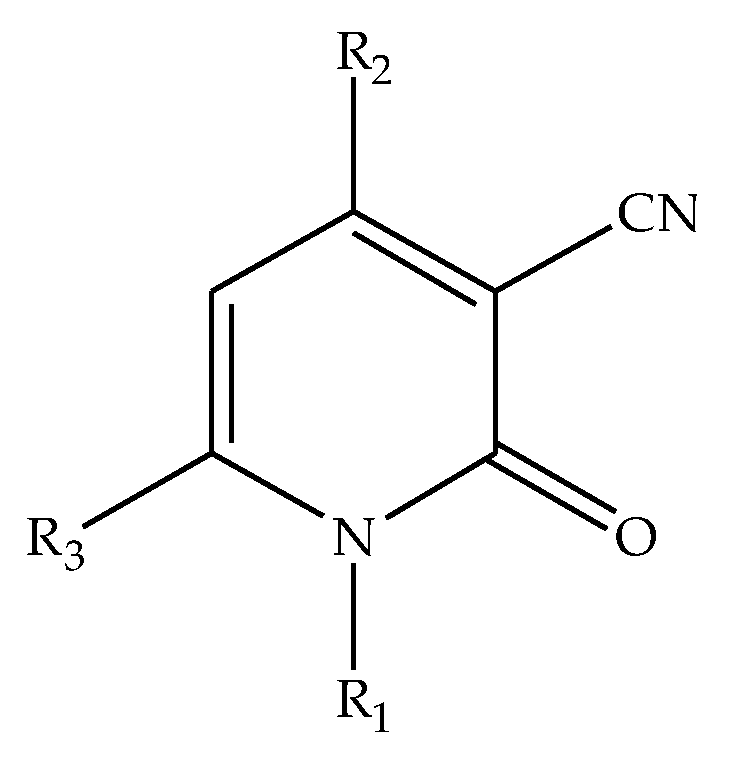
| Compound | R1 | R2 | R3 | Time (min) | Yield (%) |
|---|---|---|---|---|---|
| 1 | C2H5O- | C6H5- | C6H5- | 10 | 15 |
| 2 | NH2 | C6H5- | C6H5- | 15 | 20 |
| 3 | NH2 | C6H5- | C8H7- | 15 | 40 |
Publisher’s Note: MDPI stays neutral with regard to jurisdictional claims in published maps and institutional affiliations. |
© 2020 by the authors. Licensee MDPI, Basel, Switzerland. This article is an open access article distributed under the terms and conditions of the Creative Commons Attribution (CC BY) license (https://creativecommons.org/licenses/by/4.0/).
Share and Cite
Baba Ahmed, I.; Kibou, Z.; Vázquez-Tato, P.M.; Seijas, J.A.; Choukchou-Braham, N. One-Pot Synthesis of N-Alkylated 2-Pyridone Derivatives under Microwave Irradiation. Chem. Proc. 2021, 3, 135. https://doi.org/10.3390/ecsoc-24-08412
Baba Ahmed I, Kibou Z, Vázquez-Tato PM, Seijas JA, Choukchou-Braham N. One-Pot Synthesis of N-Alkylated 2-Pyridone Derivatives under Microwave Irradiation. Chemistry Proceedings. 2021; 3(1):135. https://doi.org/10.3390/ecsoc-24-08412
Chicago/Turabian StyleBaba Ahmed, Ikram, Zahira Kibou, Pilar M. Vázquez-Tato, Julio A. Seijas, and Noureddine Choukchou-Braham. 2021. "One-Pot Synthesis of N-Alkylated 2-Pyridone Derivatives under Microwave Irradiation" Chemistry Proceedings 3, no. 1: 135. https://doi.org/10.3390/ecsoc-24-08412
APA StyleBaba Ahmed, I., Kibou, Z., Vázquez-Tato, P. M., Seijas, J. A., & Choukchou-Braham, N. (2021). One-Pot Synthesis of N-Alkylated 2-Pyridone Derivatives under Microwave Irradiation. Chemistry Proceedings, 3(1), 135. https://doi.org/10.3390/ecsoc-24-08412