Skip Content
You are currently on the new version of our website. Access the old version .

Chemistry Proceedings

Chemistry Proceedings is an open access journal dedicated to publishing findings resulting from conferences, workshops, and similar events, in all areas of chemistry.
The conference organizers and proceedings editors are responsible for managing the peer review process and selecting papers for conference proceedings.

All Articles (1,129)

  • Proceeding Paper
  • Open Access

This study explores the design, synthesis and preliminary in silico screening of novel thiadiazole-isatin hybrid derivatives targeting diabetes mellitus. Building on thiadiazole and isatin compounds’ demonstrated antidiabetic potential, the research objectives were to design and synthesize thiadiazole-isatin hybrids and evaluate their antidiabetic potential. The methodology encompassed a literature review, computational screening using “molecular docking, ADME prediction, Lipinski’s rule”, and the synthesis of thiadiazole intermediates from thiosemicarbazide combined with isatin derivatives. The key findings revealed that compounds 2a and 2b exhibit favorable binding affinity with “human aldose reductase, monoglyceride lipase, GLP-1, and alpha-amylase”, satisfying Lipinski’s rule for optimal drug likeness. Docking scores ranged from −10.6 to −7.0 for 2a and −10.2 to −7.0 for 2b. Thiadiazole-isatin derivatives, particularly 2a and 2b, demonstrate promise as antidiabetic agents through multi-enzyme inhibition, warranting pre-clinical and in vitro validation. This research offers a novel therapeutic strategy for diabetes management and potential pharmaceutical lead compounds. Future directions include experimental validation, in vitro and in vivo efficacy studies, and structure–activity relationship exploration, contributing to innovative antidiabetic therapies.

11 November 2025
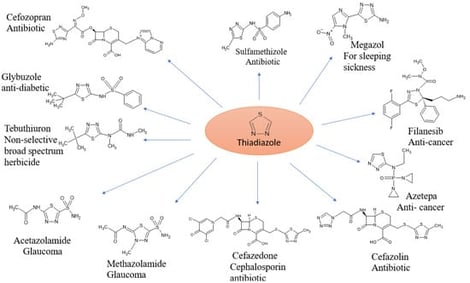
Representative medicinal scaffolds featuring the thiadiazole ring system.
  • Proceeding Paper
  • Open Access

This research focuses on synthesizing novel tetrahydroquinoline–1,2,3-triazole hybrids as potential agents for neurodegenerative diseases, particularly Alzheimer’s disease (AD). The series of structurally distinct hybrid compounds synthesized in this study has not been previously reported in the literature. The synthetic strategy involved a diastereoselective imino Diels–Alder reaction (Povarov reaction) to construct the tetrahydroquinoline (THQ) core, where various catalysts, including phthalic acid, Lewis acids, KSF (montmorillonite), and ceric ammonium nitrate (CAN), were screened. Phthalic acid was selected as the most efficient catalyst for this crucial step. Following this, we employed efficient click chemistry to introduce the triazole moiety, adhering to green chemistry principles throughout the process. The chemical structure of the synthetized compounds was assigned using an analysis of Nuclear Magnetic Resonance (NMR), Mass Spectrometry (MS), and Infrared (IR) spectroscopy. Furthermore, in silico analyses performed with Swiss ADME and OSIRIS Property Explorer indicated that most compounds exhibited excellent drug-like characteristics and favorable pharmacokinetic profiles. The synthesized compounds were evaluated as inhibitors of acetylcholinesterase (AChE) and butyrylcholinesterase (BChE) using the modified Ellman methodology. The inhibitory activity is presented as IC50 values for each enzyme and compared to galantamine as a reference standard. These findings offer promising directions for the development of new therapeutic agents for AD based on organic synthesis.

11 November 2025

  • Proceeding Paper
  • Open Access

Background: Prostate cancer is one of the most prevalent malignancies worldwide, with the androgen receptor (1E3G) playing a central role in disease progression. Methodology: This study applied computational approaches to identify natural 1E3G inhibitors. Potential ligands such as Cianidanol from Camellia sinensis and Gallocatechin from Phyllanthus amarus were optimized using Gaussian 16 with the DFT 6-31g(d,p) basis set. Molecular docking was performed using PyRx, while pharmacokinetics and toxicity were evaluated via admetSAR and ProTox-3.0. Network pharmacology (STRING, Cytoscape) and 100 ns molecular dynamics simulations (Desmond) ensured biological relevance and stability. Results: Cianidanol (−8.1 kcal/mol) and Gallocatechin (−8.4 kcal/mol) showed the strongest binding affinities and favorable ADMET profiles. Conclusions: These compounds represent promising natural 1E3G inhibitors for future prostate cancer therapy.

13 November 2025

  • Proceeding Paper
  • Open Access

This study focuses on the determination of pesticide residues in drinking water in Slovakia using the LC-MS/MS method, covering a target list of approximately 90 pesticides selected according to the national drinking water risk assessment. The aim of monitoring is to screen the presence of pesticide substances in various water supply systems and to gain experience for setting higher-quality criteria for the control of drinking water. Drinking water samples were collected in 2023, 2024 and 2025 within the National Monitoring Project of the Presence of Pesticides in Public Water Supplies, including both Large-Supply Areas (>5000 inhabitants—2023) and Small-Supply Areas (500–5000 inhabitants—2024, 2025). A total of 211 samples were measured and evaluated in 2023, compared with 199 samples in 2024. This article presents the evaluation of results for 2023 and 2024, while data for 2025 will be assessed in 2026. The findings contribute to the improved surveillance and quality control of drinking water.

20 January 2026

News & Conferences

Issues

Open for Submission

Editor's Choice

Get Alerted

Add your email address to receive forthcoming issues of this journal.

XFacebookLinkedIn
Chem. Proc. - ISSN 2673-4583