


Abstract
Many colleges’ graphic design departments have created curriculums related to digital publishing. While digital reading has become popular and various technologies of e-book production are mature, there are urgent demands to strategically and systematically cultivate professionals for the digital content industries. Thus, this research was to examine the problems associated with e-book production and their causes for future curriculum design. A literature review of college teaching courses in design-related departments was conducted, and an analytic hierarchy process (AHP) was applied with twelve senior digital publishing practitioners. The results showed that “interactive setting” was the most common problem. The next most common problems were “color labeling” and “graphic setting”. In-depth interviews with seven experts which were selected from technical and vocational colleges and the digital publishing industry revealed the causes of these problems. The reasons of mistakes were categorized into 54 causes for the seven most common problem categories. Among the causes of “interactive setting” errors, “setting the media playback controller” happened most frequently.
1. Introduction
The popularity of mobile networks along with the increasing number of e-book readers using large-screen mobile devices promotes various digital information services. This has boosted global digital reading, and the e-book industry is booming. The new network-based media has a significant impact on traditional publishers. The publishing industry is facing rapid changes in production workflows and business operations. With fierce competition and changing reading habits, publishers need to actively cultivate professionals in e-book production to overcome future challenges. For e-book publishers, independent work is an inevitable trend. Digital capability in text, image, video, and voice integration is what e-book publishers need to have. Traditional publishers must think about their market position and transformation. The professional competence and “know-how” in the traditional publishing industry have also changed [1]. Since the production of e-books is related to readability for readers, the correct content layout of e-books and comfort level to read are the key factors for the success of e-books. The hardware used is also important. Flexible materials and touchable user interface (UI) design have been introduced [2,3], and the imposition and distribution of pictures and texts have a significant impact on a reader’s comprehension in e-book publication [4].
The purpose of this research is to understand the common problems and reasons that students have for producing e-books based on surveys and interviews. The results provide a reference for future teaching curriculum development to educate students about e-book production based on theory and practice. The research results also recommend the requirements for related student training [5]. The specific purposes of this research are as follows:
- To examine the current teaching status of e-book production courses in related departments at technical and vocational colleges.
- To explore the most common problems that students encounter in e-book production.
- To understand the reasons for the most common problems encountered by students when learning about e-book production.
2. Literature Review
E-Book Production
E-books integrate texts, pictures, sounds, and other elements using multimedia software as the carriers. Through the Internet, information technology, hardware equipment, and copyright management mechanisms, e-books have changed the business operations and marketing channels of traditional publishers. They create new business models in new markets, produce digital knowledge, and develop new distribution and service chains [6]. Since e-books are in digital forms, data processing and dissemination are performed within the network. E-books provide text-based reading services in black-and-white picture books (E-ink carrier) or colored picture books (LCD carrier). Digital readers are provided with various multimedia functions, which add extra value to e-books [7].
Many scholars have studied the digital publishing industry and indicated that those who intend to enter into or transform the digital publishing industry must be familiar with the new online media and technologies and must “create friendly reading formats for different readers”. Imagination and cross-media communication are mandatory to produce e-books that are well typographic and friendly to read [8]. From the manual of the Adobe InDesign software, the most preferred by publishers, the functions of InDesign include “workspace”, “layout”, “text style”, “print style”, “tables”, “long document functions”, “drawing”, “graphics”, “frames and Objects”, “transparency effects”, “colors”, and “interactive documents”. These operations are important in publication production. Overall, digital publishing requires more diverse professional abilities than traditional publishing as an e-book is an information medium that is suitable for modern people’s lifestyles [9].
From the literature review, it was found that typesetting and page layout are most important in e-book production. Furthermore, considering the contents of digital media, the production of audio-visual materials and the script of e-books must be contained. The traditional printing processes are dismissed. Instead, a new workflow is adopted, including manuscript production, layout, and finished file output for image and text collection, file creation, type and sequence arrangement, master template creation, style setting, layout structure design, image and text integration, interactive effect setting, final preview output, and web release.
Regarding the recent development of digital publishing courses, private institutions offer more related courses than public institutions. Four-year universities and two-year vocational colleges offer digital publishing courses, with four-year universities offering more courses. The number of courses related to digital publishing is increasing every year. Colleges and universities are focusing more on talent cultivation for the digital publishing industry. More than 20,000 students took digital courses in the past five years.
3. Methodology
3.1. Research Method and Objects
The research method included a literature review, an analytic hierarchy process, and expert interviews, as described below.
To understand the “common problems in e-book production”, we compiled the “hierarchical questionnaire for common problems in e-book production” based on the literature review and expert opinions for data collection. For the survey, we invited senior digital publishing experts who have “actually engaged in the production of digital publications”. Overall, 17 questionnaires were sent, and 12 valid questionnaires were returned. The respondents were all females, with 50% having graduated from junior colleges and universities, 66% having worked in publishing companies for three to five years, and 33% having worked for over ten years.
To understand the most common problems and their causes in e-book production, expert interviews were conducted. Seven technical and vocational college lecturers and digital publishing experts were recruited, including two senior lecturers teaching e-book production courses, two experts in digital publishing, two experts in APP and digital publishing services, and an expert in the digital prepress department. The records of the interviews were compared with the result of the literature review and the questionnaire survey to clarify the differences between the needs of the industry and the current teaching content in colleges.
3.2. Research Tools
To investigate the most common problems related to students’ learning e-book production, the “Questionnaire for common problems in e-book production” was created with a nine-point scale. The results were pairwise compared between the experts. The hierarchical structure of the questionnaire contained file management, layout setting, text and table settings, graphic settings, color labeling, interactive setting, and tool panel setting. The hierarchical structure is shown in Figure 1.
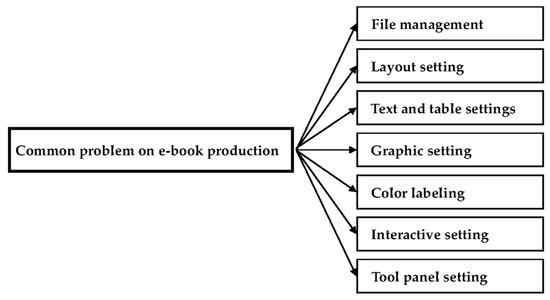
Figure 1.
Hierarchical structure of this research.
Based on the literature review, the possible causes for common problems in e-book production were classified into seven categories. This first draft was reviewed by the experts to reduce the number of causes and finalize the topics to be investigated. As the results, 54 causes for the most common problems were identified.
The data were processed using the Expert Choice 11 statistical software for hierarchical analysis. The consistency index (C.I.) was calculated for verification. The verification method is as follows: λmax is the maximum eigenvalue of the pairwise comparison matrix A, and n is the order of the matrix. If λmax = n, then the pairwise comparison matrix A is consistent.
where C.I. = 0 when the before and after judgments are completely consistent. When C.I. > 0.1, judgments are biased and incoherent. When C.I. ≤ 0.1, judgments are not consistent but acceptable. When a problem is complicated, more judgments are needed for the pairwise comparison, and the order of the pairwise comparison matrix increases. Then, it becomes difficult to maintain the consistency of judgments. Therefore, a “random index” (R.I.) is proposed to modify the C.I. value to adjust the differences between different orders in order to obtain a “consistency ratio” (C.R.) [10]. A C.I. value can be adjusted by the R.I. value in matrices of different orders to obtain a consistency ratio. When C.R. ≤ 0.1, the degree of matrix consistency is satisfactory. The calculation is carried out as follows:
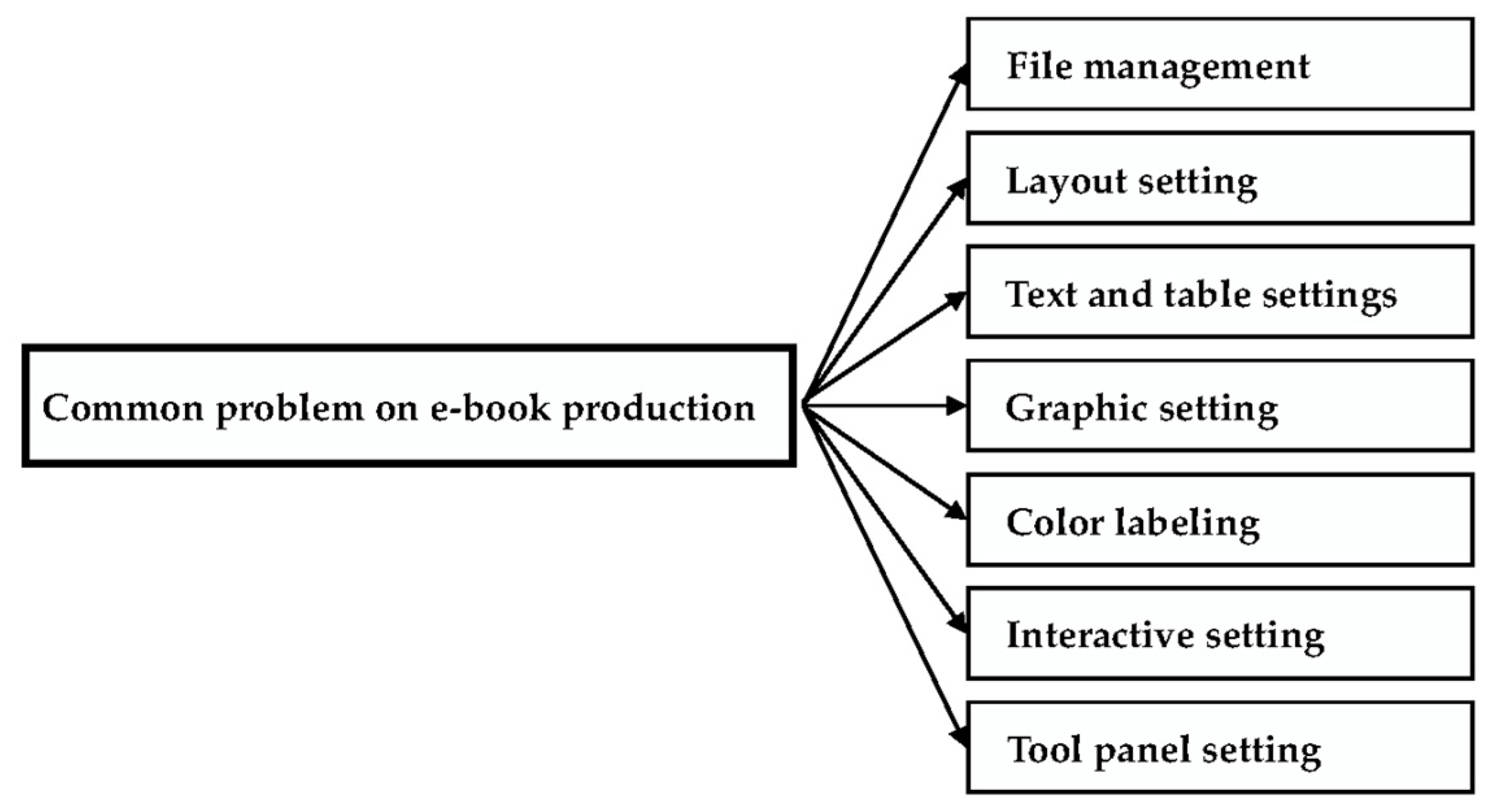
C.I. = (λmax − n)/(n − 1)
C.R. = C.I./R.I.
4. Results and Discussions
The questionnaire contained the seven categories of file management, layout setting, text and table settings, graphic settings, color code, interactive settings, and tool panel settings. Twelve experts in e-book production were invited to finalize the questionnaire. The purpose was to explore the causes of problems in e-book production. By comparing the importance of the causes in pairs, the experts chose the most common causes. During the analytic hierarchical process (AHP) using a nine-point scale of “equally prone to errors”, “slightly prone to error”, “more prone to error”, “frequently prone to error”, and “extremely prone to error” (one, three, five, seven, and nine points, respectively), the experts were asked to choose the most appropriate causes by comparing the importance of the causes in pairs. The weight of each cause was obtained. The weights of the common problems in e-book production are shown in Table 1.

Table 1.
Weight values of the most common problems in e-book production.
The results showed that “interactive setting” had the highest weight of 21.9%, followed by “color labeling” (15.5%), “graphic setting” (15%), “tools panel petting” (13.3%), “text and table settings” (12.2%), “layout setting” (11.5%), and “file management” (10.5%).
The 54 causes of the seven most common problems in e-book production were determined by the experts as follows:
- Interactive settings had 11 causes, including “setting the media playback controller”. The other common causes were “setting bookmark”, “setting directory”, “setting animation function”, “setting hyperlink”, “use swf viewer”, ‘setting object status function”, “setting page turning effect”, “setting page transition effect”, “insert multimedia files (music, video)”, and “setting button”.
- Color labeling had four causes, including “don’t notice the color model of the image file”, “using different color models”, “don’t know how to add a color swatch”, and “don’t know how to add a gradient color”.
- Graphic setting had eight causes, including “the wrong way of importing (placing) the picture (missing picture)”, “when the image is zoomed, it is often skewed (without proportional scaling)”, “don’t know how to set the object anchor”, and “when importing (placing) the image file, the link disappears”. The rest of the causes were “don’t know how to set the filter effect”, “don’t know how to set the text around the image”, “don’t know the difference between text and graphic boxes”, and “when drawing with Bezier curves, the graph is often not closed”.
- Tool panel settings had five causes, including “using the wrong operating tool”, “screen mode switching error”, “don’t know which tool to choose”, “cannot find the tool panel setting”, and “don’t know how to reopen the tool panel”.
- Text and table settings had 13 causes, including “use of too many fonts”, “incorrect text indentation settings”, and “errors occur when setting composite fonts”. The other causes were “the text characters do not show properly”, “wrong text direction when mix Chinese and English text”, “do not know how to substitute the missing font”, “don’t know how to set the space inside the text box”, “do not avoid the orphan or widow”, “text overflow does not expand”, “wrong text alignment settings”, “do not know how to put symbols and pictures in the text box”, “don’t know the steps to insert the table”, and “text in the table is not aligned”.
- Layout setting had six causes, including “unclear layer management”, “wrong page size”, “wrong document type (print, web, digital)”, “wrong binding side”, “wrong main page setting”, and “wrong chapter and page number settings”.
- File management had seven causes, including “problems when converting to other formats”, “the linked file was not encapsulated”, “no naming specification”, “don’t know how to downgrade to lower versions and formats”, “the graphic file size is either too big or not have enough resolution”, and “problem on file format setting”.
5. Conclusions
Most of the e-book production courses adopt Adobe InDesign as a learning tool as it is the mainstream software for digital publishing, especially for design layout and typesetting. However, its output diveristy and further application are relatively lacking. Today, more e-book editing applications have been released in the market. Although learning InDesign still is the most popular application for e-book production, schools should encourage students to have experience in other digital publishing workflows, such as XML and other web codings, to enhance their competitiveness. Therefore, school lecturers need to introduce and analyze the functions and characteristics of different e-books from a broader perspective and nurture students to have the conceptions and techniques necessary for general e-book production. For different types of e-books, content, and design in different formats, students need to learn how to use professional digital publishing technology. Therefore, this research was carried out to understand the common problems and causes for these problems in e-book production based on surveys and interviews. We defined seven common problems that students encounter in e-book production. The AHP results showed that “interactive setting” had the highest weight, indicating that it was the most common problem in e-book production. The second highest weight was identified for “color labeling”, followed by “graphic setting”, “tool panel setting”, “text and table settings”, “layout setting”, and “File Management”. The causes were also identified for each problem. These results provide a reference for teaching curriculum development with corresponding theory and practice.
Author Contributions
Conceptualization, S.L. and L.-Y.M.; methodology, S.L.; software, S.L.; validation, S.L. and L.-Y.M.; formal analysis, L.-Y.M.; investigation, S.L.; resources, S.L.; data curation, S.L. and L.-Y.M.; writing—original draft preparation, S.L.; writing—review and editing, L.-Y.M.; visualization, L.-Y.M.; supervision, S.L.; project administration, S.L.; funding acquisition, S.L. All authors have read and agreed to the published version of the manuscript.
Funding
This research is funded by the National Science Council TAIWAN (MOST 104-2511-S-003-035-).
Institutional Review Board Statement
Not applicable.
Informed Consent Statement
Informed consent was obtained from all subjects involved in the study.
Data Availability Statement
The data presented in this study are available on request from the corresponding author. The data are not publicly available due to they are part of the research project founded by the National Science Council TAIWAN.
Acknowledgments
This research is part of a larger research project funded by the National Science Council TAIWAN (MOST 104-2511-S-003-035-). We would like to express our gratitude to the experts and scholars for their assistance and valuable advice during the course of this research.
Conflicts of Interest
The authors declare no conflict of interest.
References
- Liao, S.; Yang, C.-C. The study of the hierarchical competencies required for the digital publishing professionals. In Proceedings of the Hawaii International Conference on Social Sciences, Honolulu, HI, USA, 30 May 2011. [Google Scholar]
- Lam, P.; Lam, S.L.; Lam, J.; McNaught, C. Usability and usefulness of eBooks on PPCs: How students’ opinions vary over time. Austr. J. Educ. Technol. 2009, 25, 30–44. [Google Scholar] [CrossRef]
- Song, S.-M. The Study on Relativity of Electronic-Reader R&D Strategy and Marketing. Master’s Thesis, National Taipei University of Technology, Taipei, Taiwan, 2010. [Google Scholar]
- Yueh, H.-P.; Lin, W.-J.; Lee, M.-C.; Huang, J.-Y.; Yeh, S.-T. Manga Reading with E-Readers: A Preliminary Usability Study, Instr. Technol. Media Learn. 2011, 95, 69–78. [Google Scholar]
- Albert, W.L.; Yao, C.H.; Ku, J.B.; Yang, M.S.; Huang, J.T.; Fu, C.; Lin, B.T.; Kuo, W.F. A Study on the Curriculum Development for the Program of Precision Mold and Die Design and Analysis Engineering in University of Science and Technology. NKNU J. 2008, 24, 81–94. [Google Scholar]
- Zeng, J.; Huang, M.; Liu, Y. A study on learning satisfaction of college students on the layout of Studio Classroom publications in different media. J. Graph. Commun. Arts 2009, 15–28. [Google Scholar] [CrossRef]
- Zhu, B.-Y. The Present Situation and Past of Digital Publishing in Taiwan. New Books Recent Publ. Taiwan 2011, 145, 65–68. (In Chinese) [Google Scholar]
- Liao, S.; Pan, Y.C. Professional abilities of the employees working in digital publishing industry. In Proceedings of the 3rd International Conference on Information Sciences and Interaction Sciences (ICIS 2010), Chengdu, China, 23–25 June 2010. [Google Scholar]
- Heilmann, J.; Linna, H. The technology and applications of the new generation of electronic books. In Proceedings of the 2001 Annual Technical Conference of the Technical Association of the Graphic Arts (TAGA), San Diego, CA, USA, 6–9 May 2001; pp. 581–590. [Google Scholar]
- Saaty, T.L. How to make a decision: The analytic hierarchy process, Eur. J. Oper. Res. 1990, 48, 9–26. [Google Scholar] [CrossRef]
Disclaimer/Publisher’s Note: The statements, opinions and data contained in all publications are solely those of the individual author(s) and contributor(s) and not of MDPI and/or the editor(s). MDPI and/or the editor(s) disclaim responsibility for any injury to people or property resulting from any ideas, methods, instructions or products referred to in the content. |
© 2023 by the authors. Licensee MDPI, Basel, Switzerland. This article is an open access article distributed under the terms and conditions of the Creative Commons Attribution (CC BY) license (https://creativecommons.org/licenses/by/4.0/).