


The agri-food supply chain uses plastic food packaging alongside many other types of packaging materials. The extensive use of single use plastic packaging is known to have many significant negative environmental implications and efforts are being made to address this issue. One of the solutions for reducing the impacts of plastic packaging is to take a circular economy approach, which includes multiple reuses of packaging before closed-loop recycling. For this purpose, it is very important to investigate the factors that may influence, discourage or prevent reusability. This research focuses on the most concerning issue relating to the reuse of food packaging: the prevention of contamination due to crossover from the old product to the new. Specifically, this work investigates factors related to surface properties that have an influence on the effectiveness of cleaning plastic food packaging and on the post-cleaning assessment.
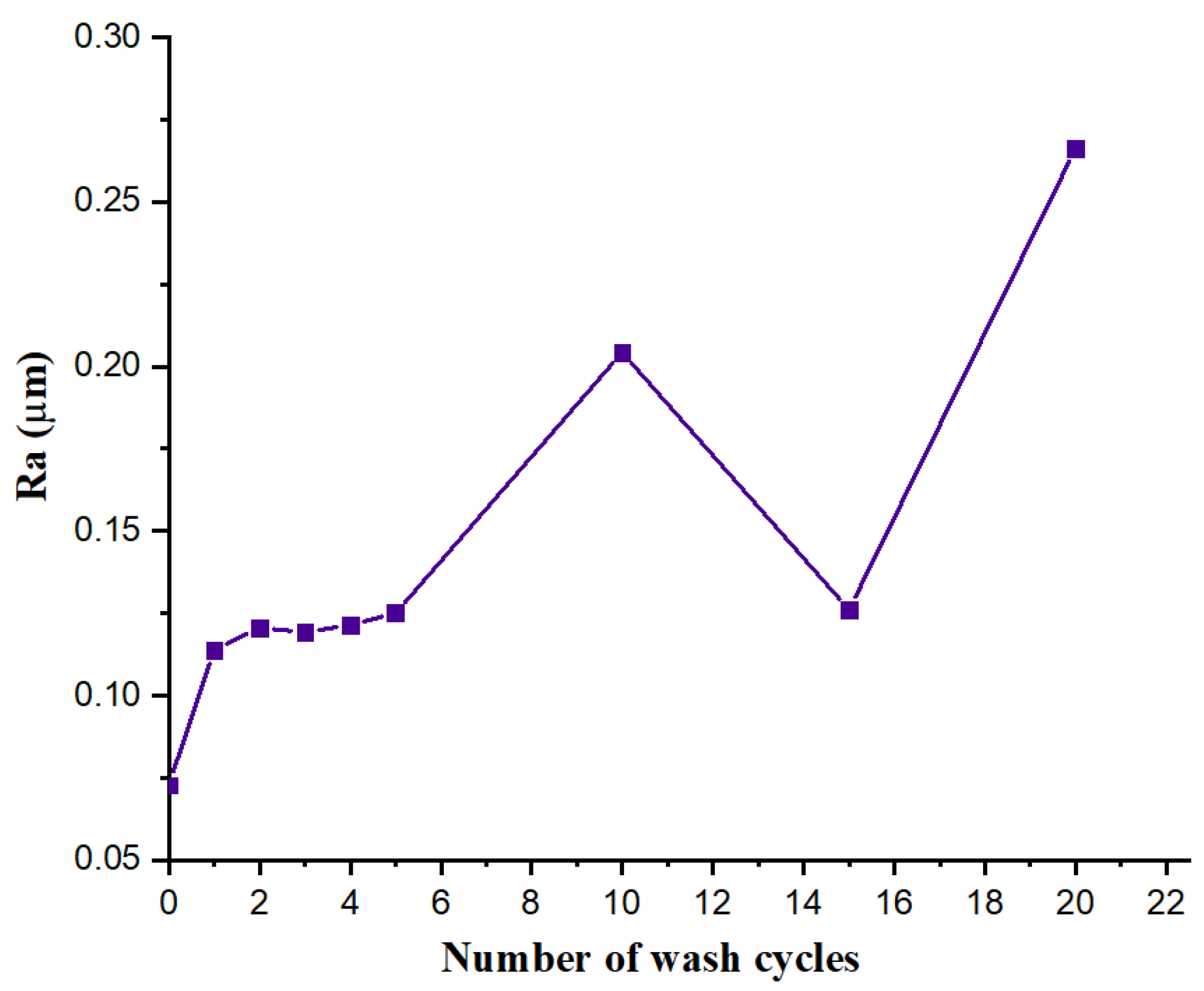
In this study, we examine the surface characteristics of recycled polyethylene terephthalate (rPET) trays that will likely change due to several supply use–clean cycles. Standard rPET packs (W × L × H, 150 × 210 × 40 mm) have been subjected to repeated wash cycles (using a Classeq® Glasswasher G400 Duo, Nisbets, Bristol, UK) at 55 °C wash and 70 °C sanitisation, and their resultant surface roughness profiles measured using a Talysurf® Form Intra 50, Taylor Hobson, Leicester, UK, apparatus. Although there was a significant change in the Ra values (ranging from 0.07 to 0.26 μm) over 20 wash cycles (Figure 1), some apparent increases in roughness could not be definitively proven due to fluctuating data points. The procedure was undertaken with and without the use of caustic soda detergent but no difference in roughness was apparent. Other influences on surface roughness, such as the use of cutlery during the consumption of food, will be assessed and correlated with cleaning parameters and the detectability of residual food fouling. The implementation of this assessment process on an industrial scale will require rapid assessment methods to analyse each pack in a rapid, automated process. Future work will thus investigate the ability of rapid ultraviolet fluorescence imaging to assess the surface properties, alongside the cleaning effectiveness of washed rPET packaging, which is a technique already under development by this research team. The implications of such a system within a data-rich Industry 4.0 system are discussed.
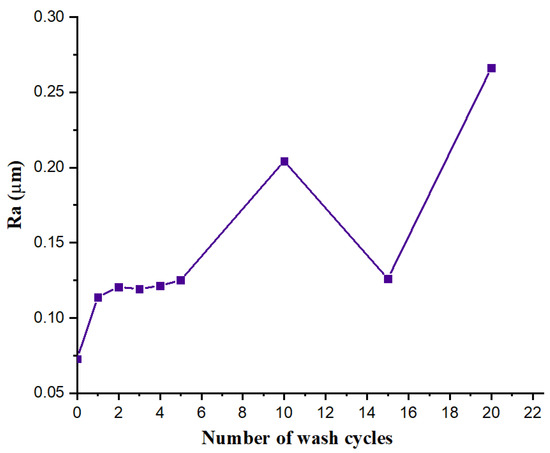
Figure 1.
Roughness of rPET Packs washed without detergent at 55 °C wash and 70 °C rinse temperature.
Author Contributions
Conceptualization, E.W., F.L.H. and M.Q.; methodology, E.W. and M.Q.; formal analysis, M.Q.; investigation, M.Q.; resources, E.W.; data curation, M.Q.; writing—original draft preparation, M.Q.; writing—review and editing, E.W., J.C., D.P.W. and F.L.H.; supervision, E.W., F.L.H., J.C. and D.P.W.; project administration, E.W.; funding acquisition, E.W. All authors have read and agreed to the published version of the manuscript.
Funding
This research was partly funded by the Natural Environment Research Council, grant number [NE/V01076X/1].
Institutional Review Board Statement
Not applicable.
Informed Consent Statement
Not applicable.
Data Availability Statement
The data from this study is not currently made available.
Conflicts of Interest
The authors declare no conflict of interest.
Disclaimer/Publisher’s Note: The statements, opinions and data contained in all publications are solely those of the individual author(s) and contributor(s) and not of MDPI and/or the editor(s). MDPI and/or the editor(s) disclaim responsibility for any injury to people or property resulting from any ideas, methods, instructions or products referred to in the content. |
© 2023 by the authors. Licensee MDPI, Basel, Switzerland. This article is an open access article distributed under the terms and conditions of the Creative Commons Attribution (CC BY) license (https://creativecommons.org/licenses/by/4.0/).