


Abstract
Technologically advanced countries are accruing benefits from the adoption of Building Information Modelling (BIM) in the Architecture, Engineering, and Construction (AEC) industry after decades of struggling for productivity enhancement using innovation and automation. Most of the developing countries have not been able to embrace technology in the AEC Sector and, consequently, are unable to ameliorate prevalent performance-related issues in construction projects. This review article identifies hurdles to BIM implementation in selected developing countries via an examination of the latest studies. The most significant challenges observed in this study are Lack of Training for Professionals, Lack of Awareness, Huge Capital Cost, Resistance to Change, and Complexity of BIM Software. This study is an update on previous studies conducted with the aim of assisting the implementation of BIM in developing countries.
1. Introduction
Building Information Modeling (BIM) is believed to be one of the most significant evolutions in the Architecture, Engineering, and Construction (AEC) industry. It is an innovative way for virtual designing, project management, and performance management [1]. In developed countries like Finland, Singapore, Korea, the USA, the UK, Australia, and Germany, BIM adoption has accrued many benefits to the stakeholders, which include better cost estimation, better overall design understanding, reduced construction cost, improved construction planning and monitoring and project quality enhancement [2]. However, most of the developing countries are lagging in BIM adoption due to numerous cultural, financial, and organizational constraints. Sustainable adoption of BIM in developing countries is essentially needed for economic progression, technological advancement, and performance improvement [3]. Governments of technologically advanced countries have played an important role in overcoming implementation challenges [4].
This review paper will endeavor to highlight the most significant challenges to BIM implementation being encountered in developing countries, which need more attention from relevant stakeholders. In this regard, literature from the last five years is surveyed with the latest information regarding BIM implementation in 15 developing countries, namely Ethiopia, Hongkong, Nigeria, GCC, Pakistan, Yemen, India, Indonesia, Seychelles, Poland, Cambodia, Jordan, Malaysia, Turkey, and Iran.
2. Main Findings and Discussion
Important findings of this review study are as follows:
- The literature confirms that the BIM adoption rate is low in developing countries because of the distinct challenges faced by each one of them.
- The literature review suggests that most of the developing countries (excluding Turkey, Malaysia, Hongkong, and Poland) are at the “infancy stage” of BIM adoption (pre-implementation stage) and are still struggling with basic issues of BIM awareness and capacity building.
- Most of the studies highlight that the lead role of the government in the implementation of BIM can be instrumental in overcoming the challenges.
- This study identifies four categories of challenges to implementing BIM in developing countries from the literature, i.e., (1) legal and contractual, (2) process-based, (3) cultural and organizational, and (4) government-related. The main categories are further divided into 27 sub-categories. Figure 1 illustrates the frequency of identified challenges reported in the literature.
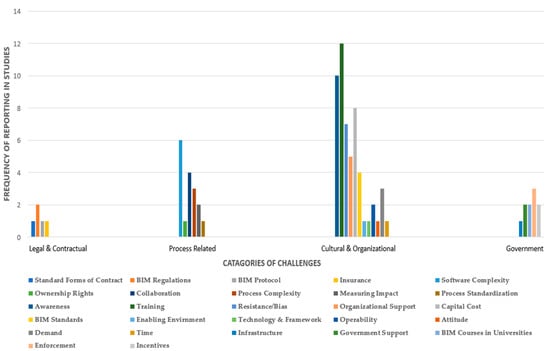 Figure 1. Frequency of Challenges to BIM Implementation in Developing Countries.
 - The most significant challenges to the implementation of BIM in the selected studies are described as follows as per the frequency of reporting. Details are enclosed in Table 1 below.
 Table 1. Most Significant Challenges to BIM Implementation in Developing Countries.
- (1)
- Lack of Training and BIM Expertise.The most repeated barrier in the selected studies is the lack of training opportunities for the professionals. Developing countries do not possess an adequate number of BIM experts for implementing BIM.
- (2)
- Lack of Awareness.Most of the stakeholders in developing countries are still uninformed about the significance of BIM and its associated advantages.
- (3)
- Huge Capital Cost.The initial investment in training of Human Resources and installation of technical infrastructure is substantially high for the AEC firms in developing countries.
- (4)
- Resistance to Change/unwillingness/Bias.Resistance to change falls in the realm of cultural domain. Decision makers in the AEC Industry in most of the developing countries show their reluctance to implement BIM.
- (5)
- The complexity of BIM software.BIM implementation requires the integration of multiple computer software with independent technical requirements and inputs, making it complex, especially for beginners.
3. Conclusions and Recommendations
Out of fifteen selected developing countries, only Turkey, Malaysia, Poland, and Hong Kong have been able to achieve preliminary milestones for BIM implementation, whereas the remaining countries are still struggling with teething problems due to technological, cultural, and financial challenges. Following are the recommendations for facilitating BIM implementation in the developing countries:
- A.
- Developing countries need to take guidance from the experiences in the developed countries regarding digitalization/automation required for BIM implementation [19].
- B.
- BIM needs to be incorporated into the curriculum of relevant engineering and technical education areas for general awareness and training of manpower [6].
- C.
- Developing countries are required to formulate a roadmap for BIM implementation as per their distinct environment [5].
- D.
- New adopter countries are required to make BIM adoption up to a particular level mandatory for AEC firms [20].
- E.
- Cost Benefit Analysis of BIM implementation must be studied by all stakeholders to financially and technically evaluate BIM adoption [21].
Author Contributions
Conceptualization, U.A. and F.J.; methodology, R.M. and M.A.; formal analysis, M.H. and M.A.; investigation, M.H. and U.A.; data curation, R.M. and U.A.; writing—original draft preparation, U.A.; writing—review and editing, F.J., R.M. and M.H.; supervision, F.J. All authors have read and agreed to the published version of the manuscript.
Funding
This research received no external funding.
Institutional Review Board Statement
Not applicable.
Informed Consent Statement
Not applicable.
Data Availability Statement
Not applicable.
Conflicts of Interest
The authors declare no conflict of interest.
References
- Azhar, S. Building Information Modeling (BIM): Trends, Benefits, Risks, and Challenges for the AEC Industry. Leadersh. Manag. Eng. 2011, 11, 241–252. [Google Scholar] [CrossRef]
- Chan, D.W.; Olawumi, T.O.; Ho, A.M. Perceived benefits of and barriers to Building Information Modelling (BIM) implementation in construction: The case of Hong Kong. J. Build. Eng. 2019, 25, 100764. [Google Scholar]
- Saka, A.B.; Chan, D.W.M.; Siu, F.M.F. Drivers of sustainable adoption of building information modelling (BIM) in the Nigerian construction small and medium-sized enterprises (SMEs). Sustainability 2020, 12, 3710. [Google Scholar] [CrossRef]
- Lee, G.; Borrmann, A. BIM policy and management. Constr. Manag. Econ. 2020, 38, 413–419. [Google Scholar] [CrossRef]
- Belay, S.; Goedert, J.; Woldesenbet, A.; Rokooei, S. Enhancing BIM implementation in the Ethiopian public construction sector: An empirical study. Cogent Eng. 2021, 8, 1886476. [Google Scholar] [CrossRef]
- Babatunde, S.O.; Udeaja, C.; Adekunle, A.O. Barriers to BIM implementation and ways forward to improve its adoption in the Nigerian AEC firms. Int. J. Build. Pathol. Adapt. 2021, 39, 48–71. [Google Scholar] [CrossRef]
- Umar, T. Challenges of BIM implementation in GCC construction industry. Eng. Constr. Arch. Manag. 2022, 29, 1139–1168. [Google Scholar] [CrossRef]
- Akdag, S.G.; Maqsood, U. A roadmap for BIM adoption and implementation in developing countries: The Pakistan case. Archnet-IJAR 2020, 14, 112–132. [Google Scholar] [CrossRef]
- Gamil, Y.; Rahman, I.A.R. Awareness and challenges of building information modelling (BIM) implementation in the Yemen construction industry. J. Eng. Des. Technol. 2019, 17, 1077–1084. [Google Scholar] [CrossRef]
- Ahuja, R.; Sawhney, A.; Jain, M.; Arif, M.; Rakshit, S. Factors influencing BIM adoption in emerging markets-the case of India. Int. J. Constr. Manag. 2020, 20, 65–76. [Google Scholar] [CrossRef]
- Telaga, A.S. A review of BIM (Building Information Modeling) implementation in Indonesia construction industry. In IOP Conference Series: Materials Science and Engineering; Institute of Physics Publishing: Bristol, UK, 2018. [Google Scholar]
- Adam, V.; Manu, P.; Mahamadu, A.-M.; Dziekonski, K.; Kissi, E.; Emuze, F.; Lee, S. Building information modelling (BIM) readiness of construction professionals: The context of the Seychelles construction industry. J. Eng. Des. Technol. 2021, 20, 823–840. [Google Scholar] [CrossRef]
- Leśniak, A.; Górka, M.; Skrzypczak, I. Barriers to bim implementation in architecture, construction, and engineering projects—The Polish study. Energies 2021, 14, 2090. [Google Scholar] [CrossRef]
- Durdyev, S.; Mbachu, J.; Thurnell, D.; Zhao, L.; Hosseini, M.R. BIM adoption in the cambodian construction industry: Key drivers and barriers. ISPRS Int. J. Geo-Inf. 2021, 10, 215. [Google Scholar] [CrossRef]
- Hyarat, E.; Hyarat, T.; Al Kuisi, M. Barriers to the Implementation of Building Information Modeling among Jordanian AEC Companies. Buildings 2022, 12, 150. [Google Scholar] [CrossRef]
- Manzoor, B.; Othman, I.; Gardezi, S.S.S.; Altan, H.; Abdalla, S.B. BIM-Based Research Framework for Sustainable Building Projects: A Strategy for Mitigating BIM Implementation Barriers. Appl. Sci. 2021, 11, 5397. [Google Scholar] [CrossRef]
- Tan, S.; Ayalp, G.G. Root factors limiting BIM implementation in developing countries: Sampling the Turkish AEC industry. Open House Int. 2022, 47, 732–762. [Google Scholar] [CrossRef]
- Khanzadi, M.; Sheikhkhoshkar, M.; Banihashemi, S. BIM applications toward key performance indicators of construction projects in Iran. Int. J. Constr. Manag. 2020, 20, 305–320. [Google Scholar] [CrossRef]
- Borrmann, A.; König, M.; Koch, C.; Beetz, J. Building Information Modeling: Why? What? How? In Building Information Modeling; Springer International Publishing: Cham, Switzerland, 2018; pp. 1–24. [Google Scholar]
- Hamma-Adama, M.; Kouider, T. Comparative Analysis of BIM Adoption Efforts by Developed Countries as Precedent for New Adopter Countries. Curr. J. Appl. Sci. Technol. 2019, 36, 1–5. [Google Scholar] [CrossRef]
- Al-Ashmori, Y.Y.; Othman, I.; Rahmawati, Y.; Amran, Y.H.M.; Sabah, S.H.A.; Rafindadi, A.D.; Mikić, M. BIM benefits and its influence on the BIM implementation in Malaysia. Ain Shams Eng. J. 2020, 11, 1013–1019. [Google Scholar] [CrossRef]
Disclaimer/Publisher’s Note: The statements, opinions and data contained in all publications are solely those of the individual author(s) and contributor(s) and not of MDPI and/or the editor(s). MDPI and/or the editor(s) disclaim responsibility for any injury to people or property resulting from any ideas, methods, instructions or products referred to in the content. |
© 2023 by the authors. Licensee MDPI, Basel, Switzerland. This article is an open access article distributed under the terms and conditions of the Creative Commons Attribution (CC BY) license (https://creativecommons.org/licenses/by/4.0/).