


Abstract
Currently, researchers are seeking to pay more attention to lightweight designs to minimize the materials used and greatly improve the strength of designs to increase their loading capacity in engineering applications. Bio-inspired patterns are given more attention in the design of these lightweight structures. In this current study, tensile specimens are fabricated as per the ASTM D638-IV standard and through the VAT photopolymerization technique with different bio-inspired patterns like honeycomb, re-entrant, and spider web structures, with unit cell sizes of 4 mm and 6 mm, respectively. Tensile tests are conducted on all the specimens, and all the test results are compared and evaluated to determine the one with the best performance. It was concluded that the 4 mm unit cell size specimens performed well, and spider web structures were shown to have especially satisfactory performance.
1. Introduction
Nature-inspired lattice structures offer a promising approach to this challenge. These structures are inspired by natural patterns found in materials such as bones, shells, and plant structures [1,2]. They have a unique geometric arrangement that provides high strength-to-weight ratios and can potentially reduce the weight of battery pack encasing in EVs while maintaining their strength and durability [3,4]. Researchers are exploring the use of various lattice structures, such as honeycomb, octet-truss, and diamond structures, in battery pack encasing for EVs [5]. The impact of the weight reduction of battery pack encasing using nature-inspired lattice structures for electric vehicles goes beyond the benefits of increased efficiency and performance. It also has a positive impact on the environment and sustainability [6]. He et al. found that hierarchical honeycomb structures, particularly those with curved lattice-inspired designs, have exceptional energy-absorbing properties under out-of-plane loads [7]. Mousanezhad et al. studied web-inspired honeycomb structures, revealing excellent mechanical properties influenced by geometrical parameters like cell size, wall thickness, and inclination angle [8]. Researchers used a large deflection model for 2D re-entrant honeycombs and derived Poisson’s ratios in two principal directions [9]. They found that the Poisson’s ratio of 2D re-entrant auxetic structures significantly depends on the strain level [10]. Stereolithography (SLA) in the additive manufacturing of polymeric nanomaterials focuses on creating high-resolution parts with unique surface finishes. A study [11,12] examined the properties of resin when printing in all three orientations, and the test results were correlated with the manufacturer’s details. The performances of 3D-printed lattice structures show they have good strength and stiffness to bear both tensile and compression loads [13,14]. A prediction analysis using machine learning techniques also showed good results in nature-inspired lattice structures towards energy absorption application [15].
In the current study, three different types of lattice-structured tensile specimens are designed, fabricated, and tested to determine their tensile properties. The results are discussed, and the best structure is selected in the conclusion section.
2. Materials and Method
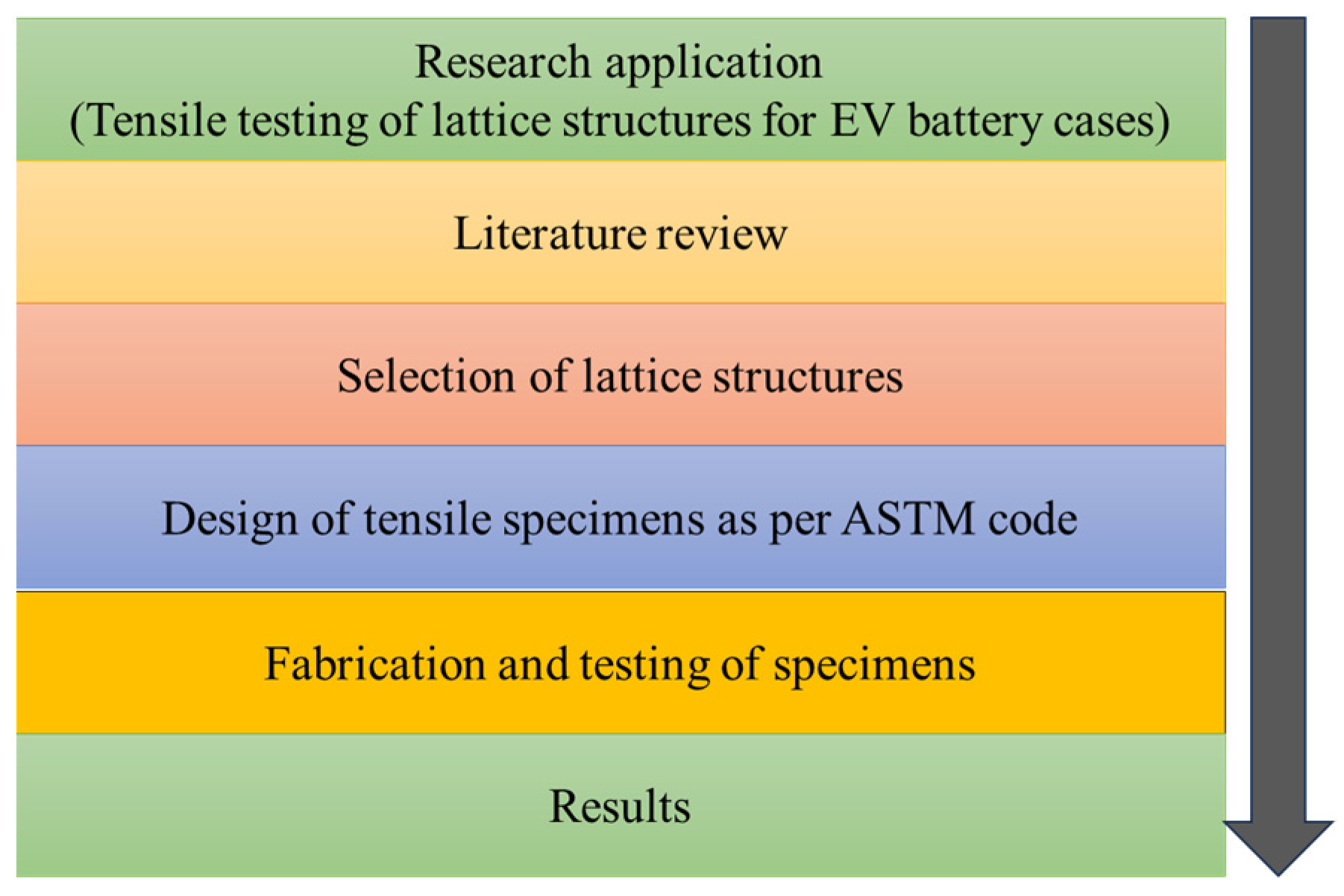
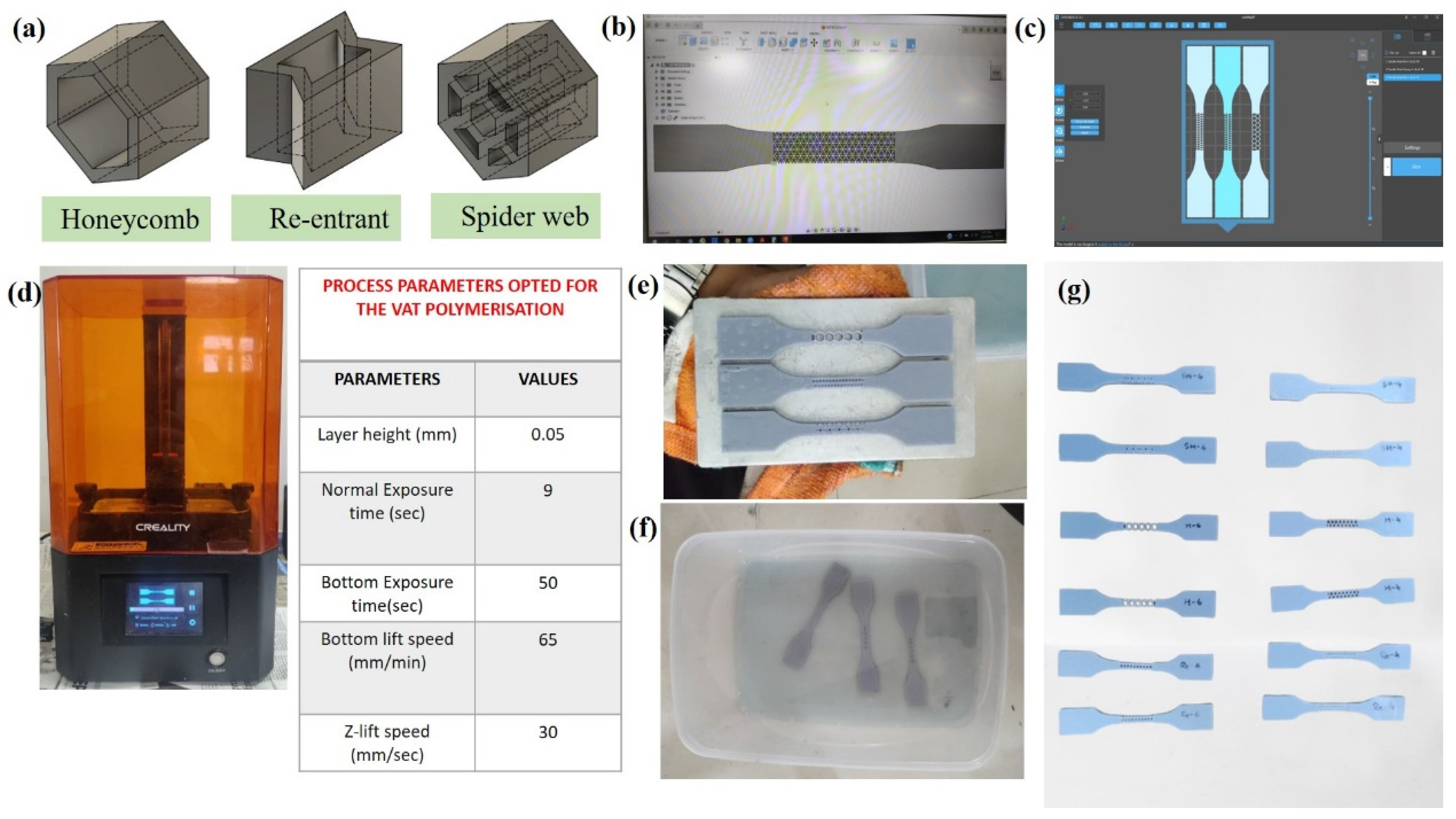
The design methodology followed in this study is shown in the flow chart in Figure 1. In the first stage, three different types of lattice structures are selected that are h, as shown in Figure 2a. All the unit cells are modeled with an overall size of the unit cell of 4 mm and 6 mm, with wall unit thickness of 0.4 mm and 0.6 mm, respectively. The tensile specimen modeled with the lattice structure is shown in Figure 2b. The slicing process of the specimens is shown in Figure 2c.
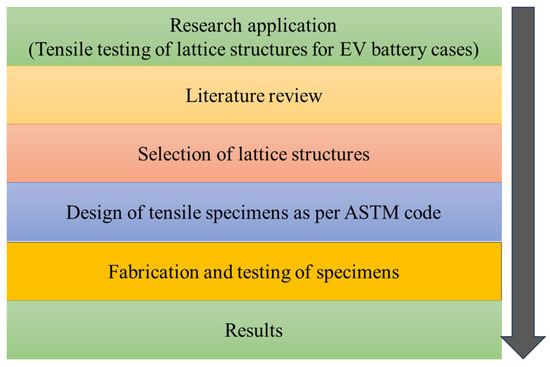
Figure 1.
Flow chart for design methodology.
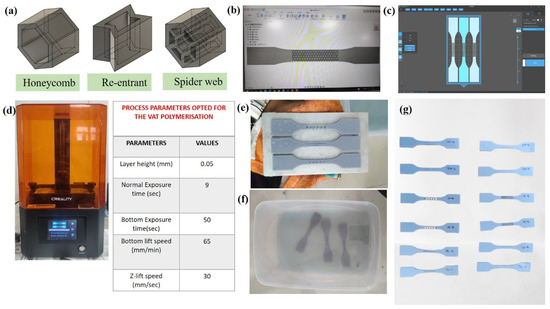
Figure 2.
(a) Design of the unit cells, (b) Modeling of the tensile specimen with lattice, (c) Slicing of STL files, (d) 3D printing of specimens with process parameters, (e) 3D-printed specimens, (f) Specimens treated with ethyl alcohol, and (g) 3D-printed specimens after curing.
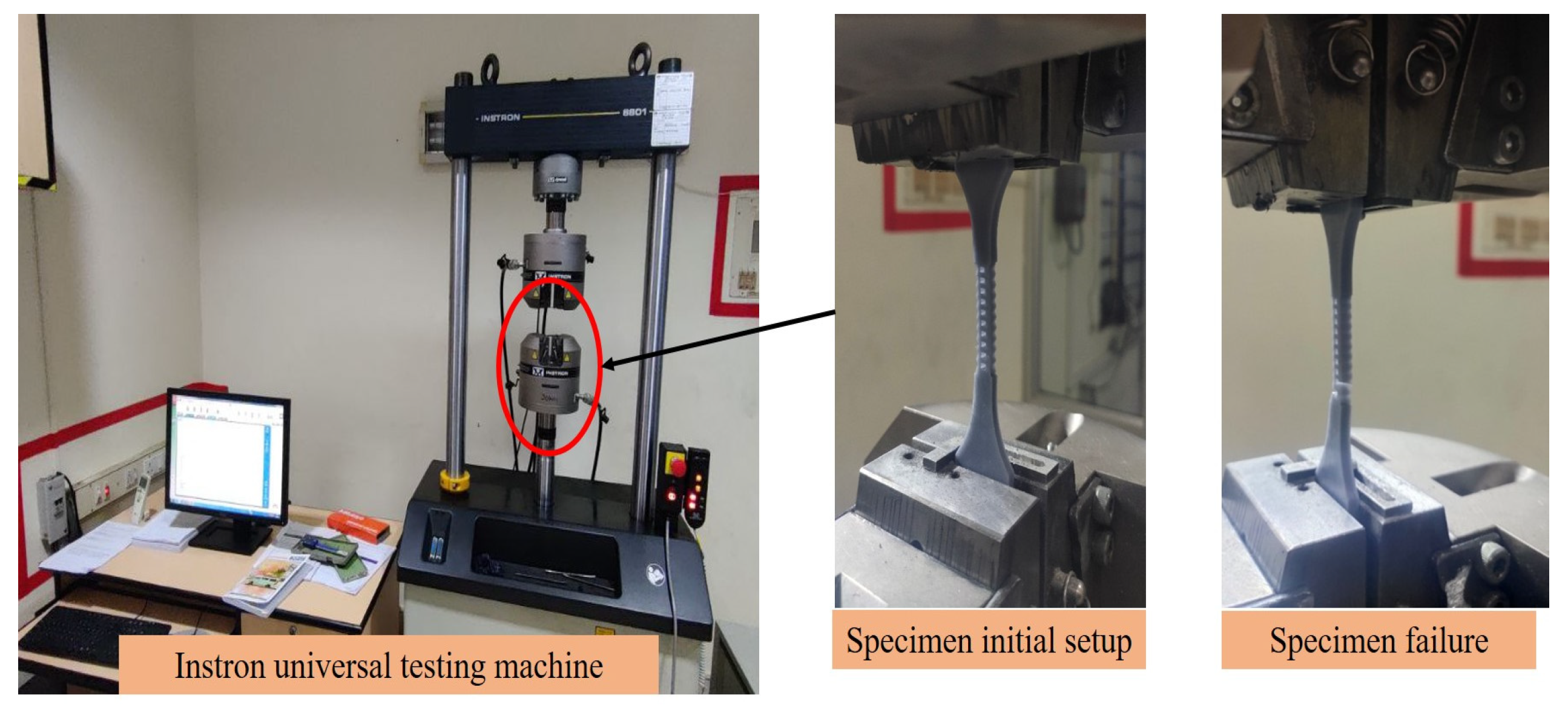
The 3D printer with the parameters used is shown in Figure 2d. The specimens printed on the built plate are shown in Figure 2e. All the printed specimens were cleaned with 80% ethyl alcohol to remove the excess resin and sticky nature of the specimens and set for proper curing for about 60–90 min, as shown in Figure 2f. The specimens that were cleaned, cured under sunlight, and made ready for testing are shown in Figure 2g. All the specimens were set for tensile testing after proper curing using Instron material testing equipment as per ASTM D638 standards [16]. All the test data were recorded using Blue Hill software V2 which was linked to the Instron equipment. The tensile test carried out on the specimens is clearly shown in Figure 3.
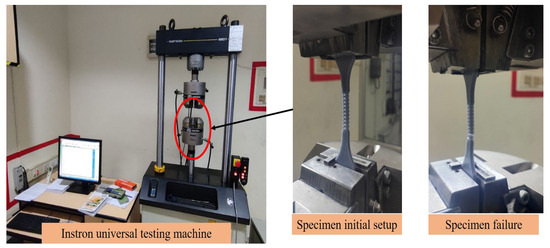
Figure 3.
Mechanical testing of 3D-printed tensile specimens.
3. Results
After testing all specimens, the results obtained from the tensile mode of testing for each specimen design were averaged to a final value, as shown in Table 1.

Table 1.
Displays the results of the tensile tests.
From Table 1, it was very clear that the honeycomb structures with both cell sizes showed more extension when compared to the other two designs. However, the load values taken by the honeycomb structures seemed to be very low when compared to the re-entrant and spider web structures. It was quite interesting that the load values taken by the spider web structures with both cell sizes were recorded as high compared to the honeycomb and re-entrant structures. It was also noticed that the elongation values observed in the re-entrant and spider web structures were almost the same values. However, there was a noticeable difference when compared to the honeycomb structures. So, it was very clear that the spider web structures took more tensile load when compared to the other two structures: 28% more than re-entrant structures with the 6 mm cell size and 10% more than those with the 4 mm size. Overall, the design of the unit cell played a crucial role in the spider web-type lattice structures and performed well due to its robust design, and an interesting point to note is that the 4 mm cell size performed well compared with the 6 mm cell size due to the accommodation of a higher number of unit cells, which may be a technical reason for it taking a higher tensile load.
4. Conclusions and Future Scope
This paper investigates the effect of three differently designed lattice unit cells with two cell sizes with two thickness values. Based on the results obtained from the tensile testing of the three lattice structures, namely honeycomb, spider honeycomb, and re-entrant, it can be concluded that the 4 mm cell size with 4 mm thickness in the spider web structure showed the best results. These findings indicate that the re-entrant structure may be a promising option for use in applications that require high strength and stiffness, which are required for making battery base plates. However, further studies may be required to optimize the design.
Author Contributions
Conceptualization, methodology, writing—original draft preparation, writing—review and editing validation, software, validation, B.M.G., R.D. and M.K. All authors have read and agreed to the published version of the manuscript.
Funding
There has been no significant financial support for this work that could have influenced its outcome.
Institutional Review Board Statement
Not applicable.
Informed Consent Statement
Not applicable.
Data Availability Statement
Data will be available upon request.
Conflicts of Interest
The authors declare no conflicts of interest.
References
- San Ha, N.; Lu, G. A review of recent research on bio-inspired structures and materials for energy absorption applications. Compos. Part B Eng. 2020, 181, 107496. [Google Scholar]
- Ramakrishna, D.; Bala Murali, G. Bio-inspired 3D-printed lattice structures for energy absorption applications: A review. Proc. Inst. Mech. Eng. Part L J. Mater. Des. Applications. 2023, 237, 503–542. [Google Scholar] [CrossRef]
- Saiteja, P.; Ashok, B. Critical review on structural architecture, energy control strategies and development process toward optimal energy management in hybrid vehicles. Renew. Sustain. Energy Rev. 2022, 157, 112038. [Google Scholar] [CrossRef]
- Gurusamy, A.; Ashok, B. Establishment of electric two-wheeler driving cycle for energy economy and life cycle assessment under Indian Tier-2 city driving environments. Sustain. Energy Technol. Assess. 2024, 66, 103826. [Google Scholar] [CrossRef]
- Gültekin, E.; Yahşi, M. Dynamic compression and impact analyses of the lattice structures for battery safety. Proc. Inst. Mech. Eng. Part D J. Automob. Eng. 2023, 237, 930–940. [Google Scholar] [CrossRef]
- Nasrullah, A.H.; Puji Santosa, S.; Widagdo, D.; Arifurrahman, F. Structural Lattice Topology and Material Optimization for Battery Protection in Electric Vehicles Subjected to Ground Impact Using Artificial Neural Networks and Genetic Algorithms. Materials 2021, 14, 7618. [Google Scholar] [CrossRef] [PubMed]
- He, Q.; Feng, J.; Chen, Y.; Zhou, H. Mechanical properties of spider-web hierarchical honeycombs subjected to out-of-plane impact loading. J. Sandw. Struct. Mater. 2020, 22, 771–796. [Google Scholar] [CrossRef]
- Mousanezhad, D.; Ebrahimi, H.; Haghpanah, B.; Ghosh, R.; Ajdari, A.; Hamouda, A.M.S.; Vaziri, A. Spiderweb honeycombs. Int. J. Solids Struct. 2015, 66, 218–227. [Google Scholar] [CrossRef]
- Logakannan, K.P.; Ramachandran, V.; Rengaswamy, J.; Ruan, D. Dynamic performance of a 3D re-entrant structure. Mech. Mater. 2020, 148, 103503. [Google Scholar] [CrossRef]
- Evans, K.E.; Caddock, B.D. Microporous materials with negative Poisson’s ratios. II. Mechanisms and interpretation. J. Phys. D Appl. Phys. 1989, 22, 1883. [Google Scholar] [CrossRef]
- Doodi, R.; Balamurali, G. Experimental and analytical investigation of bio-inspired lattice structures under compressive loading. Eng. Res. Express. 2023, 5, 035035. [Google Scholar] [CrossRef]
- Dara, A.; Johnney Mertens, A.; Raju Bahubalendruni, M.V.A. Characterization of penetrate and interpenetrate tessellated cellular lattice structures for energy absorption. Proc. Inst. Mech. Eng. Part L J. Mater. Des. Applications. 2023, 237, 906–913. [Google Scholar] [CrossRef]
- Ramakrishnan, R.; Hemanth Kumar, J.; Titus, F.; Maharshi, P.; Nithish, R. Experimental investigation of 3D printed bio-inspired Xylotus lattice structure for energy absorption under quasi-static axial loading conditions. Proc. Inst. Mech. Eng. Part L J. Mater. Des. Appl. 2024. [CrossRef]
- Bagewadi, S.S.; Bhagchandani, R.K. Effect of gradient structure on additively manufactured auxetic and hybrid auxetic structure for energy absorption applications. Proc. Inst. Mech. Eng. Part L J. Mater. Des. Applications. 2023, 237, 1739–1751. [Google Scholar] [CrossRef]
- Doodi, R.; Gunji, B.M. Prediction and experimental validation approach to improve performance of novel hybrid bio-inspired 3D printed lattice structures using artificial neural networks. Sci. Rep. 2023, 13, 7763. [Google Scholar] [CrossRef] [PubMed]
- ASTM D638-14; Standard Test Method for Tensile Properties of Plastics. ASTM International: West Conshohocken, PA, USA, 2014.
Disclaimer/Publisher’s Note: The statements, opinions and data contained in all publications are solely those of the individual author(s) and contributor(s) and not of MDPI and/or the editor(s). MDPI and/or the editor(s) disclaim responsibility for any injury to people or property resulting from any ideas, methods, instructions or products referred to in the content. |
© 2024 by the authors. Licensee MDPI, Basel, Switzerland. This article is an open access article distributed under the terms and conditions of the Creative Commons Attribution (CC BY) license (https://creativecommons.org/licenses/by/4.0/).