
Sustainable Development Goals in Mine Tailings Management: Targets and Indicators †


Abstract
1. Introduction
2. Methodology
3. Results
3.1. Identification and Selection of Targets
3.2. Development of Indicators
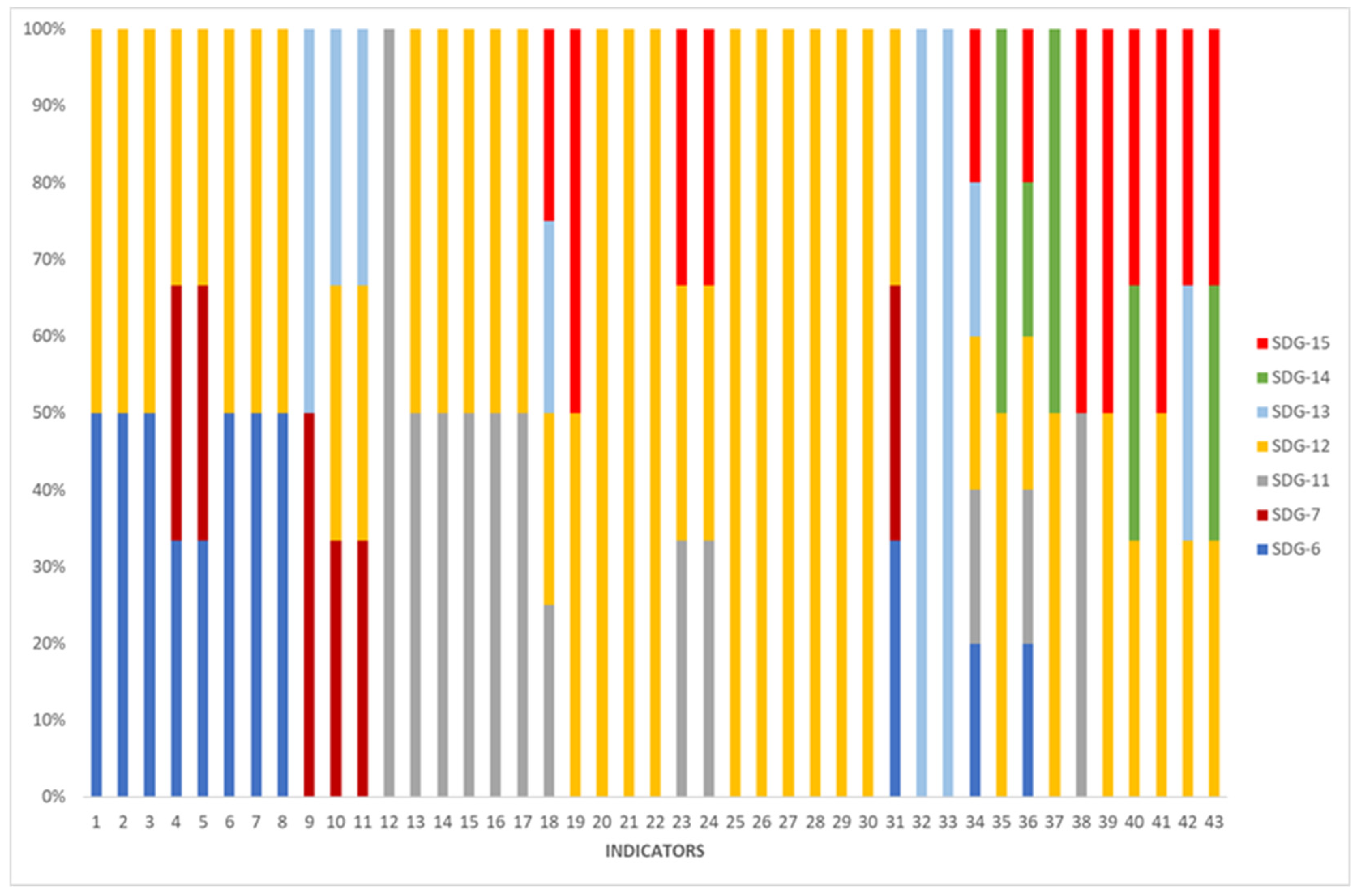
3.3. Identification of the Contribution of Indicators to the SDGs
4. Conclusions
Author Contributions
Funding
Institutional Review Board Statement
Informed Consent Statement
Data Availability Statement
Conflicts of Interest
References
- United Nations. The Sustainable Development Agenda—United Nations Sustainable Development 2020. Available online: https://www.un.org/sustainabledevelopment/development-agenda/ (accessed on 2 June 2021).
- United Nations. The Sustainable Development Goals Report 2020. 2020. Available online: https://unstats.un.org/sdgs/report/2020/ (accessed on 2 June 2021).
- United Nations. Indicators of Sustainable Development—Guidelines and Methodologies 2007. Available online: https://www.un.org/esa/sustdev/natlinfo/indicators/guidelines.pdf (accessed on 31 May 2021).
- GRI. The Global Standards for Sustainability Reporting 2021. Available online: https://www.globalreporting.org/standards/ (accessed on 3 June 2021).
- United Nations Development Programme. Managing Mining for Sustainable Development. A Sourcebook 2018. Available online: https://www.undp.org/publications/managing-mining-sustainable-development (accessed on 2 June 2021).
- Monteiro, N.B.R.; da Silva, E.A.; Neto, J.M.M. Sustainable development goals in mining. J. Clean. Prod. 2019, 228, 509–520. [Google Scholar] [CrossRef] [Scilit]
- Yakovleva, N.; Kotilainen, J.; Toivakka, M. Reflections on the opportunities for mining companies to contribute to the United Nations Sustainable Development Goals in sub–Saharan Africa. Extr. Ind. Soc. 2017, 4, 426–433. [Google Scholar] [CrossRef] [Scilit]
- Segura-Salazar, J.; Tavares, L.M. Sustainability in the minerals industry: Seeking a consensus on its meaning. Sustainability 2018, 10, 1429. [Google Scholar] [CrossRef] [Scilit]
- World Economic Forum. Mapping Mining to the SDGs: An Atlas|UNDP 2016. Available online: https://www.undp.org/content/undp/en/home/librarypage/poverty-reduction/mapping-mining-to-the-sdgs--an-atlas.html (accessed on 10 September 2020).
- International Council on Mining & Metals. Integrated Mine Closure: Good Practice Guide (2nd edition, 2019) 2019. Available online: https://www.icmm.com/pt/society-and-the-economy/mine-closure/planning-for-integrated-mining-closure (accessed on 3 June 2021).
- International Council on Mining & Metals. Global Industry Standard on Tailings Management 2020. Available online: https://www.icmm.com/en-gb/guidance/environmental-stewardship/global-industry-standard-on-tailings-management (accessed on 3 June 2021).
- International Council on Mining & Metals. Tailings Governance Framework: Position Statement 2020. Available online: https://www.icmm.com/en-gb/about-us/member-requirements/position-statements/tailings-governance (accessed on 3 June 2021).
- Azapagic, A. Developing a framework for sustainable development indicators for the mining and minerals industry. J. Clean. Prod. 2004, 12, 639–662. [Google Scholar] [CrossRef] [Scilit]
- Edraki, M.; Baumgartl, T.; Manlapig, E.; Bradshaw, D.; Franks, D.M.; Moran, C.J. Designing mine tailings for better environmental, social and economic outcomes: A review of alternative approaches. J. Clean. Prod. 2014, 84, 411–420. [Google Scholar] [CrossRef] [Scilit]
- Adiansyah, J.S.; Rosano, M.; Vink, S.; Keir, G. A framework for a sustainable approach to mine tailings management: Disposal strategies. J. Clean. Prod. 2015, 108, 1050–1062. [Google Scholar] [CrossRef] [Scilit]
- Araya, N.; Kraslawski, A.; Cisternas, L.A. Towards mine tailings valorization: Recovery of critical materials from Chilean mine tailings. J. Clean. Prod. 2020, 263, 121555. [Google Scholar] [CrossRef] [Scilit]
- Vargas, F.; Lopez, M. Development of a new supplementary cementitious material from the activation of copper tailings: Mechanical performance and analysis of factors. J. Clean. Prod. 2018, 182, 427–436. [Google Scholar] [CrossRef] [Scilit]
- Marín, O.; Valderrama, J.O.; Kraslawski, A.; Cisternas, L.A. Potential of tailing deposits in Chile for the sequestration of carbon dioxide produced by power plants using ex-situ mineral carbonation. Minerals 2021, 11, 320. [Google Scholar] [CrossRef] [Scilit]
- Mitchell, G. Problems and fundamentals of sustainable development indicators. Sustain. Dev. 1996, 4, 1–11. [Google Scholar] [CrossRef]


| SDGs | Targets for Mine Tailings Management and Valorization |
|---|---|
| SDG 6: Ensure availability and sustainable management of water and sanitation for all | -Minimize the impacts of tailings facilities and dams on water resources by minimizing acid mine drainage and the release of hazardous chemicals -Reduce the water consumption of continental water resources in tailings facilities by improving water recycling rate in tailings management, by using dewatering technologies |
| SDG 7: Ensure access to affordable, reliable, sustainable, and modern energy for all | -Achieve energy efficiency in tailings management by improving water-energy nexus -Encourage the use of renewables energies in mine tailings management |
| SDG 11: Make cities and human settlements inclusive, safe, resilient, and sustainable | -Reduce the impact of mine tailings deposits on communities nearby. -Planning land use considering the end-of-life of the mine -Recovery of nearby areas of mine tailing’s deposits -Support the development of processes to reuse, recycle, and/or re-processing tailings |
| SDG 12: Ensure sustainable consumption and production patterns | -Achieve sustainable management of tailings by reducing using of water, energy, and land -Minimize production of tailings and encourage sustainable practices and monitoring of chemicals and water management in tailings -Encourage tailing dewatering technologies, appropriate management of acid drainage, safe storage of tailings -Encourage and achieve valorization of tailings by re-processing, reusing, and recycling tailings |
| SDG 13: Take urgent action to combat climate change and its impacts | -Recognize climate change in the planning of managing and re-processing tailings -Improve energy and water efficiency in mine tailings management -Measure direct and indirect emissions of treatments of tailings -Encourage the use of renewable energies in mine sites |
| SDG 14: Conserve and sustainably use the oceans, seas, and marine resources for sustainable development | -Reduce marine pollution associated with mining tailings and acid mine drainage -Plan for responsible tailings management that avoid tailings disposal into the sea |
| SDG 15: Protect, restore, and promote sustainable use of terrestrial ecosystems, sustainably manage forests, combat desertification, and halt and reverse land degradation and halt biodiversity loss | -Conduct environmental impact assessment of tailings facilities and dams -Support projects that connect communities and biodiversity and encourage the participation of governments, communities, researchers, and NGOs in mine planning -Minimize the impact of tailings on freshwater ecosystems by reducing the water consumption of tailings management -Ensure the conservation, restoration, and sustainable use of freshwater sources -Avoid impacts of tailings facilities and dams to critical habitats by applying the mitigation hierarchy |
| Indicators | Unit | |
|---|---|---|
| 1 | country with a plan of water management and water savings in tailings facilities | (YES = 1; NO = 0) |
| 2 | Mine tailings generated using conventional method no water saving | tonnes |
| 3 | Rate of mine tailings conventional tailings/total tailings disposed | No unit |
| 4 | Mine tailings generated using dewatering technologies (tonnes) | tonnes |
| 5 | Rate mine tailings generated using dewatering technologies/total tailings disposed | No unit |
| 6 | Total water use in tailings facilities | m3/year |
| 7 | Water recycled and reused in tailings facilities | m3/year |
| 8 | % of water recycled and reused in tailings facilities | % |
| 9 | Energy consumption tailings facilities | kW h/year |
| 10 | Country has a plan to reduce energy consumption in tailings facilities | (YES = 1; NO = 0) |
| 11 | Country has a plan to use more renewables energies in tailings facilities | (YES = 1; NO = 0) |
| 12 | The proportion of people living in areas near mine tailings deposits (people living near tailings dams/total population) | No unit |
| 13 | Land use for mine tailings facilities | m2 |
| 14 | Number of mortalities related to mine tailings disasters (number) | No unit |
| 15 | Number of accidents related to mine tailings disasters (number) | No unit |
| 16 | Number of mine plants with a closure plan according to tailings regulations (Number) | No unit |
| 17 | The proportion of mining waste managed or reused of all mining waste generated (rate) | No unit |
| 18 | The country has regulations about mine closure and rehabilitation of mine sites (YES = 1; NO = 0) | (YES = 1; NO = 0) |
| 19 | National organism in charge of tailings management policies | (YES = 1; NO = 0) |
| 20 | National plan of sustainable mine tailings management policies | (YES = 1; NO = 0) |
| 21 | Countries with a national organism in charge of mining | (YES = 1; NO= 0) |
| 22 | Countries with a national plan of recycling and repurpose tailings | (YES = 1; NO = 0) |
| 23 | Inactive and abandoned tailings | tonnes |
| 24 | Active tailings | tonnes |
| 25 | Rate inactive or abandoned tailings/total tailings | No unit |
| 26 | Total Tailings production rate | Tonne/year |
| 27 | Rate active tailings/total tailings | No unit |
| 28 | Tailings that are re-processed | Tonne/year |
| 29 | Policies about acid drainage management | (YES = 1; NO = 0) |
| 30 | Numbers of initiatives and agreements on mining waste management and valorization (Number) | No unit |
| 31 | Numbers of projects already re-using, re-processing, and recycling mine tailings (Number) | No unit |
| 32 | Greenhouse gas (GHG) emissions of mine tailings treatment per year | t CO2 eq/kW h |
| 33 | GHG emissions of re-processing/re-use/recycle of tailings processes per year | t CO2 eq/kW h |
| 34 | The concentration of hazardous elements in areas nearby tailings | mg/kg |
| 35 | Deep-sea disposal, is tailings disposal into oceans permitted? | (YES = 1; NO = 0) |
| 36 | Is riverine disposal permitted? | (YES = 1; NO = 0) |
| 37 | Regulations about marine disposal | (YES = 1; NO = 0) |
| 38 | Acid mine drainage potential because tailings are in an area with high precipitations | (YES = 1; NO = 0) |
| 39 | Accident probability because tailings facilities are located in seismic region | (YES = 1; NO = 0) |
| 40 | Regulations about tailings marine and riverine disposal | (YES = 1; NO = 0) |
| 41 | Number of protected ecosystems nearby tailing facilities | No unit |
| 42 | Mine closure plan must include reforestation | (YES = 1; NO = 0) |
| 43 | The country has environmental impact assessments requirements for new tailings facilities | (YES = 1; NO = 0) |
Publisher’s Note: MDPI stays neutral with regard to jurisdictional claims in published maps and institutional affiliations. |
© 2021 by the authors. Licensee MDPI, Basel, Switzerland. This article is an open access article distributed under the terms and conditions of the Creative Commons Attribution (CC BY) license (https://creativecommons.org/licenses/by/4.0/).
Share and Cite
Araya, N.; Mamani Quiñonez, O.; Cisternas, L.A.; Kraslawski, A. Sustainable Development Goals in Mine Tailings Management: Targets and Indicators. Mater. Proc. 2021, 5, 82. https://doi.org/10.3390/materproc2021005082
Araya N, Mamani Quiñonez O, Cisternas LA, Kraslawski A. Sustainable Development Goals in Mine Tailings Management: Targets and Indicators. Materials Proceedings. 2021; 5(1):82. https://doi.org/10.3390/materproc2021005082
Chicago/Turabian StyleAraya, Natalia, Oscar Mamani Quiñonez, Luis A. Cisternas, and Andrzej Kraslawski. 2021. "Sustainable Development Goals in Mine Tailings Management: Targets and Indicators" Materials Proceedings 5, no. 1: 82. https://doi.org/10.3390/materproc2021005082
APA StyleAraya, N., Mamani Quiñonez, O., Cisternas, L. A., & Kraslawski, A. (2021). Sustainable Development Goals in Mine Tailings Management: Targets and Indicators. Materials Proceedings, 5(1), 82. https://doi.org/10.3390/materproc2021005082