


Abstract
Acoustic survey methods have been used in recent years in Greece due to rapid growth of technology for leakage detection in water distribution networks. The application of the latest methodologies and technologies allowed water authorities to improve the efficiency of their water supply networks. Thessaloniki’s water distribution network is an aging and inefficient one so the use of these methods in the last fifteen years has considerably improved the utility’s capability to reduce the losses of drinking water. The use of acoustic loggers on network fittings that record leakage noise in fixed time steps has a considerable effect in Thessaloniki’s water distribution network, which is characterized by a high level of complexity. A major challenge facing Thessaloniki Water Supply and Sewerage CO S.A. (EYATH S.A.) is how to deal with high levels of water loss, and acoustic survey methods are now seen as having an increasingly wide range of benefits, not only including environmental and water conservation benefits of reducing leak flow rate but also improving its performance in water loss management. The paper presents the implementation of the acoustic survey method for leakage detection and reduction in various field areas of Thessaloniki and the interconnected municipalities. Key parameters have been taken included, such as the complexity of water distribution network, the reliability of available mapping, the established zones with respective flow metering, and the existence of high background noise. Results are analyzed in order to examine the efficiency of the acoustic logging technology.
1. Introduction
In recent years, a major challenge facing municipalities and water companies is how to manage leakages in their water pipe networks. This requirement has become more urgent owing to water shortages caused by recent droughts, increasing demand, environmental, social and political pressures, escalating energy costs, etc. EYATH S.A. has been involved in various projects in order to manage leakage detection and reduction in the water distribution network of Thessaloniki.
This paper describes leak detections that cover the whole of the water supply network of Thessaloniki. The application took place through successive sweeps in various field areas of Thessaloniki and the interconnected municipalities with the deployment of acoustic loggers and subsequent localization of leaks with a noise correlator and additional acoustic equipment.
The water supply needs of the service area of EYATH S.A., averaging about 260.000 m3/d (2017 reference year), which are covered through three water supply sources: (1) the Aliakmonas River, through the Thessaloniki Water Treatment Plant TWTP (surface water), (2) the AravissosSprings in the Regional Unit of Pella (source water), and (3) drilling in the plain of Thessaloniki (groundwater) [1].
Today, the service area of the company includes the Thessaloniki city complex, adjacent areas, as well as areas close to the water sources of the company [1]. Due to the fact that a great variety of smaller networks operated by the local municipalities or companies have been incorporated at different times in the last decades to EYATH S.A’s central system, the water distribution network of Thessaloniki is characterized by a high level of complexity (Table 1). This has, as a result, led to a diversification of categories into pipe materials and a variety of ages of the network dating back to the beginning of the 20th century [1].

Table 1.
Construction materials of water pipes used by EYATH S.A [1].
According to the 2011 census, EYATH S.A. supplies water to a population of about 926,000 out of which 827,000 are supplied exclusively and 99,000 in an auxiliary capacity. At the same time, the EYATH network supports the firefighting needs, as it supplies 685 fire hydrants and two forest tanks [1]. The external Water Supply Network, which concerns large diameter pipes, extends over 472 km. The distribution pipes of the Water Supply Network extend over a length of 2.230 km, resulting in the total length of the EYATH’s water supply lines exceeding 2.702 km.
The aim of this paper was the reduction in high levels of water loss that Thessaloniki Water Supply and Sewerage CO S.A. (EYATH S.A.) were facing through the effectiveness of acoustic survey methods for leakage detection in various field areas of Thessaloniki and the interconnected municipalities in the last six years (from 2014 until 2019).
2. Methodology and Implementation
2.1. Equipment Used
The acoustic leak location equipment employed for Thessaloniki Water Supply and Sewerage CO S.A. (EYATH S.A.) via provision of services consisted of:
- noise loggers, for continuous recording of leak sounds with a wider network area coverage
- digital and analog correlators
- set of hydrophones
- digital geophones of high sensitivity
- a series of assistant tools and instruments
- the necessary software and supporting office infrastructure.
2.2. Methodology
The methodology of implementation of the acoustic methods for leak detection involved three steps:
- The first step related to the application of loggers on network fittings in order to record noise in the pipelines. If the recorded noise is high with a respective low spread of frequency, the logger will produce a leak indication. The recorded data were downloaded and transferred to a computer for further analysis.
- The second step related to the further examination of all leak indications provided in the first step. If the presence of a leak was confirmed, it was pinpointed with the use of the correlator, the ground microphone, and the remaining acoustic equipment.
- The third step concerned EYATH S.A.’s repair teams that confirmed leak locations. Repairs were closely monitored in order to identify the cause of each leak or the cause of failure in case of a dry hole [2].
2.3. Map Reliability
EYATH S.A. adopted the technology of a GIS System in 1998 in order to achieve an effective management for water and sewerage networks. Nowadays, with extensive in-house expertise and staff who are highly experienced in GIS technology, EYATH S.A. has managed to integrate it into its daily water supply and sewerage operations in real and business terms. The use of GIS provides EYATH’s personnel with specific technical information. The access to the company’s central mapping server reduces the response time, the operating costs, and customers’ disturbance [3].
3. Results, Analysis, and Comments
A total of 777 commands for leak detections were given by EYATH S.A.’s Executive Division of Water Supply Networks via provision of services in the last six years (from 2014 until 2019) in various field areas of Thessaloniki and the interconnected municipalities. More specifically, 359 ofthem were given by the Eastern and Central Sector Networks and 418 by the Western Sector Networks. These leaks had been excavated and repaired by EYATH S.A.’s repair team. In the majority of the cases, the leak was discovered within 1m of the marked excavation spot. Figure 1 shows the total number of leak detections per year from 2014 until 2019 with their results.
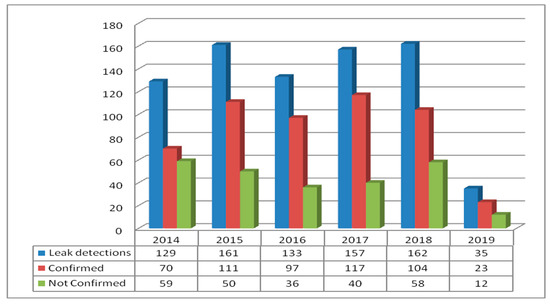
Figure 1.
Leak detections per year from 2014 until 2019 with their results.
According to Figure 1, the highest number of leak detections observed in 2018, as 162 commands for leak detections were given by EYATH S.A. In 2019, the number of leak detection was significantly low, approximately 35, due to the fact that from March 2019 until October 2019, there was no signed contract for the provision of leak detections services. Additionally, the number of confirmed leak detections is particularly high with the effect of reaching the percentage of 75% in 2017.
3.1. Ambient Noise Effect
It is also remarkable to notice that a number of leak indications were found out due to high ambient noise rather than any sound transmitted within the pipeline. Furthermore, the loggers deployed on or very near to main streets with high traffic even at nighttime recorded high levels of noise combined with high spread of sound frequency [2].
3.2. Effect of Pipe Material
Table 2 and Table 3 present the results per field area for the Eastern and Central Sector Networks and the Western Sector Networks, including information for the number of leak detections the last six years (from 2014 until 2019), the number of confirmed leaks, and the type of materials of the water pipes.
Table 2.
Leak detections per field area with the type of materials of water pipes for Eastern and Central Sector Networks from 2014 until 2019.
Table 3.
Leak detections per field area with the type of materials of water pipes for Western Sector Networks from 2014 until 2019.
As shown in Table 2 and Table 3, the number of leaks located on asbestos and PVC is quite large compared to other types of materials of water pipes. The large number of leaks found on these pipes is due to the fact that the water distribution network of Thessaloniki is characterized by a large number of different types of water pipes, a great variety of ages, and consists mainly ofPVC and asbestos pipes (Table 1). It is also remarkable that there are parts of the network dating back to the beginning of the 20th century. The use of HDPE has been adapted in recent years in order to replace the use of PVC pipes. It is safe to assume that there is a discrepancy between plastic pipes and other types of materials of water pipes because there is a low transmissivity of plastic pipes, resulting insome leak noises not being picked up by the loggers [2].
3.3. Estimation of Water Savings
A semi-empirical method of leakage estimation was applied in order to provide an indication of the water savings as a mean evaluation of the efficiency of the proposed methodology, based on the use of ESPB units (Equivalent Service Pipe Burst) [4]. In this method, the water saved by each leak repaired is estimated in relation to the type of the leak, based on a typical service pipe burst and using adequate multipliers for each type of leak. The average system pressure is also accounted for, but not the actual size of leak. This method has the advantage of not being dependent on the observer’s subjectivity, while when used over large samples of data (leaks) can produce fairly accurate statistical averages [2]. Table 4 presents the estimated water savings achieved throughout the last six years (from 2014 until 2019), assuming that all confirmed leaks are successfully excavated and repaired.
Table 4.
Estimated total water saved during the last six years from 2014 until 2019.
The estimated total water savings represent a 1.6% of the total input in the system. It must be improved with multiple sweeps of the city network and more money spent to increase water savings in the whole system, which has beenrequested.
4. Conclusions
The use of noise loggers for leakage localization, followed by accurate pinpointing with the use of correlators and other acoustic equipment is a highly efficient and cost-effective method that can assist in the rapid reduction in water losses [2]. A first extensive application of the acoustic survey method for leak detection and reduction had taken place in early 2000 in a joint project of EYATH S.A. with HYDER Consulting Ltd, which ended in 2003 [2,5,6]. In the last decade, similar projects took place via provision of services. The goal was to restrict the water losses up to 15% of the total input in the water distribution network of Thessaloniki city.
EYATH S.A. must spend a respectable amount of money using this available cost-effective technique under the existing conditions. Nowadays, EYATH S.A. develops SCADA for the water network system. Ending this project, it will be feasible to have some form of established zones or an adequate degree of flow monitoring.
Weak points are the fairly low performance of noise loggers with plastic pipes and sources of high background noise. It can be overcome with the cooperation of the private local maintenance teams who have a high level of experience of the water network in the last fifteen years. In addition, the rapid evolution of thenoise-loggers’ technique is essential in order to solve problems in difficult logging conditions.
Optimistically, as the SCADA project is developing, there will be no cause to outsource work and this know-how will remain in the company and be capitalized by EYATH’s S.A. staff.
Author Contributions
Conceptualization, methodology, statistical analysis, writing E.S.; supervision, K.A. All authors have read and agree to the published version of the manuscript.
Funding
This research received no external funding.
Acknowledgments
The research is elaborated within the framework of the invitation “Granting of scholarship for Post-Doctoral Research” of the University of Thessaly, which is being implemented by the University of Thessaly and was funded by the Stavros Niarchos Foundation.
Conflicts of Interest
The authors declare no conflict of interest.
References
- EYATH S.A. 2020. Available online: https://www.eyath.gr/ydreysi (accessed on 12 February 2020).
- Kazantzis, G.; Iosifidis, V.; Anagnostopoulos, K.; Angelidis, K. Application of acoustic survey methods for leakage detection and reduction in complex water supply networks with no area flow metering. In Proceedings of the XXX IAHR Congress, AUTH, Thessaloniki, Greece, 24-29 August 2003; Theme B. pp. 305–311. [Google Scholar]
- EYATH S.A. 2020. Available online: https://www.eyath.gr/systimata-pliroforikis-neon-technologion/#gis (accessed on 12 February 2020).
- IWA Specialist Group. Efficient Operation and Management. Water Loss Task Force. District Metered Areas; Guidance Notes; IWA: London, UK, February 2007; Version 1. [Google Scholar]
- HYDER Consulting Ltd. Thessaloniki Water Supply Network, Operation Management & Leakage Control Study: Implementation of First Phase Leakage Detection &Control; HYDER Consulting Ltd.: London, UK, 2002. [Google Scholar]
- Angelidis, K.; Koutsakos, E.; Iosifidis, V. The Thessaloniki water leakage reduction programme, 2002 Leakage management. In Proceedings of the IWA Conference, Lemesos, Cyprus, 20–22 November 2002. [Google Scholar]
Publisher’s Note: MDPI stays neutral with regard to jurisdictional claims in published maps and institutional affiliations. |
© 2020 by the authors. Licensee MDPI, Basel, Switzerland. This article is an open access article distributed under the terms and conditions of the Creative Commons Attribution (CC BY) license (https://creativecommons.org/licenses/by/4.0/).