


Abstract
Photovoltaic energy has become a key pillar in the transition to sustainable energy systems, driven by the need for efficient energy conversion and the reduction of dependency on fossil fuels. Maximum Power Point Tracking (MPPT) is central to optimizing the performance of photovoltaic systems by ensuring the maximum extraction of solar energy, even under fluctuating environmental conditions. This review provides a comprehensive analysis of MPPT algorithms developed and refined over the past decade (2015–2025), highlighting major breakthroughs in algorithmic approaches, from conventional methods such as Perturb and Observe (P&O) and Incremental Conductance (IncCond) to more advanced techniques incorporating artificial intelligence, fuzzy logic, and hybrid systems. The paper evaluates the evolution of MPPT techniques, focusing on their effectiveness in real-world applications, particularly in optimizing photovoltaic output under diverse operating conditions such as partial shading, temperature variations, and rapid irradiance changes. Furthermore, it discusses the ongoing challenges in the field and the promising directions for future research, aiming to further enhance the reliability and efficiency of solar power systems worldwide.
1. Introduction
In recent years, photovoltaic (PV) energy has emerged as one of the most promising renewable energy sources, driven by the global push towards decarburization and the increasing need for sustainable, decentralized electricity generation [1]. Worldwide, solar energy deployment has grown rapidly due to declining costs, technological advancements, and supportive policies [2]. In Africa, where solar irradiance is among the highest globally, PV systems hold significant potential to address energy access challenges, especially in remote and underserved areas [3]. However, despite this potential, the performance and reliability of PV installations can be hindered by environmental fluctuations such as irradiance variation, temperature changes, and partial shading [4].
To address these issues, Maximum Power Point Tracking (MPPT) algorithms have become essential in optimizing the output of PV systems. MPPT ensures that the photovoltaic modules operate at their optimal power point, thereby significantly improving energy efficiency and overall system performance. Various MPPT techniques have been proposed over the years, ranging from classical control methods to intelligent and adaptive algorithms [5,6,7].
This review aims to provide a comprehensive synthesis of MPPT techniques developed and refined over the past decade, from 2015 to 2025. The paper categorizes and analyzes the evolution of these algorithms, evaluates their effectiveness under different operating conditions, and highlights emerging trends and research directions. The goal is to offer valuable insights for researchers, engineers, and policymakers working to enhance the efficiency and reliability of PV systems worldwide.
2. Foundations of MPPT Techniques
2.1. Principle of Maximum Power Point Tracking
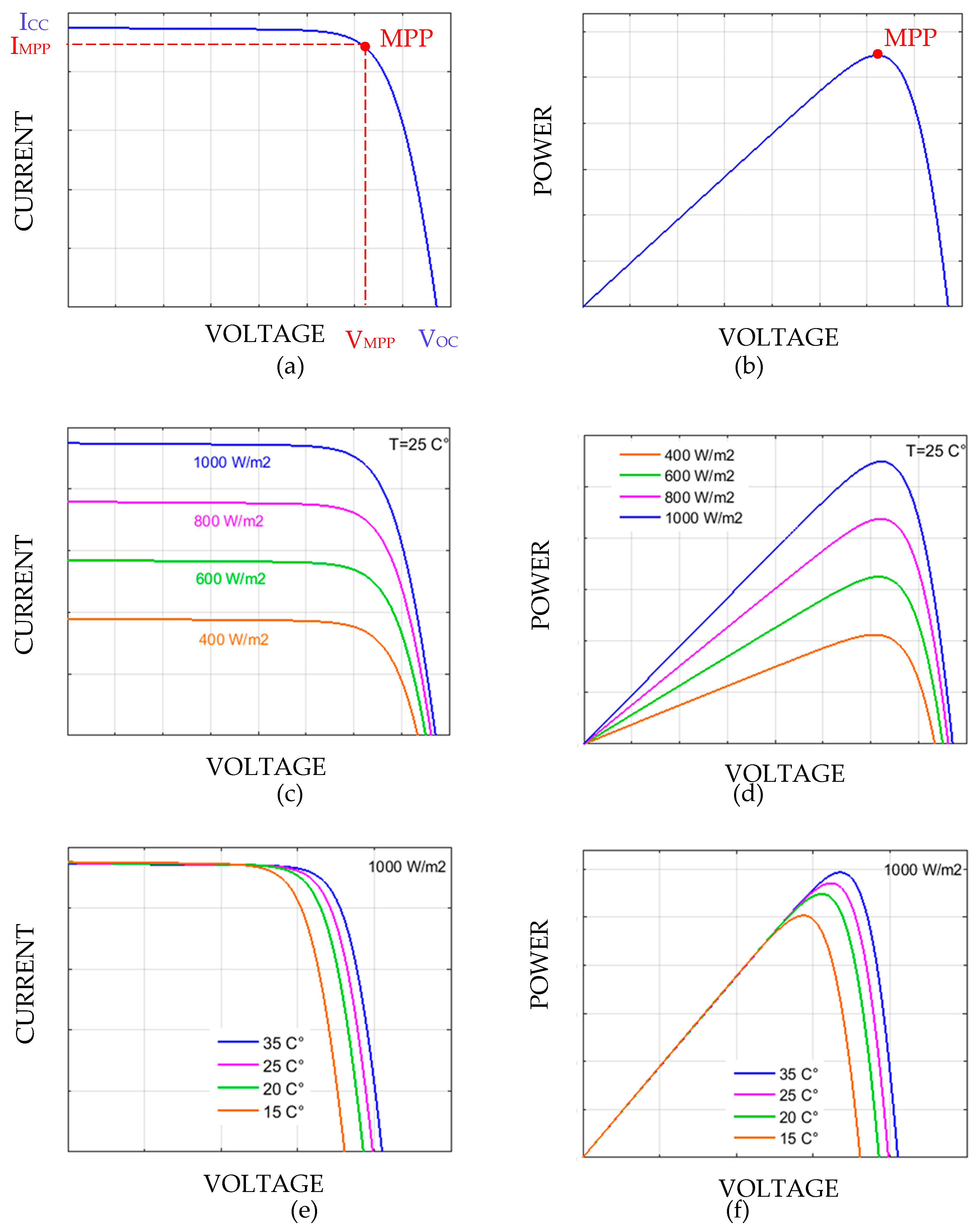
Photovoltaic modules exhibit a nonlinear current–voltage (I-V) and a power–voltage (P-V) characteristic, which are presented in Figure 1a,b. For any given irradiance and temperature condition, there exists a unique operating point, known as the Maximum Power Point, at which the power output of the module is maximized [6,7,8]. The position of this point varies continuously with environmental changes, as shown in Figure 1. MPPT refers to the process of dynamically adjusting the operating voltage or current of the PV array so as to continuously extract the maximum possible power, thereby improving the system’s overall efficiency.
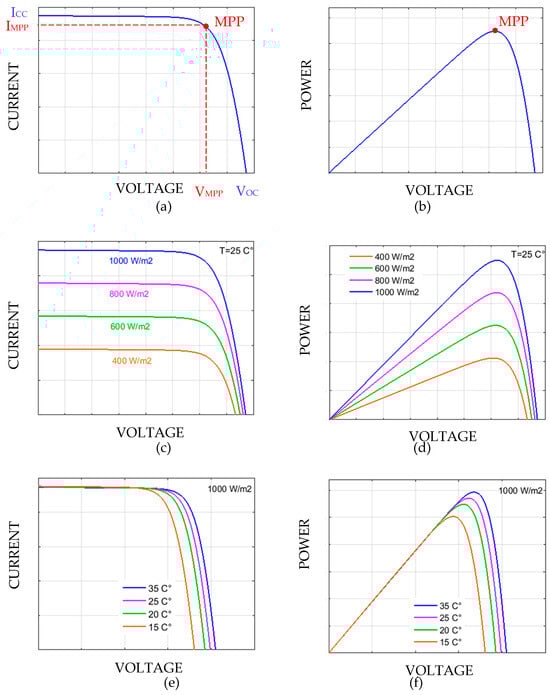
Figure 1.
(a) Current–voltage characteristic; (b) Power–voltage characteristic; (c) Current–Voltage characteristics of a photovoltaic panel under varying illumination levels; (d) Power–Voltage characteristics under varying illumination; (e) Current–Voltage characteristics at different temperatures; (f) Power–Voltage characteristics at different temperatures.
The MPPT controller, typically embedded in a DC-DC converter, monitors electrical signals from the PV module and adjusts the duty cycle to follow the MPP in real time [9]. Without MPPT, significant portions of available solar energy would be lost, especially under rapidly changing weather conditions [9,10]. Several environmental and electrical parameters influence the location of the MPP and thus the performance of the MPPT algorithm:
- Irradiance (G): Solar irradiance directly impacts the current output of PV modules. An increase in irradiance increases power generation, but also shifts the MPP [11].
- Temperature (T): Higher temperatures generally reduce the open-circuit voltage of a PV cell, thus lowering the maximum power output [12].
- Voltage (V): The operating voltage of the PV module determines the power point location. Tracking the voltage corresponding to the MPP is central to MPPT algorithms [13,14].
- Current (I): The output current changes with both load and environmental conditions and is monitored to assess power variations [15].
Figure 1 shows two important curves that describe how a photovoltaic panel works. In part (a), the I–V curve shows how the current changes with voltage. At first, the current stays almost constant, while the voltage increases; then, it suddenly drops near the open-circuit voltage. The point where the product of voltage and current is highest is called the Maximum Power Point; marked by VMPP and IMPP in part (b), the P–V curve shows how the power output increases with voltage until it reaches the MPP, then starts to decrease. This point represents the best operating condition of the panel. MPPT algorithms are used to find and follow this point in real time; so, the system can always produce the maximum power, even when sunlight or temperature changes.
The performance of a photovoltaic panel is simulated to illustrate the effects of varying irradiance and temperature. It can be seen in Figure 1c,d that as irradiance increases, the power output and current of the system also increase. On the other hand, higher temperatures lead to a noticeable decrease in output voltage and overall power, as shown in Figure 1e,f. These trends confirm the strong dependence of photovoltaic performance on environmental conditions, particularly, solar irradiance and temperature.
2.2. General Classification of MPPT Techniques
MPPT techniques are generally divided into four principal categories according to their tracking strategies: traditional methods, intelligent algorithms, optimization-based approaches, and hybrid techniques that combine elements from different categories [15]. Each group follows a unique mechanism to identify and maintain operation at the maximum power point of photovoltaic systems [14,16]. The effectiveness of these methods depends greatly on their ability to adapt to varying environmental factors such as fluctuating sunlight intensity and temperature changes, which affect the power output [17,18]. Table 1 below offers a clear summary of the different classifications of MPPT methods.

Table 1.
Summary of MPPT technique categories and their acronyms.
To ensure a structured and insightful exploration of maximum power point tracking strategies in photovoltaic systems, the remainder of this article is organized into several focused sections. The next one offers a comprehensive presentation of the principal MPPT technique categories: conventional methods, intelligent control algorithms, optimization based approaches, and hybrid techniques that integrate features from two or more categories to enhance adaptability and accuracy.
Following this technical overview, the manuscript delves into a review of scientific research conducted over the past decade, highlighting how various MPPT methods have been implemented and evaluated across different photovoltaic system architectures and under diverse environmental conditions. This critical synthesis draws on experimental studies, simulation results, and real-world deployment data to assess the evolution, performance trends, and research gaps in the field.
Building on these insights, the article then presents a comparative analysis of the reviewed MPPT techniques, examining their operational principles, responsiveness to environmental variations, tracking efficiency, implementation complexity, and computational cost. This comparative study aims to provide a clear understanding of the advantages and limitations of each method, thus guiding researchers and practitioners toward the most appropriate solutions for different application contexts.
3. Classical MPPT Control Methods
3.1. Different Traditional MPPT Techniques
3.1.1. Perturb and Observe Algorithm
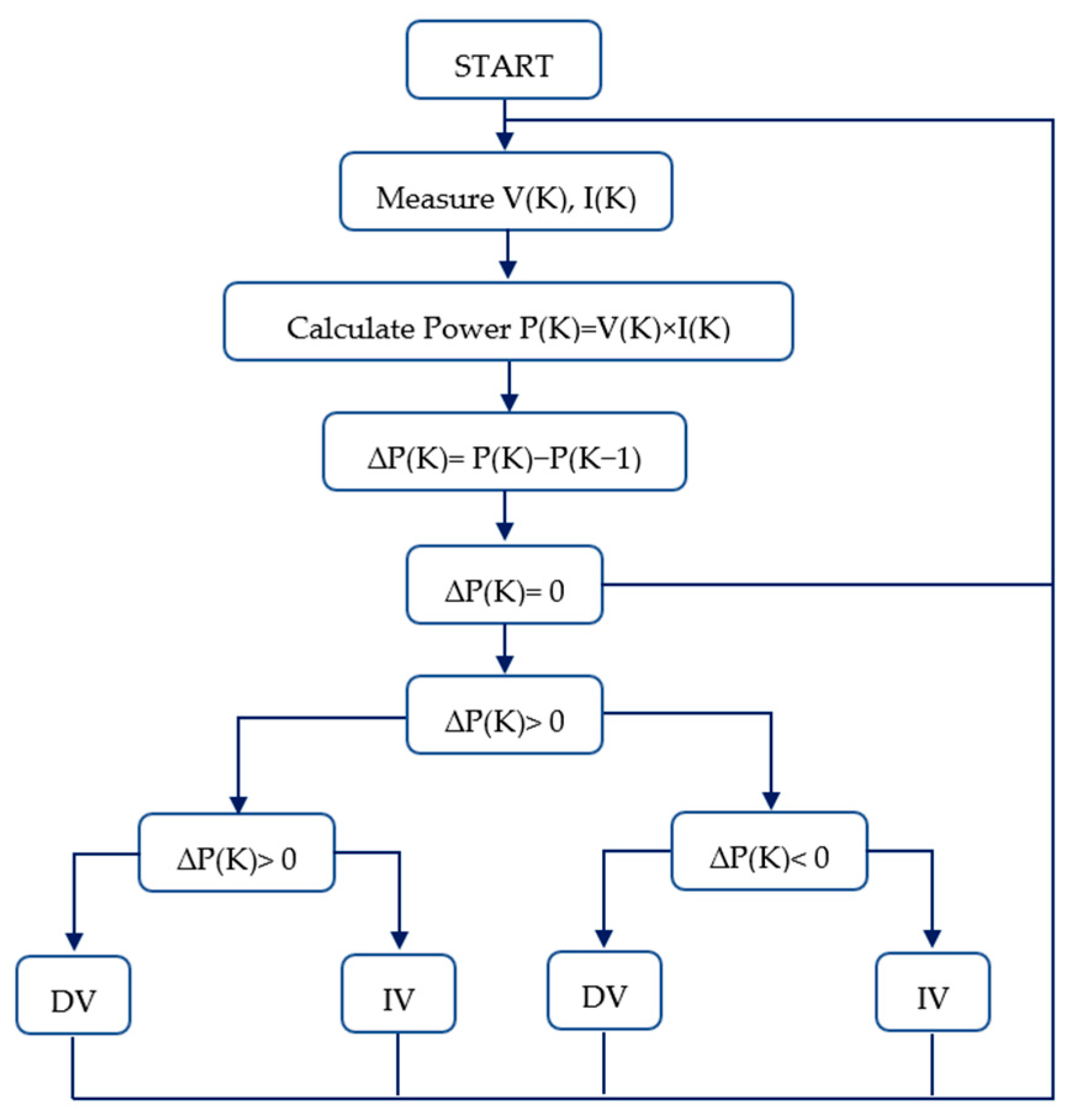
The Perturb and Observe (P&O) algorithm is one of the earliest and most widely adopted methods for maximum power point tracking in photovoltaic systems, particularly because of its simplicity, ease of implementation, and low computational overhead [19]. The core idea of the algorithm is to apply a small perturbation to the PV array voltage (or current) and observe the resulting change in power output [16]. Based on the direction of this change, the system decides whether to continue in the same direction or reverse it to reach the MPP [16,17,18,19].
Mathematically, let P(k) and V(k) denote the power and voltage of the PV system at the k-th sampling instant [20]. The algorithm evaluates the change in power ΔP and the change in voltage ΔV between two successive samples:
ΔP = P(k) − P(k − 1)
ΔV = V(k) − V(k − 1)
The control logic of the P&O algorithm is based on the following decision rule [21]:
- If ΔP > 0 and ΔV > 0: increase voltage (continue in the same direction).
- If ΔP > 0 and ΔV < 0: decrease voltage.
- If ΔP < 0 and ΔV > 0: decrease voltage (reverse direction).
- If ΔP < 0 and ΔV < 0: increase voltage.
The P&O MPPT technique is traditionally implemented using either fixed or adaptive step sizes, allowing for various enhancements in tracking performance [22]. A schematic representation of the algorithm’s operational flow is illustrated in Figure 2.
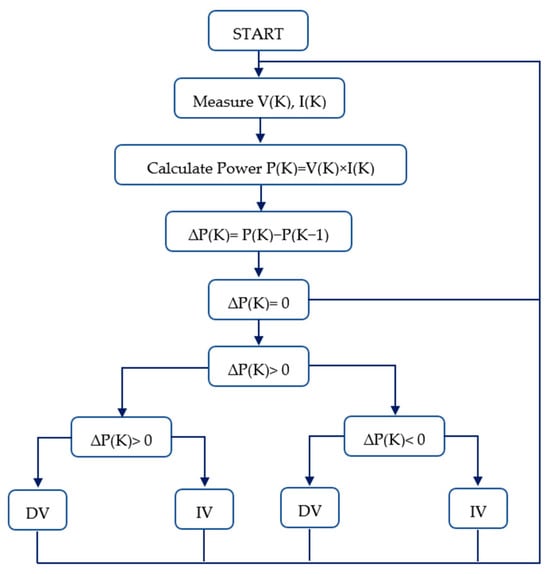
Figure 2.
Step-by-step execution diagram of the P&O algorithm.
3.1.2. Modified Perturb and Observe
The Modified Perturb and Observe (P&O) method is an enhanced version of the conventional P&O technique, developed to address its inherent limitations, such as oscillations around the maximum power point and poor performance under rapidly changing environmental conditions. In the standard P&O algorithm, the system periodically perturbs the operating voltage or current and observes the resulting change in output power to determine the tracking direction [17,18,19,20,21,22,23]. However, this approach can lead to continuous oscillations near the MPP and incorrect tracking when irradiance levels change abruptly [23]. To overcome these issues, several modifications have been introduced to improve accuracy, stability, and responsiveness. The most common enhancements include:
- Adaptive Step Size
Rather than using a fixed perturbation step, the modified P&O method dynamically adjusts the step size based on the proximity to the MPP [23,24]. When far from the MPP, larger steps are used to accelerate convergence, and as the system nears the MPP, smaller steps are applied to minimize oscillations and improve precision [24].
where α is a scaling factor that controls the adaptation rate.
- Decision Delay or Hysteresis
To prevent unnecessary switching and oscillations, a dead zone (hysteresis band) can be introduced. If the change in power ΔP is below a certain threshold, the algorithm maintains the current voltage, assuming that the system is already near the MPP [25].
where ε is a predefined power threshold.
|ΔP| < ε
- Irradiance-Aware Modifications
Some modified P&O algorithms incorporate external inputs such as irradiance or temperature variation rates to differentiate between power changes due to environmental shifts and those caused by perturbations [26]. This helps prevent misinterpretation and improves robustness under dynamic conditions.
3.1.3. Incremental Conductance
The Incremental Conductance method is a widely used traditional MPPT technique that offers higher tracking accuracy compared to the Perturb and Observe method, particularly under rapidly changing environmental conditions [27]. This approach is based on the observation of the slope of the power–voltage curve of a photovoltaic array [27].
At the maximum power point (MPP), the derivative of the output power with respect to the voltage is zero:
Given that power P is the product of current I and voltage V, the derivative becomes:
Setting this to zero at the MPP yields the tracking condition:
Thus, the InC method continuously calculates both the instantaneous conductance and the incremental conductance to determine whether the operating point is below, at, or above the MPP:
- If , the system is operating to the left of the MPP → increase voltage.
- If , the system is operating to the right of the MPP → decrease voltage.
- If , the system is at the MPP → maintain the current voltage.
3.1.4. Modified Incremental Conductance Method
The Modified Incremental Conductance method is an advancement of the conventional InC algorithm, developed to enhance tracking precision and dynamic performance in photovoltaic systems. While the traditional InC technique relies on the comparison between incremental and instantaneous conductance to locate the maximum power point, it can suffer from limitations such as steady-state oscillations and slow response under rapidly changing irradiance conditions [27,28,29].
To address these shortcomings, the modified InC introduces improvements that allow for more intelligent decision-making and smoother operation. One of the key features of the modified approach is the use of adaptive logic to monitor environmental stability [28]. For instance, when the system identifies that the MPP has been reached, it maintains the operating point without further adjustment unless a change in external conditions, such as irradiance or load, is detected [28].
In this improved version, the algorithm can include mechanisms such as:
- Flag-based control to distinguish between tracking and steady-state modes.
- Hysteresis thresholds to avoid unnecessary fluctuations near the MPP.
- Irradiance sensitivity to anticipate and react to abrupt environmental changes.
- Duty cycle freezing during stable conditions to reduce switching losses.
By incorporating these modifications, the algorithm ensures faster convergence to the MPP with reduced oscillations and more robust performance during dynamic weather scenarios [30]. It strikes a balance between precision and speed, making it a popular choice for real-time MPPT applications in modern PV systems [31].
3.1.5. Constant Voltage Method
The Constant Voltage method is one of the simplest MPPT strategies. It assumes that the maximum power point voltage Vmpp remains approximately constant under various irradiance levels [32]. The system operates at a fixed reference voltage, typically determined from prior experimental data or during a calibration phase [33].
The control algorithm compares the PV voltage Vpv to the reference value Vref, and adjusts the duty cycle of the DC-DC converter to maintain the voltage close to Vref [34].
where
Vref ≈ k × Voc
Vref is the target voltage for operation.
Voc is the open-circuit voltage of the PV array.
k is a constant typically between 0.7 and 0.8.
3.1.6. Open-Circuit Voltage Technique
This method is based on the empirical observation that the MPP voltage is a fixed fraction of the open-circuit voltage of the PV panel. Periodically, the PV array is disconnected to measure Voc; then, the system sets the operating voltage to a fraction of it [35].
Vmpp ≈ k × Voc
3.1.7. Short-Circuit Current
Similar in spirit to the OCV method, SCC uses the short-circuit current Isc to estimate the current at the MPP [36]. The PV system is briefly short-circuited to measure Isc, and then the operating current is set to a known fraction of it [37].
where k is typically around 0.9.
Impp ≈ k × ISC
3.1.8. Hill Climbing
Hill Climbing is a dynamic method that adjusts the duty cycle of the converter and monitors the resulting change in output power [38]. If the power increases, the algorithm continues in the same direction. If the power decreases, it reverses the direction of the perturbation [39].
where P(k) is the PV power at the current step.
ΔP = P(k) − P(k − 1)
3.1.9. Fractional Open-Circuit Voltage
This technique improves upon the basic OCV method by using a fixed fraction of Voc without repeatedly measuring it. Instead, the value is estimated from past measurements or stored data [40].
Vmpp = k × Voc
3.1.10. Fractional Short-Circuit Current
As an improvement over SCC, this method uses previously known or estimated values of Isc to determine the current setpoint for the converter, thereby avoiding frequent short-circuiting [41].
Impp = k × ISC
3.1.11. Ripple Correlation Control
Ripple Correlation Control (RCC) utilizes the inherent ripples in voltage and current generated by high-frequency switching converters [42]. It analyzes the correlation between power fluctuations and these ripples to guide the operating point toward the MPP [43].
RCC identifies the sign of based on ripple behavior and adjusts the operating point accordingly [44].
3.2. Overview of Previous Works on Classical MPPT Techniques Developed Between 2015 and 2025
Between 2015 and 2025, considerable research has been dedicated to the refinement and evaluation of classical MPPT techniques, with the objective of improving their performance under diverse operating conditions. Scholars have focused on enhancing traditional algorithms such as Perturb and Observe, Incremental Conductance, and their modified variants, addressing their limitations in terms of tracking speed, accuracy, and the response to rapidly changing irradiance and temperature [45]. Several works have proposed adaptive step size mechanisms and hybrid configurations to reduce steady-state oscillations and improve convergence toward the true maximum power point [45,46]. This section presents a synthesized review of the most significant contributions made during this period, emphasizing the methodological advancements, experimental validations, and practical challenges encountered in implementing classical MPPT strategies in real photovoltaic systems.
3.3. Comparative Summary of Classical MPPT Methods
This part presents a detailed comparative summary of the most widely used classical MPPT techniques. Table 2 below highlights key performance aspects such as algorithmic complexity, responsiveness to environmental variations, tracking precision, and real-time implementation feasibility. These criteria are essential for evaluating the practicality and effectiveness of each method under real-world photovoltaic operating conditions. The comparative analysis aims to assist researchers and engineers in selecting the most suitable approach based on the specific requirements of their PV systems.
Table 2.
Summary of previous works on classical MPPT techniques.
Table 3 provides a comparative overview of classical MPPT control methods. It highlights each method’s complexity, adaptability, accuracy, and suitability for real-time implementation. While simpler approaches like Perturb & Observe and Constant Voltage offer ease of use and fast response, more advanced techniques such as Modified Incremental Conductance deliver higher accuracy and adaptability, albeit with increased complexity.
Table 3.
Comparative summary of classical MPPT control methods.
4. Intelligent MPPT Control Methods
4.1. Different Intelligent MPPT Methods
4.1.1. Fuzzy Logic Control
Fuzzy Logic Control is a heuristic-based MPPT method inspired by human reasoning and linguistic rules [27]. It does not require an exact mathematical model of the photovoltaic system, making it highly adaptable and robust in complex or nonlinear environments [27]. The FLC system typically consists of three components: fuzzification, a rule base (inference engine), and defuzzification [27].
- Fuzzification transforms numerical inputs (like the change in power and voltage) into fuzzy variables [62].
- The inference engine applies a set of “if–then” rules that mimic expert knowledge (If is small and positive, then decrease duty cycle slightly) [27].
- Defuzzification converts the fuzzy output back into a numerical value to adjust the duty cycle [27].
4.1.2. Artificial Neural Network
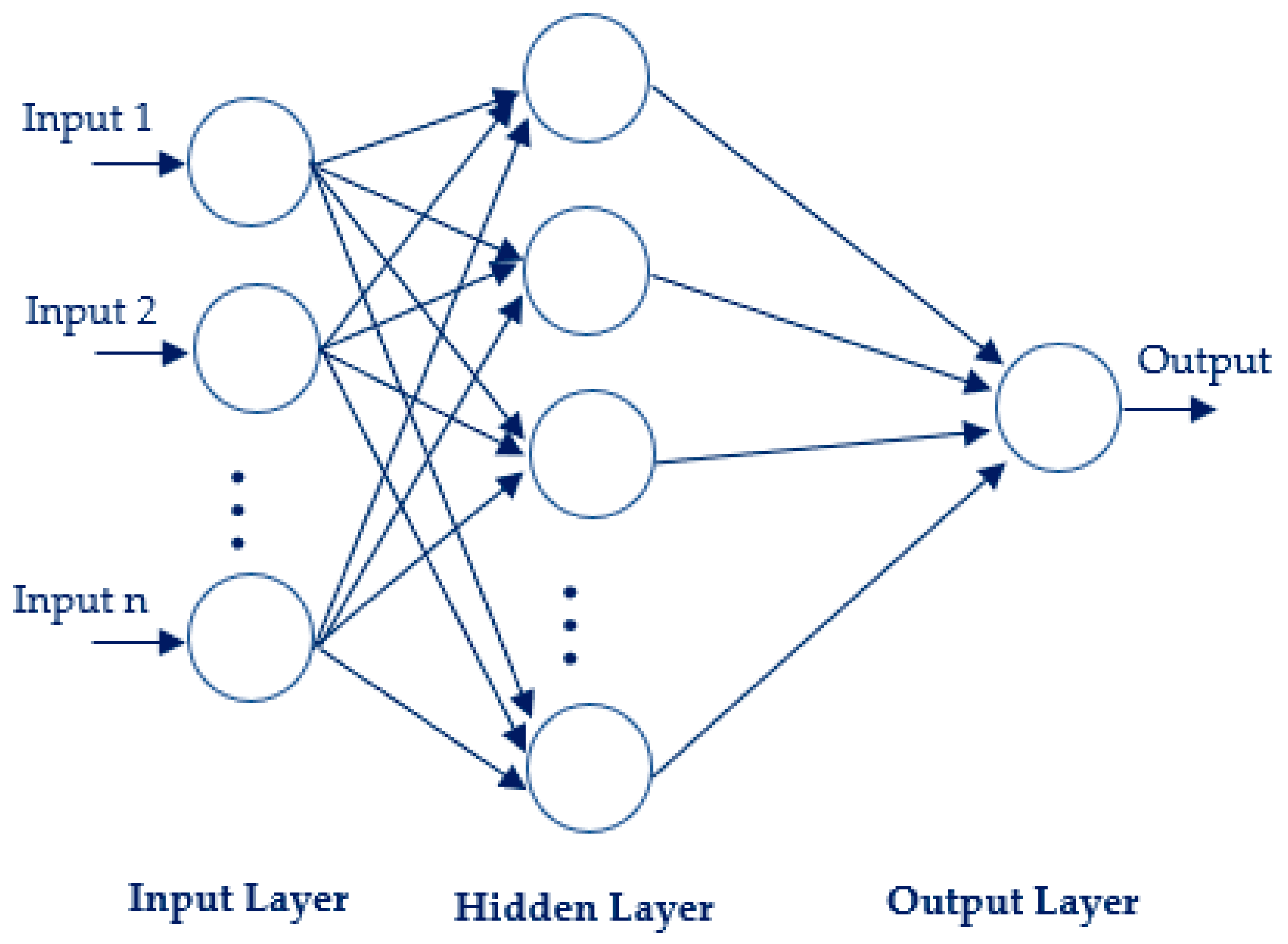
Artificial Neural Networks emulate the human brain’s learning capabilities to identify patterns between input and output parameters in PV systems. Typically, the ANN is trained with historical or simulated data containing variables like solar irradiance, temperature, voltage, and current to predict the optimal operating point [63]. An ANN structure includes an input layer, one or more hidden layers, and an output layer, as illustrated in Figure 3. After training, the ANN can generalize to unseen data, making it suitable for real-time MPPT [64].
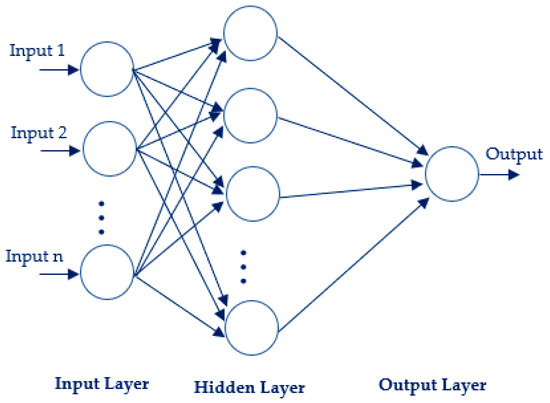
Figure 3.
Layers of ANN.
- The training process uses algorithms such as backpropagation to minimize the mean squared error between predicted and actual outputs [63,64,65].
- Once trained, the ANN directly estimates the duty cycle or voltage corresponding to MPP [65].
4.1.3. Genetic Algorithm
The Genetic Algorithm is an evolutionary optimization method inspired by natural selection [66]. It starts with a population of candidate solutions (different duty cycles) and evolves them over generations through selection, crossover, and mutation operations [66].
The fitness function is often defined as the output power of the PV system [67]:
Fitness = PPV = V × I
4.1.4. Support Vector Machine
Support Vector Machine is a supervised learning model used for classification and regression tasks [68]. In MPPT applications, SVMs are trained to learn the boundary between operating states (power increasing or decreasing) based on input features such as voltage and current variations [69].
4.1.5. Reinforcement Learning
Reinforcement Learning is a dynamic learning technique where an agent interacts with the PV system environment and learns an optimal control policy through rewards [70]. It is particularly useful in environments with uncertainty and time-varying conditions [70].
The agent (controller) chooses actions (increment/decrement duty cycle) based on the current state (voltage, power) [71]. A reward function is designed to reinforce power increases [72]:
Rt = Pt − Pt−1
4.1.6. Decision Tree-Based Control
Decision Tree (DT) models use a tree-like structure where internal nodes represent decision rules, branches represent outcomes, and leaf nodes indicate the final control action (adjust voltage or duty cycle) [73]. The DT is trained on a dataset mapping PV inputs (irradiance, voltage, current) to desired actions [74].
Each decision node splits the data based on a condition, for example, “is dP > 0?”, forming a hierarchy of rules. The model is interpretable, and decisions can be visualized clearly.
4.2. Overview of Previous Works on Intelligent MPPT Techniques Developed Between 2015 and 2025
The Table 4 bellow provides a comprehensive summary of recent research on intelligent MPPT methods published between 2015 and 2025. It highlights the growing trend of integrating artificial intelligence techniques such as fuzzy logic, neural networks, reinforcement learning, and evolutionary algorithms into MPPT control systems. These approaches have demonstrated significant improvements in tracking efficiency, response time, and adaptability under partial shading and rapidly changing environmental conditions, marking a clear evolution beyond traditional MPPT strategies. Table 5 presents a comparative summary of different intelligent MPPT methods.
Table 4.
Summary of previous works on intelligent MPPT techniques.
Table 5.
Comparative summary of intelligent MPPT control methods.
4.3. Comparative Summary of Intelligent MPPT Methods
Table 5 presents a comparison of different intelligent MPPT methods, showing their complexity, adaptability, accuracy, and real-time feasibility. It provides a clear overview of how each method performs and helps the reader quickly understand their strengths and limitations.
5. Optimization MPPT Control Methods
5.1. Different Optimization MPPT Methods
5.1.1. Particle Swarm Optimization
Particle Swarm Optimization is a population-based metaheuristic inspired by the social behavior of bird flocks or fish schools [89]. Each potential solution is represented as a “particle” in a multidimensional space [90]. These particles move within the search space, guided by their own experience and the swarm’s global best position. In the context of MPPT, PSO efficiently searches for the maximum power point by continuously updating each particle’s velocity and position [89,90]. Let xit be the position and Vit the velocity of particle i at iteration t [91].
where pi: personal best; g: global best; w: inertia weight; c1,c2: acceleration coefficients; and r1,r2: random numbers ∈ [0, 1].
Vit+1 = w Vit + c1 r1(pi − xit) + c2 r2(g − xit)
xit+1 = xit + Vit+1
5.1.2. Ant Colony Optimization
Ant Colony Optimization is inspired by the foraging behavior of real ants. In nature, ants find the shortest path to food using pheromone trails [92]. Similarly, in MPPT, artificial ants explore the search space and deposit virtual pheromones to guide the search toward the global MPP [93]. ACO builds a probabilistic model to choose the next step in the path based on the pheromone concentration τ and a heuristic desirability η [94].
where τij: pheromone on path i–j; p: evaporation rate; and Δτij: new pheromone based on quality of solution.
τij(t + 1) = (1 − p)τij(t) + Δτij(t)
5.1.3. Cuckoo Search Optimization
The technique is inspired by the brood parasitism of cuckoos [95]. It uses Lévy flights to generate new solutions and replaces the worse solutions in the population: a cuckoo lays an egg (solution) in a randomly chosen nest, and the best nests are carried to the next generation [95,96].
5.1.4. Differential Evolution
Differential Evolution is an evolutionary algorithm that works with mutation, crossover, and selection [97]. It perturbs solutions using scaled differences between randomly selected individuals in the population [97].
5.1.5. Harmony Search Algorithm
Inspired by the musical improvisation process, HSA mimics musicians adjusting pitches to find a harmonious state [98]. Each solution vector represents a “harmony,” and the algorithm seeks to improve it by either memory consideration, pitch adjustment, or random selection [99].
- Improvisation rule [98]:
5.1.6. Firefly Algorithm
The Firefly algorithm is based on the flashing behavior of fireflies [100]. Fireflies are attracted to brighter ones, and the brightness corresponds to the fitness of a solution [100]. This technique handles complex search spaces effectively and adapts well to the nonlinearity of PV systems under rapid changes [101].
where β0: attractiveness at distance 0; γ: light absorption coefficient; r: distance between fireflies; α: randomization factor; and ϵ: random vector.
5.1.7. Simulated Annealing
Simulated Annealing is inspired by the annealing process in metallurgy [102]. It explores the solution space by accepting not only better solutions but also worse ones, based on a probability that decreases over time [103]. This method is beneficial for escaping local optima and is effective in MPPT scenarios where shading or noise might cause false peaks [103].
5.1.8. Grey Wolf Optimization
This method mimics the hunting behavior and hierarchy of grey wolves [104]. The population is divided into alpha, beta, delta, and omega wolves, with the top three guiding the search [105]. The technique has demonstrated excellent performance in MPPT tasks due to its balance between exploration and exploitation [105].
5.2. Overview of Previous Works on Optimization MPPT Techniques Developed Between 2015 and 2025
Table 6 gives an overview of recent research on optimization-based MPPT techniques for photovoltaic systems published between 2015 and 2025. It summarizes approaches based on metaheuristic and bio-inspired algorithms such as Particle Swarm Optimization (PSO), Firefly Algorithm (FA), Grey Wolf Optimization (GWO), Simulated Annealing (SA), Differential Evolution (DE), Ant Colony Optimization (ACO), Cuckoo Search Optimization (CSO), and Harmony Search Algorithm (HAS). The table highlights how these methods improve performance and offer effective alternatives to classical MPPT strategies.
Table 6.
Summary of previous works on optimization MPPT techniques.
5.3. Comparative Summary of Optimization MPPT Algorithms
Building on the overview provided in Table 6, these optimization-based MPPT methods have demonstrated strong exploration capabilities, the ability to avoid local minima, and adaptability to changing environmental conditions such as partial shading, rapidly fluctuating irradiation, and temperature variations. These characteristics make them robust and high-performing solutions. Table 7 presents a comparative summary of these techniques, showing their complexity, adaptability, accuracy, and suitability for real-time implementation.
Table 7.
Comparative summary of optimization MPPT control methods.
6. Hybrid MPPT Control Methods
6.1. Different Hybrid MPPT Methods
6.1.1. Adaptive Neuro-Fuzzy Inference System (ANFIS)
ANFIS is a hybrid intelligent system that combines the learning capability of neural networks with the reasoning approach of fuzzy logic [117]. In MPPT applications, it effectively models nonlinear PV behavior and adapts to changing conditions, offering high tracking accuracy and strong generalization in complex environments [118].
6.1.2. Fuzzy Logic–Perturb and Observe (FL-P&O)
This method integrates fuzzy logic with the traditional Perturb and Observe algorithm to improve decision-making. The fuzzy controller refines the step size and direction based on input variations, making the MPPT process more stable and less oscillatory under varying irradiance [119].
6.1.3. Artificial Neural Network with Incremental Conductance (ANN-InC)
This hybrid technique leverages the learning and prediction strength of an artificial neural network to enhance the Incremental Conductance algorithm [120]. It predicts the optimal operating point with higher precision, even during fast-changing environmental conditions, thus improving convergence and stability [121].
6.1.4. Genetic Algorithm with Fuzzy Logic Controller (GA-FLC)
This hybrid approach uses a Genetic Algorithm to optimize the parameters of a Fuzzy Logic Controller [122]. The result is a self-adaptive MPPT system that balances simplicity and intelligence, capable of high-performance tracking under uncertain and dynamic weather conditions [122].
6.1.5. ANFIS with Particle Swarm Optimization (ANFIS-PSO)
In this combination, Particle Swarm Optimization is used to fine-tune the membership functions and learning parameters of the ANFIS model [123]. It enhances the learning accuracy and robustness of ANFIS, resulting in faster response and improved tracking during shading or temperature fluctuations [123].
6.1.6. Hybrid Swarm Intelligence Techniques
These techniques blend multiple swarm-based algorithms such as PSO, Ant Colony Optimization, or Grey Wolf Optimizer to leverage their complementary strengths [124]. The hybridization increases exploration and exploitation efficiency, leading to superior MPPT performance under highly dynamic and partial shading conditions [124].
6.2. Overview of Previous Works on Hybrid MPPT Techniques Developed Between 2015 and 2025
Table 8 summarizes recent developments in hybrid MPPT techniques from 2015 to 2025. These approaches combine different MPPT methods to take advantage of their respective strengths, aiming to improve efficiency, adaptability, and stability under varying environmental conditions.
Table 8.
Summary of previous works on hybrid MPPT techniques.
6.3. Comparative Summary of Hybrid MPPT Algorithms
Table 9 shows a comparison between different hybrid MPPT methods used in photovoltaic systems. It highlights their main features, such as tracking speed, accuracy, efficiency under changing conditions, and how easy they are to implement. This comparison helps to clearly see the strengths and weaknesses of each method and choose the most suitable one for improving solar energy performance.
Table 9.
Comparative summary of hybrid MPPT control methods.
Based on the reviewed works, hybrid MPPT methods clearly outperform the other categories in terms of efficiency. Traditional methods like Incremental Conductance show relatively low efficiency, reaching only around 83.79% under standard conditions. Intelligent methods such as ANN and fuzzy logic improve this performance significantly, with ANN-based systems achieving around 88.94% and GA-FLC combinations showing high accuracy under varying conditions. Optimization techniques like PSO and ACO offer even better efficiency, often above 95%. However, hybrid approaches that combine intelligent and optimization methods demonstrate the highest efficiencies overall. For instance, the ANN-InC hybrid reached 97.48%, while the ANFIS-PSO method achieved zero oscillation with strong performance. The most outstanding result was obtained by the PSO-SSO hybrid algorithm, which reached 99.99% efficiency under standard test conditions and 99.52% under partial shading. These findings suggest that hybrid MPPT techniques offer the most effective and reliable performance for photovoltaic energy harvesting, especially in dynamic environments.
7. Criteria for Ranking Different MPPT Methods
To objectively assess the strengths and limitations of the various MPPT categories, a comparative analysis is conducted based on multiple performance criteria including tracking speed, efficiency, adaptability, complexity, and behavior under partial shading. Table 10, presents a synthesized ranking of Classical, Intelligent, Optimization-based, and Hybrid MPPT techniques. It reveals that while classical methods offer simplicity and low hardware demand, they suffer in dynamic and shaded conditions. Intelligent and optimization-based approaches improve tracking precision and adaptability but require more computation and tuning. Hybrid methods consistently achieve the highest efficiency, particularly under challenging scenarios, making them the most promising solutions for modern photovoltaic applications, despite their higher complexity.
Table 10.
Criteria for ranking different MPPT methods.
8. Discussion and Recommendations for Future Research
The comparative analysis of various MPPT techniques highlights clear differences in terms of performance, complexity, and adaptability. Classical methods remain attractive due to their simplicity and low cost, but their limitations become apparent under unstable or rapidly changing sunlight conditions. In contrast, intelligent and optimization-based approaches offer improved tracking accuracy and faster response, especially in partially shaded or dynamic environments. However, these methods often require more hardware resources and careful tuning. Hybrid techniques, by combining the strengths of both approaches, currently achieve the best performance, frequently exceeding efficiencies of 99.5%, with remarkable stability and very fast response times.
That said, their complexity still poses a barrier to widespread and cost-effective implementation. Therefore, future researchers are strongly encouraged to focus on simplifying these hybrid methods while preserving their high performance. It would also be valuable to develop algorithms capable of automatically adapting to environmental variations without the need for human intervention or manual tuning. The integration of artificial intelligence, machine learning, and the Internet of Things could pave the way for smarter, predictive, and autonomous MPPT systems better suited to modern power grids. In summary, future research should aim to develop solutions that are efficient, intelligent, accessible, and ready to meet the demands of tomorrow’s photovoltaic systems.
9. Conclusions
This review has provided a detailed exploration of MPPT techniques applied in photovoltaic systems, with a focus on improving energy conversion efficiency under varying environmental conditions. Classical methods, though widely used, are often limited by steady state oscillations and slower dynamic responses. Intelligent approaches, particularly those based on fuzzy logic and neural networks, offer better adaptability but depend heavily on the quality of the training or rule-based design. Optimization-based algorithms, inspired by nature and swarm intelligence, have shown promising tracking performance, with improved accuracy and response speed. However, it is the hybrid MPPT methods that emerge as the most efficient and robust solutions, combining the advantages of multiple strategies to overcome individual limitations. These hybrid models consistently demonstrated superior performance, with some achieving efficiency levels exceeding 99.9% under standard test conditions and maintaining high effectiveness under partial shading. Looking ahead, future work should focus on the real-time implementation of hybrid MPPT controllers, their scalability in large PV systems, and reducing computational complexity while maintaining accuracy. Integration with smart grid technologies and adaptive control mechanisms based on real-time data analytics can further enhance reliability and energy yield in practical applications.
Author Contributions
Conceptualization, M.B.; methodology, M.B.; validation, M.B., M.M. and M.N.S.; formal analysis, M.B.; investigation, M.B.; resources, M.B.; data curation, M.B.; writing—original draft preparation, M.B.; writing—review and editing, M.B., M.M. and M.N.S.; supervision, M.N.S.; project administration, M.B. All authors have read and agreed to the published version of the manuscript.
Funding
This research received no external funding.
Institutional Review Board Statement
Not applicable.
Informed Consent Statement
Not applicable.
Data Availability Statement
The datasets generated and analyzed during the current study are available from the corresponding author on reasonable request.
Conflicts of Interest
The authors declare no conflicts of interest.
References
- Bouksaim, M.; Krami, N.; Acci, Y.; Srifi, M.N.; Hadjouja, A. Modeling of photovoltaic module using maximum power point tracking controller. In Proceedings of the 2018 International Symposium on Advanced Electrical and Communication Technologies (ISAECT), Rabat, Morocco, 21–23 November 2018; pp. 1–4. [Google Scholar]
- Bouksaim, M.; Acci, Y.; Srifi, M.N. Modeling of Grid-Connected Photovoltaic System Installation in Moroccan Ibn Tofail Uni-versity. Adv. Sci. Technol. Eng. Syst. J. 2019, 4, 150–155. [Google Scholar] [CrossRef]
- Li, C.; Chen, Y.; Zhou, D. A high-performance adaptive incremental conductance MPPT algorithm for photovoltaic systems. Energies 2016, 9, 288. [Google Scholar] [CrossRef]
- Marroquín-Arreola, R.; Lezama, J.; Hernández-De León, H.R.; Martínez-Romo, J.C.; Hoyo-Montaño, J.A.; Camas-Anzueto, J.L.; Santos-Ruiz, I. Design of an MPPT technique for the indirect measurement of the open-circuit voltage applied to thermoelectric generators. Energies 2022, 15, 3833. [Google Scholar] [CrossRef]
- Khatri, M.; Kumar, A. Simulation and experimental validation of hill-climbing algorithm for maximum power point tracking of solar photovoltaic plant. Curr. Sci. 2017, 113, 1423. [Google Scholar] [CrossRef]
- Radu, P.V.; Lewandowski, M.; Szelag, A. Short-circuit fault current modeling of a dc light rail system with a wayside energy storage device. Energies 2022, 15, 3527. [Google Scholar] [CrossRef]
- BOUBAKER, O. MPPT techniques for photovoltaic systems: A systematic review in current trends and recent advances in artificial intelligence. Discov. Energy 2023, 3, 9. [Google Scholar] [CrossRef]
- Mohamed, S.A.; Abd El Sattar, M. A comparative study of P&O and INC maximum power point tracking techniques for grid-connected PV systems. SN Appl. Sci. 2019, 1, 174. [Google Scholar]
- Hayder, W.; Ogliari, E.; Dolara, A. Improved PSO: A comparative study in MPPT algorithm for PV system control under partial shading conditions. Energies 2020, 13, 2035. [Google Scholar] [CrossRef]
- Hammami, M.; Grandi, G.; Rudan, M. RCC-MPPT algorithms for single-phase PV systems in case of multiple DC harmonics. In Proceedings of the 2017 6th International Conference on Clean Electrical Power (ICCEP), Santa Margherita Ligure, Italy, 27–29 June 2017; IEEE: Piscataway, NJ, USA, 2017; pp. 678–683. [Google Scholar]
- Frydrychowicz-Jastrzębska, G.; Bugała, A. Solar tracking system with new hybrid control in energy production optimization from photovoltaic conversion for polish climatic conditions. Energies 2021, 14, 2938. [Google Scholar] [CrossRef]
- Solís-Cervantes, C.U.; Palomino-Resendiz, S.I.; Flores-Hernández, D.A.; Peñaloza-López, M.A.; Montelongo-Vazquez, C.M. Design and implementation of extremum-seeking control based on mppt for dual-axis solar tracker. Mathematics 2024, 12, 1913. [Google Scholar] [CrossRef]
- Naima, B.; Belkacem, B.; Ahmed, T.; Benbouhenni, H.; Riyadh, B.; Samira, H.; Sarra, H.; Elbarbary, Z.M.S.; Mohammed, S.A. Enhancing MPPT optimization with hybrid predictive control and adaptive P&O for better efficiency and power quality in PV systems. Sci. Rep. 2025, 15, 24559. [Google Scholar] [CrossRef]
- Giurgi, G.I.; Szolga, L.A.; Giurgi, D.V. Benefits of fuzzy logic on MPPT and PI controllers in the chain of photovoltaic control systems. Appl. Sci. 2022, 12, 2318. [Google Scholar] [CrossRef]
- Bradai, R.; Boukenoui, R.; Kheldoun, A.; Salhi, H.; Ghanes, M.; Barbot, J.P.; Mellit, A. Experimental assessment of new fast MPPT algorithm for PV systems under non-uniform irradiance conditions. Appl. Energy 2017, 199, 416–429. [Google Scholar] [CrossRef]
- Khodair, D.; Motahhir, S.; Mostafa, H.H.; Shaker, A.; Munim, H.A.E.; Abouelatta, M.; Saeed, A. Modeling and simulation of modified MPPT techniques under varying operating climatic conditions. Energies 2023, 16, 549. [Google Scholar] [CrossRef]
- Pavithra, C.; Kb, S.A. Comparison of Solar P&O and FLC-based MPPT Controllers & Analysis under Dynamic Conditions. EAI Endorsed Trans. Energy Web 2024, 11, 1. [Google Scholar]
- Villegas-Mier, C.G.; Rodriguez-Resendiz, J.; Álvarez-Alvarado, J.M.; Rodriguez-Resendiz, H.; Herrera-Navarro, A.M.; Rodríguez-Abreo, O. Artificial neural networks in MPPT algorithms for optimization of photovoltaic power systems: A review. Micromachines 2021, 12, 1260. [Google Scholar] [CrossRef]
- Roy, B.; Adhikari, S.; Datta, S.; Devi, K.J.; Devi, A.D.; Ustun, T.S. Harnessing Deep Learning for Enhanced MPPT in Solar PV Systems: An LSTM Approach Using Real-World Data. Electricity 2024, 5, 843–860. [Google Scholar] [CrossRef]
- Kavya, M.; Jayalalitha, S. Developments in perturb and observe algorithm for maximum power point tracking in photo voltaic panel: A review. Arch. Comput. Methods Eng. 2021, 28, 2447–2457. [Google Scholar] [CrossRef]
- Sudhakar, G.; Kumari, J.S. Design and Analysis of P&O and FLC MPPT Techniques for Photovoltaic System. IRET Trans. Power Electron. Drives (ITPED) 2013, 1, 17–23. [Google Scholar]
- Ramadan, H.; Youssef, A.R.; Mousa, H.H.; Mohamed, E.E. An efficient variable-step P&O maximum power point tracking technique for grid-connected wind energy conversion system. SN Appl. Sci. 2019, 1, 1658. [Google Scholar]
- AL-Shetwi, A.Q.; Sujod, M.Z. Grid-connected photovoltaic power plants: A review of the recent integration requirements in modern grid codes. Int. J. Energy Res. 2018, 42, 1849–1865. [Google Scholar] [CrossRef]
- Alik, R.; Jusoh, A. Modified Perturb and Observe (P&O) with checking algorithm under various solar irradiation. Sol. Energy 2017, 148, 128–139. [Google Scholar] [CrossRef]
- Mousa, H.H.; Youssef, A.-R.; Mohamed, E.E. Study of robust adaptive step-sizes P&O MPPT algorithm for high-inertia WT with direct-driven multiphase PMSG. Int. Trans. Electr. Energy Syst. 2019, 29, e12090. [Google Scholar]
- Rajamand, S. A novel sliding mode control and modified PSO-modified P&O algorithms for peak power control of PV. ISA Trans. 2022, 130, 533–552. [Google Scholar]
- Bouksaim, M.; Mekhfioui, M.; Srifi, M.N. Design and implementation of modified INC, conventional INC, and fuzzy logic controllers applied to a PV system under variable weather conditions. Designs 2021, 5, 71. [Google Scholar] [CrossRef]
- Uprety, S.; Lee, H. A 0.65-mW-to-1-W photovoltaic energy harvester with irradiance-aware auto-configurable hybrid MPPT achieving > 95% MPPT efficiency and 2.9-ms FOCV transient time. IEEE J. Solid-State Circuits 2020, 56, 1827–1836. [Google Scholar] [CrossRef]
- Chafle, S.R.; Vaidya, U.B. Incremental conductance MPPT technique FOR PV system. Int. J. Adv. Res. Electr. Electron. Instrum. Eng. 2013, 2, 2720–2726. [Google Scholar]
- Tey, K.S.; Mekhilef, S. Modified incremental conductance MPPT algorithm to mitigate inaccurate responses under fast-changing solar irradiation level. Sol. Energy 2014, 101, 333–342. [Google Scholar] [CrossRef]
- Sabo, A.; Kolapo, B.Y.; Odoh, T.E.; Dyari, M.; Abdul Wahab, N.I.; Veerasamy, V. Solar, wind and their hybridization integration for multi-machine power system oscillation controllers optimization: A review. Energies 2022, 16, 24. [Google Scholar] [CrossRef]
- Lasheen, M.; Rahman, A.K.A.; Abdel-Salam, M.; Ookawara, S. Performance enhancement of constant voltage based MPPT for photovoltaic applications using genetic algorithm. Energy Procedia 2016, 100, 217–222. [Google Scholar] [CrossRef]
- Lasheen, M.; Abdel Rahman, A.K.; Abdel-Salam, M.; Ookawara, S. Adaptive reference voltage-based MPPT technique for PV applications. IET Renew. Power Gener. 2017, 11, 715–722. [Google Scholar] [CrossRef]
- Alhasnawi, B.N.; Jasim, B.H.; Alhasnawi, A.N.; Sedhom, B.E.; Jasim, A.M.; Khalili, A.; Bureš, V.; Burgio, A.; Siano, P. A novel approach to achieve MPPT for photovoltaic system based SCADA. Energies 2022, 15, 8480. [Google Scholar] [CrossRef]
- Das, P. Maximum power tracking based open circuit voltage method for PV system. Energy Procedia 2016, 90, 2–13. [Google Scholar] [CrossRef]
- Büyükgüzel, B.; Aksoy, M. A current-based simple analog MPPT circuit for PV systems. Turk. J. Electr. Eng. Comput. Sci. 2016, 24, 3621–3637. [Google Scholar] [CrossRef]
- Ibrahim, A.A.E.; Ramadan, M.R.I.; Aboul-Enein, S.; ElSebaii, A.A.A.; El-Broullesy, S.M. Short circuit current Isc as a real non-destructive diagnostic tool of a photovoltaic modules performance. Int. J. Renew. Energy Res. 2011, 1, 162–168. [Google Scholar]
- Fapi, C.B.N.; Wira, P.; Kamta, M.; Badji, A.; Tchakounte, H. Real-time experimental assessment of hill climbing MPPT algorithm enhanced by estimating a duty cycle for PV system. Int. J. Renew. Energy Res. 2019, 9, 1180–1189. [Google Scholar] [CrossRef]
- Sabir, B.; Lu, S.D.; Liu, H.D.; Lin, C.H.; Sarwar, A.; Huang, L.Y. A novel isolated intelligent adjustable buck-boost converter with hill climbing MPPT algorithm for solar power systems. Processes 2023, 11, 1010. [Google Scholar] [CrossRef]
- Hsu, T.W.; Wu, H.H.; Tsai, D.L.; Wei, C.L. Photovoltaic energy harvester with fractional open-circuit voltage based maximum power point tracking circuit. IEEE Trans. Circuits Syst. II Express Briefs 2018, 66, 257–261. [Google Scholar] [CrossRef]
- Fapi, C.B.N.; Wira, P.; Kamta, M.; Tchakounté, H.; Colicchio, B. Simulation and dSPACE hardware implementation of an improved fractional short-circuit current MPPT algorithm for photovoltaic system. Appl. Sol. Energy 2021, 57, 93–106. [Google Scholar]
- Hammami, M.; Grandi, G. A single-phase multilevel PV generation system with an improved ripple correlation control MPPT algorithm. Energies 2017, 10, 2037. [Google Scholar] [CrossRef]
- Hammami, M.; Ricco, M.; Ruderman, A.; Grandi, G. Three-phase three-level flying capacitor PV generation system with an embedded ripple correlation control MPPT algorithm. Electronics 2019, 8, 118. [Google Scholar] [CrossRef]
- Srinivas, C.L.; Sreeraj, E.S. A maximum power point tracking technique based on ripple correlation control for single phase photovoltaic system with fuzzy logic controller. Energy Procedia 2016, 90, 69–77. [Google Scholar] [CrossRef]
- Kumba, K.; Upender, P.; Buduma, P.; Sarkar, M.; Simon, S.P.; Gundu, V. Solar tracking systems: Advancements, challenges, and future directions: A review. Energy Rep. 2024, 12, 3566–3583. [Google Scholar] [CrossRef]
- Sadeghi, R.; Parenti, M.; Memme, S.; Fossa, M.; Morchio, S. A Review and Comparative Analysis of Solar Tracking Systems. Energies 2025, 18, 2553. [Google Scholar] [CrossRef]
- Mamatha, G. Perturb and observe MPPT algorithm implementation for PV applications. Int. J. Comput. Sci. Inf. Technol. 2015, 6, 1884–1887. [Google Scholar]
- Ahmed, J.; Salam, Z. An improved perturb and observe (P&O) maximum power point tracking (MPPT) algorithm for higher efficiency. Appl. Energy 2015, 150, 97–108. [Google Scholar] [CrossRef]
- Loukriz, A.; Haddadi, M.; Messalti, S. Simulation and experimental design of a new advanced variable step size Incremental Conductance MPPT algorithm for PV systems. ISA Trans. 2016, 62, 30–38. [Google Scholar] [CrossRef]
- Siouane, S.; Jovanović, S.; Poure, P. Influence of contact thermal resistances on the Open Circuit Voltage MPPT method for Thermoelectric Generators. In Proceedings of the 2016 IEEE International Energy Conference (ENERGYCON), Leuven, Belgium, 4–8 April 2016; IEEE: Piscataway, NJ, USA, 2016; pp. 1–6. [Google Scholar]
- Bahari, M.I.; Tarassodi, P.; Naeini, Y.M.; Khalilabad, A.K.; Shirazi, P. Modeling and simulation of hill climbing MPPT algorithm for photovoltaic application. In Proceedings of the 2016 International Symposium on Power Electronics, Electrical Drives, Automation and Motion (SPEEDAM), Capri, Italy, 22–24 June 2016; IEEE: Piscataway, NJ, USA, 2016; pp. 1041–1044. [Google Scholar]
- Nadeem, A.; Sher, H.A.; Murtaza, A.F.; Ahmed, N. Online current-sensorless estimator for PV open circuit voltage and short circuit current. Sol. Energy 2021, 213, 198–210. [Google Scholar] [CrossRef]
- Sahu, P.; Dey, R. A Comparative Analysis of IC and RCC MPPT Techniques for High-Power PV Systems. In Smart and Intelligent Systems: Proceedings of SIS 2021; Springer: Singapore, 2021; pp. 317–330. [Google Scholar]
- Jain, K.; Gupta, M.; Bohre, A.K. Implementation and comparative analysis of P&O and INC MPPT method for PV system. In Proceedings of the 2018 8th IEEE India International Conference on Power Electronics (IICPE), Jaipur, India, 13–15 December 2018; IEEE: Piscataway, NJ, USA, 2019; pp. 1–6. [Google Scholar]
- Ali, A.I.M.; Mohamed, H.R.A. Improved P&O MPPT algorithm with efficient open-circuit voltage estimation for two-stage grid-integrated PV system under realistic solar radiation. Int. J. Electr. Power Energy Syst. 2022, 137, 107805. [Google Scholar]
- Çakmak, F.; Aydoğmuş, Z.; Tür, M.R. Analysis of open circuit voltage MPPT method with analytical analysis with perturb and observe (P&O) MPPT method in PV systems. Electr. Power Compon. Syst. 2024, 52, 1528–1542. [Google Scholar]
- Sun, C.; Ling, J.; Wang, J. Research on a novel and improved incremental conductance method. Sci. Rep. 2022, 12, 15700. [Google Scholar] [CrossRef] [PubMed]
- Ulinuha, A.; Zulfikri, A. Enhancement of solar photovoltaic using maximum power point tracking based on hill climbing optimization algorithm. J. Phys. Conf. Ser. 2020, 1517, 012096. [Google Scholar] [CrossRef]
- Belabed, M.; Bechekir, S.; Brahami, M.; Bendaho, H.; Brahimi, A.; Bousmaha, I.S. Comparative Analysis of MPPT Algorithms: P&O and Inc for Optimizing PV Systems. In Proceedings of the International Conference on Artificial Intelligence in Renewable Energetic Systems, Tipasa, Algeria, 25–27 October 2024; Springer Nature: Cham, Switzerland, 2025; pp. 60–70. [Google Scholar]
- Gaherwar, N.; Singh, S.P.; Tyagi, R. High-Efficiency Boost Converter Design for PV Systems Using P&O MPPT. In Proceedings of the 2025 IEEE 1st International Conference on Smart and Sustainable Developments in Electrical Engineering (SSDEE), Dhanbad, India, 28 February–2 March 2025; IEEE: Piscataway, NJ, USA, 2025; pp. 1–6. [Google Scholar]
- Ramírez Torres, J.A.; Lastres Danguillecourt, O.; González Domínguez, R.A.; Ibáñez Duharte, G.R.; Verea Valladares, L.E.; Pantoja Enríquez, J.; Verde Añorve, A. Development and Implementation of the MPPT Based on Incremental Conductance for Voltage and Frequency Control in Single-Stage DC-AC Converters. Energies 2025, 18, 184. [Google Scholar] [CrossRef]
- Hannan, M.A.; Ghani, Z.A.; Hoque, M.M.; Ker, P.J.; Hussain, A.; Mohamed, A. Fuzzy logic inverter controller in photovoltaic applications: Issues and recommendations. IEEE Access 2019, 7, 24934–24955. [Google Scholar] [CrossRef]
- Elsheikh, A.H.; Sharshir, S.W.; Abd Elaziz, M.; Kabeel, A.E.; Guilan, W.; Haiou, Z. Modeling of solar energy systems using artificial neural network: A comprehensive review. Sol. Energy 2019, 180, 622–639. [Google Scholar] [CrossRef]
- Zakaria, M.; Mabrouka, A.S.; Sarhan, S. Artificial neural network: A brief overview. Neural Netw. 2014, 1, 2. [Google Scholar]
- Alardhi, S.M.; Al-Jadir, T.; Hasan, A.M.; Jaber, A.A.; Al Saedi, L.M. Design of artificial neural network for prediction of hydrogen sulfide and carbon dioxide concentrations in a natural gas sweetening plant. Ecol. Eng. Environ. Technol. 2023, 24, 55–66. [Google Scholar] [CrossRef]
- Rotar, C.; Iantovics, L.B. Directed evolution: A new metaheuristc for optimization. J. Artif. Intell. Soft Comput. Res. 2017, 7, 183–200. [Google Scholar] [CrossRef]
- Batool, M.; Shahnia, F.; Islam, S.M. Impact of scaled fitness functions on a floating-point genetic algorithm to optimise the operation of standalone microgrids. IET Renew. Power Gener. 2019, 13, 1280–1290. [Google Scholar] [CrossRef]
- Sarang, P. Support vector machines: A supervised learning algorithm for classification and regression. In Thinking Data Science: A Data Science Practitioner’s Guide; Springer International Publishing: Cham, Switzerland, 2023; pp. 153–165. [Google Scholar]
- Mahesh, P.V.; Meyyappan, S.; Alla, R. Support vector regression machine learning based maximum power point tracking for solar photovoltaic systems. Int. J. Electr. Comput. Eng. Syst. 2023, 14, 100–108. [Google Scholar] [CrossRef]
- Su, T.; Wu, T.; Zhao, J.; Scaglione, A.; Xie, L. A review of safe reinforcement learning methods for modern power systems. arXiv 2024, arXiv:2407.00304. [Google Scholar] [CrossRef]
- Chang, Y.; Matsumoto, K.; Narumi, T.; Tanikawa, T.; Hirose, M. Redirection controller using reinforcement learning. IEEE Access 2021, 9, 145083–145097. [Google Scholar] [CrossRef]
- Zhang, Y.; Wang, X.; Wang, J.; Zhang, Y. Deep reinforcement learning based volt-var optimization in smart distribution systems. IEEE Trans. Smart Grid 2020, 12, 361–371. [Google Scholar] [CrossRef]
- Pandiyan, P.; Saravanan, S.; Prabaharan, N.; Tiwari, R.; Chinnadurai, T.; Babu, N.R.; Hossain, E. Implementation of different MPPT techniques in solar PV tree under partial shading conditions. Sustainability 2021, 13, 7208. [Google Scholar] [CrossRef]
- Tina, G.M.; Ventura, C.; Ferlito, S.; De Vito, S. A state-of-art-review on machine-learning based methods for PV. Appl. Sci. 2021, 11, 7550. [Google Scholar] [CrossRef]
- Cheng, P.C.; Peng, B.R.; Liu, Y.H.; Cheng, Y.S.; Huang, J.W. Optimization of a fuzzy-logic-control-based MPPT algorithm using the particle swarm optimization technique. Energies 2015, 8, 5338–5360. [Google Scholar] [CrossRef]
- Rizzo, S.A.; Scelba, G. ANN based MPPT method for rapidly variable shading conditions. Appl. Energy 2015, 145, 124–132. [Google Scholar] [CrossRef]
- Kofinas, P.; Doltsinis, S.; Dounis, A.I.; Vouros, G.A. A reinforcement learning approach for MPPT control method of photovoltaic sources. Renew. Energy 2017, 108, 461–473. [Google Scholar] [CrossRef]
- Hadji, S.; Gaubert, J.P.; Krim, F. Theoretical and experimental analysis of genetic algorithms based MPPT for PV systems. Energy Procedia 2015, 74, 772–787. [Google Scholar] [CrossRef]
- Al-Gizi, A.G.; Al-Chlaihawi, S.J. Study of FLC based MPPT in comparison with P&O and InC for PV systems. In Proceedings of the 2016 International Symposium on Fundamentals of Electrical Engineering (ISFEE), Bucharest, Romania, 30 June–2 July 2016; IEEE: Piscataway, NJ, USA, 2017; pp. 1–6. [Google Scholar]
- Mahesh, P.V.; Meyyappan, S.; Alla, R.R. Maximum power point tracking using decision-tree machine-learning algorithm for photovoltaic systems. Clean Energy 2022, 6, 762–775. [Google Scholar] [CrossRef]
- González-Castaño, C.; Marulanda, J.; Restrepo, C.; Kouro, S.; Alzate, A.; Rodriguez, J. Hardware-in-the-loop to test an MPPT technique of solar photovoltaic system: A support vector machine approach. Sustainability 2021, 13, 3000. [Google Scholar] [CrossRef]
- Al-Majidi, S.D.; Abbod, M.F.; Al-Raweshidy, H.S. Design of an intelligent MPPT based on ANN using a real photovoltaic system data. In Proceedings of the 2019 54th International Universities Power Engineering Conference (UPEC), Bucharest, Romania, 3–6 September 2019; IEEE: Piscataway, NJ, USA, 2019; pp. 1–6. [Google Scholar]
- Yilmaz, U.; Kircay, A.; Borekci, S. PV system fuzzy logic MPPT method and PI control as a charge controller. Renew. Sustain. Energy Rev. 2018, 81, 994–1001. [Google Scholar] [CrossRef]
- Phan, B.C.; Lai, Y.-C.; Lin, C.E. A deep reinforcement learning-based MPPT control for PV systems under partial shading condition. Sensors 2020, 20, 3039. [Google Scholar] [CrossRef]
- Wadehra, A.; Bhalla, S.; Jaiswal, V.; Rana, K.P.S.; Kumar, V. A deep recurrent reinforcement learning approach for enhanced MPPT in PV systems. Appl. Soft Comput. 2024, 162, 111728. [Google Scholar] [CrossRef]
- Aboras, K.M.; El-Banna, M.H.; Megahed, A.I. A unique novel-based FLC approach for enhancing MPPT operation of solar systems considering sudden/gradual variation in weather conditions. Sci. Prog. 2025, 108, 00368504251323732. [Google Scholar] [CrossRef] [PubMed]
- Gayathri, A.R.; Natarajan, K.; Matcha, M.; Aravinda, K. Enhanced modelling and control strategy for grid-connected PV system utilizing high-gain Quasi-Z source converter and optimized ANN-MPPT algorithm. Electr. Eng. 2025, 107, 4921–4938. [Google Scholar] [CrossRef]
- Sangeetha, S.; Manikandan, G.; Bhuvaneswari, G.; Meenakshi, B.; Sujatha, S. SVM-based Predictive Modeling for Sustainable Solar Solutions in Off-Grid Areas. In Proceedings of the 2025 5th International Conference on Trends in Material Science and Inventive Materials (ICTMIM), Kanyakumari, India, 7–9 April 2025; IEEE: Piscataway, NJ, USA, 2025; pp. 547–552. [Google Scholar]
- Pop, C.B.; Cioara, T.; Anghel, I.; Antal, M.; Chifu, V.R.; Antal, C.; Salomie, I. Review of bio-inspired optimization applications in renewable-powered smart grids: Emerging population-based metaheuristics. Energy Rep. 2022, 8, 11769–11798. [Google Scholar] [CrossRef]
- Abualigah, L.; Sheikhan, A.; Ikotun, A.M.; Zitar, R.A.; Alsoud, A.R.; Al-Shourbaji, I.; Hussien, A.G.; Jia, H. Particle swarm optimization algorithm: Review and applications. In Metaheuristic Optimization Algorithms; Elsevier: Amsterdam, The Netherlands, 2024; pp. 1–14. [Google Scholar] [CrossRef]
- Taha, S.A.; Al-Sagar, Z.S.; Abdulsada, M.A.; Alruwaili, M.; Ibrahim, M.A. Design of an efficient MPPT topology based on a grey wolf optimizer-particle swarm Optimization (GWO-PSO) algorithm for a grid-tied solar inverter under variable rapid-change irradiance. Energies 2025, 18, 1997. [Google Scholar] [CrossRef]
- İnkaya, T.; Kayalıgil, S.; Özdemirel, N.E. Ant colony optimization based clustering methodology. Appl. Soft Comput. 2015, 28, 301–311. [Google Scholar] [CrossRef]
- Titri, S.; Larbes, C.; Toumi, K.Y.; Benatchba, K. A new MPPT controller based on the Ant colony optimization algorithm for Photovoltaic systems under partial shading conditions. Appl. Soft Comput. 2017, 58, 465–479. [Google Scholar] [CrossRef]
- Singh, E. A Study of Pheromone Maps for Ant Colony Optimization Hyper-Heuristics. Ph.D. Thesis, University of Pretoria (South Africa), Pretoria, South Africa, 2022. [Google Scholar]
- Mosaad, M.I.; Abed El-Raouf, M.O.; Al-Ahmar, M.A.; Banakher, F.A. Maximum power point tracking of PV system based cuckoo search algorithm; review and comparison. Energy Procedia 2019, 162, 117–126. [Google Scholar] [CrossRef]
- Guerrero-Luis, M.; Valdez, F.; Castillo, O. A review on the cuckoo search algorithm. In Fuzzy Logic Hybrid Extensions of Neural and Optimization Algorithms: Theory and Applications; Springer Nature: Berlin/Heidelberg, Germany, 2021; pp. 113–124. [Google Scholar]
- Eltaeib, T.; Mahmood, A. Differential evolution: A survey and analysis. Appl. Sci. 2018, 8, 1945. [Google Scholar] [CrossRef]
- Nazari-Heris, M.; Mohammadi-Ivatloo, B.; Asadi, S.; Kim, J.H.; Geem, Z.W. Harmony search algorithm for energy system applications: An updated review and analysis. J. Exp. Theor. Artif. Intell. 2019, 31, 723–749. [Google Scholar] [CrossRef]
- Zheng, L.; Diao, R.; Shen, Q. Self-adjusting harmony search-based feature selection. Soft Comput. 2015, 19, 1567–1579. [Google Scholar] [CrossRef]
- Abo-Khalil, A.G.; Alharbi, W.; Al-Qawasmi, A.-R.; Alobaid, M.; Alarifi, I.M. Maximum power point tracking of PV systems under partial shading conditions based on opposition-based learning firefly algorithm. Sustainability 2021, 13, 2656. [Google Scholar] [CrossRef]
- Satapathy, P.; Dhar, S.; Dash, P.K. A firefly optimized fast extreme learning machine based maximum power point tracking for stability analysis of microgrid with two stage photovoltaic generation system. J. Renew. Sustain. Energy 2016, 8, 025501. [Google Scholar] [CrossRef]
- Zhang, Y.; Wang, Y.-J.; Zhang, Y.; Yu, T. Photovoltaic fuzzy logical control MPPT based on adaptive genetic simulated annealing algorithm-optimized BP neural network. Processes 2022, 10, 1411. [Google Scholar] [CrossRef]
- Zaki Diab, A.A. MPPT of PV system under partial shading conditions based on hybrid whale optimization-simulated annealing algorithm (WOSA). In Modern Maximum Power Point Tracking Techniques for Photovoltaic Energy Systems; Springer International Publishing: Cham, Switzerland, 2019; pp. 355–378. [Google Scholar]
- Nasir, M.; Sadollah, A.; Mirjalili, S.; Mansouri, S.A.; Safaraliev, M.; Rezaee Jordehi, A. A Comprehensive Review on Applications of Grey Wolf Optimizer in Energy Systems. Arch. Comput. Methods Eng. 2024, 32, 2279–2319. [Google Scholar] [CrossRef]
- Silaa, M.Y.; Barambones, O.; Bencherif, A.; Rahmani, A. A new MPPT-based extended grey wolf optimizer for stand-alone PV system: A performance evaluation versus four smart MPPT techniques in diverse scenarios. Inventions 2023, 8, 142. [Google Scholar] [CrossRef]
- García-Triviño, P.; Gil-Mena, A.J.; Llorens-IBORRA, F.; García-Vázquez, C.A.; Fernández-Ramírez, L.M.; Jurado, F. Power control based on particle swarm optimization of grid-connected inverter for hybrid renewable energy system. Energy Convers. Manag. 2015, 91, 83–92. [Google Scholar] [CrossRef]
- Ben Belghith, O.; Sbita, L.; Bettaher, F. MPPT design using PSO technique for photovoltaic system control comparing to fuzzy logic and P&O controllers. Energy Power Eng. 2016, 8, 349–366. [Google Scholar] [CrossRef]
- Abdulaziz, S.; Attlam, G.; Zaki, G.; Nabil, E. Cuckoo search algorithm and particle swarm optimization based maximum power point tracking techniques. Indones. J. Electr. Eng. Comput. Sci. 2022, 26, 605–616. [Google Scholar] [CrossRef]
- Dezelak, K.; Bracinik, P.; Höger, M.; Otcenasova, A. Comparison between the particle swarm optimisation and differential evolution approaches for the optimal proportional–integral controllers design during photovoltaic power plants modelling. IET Renew. Power Gener. 2016, 10, 522–530. [Google Scholar] [CrossRef]
- Kumar, N.; Hussain, I.; Singh, B.; Panigrahi, B.K. Normal harmonic search algorithm-based MPPT for solar PV system and integrated with grid using reduced sensor approach and PNKLMS algorithm. IEEE Trans. Ind. Appl. 2018, 54, 6343–6352. [Google Scholar] [CrossRef]
- Palupi, L.N.; Winarno, T.; Pracoyo, A.; Ardhenta, L. Adaptive voltage control for MPPT-firefly algorithm output in PV system. In IOP Conference Series: Materials Science and Engineering; IOP Publishing: Bristol, UK, 2020; p. 012048. [Google Scholar]
- LE, T.-L. Firefly Algorithm-based Optimization of Control Parameters in DC Conversion Systems. Eng. Technol. Appl. Sci. Res. 2025, 15, 20588–20594. [Google Scholar] [CrossRef]
- Chaves, E.N.; Reis, J.H.; Coelho, E.A.A.; Freitas, L.D.; Junior, J.V.; Freitas, L.C. Simulated annealing-MPPT in partially shaded PV systems. IEEE Lat. Am. Trans. 2016, 14, 235–241. [Google Scholar] [CrossRef]
- Aguila-Leon, J.; Vargas-Salgado, C.; Chiñas-Palacios, C.; Díaz-Bello, D. Solar photovoltaic Maximum Power Point Tracking controller optimization using Grey Wolf Optimizer: A performance comparison between bio-inspired and traditional algorithms. Expert Syst. Appl. 2023, 211, 118700. [Google Scholar] [CrossRef]
- El Mallahi, A.; Mharzi, H. An Maximum Power Point Tracking Algorithm for Photovoltaic Power Systems Using the Particle Swarm Optimization Technique. In Proceedings of the 2025 5th International Conference on Innovative Research in Applied Science, Engineering and Technology (IRASET), Fez, Morocco, 15–16 May 2025; IEEE: Piscataway, NJ, USA, 2025; pp. 1–8. [Google Scholar]
- Sahoo, S.K.; Balamurugan, M.; Anurag, S.; Kumar, R.; Priya, V. Maximum power point tracking for PV panels using ant colony optimization. In Proceedings of the 2017 Innovations in Power and Advanced Computing Technologies (i-PACT), Vellore, India, 21–22 April 2017; IEEE: Piscataway, NJ, USA, 2018; pp. 1–4. [Google Scholar]
- Karaboga, D.; Kaya, E. Adaptive network based fuzzy inference system (ANFIS) training approaches: A comprehensive survey. Artif. Intell. Rev. 2019, 52, 2263–2293. [Google Scholar] [CrossRef]
- Khosrojerdi, F.; Taheri, S.; Cretu, A.-M. An adaptive neuro-fuzzy inference system-based MPPT controller for photovoltaic arrays. In Proceedings of the 2016 IEEE Electrical Power and Energy Conference (EPEC), Ottawa, ON, Canada, 12–14 October 2016; IEEE: Piscataway, NJ, USA, 2016; pp. 1–6. [Google Scholar]
- Remoaldo, D.; Jesus, I. Analysis of a traditional and a fuzzy logic enhanced perturb and observe algorithm for the MPPT of a photovoltaic system. Algorithms 2021, 14, 24. [Google Scholar] [CrossRef]
- Jasim, A.M.; Abdulaal, A.H.; Albaker, B.M.; Alwan, M.S. High-Gain Cubic Boost Converter Analysis with Hybrid ANN-Incremental Conductance MPPT for Solar PV Systems. Math. Model. Eng. Probl. 2024, 11, 3379–3390. [Google Scholar] [CrossRef]
- Hu, J.; Dong, M.; Shehu, M.M. An ANN-INC MPPT Strategy for Photovoltaic System. In Proceedings of the 2021 IEEE 4th International Electrical and Energy Conference (CIEEC), Wuhan, China, 28–30 May 2021; IEEE: Piscataway, NJ, USA, 2021; pp. 1–6. [Google Scholar]
- Yahiaoui, F.; Chabour, F.; Guenounou, O.; Bajaj, M.; Hussain Bukhari, S.S.; Shahzad Nazir, M.; Pushkarna, M.; Mbadjoun Wapet, D.E. An experimental testing of optimized fuzzy logic-based mppt for a standalone pv system using genetic algorithms. Math. Probl. Eng. 2023, 2023, 4176997. [Google Scholar] [CrossRef]
- Aldulaimi, M.Y.M.; Çevik, M. AI-Enhanced MPPT Control for Grid-Connected Photovoltaic Systems Using ANFIS-PSO Optimization. Electronics 2025, 14, 2649. [Google Scholar] [CrossRef]
- Dagal, I.; Akin, B.; Akboy, E. MPPT mechanism based on novel hybrid particle swarm optimization and salp swarm optimization algorithm for battery charging through simulink. Sci. Rep. 2022, 12, 2664. [Google Scholar] [CrossRef] [PubMed]
- Aldair, A.A.; Obed, A.A.; Halihal, A.F. Design and implementation of ANFIS-reference model controller based MPPT using FPGA for photovoltaic system. Renew. Sustain. Energy Rev. 2018, 82, 2202–2217. [Google Scholar] [CrossRef]
- Sankar, Y.R.; Chandra Sekhar, K. Adaptive cascaded ANFIS MPPT development for solar and fuel cell based hybrid energy system. J. Inst. Eng. Ser. B 2025, 106, 233–246. [Google Scholar] [CrossRef]
Disclaimer/Publisher’s Note: The statements, opinions and data contained in all publications are solely those of the individual author(s) and contributor(s) and not of MDPI and/or the editor(s). MDPI and/or the editor(s) disclaim responsibility for any injury to people or property resulting from any ideas, methods, instructions or products referred to in the content. |
© 2025 by the authors. Licensee MDPI, Basel, Switzerland. This article is an open access article distributed under the terms and conditions of the Creative Commons Attribution (CC BY) license (https://creativecommons.org/licenses/by/4.0/).