


Abstract
The optimization of water adsorption/desorption cycles in hydrophilic porous solids is critical for enhancing the efficiency of thermochemical energy storage systems. While NaX zeolites (FAU topology) possess high water adsorption capacity, their strong hydrophilic nature often results in high desorption temperatures, limiting their application in solar thermal charging. The NaX zeolites modified with methyltrimethoxysilane (MTMS) via co-condensation were investigated to create a partially hydrophobic environment around the Al(IV) sites. Samples were synthesized at MTMS/Al2O3 molar ratios of 0, 0.1, 0.2, and0.3. Results confirmed that the incorporation of MTMS does not compromise the FAU crystalline structure or significantly alter the global Si/Al ratio, indicating successful substitution within the zeolitic framework. Thermogravimetric analysis revealed that the 0.2 MTMS sample exhibited superior performance, achieving a reduction in maximum desorption temperature from 146.5 °C to 142.4 °C compared to the conventional NaX zeolite without sacrificing total water adsorption capacity. Kinetic modeling showed that all silane-modified samples demonstrated desorption rates at 40 °C approximately twice as high as the unmodified zeolite. Specifically, the 0.2 MTMS sample showed the highest desorption rate, facilitating faster thermal charging. These results demonstrate that adjusting the hydrophobic–hydrophilic balance through MTMS functionalization is a viable strategy to enhance the efficiency of zeolite-based thermal energy storage by enabling easier water expulsion at lower temperatures.
1. Introduction
Given the escalating impact of climate change, specifically the global warming effects driven by greenhouse gas emissions, the restructuring of the global energy system toward a low-carbon economy has become imperative. Key sustainable strategies to enhance the energy value chain include integrating solar power plants into the electrical grid and advancing energy transport sectors. The utilization of thermal energy through renewable heat, derived from sources such as biomass combustion in thermoelectric processes or solar radiation, represents a viable alternative for implementing cleaner energy solutions. However, the continuous use of solar energy is significantly hindered by its intermittency and fluctuating radiation intensity. Furthermore, several geographic regions are affected by pronounced seasonal variations in solar availability. In this context, the efficient storage and utilization of solar-derived thermal energy constitute a crucial step toward making integrated energy processes both technically and economically feasible [1].
Thermal energy storage (TES) systems are categorized into three main types: sensible heat storage, which involves raising the temperature of a specific material to store heat, subsequently recovered during the cooling process; latent heat storage, which relies on inducing a phase change in the storage medium, such as the solidification of a liquid, which releases the stored energy upon returning to the liquid state; and thermochemical heat storage, where energy is stored through an endothermic reaction within the storage solid, and recovered during the reverse exothermic stage. In the latter case, the stored and released heat is equivalent to the enthalpy of the reaction [2]. Thermochemical heat storage systems are currently in the developmental phase and face technical challenges that must be overcome for large-scale implementation [3]. However, compared to storage systems utilizing the sensible heat of water, these systems offer several advantages, including higher energy density and the capacity for long-term energy storage. This high energy density allows thermochemical energy storage units to be designed with dimensions up to 90% smaller than those based on sensible heat [4].
The principle of heat storage in adsorbent solids is based on the ability of various materials to reversibly adsorb specific molecules. From a thermodynamic standpoint, since water adsorption is a spontaneous process accompanied by a decrease in system entropy, the enthalpy of adsorption is inherently exothermic (ΔHads < 0), with the released heat originating from both the adsorbent surface and the adsorbate molecules. Consequently, the reverse process, i.e., desorption, is endothermic (ΔHdes > 0). Since heat is released during the molecular adsorption stage, this phase is referred to as thermal discharge. Conversely, the thermal charging of an adsorber is based on the desorption of previously adsorbed molecules from the solid. A straightforward approach involves using highly hydrophilic materials, such as zeolites, which easily adsorb large quantities of water. During the thermal charging stage, a bed packed with zeolite particles is permeated by a hot, dry air stream, which promotes the desorption of water molecules trapped within the structure. Given the endothermic nature of desorption, the heat from the air stream is stored within the zeolitic bed. This heat can then be recovered during the discharge stage by passing a cold, moist air stream through the bed; as the moisture is adsorbed, the stored heat is released. In recent years, there has been a growing interest in zeolite-based heat storage systems. These chemical storage systems have the potential to reach energy densities of 150–200 kWh.m−3, enabling thermochemical storage with minimal losses. However, despite this potential, commercial advancement has not yet been achieved due to operational complexities involving sophisticated charging and discharging phases, as well as challenges related to operating parameters, relatively high costs, and the specific properties of the storage materials [3].
Zeolites are microporous aluminosilicates with a crystalline structure composed of silicon and aluminum tetrahedra linked by a shared oxygen atom. According to Löwenstein’s rule [5], the presence of two aluminum atoms in adjacent tetrahedral positions Al-O-Al, i.e., is forbidden, such that the minimum Si/Al ratio for a zeolite is equal to 1. Given the trivalent nature of aluminum, its coordination with four oxygen atoms generates a negative framework charge, forming the aluminate anion (AlO4−). This negative charge is neutralized by compensating cations (M+), which define the zeolite’s properties: in the protonic form (M+ = H+), these are materials with Brønsted acidity, whereas in the form containing metal or organic cations, they exhibit Lewis basicity [6]. It is observed, therefore, that zeolites, due to a surface covered by cations, are highly hydrophilic materials, as polar water molecules interact strongly with the charge centers generated around the framework aluminum atoms. In this sense, structures with a lower Si/Al ratio (i.e., higher Al(IV) content) will exhibit a greater affinity for water.
Zeolites within the FAU (faujasite) framework group are commonly classified according to their Si/Al ratio into X-type zeolites (with Si/Al ratios up to 1.5) and Y-type zeolites (with Si/Al ratios exceeding 1.5). Due to the high fraction of framework aluminum, the cation concentration in the X-type zeolite structure is elevated, rendering this material significantly hydrophilic. Given the hydrophilic nature of these zeolites, it must be considered that the heat storage and release process in a thermal storage bed involves not only water adsorption, facilitated by the material’s high hydrophilicity, but also the desorption of water trapped within the micropores. It is important to note that water desorption temperatures in zeolites with a high aluminum fraction exceed the boiling point of bulk water. Indeed, in the case of NaX zeolite, the desorption of confined water can be observed at temperatures reaching up to 200 °C [7,8]. Consequently, the thermal charging stage is directly influenced by the desorption temperature of the confined water. In other words, the higher the desorption temperature of the trapped water, the higher the required temperature of the dry air stream during the charging phase, which in many cases can limit solar thermal (heliothermic) applications. Therefore, to operate the thermal charging stage at lower temperatures, it is essential for the zeolite to possess a high adsorption capacity coupled with ease of water desorption. In this context, achieving an optimal hydrophobic–hydrophilic balance is a fundamental requirement [9]. Yet, tailoring the local hydrophobic–hydrophilic balance within porous frameworks has emerged as a powerful mechanism to fundamentally alter sorption thermodynamics and desorption kinetics across complementary energy and capture systems [10].
Modifying the Si/Al ratio in zeolites is the most intuitive method for tuning their hydrophobicity [11]. In fact, crystalline silicates with zeolitic topologies, such as BEA and MFI, are hydrophobic materials due to the absence of the negative charges generated by the presence of framework-bound Al(IV) [12]. However, since the presence of tetrahedral aluminum is responsible for the water adsorption capacity in zeolites, the use of high-silica zeolites, while increasing framework hydrophobicity, is insufficient for the application intended in this proposal. Silanization with hydrophobic organic groups is another explored route to enhance the water repulsion of zeolitic crystals. This can be achieved through the reaction of silanol groups present on the crystals with the orthosilicate groups found in organosilanes [13], leaving the organic group pendant, pointing outward from the zeolitic surface. For instance, the hydrophobicity of HY zeolite can be enhanced by anchoring octadecyl groups onto the crystal surfaces [14]. However, it is known that this technique is typically effective for anchoring hydrophobic groups when silanols are present on the crystal surfaces, referred to as external isolated silanols, which are abundant in nanosized zeolite crystals [15], or on the surface of mesopores generated within the crystals [16,17]. Once again, this approach is effective for modifying the water desorption process, as this stage is closely related to the framework aluminum (IV) sites, which are mostly confined within the crystal micropores.
Therefore, measures must be taken to create a partially hydrophobic environment near the tetrahedral aluminum atoms. One viable approach is to construct a zeolitic framework with pendant hydrophobic groups within the aluminosilicate chain, for instance, ≡Si-CH3 sites in proximity to the aluminate groups. This co-condensation of the zeolitic framework with methylsilane groups can be achieved by adding a precursor source of these groups in the form of an orthosilicate, such as methyltrimethoxysilane (MTMS). This precursor undergoes hydrolysis in the alkaline medium of the synthesis mixture and is subsequently incorporated into the zeolite framework [18]. However, despite its potential to fundamentally alter guest–host interactions, this co-condensation approach remains unexplored as a means to tune the thermodynamic and kinetic profiles of water desorption in thermochemical energy storage systems. Herein, we demonstrate that a precise MTMS/Al tuning successfully modifies the zeolite hydrophobicity without altering the FAU crystalline topology or its total mass adsorption capacity. Most importantly, the optimized hybrid matrix reduces the thermal charging threshold while accelerating the desorption rate, offering a high-performance alternative for low-temperature solar thermal engineering.
2. Experimental Part
2.1. Synthesis of FAU-Structure NaX Zeolite with MTMS Addition
NaX zeolite was synthesized via the hydrothermal method, with a molar composition of the reaction mixture of 1 Al2O3:3.05 SiO2:4.319 Na2O:180 H2O:x MTMS. Sodium metasilicate pentahydrate (Sigma-Aldrich, St. Louis, MO, USA, 95 wt. %) was used as the silicon source, and sodium aluminate (Sigma-Aldrich, 56 wt. % Al2O3 and 37 wt.% Na2O) as the aluminum source. The synthesis was modified by adding methyltrimethoxysilane (MTMS, Sigma-Aldrich, 98%) via co-condensation in different proportions to generate partially hydrophobic environments within the micropores, where x = 0, 0.1, 0.2, 0.3.
Following the synthesis recipe, 11.58 g of distilled water and 5.33 g of sodium metasilicate pentahydrate were added to a polypropylene bottle. The mixture was stirred until the silicate was completely dissolved. In another bottle, 11.58 g of distilled water and 1.51 g of sodium aluminate were mixed under stirring until complete dissolution of the aluminate. Then, the aluminate solution was added dropwise into the silicate solution, which remained under stirring for 30 min. Finally, the required amount of MTMS was added dropwise according to the recipe proportion. The mixture was kept under stirring for 30 min, resulting in a milky white final appearance. The hydrothermal step of the synthesis was carried out in an oven at a temperature of 80 °C for 24 h. After this process, the solid was washed with distilled water until reaching pH 8 in a centrifuge at 4000 rpm for 5 min per cycle. Finally, the samples were dried in an oven at 80 °C, ground in a mortar, and stored. The solids were labeled as x MTMS, where x means the amount of MTMS used to prepare the material.
2.2. Characterization
The structural characterization of the synthesized solids was performed using X-ray diffraction (XRD) to identify crystalline phases. Measurements were carried out on a Rigaku (Tokyo, Japan) Miniflex 600 diffractometer, with a scan range from 5 to 45°, a goniometer speed of 10°.min−1, and a step size of 0.02°.
Particle shape and size were analyzed using an FEI (Hillsboro, OH, USA) Magellan scanning electron microscope (SEM). The bulk Si/Al ratio was determined by energy-dispersive X-ray spectroscopy (EDS) coupled with micrograph analysis. Analyses were performed by directly depositing the powders onto carbon tape, followed by gold sputter coating.
N2 physisorption isotherms at −196 °C for the nonfunctionalized samples were obtained on a Micromeritics (Norcross, GA, USA) ASAP 2420 instrument. The samples were previously dehydrated under vacuum at 150 °C for 24 h. The micro- and mesopore volumes were calculated using the NLDFT method.
Solid-state NMR measurements were carried out under magic-angle spinning (MAS) conditions at 9.4 T on a Bruker (Billerica, MA, USA) Avance III HD spectrometer equipped with a double-resonance 4 mm MAS probe. The 29Si spectra were collected at a spinning rate of 10 kHz. Cross-polarization experiments ({1H}29Si CP-MAS) were acquired using a contact time of 4.0 ms and a recycle delay of 3 s.
Thermogravimetric analysis (TGA) was conducted using a TA Instruments (New Castle, DE, USA) QSTD 600 thermobalance to measure water adsorption capacity and desorption temperatures, parameters directly linked to thermal storage performance. The samples were previously hydrated in a closed vessel containing a saturated CaCl2 aqueous solution at the bottom to ensure controlled humidity. After a 24-h period, the samples were immediately subjected to heating in the thermobalance. The total mass loss up to 400 °C was attributed to the desorption of water from the surface and from the cages of the material [19]. The masses of desorbed water after heating the solids up to 100, 200, 300 and 400 °C were expressed in terms of dry zeolite (heated up to 400 °C). DSC curves were obtained in the same conditions but using O2 flow.
Thermogravimetric measurements under controlled pre-hydration conditions were used to quantify both total moisture capacity and water retention strength. For bulk hydrophilic zeolitic powders like NaX, contact angle measurements yield unstable values due to immediate capillary uptake; thus, the shift in thermal desorption profiles and low-temperature desorption rates provides a reliable metric for evaluating changes in local framework hydrophobicity.
2.3. Modeling Kinetics of Water Desorption from Hydrated Samples
Desorption kinetics is a fundamental point, as it directly implies the size of the adsorption equipment and the full utilization of the beds. Thus, thermogravimetry was used to monitor the water desorption kinetics of the humidified samples. For this purpose, the amount of water desorbed from the sample was monitored in the thermobalance for 60 min at 40 °C, while flowing a stream of N2 over the sample at a flow rate of 30 mL.min−1. The water desorption kinetic curves were modeled by a first-order function, according to Equation (1):
where is the cumulative mass of desorbed water from the hydrated zeolite over time , is the mass of water desorbed from the sample after infinite time (persistent water at the analysis temperature) and is the water desorption kinetic constant.
Since the total mass of desorbed water () was substantially different among samples, the initial rate of water desorption () was used to compare the kinetics of water desorption. This parameter was obtained by the initial temporal derivative of as described in Equation (2):
3. Results and Discussion
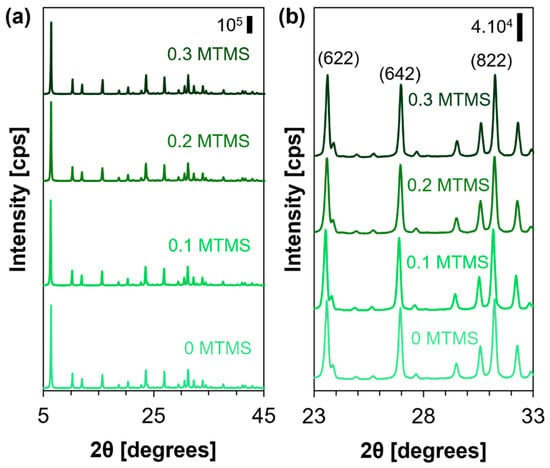
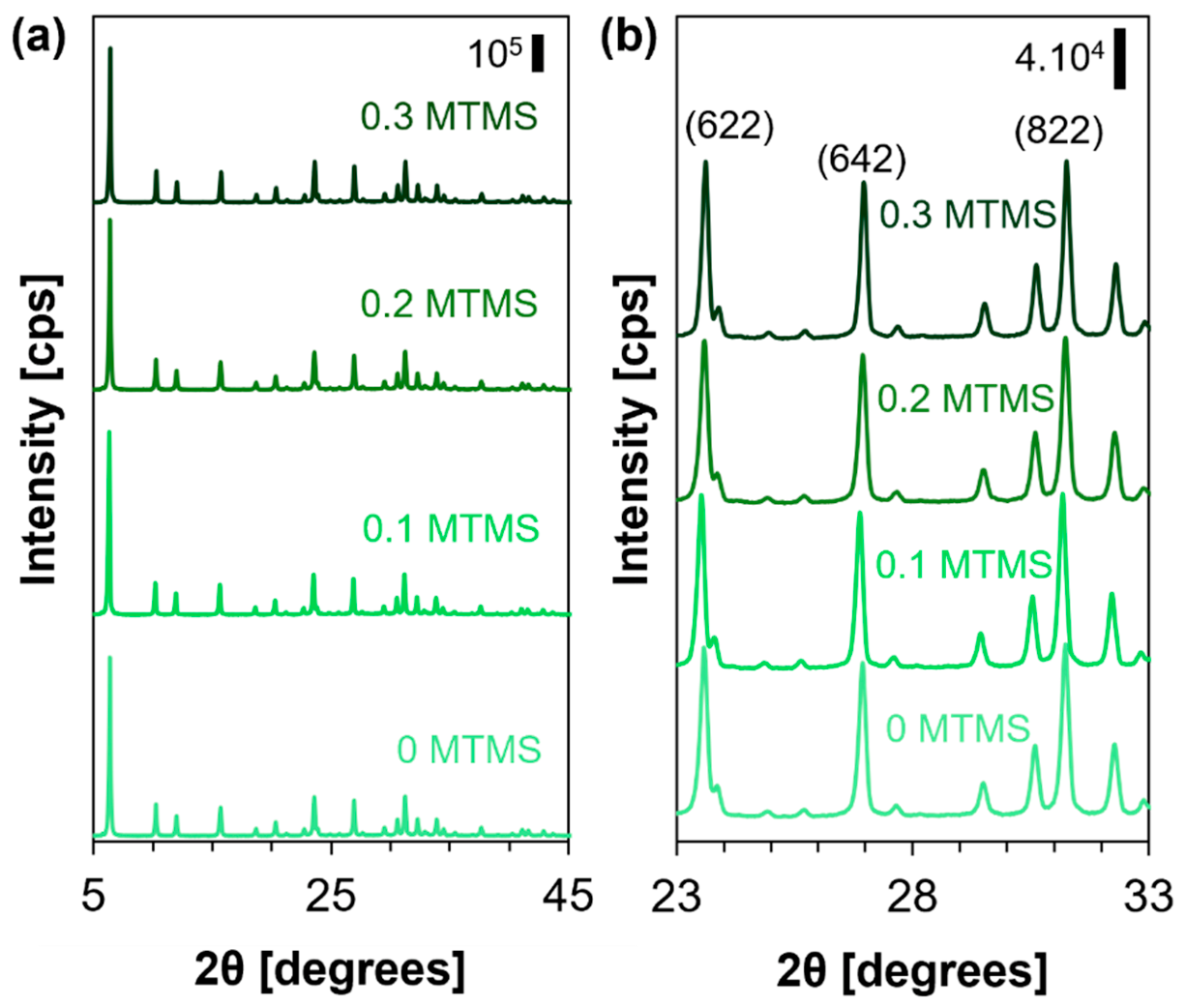
The solids synthesized via the conventional hydrothermal method and modified with different ratios of MTMS, were initially characterized by X-ray diffraction to verify the formation of the desired FAU structure. The diffractograms indicated that all samples exhibited a crystalline pattern compatible with the FAU topology, with no signs of secondary phases or amorphous solid residue (Figure 1a). These results demonstrate that the addition of MTMS, under the tested conditions, did not compromise the crystallization process or the formation of the zeolitic framework. Furthermore, the intensity and position of the diffraction peaks, especially those referring to the (622), (642), and (822) crystalline planes, highlighted in Figure 1b, indicate that the crystallinity of the samples is equivalent, with no significant preferential crystal growth in any specific crystallographic direction. Consequently, it is observed that the addition of small fractions of MTMS in the synthesis of the Na-FAU zeolite does not compromise its formation and that there would still be room for the incorporation of more MTMS into the reaction mixture. Nevertheless, the highest amount of silane used herein depends on the kinetics of water desorption that will be discussed later.
Figure 1.
(a) XRD patterns of the NaX zeolites prepared with different MTMS contents. (b) Inset for the (622), (642) and (822) diffraction peaks.
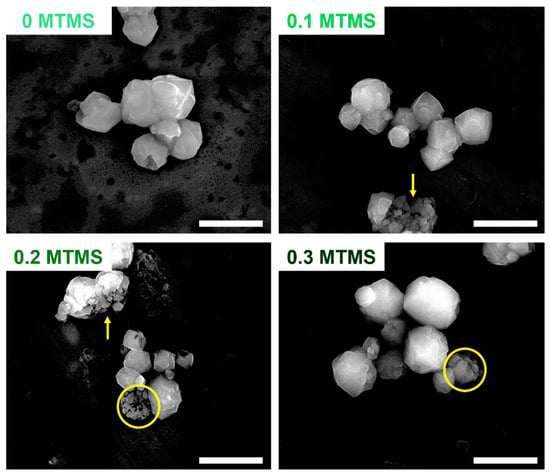
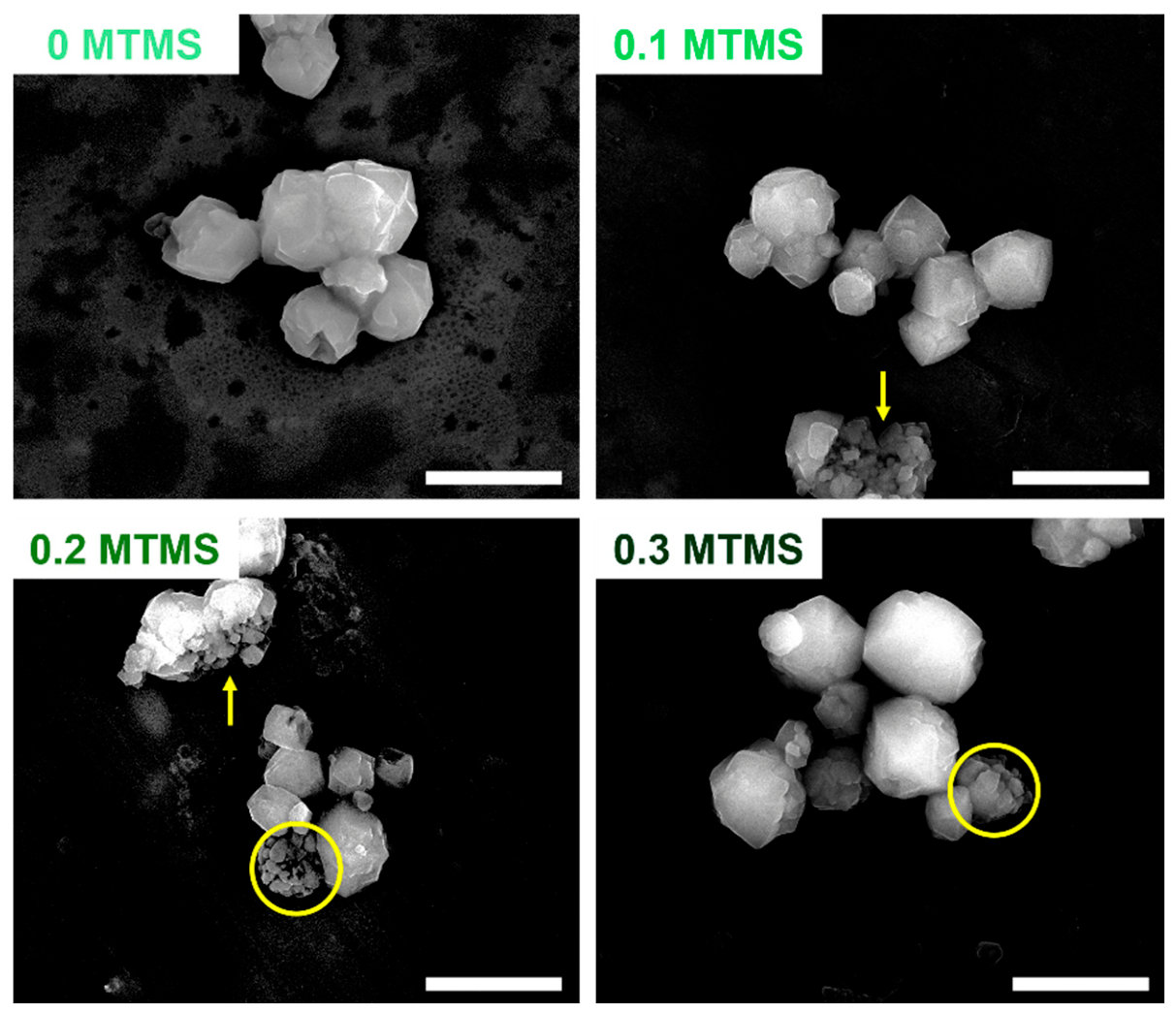
Scanning electron microscopy (SEM) images (Figure 2) illustrate the morphological evolution of the synthesized crystals as a function of increasing MTMS concentration from 0 to 0.3. In the absence of the modifier (0 MTMS), the sample exhibits polyhedral structures characterized by smooth facets and sharp, distinct edges, indicating an unhindered and homogeneous crystal growth process. However, the introduction of MTMS induces a noticeable disruption in this structural integrity. At a low concentration of 0.1 MTMS, the core polyhedral morphology is largely preserved, but initial signs of structural modification emerge, as highlighted by the yellow arrow pointing toward a localized region of fragmentation where smaller, microcrystalline sub-units begin to appear at the crystal boundaries. This disruptive effect escalates dramatically at 0.2 MTMS, where the average size of the pristine crystals decreases, and severe structural degradation becomes widespread. This is evidenced by the yellow arrow indicating a completely fragmented, rough aggregate that has lost its geometric definition, and the yellow circle highlighting a distinct, crumbled cluster composed of nanocrystalline elements [20,21,22,23]. This phenomenon suggests that MTMS acts as a surface-terminating agent or crystal growth inhibitor; its non-hydrolyzable methyl groups cap the growing crystalline faces, preventing orderly network extension and forcing secondary nucleation or lattice defects. When the concentration reaches 0.3 MTMS, this trend of surface modification is less pronounced, where the sample’s morphology is more similar to the solid prepared in the absence of the silane. Thus, it is possible to conclude, regarding the effect of textural modification, that the optimal concentration of silane was 0.2 moles of MTMS/mol of Al2O3 in the reaction mixture.
Figure 2.
Secondary electron (SE) SEM images of the NaX zeolites prepared with different MTMS contents (scale bars are of 5 µm length). The brightness of the images was computationally corrected and does not reflect any composition information about the samples.
Since SEM images reveal morphological modifications on the particles’ surfaces, N2 adsorption isotherms at 77 K were employed to verify the textural properties of the synthesized zeolites. As shown in Figure S1, all the isotherms present the same type-I shape, typically observed for microporous materials. The plateau related to the micropore filling indicates that all the samples present the same micropore volume, as confirmed by NLDFT calculations applied to the isotherms (Table 1). Moreover, as indicated by the curves, no mesopore filling was observed, thus showing that the samples are purely microporous solids without any hierarchization induced by the MTMS incorporation.
Table 1.
Si/Al molar ratios contents determined through EDS analysis and textural parameters from NLDFT analyses of N2 adsorption isotherms.
The overall Si/Al ratio was determined through EDS analysis. Considering that FAU-type zeolites are commonly classified according to this ratio, with X-type zeolites characterized by Si/Al values of up to 1.5 [24], the results obtained indicate compliance with the expected standard. Thus, it is verified that the synthesized structure exhibits characteristics compatible with NaX-type zeolites (Table 1). Furthermore, there was no significant variation in the Si/Al ratio with the incorporation of MTMS in the synthesis. This indicates that the structure forms by replacing silicon from metasilicate with the silicon from MTMS, without the formation of purely siliceous structures.
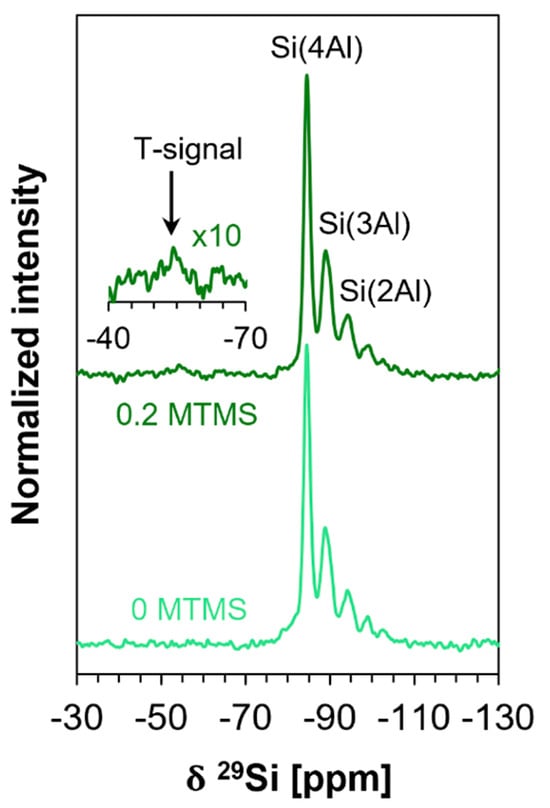
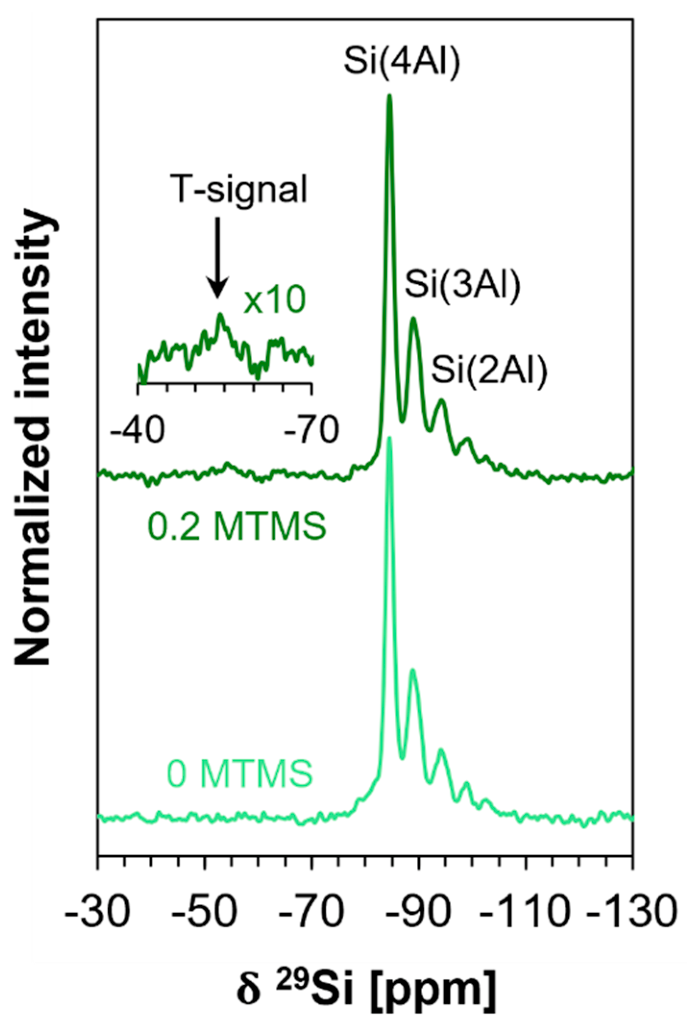
The {1H}29Si cross-polarization magic-angle spinning (CP-MAS) NMR spectra provided direct evidence of the successful introduction of methyl groups within the zeolite framework through functionalization with MTMS. In the spectrum of the unmodified 0 MTMS sample (Figure 3), the region between −40 and −70 ppm features a completely flat baseline, confirming the total absence of silicon-carbon bonds in the starting matrix. Upon introducing 0.2 MTMS in the synthesis, a broad resonance signal emerges centered at around −55 ppm. This specific peak is assigned to T sites, representing silicon atoms directly bonded to an organic carbon headgroup [25], serving as direct proof that the organosilane molecules have been covalently grafted onto the material via forming ≡Si-CH3 bonds between MTMS moieties and zeolite framework. The low intensity of the T-signal is due to the small amount of MTMS used for the synthesis (around 0.7 wt.% in the reaction mixture). Regarding the higher chemical shift region between −80 and −100 ppm, the detected signals correspond to framework Si(nAl), representing the framework formation via TO4 connections [26,27]. Moreover, the populations of each Si(4Al), Si(3Al) and Si(2Al) environments confirm the preserved Si/Al molar ratio of the FAU zeolite crystallized in the presence of small amounts of MTMS.
Figure 3.
{1H}29Si CP-MAS NMR spectra of 0 MTMS and 0.2 MTMS samples.
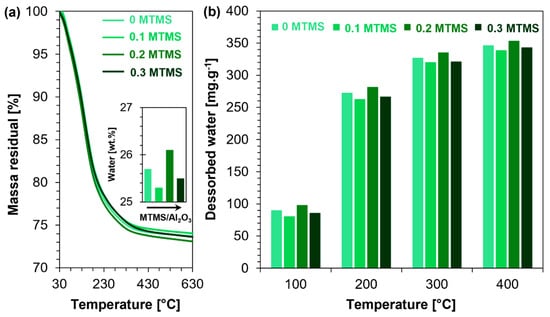
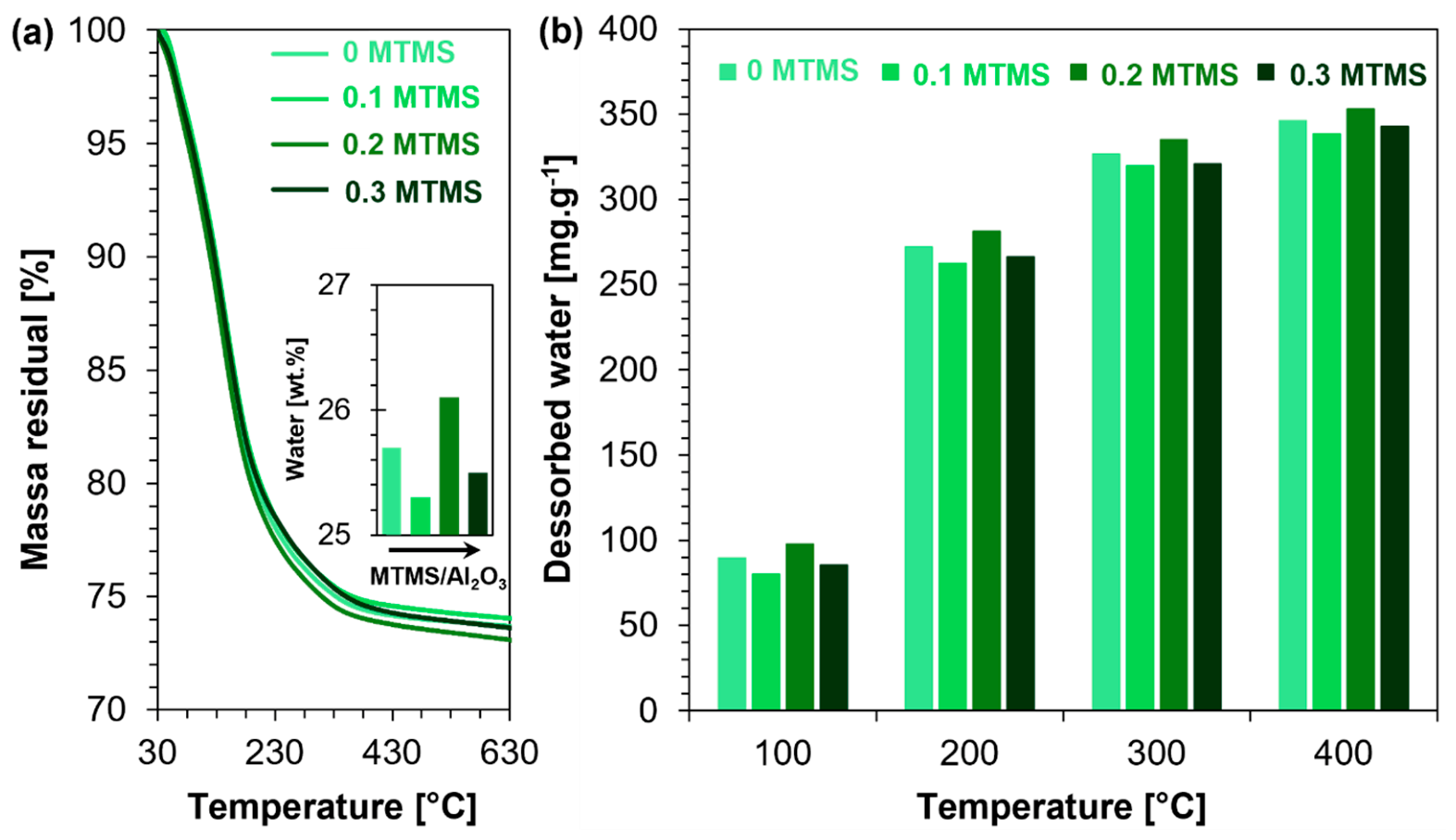
The capacity for moisture retention and the thermal profile of water release from the prepared materials was quantified using thermogravimetric analyses. As shown in Figure 4a, the mass loss profiles for all samples take place in a single, continuous desorption process that begins near room temperature and stabilizes beyond 300 °C, which is directly associated with the thermal removal of physisorbed water molecules from the microporous structure [19,28]. The total mass loss did not follow a clear trend among samples (see the inset in Figure 4a), with sample 0.2 MTMS presenting the highest water desorption of 26.1 wt. %. This shows that the addition of MTMS did not compromise the water adsorption capacity of zeolite. To better evaluate this behavior, the total amount of desorbed water was systematically calculated at specific temperature thresholds of 100, 200, 300, and 400 °C, as presented in Figure 4b. The bar chart demonstrates that the 0.2 MTMS sample consistently exhibits a systematically higher volume of desorbed water at every temperature interval compared to all other variations, reaching its maximum desorption capacity at 400 °C. This result indicates that although the material was synthesized with an organosilane known for its hydrophobic methyl groups, its overall ability to capture and desorb water is not compromised in terms of mass capacity. As previously mentioned, the maximum water desorption peak is centered at a temperature above the normal boiling point of water, which results from the strong interaction of polar molecules with the cationic and microporous surface of the zeolite [28,29,30]. The temperatures of maximum desorption rates (Tmax) measured for the four prepared solids (Figure S2) demonstrated that the 0.2 MTMS functionalized zeolite exhibited a lower desorption temperature, approximately 2.8% lower than the conventional non-functionalized zeolite. The reduction in the maximum desorption temperature Tmax from 146.5 °C to 142.4 °C for the 0.2 MTMS sample represents a significant shift when considering the extremely hydrophilic nature of the NaX framework. Even aggressive hydrophobization methods, such as drastic framework dealumination or surface grafting with bulky long-chain silanes—rarely decrease Tmax by more than 10 °C [10,31]. Here, the incorporation of localized methyl groups lowers the thermal energy barrier for water release while maintaining the full moisture adsorption capacity (26 wt. %).
Figure 4.
(a) Thermograms of the NaX zeolites prepared with different MTMS contents. (b) Amounts of desorbed water at different temperatures from the x MTMS samples.
This demonstrates that the energy expenditure required to desorb water from this zeolite is lower, evidencing its hydrophobic potential and its facilitated operational capacity during the thermal storage stage. Based on these analyses, it was concluded that the incorporation of MTMS at a ratio of 0.2 mol/mol Al2O3 in the synthesis of NaX zeolite reduced the water desorption temperature, confirming an increase in the solid’s hydrophobicity without compromising its maximum water capture capacity, since the total amounts of desorbed water are slightly higher in this sample.
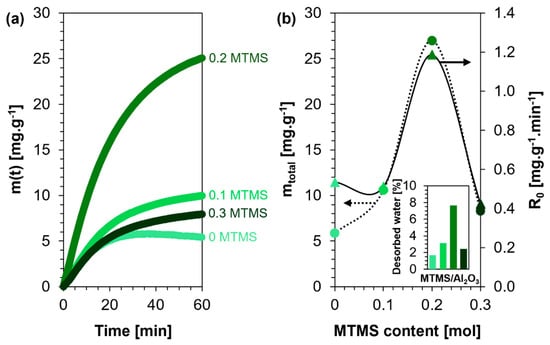
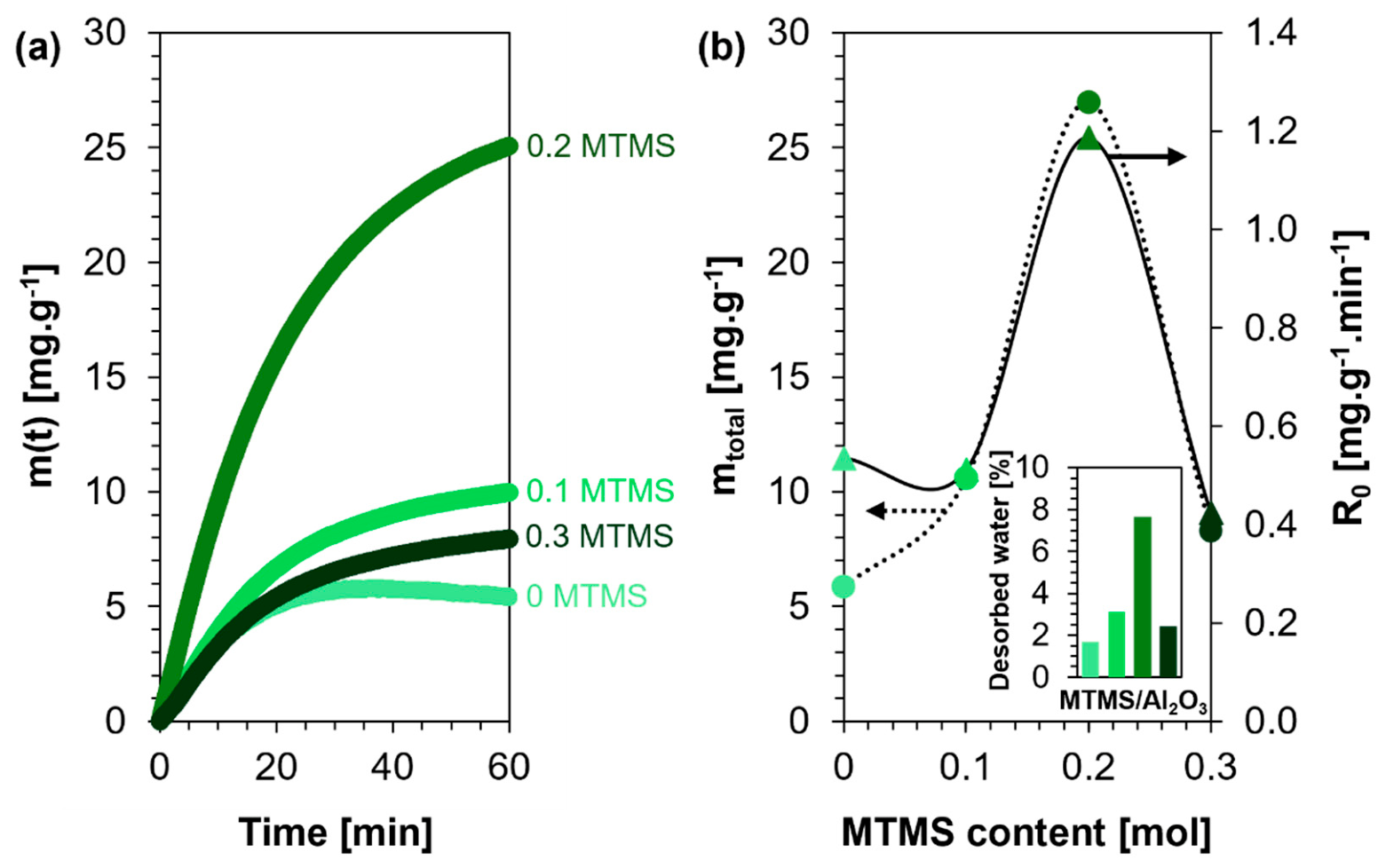
The main objective in TES is to be able to charge the thermal batteries at low temperatures. Therefore, the kinetics of water desorption was tracked at 40 °C. The amount of water desorbed over time increased progressively with the increment of MTMS used in the synthesis (Figure 5a), except for the 0.3 MTMS sample. The initial desorption rate (R0) and the total mass of desorbed water (mtotal) were higher in the 0.2 MTMS sample (Figure 5b). The behavior of the 0 MTMS sample proved quite distinct from those prepared with silane, where the steady state of desorption was reached quickly, in approximately 30 min (Figure 5a). This is a result of the high hydrophilicity of conventional NaX zeolite, which was affected by the incorporation of silane; it is observed that, within the analyzed timeframe, all samples containing MTMS exhibited a non-steady-state desorption profile, that is, the water mass continued to decrease gradually over time. In fact, all silane-containing samples had desorption rates nearly twice as high as the 0 MTMS sample (Figure 5b). This result is relevant as it confirms that the thermal charging kinetics in beds containing functionalized samples is faster. Regarding the total amount of desorbed water, all MTMS-containing samples also showed higher water release, modeled here as the mass mtotal, considering an infinite purge time with N2 at 40 °C. Again, the 0.2 MTMS sample stood out, desorbing the largest amount of water.
Figure 5.
(a) Water desorption kinetic curves under an N2 flow rate of 30 mL.min−1 at 40 °C for NaX zeolites with different MTMS contents. (b) Kinetic parameters obtained from the modeling of the curves.
The enhancement in the desorption kinetics observed for the silane-modified samples can be fully understood by correlating these kinetic parameters with the morphological evolution revealed by SEM (Figure 2). While the unmodified 0 MTMS zeolite consists of large crystals, the introduction of MTMS clearly induces a progressive structural fragmentation, leading to the formation of rough aggregates composed of nanocrystalline sub-units. This structural modification plays a dual role in accelerating water release process. Beyond the tailored hydrophobic–hydrophilic balance achieved within the framework by incorporating methyl groups (Figure 3), the reduction in the crystal size inherently decreases the intracrystalline diffusion path length that water molecules must traverse to escape the microporous network. Consequently, the diffusion resistance is minimized, and the mass transfer is significantly enhanced. Therefore, the increase in the desorption rate observed in the 0.2 MTMS sample is a synergistic result of both the local chemical environment around the aluminum sites, which are surrounded by methyl groups (Figure 3), and the structural downsizing into fractured, nanocrystalline clusters (Figure 2). Given that the topologies, Si/Al ratios, and compensating cations remain virtually identical across the series, these combined textural and chemical modifications are solely responsible for the faster thermal charging performance.
As revealed by the physisorption isotherms (Table 1, Figure S1), all samples exhibit pure Type I isotherms with equivalent micropore, confirming that MTMS incorporation neither induced mesoporosity nor degraded the zeolite microporous framework. Consequently, the sharp increase in the water desorption rate for the 0.2 MTMS sample is predominantly driven by the local chemical effect of the organosilane groups, which weakens the water binding interaction. Secondarily, the physical reduction in crystal size observed via SEM (Figure 2) shortens the intracrystalline diffusion path, acting synergistically to facilitate water mass transfer without altering the intrinsic pore structure.
The non-linear trend observed for the 0.3 MTMS sample, characterized by a morphology closer to unmodified NaX and reduced desorption kinetics, arises from the solubility and reactivity limits of organosilanes in alkaline synthesis gels. Beyond an optimal MTMS/Al ratio of 0.2, the excess organosilane favors self-condensation into soluble siloxane oligomers in the aqueous phase rather than co-condensation into the growing framework. This self-consumption reduces the effective incorporation of methyl groups within the micropores, allowing conventional crystal growth to dominate and yielding a material with kinetic profiles closer to the pristine 0 MTMS sample. Therefore, higher amounts of silane were not used.
Although the Tmax reduction represents a modest drop of 4.1 °C, its primary practical relevance for TES systems lies in lowering the thermal activation barrier for low-temperature regeneration. By more than doubling the initial desorption rate at 40 °C and desorbing nearly 5 times more water within 60 min, the material significantly reduces thermal charging times in packed-bed reactors. Furthermore, this lower thermal energy requirement allows charging via low-cost, non-concentrating solar thermal collectors without sacrificing the high total water storage capacity, thereby lowering parasitic energy consumption and enhancing overall system efficiency.
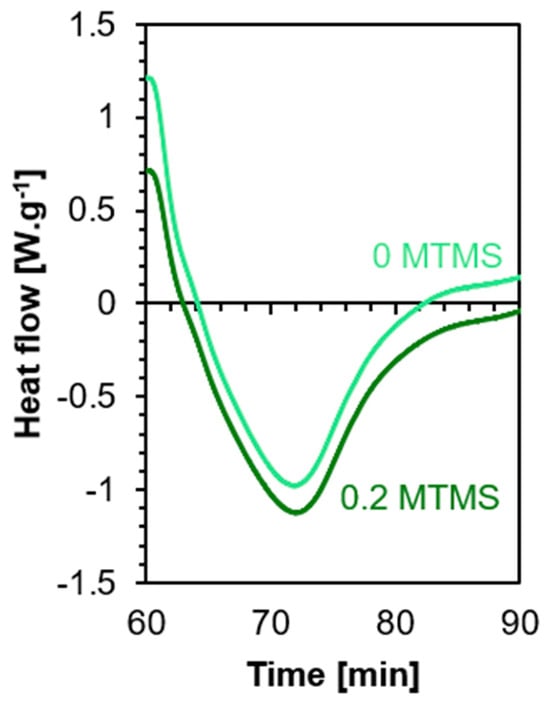
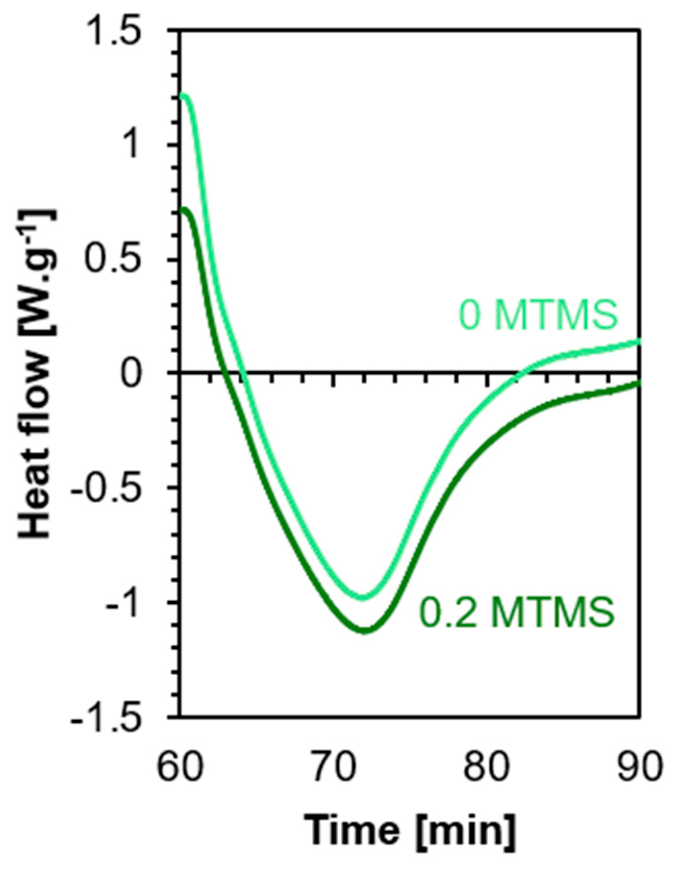
The thermochemical heat storage density was quantitatively evaluated by integrating the baseline-subtracted endothermic DSC desorption peak (Figure 6) normalized to the dry zeolite framework mass. The pristine NaX (0 MTMS) zeolite exhibited an integrated heat of desorption of 30.6 W·min.g−1 dry, corresponding to a dry-basis thermal storage density of 1836 J.g−1 dry. In comparison, the 0.2 MTMS functionalized sample yielded an integrated value of 25.7 W·min.g−1 dry (1542 J.g−1 dry). This moderate ~16% reduction in total energy storage density directly reflects the modified hydrophobic–hydrophilic balance induced by MTMS co-condensation, which weakens water-framework interactions around the Al(IV) sites. Crucially, this minor energy trade-off is strongly offset by the operational gains: the 0.2 MTMS matrix achieves significantly accelerated desorption kinetics, doubling the initial desorption rate and lower operational charging thresholds (Figure 5), making it a superior candidate for low-temperature solar thermal energy storage systems.
Figure 6.
DSC curves of pristine and 0.2 MTMS modified zeolite.
4. Conclusions
The hydrothermal synthesis of NaX zeolites with varying MTMS ratios preserved the FAU structure without the occurrence of secondary phases, indicating that co-condensation does not impair crystallization at the silane concentrations evaluated. These results provide a foundation for future innovations regarding microporosity, the presence of hydrophobic groups, and water adsorption/desorption capacity, which are fundamental for thermal energy storage applications. A 0.2 MTMS/Al2O3 molar ratio in the preparation of the NaX zeolite does not affect the NaX zeolite’s structural properties or Si/Al ratio, but yields a solid with a greater ease of expelling adsorbed water during a heating process. This modified NaX is therefore more suitable than conventional NaX zeolite for fast thermal energy storage processes.
It is worth noting that for practical thermochemical heat storage applications, long-term cycling durability across repeated hydration/dehydration runs is paramount. Since the functionalization reported herein relies on covalent organosiloxane linkage embedded within the stable FAU framework, the hybrid material is expected to maintain its structural integrity under low-temperature regeneration. Comprehensive multicycle performance stability testing will be the focus of follow-up engineering studies for bed scale-up.
Supplementary Materials
The following supporting information can be downloaded at https://www.mdpi.com/article/10.3390/esa3040019/s1, Figure S1: N2 adsorption/desorption isotherms (77K) of the synthesized materials; Figure S2: DTG curves of the x MTMS samples.
Author Contributions
Conceptualization, I.W.Z.; methodology, A.C.d.S.; validation, G.P.C., R.J.d.S., F.C.C. and I.W.Z.; formal analysis, L.L.d.S., G.T.d.A.S. and S.R.T.; investigation, A.C.d.S.; resources, G.P.C., R.J.d.S. and F.C.C.; data curation, A.C.d.S.; writing—original draft, A.C.d.S.; writing—review and editing, G.P.C., R.J.d.S., F.C.C. and I.W.Z.; visualization, L.L.d.S., G.T.d.A.S. and S.R.T.; supervision, I.W.Z.; funding acquisition, I.W.Z. All authors have read and agreed to the published version of the manuscript.
Funding
This research received funding from São Paulo Research Foundation (FAPESP), grant numbers 2024/21120-9; 2024/10494-5; and 2025/03311-4 and from National Council for Scientific and Technological Development (CNPq), grant number 421553/2025-1.
Data Availability Statement
The data supporting the conclusions of this paper will be made available by the authors on request.
Acknowledgments
The authors are grateful for the financial support received by 2024/21120-9, São Paulo Research Foundation (FAPESP) and to Laboratorio de Caracterização Estrutural (LCE DEMA UFSCar) for the microscopy analyses. Laura L. Silva also acknowledges the financial supported by the Human Resources Training Program of the Brazilian National Agency for Petroleum, Natural Gas and Biofuels—PRH ANP and FAPESP (grant numbers #2024/10494-5 and #2025/03311-4) through the PRH-39/UFSCar program.
Conflicts of Interest
The authors declare no conflicts of interest.
References
- Abedin, A.H. A Critical Review of Thermochemical Energy Storage Systems. Open Renew. Energy J. 2011, 4, 42–46. [Google Scholar] [CrossRef] [Scilit]
- Bauer, T.; Steinmann, W.-D.; Laing, D.; Tamme, R. Thermal Energy Storage Materials and Systems. Annu. Rev. Heat Transf. 2012, 15, 131–177. [Google Scholar] [CrossRef] [Scilit]
- Pfleger, N.; Bauer, T.; Martin, C.; Eck, M.; Wörner, A. Thermal Energy Storage—Overview and Specific Insight into Nitrate Salts for Sensible and Latent Heat Storage. Beilstein J. Nanotechnol. 2015, 6, 1487–1497. [Google Scholar] [CrossRef] [Scilit] [PubMed]
- Banaei, A.; Zanj, A. A Review on the Challenges of Using Zeolite 13X as Heat Storage Systems for the Residential Sector. Energies 2021, 14, 8062. [Google Scholar] [CrossRef] [Scilit]
- Loewenstein, W. The Distribution of Aluminum in the Tetrahedra of Silicates and Aluminates. Am. Mineral. 1954, 39, 92–96. [Google Scholar]
- Busca, G. Acidity and Basicity of Zeolites: A Fundamental Approach. Microporous Mesoporous Mater. 2017, 254, 3–16. [Google Scholar] [CrossRef] [Scilit]
- Vicente, J.G.P.; Lima, P.M.; Cardoso, D. Nanosized Particles of X Zeolite Containing Ammonium Cations as Basic Catalysts. Catal. Lett. 2017, 147, 880–892. [Google Scholar] [CrossRef] [Scilit]
- Motta, I.L.; Vicente, J.G.P.; Cardoso, D. Properties and Catalytic Evaluation of Nanometric X Zeolites Containing Linear Alkylammonium Cations. Mol. Catal. 2018, 458, 127–138. [Google Scholar] [CrossRef] [Scilit]
- Ristić, A.; Fischer, F.; Hauer, A.; Zabukovec Logar, N. Improved Performance of Binder-Free Zeolite Y for Low-Temperature Sorption Heat Storage. J. Mater. Chem. A Mater. 2018, 6, 11521–11530. [Google Scholar] [CrossRef] [Scilit]
- Catuzo, G.L.; Santilli, C.V.; Martins, L. Hydrophobic-Hydrophilic Balance of ZSM-5 Zeolites on the Two-Phase Ketalization of Glycerol with Acetone. Catal. Today 2021, 381, 215–223. [Google Scholar] [CrossRef] [Scilit]
- Huang, Y.; Deng, X.; Duan, Y.; Liu, C.; Xu, X. Effects of surface nanostructure and wettability on CO2 nucleation boiling: A molecular dynamics study. DeCarbon 2024, 5, 100054. [Google Scholar] [CrossRef] [Scilit]
- Trzpit, M.; Soulard, M.; Patarin, J.; Desbiens, N.; Cailliez, F.; Boutin, A.; Demachy, I.; Fuchs, A.H. The Effect of Local Defects on Water Adsorption in Silicalite-1 Zeolite: A Joint Experimental and Molecular Simulation Study. Langmuir 2007, 23, 10131–10139. [Google Scholar] [CrossRef] [Scilit] [PubMed]
- Vuong, G.-T.; Do, T.-O. A New Route for the Synthesis of Uniform Nanozeolites with Hydrophobic External Surface in Organic Solvent Medium. J. Am. Chem. Soc. 2007, 129, 3810–3811. [Google Scholar] [CrossRef] [Scilit] [PubMed]
- Zapata, P.A.; Huang, Y.; Gonzalez-Borja, M.A.; Resasco, D.E. Silylated Hydrophobic Zeolites with Enhanced Tolerance to Hot Liquid Water. J. Catal. 2013, 308, 82–97. [Google Scholar] [CrossRef] [Scilit]
- Dib, E.; Costa, I.M.; Vayssilov, G.N.; Aleksandrov, H.A.; Mintova, S. Complex H-Bonded Silanol Network in Zeolites Revealed by IR and NMR Spectroscopy Combined with DFT Calculations. J. Mater. Chem. A Mater. 2021, 9, 27347–27352. [Google Scholar] [CrossRef] [Scilit]
- da Silva, J.F.; Zapelini, I.W.; Ferracine, E.D.D.S.; Mintova, S.; Cardoso, D. Exploring Surface Silanols in Mesoporous Na-LTA Zeolite to Enhance Its Catalytic Activity in Knoevenagel Condensation by Grafting Amino Groups. Microporous Mesoporous Mater. 2024, 378, 113255. [Google Scholar] [CrossRef] [Scilit]
- Medeiros-Costa, I.C.; Laroche, C.; Pérez-Pellitero, J.; Coasne, B. Characterization of Hierarchical Zeolites: Combining Adsorption/Intrusion, Electron Microscopy, Diffraction and Spectroscopic Techniques. Microporous Mesoporous Mater. 2019, 287, 167–176. [Google Scholar] [CrossRef] [Scilit]
- Wong, K.-L.; Roz, M.E.; Tosheva, L.; Goupil, J.-M.; Mintova, S. MFI-Type Materials Prepared by Co-Condensation Synthesis Approach. Catal. Today 2013, 204, 66–72. [Google Scholar] [CrossRef] [Scilit]
- Novembre, D.; Di Sabatino, B.; Gimeno, D.; Garcia-Vallès, M.; Martínez-Manent, S. Synthesis of Na–X Zeolites from Tripolaceous Deposits (Crotone, Italy) and Volcanic Zeolitised Rocks (Vico Volcano, Italy). Microporous Mesoporous Mater. 2004, 75, 1–11. [Google Scholar] [CrossRef] [Scilit]
- Cho, K.; Cho, H.S.; de Ménorval, L.-C.; Ryoo, R. Generation of Mesoporosity in LTA Zeolites by Organosilane Surfactant for Rapid Molecular Transport in Catalytic Application. Chem. Mater. 2009, 21, 5664–5673. [Google Scholar] [CrossRef] [Scilit]
- Choi, M.; Cho, H.S.; Srivastava, R.; Venkatesan, C.; Choi, D.-H.; Ryoo, R. Amphiphilic Organosilane-Directed Synthesis of Crystalline Zeolite with Tunable Mesoporosity. Nat. Mater. 2006, 5, 718–723. [Google Scholar] [CrossRef] [Scilit] [PubMed]
- Alonso-Doncel, M.; Peral, A.; Shamzhy, M.; Čejka, J.; Sanz, R.; Serrano, D.P. Untangling the Role of the Organosilane Functional Groups in the Synthesis of Hierarchical ZSM-5 Zeolite by Crystallization of Silanized Protozeolitic Units. Catal. Today 2020, 345, 27–38. [Google Scholar] [CrossRef] [Scilit]
- Alonso-Doncel, M.; Peral, A.; Shamzhy, M.; Čejka, J.; Sanz, R.; Serrano, D.P. Fine-Tuning Hierarchical ZSM-5 Zeolite by Controlled Aggregation of Protozeolitic Units Functionalized with Tertiary Amine-Containing Organosilane. Microporous Mesoporous Mater. 2020, 303, 110189. [Google Scholar] [CrossRef] [Scilit]
- Frising, T.; Leflaive, P. Extraframework Cation Distributions in X and Y Faujasite Zeolites: A Review. Microporous Mesoporous Mater. 2008, 114, 27–63. [Google Scholar] [CrossRef] [Scilit]
- Sanz-Pérez, E.S.; Fernández, A.; Arencibia, A.; Calleja, G.; Sanz, R. Hybrid Amine-Silica Materials: Determination of N Content by 29Si NMR and Application to Direct CO2 Capture from Air. Chem. Eng. J. 2019, 373, 1286–1294. [Google Scholar] [CrossRef] [Scilit]
- Engelhardt, G. Multinuclear Solid-State NMR in Silicate and Zeolite Chemistry. TrAC Trends Anal. Chem. 1989, 8, 343–347. [Google Scholar] [CrossRef] [Scilit]
- Dib, E.; Mintova, S.; Vayssilov, G.N.; Aleksandrov, H.A.; Carravetta, M. Chemical Shift Anisotropy: A Promising Parameter to Distinguish the 29 Si NMR Peaks in Zeolites. J. Phys. Chem. C 2023, 127, 10792–10796. [Google Scholar] [CrossRef]
- Fan, M.; Panezai, H.; Sun, J.; Bai, S.; Wu, X. Thermal and Kinetic Performance of Water Desorption for N2 Adsorption in Li-LSX Zeolite. J. Phys. Chem. C 2014, 118, 23761–23767. [Google Scholar] [CrossRef] [Scilit]
- Beauvais, C.; Boutin, A.; Fuchs, A.H. Adsorption of Water in Zeolite Sodium-Faujasite. C. R. Chim. 2005, 8, 485–490. [Google Scholar] [CrossRef] [Scilit]
- Hunger, B.; Matysik, S.; Heuchel, M.; Geidel, E.; Toufar, H. Adsorption of Water on Zeolites of Different Types. J. Therm. Anal. 1997, 49, 553–565. [Google Scholar] [CrossRef] [Scilit]
- Pazin, L.H.; Zapelini, I.W.; Santagneli, S.H.; Sad, M.E.; Padró, C.; Martins, L. Ordinary hydrophobicity of mesoporous faujasites boosting the catalytic ketalization of glycerol with acetone. Appl. Catal. A Gen. 2024, 678, 119706. [Google Scholar] [CrossRef] [Scilit]

Disclaimer/Publisher’s Note: The statements, opinions and data contained in all publications are solely those of the individual author(s) and contributor(s) and not of MDPI and/or the editor(s). MDPI and/or the editor(s) disclaim responsibility for any injury to people or property resulting from any ideas, methods, instructions or products referred to in the content. |
© 2026 by the authors. Licensee MDPI, Basel, Switzerland. This article is an open access article distributed under the terms and conditions of the Creative Commons Attribution (CC BY) license.