

You are currently viewing a new version of our website. To view the old version click .

AgriEngineering

AgriEngineering is an international, peer-reviewed, open access journal on the engineering science of agricultural and horticultural production, published monthly online by MDPI.

Quartile Ranking JCR - Q2 (Agricultural Engineering)

All Articles (1,083)

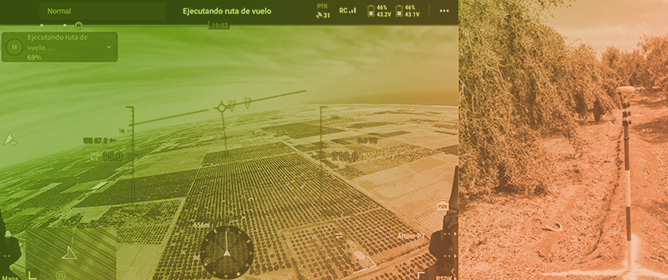
Agriculture faces growing pressure to optimize water use, particularly in woody perennial crops where irrigation systems are installed once and seldom redesigned despite changes in canopy structure, soil conditions, or plant mortality. Such static layouts may accumulate inefficiencies over time. This study introduces a decision support system (DSS) that evaluates the hydraulic adequacy of existing irrigation systems using two new concepts: the Resource Overutilization Ratio (ROR) and the Irrigation Ecolabel. The ROR quantifies the deviation between the actual discharge of an installed irrigation network and the theoretical discharge required from crop water needs and user-defined scheduling assumptions, while the ecolabel translates this value into an intuitive A+++–D scale inspired by EU energy labels. Crop water demand was estimated using the FAO-56 Penman–Monteith method and adjusted using canopy cover derived from UAV-based canopy height models. A vineyard case study in Galicia (Spain) serves an example to illustrate the potential of the DSS. Firstly, using a fixed canopy cover, the FAO-based workflow indicated moderate oversizing, whereas secondly, UAV-derived canopy measurements revealed substantially higher oversizing, highlighting the limitations of non-spatial or user-estimated canopy inputs. This contrast (A+ vs. D rating) illustrates the diagnostic value of integrating high-resolution geospatial information when canopy variability is present. The DSS, released as open-source software, provides a transparent and reproducible framework to help farmers, irrigation managers, and policymakers assess whether existing drip systems are hydraulically oversized and to benchmark system performance across fields or management scenarios. Rather than serving as an irrigation scheduler, the DSS functions as a standardized diagnostic tool for identifying oversizing and supporting more efficient use of water, energy, and materials in perennial cropping systems.

12 December 2025

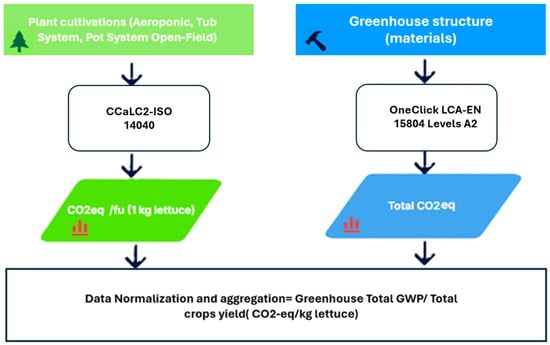
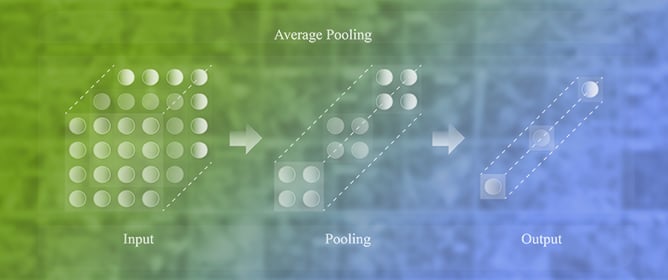
Simplified overview of the Decision Support System (DSS) and the Irrigation Ecolabel calculation.

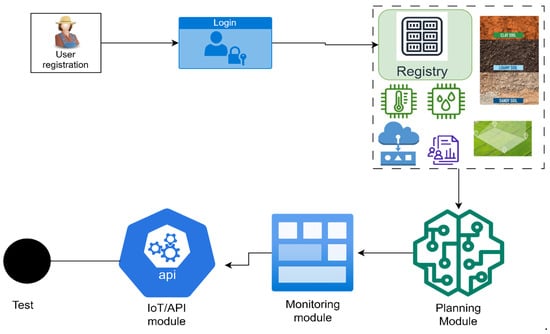
Concept of a Modular Wide-Area Predictive Irrigation System

  • Kristiyan Dimitrov,
  • Nayden Chivarov and
  • Stefan Chivarov

The article presents a method for determining the irrigation requirements of crops based on soil moisture. The proposed approach enables scheduling irrigation at the most appropriate time of day by combining current soil moisture measurements with forecasts of moisture levels for the following day. A narrow Artificial Intelligence (AI) model is developed and applied to the task of 24 h-ahead soil moisture forecasting. Water loss due to excessive irrigation is minimized through precise soil moisture monitoring, postponement or reduction of irrigation in response to measured precipitation, temperature, and wind speed, as well as meteorological forecasts of future rainfall. The proposed irrigation system is suitable for both drip irrigation and central pivot systems. It is built using cost-effective components and incorporates LoRa connectivity, which facilitates integration in remote areas without the need for internet access. Furthermore, the addition of new irrigation zones does not require physical modifications to the central server. Experimental tests demonstrated that the system effectively controls irrigation timing and achieves the desired soil moisture levels with high accuracy, while accounting for additional external factors that influence soil moisture.

12 December 2025

This study explores the potential of hyperspectral imaging combined with machine learning techniques to provide accurate and non-invasive methods for analyzing soil nutrient content in precision agriculture. Data were collected from agricultural regions in Tamil Nadu, India, using conventional soil sampling methods that are labor-intensive and time-consuming. In contrast, hyperspectral imaging preserves soil integrity and enables rapid, remote assessment of soil health. The red fox optimization (FOX) algorithm was employed for spectral band selection, effectively reducing data redundancy while retaining the informative features. The partial least squares regression (PLSR) model achieved high prediction accuracy for organic carbon, with R2=0.93, a mean absolute error (MAE) of 16.4, and a root mean square error (RMSE) of 20.1, whereas for nitrogen, phosphorus, and potassium, the corresponding R2 values all exceeded 0.89. These results confirm the robustness and computational efficiency of the FOX-optimized models and demonstrate that integrating hyperspectral imaging with optimized machine learning can enable accurate, real-time soil nutrient estimation without destructive sampling, thereby supporting sustainable soil monitoring and protection in large-scale precision agriculture.

12 December 2025

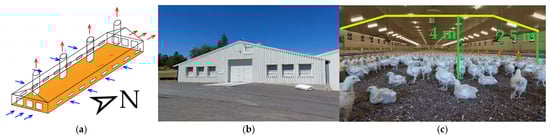
Livestock farming represents one of the primary sources of ammonia (NH3) and greenhouse gas (GHG) emissions, including methane (CH4), nitrous oxide (N2O), and carbon dioxide (CO2), having a significant environmental impact. Reducing emissions and recovering gas systems from these livestock buildings necessitate measuring gas concentrations to mitigate environmental impacts using an accurate, high-cost portable device. This study aims to evaluate the concentration of NH3 and GHGs in a semi-open dairy farm located in southern Sicily, a region with a hot climate. The measurement campaign was carried out during the spring of 2025. The concentrations of NH3, CH4, CO2, and N2O were measured in different barn areas (i.e., manger, feeding alley, and service alley) using a portable gas detector (GASMET GT5000) based on Fourier Transform Infrared (FTIR) technology. Statistical analysis revealed that NH3 concentrations were highest in the feeding alley, while CH4 concentrations peaked at the manger. N2O levels stayed low because there was no straw. Future research should investigate gas concentrations across different seasons (e.g., winter, summer) to analyze gas patterns under different climatic conditions. Additionally, the use of an accurate portable device enables further investigations into other barn typologies within the Mediterranean area to assess how farm construction and management practices influence gas production.

10 December 2025

News & Conferences

Issues

Open for Submission

Editor's Choice

Reprints of Collections

Application of Artificial Neural Network in Agriculture
Reprint

Application of Artificial Neural Network in Agriculture

Editors: Ray E. Sheriff, Chiew Foong Kwong
Emerging Agricultural Engineering Sciences, Technologies, and Applications
Reprint

Emerging Agricultural Engineering Sciences, Technologies, and Applications

Volume II
Editors: Muhammad Sultan, Yuguang Zhou, Redmond R. Shamshiri, Muhammad Imran

Get Alerted

Add your email address to receive forthcoming issues of this journal.

XFacebookLinkedIn
AgriEngineering - ISSN 2624-7402