Skip Content
You are currently on the new version of our website. Access the old version .
  • 25 days
    Time to First Decision

AI Sensors

AI Sensors is an international, peer-reviewed, scholarly, open access journal on AI sensing technologies, with a particular focus on edge computing and AIoT (AI and Internet of Things) sensing, published quarterly online by MDPI.
The International Society for Condition Monitoring (ISCM) is affiliated with AI Sensors and its members receive discounts on the article processing charges.

All Articles (11)

This work presents a 6T-SRAM-based in-memory computing (IMC) system fabricated in a 180 nm CMOS technology. A total of 128 integrated polysilicon R2R-DACs for fully analog wordline control and performance analysis are integrated into the system. The proposed architecture enables analog computation directly inside the memory array and introduces a compact 1-bit per-column comparator scheme for energy-efficient classification without requiring ADCs. A dedicated pull-down-dominant SRAM sizing and an analog activation scheme ensure stable analog discharge behavior and precise control of the computation through time-dependent bitline dynamics. The system integrates a complete sensor front-end, which allows real eddy current data to be classified directly on-chip. Measurements demonstrate a performance density of 3.2 TOPS/mm2, a simulated energy efficiency of 45 TOPS/W at 50 MHz, and a measured efficiency of 3.4 TOPS/W at 5 MHz on silicon. The implemented online training mechanism further improves classification accuracy by adapting the SRAM cell states during operation. These results highlight the suitability of the presented IMC architecture for compact, low-power edge intelligence and sensor-driven machine learning applications.

15 January 2026
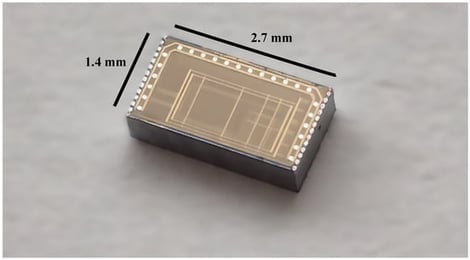
Illustrationof the IMC Chip that was fabricated in 180 nm technology.
  • Feature Paper
  • Review
  • Open Access

The rapid development of the Artificial Intelligence of Things (AIoT) has created unprecedented demands for distributed, long-term, and maintenance-free sensing systems. Conventional battery-powered sensors suffer from inherent drawbacks such as limited lifetime, high maintenance costs, and environmental concerns, which hinder large-scale deployment. Self-powered sensing technologies provide a transformative pathway by integrating energy harvesting and sensing into a single platform, thereby eliminating the reliance on external power supplies. This review systematically summarizes the key components of self-powered wireless sensing systems, with a particular focus on different energy harvesting technologies, self-powered sensing technologies, and the latest advances in low-power intelligent computation for diverse application scenarios. The integration of energy harvesting, self-sensing, and intelligent computation will make self-powered wireless sensing systems an inevitable direction for the evolution of AIoT, enabling sustainable, scalable, and intelligent monitoring networks.

22 December 2025

Overview of intelligent self-powered sensing system for AIoT. Reproduced with permission [23]. Copyright 2021, Elsevier. Reproduced with permission [24]. Copyright 2015, Wiley. Reproduced with permission [25]. Copyright 2024, Springer Nature. Reproduced with permission [29]. Copyright 2021, American Chemical Society.
  • Feature Paper
  • Review
  • Open Access

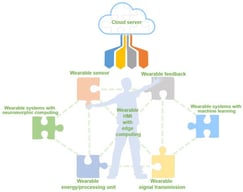
To better serve human life with smart and harmonic communication between the real and digital worlds, wearable human–machine interfaces (HMIs) with edge computing capabilities indicate the path to the next revolution of information technology. In this review, we focus on wearable HMIs and highlight several key aspects which are worth investigating. Firstly, we review wearable HMIs powered by commercial-ready technologies, highlighting some limitations. Next, to establish a dual-way interaction for exchanging comprehensive information, sensing and feedback functions on the human body need to be customized based on specific scenarios. Power consumption is another primary issue that is critical to wearable applications due to limited space, one that is possible to be solved by energy harvesting techniques and self-powered data transmission approaches. To further improve the data interpretation with higher intelligence, machine learning (ML)-assisted analysis is preferred for multi-dimensional data. Eventually, with the presence of edge computing systems, those data can be pre-processed locally for downstream applications. Generally, this review offers an overview of the development of intelligent wearable HMIs with edge computing capabilities and self-sustainability, which can greatly enhance the user experience in healthcare, industrial productivity, education, etc.

10 December 2025

Overview of the fundamental components of a wearable human–machine interface (HMI) with edge computing.
  • Feature Paper
  • Review
  • Open Access

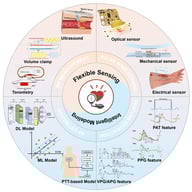
Accurate and continuous, non-invasive blood pressure (BP) monitoring plays a vital role in the long-term management of cardiovascular diseases. Advances in wearable and flexible sensing technologies have facilitated the transition of non-invasive BP monitoring from clinical settings to ambulatory home environments. However, the measurement consistency and algorithm adaptability of existing devices have not yet reached the level required for routine clinical practice. To address these limitations, comprehensive innovations have been made in material development, sensor design, and algorithm optimization. This review examines the evolution of non-invasive continuous BP measurement, highlighting cutting-edge advances in flexible electronic devices and BP estimation algorithms. First, we introduce measurement principles, sensing devices and limitations of traditional non-invasive BP measurement, including arterial tonometry, arterial volume clamp, and ultrasound-based methods. Subsequently, we review the pulse wave analysis-based BP estimation methods from two perspectives: flexible sensors based on optical, mechanical, and electrical principles, and estimation models that use physiological features or raw waveforms as input. Finally, we conclude the existing challenges and future development directions of flexible electronic technology and intelligent estimation algorithms for non-invasive continuous BP measurement.

7 November 2025

Overview of non-invasive continuous blood pressure measurement from sensing to modeling. PAT: pulse arrival time, PPG: photoplethysmogram, VPG: velocity PPG, APG: acceleration PPG, PTT: pulse transit time, ML: machine learning, SVM: support vector machines, DL: deep learning.

News & Conferences

Issues

Open for Submission

Editor's Choice

Get Alerted

Add your email address to receive forthcoming issues of this journal.

XFacebookLinkedIn
AI Sens. - ISSN 3042-5999